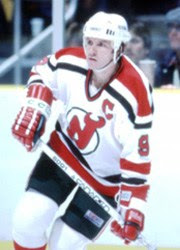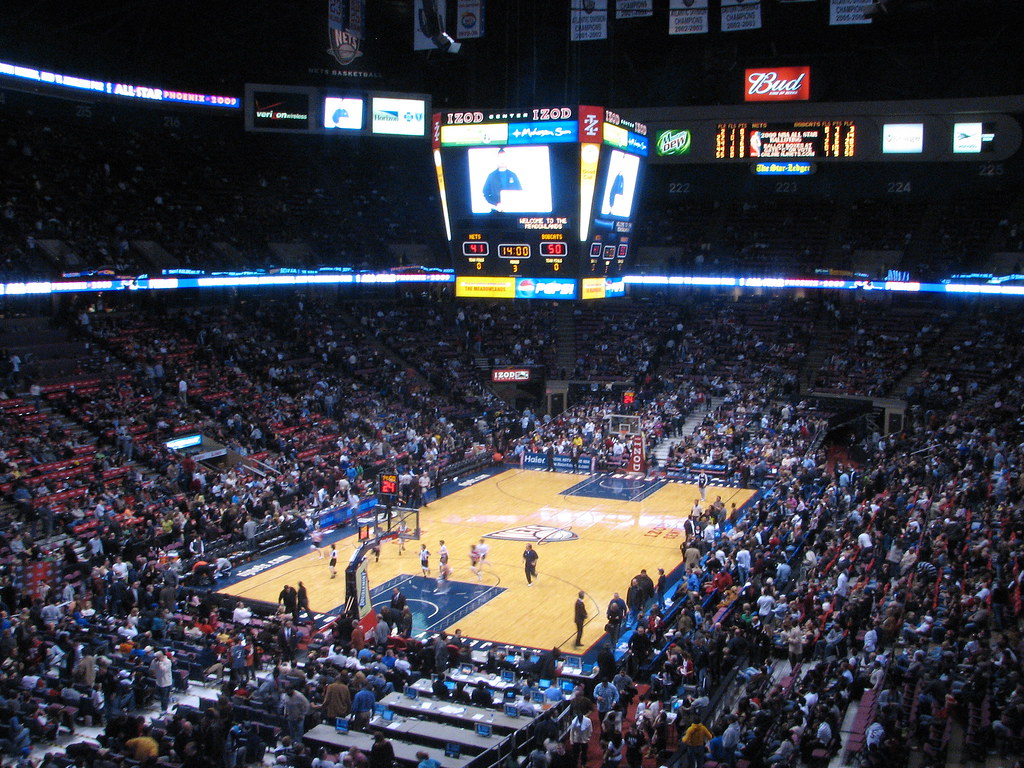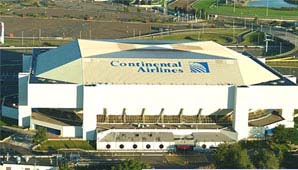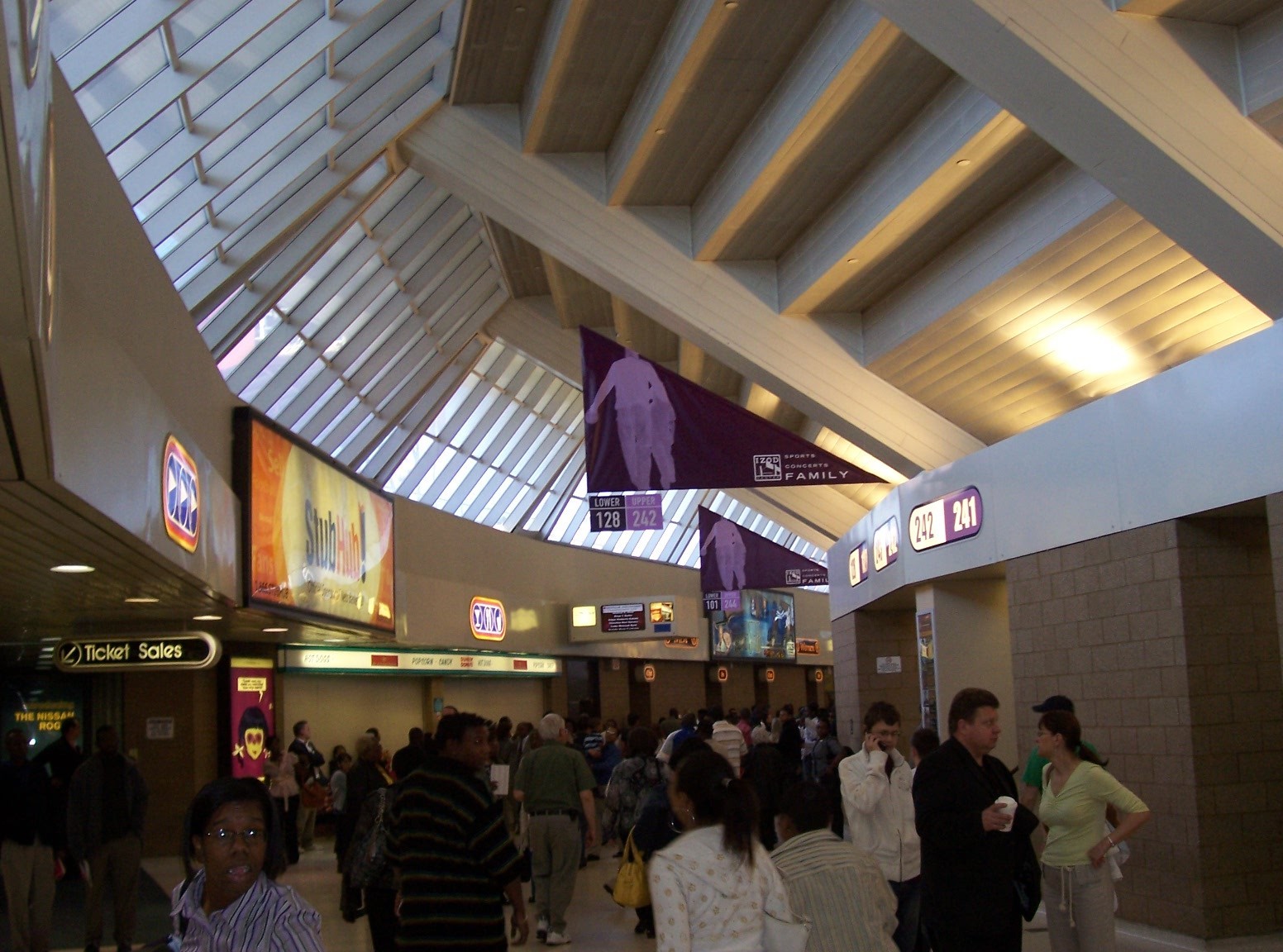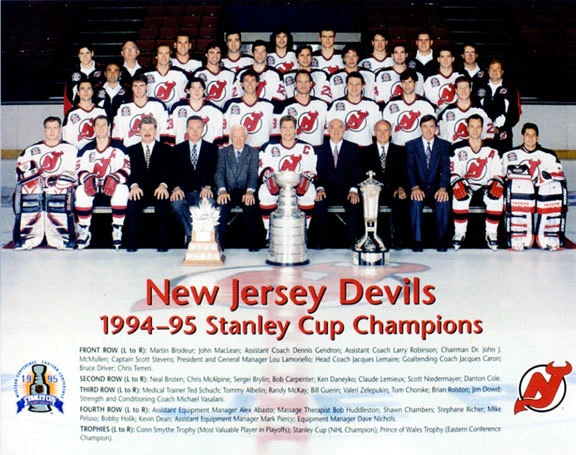
The National Hockey League approved the sale of the Colorado Rockies to an ownership group led by Dr. John McMullen, a naval engineer who was then also the owner of Major League Baseball's Houston Astros, on May 27, 1982. The NHL also approved the team's move from Denver to the Brendan Byrne Arena, in the Meadowlands Sports Complex, in East Rutherford, Bergen County, New Jersey. On June 30, the new name of the team was announced: The New Jersey Devils.
On October 5, 1982, they played their 1st regular-season game, home to the Pittsburgh Penguins, and it ended in a 3-3 tie. Three days later, they hosted the team that was geographically, but not yet emotionally, their rivals, the New York Rangers, and got their 1st win, 3-2.
Their early days were tough. They started their 2nd season 2-20. On November 19, 1983, they went to Edmonton to play the Oilers, who were on their way to their 1st Stanley Cup, and lost 13-4. Wayne Gretzky, now the best player in the sport, told the media after the game, "Well, it’s time they got their act together. They’re ruining the whole league. They had better stop running a Mickey Mouse organization, and put somebody on the ice."
It's hard to argue that he was wrong. Nevertheless, for those of us who were Devils fans from Day One, it pissed us off. From November 29 to December 17, we went on a pretty good run, going 5-3-2. On January 15, 1984, we had a rematch with the Oilers at the Meadowlands, and the place sold out. Many fans came wearing Mickey Mouse hats, the "ears" hats sold at Disney World. We lost, but this time, it was only 5-4. On January 27, we went back to Edmonton, and got a 3-3 tie.
It took until 1988 for the Devils to make the Playoffs for the 1st time -- not counting 1978 as the Rockies. We clinched in overtime of the last day of the regular season, then beat the crumbling New York Islander dynasty in the 1st round, then upset the Washington Capitals to make the Conference Finals, driving a superior Boston Bruin team to the full 7 games.
That series was highlighted -- or lowlighted, depending on how you look at it -- by a confrontation after Game 3. Devils head coach Jim Schoenfeld, formerly a take-no-shit defenseman for the Buffalo Sabres, had had it with referee Don Koharski, who seemed to give the Bruins every break. He yelled at Koharski in the tunnel, with fans able to see. Koharski fell, got up, and accused Schoenfeld of pushing him. Schoenfeld yelled back, "You fell, you fat pig! Have another doughnut! Have another doughnut!"
The Devils missed the Playoffs in 1989, but made it again in 1990, 1991, 1992 and 1993, failing to win a round each time. In 1992, they lost to the Rangers in 7 games in the 1st round. In 1994, they beat the Buffalo Sabres, and then the Bruins, and faced the Rangers in an epic series. It went the full 7, and Game 7 went to double overtime, before Stephane Matteau scored to put the Rangers into the Stanley Cup Finals.
It was the greatest hockey game I've ever seen -- and my team lost it, to the team I hate the most. In that sport, anyway.
*
A defeat like that can crush a team. Or it can show them just how close they are, and remind them that they do not want to feel like that again. The 1994-95 season was delayed due to a labor dispute, and when the regular season was over, the Devils were the 5th seed in the NHL Eastern Conference.
Head coach Jacques Lemaire and assistant coach Larry Robinson had both been elected to the Hockey Hall of Fame already, for their play with the 1970s Montreal Canadiens. Lemaire had won 8 Cups with them; Robinson, 6. They knew how to build a winner.

And general manager Lou Lamoriello was building one. In goal was Martin Brodeur, a Montreal native, whose father, Denis, had been Canada's goaltender at the 1956 Winter Olympics, and had long been the photographer for both the Canadiens and baseball's Montreal Exops. His backup was Chris Terreri, who had played at Providence College when Lamoriello was the head coach there.
/cdn.vox-cdn.com/uploads/chorus_image/image/48752389/usa-today-7869999.0.jpg)
The defense was led by Scott Stevens. Playing for the Capitals, Stevens had been one of the dirtiest players in the NHL. But he had matured, and figured out the difference between aggressive and dirty. The Devils acquired him in 1991, and he so impressed everyone that Bruce Driver willingly gave up the team captaincy the next season.

Driver had been with the Devils since the team's 2nd season, 1983-84. So had another defenseman, Ken Daneyko. So had right wing John MacLean, whose overtime goal in the last game in 1988 got the team its 1st Playoff berth.
In addition to Stevens, Driver and Daneyko, the defense included exciting young players Scott Niedermayer and Shawn Chambers, and a tough Swede -- yes, Don Cherry, they do exist -- named Tommy Albelin.
In addition to MacLean, the forwards included Neal Broten. At this point, Ken Morrow of the Islanders was the only member of the U.S. team that won the Gold Medal in the 1980 Winter Olympics to have won the Stanley Cup. Broten, whose brothers Aaron and Paul had also played for the Devils, was looking to become the 2nd.

There was also Bobby Carpenter, who made the cover of Sports Illustrated as a high school player in the Boston suburbs in 1981, a cover whose caption called him "THE CAN'T-MISS KID," and suggested that he might be the best American hockey player ever. He wasn't exactly hit with "The Dreaded SI Cover Jinx," as he did make an All-Star Game. But this was his 14th season in the NHL, and aside from the 1990 Finals with his hometown Bruins, he had never gotten close to the Stanley Cup.
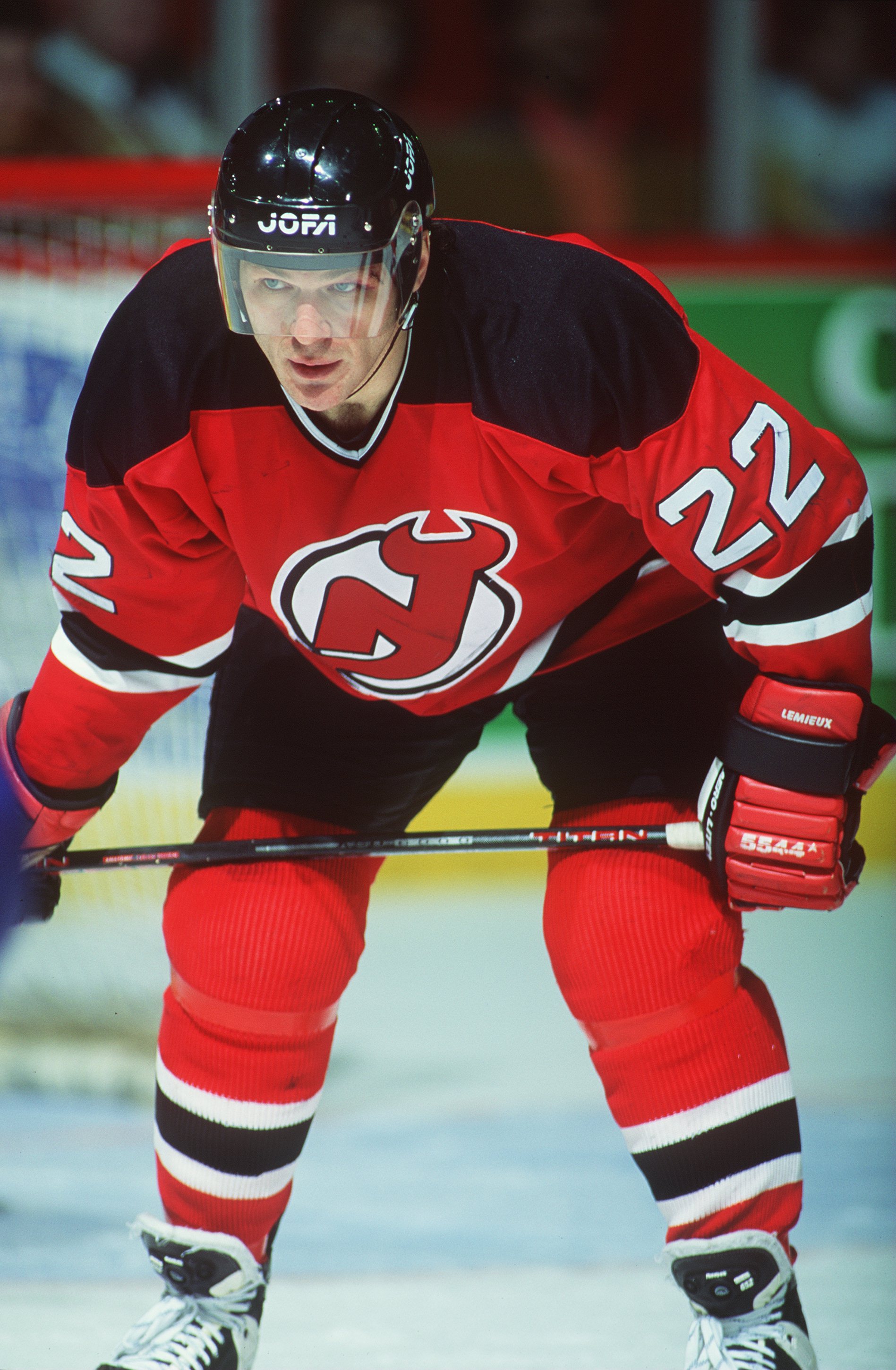
There were more connections to the Canadiens. Wingers Claude Lemieux and Stéphane Richer had played on the Habs' 1986 Stanley Cup winners, making them the only former Cup winners on the '95 Devils. Another winger, Tom Chorske, had also played in Montreal.
Claudie was a bit of a dirty player, but I loved him, for 3 reasons: He scored goals, he didn't take any shit, and he seemed to up his game against the 2 teams Devils fans hate the most: The New York Rangers (a.k.a. The Scum), and the Philadelphia Flyers (a.k.a. The Philth).
Wingers Mike Peluso and Bobby Holík, and center Randy McKay formed a forward line known as the Crash Line, the unit Lemaire sent out when he needed a little aggressiveness. Another winger was Bill Guerin, the 1st Hispanic player in NHL history, preceding future Devil Scott Gomez. And Jim Dowd, from the successful hockey program at Brick Township High School in Ocean County, was the 1st New Jersey native to play for the Devils.

On May 11, 1995, while the Devils were in the 1st round of the Playoffs, the NBC sitcom Seinfeld aired the episode "The Face Painter." Patrick Warburton played David Puddy, a mechanic who was dating Elaine Benes (Julia Louis-Dreyfus). Jerry Seinfeld (playing a fictional version of himself) had gotten tickets for Game 1 of a Playoff series with the Rangers at The Garden (suggesting that the episode took place the year before), and took Cosmo Kramer (Michael Richards) and Elaine, who took Puddy.
It turns out, Puddy is a Devils fan, from New Jersey, and not only is he wearing a Number 30 Martin Brodeur jersey, but he's painted his face in Devils colors, and he ends up making a spectacle of himself. In real life, Warburton was born in New Jersey, in Paterson, Passaic County, but grew up in the suburbs of Los Angeles.

During the episode, a broadcaster announces that a Devils goal has been scored by Richer. Richer also scored 2 goals, including the overtime winner, in my 1st live NHL game, a 5-4 Devils win over the Rangers at The Garden on December 23, 1992. This guy hated the Rangers so much, he even scored against them on sitcoms.

Speaking of sitcoms: In 1993, on an episode of Living Single, East Orange native Dana Owens, a.k.a. Queen Latifah, became the 1st person to wear a Devils jersey on a scripted TV show. Her character, Khadijah James, wore Number 1, and the name on the back was the name of the magazine she published and edited: "FLAVOR."
On October 5, 1982, they played their 1st regular-season game, home to the Pittsburgh Penguins, and it ended in a 3-3 tie. Three days later, they hosted the team that was geographically, but not yet emotionally, their rivals, the New York Rangers, and got their 1st win, 3-2.
Their early days were tough. They started their 2nd season 2-20. On November 19, 1983, they went to Edmonton to play the Oilers, who were on their way to their 1st Stanley Cup, and lost 13-4. Wayne Gretzky, now the best player in the sport, told the media after the game, "Well, it’s time they got their act together. They’re ruining the whole league. They had better stop running a Mickey Mouse organization, and put somebody on the ice."
It's hard to argue that he was wrong. Nevertheless, for those of us who were Devils fans from Day One, it pissed us off. From November 29 to December 17, we went on a pretty good run, going 5-3-2. On January 15, 1984, we had a rematch with the Oilers at the Meadowlands, and the place sold out. Many fans came wearing Mickey Mouse hats, the "ears" hats sold at Disney World. We lost, but this time, it was only 5-4. On January 27, we went back to Edmonton, and got a 3-3 tie.
It took until 1988 for the Devils to make the Playoffs for the 1st time -- not counting 1978 as the Rockies. We clinched in overtime of the last day of the regular season, then beat the crumbling New York Islander dynasty in the 1st round, then upset the Washington Capitals to make the Conference Finals, driving a superior Boston Bruin team to the full 7 games.
That series was highlighted -- or lowlighted, depending on how you look at it -- by a confrontation after Game 3. Devils head coach Jim Schoenfeld, formerly a take-no-shit defenseman for the Buffalo Sabres, had had it with referee Don Koharski, who seemed to give the Bruins every break. He yelled at Koharski in the tunnel, with fans able to see. Koharski fell, got up, and accused Schoenfeld of pushing him. Schoenfeld yelled back, "You fell, you fat pig! Have another doughnut! Have another doughnut!"
The Devils missed the Playoffs in 1989, but made it again in 1990, 1991, 1992 and 1993, failing to win a round each time. In 1992, they lost to the Rangers in 7 games in the 1st round. In 1994, they beat the Buffalo Sabres, and then the Bruins, and faced the Rangers in an epic series. It went the full 7, and Game 7 went to double overtime, before Stephane Matteau scored to put the Rangers into the Stanley Cup Finals.
It was the greatest hockey game I've ever seen -- and my team lost it, to the team I hate the most. In that sport, anyway.
*
A defeat like that can crush a team. Or it can show them just how close they are, and remind them that they do not want to feel like that again. The 1994-95 season was delayed due to a labor dispute, and when the regular season was over, the Devils were the 5th seed in the NHL Eastern Conference.
Head coach Jacques Lemaire and assistant coach Larry Robinson had both been elected to the Hockey Hall of Fame already, for their play with the 1970s Montreal Canadiens. Lemaire had won 8 Cups with them; Robinson, 6. They knew how to build a winner.

Jacques Lemaire
And general manager Lou Lamoriello was building one. In goal was Martin Brodeur, a Montreal native, whose father, Denis, had been Canada's goaltender at the 1956 Winter Olympics, and had long been the photographer for both the Canadiens and baseball's Montreal Exops. His backup was Chris Terreri, who had played at Providence College when Lamoriello was the head coach there.
Martin Brodeur
The defense was led by Scott Stevens. Playing for the Capitals, Stevens had been one of the dirtiest players in the NHL. But he had matured, and figured out the difference between aggressive and dirty. The Devils acquired him in 1991, and he so impressed everyone that Bruce Driver willingly gave up the team captaincy the next season.
"Guns don't kill people, Scott Stevens kills people"
Driver had been with the Devils since the team's 2nd season, 1983-84. So had another defenseman, Ken Daneyko. So had right wing John MacLean, whose overtime goal in the last game in 1988 got the team its 1st Playoff berth.
In addition to Stevens, Driver and Daneyko, the defense included exciting young players Scott Niedermayer and Shawn Chambers, and a tough Swede -- yes, Don Cherry, they do exist -- named Tommy Albelin.
In addition to MacLean, the forwards included Neal Broten. At this point, Ken Morrow of the Islanders was the only member of the U.S. team that won the Gold Medal in the 1980 Winter Olympics to have won the Stanley Cup. Broten, whose brothers Aaron and Paul had also played for the Devils, was looking to become the 2nd.
Neal Broten
There was also Bobby Carpenter, who made the cover of Sports Illustrated as a high school player in the Boston suburbs in 1981, a cover whose caption called him "THE CAN'T-MISS KID," and suggested that he might be the best American hockey player ever. He wasn't exactly hit with "The Dreaded SI Cover Jinx," as he did make an All-Star Game. But this was his 14th season in the NHL, and aside from the 1990 Finals with his hometown Bruins, he had never gotten close to the Stanley Cup.
There were more connections to the Canadiens. Wingers Claude Lemieux and Stéphane Richer had played on the Habs' 1986 Stanley Cup winners, making them the only former Cup winners on the '95 Devils. Another winger, Tom Chorske, had also played in Montreal.
Claudie was a bit of a dirty player, but I loved him, for 3 reasons: He scored goals, he didn't take any shit, and he seemed to up his game against the 2 teams Devils fans hate the most: The New York Rangers (a.k.a. The Scum), and the Philadelphia Flyers (a.k.a. The Philth).
"One, two, Claudie's coming for you.
Three, four, he'll knock you out and then he'll score."
Wingers Mike Peluso and Bobby Holík, and center Randy McKay formed a forward line known as the Crash Line, the unit Lemaire sent out when he needed a little aggressiveness. Another winger was Bill Guerin, the 1st Hispanic player in NHL history, preceding future Devil Scott Gomez. And Jim Dowd, from the successful hockey program at Brick Township High School in Ocean County, was the 1st New Jersey native to play for the Devils.

Jim Dowd
On May 11, 1995, while the Devils were in the 1st round of the Playoffs, the NBC sitcom Seinfeld aired the episode "The Face Painter." Patrick Warburton played David Puddy, a mechanic who was dating Elaine Benes (Julia Louis-Dreyfus). Jerry Seinfeld (playing a fictional version of himself) had gotten tickets for Game 1 of a Playoff series with the Rangers at The Garden (suggesting that the episode took place the year before), and took Cosmo Kramer (Michael Richards) and Elaine, who took Puddy.
It turns out, Puddy is a Devils fan, from New Jersey, and not only is he wearing a Number 30 Martin Brodeur jersey, but he's painted his face in Devils colors, and he ends up making a spectacle of himself. In real life, Warburton was born in New Jersey, in Paterson, Passaic County, but grew up in the suburbs of Los Angeles.

Patrick Warburton as David Puddy
During the episode, a broadcaster announces that a Devils goal has been scored by Richer. Richer also scored 2 goals, including the overtime winner, in my 1st live NHL game, a 5-4 Devils win over the Rangers at The Garden on December 23, 1992. This guy hated the Rangers so much, he even scored against them on sitcoms.

Stéphane Richer
Speaking of sitcoms: In 1993, on an episode of Living Single, East Orange native Dana Owens, a.k.a. Queen Latifah, became the 1st person to wear a Devils jersey on a scripted TV show. Her character, Khadijah James, wore Number 1, and the name on the back was the name of the magazine she published and edited: "FLAVOR."
Now, the Devils had to back up Puddy's claim: "Don't mess with the Devils, buddy! We're Number 1! We beat anybody! We're the Devils! The Devils! Haggggh!"
*
They faced the Bruins in the 1st round, and beat them in 5 games. The clincher, on May 14, 1995, was the last competitive sporting event at the Boston Garden, after 67 years as the home of the Bruins and 49 years as the home of the NBA's Boston Celtics, who had already been eliminated from their league's Playoffs.
 The Meadowlands had never been louder. That record will last just 48 hours.
*
June 24, 1995. It was a Saturday. The temperature stayed in the 70s in daylight, and dropped into the 50s that night. I did not yet have a Devils jersey, but I had a shirt with red and black stripes, which I had worn to my 1st live NHL game, because it was Devils colors. They won that night, so I'd worn it to every live game I'd been to since. It didn't always work. But it felt right to wear it on this night, even though it had long sleeves and it was the 1st week of Summer.
The Brendan Byrne Arena, as the Meadowlands arena was then known, had a hockey seating capacity of 19,040 -- convenient for mocking the Rangers, until they broke their "Curse of 1940." (For basketball, it was 20,089.) There was no way I was going to get inside: Getting to the arena was possible, but the scalpers would be charging prices far outside my price range.
So I set my VCR to record WNYW-Channel 5, the Fox station in New York, and decided to go to my original hometown, Bloomfield, in Essex County. With Route 3, which passes the Meadowlands Complex, being just to the north of town, this would put me reasonably close. I went to the Town Pub at 378 Broad Street, ordered dinner (this is one detail I don't remember), and, as the Fox broadcast began at 8:00, began ordering Red Dog beer (this, I do remember), because I'd gone to the Yankees' home opener 2 months earlier, and tried it then, and liked it.
Mike Emrick, the Devils' usual broadcaster, and former Rangers goalie John Davidson broadcast for Fox, but there was so much noise in the Town Pub that we couldn't hear them. As home teams did in the NHL at the time, the Devils took the ice wearing white jerseys at home, while the Wings did so in red. Just 1 minute and 8 seconds into the game, Broten scored. But only 55 game-seconds after that, Fedorov tied it up.
At 13:01 of the 1st period, Coffey scored a shorthanded goal to make it 2-1 Wings, and, for the 1st time since the final horn of Game 3, clinching on this night was in doubt. What we did not yet know was that the Devils' defense, led by Stevens, would be up to the task, and the Wings would not score another goal that counted for 104 days.
At 17:45, Shawn Chambers tied it back up, and the 1st period ended 2-2. After Fox came back from commercial, I heard the bar break out into boos, and I looked up to see Emrick and Davidson interviewing NHL Commissioner Gary Bettman. I joined in.
The next day, back at home, I ran the tape back, and listened to the interview. The crowd at the Meadowlands, seeing the interview on the arena scoreboard, and believing that Bettman favored the Devils' alleged proposed move to Nashville, chanted, "Bettman sucks!" Emrick asked him about this, and he said, "Never let it go unsaid that hockey fans are passionate!"
The key moment of the game came at 7:56 of the 2nd period. The Devils attacked, and the puck came to Broten. Lefthanded, he tried to shovel the puck past Vernon, who blocked it. He tried a 2nd time, but whiffed on the puck. He tried a 3rd time, and this time, as the instant replay showed, the puck sort of jumped over Vernon's left shoulder, and in.

It had been 15 years since the native of Roseau, Minnesota participated in the "Miracle On Ice." Now, he had scored what stood to be a Stanley Cup-winning goal.
The 2nd period ended with the score still 3-2 to the Devils. In the 3rd, Sergei Brylin hit a slap shot at 7:46 that seemed to clinch it. At 12:32, Chambers spun and hit a lefty shot that Vernon never saw. The Stanley Cup was in a room somewhere under the stands, and as we roared in that Bloomfield bar, we couldn't hear the goal horn, but Fox put a camera on the Cup.
New Jersey Devils 5, Detroit Red Wings 2. The emotions were flowing. Peluso, one of the tough guys of the era, his long stringy black hair making him look like a member of Mötley Crüe, looked even more so: He was crying over having achieved his dream. He wasn't the only Mike P. in North Jersey with tears of joy in his eyes that night: I did, too.

As the seconds ticked down, I made sure I looked at my watch so I would always know the exact time that it happened. It was 11:09 PM. Don't bet me. The clock ran out, and, as I learned the next day when I ran the tape back, Emrick said some of the most beautiful words I've ever heard, words I couldn't possibly have heard with all the noise in the bar at 11:09:
The championship to New Jersey! The Devils win the Stanley Cup!
The perfect words for the moment. As Trenton radio station WKXW, 101.5 FM, liked to say, "New Jersey 101.5. Not New York. Not Philadelphia. Proud to be New Jersey." I dearly love New York City. I love Philadelphia, too. I don't like their hockey teams, but I love the cities. But I was born and raised in New Jersey, and raised to love my home State.
Now, New Jersey was World Champions, and a team called the Devils had put me in Heaven. Indeed, the official NHL highlight film for the Finals would be titled Heaven.
A red carpet was laid out from the players' tunnel to center ice, and a table placed on it. The Conn Smythe Trophy, named for the old-time Maple Leafs head coach and general manager, and given to the Most Valuable Player of the Playoffs, was put on the table. Bettman came out, and got booed again. He announced that the Trophy had been awarded to Lemieux. There were a few good choices, but he was the definitive choice.
Then the Stanley Cup was brought out, by 2 employees of the Hockey Hall of Fame in Toronto, men wearing tuxedos and white gloves. They put it on the table as the fans went wild, always dreaming of seeing the Cup in their building. Now, it was here.
Bettman started talking again, and got booed again. He praised McMullen, Lamoriello, Lemaire, and the team in general. Then he turned to the Captain, and said, "Scott Stevens, this is for you!"
 The Commissioner always gives the Cup to the Captain. It is then up to the Captain to decide who gets it next. Stevens knew it should go to the 3 guys who had been there almost from the beginning: MacLean, then Driver, then Daneyko.
Given the role he would eventually occupy in hockey history, it might surprise younger fans to know that Brodeur didn't get it until halfway through. When it was his turn with the Cup, McKay nearly dropped it. (Following the 2nd win in 2000, Stevens gave it to McKay first, since he'd been going through a rough patch.) Lemaire got it last. He'd won 8 Cups as a Canadiens player. This made 9.
 I'm not old enough to remember the 1969 World Series -- I was born 2 months later -- but the Devils' '95 Cup win was similar: The team from the New York Tri-State Area had been laughed at for its first few years, then it made an unexpected run to the final, faced an absolutely loaded establishment team, and ended up toying with them, resulting in an unexpected, joyful win that was clinched at home.
But neither win was a "miracle": Both the '69 Mets and the '95 Devils outworked their opponents, and fully deserved it. One major difference: Lemaire was already in his sport's Hall of Fame. Gil Hodges, manager of the '69 Mets, still isn't in his. Also, Jacques chewed a lot more gum than Gil.
It was a long ride home. A bus from Bloomfield back to Penn Station in Newark. A train back to New Brunswick. It was too late to take a bus back to East Brunswick, but I had enough money for a taxi. I don't remember what time I got home. It didn't matter. I was brimming with joy.
There was no ticker-tape parade. The team just had a celebration in the parking lot, in front of the arena. That's another good thing about the team's 2007 move to the Prudential Center: If they ever do win another Cup, they can have a parade up Newark's Broad Street.
Did I say, "move"? Within a few days, it was announced that McMullen had no intention of selling the team, and Nashville had to wait until the 1998-99 season for the Predators to debut.
That red-and-black-striped shirt? I also wore it for the Devils' clinchers of the 2000 and 2003 Stanley Cups. And, while it's not Yankee colors, I thought, why not? I wore it for the Yankees' clinchers of the 1996, 1998, 1999, 2000 and 2009 World Series.
It hasn't always worked, though. It didn't work for the Devils in Game 6 or Game 7 of the 2001 Stanley Cup Finals. It worked in Game 6 of the 2012 Eastern Conference Finals, the Adam Henrique Game, but not Game 6 of the Stanley Cup Finals. It didn't work for the Yankees for Game 7 of the 2001 World Series, or Game 6 of the 2003 World Series, or Game 7 of the 2004 American League Championship Series. And, while it's (sort of) Rutgers colors as well, it's only worked for their football team about half the time.
I still have the shirt. It's got a few small holes in it, and it doesn't fit me anymore, since I'm considerably heavier than I was in 1995. (Even by the 2009 Yankee win, it was too small for me.) I've joked about raising it to the ceiling in my bedroom, like a retired uniform number. But I will never throw it away.

Because it's a reminder of the night that my little hockey team grew up. Expansion team no more. "Mickey Mouse organization"? Get outta here with that crap. The New Jersey Devils had won a title. And would win another. And another. (Still waiting for another, though.) But, as has been found out by...
* The 1916 Montreal Canadiens
* The 1918 Toronto Maple Leafs (then the Toronto Arenas)
* The 1928 New York Rangers
* The 1929 Boston Bruins
* The 1934 Chicago Blackhawks
* The 1936 Detroit Red Wings
* The 1974 Philadelphia Flyers
* The 1980 New York Islanders
* The 1984 Edmonton Oilers
* The 1989 Calgary Flames
* The 1991 Pittsburgh Penguins
* The 1996 Colorado Avalanche
* The 1999 Dallas Stars
* The 2004 Tampa Bay Lightning
* The 2006 Carolina Hurricanes
* The 2007 Anaheim Ducks
* The 2012 Los Angeles Kings
* The 2018 Washington Capitals
* The 2019 St. Louis Blues
There will never be another 1st one. And on this night, New Jersey fans found out. The Devils won the Stanley Cup.
 The Championship to New Jersey.
They faced the Bruins in the 1st round, and beat them in 5 games. The clincher, on May 14, 1995, was the last competitive sporting event at the Boston Garden, after 67 years as the home of the Bruins and 49 years as the home of the NBA's Boston Celtics, who had already been eliminated from their league's Playoffs.
In the next round, the Pittsburgh Penguins were the opponents. Mario Lemieux was sitting the season out due to injury, but Jaromir Jagr was at his peak. The Devils didn't care. Claude Lemieux, no relation to Mario, had only scored 6 goals in the shortened regular season, but was the biggest reason the Devils won this series, also in 5 games. Game 4, at the Meadowlands, was won with Broten scoring in the 3rd period to tie it and in overtime to win it.
Then came the Conference Finals. The Devils had gotten that far in 1988 and 1994, but faltered both times. This time, it was against another geographic rival, the Philadelphia Flyers, who had eliminated the defending champion Rangers in the preceding round.
The teams split the 1st 2 games, with the road team winning each time. Game 5 at The Spectrum in Philadelphia, on June 11, 1995, may be the key game in the history of the Devils' franchise. It was 2-2 with 44 seconds left in regulation. Claude Lemieux struck again, firing a wobbly shot from the blue line, about 65 feet. Flyer goaltender Ron Hextall never saw it.
The Spectrum may never have been so quiet. I was not. I saw that goal at the Ruby Tuesday restaurant at the Brunswick Square Mall in my hometown of East Brunswick, Middlesex County, New Jersey. When that puck went in the net, I jumped and yelled. And nobody told me to be quiet. It was then that I knew that the Devils had finally taken Central Jersey away from the Rangers. The 1994 Cup win by the Broadway Blueshirts -- or Broadway Boozehounds -- no longer mattered. South Jersey may still have been Flyer country, but from the New York State Line to Interstate 195, New Jersey now belonged to the Devils.
The Devils held on to win, 3-2, and clinched their 1st Conference title at the Meadowlands 2 days later, on June 13.
The Devils had now won 8 Playoff games on the road: In Games 1, 2 and 5 in Boston; Games 2 and 5 in Pittsburgh; and Games 1, 2 and 5 in Philadelphia. This was stunning, but it suggested they had a chance in their 1st-ever Stanley Cup Finals.
*
But it would be against the Detroit Red Wings. This team was loaded. It had the best regular-season record. It had future Hall-of-Famers: Steve Yzerman, Paul Coffey, Viacheslav Fetisov (who had been a Devil from 1989 until earlier that season), Nicklas Lidstrom, Dino Ciccarelli, Mark Howe, Sergei Fedorov.
And some players who perhaps should be in the Hall: Keith Primeau, Vyacheslav Kozlov, Vladimir Konstantinov, Darren McCarty, Kris Draper, Mike Vernon, and another 1980 Gold Medal winner, Mike Ramsey. And a couple of tough guys: Mike "Krusher" Krushelnyski and Stu "the Grim Reaper" Grimson.
Fetisov, Fedorov, Kozlov and Konstantinov would be joined the next year by Igor Larionov, forming "The Russian Five." Larionov would later help the Devils win a Cup, and is also in the Hall of Fame. He wasn't there yet in 1995, but it didn't make a difference: The Wings were good, fast, and tough.
June 17, 1995: Game 1 of the Stanley Cup Finals is held at the Joe Louis Arena in Detroit. The Red Wings are in the Finals for the 1st time in 29 years, and looking for their 1st Cup in 40 years. The Devils are in their 1st Finals. Something's got to give.
When the Devils players are introduced, each one, it seemed to me on TV, was greeted not with actual boos and hisses, but a shout of "Boo, hiss!" Even though this was my team, I thought it was brilliant. It was years before I found out that the actual shout was, "Who cares?" That was disappointing.
But the noise in "The Joe," combined with all the hype the Wings had rightly gotten, for being one of the most talent-laden teams ever, and their 8-0 record at home in these Playoffs, had me wondering if the Devils were even going to win a game.
In the Fox TV booth, Dave Maloney, a former New York Ranger captain, said, "I like the Wings in 7." Given what we were up against, I would have gladly taken that.
A funny thing happened on the way to defeat: Richer and Ciccarelli traded power-play goals in the 2nd period, and then, early in the 3rd, Lemieux continued one of the hottest postseason streaks ever. Devils 3, Red Wings 2. It was the Devils' 9th road win of the Playoffs, their 1st Stanley Cup Finals win ever, and the theft of the home-ice advantage for the series. Three wins to go.
June 20, 1995: Game 2. A goal from Dowd with 1:24 left in regulation, plus an empty-netter, gave the Devils a 4-2 win. It was their 10th road win of the Playoffs, a new record.
Nobody can believe it. New Jersey fans are shocked. Detroit fans are shocked. Fans of the NHL's other 24 teams are shocked. Two wins to go.
And yet, while all this was going on, there was a rumor that the Devils would be sold and moved to Nashville, where what's now known as the Bridgestone Arena was going up. This would be one hell of a betrayal by the NHL. Sure, in the movie Slap Shot, the Charlestown Chiefs were being moved just as they were threatening to win their minor league's championship, but that was the movies. This was real life.
Would we really lose our team at the moment of greatest glory? In all of major league sports history in North America, that had (and still has) happened only once: Despite winning the 1945 NFL Championship while playing in a great football city, the Cleveland Rams hadn't been drawing well -- soldiers not yet being fully demobilized from World War II had something to do with it -- and moved to Los Angeles for the 1946 season.
But, for now, the Meadowlands was still home, and the Meadowlands Marauders were coming home, up two games to none. (I made up the name "Meadowlands Marauders." Nobody else ever called the Devils that. I now call them the Mulberry Street Marauders, since the Prudential Center is on Mulberry Street in downtown Newark. I even have a Facebook page with that name.)
June 22, 1995: Game 3. Because of the lockout that delayed and shortened the season, this was the 1st NHL game played after the Summer Solstice. It was also the 1st Finals game in any sport played at the Brendan Byrne Arena. (The Devils would also reach the Finals there in 2000 and 2001, the Nets in 2002, and both teams in 2003.)
One of the things that amazed me was how many fans came to the Arena wearing the former jerseys, the red and green ones, that had been switched to scarlet and black for the 1992-93 season. It was as if they were sending the message: "We remember what it was like to be so bad, which is why it now feels so good to be so good."
Nobody expected the Devils to beat the Detroit Red Wings 2 straight in Detroit, but they did. So, by this point, nobody is surprised when the Devils take a 5-0 lead, on goals by Driver, Lemieux (his 13th goal of the Playoffs, after scoring only 6 in the regular season), Broten, McKay and Holík. The Wings scored 2 late goals, but it didn't matter. The Devils win 5-2. One win to go.
If they could do it, it would be the 1st World Championship for a New Jersey team. Sure, the New York Giants had won Super Bowl XXI in 1987, and Super Bowl XXV in 1991, while playing in Giants Stadium in the Meadowlands Sports Complex. But they still officially kept "New York" as their name. This, if it could be finished, would be a World Championship for New Jersey. The Devils would be New Jersey's Champions.

*
June 24, 1995. It was a Saturday. The temperature stayed in the 70s in daylight, and dropped into the 50s that night. I did not yet have a Devils jersey, but I had a shirt with red and black stripes, which I had worn to my 1st live NHL game, because it was Devils colors. They won that night, so I'd worn it to every live game I'd been to since. It didn't always work. But it felt right to wear it on this night, even though it had long sleeves and it was the 1st week of Summer.
The Brendan Byrne Arena, as the Meadowlands arena was then known, had a hockey seating capacity of 19,040 -- convenient for mocking the Rangers, until they broke their "Curse of 1940." (For basketball, it was 20,089.) There was no way I was going to get inside: Getting to the arena was possible, but the scalpers would be charging prices far outside my price range.
So I set my VCR to record WNYW-Channel 5, the Fox station in New York, and decided to go to my original hometown, Bloomfield, in Essex County. With Route 3, which passes the Meadowlands Complex, being just to the north of town, this would put me reasonably close. I went to the Town Pub at 378 Broad Street, ordered dinner (this is one detail I don't remember), and, as the Fox broadcast began at 8:00, began ordering Red Dog beer (this, I do remember), because I'd gone to the Yankees' home opener 2 months earlier, and tried it then, and liked it.
Mike Emrick, the Devils' usual broadcaster, and former Rangers goalie John Davidson broadcast for Fox, but there was so much noise in the Town Pub that we couldn't hear them. As home teams did in the NHL at the time, the Devils took the ice wearing white jerseys at home, while the Wings did so in red. Just 1 minute and 8 seconds into the game, Broten scored. But only 55 game-seconds after that, Fedorov tied it up.
At 13:01 of the 1st period, Coffey scored a shorthanded goal to make it 2-1 Wings, and, for the 1st time since the final horn of Game 3, clinching on this night was in doubt. What we did not yet know was that the Devils' defense, led by Stevens, would be up to the task, and the Wings would not score another goal that counted for 104 days.
At 17:45, Shawn Chambers tied it back up, and the 1st period ended 2-2. After Fox came back from commercial, I heard the bar break out into boos, and I looked up to see Emrick and Davidson interviewing NHL Commissioner Gary Bettman. I joined in.
The next day, back at home, I ran the tape back, and listened to the interview. The crowd at the Meadowlands, seeing the interview on the arena scoreboard, and believing that Bettman favored the Devils' alleged proposed move to Nashville, chanted, "Bettman sucks!" Emrick asked him about this, and he said, "Never let it go unsaid that hockey fans are passionate!"
The key moment of the game came at 7:56 of the 2nd period. The Devils attacked, and the puck came to Broten. Lefthanded, he tried to shovel the puck past Vernon, who blocked it. He tried a 2nd time, but whiffed on the puck. He tried a 3rd time, and this time, as the instant replay showed, the puck sort of jumped over Vernon's left shoulder, and in.
The best still photo I could find of the goal
It had been 15 years since the native of Roseau, Minnesota participated in the "Miracle On Ice." Now, he had scored what stood to be a Stanley Cup-winning goal.
The 2nd period ended with the score still 3-2 to the Devils. In the 3rd, Sergei Brylin hit a slap shot at 7:46 that seemed to clinch it. At 12:32, Chambers spun and hit a lefty shot that Vernon never saw. The Stanley Cup was in a room somewhere under the stands, and as we roared in that Bloomfield bar, we couldn't hear the goal horn, but Fox put a camera on the Cup.
New Jersey Devils 5, Detroit Red Wings 2. The emotions were flowing. Peluso, one of the tough guys of the era, his long stringy black hair making him look like a member of Mötley Crüe, looked even more so: He was crying over having achieved his dream. He wasn't the only Mike P. in North Jersey with tears of joy in his eyes that night: I did, too.
Mike Peluso, around 11:00 PM, June 24, 1995
As the seconds ticked down, I made sure I looked at my watch so I would always know the exact time that it happened. It was 11:09 PM. Don't bet me. The clock ran out, and, as I learned the next day when I ran the tape back, Emrick said some of the most beautiful words I've ever heard, words I couldn't possibly have heard with all the noise in the bar at 11:09:
The championship to New Jersey! The Devils win the Stanley Cup!
The perfect words for the moment. As Trenton radio station WKXW, 101.5 FM, liked to say, "New Jersey 101.5. Not New York. Not Philadelphia. Proud to be New Jersey." I dearly love New York City. I love Philadelphia, too. I don't like their hockey teams, but I love the cities. But I was born and raised in New Jersey, and raised to love my home State.
Now, New Jersey was World Champions, and a team called the Devils had put me in Heaven. Indeed, the official NHL highlight film for the Finals would be titled Heaven.
A red carpet was laid out from the players' tunnel to center ice, and a table placed on it. The Conn Smythe Trophy, named for the old-time Maple Leafs head coach and general manager, and given to the Most Valuable Player of the Playoffs, was put on the table. Bettman came out, and got booed again. He announced that the Trophy had been awarded to Lemieux. There were a few good choices, but he was the definitive choice.
Then the Stanley Cup was brought out, by 2 employees of the Hockey Hall of Fame in Toronto, men wearing tuxedos and white gloves. They put it on the table as the fans went wild, always dreaming of seeing the Cup in their building. Now, it was here.
Bettman started talking again, and got booed again. He praised McMullen, Lamoriello, Lemaire, and the team in general. Then he turned to the Captain, and said, "Scott Stevens, this is for you!"
Given the role he would eventually occupy in hockey history, it might surprise younger fans to know that Brodeur didn't get it until halfway through. When it was his turn with the Cup, McKay nearly dropped it. (Following the 2nd win in 2000, Stevens gave it to McKay first, since he'd been going through a rough patch.) Lemaire got it last. He'd won 8 Cups as a Canadiens player. This made 9.
But neither win was a "miracle": Both the '69 Mets and the '95 Devils outworked their opponents, and fully deserved it. One major difference: Lemaire was already in his sport's Hall of Fame. Gil Hodges, manager of the '69 Mets, still isn't in his. Also, Jacques chewed a lot more gum than Gil.
It was a long ride home. A bus from Bloomfield back to Penn Station in Newark. A train back to New Brunswick. It was too late to take a bus back to East Brunswick, but I had enough money for a taxi. I don't remember what time I got home. It didn't matter. I was brimming with joy.
There was no ticker-tape parade. The team just had a celebration in the parking lot, in front of the arena. That's another good thing about the team's 2007 move to the Prudential Center: If they ever do win another Cup, they can have a parade up Newark's Broad Street.
Did I say, "move"? Within a few days, it was announced that McMullen had no intention of selling the team, and Nashville had to wait until the 1998-99 season for the Predators to debut.
That red-and-black-striped shirt? I also wore it for the Devils' clinchers of the 2000 and 2003 Stanley Cups. And, while it's not Yankee colors, I thought, why not? I wore it for the Yankees' clinchers of the 1996, 1998, 1999, 2000 and 2009 World Series.
It hasn't always worked, though. It didn't work for the Devils in Game 6 or Game 7 of the 2001 Stanley Cup Finals. It worked in Game 6 of the 2012 Eastern Conference Finals, the Adam Henrique Game, but not Game 6 of the Stanley Cup Finals. It didn't work for the Yankees for Game 7 of the 2001 World Series, or Game 6 of the 2003 World Series, or Game 7 of the 2004 American League Championship Series. And, while it's (sort of) Rutgers colors as well, it's only worked for their football team about half the time.
I still have the shirt. It's got a few small holes in it, and it doesn't fit me anymore, since I'm considerably heavier than I was in 1995. (Even by the 2009 Yankee win, it was too small for me.) I've joked about raising it to the ceiling in my bedroom, like a retired uniform number. But I will never throw it away.

The Shirt, and the Jersey that replaced it
Because it's a reminder of the night that my little hockey team grew up. Expansion team no more. "Mickey Mouse organization"? Get outta here with that crap. The New Jersey Devils had won a title. And would win another. And another. (Still waiting for another, though.)

* The 1916 Montreal Canadiens
* The 1918 Toronto Maple Leafs (then the Toronto Arenas)
* The 1928 New York Rangers
* The 1929 Boston Bruins
* The 1934 Chicago Blackhawks
* The 1936 Detroit Red Wings
* The 1974 Philadelphia Flyers
* The 1980 New York Islanders
* The 1984 Edmonton Oilers
* The 1989 Calgary Flames
* The 1991 Pittsburgh Penguins
* The 1996 Colorado Avalanche
* The 1999 Dallas Stars
* The 2004 Tampa Bay Lightning
* The 2006 Carolina Hurricanes
* The 2007 Anaheim Ducks
* The 2012 Los Angeles Kings
* The 2018 Washington Capitals
* The 2019 St. Louis Blues
* The 2023 Vegas Golden Knights and
* The 2024 Florida Panthers...
There will never be another 1st one. And on this night, New Jersey fans found out. The Devils won the Stanley Cup.