Showing posts with label bill nicholson. Show all posts

Friday, February 9, 2018

Arsenal vs. Tottenham: The Defining Moments, Part III: 1971-1987

May 3, 1971: Arsenal and Tottenham play each other on a Monday, the final League game of the season. Originally, the game was supposed to be on March 27, but Arsenal had advanced to the FA Cup Semifinal, which was scheduled for that day, and so the Derby was moved back.

Tottenham, already having had nearly a complete turnover from their 1961 Double side and even largely from their 1967 FA Cup winners, were locked into 3rd place, and had already won the League Cup that season, certainly a good year by almost anyone's standards.

For Arsenal, who had to be exhausted after playing a strong Stoke City team (featuring 1966 World Cup teamers Gordon Banks in goal and former Arsenal forward George Eastham) just 2 days earlier, it was like this: A win would allow them to win the League over Leeds by one single solitary point. A scoreless draw, 0-0, and they would be level with Leeds on points, and win the title on goal difference. A loss, and they would lose the title by 1 point. A draw of 1-1 or higher, and they would be level with Leeds on points, and lose the title on goal difference. A boring nothing-nothing tie (or "nil-nil draw," as they would say in England) would be wonderful; a 1-1 draw would be "Second place is the first loser" misery.

The match was played at White Hart Lane, and it may have been the biggest crowd that ever attempted to see a League game in England's history. The official attendance was 51,992, pretty much as many as could squeeze into The Lane in those days, but it's been said that another 50,000 or so were outside the ground, wanting to get in but unable to do so.
White Hart Lane, 1970

The largest crowd ever to be inside a club's ground was the 84,569 crammed into Maine Road, home of Manchester City, to see Man City face Stoke City in an FA Cup Quarterfinal in 1934. A year later, the largest League crowd filed into Stamford Bridge as Arsenal visited Chelsea, 82,905. Because of the work at the Lane site, Tottenham had to play their 2016-17 Champions League matches at the new Wembley Stadium, and got 85,512 against Germany's Bayer Leverkusen on November 2, 2016.

The largest crowd ever at an English match was probably for the game that opened the old Wembley Stadium, the 1923 FA Cup Final. Officially, it was 126,047, but legend puts it at over 300,000. No fire laws in those days.

Back to May 3, 1971: As early as 6:00 AM -- pretty much all games started at 3:00 PM in those days -- fans were lining up to get in. And the vast majority of those outside the ground were Arsenal fans, known as Gooners in relation to the club nickname of Gunners. Inside, of course, the majority were Spurs fans, or Lilywhites for the team's white shirts, but ridiculed as "Spuds" by Gooners.

A 0-0 score, which Arsenal would gladly have taken, held for 87 minutes. The fans were going mental. Arsenal were about to win the League. And then... George Armstrong, whose normal post was on the right wing, was on the left wing for this sequence, and he sent a left-footed cross into the six-yard box. Ray Kennedy, still 3 months away from his 20th birthday and closing his 1st full season of professional football, jumped, and headed the ball into the net. It was his 19th goal of the season, leading a very balanced team.
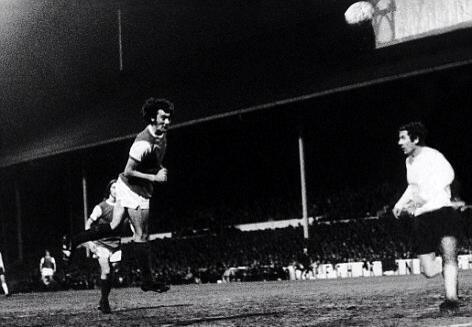
Ray Kennedy's goal

It was, as the song would later say, "One-nil to The Arsenal." But shortly after the Arsenal fans stopped roaring, a sinking feeling crept in: A 1-0 lead meant that a Tottenham equaliser would give Leeds the title. Hang on, Arsenal, hang on...

They did. And when the referee blew for full-time, the fans poured onto the pitch, however many Tottenham fans there were trying desperately to get out of the way. Although 27 fans were arrested that day, for trying to bring weapons into the stadium or for fighting, no serious injuries were reported.

But Arsenal manager Bertie Mee was nearly hurt. Club director Ken Friar -- now 83 years old and an employee of the club, in one capacity or another, for 71 years -- remembers being in the dressing room with the celebrating players, and a stadium steward said, "Mr. Mee, they'd like you to come out onto the pitch." Friar, knowing that the wildly celebrating fans were still out there, warned him, "Bertie, I've just come from there. I wouldn't go near it." Mee told Friar, 16 years his junior, "Young man, there is a time in one's career when one thinks of others."

Twenty minutes later, Mee returned, his jacket gone, his watch gone, his cufflinks gone, his shirt torn, and, in a rare moment of profanity for him, yelling back at Friar, "They're fucking mad!"

Arsenal had won the League at White Hart Lane. They had won the League at the home ground of their arch-rivals. To this day, they are the only English club that's ever done that. Going into the 2017-18 season, Manchester United have won the League 20 times, but never away to Manchester City -- or Liverpool. Liverpool have won the League 18 times, but never away to Everton -- or Man United.

May 8, 1971: Five days later -- certainly not the full 3 weeks that Tottenham got to prepare for their Final in 1961 -- Arsenal had the chance to get the other half of The Double. After a scoreless regulation, Liverpool got a goal from Steve Heighway, but Arsenal answered right back from a goal that appeared to be from George Graham. A replay later showed that it was Eddie Kelly who was the last Gunner to touch it. Substitutions had only been allowed since 1966-67, and Kelly thus became the 1st sub ever to score in an FA Cup Final.
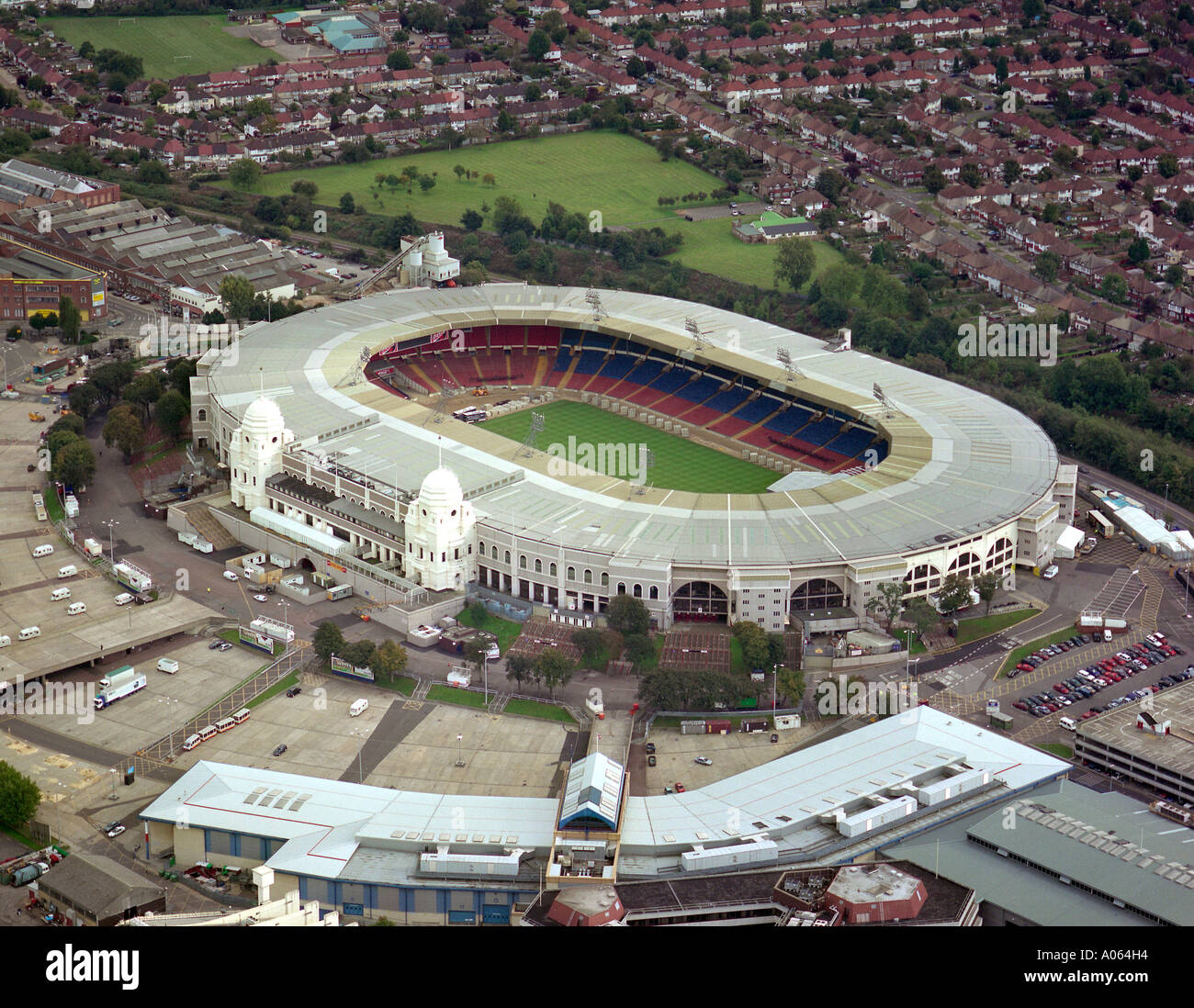
The old Wembley Stadium, 1923-2000,
with its Twin Towers

A few minutes later, with his long hair flowing, Charlie George, who had grown up a short walk from Highbury, took a pass from John Radford, stood on the 18-yard line, and sent a net-seeking missile past Liverpool's goalkeeper Ray Clemence -- like him, just 20 years old -- and Arsenal had a 2-1 lead that held up. George's drop to the ground, lying on the Wembley grass with his arms up, became one of those iconic FA Cup Final moments.
Charlie George on the floor

Tottenham had seen Arsenal win 7 League titles and 3 FA Cups, but Tottenham could still claim to be the only English club to have won The Double in the 20th Century. No more: Arsenal had done The Double, and had won the League at Tottenham to do it. It was the ultimate indignity for Spurs.

And this is the true defining moment in the rivalry. This is where the true bitterness of Tottenham fans began. If they could no longer claim to be Britain's best team, or England's best team, or the best team in the South of England, or London's best team, or even North London's best team, or the only team in the century to do The Double, then, what could they say?

* They whined (or "whinged") about "being true to their roots." Spurs had been playing at the same location since 1899 and the same neighborhood (or "neighbourhood," as it would be "spelt" in England) since 1882. In contrast, Arsenal had abandoned their roots in 1913, and crossed from South London to North London, which was always Tottenham's territory.

(No, it wasn't: Arsenal crossed from Kent to the Islington section of North London, which was 4 1/2 miles from White Hart Lane, which was then in Middlesex -- not in London. North London was never Tottenham's territory.)

* In connection with the preceding, they began to mock Arsenal as "Woolwich Arsenal." Which may have helped, as Arsenal won nothing under the Woolwich name. (They played in adjoining Plumstead, actually.) There was the occasional minor trophy that no one cared about by the time Herbert Chapman came along, but Arsenal's highest League finish in the Woolwich/Plumstead years was 6th in 1909. (Never mind that Tottenham never finished as high as 6th in Division One until 1921.) And Woolwich Arsenal's longest run in the FA Cup was to the Semifinals in 1906 and 1907. (Tottenham had won that, in 1901.)

Spurs fans began telling Gooners, "Fuck off back to Woolwich" and "North London is ours." The former was ridiculous, as, by 1971, Arsenal had been in Islington for 58 years. The latter had just become insane.

* They again brought up the lie that Arsenal had bribed their way into Division One in 1919, ignoring that there was evidence that Spurs had bribed their way into the League in 1908.

The thing is, Tottenham were a very good team in the early Seventies. They won the League Cup in 1971 and '73. They reached the UEFA Cup Final in 1972 (winning it over English club Wolverhampton Wanderers, a.k.a. Wolves) and '74 (losing to Netherlands club Feyenoord).

And Arsenal's record during Bertie Mee's stewardship wasn't great: 1 League title in 1971, 1 2nd place finish in 1973, 1 Fairs (UEFA) Cup win in '70, 1 FA Cup win in 1971, 1 FA Cup Final defeat in 1972, 1 trip to the European Cup Quarterfinals in 1972 (losing to Johan Cruyff's superb Ajax Amsterdam), and 2 League Cup Final defeats in 1968 and '69.

In this same period, both Manchester clubs (City and United), both Liverpool clubs (Liverpool and Everton), and Leeds had records that were similar to, or better than, those of the North London clubs.

But as far as the North London clubs were concerned, Arsenal had won the League, the FA Cup, and The Double more recently than had Tottenham. And that burned the Spuds up. Big-time.
Highbury, as viewed from the Clock End,
probably in the 1970s

This was also the early days of regular football hooliganism. It had always been there, but the modern age of it has been said to have begun when Man United clinched the League title away to West Ham on May 6, 1967, at which point the United fans tore up London's East End. During the 1970s, pretty much every English club had a hooligan "firm." Some became legendary for their mischief, including, in London, the Chelsea Headhunters, West Ham's ICF (Inter-City Firm) and Millwall's Bushwhackers.

Supposedly, Tottenham had once been a Jewish neighborhood. So other clubs mocked Spurs fans with anti-Semitic slurs -- most often "Yid" or "Yiddo." (These are words that should never be used in America, and I use them here only for the purpose of explanation.) Spurs fans decided to turn the slurs around, and have often chanted "YIDS!" "YIDDOS!" or "YID ARMY!" And their firm became known as the Yid Army. For a reason probably lost to time, Arsenal's firm became known as The Herd.

In truth, the Y-- Army were full of shit. Many is the Arsenal, West Ham and Millwall fan who has claimed that, like the Chelsea Headhunters, the Spurs firm didn't fight well, and preferred to run than to stand their ground and fight as best they could. Or, worst of all, would plow into a pub a mile or so from the away ground, knock over a few chairs, break some glassware, wreck the decor, scare a few old men, women and children, walk out, head off to the game, and then later "claim a result."

(I recently had this confirmed by an ex-Londoner living in Boston, who told me he's been an Arsenal fan since 1966. Anyone who became an Arsenal fan at the time, and didn't quickly switch to a then more exciting club, is a true fan.)

To this day, some Tottenham fans point with pride to the Y-- Army. Some army: Iraq has a better one.

But as the Seventies wore on, and as the Eighties began, and hooligan violence got worse, so too did the verbal response. Fans would come into White Hart Lane and invoke the worst nightmare of the Jews, the Nazi Holocaust. Particularly Chelsea fans, with their links to the far-right National Front, would chant "Auschwitz!" and make hissing noises, simulating poison gas. West Ham fans were known to come into The Lane waving Palestinian flags, and would "bow toward Mecca" -- not that most of them would have accepted Muslims among their numbers at the time. (I'm also guessing that most couldn't find Mecca, or even Saudi Arabia, on a map.)

Many English fans look back on the 1970s and 1980s as the glory days of the game. But with hooligan violence, aging stadiums with appalling structural deficiencies and atrocious restrooms (unlike the U.S., the U.K. had no stadium building boom between 1953 and 1973), hopelessly backward TV coverage (even as late as 1989, there were almost no League games on live TV, instead they were mainly shown on tape delay), and some ridiculous fashions and hairstyles (on and off the pitch), it was not a very good time. Even if your team was winning.

And, after 1974, for the most part, neither North London club was winning.

May 31, 1972: Just under 20 years after Tottenham had first done so, The Arsenal play their 1st game on North American soil. They play the Miami Gatos of the original North American Soccer League at the Orange Bowl, and win 3-2. They will return to this side of the Atlantic in 1973, and play in Toronto and Bermuda.
December 9, 1972: This match at White Hart Lane was not a particularly historic game, but if you buy the DVD Arsenal: Classic Victories Over Spurs, this is the 1st game on it, chronologically. But usual Captain Frank McLintock does not play in this game; the far less talented Jeff Blockley wears the Number 5 shirt. Nor is the iconic Charlie George in it, as Eddie Kelly wears Number 11. And another major member of the 1971 Double side is gone, as the acquisition of 1966 World Cup hero and 1970 Everton title-winner Alan Ball meant that George Graham vacated the Number 8 shirt in 1972. Tottenham also have a '66 World Cup winner in their side, former West Ham star Martin Peters.

Tottenham (correctly) have an early goal disallowed for offside, and the 1st half ends scoreless. In the 2nd half, the dangerous Martin Chivers just barely misses opening the scoring, sending a sizzling shot just wide of the goalpost to his left, which Bob Wilson could not deflect for Arsenal. Shortly thereafter, there is a scramble in front of the Spurs net, and Peter Storey heads in the 1st Arsenal goal.

A defensive mixup -- Spurs thought Radford was going to pass to Storey, who was offside -- leads to a very alert Radford seeing what was happening, and, instead keeping the ball, dribbling past the confused defenders, approaching goalkeeper Pat Jennings, and sending the ball past him for a 2-0 Arsenal lead. Peters scores a late goal to cut it to 2-1, but that is as close as Spurs get.

April 14, 1973: The preceding match's return fixture is played at Highbury, and it's a 1-1 draw. This ends up hurting Arsenal: They finished 2nd in the 1972-73 season, falling 3 points short of Liverpool, despite a February win at Anfield. A March loss at home to defending Champions Derby, this draw, and draws in the next 2 games against Everton and Southampton deny them the title, in a season that concluded with a 6-1 drubbing by Leeds at Elland Road. Tottenham finished 8th, but won the League Cup.

After this season, Mee began to break up the Double side, which had disappointed its fans nearly as much as the 1960s Spurs side had ultimately disappointed its fans. Arsenal soon became weak, even irrelevant. But Spurs fans would not be able to enjoy it much, as their own squad would suffer.

May 29, 1974: Having drawn the home leg of the UEFA Cup Final 2-2, Tottenham go to Rotterdam, the Netherlands, and lose 2-0 to Feyenoord. The unhappiness of the result leads to Tottenham fans rioting, and the club being indefinitely banned from European play. Shortly thereafter, Spurs' legendary manager Bill Nicholson retires in disgust.
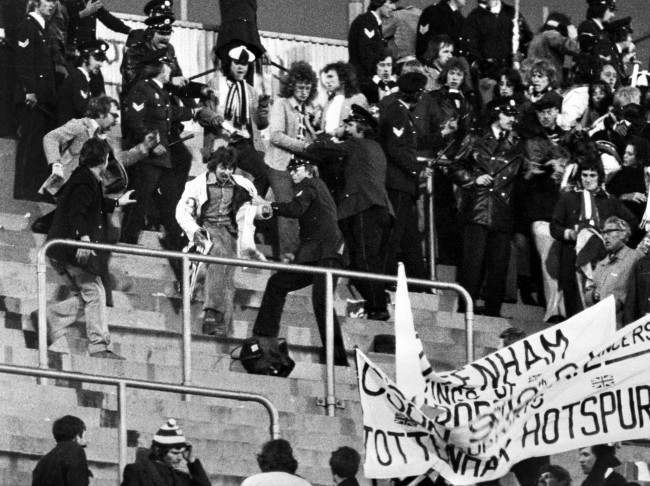
The 1974 UEFA Cup Final in Rotterdam

Aside from the Heysel ban which banned all English teams for 5 seasons, Arsenal have never been banned from Europe. But this ban, which was lifted after 2 years, is a great stain on Spurs' history. Ever since, every fan in every country in Europe, even if they are not fluent in English, knows at least 3 words: "Fuck you, Tottenham!"

This should not to be confused with the Arsenal chant, based on "Come On You Spurs" (or "COYS") -- "Fuck Off You Spurs!" (or "FOYS"). Tottenham may be the more popular club within England, but Arsenal, especially after the arrival of Arsene Wenger, became by far the more popular club in Europe.

May 7, 1977: Tottenham get clobbered 5-0 by Man City, ensuring their relegation from Division One. And so, 1977-78 remains the only season since 1948-49 that Arsenal and Tottenham have not faced each other in League play, and the only season since 1947-48 that they have not faced each other at all.

Years later, the concept of St. Totteringham's Day would be devised: The day each season when it becomes mathematically impossible for Spurs to finish ahead of Arsenal in the final standings (or "table," as they'd say in England). The day had not yet begun to be celebrated at this point, but Spurs' 0-0 draw vs. Stoke and Arsenal's 2-0 win over Coventry City made April 23 St. T's Day for 1977; Spurs' confirmation of relegation on May 7, 1977 made that day St. T's Day for 1978.

St. T's Day doesn't happen every season, of course -- but, through 2017, there have been 66 seasons when Arsenal finished ahead of Spurs, and 31 when Spurs have finished ahead of Arsenal; when both were in the same division, Arsenal lead 51 to 29.

December 23, 1978: Spurs spent just 1 season in Division Two before bouncing back up, and had obtained 2 members of the Argentina team that won the World Cup the previous summer: Osvaldo "Ossie" Ardiles and Ricardo "Ricky" Villa.

(These acquisitions would become problematic when Argentina took the Falkland Islands from Britain in 1982, and Britain took them back. For a while, neither was able to play without being booed. Both regained their popularity once Argentina had surrendered, though, and remain beloved in N17.)
Ossie and Ricky

Arsenal, having tumbled down the table to 17th in 1976, had fired Mee, and had hired Terry Neill -- who had been Tottenham's manager, but had previously played as a centreback for Arsenal. The Gunners had reached the FA Cup Final in 1978, but lost to Ipswich Town.

Now, they were led by "The Irish Connection": Midfielder Liam Brady (still one of the most beloved players in Arsenal history), forward Frank Stapleton and centreback David O'Leary (who would go on to make more appearances for Arsenal than any other player, 722) were from the Republic of Ireland; manager Neill, right back and Captain Pat Rice (the only holdover from the 1971 Double side's starters), left back Sammy Nelson (a rookie on the '71 team, who did not play in this game) and goalkeeper Pat Jennings were from Northern Ireland.

To make matters more interesting, Jennings had been Spurs' keeper from 1964 until their 1977 relegation, and, in a fool move, they simply let him go. Centrebacks Steve Walford (who subbed for Nelson in this game) and Willie Young (a Scotsman whose 6-foot-5 height led Gooners to sing, "We've got the biggest Willie in the land!") were also former Spurs players. It was 2 days before Christmas, and both sets of fans, 42,273 of them, walked into White Hart Lane loaded for bear.

But it was Arsenal fans who were saying, "Ho ho ho!" -- and very quickly. A blunder of a backpass enabled Alan Sunderland to score in the 43rd second -- not minute. Sunderland, a white Yorkshireman with an Afro any black man would have been proud to have, added another goal late in the 1st half.

The game totally came off the rails for Spurs in the 2nd half. Right after the hour mark, Brady put on a dribbling clinic down the left wing, got to the six-yard line, and sent in a hellacious cross off his much-renowned left foot, and Stapleton put it in the Tottenham net with a diving header. After this goal, the Arsenal fans were singing, "Jingle bells, jingle bells, jingle all the way! Oh what fun it is to see The Arsenal win away!"

Just 4 minutes after that, there was a scramble in the Tottenham penalty area, the ball came out of it, and Brady took the ball with a perfect (and clean) tackle. He followed up this great defensive play with a curling shot that had BBC sportscaster John Motson yelling, "Look at that! Oh, look at that! What a goal by Brady!" Sunderland finished his hat trick in the 84th minute to forge a final score of 5-0, and Stapleton just missed making it 6-0 in stoppage time.
Liam Brady and Alan Sunderland

After the game, the Y-- Army decided to kick the shit out of anyone they saw in red -- even if they were just in the neighborhood and hadn't even been at the game. As if that would change the result of the most humiliating defeat Spurs had ever suffered -- aside, that is, from May 3, 1971.

Sunderland joined Ted Drake as the only Arsenal players to score 3 goals in a competitive North London Derby match, and would end up scoring the winner in the 89th minute as Arsenal beat Manchester United 3-2 in the FA Cup Final -- the club's first trophy since the 1971 Double.

April 7, 1980: Due to Arsenal having reached the Semifinals of both the FA Cup and the European Cup Winners' Cup, there was a fixture pileup.

Arsenal had to play Everton away on a Friday, Norwich City away the following Wednesday, Southampton at home on the following Saturday, Tottenham away the following Monday (just 2 days later, the day after Easter), Juventus at home in the Cup Winners' Cup Semifinal on Wednesday (again, just 2 days later), and finally Liverpool at neutral-site Sheffield Wednesday in the FA Cup Semifinal on Saturday.

That game ended in a draw, so there had to be a replay at Aston Villa on the following Wednesday, meaning more fixture pileup, and then they had to play Liverpool for a 3rd time in 8 days, away in a League match the following Saturday. Then the away leg of the Semifinal against Juventus, in Turin, Italy, the following Wednesday.

Then home to West Bromwich Albion on Saturday, followed by yet another FA Cup Semifinal replay against Liverpool, back at Villa Park, on Monday. And when that ended in a draw, a 3rd replay against Liverpool at Coventry City on Thursday. Coventry was chosen as the site because Arsenal already had to play a League game away to Coventry City on Saturday, so they could just stay in town.

Then, back home, against European Cup holders Nottingham Forest on Monday. Then, the following Saturday, the FA Cup Final at Wembley, against West Ham. Followed on the next Wednesday by the Cup Winners' Cup Final, against Spanish club Valencia, in Brussels, Belgium -- at Heysel Stadium, site of the disastrous European Cup Final 5 years later. Then, closing out the League schedule, away to Wolverhampton Wanderers on Friday, and away to Middlesbrough on Monday, both games previously postponed due to the FA Cup ties.

Managers complain about fixture congestion now? Terry Neill's Gunners ended up having to play 18 games in just 54 days.

Neill asked Spurs management if they would agree to have the Easter Monday fixture moved. Petulant as much in 1980 as they were in 1905, 1913 and 1919, Spurs refused. Knowing that the League title was out of reach by this point anyway, Neill fielded a weakened team, to keep his stars rested for the big test against Juventus. Paul Barron was in goal instead of Jennings, Walford at left back instead of Nelson, Andy Devine in Sunderland's midfield place (though Sunderland did appear as a sub), Paul Vaessen at forward in place of Frank Stapleton, John Hollins at Number 10 instead of David Price, and, making his Arsenal debut, Paul Davis at 11 instead of Graham Rix.

The moves worked: Vaessen scored, and then Brady got hurt, forcing Neill to replace him with Sunderland, who also scored, and a half-strength Arsenal beat a full-strength Spurs 2-1. Sixteen days later, Vaessen would score a late goal at Juventus to send Arsenal to the Cup Winners' Cup Final.

This was the game in which, most likely, the worst episode of Arsenal-fan-toward-Tottenham-fan violence took place: A Gooner threw a petrol bomb -- we'd call it a Molotov cocktail -- from the south stand, the Park Lane End, the traditional location for visiting fans, onto the east stand, a.k.a. The Shelf. It exploded, and burned some Spurs fans. As far as I can tell, the offending spectator was never identified, much less arrested and prosecuted.

November 4, 1980: On the same day that Ronald Reagan is elected President of the United States, anyone who was both a member of the Democratic Party and an Arsenal fan (at this point, due to exposure to English soccer in the American media, there would have been very few) has another reason to be unhappy. Ardiles scores the only goal in a 1-0 Spurs win in the 4th Round of the League Cup. This was the 1st time since the 1941 London War Cup that Spurs had won a cup tie against Arsenal.

Sometime around this -- I can't find an exact date -- Vaessen was injured in a reserve match against Tottenham. I have no evidence that there was intent to injure, so I'm going to presume it was accidental. Certainly, I'm not going to blame Tottenham for what happened to him later; if anything, Arsenal letting him go did him more harm.

But his knee never recovered, he lost his place in the team, and descended into cocaine and heroin addiction. Finally, he died in 2001, just past his 40th birthday.

January 2, 1982: Having won the FA Cup in a replay against Manchester City the season before, Tottenham begin their defense of it in the 3rd Round, and defeat Arsenal 1-0 at White Hart Lane, on a goal by Garth Crooks. Spurs did, indeed, make it back-to-back Cups, beating another London club, Queens Park Rangers (QPR), in the Final.

May 23, 1984: Just as Arsenal won the Inter-Cities Fairs Cup in 1970 by taking a 2-legged Final on aggregate from Belgian club Anderlecht, so, too, did Tottenham take that tournament's successor, the UEFA Cup, from them.

Both legs ended 1-1, and so the White Hart Lane leg, saved by an 84th-minute tally by Graham Roberts, went to penalties. Roberts, Mark Falco, Gary Stevens and Steve Archibald made theirs for Spurs, while Anderlecht only made 3 out of their first 4. But when Danny Thomas (no relation to the great American entertainer of the same name) missed the final Spurs penalty, Spurs fans began to squirm. It was up to goalie Tony Parks to stop Anderlecht's Icelandic forward, Arnor Gudjohnsen. He did.

Tottenham had their 3rd European trophy -- a total Arsenal have yet to reach, and a particular point of pride for those bastards -- as if making the European Cup/Champions League only 3 times in the tournament's 62 seasons years isn't much more significant than having won those trophies 30 years ago or more.

A far more interesting note is that the man who missed the final penalty was the father of Eidur Gudjohnsen, who would later play for Spurs, but is probably better known for playing for another London club, Chelsea, and is probably the greatest player Iceland has ever produced, well ahead of his father. (Although Iceland's recent success at Euro 2016 may change that.)

April 17, 1985: Arsenal were falling short of a high enough place to earn a UEFA Cup berth -- not that it ended up mattering, see the next entry -- and Tottenham were challenging Everton for the League title as the clubs met at The Lane.

In fashion that would be familiar to recent Tottenham fans, Spurs choke when it matters most. Charlie Nicholas and Brian Talbot score for the Gunners, while Spurs get a late penalty that could tie it, but Roberts, a hero a year earlier, clips the crossbar, sending the ball into the stands. Tottenham 1-2 Arsenal.

Arsenal fans celebrate in an unacceptable way, ripping out seats and throwing them onto the pitch. When the dust settled, Tottenham stewards had counted 850 seats that had to be replaced, calling it the worst damage their ground had ever sustained. Spurs ended up losing 4 straight home games, and Everton took the title.

May 29, 1985: Juventus defeat Liverpool 1-0 in the European Cup Final at the aforementioned Heysel Stadium in Brussels. But the game should never have been played, as a scuffle between opposing fans led to Juve fans running, and crashing into a wall, which collapsed, and 39 fans were killed.

In the wake of the Heysel Disaster, as it came to be known, the Union of European Football Associations (UEFA) banned all English clubs from its competitions for 5 years, tacking a 6th year of punishment onto Liverpool. England as a national side could still compete in the 1986 and '90 World Cups, and the 1988 European Championships, but no English clubs could play in the European Cup, the UEFA Cup, the European Cup Winners' Cup, or smaller competitions like the Anglo-Italian Cup.

An interesting side effect of this is that it wasn't British clubs that were banned, it was English clubs, due to that country-within-a-country's reputation for hooliganism. As if other countries in Europe, including Scotland, Wales, and Northern Ireland, all within the United Kingdom, didn't have football hooligans!

And it was English clubs that were banned, not English players. So Glasgow-based Rangers told English players that they could come up to Ibrox Stadium, where they would still be eligible to play in these European competitions, and they signed up a few, and this allowed them to end their Glasgow arch-rivals' Celtic's dominance of the Scottish game, and begin their own era of glory.

March 4, 1987: Arsenal and Tottenham have advanced to the Semifinal of the League Cup, and will play each other. Tottenham won the Highbury leg 1-0, and were leading the Lane leg 1-0 when the public-address announcer said that tickets for the Final would be available at the ticket office after the game. That stirred up the Arsenal fans, and the Arsenal players, and they came from behind to win, 2-1, to draw the match 2-2 on aggregate. Instead of counting away goals, which would have given Arsenal a 2-1 win, the rules of the Cup at that time demanded a replay. It would be held at White Hart Lane.

Since English clubs could not play for European trophies in the late 1980s, only 3 trophies were available to them: The League title, the FA Cup, and the League Cup. This gave the League Cup an importance that has since faded, especially with the expansion of the UEFA Champions League, formerly the European Cup, to include the top 4 Premier League teams. Today, if you think the League Cup is a "major trophy," almost by definition, you are not a "big club." That was not the case in 1987, and even if it wasn't a major trophy then, this was the Derby. You bet your arse that both teams wanted to win.

It should also be noted that Tottenham were well in the running for a domestic Treble: The League, the FA Cup, and the League Cup. Winning all 3 had never been done before, in the 26 years that it had been possible. This, coupled with the 1984 UEFA Cup and the 1981 and '82 FA Cups, meant that Tottenham were in a period of glory comparable to themselves in the 1960s, and to Arsenal in the 1930s, the late '40s and early '50s, and in the early '70s. Without question, Spurs were the leading club not just in London, but in the South of England, and only Liverpool and Everton were seriously challenging them for the title of the best team in the entire country (England, not Great Britain).

The 1st half ends scoreless. In the 2nd half, Clive Allen, who had briefly been on Arsenal's books in 1980 before being sold, is now with Tottenham, and completes the oddity of scoring in 3 matches of a 2-legged tie -- indeed, in the 3 games, he had scored all of Spurs' goals. To make matters worse for Arsenal, their hard-drinking, hard-partying Scottish striker Charlie Nicholas is carried off injured.

Ironically, it is Champagne Charlie's substitute, Ian Allinson, who scores the equaliser. And then, in stoppage time, David Rocastle manages to poke out his left foot and put the ball into the Spurs net, past an aging Ray Clemence, who, with Liverpool, had let in Charlie George's FA Cup winner 16 years before.
"Rocky" Rocastle salutes the traveling Arsenal fans after the game

Nicholas returned for the Final at Wembley, and scored both of Arsenal's goals as they came from behind to beat Liverpool, 2-1.

This capped the 1st season as manager for George Graham, the former Arsenal forward and midfielder. Ironically, his former teammate and best friend, Terry Venables, had been a finalist for the Arsenal job -- and would later be hired to helm Tottenham! (Arsenal fans would nickname him "Terry Vegetables.")

Graham had hired his 1971 Double side teammates Bob Wilson and Pat Rice as his assistants, and they were rebuilding The Arsenal from the "Boring, Boring Arsenal" that they'd been for most of the 1980s, following Terry Neill's breakup of the Liam Brady side (Neill was fired in 1983, and Don Howe led them for the next 3 years before resigning), and helping them to once again overtake Tottenham as the best team in London.

As for Spurs, they and their fans woke up on the morning of March 4 with a chance at all 3 domestic trophies. When they went to bed on the night of May 16, their season had concluded with them winning nothing: They had lost the League Cup Semifinal to their arch-rivals, they went into a tailspin and finished 16 points behind League Champions Everton, and on that May 16 they lost the FA Cup Final, to Coventry City, which had never before (and hasn't since) won a major trophy, on an own goal by one of their most popular players, Gary Mabbutt. Their only consolation is that they beat out Arsenal for 3rd place, by just 1 point.

It was the end of an era for Spurs: By the time they won their next trophy, it would be with a lineup almost completely different from their 1981-84 trophy-winning sides. And the domestic Treble is still an achievement no team has notched. (When Arsenal became the 1st team to win both domestic cups in 1993, they finished 10th; Liverpool won the Cup Double in 2001 and finished 3rd; Chelsea have come the closest, winning both cups but finishing 2nd in 2007.)

Part IV follows.

Arsenal vs. Tottenham: The Defining Moments, Part II: 1920-1970

April 23, 1921: Tottenham win their 2nd major trophy, the FA Cup, defeating Wolverhampton Wanderers (a.k.a. Wolves) 1-0 in the Final at Stamford Bridge, home ground of West London club Chelsea. Local hero Jimmy Dimmock scored the only goal.

This would turn out to be the only major trophy Tottenham would win in a half-century span, from 1901 to 1951. "Big club"?

September 23, 1922: The clubs play an early-season match at White Hart Lane, and it was one of the most disgraceful displays in Arsenal history -- worthy of 1970s Leeds United, or more recent Manchester United and Barcelona squads. Indeed, this game would seem to confirm everything that Spurs fans believe about Arsenal.

Spurs' outside right (roughly the equivalent of a right winger in the modern era) Frederick "Fanny" Walden -- at 5-foot-2, the shortest player ever for the England national team -- left the game with an injury 20 minutes in. As substitutes weren't allowed until 1966, this left Spurs with 10 men for 70 minutes. There is no contemporary record stating that his injury was caused, willfully or otherwise, by an Arsenal player. But since Tottenham fans, even then, weren't exactly long on logic, they got angry.

A few minutes later, the intent to injure was undeniably underway. Arsenal's Arthur Hutchins fouled Spurs' Alex Lindsay. For the 5 minutes that it took to tend to his injury on the touchline (we would say "sideline"), Spurs were down to 9 men. At that, the Spurs crowd was justifiably angry. Bert Smith (no relation to later Tottenham star Bobby) got fouled, and they got angrier. Bert Bliss got hurt right before the half, and played the 2nd half limping.

Reg Boreham broke the deadlock 5 minutes into the 2nd half. But, despite being 1-0 up on a team with, essentially, 9 1/2 men, the Gunners continued to play rough. Dimmock got hacked down by Frank Bradshaw. This was the era before yellow and red cards were used to discipline players, but the referee, listed in the game account only as "Mr. C. Austin," only had a few words with Bradshaw, rather than sending him off and (more or less) evening things out.

With 10 minutes left, Boreham scored again, and Arsenal led 2-0. But Lindsay pulled one back, making it 2-1. At first, it appeared to have been ruled offside. But then Austin motioned that he was allowing it, and Arsenal goalkeeper Stephen Dunn, ignoring the fact that time had almost run out and an equalizer (equaliser) was incredibly unlikely, actually grabbed him and shook him. Today, that would be an automatic straight red card, likely a lengthy suspension, and villain status for all time. Austin let him stay on the pitch.

Then Bert Smith, according to the later report, "used filthy language" in yelling at Arsenal's Alex Graham (no relation to later star and manager George), and Graham decked him. The Spurs fans began throwing things at the Arsenal players, and the police came onto the pitch to settle things down.

The Football Association actually appointed a commission to investigate this game. And, as was often the case in those days when neighbors (neighbours) played each other, the return fixture was not weeks or months later, but just 1 week later!

September 30, 1922: The teams met again at Highbury, and 55,000 came out, the biggest Arsenal home crowd of the season. They did not leave happy. The FA appointed the strictest referee of that era, a Mr. W.E. Russell, to oversee the proceedings, and nothing untoward happened. Peter McWilliam, improvising following the previous weekend's injuries, put together a Spurs side that beat Arsenal 2-0. At the final whistle, the opposing captains shook hands, and things were calm.

When the FA concluded their inquiry on October 5, Smith, Graham and Dunn were all suspended. While the North London rivals have had viciousness between their fans on a number of occasions since, the September 23, 1922 match remains by far the most violent encounter between the sets of players.

October 25, 1924: Jimmy Brain makes his first-team debut for Arsenal, and scores the only goal in a 1-0 derby win over Spurs at Highbury. He would go on to become the 1st player to score 100 goals for Arsenal.

August 29, 1925: After some lean years under the management of Leslie Knighton, including nearly getting relegated at the end of the preceding season, Arsenal play their 1st match under Herbert Chapman, a former Tottenham player (but not a very good one), who had built Yorkshire's Huddersfield Town into the 1st team that ever won 3 straight Football League titles.
Herbert Chapman

Chapman starts 7 of the previous season's usual starters, 3 players who hadn't seen much playing time the season before, and his big new signing, Sunderland star Charlie Buchan (who, before becoming a star for those Black Cats, had briefly played for Arsenal). The game, against Tottenham at White Hart Lane, doesn't go so well for Arsenal, as Spurs win, 1-0, in front of a huge crowd of 53,183 fans. But Chapman must have liked what he saw from the previous year's 7 plus Buchan, and he began to tinker with the side a little more.

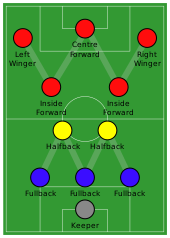
He also instituted what became known, due to its shape, as the W-M formation. Usually, teams had lined up with two fullbacks, three midfielders, and five forwards: A "2-3-5" formation. By moving a central midfielder back, creating the position of centreback, Chapman could move his left back and right back out, thus providing better coverage on defense (or "defence," as they'd say in England). By moving two forwards back, Chapman created a two-tired attack.

The W-M was a 3-2-2-3, and this, coupled with a change in the offside rule (though the W-M's creation had little to do with adapting to it), allowed Chapman to play certain players to their strengths, scoring more goals and allowing fewer.
The W-M Formation

This formation would be copied all over Europe due to the success that Arsenal would have in the 1930s, and would be the preferred formation in England until the 1953 demolition of the national side by Ferenc Puskas-led Hungary at Wembley, which led to the more modern 4-4-2 and 4-3-3 formations. (Today, Arsenal manager Arsene Wenger's preferred formation of 4-2-3-1 owes a little bit to the W-M.)

A team that had mostly the same players as the year before, plus one "marquee signing," went from nearly relegated in 1925 to 2nd place in 1926 -- the best finish in Arsenal's history to that point, and the closest any London or quasi-London team (including Tottenham) had yet come to winning Division One. "The Gunners" (nicknamed for their cannon badge, a nod to the old Royal Arsenal days) were on their way.

May 5, 1928: Both North London teams travel to Liverpool for the last game of the season. Tottenham lose 2-0 to Liverpool FC at Anfield, completing a disastrous run where they won only 3 of their last 15 League games, 2 of their last 12, 1 of their last 8, and none of their last 4.

Meanwhile, Arsenal draw 3-3 with Everton at Goodison Park. This not only allows Everton, led by the premier forward of the era, William "Dixie" Dean, to win the League title, but it completes a nosedive -- later American fans would call it a "tanking" -- Tottenham thus finish 21st, and are relegated, when 1 more point by them, or 1 fewer point by either Burnley or Portsmouth, would have saved them.

Arsenal had purposely lost to Burnley and Portsmouth earlier, in order to get Tottenham relegated. Or so the story goes. In fact, it's ridiculous. By a weird twist of the schedule, both of Arsenal's matches against Burnley were way too early in the season to know whether Tottenham were in relegation danger: August 31 and September 5, and Arsenal actually won both of those games. One of the Portsmouth games was on October 8, and Arsenal won that, too.

Arsenal did lose 2-0 at home to Portsmouth on March 28, but there were 10 games to go, and Tottenham were 9th at the time -- ahead of Arsenal. The win put Portsmouth in 15th, ahead of Arsenal in 16th, so it really didn't make sense for Arsenal to throw the game. Arsenal ended up 10th, as they lost only 2 more games the rest of the way -- 1 of them to Tottenham. Fine job of trying to get them relegated, huh?

Once again, Tottenham's version of history is, as the English say, bollocks.

April 26, 1930: After losing their 1st appearance in the FA Cup Final in 1927, to Cardiff City (still the only team outside England to win it, and Scotland's Queen's Park is the only other non-English team to even appear in the Final), The Arsenal were back in it, and against Chapman's former side, Huddersfield Town, now managed by their former star inside forward Clem Stephenson. As a result, the two sides walked out onto the field (or the "pitch," as they'd say in England) at London's Wembley Stadium together. This became a tradition, and now it's done for every game, all over the world.

Alex James scores for Arsenal in the 1st half, and Jack Lambert (no relation to the legendary Pittsburgh Steelers linebacker of the same name) adds a late insurance goal, and Arsenal win, 2-0, to win their 1st major trophy. They had won a few minor trophies, but the Cup was the big one.

April 11, 1931: Arsenal travel to Grimsby Town and win, 1-0, at Grimsby's Blundell Park, to clinch the League title for the 1st time. Indeed, they were the 1st London club ever to do it. Tottenham Hotspur had never done it -- and even if they had, at this point, Tottenham was still in Middlesex, not in London.

With stars like James, Tom Parker, Cliff Bastin, David Jack, Bob John, Joe Hulme, Eddie Hapgood, and later Ted Drake and Wilf Copping, Arsenal would go on to win the League again in 1933, '34, '35 and '38, and also take the FA Cup in 1936, while reaching the Final but losing it in 1932. Meanwhile, Tottenham would be relegated during the decade. Despite Chapman's death in 1934, The Arsenal kept winning under new manager George Allison, and became the best team in Britain, and maybe the best team in Europe.

(We can't say for sure: There would be no European Cup until the 1955-56 season, but, in late 1934, an England side with 7 Arsenal players, plus a 19-year-old but already quite wizardly Stoke star Stanley Matthews, beat Italy, which had recently won the World Cup, in a rough match played in drenching rain at Highbury. So, at that point, it was reasonable to assume that, if the top team in Italy was Juventus, which contributed more players to the nominal World Champions -- England then thought the World Cup beneath itself, and did not compete in it until 1950 -- than any other team, then Arsenal were better, and were thus "the best team in the world.")

May 5, 1931: Arsenal and Tottenham play each other in the Final of the London FA Charity Cup, at Stamford Bridge. It's the Great Depression, and only 10,160 fans are listed as having paid the expense to see a meaningless exhibition.

If it was so meaningless, why do I mention it? Because it's the first time, and it remains the only time, that Arsenal and Tottenham have ever played each other in the final of any tournament. That, at the very least, has to be worth mentioning. Arsenal win it, 2-1.

September 10, 1931: Jimmy Brain becomes the 1st major Arsenal player to cross the divide, as the Gunners sell him to Spurs, for £2,500. He appears, however, to not have had this held against him by Arsenal fans. He had scored 139 goals for Arsenal (a club record until surpassed by Bastin), but would score only 10 for Spurs.

January 6, 1934: In this pre-antibiotic age, Chapman dies of pneumonia, just short of his 56th birthday, and after leading Arsenal to the 1930 FA Cup and the League title in 1931 and 1933. But caretaker manager Joe Shaw takes them to another title in 1934. George Allison, a longtime associate of Chapman's, took over as manager, and led Arsenal to League titles in 1935 and 1938, and the FA Cup in 1936.

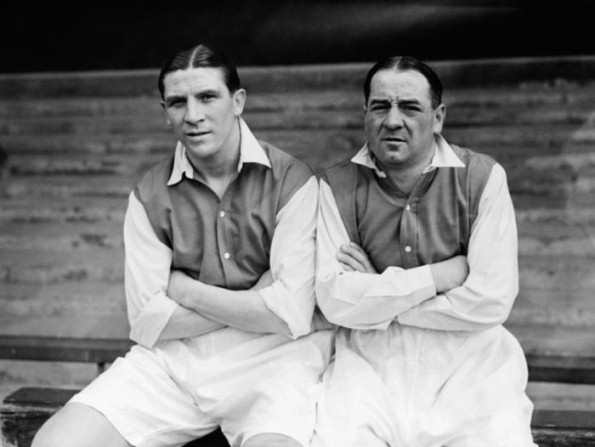
October 20, 1934: Ted Drake, who had nearly signed for Tottenham as a teenager, but was now in his 1st full season with Arsenal, scores 3 goals in a 5-1 win over Tottenham at White Hart Lane. He is the 1st Arsenal player ever to score a hat trick in a competitive match against Spurs. There has been only one other since, and he also did it at The Lane.
Ted Drake, left, and Alex James,
in the iconic red shirts with white sleeves
that Chapman had introduced in 1933

Drake was just getting warmed up: A year later, he would tie a league record for most goals in a Division One match, tallying 7 against Aston Villa. No player has matched or beaten that since.

In 1955, Drake would become the 1st man to win the League as both a non-managing player and a non-playing manager, taking Chelsea to the title. It was the only title in their 1st 99 seasons, and the only manager ever to take Chelsea to the League title without Roman Abrmovich's ill-gotten Russian energy billions is an Arsenal man.

September 1, 1939: Nazi Germany invades Poland, World War II begins, and, with the 1939-40 season barely begun, the FA shut league competition down for the duration. Since the war ended on August 14, 1945, too late to start up a new Football League season (but not too late to start up a full 1945-46 season for the FA Cup), the League did not resume until the next season, 1946-47.
Highbury, sometime between the 1936 opening of the East Stand
and the 1988 reconstruction of the south end, the Clock End

January 8, 1949: For the 1st time, a North London Derby is held in the FA Cup. In a 3rd Round match at Highbury, Arsenal, defending League Champions under manager Tom Whittaker, win, 3-0.

September 13, 1949: Arsenal purchase Freddie Cox from Tottenham for £312,000 -- for the time, a gigantic sum.

April 28, 1951: Tottenham beat Sheffield Wednesday (so named because the cricket club they were founded as played their matches on that day of the week), 1-0 at White Hart Lane, and win their 1st League title. It took them 43 years. Well, 32 seasons, if you don't count the ones that weren't played due to the World Wars.

It's not that Arsenal were in decline: Under Whittaker, who'd been the team physiotherapist in the Chapman and Allison years, they'd won the League in 1948, won the FA Cup in '50, would reach the Final again while just missing the League title in '52, and would win the League again in '53.

They were led by Captain Joe Mercer (who would later lead Manchester City to the 1968 title), the aforementioned Freddie Cox, Reg Lewis (who scored both goals in the 1950 Final), and the Compton brothers, Les and Denis, who were also esteemed cricketers.

But, in this particular season, Tottenham were better. The team, managed by Arthur Rowe and known for their style of play as "the Push and Run Spurs," included 2 future managing legends: Bill Nicholson and Alf Ramsey. Other stars included Ronnie Burgess and Ted Ditchburn.

September 29, 1951: The largest crowd in the history of North London Derbies to this point, 72,164, crams into Highbury to see a 1-1 draw.

Soon, however, both clubs would go into a down period. Between 1953 and 1971, Arsenal would only finish as high as 3rd once, in 1959. Tottenham would be even worse off in the later Fifties: As age and decline beset Nicholson, Ramsey and the rest, Rowe's health became poor, and he had to retire in favor of Jimmy Anderson. Spurs were nearly relegated in 1956, then jumped back to 2nd in '57, but Anderson got sick as well, and Nicholson became manager. This is when Tottenham's greatest period began.

June 15, 1952: The last 2 Football League Champions meet in a friendly -- at Yankee Stadium in New York. It is no contest, as 1951 Champions Tottenham clobber 1952 Champions Manchester United 7-1.
United, left, and Spurs players line up before the game


October 20, 1956: Arsenal defeat Tottenham 3-1 at Highbury. This was to be their last match with Tom Whittaker as manager. He died 4 days later. He and Herbert Chapman remain the only Arsenal managers to die in office.

April 17, 1961: Tottenham win the League for the 2nd time, as the failed Bay of Pigs invasion gets underway in Cuba. Again, the clincher is at home at White Hart Lane, and again the opponent is Sheffield Wednesday. Spurs win, 2-1.
White Hart Lane, circa 1961

Arsenal are 11th in the table, and not a factor for either the League title, the FA Cup, or the League Cup, which is run for the 1st time this season (although Arsenal won't enter it until 1965-66).

May 6, 1961: Tottenham defeat Leicester City, 2-0 at Wembley, and win the FA Cup for the 1st time in 40 years. Even more, winning the League and the FA Cup gives Spurs "The Double" -- an achievement only done twice before: By Preston North End in the 1st League season of 1888-89 (an unbeaten League season that got them nicknamed the Invincibles), and by Aston Villa of Birmingham in 1897.

By "doing The Double," Spurs were now the toast of not just London, but all of England. And while Arsenal fans sing "You won the League in black and white," there is surviving film of the Cup Final in color (or "colour," as they'd say in England).
Bill Nicholson, with the League trophy and the FA Cup

August 26, 1961: Tottenham beat Arsenal 4-3 at The Lane, and left winger (in position, I don't know about his politics) Terry Dyson becomes the 1st Spurs player to score 3 goals in a competitive game against Arsenal. He remains the only one.

September 13, 1961: Tottenham become the 1st London team to play in the European Cup. Actually, no, they don't, as they are not in London, they are in Middlesex. They do, however, become the 1st team from the South of England to play in it. In a match played in Zabrze, Poland, Tottenham lose 4-2 to Gornik Zabrze.

The tournament had begun with the 1955-56 season, when Chelsea were coming off their 1st League title, but they were ordered by the FA to decline an invitation to participate. Manchester United ignored the FA's demands, and had competed in the Cup in the 1957-58 season, making them the 1st English team to play in it. They got to the Quarterfinals, against Red Star in Belgrade, Yugoslavia (now Serbia). But a plane crash after a refueling stop in Munich, Germany killed 22 people, including 8 United players, and injured 2 others badly enough to end their careers.

This not only hurt United's trophy chances for a few years (though they still reached the '58 FA Cup Final), it is often considered the reason England did not win the World Cup in 1958 and 1962. (The fact that Garrincha, Didi, Nilton Santos and a young man known as Pelé were starring for Brazil seems to be overlooked by the English.) It would take until 1967 for a British club to win it (Celtic, of Glasgow, Scotland) and 1968 for an English one (a rebuilt United).

September 20, 1961: Tottenham become the 1st London-area team to host a European Cup match. They make Gornik pay dearly for the defeat in Poland, winning 8-1, with Welsh winger Cliff Jones scoring 3 goals and forward Bobby Smith 2.

April 5, 1962: After losing the 1st leg of the European Cup Semifinal in Lisbon, Portugal to defending Champions Benfica, 3-1, Tottenham play the home leg, and 64,448 fans shoe-horn themselves into White Hart Lane. Smith scores, and Danny Blanchflower, the Northern Irish defender who was their Captain, converts a penalty, to give Spurs a 2-1 win. But Spurs lose 4-3 on aggregate.
Danny Blanchflower

To this day, there are Spurs fans who insist that Benfica cheated in those matches. In one of his last interviews, the late Spurs defender Dave Mackay agreed. Yeah, Benfica cheated by having more experience, and having the great Mozambicquan star Eusébio in their ranks. Such people also say that Spurs would have defeated Real Madrid in the Final -- a Madrid side that featured Ferenc Puskás
and Alfredo di Stéfano. They figure they would have beaten Madrid in the Final because Benfica did.

Poor old Spurs, everybody cheats but them. As they say in England, "Go home, you're drunk."

October 6, 1962: Tottenham take a 3-0 lead over Arsenal at White Hart Lane. Mackay scores in the 4th minute, forward John White in the 16th, and Jones in the 26th. David Court scores for Arsenal right after that, and again in the 33rd, but Jones tallies again right before the half, to make it 4-2. Some observers thought Spurs could have had as many as 6 goals.

Johnny MacLeod gets the Gunners to within 4-3 early in the 2nd half, and in the 75th minute, Geoff Strong finds an equaliser. Tottenham 4-4 Arsenal. As the later song would have gone, "Three-nil, and they fucked it up!"

That was what supporting Arsenal was like in the early 1960s: Lots of games they would win 4-3 or 5-4, lose 4-3 or 5-4, draw 3-3 or 4-4. Their attack, with wingers Court and MacLeod, and forwards Strong, George Eastham and Joe Baker, was fantastic. But their defense was not equal to the task.

And what supporting Spurs was like at that time? In 1962-63, they scored 111 goals in League play, an average of 2.64 per game, but finished 2nd to Liverpool side Everton.

May 15, 1963: Tottenham -- as their fans never stop reminding us -- become the 1st British team to win any European trophy. Having again won the FA Cup in 1962, they were eligible to enter the European Cup Winners' Cup (a tournament that was canceled after the 1998-99 season). They win the Final over Atletico Madrid (not to be confused with Real Madrid), 5-1 at De Kuip, the home stadium of the Dutch giants Feyenoord in Rotterdam. This is easily their greatest moment in Rotterdam -- more troubling ones were to come.

Jimmy Greaves, their hotshot forward (obtained midway through the 1961-62 season, so he wasn't on the Double side), scores twice. So does the aforementioned Terry Dyson. So does the aforementioned John White.

Just a little over a year later, White would be killed by being struck by lightning. He was only 27. Greaves would go on to one of the greatest playing careers any Englishman has ever had, but his life would be dogged by alcoholism. Like later Arsenal legends Kenny Sansom, Tony Adams and Paul Merson, but unlike (thus far) later Spurs legend Paul Gascoigne, he would famously dry out and become a spokesman for a clean lifestyle.

Tottenham fans were sure that their 1960s Spurs would surpass the achievements of the 1930s Gunners, but, for whatever reasons -- dodgy European referees, White's death, Greavsie's drinking, you name it -- it just didn't happen. In 9 seasons, 1930 to 1938, Arsenal won 5 League titles and 2 FA Cups; in 7 seasons, 1961 to 1967, Spurs won 3 FA Cups and a Cup Winners' Cup, but only 1 League title.

October 15, 1963: A year and change after the 4-4 draw at The Lane, a crowd of 67,857 plows into Highbury to see a derby, and if they came to see goals, they are not disappointed. Greaves scores in only the 3rd minute, and Bobby Smith in the 20th. Mackay also scores for Spurs, who lead 4-2 with 5 minutes to play.

Eastham scores 2 for Arsenal, including a penalty. Then, with 5 minutes left, Baker scores. And, in stoppage time, a supposedly injured but carrying-on Strong scores off a corner to forge yet another 4-4 draw that electrifies Islington.

Smith complains that Spurs goalkeeper Bill Brown had been interfered with, and that the equaliser should be waved off. The referee is having none of it. That ref is Dennis Howell, who would later be elected to Parliament and serve as Britain's Minister of Sport. Clearly, Prime Minister Harold Wilson (serving 1964 to 1970 and again 1974 to 1976) was not a Tottenham fan.

April 1, 1965: The London Government Act 1963 takes effect, creating "Greater London." It includes the entire historic County of London, most of Middlesex, and parts of Essex, Kent, Surrey and Hertfordshire. The parts of Kent it brought into London do not include Arsenal's spiritual homes of Woolwich and Plumstead, because those had been brought into London in 1889. The parts of Middlesex it brings into London do include Tottenham. The rest of Middlesex ias broken up, put into Surrey, Hertfordshire and Berkshire.

So, now, finally, Tottenham fans could truthfully say their team was in London. Nearly 94 years after Arsenal had officially arrived in the city, and nearly 82 years after Arsenal had arrived in Norton London.

And, for the moment, there was little doubt that Spurs were the best team in London. Yes, West Ham had won the FA Cup in 1964 and the Cup Winners' Cup in 1965, and Chelsea had improved significantly, and Arsenal had a lot of history. But Tottenham were, beyond much question, tops within the London area, and, indeed, in the South of England. Liverpool, Everton, Manchester United and Leeds United could, in the mid-to-late 1960s, call themselves "the Pride of the North," but Tottenham were the Pride of the South. (Both Spurs and Arsenal have put the words "the Pride of the South" into songs, each rhyming that with how they hate the other team's fans, "'cause they are all mouth.")

Although, oddly, Spurs fans would continue to call themselves "the Pride of North London." Mainly as a swipe to their arch-rivals, 4 miles down the Seven Sisters Road. After all, as was said at the time, "Arsenal haven't won a trophy since before the Coronation." It was true: The last Arsenal trophy was the League title won on May 1, 1953, and Queen Elizabeth II was crowned a month later on June 2.

Indeed, with several years of stagnation, compared with the trophies of Spurs and the Hammers, and the glamour that was coming to Chelsea, Fulham (thanks to forward Johnny Haynes) and Queens Park Rangers (a.k.a. QPR), Arsenal were not only not one of the more popular clubs in London, but were becoming just about irrelevant.

That would change in the summer of 1966, when they dismissed Billy Wright (one of the best European players of the 1950s but a failure as a manager) and hired Bertie Mee -- their physiotherapist.

He would install Dave Sexton as assistant manager, and Sexton straightened out their attack. He left after that first season, 1966-67, for Chelsea, and would lead them to their 1st FA Cup in 1970, and their 1st European Trophy, the 1971 Cup Winners' Cup. He came close to leading QPR to pipping Liverpool for the League title in 1976, and in 1979 would manage Man United into the FA Cup Final, where they would lose to... ah, but we're getting ahead of ourselves.

Mee replaced Sexton with Don Howe, an Arsenal fullback who had been Captain in 1966 when he broke his leg in a game against Blackpool, ending his playing career. What Sexton did for the offense (or "offence" or "attack"), Howe did for the defense (or "defence"). Over the next 20 years, he would be one of the most important figures at Arsenal.

July 30, 1966: England win the World Cup, beating West Germany 4-2. The England manager was former Spurs player Alf Ramsey, who had also managed Ipswich Town to the 1962 League title.

Both Tottenham and Arsenal had only 1 player in the squad. For Tottenham, it was Greaves, who was injured in the last Group Stage game and didn't play in the knockout stage, although he insisted he was ready to play in the Final. That was still better than the lone Gunner, Eastham, who didn't take the pitch at all. Martin Peters of West Ham started the Final, and would later play for Tottenham. Alan Ball of Blackpool started the Final, and would later play for Arsenal.

Ball had kind of a weird career. He helped Everton win the League title in 1970, but joined 3 teams that had won the FA Cup the season before -- Everton in 1966, Arsenal in 1971, and Southampton in 1976 -- but never won it himself, losing the Final in 1968 and 1972.

September 16, 1967: Despite Tottenham coming in as the holders of the FA Cup, completing a string of 5 major trophies in 7 years, and Arsenal still having a long way to go on their way back up, Arsenal defeat Tottenham 4-0 at Highbury.

November 20, 1968: For the 1st time, Arsenal and Tottenham play each other in the League Cup. In the 1st leg of the Semifinal, a match played at Highbury, Arsenal win, 1-0.

December 4, 1968: In the White Hart Lane leg of the League Cup Semifinal, Arsenal manage a 1-1 draw, taking the tie 2-1 on aggregate, and advancing to the Final.

March 15, 1969: Arsenal lose that Final, at Wembley Stadium, to Swindon Town -- a Division Three team in Wiltshire, in England's West Country. Thanks to a previous event tearing up the field and a rainstorm on the preceding Thursday, the field was a horrible mess, and some Arsenal players hoped the match would be postponed. Some wanted it postponed for another reason, having the flu -- shades of the "Lasagne Incident" that would happen in 2006. To make matters worse, the match went to extra time, the last thing the tired players needed.

Arsenal had lost the League Cup Final the year before, to Don Revie's Leeds United. Losing a Wembley Final 1-0 to Leeds, which was already a very good team (and would go on to win the League in 1969), was understandable. But 3-1 to Swindon? The headlines blare, including "THE SHAME OF LONDON." And, again, the line went up: "Arsenal haven't won a trophy since the Coronation."

Years later, Howe related a story: Someone told him that the club should take down the team photos of the champions of the 1930s, and the Joe Mercer teams of 1948-53, because they were too intimidating to the current players, a reminder of what they hadn't done. Howe said, "No, we have to replace these photos, with photos of the current players with a cup in their hands, so they can be a pain in the backside to the next group that comes up."

That was Howe's goal, and, as he said, "So that's what we did."

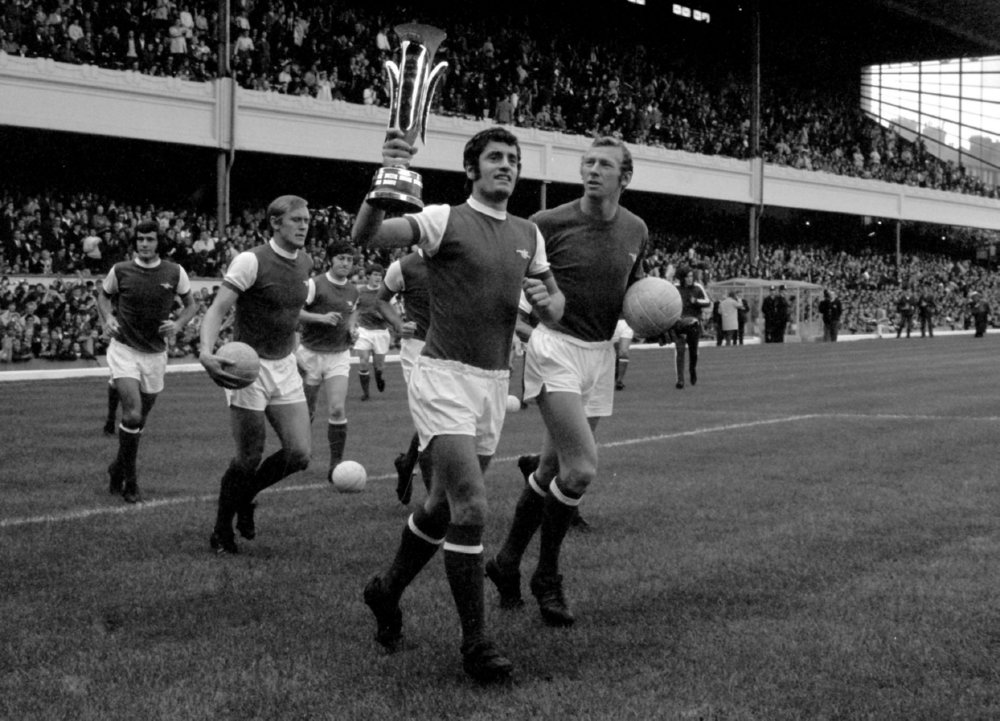
April 28, 1970: Arsenal end the trophy drought at 17 years. (And you think 9 years is hard?) They beat Anderlecht, of Brussels, Belgium, 3-0 at Highbury, to win 4-3 on aggregate and take the Inter-Cities Fairs Cup.
Arsenal Captain Frank McLintock, with the Fairs Cup,
and goalkeeper Bob Wilson

Two years later, the tournament would be renamed the UEFA Cup, and Tottenham would win it. To this day, their fans claim, "We are the 1st English team to win the UEFA Cup" -- even though, in 2010, the tournament became known as the UEFA Europa League.

But that's another Tottenham fans' lie: Arsenal had won it in 1970, so Spurs weren't even the 1st North London team to win it. Leeds had won it in 1968 and '71, and Newcastle had won it in '69 -- and that remains the Geordies' last major trophy (unless you want to count the now-defunct Intertoto Cup, which they won in 2006).

But despite winning the Fairs Cup, Arsenal finished 12th in the League. And they had lost the League Cup Final in back-to-back years. And oh how the Spurs fans (and everyone else in England) laughed at Arsenal.

In the 1970-71 season, the laughter would stop, as you'll see in Part III.

Saturday, November 5, 2016

Arsenal vs. Tottenham: The Defining Moments, Part III: 1971-1987

May 3, 1971: Arsenal and Tottenham play each other on a Monday, the final League game of the season. Originally, the game was supposed to be on March 27, but Arsenal had advanced to the FA Cup Semifinal, which was scheduled for that day, and so the Derby was moved back.

Tottenham, already having had nearly a complete turnover from their 1961 Double side and even largely from their 1967 FA Cup winners, were locked into 3rd place, and had already won the League Cup that season, certainly a good year by almost anyone's standards.

For Arsenal, who had to be exhausted after playing a strong Stoke City team (featuring 1966 World Cup teamers Gordon Banks in goal and former Arsenal forward George Eastham) just 2 days earlier, it was like this: A win would allow them to win the League over Leeds by one single solitary point. A scoreless draw, 0-0, and they would be level with Leeds on points, and win the title on goal difference. A loss, and they would lose the title by 1 point. A draw of 1-1 or higher, and they would be level with Leeds on points, and lose the title on goal difference. A boring nothing-nothing tie (or "nil-nil draw," as they would say in England) would be wonderful; a 1-1 draw would be "Second place is the first loser" misery.

The match was played at White Hart Lane, and it may have been the biggest crowd that ever attempted to see a League game in England's history. The official attendance was 51,992, pretty much as many as could squeeze into The Lane in those days, but it's been said that another 50,000 or so were outside the ground, wanting to get in but unable to do so.

(The largest crowd ever to be inside a club's ground was the 84,569 crammed into Maine Road, home of Manchester City, to see Man City face Stoke City in an FA Cup Quarterfinal in 1934. A year later, the largest League crowd filed into Stamford Bridge as Arsenal visited Chelsea, 82,905. The largest crowd ever at an English match was probably for the game that opened the old Wembley Stadium, the 1923 FA Cup Final. Officially, it was 126,047, but legend puts it at over 300,000. No fire laws in those days.)

As early as 6:00 AM -- pretty much all games started at 3:00 PM in those days -- fans were lining up to get in. And the vast majority of those outside the ground were Arsenal fans, known as Gooners in relation to the club nickname of Gunners. Inside, of course, the majority were Spurs fans, or Lilywhites for the team's white shirts, but ridiculed as "Spuds" by Gooners.

A 0-0 score, which Arsenal would gladly have taken, held for 87 minutes. The fans were going mental. Arsenal were about to win the League. And then... George Armstrong, whose normal post was on the right wing, was on the left wing for this sequence, and he sent a left-footed cross into the six-yard box. Ray Kennedy, still 3 months away from his 20th birthday and closing his first full season of professional football, jumped, and headed the ball into the net. It was his 19th goal of the season, leading a very balanced team.

It was, as the song would later say, "One-nil to The Arsenal." But shortly after the Arsenal fans stopped roaring, a sinking feeling crept in: A 1-0 lead meant that a Tottenham equaliser would give Leeds the title. Hang on, Arsenal, hang on...

They did. And when the referee blew for full-time, the fans poured onto the pitch, however many Tottenham fans there were trying desperately to get out of the way. Although 27 fans were arrested that day, for trying to bring weapons into the stadium or for fighting, no serious injuries were reported.

But Arsenal manager Bertie Mee was nearly hurt. Club director Ken Friar -- now 80 years old and an employee of the club, in one capacity or another, for 68 years -- remembers being in the dressing room with the celebrating players, and a stadium steward said, "Mr. Mee, they'd like you to come out onto the pitch." Friar, knowing that the wildly celebrating fans were still out there, warned him, "Bertie, I've just come from there. I wouldn't go near it." Mee told Friar, 16 years his junior, "Young man, there is a time in one's career when one thinks of others." Twenty minutes later, Mee returned, his jacket gone, his watch gone, his cufflinks gone, his shirt torn, and, in a rare moment of profanity for him, yelling back at Friar, "They're fucking mad!"

Arsenal had won the League at White Hart Lane. They had won the League at the home ground of their arch-rivals. To this day, they are the only English club that's ever done that. Going into the 2016-17 season, Manchester United have won the League 20 times, but never away to Manchester City -- or Liverpool. Liverpool have won the League 18 times, but never away to Everton -- or Man United.

May 8, 1971: Five days later -- certainly not the full 3 weeks that Tottenham got to prepare for their Final in 1961 -- Arsenal had the chance to get the other half of The Double. After a scoreless regulation, Liverpool got a goal from Steve Heighway, but Arsenal answered right back from a goal that appeared to be from George Graham. A replay later showed that it was Eddie Kelly who was the last Gunner to touch it. Substitutions had only been allowed since 1966-67, and Kelly thus became the first sub ever to score in an FA Cup Final.

A few minutes later, with his long hair flowing, Charlie George took a pass from John Radford, stood on the 18-yard line, and sent a net-seeking missile past Ray Clemence, and Arsenal had a 2-1 lead that held up. George's drop to the ground, lying on the Wembley grass with his arms up, became one of those iconic FA Cup Final moments.

Tottenham had seen Arsenal win 7 League titles and 3 FA Cups, but Tottenham could still claim to be the only English club to have won The Double in the 20th Century. No more: Arsenal had done The Double, and had won the League at Tottenham to do it. It was the ultimate indignity for Spurs.

And this is the true defining moment in the rivalry. This is where the true bitterness of Tottenham fans began. If they could no longer claim to be Britain's best team, or England's best team, or the best team in the South of England, or London's best team, or even North London's best team, or the only team in the century to do The Double, then, what could they say?

* They whined (or "whinged") about "being true to their roots." Spurs had been playing at the same location since 1899 and the same neighborhood (or "neighbourhood," as it would be "spelt" in England) since 1882. In contrast, Arsenal had abandoned their roots in 1913, and crossed from South London to North London, which was always Tottenham's territory. (No, it wasn't: Arsenal crossed from Kent to the Islington section of North London, which was 4 1/2 miles from White Hart Lane, which was then in Middlesex -- not in London. North London was never Tottenham's territory.)

* In connection with the preceding, they began to mock Arsenal as "Woolwich Arsenal." Which may have helped, as Arsenal won nothing in Woolwich. (Plumstead, actually.) There was the occasional minor trophy that no one cared about by the time Herbert Chapman came along, but Arsenal's highest League finish in the Woolwich/Plumstead years was 6th in 1909. (Never mind that Tottenham never finished as high as 6th in Division One until 1921.) And Woolwich Arsenal's longest run in the FA Cup was to the Semifinals in 1906 and 1907. (Tottenham had won that, in 1901.) Spurs fans began telling Gooners, "Fuck off back to Woolwich" and "North London is ours." The former was ridiculous, as, by 1971, Arsenal had been in Islington for 58 years; the latter had just become insane.

* They again brought up the lie that Arsenal had bribed their way into Division One in 1919, ignoring that there was evidence that Spurs had bribed their way into the League in 1908.

The thing is, Tottenham were a very good team in the early Seventies. They won the League Cup in 1971 and '73. They reached the UEFA Cup Final in 1972 (winning it over English club Wolverhampton Wanderers, a.k.a. Wolves) and '74 (losing to Netherlands club Feyenoord). And Arsenal's record during Bertie Mee's stewardship wasn't great: 1 League title in 1971, 1 2nd place finish in 1973, 1 Fairs (UEFA) Cup win in '70, 1 FA Cup win in 1971, 1 FA Cup Final defeat in 1972, 1 trip to the European Cup Quarterfinals in 1972 (losing to Johan Cruyff's superb Ajax Amsterdam), and 2 League Cup Final defeats in 1968 and '69. In this same period, both Manchester clubs (City and United), both Liverpool clubs (Liverpool and Everton), and Leeds had records that were similar to, or better than, those of the North London clubs.

But as far as the North London clubs were concerned, Arsenal had won the League, the FA Cup, and The Double more recently than had Tottenham. And that burned the Spuds up. Big-time.

This was also the early days of regular football hooliganism. It had always been there, but the modern age of it has been said to have begun when Man United clinched the League title away to West Ham on May 6, 1967, at which point the United fans tore up London's East End. During the 1970s, pretty much every English club had a hooligan "firm." Some became legendary for their mischief, including, in London, the Chelsea Headhunters, West Ham's ICF (Inter-City Firm) and Millwall's Bushwhackers.

Supposedly, Tottenham had once been a Jewish neighborhood. So other clubs mocked Spurs fans with anti-Semitic slurs -- most often "Yid" or "Yiddo." (These are words that should never be used in America, and I use them here only for the purpose of explanation.) Spurs fans decided to turn the slurs around, and have often chanted "YIDS!" "YIDDOS!" or "YID ARMY!" And their firm became known as the Yid Army. For a reason probably lost to time, Arsenal's firm became known as The Herd.

In truth, the Y-- Army were full of shit. Many is the Arsenal, West Ham and Millwall fan who has claimed that, like the Chelsea Headhunters, the Spurs firm didn't fight well, and preferred to run than to stand their ground and fight as best they could. Or, worst of all, would plow into a pub a mile or so from the away ground, knock over a few chairs, break some glassware, wreck the decor, scare a few old men, women and children, walk out, head off to the game, and then later "claim a result." (I recently had this confirmed by an ex-Londoner living in Boston, who told me he's been an Arsenal fan since 1966. Anyone who became an Arsenal fan at the time, and didn't quickly switch to a then more exciting club, is a true fan.)

To this day, some Tottenham fans point with pride to the Y-- Army. Some army: Iraq has a better one.

But as the Seventies wore on, and as the Eighties began, and hooligan violence got worse, so too did the verbal response. Fans would come into White Hart Lane and invoke the worst nightmare of the Jews, the Nazi Holocaust. Particularly Chelsea fans, with their links to the far-right National Front, would chant "Auschwitz!" and make hissing noises, simulating poison gas. West Ham fans were known to come into The Lane waving Palestinian flags, and would "bow toward Mecca" -- not that most of them would have accepted Muslims among their numbers at the time. (I'm also guessing that most couldn't find Mecca, or even Saudi Arabia, on a map.)

Many English fans look back on the 1970s and 1980s as the glory days of the game. But with hooligan violence, aging stadiums with appalling structural deficiencies and atrocious restrooms (unlike the U.S., the U.K. had no stadium building boom between 1953 and 1973), hopelessly backward TV coverage (even as late as 1989, there were almost no League games on live TV, instead they were mainly shown on tape delay), and some ridiculous fashions and hairstyles (on and off the pitch), it was not a very good time. Even if your team was winning.

And, after 1974, for the most part, neither North London club was winning.

December 9, 1972: This match at White Hart Lane was not a particularly historic game, but if you buy the DVD Arsenal: Classic Victories Over Spurs, this is the 1st game on it, chronologically. But usual Captain Frank McLintock does not play in this game; the far less talented Jeff Blockley wears the Number 5 shirt. Nor is the iconic Charlie George in it, as Eddie Kelly wears Number 11. And another major member of the 1971 Double side is gone, as the acquisition of 1966 World Cup hero and 1970 Everton title-winner Alan Ball meant that George Graham vacated the Number 8 shirt in 1972. Tottenham also have a '66 World Cup winner in their side, former West Ham star Martin Peters.

Tottenham (correctly) have an early goal disallowed for offside, and the 1st half ends scoreless. In the 2nd half, the dangerous Martin Chivers just barely misses opening the scoring, sending a sizzling shot just wide of the goalpost to his left, which Bob Wilson could not deflect for Arsenal. Shortly thereafter, there is a scramble in front of the Spurs net, and Peter Storey heads in the 1st Arsenal goal.

A defensive mixup -- Spurs thought Radford was going to pass to Storey, who was offside -- leads to Radford seeing what was happening, and, instead keeping the ball, dribbling past the confused defenders, approaching goalkeeper Pat Jennings, and sending the ball past him for a 2-0 Arsenal lead. Peters scores a late goal to cut it to 2-1, but that is as close as Spurs gets.

April 14, 1973: The preceding match's return fixture is played at Highbury, and it's a 1-1 draw. This ends up hurting Arsenal: They finished 2nd in the 1972-73 season, falling 3 points short of Liverpool, despite a February win at Anfield. A March loss at home to defending Champions Derby, this draw, and draws in the next 2 games against Everton and Southampton deny them the title, in a season that concluded with a 6-1 drubbing by Leeds at Elland Road. Tottenham finished 8th, but won the League Cup.

After this season, Mee began to break up the Double side, which had disappointed its fans nearly as much as the 1960s Spurs side had ultimately disappointed its fans. Arsenal soon became weak, even irrelevant. But Spurs fans would not be able to enjoy it much, as their own squad would suffer.

May 29, 1974: Having drawn the home leg of the UEFA Cup Final 2-2, Tottenham go to Rotterdam, the Netherlands, and lose 2-0 to Feyenoord. The unhappiness of the result leads to Tottenham fans rioting, and the club being indefinitely banned from European play. Shortly thereafter, Spurs' legendary manager Bill Nicholson retires in disgust.

Aside from the Heysel ban which banned all English teams for 5 seasons, Arsenal have never been banned from Europe. But this ban, which was lifted after 2 years, is a great stain on Spurs' history. Ever since, every fan in every country in Europe, even if they are not fluent in English, knows at least 3 words: "Fuck you, Tottenham!"

This should not to be confused with the Arsenal chant, based on "Come On You Spurs" (or "COYS") -- "Fuck Off You Spurs!" (or "FOYS"). Tottenham may be the more popular club within England, but Arsenal, especially after the arrival of Arsene Wenger, became by far the more popular club in Europe.

May 7, 1977: Tottenham get clobbered 5-0 by Man City, ensuring their relegation from Division One. And so, 1977-78 remains the only season since 1948-49 that Arsenal and Tottenham have not faced each other in League play, and the only season since 1947-48 that they have not faced each other at all.

Years later, the concept of St. Totteringham's Day would be devised: The day each season when it becomes mathematically impossible for Spurs to finish ahead of Arsenal in the final standings (or "table," as they'd say in England). The day had not yet begun to be celebrated at this point, but Spurs' 0-0 draw vs. Stoke and Arsenal's 2-0 win over Coventry City made April 23 St. T's Day for 1977; Spurs' confirmation of relegation on May 7, 1977 made that day St. T's Day for 1978.

St. T's Day doesn't happen every season, of course -- but, through 2016, there have been 66 seasons when Arsenal finished ahead of Spurs, and 30 when Spurs have finished ahead of Arsenal; when both were in the same division, Arsenal lead 51 to 28.

December 23, 1978: Spurs spent just 1 season in Division Two before bouncing back up, and had obtained 2 members of the Argentina team that won the World Cup the previous summer: Osvaldo "Ossie" Ardiles and Ricardo "Ricky" Villa.

Arsenal, having tumbled down the table to 17th in 1976, had fired Mee, and had hired Terry Neill -- who had been Tottenham's manager, but had previously played as a centreback for Arsenal. The Gunners had reached the FA Cup Final in 1978, but lost to Ipswich Town.

Now, they were led by "The Irish Connection": Midfielder Liam Brady (still one of the most beloved players in Arsenal history), forward Frank Stapleton and centreback David O'Leary (who would go on to make more appearances for Arsenal than any other player, 722) were from the Republic of Ireland; manager Neill, right back and Captain Pat Rice (the only holdover from the 1971 Double side), left back Sammy Nelson (who did not play in this game) and goalkeeper Pat Jennings were from Northern Ireland.

To make matters more interesting, Jennings had been Spurs' keeper from 1964 until their 1977 relegation, and, in a fool move, they simply let him go. Centrebacks Steve Walford (who subbed for Nelson in this game) and Willie Young (a Scotsman whose 6-foot-5 height led Gooners to sing, "We've got the biggest Willie in the land!") were also former Spurs players. It was 2 days before Christmas, and both sets of fans, 42,273 of them, walked into White Hart Lane loaded for bear.

But it was Arsenal fans who were saying, "Ho ho ho!" -- and very quickly. A blunder of a backpass enabled Alan Sunderland to score in the 43rd second -- not minute. Sunderland, a white Yorkshireman with an Afro any black man would have been proud to have, added another goal late in the 1st half.

The game totally came off the rails for Spurs in the 2nd half. Right after the hour mark, Brady put on a dribbling clinic down the left wing, got to the six-yard line, and sent in a hellacious cross off his much-renowned left foot, and Stapleton put it in the Tottenham net with a diving header. After this goal, the Arsenal fans were singing, "Jingle bells, jingle bells, jingle all the way! Oh what fun it is to see The Arsenal win away!"

Just 4 minutes after that, there was a scramble in the Tottenham penalty area, the ball came out of it, and Brady took the ball with a perfect (and clean) tackle. He followed up this great defensive play with a curling shot that had BBC sportscaster John Motson yelling, "Look at that! Oh, look at that! What a goal by Brady!" Sunderland finished his hat trick in the 84th minute to forge a final score of 5-0, and Stapleton just missed making it 6-0 in stoppage time.

After the game, the Y-- Army decided to kick the shit out of anyone they saw in red -- even if they were just in the neighborhood and hadn't even been at the game. As if that would change the result of the most humiliating defeat Spurs had ever suffered -- aside, that is, from May 3, 1971.

Sunderland joined Ted Drake as the only Arsenal players to score 3 goals in a competitive North London Derby match, and would end up scoring the winner in the 89th minute as Arsenal beat Manchester United 3-2 in the FA Cup Final -- the club's first trophy since the 1971 Double.

April 7, 1980: Due to Arsenal having reached the Semifinals of both the FA Cup and the European Cup Winners' Cup, there was a fixture pileup.

Arsenal had to play Everton away on a Friday, Norwich City away the following Wednesday, Southampton at home on the following Saturday, Tottenham away the following Monday (just 2 days later, the day after Easter), Juventus at home in the Cup Winners' Cup Semifinal on Wednesday (again, just 2 days later), and finally Liverpool at neutral-site Sheffield Wednesday in the FA Cup Semifinal on Saturday.

That game ended in a draw, so there had to be a replay at Aston Villa on the following Wednesday, meaning more fixture pileup, and then they had to play Liverpool for a 3rd time in 8 days, away in a League match the following Saturday. Then the away leg of the Semifinal against Juventus, in Turin, Italy, the following Wednesday.

Then home to West Bromwich Albion on Saturday, followed by yet another FA Cup Semifinal replay against Liverpool, back at Villa Park, on Monday. And when that ended in a draw, a 3rd replay against Liverpool at Coventry City on Thursday. Coventry was chosen as the site because Arsenal already had to play a League game away to Coventry City on Saturday, so they could just stay in town.

Then, back home, against European Cup holders Nottingham Forest on Monday. Then, the following Saturday, the FA Cup Final at Wembley, against West Ham. Followed on the next Wednesday by the Cup Winners' Cup Final, against Spanish club Valencia, in Brussels, Belgium -- at Heysel Stadium, site of the disastrous European Cup Final 5 years later. Then, closing out the League schedule, away to Wolverhampton Wanderers on Friday, and away to Middlesbrough on Monday, both games previously postponed due to the FA Cup ties.

Managers complain about fixture congestion now? Terry Neill's Gunners ended up having to play 18 games in just 54 days.

Neill asked Spurs management if they would agree to have the Easter Monday fixture moved. Petulant as much in 1980 as they were in 1905, 1913 and 1919, Spurs refused. Knowing that the League title was out of reach by this point anyway, Neill fielded a weakened team, to keep his stars rested for the big test against Juventus. Paul Barron was in goal instead of Jennings, Walford at left back instead of Nelson, Andy Devine in Sunderland's midfield place (though Sunderland did appear as a sub), Paul Vaessen at forward in place of Frank Stapleton, John Hollins at Number 10 instead of David Price, and, making his Arsenal debut, Paul Davis at 11 instead of Graham Rix.

The moves worked: Vaessen scored, and then Brady got hurt, forcing Neill to replace him with Sunderland, who also scored, and a half-strength Arsenal beat a full-strength Spurs 2-1. Sixteen days later, Vaessen would score a late goal at Juventus to send Arsenal to the Cup Winners' Cup Final.

This was the game in which, most likely, the worst episode of Arsenal-fan-toward-Tottenham-fan violence took place: A Gooner threw a petrol bomb -- we'd call it a Molotov cocktail -- from the south stand, the Park Lane End, the traditional location for visiting fans, onto the east stand, a.k.a. The Shelf. It exploded, and burned some Spurs fans. As far as I can tell, the offending spectator was never identified, much less arrested and prosecuted.

November 4, 1980: On the same day that Ronald Reagan is elected President of the United States, anyone who was both a member of the Democratic Party and an Arsenal fan (at this point, due to exposure to English soccer in the American media, there would have been very few) has another reason to be unhappy. Ardiles scores the only goal in a 1-0 Spurs win in the 4th Round of the League Cup. This was the 1st time since the 1941 London War Cup that Spurs had won a cup tie against Arsenal.

Sometime around this -- I can't find an exact date -- Vaessen was injured in a reserve match against Tottenham. I have no evidence that there was intent to injure, so I'm going to presume it was accidental. Certainly, I'm not going to blame Tottenham for what happened to him later; if anything, Arsenal letting him go did him more harm. But his knee never recovered, he lost his place in the team, and descended into cocaine and heroin addiction. Finally, he died in 2001, just past his 40th birthday.

January 2, 1982: Having won the FA Cup in a replay against Manchester City the season before, Tottenham begin their defense of it in the 3rd Round, and defeat Arsenal 1-0 at White Hart Lane, on a goal by Garth Crooks. Spurs did, indeed, make it back-to-back Cups, beating another London club, Queens Park Rangers (QPR), in the Final.

May 23, 1984: Just as Arsenal won the Inter-Cities Fairs Cup in 1970 by taking a 2-legged Final on aggregate from Belgian club Anderlecht, so, too, did Tottenham take that tournament's successor, the UEFA Cup, from them.

Both legs ended 1-1, and so the White Hart Lane leg, saved by an 84th-minute tally by Graham Roberts, went to penalties. Roberts, Mark Falco, Gary Stevens and Steve Archibald made theirs for Spurs, while Anderlecht only made 3 out of their first 4. But when Danny Thomas (no relation to the great American entertainer of the same name) missed the final Spurs penalty, Spurs fans began to squirm. It was up to goalie Tony Parks to stop Anderlecht's Icelandic forward, Arnor Gudjohnsen. He did.

Tottenham had their 3rd European trophy -- a total Arsenal have yet to reach, and a particular point of pride for those bastards -- as if making the European Cup/Champions League only 3 times in the tournament's 62 seasons years isn't much more significant than having won those trophies 30 years ago or more.

A far more interesting note is that the man who missed the final penalty was the father of Eidur Gudjohnsen, who would later play for Spurs, but is probably better known for playing for another London club, Chelsea, and is probably the greatest player Iceland has ever produced, well ahead of his father. (Although Iceland's recent success at Euro 2016 may change that.)

April 17, 1985: Arsenal were falling short of a high enough place to earn a UEFA Cup berth -- not that it ended up mattering, see the next entry -- and Tottenham were challenging Everton for the League title as the clubs met at The Lane.

In fashion that would be familiar to recent Tottenham fans, Spurs choke when it matters most. Charlie Nicholas and Brian Talbot score for the Gunners, while Spurs get a late penalty that could tie it, but Roberts, a hero a year earlier, clips the crossbar, sending the ball into the stands. Tottenham 1-2 Arsenal.

Arsenal fans celebrate in an unacceptable way, ripping out seats and throwing them onto the pitch. When the dust settled, Tottenham stewards had counted 850 seats that had to be replaced, calling it the worst damage their ground had ever sustained. Spurs ended up losing 4 straight home games, and Everton took the title.

May 29, 1985: Juventus defeat Liverpool 1-0 in the European Cup Final at the aforementioned Heysel Stadium in Brussels. But the game should never have been played, as a scuffle between opposing fans led to Juve fans running, and crashing into a wall, which collapsed, and 39 fans were killed.

In the wake of the Heysel Disaster, as it came to be known, the Union of European Football Associations (UEFA) banned all English clubs from its competitions for 5 years, tacking a 6th year of punishment onto Liverpool. England as a national side could still compete in the 1986 and '90 World Cups, and the 1988 European Championships, but no English clubs could play in the European Cup, the UEFA Cup, the European Cup Winners' Cup, or smaller competitions like the Anglo-Italian Cup.

An interesting side effect of this is that it wasn't British clubs that were banned, it was English clubs, due to that country-within-a-country's reputation for hooliganism. As if other countries in Europe, including Scotland, Wales, and Northern Ireland, all within the United Kingdom, didn't have football hooligans!

And it was English clubs that were banned, not English players. So Glasgow-based Rangers told English players that they could come up to Ibrox Stadium, where they would still be eligible to play in these European competitions, and they signed up a few, and this allowed them to end their Glasgow arch-rivals' Celtic's dominance of the Scottish game, and begin their own era of glory.

March 4, 1987: Arsenal and Tottenham have advanced to the Semifinal of the League Cup, and will play each other. Tottenham won the Highbury leg 1-0, and were leading the Lane leg 1-0 when the public-address announcer said that tickets for the Final would be available at the ticket office after the game. That stirred up the Arsenal fans, and the Arsenal players, and they came from behind to win, 2-1, to draw the match 2-2 on aggregate. Instead of counting away goals, which would have given Arsenal a 2-1 win, the rules of the Cup at that time demanded a replay. It would be held at White Hart Lane.

Since English clubs could not play for European trophies in the late 1980s, only 3 trophies were available to them: The League title, the FA Cup, and the League Cup. This gave the League Cup an importance that has since faded, especially with the expansion of the UEFA Champions League, formerly the European Cup, to include the top 4 Premier League teams. Today, if you think the League Cup is a "major trophy," almost by definition, you are not a "big club." That was not the case in 1987, and even if it wasn't a major trophy then, this was the Derby. You bet your arse that both teams wanted to win.

It should also be noted that Tottenham were well in the running for a domestic Treble: The League, the FA Cup, and the League Cup. Winning all 3 had never been done before, in the 26 years that it had been possible. This, coupled with the 1984 UEFA Cup and the 1981 and '82 FA Cups, meant that Tottenham were in a period of glory comparable to themselves in the 1960s, and to Arsenal in the 1930s, the late '40s and early '50s, and in the early '70s. Without question, Spurs were the leading club not just in London, but in the South of England, and only Liverpool and Everton were seriously challenging them for the title of the best team in the entire country (England, not Great Britain).

The 1st half ends scoreless. In the 2nd half, Clive Allen, who had briefly been on Arsenal's books in 1980 before being sold, is now with Tottenham, and completes the oddity of scoring in 3 matches of a 2-legged tie -- indeed, in the 3 games, he had scored all of Spurs' goals. To make matters worse for Arsenal, their hard-drinking, hard-partying Scottish striker Charlie Nicholas is carried off injured.

Ironically, it is Champagne Charlie's substitute, Ian Allinson, who scores the equaliser. And then, in stoppage time, David Rocastle manages to poke out his left foot and put the ball into the Spurs net, past an aging Ray Clemence, who, with Liverpool, had let in Charlie George's FA Cup winner 16 years before.

Nicholas returned for the Final at Wembley, and scored both of Arsenal's goals as they came from behind to beat Liverpool, 2-1.

This capped the 1st season as manager for George Graham, the former Arsenal forward and midfielder. Ironically, his former teammate and best friend, Terry Venables, had been a finalist for the Arsenal job -- and would later be hired to helm Tottenham! (Arsenal fans would nickname him "Terry Vegetables.")

Graham had hired his 1971 Double side teammates Bob Wilson and Pat Rice as his assistants, and they were rebuilding The Arsenal from the "Boring, Boring Arsenal" that they'd been for most of the 1980s, following Terry Neill's breakup of the Liam Brady side (Neill was fired in 1983, and Don Howe led them for the next 3 years before resigning), and helping them to once again overtake Tottenham as the best team in London.

As for Spurs, they and their fans woke up on the morning of March 4 with a chance at all 3 domestic trophies. When they went to bed on the night of May 16, their season had concluded with them winning nothing: They had lost the League Cup Semifinal to their arch-rivals, they went into a tailspin and finished 16 points behind League Champions Everton, and on that May 16 they lost the FA Cup Final, to Coventry City, which had never before (and hasn't since) won a major trophy, on an own goal by one of their most popular players, Gary Mabbutt. Their only consolation is that they beat out Arsenal for 3rd place, by just 1 point.

It was the end of an era for Spurs: By the time they won their next trophy, it would be with a lineup almost completely different from their 1981-84 trophy-winning sides. And the domestic Treble is still an achievement no team has notched. (When Arsenal became the 1st team to win both domestic cups in 1993, they finished 10th; Liverpool won the Cup Double in 2001 and finished 3rd; Chelsea have come the closest, winning both cups but finishing 2nd in 2007.)

Part IV follows.