Showing posts with label belmont park. Show all posts

Monday, June 1, 2026

June 1, 1946: Assault Wins the Triple Crown

June 1, 1946, 80 years ago: We tend to think of horse racing as a sport with grace, rather than a contact sport full of violence. Yet, on this day, a horse named Assault won the Triple Crown.

Assault was foaled at King Ranch in south Texas, a son of 1936 Kentucky Derby and Preakness States winner Bold Venture. His maternal grandfather was Equipoise, the 1932 and 1933 Horse of the Year despite not winning any of the Triple Crown races. And he was a great-grandson of a sister of Man o' War, making him a cousin of both War Admiral and Seabiscuit.

Perhaps the true "assault" was the amount of injuries inflicted on him as a foal. He stepped on what was believed to have been a surveyor's stake, driving it through his front right hoof. The hoof was permanently deformed, and the colt developed a limp to accommodate the odd shape of his foot. However, the "Club-footed Comet," as he was later dubbed, showed no signs of abnormality when he was at a full gallop. Throughout his career, Assault also overcame kidney, splint bone, fetlock, knee and bleeding problems.

Trained by Max Hirsch, and ridden by Warren Mehrtens, he won only 2 races as a 2-year-old. One of them was a genuine rarity, a four-horse photo finish, in the perhaps aptly-named Flash Stakes at Saratoga Race Course in Upstate New York.

As a 3-year-old, he won the Wood Memorial, one of the major prep races for the Kentucky Derby, at Aqueduct Racetrack in New York's Queens, but ran badly in the Derby Trial Stakes, and was not considered a favorite for the 1946 Kentucky Derby, run on May 4.

Yet he ran "the Run for the Roses" in 2 minutes, 6 and 3/5ths seconds, and tied what was then the race record by winning by 8 lengths. The Preakness was run a week later, on May 11. With a furlong (1/8th of a mile) to go, he led by 4 lengths, but he tired, and ended up winning by only a neck over Lord Boswell.

At a mile and a half, the longest major stakes race in America, the Belmont Stakes is known as "The True Test of Champions." Although it had happened only once to that point -- Pensive finished 2nd in 1944 -- no fewer than 19 horses have won the Derby and the Preakness, but come up short in the Belmont between then and 2014. (From 1932 to 2026, 3 other Triple Crown potentials did not run in the Belmont due to injury concerns.)

So it was thought by racing experts that Assault would not hold up in the long distance at Belmont Park, just outside New York City in Elmont, Long Island, and Lord Boswell was the betting favorite for the Stakes on June 1.

The experts were wrong: Almost the exact opposite of what they expected happened. Assault stumbled out of the gate, and trailed almost the whole way. But it was the other 6 horses in the race that got tired, and Assault made a run with 200 yards to go, and won by 3 lengths, in 2:30 and 4/5ths. Natchez finished 2nd, and Lord Boswell faded to 5th. Assault had won the Triple Crown.

Injuries and illness troubled Assault for the rest of the year. Hirsch replaced Mehrtens with Eddie Arcaro, and he rode Assault to victory in both the Pimlico Special back in Baltimore and the Westchester Stakes at Belmont. He won 5 out out his 7 races as a 4-year-old, and, unusual for a major thoroughbred, was raced until he was 7.

Assault failed at stud, and lived until 1971. Jockey Warren Mehrtens lived until 1997. 

Sunday, July 6, 2025

July 6, 1975: The Tragedy of Ruffian

Ruffian, before an earlier race at Belmont Park

July 6, 1975, 50 years ago: Another sport has set up an equivalent to the "Battle of the Sexes" that tennis had 2 years earlier. Only this time, it didn't seem so ridiculous, mainly because the male competitor wasn't running his mouth.

He couldn't: Like his female opponent, he was a horse.

Of course, when Billie Jean King beat Bobby Riggs, there was a chance that Riggs, then 55 years old, could have had a heart attack and dropped dead. But he didn't.

This time, the competition did end in tragedy.

*

Every now and then, there is a racehorse about whom the sport's observers say loves to run, was born for it. Ruffian was the 1st filly about whom it was said. Foaled on April 17, 1972 at Claiborne Farm in Paris, Kentucky, she was a granddaughter of 1957 Preakness Stakes winner Bold Ruler, making her a niece to 1973 Triple Crown winner Secretariat. Her other grandfather was 1953 Preakness and Belmont Stakes winner Native Dancer. (This was not surprising: Both grandfathers can count dozens of winning horses among their descendants.) She was large for a filly, and ran 5 races as a 2-year-old, winning them all.

As a 3-year-old, she ran 5 races, and won them all. This included the Triple Tiara, the fillies' version of colts' Triple Crown: The Acorn Stakes, at Belmont Park, just outside New York City in Elmont, Long Island, New York; the Mother Goose Stakes, also at Belmont; and the Coaching Club American Oaks, at Saratoga Race Course in Saratoga Springs, in the Adirondack Mountains of northern New York State.

An "oaks" is the female version of a "derby." The Mother Goose Stakes has since been dropped from the Triple Tiara. Now, it's the Acorn Stakes, the Coaching Club, and the Alabama Stakes, which is run at Saratoga. The Kentucky Oaks, run annually the day before the Kentucky Derby, is a prestigious race for fillies, but is not part of the Triple Tiara, which is probably why Ruffian was not entered into it. And while fillies are eligible for the Triple Crown races, very few run in them: The Kentucky Derby has had just 3 female winners in 151 races, the Preakness Stakes 6 out of 150, and the Belmont Stakes 3 out of 157.

Ruffian had been working her way up in length, as young racehorses tend to have done for them. Until her 8th race, the Acorn Stakes on May 10, 1975, she had never run as long as a full mile. But in winning the Coaching Club and taking the Triple Tiara on June 22, she had run a mile and a half -- the same length as the Belmont Stakes, whose length has given it the name "the true test of champions."

It wasn't just that she was undefeated: She won big. Her 10 races were won by an average distance of 8.3 lengths. She won the Mother Goose by 13 1/2. And in every stakes race she ran, she set a new record for that race. This was the closest thing that fillies had ever had to Secretariat, who had blown away the competing colts to win the Triple Crown 2 years earlier.

The question was asked: Could the best filly in the country defeat the best colt in a match race?

Match races are rare. There had been 4 big ones in the 20th Century:

* 1920: Belmont Stakes winner Man o' War over the previous year's Triple Crown winner Sir Barton, at Kenilworth Park in Windsor, Ontario, across the river from Detroit.

* 1923: Preakness and Belmont winner Zev over Epsom Derby winner Papyrus, at Belmont Park.

* 1938: West Coast champion Seabiscuit over the previous year's Triple Crown winner War Admiral (a son of Man o' War), at Pimlico in Baltimore.

* 1955: Preakness and Belmont winner Nashua over Kentucky Derby winner Swaps, at Washington Park in Chicago in 1955.

So a match race between Ruffian and a leading colt would be the first major match race will full television coverage.

Her trainer, Frank Whiteley, had preferred to take her up to Saratoga, and run her against colts in the Travers Stakes, America's leading Summer thoroughbred race. "Prove the point one time, and that'll be it," he said. But her owners, Stuart and Barbara Janney, overruled him, because the money from a match race against the top colt in the country was too good to pass up. Stuart did insist that it take place on her usual home track, Belmont.

So it was set up for Sunday, July 6: Ruffian, wearing Number 2, would take on Foolish Pleasure, wearing Number 1. Foolish Pleasure, bred, foaled and trained in Florida, was a first cousin of Ruffian: Each was a grandchild of Bold Ruler.

Foolish Pleasure won the Kentucky Derby by making a late charge to beat Avatar, finished 2nd to the not-quite-aptly-named Master Derby in the Preakness, and finished 2nd to Avatar in the Belmont. Given this record, he was probably the best 3-year-old thoroughbred colt in the country, but it was hardly definitive.
Foolish Pleasure

There was another issue: Both horses had the same jockey, Jacinto Vásquez, a 31-year-old native of Panama. He had to make a choice, and he chose Ruffian, which spoke volumes. After all, he probably knew each horse as well as its owners and trainers, and he was certainly the only person who knew the tendencies, and the emotional makeups, of both horses.

So Braulio Baeza, 35 and also from Panama, was hired to ride Foolish Pleasure. He had won the 1961 Belmont Stakes aboard Sherluck, both the Kentucky Derby and the Belmont in 1963 aboard Chateaugay, and the 1969 Belmont aboard Arts and Letters. So he was certainly familiar with Belmont, its track and its atmosphere. His win aboard Chateaugay made him the 1st Hispanic jockey to win the Kentucky Derby. If he wasn't the best possible choice, he was certainly a very good one.

Belmont Park, which originally opened in 1905, had been rebuilt, and reopened in 1968 with a 33,000-seat grandstand, and, with infield seating, necessary for the Belmont Stakes, could seat over 100,000 people. The infield seating was needed again, as over 50,000 people came to see "The Great Match." Another 20 million watched on ABC, obliterating the record for TV viewership of a horse race set at the 1973 Belmont Stakes won by Secretariat.

The odds on Ruffian were 20-1. Horse racing oddsmakers are usually older men, and they seemed sure that there was no way any filly could beat a champion colt. But Vásquez knew better than anyone, because he had ridden both horses, and he chose Ruffian because he genuinely believed she was the better horse. The winner-take-all prize: $350,000. (About $2.08 million in 2022 money.)

The horses broke from the starting gate. But Ruffian did not do so straight, bumping her shoulder on the gate before straightening out. If that had been the worst of it, it would have been a footnote: Even if she had run the race to its conclusion and lost, that probably wouldn't have been considered the reason.

The 1st quarter-mile was run in 22 1/5th seconds, and Ruffian was ahead by a nose. A furlong later, she had a lead of half a length. It was too soon to tell if she would hold the lead the whole way.

Just then, both jockeys heard a sound that they described as a crack. A bird had flown across the infield, distracting Ruffian, and she took a bad step. She had broken both of the sesamoid bones in her right foreleg.

Vásquez, not possessed of X-ray vision, didn't know exactly what was wrong, but he knew horses well enough to know that this was a devastating injury. He tried to pull her up, to get her to stop. But this horse that loved to run, apparently not yet feeling the pain, kept going. This further damaged the leg's bones, and tore its ligaments. Vásquez finally got her to stop, and Baeza guided Foolish Pleasure to a win in what amounted to a walkover.

Ruffian was loaded onto an ambulance, and taken to Belmont Park's veterinary clinic. Surgery on her leg took 12 hours, and she had to be revived twice. The next day's first edition of the New York Daily News, sent to press while Ruffian was still alive, printed a hopeful, if tasteless, secondary headline.
But in her padded recovery stall, she kept flailing her legs, knocking the plaster cast against the wall, until it came loose. Her continued flailing undid all the surgery. The doctors concluded that she could not survive another operation. She was euthanized in the middle of the night. Later editions of newspapers had to print the awful truth. 
This was something relatively new in American sports. There had been deaths on the field of play before, but most of them happened before television came along (as with baseball player Ray Chapman in 1920), or had only happened on local TV, with the footage not preserved due to the high cost of videotape (such as happened to hockey player Bill Masterton in 1968, and a few football players in the 1960s and early '70s). Ruffian didn't die during the race, but she died as a result of it, and the announcers let the audience know that it could happen.

Some of the 20 million people watching on TV were women who had never watched a horse race before, not even with Secretariat, but were watching because Ruffian was a girl going up against the best of the boys. Many of the viewers, men and women alike, swore they would never watch another horse race.

Sure enough, in spite of 2 more Triple Crown winners in the decade -- Seattle Slew in 1977 and Affirmed in 1978, and the dramatic story of the 1980 Kentucky Derby (more about that in a moment), TV viewership of horse racing severely declined. So did live attendance, as the growth of cable TV led to more sports viewing opportunities without having to leave your house.

Up until the dawn of the TV era, horse racing was the 3rd-most popular sport in America, behind baseball and boxing. Even in 1975, with football having surpassed everything, horse racing was still more popular than basketball and hockey. Now, despite 2 Triple Crown winners in the 2010s, it might not even be one of the top 10 sports.

Ruffian was buried in the infield at Belmont, with her nose pointing toward the finish line. She is the only horse laid to rest there. The following year, the Ruffian Handicap was founded, and was run annually at Belmont until 2009. In 2010, it was moved to Saratoga. In 2014, it was moved back to Belmont. The veterinary clinic at Belmont, where Ruffian died, is now named Cornell Ruffian Equine Specialists, run by Weill Cornell Medicine, of Cornell University.

Foolish Pleasure, forever to be remembered for a race that, officially, never took place, raced as a 4-year-old, and was retired to stud. He died of a stomach ailment at a ranch in Wyoming in 1994.

In 1980, Jacinto Vásquez accomplished something that he hadn't done even with Ruffian: He won the Kentucky Derby aboard a filly, Genuine Risk. The 2 Kentucky Derbies he won would be the only Triple Crown races he won.

In 1976, Baeza rode Honest Pleasure, another first cousin of Foolish Pleasure, to a 2nd-place finish in the Kentucky Derby. After finishing 5th in the Preakness with Honest Pleasure, he finished the season, and retired with 3,140 wins.

That year, he was elected to the National Racing Hall of Fame. So was Ruffian. Vásquez kept racing until 1996 -- racing into one's 50s is not unusual for a jockey -- and retired with 5,231 wins. He was elected to the Hall of Fame in 1998. As of July 6, 2025, Baeza is 85, and Vásquez is 81.

The racing magazine The Blood-Horse ranked Ruffian as the top female thoroughbred racehorse of the 20th Century -- but only 35th overall on their list of the top 100 thoroughbreds. Foolish Pleasure was ranked 97th.

A film titled Ruffian was made in 2007. Sam Shepard played Whiteley, Nicholas Pryor played Stuart Janney, Christine Belford played Barbara Janney, Vladimir Diaz played Vásquez, Francisco Torres played Baeza, Frank Whaley played Sports Illustrated racing writer William Nack, and original track announcer Dave Johnson, needing only to provide a repeat of his announcing, not needing to show his older face, played himself.

There would not be another match race in America until July 23, 1988, at Ak-Sar-Ben Racetrack in Omaha, Nebraska. (Ak-Sar-Ben, also the name of an adjacent sports arena, is "Nebraska" spelled backwards. Both the arena and the track have since been demolished.) Again, it was a "Battle of the Sexes," but neither horse had won any Triple Crown races. The colt Who Doctor Who beat the filly Explosive Girl by 3 1/2 lengths.

Friday, June 9, 2023

June 9, 1973: Secretariat Wins the Triple Crown

June 9, 1973, 50 years ago: The Belmont Stakes is held at Belmont Park, just over the New York City line in Elmont, Nassau County, New York. The big story: Secretariat is going for the Triple Crown.

Secretariat was born on March 30, 1970, at Meadow Stud in Caroline County, Virginia, the son of Something Royal and Bold Ruler, winner of the 1957 Preakness Stakes. (Being a son of Bold Ruler also made Secretariat an uncle of Kentucky Derby winners Dust Commander, Cannonade, Foolish Pleasure, Bold Forbes, Seattle Slew and Spectacular Bid; and of Ruffian, the leading filly of the 1970s.) He was born with a "star" with a narrow stripe on his nose, and 3 of his 4 legs had "white socks."

Meadow Stud's owner, Penny Chenery, asked her secretary, Elizabeth Ham, for suggestions for a name. Mrs. Ham was an old lady who had worked at the Secretariat of the League of Nations -- the failed attempt at a peacekeeping organization after World War I, which led to the United Nations being founded after World War II, and it has its own Secretariat -- and she suggested "Secretariat." So that's what was chosen.

But Secretariat grew to be a big horse, with a gorgeous dark brown coat that looked red from a distance. So "Big Red" was an obvious nickname.

He made his 1st race on July 4, 1972 at Aqueduct Racetrack in Queens, New York City, and finished 4th. But 11 days later, he ran at Aqueduct again, and won. After 2 races with Paul Feliciano aboard, he was given a new jockey, a 31-year-old French-Canadian named Ron Turcotte. He wore the colors of Meadow Stud: Blue and white checks on the body, blue and white stripes down the sleeves.

Secretariat ran 7 more races as a 2-year-old, winning all but 1, missing that 1 by just 2 lengths. He entered 1973 as the leading 3-year-old horse in the country, a favorite to win the "Triple Crown" races.

Those races are the Kentucky Derby, traditionally run on the 1st Saturday in May at Churchill Downs, in Louisville, Kentucky, a mile and one-quarter; the Preakness Stakes, usually run 2 Saturdays later at Pimlico Race Course, in Baltimore, a mile and three-sixteenths; and the Belmont Stakes, usually run on the 1st Saturday in June at Belmont Park, known due to its distance, a mile and a half, as "the true test of champions."

In 1919, Sir Barton became the 1st horse to win all 3 in a single year, and it became known as "the Triple Crown of American thoroughbred racing." For fillies, each of those tracks hosts a race the day before, known as the Triple Tiara: The Kentucky Oaks, the Black-Eyed Susan Stakes, and the Acorn Stakes.

Secretariat began his 3-year-old season at Aqueduct, winning the Bay Shore Stakes on March 17 and the Gotham Stakes on April 7, but only finished 3rd, 4 lengths back, at the Wood Memorial on April 21. Along with the Florida Derby at Gulfstream Park outside Miami, and the Santa Anita Derby at Santa Anita Park outside Los Angeles, the Wood is considered one of the major warmups for the Triple Crown races. Each of the 3 is a mile and one-eighth, a little shorter than the Kentucky Derby, but slightly longer than the Preakness. And Secretariat hadn't won it.

So, on May 5, 1973, he went into the paddock at Churchill Downs, wearing Number 1A, as a joint entry with another Meadow Stud horse, Angle Light, as the favorite with odds of 3-2 (or one and a half to one). He won the race in 1 minute, 59 and 2/5ths seconds. Each quarter-mile was faster than the last: Secretariat was running faster at the end. Runner-up Sham was 2 1/2 lengths back.

It wasn't just a record: It was the 1st time the Kentucky Derby, the most famous American horse race, billing itself as "The Most Exciting Two Minutes In Sports," had been run in under 2 minutes since its mile-and-a-quarter length was set. It would take until 2001 before another horse ran the Derby in under 2 minutes, Monarchos. Secretariat's record still stands.

On May 19, Secretariat went into the Preakness as a 3-10 favorite, wearing Number 3. He won it in 1:53, a new record. Again, Sham was 2 1/2 lengths behind, and also broke the previous record.

Horse racing had been in a bit of a slump. It used to be that the 3 biggest sports in America were baseball, boxing, and horse racing, "the Sport of Kings." It helped that there had been 6 Triple Crown winners in 19 years between 1930 and 1948. But there hadn't been any since.

It took a while for the Triple Crown to become a big deal: Man o' War, considered the greatest racehorse of all time when he ran in 1920, only competed in one of them, the Belmont, winning it. (He ran 21 races, and won 20. The horse that beat him was named Upset, but the term "upset" for an unexpected win in sport was already in common use, so it wasn't named after the horse.)

The Triple Crown was won again by Gallant Fox in 1930, Omaha in 1935, War Admiral in 1937, Whirlaway in 1941, Count Fleet in 1943, Assault in 1946, and Citation in 1948. Citation, in particular, had been so dominant, that when racing fans were asked to name the greatest thoroughbred of all time, he was the 1st one to seriously challenge Man o' War for the title.

From 1949 to 1972, there were 7 horses that won the Kentucky Derby and the Preakness, but not the Belmont: Tim Tam in 1958, Carry Back in 1961, Northern Dancer in 1964, Kauai King in 1966, Forward Pass in 1968, Majestic Prince in 1969, and Cañonero II in 1971.

It had been 25 years since Citation did it. Could it be done again? Secretariat was big, and he was fast, and he loved to run. But he had never run a mile and a half before. (Then again, most Derby and Preakness contenders, let alone winners, don't run that far until they get to the Belmont. And somebody has to win the mile-and-a-half race.) The story got huge, made bigger by the fact that Belmont Park is just outside New York City, so the New York media got involved.

The national media got involved: Secretariat's bid for the Triple Crown became a nice distraction from the growing national scandal of Watergate, and the unsatisfying end to the Vietnam War. But could he do it?

On June 9, 1973, wearing Number 2 -- an omen that he would finish 2nd, not 1st? -- Ron Turcotte mounted Secretariat, and guided him into the paddock at Belmont. There were only 5 horses in the field. The odds were 1-10: Secretariat was considered so likely to win the race, a 10-dollar bet would win you only 1 dollar.

A crowd of 69,138 packed into the stands. Millions more watched on CBS. The weather was warm, but not hot. The Sun was out. The track was fast. The gates were opened, and, as expected, Secretariat and Sham were the fastest, Secretariat on the inside. The 1st quarter-mile was run in 23 and 3/5th seconds; the 2nd, in 22 and 3/5ths. Together, they were 10 lengths ahead of the other horses.

In the 3rd quarter-mile, Sham began to lag, and would finish last. Secretariat, on the other hand, picked up speed. Charles "Chic" Anderson, describing the race for CBS, delivered the most famous commentary in the history of any race, be it man, animal or automobile:

They're on the turn, and Secretariat is blazing along! The first three-quarters of a mile are 1:09 and 4/5ths! Secretariat is widening now! He is moving like a tremendous machine! Secretariat by 12! Secretariat by 14 lengths on the turn!

Secretariat broke the Belmont Stakes 1st-mile record set by his father, Bold Ruler, in 1957: 1 minute, 34 and 1/5th second. Except Bold Ruler conked out and finished 3rd. Secretariat did not: Anderson yelled, "Secretariat is all alone! He's out there, almost a sixteenth of a mile away from the other horses!"

Looking at the footage now, from a 21st Century perspective, following some racing tragedies, including that of Barbaro in the 2004 Preakness, it's easy to think, "Don't break down. You're doing this magnificent thing, don't ruin it by breaking down. Please, God, don't let him break down."

Secretariat did not break down. He kept going and going. When he crossed the finish line, Anderson said he'd won by 25 lengths. That would have matched the record set by Triple Crown winner Count Fleet in 1943. In fact, it was 31 lengths. The time was 2 minutes, 24 seconds even. That's an average speed of 37.5 miles per hour. The greatest race any horse has ever run.

The performance was so spectacular, the fact that he'd just won the 1st Triple Crown in a quarter of a century became secondary. It's like asking someone who remembers the 1956 World Series, "Who won it?" and being told about Don Larsen's perfect game in Game 5, before being told the Yankees won it in 7.

Did I say, "perfect"? That night, Jack Whitaker, part of CBS' broadcast team, received a phone call from Jack Nicklaus, preparing to defend his title at golf's U.S. Open the following weekend, at Oakmont Country Club outside Pittsburgh. (Johnny Miller ended up winning it.)

Nicklaus: "Jack, I gotta tell you, when I saw Secretariat running, I had tears in my eyes."
Whitaker: "That's because you've been pursuing perfection your whole life, and you finally saw it."

How can you follow up something like that? You couldn't. Not then: There would be no Breeders' Cup until 1984. Secretariat ran 6 more races, before retiring at the end of that season. He won 4 of them: The Arlington Invitational outside Chicago, the Marlboro Cup and the Man o' War Stakes back at Belmont, and the Canadian International at Woodbine in Toronto. His career record: 21 races, 1st in 16, 2nd in 3, 3rd in 1, 4th in 1. Earnings: $1,316,808 -- a little under $9 million in 2023 money.

The Triple Crown was subsequently won by Seattle Slew in 1977 and Affirmed in 1978. Another long drought with several near-misses (horses winning the Derby and the Preakness, but not the Belmont) followed, until the Triple Crown was again won by American Pharoah in 2015 and Justify in 2018.

Unlike his father, Bold Ruler, Secretariat did not have many champion descendants. His grandson, A.P. Indy, won the Belmont Stakes and the Breeders' Cup Classic in 1992; Indy's son Rags to Riches won the Belmont in 2007; and Indy's great-grandson California Chrome won the Kentucky Derby and the Preakness in 2014.

Secretariat had been retired to stud at Claiborne Farm, outside Paris, Kentucky. He developed a hoof infection called laminitis, and did not respond to a month's worth of treatment. He was euthanized on October 4, 1989, at the age of 17. He was buried at Claiborne.

(Barring such infections, an average lifespan for a racehorse is between 25 and 28. Silver Charm, winner of the Kentucky Derby and the Preakness in 1997, is the oldest living winner of either of those races, at 29. The oldest living winner of any of the 3 is Editor's Note, 30, winner of the 1996 Belmont.)

In 2005, ESPN ranked the Top 20 greatest individual sports performances ever. Secretariat's Belmont win came in 2nd, behind Wilt Chamberlain's 100-point game in 1962. ESPN also estimates that Secretariat has had more streets in the United States named after him than any other athlete: 263. (There are probably more streets named Ruth, including a Ruth Street in my hometown of East Brunswick, New Jersey, but most of those are not named for Babe Ruth.)

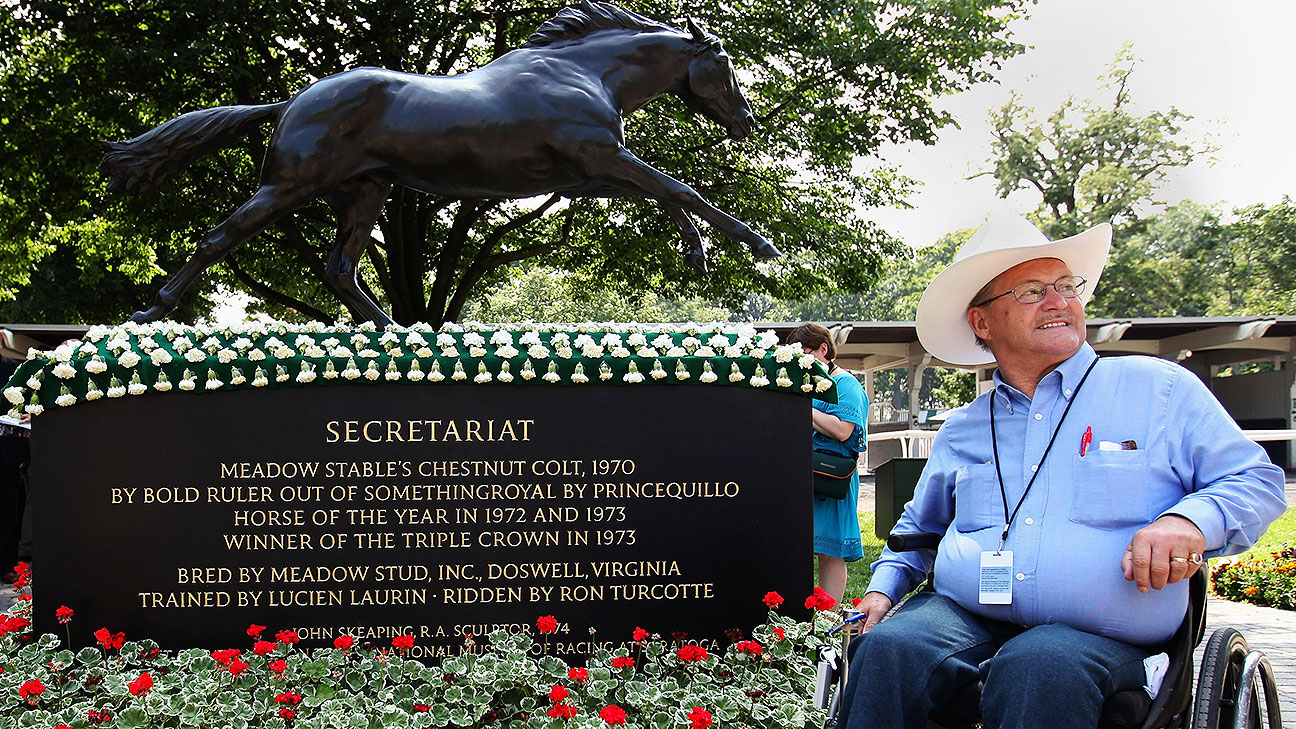
Statues of Secretariat now stand outside the National Museum of Racing and Hall of Fame at Saratoga Race Course in Saratoga, New York; the Kentucky Horse Park and Keeneland Race Course, both in Lexington, Kentucky; and, with Turcotte aboard, in Turcotte's hometown of Grand Falls, New Brunswick, Canada.

Unfortunately, Turcotte himself had a grand fall: During a 1978 race at Belmont, he fell from his mount, and was paralyzed. As of June 9, 2023, he is 81 years old, still lives in Grand Falls, and is an advocate for disability research.
Turcotte at Secretariat's statue at the Kentucky Horse Park

In 1975, Sports Illustrated horse racing writer William Nack, who covered every race "Big Red" ever ran, published Secretariat: The Making of a Champion. In 2010, it served as the basis for the film Secretariat. Diane Lane starred as Penny Chenery, real-life jockey Otto Thorwarth played Turcotte, Kevin Connolly played Nack, and the horse that played Secretariat was not identified. 

Sunday, December 5, 2021

How to Be a Devils Fan On Long Island -- 2021-22 Edition

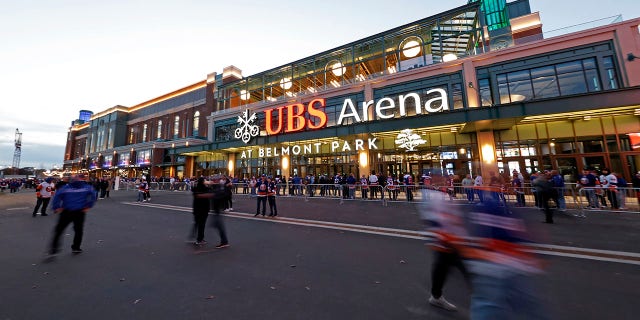
Next Saturday night, December 11, for the 1st time, the New Jersey Devils will play the New York Islanders at the Islanders' new home, the UBS Arena.

The Islanders have made the NHL Eastern Conference Finals in each of the last 2 seasons. To put that in perspective, here are the last 2 "round of four" appearances for the New York Tri-State Area's teams:

* New York Islanders: 2021 and 2020
* New York Yankees: 2019 and 2017
* New York Red Bulls: 2018 and 2016
* New York Rangers: 2015 and 2014
* New York Liberty: 2015 and 2010
* New York Mets: 2015 and 2006
* New Jersey Devils: 2012 and 2003
* New York Giants: 2011 and 2007
* New York Jets: 2010 and 2009
* Brooklyn Nets: 2003 and 2002
* New York Knicks: 2000 and 1999
* New York City F.C.: Has never happened

The fact that Lou Lamoriello, who built the Devils into Champions, is now the Islanders' general manager, shouldn't complicate things. You almost certainly won't be seeing him, so you won't have to boo him, so feel free to boo the team he's assembled.

Before You Go. In New York and North Jersey, anything is possible as far as the weather goes. Temperatures are expected to be in the 50s all day on Thursday, and rain is predicted for much of the day. You might want to bring an umbrella.

It's the Eastern Time Zone, so you don't have to worry about fiddling with your timepieces.

Tickets. The Islanders have been among the trailers in NHL attendance for years. The new arena will probably help that, until two things happen: The novelty wears off, and the team stops winning. But, for now, tickets may be difficult to get. And they will be a hell of a lot more expensive at UBS Arena than they were at the Barclays Center or the Nassau Coliseum.

In the lower level, the 100 sections, seats between the goals are $236. Behind the goal, they're $115. In the upper level, the 200 sections, they're $150 between the goals, and $76 behind the goal. At the back, in the 300 sections, they're $109between and $95 behind.

Getting There. The UBS Arena is 31 miles from the Prudential Center, and 18 miles from Times Square. If you're driving, keep in mind that you will be driving in New York City, and should expect it to take anywhere from 1 hour and 20 minutes to 2 hours.

How should you drive there? Depends on where you want to cross the City. You could take the New Jersey Turnpike north to the George Washington Bridge, then the Cross Bronx Expressway to the Throgs Neck Bridge, and then the Cross Island Expressway south to the Belmont Park complex.

Or, you could take the Turnpike south to the Goethals Bridge, then take the Staten Island Expressway to the Verrazzzano-Narrows Bridge to Brooklyn, and then the Shore Parkway east, and finally the Cross Island Expressway north to the Belmont Park complex.

Or, you could take the Turnpike north to the Lincoln Tunnel, take 36th Street across Manhattan to the Queens-Midtown Tunnel, then the Long Island Expressway, the Cross Island Expressway south to the Belmont Park complex.

Still thinking of driving? I didn't think so. But there is a public transportation option. But it's not as good as it could be. There is a Long Island Rail Road station at Belmont Park, but it only operates on racing days.

So your best move is to get to Penn Station in New York (possibly from the one in Newark), and take the 5:45 PM train on the Long Beach Branch, then transfer at Jamaica at 6:08 to the Hempstead Branch, which will get you to the Elmont Station at 6:26. Then it's a 10-minute walk to the Arena. The fare is $9.25 each way, or $18.50 round-trip.

Once In the "City." Long Island is home to a little under 3 million people, about half of that in each County. The Town of Hempstead has about 760,000, while the "hamlet" of Elmont, the "census-designated place" within Hempstead that includes the Arena, has about 33,000 permanent residents. And, yes, Elmont was, like Belmont Park itself, named for the industrialist August Belmont Jr. (actually, he named them for his father), who also financed the building of New York's Subway.

The ZIP Code for Elmont is 11003, but most ZIP Codes in Nassau County begin with the digits 115 for the West, including for the Coliseum, 11553; and 118 for the East. For Suffolk County, they begin with 117 and 119. The Area Code for Nassau is 516, with 631 split off for Suffolk in 1999.

Aside from the Arena and the Racetrack, there isn't much in Elmont. Essentially, you'll want to get from home to the Arena, see a game, and get out.

Going In. After years of the Nassau Coliseum being inadequate, and being unhappy with the new Barclays Center in Brooklyn, the Islanders explored their options. One was renovating the Coliseum, which has been done, but not on the scale they imagined with the LIghthouse Project -- Capital LI for "Long Island." They considered building a new arena next to the Coliseum, and building one in Queens near an LIRR station. A site adjacent to the Mets' Citi Field was considered.

In late 2017, they finally got a deal for the Belmont Park site outbidding soccer team New York City F.C. for the site. Imagine that: A team owned by the royal family of Dubai lost out to the 3rd-most-popular hockey team in the New York Tri-State Area, over money. 

The official address of the UBS Arena is 2400 Hempstead Turnpike, Elmont, NY 11003. It's 7 miles west down the Hempstead Turnpike, a.k.a. New York State Route 24, from the Nassau Coliseum, on the City Line with Queens, next to the Belmont Park Racetrack. As with their former home with a mailing address of Uniondale, it's part of the Town of Hempstead.
The naming rights were bought by UBS Group AG, the largest private bank in the world, formerly known as United Bank of Switzerland. UBS Arena opened on November 19, 2021, with a concert by the rock band Chicago. No, not an act with Long Island roots, like, say, Billy Joel or Mariah Carey or Public Enemy or even Debbie Gibson. The Islanders played their 1st game there the next day, losing to the Calgary Flames, 5-2. Brad Richardson of the Flames scored the 1st goal, and Brock Nelson got the 1st goal for the Isles.
The rink is aligned north-to-south, and the Islanders shoot twice at the south end. Although it doesn't currently have a permanent basketball tenant, St. John's University (in Jamaica, Queens) and Iona College (in New Rochelle, Westchester County) have already played "home games" there.

The Arena claims "Design inspired by iconic New York landmarks, including Central Park, Ebbets Field, Grand Central Terminal, Park Avenue Armory and Prospect Park Boathouse"; and "More restrooms per person than any arena in Metro New York.

Food. Those of you who've been with the Devils since the Meadowlands days, you know that one level of concourse for two levels of seats simply doesn't work. Unfortunately, the Nassau Coliseum appeared to be the arena on which the Meadowlands was based.

Fortunately, the UBS Arena is an up-to-date facility, with more and better concession stands. It's so varied, it would be difficult to list them all. Instead, here's a link, and you can see for yourselves.

Team History Displays. The Islanders' history is summed up in 4 moments: The 1975 Playoff upset over the Rangers; the 4 and oh-so-close to 5 straight Stanley Cups of 1980 to 1984, including 3 Playoff wins over the Rangers; the 1987 "Easter Epic" Game 7 win over the Washington Capitals; and the run to the 1993 Conference Finals. But since the dawn of the Clinton Administration, they've won nothing. True, they reached the Conference Finals the last 2 seasons, but they did so without finishing 1st in their Division.

The Islanders' 4 Stanley Cup banners now hang on the south side of the arena. Hanging on the west side are single banners for division and conference titles, as opposed to the banners for all of those that hung in the Coliseum: The Conference titles of 1980, '81, '82, '83 and '84; and the Division titles of 1978, '79, '81, '82, '84 and '88. (That's regular-season Division titles, not the "Patrick Division Playoff Champions" that were also available, and which they won in 1978, '79, '80, '81, '82, '83, '84 and '93.)
On the north side of the arena, the Isles feature their retired number banners. All of them are from their Stanley Cup wins: 5, defenseman and Captain Denis Potvin (who, it should be pointed out, did not suck); 9, left wing Clark Gillies; 19, center Bryan Trottier; 22, right wing Mike Bossy; 23, right wing Bob Nystrom; 27, left wing John Tonelli; 31, goaltender Billy Smith; and 91, center Butch Goring. (Goring had worn 19 with the Los Angeles Kings, but switched to 91 upon his arrival in Hempstead, in respect to Trottier.) Gillies, Trottier and Bossy formed "the Trio Grande Line."
The Isles also honor coach Al Arbour and general manager Bill Torrey with banners. Torrey's banner has a bowtie, which he always wore, and the words "The Architect." Arbour, a good defenseman who usually wore Number 3 in his playing days, had been represented by a banner with the number 739 on it, for his coaching wins.

In 2007, when it was noticed that he had coached 1,499 games in the NHL, coach Ted Nolan asked the Isles and the League to allow him to step aside for 1 game, so that Arbour could be a head man for a 1,500th time. It was set up, and the Isles won. A new banner went up with Arbour's name and the number 1500. It made him the oldest man to coach in the NHL, and only Scotty Bowman has coached, or won, more games.
All of these men, except Tonelli, Goring, and Nystrom, scorer of the goal that clinched the 1st Cup in 1980, are in the Hockey Hall of Fame. So is Pat LaFontaine, whose number has not been retired, but he has been elected to the Islanders' Hall of Fame. So have Bob Bourne, Ken Morrow, Patrick Flatley and Kenny Jonsson. Tomas Jonsson, a defenseman from the Cup teams, and no relation to Kenny, has been elected to the International Ice Hockey Federation (IIHF) Hall of Fame. Torrey, Arbour, Morrow and LaFontaine have been awarded the Lester Patrick Trophy for contributions to hockey in America. Arbour died in 2015, and Torrey in 2018. All of the honored players are still alive.

Unfortunately, the plaques for the Islanders' Hall of Fame are next to the team's locker room, and are not accessible to the general public.

Morrow played for the 1980 U.S. Olympic hockey team. Potvin, Bossy, Trottier and Smith were named to The Hockey News' 100 Greatest Players in 1998. So were Sweeney Schriner and Nels Stewart of the old New York Americans. Potvin, Trottier, Smith, Bossy and LaFontaine were named to the NHL's 100th Anniversary 100 Greatest Players in 2017. (Oddly, LaFontaine is not yet in the Hockey Hall of Fame.)

The Islanders and Rangers are one of the nastiest rivalries in the NHL. And one of the closest: Currently the Rangers lead it 152-151, with 19 ties. They've played each other in 8 Playoff series, with the Isles winning 5, although they haven't met in the postseason since the Ranger Cup year of 1994.

Stuff. The Islanders Team Store is on the street level, on the Arena's east side. It is considerably larger than the small one that was on the west side of the Coliseum.

In 2012, to commemorate the team's 40th Anniversary, Greg Prato wrote Dynasty: The Oral History of the New York Islanders, 1972-1984. In 2005, Peter Botte of the Daily News and Alan Hahn of MSG Network picked up the story from the end of the dynasty with Fish Sticks: The Fall and Rise of the New York Islanders.

To celebrate their 15th Anniversary in 1987, the team released Pride of the Island: The New York Islanders Story, which is available on Amazon.com, but only in VHS form. So is Never Say Die: The Story of the New York Islanders, released in 1996.

In 2009, the NHL released the DVD New York Islanders: 10 Greatest Games, but Amazon says it is currently not available. It includes all 4 Cup clinchers, the 1982 Game 5 comeback against the Pittsburgh Penguins, the overtime Playoff clincher against the Rangers in 1984, the 4-overtime Game 7 "Easter Epic" against the Washington Capitals in 1987, the 1993 overtime winner against the Penguins in 1993, a 2002 Playoff win over the Toronto Maple Leafs that featured a penalty shot by Shawn Bates, and Arbour's 1,500th game in 2007 (also against the Penguins). It doesn't, however, include the Game 7 overtime winner against the Capitals by Pierre Turgeon (and his subsequent clobbering by Dale Hunter), the Islanders' most consequential win of the last 30 years.

During the Game. A November 19, 2014 article on The Hockey News' website ranked the NHL teams' fan bases, and listed the Islanders' fans 22nd -- 1 place below the Devils, and well below the Rangers, dead last in the Tri-State Area: "Maybe improved team, move to Brooklyn finally gets people interested in Isles." This prediction proved to be, at the very least, premature.

Islander fans hate the Rangers. They also don't like the Devils -- but their jealousy of our 3 Stanley Cups since 1995 leads them to say we are jealous of them for their 4 Cups, now long ago. Riiiight.

At any rate, they don't especially hate us any more than they hate Philadelphia, Pittsburgh, Washington or Boston. They certainly don't hate us as much as they hate the Rangers. A Ranger fan, wearing a Ranger jersey, took his life into his hands in and around the Nassau Coliseum. That hasn't changed at the Barclays Center. A Devils fan, wearing Scarlet & Black, should be fine, as long as he doesn't provoke Islander fans.

The Islanders used to have mascots. Nyisles (pronounced like Frasier's brother) was "a seafaring islander." He was replaced by Sparky the Dragon, who had already been the mascot for the other team playing at the Coliseum -- no, not the Nets (though the New Jersey version had tried Duncan the Dragon), the Arena Football League's New York Dragons.

The character was retired, and didn't make the trip down the LIRR to Brooklyn. But he was brought back in 2019 for the Coliseum games, and now appears at the UBS Arena.
Sparky

Amanda Kaletsky is the regular National Anthem singer for the Islanders, and sometimes sings it at Mets games as well. Their goal song is "Crowd Chant" by Joe Satriani. The fans had deep attachment to their cheerleaders/cleanup crew, the Ice Girls, but they were replaced by a coed cleanup crew upon the 2015 move to Brooklyn.
But with an Anthem singer like that, who needs Ice Girls?

At least once every period, the whistle to which we have all become accustomed at the Prudential Center, and before that at the Meadowlands, will ring out in the arena where it originated, followed by the chant: "RANGERS SUCK!" (Which... they do.) Islander fans do not, however, add what we add, because they simply don't hate the Flyers as much as we do.

Inevitably, at some people, the Barclays sound system will play "The Chicken Dance," and at the point where most people would do the 4 claps, Islander fans shout, "The Rangers suck!" (Which, as I said, they do.)

After the Game. Getting out of the Nassau Coliseum was difficult. Having just the one concourse, getting out isn't easy. And, if you didn't drive, the distance from the exit to the bus shelter on the Hempstead Turnpike -- especially at night, and especially if it was cold, or wet -- could seem interminable. And the wait for a bus could be just as bad.

At the UBS Arena, it's considerably better, with a shorter walk to Elmont Station, so you don't have to go bus to train to train. Just train to train. And you'll probably be safe. And if there's someone who looks like he's getting a little unruly, just tell him that the Rangers suck. That should turn him around -- or, at least, redirect his anger away from you.

Looking for a good place to have a postgame meal, or just a pint? If you turn east down Hempstead Turnpike, within 4 blocks, you'll find Belmont Deli & Grill. Within 7 blocks, a Wendy's and a Dunkin'. To the west, crossing over the Cross Island Parkway, you'll be in Queens Village, and there's a few Chinese restaurants. However, you're probably better off getting on the train and back to Manhattan before eating.

If you're visiting New York during the European soccer season, as we are now in, there are many places where you can watch your favorite team. The best "football pub" on Long Island, though, is Prost (the German toast, equivalent to "To your health!" or "Na zdrowie!"), at 652 Franklin Avenue in Garden City. You're better off staying in the City, and going to The Football Factory at Legends, at 6 West 33rd Street.

Sidelights. This is where I discuss other sports-related sites in the metropolitan area in question, and then move on to tourist attractions that have no (or little) connection to sports. Since most people reading this will be from the Tri-State Area, I'll keep it short as possible. Indeed, since the focus is on the Long Island team, I'll focus on stuff on Long Island -- but also mention the other current home of the Islanders.

UBS Arena is adjacent to Belmont Park. New York's greatest horse racing track is home to some of the greatest competitions in thoroughbred racing: The Belmont Stakes (the 3rd and final leg of the Triple Crown, the mile-and-a-half "True Test of Champions"), the Jockey Club Gold Cup, the Metropolitan Handicap (a.k.a. the Met Cap), the Manhattan Handicap (a.k.a. the Man Cap), the Champagne Stakes, the Mother Goose Stakes, the Man O' War Stakes, and many others. It has hosted the Breeders' Cup in 1990, 1995, 2001 and 2005.
The Belmont Stakes was previously held in Jerome Park in The Bronx from 1867 to 1890, at Morris Park in the Bronx from 1891 to 1904. Belmont Park opened on May 4, 1905, but the main grandstand was torn down in 1962. From 1963 to 1967, the major Belmont races, including the Belmont Stakes, were run at Aqueduct in nearby Queens. On May 20, 1968, the current grandstand opened, seating 33,000. With infield seating, usually used only for the Belmont Stakes, capacity has reached 120,139, making it the largest sports venue in the Tri-State Area.

Aqueduct Racetrack first opened in 1894, and was rebuilt in time for the 1959 racing season. It annually hosts the Wood Memorial, one of the leading warmup races for thoroughbred racing's Triple Crown. It hosted the Breeders' Cup in 1985, and the Belmont Stakes from 1963 to 1967, while Belmont Park was being rebuilt. 110-00 Rockaway Blvd., in Ozone Park, Queens. A Train to Aqueduct Racetrack.

The official address of the Nassau Coliseum is 1255 Hempstead Turnpike, Uniondale, NY 11553. The mailing address is Uniondale, but it's part of the Town of Hempstead. This arena, built in 1972, wasn't the most convenient of sports venues then, but got a major renovation in 2017, dropping seating capacity to 13,197. 

The Nets and expansion Islanders moved into the brand-new Coliseum in 1972, and while it took the Isles a while to find their bearings, the Nets won right away, including the 1974 and 1976 ABA titles with Julius "Dr. J" Erving, Bill Melchionni and Super John Williamson.
Before the renovation

In 1976, the Nets were invited to join the NBA. But in order to get in, they had to pay the NBA an expansion fee, and pay the Knicks a territorial indemnification fee. As a result, they had to sell Erving to the Philadelphia 76ers. The Nets went from being the best team in a 6-team league to being the worst team in a 22-team league. They had to get out, and they did.

Meanwhile, the Isles were building the team that would win 4 straight Stanley Cups from 1980 to 1983, and win a record 19 straight postseason series from 1980 to 1984. The Coliseum became known as "Fort Neverlose," and the Isles' battles with the Rangers, Philadelphia Flyers and Boston Bruins became legendary.

But after the 1987 Easter Epic, a 4-overtime Game 7 win over the Washington Capitals, the Isles got old in a hurry. Aside from a 1993 trip to the Conference Finals, they've been just another team at best, and pathetic (and poorly-dressed) at worst.

A failed referendum to build a new arena in 2010 led to speculation that they would move to Kansas City, which has built a new arena, but new ownership cut a deal to move them into the Barclays Center, which they did in 2015. But problems with that arena led them to make the deal for the Belmont Park arena, and to split games at the downsized Coliseum. It is now home to the Long Island Nets, a Brooklyn Nets farm team.
After the renovation

Elvis Presley sang at the Nassau Coliseum on June 22, 23, and 24, 1973, and on June 19, 1975. The 1st concert on his Fall 1977 tour was supposed to be there, but it was not to be. It's also hosted many other renowned concerts, including major ones by Long Island native Billy Joel.

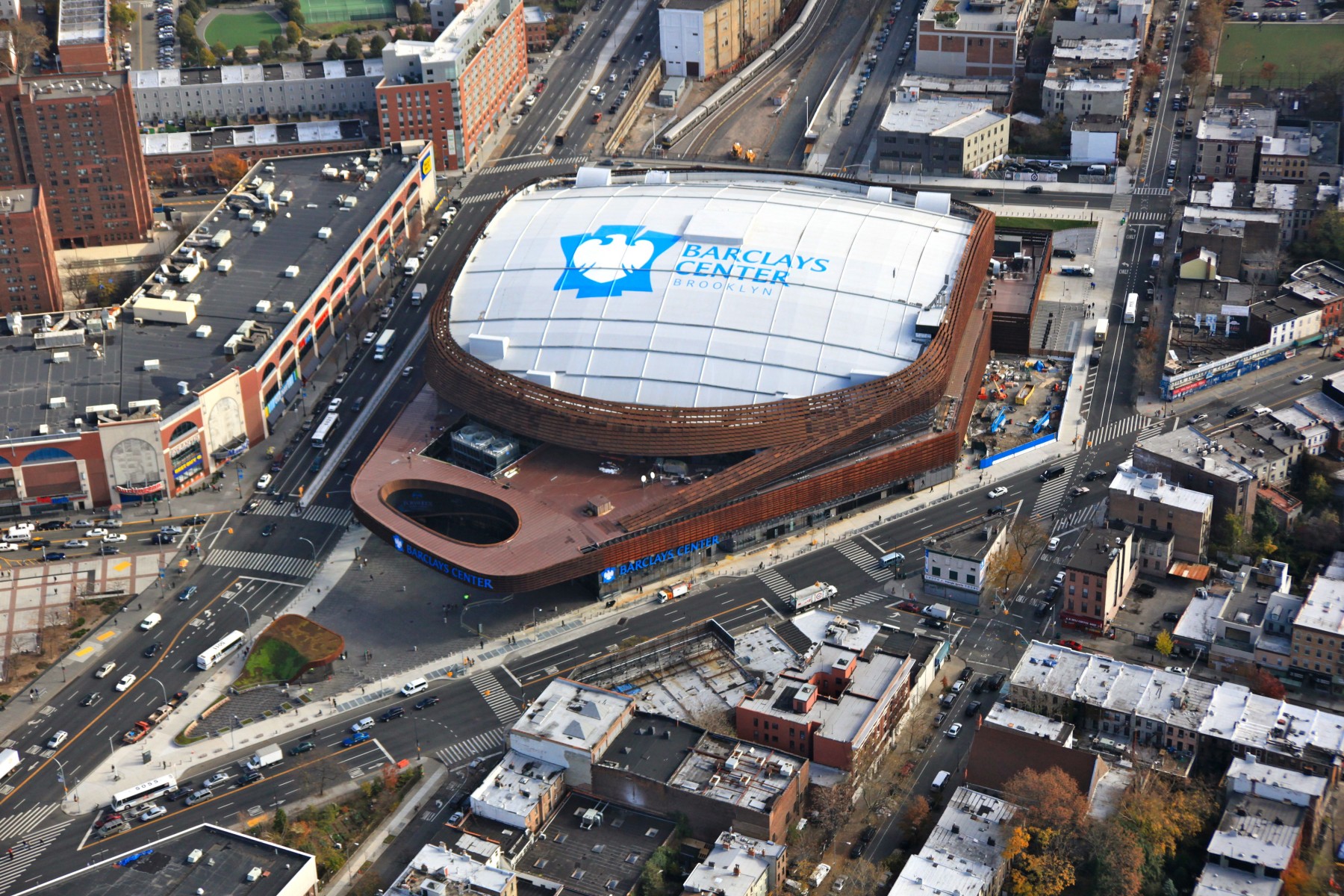
The address of the Barclays Center, perhaps the weirdest-looking building in the entire city, and named for a London-based banking and financial services company, is 620 Atlantic Avenue, at the southern edge of Downtown Brooklyn, intersecting with Flatbush Avenue. It's about 5 miles southeast of Midtown Manhattan, across the street from the LIRR's Atlantic Terminal, and several Subway lines meet there: The 2, 3, 4, 5, B, D, N, Q and R lines.
Very weird-looking.

The best way to get there from Penn Station is to take the 2 or 3; from Port Authority, take the tunnel connecting the 8th and 7th Avenue lines and take the 2, 3, N or Q; from Grand Central, take the 4 or 5.

But its seating capacity is too low (15,795 for hockey, as opposed to 17,732 for basketball), the seats aren't properly aligned for hockey (behind-the-basket seats had to be removed at one end), and the scoreboard, while on-center for basketball, is off-center for hockey. Groundsharing can be fun. In this case, it wasn't.

The Barclays Center opened on September 28, 2012, with a concert by Brooklyn's own Jay-Z. The arena hosted its 1st Heavyweight Championship fight on January 16, 2016, as WBC Champion Deontay Wilder knocked out Artur Szpilka. On November 4, 2017, Wilder returned, and knocked out Bermane Stiverne. On March 3, 2018, Wilder scored a 3rd knockout at the Barclays Center, of Luis Ortiz. 

* Hofstra University. The campus of Long Island's best-known institution of higher learning has its campus to the south of the Coliseum, across the Hempstead Turnpike; and to the west of it, across Earl Ovington Blvd.. To the west is Weeb Ewbank Hall, the former offices and practice facility of the New York Jets.

To the south is most of the school's athletic facilities, James M. Shuart Stadium. Hofstra -- originally the Flying Dutchmen, and now, in a weird nod to political correctness (I don't recall any Dutch-American groups getting upset at the name), the Pride -- no longer plays football. But they do play other sports there, and the new version of the New York Cosmos, as the original version did for a time in the early 1970s, plays their home games there while they look for a stadium closer to The City.

Hofstra's theater, the Leo A. Guthart Cultural Center, hosted the 2nd Presidential Debate of 2008, between Senators Barack Obama of Illinois and John McCain of Arizona; and the 3rd Debate of 2012, between President Obama and former Governor Mitt Romney of Massachusetts. 779 Hempstead Turnpike, at California Avenue, 2 blocks west of Shuart Stadium and 9 blocks west of the Coliseum.

According to an article in the October 3, 2014 edition of The New York Times, the most popular college football teams on Long Island are Syracuse and Notre Dame -- Syracuse in Nassau County, Notre Dame in Suffolk County.

* Long Island Arena. Also known as the Commack Arena, this 4,000-seat barn opened in 1956, and from 1959 until 1973 -- forced into irrelevancy and dissolution by the arrival of the Islanders -- it was home to the Long Island Ducks of the Eastern Hockey League. (There is now an independent minor-league baseball team with that name playing in Central Islip, Suffolk County.)

The ABA team in the New York market arrived, after spending the 1st season of 1967-68 as the New Jersey Americans at the Teaneck Armory, and, to rhyme with the Mets and the Jets, changed their name to the New York Nets -- admittedly, a dumb name with a dumb reason. They were terrible in that 1968-69 season, and found the floor unacceptable, full of pits and gouges, and with condensation from the ice beneath coming up, making it slick. After 1 season, the Nets moved again, for reasons that had little to do with poor attendance or performance.

John F. Kennedy made campaign stops at both the Teaneck Armory and the Long Island Arena on November 6, 1960, 2 days before he was elected President. Part of Peter Frampton's album Frampton Comes Alive! was recorded there. It housed an indoor flea market before being closed and demolished in 1996. A shopping center is now on the site. 88 Veterans Memorial Highway at Sunken Meadow Parkway. Not really reachable by public transportation.

* Island Garden. Built across the street from the original Island Garden, which hosted rock concerts from 1957 to 1968, the Nets managed to stay here for 3 seasons, from 1969 to 1972, including Rick Barry's ABA scoring leader season in 1971 and their 1st Division title in 1972.

The opening of the Nassau Coliseum made the Island Garden's 8,500 seats obsolete. (Yes, kids, the "Mausoleum" made another arena obsolete.) It was partly demolished in 1973, and, as with the Long Island/Commack Arena, a shopping center is on the site today. But so is a part of the original arena, and youth basketball is still played there. 45 Cherry Valley Avenue at Terminal Road, West Hempstead. LIRR Hempstead Branch to Queens Village, then transfer to MTA N6 bus.

* Bethpage Ballpark. This 6,002-seat stadium, about 45 miles east of Midtown Manhattan and 20 miles east of the Nassau Coliseum, opened in 2000, and had 4 different names in just 10 years (now 15 seasons of play). Bethpage Federal Credit Union bought the naming rights in 2010, so it has the name of that Suffolk County town, even though it's not in that town.

The Ballpark is home to the Long Island Ducks, named for the old minor-league hockey team, which was named for the many duck farms in Suffolk County. The Ducks have won the Atlantic League Pennant in 2004, 2012 and 2013, and have usually led the League in attendance. Former Met shortstop Bud Harrelson is a part-owner, was their first manager, and is now the 3rd base coach (as he was for the last Met title in 1986), and Gary Carter managed them to a Playoff berth in 2010.

3 Court House Drive, Central Islip. Not really reachable by public transportation: The closest LIRR station is in Central Islip, over 2 miles away.

* Sagamore Hill. Theodore Roosevelt, the only native of New York City legitimately elected President, kept his permanent residence for most of his adult life at Sagamore Hill in Oyster Bay. 20 Sagamore Hill Road. LIRR to Oyster Bay, then it's 2 miles east, and 1 mile north up a steep hill. Don't walk it: Call a taxi.

Lots of movies have been shot on Long Island, including Citizen Kane (Oheka Castle in Huntington stood in for Kane's Xanadu), The Godfather (James Caan's Sonny Corleone was whacked at a toll booth temporarily erected at Mitchel Field in Uniondale), The Amityville Horror, The World According to Garp (Fisher's Island stood in for coastal Maine), Trading Places (Mill Neck Manor was the home of the villainous Duke brothers), Married to the Mob (shot all over the Island, if you'll pardon my choice of words), Born On the Fourth of July (based on the memoir of Massapequa native Ron Kovic), and John Wick (Republic Airport in Farmingdale was used).

In Old Westbury, the Phipps Estate stood in for both the mansion of the villain played by James Mason in North By Northwest and the home of the hero played by Ryan O'Neal in Love Story. Also in Old Westbury, the Knole Estate stood in for the home of the titular characters in Arthur and The Devil's Advocate.

The most famous work of popular culture set on Long Island, F. Scott Fitzgerald's 1925 novel The Great Gatsby. East Egg is Great Neck, Nassau County; West Egg is Little Neck, Queens; and the "valley of ashes," halfway between Midtown Manhattan and East Egg is Flushing Meadow, roughly where the Mets eventually moved. It's been made into a movie 5 times, but on none of those occasions was it filmed on Long Island: The 1926 and 1949 versions filmed in Southern California; the 1974 version in Newport, Rhode Island; the 2000 version in Montreal; and the 2013 version in Australia, homeland of its director, Baz Lurhmann.

TV shows set on Long Island have included Silver Spoons, Growing Pains and Everybody Loves Raymond. The Gellers and the Greens of Friends were said to be from Long Island, and there were hints (but never proof) that The Wonder Years was set there.

And Long Island has its beaches: Jones Beach, Fire Island, the Hamptons.

*

Getting out of the Nassau Coliseum, as it then was, was a good thing for the Islanders. And, physically/geologically, if not culturally, Brooklyn is still on Long Island. So the identity still works.

Now, they are back on Long Island, at least part-time. Soon, it will be full-time again.

Sunday, June 10, 2018

The True Test of Champions

The Belmont Stakes, at a mile and a half the longest of thoroughbred horse racing's "Triple Crown" events, is known as "The True Test of Champions."

Justify, trained by Bob Baffert and ridden by Mike Smith, won it on Saturday. Justify had previously won the Kentucky Derby and the Preakness Stakes, so winning the Belmont gave him the Triple Crown.

He is the 2nd horse in the last 4 years to win it, after American Pharoah did it in 2015, and the 13th overall. His great-great-grandfather, Seattle Slew, did it in 1977. And Slew's father, Secretariat, did it in 1973. So that's one heck of a lineage.

Justify had won both the Derby and the Preakness on sloppy tracks, and I'm sure lots of people were saying that he wouldn't win the Belmont if the track was in good shape.

I'm starting to think the opposite may have been true: That if the first two tracks had been in good shape, he would have lost those races, but still won the Belmont. At any rate, he won all three, none was a fluke, and he is a true champion.

*

The Washington Capitals won the Stanley Cup on Thursday night. They overcame their past, 43 previous seasons with no Cup, many of them ending in nasty chokes; their greatest team nemesis, the Pittsburgh Penguins, something of a regional rival; and their greatest individual nemesis, Marc-Andre Fleury, the goaltender for 3 Cup-winning Penguin teams, now with the Vegas Golden Knights, whom the Caps beat 4 straight after dropping Game 1.

The Caps faced their demons, and beat them all. They faced a true test of champions, and passed with flying colors.

*

The Golden State Warriors won the NBA Championship on Friday night. They are 1 win in 2016 short of 4 straight titles. This time, they needed hard-fought wins in Games 6 and 7 of the Western Conference Finals against the Houston Rockets, before they swept the Cleveland Cavaliers and their easily-quitting leader LeBron James in 4 straight.

It's one thing to show a lot of character. It's another thing to utterly dominate. The Warriors did one, then the other, to win the title. They passed a true test of champions.

*

The Yankees, of course, are in Major League Baseball. A regular season of 162 games, plus a postseason where you have to win 11 out of a possible 19 games, is a true test of champions. As is England's Premier League: 38 games, one home and one away against each of the other 19 teams in the League.

A true test of champions is not supposed to be easy. Otherwise, it would not be a true test.

Saturday, June 6, 2015

How Long It's Been: A Horse Won the Triple Crown

American Pharoah won the Belmont Stakes today, completing the Triple Crown of thoroughbred horse racing.

On May 2, at Churchill Downs in Louisville, Kentucky, he won the Kentucky Derby. I didn't watch it.

On May 16, at Pimlico Race Course in Baltimore, he won the Preakness Stakes. I was taking a beach day, and hadn't intended to watch it, but found myself inside Caesar's Atlantic City, and watched it.

Today, June 6, 2015 -- the 71st Anniversary of D-Day -- he won the Belmont, known for its mile-and-a-half length, and for 37 years of horses being unable to complete the Triple Crown, as "the true test of champions." This time, I watched.

I saw him leading halfway through, at the three-quarter-mile mark. I got a bad feeling, because leading the whole way is a bad sign, especially at the Belmont.

When the horses rounded the final turn, and entered the last straightaway, he was keeping the three-quarters-of-a-length lead he'd held most of the way, and I was thinking of how Smarty Jones was leading at that point in the 2004 Belmont, and blew it, and I said, "Don't blow it, don't blow it, don't blow it... " As if the horse could hear me through the TV, and over the yelling of the fans -- and could understand English.

When he began to increase that lead, making it all but impossible for him to be caught, I began thinking of Barbaro, who won the Kentucky Derby in 2006, but was injured in the Preakness Stakes, and, despite prolonged medical efforts, had to be put to sleep. So I said to the TV, "Don't break down, don't break down, don't break down... "

He didn't. He won the race in 2 minutes, 25.65 seconds. I pumped my fist and yelled, "Yes!" as he crossed the finish line, well in front, and with no sign of injury.

He is trained by Bob Baffert, and was ridden in all 3 races by Victor Espinoza, a 43-year-old Mexican jockey who thus won his 1st Belmont, and had won the Derby and the Preakness twice each before American Pharoah made it 3 each. It's important to remember that not only had no horse done it in a long time, but neither had any jockey, nor any trainer.

American Pharoah is the 12th horse to win the Triple Crown. Here they are, as follows:

1. 1919: Sir Barton, ridden by Johnny Loftus, trained by Guy Bedwell.

2. 1930: Gallant Fox, ridden by Earl Sande, trained by "Sunny Jim" Fitzsimmons.

3. 1935: Omaha, son of Gallant Fox, ridden by Willie "Smokey" Saunders, trained by Fitzsimmons, the only man to train 2. Both Gallant Fox and Omaha, the only father-son combo to do it, were owned by, born, raised and trained at Belair Stud.

4. 1937: War Admiral, ridden by Charley Kurstinger, trained by George H. Conway. A year later, WAar Admiral famously lost a match race to Seabiscuit, who did not compete in any of the Triple Crown races at age 3 in 1936, because he was then so lightly regarded, and didn't blossom until age 4, much like 1950s horse Kelso and 1980s horse John Henry.

War Admiral was the son of Man o' War, who ran in 1919 and 1920, and famously lost only 1 of the 21 races he ran, to a horse whose name has, ever since, been applied to any event where the expected winner did not win: Upset. But since the Triple Crown wasn't yet a big thing, even in the wake of Sir Barton, the drive to win all 3 wasn't there. Man o' War did win the 1920 Belmont, but did not run in the other 2. In 1922, Pillory won the Preakness and the Belmont, but couldn't run in the Derby, as it was held on the same day of the Preakness.

5. 1941: Whirlaway, ridden by Eddie Arcaro, trained by Ben A. Jones.

6. 1943: Count Fleet, ridden by Johnny Longden, trained by Don Cameron.

7. 1946: Assault, ridden by Warren Mehrtens, trained by Max Hirsch.

8. 1948:  Citation, ridden by Arcaro, the only man to ride 2, trained by Jimmy Jones. Citation was a product of Calumet Farm, as was Whirlaway, making Calumet and Belair the only 2 "homes" of 2 Triple Crown winners. Then there was a 25-year drouht, until...

9. 1973: Secretariat, ridden by Ron Turcotte, trained by Lucien Laurin. Secretariat not only won all 3, but set records in all 3. His records for the Derby and the Belmont still stand. He famously won the Belmont by a whopping 31 lengths. I'm waiting for Kanye West to say, "Yo, American Pharoah, I'm-a let you finish, but Secretariat ran the greatest Belmont ever!"

10. 1977: Seattle Slew, ridden by Jean Cruget, trained by William H. Turner Jr. I was only 3 years old when Secretariat ran, so Seattle Slew was the first Triple Crown winner I can remember.

11. 1978: Affirmed, ridden by Steve Cauthen, trained by Laz Barrera. Later in the year, in the only races ever to match 2 Triple Crown winners, Seattle Slew beat Affirmed, and all other horses in the races, twice. In 1980, Affirmed's sister, Genuine Risk, became the 1st filly to win the Derby in 75 years. After Affirmed, there was a drought of 37 years, until...

12. 2015: American Pharoah, ridden by Victor Espinoza, trained by Bob Baffert. At 43, Espinoza is the oldest jockey to achieve the feat. The horses have all been 3 years old.

23 horses have won the Derby and the Preakness, but not the Belmont, 13 of them between Affirmed and American Pharoah:

* In 1979, Spectacular Bid allegedly stepped on a safety pin on the morning of the Belmont, and finished 3rd.
* In 1981, Pleasant Colony finished a close 3rd.
* In 1987, Alysheba finished 4th.
* In 1989, Sunday Silence finished a distant 2nd to his much-hyped rival, Easy Goer.
* In 1997, Silver Charm finished just 3/4 of a length behind Touch Gold, the closest any horse had yet come to winning it without doing so.
* In 1998, Real Quiet came even closer, a photo finish showing him coming in just a nose behind Victory Gallop.
* In 1999, Charismatic broke his leg late in the Belmont, losing to Lemon Drop Kid by a length and a half. Jockey Chris Antley, seeing something was wrong, chose to pull him up and, possibly, save the horse's life, rather than push him onward and have a Triple Crown winner euthanized right there on the track. Antley had a drug addiction that would kill him not long afterward, but he saved the life of a champion. After 3 straight near-misses, people began wondering if the Belmont was jinxed. Sports fans can be superstitious people, and horse racing fans are not only no exception, but more so than most.
* In 2002, War Emblem stumbled coming out of the gate, and finished 8th. Sarava won the race with the longest odds of any Belmont winner ever: 70-1.
* In 2003, Funny Cide finished 3rd.
* In 2004, Smarty Jones led most of the way, but ran out of gas, and lost to Birdstone by a length.
* In 2008, Big Brown was pulled up, finishing last, but his life was saved.
* In 2012, I'll Have Another was found to have a tendon injury the day before the race, and was scratched.
* In 2014, just last year, California Chrome was stepped on by another horse coming out of the gate, and ran the race with an injured heel, finishing 4th.

If there was a jinx, American Pharoah ended it today.

*

The last Triple Crown winner in thoroughbred racing was Affirmed, who beat Alydar (father of the aforementioned Alysheba) in all 3 races, by less each time. Affirmed died in 2001, and Seattle Slew a year later, so for 13 years there have been no living Triple Crown winners.

Affirmed completed his Triple Crown on June 3, 1978. That's 37 years and 3 days. How long has that been?

Horse racing was still a relatively healthy sport then. Interest had been jacked up by 3 Triple Crown winners in the past 6 seasons, plus the tragic 1975 match race at Belmont Park that left Ruffian, who won the fillies' version of the Triple Crown, injured and humanely put down, against Foolish Pleasure, who had won the Derby but finished 2nd in the other 2 races.

The thought of horse racing becoming a minor sport, and being in serious financial trouble, was then inconceivable. Today, many racetracks, including the Meadowlands and Monmouth Park here in New Jersey, have legalized casino-style gambling, as well as simulcasting from other tracks, allowing for extra betting. Pimlico, site of the Preakness, is in danger of having to close, meaning that the race would have to be moved.

(Major horse races usually don't get moved. A notable exception is one of the major harness races, the Hambletonian Stakes, which has been run since 1926, but has had multiple sites, until settling at the Meadowlands in 1981.)

The defending World Champions in the major sports were the Yankees in baseball, the Dallas Cowboys (ew) in the NFL, the Montreal Canadiens in hockey, and the Portland Trail Blazers in the NBA. Four days after Affirmed completed his Triple Crown, the Washington Bullets (now Wizards) won their 1st NBA title. (While the Yankees, Cowboys and Canadiens have combined for 12 titles since, neither the Blazers nor the Bullets/Wizards have ever won again.) The Heavyweight Champion of the World was Leon Spinks, who had recently taken it from Muhammad Ali, but Ali would soon take it back.

Few of the great athletes of today had yet been born. Notable baseball players yet born who are still active today include LaTroy Hawkins (the current oldest, at 42), Bartolo Colon, Ichiro Suzuki and R.A. Dickey. From the NBA, Tim Duncan, Manu Ginobli, Kevin Garnett and Paul Pierce, all still active today, had been born. Hockey player Jaromir Jagr was 6 years old. Peyton Manning was 2, Tom Brady was 10 months old.

The managers and head coaches of the New York teams in question? Yankees, Billy Martin; Mets, Joe Torre -- yes, that Joe Torre; Giants, John McVay (not John McKay); Jets, Walt Michaels; Knicks, Willis Reed was in his one-season interruption of the long tenure of Red Holzman; Rangers, Jean-Guy Talbot; and Islanders, Al Arbour. The New Jersey Devils were still the original hockey version of the Colorado Rockies.

What were the current Tri-State Area managers and head coaches doing in June 1978? Tom Coughlin of the Giants was the offensive coordinator at Syracuse University; Lionel Hollins of the Nets was starring for the defending NBA Champion Trail Blazers; Terry Collins of the Mets was a shortstop in the minor-league system of the Pittsburgh Pirates; Alain Vigneault of the Rangers was in high school at a defenseman with the "major junior" hockey team the Hull Olympiques, outside Ottawa; Todd Bowles of the Jets was at Elizabeth High School in New Jersey; Joe Girardi of the Yankees and Jack Capuano of the Islanders were in junior high school; Derek Fisher of the Knicks was about to turn 4; and John Hynes of the Devils was 3. (Yes, I will be doing a piece on new Devils hire Hynes, hopefully within the next few days.)

The World Cup was about to be held in Argentina, and has since been held in Spain, Mexico, Italy, America, France, Japan, Korea, Germany, South Africa and Brazil. The Olympics have since been held in America 3 times, Canada and Russia twice each, Bosnia, Korea, France, Spain, Norway, Japan, Australia, Greece, Italy, China and Britain.

There were 26 Amendments to the Constitution of the United States. (There are now 27.) The idea that corporations were "people" and thus entitled to the rights and protections thereof, was ridiculous -- but so was the idea that two people of the same gender could get married and half the rights and protections of marriage. The U.S. Supreme Court has since changed both.

The President of the United States was Jimmy Carter. Gerald Ford and Richard Nixon, their wives, and the widows of Lyndon Johnson, John F. Kennedy, Dwight D. Eisenhower and Harry Truman were all still alive.

Ronald Reagan and George H.W. Bush were out of office, and preparing campaigns for the Presidency in 1980. Bill Clinton was Attorney General of the State of Arkansas, and running for Governor. George W. Bush was making his 1st run for public office, for Congress from his home district in Texas. Barack Obama was in high school.

The Governor of the State of New York was Hugh Carey. The Mayor of the City of New York was Ed Koch. Both were at Belmont that day. The Governor of New Jersey was Brendan Byrne. Andrew Cuomo was attending Fordham University, while Bill de Blasio and Chris Christie were in high school.

The monarch of Great Britain was Queen Elizabeth II -- that hasn't changed -- but the Prime Minister was James Callaghan, and of Canada, Pierre Trudeau. England's Football League had just been won in an upset by Brian Clough's Nottingham Forest, and the FA Cup in an equally surprising result by Bobby Robson's Ipswich Town, over Arsenal.

Amnesty International was the current holder of the Nobel Peace Prize. The Pope, in the last few weeks of his reign and life, was Paul VI. The current Pope, Francis, was Bishop Jorge Mario Bergoglio, the provincial superior of the Society of Jesus (a.k.a. the Jesuits) in his native Argentina. There have since been 6 Presidents of the United States, 6 Prime Ministers of Britain, and 5 Popes.

Major novels of 1978, all of which became major motion pictures, included Eye of the Needle by Ken Follett, The Year of Living Dangerously by Christopher Koch, and a pair of eventual Robin Williams vehicles: The World According to Garp by John Irving and What Dreams May Come by Richard Matheson. Stephen King published The Stand, and William Luther Pierce III, under the pen name Andrew Macdonald, published The Turner Diaries, imagining a white supremacist uprising that takes over the United States and exacts revenge against blacks and Jews.

Like most right-wing literature, it's not only abominable sociology, it's bad writing. (By a weird retroactive coincidence, Pierce was born on a September 11, and, already dying of cancer, praised the perpetrators of the 9/11 attacks.)

Stephen King was about to publish The Stand. George R.R. Martin was writing Sandkings. J.K. Rowling was about to turn 13. No one had yet heard of literary characters Arthur Dent, Jason Bourne, Hannibal Lecter, Kinsey Millhone, Celie Harris, Forrest Gump, Jack Ryan, Alex Cross, Bridget Jones, Harry Potter, Robert Langdon, Lisbeth Salander, Bella Swan or Katniss Everdeen. Comic book characters V, Deadpool and Rick Grimes had yet to debut.

Dallas and Fantasy Island all recently debuted on American TV. They didn't have much in common, although with Dr. David Banner, J.R. Ewing, and Mr. Roarke, I don't think you wanted to make any of them angry. Shows getting ready to premiere in the fall included the original version of Battlestar Galactica, Taxi, WKRP in Cincinnati, Diff'rent Strokes, The White Shadow, and Mork & Mindy, starring the aforementioned Robin Williams. The Carol Burnett Show, The Bob Newhart Show, Maude, Columbo, Baretta, and both The Six Million Dollar Man and its spinoff The Bionic Woman, had aired their last first-run episodes.

The panelists on the episode of Match Game that aired that week were Gary Burghoff, Brett Somers, Charles Nelson Reilly, Hope Lange (the star of the late 1960s sitcom The Ghost & Mrs. Muir, which also had Reilly as a regular), Richard Dawson and Patti Deutsch. Kris Houghton was about to marry Robert Kardashian, and (as far as I know), neither of them had ever met Bruce Jenner.

No one had yet heard of such TV icons as Sam Malone, Christine Cagney & Mary Beth Lacey, Zack Morris, Hayden Fox, Dale Cooper, the Seinfeld Four, Buffy Summers, Fox Mulder, Andy Sipowicz, Ross Geller & Rachel Greene, Doug Ross, Xena, Carrie Bradshaw, Tony Soprano, Jed Bartlet, Jack Bauer, Omar Little, Leroy Jethro Gibbs, Michael Bluth, Michael Scott, Don Draper, Walter White, Jax Teller, Richard Castle, Ceslie Knope or Sarah Manning.

Nor had anyone yet heard of animation or video game legends such as Mario, He-Man, the Teenage Mutant Ninja Turtles, Goku, the Thundercats, Bart Simpson, Ash Ketchum or Master Chief.

Christopher Reeve was about to debut in film as Superman, and CBS had Lynda Carter as Wonder Woman, Nicholas Hammond as Spider-Man, Lou Ferrigno as the Hulk, and Reb Brown as Captain America. But Adam West was still the most recent live-action Batman, with Olan Soule voicing him on Super Friends (which also had Danny Dark as Superman and Shannon Farnon as Wonder Woman). Roger Moore was playing James Bond, and Tom Baker The Doctor.

No one had yet heard of Mad Max, Jason Voorhees, Ash Williams, John Rambo, the Terminator, the Ghostbusters, Freddy Kreuger, Marty McFly, Robocop, John McClane, Jay & Silent Bob, or Austin Powers.

Gene Roddenberry, having heard that Paramount Pictures had shut down its idea for a 4th major TV network, had begun turning his previously accepted idea for an anchor series, Star Trek: Phase II, into Star Trek: The Motion Picture. George Lucas had begun working on Star Wars, Episode V: The Empire Strikes Back. Stephen Spielberg was filming John Belushi in the war-themed comedy 1941, and it would be one of the few flops that either would have.

Michael Jackson was playing the Scarecrow in a film version of The Wiz, a black version of The Wizard of Oz, with Diana Ross as Dorothy and Richard Pryor as The Wiz. Elvis Presley had died a year earlier. Frank Sinatra had recently organized a star-studded benefit in Las Vegas for ailing former Heavyweight Champion Joe Louis. The Number 1 song in America was "Too Much, Too Little, Too Late," a duet between veteran Johnny Mathis and newcomer Deniece Williams. Within days, Bob Dylan would release his album Street-Legal.

The Buddy Holly Story, starring Gary Busey as the rock and roll pioneer, had just been released to theaters. John Belushi and Dan Aykroyd had recently debuted The Blues Brothers on Saturday Night Live, having previously tried the idea out as The Killer Bees, which Belushi hated. A parody of the Beatles, The Rutles: All You Need Is Cash, and Ringo Starr's special Ringo had both aired on NBC. George Harrison had assisted with each. What John Lennon and Paul McCartney thought of either, I don't know. Paul and his band Wings had a Number 1 hit with "With a Little Luck," while John was still in his self-imposed "househusband" exile from music.

Inflation was such that what $1.00 bought then, $3.66 would buy now. A U.S. postage stamp cost 15 cents, and a New York Subway ride 50 cents. The average price of a gallon of gas was 65 cents, a cup of coffee 74 cents, a McDonald's meal (Big Mac, fries, shake) $1.65, a movie ticket $2.33, a new car $4,645, and a new house $61,600. The Dow Jones Industrial Average closed the day before (a Friday) at 847.54.

The tallest building in the world was the Sears Tower in Chicago. Hardly anybody had mobile telephones, and they were huge. Automatic teller machines were still a relatively new thing, and many people had never seen one. There were heart transplants, liver transplants and lung transplants, and artificial kidneys, but no artificial hearts. There were birth control pills, but no Viagara.

Pong was widely available, but the Atari 2600 video game system hadn't yet caught on. Space Invaders was about to turn arcades from pinball-dominated to video-game-dominated. Personal computers were just beginning, with the Commodore VIC-20 still the leader. Apple was way off. Most people had never heard of Steve Jobs or Bill Gates, and almost no one outside his inner circle had heard of Tim Berners-Lee.

In the Spring of 1978, Italy's former Prime Minister Aldo Moro was found, assassinated. A coup took place in the African nation of Comoros. Despite being 53 years old, Mavis Hutchinson became the 1st woman to run across America, doing it in 69 days. Atlantic City's 1st legal casino opened, Resorts International, in the former Haddon Hall hotel. (It still stands, at 1133 Boardwalk, under the name Resorts Casino Hotel, and, in a nod to when the first building in the complex was built, has a Roaring Twenties theme.) In baseball, Pete Rose collected his 3,000th career hit. His 44-game hitting streak was yet to begin. 

Aram Khachaturian, and Robert Menzies, and Lucius Clay died. Maria Menounos, and Brian Urlacher, and Dirk Nowitzki were born.

June 3, 1978. Affirmed, with Steve Cauthen aboard, won the Belmont Stakes, and with it the Triple Crown.

Now, American Pharoah has done it again, after 37 years. Let's hope we don't have to wait 37 years for another -- or even 25 years, like it was between Citation in 1948 and Secretariat in 1973.