Showing posts with label arnie ferrin. Show all posts

Wednesday, December 28, 2022

Arnie Ferrin, 1925-2022

Arnie Ferrin was a legend. And you've probably never heard of him.

Chariton Arnold Ferrin Jr. was born on July 29, 1925 in Salt Lake City, Utah, and grew up in Ogden, Utah. In 1944, he led the University of Utah to the Championship of the NCAA Tournament, beating Dartmouth in the Final. He became the 1st freshman to win the Tournament's Most Outstanding Player award. He and teammate Fred Sheffield had the Utes on a path to repeating in 1945, but World War II was still raging, and both were drafted, and unavailable for the Tournament.

Although Ferrin returned to help Utah win the National Invitational Tournament in 1947 -- until the 1951 point-shaving scandal, still considered bigger than the NCAA -- Utah didn't reach the NCAA Final Four again until 1961. Ferrin became Utah's 1st, and is still its only, 4-time All-American. They have retired his Number 22.

He was selected by the Minneapolis Lakers in the 3rd Round of the 1948 NBA Draft. The Lakers had just joined the NBA from the National Basketball League, where, led by George Mikan, they had won the previous season's Championship. Ferrin became part of a dynasty that included 6 men who would be elected to the Basketball Hall of Fame: Himself, Mikan, Jim Pollard, Vern Mikkelsen, Slater Martin and head coach John Kundla. (Clyde Lovellette would not reach the Lakers until Ferrin left, but would also win a Championship with them, and be elected to the Hall.)

The Lakers won the NBA Championship in 1949 and 1950, and reached the Western Conference Finals in 1951, leading to 2 titles for Ferrin. After he left, they won the title again in 1952, 1953 and 1954.
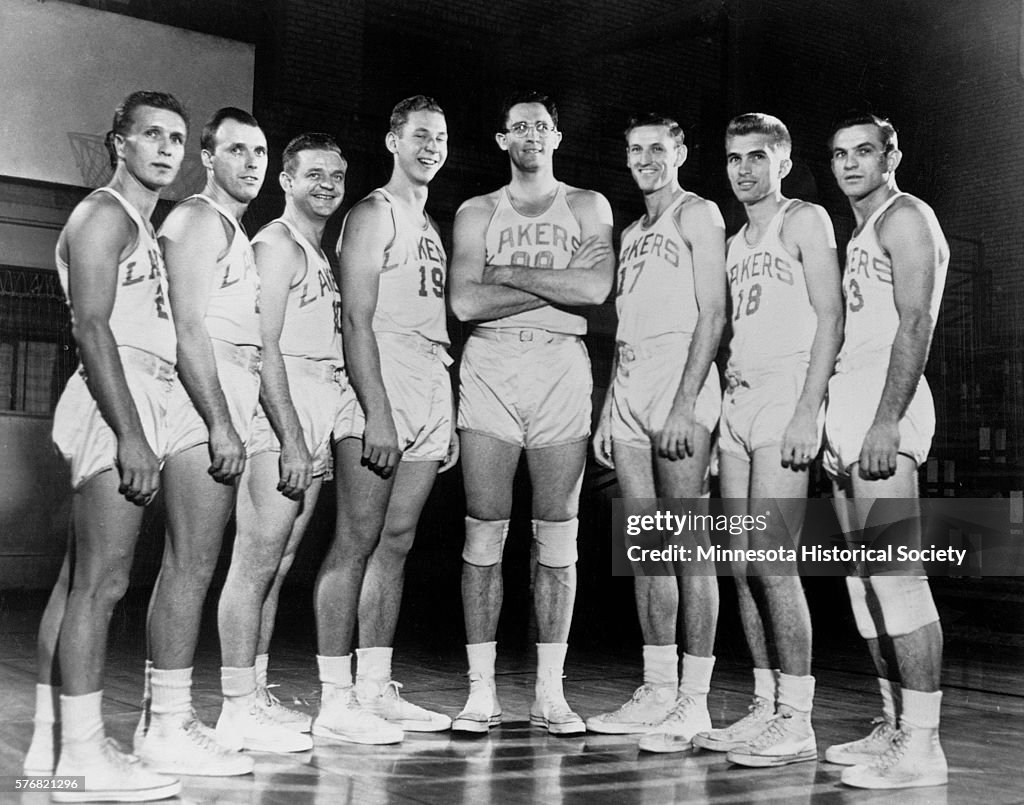
The 1950 NBA Champion Minneapolis Lakers. Left to right:
Slater Martin, Don Carlson, Herman Schaefer, Vern Mikkelsen,
George Mikan, Jim Pollard, Arnie Ferrin (Number 18), and Tony Jaros.

Ferrin returned to the University of Utah, as a broadcaster for their basketball and football teams. From 1972 to 1974, he was the general manager of the Utah Stars of the American Basketball Association. The Stars had won the ABA Championship in 1971, and reached the Finals again under his leadership in 1974.

He went back to the University of Utah in 1976, and served as athletic director until 1985. The school was 10 National Championships across various sports, including 4 in gymnastics under head coach Greg Marsden. The basketball team was then coached by Jerry Pimm, winning 3 Western Athletic Conference titles.

He was elected to the Basketball Hall of Fame, the National Collegiate Basketball Hall of Fame, the Utah Sports Hall of Fame, and, with the University of Utah's move to the Pacific-12 Conference, the Pac-12 Hall of Honor.
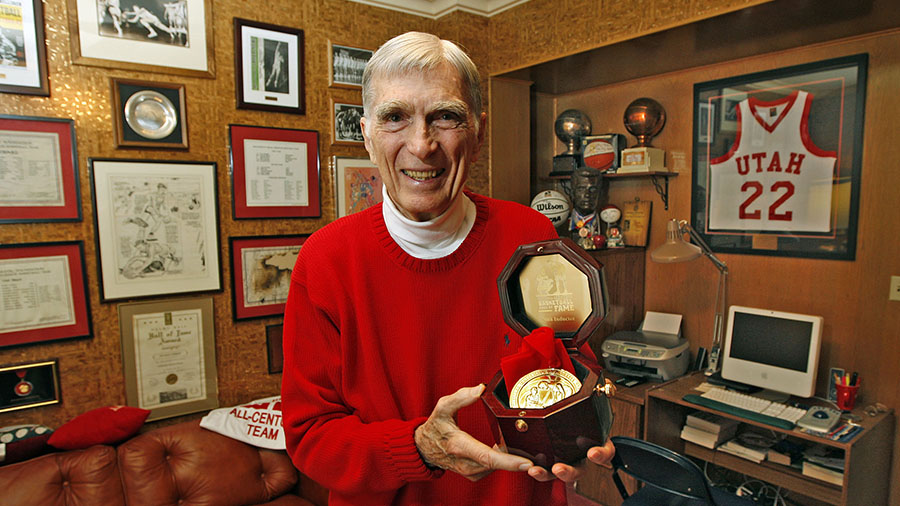
He and his wife, RoLayne Rassmussen, had four children: Chariton Arnold Ferrin III, a.k.a. Tres Ferrin, Richard, Louanne and Shawn. He had 8 grandchildren, 2 of whom were also sons named Chariton, although neither was a Chariton Arnold Ferrin IV. He lived to see 12 great-grandchildren and 4 great-great-grandchildren. After RoLayne's death, he married again, to Patricia Panos, who survived him. He was a speedboat enthusiast, and was twice a semifinalist in the Utah State Amateur Golf Championship.

Arnie Ferrin died on December 27, 2022, of natural causes. He was 97 years old. He was the last surviving member of Utah's 1944 National Champions, and the last surviving member of the 1949 NBA Champion Minneapolis Lakers. With his death, there are 2 surviving members of the 1950 NBA Champion Lakers, the earliest surviving NBA Champions: Bob Harrison and Bud Grant. Yes, the same Bud Grant who would later coach the Minnesota Vikings to 4 NFC Championships.

Ferrin had also played in the 1950 game in which the Fort Wayne Pistons held the ball so much, to keep it away from Mikan, that it became the lowest-scoring game in NBA history: Pistons 19, Lakers 18. This inspired the institution of the 24-second shot clock. Harrison and Grant are also the last 2 surviving players from that game.

And Bob Cousy, with the College of the Holy Cross in 1947, is now the earliest surviving member of a team that won the NCAA Tournament.

UPDATE: Ferrin's final resting place is not publicly known.

Thursday, January 4, 2018

Top 10 Athletes From Utah

January 4, 1896: Utah is admitted to the Union as the 45th State.

Top 10 Athletes From Utah

Honorable Mention to Missy Marlowe of Salt Lake City. The University of Utah gymnast won the 1991-92 Honda-Broderick Cup as the outstanding female collegiate athlete of the schoolyear. However, her best Olympic finish was a 4th in Seoul in 1988.

Honorable Mention to Steve Konowalchuk of Salt Lake City. The 1st hockey player born in Utah, and the 1st trained there, to make it to the NHL, he played 14 seasons as a left wing, mostly with the Washington Capitals, scoring 171 goals. He helped the U.S. win the 1996 World Cup of Hockey, and the Caps reach their only Stanley Cup Finals so far, in 2008.

A newly-detected heart condition forced him to retire as a player shortly before his 34th birthday. He is now an assistant coach for the Anahiem Ducks.

10. Bruce Hardy of Copperton. A tight end, he caught enough notice at South Jordan's Bingham High School to appear on the cover of Sports Illustrated in 1974. "The Dreaded SI Cover Jinx" didn't seem to affect him: As Danny White's favorite receiver, he helped Arizona State University win the Western Athletic Conference (WAC) Championship in 1975 and 1977, before they moved to turn the Pacific-8 into the Pac-10. (It's now the Pac-12.)

In the pros, he caught 256 passes in 12 seasons with the Miami Dolphins, helping them win the 1982 and 1984 AFC Championships.

9. Rulon Jones of Ogden. A defensive end, he made 2 Pro Bowls, was named 1986 AFC Defensive Player of the Year, and helped the Broncos win the 1986 and 1987 AFC Championships.

8. Alma Richards of Parowan. Despite the feminine name, this was a man. He was perhaps the 1st good basketball player from Utah, but it was in track & field that he made his mark. In Stockholm, Sweden in 1912, he became the State's 1st native to win an Olympic Gold Medal, in the high jump. He was preparing to compete in both the high jump and the decathlon in Berlin in the 1916 Olympics, but those Games were canceled due to World War I.

7. Danny Lopez of Fort Duchesne. The part-Mexican member of the Ute tribe, nicknamed "Little Red" and occasionally posed in boxing gear and a Native American headdress was Featherweight Champion of the World from 1976 to 1980. He was elected to the International Boxing Hall of Fame.

6. Natalie Williams of Taylorsville. The daughter of former NBA player Nate Williams, she played basketball and volleyball at UCLA, and won 2 National Championships in volleyball.

But there's no major league volleyball, for men or women, So she turned to her father's sport professionally. She was a 4-time WNBA All-Star with her hometown Utah Starzz and the Indiana Fever, and won a Gold Medal with the U.S. team at the 2000 Olympics in Sydney.

5. Bruce Hurst of St. George. He went 145-113 in 15 seasons as a major league pitcher, including coming within 1 strike of being named World Series MVP with the 1986 Boston Red Sox. (It had already been announced before the 10th inning meltdown in Game 6.) He was an All-Star in 1987, and the Sox have named him to their team Hall of Fame.

4. Arnie Ferrin of Ogden. Due to the manpower drain of World War II, the NCAA let freshmen play varsity sports. A lucky break for the University of Utah, as freshman Ferrin led them to the 1944 National Championship, being named the NCAA Tournament's Most Outstanding Player. He was not yet 19 years old. As a senior, he led them to the 1947 NIT title, at a time when that was still considered the bigger tournament. The school retired his Number 22.

He was a part of the Minneapolis Lakers' George Mikan-led dynasty, playing on NBA Championship teams in 1949 and 1950. He is in the College Basketball Hall of Fame, but not in the main Basketball Hall of Fame in Springfield, Massachusetts. He's 92 years old. What are they waiting for?
This guy won a major sports championship
during World War II, and he's still alive.

3. Gene Fullmer of West Jordan. He held the Middleweight Championship of the World for 4 months in 1957, winning it by decision from Sugar Ray Robinson, and then losing it back to Robinson. They fought 4 times, with Fullmer winning 2, Robinson 1, and 1 draw.

In addition to Robinson, he beat Paul Pender, Carmen Basilio (twice), and Benny "The Kid" Paret. His final record was 55-6-3.

2. Mac Speedie of Salt Lake City. With a name like that -- in full, Mac Curtis Speedie -- he should have been a wide receiver, and he was the best of his time. He was an 8-time All-Star: 4 in the All-America Football Conference, 2 in the NFL, and 2 in the CFL. With the Cleveland Browns, he won the AAFC Championship in 1946, 1947, 1948 and 1949; and the NFL Championship in 1950.

In 7 seasons with the Browns, he averaged more than 800 receiving yards a season, a record that stood for 20 years. His average of 49.9 yards per game stood as a record for 25 years. He was named to the NFL's 1940s All-Decade Team. However, his feud with Browns coach Paul Brown and his jump to the CFL led to his being blackballed from the Pro Football Hall of Fame. Both men have been dead for 25 years. It's time to let him in.

1. Merlin Olsen of Logan. Your generation might not know him at all. My generation knew him as a color commentator on NBC's NFL broadcasts, as an actor on Little House On the Prairie and Father Murphy, and, perhaps incongruously, as a commercial pitchman for FTD florists. Before that, he was one of the best defensive tackles ever.

He was a 2-time All-America at Utah State University, winning the 1961 Outland Trophy as college football's outstanding interior lineman. USU named the playing surface at Romney Stadium for him, Merlin Olsen Field, and dedicated a statue of him outside.

He was NFL Rookie of the Year in 1962, the 1st of 14 Pro Bowl seasons. He, Deacon Jones, Rosey Grier and Lamar Lundy formed the Los Angeles Rams defensive line that became known as the Fearsome Foursome. (The San Diego Chargers actually used that first, but they were in San Diego and the AFL, not Hollywood and the NFL.)
The Rams never reached an NFL Championship Game or a Super Bowl while Merlin was with them, but he was still named to the College and Pro Football Halls of Fame, the NFL's 1960s and 1970s All-Decade and 75th Anniversary Teams, The Sporting News' 100 Greatest Football Players (ranking 25th in 1999) and the NFL Network's 100 Greatest Players (ranking 27th in 2010). The Rams retired his Number 74.
The more familiar version of Merlin,
broadcasting an NFL game with Dick Enberg,
with beard and vest, at his former playing home,
the Los Angeles Coliseum.

His brother Phil Olsen was briefly a Rams teammate, and their brother Orrin Olsen played a season with the Kansas City Chiefs.