October 28, 1981, 40 years ago: A dark day in my life. One might even say a blue day... Dodger Blue.
No two franchises have played each other in the World Series as often as the New York Yankees and the Dodgers. They played each other in 1941, 1947, 1949, 1952, 1953, 1955 and 1956, when the Dodgers were in Brooklyn. The Dodgers won in 1955, but the Yankees won all the rest.
After the 1957 season, the Dodgers moved to Los Angeles. They beat the Yankees in 1963. They didn't play each other again until 1977, and the Yankees won. The Yankees beat them again in 1978.
By this point, I was old enough to watch baseball on television, and these were the Yankees of Reggie Jackson, Thurman Munson, Catfish Hunter, Ron Guidry, Graig Nettles and Goose Gossage. And these were the Dodgers of Steve Garvey and Don Sutton, with a young Dusty Baker in left field. And while the Yankees had replaced their managers periodically -- Billy Martin managed the 1977 title, Bob Lemon the one in 1978 -- Tommy Lasorda had been their manager since late in 1976.
This Dodger team had also won the National League Pennant in 1974, losing the World Series to the Oakland Athletics, then including Jackson, Hunter, and Ken Holtzman, who would also pitch for the Yankees in 1977, but was traded in 1978. The Yankees had also won the American League Pennant in 1976, losing the World Series to the Cincinnati Reds.
Pretty much everybody outside each team's market hated both teams. The Yankees were seen as New York gangsters, rough and nasty, ready to run over your grandmother if she got in their way; the Dodgers as L.A. nice guys, All-American Boys, a little too clean, too good to be true. No longer the beloved underdogs, a.k.a. "Dem Bums," as they were in Brooklyn, the Los Angeles Dodgers were popular from the Pacific Ocean to Las Vegas, but not east of there.
But when they played each other in the World Series, even people who hated the Dodgers rooted for them, because they hated the Yankees more.
In 1978, the Dodgers had won the 1st 2 games of the Series in Los Angeles. Then the Yankees took the next 4, 3 at Yankee Stadium and Game 6 at Dodger Stadium, to win the title.
Both teams had done a little retooling. In 1979, neither made the Playoffs, and Munson, the Yankees' catcher and Captain, was killed in a plane crash. Hunter retired due to a shoulder injury. Roy White also retired. Sparky Lyle (a season earlier), Ed Figueroa, Mickey Rivers and Chris Chambliss were traded. Lemon, Oscar Gamble and Rudy May had left, and returned. Bobby Murcer, traded after the 1974 season, had also returned. The Yankees signed pitcher Tommy John away from the Dodgers, and brought in Bob Watson, Jerry Mumphrey and Rick Cerone.
In 1980, the Yankees won the AL Eastern Division again, but lost the AL Championship Series to the Kansas City Royals, whom they had beaten in the ALCS in 1976, '77 and '78. The Dodgers finished in a tie with the Houston Astros for the NL Western Division title, but lost a Playoff to the Astros.
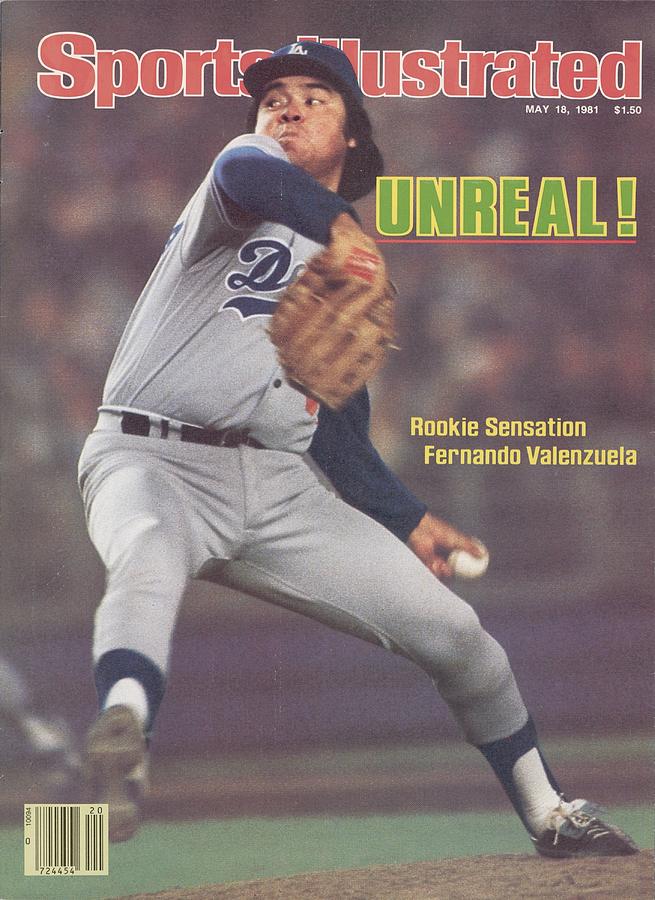
The Dodgers traded Sutton, but benefited from the arrival in 1981 of Fernando Valenzuela, a chubby Mexican lefthander with a sensational screwball that allowed him to win his 1st 8 decisions. Even people who didn't like the Dodgers were gripped by "Fernandomania." He finished 13-7, and was named the NL's Rookie of the Year, just as their reliever Steve Howe had been in 1980, and their starting pitcher Rick Sutcliffe in 1979.
The Yankees signed San Diego Padres star Dave Winfield to their 1st contract worth more than $1 million a year. Remembering how he wasn't exactly welcomed as the big free agent signing 4 years earlier, Reggie showed Dave the courtesy he'd wanted.
The strike that interrupted the 1981 season meant that a team had to finish 1st in either half of the season to qualify for the Playoffs. The Yankees won the AL East in the 1st half; beat the 2nd-half winners, the Milwaukee Brewers; and finally the A's for the Pennant. The Dodgers won the NL West in the 1st half, beat the Astros, and then beat the Montreal Expos for the Pennant.
*
October 20, 1981: Game 1 of the World Series at Yankee Stadium. A banner is hung from the upper deck: "DON'T THE DODGERS EVER LEARN"?
Not yet, they don't, as Watson's 1st-inning homer and the pitching of Guidry and Gossage shut the Bums down, 5-3.
October 21, 1981: The Yankees take a 2-0 lead, as John and Gossage combine on a 3-0 shutout. Watson has 2 hits and an RBI.
The Yankees are 2 wins away from their 23rd World Championship. No one can imagine it now, but the team will not win another competitive game until April 12, 1982 (later than it should have, due to a late snowstorm postponing a week's worth of games), and it will take them 15 more years to get that 23rd title.
The Yankees also make a trade on this day, sending 22-year-old outfielder Willie McGee to the St. Louis Cardinals for pitcher Bob Sykes. It will be one of the worst trades in Yankee history, as Sykes, a native of nearby Neptune, New Jersey, is already damaged goods, and never appears in another big-league game, finished at 27. McGee helps the Cards win the next year’s World Series and 3 of the next 6 NL Pennants.
October 23, 1981: Despite an uncharacteristic poor performance (9 hits‚ 7 walks), Valenzuela goes the distance in the Dodgers' 5-4 come-from-behind win in Game 3. The deciding run scores on a double play.
Yankee starter Dave Righetti lasts just 2 innings‚ walking 2 and allowing 5 hits‚ but it is reliever George Frazier who takes the loss. Ron Cey hits a 3-run homer for the Dodgers. Starters Valenzuela and Righetti are the 1st 2 Rookies of the Year, of any position, to oppose each other in the World Series since Willie Mays and Gil McDougald in 1951.
October 24, 1981: The Dodgers tie the World Series up at 2 games apiece, 8-7, thanks to some poor Yankee fielding. Reggie Jackson and Willie Randolph hit home runs for the Bronx Bombers -- Reggie's last in a Yankee uniform, as it turned out -- but Jay Johnstone, who'd helped the Yankees beat the Dodgers in the 1978 World Series, returns the favor for the Dodgers.
Johnstone would later write, in his memoir Temporary Insanity (a title based on his quirky personality), that George Steinbrenner stormed into the locker room and demanded that Ron Davis (Yankee reliever and Ike's father) tell him why he threw Johnstone a fastball.
October 25, 1981: The Dodgers win Game 5, as back-to-back homers by Pedro Guerrero and Steve Yeager off Guidry give the Dodgers their 3rd consecutive win, 2-1. Winfield singled in the 5th, but that turned out to be his only hit in the Series. Even then, he didn't score, as he was eliminated when Reggie grounded into a double play.
After this game, George says he'd scuffled with 2 Dodger fans in a hotel elevator, and emerges with a fat lip and a broken hand.
*
It was 40 years ago, and it was a different time. In spite of the Pennant, the Yankees averaged only 15,804 fans per home game at the original Yankee Stadium. This was partly due to the Strike of '81, and partly due to the South Bronx having deteriorated into an urban nightmare -- the Paul Newman cop drama Fort Apache, The Bronx was released in February of that year. Nobody wanted to go to The Bronx -- unless that's where your drug dealer wanted to meet and you really, really needed a fix.
It had been an awful regression for New York City, and it could be seen in film: From the style and sophistication of
Breakfast at Tiffany's in 1961, to the funky seediness of
Midnight Cowboy in 1969, to the desolation of
Taxi Driver in 1976, to
Fort Apache, The Bronx in 1981.
Two recent period pieces, the TV show
Life On Mars (set in 1973) and the miniseries
The Bronx Is Burning (about 1976-77 in New York, including the Yankees, the Mayoral election and the hunt for the Son of Sam), did not exaggerate. I remember: It really was that bad, no matter how much Mayor Ed Koch and Governor Hugh Carey tried to talk the City up, no matter how much people in tourism commercials sang, "I Love New York." (That campaign was more for the State than the City, anyway: One even had a guy obviously in a rural area, possibly the Catskills or the Finger Lakes, saying, "I live in Brooklyn, but I love New York!")
Baseball legends Satchel Paige, Stan Coveleski, Waite Hoyt, Joe Cronin, Smoky Joe Wood, Red Ruffing, Ted Lyons and Hank Greenberg were still alive. Mariano Rivera was 11 years old, Jorge Posada 10, Andy Pettitte 9, Derek Jeter 7, Alex Rodriguez 6, David Ortiz 5, Jimmy Rollins nearly 3, Albert Pujols nearly 2, CC Sabathia 1, and Robinson Cano, David Wright, Miguel Cabrera, Justin Verlander, Brett Gardner and Max Scherzer weren't born yet.
There had never been a Major League Baseball game in Florida or in the Rocky Mountain States. The San Diego Padres, Seattle Mariners, Texas Rangers and Toronto Blue Jays had never made the Playoffs. The Padres, Rangers, Blue Jays, the aforementioned Brewers and Astros, and the teams then known as the California Angels and the Montreal Expos had never won a Pennant. The Atlanta Braves hadn't won a Pennant since they were still in Milwaukee. The Chicago Cubs hadn't won a Pennant since 1945.
The Blue Jays, the Expos, the Astros, the Braves since moving to Atlanta, the aforementioned Royals, the San Francisco Giants since they were still in New York, the Minnesota Twins since they were the Washington Senators all the way back in 1924, the Boston Red Sox since 1918, and the Chicago White Sox since 1917, and the Cubs since 1908 had not won the World Series.
All of those facts are no longer true.
Only 6 teams are still using the same ballparks they were using in 1981: The 2 Los Angeles-area teams, the Red Sox, the Royals, the A's and the Chicago Cubs. Only 4 NFL teams (Buffalo, Green Bay, Kansas City and New Orleans) are using the same stadiums they were using in October 1981. Madison Square Garden is both the only NBA venue and the only NHL venue still being used. Yankee Stadium, Shea Stadium, Giants Stadium, the Nassau Coliseum and the Meadowlands Arena have all been replaced.
There was an NFL team in Baltimore, but it was the Colts, not the Ravens. There was one in St. Louis, but it was the Cardinals, not the Rams. There was one in Houston, but it was the Oilers, not the Texans. The NFL was still a League where the high-profile teams were the Oakland Raiders, the Pittsburgh Steelers, the Miami Dolphins and the Dallas Cowboys, but the San Francisco 49ers were about to begin their dynasty.
The Philadelphia Phillies were defending World Champions. The Oakland Raiders had won the most recent Super Bowl. The Boston Celtics were defending NBA Champions, having beaten the Houston Rockets in the Finals. The Los Angeles Lakers and Philadelphia 76ers would be back, however. Kareem Abdul-Jabbar, Magic Johnson, Larry Bird and Julius "Dr. J" Erving were the big names. Michael Jordan was about to play his 1st game at the University of North Carolina. The Knicks and Nets were both nondescript teams.
The New York Islanders were in the middle of their Stanley Cup dynasty, and the Edmonton Oilers of Wayne Gretzky and Mark Messier hadn't won any yet. The Rangers were an aging team in transition, and the Devils were still the NHL version of the Colorado Rockies. The Heavyweight Champion of the World was Larry Holmes.
Bobby Carpenter of the Boston suburb of Needham, Massachusetts played his 1st NHL game a few days earlier, becoming the 1st U.S. hockey player to go directly from high school to the NHL, and both scored a goal and collected an assist for the Washington Capitals, who lost to the Buffalo Sabres anyway.
"The Wave" -- or, as it's known in Europe, since most people there first saw it on TV during the 1986 World Cup in Mexico, "The Mexican Wave" -- was first noticed nationwide. "Krazy George" Henderson claims to have invented it at an NHL game in Edmonton a year earlier. He led it during the 7th Inning Stretch of Game 3 of the 1981 ALCS. Robb Weller, later a co-host of Entertainment Tonight, claimed he invented it at the University of Washington, during their October 31, 1981 game against Stanford. But that was 2 weeks after Krazy George's nationally televised demonstration, so he's lying.
Current Yankee manager Aaron Boone was 8 years old. Current Dodger manager Dave Roberts was 9. Luis Rojas, the most recent holder of the currently-vacant Mets' managerial post, had been born only 47 days earlier.
Lindy Ruff of the Devils was playing for the Buffalo Sabres. Tom Thibodeau of the Knicks was an assistant coach at Salem State University in Massachusetts. Gerard Gallant of the Rangers was playing for the minor-league Sherbrooke Castors in Quebec. Barry Trotz of the Islanders was playing for the minor-league Regina Pats in Saskatchewan. Steve Nash of the Nets was 7 years old. Ronny Deila of NYCFC was 6. Gerhard Struber of the Red Bulls was 4. Robert Saleh of the Jets was 2. And Joe Judge of the Giants and Walt Hopkins of the Liberty hadn't been born yet.
The Olympic Games have since been held in America 3 times; in Canada, Korea and Japan twice; and once each in Bosnia, France, Spain, Norway, Australia, Greece, Italy, China, Britain, Brazil and Russia. The World Cup has since been held in America, Spain, Mexico, Italy, France, Japan, Korea, Germany, South Africa, Brazil and Russia.
There were then 26 Amendments to the Constitution of the United States. The idea that two people of the same gender could marry each other, with all the legal benefits of marriage, was ridiculous. But then, so was the idea that corporations were "people," with the legal rights thereof.
The President of the United States was Ronald Reagan. George H.W. Bush was his Vice President. Richard Nixon, Gerald Ford, Jimmy Carter, their wives, and the widows of Harry Truman, John F. Kennedy and Lyndon Johnson were all still alive.
Bill Clinton was out of office, having been defeated for re-election as Governor of Arkansas the year before -- but was already planning one of his occasional comebacks. George W. Bush was running Arbusto Energy -- running it into the ground. Barack Obama had just transferred from Occidental College in Los Angeles to Columbia University in New York. Donald Trump was still unknown outside of New York City, his Trump Tower under construction. Joe Biden was in his 2nd term as a U.S. Senator from Delaware. Kamala Harris had just begun attending Howard University in Washington, D.C. None of the Justices then on the U.S. Supreme Court are still on it.
The Governor of the State of New York was Hugh Carey, the Mayor of the City of New York was Ed Koch, and the Governor of New Jersey was Brendan Byrne, with Tom Kean and Jim Florio running to replace him. Kean would win the closest election in the office's history. Eight years later, Florio would try again, and win in a landslide. The Governor of California was Jerry Brown, and the Mayor of Los Angeles was Tom Bradley.
The current holders of those offices? Kathy Hochul was in law school, at The Catholic University of America -- like Harris' alma mater, Howard, in Washington. Bill de Blasio was at New York University, and his likely successor, Eric Adams, was also in college in the City, at the John Jay College of Criminal Justice. Phil Murphy was at the University of Pennsylvania's Wharton School of Business. Gavin Newsom was 14 years old, and Eric Garcetti was 10.
The Nobel Peace Prize was about to be awarded to the Office of the United Nations High Commissioner for Refugees. The Pope was John Paul II. The current Pope, Francis, then Jorge Mario Bergoglio, was the rector of his alma mater, the Philosophical and Theological Faculty of San Miguel in his native Buenos Aires, Argentina.
The Prime Minister of Canada was Pierre Trudeau, and of Britain, Margaret Thatcher. The monarch of both nations was Queen Elizabeth II -- that hasn't changed. There have since been 7 Presidents of the United States, 7 Prime Ministers of Britain and 3 Popes.
There were still living veterans of the Spanish-American War, the Philippine Campaign, the Boxer Rebellion, the Boer War, the Potemkin Mutiny, the Russo-Japanese War and the Mexican Revolution.
Aston Villa of Birmingham, the West Midlands, had won the Football League for the 1st time in 71 years (still their only title in the last 121 years). Liverpool FC had won the European Cup. In the season now in progress, they would switch. Tottenham Hotspur were in the middle of back-to-back FA Cup wins; his was a rare period when they were definitively better than the real team in North London, Arsenal.
James Clavell published
Noble House, Frank Herbert
God Emperor of Dune, John Irving
The Hotel New Hampshire, Gabriel Garcia Marquez
Chronicle of a Death Foretold, Toni Morrison
Tar Baby, Martin Cruz Smith
Gorky Park, Paul Theroux
The Mosquito Coast, and Joseph Wambaugh
The Glitter Dome.
John Gardner restarted the James Bond novels, which had been exhausted following the last unpublished stories of the character's creator Ian Fleming, with
Licence Renewed. Thomas Harris published
Red Dragon, which introduced the character of Dr. Hannibal Lecter. George R.R. Martin published
Windhaven, deftly using science fiction and a restart of technology to meld the future with the past on a distant planet occupied by the descendants of Earthmen. J.K. Rowling was in high school in Tutshill, Gloucestershire, England.
No one had yet heard of Celie Harris, Kinsey Millhone, Jack Ryan, Forrest Gump, John McClane, Alex Cross, Bridget Jones, Robert Langdon, Bella Swan, Lisbeth Salander or Katniss Everdeen.
Major films released in the middle of Autumn 1981 included
My Dinner with Andre, All the Marbles, Looker, Halloween II, Time Bandits and
The Pursuit of D.B. Cooper. Earlier in the year, Roger Moore had played James Bond in
For Your Eyes Only, and Christopher Reeve had starred in
Superman II. Batman was still in the interregnum between Adam West and Michael Keaton; the best Batfans could do was the comic books and Olan Soule's voiceover in the Saturday morning cartoon
Super Friends. Peter Davison had recently become the Fifth Doctor.
In television, the previous spring's
Dallas cliffhanger was resolved: J.R. Ewing had
not gotten revenge on his sister-in-law/former mistress/baby mama Kristin Shepard for shooting him a year earlier. He didn't push her over the railing and into the pool to her death; she fell because she had a drug overdose.
Luke Spencer and Laura Webber were about to get married on
General Hospital. Chuck Woolery was about to leave his post as host of
Wheel of Fortune, handing it over to Pat Sajak. And both turned out to be right-wing maniacs, a fact they kept hidden even during the Reagan Revolution.
Entertainment Tonight, Lee Majors' post-
Six Million Dollar Man series
The Fall Guy, Tony Randall's post-
Odd Couple series
Love, Sidney, Nell Carter's
Gimme a Break,
Simon & Simon and
Falcon Crest all debuted, or soon would, in the TV season that had just begun. So did the U.S. version of the cartoon
The Smurfs, and new cartoons featuring comic book characters Captain Marvel (a.k.a. "Shazam!") and Spider-Man.
Charlie's Angels, The Waltons and
Eight Is Enough had recently aired their final first-run episodes.
In the week in question, the following panelists were on
Match Game: Comedian Scoey Mitchell, regular Brett Somers, regular Charles Nelson Reilly, actress Elaine Joyce, former
M*A*S*H star McLean Stevenson, and actress Betty White.
Robert Kardashian was working in the music business. He was married to the former Kris Houghton. Their daughter Kim had been born almost exactly a year before. Bruce Jenner was still an actor, and not winning any medals for it.
The Number 1 song in America was "Arthur's Theme (The Best That You Can Do)," by Christopher Cross, from the Dudley Moore film Arthur that came out in the preceding Summer. MTV had gone on the air at that time. Were they actually airing music at the time? Yes. Was it good music? For the most part, no.
Paul Simon & Art Garfunkel had a reunion concert in front of half a million people in Central Park. Prince released his album Controversy, and got booed off the stage at the Los Angeles Memorial Coliseum, as the opening act on the Rolling Stones' tour for their album Tattoo You.
In the course of 1981, The Buzzcocks, Steely Dan and the Bay City Rollers broke up. 10,000 Maniacs, Anthrax, The Bangles, The Blow Monkeys, The Beastie Boys, The Butthole Surfers, Culture Club (these last 2 definitely not to be confused with each other), Katrina and the Waves, Metallica, Ministry, Mötley Crüe, Pet Shop Boys, Queensrÿche, Patti Smyth's band Scandal, Slayer, Sonic Youth and Suicidal Tendencies all formed.
George Harrison released "All Those Years Ago," his tribute to John Lennon, who had been killed nearly a year earlier. Bob Dylan was in his Christian rock phase. Michael Jackson was following Off the Wall up with writing the songs that would go on Thriller. Priscilla Presley had taken over Elvis Presley Enterprises, and made Elvis more money than he ever had while he was alive. Frank Sinatra just kept on touring.
Inflation has been such that what $1.00 would buy then, $3.02 would buy now. A U.S. postage stamp was 18 cents, and a New York Subway token was 75 cents. The average price of a gallon of gas was $1.35, a cup of coffee $1.04, a McDonald's meal (Big Mac, fries, shake) $2.00, a movie ticket $2.75, a new car $5,743, and a new house $83,700. The Dow Jones Industrial Average closed that day at 837.61.
The tallest building in the world was the Sears Tower in Chicago. Desktop computers and mobile telephones had been developed, but they were still very bulky and very slow. Nordic Mobile Telephone set up the 1st cellular telephone system, in Sweden. There was not much of an Internet. The 1st space shuttle, Columbia, had been launched earlier in the year. The Atari VCS (later renamed the Atari 2600) and the Mattel Intellivision were battling it out to be the leading home video game system.
There were heart transplants, liver transplants and lung transplants, and artificial kidneys, but the 1st artificial hearts wouldn't be tried until the next year. The birth control pill was long-established, but there was, as yet, no Viagra.
In the mid-Autumn of 1981, Egyptian President Anwar Sadat was assassinated by Islamic militants, beginning the 31-year dictatorship of the man who had been his Vice President, Hosni Mubarak. For a long time, Mubarak seemed like an enlightened leader and an ally to America, but eventually the truth came out. Moshe Dayan, a leading figure in early Israeli history, also died, but of complications of cancer.
The hunger strike at Maze Prison in Northern Ireland was ended. The last Triumph TR7 rolled off the assembly line. France abolished capital punishment, and developed their first high-speed rail system, the TGV. The Central American colony of British Honduras gained its independence, becoming the independent nation of Belize, remaining in the British Commonwealth. So did the newly-independent nation of Antigua & Barbuda. The Sydney Tower opened in Australia.
In America, Sandra Day O'Connor was confirmed and sworn in as the 1st female Justice of the U.S. Supreme Court. The Reverend Sun Myung Moon was indicted for tax evasion, a charge on which he would be convicted and serve 18 months in prison. The Boeing 767 went into service. And John Shoecroft and Fred Gorrell flew Super Chicken III from Costa Mesa, California to Blackbeard Island, Georgia. The 55-hour-25-minute trip was the 1st nonstop crossing of America by hot-air balloon.
In the Autumn of 1981, songwriter Harry Warren, and Baseball Hall-of-Famer Freddie Lindstrom, and legendary Liverpool Football Club manager Bill Shankly died. Alexis Bledel, and Zlatan Ibrahimović, and Serena Williams were born.
*
October 28, 1981, 40 years ago today: Game 6 of the World Series is played at Yankee Stadium, having been postponed a day due to rain. John started for the Yankees, Burt Hooton for the Dodgers, and both of them got through the 2nd inning without allowing a run.
The Yankees, needing to win to force a Game 7, got on the board first: With 2 out in the bottom of the 3rd, Willie Randolph hit a home run. They got 2 more men on, and that brought up Mr. October. But Reggie flied to left. The Dodgers tied it in the top of the 4th, on singles by Baker, Rick Monday and Yeager.
With 1 out in the bottom of the 4th, Nettles doubled, and Cerone struck out. Lasorda ordered the weak-hitting shortstop, Larry Milbourne, walked intentionally, to bring the pitcher's spot in the order up. Lemon gambled, and sent Bobby Murcer up to pinch-hit for a pitcher who'd allowed only 1 run in 4 innings. Having made his major league debut 16 years earlier, this was the biggest plate appearance that Murcer would ever have. He nearly hit it out to right field, but not quite long enough.
Lemon sent George Frazier out for the 5th, and he had nothing, allowing an RBI single by Ron Cey and an RBI triple to Pedro Guerrero, giving the Dodgers a 4-1 lead.
It got worse in the 6th, as Davis walked Hooton, walked Davey Lopes, and allowed an RBI single to Bill Russell. Lemon replaced him with Rick Reuschel. When Lopes and Russell advanced on a double steal, Lemon ordered Garvey walked to set up the double play. It didn't work: Derrel Thomas hit a grounder to 3rd that got Lopes home. Baker reached on an error, and Guerrero singled home 2 runs. It was 8-1 Los Angeles.
Lou Piniella singled home a run in the bottom of the 6th, but that would be it for the Bronx Bombers, no further bombing. In the top of the 8th, Guerrero hit a home run. In the bottom of the 9th, Howe walked Randolph, struck Mumphrey out, and got Winfield to fly to left.
Mr. October came to bat as a Yankee one more time, and grounded to Lopes at 2nd. Lopes had driven the Yankees crazy in all 3 World Series. This time, he bobbled the ball, and Reggie reached base in Pinstripes one last time. Watson made the last out, flying to Lee Lacy in center.
Dodgers 9, Yankees 2. The L.A. Bums had finally beaten the Yankees in the World Series. For the 1st time, the Series' Most Valuable Player award was split, awarded to Guerrero, Cey and Yeager.
Winfield was just 1-for-21‚ while Frazier tied a Series record by losing 3 games. The record was set by the White Sox' Lefty Williams in 1919‚ but Williams‚ one of the 8 "Black Sox‚" was losing on purpose. Frazier was trying to win, and didn't.
The long-term effects on the Yankees were as follows:
* This was the last time that Reggie Jackson suited up as a player for the Yankees, and George Steinbrenner refused to exercise the option for a 6th year on his contract. Reggie happily accepted an offer from Gene Autry to return to the West Coast and play for the California Angels.
* Winfield's performance contrasted so much with Reggie's Mr. October persona that George eventually nicknamed him Mr. May, never gave him the respect he deserved, and ended up chasing Dave out of town – coincidentally, also to the Angels, although Reggie was retired by that point – and getting himself in trouble with how he did it.
While George gave Dave a "Day" after he was elected to the Hall of Fame, to this day, Dave's Number 31 has not been retired, along with those of his Yankee teammates Jackson (44), Ron Guidry (49) and Don Mattingly (23), and his occasional manager Billy Martin (1). Nor has he gotten a Plaque in Monument Park like those 4, and also like teammates Willie Randolph and Goose Gossage.
* George went through various experiments in managers and styles of play (booming bats one year, speed the next, and so on) to get the Yankees back on top, but they wouldn't reach the World Series again for 15 years, giving the new ownership of the Mets the chance to become from 1984 to 1992 what they have not been since '92, New York's first team. (Despite their 2015 Pennant, they still aren't.)
Blowing that lead, to the evil O'Malley Bums and their fat hypocritical slob of a manager, Tommy Lasorda, losing the Series at home, and when I was just 11 going on 12...
More than any other Yankee defeat, this one sticks in my craw. As bad as the 2001 and 2003 World Series losses were (I don't really remember the 1976 sweep loss); or the 1980 and 2012 ALCS sweeps; or the 2010, 2017 and 2019 ALCS folds; or the ALDS losses of 1995, 1997, 2006, 2011, 2018 and 2020; or the 1985 and 1988 regular-season near-misses; or the complete bottle-jobs in the Wild Card Game of 2015. Even the 2004 ALCS collapse doesn't bother me as much as the 1981 World Series.
And, unlike with the 2004 Red Sox nd the 2017 and '19 Astros, I can't even rationalize it away by saying the Dodgers cheated! That I know of. There are some people who have alleged that the mound at Dodger Stadium was actually less than 60 feet 6 inches from home plate, but I don't think this was ever seriously challenged.
In 1998, the Yankees celebrated the 20th Anniversary of the '77 and '78 World Champions by inviting the Dodgers of that period to Old-Timers' Day. The Old-Timers' Game usually goes 3 innings, but since it was tied, it went to a 4th inning, and Willie Randolph hit a home run off Tommy John to win it for the Yankees. So not only did John pitch on the losing side in all 3 of these Yankee-Dodger World Series, but he lost this Old-Timers' Game as well.
Among the interviews done on WPIX-Channel 11, Bobby Murcer, by then a broadcaster, and wearing a special hookup on his belt so he could announce a game he was playing in, talked to Lasorda. The man who said, "I bleed Dodger Blue," and referred to God as "the Big Dodger in the Sky," talked about the '77 and '78 Series, but brought up '81, Murcer's only World Series in 17 seasons in the major leagues, 13 of them with the Yankees, and said, "We brought that World Championship trophy back to Los Angeles where it belongs!"
The fat bigoted slob forgot: Los Angeles isn't even where the Dodgers belong. Brooklyn is.
Buster Olney titled his book about the 2001 Yankees, with a focus on their loss to the Arizona Diamondbacks in Game 7 of the World Series, The Last Night of the Yankee Dynasty. Peter Golenbock, in Dynasty: The New York Yankees, 1949-1964; David Halberstam, in October 1964; and Philip Bashe, in Dog Days: The New York Yankees' Fall from Grace and Return to Glory, 1964-1976 have all written about how the Yankees' loss to the St. Louis Cardinals in Game 7 of the 1964 World Series was the last day of the old Yankee Dynasty.
October 28, 1981 was the last day of my Yankee Dynasty. That wasn't apparent at the time. But the team's collapse in 1982 made it clear.
The Yankees were now 8-3 in World Series against the Dodgers, 2-2 in their Los Angeles period. In the 40 years since, the teams have never played each other in another World Series. In Interleague Play, yes; in the World Series, no.
They've both made the Playoffs in 1995, 1996, 2004, 2006, 2009, 2015, 2017, 2018, 2019, 2020 and 2021. They've both reached their respective League Championship Series in 2009, 2017 and 2019. But, since 1981, they've never again met in the World Series.
And at the rate Brian Cashman is going, it looks like it won't happen again for years to come, through no fault of the Dodgers and their management.