Friday, January 24, 2020

Super Bowl Starting Quarterbacks' Records by Uniform Number

Super Bowl starting quarterbacks' records by uniform number:
1: 0-1. Cam Newton lost Super Bowl 50.

2: 0-1. Matt Ryan lost LI.

3: 1-2. Daryle Lamonica lost II, Russell Wilson won XLVIII and lost XLIX (but it was Pete Carroll's fault).

4: 1-1. Brett Favre won XXXI and lost XXXII.

5: 1-1. Donovan McNab lost XXXIX, Joe Flacco won XLVII.

6: 0-0. No quarterback wearing the number has ever started an NFL Championship Game, under any name.
7: 5-10. Craig Morton lost XII. Ron Jaworski lost XV. Ken Anderson lost XVI. Joe Theismann won XVII and lost XVIII. John Elway lost XXI, XXII and XXIV, and won XXXII and XXXIII. Boomer Esiason lost XXIII. Ben Roethlisberger won XL and XLIII and lost XLV. Colin Kaepernick lost XLVII.

8: 5-2. Troy Aikman won XXVII, XXVIII and XXX. Steve Young won XXIX. Trent Dilfer won XXXV. Matt Hasselbeck lost XL. Rex Grossman lost XLI.

9: 3-1. Jim McMahon won XX. Steve McNair lost XXXIV. Drew Brees won XLIV. Nick Foles won LII.

10: 2-3. Fran Tarkenton lost VIII, IX and XI. Eli Manning won XLII and XLVI. Jimmy Garoppolo, take note.

11: 2-3. Joe Kapp lost IV. Tony Eason lost XX. Phil Simms won XXI. Mark Rypien won XXVI. Drew Bledsoe lost XXXI.
12: 17-14. This will take a while. Joe Namath won III. Roger Staubach won VI and XII, and lost X and XIII. Bob Griese lost VI, and won VII and VIII. Terry Bradshaw won IX, X, XIII and XIV. Ken Stabler won XI. Jim Kelly lost XXV, XXVI, XXVII and XXVIII. Stan Humphries lost XXIX. Chris Chandler lost XXXIII. Kerry Collins lost XXXV. Tom Brady won XXXVI, XXXVIII, XXXIX, XLIX, LI and LII, and lost XLII, XLVI and LII. Rich Gannon lost XXXVII. Aaron Rodgers won XLV.

13: 1-3. Dan Marino lost XIX. Kurt Warner won XXXIV, and lost XXXVI and XLIII.

14: 1-2. Craig Morton lost V. Neil O'Donnell lost XXX. Brad Johnson won XXXVII.

15: 4-2. Bart Starr won I and II. Earl Morrall lost III and won V. Vince Ferragamo lost XIV. Jeff Hostetler won XXV. Patrick Mahomes, take note.

16: 7-3. Len Dawson lost I and won IV. Jim Plunkett won XV and XVIII. Joe Montana won XVI, XIX, XXIII and XXIV. David Woodley lost XVII. Jared Goff lost LIII.

17: 1-2. Billy Kilmer lost VII. Doug Williams won XXII. Jake Delhomme lost XXXVIII.

18: 2-2. Peyton Manning won XLI and 50, and lost XLIV and XLVIII.

19: 0-0. Johnny Unitas played in 2, but wasn't the Colts' quarterback of record in either: He came off the bench in III, but couldn't save them; and started V, but was hurt, and Earl Morrall won it.

Thursday, January 23, 2020

Which Current New York Athletes Will Make the Hall of Fame?

Tomorrow, Eli Manning will hold a press conference and announce his retirement from the National Football League.

The question has been asked: Should he be elected to the Pro Football Hall of Fame?

Yes. As Drew Rosenhaus would say, "Next question!"

Come on. This is stupid. Of course Eli belongs.

He has passed for 57,023 yards. That is more than everybody except his brother Peyton Manning, Drew Brees, Tom Brady, Brett Favre, Dan Marino and Phillip Rivers. Favre and Marino are already in, Peyton becomes eligible next year, and Brady (unless you want to keep him out due to cheating) and Brees are easy choices. Rivers is a question mark, but he plans to play next season, and could provide an easier answer.

He has passed for 366 touchdowns. That is higher than everybody except the exact same 6: Brees, Brady, Peyton, Favre, Marino and Rivers.

He has a pass completion rating of 60.3 percent. That is higher than these men already in the Hall: Sammy Baugh, Sid Luckman, Otto Graham, Bob Waterfield, Norm Van Brocklin, Bobby Layne, Johnny Unitas, Y.A. Tittle, Bart Starr, Sonny Jurgensen, George Blanda, Len Dawson, Bob Griese, Fran Tarkenton, Ken Stabler, Roger Staubach, Terry Bradshaw, Dan Fouts, Dan Marino, Jim Kelly, John Elway and Warren Moon.

It's also higher than that of the man considered the best quarterback in New York football history: Joe Namath. Also, while he's not yet in the Hall, he should be, but he didn't have a higher career completion percentage than Eli, either: Phil Simms. Nor did Archie Manning.

His career passer rating is 84.1. Granted, it's a weird stat, and I don't put much stock in it. But it is higher than every one of those quarterbacks, and one more who is already in the Hall of Fame: Troy Aikman.

He led 37 regular-season game-winning drives. That's more than anybody except Peyton, Brees, Marino, Elway, Brady, Favre, Roethlisberger, Elway, Unitas and Matt Ryan.

Oh yes: He not only won 2 Super Bowls, defeating Brady and the New England Cheatriots both times, but won the Most Valuable Player in each game.

Here is the list of quarterbacks who have won at least 2 Super Bowls and are eligible for the Hall of Fame: Starr, Griese, Bradshaw, Staubach, Aikman, Jim Plunkett, Joe Montana. That's it: 7 guys. Eli, his brother Peyton Manning, Brady and Ben Roethlisberger have also done it, but they're not yet eligible: Peyton becomes eligible in next year's election, and Brady, Big Ben and (for the moment, at least officially) Eli are still active.

The only one of the 7 who isn't in is Plunkett. He should be in. And he was not a better quarterback than Eli Manning. (There's a little irony: Plunkett was one of the guys who beat Archie Manning, Eli & Peyton's father, out for the 1970 Heisman Trophy.)

If you count pre-Super Bowl NFL Championships -- and you should -- then add Van Brocklin (in), Unitas (in), Layne (in), Otto Graham (in), Tommy Thompson (out), Baugh (in), Luckman (in), Arnie Herber (in) and Ed Danowski (out -- which doesn't help Eli, because he was also a Giant).

So that's 13 out of 16 in. And if you don't know much about Thompson (1948 and '49 Eagles) and Danowski (1934 and '38), you may know that this was an era of significantly less sophisticated passing, and you would be safe in presuming that Eli was better than either of them.

*

What other current players for New York Tri-State Area teams are going to their sports' Halls of Fame? It's not a long list. From the Giants, there is nobody else that's anywhere near sure. Saquon Barkley has gotten off to a very good start, but he's had just 2 years. Way too soon to tell.

From the Jets: Le'Veon Bell is a possibility, but that's mainly for what he did with the Pittsburgh Steelers. Sam Darnold? Based on what we've seen so far, he seems more Richard Todd than Joe Namath.

From the Yankees: Lots of guys with a chance, but, unlike the newly-elected Derek Jeter and last year's honoree Mariano Rivera, nobody yet obvious. It's way too soon to tell for Aaron Judge, Gleyber Torres, or any of the other "Baby Bombers." Giancarlo Stanton has 308 home runs and he just turned 30, but his injuries, and now 2 postseason failures, make him a big question mark.

Masahiro Tanaka has won 174 games by age 31, but that's counting his stats in Japan. In America alone, he doesn't get in. The newly-acquired Gerrit Cole is 94-52 with 1,336 strikeouts at age 29, but we may soon find out just how much of that was due to his talent, and how much of it was due to his Houston Astro teammates cheating.

From the Mets: Jacob deGrom is 66-49 with 1,255 strikeouts, and 1 trip to the World Series (lost). He'll be 32 in June. He's not going.

Don't tell me about his Cy Young Awards. Tim Lincecum won 2 Cy Young Awards in the National League, and he'll never make the Hall of Fame. In the American League, Denny McLain, Bret Saberhagen and Johan Santana won 2, and they'll never get in. Of course, Saberhagen and Santana wrecked their careers by going to the Mets, something deGrom doesn't have to worry about. Corey Kluber has also won 2 Cys, but he's not going to the Hall, either.

The Mets have Robinson Cano, with a .302 lifetime batting average, 2,570 hits including 324 home runs, 8 All-Star berths, 2 Gold Gloves, and a World Series ring. But he's also got a steroid cloud over him -- one that came over him after he left the Yankees. He's not getting in.

The Mets have Yoenis Cespedes, but he's only got 163 homers, 2 All-Star berths and 1 Gold Glove, and he's 34. He's not adding enough stats to get in.

And the Mets have Pete Alonso. He hit 53 home runs as a rookie, and he's only 25. But, as with Saquon Barkley, it's way too soon to tell.

From the Knicks: Don't make me laugh.

From the Nets: There's Kevin Durant, but he's hurt, hasn't yet played a game for the Nets, and at 31, he has considerably more yesterdays on the court than tomorrows. He'll get in for what he did in Oklahoma City and Oakland, but not in Brooklyn. There's Kyrie Irving, who might get in for what he did as LeBron James' "Scottie Pippen" in Cleveland, and doing something with the Nets could secure his place in Springfield. But I doubt that, in 2035, anyone is going to call him "Nets Hall-of-Famer Kyrie Irving."

From the Rangers: Henrik Lundqvist has 458 career wins as an NHL goaltender. That's more than anybody except Martin Brodeur, Patrick Roy, Roberto Luongo and Ed Belfour. He may end up passing everyone except Brodeur. His goals-against average is 2.43. There are only 10 goalies since the 1967 expansion who have a lower average, including Brodeur, but not including Roy. Of the 10, 4 are still active: Tuuka Rask, Ben Bishop, Jonathan Quick and Pekka Rinne.

He'll probably make it. But he's in his 15th season, and is 1-4 in Stanley Cup Finals games. That's not going to keep him out, but it sticks out like a sore thumb.

Chris Kreider will be 29 in April, so he has time to build up his stats, but his chances of getting in are slim. Nobody else on the team is even working his way into consideration.

From the Islanders: Who's kidding who? John Tavares has a chance, but he's been gone for a year and a half.

From the Devils: With Taylor Hall having been traded this season, nobody is close. It's far too soon to tell for Nico Hischier (21) and Jack Hughes (18).

So there it is. Since we can no longer count Eli Manning, here is the list of New York Tri-State Area athletes who are almost certainly going to their sport's Hall of Fame:

1. Henrik Lundqvist

That's it. He's all by himself. He's at the top.
This is the closest Lundqvist has ever come to actually being a "King."

UPDATE: In 2022, former Met manager Gil Hodges and former Yankee broadcaster Jim Kaat were elected to the Baseball Hall of Fame. That same year, while I hadn't included the New York Liberty in the original post, Swin Cash was elected to the Basketball Hall of Fame.

In 2023, Lundqvist was, indeed, elected to the Hockey Hall of Fame. So was early 1990s Islander Pierre Turgeon. That same year, 1980s Jet Joe Klecko and 2010s Jet Darrelle Revis were elected to the Pro Football Hall of Fame.

Wednesday, January 22, 2020

Baseball Hall-of-Famers By Team, 2020 Edition

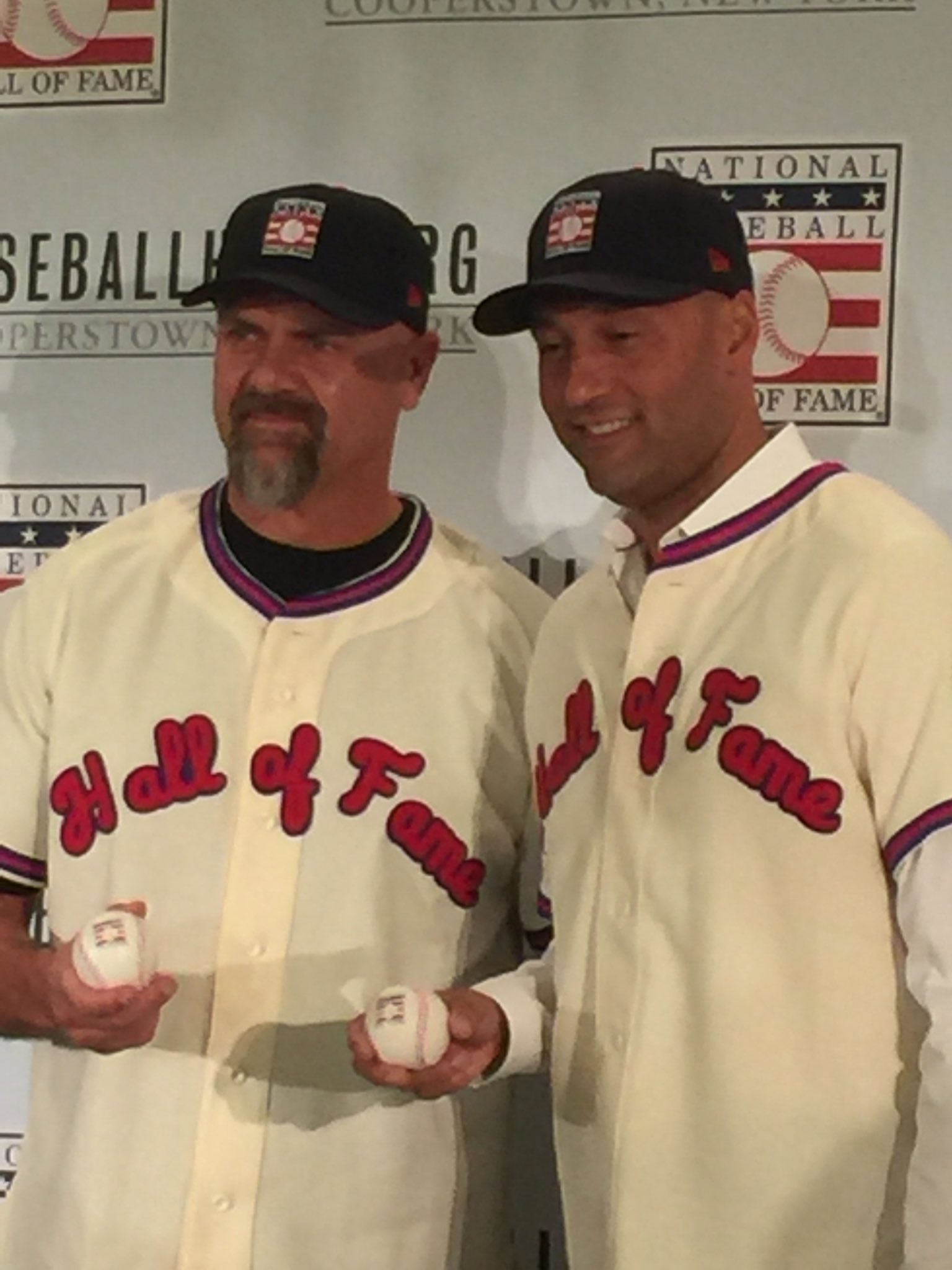
With the announcement of the elections of Derek Jeter, Larry Walker, Ted Simmons and Ken Harrelson, it is time to update this list.

A player is counted as a Hall-of-Famer with the team if he played at least 4 seasons with them. However, there will be the occasional exception. Teams are ranked in order of most HOFers.

If there is a tie, it will be broken by which team has more players, as opposed to those who were elected in other categories. If there is still a tie, then I go to which has more non-broadcasters. If it's still a tie, which has more players whose contributions were mostly with that club. If it's still a tie, which team has played fewer seasons will be ranked ahead -- since, for example, 5 HOFers is more impressive for a team that's been around since 1977 than it would be for one that's been around since 1961.

Teams that no longer exist in that form will be listed in italics, and in the position where they would be ranked if they still did.

Players are listed in chronological order of when they arrived at the club, then managers, then broadcasters.

1. New York Yankees, 42: It works out to a little over 1 for every Pennant the team has won:

Clark Griffith (the team's first manager, elected as a pitcher and he was still a solid pitcher while he was their manager), Willie Keeler, Jack Chesbro, Frank "Home Run" Baker, Waite Hoyt, Herb Pennock, Babe Ruth, Lou Gehrig, Tony Lazzeri, Earle Combs, Bill Dickey, Red Ruffing, Lefty Gomez, Joe DiMaggio, Joe Gordon, Phil Rizzuto, Yogi Berra, Johnny Mize, Whitey Ford, Mickey Mantle, Enos Slaughter, Jim "Catfish" Hunter, Reggie Jackson, Rich "Goose" Gossage, Dave Winfield, Rickey Henderson, Wade Boggs, Derek Jeter, Mariano Rivera and Mike Mussina.

Also, managers Miller Huggins, Joe McCarthy, Casey Stengel and Joe Torre; owner Jacob Ruppert; executives Ed Barrow and George Weiss; broadcasters Mel Allen, Red Barber, Joe Garagiola, Jerry Coleman (played for the Yankees but elected as a broadcaster, first for the Yankees, then for the Padres) and Tony Kubek (played for the Yankees but elected as a broadcaster).

Bucky Harris managed the Yankees to the 1947 World Championship, but was only their manager for 2 seasons (1947 & '48), so I'm not counting him with the Yankees. In this case, according to the rule I set, I have to count Rickey Henderson as a Yankee. If Lou Piniella is ever elected as a manager, I wouldn't be able to count him as a Yankee HOFer, since he wouldn't be elected as a player ,and only managed them for 3 seasons, none of them a title season.

Rizzuto was also a longtime broadcaster. Lee MacPhail was elected for what he did as American League President, not as Yankee general manager. Bernie Williams and Paul O'Neill have dropped off the writers' ballot. They, like Don Mattingly, will, in a few years, become eligible once again, through the Veterans' Committee -- but in all 3 cases, let's not kid ourselves.

And then there's Roger Clemens: Even if he does get in, would you want to count him as a Yankee? George Steinbrenner, now being dead, is now eligible through the Veterans' Committee.

Tim Raines was a Yankee for only 3 years, although 2 of them were title seasons. Ivan Rodriguez was a Yankee for about 3 minutes. So neither of them can be included here.

Andy Pettitte is eligible. Alex Rodriguez becomes eligible, in 2022 -- the same year as David Ortiz, who hit a lot fewer home runs, was not the runner or fielder that A-Rod was, and, unlike A-Rod, is known to have flunked a steroid test. Bet you any money you like, Ortiz gets in in his 1st year of eligibility, and A-Rod goes through his entire 10-year BBWAA eligibility without getting in.

Andy and A-Rod have the stats to get in. They ar big question marks, but will probably, at least for a while, become victims of the Yankee Doodle Double Standard.

2. St. Louis Cardinals, 32: Charlie Comiskey (played for them before managing and owning teams elsewhere), Jake Beckley, Roger Bresnahan, Rogers Hornsby (won a World Series as their player-manager), Jesse Haines, Grover Cleveland Alexander, Jim Bottomley, Charles "Chick" Hafey, Burleigh Grimes, Frankie Frisch (elected as a player, won a World Series as their player-manager), Dizzy Dean, Joe Medwick, Johnny Mize, Enos Slaughter, Stan Musial, Red Schoendienst (elected as player, also managed them to a title), Bob Gibson, Lou Brock, Orlando Cepeda, Steve Carlton (7 seasons), Ted Simmons, Bruce Sutter, Ozzie Smith, Lee Smith (4 seasons, so he qualifies here).

Also, Miller Huggins (manager, also played several years for the Cards), Billy Southworth (manager, also played for them), Whitey Herzog (manager-executive), Tony LaRussa (manager), Branch Rickey (executive), Harry Caray (broadcaster), Jack Buck (broadcaster), Joe Garagiola (broadcaster).

Jesse Burkett won a batting title with the Cards, but only played 3 seasons with them, so he just misses qualifying. On the other hand, Cepeda didn't even play 3 full seasons with the Cards, but his tenure included the 1967 title and the 1968 Pennant, and he, as much as Gibson, was a symbol of that team, and he may be better remembered as a Cardinal than as a Giants, so I'm bending the rule for him. Leo Durocher was a good player for the Cards, but was elected as a manager and never managed them, so he doesn't qualify here.

Larry Walker was only a Cardinal for a year and a half, so, although that time did include the only Pennant he ever won (2004), he doesn't count for the Cards. Mark McGwire and Jim Edmonds did not qualify on enough ballots, and won't be eligible again until they qualify under the Veterans Committee. Surprisingly, longtime owner Gussie Busch has never been elected.

3. Chicago Cubs, 28: Adrian "Cap" Anson, Mike "King" Kelly, Clark Griffith (elected as a pitcher for them, later a manager and owner elsewhere), Joe Tinker, Johnny Evers, Frank Chance (elected as a player but should have been elected as a manager instead), Mordecai "Three-Finger" Brown, Grover Cleveland Alexander, Hazen "Kiki" Cuyler, Lewis "Hack" Wilson, Charles "Gabby" Hartnett (also managed them to a Pennant), Rogers Hornsby, Billy Herman, Ernie Banks, Billy Williams, Ron Santo, Ferguson Jenkins, Bruce Sutter, Ryne Sandberg, Lee Smith, Andre Dawson, Greg Maddux (spent enough time with them).

Also, Al Spalding (elected as an executive but was also a great pitcher), Frank Selee (manager), Joe McCarthy (manager, managed them to a Pennant before going to the Yankees), Leo Durocher (manager), Jack Brickhouse (broadcaster), Harry Caray (broadcaster).

Sammy Sosa is eligible, but he's not getting in. If Lou Piniella is elected as a manager, I'll have to count him as a Cub HOFer, since he managed them for 4 seasons.

Lou Boudreau was a beloved broadcaster for the Cubs after his playing and managing career, but never played or managed for them, and so I can't count him as a Cub HOFer. Santo was also a longtime broadcaster. Surprisingly, longtime owner Phillip K. Wrigley is not in.

New York Giants, 26: Roger Connor, Buck Ewing, Tim Keefe, Mickey Welch, John Montgomery Ward, Roger Bresnahan, Christy Mathewson, Joe McGinnity, George Davis, Richard "Rube" Marquard, Dave Bancroft, Ross Youngs, Frankie Frisch, George "Highpockets" Kelly, Fred Lindstrom, Travis Jackson, Bill Terry, Mel Ott, Carl Hubbell, Johnny Mize, Monte Irvin, Willie Mays, Hoyt Wilhelm.

Also, John McGraw (manager, also played for them), Leo Durocher (manager), Russ Hodges (broadcaster).

Casey Stengel played for the Giants, but was elected as a manager, so I can't count him as a Giant HOFer.  

Counting all figures who played or managed at least one game for the Giants, in New York and San Francisco, they have 76, more than any other team; however, many of those were with the club only briefly. But even by my definitions, they are ahead of the arch-rival Dodgers.

4. Chicago White Sox, 25: Ed Walsh, George Davis, Eddie Collins, Ray Schalk, Red Faber, Ted Lyons, Luke Appling, Nellie Fox, Luis Aparicio, Early Wynn, Hoyt Wilhelm, Goose Gossage (5 years with them), Carlton Fisk, Harold Baines, Frank Thomas, Tim Raines, Jim Thome, Al Lopez (manager), Tony LaRussa (manager), Charlie Comiskey (owner), Bill Veeck (owner), Jack Brickhouse (broadcaster), Bob Elson (broadcaster), Harry Caray (broadcaster), Ken Harrelson (broadcaster).

Although Clark Griffith pitched for them in their 1st 2 seasons and won the 1st American League Pennant as their manager, those 2 seasons are not enough to qualify with the White Sox. Although Tom Seaver notched his 300th victory with the Pale Hose, he pitched for them in just 3 seasons, and can't be counted as one of their HOFers.

Thome was a White Sock for less than 4 full seasons, but did play for them in 4 seasons, so he counts with them.

5. Pittsburgh Pirates, 23: James "Pud" Galvin, Vic Willis, John "Honus" Wagner, Fred Clarke (elected as a player, also won Pennants as their manager), Jack Chesbro, Jake Beckley, Max Carey, Hazen "Kiki" Cuyler, Waite Hoyt (5 seasons with them), Harold "Pie" Traynor (also managed them), Paul Waner, Lloyd Waner ("Big Poison" and "Little Poison," though Lloyd was actually taller), Joseph "Arky" Vaughan, Al Lopez (elected as a manager but was an All-Star catcher for the Pirates), Ralph Kiner, Bill Mazeroski, Roberto Clemente, Willie Stargell, Bert Blyleven.

Also, Bill McKechnie (manager), Barney Dreyfuss (owner), Branch Rickey (executive), Bob Prince (broadcaster).

Blyleven was only a Pirate for 3 seasons, but I'm bending the rule because he was a key cog on their last World Championship team in 1979. Barry Bonds is eligible, but while the stance against steroid cheats is softening, he still, for the moment, falls under the category of, "Who's kidding who?"

6. Boston Red Sox, 23: Jimmy Collins (elected as a player but also managed them to the 1st World Series title in 1903), Cy Young, Tris Speaker, Harry Hooper, Babe Ruth (6 seasons with Sox before going to Yanks), Herb Pennock (7 seasons before Yanks), Red Ruffing (also 7 seasons before Yanks), Joe Cronin (elected as a player, but also managed them to the 1946 Pennant, though unlike Collins had already retired as a player; was also longtime AL President), Rick Ferrell, Jimmie Foxx, Lefty Grove, Bobby Doerr, Ted Williams, Carl Yastrzemski, Carlton Fisk, Jim Rice, Dennis Eckersley, Wade Boggs, Pedro Martinez.

Also, Dick Williams (manager, no relation to Ted), Tom Yawkey (owner), Curt Gowdy (broadcaster), and Ken Harrelson (broadcaster). "Hawk" only played 2 seasons for Boston, though 1 was the 1967 "Impossible Dream" Pennant season; but he broadcast for them for 7 years, so he counts here.

I am bending the rule slightly for Dick Williams, who only managed 3 seasons for the Red Sox, but 1 of them, 1967, was the most important season in the club's modern history. Luis Aparicio played 3 seasons for the Red Sox, so by my rule he is not eligible to be counted with them. Eckersley, however, played 7 seasons with them, so I have to count him with them, and with their living HOFers for as long as he lives.

It was long suspected that owner Jean Yawkey would become the 1st woman elected to the Hall of Fame, but Effa Manley, who owned the Negro Leagues' Newark Eagles, is in, while Mrs. Yawkey is still out.

David Ortiz (500 Home Run Club but known steroid cheat) becomes eligible in 2022. Manny Ramirez (500 Home Run Club but known steroid cheat), Roger Clemens (300 Win and 3,000 Strikeout Clubs but suspected steroid cheat) and Curt Schilling (3,000 Strikeout Club but possible steroid cheat) are eligible, but not yet in.

Boston Braves, 22: Harry Wright (player and manager), George Wright, Al Spalding, Jim "Orator" O'Rourke, James "Deacon" White, Charlie "Old Hoss" Radbourne, Mike "King" Kelly, John Clarkson, Charles "Kid" Nichols, Cy Young, Hugh Duffy, Tommy McCarthy (he and Duffy were known as "the Heavenly Twins"), Billy Hamilton, Vic Willis, Jimmy Collins, Johnny Evers, Walter "Rabbit" Maranville, Dave Bancroft.

Also, Frank Selee (manager), Bill McKechnie (manager, though with no success with the Braves), Casey Stengel (ditto, also played for Braves), Billy Southworth (manager).

Brooklyn Dodgers, 21: Willie Keeler, Joe Kelley, Richard "Rube" Marquard, Zack Wheat, Burleigh Grimes, Charles "Dazzy" Vance, Joseph "Arky" Vaughan, Billy Herman, Joe "Ducky" Medwick, Harold "Pee Wee" Reese, Jackie Robinson, Edwin "Duke" Snider, Roy Campanella, Ned Hanlon (manager), Wilbert Robinson (manager), Leo Durocher (elected as a manager but was also a good player), Walter Alston (manager), Branch Rickey (owner), Walter O'Malley (owner), Red Barber (broadcaster), Vin Scully (broadcaster).

Casey Stengel played 6 seasons for the Dodgers, and was good, but not Hall of Fame good.  He managed 3 seasons for them; in spite of their poor performance under him, had he managed them for 1 more season, he would still qualify as one of theirs under my rule.  Dick Williams played 5 seasons for them, but was elected as a manager, and never managed the Dodgers. Owner Charles Ebbets is not in.

7. Detroit Tigers, 18: Sam Crawford, Ty Cobb, Harry Heilmann, Henry "Heinie" Manush, Charlie Gehringer, Goose Goslin, Hank Greenberg (the last 3 nicknamed the "G-Men" in those early days of the FBI), Mickey Cochrane (elected as a player, also managed them to 2 Pennants), Hal Newhouser, George Kell, Al Kaline, Jim Bunning, Jack Morris, Alan Trammell, Ivan Rodriguez, Hughie Jennings (manager, also played for the team), Sparky Anderson (manager), Ernie Harwell (broadcaster).

With Trammell getting in through the Veterans Committee, Lou Whitaker's chances of also doing so increase. Kaline and Kell were also longtime broadcasters. Longtime owners Frank Navin, Walter Briggs and John Fetzer are not yet in. Former executive Will Harridge is in, but for what he did as President of the AL, so I can't count him as a Tiger HOFer.

8. Philadelphia Phillies, 18: Billy Hamilton, Ed Delahanty, Sam Thompson, Grover Cleveland Alexander, Eppa Rixey, Dave Bancroft, Chuck Klein, Richie Ashburn, Robin Roberts, Jim Bunning, Steve Carlton, Mike Schmidt, Jim Thome, Roy Halladay, Harry Wright (manager), Pat Gillick (executive), By Saam (broadcaster), Harry Kalas (broadcaster).

Thome spent 3 seasons with them, then left, then returned for a 4th, so he counts here. Ashburn was also a longtime broadcaster for the Phils. If Curt Schilling gets in, he can be counted with the Phillies. Pete Rose, of course, is ineligible.

9. Cincinnati Reds, 18: Bid McPhee, Jake Beckley, Joe Kelley, Sam Crawford, Edd Roush, Eppa Rixey, Ernie Lombardi, Frank Robinson, Johnny Bench, Tony Perez, Joe Morgan, Tom Seaver (6 seasons with Reds), Barry Larkin, Ken Griffey Jr., Bill McKechnie (manager), Sparky Anderson (manager), Red Barber (broadcaster), Marty Brennaman (broadcaster).

Pete Rose, of course, is ineligible. John Franco is not yet in, but if he gets in, he pitched enough seasons with the Reds to qualify for this list. If Lou Piniella is elected as a manager, I'll count him as a Reds HOFer: He only managed them for 3 seasons, but 1 was a World Championship season. Miller Huggins played several years for the Reds, but was elected as a Yankee manager.

Longtime owner Powel Crosley and GM Bob Howsam should be in, but they're not. Waite Hoyt broadcast for the Reds, and was beloved in that role, but has not been given the Ford Frick Award, so I can't count him with the Reds.

And while 2 members of the 1st openly professional baseball team, the 1869-70 Cincinnati Red Stockings, are in the Baseball Hall of Fame, Harry and George Wright -- the other Wright Brothers who "invented" something important in American life -- that team was not the same team as the current Reds franchise, which began in the old American Association of 1882 and joined the NL in 1892.

10. Cleveland Indians, 17: Napoleon "Nap" Lajoie, Elmer Flick, Addie Joss, Tris Speaker (elected as player but also managed them to a title), Stan Coveleski, Joe Sewell, Earl Averill, Bob Feller, Lou Boudreau, Bob Lemon, Larry Doby, Early Wynn, Gaylord Perry, Jim Thome, Al Lopez (manager), Bill Veeck (owner), Jimmy Dudley (broadcaster).

Barring a major shift in voters' attitudes, Manny Ramirez is probably out of luck. Satchel Paige reached the majors with the Indians, but only pitched 2 seasons for them. So, although I can count him with 3 different Negro League teams on this list, I can't count him with any major league team. Indeed, that fact is the reason I've included the Negro League teams on this list, along with moved and defunct major league teams.

11. Baltimore Orioles, 14: Brooks Robinson, Hoyt Wilhelm, Robin Roberts (4 seasons with O's), Luis Aparicio, Frank Robinson, Jim Palmer, Eddie Murray, Cal Ripken, Roberto Alomar, Harold Baines, Mike Mussina, Earl Weaver (manager), Chuck Thompson (broadcaster), Jon Miller (broadcaster).

Although he won his only World Series with the Orioles, we don't usually associate Aparicio with them, but he did play 5 seasons with them, so, by my own rule, I've got to count him here. Same with Robin Roberts, who played 4 seasons in Baltimore. Rafael Palmeiro is eligible, but he's not getting in.

Mike Mussina should be in. Frank Cashen should be in as an executive. Dick Williams played enough seasons with the O's to qualify, but was elected as a manager and never managed them, so he doesn't qualify as an O's HOFer.

Philadelphia Athletics, 13: Eddie Plank, Rube Waddell, Frank "Home Run" Baker, Chief Bender, Eddie Collins, Herb Pennock, Al Simmons, Mickey Cochrane, Jimmie Foxx, Lefty Grove, George Kell, Connie Mack (owner-manager), By Saam (broadcaster).

Washington Senators, 11: Walter Johnson, Bucky Harris (elected as a manager but was also a great player), Sam Rice, Henry "Heinie" Manush, Goose Goslin, Joe Cronin (elected as a player but also managed them to a Pennant), Rick Ferrell, Early Wynn, Clark Griffith (owner), Arch McDonald (broadcaster), Bob Wolff (broadcaster). 

No, you can't count Ted Williams as a manager.

12. New York Mets, 11: Nolan Ryan, Tom Seaver, Gary Carter, Mike Piazza, Tom Glavine (5 seasons), Pedro Martinez (4 seasons), Casey Stengel (manager, 4 seasons), Joe Torre (manager), Lindsey Nelson (broadcaster), Bob Murphy (broadcaster), Tim McCarver (broadcaster). So that's 3 broadcasters, 2 managers, and 6 players.

Still, you didn't realize the Mets had so many, did you? And that's without counting Ralph Kiner, who was elected as a Pirates' player, not as a Mets' broadcaster. Nor can you count Richie Ashburn, Duke Snider, Warren Spahn or Willie Mays -- and why would you want to count Eddie Murray, Rickey Henderson or Roberto Alomar as Mets?

I had not previously counted Ryan. However, he did appear in at least 1 game for 5 different seasons, including the 1969 World Championship season. So I have to count him here.

I had previously counted Yogi Berra, but while he managed them for 4 seasons, including winning a Pennant, he was elected to the Hall as a player, not as a manager, and so I can't count him as a Met HOFer.

As for Torre: Yes, he managed in 4 seasons for them. They were awful then, and there wasn't much he could do about it, but he counts as a Met Hall-of-Famer. Although I notice that, unlike Yogi and Willie, he wasn't invited to the farewell ceremony at Shea Stadium in 2008.

Frank Cashen should be in as an executive. If John Franco is ever elected, you can count him.

13. Atlanta Braves, 10: Hank Aaron, Phil Niekro, Tom Glavine, Greg Maddux, John Smoltz, Chipper Jones, Bobby Cox (manager), Joe Torre (managed them in between Cox's 2 tenures there, also a player), John Schuerholz (general manager), Milo Hamilton (broadcaster).

Fred McGriff and Andruw Jones will be listed with them if they are elected. Don Sutton broadcasts for the Braves, but can't be counted among their HOFers. Former owners Bill Bartholomay and Ted Turner are not in, nor do I ever expect them to be elected, but maybe they should be.

14. Los Angeles Dodgers, 10: Duke Snider (played 5 seasons for them in L.A.), Don Drysdale, Sandy Koufax, Don Sutton, Mike Piazza, Walter Alston (manager), Tommy Lasorda (manager), Walter O'Malley (owner), Vin Scully (broadcaster), Jamie Jarrin (broadcaster).

Steve Garvey is not getting in. Pedro Martinez started out with the Dodgers, but only played 2 seasons for them.

15. San Diego Padres, 9: Dave Winfield, Ozzie Smith, Rollie Fingers, Goose Gossage, Tony Gwynn, Trevor Hoffman, Dick Williams (manager), Jerry Coleman (broadcaster), Dick Enberg (broadcaster).

Yes, the Wizard and the Goose each played 4 seasons in Mission Valley. Considering how many they have in a comparatively short history, you shouldn't also count Willie McCovey, Gaylord Perry or Roberto Alomar. Longtime owner Ray Kroc, who saved the team from being moved to Washington in 1974, is not in. Steve Garvey, who is not my Padre, is not getting in.

16. Oakland Athletics, 9: Jim "Catfish" Hunter, Reggie Jackson, Rollie Fingers, Rickey Henderson, Dennis Eckersley, Dick Williams (manager), Tony LaRussa (manager), Lon Simmons (broadcaster), Bill King (broadcaster).

Mark McGwire is eligible, but he's not getting in. Owner Charlie Finley is eligible, but I don't think he'll ever get in, either. I am bending the rule slightly for Williams, who only managed 3 seasons for the A's, but got them into the postseason in all 3, including 2 World Championships.

Montreal Expos, 8: Gary Carter, Andre Dawson, Tim Raines, Larry Walker, Pedro Martinez, Vladimir Guerrero, Dick Williams (manager), Dave Van Horne (broadcaster). Duke Snider cannot be counted for the Expos, although he broadcast for them. He also played in Montreal for the Dodgers' farm team, the Montreal Royals, as did Tommy Lasorda.

Chicago American Giants (Negro Leagues), 8: Andrew "Rube" Foster (also manager and owner), Bill Foster (a.k.a. Willie Foster, Rube's brother), Cristobal Torriente, Pete Hill, George "Mule" Suttles, John Henry "Pop" Lloyd, Norman "Turkey" Stearnes, Willie Wells.

Kansas City Monarchs (Negro Leagues), 8: Jose Mendez, Leroy "Satchel" Paige, James "Cool Papa" Bell, Wilber "Bullet" Rogan, Norman "Turkey" Stearnes, Andy Cooper (also manager), Hilton Smith, J.L. Wilkinson (owner).

Bell played 3 seasons for them, but because Negro League players bounced around as much as international soccer players do, and also like club soccer there were often loan deals involved, I'll bend my 4-season rule. John "Buck" O'Neil, 1st baseman and manager, is not in the Hall of Fame, a terrible oversight, especially given that his contributions to the game include what he did in the last 15 or so years of a very long life.

Jackie Robinson played his first season in professional baseball, 1945, with the Monarchs. They were also the first pro team of Ernie Banks. But neither was elected on the basis of anything he did in Kansas City.

Homestead Grays (Negro Leagues), 7: Cumberland "Cum" Posey (pitcher, then manager, then owner), Smokey Joe Williams, Josh Gibson, Buck Leonard, James "Cool Papa" Bell, Jud Wilson, Ray Brown.

Oscar Charleston and Judy Johnson each played 2 seasons for them, but I'm not willing to bend the rules THAT much. Gibson was known as the Black Babe Ruth, Leonard as the Black Lou Gehrig, and together they were known as the Thunder Twins or the Dynamite Twins. Williams was sometimes known as Cyclone Joe, sometimes as Smokey Joe (but never as Smokin' Joe, like boxer Frazier).

As for Posey, "Cum" was short for "Cumberland," and it is possible that, like James "Pud" Galvin, his nickname was not considered sexually explicit in his time. As an athlete, he was probably better in football, and Wendell Smith, the leading black sportswriter of the between-the-wars years and a winner of the Hall's Taylor Spink Award for media work, called him "the smartest man in Negro baseball and certainly the most successful."

Newark Eagles (Negro Leagues), 7: George "Mule" Suttles, Ray Dandridge, Leon Day, James "Biz" Mackey (also manager), Monte Irvin, Larry Doby, Effa Manley (owner, the only woman in the Baseball Hall of Fame). Don Newcombe also played for the Eagles, and if his service there is counted, I believe that it makes him worthy of election to the Hall, but he hasn't been elected.

17. San Francisco Giants, 7: Willie Mays, Orlando Cepeda, Willie McCovey, Juan Marichal, Gaylord Perry, Lon Simmons (broadcaster), Jon Miller (broadcaster).

Barry Bonds is eligible, and his rising percentages suggest that he might get in despite his known cheating. And I'm surprised that longtime owner Horace Stoneham isn't in, and that neither is his son-in-law, Charles "Chub" Feeney, a Giant executive who became President of the NL.

18. Houston Astros, 7: Joe Morgan, Nolan Ryan, Craig Biggio, Jeff Bagwell, Gene Elston (broadcaster), Milo Hamilton (broadcaster), Harry Kalas (broadcast 6 seasons for them before joining the Phillies' broadcast team).

Roger Clemens is eligible, but only played 3 seasons with the Astros, and, even with his legal exoneration, it's not clear that he will ever get in.

19. Los Angeles Angels of Anaheim, 6: Nolan Ryan, Rod Carew, Reggie Jackson, Bert Blyleven, Vladimir Guerrero. Dick Enberg (broadcaster). Jim Edmonds will have to wait for the Veterans Committee. Founder-owner Gene Autry is not in, but should be. All but Guerrero played for them under the "California Angels" name.

20. Milwaukee Brewers, 6: Robin Yount, Paul Molitor, Rollie Fingers, Ted Simmons, Bud Selig (owner), Bob Uecker (broadcaster). No, you can't count Hank Aaron, because, while he played 14 seasons in Milwaukee, only 2 of those were for the Brewers.

Baltimore Orioles, AA & NL 1882-1899, 6: John McGraw, Wilbert Robinson, Hughie Jennings, Willie Keeler, Joe Kelley, Ned Hanlon (manager).

While McGraw, Robinson and Jennings were all elected as managers, all could have been elected on the basis of their playing for the old Orioles. Indeed, to this day, McGraw has the highest lifetime batting average of any 3rd baseman, .334. Dan Brouthers played 2 seasons with them, the 1894 and '95 Pennant seasons, but can't be counted with them.

St. Louis Browns, 6: Bobby Wallace, George Sisler, Rogers Hornsby (also managed them), Rick Ferrell, Branch Rickey (executive), Bill Veeck (owner).

Rube Waddell, Goose Goslin, Heinie Manush and Satchel Paige just miss, each having played 3 seasons for the Browns. That was also the length of time that Veeck owned the team, but since he (and his one-at-bat midget Eddie Gaedel) are now the people most identified with this team, I'm bending the rule for him.

Pittsburgh Crawfords (Negro Leagues), 5: Oscar Charleston, Satchel Paige, Josh Gibson, James "Cool Papa" Bell, WIlliam "Judy" Johnson.

21. Texas Rangers, 5: Ferguson Jenkins, Gaylord Perry, Nolan Ryan, Ivan Rodrgiuez. Eric Nadel (broadcaster). Bert Blyleven pitched just 2 seasons for them. Rafael Palmeiro and Juan Gonzalez are eligible, but who's kidding who? No, you can't count Ted Williams as a manager. And I sure hope former owner George W. Bush is never elected; but, since the team won nothing while he was in control, that seems safe.

22. Minnesota Twins, 5: Harmon Killebrew, Rod Carew, Bert Blyleven, Kirby Puckett, Herb Carneal (broadcaster).

Tom Kelly could be elected as a manager, but Tony Oliva seems unlikely to ever be elected as a player, having missed in a recent Vets' Committee election by a single vote.

No, you can't count Dave Winfield, Paul Molitor, or, if he ever gets in, Jack Morris: Although hometown heroes, none played 4 seasons with the Twins. Jim Thome played only 2 seasons with them. Founder Calvin Griffith is not in, nor should he be.

23. Toronto Blue Jays, 5: Roberto Alomar, Roy Halladay, Pat Gillick (executive), Tom Cheek (broadcaster), Tony Kubek (broadcaster). No, you can't count Dave Winfield, Rickey Henderson, Paul Molitor or Frank Thomas. Or Roger Clemens, if he ever gets in.

Milwaukee Braves, 4: Warren Spahn, Eddie Matthews, Hank Aaron, Red Schoendienst. Joe Torre began his playing career with them, but can't be counted here.

Buffalo Bisons (NL 1879-1885), 4: Dan Brouthers, Jim "Orator" O'Rourke, James "Deacon" White, James "Pud" Galvin.

24. Seattle Mariners, 4: Edgar Martinez, Randy Johnson, Ken Griffey Jr., Pat Gillick (executive). If Lou Piniella is elected as a manager, I'll have to count him as a Mariner HOFer.

25. Kansas City Royals, 4: George Brett, Whitey Herzog (manager), John Schuerholz (executive), Denny Matthews (broadcaster). Founder-owner Ewing Kauffman, surprisingly, is not in.

Lincoln Giants/Brooklyn Royal Giants (Negro Leagues), 3: Louis Santop, Smokey Joe Williams, John Henry "Pop" Lloyd. Imagine that, a Brooklyn team called the Giants. What the heck, from 1944 to 1948, the NFL had a Boston Yanks (defunct); and, in the 1961-62 season, the NBA had a Chicago team called the Packers (today's Washington Wizards).

Cuban Giants (Negro Leagues, based in New York), 3: Frank Grant, Sol White, Pete Hill. Unlike the later Cuban Stars and New York Cubans, both also based in New York, this 1880s-90s team had no Cubans: They were called "Cuban" so their all-black roster would be better accepted. Grant has been called the best black player of the 19th Century.

Detroit Stars (Negro Leagues), 3: Pete Hill, Andy Cooper, Norman "Turkey" Stearnes. Stearnes now has a statue at Comerica Park, alongside several Tiger greats.

Indianapolis ABCs (Negro Leagues), 3: Oscar Charleston, Ben Taylor, James "Biz" Mackey (also managed them). A later team, the Indianapolis Clowns, was the first professional team of Hank Aaron.

Philadelphia Giants (Negro Leagues), 3: Sol White, Pete Hill, John Henry "Pop" Lloyd.

Philadelphila Hilldale (Negro Leagues), 3: Martin DiHigo, James "Biz" Mackey (also managed them), William "Judy" Johnson.

St. Louis Stars (Negro Leagues), 3: George "Mule" Suttles, James "Cool Papa" Bell, Willie Wells.

Cuban Stars (Negro Leagues, based in New York), 3: Jose Mendez, Martin Dihigo, Alex Pompez (owner).

Providence Grays (NL 1878-1885), 2: John Montgomery Ward, Charlie "Old Hoss" Radbourn. Their 1879 Pennant was managed by original 1869 Cincinnati Red Stocking George Wright, but he only played with them for 2 seasons.

Cleveland Spiders (NL, 1887-1899), 2: Cy Young and Jesse Burkett.

Detroit Wolverines (NL, 1881-1888), 2: Sam Thompson, Ned Hanlon (elected as a manager but played 8 seasons for them). Dan Brouthers and Deacon White played 3 seasons for them.

26. Miami Marlins, 2: Felo Ramirez and Dave Van Horne (both broadcasters). Ivan Rodriguez was only a Marlin for 1 season, although it was a World Championship season. If Gary Sheffield gets in, he can be counted as a Marlin, but I don't think he's getting in. No, you can't count Miami native Andre Dawson, although he did close his career with the club and is now working in their front office. So is Tony Perez, who briefly managed the team, but you can't count him, either.

Baltimore Black Sox (Negro Leagues), 2: Jud Wilson, Ben Taylor. This team is not to be confused with the Elite Giants.

Washington/Baltimore Elite Giants (Negro Leagues), 2: James "Biz" Mackey (also manager), Roy Campanella. And that's pronounced EE-light, not the usual Eh-LEET.

Birmingham Black Barons (Negro Leagues), 2: George "Mule" Suttles, Satchel Paige. Willie Mays played his first professional season, 1948, for the Black Barons, but only that 1 season, so he can't be counted here.

Kansas City Stars (Negro Leagues), 2: James "Cool Papa" Bell, Willard Brown.

New York Cubans (Negro Leagues), 2: Martin DiHigo, Alex Pompez. Although DiHigo and Pompez were also involved with the Cuban Stars, and that team was also based in New York, it was not the same team as the New York Cubans. Like several of the Negro League owners, Pompez got some funding from the black organized crime bosses of the era, and eventually turned state's evidence to avoid prison. He later worked as an unofficial scout for the New York/San Francisco Giants, helping to sign Hispanic stars like Orlando Cepeda, Juan Marichal, and the Alou brothers.

Philadelphia Stars (Negro Leagues), 2: James "Biz" Mackey (also manager), Jud Wilson.

27. Arizona Diamondbacks, 1: Randy Johnson. If Curt Schilling gets in, he can be counted with them.

28. Colorado Rockies, 1: Larry Walker.

29. Washington Nationals, 1: Frank Robinson, their 1st manager, was already in the Hall long before MLB returned to D.C., but he did manage for them for 5 years, 1 more than my rules require. But you can't count the HOFers from this franchise's previous incarnation, the Montreal Expos.

Bacharach Giants (Negro Leagues), 1: John Henry "Pop" Lloyd.  This team played its home games in Atlantic City, and were named for Harry Bacharach, who was that city's Mayor on and off from 1912 to 1935. He was played by John Rue on the TV series "Boardwalk Empire." Lloyd stayed in Atlantic City after he retired, died there, and a youth baseball facility there is named for him.

Harrisburg Giants (Negro Leagues), 1: Oscar Charleston.

San Antonio Black Bronchos (Negro Leagues, pronounced like Broncos), 1: Smokey Joe Williams.

30. Tampa Bay Rays, none: With the Rockies being able to claim Larry Walker, the Rays are now the only team without a legitimate Hall-of-Famer. If Fred McGriff gets in, he can be counted with them. Wade Boggs cannot. Nor, if he is ever elected as a manager, can Lou Piniella.

Kansas City Athletics, none: No player in the Hall of Fame was with the A's in their K.C. tenure for at least 4 seasons. Ken Harrelson played 5 seasons for them, but he was elected as a broadcaster, not a player, so he doesn't count as one of their Hall-of-Famers.

Analyzing the 2020 Baseball Hall of Fame Vote

Yesterday, there were 2 new players elected to the Baseball Hall of Fame by the Baseball Writers Association of America:

* Derek Jeter. The Yankee shortstop of 1996 to 2014 getting in surprised no one. What did is that he got 396 of a possible 397 votes. That's 99.7 percent of the vote. Just 1 voting member of the BBWAA refused to vote for him. Last year, his longtime teammate Mariano Rivera became the 1st-ever unanimous honoree. If Jeter doesn't get in unanimously, I don't see anyone else being so honored.

I would understand it if there were 5 people who didn't vote for him, or even 2. But one? I don't yet know who he is, and I don't favor him getting harassed over this for the rest of his life. But I do think he should come to Yankee Stadium on Opening Day, and stand before a microphone, and explain his vote to the fans.

* Larry Walker. The right fielder played for the Montreal Expos from 1989 to 1994, the Colorado Rockies from 1995 to 2004, and the St. Louis Cardinals in 2004 and 2005. He was a 5-time All-Star, a 7-tie Gold Glove, a 3-time National League batting champion, and in 1997 led the NL in home runs and won its Most Valuable Player award. It was his 10th and final year on the ballot. He got 76.6 percent of the vote, and is the 2nd Canadian native and/or citizen in the Hall, following Ferguson Jenkins.

These men got the necessary 75 percent of the vote. They will join the honorees by the Modern Baseball Era Committee, one of the groups that took the place of the old Veterans Committee: Ted Simmons, catcher for the 1970s St. Louis Cardinals and the 1980s Milwaukee Brewers; and Marvin Miller, Executive Director of the Major League Baseball Players Association, the players' labor union, from 1966 to 1982. He had been denied election several times, most likely due to his having exposed the team owners as greedy and swindling players, before his death in 2012.

They will also join the late Nick Cafardo of The Boston Globe, who was posthumously given the Hall's award for sportswriters, the J.G. Taylor Spink Award, named for the longtime publisher of The Sporting News, once known as "The Bible of Baseball"; and Ken Harrelson, a slugger for 4 teams in the 1960s, now a broadcaster for the Chicago White Sox, given the Hall's award for broadcasters, the Ford Frick Award, named for the sportswriter who served as NL President, and later as Commissioner of Baseball, and himself a Hall inductee.

*

There were 4 players who got between 40 and 75 percent of the vote, all of them with a higher percentage than they got last year, missing this time, but suggesting that they will eventually get in through the writers' ballot: Curt Schilling, 70.0 percent; Roger Clemens, 61.0 percent; Barry Bonds, 60.7 percent; and Omar Vizquel, 52.6 percent.

It should be pointed out, though, that Schilling, Clemens and Bonds were each in their 8th year on the writers' ballot. Where once a player fell off the ballot if he failed 15 times, now, that threshold is 10. In other words, if they don't get elected in 2021 or 2020, they will have to wait for the Modern Baseball Era Committee.

Schilling has over 3,000 career strikeouts and an enviable postseason pitching record, but he might not be in yet because of all the feathers he's ruffled. If character truly counts, he goes from a good choice (but not an absolute choice) to a borderline choice.

And speaking of character and for how much it counts, Clemens and Bonds are still under the steroid cloud, despite Clemens' acquittal in a court of law. And I'd still like that bloodstain on Schilling's famous sock tested.

The fact that Clemens and Bonds, both of whom have overwhelming career statistics, are getting closer (but not much closer) to the magic 75 suggests that maybe, just maybe, the writers believe they have been punished enough for whatever cheating they may have done, and are getting closer to being willing to overlook it.

Or maybe they're just warming up for the election of 2022, when both Alex Rodriguez and David Ortiz will become eligible. But, based on how the baseball world reacted to each of these men, we can guess that Big Papi will be elected that year, and A-Rod will not.

This is despite the facts that, when he got caught, A-Rod came clean, and Big Papi got caught, and continues to lie about it to this day. People hate the Yankees, and, as the Yankees' biggest rivals, they love the Red Sox, and they want to believe that the Yankees' achievements are illegitimate, while their opponents' achievements are worthy of admiration, and not of suspicion. The truth is, it shouldn't work that way, given the evidence that we have.

If you are wondering about the other major known or suspected steroid cheats: Mark McGwire and Rafael Palmeiro have failed to get 5 percent of the votes on a ballot, and thus have dropped off the ballot completely, and are waiting to become eligible through the Veterans Committee. Manny Ramirez, Gary Sheffield and Sammy Sosa are hanging on, and I'll get to them shortly.

*

The following players got between 5 and 40 percent of the vote, making it unlikely that they will ever get in through the writers' ballot:

* Scott Rolen, 35.3 percent in his 3rd year. In 1 year, he jumped 18 percent, suggesting he could make it. The Hall doesn't have many 3rd basemen, and this may work to Rolen's advantage. After all, for most of his career, the only 3rd baseman with notably better stats and a comparable fielding acumen was A-Rod.

* Billy Wagner, 31.7 percent in his 5th year. Among left-handed pitchers, only John Franco has more career saves (barely, 424 to 422). What hurts Wagner is the statistics that make him, arguably, the worst relief pitcher in postseason history, even worse than Armando Benitez.

* Gary Sheffield, 30.5 percent in his 6th year. Over 500 home runs, but that asterisk likely means it's the Veterans Committee or bust.

* Todd Helton, 29.2 percent in his 2nd year. This nearly doubles his percentage from last year. Being a hitter for the Colorado Rockies, in the high elevation of Denver, hurts him, as it had hurt Walker. But Walker now getting in may have, as was said yesterday, "taken the curse off of Coors Field." And being a contact hitter, a hitter for average, first and a power hitter second may actually help him.

* Manny Ramirez, 28.2 percent in his 4th year. He 5.4 percent over last year. Here's a guy who, like Clemens and Bonds, was good enough that he didn't have to cheat, but he did anyway. And he proved himself to be someone of a very low character. In spite of over 500 home runs, I don't think he'll ever get in.

* Jeff Kent, 27.5 percent in his 7th year. Being the all-time home run leader at the position of 2nd base has helped his Hall of Fame chances about as much as a degree in ancient astrology has helped someone go from barista to manager at Starbucks.

* Andruw Jones, 19.4 percent in his 3rd year. Here's a guy who played 17 major league seasons, reached the postseason in 13 of them, hit 434 home runs and won 10 Gold Gloves. How could he not even get 20 percent of the Hall of Fame vote?

* Sammy Sosa, 13.9 percent in his 8th year. With steroids, he hit 609 career home runs. Without them, he might have had half as many. He's not getting in unless the Veterans Committee is really lenient about performance-enhancing drugs.

* Andy Pettitte, 11.3 percent in his 2nd year. He was far more honest about what he did (very briefly) than some others we've mentioned. He won 256 games in the 5-man rotation era, and a record 19 more in postseason play. But he didn't gain much over last year, and the writers may be holding his Yankeeness against him.

* Bobby Abreu, 5.5 percent in his 1st year. Very good player, and clean as far as we know, but he'll never get in.

These players, all in their 1st year of eligibility, got very few votes, and thus fell off the ballot completely: Paul Konerko, 10 votes for 2.5 percent; Jason Giambi and Alfonso Soriano, 6 votes for 1.5 percent; Eric Chavez and Cliff Lee, 2 votes for 0.5 percent; and Adam Dunn, Raul Ibanez, Brad Penny and J.J. Putz, 1 vote for 0.3 percent.

Remember when Lee was supposed to be the best pitcher in baseball? He, Konerko and Soriano may have better luck when they become eligible through the Modern Baseball Era Committee.

These players, all in their 1st year of eligibility, got no votes at all, and thus fell off the ballot completely: Josh Beckett, Heath Bell, Chone Figgins, Rafael Furcal, Carlos Pena, Brian Roberts and Jose Valverde.

*

Based on the preceding, who is likely to be elected next year? Among the first-time hitters are Torii Hunter, Shane Victorino, Grady Sizemore and Nick Swisher. Unless the voters consider Hunter's 9 Gold Gloves along with his 2,452 hits, 353 of which were home runs, neither of which is a HOF stat by itself, I don't think any of them gets in.

Among the first-time pitchers are Tim Hudson, Mark Buehrle, Dan Haren, Barry Zito and A.J. Burnett. Hudson and Buehrle are borderline cases at best, and the others aren't even that.

It's possible that no first-timers will get in next year -- as opposed to 2022, when the first-timers will include the aforementioned A-Rod and Big Papi, and also Mark Teixeira and Jimmy Rollins, who are less likely, although not because of steroid use, because they've never been seriously suspected of it.

Therefore, with 2022 probably being Ortiz' year, and maybe also A-Rod's, 2021 could be it for Schilling, Clemens and Bonds. If they don't get elected in 2021, then it's the Modern Baseball Era Committee for them -- which, unlike the BBWAA vote, will include former players, and maybe the respect they've generated from their peers will help.

If they don't get in in '21, then, in '22, the steroid question will be forced with the eligibility of A-Rod and Papi.

Two years from now, give or take a few days, we will know whether the writers are willing to overlook PED use for all, some, or none. Given what we have seen, about their feelings for the Yankees and the Red Sox, I'm still thinking it will be Clemens and Ortiz in, and Rodriguez and Pettitte out, with Bonds a toss-up. After all, it is widely presumed that Clemens wasn't cheating while with the Red Sox.

Monday, January 20, 2020

You Are a Survivor. Yes, You.

NOTE: When I wrote this, COVID-19 was still pretty much a rumor in America. We had no idea of what its effect on America would be. Little did we know just how badly Trump would screw up his response to it. And over 1 million Americans did not survive it. But for those who did survive it, the following still applies.

Today is January 20, 2020. One year from today, there will be a Presidential Inauguration.

If we do what we have to do, the President inaugurated on that day will not be Donald Trump, or any of the Republicans standing with him now, including Vice President Mike Pence.

We have survived 3 years of this Administration.

You have survived it.

You, yes, you are a survivor.

Think about it:

* If you are at lesat 11 years old, you survived some of the George W. Bush Administration.

* If you are at least 19 years old, you survived the entire Dubya Administration and the 9/11 attacks.

* If you are at least 29 years old, you survived at least some of the Cold War.

* If you are at least 31 years old, you survived some of the Ronald Reagan Administration.

* If you are at least 39 years old, you survived the entire Reagan Administration.

* If you are at least 46 years old, you survived some of the Richard Nixon Administration. And I have survived each of the preceding along with you.

* If you are at least 51 years old, you survived the entire Nixon Administration.

* If you are at least 58 years old, you survived the Cuban Missile Crisis.

* If you are at least 65 years old, you survived the Vietnam War, either serving in it or avoiding having been drafted into it.

* If you are at least 85 years old, you survived the Korean War, either serving in it or avoiding having been drafted into it.

* If you are at least 93 years old, you survived World War II, either serving in it or avoiding having been drafted into it.

* And if you are between 79 and 91 years old, you survived the Great Depression.

Congratulations on surviving everything that you have survived.

So why not live one more year? If you've survived even half of this stuff, anything after surviving the Trump Administration is going to be icing on the cake.

*

Days until the Baseball Hall of Fame vote is announced, electing Derek Jeter: 1, tomorrow.

Days until Arsenal play again: 1, tomorrow, 3:15 PM New York time, in Premier League action, away to West London team Chelsea.

Days until the 1st Presidential voting of 2020, the Iowa Caucuses: 14, on Monday, February 3. Just 2 weeks. The New Hampshire Primary will be 8 days later.

Days until the New Jersey Devils next play a local rival: 17, on Thursday night, February 6, against the Philadelphia Flyers, a.k.a. The Philth, will be at the Wells Fargo Center. The next game against the New York Rangers, a.k.a. The Scum, will be on Saturday night, March 7, at Madison Square Garden. The next game against the New York Islanders will be on Saturday night, March 21, at the Prudential Center.

Days until the New York Red Bulls play again: 41, on Sunday, March 1, at 1:00 PM, home to FC Cincinnati. Under 6 weeks.

Days until the Yankees' 2020 Opening Day: 66, at 1:00 on Thursday, March 26, away to the Baltimore Orioles. Under 10 weeks. And now, it feels as though we can look forward to it.

Days until the U.S. national soccer team plays again: 66, at 3:45 PM New York time on March 26, 2020, against the Netherlands, at Philips Stadion in Eindhoven, home of PSV Eindhoven.

Days until the Yankees' 2020 home opener: 73, on Thursday, April 2, against the Toronto Blue Jays.

Days until the Red Bulls next play a "derby": 89, on Saturday, April 18, at 1:00 PM, against the New England Revolution, at Red Bull Arena. On Sunday, April 26, at 3:00 PM, they will play D.C. United, at Audi Field in Washington. On Sunday, May 31, at 3:00 PM, they will play New York City FC, at Yankee Stadium II. And on Saturday, June 6, at 6:00 PM, they will play the Philadelphia Union, at Red Bull Arena.

Days until the next North London Derby: 96, on Saturday, April 25, Arsenal's 1st visit to the new Tottenham Stadium, adjacent to the site of the previous White Hart Lane. A little over 3 months. It is currently scheduled to be on the 16th Anniversary of the 2nd time that Arsenal won the League at White Hart Lane -- but also the last time Arsenal won the League anywhere. Of course, for TV reasons, the game could be moved to another date, probably the next day.

Days until the next Yankees-Red Sox series begins: 109, on May 8, 2020, at Yankee Stadium II. Under 4 months. 

Days until Euro 2020 begins, a tournament being held all over Europe instead of in a single host nation: 144, on Friday, June 12, 2020. Under 5 months.

Days until the next Summer Olympics begins in Tokyo, Japan: 186, on July 24, 2020. A little over 6 months.

Days until Rutgers University plays football again: 229, on Saturday, September 5, at noon, home to Monmouth University, a Football Championship Subdivision School in West Long Branch, Monmouth County, New Jersey. In other words, if they don't win this game overwhelmingly, especially now that Greg Schiano is back as head coach, it will look very, very bad. Anyway, under 8 months.

Days until East Brunswick High School plays football again: Unknown, as the 2020 schedule has not been released yet. Most likely, the season opener will be against arch-rival Old Bridge, on Friday night, September 11, away at the purple shit pit on Route 9. That's 235 days.

Days until the next East Brunswick-Old Bridge football game: See the previous answer.

Days until the next Presidential election, when we can dump the Trump-Pence regime and elect a real Administration: 288, on November 3, 2020. Under 10 months.

Days until the next Rutgers-Penn State football game: 313, on Saturday, November 28, at home. A little over 10 months.

Days until a fully-Democratic-controlled Congress can convene, and the Republicans can do nothing about it: 349, on January 3, 2021. Under a year, or under 12 months.

Days until Liberation Day: 366, at noon on January 20, 2021. Exactly 1 year, or exactly 12 months. (Remember: 2020 is a Leap Year.) Note that this is liberation from the Republican Party, not just from Donald Trump. Having Mike Pence as President wouldn't be better, just differently bad, mixing theocracy with plutocracy, rather than mixing kleptocracy with plutocracy.

Days until Alex Rodriguez and David Ortiz become eligible for the Baseball Hall of Fame: 722, on January 11, 2022. Under 2 years. We will then find out if it's okay for a Red Sox steroid cheat to be in the Hall, but not for a Yankee steroid cheat.

Days until the next Winter Olympics begins in Beijing, China: 746, on February 4, 2022. A little over 2 years, or a little over 24 months.

Days until the next World Cup is scheduled to kick off in Qatar: 1,036, on November 21, 2022, in Qatar. Under 3 years, or just 34 months.

Days until the next Women's World Cup is scheduled to kick off: As yet unknown, but space on the international women's soccer calendar has been cleared for July 10 to August 20, 2023. So if July 10 is the tournament's starting date, that would be 1,267 days, a little over 3 1/2 years, or under 42 months. A host nation is expected to be chosen on March 20, 2020. Bids have bee put in by Brazil (South America has never hosted), Colombia (ditto), Japan (Asia last hosted in 2007), and a joint bid by Australia and New Zealand (Oceania has never hosted).

Sunday, January 19, 2020

Programming On Infinite Earths

Last week, TV network The CW finished Crisis On Infinite Earths, its 5-part series where its various superhero TV shows had a "crossover event" that mirrored -- but, thankfully, didn't match -- the 1985 DC Comics event created by comic book writer Marv Wolfman, who made a guest appearance in the 5th and last episode.

This is not the 1st time that characters from one TV show have appeared on another. In fact, it's quite common. And we can even give names to the "worlds" or "fictional universes" in which it's happened.

Earth-A: All In the Family and its spinoffs take place on this world. AITF spun off Maude, which spun off Good Times. AITF also spun off The Jeffersons, which spun off Checking In.

Bea Arthur played Maude Findlay, and she also played Dorothy Zbornack on The Golden Girls. Rue McClanahan played Vivian Harmon on Maude, and she also played Blanche Devereaux on The Golden Girls. That show spun off Empty Nest, which spun off Nurses, all taking place in Miami, and there were crossovers.

I'd like to believe it took place on the same world as The Mary Tyler Moore Show, which had Betty White as Sue Ann Nivens, because Betty also played Rose Nylund on The Golden Girls. Lou Grant was a spinoff of The MTMS, so they definitely took place on the same world.

One thing is for certain: Murphy Brown, in her show of the same name, had a magazine cover with Archie Bunker on it framed on the wall of her office, so her show and Norman Lear's AITF franchise do not take place on the same world.

Maybe we can say that, barring evidence to the contrary, all TV shows not otherwise mentioned take place on this world.

Earth-B: B for Brooklyn. Welcome Back, Kotter was set in Brooklyn, at fictional James Buchanan High School in the 1970s. Head of the Class was set in Brooklyn, at fictional Millard Fillmore High School, also named for a pre-Civil War President, in the 1980s. Granted, that doesn't mean they took place on the same world. But the parallels are uncanny, including the unconventional teacher, the cynical principal, and the misfit kids -- remedial ones in the former, advanced-placement geniuses in the latter.

Another 1970s-'80s ABC sitcom, Barney Miller, would have fit right in, taking place across the East River in Manhattan, at the fictional 12th Precinct. However, in the final episode, "The One-Two" was closed down, as the show's fictional version of the New York Police Department redrew its precinct lines. This rules out the 2010s cop show Castle taking place on the same world: Their world's 12th Precinct was still in use, albeit in a different building.

One thing I've noticed: Castle (set at the fictional 12th), NYPD Blue (set at the fictional 15th), and The Mysteries of Laura (set at the fictional 2nd, and the only one of these not on ABC, rather on NBC) all used the same location for their exterior shots: The 9th Precinct, at 321 East 5th Street, on Manhattan's Lower East Side. (That's it, in the photo.)

This building opened in 2007, having been built on the site of a previous precinct house that stood from 1912 to 2002. It was the 15th until 1929, when it was renamed the 9th, and the number 15 was carved into the sidewalk pediment, inspiring the precinct number on NYPD Blue. This older building was used for exterior shots of Kojak (set at the fictional 11th Precinct), Cagney & Lacey, and NYPD Blue; the others used the new one.

Life On Mars was set at the fictional 125th, but, unlike any show using the 9th, their precinct house was on a corner, so it's not the same one.

Cagney & Lacey was set at the 14th Precinct, which does exist in real life, but is usually called "Midtown South," a name that was referenced on Barney Miller several times; but their neighborhood was called "Alphabet City" because of Avenues A, B, C and D, and that same subset of the Lower East Side was patrolled by the 15th squad of NYPD Blue, and we've got, to use a New York expression, a bit of a kerfuffle.

So none of these shows -- Kojak, Barney Miller, Cagney & Lacey, NYPD Blue, Life On Mars, Castle or The Mysteries of Laura -- takes place on the same world as any of the others. But that doesn't mean one of these cop shows can't share a world with another show.

Brooklyn Nine-Nine takes place in the fictional 99th Precinct, and had a crossover with New Girl. Might these shows take place on the same world as WBK, HOTC and Barney Miller? What about other Brooklyn-based shows? How about The Honeymooners? Or The Patty Duke Show? Or Living Single? The Cosby Show was set in Brooklyn, and A Different World was a spinoff of it. And The King of Queens and Long Island-based Everybody Loves Raymond had a crossover.

Earth-D. The Dick Van Dyke Show starred Dick Van Dyke as Rob Petrie, a writer for a TV variety show named The Alan Brady Show. That show existed on the same world as Mad About You, but about 30 years earlier. Not only was The ABS mentioned on a 1995 episode of MAY, but Carl Reiner played Brady on it. And Helen Hunt played both Jamie Buchman in the present and her mother, Theresa Stemple (then using her maiden name, Terry Cooper) in a flashback scene of The ABS.

And MAY was on the same world as Seinfeld and Friends. (And a now-forgotten sitcom titled The Single Guy.) We know this because Cosmo Kramer from Seinfeld (Michael Richards) appeared on MAY, and Ursula the waitress on MAY turned out to be the twin sister of Phoebe Buffay on Friends
(both played by Lisa Kudrow, and confusing the hell out of MAY's Jamie and Leila Kenzle as Fran Devanow when they dropped by Central Perk).

However, Mary Tyler Moore's presence as Laura Petrie on The DVDS does not necessarily put that show on the same world as The MTMS.

Earth-F: For for Friday. ABC's "TGIF" sitcoms were all linked. Perfect Strangers spun off Family Matters, whose character Steve Urkel (Jaleel White) made guest appearances on Full House and Step By Step. The actions of Salem the cat (voiced by Nick Bakay) on Sabrina the Teenage Witch affected Teen Angel, You Wish, Boy Meets World, and, retroactively, BMW's successor series Girl Meets World.

Earth-G: It's been established that the ABC soap operas General Hospital, its spinoff Port Charles, and One Live to Live take place on the same world. It is safe to presume that another ABC soap, All My Children, also does so.

Earth-H: H for Hooterville. CBS "rural" comedies The Beverly Hillbillies, Green Acres and Petticoat Junction had crossovers in the 1960s.

Earth-I: I for The Incredible Hulk. The Bill Bixby & Lou Ferrigno CBS version of 1977-82 was very different from the comics' version of the Hulk. The human form was still a scientist who made a mistake with radiation, but the method and his motivation were different, and so was his name: The Robert Bruce Banner of the comics (sometimes "Bob" but usually "Bruce") became David Bruce Banner (always "David," and, to hide his identity, using last names starting with B, such as Brown and Baxter).

In 1988, '89 and '90, The Incredible Hulk had return movies that featured versions of Thor and Daredevil that weren't much like either the comics or the MCU, and bombed so badly that neither got the show that these "backdoor pilots" were trying to establish. While there were no other crossovers, it's likely that this world also includes the bad Spider-Man, Captain America and Doctor Strange TV-movies of the late 1970s.

Earth-L: L for Los Angeles. Jack Webb first produced, directed, frequently wrote, and starred as Detective Sergeant Joe Friday on, the police drama Dragnet from 1951 to 1959, using one of many lines from the show that entered the public consciousness: "This is the city: Los Angeles, California."

With his production company, Mark VII Limited, he revived it from 1967 to 1970, but he didn't stop there. He also produced the police drama Adam-12 and the medical drama Emergency! And he had characters cross over between the 3 series, all on NBC.

Emergency! was created by Harry Jack Bloom, who also created Hec Ramsey, a combination Western and police drama set in 1901 Oklahoma, starring Richard Boone, who had previously played the cultured gunman-for-hire Paladin on Have Gun -- Will Travel. On an episode of that show, which was on CBS, Paladin cites a familiarity with the career of Marshal Matt Dillon, the lead character of the defining CBS Western, Gunsmoke, suggesting that they took place on the same world.

Boone described Hec Ramsey as "Paladin, but fatter." And, clearly, older. So those 3 shows can be said to have taken place on the same world. Was it the same world as Dragnet, Adam-12 and Emergency, 70 or so years later?

What about Bonanza, on NBC, set in 1860s Virginia City, Nevada? As far as I know, there is no link between it and any other show, unless you want to count the later movies based on it, and the prequel show Ponderosa, which changed several details.

What about other L.A.-set crime-related shows of the 1970s? Columbo? The Rockford Files? CHiPs? Quincy, M.E.? I know of nothing that would rule those shows out. Starsky & Hutch took place in fictional Bay City, a name which would suggest San Francisco, but the city was said to be in Southern California, and was clearly filmed in L.A.

Worth noting: ABC's Modern Family takes place in Los Angeles, but, on their world, Game of Thrones does not exist. Instead, there is an analogue show of which Phil Dunphy (Ty Burrell) and his brother-in-law Mitchell Pritchett (Jesse Tyler Ferguson) are fans, to the point of cosplaying at a convention.

Earth-M: M for Mayberry. The Danny Thomas Show spun off The Andy Griffith Show, which spun off Gomer Pyle, U.S.M.C. Given Mayberry's rural setting, it's tempting to say that it takes place on the same world as the Hooterville shows.

Earth-N: N for Navy. All the NCIS shows, their base show JAG, and the recent CBS reboots of Hawaii Five-O, Magnum, P.I. and MacGyver have been established as taking place on the same world.

The original Magnum had a crossover with Murder, She Wrote. But, as far as I know, they can't be linked with any other show, including the original Hawaii Five-O (whose last episode aired on April 5, 1980, 8 months before Magnum debuted in Hawaii on CBS) or the original MacGyver.

Earth-P: P for Public Broadcasting Service (PBS). Mr. Rogers made a guest appearance on Sesame Street, and that show's Grover made one on The Electric Company. And Spider-Man appeared on The Electric Company. But this was a very different Spidey than has appeared in comic books and any movie thus far seen, so it's not Tom Holland's version from the current Marvel Cinematic Universe.

Earth-R: R for Rhimes. All of Shonda Rhimes' "Shondaland" shows are linked, including Grey's Anatomy, Private Practice, How to Get Away With Murder, Station 19, and Scandal. Too bad, because Scandal shows things to be truly screwed-up. Seriously: Would you want to live in a world where the choices for President are Fitz Grant and Sally Langston?

Earth-S: S for Star Trek. The world we've known from 1990 or so onward doesn't match the "Star Trek Timeline." No, we haven't gotten out of our solar system by the dawn of the 2020s. But we also avoided the Eugenics Wars of the 1990s. All of the Trek shows and movies take place in that timeline.

These include the past sequence of Star Trek IV: The Voyage Home (1986), the past sequence of Star Trek: First Contact (2063), Star Trek: Enterprise (2151-61), Star Trek: Discovery (2256), Star Trek (a.k.a. "The Original Series," 2266-69), Star Trek: The Animated Series (2270), Star Trek: The Motion Picture (2273), Star Trek II, III, IV and V (2285-86), Star Trek VI and the early part of Star Trek: Generations (2293), Star Trek: The Next Generation (2364-70), Star Trek: Deep Space Nine (2369-75), Star Trek: Voyager (2371-77), the TNG movies (2371-79), and, debuting this week, Star Trek: Picard (which begins in 2399).

And it includes all trips back in time on the various shows, including (but not limited to) Earth in 1893, 1930, 1944, 1947, 1957, 1968, 1969, 1996, 2004 and 2024. (The Bell Riots are just 4 years and 7 months away now, and it's not hard to imagine Donald Trump making things bad enough for that to happen.)

The J.J. Abrams movies with the Star Trek label? As Captain Kirk (the only one, played by William Shatner) would say, "Go to the Devil!"

While The Orville shares many similarities with Star Trek, and especially appears to be an homage to The Next Generation, it clearly does not take place in the same universe.

Earth-T: This is "the Tommy Westphal Universe," inspired by the last scene of the NBC medical drama St. Elsewhere, which aired in 1988. Based on characters that appeared on that show, and characters from that show that appeared on others, and other references dropped, we know that this world includes The White Shadow, Cheers, Frasier, Homicide: Life On the Street, The X-Files and its spinoff The Lone Gunmen, Millennium, every Law & Order show, and every show in NBC's current One Chicago franchise.

UPDATE: A character from Chicago P.D., Detective Hailey Upton, played by Tracy Spiridakos, has since appeared on an episode of FBI, despite that show being on CBS, because it has the same producers. So that series, and its spinoff FBI: Most Wanted, also exist on this planet.

Earth-W: As far as I know, The West Wing (NBC, 1999-2006) has never crossed over with another show. But it did the "fictional President" thing better than any show ever has, so I'm giving it its own world.

The Peanuts specials and The Beverly Hillbillies were mentioned on The West Wing, ruling them out as taking place on the same world.

Do you know of any others? I'm not doing any Simpsons-related crossovers. You want those, write your own blog.

First Thing You Think Of

New York Yankees: 27 World Series, started by Babe Ruth.

New York Mets: The 1969 World Series "Miracle."

Chicago Cubs: Wrigley Field.

St. Louis Cardinals: Stan "the Man" Musial.

San Francisco Giants: Willie Mays.

Los Angeles Dodgers: Sandy Koufax. Maybe Jackie Robinson if you count their Brooklyn era.

Detroit Tigers: Al Kaline, Denny McLain & the rest of the 1968 World Champions.

Pittsburgh Pirates: Roberto Clemente. Maybe Bill Mazeroski, or Willie "Pops" Stargell and his 1979 "Family."

Cincinnati Reds: The 1970s "Big Red Machine."

Oakland Athletics: The 1970s "Mustache Gang."

Milwaukee Brewers: The 1980s "Harvey's Wallbangers."

Toronto Blue Jays: Joe Carter.

Baltimore Orioles: Cal Ripken and his streak.

Seattle Mariners: The 1995 American League Division Series.

Washington Nationals: The 2019 World Series.

*

But not every team has a good "first thing you think of":

Chicago White Sox: Sorry, after 100 years, it's still the Black Sox Scandal.

Cleveland Indians: Sorry, it's still the choking: 1954, 1997, 2007, and now, 2016.

Los Angeles Angels: Sorry, even after 2002, it's still the choking: 1982, 1986 and 1995.

Philadelphia Phillies: Sorry, even after 1980 and 2008, it's still the choking: 1964, 1977 and 1983.

Miami Marlins: The 1997-98 First-to-worst performance.

Atlanta Braves: Sorry, it's not Hank Aaron and 715, it's that stupid Tomahawk Chop.

San Diego Padres: The awful uniforms.

Minnesota Twins: The homer-happy Metrodome. Good riddance.

Colorado Rockies: The homer-happy Coors Field.

Texas Rangers: Taking nearly half a century to block Texas' heat with a dome, and then doing it with a stadium that looks like a giant warehouse.

Tampa Bay Rays: The worst baseball stadium of the modern era.

And it could be worse:

Houston Astros: Cheating with electronic sign stealing.

Boston Red Sox: Cheating with steroids, and maybe also with electronic sign stealing.

Kansas City Royals: Cheating with pine tar.

Arizona Diamondbacks: Ruining New York's post-9/11 comeback with a tainted World Series.