Thursday, May 30, 2019

Yankees Pound Padres, Ready for Red Sox

In the opener of their home interleague Series against the San Diego Padres, the Yankees got the runs they needed. In the middle game, they didn't quite get enough. Yesterday afternoon, in the closer, they got the runs they needed, and more.

James Paxton came off the Injured List, and was fantastic. Being cautious, the Yankees limited him to only the 1st 4 innings, but he allowed no runs and no hits, just 2 walks. Chad Green pitched the 5th inning, Adam Ottavino the 6th, Jonathan Holder the 7th and the 8th, and Nestor Cortes the 9th. Between them, the 5 Yankee pitchers allowed 4 hits and 3 walks, striking out 10.

A pitching performance like that deserves good hitting. And the Yankees gave it to them. The 1st 2 Yankee batters of the game, DJ LeMahieu and Luke Voit, both hit home runs. Gio Urshela hit a home run in the 2nd, and Brett Gardner got another run home with a sacrifice fly in the 5th. An error led to another Yankee run in the 6th, and in the 7th, Voit hit a triple and Gleyber Torres hit a home run.

Those last 3 runs were all allowed by two-time former Yankee, and Brian Cashman fave rave, Adam Warren.

Knock knock. "Who's there?" Orange. "Orange who?" Orange you glad we don't have Warren anymore?

Yankees 7, Padres 0. WP: Difficult to determine, because the rules say that, no matter how well the starting pitcher pitches, he does not get the win if he does not go the first 5 innings. In a situation such as this, any later pitcher may be selected, at the discretion of the game's official scorer. In this case, the selection was Holder (4-2). No save. LP: Chris Paddack (4-3).

The Yankees close this series 1 game ahead of the Tampa Bay Rays in the American League East, although even in the all-important loss  column.

Now, into Yankee Stadium II, here come The Scum, the Boston Red Sox. Their big story is the injury to Dustin Pedroia, which has led him to take an indefinite leave of absence. There is already concern that he may never be able to play again.

I might do a piece on whether he is already a Hall-of-Famer. Probably not. At this point, he's not the next Ted Williams or Carl Yastrzemski. More like the Red Sox version of David Wright. Except, he actually has won a World Series. (Three, in fact.) But, to hear the Chowdaheads tell it, this one injury is more worthy of reporting, and the Sox' success without him more worthy of praise, and what's happened with the Yankees, even though there are so many more injuries, and the Yankees are 7 1/2 games ahead of Sox in the standings.

As I was putting this post together, it was announced that tonight's game was postponed, due to rain. So posting the intended starting pitchers for the series would be pointless.

Come on you Pinstripes! Beat The Scum!

Wednesday, May 29, 2019

List of Arsenal Cup Finals, 1927-2019

Today, Arsenal lost the UEFA Europa League Final, in truly pathetic fashion. For importance of game, divided by performance, it may have been the worst game in the 123-year history of the team.

The team could have added to its long list of glories. They did not.

Arsenal Cup Finals

April 23, 1927, FA Cup Final, at the original Wembley Stadium, West London: Arsenal lose to Cardiff City of Wales, 1-0. In their 1st Cup Final, Arsenal are victimized by a freak play. Hughie Ferguson of Cardiff is stopped by Arsenal goalkeeper Dan Lewis, but the ball squeezes through his elbow and back into the net. This is the only time a team from outside England has won the FA Cup.

April 26, 1930, FA Cup Final, Wembley: Arsenal defeat Huddersfield Town of Yorkshire, 2-0. The goals are scored by Alex James and Jack Lambert -- no relation to the later legendary Pittsburgh Steeler linebacker. It is The Arsenal's 1st major trophy. They win their 1st Football League title the next season.

April 23, 1932, FA Cup Final, Wembley: Arsenal lose to Newcastle United of the North-East, 2-1. Bob John of Arsenal opens the scoring. Newcastle's 1st goal comes when Jimmy Richardson stopped an errant pass at the end line, or over it (thus it was out of bounds, and should have been a goal kick to Arsenal) as many people thought, and crosses it back to Jack Allen, who scores it, and later adds the winner.

This may have been the 1st time in a big game that Arsenal had been robbed by the officials. It would not be the last.

April 25, 1936, FA Cup Final, Wembley: Arsenal defeat Sheffield United of Yorkshire, 1-0. Ted Drake is the scorer.

May 4, 1941, Football League War Cup Final, Wembley: Arsenal and Preston North End of Lancashire play to a 1-1 draw. A replay is necessary.

May 31, 1941, Football League War Cup Final Replay, Ewood Park, Blackburn, Lancashire: Arsenal lose 2-1 to Preston.

May 15, 1943, Football League War Cup Final, Stamford Bridge, West London: Arsenal lose 4-2 to Blackpool of Lancashire.

April 29, 1950, FA Cup Final, Wembley: Arsenal defeat Merseyside club Liverpool, 2-0. Reg Lewis scores both goals.

May 3, 1952, FA Cup Final, Wembley: Arsenal lose 1-0 to Newcastle. Right back Walley Barnes twists his knee in the 35th minute, with the score still 0-0. No substitutes were allowed in English soccer until 1968, so The Arsenal were down to 10 men for the last 55 minutes of the game.

George Robledo, a Chilean playing in England, scores the goal. Arsenal would win the League the next season, but didn't play for a major trophy again for 15 years.

March 2, 1968, Football League Cup Final, Wembley: Arsenal lose 1-0 to Leeds United of Yorkshire. The League Cup began in 1960.

March 15, 1969 League Cup Final, Wembley: Arsenal lose 3-1 to Swindon Town of Wiltshire in extra time. The pitch (field) was a mess because of a previous event. Then, half the Arsenal team was stricken by the flu -- similar to the lasagne story at Tottenham in 2006, although not with sinister implications.

Then it rained. On the day before the game, the Arsenal players who felt well enough to get out of bed went to look at the pitch, and told the officials it was unplayable, and the game should be postponed. It wasn't. The officials screwing Arsenal over did not begin with Arsène Wenger becoming their manager, or even with the start of the Premier League in 1992.

Despite Swindon being a 3rd division team, they led Arsenal from the 35th minute until the 86th, when Bobby Gould scored. But the weakened players couldn't handle extra time on a bad pitch, and allowed 2 goals by Don Rogers, the 1st one on a defensive error by centreback Ian Ure, who would be abused by Arsenal fans for this mistake for the rest of his career.

This may still be the most disastrous loss in Arsenal history, ahead of the famous losses to Walsall in the 1933 FA Cup and the 1983 League Cup, and "The Wrexham Disaster" in the 1992 FA Cup.

April 22, 1970, Inter-Cities Fairs Cup Final, 1st Leg, Stade Constant Vanden Stock, Anderlecht, Belgium: Arsenal lose 3-1 to Anderlecht. Trailing 3-0 in the 82nd minute, Ray Kennedy scoring a goal giving them a lifeline -- or a "Ray of hope," as the newspapers called it. But Arsenal would have to win by at least 2 goals in the home leg to take this trophy -- 3 if Anderlecht got an away goal.

April 28, 1970, Inter-Cities Fairs Cup Final, 2nd Leg, Arsenal Stadium, Highbury, North London: Arsenal beat Anderlecht, 3-0. Eddie Kelly scored in the 25th minute, and then came John Radford in the 75th and Jon Sammels just 1 minute later. Thus, Arsenal won 4-3 on aggregate. Given the away goals rule, Sammels' goal was not necessary, but it was welcomed.

The Fairs Cup began in 1958. It was renamed the UEFA Cup for the 1971-72 season, and the UEFA Europa League for the 2010-11 season.

May 8, 1971, FA Cup Final, Wembley: Arsenal beat Liverpool 2-1. Regulation ended scoreless, and Steve Heighway gave Liverpool the lead in extra time. But Arsenal followed with goals by Eddie Kelly and the iconic blast and lie-on-the-ground celebration by Charlie George. Having already won the League, by beating Tottenham away 5 days earlier, Arsenal thus clinch "The Double."

May 6, 1972, FA Cup Final, Wembley: Arsenal lose to Leeds 1-0. The Centenary Cup Final had a pregame ceremony where many previous Cup Final heroes were introduced. But, having just missed another League title, Arsenal fall short of successfully defending the Cup, losing on a diving header by Allan Clarke.

Starting goalkeeper Bob Wilson was injured, and his replacement, Geoff Barnett, has been blamed for allowing the goal. This is unfair: I've seen the video many times, and it was a great shot. Wilson wouldn't have stopped it, either.

May 6, 1978, FA Cup Final, Wembley: Arsenal lose to Suffolk team Ipswich Town 1-0. Liam Brady is played even though injured, and Roger Osborne scores the only goal, in the 77th minute.

May 12, 1979, FA Cup Final, Wembley: Arsenal beat Manchester United 3-2. Brian Talbot and Frank Stapleton score in the 1st half, and Arsenal lead 2-0 late. But United score in the 86th and the 88th to tie it. Then Alan Sunderland scores in the 89th to win it. Brady assisted on all 3 Arsenal goals. It becomes known as "The Five-Minute Final."

May 10, 1980, FA Cup Final, Wembley: Arsenal lose to East London team West Ham United 1-0. Trevor Brooking scores early, and the Gunners can't equalize. The Hammers remain the last team from outside the top division to win the Cup -- and this remains their last major tropy.

May 14, 1980, European Cup Winners' Cup Final, Heysel Stadium, Brussels, Belgium: Arsenal play Spanish team Valencia to a 0-0 draw, then lose 5-4 on penalties. Brady is soon lured away by the money of Juventus. A year later, Stapleton is lured away by Manchester United.

In 1985, Heysel would host the European Cup Final, at which 39 fans were killed due to a wall collapse inside. The game was played anyway, and Juventus (with Brady already having been sold) beat Liverpool. I've talked to some Arsenal fans who were at the 1980 Final, and they said the stadium was already unsuitable for a major event then.

April 5, 1987, League Cup Final, Wembley: Arsenal beat Liverpool 2-1. There was a daunting statistic: Liverpool had never lost when Ian Rush scored, and, sure enough, he opened the scoring for the Scousers. It looked like Arsenal's bid for a 1st trophy in 8 years would end with a bit of a hangover from their dramatic Semifinal win over arch-rival Tottenham.

But Charlie Nicholas, one of the highest-profile, and thus most disappointing, acquisitions in Arsenal history, justified the team's 1983 faith in him by scoring twice, netting the winner in the 83rd minute.

April 24, 1988, League Cup Final, Wembley: Arsenal lost 3-2 to Luton Town of Bedfordshire. In one of their few seasons in the top division, Luton won their only major trophy, as a ghastly mistake by backup Arsenal centreback Gus Caesar gifted Danny Wilson an equalizer in the 82nd minute, and Mark Stein got the winner at the death.

As with Ian Ure in the League Cup Final 19 years earlier, Caesar was never forgiven by Arsenal fans. As with Ure, Arsenal would find some glory in the next few years -- in this case, the League title in 1989 and 1991 -- but he wouldn't be a part of it.

April 18, 1993, League Cup Final, Wembley: Arsenal beat Sheffield Wednesday of Yorkshire, 2-1. This was the 1st match in the history of European soccer in which players wore uniform numbers of their own choosing and their names on the back. Previously, numbers were assigned to positions, not players, and thus putting names on the back would have been cost-prohibitive.

John Harkes of Wednesday, a native of Kearny, Hudson County, New Jersey, becomes the 1st American to score a goal at Wembley, and gives the Owls the lead in the 8th minute. But Paul Merson equalizes in the 20th, and Steve Morrow wins it in the 68th.

Ironically, Morrow did not receive his winner's medal at the postgame ceremony. Arsenal Captain Tony Adams tried to pick him up and carry him off the pitch on his shoulders, but slipped, and Morrow landed on his arm and broke it. He was given his medal at the FA Cup Final the next month.

May 15, 1993, FA Cup Final, Wembley: Arsenal and Wednesday play to a 1-1 draw. By a weird turn of events, the only time this has ever happened, the opponents for the FA Cup Final are the same opponents as were in the League Cup Final. Arsenal take a 1-0 lead on an Iran Wright goal, but Wednesday find an equalizer. The game goes to a replay. It will be the last time: From the 1993-94 season onward, if the Final is still tied at the end of extra time, it will go to a penalty shootout.

May 20, 1993, FA Cup Final Replay, Wembley: Arsenal beat Wednesday 2-1. As he had in the 1st game, Ian Wright opens the scoring. Former Tottenham star Chris Waddle equalizes for Wednesday. Extra time is played, and just when it looks like there will be penalties, in the 119th minute, Arsenal take a corner, and rarely-used centreback Andy Linighan heads the ball into the net.

His partner in central defense was David O'Leary, making his 722nd and last appearance for The Arsenal, still a team record.

May 4, 1994, European Cup Winners' Cup Final, Parken Stadium, Copenhagen, Denmark: Arsenal beat Parma of Italy, 1-0. Given the presence in the Parma lineup of Gianfranco Zola, Faustino Aspirlla and Thomas Brolin, and the absence from the Arsenal lineup of Wright, suspended due to yellow card accumulation, Parma were solidly favored.

But a mistake in the 20th minute led to an Alan Smith goal, and "the famous back four" of right back Lee Dixon, centrebacks Tony Adams and Steve Bould, and left back Nigel Winterburn held on for the quintessential "One-nil to The Arsenal" victory. Along with the League title win over Liverpool in 1989, this is considered manager George Graham's masterstroke.

May 10, 1995, European Cup Winners' Cup Final, Parc des Princes, Paris: Arsenal lose 2-1 to Real Zaragoza of Spain. The worst Arsenal season in 19 years included a 12th-place finish, and Graham being fired, not for poor performance but for managerial improprieties. Arsenal were still in the CWC, due to being defending Champions. The game went to extra time, but Zaragoza's Turkish midfielder Mohamed Ali Amar, who went by the nom de soccer Nayim, lobbed the ball over Arsenal goalkeeper David Seaman in the last minute.

Nayim played 5 seasons for Tottenham. To this day, Tottenham fans sing Nayim's name, because his goal defeated and embarrassed Arsenal, even though the game in question had nothing to do with Tottenham.

May 16, 1998, FA Cup Final, Wembley: Arsenal beat Newcastle 2-0. Having already won the League, this clinches The Double. There would be no repeat of the upset wins of 1932 and 1952 for "The Toon," as Paul Merson in the 1st half and Nicolas Anelka in the 2nd dusted them.

This was Arsenal's 1st cup final under manager Arsène Wenger. Under him, Arsenal would play in 13 cup finals. Under all other managers combined: 24, not counting replays and 2-legged finals.

It would also be their last game at the old Wembley. The old stadium, which opened in April 1923, the same month as the original Yankee Stadium, was closed in 2000, demolished, replaced with a new one, and opened in time for the 2007 FA Cup Final.

May 17, 2000, UEFA Cup Final, Parken Stadium: Arsenal lose to Galatasaray of Istanbul, Turkey, 4-1 on penalties following a scoreless game. The Copenhagen stadium, site of the 1994 Cup Winners' Cup Final, would not be the site of a 2nd great Arsenal win on this occasion.

May 12, 2001, FA Cup Final, Principality Stadium, Cardiff, Wales (then named the Millennium Stadium): Arsenal lose to Liverpool, 2-1. With Wembley having been closed, this was now the biggest stadium in the United Kingdom, and thus, for the 1st time, the Final was held outside England, and wouldn't return until the new Wembley opened in 2007.

As with Arsenal against Newcastle, Liverpool found the 3rd time against Arsenal to be the charm. Liverpool committed some blatant handballs, but they weren't called. Still Freddie Ljungberg gave Arsenal the lead in the 72nd minute. But Michael Owen scored in the 83rd and the 88th, giving Liverpool the win.

May 4, 2002, FA Cup Final, Principality Stadium: Arsenal beat Chelsea of West London, 2-0. As with the year before, the game was scoreless well into the 2nd half. As with the year before, Arsenal broke the deadlock, this time with a screamer by Ray Parlour in the 70th minute. But unlike the year before, Arsenal managed to get a 2nd, by Ljungberg in the 80th, and that that iced it. Four days later, Arsenal beat Manchester United at Old Trafford, and won their 3rd Double.

May 17, 2003, FA Cup Final, Principality Stadium: Arsenal beat Southampton of Hampshire, 1-0. Robert Pires, who seemed to specialize in scoring against Southampton, did so again, in the 38th minute, and Arsenal held on.

May 21, 2005, FA Cup Final, Principality Stadium: Arsenal beat Manchester United, 5-4 on penalty kicks after a 0-0 draw. The season before, Man U had beaten Arsenal in the Semifinal before winning the Final and taking the Cup away. Earlier this season, they had cheated their way to ending Arsenal's 49-game League unbeaten streak.

This was a very rough game, as were most AFC-MUFC games, but Arsenal held on, and extended the game to penalties. Ruud van Nistelrooy and Lauren traded successful conversions, but Jens Lehmann stopped Paul Scholes, and that made the difference. Ljungberg scored for Arsenal. Both 3rd round shooters made theirs, Cristiano Ronaldo and Robin van Persie. So did both 4th round shooters, Wayne Rooney and Ashley Cole. Roy Keane made his in the 5th round, but Patrick Vieira, in his last act as an Arsenal player, made his, and Arsenal got the Cup back.

May 17, 2006, UEFA Champions League Final, Stade de France, Saint-Denis, outside Paris: Arsenal lose 2-1 to FC Barcelona. Arsenal's 1st game for the European Cup was ruined in the 18th minute, when goalkeeper Jens Lehmann was wrongly sent off for how he stopped Samuel Eto'o, making him the 1st player ever sent off in a European Cup/Champions League Final.

Then Wenger made a key mistake: He had to take an attacking player off, so that he could sent in backup keeper Manuel Almunia, but he chose Pires, instead of a younger, less-proven player like Cesc Fàbregas or Aleksandr Hleb.

Incredibly, Arsenal took the lead in the 37th minute, on a goal by a defender, no less, Sol Campbell. The 10 Gunners held the lead against the 12 Blaugrana until the 76th minute, when Eto'o scored a goal that was clearly offside. In the 80th, Juliano Belletti scored the winner.

This was probably the most crushing defeat in Arsenal's history, and it was the end of the era: Not only was it the final season for Highbury, but it was the final game in Arsenal's colors for Campbell (though he would briefly return in 2010), Pires, Cole and Dennis Bergkamp. Henry remained for 1 more year.

February 25, 2007, League Cup Final, Principality Stadium: Arsenal lose 2-1 to Chelsea. As was his habit, Wenger started mostly kids in a League Cup match: The only players in his starting XI who were in his usual XI were Fàbregas and Kolo Touré. In contrast, Chelsea manager Jose Mourinho had all of his usual starters at the start.

It almost worked: Theo Walcott scored in the 12th minute. But Didier Drogba, the diving master from the Ivory Coast, equalized in the 20th. In the 63rd, Abou Diaby went for the ball, and accidentally kicked Chelsea captain John Terry in the jaw. As Terry is one of the most execrable people in the sport in the last 20 years, this earned Diaby goodwill that his performance never did. Drogba scored the winner in the 84th.

February 27, 2011, League Cup Final, new Wembley Stadium, London: Arsenal lose 2-1 to Birmingham City. It wasn't Arsenal's 1st visit to the new Wembley: That was the 2009 FA Cup Semifinal, a 2-1 loss to Chelsea.

For once, Wenger went against his kids-in-the-League-Cup policy, and went for it. Like everyone else, he had heard the whine of "Arsenal haven't won a trophy in X years" reach 6, and he wanted it.

But Fàbregas was unavailable due to injury, and Arsenal really could have used him. Birmingham City, known for being a dirty team -- their Martin Taylor had infamously broken Diaby's leg in 2006 -- were terrible, and would be relegated at the end of the season. Even a half-strength Arsenal team should have handled them.

But Nikola Zigic scored for the Brummies in the 28th. van Persie scored in the 39th, and it remained 1-1 until the 89th, when Zigic shot, and, in attempt to block it, goalkeeper Wojciech Szczęsny
collided with centreback Laurent Koscielny, allowing a loose ball that Obafemi Martins fired into the net.

It was probably the most humiliating Arsenal loss since the 1969 edition of the event, against Swindon Town. And it was the beginning of the idiotic #WengerOut movement.

May 17, 2014, FA Cup Final, Wembley: Arsenal beat Hull City of Yorkshire, 3-2 in extra time. The trophy drought had reached 9 years. And when Hull scored 2 goals in the 1st 8 minutes, it looked as if it would be extended to a 10th season, and perhaps be the end of the line for Wenger.

But Santi Cazorla scored in the 17th. A long lull followed, including halftime. Koscielny scored in the 71st to tie it. It went to extra time, and, in the 109th minute, off a cheeky backheel by Olivier Giroud, Aaron Ramsey scored. He copied Charlie George's 1971 celebration, sliding on the (new) Wembley turf and lying on his back.

The last 12 minutes of the game were agony for Arsenal fans, especially those of us in America who had joined, thanks to the growth of satellite TV, since the last trophy, and had never won one with the team. When it was over, there was so much joy and relief. And yet, Wenger looked happier than any of us.

May 30, 2015, FA Cup Final, Wembley: Arsenal beat Aston Villa of Birmingham, 4-0. I watched this game at Mulligan's in Hoboken, New Jersey, just across the Hudson River from Manhattan. There, the TV screens are on the ground floor and the bathroom is in the basement. I was trying to hold it until halftime, but I couldn't make it. I was finishing up, washing my hands, in the 40th minute, when a huge roar went up. Since there were about 100 Arsenal fans in the place, and only 6 people wearing Villa colors, I knew it was an Arsenal goal.

As I got up the stairs, I yelled, "Who scored it?" The answer came back: "Walcott!" Perfect: The previous season, in the 3rd Round game against Tottenham, Theo Walcott had scored, but had also gotten injured, and missed the rest of the season. That injury cost Arsenal dearly in the League, but not in the Cup. Still, he missed it. Watching the halftime highlights, I saw the goal, and the look of elation on his face. It was easy to see just how much this meant to him.

The 2nd half started a little nervy. It looked like "a movie I'd seen before": An Arsenal player (sometimes Walcott) would score in the 1st half, and they'd hang on for dear life before allowing an equalizer. Not this time: Alex Sanchez scored a beauty in the 50th, Captain and centreback Per Mertesacker scored in the 62nd, and Giroud finished it off in the 90th.

The pressure was off -- but then, having won it the season before, there wasn't as much pressure anyway. This win was nice, and I'm glad Arsenal got it. But it would never mean as much to me as the one before did. It sure meant a lot to Theo, though.

May 27, 2017, FA Cup Final, Wembley: Arsenal beat Chelsea, 2-1. Chelsea had been a "bogey team" for Arsenal since the 2004 Champions League Quarterfinal: It seemed, the bigger the game, the better Chelsea was, and the less effectiveness Arsenal had. Not this time: Alexis scored in the 4th minute to settle our nerves early.

But, again, it seemed like one of those hang-on-for-dear-life games. Sure enough, in the 76th minute, Diego Costa, who had succeeded Drogba as Chelsea's Master of Cheating, equalized. It looked like a game of "Name Your Poison": Would you rather lose in regulation, in extra time, or on penalties?

What do we say to the God of Defeat? Aaron Ramsey, once again, said, "Not today." As in 2014, he took a Giroud pass and put it into the net, this time a header in the 79th. Chelsea were completely deflated, and it was 3 FA Cups in 4 years.

February 25, 2018, League Cup Final, Wembley: Arsenal lose 3-0 to Manchester City. Every previous Arsenal cup final defeat had been by 1 goal or on penalties. Sergio Aguero scored in the 18th, but it was still only 1-0 as the hour mark approached, so there was hope. But Vincent Kompany scored in the 58th, and that was it. David Silva's goal in the 65th was just a cherry on their sundae.

May 29, 2019, UEFA Europa League Final, Bakı Olimpiya Stadionu, Baku, Azerbaijan: Arsenal lose 4-1 to Chelsea. In spite of having an obvious penalty denied early on, Arsenal were the better team in the 1st 35 minutes, but began to break down.

New manager Unai Emery needed to straighten them out at halftime. He didn't: Former Arsenal forward Olivier Giroud scored in the 49th, and it was all downhill from there. Alex Iwobi scored in the 69th to make it 3-1 and give some hope to those Gooners who somehow made it to Baku against long odds, but it wasn't going to happen.

Overall: Won 17, lost 21, drawn 1. 2-6 in European Finals, 15-15-1 in domestic ones.

Tanaka Not In Clover, Yanks Lose to Padres

Every season, Momoiro Clover Z, a vocal group from Japan, records a new track exclusively for Yankee pitcher Masahiro Tanaka to use as his warmup song. Last night, for the 1st time, they got to watch him pitch live.

They picked a heck of a game: Against the San Diego Padres at Yankee Stadium, he let in 4 runs in the 1st inning, 1 for every member of the group. (According to their "J-pop" videos, they've had more, usually 5 or 6.) One heck of a case of onebadinningitis. He settled down, and got through the 6th inning without allowing any more runs. But the damage was done. The group's name may have "Clover" in its name, but Tanaka was most definitely not "in clover."

Gary Sanchez hit a home run in the 4th, to cut the deficit to 4-1. But the Padres scored again in the 6th, and that made the difference. In the 7th, a DJ LeMahieu single scored 2 runs, and a fielder's choice brought a run home, to bring the Yankees to within a run, but they stranded runners on 1st and 3rd.

They did make a go of it in the 9th. Gio Urshela hit a leadoff single, but Brett Gardner grounded into a fielder's choice, and LeMahieu grounded into a double play. At first, the umpire ruled him safe. But the Padres' manager, Andy Green -- no relation to New Jersey Devils Captain Andy Greene -- asked for a video replay. To me, one angle made DJLM look safe, and another made him look out. "Tie goes to the runner"? Not this time: The umpires ruled him out, and that ended the game.

I can't complain too much about the call: The Yankees just didn't get the job done.

Padres 5, Yankees 4. WP: Eric Lauer (4-4). SV: Kirby Yates (21). LP: Tanaka (3-4).

The series concludes this afternoon. Good news: James Paxton has been activated from the Injured List, and will start. Of course, knowing Brian Cashman, he'll probably have Aaron Boone pull him after only 4 innings, and play musical chairs with the bullpen. Chris Paddack is set to start for the Padres.

Tuesday, May 28, 2019

Yankees Win Memorial Day Matinee vs. Padres

The Yankees came home to begin a 3-game Interleague series with the San Diego Padres, starting with a Memorial Day matinee. Since the era of holiday doubleheaders is over, making this game a matinee was pretty much the least they could do.

For the first time that I can remember, all Major League Baseball teams were wearing a red poppy patch on their uniforms, as a tribute to the fallen in war, as English soccer teams do on their match closest to November 11, known as Veterans Day here and Remembrance Day there.

With CC Sabathia, Luis Severino, James Paxton, Jordan Montgomery and Jonathan Loaisiga -- a pretty good starting rotation, if they were all healthy -- all injured, and Brian Cashman still unwilling to sign Dallas Keuchel, Chad Green became the "opener," and struck out the side in the top of the 1st inning.

This might have been one occasion where trusting Green for a 2nd inning might have been the right thing to do. Instead, David Hale was brought in, and he allowed 2 runs in the 2nd. But he settled down after that, pitching through the 5th without allowing any more runs.

The Yankee bullpen -- Adam Ottavino in the 6th, Tommy Kahnle in the 7th, Zack Britton in the 8th and Aroldis Chapman in the 9th -- went the rest of the way, allowing just 3 hits and no walks. Using 4 relief pitchers over and over again may yet come back to bite the Yankees, but that didn't happen yesterday.

The Yankees played Doctor Longball again. Clint Frazier and Brett Gardner both his home runs in the 2nd inning, to take a 3-2 lead. Gary Sanchez added a homer in the 8th. The Yankees got another run in that inning due to a hit by Gleyber Torres and another by Cameron Maybin, which was aided by 2 errors on the play, allowing Torres to score.

That produced the final: Yankees 5, Padres 2. WP: Hale (1-0). SV: Chapman (15). LP: Matt Strahm (2-4). The Yankees remain 2 games in 1st in the AL East, ahead of the Tampa Bay Rays.

The series continues tonight. Masahiro Tanaka starts against Eric Lauer. Tomorrow's game is another matinee, since it's a getaway day. Then the Red Sox come in. You know the old saying: "In this rivalry, you can throw out the records."

Bill Buckner, 1949-2019

A man plays 2,541 games in the major leagues, including an All-Star Game and 23 postseason games. He deserves to be remembered for more than one play.

William Joseph Buckner was born on December 14, 1949, in Vallejo, California, the East Bay town that was already home to actor Raymond Burr, disc jockeys turned singers Johnny Otis and Sly Stone, baseball player Ping Bodie and football player Dick Bass; and would later be home to baseball stars Tug McGraw and CC Sabathia, University of Texas baseball coach Augie Garrido, football stars Mike Merriweather and Rashad Ross, basketball star DeMarcus Nelson, and Olympic swimmer Natalie Coughlin.

He grew up north of San Francisco, in American Canyon, California. He was an All-State receiver at Napa High School, but it became clear that his best sport was baseball. He was drafted by the Los Angeles Dodgers in 1968, and made his major league debut with them on September 21, 1969, at Candlestick Park in San Francisco. Wearing Number 38, he pinch-hit for pitcher Jim Brewer, against future Hall-of-Famer Gaylord Perry, in the top of the 9th inning, and popped up to 2nd base. The Dodgers lost 4-3 to their arch-rivals, the San Francisco Giants, in 10 innings, due to 3 walks and an error.

That would be his only appearance in 1969. He played 28 games in 1970, and made the majors for good in 1971, wearing Number 22, and playing 1st base, left field and right field. He batted .319 in 1972, and .314 in 1974. He also stole 31 bases that year.

That 1974 season would be memorable, both at the beginning and at the end. At the beginning, on April 8, he was playing left field for the Dodgers, and a home run went over his head, uncatchable. It was the 715th career home run for Hank Aaron, breaking Babe Ruth's record. Remember this point for later.

At the end, the Dodgers won the National League Pennant, their 1st since 1966 and the team of Sandy Koufax, Don Drysdale and Maury Wills. This was the beginning of their era of Don Sutton, Tommy John, Steve Garvey and Reggie Smith. In the 8th inning of Game 3 of the World Series against the Oakland Athletics, he hit a home run off Jim "Catfish" Hunter. But the A's won the game and the Series anyway.

*

He batted .301 in 1976, but he injured his ankle, which would bother him for the rest of his career. The Dodgers traded him, Ivan DeJesus and Jeff Albert to the Chicago Cubs for Rick Monday and Mike Garman. This was a good trade for both teams. Monday became the Dodgers' center fielder on their Pennant-winning teams of 1977, '78 and '81; while Buckner, moved to 1st base, and DeJesus, at shortstop, were big upgrades over what the Cubs had.

Buckner batted .323 in 1978, and won the NL batting title with .324 in 1980. In 1981, he batted .311, led the NL with 35 doubles, and made his only All-Star Game. In 1982, he batted .306, his 7th and .300+ season, had his 1st 100+ RBI season with 105, and again led the NL in doubles, with 38.

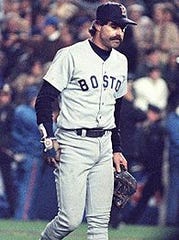
Unfortunately, these were bad years for the Cubs, made all the worse by one of the worst uniforms in baseball history: Poweder-blue road uniforms, with white "reverse pinstripes."
The Seventies were over,
but Buckner still had the Tony Orlando mustache.

Then came a stroke of bad luck: On May 25, 1984, the Cubs traded Buckner to the Boston Red Sox for Dennis Eckersley and Mike Brumley. The trade paid immediate dividends for the Cubs, and Eckersley helped them win the NL Eastern Division title.

The Red Sox, at that point, were in a transition period: While they still had Jim Rice, Dwight Evans and Bob Stanley from their hard-hitting but near-missing late 1970s team, Carl Yastrzemski, Carlton Fisk and Fred Lynn were gone. But new players were coming up: Roger Clemens, Bruce Hurst, Mike Greenwell, Marty Barrett.

The change of scenery from Wrigley Field to Fenway Park, and a switch to uniform Number 6, helped Buckner: In 1985, he batted .299, and reached career highs 46 doubles, 16 home runs and 110 RBIs. In 1986, at age 36, he tailed off a little, partly due to injuries, and batted only .267. But he hit a new career high with 18 homers, and had 102 RBIs. He hit .340 in September, helping the Red Sox outrun the New York Yankees and win the American League Eastern Division title. His 3 RBIs in the AL Championship Series helped the Sox beat the California Angels for the Pennant.

*

This is the nightmare scenario for a Yankee Fan: A World Series between the New York Mets and the Boston Red Sox. The Other Team vs. The Scum.

I was rooting for the Red Sox. Why? Well, it was 1986. This was before Big Papi and Manny Being Manny and all the other steroid cheats. This was before Pedro the Punk and Varitek the Coward and Crybaby Curt. This was before Papelbum and Youkilis wiggling his ass at the plate. Not only weren't the Sox "The Scum" yet, but it didn't occur to me to call them that until I got into English soccer in 2008, and I found out that fans from Newcastle in the north to Southampton in the south called their team's arch-rivals "The Scum."

Yes, it was a rough Pennant race that year, and the Sox beat the Yanks out. Yes, I remembered the battles of the late 1970s -- well, maybe not 1975 or '76, as I was not quite old enough to watch baseball on TV yet; but definitely '77 and '78. I knew the battles. Thurman Munson vs. Carlton Fisk. Reggie Jackson vs. Jim Rice. Ron Guidry vs. Dennis Eckersley. Bill Lee vs., well, every Yankee. Bucky Dent vs. Mike Torrez. And, ultimately, Carl Yastrzemski vs. Rich Gossage -- Yaz vs. the Goose.

But, to me, then, the Mets were The Enemy. I didn't have to live in New England, surrounded by Sox fans. I had to live in Central Jersey, surrounded by Met fans, people with all the arrogance of Yankee Fans but having earned none of it. (This was also shown in hockey, as Ranger fans hated Islander fans for the same reason, until the Isles did earn it.)

And while I may have hated Rice and Fisk and Eck and Lee and, especially, Jerry Remy, who always seemed to do well against the Yankees, before becoming the Sox' broadcaster, their Phil Rizzuto or Richie Ashburn, I didn't hate Yaz. Or Dwight Evans. And, on the current team, I didn't hate Buckner, or Wade Boggs, or Mike Greenwell, or Bruce Hurst. I kind of liked them. Certainly, I respected them. I even liked Roger Clemens -- for the moment. That would change. And change back. And change back and forth a few times.

I had no problem rooting for the Red Sox against the Mets. The fact that the Sox were the American League team had nothing to do with it. Met fans will always root for the National League Champions in the World Series. Even if it's the Philadelphia Phillies or the Atlanta Braves. Even if it's one of the teams that abandoned New York after the 1957 season, the Los Angeles Dodgers or the San Francisco Giants.

Yankee Fans don't think that way: We might root for the American League Champions in the World Series, but not because they're the American League team.

So, yeah, I wanted the Red Sox to win the 1986 World Series. As had been sung in The Sound of Music, I was 16 going on 17. As would later be said in politics, "It was as youthful indiscretion."

Going into the World Series, both of Buckner's ankles were injured. Sox manager John McNamara had been replacing him for defensive purposes, with Dave Stapleton. The Red Sox took the 1st 2 games of the World Series against the Mets, but the Mets won the next 2. The Sox won Game 5, and needed just 1 more win for their 1st World Championship in 68 years.

It was October 25, 1986, at Shea Stadium in Flushing Meadow, Queens, New York, New York. The Sox were leading Game 6 5-3 in the 10th inning, putting them 3 outs away. Buckner was 0-for-5, and should have been taken out for defensive purposes one more time. But McNamara wanted him to be on the field for the celebration.

Sox pitcher Calvin Schiraldi got the 1st 2 outs. Then he began one of the worst meltdowns in baseball history. He allowed a single to Gary Garter. He allowed a single to Kevin Mitchell. He allowed a single to Ray Knight, scoring Carter and making it 5-4.

McNamara took him out, replacing him with Stanley. Buckner remained at 1st base, instead of Stapleton being sent out there.

Stanley pitched to Mookie Wilson. He got 2 strikes on him, but Mookie fouled some pitches off. Between Schiraldi and Stanley, there were 13 separate pitches that could have been the last out for the Sox.

Finally, Stanley threw a wild pitch that nearly hit Wilson, and Mitchell scored. 5-5. Tie ballgame. Someone did the math, and determined that, before Stanley threw that pitch, the odds were 320-1 against the Mets winning the Series. Now, the lead was blown.

And Buckner had nothing to do with it.

Stanley pitched to Wilson again. Wilson swung awkwardly. Under ordinary conditions, this would have been an easy play: Ground ball to the 1st baseman, who would flip to the pitcher, who would step on 1st for the out, ending the inning.

These were not ordinary conditions. Stanley did not run to cover 1st. And Buckner was playing hurt. He bent over to pick up the ball, and, well...

When I saw it, I said, "He's not gonna get it." But what that meant didn't quite register. Then, when my prediction came true, it registered, and I yelled, "Oh my God! Oh my God! Oh... my... God!"

Three and two to Mookie Wilson. Little roller up along first, behind the bag! It gets through Buckner! Here comes Knight, and the Mets win it! (After letting the roar of the crowd tell the story for a minute) If one picture is worth a thousand words, you have seen about a million words. But, more than that, you have seen an absolutely bizarre finish to Game 6 of the World Series. The Mets are not only alive, they are well, and they will play the Red Sox in Game 7 tomorrow! 
"A picture is worth a thousand words." -- Arthur Brisbane,
American newspaper editor, 1864-1936

Jack Buck, on CBS radio:

Here's the pitch to Mookie Wilson. Winning run at second. Ground ball to first, it is a run... an error! An error by Buckner! The winning run scores! The Mets win it, 6-5 with 3 in the 10th! The ball went right through the legs of Buckner, and the Mets, with 2 men out and nobody on, have scored 3 times to bring about a 7th game, which will be played here tomorrow night. Folks, it was unbelievable.

Bob Murphy, on the Mets' station, WHN, AM 1050, soon to become the original WFAN:

Three and two the count. And the pitch by Stanley. And a ground ball,  trickling, it is a fair ball! Gets by Buckner! Rounding 3rd, Knight! The Mets will win the ballgame! The Mets win! They win!

(No, he didn't say, "The Mets win the damn thing!" He did say that, but not on this occasion.)

Ken Coleman, on the Red Sox' station, WRKO, AM 680: 

Ground ball to 1st base, Buckner, it gets by him! And here comes the winning run!

Mets 6, Red Sox 5. World Series tied, 3-3. Game 7 was postponed a night by rain. But the idea that "The Red Sox were doomed," or "There was no way they were going to win Game 7" is ludicrous. They had their chances: They took a 2-0 lead in the top of the 2nd inning, still held that lead going into the bottom of the 6th, and closed to within 6-5 in the top of the 8th. It didn't truly become hopeless until Darryl Strawberry's home run and seemingly endless home run trot in the bottom of the 8th. Mets 8, Red Sox 5. Mets win Series.

It was almost the ultimate nightmare scenario for Yankee Fans: Thinking the Red Sox had won the World Series, and then, less than 24 hours later, seeing the Mets win it. It was as if they'd both won it.

Of course, the Red Sox had lost it. 

Even though the Yankees had nothing to do with this -- although a New York team did -- Buckner's error became the culmination of the myth of "The Curse of the Bambino." When Dan Shaughnessy, columnist for The Boston Globe, wrote his book with that title, publishing it in 1990, he brought up all kinds of weird things, and connected them to the Sox' sale of Babe Ruth to the Yankees in the 1919-20 off-season, as the explanation for why the Sox hadn't won the World Series since 1918.

He mentioned the Sox' retired numbers on the right field roof at Fenway Park, reading "9 4 1 8," suggesting September 4, 1918, the day before the last World Series the Sox won. He mentioned the fact that Bruce Hurst, who stood be named Most Valuable Player of the Series before Schiraldi and Stanley blew it, could have his name rearranged: "BRUCE HURST" to "B. RUTH CURSE."

But somebody pointed out something else to him: When Hank Aaron hit his 715th career home run, to break Ruth's all-time record, the Dodger left fielder it went over was Bill Buckner. It was as if Ruth was punishing the Sox in general, and Buckner in particular. Well, what was Buckner supposed to do? Fly, to catch the ball? He wasn't Superman. (Clearly, as he was injured in the '86 Series, and Superman is invulnerable.)

Buckner was assigned the blame by Red Sox fans. He was harassed at home during the off-season. Someone threw garbage on his lawn. He got death threats in the mail and on the phone. If there had been an Internet at the time, it would have been even uglier.

During the 1986 World Series between the Red Sox and the Mets, Bud Collins, NBC Sports' tennis maven, and a huge Red Sox fan, was covering a tennis tournament in Japan. When he boarded his plane in Tokyo, he had just seen, on TV in the airport lounge, Dave Henderson hit a home run that gave the Sox the lead in the 10th inning in Game 6. Now, they were going to win the World Series for the 1st time since 1918, and he was going to miss it. Forget not being in the stadium: He wasn't on the right side of the world. He wasn't even going to see it, because he was going to be on the plane!

When the plane landed at Los Angeles hours later, he expected to find people talking about it. Oh, they were talking about it all right, but, knowing who Bud was and where he was from, they kept coming up to him and telling him how sorry they were. He'd been in the air, without today's laptops and smartphones, and he had no idea of what they were talking about. A quick trip to the airport lounge and a look at a TV showed him the collapse, and its exclamation-point error by Bill Buckner.

Collins would later say, "He was driven out of New England, because, to New England, Bill Buckner was like Rasputin. He'd done evil, wicked things. We all make mistakes, but that was a mistake that will haunt him for the rest of his life."

In 2005, ESPN launched its series The Top 5 Reasons You Can't Blame... Host Brian Kenny said that Buckner could have been the show's patron saint. Here were the network's...

Top 5 Reasons You Can't Blame Bill Buckner for the Boston Red Sox Losing the 1986 World Series

First, The Best of the Rest:

Missed Opportunities. For example, the Sox left 14 runners on base in Game 6.

Dennis "Oil Can" Boyd. The Sox pitcher celebrated too soon, opening one of the bottles of champagne that had been brought into the clubhouse.

The Shea Stadium Scoreboard. Whoever was operating it put up a premature message that congratulated the Sox for winning.
Pictured: A real image that actually happened,
not "Alternate History."

5. Roger Clemens' Exit. Did John McNamara take him out too soon, or did he really have a blister, like McNamara said? Clemens is a known liar, but he has always stuck to his story that he could have pitched longer.

4. Calvin Schiraldi. All he needed was one more out. He blew Game 6, and blew Game 7, too. In the 33 years since, he's been said to have a "deer in the headlights" look. The experience left him so scarred (How scarred was he, Uncle Mike?), when he was interviewed for that ESPN show, the former Met and former Red Sock wasn't wearing Met gear, or Sox gear, but a jersey and a cap from his alma mater, Mississippi State University. (A very good baseball program, then and now.)

3. Rich Gedman and Bob Stanley. If Stanley hadn't thrown that wild pitch... if Gedman had blocked it... if either of those things had happened, it might not have mattered whether Buckner had gotten the ball and Stanley had covered 1st base.

2. Mookie Wilson. He hit the ball, so give him credit. He was one of the fastest guys in baseball at the time. Buckner, with his injured ankles, was never going to beat him to the bag. Even if Buckner had gotten to the ball, and Stanley had covered 1st, Mookie still might have beaten it out.

Then it would have been bases loaded, and the next batter would have been Howard Johnson, not a good hitter for average at the time, but with some pop in his bat. The Sox would hardly have been out of the woods.

1. John McNamara. The Boston manager had screwed the pooch in any number of ways, including not replacing Buckner with the fully-fit, better-fielding Dave Stapleton.

Throw in the fact that the Sox led Game 7 from innings 2 through 6, and anybody who blamed Buckner for losing the Series was an idiot.

But then, we are talking about Red Sox fans.

*

Buckner was treated decently at every American League ballpark in 1987 -- except Fenway Park, his home park. On July 23, despite having a decent .273 batting average and a solid 42 RBIs, the Sox released him. He was quickly picked up by the Angels, and he batted .306 the rest of the way, finishing at .286, with 5 homers and 74 RBIs -- not bad for a player in pitcher's parks (as Fenway is for lefthanded hitters, and Angel Stadium is for any hitter), and especially for a 37-year-old player with nagging injuries.

Still, the Angels released him early in the 1988 season, and was picked up by the Kansas City Royals, playing with them through the 1989 season.

In 1990, the Red Sox signed him again, making him 1 of what's now 29 players who played in the major leagues in 4 different decades -- 5 of them in the 1960s, '70s, '80s and '90s: Buckner, Nolan Ryan, Carlton Fisk, Jerry Reuss and Rick Dempsey.

He wasn't in the starting lineup on Opening Day, so he was introduced with all the nonstarters, as is Opening Day custom throughout baseball. And he received a standing ovation. But he was 40 years old, and done. He had a .186 batting average when he was released on June 5, and retired.

He finished his career with a .289 lifetime batting average, a .321 on-base percentage, a .408 slugging percentage, and an OPS+ of exactly 100 -- in other words, exactly average. Maybe this stat doesn't always tell the truth: He was a better hitter than that, topping 110 5 times, reaching a high of 130 in 1981. He collected 2,715 hits. Only 174 of them were home runs, but 498 of them were doubles.

Here is a list of all players eligible for the Baseball Hall of Fame, but not yet in, and not under a cloud of steroid suspicion, with more career hits than Bill Buckner: 

1. Omar Vizquel 2,877
2. Johnny Damon 2,769
3. Vada Pinson 2,757
4. Al Oliver 2,743
5. Rusty Staub 2,716
6. Bill Buckner 2,715

That's it. Vizquel will almost certainly get in, but that's because of his glove. Of the other 4, Buckner was, prior to his 1986 injuries, a better fielder than any of them.

Here is a list of all players eligible for the Baseball Hall of Fame, but not yet in, and not under a cloud of steroid suspicion, with more career doubles than Bill Buckner: 

1. Todd Helton 592
2. Jeff Kent 560
3. Al Oliver 529
4. Dave Parker 526
5. Garret Anderson 522
Tie. Johnny Damon 522
7. Scott Rolen 517
8. Mark Grace 511
9. John Olerud 500
10. Rusty Staub 499
11. Bill Buckner 498
Tie. Torii Hunter 498

Again, pretty good company.

Am I saying that Buckner belongs in the Hall of Fame? No, I'm not. Am I saying he deserves more respect than he's gotten? You bet your sweet bippy.

*

After retiring, Buckner moved to the Boise, Idaho area with his wife Jody, and his 3 children, daughters Brittany and Christen, and son Bobby. He invested in real estate, and made a lot of money. He owned an auto dealership, and lost money. In 2011, he returned to Massachusetts to manage the Brockton Rox of the Can-Am League, and took them to a winning record. For the next 2 seasons, he served as the hitting instructor for the Boise Hawks, a Cubs farm team.

But that one play wouldn't go away. It was mentioned in the Boston-based movies Celtic Pride, Rounders, and the U.S. version of Fever Pitch. It was mentioned on an episode of The Simpsons. Buckner agreed to appear in an episode of Curb Your Enthusiasm, where he again mishandled a baseball, but made up for it by catching a falling baby.

In 2004, the Red Sox finally won the World Series. Many Sox fans began to talk about "forgiving" Buckner. Forgive him? For what? When he made his error, the damage had already been done.

On Opening Day 2008, when the Sox got their World Series ring, Buckner was invited to throw out the ceremonial first ball. He got a standing ovation. He got another at Fenway's 100th Anniversary celebration in 2012. He also appeared at the 50th Anniversary celebration for Dodger Stadium that year, and the 100th Anniversary celebration for Wrigley Field in 2014.
But he developed Lewy body dementia, which produces symptoms similar to Alzheimer's disease, Parkinson's disease, and schizophrenia. Yes, all three. It's a hell of a way to live, and to die. Comedian Robin Williams committed suicide because he couldn't handle living with the symptoms. His widow wrote an article titled "The Terrorist in My Husband's Brain."

It also slowly killed actress Estelle Getty, disc jockey Casey Kasem, and 1950s Yankee 3rd baseman Andy Carey. Former Atlanta Braves and Hawks owner, and CNN founder, Ted Turner has it. Buckner isn't even the 1st former Chicago sports star to develop it: It killed Blackhawks Hall-of-Famer Stan Mikita, and former Bulls star and Utah Jazz coach Jerry Sloan has it.

Bill Buckner died yesterday, May 27, 2019, at his home outside Boise. He was 69 years old.

Let him be remembered for a good baseball career that included over 2,700 hits, an All-Star berth, and 2 Pennants. And let him be remembered for the standing ovations he received in his retirement.

That's what we need to remember about him. Not one play, but 22 seasons and a good life.

UPDATE: His final resting place is not publicly, known.

Monday, May 27, 2019

Bart Starr, 1934-2019

First things can happen only once. There will only ever be one Super Bowl I, and it will only ever have one winning team, one winning quarterback, and one Most Valuable Player. The Green Bay Packers were that team, Bart Starr was that quarterback, and he was that MVP.

Bryan Bartlett Starr was born on January 9, 1934 in Montgomery, Alabama. He had a difficult relationship with his father. He quit the football team at Sidney Lanier High School in Montgomery 2 weeks into his sophomore year. His father told him he could play football, or he could drop out of high school and work in the family garden. Bart went back to football.

In his junior year, he led Lanier to an undefeated season. He went to the University of Alabama -- before Bear Bryant became its head coach. At the time, the Southeastern Conference allowed freshmen to play varsity football, and Starr played enough to earn a varsity letter, even throwing a touchdown pass in the 1953 Orange Bowl -- which was completely unnecessary, as Alabama inundated Syracuse 61-6.

He became the starter the next year, and got Alabama into the 1954 Cotton Bowl, where they lost to Rice, in a game remembered for Rice being awarded a touchdown when Alabama's Tommy Lewis jumped off the bench, becoming an ineligible player, and tackled Dickey Moegle to prevent him from scoring a touchdown.

In the off-season, Starr eloped with his girlfriend, Cherry Morton -- an Auburn student. The fact that she went to 'Bama's arch-rival wasn't nearly as much of a problem as their marriage happening at all: In those days, colleges often revoked the scholarships of married athletes. So they kept it a secret, and Bart stayed in Tuscaloosa the University, while Cherry returned to her hometown of Jackson, Alabama.

A few weeks later, he suffered a back injury, which nagged him for the rest of his life, but also made him 4-F and ineligible for the military draft. A new coach, J.B. Whitworth, went with a youth movement, and benched Starr, resulting in poor seasons that led to Whtiworth's firing and Bryant's hiring.

*

Starr's chances of a pro career seemed over: No NFL team seemed likely to draft him, and the AFL wasn't even an idea at this point. But Alabama basketball coach Johnny Dee was a friend of Jack Vainisi, the personnel director of the Green Bay Packers. Vainisi drafted Starr in the 17th Round of the 1956 NFL Draft.

These are the quarterbacks who were selected ahead of Starr in that draft: Earl Morrall of Michigan State, by the San Francisco 49ers; John Roach of Southern Methodist, by the Chicago Cardinals; Jerry Reichow of Iowa, by the Detroit Lions; Em Lindebeck of Illinois, by the Los Angeles Rams; John Polzer of Virginia, by the Baltimore Colts; Tom Spiers of Arkansas State, by the Cardinals; George Herring of Mississippi Southern, by the 49ers; and George Welsh of the Naval Academy, by the Cardinals. Of these, only Morrall had much of a pro career, although Welsh went on to be elected to the College Football Hall of Fame as a coach, winning 2 Atlantic Coast Conference titles at Virginia. (He died earlier this year, age 85.)

In Starr's 1st 3 seasons, he split playing time, first with Tobin Rote, then with Babe Parilli -- both of whom would become bigger stars in the AFL. The Packers were terrible, bottoming out at 1-10-1 in 1958.

In 1959, they hired Vince Lombardi as head coach. Lombardi had 2 messages for his players: "We may not win, but we won't be losing with the same people"; and, "Those who stay will be champions." He cleared out the talented underperformers, showing everyone else that no one's job was safe if they didn't work hard enough and smart enough.

Starr worked hard and smart, and Lombardi loved him for it. And Lombardi built an offense for Starr to work with, including Hall-of-Fame running backs Paul Hornung and Jim Taylor, and Hall-of-Fame linemen Jim Ringo, Jerry Kramer and Forrest Gregg; and a great defense that included Hall-of-Famers Willie Davis, Henry Jordan, Ray Nitschke, Herb Adderley and Willie Wood.

Together, they would dominate the NFL in the 1960s. In 1959, they improved to 7-5. In 1960, they won the NFL Eastern Division, losing the NFL Championship Game to the Philadelphia Eagles. In 1961, they won the NFL Championship. In 1962, they did it again. Both times, they defeated the New York Giants in the title game. After missing the Division title in 1963 and 1964, they won 3 straight NFL Championships Games -- the only time it's ever been done -- against the Cleveland Browns in 1965, and the Dallas Cowboys in 1966 and 1967.
Starr and Lombardi

Along the way, in a league that then included Johnny Unitas of the Baltimore Colts, Sonny Jurgensen of the Philadelphia Eagles and then the Washington Redskins, Y.A. Tittle of the Giants, and Fran Tarkenton of the Minnesota Vikings, Starr led the NFL in passer rating 5 times, made 4 Pro Bowls, and was named NFL Most Valuable Player for the 1966 season. He wasn't just a guy benefiting from being on a great team: He directed that great team. Lombardi may be thought of today as a "micromanager," but he let Starr call his own plays.

Nowhere was that more important than at the end of the 1967 NFL Championship Game, at Lambeau Field in Green Bay, a game so cold it was known as the Ice Bowl. The Packers trailed the Cowboys 17-14 with 16 seconds left, and had a 3rd-and-goal on the 1-yard line. Run the ball and fail, and they wouldn't be able to stop the clock in time to kick the tying field goal. Pass the ball, and it could fall incomplete, leaving 4th down with the clock stopped with a few seconds left, and you could still kick the field goal -- but it could also be intercepted. Kick it now, on 3rd down, and it could be missed, and even if it's made, the game is still only tied.

Starr recommended a play called "31-Wedge" to Lombardi: "Coach, the linemen can get their footing on the wedge, but the backs are slipping. I'm right there. I can just shuffle my feet and lunge in."

At this point, Lombardi was as cold and as tired as anyone, and was not looking forward to overtime, so he told Starr, "Run it, and let's get the hell out of here!"

Starr called the play. It required guard Kramer and center Ken Bowman to double-team Cowboys defensive tackle Jethro Pugh. Bowman snapped the ball, Starr took it, lowered his head, and followed the block. Touchdown. Packers win, 21-17.
Starr (15) over the goal line. Mercein (30) with his hands up.
Kramer (64) having blocked Pugh (75).
This is Walter Iooss Jr.'s photo for Sports Illustrated.
The most familiar shot of the touchdown is in black & white,
and I wanted a color photo.

In his 1980 book Pro Football's 10 Greatest Games, sports historian (usually specializing in baseball) John Thorn wrote, "It is the most famous touchdown in football history." This was before the 1982 Dwight Clark "The Catch," but Thorn put it ahead of the 1958 Alan Ameche overtime score (he included that title game in the book), and the 1974 Clarence Davis "Sea of Hands" catch (he included that game, too), and apparently ahead of the 1972 Franco Harris "Immaculate Reception" (he did not include that game).

Bart Starr quarterbacked 5 NFL Championships. To this day, no other man has ever done that, except Tom Brady, and he doesn't count. Can you imagine Vince Lombardi putting up with his quarterback -- or, as general manager, with his head coach -- cheating? No you can't. Don't even try. Maybe Brady would have won a title or two with Lombardi running things, but it would have been honestly. Not the 5 that Starr won, or the 6 that Brady has won, all of them questionable.

The 1966 and 1967 seasons were the 1st 2 in which the Champions of the 2 Leagues would face each other, in what was then named "The AFL-NFL World Championship Game." It would begin to be officially called the Super Bowl for the 3rd one, and the Roman numerals were added 2 years after that, for Super Bowl V. So the title games played on January 15, 1967 and January 14, 1968 were retroactively renamed "Super Bowl I" and "Super Bowl II."

In Super Bowl I, at the Los Angeles Memorial Coliseum, Starr completed 16 of 23 passes, for 250 yards, 2 touchdowns and an interception. The Packers beat the Kansas City Chiefs 35-10. In Super Bowl II, at the Orange Bowl in Miami, Starr completed 13 of 24, for 202 yards, a touchdown, and no interceptions. The Packers beat the Oakland Raiders 33-14.

Both times, Starr was named the game's MVP. The award was presented by the now-defunct SPORT magazine, and the prize was a new Chevrolet Corvette. Starr donated his Super Bowl II Corvette to Rawhide Boys Ranch in New London, Wisconsin, which he had co-founded to help troubled boys in Wisconsin.

But Super Bowl II was Lombardi's last game with the Packers. The dynasty players were getting old, and Lombardi's successors on the sideline and in the front office were not up to the task. Starr retired during training camp in 1972, at age 38.

*

He immediately went into coaching, becoming the Packers' quarterbacks coach, under head coach Dan Devine. In 1972, with Starr advising Scott Hunter, the Packers won the NFC Central Division. Then he left football, to pursue private business interest, and broadcast some games for CBS.

After the 1974 season, Devine was hired by Notre Dame -- interestingly, the alma mater of Packers founder Earl "Curly" Lambeau -- and Starr was hired. He only made the Playoffs once, in 1982, and got them to a Playoff win over the St. Louis Cardinals, before losing to the Dallas Cowboys. He was fired after the next season.

Almost immediately, a group looking to gain an expansion team for Phoenix, hired Starr to coach the team they wanted to call the Arizona Firebirds. But the NFL put expansion plans on hold due to legal issues. Once they were resolved, St. Louis Cardinals owner Bill Bidwill moved his team to Phoenix for the 1988 season, and the Firebirds' group disbanded.

Starr never worked in football again. He was elected to the Pro Football Hall of Fame, the Green Bay Packers Hall of Fame, the Wisconsin Athletic Hall of Fame, and the NFL's 1960s All-Decade Team. The Packers retired his Number 15. In 1999, The Sporting News ranked him 41st on their list of the 100 Greatest Football Players. In 2010, the NFL Network ranked him 51st on their list of the 100 Greatest Players.
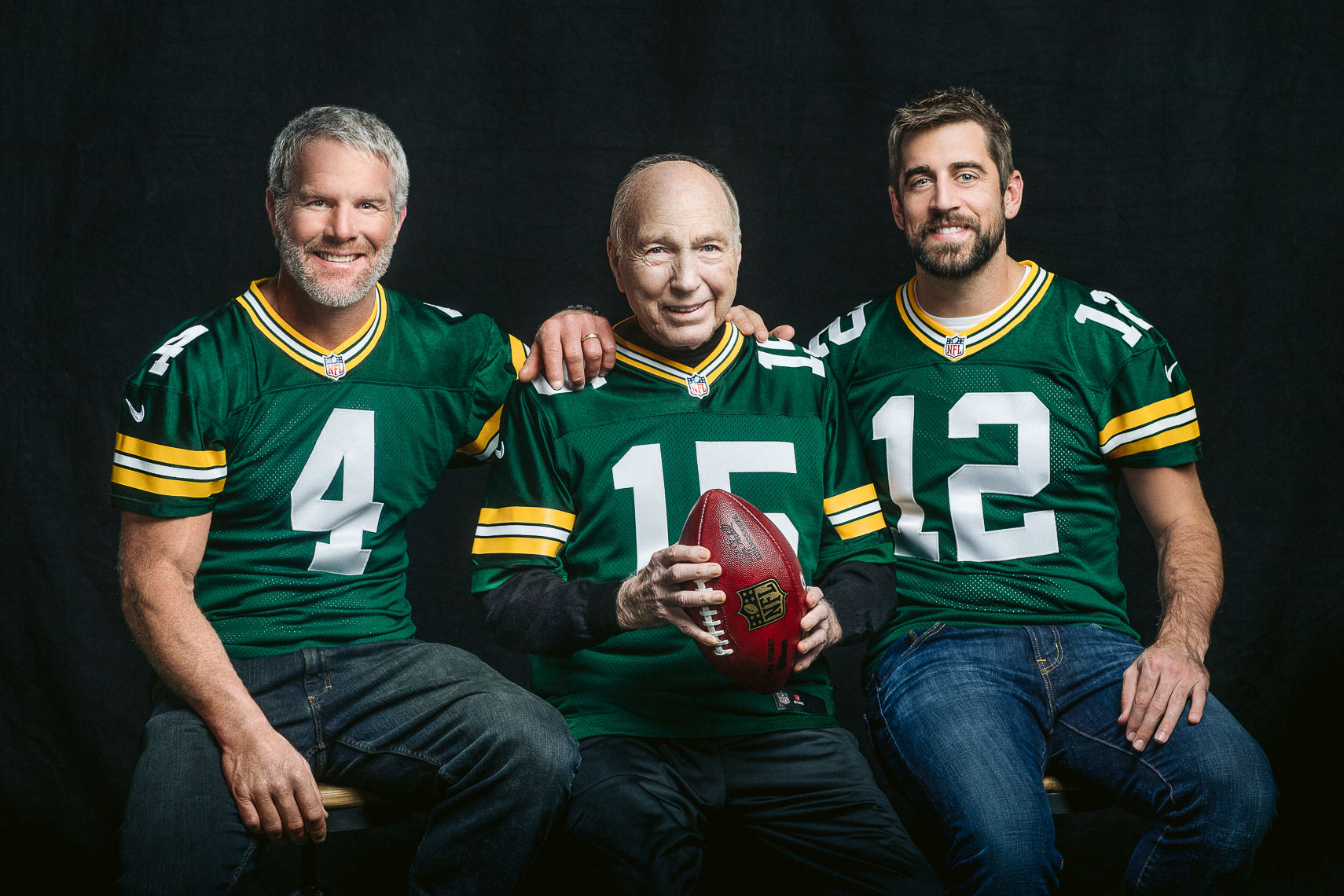
Brett Favre, Bart Starr and Aaron Rodgers

In 1989, the NFL instituted the Bart Starr Award, given annually to a player of outstanding character. The 1st winner was Steve Largent. Most of the players who've won it have gone on to the Hall of Fame, or will, including Anthony Munoz, Mike Singletary, Reggie White, Warren Moon, Darrell Green, Bruce Matthews, LaDainian Tomlinson, Drew Brees, Aaron Rodgers and Peyton Manning. Only 1 player for a New York team has won it: Curtis Martin of the 2006 Jets. The 2019 winner is Calais Campbell, defensive end for the Jacksonville Jaguars.

The last few years of his life were not kind to Bart Starr, as he was always ill. He had a heart attack, 2 strokes, and a broken hip. In 2015, he was able to attend a ceremony at Lambeau Field, for the retirement of Brett Favre's Number 4. But he was not able to attend the pregame ceremony of Super Bowl 50, honoring all previous Super Bowl MVPs. He was the only one unable to attend, and instead sent a videotaped greeting from his home in Birmingham, Alabama.

The strokes affected his memory. When Ian O'Connor of ESPN visited him in 2015, O'Connor mentioned that he was a graduate of St. Cecilia High School in Englewood, Bergen County, New Jersey, where Vince Lombardi had coached in the 1940s. (The school closed in 1986.) Starr said he couldn't even remember Lombardi.

We often say things like, "I will never forget (notable person or event)." Certainly, one would think that Vince Lombardi was unforgettable. But that's not always true. Stem-cell treatments helped, and, in 2017, he was able to attend a 50th Anniversary ceremony honoring the Ice Bowl, his memory of that game restored.

Toward the end, Cherry found him listening to Il Divo's rendition of "Unchained Melody." Bart asked her to play it at his wedding. He meant "funeral," of course, but the treatments that were helping his brain to work could only do so much. Cherry believes that he was one of the many football players for whom the game led to brain damage.
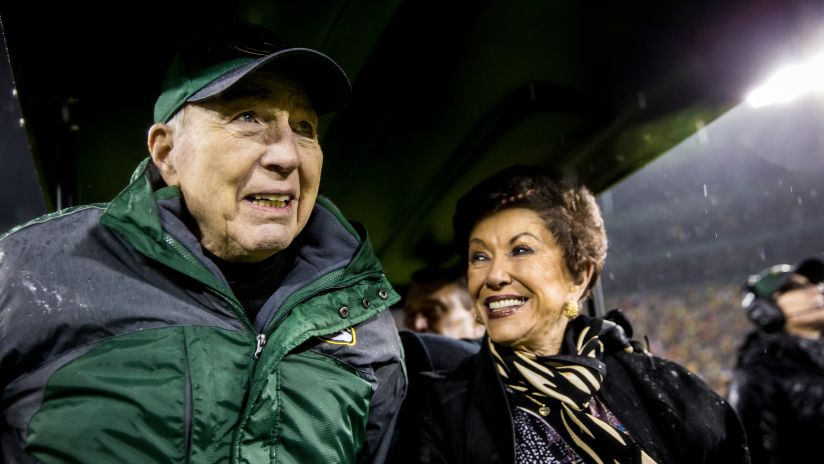
Bart and Cherry Starr

Bart and Cherry had 2 sons, Bart Jr., and Bret. The former gave them 3 granddaughters. The latter died in 1988, of a cocaine overdose, only 24 years old.

Bart Starr died yesterday, May 26, 2019, at his home in Birmingham. He was 85 years old.

In his ESPN.com obituary for Starr, O'Connor wrote that when he left Starr's house that day, he told Starr that he was the toughest man to play in the NFL. Starr said, "Well, I've been the luckiest football player ever."

"Go look at the film of the Ice Bowl," O'Connor says. "When it came to Bryan Bartlett Starr, luck had absolutely nothing to do with it."

UPDATE: His final resting place is not publicly known.

*

With Starr's death, there are now 12 surviving players from the 1961 NFL Champion Green Bay Packers: Paul Hornung, Willie Wood, Herb Adderley, Willie Davis, Jerry Kramer, John Roach, Tom Moore, Dale Hackbart, Nelson Toburen, Lee Folkins, Gary Knafelc and Boyd Dowler.

There are 14 surviving players from the 1962 NFL Champion Packers: Hornung, Wood, Adderley, Davis, Kramer, Roach, Moore, Toburen, Knafelc, Dowler, Howie Williams, Ed Blaine, Ron Gassert and Gary Barnes.

There are 18 surviving players from the 1965 NFL Champion Packers: Hornung, Wood, Adderley, Davis, Kramer, Moore, Dowler, Zeke Bratkowski, Tom Brown, Junior Coffey, Doug Hart, Bill Curry, Ken Bowman, Steve Wright, Bob Long, Marv Fleming, Carroll Dale and Dave Robinson.

There are 24 surviving players from the 1966 NFL Champion Packers: Hornung, Wood, Adderley, Davis, Kramer, Dowler, Bratkowski, Tom Brown, Hart, Curry, Bowman, Wright, Long, Fleming, Dale, Robinson, Red Mack, Jim Grabowski, Phil Vandersea, Donny Anderson, Dave Hathcock, Jim Weatherwax and Allen Brown.

And there are 25 surviving players from the 1967 NFL Champion Packers: Wood, Adderley, Davis, Kramer, Dowler, Bratkowski, Tom Brown, Hart, Bowman, Wright, Long, Fleming, Dale, Robinson, Grabowski, Anderson, Weatherwax, Allen Brown, Don Horn, Chuck Mercein, Ben Wilson, John Rowser, Bob Hyland, Jim Flanigan and Dick Capp.

Big Comeback Wasted as Yankees Lose In 10

I hate losing. I really hate losing in extra innings. I especially hate wasting a good comeback and losing anyway.

I was sure that manager Brian Cashman's orders to have his lackey Aaron Boone wear the bullpen out, especially starting Chad Green yesterday, was going to come back to bite the team. Sure enough, yesterday afternoon, in the finale of the series away to the Kansas City Royals, it did.

Domingo German started, looking to extend his surprising 9-1 record. This time, he had nothing: He went 5 innings, allowing 7 runs on 9 hits, including 4 home runs. The facts that he walked none and struck out 6 were good, but it was his worst performance of the season.

It was 7-1 Royals going to the top of the 6th inning. But the Yankees got a couple of runners on, and Gleyber Torres hit a home run. Suddenly, at 7-4, the lead seemed surmountable. Nestor Cortes pitched the 6th, 7th, 8th and 9th innings, and while he allowed 4 hits and 2 walks, he allowed no runs.

The top of the 9th inning included the kind of comeback that championship teams make. With 1 out, Clint Frazier and Gio Urshela hit back-to-back singles. Brett Gardner struck out, but DJ LeMahieu singled Frazier home. Luke Voit drew a walk to load the bases. Aaron Hicks singled, tying the game. There was hope. But Gary Sanchez flew out to end the inning.

Cortes got into trouble in the bottom of the 9th, but got out of it. It was on to extra innings. Kendrys Morales walked with 1 out in the 10th, but both Frazier and Urshela popped up.

Cashman, through Boone, didn't want Cortes out there for the 10th. So he called on Jonathan Holder, who's been, Cliche Alert, consistently inconsistent. He struck Martin Maldonado out. But, Cliche Alert: Walks can kill you. He walked Billy Hamilton, who then stole 2nd. Holder got Nicky Lopez to ground out. But Whit Merrifield hit a bad-hop single to left to end it.

Royals 8, Yankees 7. WP: Kevin McCarthy (1-1). No save. LP: Holder (3-2).

*

So here's where things stand, after 52 games, 32 percent of the way through the season, nearly 1/3rd:

* The Yankees are 34-18, in 1st place in the American League Eastern Division, despite not having had Luis Severino, Dellin Betances and Didi Gregorius at all this season; despite not having Aaron Judge, Giancarlo Stanton, Miguel Andujar and Aaron Hicks for most of it; and despite not having James Paxton, their only big off-season acquisition, for much of it.

* They lead the Tampa Bay Rays by 2 games (1 in the loss column), the Boston Red Sox by 6 1/2 (6), the Toronto Blue Jays by 13 1/2 (14), and the Baltimore Orioles by 18 1/2 (19).

* If the current standings hold to the end of the season, they would have the 2nd seed in the American League Playoffs. Only the Minnesota Twins, currently running away with the AL Central Division, have a better record. In the National League, only the Los Angeles Dodgers have a better record.

* Injury updates: Paxton possibly this week; CC Sabathia in early June; Judge, Stanton, Gregorius, Betances and Troy Tulowitzki by mid-June; Severino, Jonathan Loaisiga and Jordan Montgomery after the All-Star Break; Greg Bird unknown, Andujar next season, and Jacoby Ellsbury will probably never play for the Yankees again.

The Yankees come home to start an Interleague series with the San Diego Padres, including a Memorial Day matinee today. (The era of holiday doubleheaders is over.) Here are the projected pitching matchups:

* Today, 1:05: The Yankees are as yet undecided, while the Padres intend to start Matt Strahm.

* Tomorrow night, 6:35: Masahiro Tanaka vs. Eric Lauer.

* Wednesday afternoon, 1:05: Again, the Yankees are undecided, while the Padres intend to start Chris Paddack.

Then, on Thursday, The Scum come to town. I hope the Yankees don't use up all their runs on the Padres. Because that's been done before: Score a lot of runs in the series before facing the Red Sox, and then not having enough to beat them.