Tuesday, June 18, 2013

How To Be a Yankee Fan In Chicago -- 2013 Edition

Because of the way the Interleague schedule was (mis)arranged, the Mets will be going to Chicago to face the White Sox before the Yankees do: Next week, while the Yankees don't arrive until August 5.

Hog Butcher for the World,
Tool Maker, Stacker of Wheat,
Player with Railroads and the Nation’s Freight Handler,
Stormy, husky, brawling,
City of the Big Shoulders:

They tell me you are wicked and I believe them, for I have seen your painted women under the gas lamps luring the farm boys.

And they tell me you are crooked and I answer: Yes, it is true I have seen the gunman kill and go free to kill again.

And they tell me you are brutal and my reply is: On the faces of women and children I have seen the marks of wanton hunger.

And having answered so I turn once more to those who sneer at this my city, and I give them back the sneer and say to them:

Come and show me another city with lifted head singing so proud to be alive and coarse and strong and cunning.

Flinging magnetic curses amid the toil of piling job on job, here is a tall bold slugger set vivid against the little soft cities;

Fierce as a dog with tongue lapping for action, cunning as a savage pitted against the wilderness,

Bareheaded, shoveling, wrecking, planning, building, breaking, rebuilding,
Under the smoke, dust all over his mouth, laughing with white teeth,
Under the terrible burden of destiny laughing as a young man laughs,
Laughing even as an ignorant fighter laughs who has never lost a battle,
Bragging and laughing that under his wrist is the pulse.
And under his ribs the heart of the people, laughing!

Laughing the stormy, husky, brawling laughter of Youth, half-naked, sweating, proud to be Hog Butcher, Tool Maker, Stacker of Wheat, Player with Railroads and Freight Handler to the Nation.

-- Carl Sandburg, 1916.

Sandburg knew. He was right then. He is still right now. And this legendary poem "Chicago" fits the White Sox much more than it does the Cubs.

“If I was a colonel in some horrible war,” said Jean Shepherd, the legendary writer and radio show host, native of Hammond, Indiana, and hard-core White Sox fan, “and I needed volunteers for a suicide mission to take an enemy pillbox, I’d call out, ‘Any of you White Sox fans? Follow me!’ And those White Sox fans would follow me, and we’d take that pillbox! Because White Sox fans are special. Fifty years without a Pennant? A hundred years? Doesn't matter. We're loyal.”

Shepherd said that in the 1987 documentary Chicago White Sox: A Visual History. It was an elaboration of something he'd said before: ”If I was going to storm a pillbox, going to sheer, utter, certain death, and the colonel said, ‘Shepherd, pick six guys,’ I’d pick White Sox fans, because they have known death every day of their lives, and it holds no terror for them.”

White Sox fans hate the Cubs, and especially Cub fans, a lot more than Cub fans hate the White Sox and their fans. To a Cub fan, a White Sox fan is a greasy, dirty, uncouth hood who likes heavy metal and marijuana -- an image probably ingrained due to the South Side's gritty reputation and Disco Demolition Night in 1979. To a White Sox fan, a Cub fan is a prissy, effete intellectual who is willing to accept losing so long as he has his ivy and his beer -- and, occasionally, his marijuana. In other words, newspaper columnist and conservative TV news pundit George Will, who actually is a Cub fan... except for the substance abuse part.

Jean Shepherd has been dead for a few years, but I'll bet he didn't like George Will. Will is still alive, and I'll bet he was never a Jean Shepherd fan, either.  Too much imagination.

Disclaimer: While I have been to Chicago, and I have seen games at Wrigley Field, and I saw a game at the old Comiskey Park, I have not yet been to a game at the new Comiskey Park, now named U.S. Cellular Field. But much of this information is taken from the White Sox' website, and is believed to be accurate.

Before You Go.  It's a little soon to predict the weather for next week, but Chicago in late June is usually hot in the daytime and humid at night.  And in early August, when the Yankees go out there, it'll probably be even hotter.  So ignore all the stories you’ve heard about Chicago being cold: You’re going to New Comiskey to see the Mets or Yankees play the White Sox, not to Soldier Field to see the Giants or Jets play the Bears.  Pack accordingly, and be sure to check the websites of the Chicago Tribune and the Chicago Sun-Times for their forecasts at your trip gets closer.

Getting There. Chicago is 789 land miles from New York. Knowing this, your first reaction is going to be to fly out there.

Unlike some other Midwestern cities, this is a good idea if you can afford it. If you buy tickets online today, next week's Mets visit would be $818 round-trip on American Airlines, but for the Yankees' August trip, you can get round-trip fare for just $383.  Nearly every flight from the New York Tri-State Area’s airports to Chicago’s is nonstop, so it’ll be 3 hours, tarmac to tarmac, and about 2 hours going back.

The Chicago Transit Authority (CTA) Blue Line train can get you from O’Hare International Airport, at the northwestern edge of the city, to the downtown elevated (or “L”) tracks that run in “The Loop” (the borders of which are Randolph, Wells, Van Buren and Wabash Streets) in 45 minutes.  That's also roughly the time that the Orange Line can get you from Midway Airport to the Loop.

By bus, Greyhound’s run between the 2 cities is relatively easy, but long, about 18 hours, and is $235 round-trip. The station is at 630 W. Harrison Street. (If you’ve seen one of my favorite movies, Midnight Run, which came out in 1988, this is a new station, not the one seen in that film.) The closest CTA stop is Clinton on the Blue Line, around the corner.  Keep in mind that, while this station is at the edge of downtown, it is, literally, out of the Loop.  In fact, it's across the south branch of the Chicago River from downtown

By train? Amtrak’s Lake Shore Limited (formerly known as the Twentieth Century Limited when the old New York Central Railroad ran it from Grand Central Terminal to Chicago's LaSalle Street Station) leaves New York's Penn Station at 3:40 every afternoon, and arrives at Union Station at 225 South Canal Street in Chicago at 9:45 every morning. It’s $281 round-trip.  The closest CTA stop is Quincy/Wells, in the Loop, but that’s 6 blocks away – counting the Chicago River as a block; Union Station is also not in the Loop.

If you do decide to walk from Union Station to the Loop, don’t look up at the big black thing you pass. That’s the Sears Tower -- excuse me, the Willis Tower.  (Willis is a London-based insurance broker, definitely far less known in the U.S. than Sears, which has long since moved its headquarters out of the Tower and into Chicago's suburbs.) If there’s one thing being in New York should have taught you, it’s this: “Don’t look up at the tall buildings, or you’ll look like a tourist.” But since you’ve come all this way, it makes sense to get a hotel, so take a cab from Union Station or Greyhound to the hotel – unless you’re flying in, in which case you can take the CTA train to within a block of a good hotel.

If you decide to drive, it’s far enough that it will help to get someone to go with you and split the duties, and to trade off driving and sleeping. The directions are rather simple, down to (quite literally) the last mile. You'll need to get into New Jersey, and take Interstate 80 West. You'll be on I-80 for the vast majority of the trip, through New Jersey, Pennsylvania and Ohio. In Ohio, in the western suburbs of Cleveland, I-80 will merge with Interstate 90. From this point onward, you won’t need to think about I-80 until you head home; I-90 is now the key.

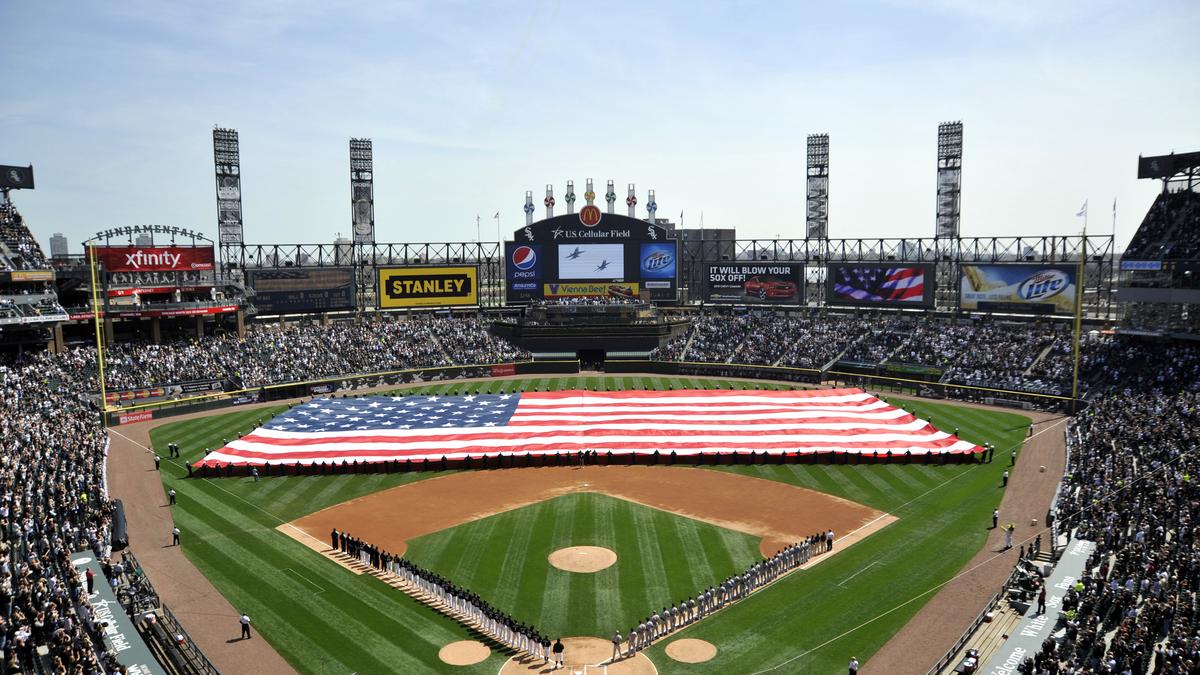
If you were going directly to U.S. Cellular Field (not a good idea, as you should go to your hotel first), you’d take Exit 55A for 35th Street, merge onto LaSalle Street, and turn left on 35th Street. The ballpark is bounded by 35th Street (3rd base), Shields Avenue/Bill Veeck Drive and the Amtrak/Metra tracks (1st base), 37th Street (right field) and Wentworth Avenue (left field).

If you do it right, you should spend about an hour and a half in New Jersey, 5 hours and 15 minutes in Pennsylvania, 4 hours in Ohio, 2 hours and 30 minutes in Indiana, and half an hour in Illinois before you reach the exit for your hotel. That’s 13 hours and 45 minutes. Counting rest stops, preferably halfway through Pennsylvania and just after you enter both Ohio and Indiana, and accounting for traffic in both New York and Chicago, it should be no more than 18 hours, which would save you time on both Greyhound and Amtrak, if not flying.

Tickets. In spite of the White Sox normally being the better team on the field, the Cubs have had the better attendance. This season, the Cubs are averaging 32,104 for home games, the White Sox just 21,919, even though the Sox are doing a little better than the Cubs at the moment.  (The Sox are 9 games under .500, the Cubs 12 games under.)

In fact, the Cubs have had a higher attendance than the White Sox every season from 1994 onward, even though the Sox were then in a very good period and have actually won a Pennant and a World Series since: Even in their title season of 2005, the Sox trailed the Cubs in per-game attendance, 24,437 to 39,138. The Sox’ record is 36,511 in 2007, and the Cubs had 39,040 the same year.

I think the Cub/Sox divide -- that is, the Sox fans hate the Cubs and their fans more than the Cub fans hate the Sox and their fans -- is partly due to the Cub-Cardinal rivalry. Cub fans have someone they hate more than they hate the White Sox. The move of the Milwaukee Brewers, considerably closer to Chicago than St. Louis is, to the National League has killed the Sox-Brewers rivalry, which was never all that strong, but neither has it made Cub fans hate the Brewers all that much. In contrast, Brewers fans have grown to hate Cub fans, mainly because they were probably already sick of hearing about Cub fans, Wrigley Field and Harry Caray on "Superstation" WGN.  (This may also be spillover from Chicago Bears vs. Green Bay Packers, although it's been a while since Chicago Bulls vs. Milwaukee Bucks, or even DePaul vs. Marquette, has meant much.)

Hopefully, the White Sox' 2005-present resurgence, under (now former) manager Ozzie Guillen and general manager Kenny Williams will help them build rivalries with AL Central opponents Detroit, Cleveland and Minnesota, and they can have better attendance as a result of both the winning and the rivalries.

But, for now, getting tickets for a White Sox game shouldn't be difficult: Essentially, you can probably get any seat you can afford. Lower Boxes will cost $92, Lower Reserved $66, Upper Boxes $34, Upper Reserved $30, and Bleachers $44.

Going In.  A derivation of a Native American name, "Chikagu" was translated as "Place of the onion," as there were onion fields there before there was a white settlement.  Some have suggested the translation is off, that it should be "Place of the skunk." Others have said, either way, it means "Place of the big stink."

Founded in 1831, so by American standards it's a young city, Chicago's long-ago nickname of "the Second City" is no longer true, as its population has dropped, and Los Angeles' has risen, to the point where L.A. has passed it, and Chicago is now the 3rd-largest city in America.  But at 2.7 million within the city limits, and 8.7 million in the metropolitan area, it's still a huge city.  And its legendary crime problem is still there, so whatever precautions you take when you're in New York, take them in Chicago as well.

The city's street-address centerpoint is in the Loop, at State & Madison Streets.  Madison separates North from South, State separates East from West.  The street grid is laid out so that every 800 on the house numbers is roughly 1 mile.  As Wrigley is at 1060 West Addison Street, and on the 3600 block of North Sheffield Avenue, now you know it's a little more than a mile west of State, and 4 1/2 miles north of Madison.

To get to "The Cell" (or "The Phone Booth") from downtown, take the Chicago Transit Authority's Red Line L train to "Sox-35th." It’s about a 12-minute ride, making it twice as fast as from Midtown Manhattan to Yankee Stadium, 3 times as fast as from Midtown Manhattan to Citi Field.  A single ride is $2.25, cheaper than in New York.  A one-day Full Fare Pass is $10, a 3-day pass is $20.

The area around the park, part of the Bridgeport neighborhood of the South Side, isn't as bad as it was in the 1960s, '70s, '80s and early '90s. It was in 1973 that Jim Croce, in "Bad, Bad Leroy Brown," called the South Side "the baddest part of town." But things have improved significantly. Nevertheless, take the L, and leave the car at the hotel -- not just because of the safety issue, but because it's just more convenient to train it.

You’ll be most likely to enter by the home plate gate at 35th & Shields. Unlike Wrigley Field, the park is not surrounded by bars, famous or otherwise. Unfortunately, McCuddy's Tavern, the legendary saloon that was on the site, across from Comiskey Park, did not, as was promised to its owners, get rebuilt across the street. Instead, the site of old Comiskey is just a parking lot for the new one.

Prior to a refit about 10 years ago, new Comiskey looked a lot like the 1976-2008 edition of Yankee Stadium, with two decks of blue seats wrapping from the left field pole around home plate to the right field pole, with a white wall bracketing the outfield bleachers. But complaints about the place being a "Mallpark" -- especially after Camden Yards in Baltimore opened just one year later, making the White Sox' new home almost instantly obsolete -- led to some changes, including new green seats, more bleacher seats, removing the top couple of rows in the upper deck and replacing them with a slightly overhanging roof, and better concession stands. It does look better -- if a bit less like the park where I (and many of you) grew up.

The ballpark faces southeast, away from downtown and the city’s skyscrapers; its predecessor had faced northeast, and the Sears Tower could be seen over the left field upper deck. The outfield distances are 330 feet to left, 335 to right, 375 to the power alleys and 400 to center -- much more of a hitters' park than old Comiskey was, but still not heavily favoring hitters. And the field is immaculate, as it usually was at old Comiskey, although that one was occasionally "tailored" for the home team. Capacity is officially 40,615.

Joe Borchard, with the White Sox in 2004, hit the longest home run, 504 feet.  The longest at the old Comiskey Park? It's hard to say.  A few balls were hit over its roof.  Jimmie Foxx, Mickey Mantle and Dick Allen cleared it in left field, and Ted Williams did it to right.  These would have to be 525-foot shots, at least; Mickey's drive, in 1955, has been suggested at 550.

Like its predecessor, U.S. Cellular Field has an "exploding scoreboard" that lights up, and shoots off fireworks, for a White Sox home run or a White Sox win. It's not a replica of either of the first two boards -- the original exploding scoreboard, at the old Comiskey, lasted from 1960 to 1982 and was replaced in time for the 1983 All-Star Game -- but it upholds the tradition. Legend has it that, upset by the "unprofessionalism" of the original 1960 board, Casey Stengel brought sparklers into the Yankee dugout, and when a Yankee homered, he had the sparklers lit, and the Yankees jumped up and down in the dugout in mock celebration.

Food. As one of America’s greatest food cities, in Big Ten Country where tailgate parties are practically a sacrament, you would expect the Chicago ballparks to have lots of good options. The Cubs are rather disappointing in this regard.

The White Sox? In fact, there may be no team with better food options than the Pale Hose. Hot dogs. Sausages. Sandwiches. Pizza. Ethnic varieties. Ice cream. And so much beer, you'll think you missed your exit and ended up in Milwaukee. Bill Veeck used to call the old Comiskey "the world's largest saloon," and the new park reflects this, even if it's not as dark and foreboding in the corridors. (The old one could have used better lighting, but, aside from that and being in poor condition when I visited, I loved it.)

There's no equivalent to Boog's Barbecue at Camden Yards, where a team legend actually tends to the stand.  But all over the park are stands, with hot dogs, bratwurst, Polish sausage and pizza, named for White Sox legends: Eddie Collins, Chico Carrasquel, Early Wynn, Nellie Fox, Jim Landis, Sherm Lollar, Al Lopez, Bill Melton, Dick Allen, Tony LaRussa, Ed Farmer, Ron Kittle, and, yes, Chicago native Greg Luzinski -- but if you want to see "the Bull" dishing out barbecue, you'll have to go to Philadelphia, where he made his baseball name.

The ChiSox also have funnel cake stands at Sections 108, 155 & 533, and, in honor of their 1983 Division Champions, "Winning Ugly is Sweet Ice Cream" at Section 145.

Team History Displays.  As I said, I have not been inside the new Sox park. But the Sox do have flags honoring their Pennants (1901, 1906, 1917, 1919, 1959 and 2005), and statues honoring some of their all-time greats: Founding owner Charlie Comiskey and the 1950s double-play combination of Luis Aparicio and Nellie Fox, behind Section 100 on the right side of center field; 1950s legends, left fielder Orestes "Minnie" Minoso and pitcher Billy Pierce, and 1980s catcher (also Red Sox legend) Carlton Fisk, behind Section 164 on the left side of center field; 1980s outfielder Harold Baines, behind Section 105 in right field; and 1990s first baseman Frank "Big Hurt" Thomas, behind Section 160 in left field.

Outside Gate 4 is Champions Plaza, a display honoring the team's 2005 World Championship, featuring images (strictly speaking, not "statues") of 1st baseman Paul Konerko, the team's current legend, with 428 career home runs as I type this; 3rd baseman Joe Crede, who homered in Games 1 and 3; 2nd baseman Geoff Blum, whose 14th-inning homer won Game 3, tied for the longest game in World Series history; shortstop Juan Uribe, who fielded an Orlando Palmeiro grounder for the clinching out; and our old friend Orlando Hernandez (though I'm not sure why they chose El Duque, as his role in the 2005 postseason was not especially notable).  Why left fielder Scott Podsednik, whose Game 2 homer is the only World Series walkoff ever hit by a Chicago player, is not included, I don't know.  (Crede is now with the Minnesota Twins, Uribe is with the Los Angeles Dodgers, Podsednik is currently a free agent, and El Duque has retired.  So has Blum, who later played for the team his homer beat, the Houston Astros, and now broadcasts for them.)

The team's retired numbers are depicted on the outfield fence: Number 2, Fox; 3, Baines; 4, 1930s-40s shortstop Luke Appling; 9, Minoso; 11, Aparicio; 16, 1920s-30s pitcher Ted Lyons; 19, Pierce; 35, Thomas; and 72, Fisk.

There is a Chicago White Sox Hall of Fame located somewhere in the park, and "Shoeless Joe" Jackson, the most famous of the "Eight Men Out" who supposedly threw the 1919 World Series to the Cincinnati Reds, is honored there, as is Bill Veeck, who owned the White Sox twice: 1959-61, selling them because he was sick, and misdiagnosed and thought he was dying; and again 1975-81, selling them because he couldn't keep up with the rising costs: "It's not the high price of talent that bothers me, it's the high price of mediocrity."

I can't find a full list of members, but, aside from those already mentioned, the following players were White Sox in the Baseball Hall of Fame in Cooperstown, New York: 1900s shortstop George Davis, 1900s pitcher Ed Walsh, 1910s-20s 2nd baseman Eddie Collins (better known for his time with the Philadelphia Athletics), 1910s-20s catcher Ray Schalk, 1920s outfielder Harry Hooper (better known for his time with the Boston Red Sox), 1920s pitcher Red Faber, 1960s pitcher Hoyt Wilhelm (better known for his time with  other teams), and, while we're talking about someone better known for playing with another team, 1972-76 pitcher Rich "Goose" Gossage.

Stuff. Chicago Sports Depot stores are located on the first level of the park, behind home plate and at each outfield corner.  The usual items that can be found at a souvenir store can be found there.

Chicago is a great literary city, and while the Cubs have been seen as the more romantic team, there have been a lot of good books about the White Sox:

* Who's On 3rd? The Chicago White Sox Story, Richard Lindberg's tale that takes them from their 1901 founding up to the 1984 season.

* When Chicago Ruled Baseball: The Cubs-White Sox World Series of 1906, a 100th Anniversary tribute by Bernard A. Weisberger -- even in a Series where they beat the Cubs, the Sox don't get top billing!

* Eight Men Out: The Black Sox and the 1919 World Series, the definitive book on the greatest of all baseball scandals, by Eliot Asinof, which was made into the great 1988 film, with director John Sayles playing legendary sportswriter Ring Lardner, the late Chicago icon Studs Terkel as Ring's colleague Hugh Fullerton, D.B. Sweeney as Shoeless Joe, and Chicago native John Cusack as the greatest victim of the scandal, 3rd baseman Buck Weaver.

* Minnie and the Mick: The Go-Go White Sox Challenge the Fabled Yankee Dynasty, 1951 to 1964, Bob Vanderberg's tale of growing up in Chicago in the Eisenhower and Kennedy years, with the irony of Minnie Minoso being away from the Sox for their one Pennant from 1919 to 2005, before returning.  (Minoso returned by 1964, when the Yanks beat the Sox out for the Pennant by one game.)

* Go-Go to Glory: The 1959 Chicago White Sox, a 50th Anniversary tribute by Bill Nowlin.

* South Side Hitmen: The Story of the 1977 Chicago White Sox, by Dan Helpingstine and Leo Bauby, about the first White Sox team I can remember and one that, for a brief time, made the Pale Hose cooler than the Cubbies.

* Stealing First in a Two-team Town: The White Sox from Comiskey to Reinsdorf, the aforementioned Richard Lindberg updating the story through the Sox' 1993 Division title.

* Sox and the City: A Fan's Love Affair with the White Sox from the Heartbreak of '67 to the Wizards of Oz, by Chicago Sun-Times film critic Richard Roeper.

Available DVDs include White Sox Memories: The Greatest Moments in Chicago White Sox History, and the official 2005 World Series highlight film package. This is the only World Series the South Siders have won since official WS highlight films have been made.

During the Game. White Sox fans can get a bit rough, and they do like to drink. However, if you don't antagonize them, they will probably give you no worse than a bit of verbal.

The White Sox have a mascot, a big furry yellow thing called Southpaw, a reference to the team playing on the South Side. Their 1980s mascots, Ribbie and Rhubarb, are long gone.

The White Sox have a theme song, "Go-Go White Sox," which is what their 1959 Pennant winners were called, and it's a pretty rousing number, certainly with better lyrics than either "Here Come the Yankees" or "Meet the Mets." The White Sox, led by organist Nancy Faust (who retired after the 2010 season), were the first team to use the 1969 Steam chart-topper "Na Na Hey Hey (Kiss Him Goodbye)" to serenade a pitcher getting knocked out of the game. And if they win, they will play, appropriate for the South Side, the blues standard "Sweet Home Chicago."

After the Game. The neighborhood should be safe after a day game, but after a night game, with all that extra time to drink, it can get a little dodgy. But, as I said, leave them alone, and they'll probably leave you alone.

If you want to be around other New Yorkers, I found listings of 4 Chicago bars where New York Giants fans gather: Red Ivy, just south of Wrigley at 3519 N. Clark Street at Eddy Street; The Bad Dog Tavern, 4535 N. Lincoln Avenue at Wilson Avenue (Brown Line to Western); Racine Plumbing Bar and Grill, 2642 N. Lincoln Avenue at Kenmore; and Trinity, at 2721 N. Halsted Street at Diversey Parkway (Brown or Purple Line to Diversey for either Racine or Trinity).

And I found these 2 which show Jets games: Rebel Bar & Grill, also just south of Wrigley at 3462 N. Clark at Cornelia Avenue; and Butch McGuire's, 20 W. Division Street at Dearborn Street (Red Line to Clark/Division).

Sidelights. Chicago is one of the best sports cities, not just in America, but on the planet. Check out the following – but do it in daylight, as the city’s reputation for crime, while significantly reduced from its 1980s peak, is still there. For my thoughts on Wrigley Field, check out my post on the subject.

* Site of old Comiskey Park. The longtime home of the White Sox, 1910 to 1990, was at 324 W. 35th Street at Shields Avenue (a.k.a. Bill Veeck Drive), and is now a parking lot, with its infield painted in. This was the home field of Big Ed Walsh (the pitcher supposedly helped design it to be a pitchers’ park), Eddie Collins, Shoeless Joe Jackson and the rest of the “Black Sox,” Luke Appling, the great double-play combination of Luis Aparicio and Nellie Fox of the ’59 “Go-Go White Sox,” Dick Allen, the 1977 “South Side Hit Men” of Richie Zisk and Oscar Gamble, and the 1983 Division Champions of Carlton Fisk, Ron Kittle, LaMarr Hoyt and Harold Baines.

The old Comiskey was also where future Yankee stars Russell “Bucky” Dent and Rich “Goose” Gossage began their careers, and where, in the last game the Yankees ever played there, Andy Hawkins pitched a no-hitter – and lost, thanks to his own walks and 3 errors in the 8th inning. The NFL’s Chicago Cardinals played there from 1922 to 1959, and the franchise, now the Arizona Cardinals, won what remains their only NFL Championship Game (they didn’t call ‘em Super Bowls back then) there in 1947. And in 1979, during what was supposed to be intermission between games of a White Sox vs. Tigers doubleheader, was Disco Demolition Night. Today, it’s called a fiasco, but the sentiment was right: Disco really did suck. But the biggest music event there was the Beatles' concert on August 20, 1965.

* Wrigley Field.  Built in 1914 for the Federal League's Chicago Whales, the Cubs moved in for the 1916 season, and have stayed ever since.  Eight World Championships have been won here -- all by the NFL's Bears, between 1921 and 1963.  The Giants lost NFL Championship Games to the Bears there in 1933, 1941 and 1963.  1060 West Addison Street at Clark Street.  Red Line to Addison.

* Previous Chicago ballparks. The Cubs previously played at these parks:

State Street Grounds, also called 23rd Street Grounds, 1874-77, winning the NL’s first Pennant in 1876, 23rd, State, and Federal Streets & Cermak Road (formerly 22nd Street), Red Line to Cermak-Chinatown.

Lakefront Park, also called Union Base-Ball Grounds and White-Stocking Park (the Cubs used the name “Chicago White Stockings” until 1900, and the AL entry then took the name), 1878-84, winning the 1880, ’81 and ’82 Pennants, Michigan Avenue & Randolph Street in the northwest corner of what’s now Millennium Park, with (appropriately) Wrigley Square built on the precise site.  Randolph/Wabash or Madison/Wabash stops on the Loop.

West Side Park I, 1885-91, winning the 1885 and ’86 Pennants, at Congress, Loomis, Harrison & Throop Streets, now part of the campus of the University of Illinois at Chicago (UIC), Blue Line to Racine.

South Side Park, 1891-93, just east of where the Comiskey Parks were built.

West Side Park II, 1893-1915, winning the 1906 and 1910 Pennants and the 1907 and 1908 World Series, the only World Series the Cubs have ever won, at Taylor, Wood and Polk Streets and Wolcott Avenue, now the site of a medical campus that includes the Cook County Hospital, the basis for the TV show ER, Pink Line to Polk.  (Yes, the CTA has a Pink Line.)

Prior to the original Comiskey Park, the White Sox played at a different building called South Side Park, at 39th Street (now Pershing Road), 38th Street, & Wentworth and Princeton Avenues, a few blocks south of the Comiskey Parks.

* United Center and site of Chicago Stadium. From 1929 to 1994, the NHL’s Chicago Blackhawks played at Chicago Stadium, “the Madhouse on Madison,” at 1800 W. Madison Street at Wood Street. The NBA’s Bulls played there from 1967 to 1994. The United Center opened across the street at 1901 W. Madison at Honore Street. At the old Stadium, the Blackhawks won Stanley Cups in 1934, ’38 and ’61, and the Bulls won NBA Titles in 1991, ’92 and ’93. At the United Center, the Bulls won in 1996, ’97 and ’98 and the Blackhawks won the 2010 Cup -- and, as of this writing, are currently in the Stanley Cup Finals again.

The Democrats had their Convention at Chicago Stadium in 1932, ’40 and ’44, nominating Franklin D. Roosevelt each time; the Republicans also had their Convention there in ’32 and ’44. The Democrats held court (or rink) at the United Center in 1996, their first Convention in Chicago since the disaster of 1968. And Elvis Presley gave concerts at the Stadium on June 16 and 17, 1972 -- giving the last of these as burglars were breaking into the Watergate complex in Washington.

Blue Line to Illinois Medical District (which can also be used to access the site of West Side Park II and ER), or Green or Pink Line to Ashland-Lake.

* Soldier Field. Opened in 1924, and for years was best known as the site of the Chicago College All-Star Game (a team of graduating seniors playing the defending NFL Champions) from 1934 to 1976.  It was the site of the 1927 heavyweight title fight between Jack Dempsey and Gene Tunney, the famed “Long Count” fight, which may have had what remains the greatest attendance ever for a U.S. sporting event, with figures ranging from 104,000 to 130,000, depending on who you believe. It definitely was the site of the largest football crowd ever, 123,000 to see Notre Dame play USC a few weeks after the Long Count; in spite of various expansions, the universities of Michigan and Tennessee and Penn State still can’t top this. Games of the 1994 World Cup were also held at the old Soldier Field.

Amazingly, the Bears played at Wrigley from 1921 to 1970, with the occasional exception. The story I heard is that Bears founder-owner-coach George Halas was a good friend of both the Wrigley and Veeck families, and felt loyalty to them and that’s why he stayed at Wrigley despite having just 47,000 seats for football. But I heard another story that Halas was a Republican and didn’t like Chicago’s Democratic Mayor, Richard J. Daley (whose son Richard M. recently left office having broken his father’s record for longest-serving Mayor), and didn’t want to pay the city Parks Department a lot of rent. (Also, Halas was known to be cheap: Mike Ditka, who nonetheless loved his old boss, said, “Halas throws nickels around like manhole covers.”) The real reason the Bears moved to Soldier Field in 1971 was Monday Night Football: Halas wanted the revenue, and Wrigley didn’t have lights until 1988.

A 2002-03 renovation demolished all but the famed Greek-style columns that used to hang over the stadium, and are now visible only from the outside. It doesn’t look like “Soldier Field” anymore. Capacity is now roughly what it was in the last few years prior to the renovation, 61,500. And while the Bears won 8 Championships while playing at Wrigley (8 more titles than the Cubs have won there), they’ve only won one more at Soldier Field, the 1985 title capped by Super Bowl XX. The Monsters of the Midway have been tremendous underachievers since leaving Wrigley. 1410 S. Museum Campus Drive, at McFetridge and Lake Shore Drives, a bit of a walk from Roosevelt station on the Green, Orange and Red Lines.

* Site of Chicago Coliseum. There were 2 buildings with this name that you should know about. One hosted the 1896 Democratic National Convention, where William Jennings Bryan began the process of turning the Democratic Party from the conservative party it had been since before the Civil War into the modern liberal party it became, a struggle that went through the Woodrow Wilson and Franklin Roosevelt years before it finally lived up to its promise under John F. Kennedy and Lyndon Johnson. It was here that Bryan gave the speech for which he is most remembered, calling for the free coinage of silver rather than sticking solely to the gold standard: "You shall not press down upon the brow of labor this crown of thorns. You shall not crucify mankind upon a cross of gold." Now a part of Jackson Park, at 63rd Street & Stony Island Avenue. 63rd Street Metra (commuter rail) station.

The other was home to every Republican Convention from Theodore Roosevelt’s in 1904 to Warren Harding’s in 1920, including the 1912 Convention where TR split from the party after being maneuvered out of the nomination to return to office, and his subsequent Progressive Party Convention was also held there. It was also the original home of the Blackhawks, from 1926 to 1929 and briefly again in 1932. In 1935, roller derby was invented there. In 1961, an NBA expansion team, the Chicago Packers, played there, becoming the Zephyrs in 1962 and moving to become the Baltimore Bullets in 1963. The Coliseum hosted a few rock concerts before the Fire Department shut it down in 1971, and it was demolished in 1982. The Soka Gakkai USA Culture Center, a Buddhist institute, now occupies the site. East side of Wabash Avenue at 15th Street, with today’s Coliseum Park across the street. Appropriately enough, the nearest CTA stop is at Roosevelt Avenue, on the Red, Yellow and Green Lines.

* Site of International Amphitheatre. Home to the Bulls in their first season, 1966-67, and to the World Hockey Association’s Chicago Cougars from 1972 to 1975, this arena, built by the stockyards in 1934, was home to a lot of big pro wrestling cards. Elvis Presley sang here on March 28, 1957. The Beatles played here on September 5, 1964 and August 12, 1966.

But it was best known as a site for political conventions. Both parties met there in 1952, the Democrats in 1956, the Republicans in 1960, and, most infamously, the Democrats in 1968, with all the protests. The main protests for that convention were in Grant Park and a few blocks away on Michigan Avenue in front of the Conrad Hilton Hotel, one of the convention headquarters (now the Chicago Hilton & Towers. 720 S. Michigan), but the Amphitheatre itself, torn down in 1999, was at 4220 S. Halsted Street, where an Aramark plant now stands. Red Line to 47th Street. NOT to be visited after dark; indeed, unless you’re really interested in political history, I’d say, if you have to drop one item from this list, this is the one.

* Northwestern University. Chicago’s Big Ten school is just north of the city, in Evanston. Dyche Stadium/Ryan Field, and McGaw Hall/Welsh-Ryan Arena, are at 2705 Ashland Avenue between Central Street and Isabella Street.  (Purple Line to Central.) And while Northwestern’s athletic teams have traditionally been terrible, the school has a very important place in sports history: The first NCAA basketball tournament championship game was held there in 1939, at Patten Gymnasium, at 2145 Sheridan Road: Oregon defeated Ohio State.  The original Patten Gym was torn down a year later, and the school’s Technological Institute was built on the site. Sheridan Road, Noyes Street and Campus Drive. Purple Line to Noyes.

Welsh-Ryan, under the McGaw name, hosted the Final Four in 1956: Bill Russell and K.C. Jones, soon to be Boston Celtics stars, led the University of San Francisco past Iowa.  These are the only 2 Final Fours ever to be held in the Chicago area.

* National Italian-American Sports Hall of Fame.  Appropriately in Chicago's Little Italy, west of downtown, it includes a state uf Yankee legend Joe DiMaggio.  Other New York native or playing baseball players honored include Joe Torre, Yogi Berra, Phil Rizzuto, Billy Martin, Vic Raschi, Tony Lazzeri, Dave Righetti, Frank Crosetti, Roy Campanella, Sal Maglie, Mike Piazza, Bobby Valentine, John Franco, Carl Furillo, Frank Viola, Jim Fregosi, Ralph Branca, Rocky Colavito, broadcaster Joe Garagiola, and the last active player to have been a Brooklyn Dodger, Bob Aspromonte, and his brother Ken Aspromonte.  1431 W. Taylor Street at Loomis Street.  Pink Line to Polk.

* Museums. Chicago’s got a bunch of good ones, as you would expect in a city of 3 million people. Their version of New York’s Museum of Natural History is the Field Museum, just north of Soldier Field. Adjacent is the Shedd Aquarium. On the other side of the Aquarium is their answer to the Hayden Planetarium, the Adler Planetarium. And they have a fantastic museum for which there is no real analogue in New York, though the Franklin Institute in Philadelphia is similar: The Museum of Science & Industry, at 57th Street & Cornell Drive, near the University of Chicago campus; 56th Street Metra station. The Art Institute of Chicago is their version of the Metropolitan Museum of Art, at 111 S. Michigan Avenue, just off the Loop.

* Ferris Bueller’s Day Off. If you’re a fan of that movie, as I am (see my 25th Anniversary retrospective, from June 2011), not only will you have taken in Wrigley Field, but you’ll recognize the Art Institute as where Alan Ruck focused on Georges Seurat’s painting A Sunday Afternoon on the Island of La Grande Jatte.

Other sites visited by Ferris, Cameron and Sloane were the Sears Tower, then the tallest building in the world, 1,454 feet, 233 S. Wacker Drive (yes, the name is Wacker), Quincy/Wells station in the Loop; and the Chicago Mercantile Exchange, 335 S. La Salle Street, LaSalle/Van Buren station in the Loop (also where Steve Martin & John Candy finally reached Chicago in Planes, Trains and Automobiles).  The von Steuben Day Parade goes down Lincoln Avenue every September, on or close to the anniversary of Baron von Steuben's birth, not in the spring as in the film.

While the Bueller house was in Long Beach, California, the Frye house is in Highland Park, north of the city.  Remember, it’s a private residence, and not open to the public, so I won’t provide the address, even though I know it. And the restaurant, Chez Quis, did not and does not exist.

Nor did, or does, Adam's Ribs, a barbecue joint made famous in a 1974 M*A*S*H episode of the same title.  Today, there are 18 restaurants in America named Adam's Ribs, including two on Long Island, on Park Boulevard in Massapequa Park and on the Montauk Highway in Babylon; and another on Cookstown-Wrightstown Road outside South Jersey's Fort Dix and McGuire Air Force Base. But only one is anywhere near Chicago, in Buffalo Grove in the northwestern suburbs.

Not far from that, in the western suburbs, is Wheaton, home town of football legend Red Grange and the comedic Belushi Brothers, John and Jim. John and Dan Aykroyd used Wrigley Field in The Blues Brothers, and Jim played an obsessive Cubs fan in Taking Care of Business. Their father, an Albanian immigrant, ran a restaurant called The Olympia Cafe, which became half the basis for John's Saturday Night Live sketch of the same name, better known as the Cheeseburger Sketch: "No hamburger! Cheeseburger, cheeseburger, cheeseburger, cheeseburger, cheeseburger... No fries, chips!... No Coke, Pepsi!"

Don Novello, an SNL writer who played Father Guido Sarducci, said the other half of the inspiration was the Billy Goat Tavern, originally operated by Greek immigrant William "Billy Goat" Sianis, originator of the supposed Billy Goat Curse on the Cubs, across Madison Street from Chicago Stadium, from 1937 until 1963. At that point, Sianis moved to the lower deck of the double-decked Michigan Avenue, since it was near the headquarters of the city's three daily newspapers, the Tribune, the Sun-Times, and the now-defunct Daily News. Mike Royko, who wrote columns for each of these papers, made it his haunt and frequently mentioned it in his columns.

Novello and Bill Murray, Chicagoans, were regulars at the Billy Goat, but John Belushi later said he'd never set foot in the place, so while the others may have drawn inspiration from it, his came from his father's restaurant.

Sam Sianis, nephew of the original Billy, still serves up a fantastic cheeseburger (he was there when I visited in 1999), he deviates from the sketch: No Pepsi, Coke. It's open for breakfast, and serves regular breakfast food. It looks foreboding, being underneath the elevated part of Michigan Avenue, and a sign out front (and on their website) says, "Enter at your own risk." But another sign says, "Butt in anytime." 430 N. Michigan Avenue, lower deck, across from the Tribune Tower. Red Line to Grand. The original location near Chicago Stadium has effectively been replaced, at 1535 W. Madison Street.

The Tribune Tower is a work of art in itself.  Its building, Tribune publisher "Colonel" Robert R. McCormick, had stones taken from various famous structures all over the world: The Palace of Westminster in London, the Western Wall in Jerusalem, the Taj Mahal, the Great Wall of China, the Grand Canyon.  (He must've paid a lot of people off.) These can be seen at near ground level, but the building itself is so grand that it doesn't need it.  The building is also the headquarters of the TV and radio station that McCormick named for his paper: WGN, "The World's Greatest Newspaper," a line that has long since disappeared from the paper's masthead.  435 N. Michigan Avenue.  Red Line to Grand.

The Wrigley Building is right across from it, at 400 N. Michigan.  The block of North Michigan they're on is renamed Jack Brickhouse Way, and Brickhouse's statue is on the grounds of the Tribune Tower.

You may notice some other film landmarks. The Chicago Board of Trade Building was used as the Wayne Tower in Christopher Nolan’s Batman films. And Chicago stood in for Metropolis in the Superman-themed TV series Lois & Clark, with the Wrigley Building and the Tribune Tower as standout landmarks.

TV shows set in Chicago include The Untouchables, about Eliot Ness and his Depression-era crimebusters; Good Times, set in the infamous, now-demolished Cabrini-Green housing project; the related sitcoms Perfect Strangers and Family Matters (Great shows? Well, of course, they were, don't be ridiculous!); Married... with Children, Fox's longest-running non-cartoon (though the Bundy family was pretty darn cartoonish); the 1990s hospital dramas ER and Chicago Hope; Boss, the current show with Kelsey Grammer as a corrupt Mayor; and The Bob Newhart Show, with Bob as psychiatrist Dr. Bob Hartley.

Nearly every one of these shows was actually filmed in Los Angeles, and the exterior shots were also mostly L.A. sites, so don't bother going to look for them.  However, a statue of Newhart is at the Navy Pier, near its amusement rides, between Grand Avenue & Illinois Street at the lake.

*

Every American should visit Chicago. And with the Sox having the smaller attendances, you'll have an easier time getting into U.S. Cellular Field than into Wrigley. Have fun -- but remember, be smart, and don't go out of your way to antagonize anyone.

Monday, June 17, 2013

It Don't Come Easy

In 1978, WPIX-Channel 11 released a highlight film of the recently-concluded baseball season, in which the Yankees overcame a slew of injuries and a 14-game deficit to beat the Boston Red Sox for the American League Eastern Division title, the Kansas City Royals for the AL Pennant, and the Los Angeles Dodgers for the World Series.

As the theme song for that film, they chose Ringo Starr's first post-Beatles hit: "It Don't Come Easy." They made that the title of the film, too.

It wasn't easy for the Yankees in 1978. Nor is it easy for them in 2013, another year full of injuries in which, for the moment, the hated Red Sox are in 1st place.

The Yankees began the last segment of their Pacific Coast roadtrip on Friday night in Anaheim, with the odd notion of, "Hey, Andy Pettitte is on the mound, and he's done so much for us, let's not give him enough run support." It was yet another "Yankee RISPfail": 1-for-6 with runners in scoring position. All they got was a 2-run single from David Adams in the 4th. That put the Yankees up, 2-1. But the Angels chipped away and won it, 5-2.

WP: C.J. Wilson (5-5). SV: Ernesto Frieri (15). LP: Pettitte (5-4).

Saturday's game was much the same story. David Phelps didn't pitch great, but it should have been good enough to win. But the Yankees got only 5 hits, again just 1-for-6 with RISP. This time it was a Brett Gardner triple and a Jayson Nix single in the 3rd, giving them a 2-1 lead, but the Angels chipped away and won it, 6-2.

WP: Tommy Hanson (4-2). No save. LP: Phelps (4-4).

That's 5 losses in a row, 6 out of the last 9. Not quite a "Borg roadtrip" (7 of 9), but bad enough.

So, on Sunday, the Yankees needed a win. Very, very badly.

Fortunately, the Big Fella was on the mound. Carsten Charles Sabathia. But what if he got the job done, and the Yankees still didn't hit?

In the top of the 3rd, Chris Stewart led off with a walk. Gardner singled him to 3rd. Gardner stole 2nd. Ichiro Suzuki struck out. Robinson Cano flied out. Oh no, here we go again...

Travis Hafner woke up: Home run to center field, his 11th of the season. Vernon Wells woke up: Single to left. Lyle Overbay woke up: Double to center, scoring Wells. Nix singled home Overbay. 5-0 Yankees.

Wells added a sacrifice fly to score Cano in the 8th, for what seemed like the icing on the cake. 6-0 Yankees. Little did we know how important that 6th run would be.

CC was dominant. 8 innings, 4 hits, 2 walks, no runs. This was exactly the kind of pitching performance the Yankees needed.

Joe Girardi trusted CC to finish the game. But he allowed a leadoff double to Mike Trout. And he walked Albert Pujols.

Girardi consulted his Binder Full of Strategies, and decided that was enough for CC. He brought in David Robertson, since this wasn't a save situation.

But Mark Trumbo hit a line drive that hit Robertson and went into right field. Trout scored. 6-1.

After a check to see if Robertson was injured, it was determined that he was okay. He must've been, because he struck out Howie Kendrick. But then he walked J.B. Shuck. Now the bases were loaded... and, suddenly, a grand slam would make it a one-run game.

Girardi didn't need his Binder, because the next move was obvious: He brought in Mariano Rivera. Mo got Erick Aybar to ground to 1st. Exchanging 1 run for 1 out was no big deal, as it was now 6-2. Men on 2nd and 3rd, but 2 out. Not the way you want to end the game, but it could be worse.

It got worse. Alberto Callaspo singled to right. And now it was 6-4.

Callaspo went to 2nd on defensive indifference. Brad Hawpe singled to left. Men on 1st and 3rd. Now the tying runs are on, and the winning run is at the plate.  Oh no...

Peter Bourjos singled to left. Callaspo scored.  6-5.

Two out, but tying run on 2nd, winning run on 1st. The next 2 batters are Mike Trout (who looks like he could become the best hitter of the 2010s) and Albert Pujols (who was the best hitter of the 2000s, and I wouldn't put it past him to still come up with a big hit).

No, no, we can't blow a 6-0 lead in the 9th... not with CC, D-Rob and Mo on the mound... If we blow this, then we might as well pack in the season...

Mo walked Trout. Bases loaded.

Mariano Rivera vs. Albert Pujols, with the tying and winning runs in scoring position and 1 out to go. It was like somebody's computer had drawn up an all-time All-Star Game, with Mo trying to close it down for the AL, and Pujols, still a St. Louis Cardinal, in position to win it for the National League.

The great Rivera threw the great Pujols 3 four-seam fastballs. 94 miles an hour, 94, 93. Called strike 1, foul ball for strike 2, swing and a miss, strike 3.

Ballgame over, Yankees win, theeeeeeee Yankees win. Whew.

WP: Sabathia (7-5). SV: Rivera (24). LP: Jered Weaver (1-3).

So, with 11 of the season's 26 weeks gone, in spite of all their troubles this season, the Yankees are 38-31, 3 games behind the Red Sox in the AL East, 2 in the loss column. The Baltimore Orioles are a game and a half back, 1 in the loss column. The Tampa Bay Rays are 5 (4) back, the Toronto Blue Jays 8 1/2 (7).

Today is a travel day for the Yankees, and tomorrow night, they come home and start a 2-game Interleague series with the Los Angeles Dodgers. Then comes a 4-game series with the Rays, concluding on Sunday with Old-Timers' Day. It comes a bit earlier than usual, and it's odd that it's on a Sunday.

Announced attendees:

* From the 1947-53 Dynasty: Yogi Berra, Whitey Ford, Bobby Brown, Jerry Coleman (the San Diego Padres have let their legendary broadcaster come home these last few years).

* From the 1955-64 Dynasty: Yogi, Whitey, Don Larsen, Bobby Richardson, Hector Lopez, Luis Arroyo, Al Downing, Joe Pepitone, Mel Stottlemyre,

* From the 1965-75 Dark Age: Horace Clarke, Gene Michael, Ron Blomberg.

* From the 1976-81 Dynasty: Reggie Jackson, Goose Gossage, Ron Guidry, Lou Piniella, Chris Chambliss, Willie Randolph, Bucky Dent, Mickey Rivers, Roy White, Mike Torrez, Brian Doyle, Oscar Gamble, Michael (then a coach), and trainer Gene Monahan.

* From the 1982-95 Dark Age: Rickey Henderson, Steve Balboni, Jesse Barfield, Brian Dorsett, Sterling Hitchcock, Scott Kamieniecki, Pat Kelly, Lee Mazzilli, manager Stump Merrill, Michael (then a coach) and Monahan.

* From the 1996-2003 Dynasty: Paul O'Neill, Bernie Williams, David Cone, David Wells, Joe Girardi, Jeff Nelson, Charlie Hayes, Graeme Lloyd, Brian Boehringer, Homer Bush, Todd Greene, Andy Phillips, Michael (then the "superscout"), Mazzilli (then a coach), Monahan, and, making his 1st Old-Timers' Day appearance, the one and only El Duque, Orlando Hernandez.

* From the 2004-08 Interregnum: John Flaherty.

* Yankee Widows: Arlene Howard, Kay Murcer, Diana Munson, Helen Hunter, Jill Martin.

Gates open at 10:00 AM, and ceremonies start at 11:00. The regular game is set for a 2:05 PM first pitch.

Friday, June 14, 2013

Eighteen Innings. And What Did We Get?

The longest baseball game I've ever seen live was 15 innings. Well, 18, if you count the Old-Timers' Game before it. It was July 11, 1987, at the old Yankee Stadium. Catfish Hunter, 41 years old, was painting the corners the way he used to. Made sense, he'd had 8 years' rest.

It was the first time players I'd grown up watching played in an Old-Timers' Game, and that creeped me out. Two of "my Yankees" were still playing in the regular game. Willie Randolph didn't do much. Ron Guidry struck out 14 batters, but couldn't finish the 7th inning. The bullpen held off the Chicago White Sox as long as it could, but the Pale Hose scored 3 in the top of the 15th, and that was it: Yankees lose, 5-2.

The longest game I'd ever seen on TV was 19 innings, the Mets-Braves epic in Atlanta on July 4, 1985, the Rick Camp Game. I watched it on Channel 9, then WOR, with Ralph Kiner, Tim McCarver and Steve Zabriskie. Little did I know that, doing the game for the Braves on WTBS, was John Sterling. The Mets finally won it, 16-13.

The longest Yankee game I'd ever seen on TV was 17 innings, in the magical season of 1978. Unfortunately, there was nothing magic about that one: It was at home, against the Boston Red Sox, and after 14 innings, the game was suspended due to the American League's curfew: No inning can start after 1:00 AM. (That rule no longer stands.)

The game was resumed the next night, August 3, and Boston hit 4 singles off Ken Clay in the top of the 17th to win it, 7-5. My man Reggie Jackson went 0-for-7. So did Cliff Johnson, catching that night to give aching Thurman Munson some relief. It didn't work: Thurm was the DH that day, and he went 1-for-7. (He was still better off that day than he was exactly 1 year later.) Then the Sox took the night's regularly-scheduled game, too, 8-1, smacking Jim Beattie and Paul Lindblad and making a winner of Mike Torrez. And seemingly ending that year's AL East race. (Little did we know... )

Just a few days ago, the Mets lost to the Miami Marlins in 20 innings.

*

And then came yesterday's season finale in Oakland, with the Athletics already having taken the 1st 2 games against the Yankees. It was a 12:30 PM Pacific Time start, meaning 3:30 Eastern Time. No help for anyone there, although it looked like it was a beautiful day for a game. (Which isn't all that common in Oakland: They got a lot of the drawbacks of living in the San Francisco Bay Area, including the weird weather, and few of the perks and little of the glamour.)

To paraphrase Tennessee Ernie Ford: Yesterday the Yankees played 18 innings, and what did we get? Another day older and deeper in debt.

As with last year's postseason against Baltimore and Detroit, we certainly can't blame the pitching. Hiroki Kuroda started and allowed just 2 runs, 2 hits and 2 walks over 8 innings. David Robertson was a little shaky in the 9th, but struck out the side. Between them, Boone Logan and Shawn Kelley managed to not screw up the 10th.

Adam Warren had what would usually be considered a "quality start." Except it started in the 11th inning. He threw 85 pitches, and, as Paul Sullivan of Sully Baseball (a pretty keen observer so don't hold it against him that he's a Red Sox fan) pointed out, every single one of those 85 pitches could have ended the game in defeat for his team. None of them did.

Warren pitched the 11th, the 12th, the 13th and the 14th like nobody's business. At which point, YES Network announcer Michael Kay said, "You want free baseball? You got it!"

No, I don't want free baseball! I want winning baseball! If I just wanted the game, I could've rooted for that other team!

Warren got into serious trouble in the 15th, and I thought, "It would be a damn shame if Girardi left him in too long, and he got tired, and he ended up the losing pitcher because of that." The A's had Brandon Moss on 2nd and Josh Reddick on 1st with 1 out. The batter was Coco Crisp, who's hit the Yankees well for a long time. And, sure enough, Crisp got a hit, a single to left.

"Well, that's it, game over," I thought. Except Vernon Wells threw home, catcher Chris Stewart got the ball and blocked the plate, and Moss was out. Then Warren found something deep within his character and struck out Adam Rosales to end the threat.

Then I began to wonder if Joe Girardi's Binders Full of Strategies had any contingencies for games that lasted longer than 15 innings, because he left Warren in for the 16th. Warren got the 1st 2 outs, then allowed a single and a walk, before Nate Freiman hit a liner to right. Ichiro Suzuki slipped, but caught the ball anyway. I yelled out a profanity at Ichiro and added, "We don't need that kind of drama!"

Girardi took Warren off the hook, and sent Preston Claiborne out to pitch the 17th. Flyout, flyout, single, strikeout.

After all this good pitching, you'd think the Yankees would have given their pitchers the gratitude of scoring at least 3 runs. Yeah, well, you would think, but you'd be wrong.

Brett Gardner led off the game with a double. Jayson Nixon hit a line drive that A's shortstop Jed Lowrie caught. Then Robinson Cano hit his 16th home run of the season, to make it 2-0 Yankees.

Over the next 17 2/3 innings, the Yankees sent 67 batters to the plate. They got 8 hits and 7 walks. Zero runs.

Let me spell that out: Sixty-seven batters, no runs.

The worst offenders:

* Travis Hafner, 0-for-8, including 3 strikeouts, and 7 men left on base.

* Vernon Wells, 0-for-8, including 3 strikeouts, and 3 men left on base, although he did make that great throw in the 15th to keep the game alive.

* Kevin Youkilis, 0-for-7, including 3 strikeouts, and 6 LOB.

* Mark Teixeira, 0-for-5, including 3 strikeouts, and 4 LOB, though he did draw 2 walks.

* Chris Stewart, 1-for-6, including a strikeout, and 2 LOB, though he did have that great plate-block in the 15th.

* And the 2nd spot in the order: Between them, Jayson Nix, Lyle Overbay and Reid Brignac were 1-for-8 with a strikeout and 5 LOB.

Essentially, this is the kind of game people were fearing they would repeatedly see, when they saw in Spring Training that we would, through injuries, be missing Alex Rodriguez and Curtis Granderson, and also Teix who could once again, once he came back, go into the traditional Yankee 1st baseman's role (which predates even Don Mattingly) of getting off to a slow start (he's now batting .163).

I began to wonder if I was going to get a text message from the Yankees:

"We're so sorry, Uncle Michael, but we haven't hit a bloody thing all day!"

In the bottom of the 18th, Claiborne got Derek Norris to ground out, but allowed a single to John Jaso. In this case, the right thing to do would have been to give him at least 1 more batter, to see if he could get out of it.

But Girardi consulted his Binders Full of Strategies, and he brought in Mariano Rivera to relieve in the bottom of the 18th inning of a tie game. Andy Pettitte, scheduled to be tonight's starter in the opener of a series in Anaheim against the "Los Angeles" Angels, was sent out to the bullpen, just in case someone was needed to pitch a bottom of the 19th.

I remember saying, "I don't like this... " I saw someone on Twitter invoke the old Star Wars line: "I've got a bad feeling about this!"

Mo allowed a single to Seth Smith. Jaso got to 3rd. 1st & 3rd, 1 out. Girardi told Mo to intentionally walk Lowrie to load the bases and set up a double (or at least a force) play.

No use. Freiman hit a weak liner to left, and Wells had no chance at it. Ballgame.  A's 3, Yankees 2.

WP: Jesse Chavez (1-0). LP: Claiborne (0-1), though he hardly deserved to be assessed the loss. Nor did Mo.

It was a long day's journey into numbness.

Tonight, at 10:05 PM our time, the Yankees send Pettitte out to face the Angels. Their pitcher is C.J. Wilson, whom you'll remember giving us trouble in the 2010 ALCS with the Texas Rangers.

At this point, I could live with it if the Yankees lost 9-8. Or even 13-7. (Sorry, Andy.) At this point, I could take a 13-7 loss a lot easier than I could take one that was 2-1.

Thursday, June 13, 2013

Suzyn Waldman CAN Predict Baseball -- In This Case, It Wasn't a Good Thing

During every Yankee radio broadcast, with New York station WCBS 880 as the flagship station, sometimes more than once, play-by-play announcer John Sterling will turn to color commentator Suzyn Waldman, and say, "You know, Suzyn, you just can't predict baseball."

It's not true: There are enough tendencies in baseball that decent guesses as to what will happen are very possible. What John means is that baseball is a game full of surprises, which is definitely true.

In the bottom of the 2nd inning of last night's game with the Oakland Athletics (or "Philadelphia Athletic B.C.," as they'd still be known if baseball followed the example of English soccer), Brandon Moss hit a home run off Phil Hughes. That made it 2-0 A's. The A's stretched it to 3-0 in the 5th, knocking Hughes out, before the Yankees got a run back in the 6th (on a Mark Teixeira sacrifice fly) and another in the 7th (on a Jayson Nix single) to make it 3-2.  

Joba Chamberlain began the bottom of the 8th by pitching to Moss. He had nothing on his pitches: He got the 1st 2 pitches over for strikes, but couldn't find the plate after that. He kept throwing high fastballs, and either they were called balls or Moss fouled them off. The count went full, 3-and-2.  I thought, "Uh-oh, either he's gonna walk a bunch of batters, or he'll get the ball down only enough to allow somebody to turn on a high fastball."

Now, I'm not saying I predicted what would happen, because, let's face it, I gave equal possibility to a different outcome, albeit one also deleterious. (In case any Met fans are reading this: "Deleterious" means "not good.")

But Suzyn did predict it: She suggested that if Joba didn't get his pitches lower, Moss might hit another home run.

Joba put one just a little lower, low enough to swing at, and Moss drilled it to dead center field. It hit the wall of the Oakland Coliseum's Mount Davis football bleachers and bounced back onto the field. As Sterling pointed out, the ground rules make that a home run. Moss' 2nd of the game.

And instead of that annoying catchphrase (one of several that he has), John said of Suzyn, "And my partner was prophetic!"

Apparently, she can predict baseball!

At that point, I snapped off the radio. Because I know how Joba Chamberlain's mind works. He's a front-runner: When things are going well, he's a great pitcher.  But at the slightest hint of adversity, he falls apart.

After I turned the radio off, he got a popup and a flyout, but also allowed 2 singles, turning 4-2 A's into 5-2 A's. Joe Girardi consulted his binders full of strategies, and brought in Preston Claliborne, and he walked the next batter, before striking out the next to end the damage.

But it was too late: In the 9th, Travis Hafner struck out, Vernon Wells popped up, Kevin Youkilis walked, Ichiro Suzuki singled, bringing up the tying run, but Nix grounded out to end it.

WP: Dan Straily (4-2). SV: Grant Balfour (17). LP: Hughes (3-5).

The series concludes this afternoon, a 3:30 start our time. Hiroki Kuorda starts for us, Jarrod Parker for them.

*

Elsewhere, in connection with the Yankees, Facebook recommended that I "Like" Boone Logan.

In the immortal words of Maya Wilkes (played by Golden Brooks on Girlfriends)...


OH, HELL, NO!

*

Boston vs. Chicago is a rare Finals matchup. In spite of all the teams from those cities, they've only met in a sport's final twice before: 1918 World Series, Red Sox over Cubs; and 1985-86 Super Bowl, Da Bears over Patriots. In the NBA, it hasn't even been possible since 1980, when the Bulls were moved from the Midwest Division in the Western Conference to the Central Division in the Eastern Conference. It is still possible in the World Series, the Super Bowl, and, as we've now seen, the Stanley Cup Finals.

Between them, the Boston Bruins and the Chicago Blackhawks have reached the Stanley Cup Finals 28 times - but this is the 1st time they have done so against each other. They reached the Finals in back-to-back seasons in 1938-39 (Hawks first), 1943-44 (Bruins first), 1971-72 (Hawks), 1972-73 (Bruins), 1973-74 (Hawks), and 2010-11 (Hawks), and came pretty close to facing each other in 1990, but it's never happened until now.

They made for lost time: Game 1 of the Stanley Cup Finals went to 3 overtimes, before Andrew Shaw won it for the Hawks at 12:08 of the 3rd OT. It was the 4th-longest game in Finals history. One Hawks fan said on Twitter that, not having had this matchup before, hockey fans have been ripped off for the last 80 years.


The Bruins had led 3-1, but, remembering they're from Boston, they choked. Three-one, and you fucked it up!

There is still one "Original Six" matchup that has never happened in the Finals: The Hawks and the New York Rangers. Like Hawks-Bruins, it has happened in earlier rounds.


The one that's happened the most often? The Detroit Red Wings have played the Toronto Maple Leafs 6 times, although not at all since 1964.

Wednesday, June 12, 2013

Yanks Lose, Arsenal Fans Rooting for Spurs, USA 2-0 Panama, Belichick & Tebow

I've been sick for a few days.  Last night's Yankee game didn't help. It was the opener of a 3-game series against the Oakland Athletics at the Oakland Coliseum (whatever they're calling it this season).

CC Sabathia (6-5), despite pitching in the park where he grew up as a baseball fan, a pitcher's park no less, didn't have his good stuff, allowing single runs in the 1st and 2nd innings, then 3 in the 4th and another in the 6th. Preston Claiborne pitched a perfect 7th and Joba Chamberlain a scoreless 8th -- lowering their respective ERAs to 0.47 and 4.73 in the process -- but, by then, it was too late.

Bartolo Colon (8-2), a Yankee in 2011 and a newly-minted 40-year-old, was phenomenal, throwing 6 scoreless innings. To mix up my sports metaphors, we could barely lay a glove on him. We wasted some opportunities:

* 1st: Brett Gardner led off the game with a single to right. Robinson Cano walked. Mark Teixeira flew out, but Travis Hafner walked. Bases loaded, 1 out. But Kevin Youkilis popped up and Lyle Overbay flew to right.

* 2nd: Chris Stewart got a 2-out single, but Gardner grounded to first.

* 4th: Youkilis led off with a single, but Overbay took a called strike 3, Ichiro Suzuki grounded into a forceout, and Jayson Nix flew to right.

* 5th: Cano drew a 2-out walk, but Teix grounded to 2nd.

The Yankees got a bit closer in the 8th. Three straight singles by Gardner, Cano and Teix brought a run home. After a Hafner lineout and a Youk forceout, Vernon Wells (pinch-hitting for the increasingly slumping Overbay) singled home another.

With 1 out in the 9th, Stewart singled. Gardner struck out. But Cano doubled Stewart over to 3rd.  Teix singled home Stewart and Cano. So now it was 6-4 A's, and the tying run was at the plate. But Grant Balfour (16th save) got Hafner to fly to left.

This defeat leaves the Yankees 2 games behind the Red Sox, though only 1 in the loss column. (The Yankees have 2 games in hand on the Sox.) The Baltimore Orioles are 2 1/2 (2) back, and the Tampa Bay Rays 4 (3) back.

The series continues tonight, with Phil Hughes starting against Dan Straily. No, I'd never heard of him before, either. He's 24, from Oregon, and wears Number 67, which is not surprising for a pitcher whose major league debut was less than a year ago (August 3) and has made a grand total of 16 appearances (in his case, all starts). He was 2-1 with a 3.89 ERA and a 1.322 WHIP last year; so far, this year, he's 3-2 with his ERA rising to 4.67, but his WHIP dropping to a fine 1.135.

Straily is not, however, the proverbial "pitcher we've never seen before." He was, this past May 5, at The Stadium, and on that occasion, while it wasn't pretty, he fit the type. He barely got into the 6th inning, but the A's still won the game, 5-4. The main reason the A's won the game is not that they made the Yankees face a pitcher they'd never seen before, but because Boone Logan allowed the go-ahead run in the 8th. (I may have mentioned this before, but Logan is a bum.)

*

Better news: The San Antonio Spurs beat the Miami Heat last night. Clobbered 'em, 113-77, and took a 2-games-to-1 lead in the NBA Finals.

Think about this: The Spurs are going for their 5th NBA Title. If they get it, then, between them, the Spurs, the Boston Celtics, the Minneapolis/Los Angeles Lakers, and the Chicago Bulls will have won, between them, 44 titles. Every other team combined? 23.

When you count only those titles won in the teams' current cities, that drops the Lakers' total a bit, but those 4 teams would still be at 39; every other team combined, 16.

It's difficult to be an Arsenal fan at this time: Not only do you have to put up with all the transfer gossip, nearly all of which will turn out to be baloney, and the Wenger Out Brigade demanding giant sums of money be spent on big names (forgetting that Liverpool spent £35 million -- $55 million at the current exchange rate -- on Andy Carroll, who turned out to be one of the great busts in sports history), but, if you have any taste at all, you have to root for a team called "Spurs." And, for a club whose arch-rivals are the loathsome Tottenham Hotspur, a.k.a. "Spurs," that's a hard pill to swallow.

Then again, my illness has made swallowing hard enough.

*

Better news: Last night, in Seattle, the U.S. soccer team beat Panama, 2-0, and moved to the top of the "Hexagonal" table for qualification for the CONCACAF places at the 2014 World Cup.

Manager Jurgen Klinsmann and forward Jozy Altidore, 2 misfits if I ever saw any, apparently have begun to work well together. Altidore, who also did so in the friendly against Germany I attended on June 2 at Robert F. Kennedy Stadium in Washington, opened the scoring, this time in the 36th minute.  Eddie Johnson added a goal in the 53rd.

Slight problem: 4 U.S. players picked up yellow cards for fouls: Altidore, goalie Tim Howard, defender DaMarcus Beasley and midfielder Geoff Cameron. Accumulation of cards can result in suspension; unavailability of certain players could be a problem later on.

Nevertheless, halfway through the Hex, the U.S. has 3 wins, 1 draw and 1 loss, for 10 points. Costa Rica and Mexico, who played each other to a turgid 0-0 draw last night, resulting in the Mexican fans yet again booing their own team, each have 8 points. Honduras has 7, Panama 6, Jamaica just 2. I should note that all 6 teams have played at least 5 of these Qualifiers, but Mexico and Jamaica have played 6.

The top 3 teams advance to the World Cup. The 4th place team advances to a playoff, the winner of which gets in. The U.S. still has to play Honduras at home, on June 18 at the home of Real Salt Lake in the Salt Lake City suburb of Sandy, Utah; Costa Rica away, on September 6; Mexico at home, on September 10 at Columbus Crew Stadium; Jamaica at home, on October 11 at the home of Sporting Kansas City at Sporting Park in Kansas City, Kansas; and Panama away, on October 15.

If we win our home games, that will give us 19 points, and so even if Costa Rica (23), Mexico (17 -- remember, we've got a home game against them) and Honduras (19 -- remember, we've got a home game against them) win all their other games, we qualify without needing the Playoff.

Our fate is in our own hands: To borrow a cliche that is especially popular in American football, we control our own destiny.

A side note: The word "turgid" seems to have been coined to describe boring nil-nil draws, doesn't it?

*

Speaking of American football: Once the shock of Tim Tebow actually signing with another NFL team wore off, is anybody really surprised that it was the New England Patriots?

Seriously: Bill Belichick is the kind of guy who will do something just to rub it in, especially to his team's biggest rivals -- in his case, the Jets. He is a man out of a Johnny Cash song: He would shoot a man just to watch him die, and he would name his son "Sue" -- not so he'd "have to get tough, or die," but for a laugh.

I looked it up: Belichick has sons named Stephen (for his own father) and Brian, and a daughter named Amanda. He had an affair with a receptionist in the Giants office, breaking up both their marriages.

Not exactly the kind of behavior of which Tebow would approve. But, what does he care? He's gettin' his money, whether he plays or not. "Prosperity gospel," indeed.

And you know this is going to come back to bite the Jets in the ass. Look, I'm not a Jets fan. I have no personal stake in this. I don't have to cringe when I type this. But in some Jets-Pats game, possibly as soon as this coming season, Belichick will put in a trick play that will involve Tebow -- possibly as passer, possibly as something else -- and it will end up being as embarrassing to the Jets as Dan Marino's fake spike on November 27, 1994. Like that day, it will be a day which lives in Jet infamy.

UPDATE: I was wrong. Tebow played in 2 preseason games for the Patriots, but was cut before the regular season began, and, through the 2018 season, has never played another regular-season down in the NFL. He went into broadcasting, and spent the 2018 baseball season in the Mets' farm system.

Tuesday, June 11, 2013

How to Be a Met Fan In Atlanta -- 2013 Edition

The Devils aren't going down to Georgia. The Stanley Cup Finals are about to get underway with the Boston Bruins and Chicago Blackhawks, and besides, the Atlanta Thrashers have moved to become the new Winnipeg Jets anyway.

But the Mets are going down to Georgia, looking for some games to steal. They are way behind, they are in a bind, and their fans are asking, "What's the deal?"

Despite beating them in the first-ever National League Championship Series in 1969, the Mets and Braves were really only rivals for a brief time, roughly 1998 to 2001. In each of those seasons, the Braves won the NL Eastern Division and the Mets finished 2nd, just missing the Wild Card in '98, getting it before losing to the Braves in the NL Championship Series in '99, then catching a break in 2000 when the Braves lost to the St. Louis Cardinals, who then lost to the Mets. Who then, of course, lost the World Series to the Yankees.

Now that the Phillies have gotten good, the Mets are, for the first time in their history, really, seeing what a rivalry is.

DISCLAIMER: I have never been to Atlanta.  Much of this information is from the Braves' website.  And, of course, with the series starting tomorrow, you won't have much of a chance to put any plan based on this entry into action.  Sorry, but due to commitments in the real world, the delay couldn't be helped.

UPDATE: The Braves have announced that they are moving to suburban Cobb County. This is a bad idea.

Before You Go. Being well south of New York, Atlanta is usually warmer than we are. In addition, Turner Field does not offer much protection from the sun.  Check the website of the Atlanta Journal-Constitution (used to be 2 papers, now 1) before you go; it's too soon to check its weather predictions.  Best to dress for warm weather, especially as we're in mid-June.  They don't call it "Hot-lanta" just for its nightlife.

Although Georgia, a.k.a. The Heart of the South, seceded from the Union in 1861, it was readmitted in 1870. You do not need a passport, and you don't need to change your U.S. dollars into Confederate money. Do keep in mind, though: They think you talk as funny as you think they do.

Getting There. It’s 868 miles from Times Square in New York to Five Points, Atlanta’s center of attention.  Google Maps says the fastest way from New York to Atlanta by road is to take the Holland Tunnel to Interstate 78 to Harrisburg, then I-81 through the Appalachian Mountains, and then it gets complicated from there.

No, the best way to go, if you must drive, is to take the New Jersey Turnpike/I-95 all the way from New Jersey to Petersburg, Virginia. Exit 51 will put you on I-85 South, and that will take you right into Atlanta.

You’ll be in New Jersey for about an hour and a half, Delaware for 20 minutes, Maryland for 2 hours, inside the Capital Beltway (Maryland, District of Columbia and Virginia) for half an hour if you’re lucky (and don’t make a rest stop there), Virginia for 3 hours, North Carolina for 4 hours, South Carolina for about an hour and 45 minutes, and Georgia outside I-285 (the beltway known as the Perimeter, the Atlanta Bypass or “the O around the A”) for an hour and a half.

Throw in traffic in and around New York at one end, Washington in the middle, and Atlanta at the other end, and we’re talking 16 hours. Throw in rest stops, preferably in Delaware, near Richmond, near Raleigh, and in South Carolina, and it’ll be closer to 19 hours.  Still wanna drive? Didn’t think so.

Take the bus? Greyhound has plenty of service between the two cities, if you don’t mind paying $257. Yeah. Even with high gas prices, that’s not better than driving. And, at 20 hours each way (including an hourlong stopover in Richmond, Virginia), it saves you no time.  At least the station is downtown, at 232 Forsyth Street at Brotherton Street, by the Garnett station on the subway.

Take the train? Amtrak’s New York-to-New Orleans train, the Crescent, leaves Penn Station at 2:15 PM and arrives at 8:13 AM the next morning. The round-trip fare is $346. It’s as long as driving and riding the bus, and costs more than twice as much as the bus.  The station is at 1688 Peachtree Street NW at Deering Road, due north of downtown.  From there, take the 110 bus into downtown.

So unless you can con someone into sharing the driving and the gas costs, the best way to get from New York to Atlanta is by plane.  If you don’t mind making a stopover at Douglas International Airport in Charlotte, then, if you book now, US Airways can get you from Newark Liberty International Airport to Hartsfield-Jackson International Airport (named for 2 late Mayors of Atlanta) for a little over $400 round-trip. True, that’s more expensive than the train, but 4½ hours each way beats the hell out of 18.

The Metropolitan Atlanta Rapid Transit Authority (MARTA) subway from Hartsfield-Jackson to Five Points takes just half an hour.  A single trip on any MARTA train is $2.50, the same as New York's.  A 10-trip is no bargain at $25.  The subway started running with tokens in 1979, and switched to farecards in 2006.

When you get to your hotel in Atlanta (and, let’s face it, if you went all that way, you’re not going down for a single 3-hour game and then going right back up the Eastern Seaboard), pick up a copy of the Journal-Constitution. It’s a good paper with a very good sports section. The New York Times may also be available, but, chances are, the Daily News and the Post won’t be.

Unfortunately, the MARTA subway does not get all that close to Turner Field. To make matters worse, the ballpark is separated from downtown Atlanta by the intersection of Interstates 20 and 75/85, so unless you’ve got a hotel within a 10-minute walk of the ballpark, you’re not going to walk there. But, if you didn’t drive down, or fly and then rent a car, the Number 55 bus goes from Five Points Station, the centerpoint of MARTA, to Turner Field.  And the Braves Shuttle goes between Underground Atlanta and the ballpark.  A round-trip ticket is $5.50 (buy it at the Best of Atlanta shop at Underground Atlanta, at Lower Alabama & Lower Pryor Sts.), but it's free if you transfer from MARTA.  Pick it up at Steve Polk Plaza, at Central Ave. & Martin Luther King Jr. Drive.

Tickets. The Braves rarely sell out, except for the World Series. Even during the 1999 NLCS, Met fans found it not so difficult to get tickets at the 50,097-seat Turner Field. The Braves averaged 29,878 per home game last season, and are averaging 30,498 this season. So for a regular-season game, even for a team that has conteded for the Playoffs the last few years, it should be a snap.

Since the opponent is New York, premium pricing will be used.  The most expensive seats, the Henry Aaron Seats right behind home plate, go for $111.  Field Reserved go for $57, Terrace Infield for $46, Terrace View for $60, Terrace Reserved for $35, Upper Box for $25, and Upper Pavilion seats, in the upper deck from first base to right field, are $12.  For games against less-demanding teams, they're just $6. No, that’s not a misprint: Six dollars.

Going In. Founded in 1837, and originally named "Terminus" because it was established as a railroad center, but later renamed because the railroad was the Atlantic-Pacific Railroad, Atlanta is a city of about 430,000 people (less than Staten Island), in a metropolitan area of about 5.4 million (still roughly 1/4 the size of the New York Tri-State Area).

Be advised that a LOT of streets are named Peachtree, which can confuse the hell out of you; and the city uses diagonal directions on its streets and street signs, much like Washington, D.C.: NW, NE, SE and SW. The street grid takes some odd angles, which will confuse you further.  Five Points -- Peachtree St., Marietta St. & Edgewood Ave. -- is the centerpoint of the city.

A building boom in the 1980s gave the city some pretty big skyscrapers, so, while it won't seem quite as imposing as New York, Philadelphia or Chicago, it will seem bigger than such National League cities as Cincinnati and St. Louis.  The building currently named Bank of America Plaza, a.k.a. the Pencil Building because of its shape, is the tallest in the State of Georgia, at 1,033 feet.  It stands at 600 Peachtree St. NE at North Ave.

You do not have to worry about wearing Mets, or any other team’s, gear in Turner Field. Braves fans will generally not act like New York, Philadelphia or Boston fans and get snippy (or worse, rough) because of it.

Turner Field is at the intersection of Capitol Street SE and Love Street SE, but the official address is 755 Hank Aaron Drive SE.  Most fans will enter at the stadium’s north entrance, N Gate. There’s also E, SW and NW gates (East, Southwest and Northwest).

“The Ted” was named after broadcasting mogul and former Braves and NBA Atlanta Hawks owner Ted Turner. His real name is actually not Theodore, but Robert Edward Turner III – after Robert E. Lee. Since his father was already “Bob,” he went with Edward, and, like a number of people named Edward, including the late Senator Kennedy of Massachusetts, his “Edward” became “Ted.”

Outside The Ted are statues of Braves greats Henry “Hank” Aaron, Phil Niekro and Warren Spahn -- even though Spahn was with  the Braves in Boston and Milwaukee, and never threw a pitch for Atlanta -- and the greatest baseball player born in Georgia, Ty Cobb. Although Jackie Robinson was born in Georgia, he grew up outside Los Angeles, so while his Number 42 is posted with the Braves’ retired numbers, there is no statue of him outside Turner Field.

Inside, expect the usual post-1992, post-Camden Yards concourses, lighting, and decorations (team-specific, of course).  While the park is south of downtown and open at its north end, don't expect to see a nice view of skyscrapers: The field points northeast, technically away from downtown.

The field is not symmetrical.  It is 335 feet down the left-field line, 380 to left-center, 401 to center, 390 to right-center, and 330 to right.  This might lead you to believe that The Ted is a pitcher's park.  But you would be wrong: Those distances are that long because, until Colorado and Arizona came into the NL, Atlanta had the highest elevation in the major leagues.  The old Fulton County Stadium was known as "The Launching Pad." Put it this way: If the field conditions there were the same as at Milwaukee County Stadium, Hank Aaron would still have hit over 600 home runs, but he wouldn't have gotten to 715.  So the faraway distances at The Ted make it a balanced ballpark.

The longest home run at Turner Field thus far is a 471-foot drive that Sammy Sosa hit in 2001.  I can't find a reference to the longest ever hit at Fulton County Stadium, although there was a seat in the upper deck in left field decorated with a hammer and the words HAMMER 557 -- not that the seat was 557 feet from home plate, but that it was where Hammerin' Hank Aaron's 557th career home run landed.  This would have to have been in the vicinity of 500 feet, but I can't verify that it was the stadium's lonest.

Food. Son, Ah say son, this bein’ the South, y’all can expect good eatin' and good hospitality. You want the usual ballpark fare, including hot dogs and beer? They got ‘em and they got ‘em good. You want Southern specialties such as fried chicken and barbecue? They got that, too.

As with most of these new parks, they have higher-end restaurants, too: The Braves Chophouse (a.k.a. “Top of the Chop”) and, in yet another thing named after Aaron, the 755 Club. Not sure what the dress code is for a Southern ballpark’s high-end restaurant, but don’t look to the “You might be a redneck” jokes of Atlanta-suburbs native and major Braves fan Jeff Foxworthy for inspiration: If you have any doubt as to whether what you’ve got would be appropriate for the same kind of restaurant at Citi Field or Yankee Stadium II, don’t go in.

If you don't mind their stance on social issues, the Atlanta-based Chick-fil-A has stands behind Sections 139, 202 and 333.  If you need a taste of good old N'Yawk, there's a Pasta Bar behind Section 47.

Team History Displays. As stated, there are statues of Cobb, Aaron, Spahn and Niekro outside. In the Green Lot parking area north of the park, where Atlanta-Fulton County Stadium used to be, there is a chain-link fence about where the left-center-field fence was, and, at the approximate location of where it landed, then the Braves’ bullpen, is the marker that used to be on the wall behind it, honoring Aaron’s record-breaking 715th career home run, hit on April 8, 1974.

On the facing of the left-field stands, the Braves have placed their retired numbers, with their pennants further along in left-center. Number 3, Dale Murphy, 1980s outfielder; Number 6, Bobby Cox, 1990s-2000s manager; Number 21, Warren Spahn, 1940s-50s pitcher; Number 29, John Smoltz, 1990s-2000s pitcher; Number 31, Greg Maddux, 1990s-2000s pitcher; Number 35, Phil Niekro, 1960s, ‘70s and ‘80s pitcher; Number 41, Eddie Mathews, 1950s-60s 3rd baseman and 1970s manager; Number 44, Hank Aaron, 1950s, ‘60s and ’70s right fielder; and Number 47, Tom Glavine, 1990s-2000s pitcher (known to Met fans as “the Manchurian Brave”). Jackie Robinson’s Number 42 is also displayed there.

The Number 10 of 1990s-2000s 3rd baseman Larry Wayne Jones Jr., a.k.a. Chipper Jones, will be retired on June 28 -- against the Arizona Diamondbacks, not the Mets.  So there's a little class from the Braves' organization, waiting until after the Mets have left, choosing to not rub it in.  The Number 25 of 1990s-2000s center fielder Andruw Jones (now playing in Japan) is not currently assigned, and I suspect it will eventually be retired as well.

Inside Turner Field, on the northwest (left field) side of the park under Section 134, the Ivan Allen Jr. Braves Museum and Hall of Fame (named for the man who was Mayor when the Braves arrived) contains various items from Braves history, including the club's tenures in Boston (1871-1952) and Milwaukee (1953-1965).

In addition to the preceding, the Hall's members include the following: Boston-era players Herman Long, Kid Nichols, Tommy Holmes and Johnny Sain; Milwaukee-era players Del Crandall, Lew Burdette and Ernie Johnson Sr. (father of basketball broadcaster Ernie Johnson Jr.); Atlanta players Ralph Garr and David Justice; team owners Bill Bartholomay and Ted Turner; team executives Bill Lucas (MLB's first black general manager) and Paul Snyder; and broadcasters Johnson, Skip Caray and Pete van Wieren.

Those pennants on the left-center-field façade can seem awfully impressive, until you remember that only 1 of them is for a World Championship, 1995. Then there’s 4 that are for Pennants where the Braves went on to lose the World Series: 1991, ’92, ’96 and ’99. And the 11 Division Championships where the Braves did not go on to win the Pennant: 1969, ’82, ’93, ’97, ’98, 2000, ’01, ’02, ’03, ’04 and ’05.

Strangely, while the Braves include the retired numbers of Spahn, who pitched for them in Boston and Milwaukee, and Mathews, who played only his last season as a Brave in Atlanta, they do not include the Pennants the team won in Boston (National Association 1872, '73, '74, '75; NL 1877, '78, '83, '91, '92, '93, '97, '98, 1914 & '48) or in Milwaukee (1957 & '58), or the 1914 (Boston) or 1957 (Milwaukee) World Series wins with those flags.

And, let’s not forget, while the fact that most of those flags came from 1991 to 2005, the relative dearth of them from 1966 (actually 1959 if you count Milwaukee) to 1990 shows that the Braves haven’t been nearly as successful a franchise as you might think. True, in Boston, they were the greatest American sports franchise of the 19th Century; and they were at least in the Pennant race in nearly all of their 13 seasons in Milwaukee; but from 1899 to 1990, 92 seasons, they won only 4 Pennants – as many as the Mets have in 52 years, and a rate about as bad as the Chicago White Sox (5 in their first 104 years), Cleveland Indians (5 in their first 110 and 3 in their first 94), and Philadelphia Phillies (5 in their first 125 and 4 in their first 110).

Stuff. You can get pretty much anything you want, from T-shirts with names and numbers of long-gone players to team-oriented DVDs, in the souvenir stands. But do yourself a favor and do not buy a foam Tomahawk. That’s a souvenir you just don’t need.

There are quite a few good books about Hank Aaron, including his own memoir I Had a Hammer: The Hank Aaron Story, but it's 20 years old.  A more detailed one about the chase for 715, rather than Aaron's entire life, would be Tom Stanton's more recent Hank Aaron and the Home Run That Changed America.

van Wieren, who retired after the 2008 season and has been battling lymphoma, recently published Of Mikes and Men: A Lifetime of Braves Baseball. After the 1995 World Championship, he collaborated with longtime New York baseball writer Bob Klapisch on a comprehensive history of the team: The World Champion Braves: An Illustrated History of America's Team 1871-1995.  (During the team's run to the 1982 Playoffs, Turner tried to take the "America's Team" tag promoted by the Dallas Cowboys and use it to promote the Braves on TBS, which he then called his nationally-syndicated "superstation," making the Braves popular outside the South.) Lang Whitaker, a writer for the NBA magazine SLAM!, has written In the Time of Bobby Cox: The Atlanta Braves, Their Manager, My Couch, Two Decades, and Me.  And Glavine, Smoltz and Javy Lopez have written inside accounts of the Cox "dynasty."

If you want a look at the franchise's previous incarnations, there's John Klima's Bushville Wins! The Wild Saga of the 1957 Milwaukee Braves and the Screwballs, Sluggers, and Beer Swiggers Who Canned the New York Yankees and Changed Baseball.  True, the success of the Braves and their big (for the time), automobile-accomodating ballpark led Walter O'Malley to lead the Dodgers out of first Ebbets Field and then, when he couldn't get a new stadium in Brooklyn, out of New York City entirely, and led him to con Horace Stoneham into doing the same with the Giants.  But that did also pave the way for the union of Dodger and Giant fans into the Met alliance.  And the Braves did beat the Yankees -- in one out of two World Series, anyway.  But William Povletich's Milwaukee Braves: Heroes and Heartbreak tells not only what happened in their rise, but in their fall, and the causes of the move to Atlanta.  (Hint: The Minnesota Twins arrived in 1961 and took away about half their population base, and the success of the Green Bay Packers from 1960 onward also distracted Wisconsinians.)

Sportswriter Harold Kaese wrote The Boston Braves after their 1948 Pennant season.  Late in his life, Warren Spahn worked with Kaese' estate to add an update.

There is, as yet, no DVD of The Essential Games of the Atlanta Braves, or The Essential Games of Atlanta-Fulton County Stadium.

During the Game. Atlanta can be a rough city, and NFL Falcons, NBA Hawks and Georgia Tech college football games might be good places to keep your guard up. But Braves fans are not going to pick fights with you. As I said, they barely care enough to show up. And if you’re looking for famous Braves fans in the stands, don’t bother. Turner, while no longer the owner, might be there; his ex-wife Jane Fonda and former President Jimmy Carter and his wife Rosalynn probably won’t be; and as for other celebrities, considering that Foxworthy is still hosting Are You Smarter Than a Fifth Grader? in Los Angeles, he won’t be attending too many games, even though he’s probably, aside from the preceding, the most famous Braves fan.

As you might guess, Braves fans conclude the National Anthem not with “ …and the home of the brave” but “ …and the home of the Braves!” It’s not as dumb as the Baltimore “O! say does that… ” but it’s bad enough. Fortunately, the Braves don’t have a special song they use to follow “Take Me Out to the Ballgame” in the 7th inning stretch. Nor do they have a true theme song.

What they do have is that annoying Tomahawk Chop and its song, the War Chant: “Oh, oh-whoa-oh-oh… whoa-oh-oh… oh-whoa-oh-oh…” It was brought to the Braves by outfielder Deion Sanders, who had played football at Florida State University before playing both baseball and football professionally. Since FSU preceded the Braves into championship contention by a few years, this was a chance to latch onto something they thought was special, and, long after Deion’s retirement from all sports and the 1996-97 move from Fulton County Stadium to Turner Field, the Chop and the Chant remain. If you’re a real Met fan, you’ll be very quickly reminded of how sick it used to make you feel.

The Braves have had a number of mascots over the years, including Chief Noc-a-Homa (knock a homer), a decidedly politically incorrect Native American whose tepee was located in Fulton County Stadium’s left field stands, who would do a so-called Indian war dance after every Braves home run. For a while, like some other MLB mascots, including Mr. Met’s own Lady Met, the Chief got a girlfriend, Princess Win-a-Lotta. I swear, I am not making that up. I wish I was.

Anyway, having entertained fans since the Braves’ 1966 arrival, Levi Walker Jr., who played the Chief, quit in 1986 after a salary dispute. Deciding this was as good a time as any to address the issue of whether the character was insulting to Native Americans, the Braves did not hire a new Chief, and let the character fade away.  Instead, the Braves adopted a new mascot, named Homer the Brave. You might recognize him: He has a baseball head, much like Mr. Met, only he has eyeblack and a Braves uniform and cap. Is he as good as Mr. Met? Anybody who thinks so must’ve broken into the Dukes of Hazzard’s moonshine stash.

The Home Depot is based in Atlanta, and they sponsor a "mascot race": People dressed like tools.  A hammer, a saw, a paint brush and a power drill start from the warning track in right field and finish in front of the left field scoreboard.

After the Game. You should have no trouble with Braves fans on your way out, and you may even find a few of your fellow travelers ready to celebrate a Met win – or commiserate with you on a Met loss. But, if it’s a night game, be sure to get on the Braves Shuttle back to Underground Atlanta and then back to your hotel. Atlanta does have a bit of a crime problem; while you’ll probably be safe in the stadium parking lot and on the subway, you don’t want to wander the streets late at night.

A good way to have fun would seem to be to find a bar where New Yorkers hang out. Unfortunately, the best ones I could come up with were all outside the city: Hudson Grille (sure sounds like a New York-style name), 6317 Roswell Road in Sandy Springs, is 15 miles north of Five Points.  Mazzy’s, at 2217 Roswell Road in Marietta, is 20 miles north. The Sportsline Bar and Grille, at 2100 Riverside Parkway in Lawrenceville, is 30 miles northeast. Mazzy's was listed on an out-of-town football fans’ site as a Jets hangout, the other two for Giants fans. A Facebook page titled “Mets Fans Living In Atlanta” was no help. Your best bet may be to research hotel chains, to find out which ones New Yorkers tend to like, and meet up with fellow Metsophiles (or Metsochists) there.

Sidelights.  When the Thrashers moved to become the new Winnipeg Jets a year ago, it marked the 2nd time in 31 years that Atlanta had lost an NHL team.  They still have teams in MLB, the NFL and the NBA, plus a Division I-A college which has been successful in several sports, the annual Southeastern Conference Championships for both football and basketball, and an annual college football bowl game, the Chick-fil-A Bowl (formerly the Peach Bowl).

But that doesn’t make Atlanta a great sports town. All of their major league teams have tended to have trouble filling their buildings.

* Atlanta-Fulton County Stadium. Home to the Southern Association’s Atlanta Crackers in their last season, 1965; to the Braves from 1966 to 1996; and to the NFL Falcons from 1966 to 1991. It was in what’s now the parking lot north of Turner Field.

* Georgia Dome, Philips Arena, site of The Omni. They’re next-door to each other, at Martin Luther King Jr. Drive SW and Northside Drive NW (another confusing street name). The Georgia Dome has been home to the Falcons since 1992 and has hosted the SEC Championship Game.  It hosted the NCAA Final Four in 2002 (Maryland beating Indiana), 2007 (Florida beating Ohio State), and 2013 (Louisville over Michigan).

The Philips Arena has been home to the NBA’s Hawks since 1999, and was the home of the NHL’s Thrashers from 1999 to 2011. It was built on the site of the previous Atlanta arena, The Omni, which hosted the Hawks from 1972 to 1997, the NHL’s Atlanta Flames from 1972 to 1980 (when they moved to Calgary), the 1977 NCAA Final Four (Queens native andn ex-Knick Al McGuire leading Marquette over Dean Smith’s North Carolina), and the 1988 Democratic Convention (Michael Dukakis was nominated for President, which didn’t work out too well).

The CNN Center is adjacent to the arena. Dome-GWCC-Philips Arena stop on MARTA.

* Alexander Memorial Coliseum. The Georgia Institute of Technology (a.k.a. Georgia Tech) has played basketball here at “the Thrillerdome” since 1956, and recently completed a renovation.  This building, named for legendary football coach Bill Alexander, also hosted the Hawks from their 1968 arrival from St. Louis to The Omni’s opening in 1972, and again from 1997 to 1999 while Philips was built on The Omni’s site. 965 Fowler Street NW, Arts Center stop on MARTA.

* Bobby Dodd Stadium at Historic Grant Field. The oldest stadium in Division I-A college football? It sure doesn’t look it, having been modernized several times since its opening just about 100 years ago, on September 27, 1913. Dodd, who played at the University of Tennessee and coached at Georgia Tech (first as an assistant to Alexander, then as head coach), is one of only 3 people elected to the College Football Hall of Fame as both a player and a coach.

Georgia Tech's teams have two nicknames, the Yellow Jackets and the Ramblin’ Wreck. There is a 1930 Ford Model A called the Ramblin’ Wreck (don’t let the name fool you, they love their college traditions in the South and this vee-hicle is kept in tip-top condition) that drives onto the field before every game, carrying the Tech cheerleaders, including Buzz the Yellow Jacket, with the team running behind it. I would advise against going to Dodd/Grant when Tech plays their arch-rivals, the University of Georgia, as those games not only sell out, but have been known to involve fights. Other than that, the stadium has a great atmosphere. 177 North Avenue NW (yeah, another one of those). North Avenue stop on MARTA.

A few steps away, over the North Avenue Bridge (over I-75/85) at 61 North Avenue NW, highlighted by a huge neon letter V, is The Varsity. No visit to The A-T-L is complete without a stop at The Varsity. Basically, it’s a classic diner, but really good. Be careful, though: They want to keep it moving, much like the Soup Nazi on Seinfeld and its real-life counterpart The Original Soup Man, and also Pat’s Steaks in Philadelphia.

The place has a language all its own, and, when they ask, “What’ll you have?”, being a Met fan, you do NOT want to order what they call a Yankee Dog – or a Naked Dog, which, oddly, is the same exact thing: A hot dog whose only condiment is mustard (which hardly makes it “naked,” but that’s what they call it). Check out this link, and you’ll get an idea of what to say and what not to say.

* Site of Ponce de Leon Park.  The Southern Association's Atlanta Crackers played at 2 stadiums with this name, from 1907 to 1923, and then, after a fire required rebuilding, from 1924 to 1964.  The second park seated 20,000, a huge figure for a minor league park then -- a pretty big one for a minor league park now.

Crackers? The term is usually applied to a poor white Southerner, and is, effectively, black people's response to what we now call "the N-word." It has also been suggested that the term referred to plowboys cracking a whip over their farm animals, or that it was a shortened version of an earlier team called the Firecrackers, or that it comes from the Gaelic word "craic," meaning entertaining conversation, or boasting, or bantering.

The team won a Pennant in 1895, before the first ballpark with the name was built.  In the first park, they won Pennants in 1907, 1909, 1913, 1917 and 1919.  In the second, they won in 1925, 1935, 1938, 1945, 1954, 1956, 1957, 1960 and 1962.  So, 15 in all.  After that 1962 Crackers Pennant, Atlanta would not win another until the Braves finally did it 29 years later.  All told, Atlanta has won 19 Pennants.

The park was known for a magnolia tree that stood in deep center field, until 1947 when Earl Mann bought the team and moved the fence in a bit.  Although it never happened during a regular-season professional game, in exhibition games both Babe Ruth and Eddie Mathews hit home runs that got stuck in the tree.  The park also hosted high school football and the occasional prizefight, including the last fight of Jack Dempsey, in 1940, when he was 45 years old and beat pro wrestler Clarence "Cowboy" Luttrell.

The Southern Association, a Double-A League (since replaced by the Southern League) folded in 1961, rather than accept integrated teams.  The Crackers, known (ironically, considering their location) as "the Yankees of the Minors," were accepted into the Triple-A American Association, and remained their until their final season, 1965, before the Braves arrived the next year.  That last season was played at what became Fulton County Stadium for their final season in 1965, its 52,000 seats making it the largest stadium ever to regularly host minor-league games, a record that would later be broken by the Denver Bears after Bears Stadium was expanded to 74,000 seats and became Mile High Stadium.

The Midtown Place Shopping Center is now on the site.  Unlike the park, and the first shopping center that was on the site, before Midtown Place, the magnolia tree has never been torn down.  650 Ponce de Leon Avenue NE.  MARTA Gold to North Avenue, then transfer to Number 2 bus.

* Non-Sports Sites. There’s the Atlanta Cyclorama and Civil War Museum, 800 Cherokee Avenue SE, which tells the true story of that fire you saw in Gone With the Wind. At the other end of the spectrum, giving all people their equal due, is the Martin Luther King Jr. National Historic Site at 449 Auburn Avenue NE, which includes the house that was Dr. King’s birthplace and boyhood home, the Ebenezer Baptist Church where he and his father Martin Sr. preached, and his tomb. The King Memorial stop on MARTA serves both the King Center and the Cyclorama.

The Carter Center, housing Jimmy Carter’s Presidential Library and Museum, and the Carter Center for Nonviolent Social Change, is at 453 Freedom Parkway. Bus 3 or 16 from Five Points stop on MARTA. There are also museums honoring GWTW author and Atlanta native Margaret Mitchell, Atlanta’s native drink Coca-Cola, and Atlanta’s native news network CNN. And there's the city's major shopping district, Underground Atlanta, in the Five Points area.

Atlanta is the home base of actor-writer-director Tyler Perry, and all his TV shows and movies are set there.  The house that stands in for the home of his most famous character, Mabel "Madea" Simmons, is at 1197 Avon Ave. SW.

The most famous TV show set in Georgia -- the State in which Hazzard County was located was never specified in the script, but the cars had Georgia license plates and Georgia State Highway signs could be clearly seen -- was The Dukes of Hazzard.  The first few episodes were filmed in Covington, about 37 miles southeast of Five Points; after returning from a Christmas break from filming in 1978-79, new sets were built in Southern California to mimic a small southern town's courthouse square.  Years later, the TV version of In the Heat of the Night would also film in Covington.

Atlanta has attracted the supernatural, including The Vampire Diaries, The Walking Dead and Teen Wolf. Much of Andy Griffith's ole-country lawyer show Matlock was filmed around the Fulton County Government Center and the State Capitol along MLK Drive, centered on Central Ave.  But, for the most part, Matlock, like another Atlanta-based show, Designing Women, was filmed in L.A.  The house that stood in for Julia Sugarbaker's home, at 1521 Sycamore St. in the show (the address does exist in neighboring Decatur), isn't even in Georgia: It's in Little Rock, Arkansas.

*

Atlanta is an acquired taste, especially for a Met fan. Is it worth going? Put it this way: At the rate both the Mets and the Braves are going, if your mission is to see the Mets “burn Atlanta” the way the Yankees of William Tecumseh Sherman did in 1864, you’re out of luck. If it’s to see the Mets do it the way the Yankees of Joe Torre did in 1996 and 1999, and the Mets themselves came close to doing in 1999, you’ve got a chance, but not a great chance.

But if your mission is simply to have a good time in an unfamiliar city, and to “cross one more ballpark off your list,” then, by all means, go, stay safe, and have fun.