
Phil Esposito
November 7, 1975, 50 years ago: The New York Rangers and the Boston Bruins make what quickly became known, and is still known in hockey, as "The Trade."
"The New Madison Square Garden Center" opened in 1968, on top of Penn Station, between 31st and 33rd Streets, and 7th and 8th Avenues. What became known as "the old Garden" was demolished right afterward, and a parking lot was put on the site until construction began on Worldwide Plaza, a skyscraper which opened in 1989.
The Rangers rose back to contention largely thanks to goalie Eddie Giacomin, defenseman Brad Park, and the "GAG Line," which stood for "Goal A Game": Jean Ratelle centering Vic Hadfield and Rod Gilbert. All are still alive; all but Hadfield are in the Hall of Fame, and Hadfield probably should be.
This was a bit of a golden age for New York sports: Between 1968 and 1973, although the Yankees and Giants were mediocre at best, World Championships were won by the Mets, the Jets, and the Knicks twice, with the Mets winning an additional Pennant and the Knicks reaching an additional NBA Finals.
The Rangers were a part of this, reaching the Finals in 1972, before losing in 6 games to the Boston Bruins of Bobby Orr and Phil Esposito.
This was in the NHL's big era of expansion, and the next season, the Islanders debuted, at the Nassau Coliseum in Hempstead. (The mailing address is Uniondale, but it's within the town of Hempstead.) For 2 years, they were terrible, but in 1975, just their 3rd season, they beat the Rangers in the Playoffs.
This was a stunning blow, and it was a transition period in New York sports: The Yankees were playing in Shea Stadium while the original Yankee Stadium was being renovated, the Mets began to decline, the Giants played first at the Yale Bowl in Connecticut and then at Shea while waiting for Giants Stadium to be finished, the Jets fell apart as did Namath's knees, and the Knicks got old and fell apart while watching the Nets win 2 ABA titles.
The hockey shift was the most noticeable of all. The Islanders began a dominant stretch that would eventually see them reach 5 straight Finals, winning 4 straight Cups.
But calendar year 1975 was the Rangers' annus horribilis. Ranger management, having already traded Hadfield, fired Emile Francis as head coach after the Playoff loss to the Isles, ending his tenure in that role after 11 years. He remained general manager a little longer, being relieved of duty the following January.
But before that, he made a few deals, including one in June with the St. Louis Blues that brought in young goalie John Davidson. That left the veteran Gilles Villemure as the odd man out in the net, and he asked to be traded, and was, to Chicago on October 28. Then, on Halloween, October 31, just 4 games into the new season, the Rangers waived the still-popular Giacomin, and he was picked up by the Detroit Red Wings.
As fate would have it, the Wings were the opponents in the Rangers' next home game, and on November 2, Ranger fans, showing that they knew more about hockey than their team's management, chanted, "Ed-die! Ed-die! Ed-die!" The Rangers lost, 6-4. It was probably the only time Ranger fans ever left The Garden happy about a defeat.
Five days later, on November 7, the Broadway Blueshirts made what became known in hockey as The Trade: Sending Park, by then the team Captain, Ratelle, and defenseman Joe Zanussi for Esposito and defenseman Carol Vadnais. None of those players had wanted to be traded. Asked in 2008 how long it took him to get over his anger at the Rangers, Park said, "I'm still ticked!"
 To make matters worse, Espo demanded the Number 7 he'd worn in Boston, but Gilbert, who'd worn it for the Rangers since 1962 (like Bobby Hull, he started his career wearing 16), didn't want to give it up. Gilbert was already (and, to this day, remains) the Rangers' all-time leading scorer, and it didn't matter if you were a 2-time Stanley Cup winner; holder (at the time) of the single-season records for goals, assists and points; and a national hero in your homeland: You do not ask a club icon to give up his uniform number.
The Rangers rose back to contention largely thanks to goalie Eddie Giacomin, defenseman Brad Park, and the "GAG Line," which stood for "Goal A Game": Jean Ratelle centering Vic Hadfield and Rod Gilbert. All are still alive; all but Hadfield are in the Hall of Fame, and Hadfield probably should be.
This was a bit of a golden age for New York sports: Between 1968 and 1973, although the Yankees and Giants were mediocre at best, World Championships were won by the Mets, the Jets, and the Knicks twice, with the Mets winning an additional Pennant and the Knicks reaching an additional NBA Finals.
The Rangers were a part of this, reaching the Finals in 1972, before losing in 6 games to the Boston Bruins of Bobby Orr and Phil Esposito.
This was in the NHL's big era of expansion, and the next season, the Islanders debuted, at the Nassau Coliseum in Hempstead. (The mailing address is Uniondale, but it's within the town of Hempstead.) For 2 years, they were terrible, but in 1975, just their 3rd season, they beat the Rangers in the Playoffs.
This was a stunning blow, and it was a transition period in New York sports: The Yankees were playing in Shea Stadium while the original Yankee Stadium was being renovated, the Mets began to decline, the Giants played first at the Yale Bowl in Connecticut and then at Shea while waiting for Giants Stadium to be finished, the Jets fell apart as did Namath's knees, and the Knicks got old and fell apart while watching the Nets win 2 ABA titles.
The hockey shift was the most noticeable of all. The Islanders began a dominant stretch that would eventually see them reach 5 straight Finals, winning 4 straight Cups.
But calendar year 1975 was the Rangers' annus horribilis. Ranger management, having already traded Hadfield, fired Emile Francis as head coach after the Playoff loss to the Isles, ending his tenure in that role after 11 years. He remained general manager a little longer, being relieved of duty the following January.
But before that, he made a few deals, including one in June with the St. Louis Blues that brought in young goalie John Davidson. That left the veteran Gilles Villemure as the odd man out in the net, and he asked to be traded, and was, to Chicago on October 28. Then, on Halloween, October 31, just 4 games into the new season, the Rangers waived the still-popular Giacomin, and he was picked up by the Detroit Red Wings.
As fate would have it, the Wings were the opponents in the Rangers' next home game, and on November 2, Ranger fans, showing that they knew more about hockey than their team's management, chanted, "Ed-die! Ed-die! Ed-die!" The Rangers lost, 6-4. It was probably the only time Ranger fans ever left The Garden happy about a defeat.
Five days later, on November 7, the Broadway Blueshirts made what became known in hockey as The Trade: Sending Park, by then the team Captain, Ratelle, and defenseman Joe Zanussi for Esposito and defenseman Carol Vadnais. None of those players had wanted to be traded. Asked in 2008 how long it took him to get over his anger at the Rangers, Park said, "I'm still ticked!"
Gilbert held firm, and the team backed him up, so Espo took Number 77. In the next few years, as age caught up with Gilbert and he retired, Espo would win the fans over, big-time. But he got off to a very rocky start, and, yes, part of it was his fault.
The Rangers missed the Playoffs in that 1975-76 season, and the next. Fans got restless. The top level, the 400 sections, of The Garden had blue seats, and in those cheapest of seats, the passion began to boil over. The seats were blue, the jerseys were blue (although, at this point, home teams wore white in the NHL), the air was blue (smoking was still allowed in sports arenas at the time), and the language was getting bluer than ever.
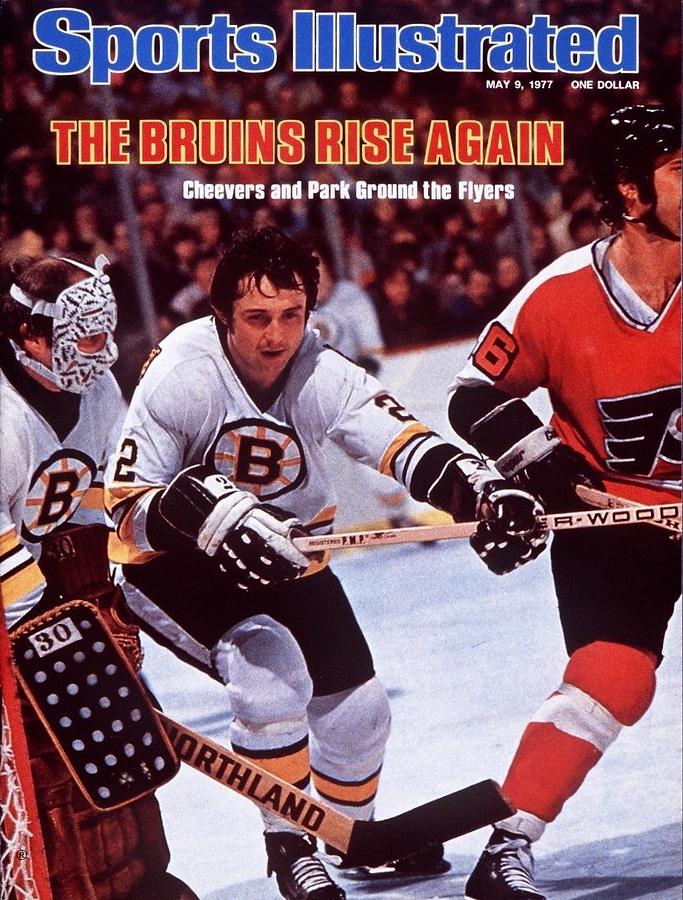
The Rangers made the Playoffs in 1978, and then in 1979, they regained their local icon status, including a thrilling Stanley Cup Semifinal win over the Islanders, delaying the Nassau County club's rise to the top for one more year. Esposito won the fans over, and remains beloved in both New York and Boston. Park and Ratelle won Bruin fans over, helping them reach the Stanley Cup Finals in 1977 and '78, but did not win either time, so they remain respected there, but not loved.
The Rangers made the Playoffs in 1978, and then in 1979, they regained their local icon status, including a thrilling Stanley Cup Semifinal win over the Islanders, delaying the Nassau County club's rise to the top for one more year. Esposito won the fans over, and remains beloved in both New York and Boston. Park and Ratelle won Bruin fans over, helping them reach the Stanley Cup Finals in 1977 and '78, but did not win either time, so they remain respected there, but not loved.
November 7, 1975 was a Friday. This was also the day The New Original Wonder Woman, starring Lynda Carter, premiered on ABC.


No comments:
Post a Comment