Tuesday, April 21, 2026

Yankees vs. Red Sox: The Defining Moments, Part V: 2002-2004

 
December 26, 2002, Fenway Park. The Yankees sign Cuban pitcher José Contreras, and new Sox president Larry Lucchino, in a fit of petulance, calls the Yankees "the Evil Empire."

Oh, really? Putting aside the question of which team is actually more evil... The term "Evil Empire" had been used by President Ronald Reagan -- who knew more about baseball than he did about economics or foreign affairs -- to describe the Soviet Union. Excuse me, Larry, but how do you square the image of the heavily capitalist Yankees with Communism and its prohibition of private property?

Some Yankee Fans, however, connect the word "Empire" with the villains of the Star Wars film franchise, including one fan who made a T-shirt with Darth Vader's helmet, saying, "May the Curse be with you."

October 11, 2003, Fenway Park. Game 3 of the ALCS, and another Roger vs. Pedro matchup. Pedro hits Karim Garcia in the head, on purpose. Not the first time he's hit a Yankee on purpose, nor will it be the last, but it is easily the most notorious.

There is yelling back and forth. Jorge Posada, himself a former Pedro victim, yells in Spanish so that Pedro has no problem understanding. Pedro points at his head, then at Jorge. Message: "I'm going to hit you in the head." Making such a threat is a crime.

Later in the game, Clemens pitches to Manny Ramirez, and the pitch is head-high... but over the plate, and clearly not intended to hit Manny. (As we've seen, if Roger Clemens wanted to hit a batter, that batter got hit.) Manny points at Clemens and walks toward him, still holding the bat. The benches clear again, and Yankee coach Don Zimmer -- manager of the Sox in 1978, but also a former player who nearly died from a beaning in Triple-A ball in 1953 -- runs toward Pedro.

Pedro Martinez, age 32, grabs Don Zimmer, age 72, by the head, and throws him to the ground. Attempted murder, if the jurisdiction is New York City. In Boston, Zimmer ends up forced to apologize, with Pedro getting a $50,000 fine -- pocket change, with what the Sox are paying him.

Refresh my memory: Did we have to apologize to Japan for putting Pearl Harbor in the way of our Pacific Coast?
When things finally settle down, Clemens finishes his strikeout of Manny. The Yankees win, 4-3. The next day, Game 4 is rained out, giving everyone a 24-hour cooling-off period, which was really for the best.

English soccer fans like to refer to their rivals as "The Scum," and their rivals' fans as "Scummers." As far as I'm concerned, this was the day the Red Sox stopped being mere arch-rivals, and truly became The Scum. They can take their "Evil Empire" talk and shove it up their own evil asses.

October 16, 2003, Yankee Stadium. It comes down to a Game 7. David Ortiz hits 2 home runs (cough-steroids-cough), and the Sox lead 5-2 in the bottom of the 8th. By this point, Ortiz, a.k.a. "Big Papi," has been hitting the Yanks like crazy all year. His success against the Yankees will eventually beg the question, "How many times does a guy have to get big hits off you before you plunk him?"

Ah, but there's a double standard at work: A Sox pitcher can hit a Yankee batter, and get away with it every... single... time; a Yankee pitcher can hit a Sox batter, and he gets thrown out of the game, fined and suspended. Anyway, the Sox need 5 more outs.

Derek Jeter doubles. Bernie Williams singles, Jeter scores. It's 5-3. Sox manager Grady Little comes out, and he has to know that Pedro has thrown too many pitches, and that the next 2 batters are Hideki Matsui, a lefty; and Posada, a switch-hitter but much better from the left side than from the right; so the right thing to do is to bring in a lefthanded pitcher, probably Alan Embree (who usually pitched well against the Yankees), to pitch Matsui lefty-on-lefty and turn Posada to his weaker right side. The decision seems obvious to everyone: Sox fans, Yankee Fans, the Fox broadcast team, neutral TV viewers.

Obvious to everyone, that is, except for the man whose decision it was: Little. He leaves Pedro in. Matsui hits a ground-rule double, moving Bernie to 3rd base.

2nd & 3rd, only 1 out, and the dangerous (especially from the left side) Posada coming up. Now Little has got to take Pedro out, and bring in Embree.

But he stays in the dugout. Pedro remains on the mound, and Jorge dumps a looper into short center, scoring Bernie and Hideki. 5-5. Yet another legendary Sox choke, and The Stadium shakes with fans cheering and jumping. (And, considering Game 3, I find it very fitting that Posada got the hit that ended Pedro's night.)

Bottom of the 11th, and Tim Wakefield, who had beaten the Yanks in Games 1 and 4 of the series, and had pitched a scoreless 10th, opens the inning by throwing a 69 miles-per-hour knuckleball to Aaron Boone. Boom. Yankees 6, Red Sox 5. Boone takes his place alongside Bucky Dent and Bill Buckner.
Was this the greatest game of all time? Or, at least, the greatest Yanks-Sox game? It might have been, if the Yankees had won the ensuing World Series. But they lost. I don't want to talk about it. Jeff Fucking Weaver.

So, to me, the Bucky Dent Game remains the greatest. We won the World Series after that one.

November 28, 2003, Fenway Park. Having failed to trade Nomar to the Texas Rangers for Alex Rodriguez, the Red Sox instead pull off a "reverse Tom Seaver": They trade 4 nobodies -- Casey Fossum, Brandon Lyon, Jorge De La Rosa, and Mike Goss (who never even made the major leagues) -- to the Arizona Diamondbacks for one of the top pitchers in the game, Curt Schilling, who had previously driven the Yankees nuts in the 2001 World Series.

As a Philadelphia Phillie, Schilling had been described by general manager Lee Thomas as follows: "One day out of five, he's a horse; the other four, he's a horse's ass." Schilling lives up to that reputation at his introductory press conference in Boston, by saying, "I guess I hate the Yankees now."

February 15, 2004, Yankee Stadium. With the Sox having failed to trade for A-Rod, making a very public mess of the negotiations with the Texas Rangers, the Yankees succeed, sending Alfonso Soriano to Texas for the biggest name (if not the best player) in baseball. With Jeter still at shortstop, A-Rod moves over to 3rd base.

July 1, 2004, Yankee Stadium. As wild a regular-season game as you'll ever see. The Yankees end up using everyone on their roster. The Sox use everyone on theirs, except for 2. One is backup catcher Doug Mirabelli, who had to be held back in case of emergency. The other is Nomar, apparently injured but not on the Disabled List -- and the fact that Nomar is not sent into what is very much a key game, calendar be damned, is telling.

Once, Nomar, Jeter and A-Rod were the subjects of a debate as to who was the best shortstop in baseball. Now, Jeter is making a diving play that saves the game, A-Rod is playing 3rd base and moving to shortstop after Jeter got hurt on that play, and Nomar is sitting on the bench, leading to his being traded by the Sox within a few days.

Manny homers in the top of the 13th, but Miguel Cairo and John Flaherty double in the bottom of the 13th to win it. Yankees 6, Red Sox 5. A stunning game whose re-airing on the YES Network the next morning gets relabeled from Yankees Recap to the newest episode of Yankees Classics.

It also allowed "Flash" Flaherty to turn his one big hit in the major leagues into a broadcasting career on YES. Then again, one big hit is more than Fran Healy, a backup catcher for the Yankees who broadcast for both New York teams, ever got.

July 24, 2004, Fenway Park. Sox pitcher Bronson Arroyo -- except for Bo Derek, white people should never wear cornrows -- purposely hits A-Rod in the back. A-Rod curses Captain Cornrows out. Sox catcher and Captain Jason Varitek leaves on his mask, like the coward that he is, and pushes his catcher's mitt into A-Rod's pretty face, instigating a full-scale brawl.
Refresh my memory: Which of these teams is evil? After the 1976 brawl, Bill Lee said, "The Yankees looked like a bunch of hookers swinging their purses." Well, at least they didn't hide behind protective masks.

Bill Mueller takes Mariano Rivera deep in the bottom of the 9th. Red Sox 9, Yankees 8. Mueller has often been suspected of steroid use, but has thus far been protected from such revelations.

September 19, 2004, Yankee Stadium. Yankees 11, Red Sox 1. The Yankees, the one team that seems to give Pedro trouble, beat him yet again, pounding him. In a postgame press conference, he says, "I just tip my cap, and call the Yankees my daddy."

"Who's Your Daddy?" chants will dog Pedro for the rest of his career. One fan -- was it Vinny Milano, a.k.a. Bald Vinny the River Avenue T-shirt vendor? -- made up a T-shirt showing Darth Vader wearing a Yankee jersey, and saying, as if to Luke Skywalker, "Pedro, I am your father!"
The chant even returned when Pedro pitched for the Mets in an Interleague game in 2006, and for the Philadelphia Phillies in Games 2 and 6 of the 2009 World Series at the new Yankee Stadium.

October 17, 2004, Fenway Park. Game 4 of the American League Championship Series. The Yankees had won the 1st 3, including 19-8 last night. The Sox were looking pitiful. Still, their resident wisenheimer, Kevin Millar, told the media, "Don't let us win tonight."

It seemed like a ridiculous thing to say, for 8 1/2 innings. It was 4-3 Yankees going to the bottom of the 9th. All the Yankees needed to complete a sweep was 3 more outs without a run, and Mariano Rivera was on the mound.

But, Cliché Alert: Walks can kill you, especially the leadoff variety. Rivera issued a leadoff walk to Millar himself. Manager Terry Francona took Millar out, replacing him with pinch-runner Dave Roberts. Everybody watching this game, in Fenway or on TV, knew that Roberts would try to steal 2nd base. Joe Torre could have called a pitchout. He didn't, and Roberts had what is now the most famous stolen base in baseball history. Bill Mueller singled up the middle to bring Roberts home with the tying run.

In the bottom of the 12th, Paul Quantrill allowed a single to Manny Ramirez, and gave up a walkoff home run to Ortiz. Red Sox 6, Yankees 4.

October 18, 2004, Fenway Park. Okay, it was 1 game. The Yankees just had to win tonight to close it out in Boston. And Mike Mussina had taken a perfect game into the 7th inning of Game 1. This shouldn't be too hard.

Is it sounding like the 1978 Boston Massacre yet, with the cleat on the other foot?

The Yankees trailed 2-1 in the top of the 6th, but took a 4-2 lead. That lead held into the bottom of the 8th. But former Sox pitcher Tom Gordon gave up a leadoff homer to Ortiz. Again, Millar drew a walk; again, he was replaced by Roberts. No steal necessary this time: Trot Nixon singled, Gabe Kapler ran for Nixon, Mariano was brought in, and Varitek hit a sacrifice fly to score Roberts and tie the game. For the 2nd night in a row, Rivera had blown a postseason save. The entire rest of his career, he did that only twice.

The game went to the bottom of the 14th. At 5 hours and 49 minutes, it was, at the time, the longest postseason game by time. Esteban Loiaza, a former Chicago White Sox ace who'd been shaky for the Yanks that season, had pitched valiantly since the 11th, and struck Mark Bellhorn out to start the inning. But he was out of gas. Again, it was walks that made the difference: He walked Damon and Ramirez, bracketing a strikeout of Orlando Cabrera. Then Ortiz hit not a home run, but a looping single that was enough to bring Damon home. Red Sox 5, Yankees 4.

October 19, 2004, Yankee Stadium. Game 6. The series had come back to Yankee Stadium, home of Mystique and Aura and 39 American League Pennants and 26 World Championships. All the Yanks had to do was win tonight, and all those brand-new Sox memories would have been as wasted as Carlton Fisk’s home run that won Game 6 of the 1975 World Series.

Except Curt Schilling (who had said before the series, "I'm not sure I can think of any scenario more enjoyable than making 55,000 Yankee Fans shut up") was pitching for the Sox. So badly hurt that he couldn't pitch well in Game 1, he’d had a special surgery on his ankle that allowed him to pitch tonight. Who pitches 6 days after surgery? Curt Schilling did, and has been called "courageous" ever since. If a Yankee had done it, what would the media have called him?

And the Yankees refused to test that ankle by bunting on him. John McGraw would have done it. Casey Stengel would have done it. Earl Weaver (not a New York manager but a crafty one) would have done it. You can be damn sure that Billy Martin would have done it. Joe Torre didn't do it.  What good is "class" if you lose? Especially to The Scum?

Schilling pitched 7 solid innings, and Bellhorn (cough-steroids-cough) hit a home run. It was a reverse of the Jeffrey Maier play in 1996: The ball hit a front-row fan in the chest and bounced back onto the field. It was an obvious home run, but the umpires ruled it went off the wall. Sox manager manager Terry Francona appealed, and the ruling was (sadly, but correctly) changed to a homer.

The Sox still led 4-2 in the bottom of the 8th, but the Yankees got Jeter on 1st. With 1 out, Alex Rodriguez came to the plate. And the pitcher was Bronson Arroyo, the same matchup as on July 24.

Alex hit a weak grounder back to the mound, and as Arroyo tried to make the tag just before 1st base, he (or so it first appeared) dropped the ball. It had been 18 years (minus 6 days) since the Bill Buckner Game. Now, at another New York ballpark in October, a ball rolled away from 1st base down the right-field line, and a run scored against the Red Sox! It was 4-3 Boston, and A-Rod was on 2nd with the tying run! The Stadium was going bananas! Red Sox fans were in full "Oh, noooo, not again! It can't be happening again!" mode.

Except this call was reversed as well. It was The Slap Play. A-Rod slapped the ball out of Arroyo's glove. It met baseball's legal definition of interference, and he was called out. What's more, Jeter was sent back to 1st.

That's the part that bothers me, ruling-wise: Jeter had nothing to do with the interference, and he would have had 2nd legitimately even if A-Rod had done nothing out of the ordinary, and Arroyo had been allowed to properly tag him out. It wasn't Jeter's fault: 2nd base was rightfully his, interference or no, even if 3rd and home were not.

This killed the rally, but, as mad as I was at the umpires, A-Rod was rightfully the real target of Yankee Fans' wrath, including my own. This was the beginning of A-Rod's image as "a player who screws the Yankees over in the clutch," and he did not shake it until October 2009. Though he did his damnedest to restore it in the next 3 Octobers, and again in 2015. (So how many bad Octobers does one good October excuse? Apparently, at least 8.)

The Sox held on to win by that same 4-2 score, and the series was tied, the 1st time a Major League Baseball team had ever come back from 3-games-to-none down to force a Game 7.

For the first time since I became aware of the Curse of the Bambino, I believed it was not going to work. As the man who popularized the Curse, Boston Globe sports columnist Dan Shaughnessy, pointed out, the kinds of things that usually went against the Red Sox and/or in the Yankees favor were now working the other way around.

As bad as the next night was, Game 6 was really the day that any curse, jinx, hex, hoodoo, hammer, whammy, whommy, whatever you want to call it, that the Yankees had over the Red Sox came to an end.

And those of us who are old enough to remember could feel it coming. I had no confidence at all that the Yankees would win Game 7, not even at home, especially with their starting pitching options so messed-up. As the historian Doris Kearns Goodwin, a Brooklyn Dodger fan as a kid but a Red Sox fan since going to Harvard, likes to say, "There's always these omens in baseball." This was an omen to rival Damien Thorn.

Had the Yankees won Game 6, there would have been no Game 7. David Ortiz's "heroics" of Game 4 and Game 5 would have been meaningless, as they were the year before. The Yankees would have prepared for the World Series against the St. Louis Cardinals, and probably won it.

If that had happened, you can be damn sure that the outcry from Red Sox fans (and fans of other teams that hate the Yankees) that, due to the steroid use of A-Rod, Jason Giambi and Gary Sheffield, "The Yankees cheated" and should be stripped of their Pennant and title. And their willing accomplices in the media would have gone along with it. There would have been a cloud over the Yankees, the way there never has been over the Red Sox, who, through Ortiz and Manny Ramirez, were far more reliant on performance-enhancing drugs, and, from 2003 to 2016, the Big Papi Years, probably wouldn't even have made the Playoffs, much less won 3 World Series.

The Yankees wouldn't have gotten away with it, as the Red Sox always have.

Still, having that cloud over us -- which we essentially had put over us anyway -- would have been preferable to the insufferable unearned arrogance of the Boston fans of 2004 onward, especially the bandwagoners.

And I still want the blood on Schilling's sock tested! I think he was using steroids, too! And somebody else must think so. It can't be only his rotten personality, his politics, and his post-retirement business shenanigans that's keeping him out of the Hall of Fame. If anything, those things, as bad as they are, should be irrelevant as to whether he belongs in Cooperstown.

October 20, 2004, Yankee Stadium. Game 7 is a disaster from the outset, as proven steroid user Ortiz homers again. Red Sox 10, Yankees 3.
What a difference 4 days can make.

The game was over in a hurry, as emergency starter Kevin Brown gave up a 2-run homer to Ortiz in the 1st inning, and Javier Vázquez gave up a grand slam to Damon in the 2nd. In a manner of speaking, it was the longest game in Yankee history. We had to endure 9 innings' worth, 3 1/2 hours' worth of Sox fans' celebrating and taunting, before it ended.

To paraphrase New York gangster Henry Hill: "It was revenge for Bucky Dent, and a lot of other things. And there was nothing that we could do about it. Papi was a made man, and A-Rod wasn't. And we had to sit still and take it. It was among the New Englanders. It was real Chowdahead shit."

The Red Sox became the 1st Major League Baseball team to come back from a 3-games-to-0 postseason deficit, and win the Pennant, clinching at Yankee Stadium, a house of pain for them for so long. They went on to beat the St. Louis Cardinals in the World Series, killing the Curse of the Bambino after 86 years.

Or so they thought. Now we know the truth.

Part VI, the finale, is ahead.

Yankees vs. Red Sox, The Defining Moments, Part IV: 1983-2001

July 4, 1983, Yankee Stadium. Both teams have changed tremendously in 5 years. The rivalry has fallen a bit. Despite the opponent and the 4th of July holiday, only 41,077 fans come out to The Stadium. Why? Well, it is the 4th of July, and it's really hot, so it's a beach day, not a baseball day. And neither team is really in the race.

This game would be totally forgotten by anyone who wasn't there... if it wasn't for Dave Righetti pitching a no-hitter. He even managed to strike out the tough-to-fan Wade Boggs for the final out. Yankees 4, Red Sox 0.

October 5, 1986, Fenway Park. The Yankees beat the Red Sox, 7-0, and complete a 4-game sweep. However, this not-quite Boston Massacre -- this was the only real blowout of the series -- is meaningless, as the Sox had already clinched the American League Eastern Division title a weak earlier.

This was because the Sox had great starting pitching: Roger Clemens, Bruce Hurst, Dennis "Oil Can" Boyd, and even the final, somewhat hard-luck season of Tom Seaver. In contrast, the Yanks' rotation was weak: While Dennis Rasmussen went 18-6, no other Yankee pitcher, starter or reliever, won in double figures. Ron Guidry had an uncharacteristic 9-12 after winning 22 the year before, and Doug Drabek, Bob Tewksbury and 41-year-old knuckleballer Joe Niekro (whose brother Phil had pitched for the Yanks the preceding 2 years) won just 34 between them.

Also, Boggs, who did have the excuse of a sore hamstring, sat this series out, and wins the AL batting title over Don Mattingly, who slumped badly in the last 2 weeks.

October 25, 1986, Shea Stadium, New York. For Yankee Fans, this was the nightmare scenario: A World Series between the Boston Red Sox and the New York Mets. For the record, at the time, I hated the Mets more, and I had a little sympathy for Sox fans and their World Series drought, then 68 years, so I rooted for the Sox.

If it were ever to happen again? I would root for aliens to come and beam up the entire stadium. Including both sets of fans? Especially both sets of fans.

While "The Bill Buckner Game" was played in New York City, and it did make the Sox look like morons, it had nothing to do with the Yankees, and it makes the Mets look heroic, and I don't think either Yankee Fans or Sox fans want to hear about it. So let's just move on.

September 28, 1987, Yankee Stadium. Mike Easler -- not traded from Boston to New York for Don Baylor in the 1985-86 off-season, although it did sort of work out that way -- treats Calvin Schiraldi even more harshly than the Mets did in the previous year's World Series. He hits a pinch-hit home run to win the game, 9-7.

May 27, 1991, Yankee Stadium. The Sox are the defending AL East Champions (and would barely be nipped by the Toronto Blue Jays at the end this time), while the Yankees had finished last the year before. Only 32,369 come out for this Memorial Day matinée between the two old rivals, and the Yanks trail 5-3 in the bottom of the 9th.

But Mel Hall -- who would later leave the Yankees under ignominious circumstances -- takes Jeff "the Terminator" Reardon deep. Yankees 6, Red Sox 5. Maybe Sox fans can blame the 1st base umpire, Larry Barnett, the same ump who they, in their delusions, think screwed them in Game 3 of the '75 World Series.

A lot of Yankee Fans point to this game as the beginning of the rise from the abyss. It wasn't: 1991 and '92 were both bad years, though not as bad as '89 and '90. But the building blocks were in place: George Steinbrenner had been suspended for 2 years, former good-field-no-hit infielder Gene Michael was running the show as general manager, and the Yankees were making good trades and draft choices, including, the following June, a shortstop born in North Jersey, but raised in Kalamazoo, Michigan and graduating from Kalamazoo Central High School. His name was Derek Jeter.

This Mel Hall homer is also cited by some as the beginning of Yankee broadcaster John Sterling's closing call of, "Ballgame over! Yankees win! Theeeeeeee Yankees win!" I'm not so sure. Granted, I was watching this one on WPIX-Channel 11 with Phil Rizzuto, Bobby Murcer and Tom Seaver, rather than listening to Sterling and Joe Angel on 77 WABC.  But even as late as Jim Leyritz's 1995 Playoff walkoff against Seattle, his "Theeeeeeee... " was still just a "The... " without much elongation.

September 14, 1991, Yankee Stadium. This was my first live Yanks-Sox game, included among an attendance of 45,758. This was a 4-game series, and the Sox won 3 of them. Not this one: Yankees 3, Red Sox 1. And, yes, Sox fans were every bit as obnoxious as you might expect, especially since they were still in the race (they'd be caught at the death by those pesky Blue Jays) and the Yanks were awful, having just begun their climb back from the abyss of last place the season before.

December 15, 1992, Yankee Stadium. Having been allowed to leave via free agency by the Sox, Boggs signs with the Yankees. It was weird seeing him in Pinstripes, but I got used to it, because he could still hit for average, began to hit with power (aided by the short porch in right field at Yankee Stadium), and his fielding, already good, got better.

October 26, 1996, Yankee Stadium. The Yankees beat the Atlanta Braves, 3-2, to win Game 6 and clinch the World Series, their first such win in 18 years. A moment in time by Red Sox standards, but interminable by ours.

Boggs, who'd come so close with the 1986 Red Sox, and signed with the Yankees prior to the 1993 season and became part of the restoration, got on a policeman's horse and rode around the field in the celebration. Rubbing it in? He may not have thought so, but we sure did.

As Denis Leary, a native of Worcester, Massachusetts, a big Sox fan, but also with connections to New York through his comedy career and his TV series The Job and Rescue Me (about policemen and firemen, respectively), put it: "If you had told my father in 1986 that, within 10 years, Wade Boggs would be celebrating winning a World Series with the Yankees while riding on the back of a police horse, his head would have blown up."

May 24, 1997, Yankee Stadium. Charlie Hayes is best remembered by Yankee Fans for catching the last out of the 1996 World Series. Almost forgotten is this game the following spring, in which he hit a walkoff homer against John Wasdin -- or "Wayback Wasdin," as some Sox fans called him. Yankees 4, Red Sox 2.

February 18, 1999, Yankee Stadium. Although the rivalry was amped up a little bit by the Yankees signing Boggs, Boggs riding that horse, and the arrivals in Boston of Pedro Martinez and Nomar Garciaparra -- the latter forging a rivalry-within-the-rivalry with Yankee shortstop Jeter -- and the Sox had made the Playoffs the season before, this is the day the rivalry really gets going again.

On this day, the Yankees trade pitchers David Wells and Graeme Lloyd, and infielder Homer Bush, to the Toronto Blue Jays for Roger Clemens, whom the Red Sox had cast aside 2 years earlier. Then-Sox general manager Dan Duquette saw Clemens not getting enough run support to get a plus-.500 record, and gaining weight, and said he was "in the twilight of his career."

Whether Duquette blew it big-time, or Clemens really was in the twilight of his career and turned that around with performance-enhancing drugs, may never be fully proven. What we know for sure is this: One way or another, Clemens got back into shape, had 2 great years with the Jays, and became a Yankee Legend, albeit one most of us on the Light Side of The Force are not comfortable with. By contrast, Sox fans have treated Clemens as their "Darth Vader," forgetting just which side is good and which side is evil.

July 13, 1999, Fenway Park, Boston. The Major League Baseball All-Star Game is held at the ancient home of the Sox. Yankee manager Joe Torre is manager for the American League team. Nomar Garciaparra of the Red Sox starts for the American League at shortstop and receives a standing ovation from the fans after Jeter comes in to replace him after they embrace. Later in the game when he came to bat, Jeter gave Garciaparra a tribute by mimicking his batting stance. Pedro starts for the AL and strikes out 5 of the 6 National League batters he faces.

Before the game, nominees for the MLB All-Century Team are introduced. The legends wear the current caps of their teams, not necessarily the caps their teams wore in their own time. One of the nominees is Reggie Jackson, former recipient of "Reggie Sucks!" chants from the Fenway stands, and he gets a nice cheer. Hearing this, he looks at the TV camera, wearing his Yankee cap, and winks.

There was only one person among the nominees who was booed: Clemens. He wore not the cap of the team that made him famous, the Sox, but of the team for whom he played at the moment, the Yanks. Tremendous booing. Heck, even Rickey Henderson got cheered. (Barry Bonds, not yet known as a steroid cheat, was not in attendance, as he was not named to the NL All-Star Team that year, although he was an All-Century Team nominee.) The AL wins the game.

July 30, 1999, Fenway Park. I was there for this one. The Sox had recently published their plans for New Fenway Park, to be built across the street, and I figured this might be my last chance to see a Yanks-Sox game at Fenway in the heat of a Pennant race. Who knew at the time that, 10 years later, Fenway would still stand, and it would be the Yankees who would build a new stadium across their street?

I paid a scalper $42 for a $24 obstructed-view seat. It was worth every penny. On the 2nd pitch of the game, Chuck Knoblauch hit a home run over the Green Monster. On the 5th pitch of the game, Derek Jeter hit a home run to dead center field. The victimized Sox pitcher was Mark Portugal, who had been a fair pitcher with the Houston Astros, but was now washed up, would retire after the season, and literally fell off the mound a few pitches later.

The Yanks left the 1st inning ahead 2-0, and while the Sox did tie it up, the Yanks unloaded the lumber afterward. Yankees 13, Red Sox 3. Joe Torre let Hideki Irabu pitch a complete game. No, I'm not kidding: Torre let a pitcher go the distance, and Hideki I-rob-you, no less.

At the start of the game, there were 33,777 paying customers in Fenway, and about 10,000 of them were Yankee Fans. By the 7th inning stretch, there were about 15,000 people there, and about 10,000 of them were chanting, "Let's go, Yankees!" A great night. I even ran into a guy who played football at my high school, who was by this point going to Boston College. And he was also a Yankee Fan. What were the odds?

September 10, 1999, Yankee Stadium. Chili Davis hits a home run off Pedro Martinez. That's the only hit that Pedro allows, and he strikes out 17 batters, the most ever fanned by a Yankee opponent. Had Andy Pettitte not allowed a home run to Trot Nixon, Pedro would have pitched a one-hitter and struck out 17 Yankees, and lost. Instead... Red Sox 3, Yankees 1.

Pedro begins to achieve godlike status among Sox fans, a status achieved since World War II only by Ted Williams, Tony Conigliaro, Carl Yastrzemski, Carlton Fisk and Nomar. But the Yankees win the American League Eastern Division, while the Sox get the Wild Card.

October 13, 1999, Yankee Stadium.  Game 1 of the American League Championship Series. Because the Boston Tie Party of 1978 is officially counted as a regular-season game, this is the first "real" postseason game between the Pinstripes and The Scum. Sox fans are sure that their deliverance from the Yankees and the Curse of the Bambino are finally at hand.

Not tonight: Bernie Williams hits a home run to dead center field off Rod Beck. Yankees 4, Red Sox 3. The Yanks will take Game 2 as well.

October 16, 1999, Fenway Park. Game 3. Pedro pitches superbly, while the Sox batter Clemens. As Clemens walks off the mound after getting knocked out of the box, a fan holds up a sign saying, "Roger, thanks for the memories -- especially this one!" One side of Fenway chants, "Where is Roger?" The other side chants, "In the shower!" Red Sox 13, Yankees 1. Sox fans are delirious, and are now sure they will beat the Yanks and go all the way.

But, as Boston Globe columnist Dan Shaughnessy, the man who popularized the phrase "Curse of the Bambino," pointed out, the point was not to beat Clemens, but to win the series. And the Sox still trail it, 2 games to 1. The Yankees don't lose again until April.

October 17, 1999, Fenway Park. Game 4.  Admittedly, there were a couple of umpiring mistakes that worked in the Yanks' favor. But it's still 3-2 Yanks in the 9th, and poor fielding leads to a Ricky Ledée grand slam off Beck. Sox fans, furious at the umpiring, throw garbage onto the field.

Since then, the description of Boston as "the Athens of America" gets this response from me: "Bullshit." While there were many fans who had stood by the Sox through all the torment, this was a limited few who had come to the team through Pedro and Nomar, and were more likely to get blitzed than the ones who did so in '78, and they were animals. Of course, these are the ones who get noticed, the kind that got stereotyped as the "Red Sox fans" we have come to know, lampooned on Saturday Night Live by Jimmy Fallon (before he moved on to the U.S. version of Fever Pitch).

Anyway, Yankees 9, Red Sox 2.

October 18, 1999, Fenway Park. Jeter and Jorge Posada hit home runs, Orlando "El Duque" Hernandez pitches superbly, and the Yankees beat the Red Sox, 6-1, and clinch the Pennant, and danceon the field at Fenway. They go on to win the World Series.

April 22, 2001, Yankee Stadium. David Justice bangs his gavel off Derek Lowe, hitting a walkoff homer to give the Yanks a 4-3 win.

May 24, 2001, Yankee Stadium. On the 60th birthday of Bob Dylan -- a man who once wrote a song about Catfish Hunter, and another song titled "Seven Curses" (but it had nothing to do with baseball) -- Pedro is getting ready to pitch against the Yankees. "I don't believe in curses," Pedro says. "Wake up the damn Bambino, and have me face him. Maybe I'll drill him in the ass."

But the Yankees beat him. Yankees 2, Red Sox 1. The Yanks move into first place, Pedro gets hurt in his next start, and doesn't win another game for the rest of the season.

You don't believe in curses? You mock Babe Ruth -- a better pitcher than you were, Pedro? What a fool. As Dylan might have said, "They'll stone you just like they said they would."

September 2, 2001, Fenway Park. Mike Mussina comes within one strike of pitching a perfect game, but Carl Everett's 9th-inning, two-out, two-strike single is the only baserunner allowed by Mussina. By an amazing coincidence, David Cone, the last Yankee pitcher to throw a perfect game in 1999, had started the game for the Red Sox. Yankees 1, Red Sox 0.

September 18, 2001, Fenway Park. The Sox play their first game since the 9/11 attacks.  They play the Tampa Bay Devil Rays, and win, 7-2.  A fan at Fenway holds up a banner of solidarity, which would have been unimaginable 8 days earlier (and on most days since September 2001): "TODAY, WE (HEART) NY." The Yankees also play their first game following the resumption of play, in Chicago against the White Sox, and win, 11-3.

December 20, 2001, Fenway Park. The JRY Trust, named for Jean Yawkey, sells the Sox to New England Sports Ventures, the company now named Fenway Sports Group, run by John W. Henry. This ends 79 years of Yawkey family-connected ownership of the Sox. (Tom and Jean never had any children to take over for them; Jean inherited the team when Tom died in 1976, and John Harrington had run the club through the Trust since Jean's death in 1992.)

The Henry group, including former Florida Marlins owner Henry, former Baltimore Orioles and San Diego Padres president Larry Lucchino, and the youngest general manager in the game at the time, Theo Epstein, change the culture around the club. The fans, having already changed into the Chowdaheads that they became at the dawn of the Nomar-Pedro era, don't change, but they sure embrace this change.

Part V is ahead.

Yankees vs. Red Sox, The Defining Moments, Part III, 1967-1982

April 14, 1967, Yankee Stadium. The Yankees hold their home opener, starting their ace, Whitey Ford. But an injury will end his career the following month. The Red Sox start a rookie, Billy Rohr. He comes within 1 strike of a no-hitter, partly thanks to an amazing 9th-inning catch of a Tom Tresh line drive by Carl Yastrzemski, the kind of play that makes you think, "If he wasn't going to lose the no-hitter on that play, he's not going to lose it."

But he did lose it. Elston Howard -- ironically, to join the Sox late in the season to help with their Pennant race -- singled to right to break it up. Rohr gets Charley Smith (the man the Yankees traded Roger Maris even-up for) to finish it up, and the Red Sox win, 3-0.

April 21, 1967, Fenway Park. Rohr beat the Yankees again, outpitching Mel Stottlemyre, as the Sox win, 6-1. But Rohr would win only 1 more game in his career, wash out, and become a lawyer. He got a huge hand at the Fenway Park Centennial celebration in 2012.

June 21, 1967, Yankee Stadium. Thad Tillotson beans Sox 3rd baseman Joe Foy, later to be a part of one of the biggest bonehead trades in history -- not surprisingly, by the New York Mets.

When Tillotson comes up to bat (there will be no designated hitter in the American League until 1973), Jim Lonborg beans Tillotson. The benches empty, and all hell breaks loose. It becomes one of the nastiest brawls in baseball history, and it may be the earliest one preserved on any kind of video. The fight is, more or less, a draw. The game is a Boston win: Red Sox 8, Yankees 1.

Despite the acrimony from this brawl, this was an anomaly in the teams' relationship in the era. It was not the beginning of the modern Yanks-Sox rivalry. That was still to come.

October 1, 1967, Fenway Park. Lonborg, putting together a 22-win season that will win him the AL Cy Young Award, goes the distance. Yastrzemski ties the game with a bases-loaded single to clinch the Triple Crown, MLB's last until 2012. The Red Sox beat the Minnesota Twins, 5-3. When the Detroit Tigers only split a doubleheader against the California Angels, the Sox have won their 1st Pennant in 21 years, only their 2nd in 49 years.
Yaz '67

While the Sox were putting together their "Impossible Dream" season, the one that gets remembered as the one that began "Red Sox Nation," the Yankees finished 9th in the 10-team AL. The Sox took the World Series to 7 games, before losing to the St. Louis Cardinals.
Fenway Park, 1967

It is the most important season in Red Sox history, even more than 2004. It made the Sox a New England cultural icon. It also saved Fenway Park: Team owner Tom Yawkey, born in Detroit, "summered" in Manhattan and "wintered" in South Carolina, had no emotional connection to Boston, and had begun to ask the city for a new ballpark, and wasn't getting very far.

If the Sox hadn't made that 1967 Pennant run, or even if they'd come close and still not won it, New England might have ended up with one of those round "cookie-cutter" stadiums in Foxborough, shared by the Red Sox and the Patriots, instead of the oversized high school football stadium that actually opened there in 1971, solely for the Pats. Or they might have ended up losing the Red Sox entirely, possibly to be replaced by an expansion team.

September 28, 1968, Fenway Park. Mickey Mantle pops up to shortstop Rico Petrocelli in the top of the 1st inning, and (no longer a center fielder) is replaced at 1st base by Andy Kosco. The Boston crowd gives him a standing ovation, suspecting, as they had with Babe Ruth in 1934, that this was the last time they would see him. Indeed, it was the last game of his career, as he did not enter the next day's game, the regular season finale.

Joe Pepitone hit a home run in the top of the 9th inning off Lonborg, who tailed off considerably this season due to an off-season injury, and the Yankees win, 5-4.

April 7, 1970, Yankee Stadium. This was Opening Day, and, at first glance, it might not have any more significance than that. But it was the 1st Yankee game of my lifetime. It didn't end so well for the Good Guys, as only 21,379 came out to the big ballyard in The Bronx to see Mel Stottlemyre give up an RBI double to opposing pitcher Gary Peters. Red Sox 4, Yankees 3.

The Yanks did finish 2nd, with 93 wins, far ahead of the Sox, but the Baltimore Orioles ran away with the AL Eastern Division and won the World Series.

September 15, 1970, Yankee Stadium. Curt Blefary's time with the Yankees wasn't as good as his preceding time with the Orioles, but he did hit a pinch-hit walkoff homer in this game, against Mike Nagy. Yankees 3, Red Sox 2.

March 22, 1972, Fort Lauderdale Stadium, Fort Lauderdale, Florida. The Yankees and Red Sox complete what remains the biggest trade between the teams since Harry Frazee's selloff in the late 1910s and early 1920s. The Sox send wacky relief pitcher Albert "Sparky" Lyle to the Yankees, in exchange for Danny Cater and a player to be named later, who turned out to be Mario Guerrero.

Sox management didn't know how to handle Lyle, and their reasoning for obtaining Cater was that he hit well at Fenway Park, so why not let him play there 81 times a year? It didn't work, as Cater's batting average dropped from .276 in 1971 to .237 in 1972. They didn't realize that the reason that Cater hit so well at Fenway is that he was batting against Red Sox pitchers. Now, he wasn't doing that anymore. Guerrero was never more than the stereotypical "good-field-no-hit" middle infielder.

Sparky, in 1972, set an American League record (though it was broken a year later) with 35 saves, and set the standard for Yankee relievers that was followed by Goose Gossage, Dave Righetti, John Wetteland and Mariano Rivera.
Sparky Lyle. Along with Reggie Jackson, 
Thurman Munson, Chris Chambliss, Mickey Rivers,
Willie Randolph, Dick Tidrow,  and eventually Goose Gossage,
Yankee opponents in the late 1970s had to fear the 'stache.

April 6, 1973, Fenway Park. Opening Day. Ron Blomberg bats for the Yankees, and becomes the 1st official player to come to bat as a designated hitter. He draws a walk. It doesn't help: The Red Sox win, 15-5.

This was also the 1st game as a Yankee for 3rd baseman Graig Nettles. It was also the 1st game as Yankee owner for George Steinbrenner, a Cleveland-born, Tampa-based shipbuilding tycoon. He said, "I won't be active in the day-to-day operations of the club at all. I've got enough headaches with my shipbuilding company."

It would soon be clear that he was lying -- or, perhaps, deluding himself -- about that. But, like Jacob Ruppert before him, he would also do whatever it took, including going with the new rules of free agency and big spending, to build the Yankees back into World Champions.

August 1, 1973, Fenway Park. In 1972, the Yanks and Sox were both still in the Pennant race as late as August for the 1st time since 1953. But it would not be the 1st time since 1951 that both were still in it as late as September. That would have to wait until 1974.

On this day, with the game tied 2-2 in the top of the 9th, Yankee catcher Thurman Munson leads off with a double, and is sacrificed to 3rd. With Gene Michael at the plate, manager Ralph Houk orders a suicide squeeze. Houk was a smart man, and he knew Michael was known as "Stick" because he was skinny. Although he was a good fielder, he wasn't known as "Stick" because of his hitting: He couldn't hit a beach ball with a telephone pole.

Michael missed the pitch anyway, and Munson, a dead duck at home, tried the only thing that might save him, trying to dislodge the ball from the mitt of Sox catcher Carlton Fisk, only to have Fisk flip him aside. The two catchers already didn't like each other, and they went at it, clearing the benches. A rivalry was reborn, and the Sox won this battle. Red Sox 3, Yankees 2.
Neither team won the Division (the Orioles did). In 1974, the Yanks and Sox would chase each other into September as the top 2 teams. Then the Orioles got into the act again, and smacked the Sox, who collapsed to 3rd place. The O's then swept a doubleheader at Shea Stadium (the Yanks had to play '74 and '75 at the Flushing Toilet while The Stadium was being renovated) in late September to take the Division. The Sox did win the Pennant in '75, losing an epic World Series to the Cincinnati Reds in 7 games. And then...

May 20, 1976, Yankee Stadium. In the bottom of the 6th, with the Yankees leading, 1-0, Lou Piniella on 2nd base and Graig Nettles on 1st base, Otto Vélez singles to right field. Piniella comes around to score, but Fisk gets the throw from Dwight Evans in right. "Sweet Lou" barrels into "Pudge," but it's no use: He's out. In retaliation, Fisk shoves Piniella, and here we go again. This one was even nastier than the brawls of '67 at The Stadium and '73 at Fenway.

The combatants are separated, but Sox reliever Bill Lee -- who may have hated the Yankees more than any Red Sock ever, even more than the Roid Sox of 2003-16 -- starts yelling at Nettles, claiming that Nettles had hurt his shoulder. Spewing obscenities like a typical drunken lout Sox fan, "the Spaceman" (may NYPD Detective Sam Tyler, wherever he is, forgive me) calls Nettles out.

Lee was a pretty good pitcher up until this point, but this incident may have been the effect of drugs on his brain. (He has occasionally expressed his liking of marijuana, which usually leaves one much mellower than this.) If you call Graig Nettles out, he's going to clobber you. He did. Yeah, it was a sucker punch, but then, Lee was a sucker.
The Sox won the game, 8-2, but lost the fight, only split that 4-game series, and were well back of the Yankees, who went on to win the Pennant.

Lee later said, "The Yankees fought like Times Square hookers, swinging their purses." First of all, How would he know how hookers fight? Second of all, What does it say about him that he still lost the fight? How long would he have lasted against a Times Square hooker? Probably as long as he would have lasted with one.

Third of all, Nettles has said that he was responding to punches that Lee was already throwing on his teammates. I don't know how reliable a narrator Nettles is, but if he's telling the truth, then that changes the narrative that the Sox-friendly media has been feeding us for half a century. The Yankees-Red Sox rivalry, at least until July 2004, was like the Civil War: One of the few cases where the losers wrote history and the winners let them get away with it. Lee was not defenseless, and Nettles was well within his rights.

Fourth of all, Nettles has also claimed, "I remember some of their players coming up to me the next day, congratulating me, so they wouldn't have to put up with that guy." Lee may have been popular with his fellow "Buffalo Heads," a bunch of wise guys that Sox management got rid of, one by one, because of their bad behavior; but, apparently, he wasn't exactly popular with everyone else.

And fifth and last of all, Anybody who claims that Nettles "sucker-punched" Lee has to concede that Lee made himself a sucker.

Sox fans like to say that Nettles ruined Lee, a great pitcher until then, but who never recovered. Actually, Lee was only a pretty good pitcher until then, and Lee did recover -- after yet another brilliant Sox trade, sending Lee to the Montreal Expos for Stan Papi. Not the Papi that Sox fans like to remember.

July 9, 1976, New England Baptist Hospital, Boston. Tom Yawkey dies of leukemia at the age of 73. His widow Jean inherits the team. From this point onward, the tenor of the Sox organization changes. Tom was always willing to spend big in the hope of winning. But the money was Jean's now, and she was going to keep as much of it as she could. Which helped the Sox' opponents.

July 23, 1976, Yankee Stadium. Doyle Alexander pitches a perfect game for 8 innings, before Rick Burleson leads off the top of the 9th with a single, leading to a Boston run. The Yankees won, 9-1.

July 25, 1976, Yankee Stadium. Chris Chambliss turns a 5-3 Sox lead in the bottom of the 9th into a 6-5 Yankee win with a home run off Tom House -- known today as a pitching coach and as the man who, standing in the Atlanta Braves' bullpen in 1974, caught the ball Hank Aaron hit for his 715th career home run.

This was foreshadowing of the Pennant-winning walkoff Chambliss would hit against the Kansas City Royals less than 3 months later, ending a 12-year Pennant drought for the Yankees.

June 18, 1977, Fenway Park. Jim Rice was a great power hitter, but was also slow as molasses. Yet, in the bottom of the 6th inning, Reggie Jackson misplays his looper, and Rice ends up on 2nd base. Manager Billy Martin pulls Reggie out of the game in mid-inning, and they end up shouting at each other in the dugout. Billy says something that ticks Reggie off, and Reggie tells Billy that all the alcohol he's has been ingesting has been getting into his brain.

How many Yankee catching legends turned coaches does it take to restrain Billy Martin? Two, apparently: Yogi Berra and Elston Howard. And the whole country (well, anyone in the country who wanted to watch baseball) sees this on the NBC Game of the Week. Red Sox 10, Yankees 4.

Oddly, the Red Sox did not score in the inning, and there was no play in the remainder of the game where having Blair in the field would have made a difference. It was a complete waste on Billy's part.

The Sox finish a series sweep the next day, and it takes several players, including Captain Thurman Munson and even Reggie himself -- who knows that Billy getting fired would be the worst thing for him, public-relations-wise -- to talk Steinbrenner out of firing Billy.

June 24, 1977, Yankee Stadium. The Yanks need a win over these guys. Real bad. They trail in the bottom of the 9th. But Roy White, the senior Yankee at this point, knocks one out to send it to extra innings. In the bottom of the 11th, Reggie gets his first real chance to prove his clutch bona fides in New York, and singles home Nettles with the winning run. Yankees 6, Red Sox 5. This begins a Yank sweep, and the race is back on.

September 14, 1977, Yankee Stadium. The Yanks already won last night, and the Sox need this one badly if they want to win the Division. This was the only way to make the Playoffs from 1969 to 1993 -- no Wild Cards.

Going into the bottom of the 9th, Ed Figueroa and Reggie Cleveland are both pitching shutouts. (Yes, kids, they both went the whole way.) Munson opens the inning with a single up the middle, and Reggie cranks one. Yankees 2, Red Sox 0.

The Sox win the next night, but as soon as the ball left Reggie's bat on this night, the American League Eastern Division race was effectively over. After a very nasty year, Reggie had won over his teammates and the New York fans. He did some hitting in the postseason, too.
It's easy to find a photo of Billy Martin smiling. Same with Reggie Jackson.
But the two of them, smiling together? That's a bit harder.

This was Reggie's 2nd walkoff homer for the Yankees. He would make it 4, but this was the only one against the Sox.
After leading the AL East for most of the season, the Sox ended up finishing 2 1/2 games behind the Yankees, tied with the Orioles for 2nd place. But this blowing of a Division lead was just foreshadowing for the next year.
Yankee Stadium, after the 1973-76 renovation

November 23, 1977, Fenway Park. Mike Torrez signs as a free agent with the Sox. He had won 17 games in the regular season, including 14 after being traded from the Oakland Athletics to the Yankees. This did not include losing the game in June where Reggie and Billy set it off in the Fenway dugout. But then, nor did it include his wins in Games 3 and 6 in the World Series.
In spite of Sox fans' love of Luis Tiant and Bill Lee, it was actually Torrez, with 16 wins, who was 2nd on the '78 Sox in wins, behind the 20 of another off-season pickup, Dennis Eckersley, who had won 14, including a no-hitter, for the '77 Cleveland Indians.
(Incidentally, Torrez wore Number 21 for the Sox, a number that had previously been worn by 1946 Pennant hero Tex Hughson, and would later be worn by Roger Clemens. He had worn 24 for most of his career, including with the Yankees, but Dwight Evans was wearing that number in Boston.)
Taking such a key pitcher off the Yankees, let alone bringing him in to themselves, should have been a big boost for the Sox and a big blow for the Yanks. And for a long time, it sure looked that way: As Billy Martin said, "Torrez is a hoss," and he was every bit the hoss for the '78 Sox that he was for the '77 Yanks -- and the '76 A's, for whom he won 16; and the '75 Orioles, for whom he won 20; and the '72 and '74 Montreal Expos, for whom he won 16 and 15, respectively.
And yet, there had to be a reason that Torrez kept changing teams. He won another 16 for the Sox in '79, but never won that many again.  In 1983, they let him get away to the Mets (wearing Number 30 for them, as did Nolan Ryan), where in 1984 he (accidentally, I think) beaned Houston Astro shortstop Dickie Thon, curtailing what was shaping up to be a very good career. His own ended that season, and although he won 185 games, he also lost 160, and has never been seriously considered for the Hall of Fame.
If he was a bad teammate, it's never been publicized, and he's always been invited back to Yankee Stadium for Old-Timers' Day -- which has often included him pitching to Bucky Dent. More on that in a moment.
June 27, 1978, Yankee Stadium. The Sox are flying. The Yanks are reeling and hurting.  The Yanks need a win, very badly. Graig Nettles gives it to them, hitting a 2-run shot off Dick Drago to win it in the bottom of the 9th. Yankees 6, Red Sox 4.
July 4, 1978, Fenway Park. The Sox are still flying. The Yanks are still reeling and hurting. The Sox won last night. The Fenway Faithful are cackling with glee, as it looks like the Sox will run away with the AL East title. The Yanks are desperate.
And the game is rained out. This turns out to be tremendously important, as the game is rescheduled for September 7, the beginning of what will now be a 4-game series, instead of a 3-gamer.
This was also the day after NewsChannel 4's Dr. Frank Field predicted beautiful weather for the 4th of July, claiming it would be perfect for the beach, the boardwalk, and fireworks, and the rain that soaked New England also soaked the New York Tri-State Area. The only fireworks that day were on the NBC switchboard, from furious viewers, and Field shows up for the 6:00 news with a noose around his neck. It was meant as a joke. I think.
I was 8 years old, and so upset over the postponement of the fireworks at Point Pleasant Beach, New Jersey. Little did I know how much this would end up benefiting the Yankees...
July 17, 1978, Yankee Stadium. Billy gives Reggie a bunt sign in the bottom of the 9th. He hasn't bunted in 6 years. After strike 1, Billy takes the bunt sign off. Reggie decides he's been shown up, so he's going to show Billy up in return -- almost exactly the reverse of what happened at Fenway the previous year. He bunts foul with 2 strikes, and thus strikes out. The Yankees lose 9-7 to the Kansas City Royals in 11 innings.
The Yankees are now in 4th place, 14 games behind the Red Sox. Overall, the Sox lead by 9 games over the Milwaukee Brewers. Billy suspends Reggie for 5 games -- and the Yankees win all 5, in Minnesota against the Twins and Chicago against the White Sox.
July 23, 1978, O'Hare International Airport, Chicago. Reggie's suspension ends. While boarding the plane that will take the Yankees to Kansas City, Billy is asked by a reporter how he'll handle Reggie. Having already visited an airport bar, he mumbles something about Reggie, and something about George Steinbrenner, and then says, "You know, they're made for each other. One's a born liar, the other's convicted."
Billy was referencing George's conviction for violating campaign finance laws as the director of Ohio Democrats for Nixon in 1972, for which he avoided jail time, and was pardoned by a later Republican President, Ronald Reagan.
George flies out to Kansas City, and word of this fact gets to Billy. Once he sobers up, Billy knows that, like Nixon, he'll be "impeached" if he doesn't resign. He does.
George hires Bob Lemon, the Hall of Fame Cleveland Indians pitcher who'd recently been fired as manager of the White Sox. He calms the team down, tells them to just go out and play, and sees them get healthy.
August 3, 1978, Yankee Stadium. After playing 14 innings the night before, a rule that is no longer in place, that no inning may start in an American League game after 1:00 AM, is invoked. The game is restarted, and the Sox win 7-5 in 17 innings. The Sox are leading the regularly-scheduled game 8-1 after 7 innings when it starts raining, and it's called.
The Yankees were now 8 1/2 games back, with 55 to play. It looks like it's over. But, as Yankee coach and catching legend Yogi Berra (though managing the Mets at the time, in 1973) said, "It ain't over 'til it's over." The Yankees' injuries have begun to clear up. Jim "Catfish" Hunter had briefly recovered from shoulder woes, and went on to win 6 straight decisions. And the Sox developed injuries, and, unlike the Yankees, they did not have a bench equal to the task.
September 7, 1978, Fenway Park. The Yanks got healthy and got hot, and had turned a 14-game deficit on July 20 into a 4-game deficit. Little-known fact: The Sox actually led the AL East by 10 games over Milwaukee on July 8, 9 on August 13, and 7 as late as August 31. So, while the Yankees gained 14 games, technically, the Sox "only" blew a 10-game lead.
Now it was the Sox were hurting and slumping, and their bench was to be tested. As the kids are saying these days, "Epic fail."
The 1st game was played on the night that Keith Moon, drummer for The Who, died from a drug overdose. Some Sox fans began to wish they could join him. Willie Randolph got 3 hits before Butch Hobson, the Sox' badly injured 3rd baseman and Number 9 hitter, even came to bat. Yankees 15, Red Sox 3.
(Because of the bone chips in his elbow, Clell Lavern Hobson Jr., who once had good enough of an arm to be a backup quarterback for Bear Bryant at the University of Alabama, made 43 errors in 1978. No player has had as many in a season since.)
September 8, 1978, Fenway Park. The 2nd game is a near-repeat performance, as Mickey Rivers got 3 hits before Hobson, elbow bone chips and all, could reach the plate. Yankees 13, Red Sox 2.

September 9, 1978, Fenway Park. The 3rd game is an NBC Game of the Week, and it is each team's ace, Ron Guidry (having the greatest season any Yankee pitcher has ever had) against Dennis Eckersley (having the greatest season any Sox pitcher had between Jim Lonborg in '67 and Roger Clemens in '86). Sox fans were confident that all they had to do was take these last 2 games, and the Yanks would have wasted all those runs and hits for nothing.
But the Yanks smacked the Eck around. Yankees 7, Red Sox 0. Someone wrote, "This is the first time a first-place team has been eliminated from the race."

September 10, 1978, Fenway Park. The Sox come close in the series finale, getting the tying run to the plate late, but... Yankees 7, Red Sox 4.

Tied for 1st. The defining image of the series is of Sox Captain and legend Carl Yastrzemski leaning against the scoreboard at the base of the Green Monster, head bowed, as if to say, "Please... I'll do anything you say... Just don't hurt us anymore... "

An urban legend said that someone got on top of a bar somewhere in New England, and said, "The sons of bitches killed our grandfathers, they killed our fathers, and now they've come for us."

Except it wasn't over. In 1904 and 1949, it took 154 games to decide a Yanks-Sox race.  In 1977, it took 161 out of the 162 games. This time, it would require a Game 163, as the Sox won 12 of their last 14, including their last 8, while the Yankees lost their Game 162.

October 2, 1978, Fenway Park. I like to call it the Boston Tie Party. Red Sox fans like to call it something else. This game had so many twists and turns, and, with the possible exception of the 1951 Dodger-Giant Playoff (the Bobby Thomson Game), it has probably had more books written about it than any single game in the history of baseball.

What can I say about this game that hasn't already been said, including by myself? Probably nothing, so I'll simply say, "Bucky Blessed Dent."
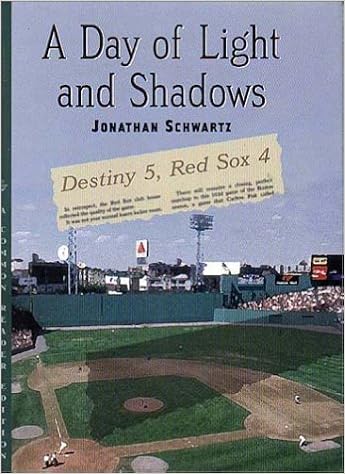
"Destiny 5, Red Sox 4" -- that's what the headline in the next day's Boston Herald-American said. Well, of course: "DESTINY" ends with "NY." The Yanks went on to win the World Series again.
One of the aforementioned books
The difference between this Sox loss to the Yankees and the one 25 years later is stark. When Nettles caught Yaz's popup for the final out, the Sox, as can be seen on the videotape, sort of slink back into their dugout, looking as if they were thinking, "If we couldn't do it this time, we'll never be able to do it." And, sure enough, the next time they got close, in 1986, only 8 years later, only 3 players were left from '77 and '78: Rice, Evans and Bob Stanley. And only Rice and Evans were still there from the '75 World Series.
They had won 196 games in 2 seasons -- just as they had won 192 in 1948-49 -- and, as in that 1940s instance, they hadn't even made baseball's official postseason, partly because they'd lost a one-game playoff at home. (In '48, it was to the Indians.)
A side note: I got my right hip replaced in 2020, and my left hip in 2021. Some "hippies" name their artificial hips. Between Reggie Jackson was lefthanded, and Bucky Dent was righthanded, I named the left hip "Reggie" and the right hip "Bucky."
November 13, 1978, Yankee Stadium. A year after letting the Sox sign Torrez, the Yanks turn the tables, and sign free agent pitcher Luis Tiant.
For the rest of his life, Tiant remained one of the most popular players in Sox history -- he was their "barbecue stand guy," the way Boog Powell is in Baltimore and Greg Luzinski is in Philadelphia -- and, with a 229-172 career record, a 1.199 WHIP and 2,416 strikeouts, is one of the best pitchers not in the Hall of Fame.
Was he a good pickup for the Yankees, even at age (we think) 38? Well, in 1979, he went 13-8 for a team that didn't do too well. He pitched a 2-hit shutout against the A's that included a grounder that went up the middle, right to his foot, which he kicked up and caught, and threw to 1st for an out. But in 1980, age finally caught up with him, and he was just 8-9, and his ERA went up by a full run. The Yanks chose not to re-sign him after that. Still, he pitched 2 more seasons in the majors before hanging 'em up.
Although his Yankee teammates liked him, and he has occasionally returned to New York for Old-Timers' Day, and had some of his best years in Cleveland, it's easy to forget now that he played for anyone other than the Red Sox.
When the Yanks fell apart in 1979, the Sox were unable to take advantage: They won 91 games, but that was 11 behind the Orioles.

September 14, 1980, Fenway Park. The Yankees complete another 4-game sweep on the Sox' turf: 8-5 in 10 innings, 4-2, 4-3 and, today, 5-3. They now lead the AL East by 5 games over the Orioles, and will end up winning 103, with the O's winning 100 and, without a Wild Card, missing the Playoffs.

The Sox? They finished the season only 83-79, and, through a bureaucratic mixup, they let Carlton Fisk and Fred Lynn get away after the season.
October 14, 1982, NBC Headquarters, Rockefeller Center, Manhattan, New York City. In only its 3rd episode, the NBC sitcom Cheers airs an episode titled "The Tortelli Tort." The Sox actually did lose 5-0 to the Yankees just 12 days earlier, but that was at Yankee Stadium.
The game shown on the TV at the bar was clearly at Fenway, with first Tommy John, then George Frazier pitching for the Yankees. John did pitch against the Red Sox at Fenway in 1982, and Frazier did relieve him in that game. But it was on June 9, the Sox won 3-2, and Frazier did not pitch to Carl Yastrzemski in the game, let alone get him to pop up for the final out. So the clips shown on the show had to be from different games.
A minute later, a guy calling himself "Big Eddie" (played by Ron Karabatsos) comes into the bar, and winds the Cheers regulars up for a few minutes. He recognizes bar owner Sam Malone (Ted Danson) as a former Red Sox pitcher, and starts some good-natured banter. Sam's heard it all before, and takes it in stride. But barmaid Carla Tortelli (Rhea Perlman) can't handle it, and she jumps on Eddie's back, grabs him by the ears, and starts slamming his head into the bar. (Refresh my memory: Which character was the alcoholic?)
Eddie threatens to sue unless Sam fires Carla, so Sam sends Carla to an anger-management class. When Eddie returns, he tests her, starting by saying, "Boston stinks." Carla holds her tongue. Then, "This bar stinks." The patrons begin to converge on Eddie, but Sam sends them back. Still, no reaction from Carla.
The insults get worse and worse, until he mentions hockey, and Sam warns him against that. "A sore spot, eh?" He asks, and bellows, "The Bruins are a bunch of ugly... stupid... sissies!" Carla still holds her tongue, and Sam finally says, "What more do you want, Eddie?" Eddie gives up, and starts to walk out, when he is met by a Bruin player, who, we can presume, gave Eddie his comeuppance outside.

The scriptwriters did not have him say "Boston sucks," but "Boston stinks." Which, to be honest, in some spots of the city, is much closer to the truth. Oddly, the scriptwriter got one thing wrong: He has Eddie say the Yankees have won 23 World Series, 1 more than they actually had at the time.

Part IV follows.