Saturday, January 29, 2022

How to Be a New York Basketball Fan In Utah -- 2022 Edition

The Brooklyn Nets go to Salt Lake City to play the Utah Jazz this Friday, February 4. The New York Knicks will follow on Monday, February 7.

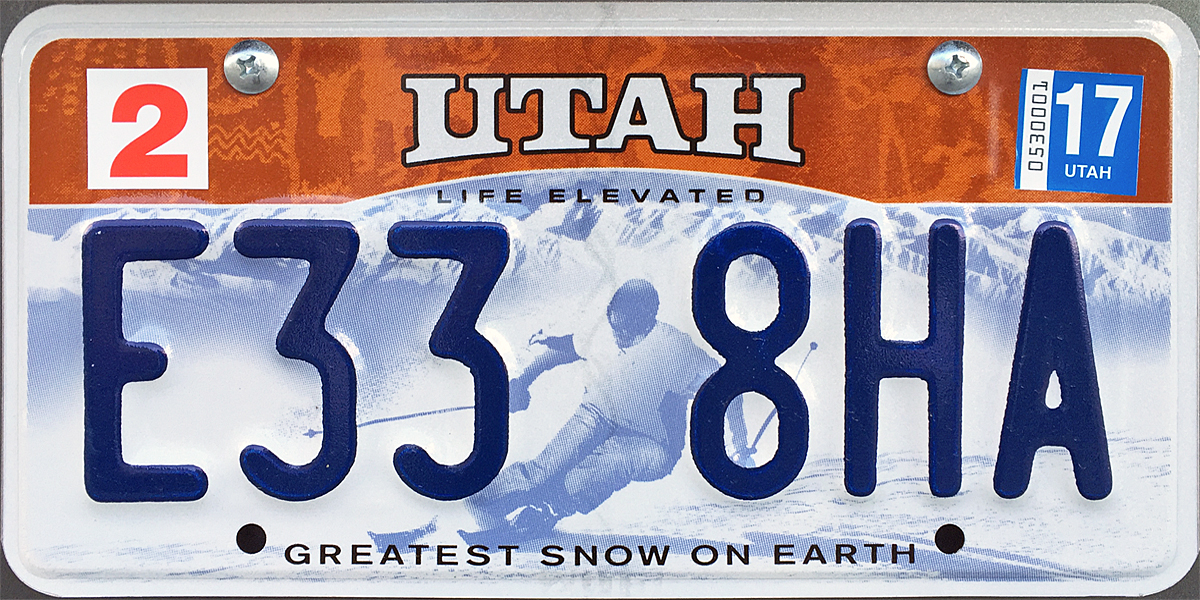
Before You Go. We think of Utah, we think of the Wild West. Desert. National Monument Valley. We forget that it's also in the Rocky Mountains. I flipped out when I heard that it was chosen as the site of the 2002 Winter Olympics. Winter? Utah? But it's got mountains, and it's got snow. For years, the license plates even said, "Ski Utah." Now, they say, "Greatest Snow On Earth."
The Salt Lake Tribune, the State's largest newspaper, is predicting the high 30s for daylight next Friday, and low 20s for the evening. Bundle up.

Utah is in the Mountain Time Zone, 2 hours behind New York. Adjust your timepieces accordingly.

Tickets. The Jazz averaged 18,306 fans per home game in 2019-20, before COVID shut everything down. That's officially a sellout. So getting tickets might be a problem.

In the Lower Level, the single-digit and double-digit sections, seats are $196 between the baskets and $157 behind them. In the Upper Level, the triple-digit sections, seats are a considerably cheaper $54 between the baskets and $31 behind them.

Getting There. It's 2,174 miles from Midtown Manhattan to downtown Salt Lake City. In other words, if you're going, you're flying.

Because, driving, you'd have to get onto Interstate 80 West in New Jersey, and – though incredibly long, it's also incredibly simple – you'll stay on I-80 for almost the entire trip, getting off at Exit 306 for downtown Salt Lake.

Not counting rest stops, you should be in New Jersey for an hour and a half, Pennsylvania for 5:15, Ohio for 4 hours, Indiana for 2:30, Illinois for 2:45, Iowa for 5 hours, Nebraska for 7:45, Wyoming for 6:45, and Utah for 1:15. That's almost 37 hours, and with rest stops, and city traffic at each end, we're talking 2 full days.

That's still faster than Greyhound and Amtrak. The station serving both, Salt Lake Central Station, is at 300 South 600 West, 5 blocks from the arena. But the Greyhound trip averages about 49 hours, depending on the run, and will require you to change buses twice, most likely in Pittsburgh and Denver. Round-trip fare is $502, but can drop to $370 with advanced purchase.

On Amtrak, you would leave Penn Station on the Lake Shore Limited at 3:40 PM on Tuesday, arrive at Union Station in Chicago at 9:50 AM Central Time on Wednesday, and switch to the California Zephyr at 2:00 PM, arriving at Salt Lake City at 11:05 PM Mountain Time on Thursday, about 20 hours before tipoff. Getting back, the California Zephyr leaves Salt Lake City at 3:30 AM on Sunday, arrives in Chicago at 2:50 PM on Monday, and the Lake Shore Limited leaves at 9:30 PM and arrives in New York at 6:23 PM on Tuesday. Round-trip fare would be $487.
But not this time. Amtrak seems to have canceled the Lake Shore Limited for the time being. Instead, you'd have to take 3 separate trains, so it really isn't worth it. Forget Amtrak this time.

Newark to Salt Lake City is a cheap flight this week, and you can get it nonstop, if you're willing to leave early in the morning, as low as $337.

Once In the City. Founded in 1847 by Mormon leader Brigham Young (who famously found what he thought was the right spot for his followers and said, "This is the place") and named after the Great Salt Lake, Salt Lake City is the smallest anchor city in North American major league sports, except for Green Bay, Wisconsin: 199,000.

But it has a metropolitan area population of about 2.6 million and rising, which makes it larger than NBA markets San Antonio, Indianapolis, Milwaukee, New Orleans, Oklahoma City and Memphis; and MLS markets Kansas City and Columbus -- and not that far behind Vancouver.
The State House

Society in the State and the City remains dominated by "The Church of Jesus Christ of Latter-Day Saints," a.k.a. the Mormons. So, in Star Trek IV, when James T. Kirk, having traveled back in time with Spock, tells a woman that Spock was in Berkeley, California in the 1960s and "did a little too much LDS," it was a mistake on his part (intentional on the writers' part), not a reference to Spock being a Mormon.

Despite it being a Western university, I don't think there were very many Mormons at the University of California, Berkeley in those days. They were much more likely to have attended the University of Utah in Salt Lake City, Utah State University in Logan, or, especially, the school named for their faith's leading figure, Brigham Young University in Provo.

Nevertheless, like Austin in Texas, Little Rock in Arkansas, Atlanta in Georgia and Lincoln in Nebraska (but definitely not the suburbs of any of those), Salt Lake City is an increasingly liberal capital city in an otherwise very conservative State.

I put it this way: In Salt Lake City, Mitt Romney, America's most famous living Mormon, is regarded as "severely conservative"; in the rest of Utah, he's "Massachusetts Moderate Mitt." (As Dick Smothers would say, "That was not a compliment." Dick and his brother Tom probably also had a few things to say about Mitt's father, George, Governor of Michigan and a Presidential candidate in the 1960s.)

Salt Lake City has the most confusing street names I've ever seen. In place of numbered streets, such as "West 6th Street," they have "600 West," then divide them along the other access, so it reads as "South 600 West." I suppose that if you've lived there all your life, this would be second nature to you. Or North 200 Nature to you. But it would drive me bananas.

At any rate, Main Street is the east-west divider, with State Street taking the place of 100 East, and West Temple -- not "West Temple Street" or "West Temple Avenue" or anything like that, just "West Temple" -- taking the place of 100 West. There's also a North Temple and a South Temple, but not an East Temple. South Temple is the north-south divider. The exact centerpoint is Temple Square. Interstate 215 forms a partial "beltway."

ZIP Codes for Utah begin with the digits 84. The Area Codes are 801 (overlaid by 385) and 435. Rocky Mountain Power runs Salt Lake City's electricity. Salt Lake City was 91 percent white as recently as 1970, but is now 66 percent white, 22 percent Hispanic, 8 percent Asian, 3 percent black and 1 percent Native American.
With so few black people -- the joke is that they all play for the Utah Jazz -- Salt Lake City has had very few racial issues. But on February 27, 2016, the police shot a 17-year-old Somali refugee named Abdullahi Omar Mohamed, after he got into a fight with another man as the result of a drug deal gone wrong. People began to throw rocks at the police, and a riot squad was called out. Mohamed barely survived, and served a little time in jail. 

With their history as the site of the union of Eastern and Western railroads, with the famous 1869 "Golden Spike" ceremony at Promontory Summit, you would expect Utah to have good rail service. The Utah Transit Authority runs buses and TRAX light rail. Routes numbered 001 to 199 run east-to-west, 200 to 299 run north-to-south, 300-399 are express, 400 to 499 are intercounty, 500 to 599 are neighborhood routes, 600 to 699 are Weber/Davis County routes, 800 to 899 are Utah County Routes, and 900 to 999 are Ski Service/Seasonal routes.
A TRAX train at Gallivan Plaza

A square bounded by Temple on the north, 200 East on the east, 500 South on the south, and 400 West on the west, plus the State Capitol, Salt Lake Central Station and Old Greektown Station, are a Free Fare Zone. Otherwise, within Salt Lake City, a one-way fare is $2.50, and a Day Pass is $6.25.

The "sales and use tax," as it's known in Utah, is 4.7 percent for the State, and rises to 6.85 percent in Salt Lake City.

Going In. The Jazz' arena opened in 1991 as the Delta Center, with the airline having bought the naming rights. It became the Energy Solutions Arena in 2006, and was changed again in 2015, to Vivint Arena, as the naming rights were bought by the private home security system. Yet another thing about Salt Lake City that's confusing, along with the street addresses, the combination of desert and snow-capped mountains, and the liberal City in the conservative State.

The official address of the arena is 301 West South Temple. It's downtown, within walking distance of most hotels. The Gateway Mall, including the old Union Pacific Railroad depot, is across North 400 West. Parking is available all around, including underneath the Salt Palace Convention Center, across 300 West from the arena. I can't find any reference to how much parking costs in these lots, but metered parking is $2.00 for 2 hours, and free after 8:00 PM (in other words, in the middle of the game).
The Larry H. Miller Court, named for the late Jazz owner (whose company still owns the team and the arena), is laid out southwest to northeast. The building was used for figure skating and short track speed skating at the 2002 Winter Olympics. (Because the Olympics prohibit corporate names on venues, it was officially known as the Salt Lake Ice Center for the duration.) The WNBA's Utah Starzz played there from 1997 to 2002, when they moved to become San Antonio Silver Stars.
It was home to a pair of minor-league hockey teams, the Salt Lake Golden Eagles from 1991 to 1994, and the Utah Grizzlies from 1995 to 1997, winning the Turner Cup in 1996 and '97. It's hosted NCAA Tournament games, although the NCAA is now committed to holding them in domed stadiums with at least twice this arena's capacity of 19,911.

In 2008, Sports Illustrated took a poll of 240 NBA players, and the building was chosen by 20 percent (hardly a majority, but a plurality) as the most intimidating arena in the NBA. It could be due to the high elevation in this Rocky Mountains city, as much as to the noise of the fans.

Food. The arena has some new additions to their traditional concessions:

* Chick-fil-A: located on the main level between portals R and S
* Cupbop: located on the main level between portals K and L
* Authentic Korean Tacos: located next to Cupbop between portals K and L
* Swig "Dirty Soda": One location on main level between Portals L and M, another on level 5 between MM and NN
* Frank's Dogs and Sausages: One location on main level between portals B and C and another on the main level between portals X and Y
* Salt City Panini: Located on the main level between portals X and Y (One option for healthier foods like chef salads and fruit dippers)
* Tom's Smokehouse BBQ: Located on the main level between portals X and Y
Unfortunately, in addition to Chick-fil-A, they also serve Papa John's Pizza. Which isn't that good even if Papa John Schnatter himself wasn't a right-wing asshole.
The Squatters' Tavern is on the arena's southeast side, and the Coors Light Champion Club in the west corner. 
Team History Displays. The Jazz began as an expansion franchise in 1974, in New Orleans, and moved to Salt Lake City in 1979. "New Orleans Jazz" made sense, but "Utah Jazz" doesn't. Former coach Frank Layden suggested that the team swap names with the Los Angeles Lakers, who started in Minnesota, "the Land of 10,000 Lakes," because Utah has a big lake, while L.A. is the West Coast's leading city for jazz. Neither Commissioner Larry O'Brien nor Lakers owner Jerry Buss (both now deceased) went for the idea. Still, the Jazz' note-shaped J logo is pretty sharp. Definitely not flat. It looks completely natural.

Sam Battistone, the team's majority owner at the time of the move, said there wasn't time to get the name officially changed before the 1979-80 season, and that nobody came up with a better name: "The names that came in, nothing seemed to fit." He sold the team to Larry Miller, Utah's most successful car dealer, in 1985, and he didn't change the name, either. Nor did Gail Miller, his widow and successor as owner. Nor has Ryan Smith, the billionaire she sold the team to. 

The Jazz won the Midwest Division in 1984, 1989, 1992, 1997, 1998 and 2000. They've won the Northwest Division in 2007, 2008, 2017 and 2021. They've won the Western Conference in 1997 and 1998. They have banners for each of these achievements, doubling up for '97 and '98. (There is no notation in the arena's rafters for the 1971 ABA Championship won by the Utah Stars, who also reached the ABA Finals in 1974, losing to the New York Nets.)
For a franchise so young, and without an NBA title, the Jazz have a very high number of honorees for "retired numbers": 11. Although Pete Maravich only played 17 games for Utah after the move, before being traded to the Boston Celtics, the Jazz retired his Number 7 for what he did for the franchise in New Orleans, even though he wore 44 when he started with them. The New Orleans Hornets/Pelicans also retired 7 for him, even though he never played for them.

From the 1984 Division title, they honored coach Frank Layden with 1, forward Adrian Dantley's 4, guard Darrell Griffiths' 35 and center Mark Eaton's 53. From the 1989 Division title, they honored Dantley, Griffith, Eaton, guard John Stockton's 12 and forward Karl Malone's 32. From the 1992 Division title, they honored Eaton, Stockton and Malone. And from the 1997 and 1998 Conference titles and the 2000 Division title, they honored Stockton, Malone, and guard Jeff Hornacek's 14.

As yet, no one is honored from the 2007 and 2008 Division titles. With as many retired numbers as they have, it seems silly to retire Carlos Boozer's 5, Deron Williams' 8 and Mehmet Okur's 13 when they didn't win a title.

Straddling the eras, they have banners honoring owner Miller, broadcaster Rod Hundley, and head coach Jerry Sloan. Hundley, who'd been a star player for the Lakers in the 1960s, is represented by a banner with the number of games he broadcast, 3051. Miller, for whatever reason, has Number 9, while Sloan's banner has the number of games he won as Jazz head coach, 1223.
Miller made his name as a car salesman and then a dealership owner throughout Utah and Colorado, and built a media empire, even buying Salt Lake City's Channel 14 and renaming it KJZZ for the team. He bought the Jazz and built the arena. He also owned the WNBA's Starzz, the IHL Golden Eagles, and the Pacific Coast League's Salt Lake Bees. Although he never went to college, as a Mormon, he donated heavily to BYU, and they named their baseball complex Larry H. Miller field for him.

In addition, the Jazz have statues of Stockton and Malone outside one of the longer entrances. The two of them, and Maravich, were named to the NBA's 50th Anniversary 50 Greatest Players, and also to the 75th Anniversary 75 Greatest Players.
The Malone (left) and Stockton statues

Basketball Hall-of-Famers associated with the Jazz are Maravich, Dantley, Stockton, Malone, Sloan, Gail Goodrich (3 seasons in New Orleans), Walt Bellamy (1 season in New Orleans), Elgin Baylor (ditto, as coach), Spencer Haywood (the last season in New Orleans) and Bernard King (the 1st season in Utah).

Zelmo Beaty, Ron Boone, Jimmy Jones and Willie Wise of the Stars were named to the ABA All-Time Team. Beaty was elected to the Basketball Hall of Fame in 2016.

For geographic reasons, the Jazz' biggest rival is the Denver Nuggets. The Jazz lead the rivalry 135-99 -- 153-123 if the New Orleans years are counted. They've played each other in the Playoffs 5 times, with the Jazz winning in 1984, 1994 and 2010, and the Nuggets winning in 1985 and 2020.

Stuff. The Fanzz Jazz Team Store is on the northwest side of the building.

There aren't many books about the Jazz. Michael Lewis, author of Moneyball and The Blind Side, wrote: To the Brink: Stockton, Malone, and the Utah Jazz's Climb to the Edge of Glory after their 1997 and '98 Finals appearances. Nate LeBoutillier contributed the Jazz' entry in the NBA's A History of Hoops series. Stockton wrote an autobiography, Assisted. Malone, nicknamed The Mailman for his ability to "deliver," was profiled in Clayton Geoffreys' bio Karl Malone: The Remarkable Story of One of Basketball's Greatest Power Forwards.

Don't count on finding any Jazz DVDs, not even a 20th, 25th or 30th Anniversary video (1999, 2004 or 2009). The only one available on Amazon.com is of Game 5 of the 1997 NBA Finals, and they lost that one: Michael Jordan's "Flu Game."

During the Game. A November 13, 2014 article on DailyRotoHelp ranked the NBA teams' fan bases, and listed the Jazz' fans 9th: "Regardless of a team that hasn't made it to the Playoffs in years, the fan base in Utah are a dedicated and loyal bunch."

The Jazz' biggest rivalries are with the Nuggets, the Houston Rockets and the Los Angeles Lakers. They don't have any special animus for either the Knicks or the Nets. They are not going to bother you.

Then again, a 2008 Bleacher Report article called Jazz fans "The Most Disgusting Fans in the NBA." The author has a point. I thought Boston Celtics fans were bad, but they've never been this bad. But that was 10 years ago, so it may no longer aply

Neither of the New York teams' visits this season will feature a promotion. The Jazz hold National Anthem auditions every September for the entire season, instead of having a regular singer. A group called the Basketball Rockers has recorded a theme song for them, based on the Mortal Kombat video game series. There are no notable Jazz fan chants.

Dan Roberts has been the team's public address announcer since they arrived in 1979. Before that, he was the P.A. announcer for the University of Utah, including when their arena hosted the 1979 NCAA Championship Game. In nearly 40 years, he's missed 10 Jazz home games. His son Jeremy Roberts, the regular announcer for the Jazz' farm team, the Salt Lake City Stars, has filled in for him on those occasions.

The team's mascot is Jazz Bear. He rides onto the court on a motorcycle, wearing a Jazz uniform with Number 00, and a headband. He was named NBA Mascot of the Year in 2008 and 2018, and he's been elected to the Mascot Hall of Fame. But he looks like a ripoff of Squatch, the mascot of the now-moved Seattle SuperSonics.
Apparently, that's a bear.

After the Game. Salt Lake City is one of the safest cities in the NBA. You should have no trouble getting back to your car or your hotel all right.

If you want to go out for a postgame meal or drinks, the Squatters' Pub inside the arena might still be open. The Gateway mall across North 400 West may have some places open. As far as I know, there are no bars or restaurants anywhere near Salt Lake City that are known hangouts for New Yorkers.

If your game in Salt Lake is during the European soccer season (which this one is), there's one place that shows up whenever you look up area soccer bars: Fiddler's Elbow, at 1063 East 2100 South, 5 1/2 miles southeast of downtown, in the Sugarhouse area. Bus 209, then a 3-block walk east on 2100.

Sidelights. Aside from the Jazz, Salt Lake City doesn't have much sports history, but may still be worth a visit beyond the game.

* Salt Palace. There have actually been 3 buildings with this name, but only the 2nd is connected to sports. Opening in 1969, it hosted minor-league hockey's Salt Lake Golden Eagles from 1969 to 1991; the ABA's Utah Stars from 1970 to 1975, including their 1971 ABA Championship; and the Jazz from 1979 to 1991. The Beatles never performed in Utah, but Elvis Presley sang at the Salt Palace on November 16, 1971 and July 2, 1974.
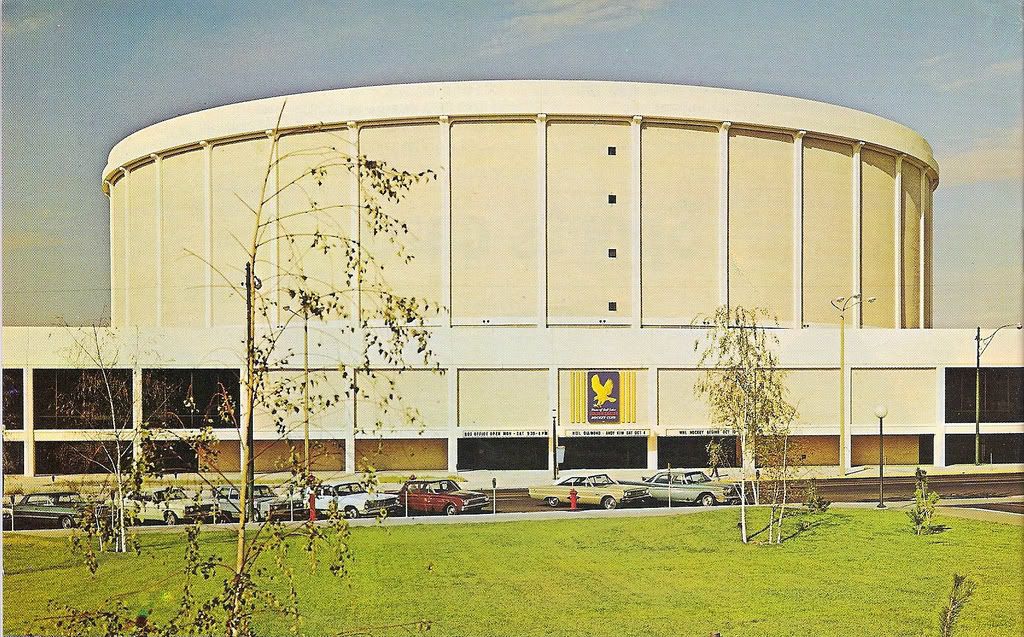
For most of its history, it seated a little over 12,000 people. By the time the Jazz got good in the mid-1980s, among the NBA's 23 teams, only the Milwaukee Bucks had an arena with a smaller capacity. It was time to build a larger arena.

On of the last events there was an AC/DC concert on January 18, 1991, at which fans rushed the stage, and 3 of them were trampled to death. It took 20 minutes for someone to get word to the band about what had happened, and they stopped the concert. Most likely, you didn't hear about this (unless you were a fan of the band or a Utah native) because the Persian Gulf War had started 2 nights before, and that was all that TV news wanted to talk about. A lawsuit was filed against the arena operators and the band, and was eventually settled out of court.

The Salt Palace was demolished in 1994. The Salt Palace Convention Center was built on the site, and includes the Utah Museum of Contemporary Art and a concert hall, Abravanel Hall. 100 South Temple.

* Smith's Ballpark. This 15,411-seat ballpark, one of the largest in the minor leagues, has been the home of the Salt Lake team in the Pacific Coast League since 1994, known first as the Buzz, then as the Stingers starting in 2001, and as the Bees since 2006. They are currently a farm team of the Los Angeles Angels of Anaheim.
It was built on the site of Derks Field, which had been home to area baseball since 1947. The original Salt Lake City baseball team played from 1911 to 1984. As the Bees, they won the Pioneer League (then Class C) Pennant in 1946, 1948 and 1953, and the PCL Pennant in 1959. As the Salt Lake City Angels, they won the PCL Pennant in 1971. As the Salt Lake City Gulls, they won the PCL Pennant in 1979. But the current Bees have never won a Pennant, last making the Playoffs in 2013.

The Salt Lake Trappers won Pioneer League (now a Rookie League) Pennants in 1985, 1986, 1987 and 1991, making a total of 10 Pennants for Salt Lake City teams. En route to the 1987 Pennant, they won 29 straight games, to set a North American professional baseball record. In 1994, the Trappers moved upstate to become the Ogden Raptors. 1365 South West Temple, 2 1/2 miles south of Temple Square. Ballpark station on TRAX light rail.

* Rice-Eccles Stadium. Home to University of Utah football since 1998, this 45,807-seat stadium was the centerpiece of the 2002 Winter Olympics. It was built on the site of the previous Rice Stadium, built in 1927. It hosted Major League Soccer's Real Salt Lake from 2005 to 2008, and a U.S. soccer team win over Costa Rica on June 4, 2005. 451 1400 East.
* Jon M. Huntsman Center. Home to University of Utah basketball since 1969, it was originally named the Special Events Center. It was renamed for a major university contributor, the founder of Huntsman Chemical Corporation and the father of a former Governor. Jon Huntsman Sr. died on February 2, 2018, but Jon Jr. is still alive.

Most notably, it hosted the 1979 NCAA Final Four, including the legendary Final, won by Earvin "Magic" Johnson's Michigan State over Larry Bird's Indiana State. It has hosted 81 NCAA Tournament games, 2nd only to the University of Dayton Arena's 91.
Both the stadium, at 451 1400 East, and the Huntsman Center, at 1825 East South Campus Drive, are about 3 miles east of downtown, and can be reached by TRAX light rail at University Campus South station.

Utah State is in Logan, 83 miles north on U.S. Route 89. It is not easily reachable by public transportation. BYU is in Provo, 45 miles south on I-15. TRAX does extend to Provo Central Station, taking about an hour, and then you can transfer to the 830 or 831 bus to the campus.

* Rio Tinto Stadium. Home of Real Salt Lake since 2008, including its 2013 MLS Cup season, this 20,213-seat soccer-specific stadium has also hosted 4 U.S. soccer team matches, 3 of them victories, but the most recent game is a 2017 draw with Venezuela.

The U.S. women's team has a perfect 4-0 record there, and the Utah Royals of the National Women's Soccer League have begun play there as well. 9256 State Street in the suburb of Sandy. TRAX to Sandy Expo Station, a 48-minute ride. The Royals were moved to Kansas City after the 2020 season.
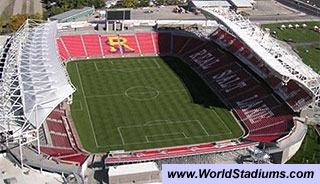
* Maverik Center. Originally known as the E Center, this 12,500-seat arena hosted the 2002 Winter Olympic hockey tournament. The East Coast Hockey League's Utah Grizzlies have played there since it opened in 1997. (Yes, I know: Utah is on neither the Pacific Coast nor the East Coast. I didn't name these leagues.) 3200 Decker Lake Drive, in the suburb of West Valley City. TRAX to Decker Lake station.

Don't count on Salt Lake City ever getting a team in a sport other than the NBA and MLS. Its metro area population would rank it 30th in MLB, 27th in the NFL, and 23rd in the NHL. For now, the closest teams in those leagues are in Denver, 523 miles away.

And yet, while the Denver Broncos are Utah's favorite NFL team, and the Colorado Avalanche its favorite NHL team, it doesn't hold true in baseball. According to an article in the April 23, 2014 edition of The New York Times, Salt Lake City's vast distance from any major league team means that its favorite teams are the teams it's used to seeing on TV: The Yankees and Red Sox each got 17 percent in a poll, and the next-closest in the poll was the Los Angeles Dodgers, with a mere 7 percent. It's not until you get to Uintah County, 160 miles east of Salt Lake (and 320 miles west of Denver), that you get to definitive Colorado Rockies territory in Utah.

Utah has never produced a President. Mitt Romney, born in Detroit and living most of his life in Boston, but having a home in the Salt Lake suburb of Park City, was nominated for President in 2012, but didn't come all that close to winning. So there's no Presidential Library or Museum nearby. Romney has moved back to Utah, and was elected to the U.S. Senate in 2020, having lost a Senate race to Ted Kennedy in Massachusetts in 1994.

The most famous Utahan remains Mormon leader Brigham Young, and his home, The Beehive House, is a Salt Lake City landmark. The spot where Young told his followers, "This is the place" is now the This Is The Place Heritage Park, a "living history" park, a "Mormon Williamsburg" if you prefer. 2601 Sunnyside Avenue South. It is part of the University of Utah campus, as is the Natural History Museum at 301 Wakara Way. Like the This Is The Place. Both can be reached by Bus 3 from Temple Square.

As I mentioned, the Utah Museum of Contemporary Art is part of the new Salt Palace complex. The Museum for Speed includes exhibits about the speed records set at Utah's Bonneville Salt Flats. 165 East 600 South. Bus 200 from Temple Square.

Golden Spike National Historic Site commemorates the meeting of the Union Pacific and Central Pacific Railroads to form the 1st transcontinental railroad on May 10, 1869. Interestingly, both of the locomotives shown in the famous photo were made within a reasonable drive of us: Rogers Locomotive and Machine Works of Paterson, New Jersey built Union Pacific No. 119; and Schenectady Locomotive Works of the Albany area built Central Pacific Railroad #60, a.k.a. Jupiter.

6200 North 22300th Street West (no, I checked, that address is not a typo), in Corrinne, 86 miles northwest of Salt Lake City and around the Great Salt Lake itself, up I-15 and Utah Route 83. Ironically, it's not reachable by train. Nor by bus: You'd have to rent a car to see it. It's about 32 miles southeast of the actual location, usually referred to as Promontory Point, but actually named Promontory Summit, near Brigham City. ("Promontory Point" is a different place.)

The tallest building in the State of Utah is the Wells Fargo Center in Salt Lake City, 422 feet high. (It should not be confused with the building of the same name that is the new Philadelphia sports arena.) Main Street and 300 South. But the most famous building in the State remains the Salt Lake Temple at Temple Square, the Mormons' "Vatican."

As the home of National Monument Valley, many of the films made in Utah have been Westerns, including Stagecoach, The Searchers, How the West Was Won, Butch Cassidy and the Sundance Kid -- which gave its name to Kid portrayer Robert Redford's Sundance Film Festival -- and the Wild West scenes from Back to the Future III. The beginning sequence of Indiana Jones and the Last Crusade, with 18-year-old River Phoenix playing a 13-year-old Indy, was said by the credits to take place in "Utah, 1912," and was indeed filmed in the State. The spot in Forrest Gump where Forrest stops running is on U.S. Route 163 in Monument Valley.

As for Salt Lake City itself, a scene from Legally Blonde 2 was filmed at the Jazz' arena, and another at the State Capitol. The High School Musical movies were filmed at East High School, 3 miles east of downtown. 840 1300 East. Bus 220.

But the most famous movie shot in Salt Lake was, ironically, set in a place we normally associate with filming locations: The Sandlot, set in California's San Fernando Valley in 1962. The houses of Scotty Smalls (played by Tom Guiry) and Benny "the Jet" Rodriguez (Mike Vitar) are at the corner of Bryan Avenue and 2000 East, 5 miles southeast of downtown. Also Bus 220.

The actual sandlot, renovated for the film's 20th Anniversary in 2013, is behind 1386 Glenrose Drive South at Navajo Street, 4 miles southwest of Temple Square. Bus 516. Patrick Renna, who played catcher Hamilton "The Great Hambino" Porter, filmed another movie in SLC, The Great Unknown, in 1997.
A recent photo of the Sandlot

TV shows set and/or filmed in Utah include the late 1950s Western Union Pacific, Touched By an Angel (the angels' car went all over the American West but had Utah license plates), its spinoff
Promised Land, Everwood, and the Mormon-themed drama Big Love and reality series Sister Wives.

*

Like a lot of cities, Salt Lake City can be a bit of an acquired taste. But it's a good basketball town, and it could be a good roadtrip for a Knicks or Nets fan.

How to Be a New York Basketball Fan In Sacramento -- 2022 Edition

The Brooklyn Nets will play away to the Sacramento Kings this coming Wednesday night, February 2. The New York Knicks will do so on March 7.

Before You Go. Sacramento is 90 miles inland from San Francisco, so the city's notorious weird weather won't be a factor. The Sacramento Bee website is predicting the mid-60s for Wednesday afternoon, but it will drop to the mid-30s for the evening. No rain is predicted for the entire week, but you should still bring a Winter jacket.

Sacramento is in the Pacific Time Zone, which is 3 hours behind us. Adjust your timepieces accordingly.

Tickets. Once a guaranteed sellout of 17,317 fans per game, every game, the Kings fell off significantly. In 2019-20, before COVID shut everything down, their per-game attendance was now 16,896, about 96 percent of capacity. You should be able to get a ticket.

In the lower level, the 100 sections, seats are $138 between the baskets and $101 behind them. In the upper level, the 200 sections, they're $38 and $37.

Getting There. It's 2,824 miles from Times Square to downtown Sacramento. Unless you want to spend 41 hours, plus rest stops making it more like 48 hours, each way, on Interstate 80 (getting off at Interstate 5 and taking that south to downtown), or take an even longer-time trip on Amtrak, you're flying. You should be able to get a flight for under $600, but it won't be nonstop: You'll have to change planes each way, in Chicago, Denver, or maybe even in San Francisco.

If you board Greyhound at Port Authority by 4:10 PM on Sunday, you'll get to Sacramento at 6:20 PM local time on Wednesday, which will be in time to get to the game. It's $748 round-trip, but, depending on when you leave, it can be reduced to $516 on advanced purchase. The Greyhound station is at 420 Richards Blvd. at 7th Street. Walking 2 blocks east on Richards will take you to the Township 9 station on the Light Rail Green Line, and from there it's 1 stop to downtown, including the new arena.

To get there in time via Amtrak, you'd have to take the Lake Shore Limited out of Penn Station at 3:40 PM on Sunday, get to Union Station in Chicago at 9:50 AM on Monday, switch to the California Zephyr at 2:00 PM, and arrive in Sacramento at 2:13 PM on Wednesday. Then you'd have to leave Sacramento at 11:09 in the morning on Thursday, and arrive back in New York at 6:23 PM on Sunday. Round-trip fare is $596. The Amtrak station is at 4th & I Streets.

WARNING: You can't do Amtrak this time. The Lake Shore Limited for Sunday, January 30 has been canceled.

Once In the City. Founded in 1850, and the capital of the State of California since 1854 (Monterey had been the capital when California was ruled by Spain and Mexico), Sacramento is home to a little over 500,000 people, and growing.
The metropolitan area is home to 2.6 million people, ranking it 23rd out of the NBA's 30 markets, and larger than older NBA markets like Indianapolis, San Antonio, Milwaukee and Salt Lake City.
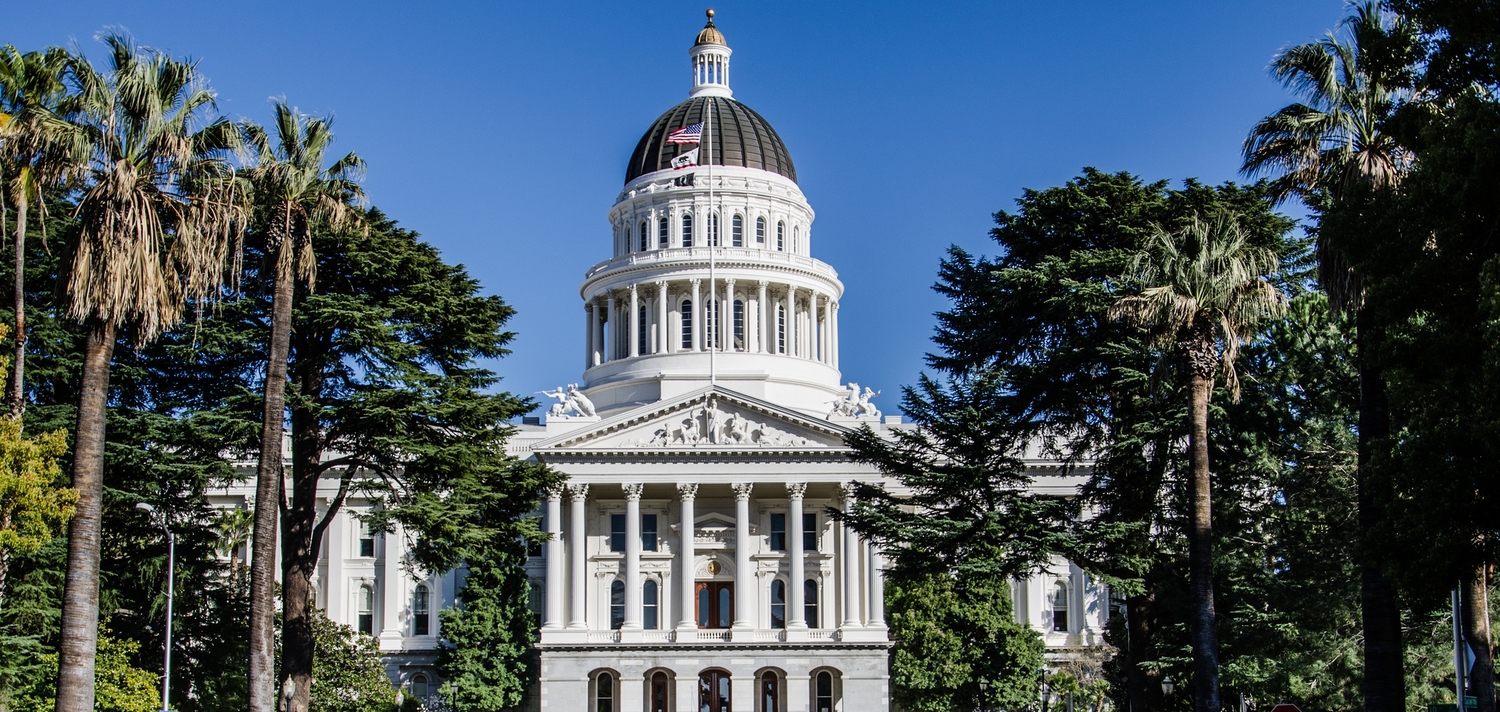
The California State House

Sacramento still tries to retain a small-town feel, and to resist its connections to far-out places like San Francisco, Oakland, Berkeley, Los Angeles, Hollywood and Venice Beach. Or, as Nancy Reagan said when her husband was working there as Governor (1967-74), "Sacramento is not in California."
The Sacramento River divides street addresses into east and west, and the railroad does so into north and south. There is no freeway "beltway." The Sacramento Regional Travel District runs buses and a light-rail system. A single fare is $2.50, while a daily pass is $6.00.
The sales tax in the State of California is 7.5 percent, in the County of Sacramento 8 percent, and in the City of Sacramento 8.5 percent. ZIP Codes in Sacramento start with the digits 942, 956, 957 and 958; and the Area Code is 916. The Sacramento Municipal Utility District (SMUD) runs power and water for the city, which is about 36 percent white, 29 percent Hispanic, 16 percent black and 19 percent Asian.

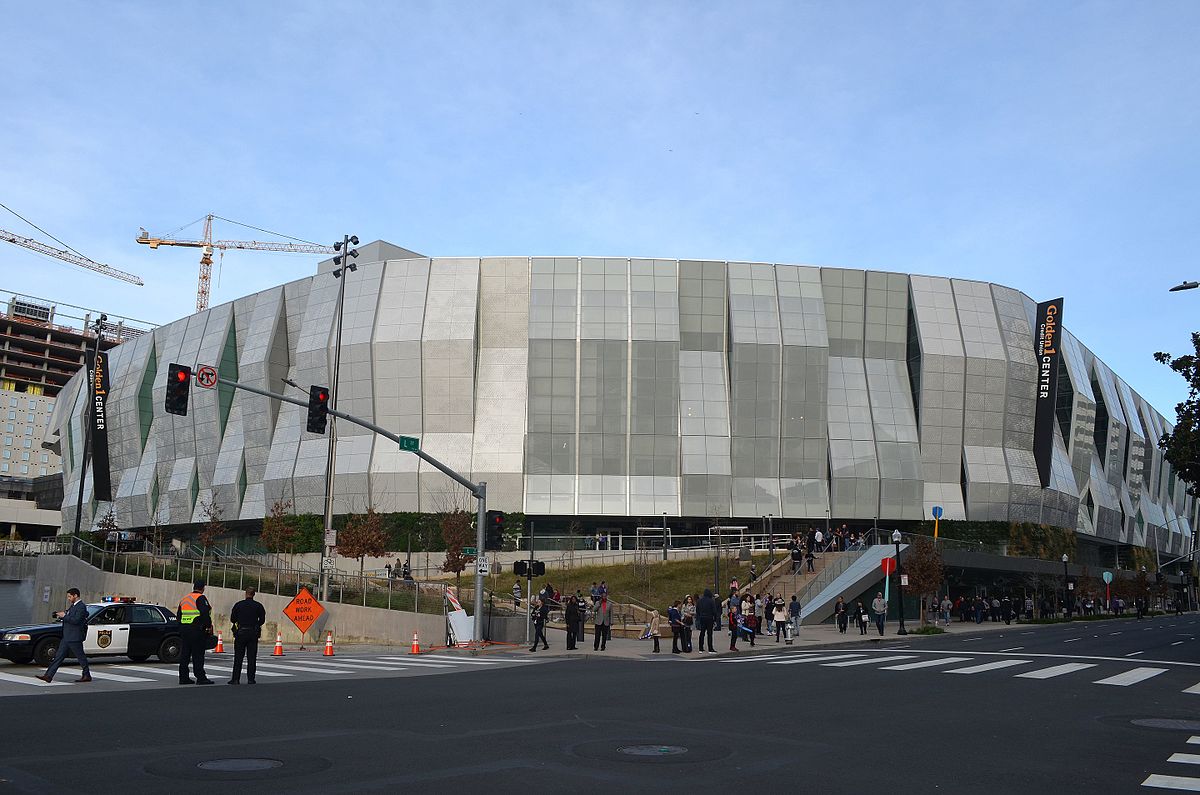
Going In. The 17,500-seat Golden 1 Center opened for the 2016-17 season. The official address is 500 David J. Stern Walk (named for the former NBA Commissioner). It is in the Downtown Commons and Capitol Mall area, bounded by J Street to the north, 6th Street to the east, L Street to the south and 5th Street to the west. Parking is $11.
Not quite as weird-looking as the Nets' Barclays Center,
but pretty weird.

Golden 1 Credit Union bought the naming rights. Like Gainbridge Fieldhouse in Indianapolis, it has big windows, allowing fans to see out, which is a novelty in the NBA. The court is aligned north-to-south (more or less).
Every March, it hosts the California high school basketball State Championships. It also hosts NCAA Tournament games, WWE and UFC events, and concerts.

Food. The new arena quickly got rave reviews for its food. And the theme is buy local: A recent Sacramento Bee article says:

Its stalls are not anonymous hot-dog huts but brand extensions of Paragary's, Selland's, Mulvaney's, Star Ginger and other popular local restaurants that have licensed their names and recipes to concessions giant Legends Hospitality...
We enter the arena at 5:30 p.m., just as Kings fans are starting to trickle in. We hit Selland's Market-Cafe first, because it's so close to the entrance and because Tuohy had told us earlier that pizza from Selland's and Paragary's were top sellers at previous arena events... 
Next we hit Cafe Bernardo Burgers & Shakes, for a $14 bacon habanero burger. Though the patty is slimmer than what we have had at other Bernardos, the meat holds a similar, and welcome, peppery taste. The sandwich comes with more smoky bacon than one expects to get at an arena, and noticeably fresh lettuce and tomato.
Near the condiment station, at the edge of the main concourse, we spot the dapper figure of Randy Paragary, looking out onto the court and seating areas below. Though not precisely the king of all he surveys, Paragary has more of his brands on Golden 1 stands than any other local restaurateur – two Bernardos, two Paragary's pizza places and a Centro street-taco spot.
Paragary says he and corporate executive chef Kurt Spataro have come to every arena event so far, tweaking ingredients and fine-tuning the preparation process. Centro started with the staff adding salsa to tacos, but that process proved too time-consuming. Now there's a salsa bar that also includes cilantro, chopped onion and cotija cheese...
Whereas the same items repeated at most stands at Sleep Train, Golden 1 offers 82 distinct menu items, Tuohy said. They include a well-executed $12 chicken banh mi, its French roll crunchy and its marinated vegetables crisp, at the Star Ginger stand...
We try Porchetta House, a rotisserie spot named after a specialty of Tuohy, former chef at Sacramento's Grange and LowBrau. The porchetta sandwich marries tender, expertly seasoned pork roast from Chico's Rancho Llano Seco with a substantial yet airy bun and is as good as anything we ever have tried at any sports venue.
The $12 "carnitas nachos" and $13 "loaded bacon cheese dog" served at another in-house spot, El Jefe, disappoint. The nachos feature Petaluma Creamery cheese and chunky, very fresh guacamole, but lack snap. The dog, covered in the same rich yet bland-tasting cheese sauce, makes a mess of your face when you bite into it...
It was a fitting cap to a night that never required us to make that other kind of concession so common to eating at sports venues. The one in which you settle for an arena hot dog or pizza slice because you lacked the time to grab a bite elsewhere before a game. Golden 1 Center is a legitimate dinner option.
Read more here: http://www.sacbee.com/food-drink/restaurants/article108066327.html#storylink=cpy
Team History Displays. The Kings have a complicated history. They are the oldest franchise in the NBA (even if you count the Philadelphia/San Francisco/Golden State Warriors as the direct successor to the Philadelphia SPHAs), yet they have gone longer without winning a title than any other team, and their last title was 3 cities ago.

They began in 1923 -- at which point, there were only 16 current MLB franchises, 3 from the NFL, and 2 from the NHL -- as the Rochester Pros. At some point, they became the Rochester Royals, winning the championship of the Midwest-based National Basketball League in 1945.

In 1948, they moved to the fledgling NBA (known for 1 more season as the Basketball Association of America), and in 1951 won the NBA Championship. That's 68 years, and they haven't even been back to the Finals since. It's also, unless you count the 1955 NBA Champion Syracuse Nationals, the last time a team from Western New York won a World Championship.

But, as with Syracuse and Fort Wayne, Rochester was not big enough to support a truly major league team, though their Red Wings baseball team and Americans hockey team are minor-league legends. So, in 1957, they moved, becoming the Cincinnati Royals. The closest they got to a title in Cincy was the 1963 and 1964 Eastern Division Finals.

In 1972, they moved to become the Kansas City-Omaha Kings. They couldn't remain the Royals because Kansas City already had a baseball team with that name, and they didn't want to double-up like the NFL's Chicago Cardinals did upon moving to St. Louis.

After 3 years dividing between K.C. and their status as the only major league team the State of Nebraska has ever known, they played all home games in Kansas City from 1975 to 1985, but didn't like their arena deal, and moved to Sacramento in 1985. Until the Golden 1 Center deal was cut in 2014, their threats to move to Anaheim and Seattle were very real.

The Kings hang a banner for the Rochester Royals' NBA title of 1951, and also for their Division titles from 1979 (Kansas City), 2002 and 2003. The Kings reached the Western Conference Finals in Kansas City in 1981 and in Sacramento in 2002 -- in the latter, combining an epic choke against the Los Angeles Lakers with an equally epic screwing-over by the referees. (Ironically, it was Mitch Richmond, arguably the greatest player in Sacramento Kings history, who dribbled out the clock for the Lakers.) For this reason, the Lakers, not the much-closer Golden State Warriors, remain the Kings' arch-rivals.
Most of the Northern California sports teams don't honor retired numbers from their previous cities. The San Francisco Giants do it for New York, but neither the Oakland Athletics nor the Warriors do it for Philadelphia (Wilt Chamberlain, who moved with them to the West Coast, is an exception), and the once-again-departed Raiders don't retire numbers at all, for Oakland or Los Angeles.

The Kings do. It makes sense that the NBA's oldest franchise would have so many retired numbers; in their case, 11. Number 11, guard Bob Davies, and Number 12, forward Maurice Stokes, played for them as the Rochester Royals. Number 14, guard Oscar Robertson, and Number 27, forward Jack Twyman, are honored for their time with the Cincinnati Royals. (Number 16, forward Jerry Lucas, has not been so honored, despite having been named to the Basketball Hall of Fame.

From the Kansas City Kings period, they honor Number 1, guard Nate "Tiny" Archibald, and Number 44, center Sam Lacey. And despite having had only 1 close call in their 31 years in Sacramento (2002), they have honored 4 players from this period: Number 2, guard Mitch Richmond; Number 4, forward Chris Webber; Number 16, forward Predrag "Peja" Stojaković; and Number 21, center Vlade Divac. The 2 Serbs are now both working in the team's front office.

The Kings have a banner honoring the ARCO/Sleep Train Arena, and have recognized a long sellout streak that began with their arrival in 1985 and extended into well into their current Playoff drought (which began in 2006, but the sellout streak is long over), by retiring Number 6 for their fans, as "The Sixth Man."
In the Basketball Hall of Fame, Rochester is represented by Davies, Stokes, Arnie Risen, Bobby Wanzer, Al Cervi, and team owner Les Harrison; Cincinnati by Robertson, Twyman and Lucas; Kansas City by Archibald; and Sacramento by Richmond, Divac and Webber.

Center Wayne Embry played 8 seasons in Cincinnati, but he's been elected to the Hall as a "Contributor," for his role as a pioneering black executive. There are 6 other members of the Hall with just 1 season with the franchise: In Cincinnati, Clyde Lovellette in 1957-58 and Guy Rodgers in 1967-68; and, in Sacramento, Jo Jo White in 1980-81, Bill Russell as head coach in 1987-88, Ralph Sampson in 1989-90, and Sarunas Marciulionis in 1995-96. Cotton Fitzsimmons coached the Kings in Kansas City (1978-84), and Rick Adelman coached them in Sacramento (1998-2006), but they're in the Hall of Fame for coaching elsewhere (Phoenix and Portland, respectively).

Davies was named to the NBA's 25th Anniversary Team in 1971. Robertson was named to the NBA's 35th Anniversary Team in 1980. Robertson, Lucas and Archibald were named to the NBA's 50th Anniversary 50 Greatest Players and its 75th Anniversary 75 Greatest Players.

The Monarchs won the WNBA title in 2005 and reached the Finals again in 2006. They have banners honoring general manager Jerry Reynolds, who previously worked in the Kings' front office, was their interim head coach in 1987 and official head coach from 1988 to 1990; and Number 6, Ruthie Bolton. Despite the team having been folded, their banners are still in the rafters.

Bolton was not named to the WNBA's 15th Anniversary 15 Greatest Players in 2012, or to the WNBA Top 20 at 20 in 2016 -- in the 20th Season, rather than at the 20th Anniversary -- but Yolanda Griffith and Ticha Penicheiro were named to both all-time teams.
It seems odd to leave up retired number banners 
for a team that no longer exists. 
Who's going to wear the numbers,
 now that there's no team to issue them?

Stuff. The Kings have Official Kings Stores at the north end of the arena, at the Arden Fair Mall in Sacramento, and at the Westfield Galleria in Roseville.

Having had such a disjointed history, there are no official NBA videos about the Kings, but there are some good books about them. Zach Wyner wrote the Kings' edition of the NBA's On the Hardwood series. In 2005, Jerry Reynolds wrote a book about his 20 years of experiences with the Kings called Reynolds Remembers: Tales from the Sacramento Kings. And Jason Coldiron wrote of the now-successful struggle to save what is, for the moment, the only major league sports team in the area: Saving Sacramento: A Story of Fans, Sports & Politics.

During the Game. A November 13, 2014 article on DailyRotoHelp ranked the NBA teams' fan bases, and listed the Kings at 11th. The author said, "I still can't believe how many people come out and support the Kings. They somehow have a loyal fan base come out to games who are fully aware this team isn't even coming close to contending in the next 5 years. They are there day and night without complaint." Well, the big reason is that the Kings are all they've got: No pro football, lost their WNBA team, nearest pro hockey team is in Stockton, Triple-A in baseball, 3rd division in soccer.

While Sacramento, like most large California cities, has developed a problem with gang violence, the Golden 1 Center is downtown, with a large police presence. Kings fans will not treat Knicks or Nets fans with the same kind of contempt that they have for Laker fans. You (and, if you drove in, your car) will be safe.

Naturally, given their royal name, the King's mascot is a "king of the jungle," a lion named Slamson. (A play on "Samson" and "slam dunk.") The Tuesday night game against the Nets is being celebrated as Slamson's "birthday" -- probably the anniversary of the character's introduction.

Not only do the Kings hold auditions for singing the National Anthem instead of having a regular singer, but, with a purchase of 75 tickets and "performance approval," a group may sing it together. Their theme song is "Kings of the Court." But the biggest fan chant is, "SAC-ra-MEN-to! (clap, clap, clap-clap-clap)." At least they're cheering for their city, as much as for their team.
Slamson the Lion

After the Game. Win or lose, Kings fans will not bother you. Your safety will not be an issue. But if you came by public transportation, your best bet for a postgame meal will be to take the bus back downtown. If you drove, there are nearby options, although none that is a place where New York sports fans are known to gather.

The Downtown Commons Mall, or DOCO, was built across from the northwest corner of the Golden 1 Center, which was essentially built on the site of the previous mall. But, after a night game, it might be closed. There are other postgame dining options. To the north: Lotus Thai Cuisine is at 425 J Street, Subway stores are at 428 and 731 J Street and 931 K Street, Cilantro's Mexican Restaurant is at 705 J Street, and a Starbucks is at 630 K Street.

To the south: Il Fornaio Sacramento, an Italian restaurant, is at 400 Capitol Mall; Morton's The Steakhouse, if you feel like spending as much for your dinner as you did on your game ticket, is at 621 Capitol Mall; The Foundation Restaurant & Bar is at 400 L Street, and Frank Fat's, a Chinese restaurant, is at 806 L Street.

There's a lot more places to the west, along the riverfront, but you'll have to go under the elevated Interstate 5 to get there.

Tropic's Ale House Midtown is supposedly a bar for fans of the football Giants. 2001 J Street, downtown. The Limelight Cardroom, also downtown, is supposedly a home for Jet fans. 1014 Alhambra Blvd. at J Street.

If your visit to Sacramento is during the European soccer season, which is currently underway, the California capital's top "football pub" is Henry's Lounge, at 2019 O Street, about a mile east of the Golden 1 Center. Bus 62. (The former hub pub, de Vere's at 1521 L Street, went out of business due to COVID.)

Sidelights. Aside from the Kings -- and a State government that might make California 1 of the 10 strongest nations in the world all by itself -- Sacramento is a minor-league town.

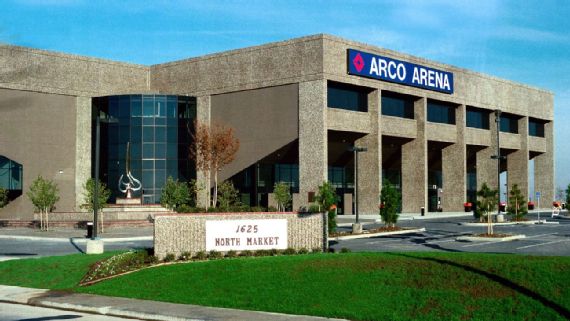
When the Kings arrived in 1985, a temporary arena was built, seating only 10,333, the smallest in the NBA at the time. Like its successor originally was, it was named the ARCO Arena, but was nicknamed the Madhouse on Market.
It was only meant to be a stopgap facility, never a special place. But it still stands, may end up outliving its successor, and, as the 1st major league sports building in the metro area, it is a special place. It now houses the California Department of Consumer Affairs. 1625 N. Market Blvd. at Sports Drive, about 7 miles north of downtown. Bus 88.

The 2nd ARCO Arena, which became the Power Balance Pavilion and is now the Sleep Train Arena, amed for a bedding store chain, was built n 1988. It has an address of One Sports Parkway. It's 5 miles north of downtown. Take the Number 11 bus to Truxel Road & Terracina Drive, and then a 15-minute walk west on Terracina, down "E Entrance."
The arena has hosted NCAA Tournament games, and is one of the leading West Coast sites for Ultimate Fighting. From 1997 until they folded in 2009, it was home to the WNBA's Sacramento Monarchs. (Why not "Queens" to go with "Kings"? Does "Monarchs" sound like they have more power? Or did they not use "Queens" because they were afraid of gay jokes?) There has been talk of reviving the Monarchs for the new arena.

The Sacramento River Cats, now a San Francisco Giants farm team, play at Raley Field, named for a locally-headquartered supermarket chain. It opened in 2000 with 10,624 seats. Counting lawn seating, they can have over 14,000 fans in the place, which is big for the minors, even Triple-A.

They led the minor leagues in attendance in each of their 1st 8 seasons in Raley, got rated as the most valuable minor-league franchise by Forbes magazine in 2012, and have won 4 Pennants since moving in: 2003, 2004, 2007 and 2008.
But if Sacramento ever wants to lure an established MLB team, or get an expansion team, there is room to add outfield seating, but they'd also have to add a 2nd deck to the main grandstand to get the number of seats above 35,000. This seems unlikely. 400 Ballpark Drive at 5th Street, West Sacramento, just over Tower Bridge and the Sacramento River from downtown.

The old PCL team, the Sacramento Solons, was not particularly successful. They played from 1909 to 1976, and won Pennants only in 1938 and 1939. From 1910 to 1960, they played at Edmonds Field. It was located at the southeast corner of Broadway and Riverside Blvd. Demolished in 1964, a Target store currently occupies its footprint, and there is a plaque in the parking lot where home plate once sat. Bus 51.
According to an April 23, 2014 article in The New York Times, the San Francisco Giants (86 miles away) are way ahead of the Oakland Athletics (87 miles away) when it comes to baseball popularity in Sacramento, averaging 55 percent of local fandom to around 12 percent for the A's. Considering that the Coliseum is on the same side of the Bay (but actually further away, now that the Giants have moved from Candlestick Park to downtown), and that the A's had so much more success prior to the Giants' early 2010s run of glory, the A's should have a much higher percentage than they do.

Charles C. Hughes Stadium, named for a school superintendent, opened in 1928, and seats 20,311. It hosts Sacramento City College football and high school football, hosted the Camellia Bowl from 1961 to 1980, and hosted a revival of the Sacramento Solons from 1974 to 1976, despite having a left field fence that was way too short. In 2014, it briefly hosted Sacramento Republic FC, a team in the United Soccer League, the 3rd tier of American soccer.
Hornet Stadium, built in 1969, seats 21,195, and has hosted California State University at Sacramento (a.k.a. "Sacramento State") football since it opened. It also hosted the Sacramento Surge of the short-lived World League of American Football in 1992, and the Sacramento Gold Miners in 1993 and 1994, in the Canadian Football League's desultory excursion into the U.S. market.
Stadium Drive and College Town Drive, although its mailing address is 6000 J Street. Gold Line light rail to University/65th Street Station.

According to a September 5, 2014 article in The Atlantic, the San Francisco 49ers are easily the most popular NFL team in the Sacramento area, even though the Oakland Coliseum is a little closer to Sacramento than Candlestick Park was (87 miles to 91 -- Levi's Stadium is 114 miles away). The closest NHL team is the San Jose Sharks (120 miles).

The aforementioned Sacramento Republic FC, with the USL now considered American soccer's 2nd division, play at Papa Murphy's Park, named for a local pizza chain. Built in 2014 and seating 11,569, it's just fine for lower-division soccer, but "The Quails" will need a larger stadium if they're to get promoted to Major League Soccer.
1600 Exposition Blvd., about 4 miles northeast of downtown, next to Raging Waters theme park. Bus 68. Presuming that this is the closest Sacramento will ever get to MLS, as now seems likely, the closest current MLS team is the San Jose Earthquakes (117 miles).

Major college football and basketball isn't all that close, either: If you live in or around Sacramento, and you don't want to go to games at Sac State, you're out of luck: Cal-Davis is 15 miles west, but it's FCS (formerly known as Division I-AA); and the University of the Pacific is 47 miles to the south, so you might as well go the distance to the Bay Area, all the way to Cal (79 miles) or Stanford (126 miles).

With its relatively low metropolitan population, Sacramento would rank 29th among MLB markets (ahead of only Kansas City and Milwaukee), 26th in the NFL, and 23rd in the NHL.

Sacramento is the closest major league city to the recently-renamed Palisades Tahoe, California, formerly Squaw Valley, site of the 1960 Winter Olympics. It was here that the U.S. hockey team first beat the Soviet Union -- and, as would happen 20 years later in Lake Placid, New York, they still had to win one more game to win the Gold Medal, which they did, in this case against Czechoslovakia. This team included some of the fathers of the 1980 players, and the last player cut from the 1960 team -- although he did make the 1964 team -- was Herb Brooks, who coached the 1980 team.

The hockey games were held at Blyth Arena, built for the Games, and torn down in 1983. A hotel, The Village at Squaw Valley, is now on the site. 1840 Squaw Valley Road, just off Lake Tahoe, part of the State Line between California and Nevada. It's 110 miles east of downtown Sacramento, 43 miles southwest of Reno, and just 24 miles west of the now-closed theme park based on Bonanza's Ponderosa Ranch in Incline Village. (Palisades Tahoe is 68 miles west of the real-life Virginia City.)
Note the pine trees: In Spanish, ponderosas,
giving their name to the Bonanza ranch.

The best-known museum in Sacramento is the California State Capitol Museum, under the dome at 1315 10th Street. The Crocker Art Museum is at 2nd & O Streets. The only Presidentially-related site in the area is the Governor's Mansion, where Ronald Reagan lived during his 1967-1974 Governorship. It's a State Historic Park, at 1526 H Street downtown. The tallest building in town is the Wells Fargo Center (same name as the Philadelphia arena currently has), 429 feet high, at Capitol Mall & 4th Street.

Elvis Presley never performed in Sacramento. Neither did the Beatles. Johnny Cash did, although his best-known concert in the Sacramento area was 25 miles to the northeast, at Folsom State Prison, namesake of his song "Folsom Prison Blues," on January 13, 1968. I wouldn't recommend going there (as a visitor or otherwise), but if you're that big of a fan of The Man In Black, it's at 300 Prison Road -- which sounds like it could be the title of a Johnny Cash song.

It is reachable by public transit, sort of: Take the Gold Line light rail from Sacramento Valley station to Glenn station, nearly an hour; then transfer to Bus 30, to Natoma Street & Wales Drive, and then it's a 20-minute walk up Natoma Street and Prison Road. (That other California prison he's famous for having recorded a live album at, San Quentin, on February 24, 1969, is in Marin County, about 20 miles north of downtown San Francisco.)

The best-known TV shows set in Sacramento have been the late 1970s, early 1980s ABC comedy-drama Eight Is Enough, the recent CBS crime drama The Mentalist, and the Disney Channel series Even Stevens. Sons of Anarchy was set in the fictional town of Charming, said to be near Sacramento. The late 1960s Western The Big Valley was set at a ranch in Calaveras County, outside Stockton, about 45 miles southeast of Sacramento.

There haven't been many movies set or filmed there. Those that were include Clint Eastwood's 1989 Pink Cadillac, The Al Pacino & Michelle Pfeiffer movie Frankie & Johnny, John Travolta's Phenomenon, Kurt Russell's Breakdown, and Almost Famous, the film that made Cameron Crowe and Kate Hudson more than that.

*

Sacramento is a bigger city than it seems to be, but not as big a city as it would like to be. If you're an NBA fan, and have to cross all 30 teams off your list, this should be a good guide for you. 

Friday, January 28, 2022

How to Be a New York Basketball Fan In Phoenix -- 2022 Edition

The Brooklyn Nets visit Arizona to play the Phoenix Suns this coming Tuesday night, February 1. The Knicks visit on March 9.

Before You Go. AZcentral.com, the website for Phoenix's largest newspaper, the Arizona Republic, is predicting low 70s for Tuesday afternoon, and the mid-40s for the evening. So the legendary Arizona "dry heat" won't be an issue. You'll still have to bring a jacket.

According to a January 30, 2019 article in Thrillist:  


Occasionally, retired Kroger business executives from Ohio and their Pilates-instructor second wives will accidentally move to Flagstaff and get very sad and angry when they realize the average winter temperature is somewhere in the 20s. But most of Arizona offers up that dry desert day heat that is good for arthritis and any lingering guilt about leaving their first wives to deal with their delinquent teenage kids back in Indian Hill.    

Arizona's infamous Daylight Savings Time issue has been settled: The State is on Mountain Time when New York is on Daylight Savings Time, and on Pacific Time when we're on Standard Time. This will be the day after DST ends, so you'll be on Mountain Time, 2 hours behind New Jersey and New York City. Adjust your timepieces accordingly.

If you're thinking of making a side trip into Mexico, you should know that it's a 4-hour drive at the least. No public transportation. You'll need a passport, and you'll also need Mexican driving insurance, which you might be able to get at the Mexican consulate in New York or Phoenix. In other words, it's not really worth the trip.

Tickets. The Suns averaged 15,792 fans per home game in 2019-20, about 85 percent of capacity, before COVID shut everything down. But their run to the NBA Finals in 2021 has changed that. Getting tickets will not be easy.

Seats in the lower level, the 100 sections, are $289 between the baskets, and $209 behind them. In the upper level, the 200 sections, seats are $89 between the baskets and $49 behind them.

Getting There. It's 2,458 miles from Times Square downtown Phoenix. In other words, if you're going, you're flying.

You think I'm kidding? Even if you get someone to go with you, and you take turns, one drives while the other one sleeps, and you pack 2 days' worth of food, and you use the side of the Interstate as a toilet, and you don't get pulled over for speeding, you'll still need nearly 2 full days to get there. One way.

But, if you really, really want to... You'll need to get on the New Jersey Turnpike. Take it to Exit 14, to Interstate 78. Follow I-78 west all the way through New Jersey, to Phillipsburg, and across the Delaware River into Easton, Pennsylvania. Continue west on I-78 until reaching Harrisburg. There, you will merge onto I-81. Take Exit 52 to U.S. Route 11, which will soon take you onto I-76. This is the Pennsylvania Turnpike, the nation's 1st superhighway, opening in 1940.

The Turnpike will eventually be a joint run between I-76 and Interstate 70. Once that happens, you'll stay on I-70, all the way past Pittsburgh, across the little northern panhandle of West Virginia, and then across Ohio, Indiana and Illinois, into Missouri.

At St. Louis, take Exit 40C onto Interstate 44 West, which will take you southwest across Missouri into Oklahoma. Upon reaching Oklahoma City, take Interstate 40 West, through the rest of the State, across the Texas Panhandle and New Mexico, into Arizona. At Flagstaff, take Interstate 17 South, which will take you into Phoenix.

If you do it right, you should spend about an hour and 15 minutes in New Jersey, 5 hours and 30 minutes in Pennsylvania, 15 minutes in West Virginia, 3 hours and 45 minutes in Ohio, 2 hours and 45 minutes in Indiana, another 2 hours and 45 minutes in Illinois, 5 hours in Missouri, 6 hours in Oklahoma, 3 hours in Texas, 6 hours and 15 minutes in New Mexico, and 5 hours and 30 minutes in Arizona. That's about 42 hours. Counting rest stops, you're probably talking about 55 hours.

That's still faster than Greyhound, averaging around 68 hours, including a 1:45 bus-change in Richmond, a 1:15 stopover in Charlotte, an hour's bus-change in Atlanta, an hour's stopover in Birmingham, a 45-minute stopover in Jackson, Mississippi, an hour's stopover in Shreveport, a 1:30 bus-change in Dallas (that's right, changing buses 3 times each way), and a 1:15 stopover in El Paso.

It's $672 round-trip, but it can drop to $462 with advanced purchase. The station is at 2115 East Buckeye Road, adjacent to Sky Harbor International Airport. Number 13 bus to downtown.

WARNING: You can't use Greyhound this time. The only bus leaving Port Authority on Sunday that would get you there in time for the game is sold out. And the one leaving on Saturday has been canceled.

Amtrak doesn't work, because you'd have to board the Crescent at Penn Station, ride a full day to Union Station New Orleans, stay overnight in New Orleans, and ride another overnight, the Sunset Limited, to Maricopa. And since the Sunset Limited only runs every other day, you'd have to leave tomorrow, and arrive at at 8:52 PM on Sunday night -- nearly 46 hours before tipoff.

And you'd still have to get from Maricopa station, at 19427 N. John Wayne Pkwy., to downtown Phoenix, 35 miles to the north, as Amtrak closed Union Station in Phoenix a few years back. And if you can't rent a car, then you'll have to take a cab, because there's no train or bus from Maricopa to Phoenix. And, to get back, you'd have to get to Maricopa in time to catch the 5:40 AM Sunset Limited back to New Orleans on Tuesday morning -- yet another unncessary overnight. Total fare: $709 -- not counting the taxis.

Flights to Phoenix are usually among the cheapest to any big-league city. This time, for nonstop flights between Newark and Sky Harbor, you could pay as little as $438. The city's light rail system can get you downtown in 36 minutes.

Once In the City. Of the 4 major league sports teams that call Phoenix home, the Suns are the only ones still using the city's name, rather than the State's name -- apparently from a Native American word meaning "small spring" -- as their geographic identifier. Nevertheless, Phoenix is the capital of the State of Arizona.
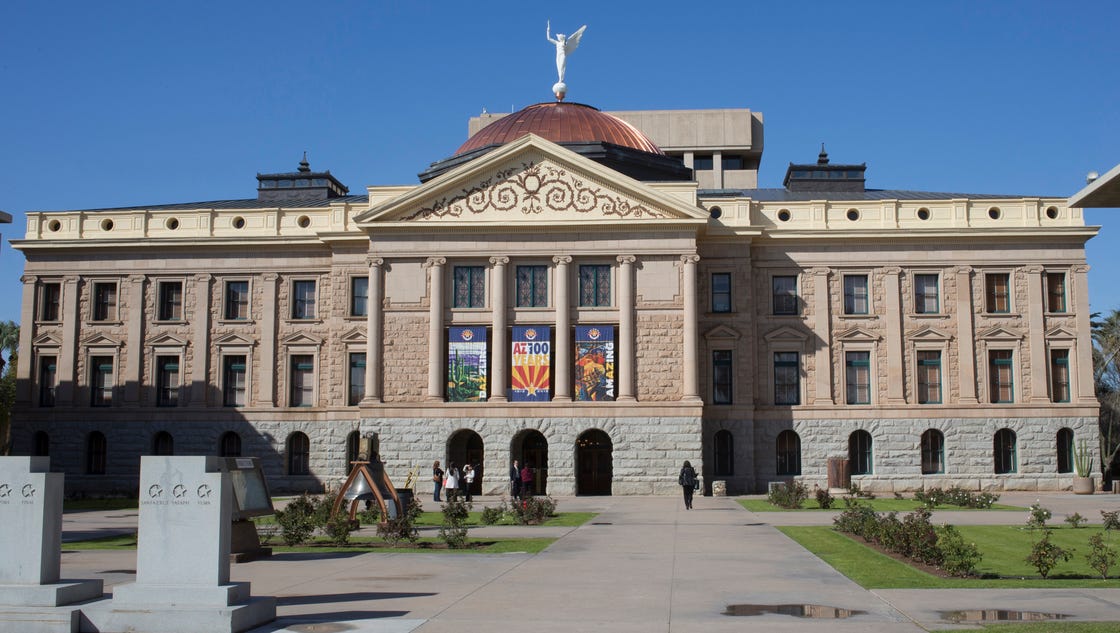
The State House in Phoenix,
apparently in 2012, the 100th Anniversary of Statehood

Jack Swilling, a Confederate veteran who founded the place in 1867, accepted the suggestion of a fellow settler, an Englishman named Lord Duppa: Since it was on the site of a previous Indian civilization, it should be named Phoenix, for the mythical bird that rose from its own ashes. The city was incorporated in 1881, making it the youngest city in American major league sports. Along with New Mexico, Arizona gained Statehood in 1912, the 47th and 48th States of the Union.

Home to just 100,000 people in 1950, Phoenix saw huge growth in the 2nd half of the 20th Century: 440,000 by 1960, 580,000 by 1970, 800,000 by 1980, and it surpassed the 1 million mark in the early 1990s. It's 1.6 million now, with about 4.8 million people in the metropolitan area.

All this made it an expansion target. The NBA's expansion Suns arrived in 1968. The NFL's St. Louis Cardinals in 1988, changing their name from the Phoenix Cardinals to the Arizona Cardinals in 1993. The USFL's Arizona Wranglers played there in 1984, and became the Arizona Outlaws the following year. This was around the time that the Philadelphia Eagles nearly moved there due to owner Leonard Tose's fractured finances.

The MLB team that became the Diamondbacks was awarded in 1995, to begin play in 1998. And the NHL's 1st Winnipeg Jets became the Phoenix Coyotes in 1997, changing their name to the Arizona Coyotes in 2013. This was after the World Hockey Association had the Phoenix Roadrunners in the 1970s -- and, yes, I'm well aware of the cartoon connection: Roadrunners replaced by Coyotes. The WNBA's Phoenix Mercury also began play in 1997. Today, the Suns are the only Phoenix-area team to keep the city's name as their identifier, rather than the State's name.

The sales tax in Arizona is 5.6 percent, but it's 8.3 percent within the City of Phoenix. ZIP Codes for Arizona start with the digits 85 and 86, and the Area Codes are 602 (for Phoenix), 480 and 623 (for the suburbs). Arizona Public Service provides electricity and water. The Phoenix metropolitan area has a population that is about 58 percent white, 31 percent Hispanic, 5 percent black, 3 percent Asian, and 3 percent Native American.

Although Phoenix has had a gang problem, its bigger problem has been the racism of the white people to the Mexican-American community, symbolized by Joe Arpaio, Sheriff of Maricopa County from 1993 to 2017, who had people arrested without cause and tortured in his jails. After losing his last bid for re-election, he was convicted for contempt of court. He then became the 1st criminal pardoned by Donald Trump, and ran for his old office again in 2020, and lost.

Central Avenue is the source street for east-west house numbers; oddly, the north-south streets are numbered Streets to the east, and numbered Avenues to the west. Washington Street divides addresses into north and south. State Route 101 forms a partial "outer beltway," while Interstates 10 (north and east) and 17 (south and west) form an "inner beltway." A single ride on Phoenix buses and Valley Metro Rail is $2.00, with an All-Day Pass a bargain at $4.00. 
A Valley Metro Rail train

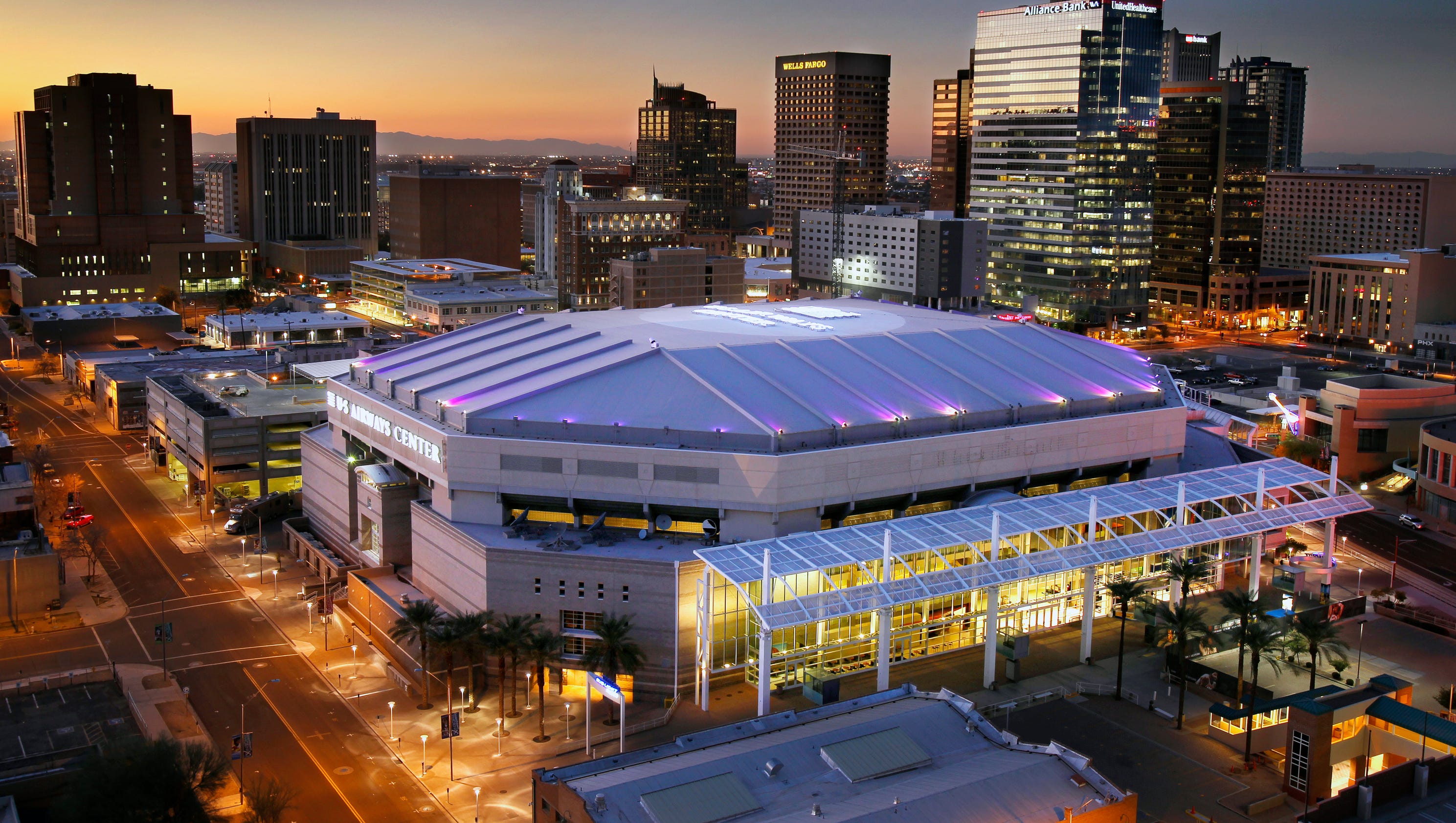
Going In. The Suns' arena opened in 1992, and was named the America West Arena, for an airline. In 2006, America West was bought out by US Airways, and the arena was renamed the US Airways Center. In 2015, a luxury hotel and casino on Native American property in nearby Scottsdale bought the naming rights, and it was renamed the Talking Stick Resort Arena. In 2021, it become the Footprint Center. Footprint is an Arizona-based "material science" company. )

The Suns and the Arena Football League's Arizona Rattlers have played here since it opened in 1992, and the WNBA's Phoenix Mercury since their inception in 1997. The NHL's Phoenix Coyotes played here from 1996 to 2003.

The hockey team is now named the Arizona Coyotes. The Suns are the last major league team in the State still using the city's name, Phoenix, as their identifier, rather than the State's name, Arizona.

The arena's address is 201 E. Jefferson Street, 2 blocks from Chase Field, home of MLB's Arizona Diamondbacks, at 401 E. Jefferson Street. Both buildings can be reached on Metro Light Rail via the Jefferson Street & 3rd Street station. The Jefferson Street Garage provides parking for both buildings. Parking can be had for as little as $5.00.
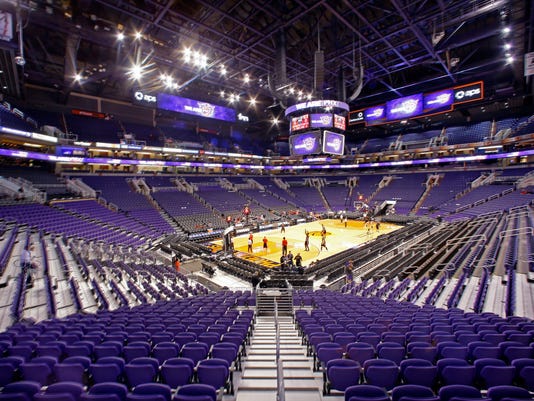
The arena under its former name, the US Airways Arena

If you're entering from the light rail station or the Jefferson Street Garage, you'll most likely be entering from the east or the north. The court is laid out north-to-south. The seats are purple, in line with the Suns' logo, and so the arena is nicknamed the Purple Palace.
Yes, the seats are purple.

Since the Suns' arena is downtown, it gets far more concert dates than the Coyotes' arena. The reason the Coyotes left the downtown arena in the first place is because its retrofit meant losing about 2,000 seats for hockey (some due to removal to fit a rink in, some due to obstructed views -- one of the nets couldn't be seen), resulting in poor revenue.

The Talking Stick Resort Arena is also a regular host for "professional wrestling," and has hosted fights by Hispanic boxers, including Oscar de la Hoya and the final professional fight of Julio Cesar Chavez.

Food. As a Southwestern city, you might expect Phoenix to have Mexican, Spanish, Western and Southwestern food themes. Which is the case. Tortas del Sol is behind Section 112, and Tortas el Ray at 119. 

Levy Restaurants runs the arena's concessions. Links & Lagers specializes in sausages and sausage hoagies, at 106 and 221. ZZ's To Go serves salad, pizza, sandwiches and pasta at 119. Fractured Prune Doughnuts is at 101, but they serve many flavors, not just prune. BrewMaster's Pub is a walk-in lounge at 119. The Coop specializes in chicken and garlic Parmesan fries. And the arena also features the Coors Light Zone Patio, in the style of a beer garden, with barbecue-style food.

Team History Displays. By far the oldest major league sports team in Arizona, the Suns have some history, and they've usually been at least good. But they've never been great enough to put it all together. They haven't won a World Championship yet, making them the oldest NBA team to have not done so. But they won the Western Conference in 1976, 1993 and 2021, and have won their Division 7 times: In 1981, 1993, 1995, 2005, 2006, 2007 and 2021. (They reached the Finals in 1976 despite not finishing 1st in their Division.)

Unlike the Suns, the Mercury have won their league -- 3 times, in 2007, 2009 and 2014. They also won the WNBA's Western Conference and made the Finals in 1998.
The Suns have a Ring of Honor in their arena, honoring 15 men, including 6 retired numbers:

* From the early days, but not making it to 1976: 42, forward Connie Hawkins.

* From the 1976 Conference Champions: 5, guard Dick Van Arsdale; 33, center Alvan Adams; 44, guard Paul Westphal; head coach John MacLeod.

* From the 1981 Division Champions: MacLeod, Adams, and 6, guard Walter Davis.

* From the 1993 Conference Champions: Westphal as head coach; 7, guard Kevin Johnson; 9 (not retired), forward Dan Majerle; 24 (not retired), forward Tom Chambers; 34 (not retired), forward Charles Barkley.

* From the 2005, 2006 and 2007 Division Champions: 13 (not retired), guard Steve Nash.

* Spanning the eras: Former owner, coach and executive Jerry Colangelo; former coach Lowell "Cotton" Fitzsimmons; broadcaster Al McCoy; and trainer Joe Proski.
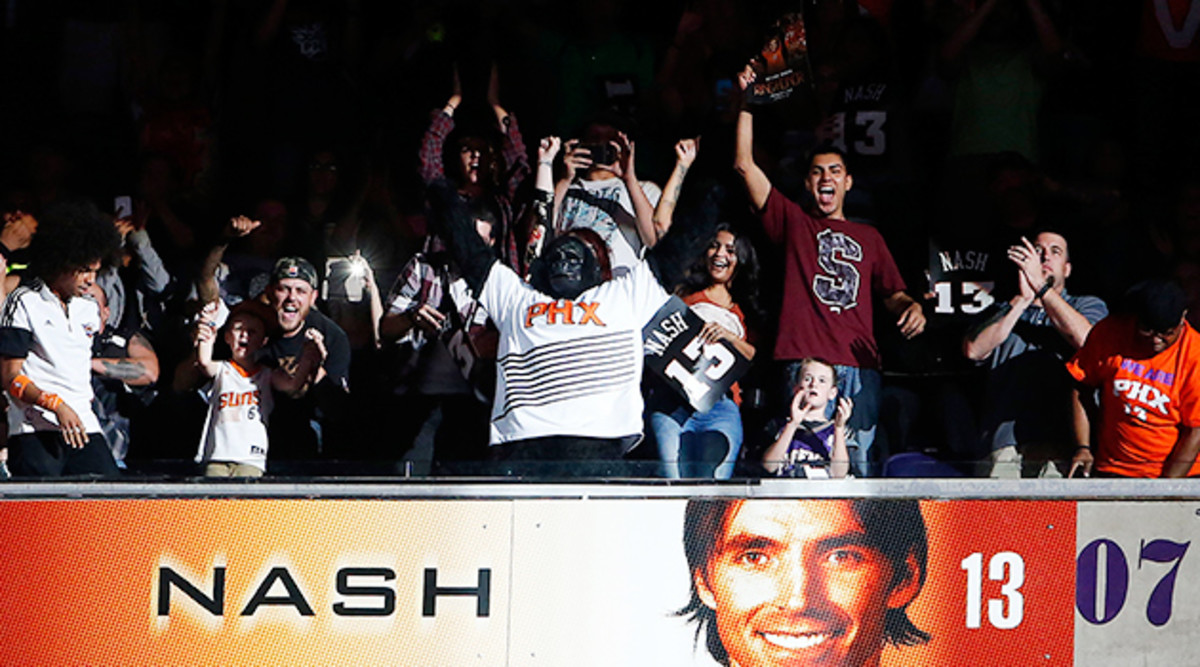
The Gorilla and some fans behind Nash's display on the Ring of Honor

In 1999, Suns fans voted on an All-Century Team. Westphal was named as a player on the 2nd Team and head coach of the 1st Team. The 1st Team was Adams, Johnson, Chambers, Barkley, and guard Jason Kidd. The 2nd Team was Hawkins, Westphal, Davis, Majerle, and center Mark West from the 1993 team.

In 2008, Suns fans voted on a 40th Anniversary Team. The guards were Van Arsdale, Westphal, Davis, Johnson and Nash. The forwards were Hawkins, Chambers, Barkley and forward Shawn Marion from the 2000s' Division titlists. The centers were Adams and 2000s' Division titlist Amar'e Stoudemire, recently of the Knicks. A 50th Anniversary Team was not chosen.

There are 16 people in the Basketball Hall of Fame who are associated with the Suns. Hawkins, Westphal, Barkley, Nash, Colangelo and Fitzsimmons were elected largely on the basis of their time with the Suns. Gail Goodrich was taken by the Suns in the 1968 expansion draft, but after just 2 years was sent back to the Lakers, whom he helped win the 1972 NBA title. Another '72 Laker titlist was Pat Riley, who played just 1 season with the Suns, but it was the 1976 Finals season.

Gus Johnson played for them only in 1972. Dennis Johnson (no relation) was famously traded by the Seattle SuperSonics to the Suns, even-up for Westphal), and was part of their '81 Division winners, before going to the Boston Celtics and winning 2 titles with them on top of the 1 he won in Seattle.

Charlie Scott played 3 early seasons with the Suns. Jason Kidd and Grant Hill each played 5 seasons with them, but were elected mainly for what they did elsewhere. Rick Welts was team president from 2002 to 2011, but was elected mainly for what he's done since with the Golden State Warriors.

Already in the Hall when she got the job, Ann Meyers has been a Vice President of the Suns and the Mercury since 2005. And Shaquille O'Neal only played 1 season with the Suns.

Barkley was the only player named to the NBA's 50th Anniversary 50 Greatest Players in 1996 who had spent any time with the Suns. He, Shaq, Kidd, Nash and current star Chris Paul were named to the 75th Anniversary 75 Greatest Players in 2021. Nash is the 1st and, for the moment, the only basketball player yet elected to Canada's Walk of Fame. (The sport's inventor, Dr. James Naismith, has also been invented.)

Tom Van Arsdale, Dick's twin brother, was a 3-time NBA All-Star, but had his best years with the Cincinnati Royals, before wrapping up his career playing the 1976-77 season alongside Dick. Wearing Number 5 for most of his career, like Dick, he switched to 4 in Phoenix.

The Mercury have retired Michelle Timms' Number 7, Penny Taylor's 13, Jennifer Gillom's 22 and Bridget Pettis' 32. Cappie Pondexter (better known with the New York Liberty, now with the Chicago Sky) and Diana Taurasi (still with them) were named to the WNBA's 15th Anniversary 15 Greatest Players in 2002. Both were also named to the WNBA Top 20 at 20 in 2016 -- in the 20th Season, rather than at the 20th Anniversary.

There is an Arizona Sports Hall of Fame, and it has elected Dick Van Arsdale, Adams, Barkley, Chambers, Majerle, Fitzsimmons, MacLeod, Colangelo, McCoy, early part-owner Karl Eller, and sportscaster Bob Vache, who was the first voice of the Suns but was elected for other contributions.

They've also elected University of Arizona basketball figures Lute Olson, Sean Elliott, and the entire 1997 National Championship team; Arizona State basketball figures Ned Wulk and Fat Lever; and high school basketball coaches Ed Long and Royce Youree.

Despite being a team more than 50 years old, the Suns don't have a major rivalry. Wikipedia seems to think their biggest rival is the San Antonio Spurs, who lead their all-time series 124-103. Geographically, it doesn't make much sense: The Spurs are 984 miles away. The Los Angeles Lakers and Clippers are 375 miles, the Utah Jazz 663, the Golden State Warriors 754, the Denver Nuggets 863. Even the Oklahoma City Thunder are closer, at 959. If the NBA ever got a team in Las Vegas, 302 miles away, that would make sense as a rivalry.

Stuff. The Team Shop is located on the ground floor of the north side of the arena. Suns, Mercury and Rattlers merchandise can be purchased there. Perhaps, due to Arizona's Western heritage, you can find cowboy hats with the team's logo on them. It is open from 10 AM to 5 PM on non-game days.

There aren't many books about the Suns, despite over a half-century of play. After the 1993 Conference title, Lee Shappell published Phoenix Suns: Rising to the Top with the "Team of Oddities." Sports Illustrated's Jack McCallum covered their Steve Nash all-offense-and-no-defense years, and wrote Seven Seconds or Less: My Season on the Bench with the Runnin' and Gunnin' Phoenix Suns. And in 2013, Howard A. DeWitt published The Phoenix Suns: The View From Section 101.

Since the Suns haven't yet won an NBA title, there's no commemorative DVD package. And their 50th Anniversary passed in 2018 without a team history DVD. The only videos I found about them on Amazon.com were VHS cassettes about their 1993 Conference title season.

During the Game. A November 13, 2014 article on DailyRotoHelp ranked the NBA teams' fan bases, and listed the Suns' fans at 15th, on the plus side of the league's exact middle, praising their showing up no matter what, and their rather generous reactions to the departures of Shaq and Nash.

Wearing Knicks or Nets gear in Phoenix will not endanger your safety. The Suns' biggest rivals are the Los Angeles Lakers, the Dallas Mavericks and the San Antonio Spurs, not either of the New York teams. For the most part, Arizona fans are okay, not making trouble for fans of teams playing the NFL Cardinals, NHL Coyotes or MLB's Diamondbacks, either. In fact, their biggest rivalry is intrastate: The University of Arizona vs. Arizona State University. It's a heated rivalry... but it's a dry heat.

This Saturday's game against the Nets will not feature a promotion, but the December 13 game against the Knicks is Phoenix Night, and the Suns will be giving away posters.

This Tuesday's game against the Nets will be College Night, with fans receiving Hawaiian shirts with Suns logos on them. The March 6 game against the Knicks will be Pride Night. Arizona trying to send New York a message? Not that there's anything wrong with that.

The Suns hold auditions for National Anthem singers, instead of having a regular singer. Their introduction song is "Zombie Nation" by Kernkraft 400. There's not much in the way of fan chants, except the very ordinary "Let's go, Suns!"

The mascot is Go the Gorilla. He was the 1st NBA mascot to do trick dunks, preceding Charlotte's Hugo the Hornet by years. This makes him perhaps the most famous NBA mascot, unless you want to count Lucky the Leprechaun, and the Celtics didn't have a live Lucky until recently.
On April 8, 2017, Andrew Lynch ranked the NBA mascots for Fox Sports' website. He ranked Go 3rd, saying, "The Gorilla is a legend, through and through." He, the Phillie Phanatic, and the San Diego Chicken were the 1st 3 inductees into the Mascot Hall of Fame, in 2005.

After the Game. Phoenix does have crime issues, but you should be safe as long as you stay downtown. It's incredibly unlikely that Suns fans will bother you, and the fact that the Knicks and the Nets aren't rivals to them helps.

As for anything New York-friendly, Duke's Sports Bar and Grill is said to be a Yankee Fan hangout. 7607 E. McDowell Road, in Scottsdale, 9 miles east of downtown. Bus 17.

If you visit Phoenix during the European soccer season, as we are now in, the best "football pub" in Arizona is the George & Dragon Pub, which opens at 7:00 AM on matchdays. 4240 N. Central Avenue, about 3 miles north of downtown. Rail to Indian School & Central Avenue. 

Sidelights. On November 30, 2018, Thrillist published a list of "America's 25 Most Fun Cities," and Phoenix came in 21st. Phoenix's sports history is relatively brief, and not very successful. But there are some notable locations.

* Chase Field. The Arizona Diamondbacks have played since their 1998 inception at Chase Field, a retractable-roof stadium, originally named Bank One Ballpark, and having that name during what remains the Diamondbacks' only World Series thus far, 2001. It looks like a big airplane hangar, without much atmosphere. True, there is that pool in the right-center-field corner... but what's a pool doing at a ballpark?

Major League Baseball is now concerned enough about developments at Chase Field that it might force the Diamondbacks to move. For now, though, they are playing at Chase Field, which is at 401 E. Jefferson Street, 2 blocks east of the Suns' arena, and also uses the Jefferson & 3rd light rail station.

* State Farm Stadium and Gila River Arena. The Glendale Sports & Entertainment District, in the Phoenix suburb of Glendale, consists of State Farm Stadium (until this year known as The University of Phoenix Stadium), home to the Arizona Cardinals since 2006; and the Gila River Arena, home to the Coyotes since 2003.

The complex is about 17 miles northwest of downtown Phoenix. The official address of the stadium is 1 Cardinals Drive, and that of the arena is 9400 W. Maryland Avenue. Number 8 bus from downtown to 7th & Glendale Avenues, then transfer to Number 70 bus, to Glendale and 95th Avenue, then walk down 95th. If you drive in, parking starts at $10.

New York Tri-State Area sports fans know the stadium as the site of Super Bowl XLII, where the Giants derailed the New England Patriots' bid for the NFL's first 19-0 season. The Cardinals defeated the Philadelphia Eagles there in January 2009 to advance to Super Bowl XLIII. The Baltimore Ravens beat the San Francisco 49ers there in Super Bowl XLIX. It is set to host Super Bowl LVII on February 5, 2023.

The stadium is also home to the Fiesta Bowl, and thus what has amounted to 3 National Championship Games: 2006-07, Florida over Ohio State; 2010-11, Auburn over Oregon; and 2015-16, Alabama over Clemson.

In 2017, it became the 1st building in Arizona to host a Final Four, with North Carolina defeating Gonzaga in the Final. It will host the Final Four again in 2024. It's hosted 3 matches of the U.S. soccer team, most recently a 1-0 loss to Colombia in the 2016 Copa America. On January 27, 2019, it hosted a 3-0 win over Panama. It hosted 2 Quarterfinals of the 2021 CONCACAF Gold Cup.

UPDATE: In 2022, the Gila River Arena was renamed the Desert Diamond Arena, and the Coyotes moved to the new Mullett Arena, as tenants of Arizona State. It seats just 5,000 people. The Coyotes still have difficulty selling it out.

* Arizona Veterans Memorial Coliseum. The Grand Canyon State's 1st home to big-league sports, opening in 1965, was home to the Suns from their 1968 arrival until 1992, and to the World Hockey Association's Phoenix Roadrunners from 1974 to 1977. Like the Capital Centre outside Washington and the Saddledome in Calgary, it was built with a saddle-shaped roof.
Elvis Presley sang at the Coliseum on September 9, 1970, and again on April 22, 1973. Early in his career, on June 9, 1956, he sang at a grandstand at the adjoining Arizona State Fairgrounds. The next day, he sang at the Rodeo Grounds in Tucson. He also sang at the Tucson Community Center on November 9, 1972 and June 1, 1976. (While individual ex-Beatles have performed in Arizona, the band as a whole did not do so on any of their 3 North American tours.)

The Coliseum still stands, and is part of the State Fairgrounds complex. 1826 W. McDowell Road. Northwest of downtown. Number 15 bus to 15th & McDowell, then 3 blocks west.

* Phoenix Municipal Stadium. This ballpark was home to the Phoenix Giants/Firebirds from its opening in 1964 until 1991, and is the current spring training home of the Oakland Athletics, the Diamondbacks' Rookie League team, and Arizona's State high school baseball championship. 5999 E. Van Buren Street, 8 miles east of downtown. Take the Light Rail to Priest Drive/Washington station, then a short walk up Priest. The Phoenix Zoo is adjacent.

* Scottsdale Stadium. This stadium was home to the Firebirds in their last years, 1992 to 1997. Its seating capacity of 12,000, 4,000 more than Phoenix Municipal, was meant to showcase the Phoenix area as a potential major league market. It's the San Francisco Giants' spring training site, and replaced a previous stadium on the site that dated to 1956, used as a spring training home for the Giants, A's, Red Sox, Orioles and Cubs -- sometimes all at the same time.

Because it was the Cubs' spring training home, thus leading to Phoenix becoming "Chicago's Miami," where retirees from the city tend to go (paging Michael Wilbon of the Washington Post & ESPN's Pardon the Interruption & NBA coverage), it was where former Cub catcher Randy Hundley hosted the very first baseball fantasy camp. Those of you who are Met fans, you might remember Randy's furious reaction to Tommie Agee scoring on a controversial umpiring call at home plate at Shea in September 1969. You might also remember Randy's son, former Met catcher Todd Hundley.

7408 E. Osborn Road, at Drinkwater Boulevard, 12 miles northeast of downtown. Light Rail to Veterans Way/College station, then transfer to Number 72 bus to Osborn, then walk 2 blocks east.

* Arizona State University. The University of Arizona is 114 miles away in Tuscon, but ASU is just a 24-minute Light Rail ride, 10 miles southeast of downtown. The station is at 5th Street & Veterans Way, and is 2 blocks away from Sun Devil Stadium and the Wells Fargo Arena (formerly the ASU Activity Center), home to their football and basketball teams, respectively. The arena was previously known as the ASU Activity Center. Elvis sang there on March 23, 1977.

Sun Devil Stadium was built in 1958, and ASU still plays there rather than move to the larger, more modern (but well off-campus) University of Phoenix Stadium. The Cardinals played there from 1988 to 2005, and the Fiesta Bowl was held there from 1971 to 2006. This meant what amounted to 5 National Championship Games: 1986-87, Penn State over Miami; 1988-89, Notre Dame over West Virginia; 1995-96, Nebraska over Florida; 1998-99, Tennessee over Florida State; and 2002-03, Ohio State over Miami.

The Dallas Cowboys treated it as a second home field when they played the Cardinals (mainly because there always seemed to be more Cowboy fans there), and won Super Bowl XXX there, when the world learned A) it was possible for the Pittsburgh Steelers to lose a Super Bowl, and B) Terry Bradshaw was a smart quarterback compared to Neil O'Donnell. It also hosted 2 U.S. soccer team matches in the 1990s.

Packard Stadium, opened in 1974, is home to the ASU baseball program, one of the most successful college baseball teams, east of the stadium and arena, at Rural Road and Rio Salado Parkway. The Sun Devils have won 5 National Championships, most recently in 1981. Their legends include Reggie Jackson, Barry Bonds, and current MLB stars Dustin Pedroia and Andre Ethier. Notable ASU and Met alumni include Gary Gentry, Duffy Dyer, Lenny Randle, Craig Swan, Hubie Brooks, Paul Lo Duca and Ike Davis.

ASU's Gammage Auditorium, at the other end of the campus, hosted one of the 2004 Presidential Debates between George W. Bush and John Kerry. 1200 S. Forest Avenue.

The US Airways Center, Wells Fargo Arena, University of Phoenix Stadium, and the University of Arizona's McKale Center have all hosted NCAA basketball tournament games. UA has been in the Final Four in 1988, 1994, 1997 and 2001, winning it all in 1997; but ASU has never gotten any closer than the Sweet 16, in 1995.

The highest-ranking pro soccer team in Arizona is Phoenix Rising FC, in the United Soccer League, our 2nd division. They play at the rather unimaginatively-named Phoenix Rising FC Soccer Complex, which seats 6,200. 751 N. McClintock Drive, in Scottsdale, 10 miles east of downtown Phoenix. It takes 4 buses over 2 hours to get there, so if you don't have a car, forget it. 

Presuming Major League Soccer's current expansion wave passes Phoenix by, the closest MLS teams are the 2 in Los Angeles, 375 (LAFC) and 376 (LA Galaxy) miles to the west, respectively. The San Jose Earthquakes and Real Salt Lake are considerably further away.

Arizona hosts a college football bowl game. From 1989 to 1996, it was named the Copper Bowl; from 1997 to 2011, the Insight Bowl after a tech company; in 2012 and 2013, the Buffalo Wild Wings Bowl; from 2014 to 2017, the Cactus Bowl; and now, the Cheez-It Bowl. In 2020, it became the Guaranteed Rate Bowl.

It was played at the Wildcats' Arizona Stadium from 1989 to 1999. It was moved to Chase Field in 2000, to Sun Devil Stadium in 2006, and back to Chase Field in 2016.

* Arizona Science Center. Phoenix is not a big museum center. And while there have been Native Americans living in Phoenix for thousands of years, and Spaniards/Mexicans for hundreds, its Anglo history is rather short. No Arizonan has ever become President (although Senators Barry Goldwater and John McCain got nominated), so there's no Presidential Library or Museum. And it doesn't help history buffs that the city only goes back to 1867, and Statehood was gained only in 1912. But the Science Center is at 4th & Washington, just a block from the ballpark and 3 blocks from the arena. And Arizona State has a renowned Art Museum.

The tallest building in Phoenix, and in all of Arizona, is the Chase Tower, bounded by Central Avenue and Van Buren, 1st and Monroe Streets. That it's only 483 feet, and that no taller building has been built in the city since it opened in 1972, says something about this city, but I'm not sure what. But the city seems to be intent on growing outward, not upward.

Television shows set in Phoenix, or anywhere in Arizona, are few and far between. The High Chaparral, another Western created by Bonanza creator David Dortort, ran on NBC from 1967 to 1971, and is fondly remembered by some. Medium was set in the Maricopa County District Attorney's office in Phoenix.

The best-remembered show is Alice, starring Linda Lavin as one of several waitresses at fictional Mel's Diner, running on CBS from 1976 to 1985. The show was taped in Hollywood (Burbank, actually), and its address was given on the show as 2128 Bush Highway. There is a Bush Highway in the area, but it starts in Mesa, well to the northeast of downtown.

But that once-famous "14-ounce coffee cup" sign is still used outside a real working diner in Phoenix. It was Lester's, until the owner agreed to change the name to "Mel's Diner" for the publicity. 1747 NW Grand Avenue, 2 miles northwest of downtown. Number 15 bus to 15th Avenue & Pierce Street, and then walk one block east to Grand, Pierce, and 12th. There are also still-in-business diners in Ohio and Florida that use the same sign design. "Pickup!"

Movies set in modern-day Arizona usually show the Grand Canyon or the Hoover Dam. Notable on this list is Superman: The Movie, in which Lex Luthor destroys the Dam; and Thelma & Louise, in which Geena Davis and Susan Sarandon drive a 1966 Ford Thunderbird into the Canyon rather than be captured by the FBI, enacting a distaff version of Butch Cassidy & the Sundance Kid. National Lampoon's Vacation and Natural Born Killers also used Arizona as a backdrop. The University of Arizona stood in for Adams College in the 1984 film Revenge of the Nerds.

The vast majority of movies set in Arizona have been Westerns, including the 1957 and 2007 versions of 3:10 to Yuma, the 1950 film Broken Arrow (not the later John Travolta film of the same title), Paul Newman's Hombre, Fort Apache (not the later Newman film set in The Bronx), Johnny Guitar, A Million Ways to Die In the West, No Name On the Bullet, and all the films based on the 1881 Earps vs. Clantons gunfight, including My Darling Clementine in 1946, Gunfight at the O.K. Corral in 1957, Tombstone in 1993 and Wyatt Earp in 1994. While not a Western, Revenge of the Nerds was filmed at the University of Arizona, in Tucson.

If you're a Western buff, and you want to see the site of the legendary gunfight, the official address is 326 East Allen Street, Tombstone, AZ 85638. Reenactments are held daily. Be advised, though, that it's 184 miles southeast of downtown Phoenix, a 3-hour-plus drive, and ain't no Greyhound or Amtrak service, stranger. It's also just 50 miles from the Mexican border.

And the other 2 things in Arizona that everybody talks about? The Grand Canyon Skywalk is 262 miles northwest of downtown Phoenix, and Hoover Dam 269 miles. They're 96 road miles apart, but about half that as the crow flies. 

*

If you go to Phoenix to see the Knicks or the Nets play the Suns, you won't be subjected to Arizona's usual intense heat, and you can probably see a basketball game relatively cheap. Have fun!