Before You Go. Pittsburgh is at roughly the same latitude as New York City, and while it's more of a Midwestern city than a Northeastern one, it's well inland from the Great Lakes. So roughly the same weather that New York gets can be expected. As always, check out the newspaper website (the Pittsburgh Post-Gazette) before you head out.
For this weekend, they're predicting low 80s for the afternoon, high 60s for the evenings. Showers are predicted for Friday, so there may be a rain-forced doubleheader on Saturday or Sunday.
Pittsburgh is in the Eastern Time Zone, so you won't have to adjust your timepieces.
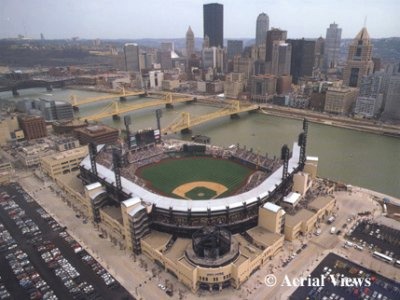
Tickets. No problem. No problem at all. Despite having moved from Three Rivers, an artificially-turfed concrete doughnut, to a beautiful new ballpark with a view of Pittsburgh's very sharp downtown skyline – maybe the best view any big-league ballpark has – and despite having a string of 3 straight Playoff seasons not that long ago, the Pirates do not draw well. This season, the team is averaging 18,155 per home game, only 47 percent of capacity, and a decrease of about 5,500 per game over the preceding season.
Their attendance struggles are less because Pittsburgh is a football town (the Steelers nearly always sell out, even when they're bad), and more because, going into 2012, they hadn't had a winning season, let alone made the Playoffs, since George Bush was President. I'm talking about the father, not the son. That's an entire generation out of the Playoffs.
And all 3 of those postseason berths were via the Wild Card. The Pirates are 1 of 3 teams that have not won their current Division; their last Division title was in the National League Eastern in 1992, and they moved into the NL Central in 1994. The other 2 teams are the Miami Marlins and the Colorado Rockies, and they have reached the World Series more recently than the Pirates, via the Wild Card route.
Aside from the Seattle Mariners, who've been in business since 1977 and have never won a Pennant, and the Washington Nationals, who started as the Montreal Expos in 1969 and have never won won, no team has gone longer without one than the Pirates. Their last Pennant, and their last World Series win, was in the Carter Administration, in 1979, led by "Pops" Stargell and "The Family." That was 38 years ago. Of the teams that have actually won a World Series, only the Cleveland Indians (1948) have longer droughts, now that the Cubs have won one again.
As a result of having a full generation of ineptitude, you can just walk up to the ticket window at PNC Park and buy pretty much any seat you can afford. The Pirates, even with a seating capacity of just 38,362, aren't going to sell out. In fact, considering there's less than 400 miles between New York and Pittsburgh, Met fans could "take over the ballpark" -- if, that is, they were willing to take over any ballpark. Frequently, you guys have enough trouble taking over your own.
By MLB standards, Pirates tickets are cheap. Infield Box seats, Sections 109 to 124, will set you back $58. Outfield Boxes are $50, Grandstand (upper deck) seats are $32, Outfield Reserved (right field) are $32, and Upper Grandstand (left field) are $26.
Getting There. I'm not going to kid you here: There's only one way to do so, and that's by car. You do not want to fly, because even if you get a good deal, you'll end up spending over 500 bucks to go less than 400 miles, and the airport is out in Imperial, Pennsylvania, near Coraopolis and Aliquippa, so it's almost as close to West Virginia and Ohio as it is to downtown Pittsburgh.
The Amtrak schedule doesn't really work. The Pennsylvanian leaves Penn Station at 10:52 AM, and doesn't get to Pittsburgh's station of the same name until 7:59 PM, after the first pitch. And there's no overnight train that would leave at, say, 11 PM and arrive at 8 AM. And going back, the
Pennsylvanian leaves at 7:30 AM and arrives back at 4:55 PM. So in order to watch all 3 games of this Monday-Tuesday-Wednesday series, you'd have to leave New York on Sunday morning, and leave Pittsburgh on Thursday morning. And it's not that cheap: $234 round-trip.
Greyhound isn't much better, but at least you have options. There are 14 buses a day between Port Authority Bus Terminal and Pittsburgh, and it's $226, just $102 with advance purchase. The Greyhound station is at 55 11th Street, across Liberty Avenue from the Amtrak station.
The only sensible way is by car – especially if there's more than one of you going and you can take turns driving. It's 373 miles from Times Square in Manhattan to downtown Pittsburgh, and 383 miles from Citi Field to PNC Park. (Yes, the naming rights to both are owned by banks. PNC's service is so bad people say the letters stand for "People Never Count.") This is far enough that, if you need to see all 3 games in a weekend series, and you have a standard Monday-to-Friday job, you'll have to take Friday and Monday off. Better to skip the Friday night game, and leave early on Saturday morning (say, 8:00) so you can get there in time to get to a hotel and see the Saturday night game, and leave right after the Sunday afternoon game and get home around midnight Sunday-into-Monday.
From the City, you'll need to get on the New Jersey Turnpike. Take it to Exit 14, to Interstate 78. From elsewhere in New Jersey, taking Interstate 287 should get you to I-78. Follow I-78 west all the way through New Jersey, to Phillipsburg, and across the Delaware River into Easton, Pennsylvania. Continue west on I-78 until reaching Harrisburg. There, you will merge onto I-81. Take Exit 52 to U.S. Route 11, which will soon take you onto I-76. This is the Pennsylvania Turnpike, the nation's first superhighway, opening in 1940.

You'll take the Pennsylvania Turnpike to Exit 57, the signs showing I-376 and U.S. 22 – the same Route 22 you might know from New Jersey, which I-78 was designed to replace – and the sign will say "Pittsburgh."
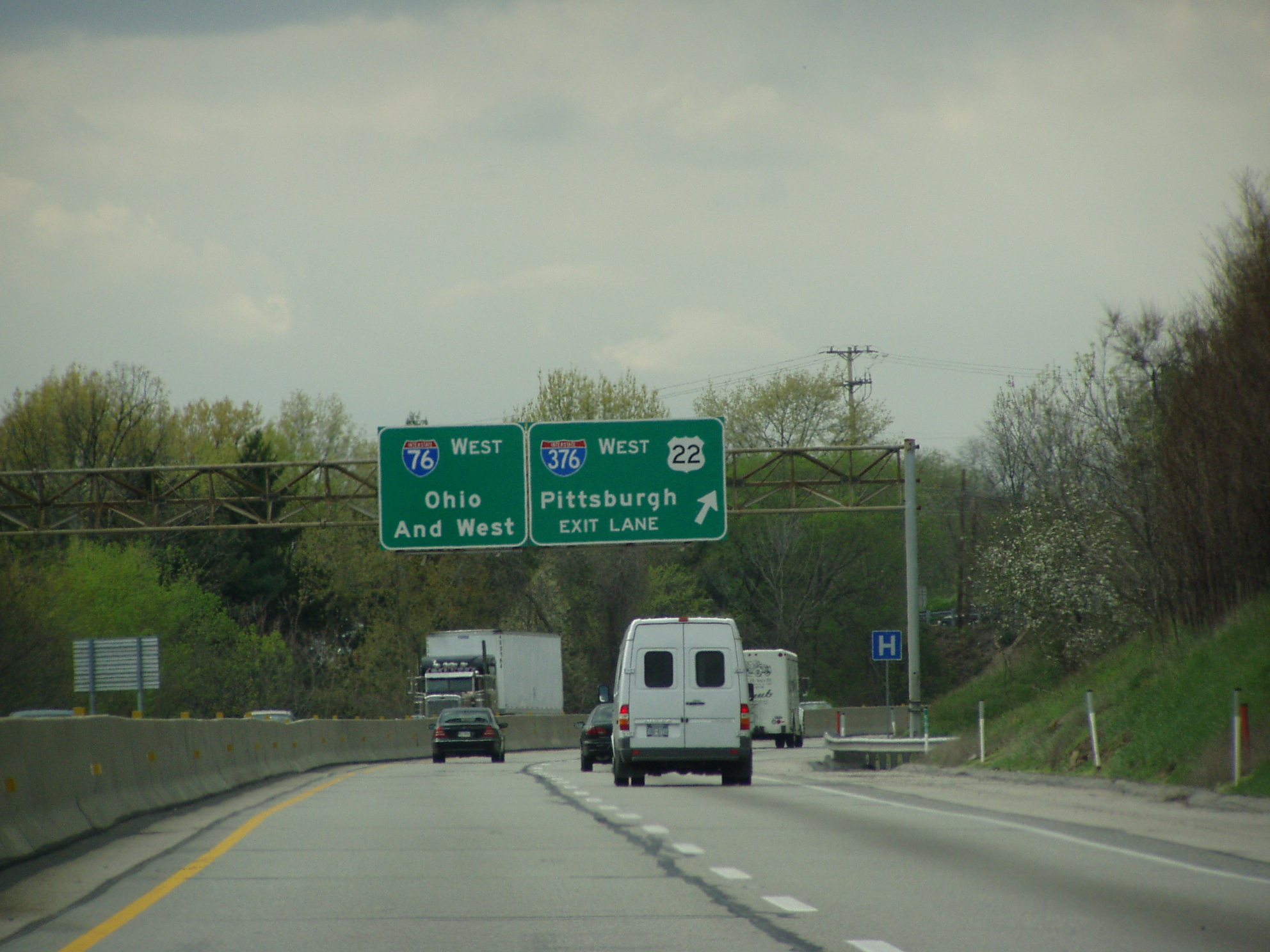
From anywhere in New York City, allow 6½ hours for the actual driving, though from North Jersey you might need "only" 6. I recommend at least 2 rest stops, preferably after crossing over into Pennsylvania around Easton, and probably around either Harrisburg or Breezewood. So the whole thing, assuming nothing goes wrong, will probably take about 8 hours.
Once In the City. Pittsburgh has, by American standards, a long history. It was settled by the French as Fort Duquesne in 1717, and captured by the British in 1758, and renamed Fort Pitt, for Prime Minister William Pitt the Elder.
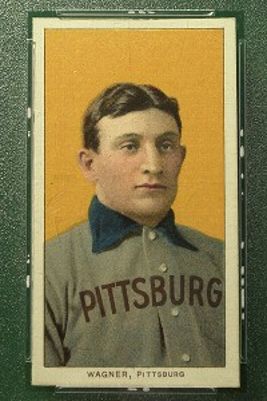
The General who captured it, John Forbes (for whom the Pirates' former park Forbes Field would be named), was a Scotsman, and he intended the town that grew around it to be named "Pittsburgh" -- pronounced "Pitts-burrah," like the Scottish capital Edinburgh. From 1891 to 1911, the H was dropped from the city's name, and this was reflected on the Pirates' uniforms, which sometimes read "PITTSBURG," as seen on the famous 1909 "T-206" baseball card of Honus Wagner. But the Germanic "Pittsburg" went back to the Scottish "Pittsburgh," while keeping the Germanic pronunciation. (There is, however, a town named Pittsburg, no H, in Kansas.)
The reduction of blue-collar jobs led people to take comfort in their sports teams, especially in the 1970s. Either the Pirates or the Steelers made the Playoffs in every year of that decade, both of them did so in 4 of those 10 years, and the University of Pittsburgh (or just "Pitt," though they don't like that nickname at that school) had an undefeated National Championship season in 1976. The Pirates won 2 World Series in the decade, the Steelers 4 Super Bowls in 6 years.
Calendar year 1979, with spillover into January 1980, was an annus mirabilis, in which the "Steel Curtain" won Super Bowl XIII in January, the "Bucs" (or "Buccos," or "Lumber Company," or "Family") won the World Series in October, and the Steelers then went on to win Super Bowl XIV, with the Pirates' Willie Stargell and the Steelers' Terry Bradshaw being named Co-Sportsmen of the Year by Sports Illustrated and the city government advertising itself as the City of Champions.
(It was also at that time that, in order to ride the Pirates/Steelers bandwagon, the NHL's Penguins switched their colors from navy blue and yellow to black and gold, but it was several more years before they became a championship contender.)
While the loss of industry did mean a sharp, long-term decline, the financial, computer and health care industries opened new doors, and Pittsburgh is very much a now and tomorrow city. And they love their sports, having won 16 World Championships in 21 trips to their sports' finals (which gives them a .762 winning percentage in finals, the best of any city of at least 3 teams) -- and that doesn't count the 9 National Championships won by Pitt football, the Negro League Pennants won by the Homestead Grays (10) and the Pittsburgh Crawfords (4), or the 1968 ABA Championship won by the Pittsburgh Pipers.
.svg/2000px-Pittsburgh_Light_Rail_(logo).svg.png)
The old Pittsburgh Press, once the 2nd-largest newspaper in Pennsylvania behind the Philadelphia Inquirer, went out of business due to a strike in 1992, before the city's remaining daily, the Pittsburgh Post-Gazette, brought it back in online form in 2011. That strike gave Richard Mellon Scaife, the current head of the legendary Pittsburgh metals and banking family, a chance to turn a local suburban paper into the Pittsburgh Tribune-Review, spouting his right-wing fanatic views. It may be that the P-G brought back the Press to give the city 2 liberals voices against the 1 nutjob voice.
The city's population was 88 percent white in 1950. By 2010, that had dropped to 65 percent. It's 26 percent black, 4.4 percent Asian, and, surprising me, only 2.3 percent Hispanic.
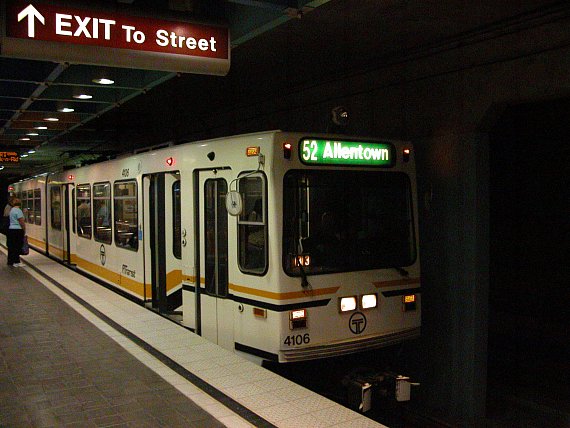
Going In. From most of downtown, PNC Park is within a mile's walk, crossing the 6th Street Bridge, now the Roberto Clemente Bridge, over the Allegheny River, shortly before it joins with the Monongahela River to form the Ohio River. There are local buses (including the Number 14) that go from downtown to the ballpark. Pittsburgh's subway/light rail system's Blue Line has now been extended to North Side Station, at Reedsdale & Martindale Streets, 2 blocks from the park.

The official address is 115 Federal Street. There are several nearby parking garages, most of them charging only $5.00.
Most likely, you will enter the park at 1 of 2 rotundas (rotundae?): The Trib Total Media Rotunda (especially if you're coming in by light rail or bus), or the Allegheny Sports Medicine Rotunda at the left field corner (especially if you're walking in from over the bridge).
Behind the park's left-field stands, you'll see the Roberto Clemente Bridge, formerly the 6th Street Bridge. (It was already Pirate yellow before they renamed it.) On game days, the Bridge is closed to vehicular traffic, to allow fans to walk across from downtown.
Behind the park's 1st-base stands, you'll see the Fort Duquesne Bridge – reflecting the original French name of the city before the British took it in the French & Indian War – and beyond that, the new home of the Steelers and Pitt football, Heinz Field. In between Heinz and the bridge is a parking lot where Three Rivers Stadium stood. Roughly between the site of Three Rivers and PNC Park, including the northern end of the Fort Duquesne Bridge, was the site of Exposition Park, where the Pirates played from 1891 to 1909.

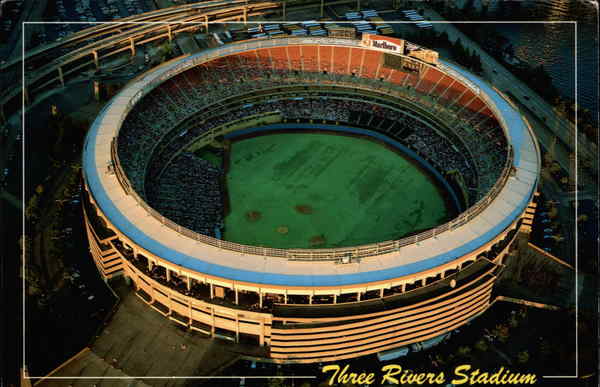
In front of you are informative and attractive scoreboards, and a nice, natural-grass field, instead of the hideous pale-green carpet at Three Rivers, which was one of the most foul-looking rugs in sports (even in fair territory). I don't know how the Pirates and Steelers, between them, won 6 World Championships on the stuff: How could they look at that turf and not get sick? What kind of home-field advantage could they have had?
Home pate was moved from Forbes Field to Three Rivers Stadium in 1970, and from there to PNC Park in 2001. How long that particular plate was used at Forbes, I don't know. Given that the Pirates had a World Series clincher at Forbes in 1960, and the fans stormed the field, there is reason to doubt that it's the same plate that the park opened with in 1909.
The field, which points southeast, is not symmetrical: It's 325 feet down the left-field line, 383 to left-center, 410 to the deepest part of the park to the left of center, 399 to straightaway center, 375 to right-center, and 320 to right. The right field wall is 21 feet high, partly to offset a short distance, and partly to honor Clemente, and his Number 21 is displayed above the scoreboard on the wall.

Sammy Sosa of the Cubs (with, uh, help) hit the longest home run at PNC Park, 484 feet in 2002. Oddly, while Willie Stargell hit the longest home run at several stadiums, Three Rivers was not one of them: Greg Luzinski of the Phillies was, in 1979, hitting one 483 feet -- perhaps poetic justice for Stargell hitting the longest at the Vet, in 1971.
The longest at Forbes Field is believed to be one that Dick Stuart hit in 1959, which wasn't measured, but almost certainly cleared 500 feet. The man known then as Stonefingers and later as Dr. Strange-glove couldn't field, but he sure could hit. Babe Ruth's 714th and final home run, with the Boston Braves in 1935, went over the right-field roof at Forbes, but no distance was suggested at the time, and anybody estimating its distance now would just be guessing. But it may have been longer than Stuart's blast.
PNC Park has hosted concerts, but, as yet, no sports besides baseball. Pitt and Duquesne began playing what was officially labeled "The City Game" there in 2003, but stopped in 2010, after Duquesne dropped their baseball program.
Food. Pittsburgh is a city of many ethnicities, and most of them love to eat food that really isn't good for you: Irish, Italian, Polish, Greek, and African-Americans with Soul Food and Barbecue. Yes, I did mean to capitalize those last two. They deserve it.
Reflecting this, a "Tastes of Pittsburgh" series of stands is on the main concourse, including Primanti Brothers sandwiches: Meat, cheese, hand-cut French fries, tomatoes and cole slaw. All together between slices of Italian bread. A recent Thrillist article on the best food at each big league ballpark
cited "Anything from Primanti Brothers" as the best at PNC Park.
Like several other ballparks, such as Baltimore with Boog Powell and Philadelphia with Greg Luzinski, the Pirates have one of their retired greats holding court in right field (on "the Riverwalk") at a barbecue stand named for him, Manny's BBQ. This is Manny Sanguillen, 1970s catcher.
They have Dippin Dots and Rita's Italian Ice. They have a food court named after their favorite-son fat man, Stargell: Pops' Plaza. They have another food court called Smorgasburgh, including a steak sandwich stand called Quaker Steak and Lube. Another bonus of PNC Park is that they let you bring your own food in – but why would you, with all those choices available?
Team History Displays. There are a whopping 11 statues outside the ballpark. Honus Wagner, the Pirate star of 1900 to 1917, still usually considered the greatest shortstop who ever lived (yes, even ahead of such modern heroes as Cal Ripken and Derek Jeter), originally had a statue outside Forbes Field, and it was moved to Three Rivers and then to PNC Park.


Roberto Clemente's statue, with his bridge in the background
A statue of Bill Mazeroski, second baseman of 1956 to 1972, was dedicated in honor of the 50th Anniversary of him hitting the home run that won the 1960 World Series. (A lot of Yankee Fans who are old enough to remember it are still bothered by it.) A monument to former owner Barney Dreyfuss used to sit in center field at Forbes Field, and was moved to the concourse at Three Rivers and then to PNC Park.
And on June 26, 2006, in anticipation of the park hosting the All-Star Game the next month, 7 statues were unveiled, honoring Negro League greats who played in the city: Leroy "Satchel" Paige, Josh Gibson, Walter "Buck" Leonard, Oscar Charleston, William "Judy" Johnson, James "Cool Papa" Bell, and Smokey Joe Williams.
Because the Homestead Grays divided their "home" games between Pittsburgh (where Homestead actually is) and Washington, Josh Gibson is the only man who never played in Major League Baseball who is honored with statues at 2 different major league ballparks, and in 2 different cities, no less.
As someone who has now tried it with his nieces born 60 years after Jackie Robinson's debut, I can tell you: Explaining why black players weren't allowed in "organized baseball" prior to 1947 is not easy. But it must be done, so that people whose sole experience with New York baseball is fully integrated, and at the new Yankee Stadium and Citi Field, will understand.

Josh Gibson's statue at PNC Park, which doesn't have
the surrealism of his statue at Nationals Park in Washington.
The Pirates have won 9 National League Pennants: In 1901, 1902, 1903, 1909, 1925, 1927, 1960, 1971 and 1979. This 78-year span is pretty impressive, especially when you consider they clinched their 1st when the bodies of Queen Victoria and President William McKinley were newly entombed. It gets less impressive when you realize that their last was clinched when Jimmy Carter was President, disco was king, and Radar O'Reilly was getting sent home on M*A*S*H.
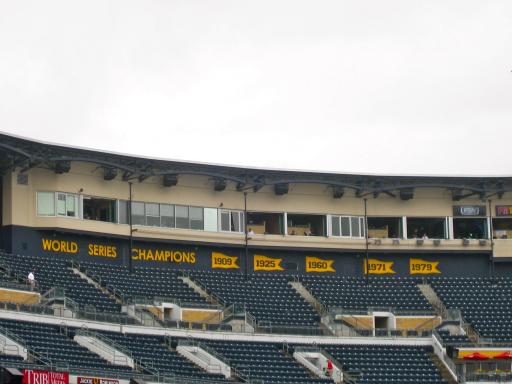
They've won 5 World Series, in 1909, 1925, 1960, 1971 and 1979, which are noted beneath the press box. In a quirk, every World Series they've ever been in but one (1927, swept by the Yankees), win or lose, has gone at least 7 games. (Yes, "at least." In 1903, the 1st year of the World Series, it was a best 5-out-of-9, and the Boston Red Sox beat them, 5 games to 3.)
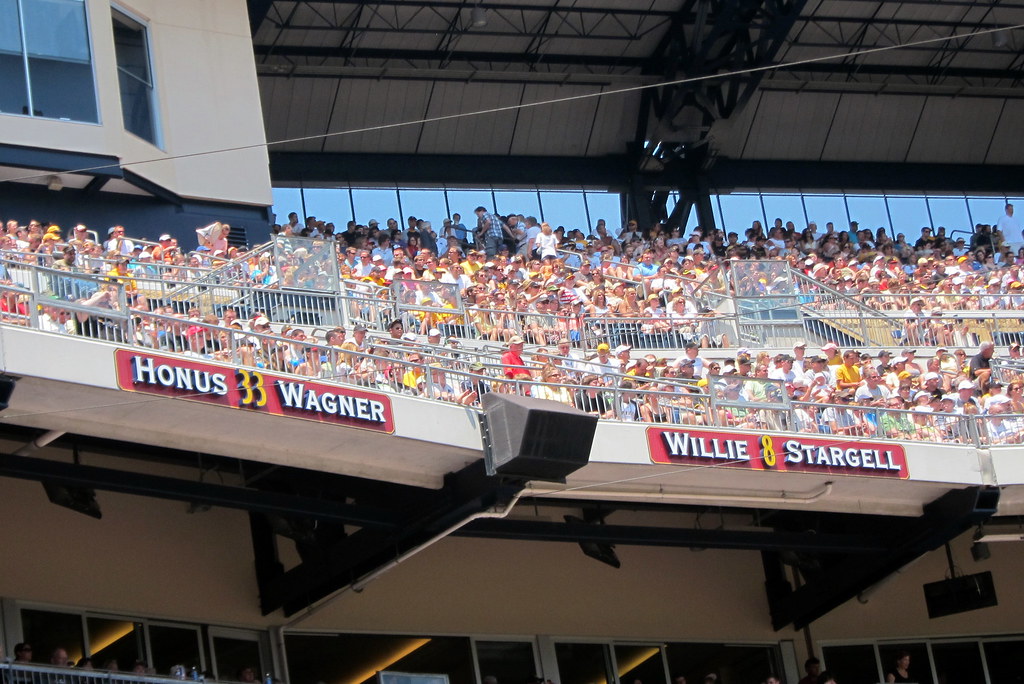
Jackie Robinson's Number 42, honored throughout baseball, is also displayed. And, as mentioned, the Barney Dreyfuss Monument survives, and rests on the lower concourse.

Connie Mack (1891-96) and Al Lopez (1940-46) were catchers for the Pirates, and Lopez was a pretty good one, formerly holding the all-time record for games caught; but both of them were elected to the Hall of Fame for what they did as managers, after they left Pittsburgh. Frankie Frisch managed the Pirates (1940-46), but they weren't very good at that time, and he was elected to the Hall for what he did elsewhere.
In 1933, baseball's 1st All-Star Game was played. Traynor and Paul Waner (but not his brother Lloyd) were selected from the Pirates. In 1999, Wagner was named to the Major League Baseball All-Century Team. That same year, he, Traynor, Paul Waner, Kiner, Clemente, Stargell and Barry Bonds were named to The Sporting News' 100 Greatest Baseball Players. So were Oscar Charleston, Josh Gibson, Buck Leonard and Cool Papa Bell from the Crawfords and/or the Grays. In 2006, Pirate fans chose Clemente in the poll for DHL Hometown Heroes.
Stuff. The Majestic Clubhouse Store at PNC Park is located on Federal Street, outside the Left Field Gate entrance, near the Willie Stargell statue. There are plenty of pirate-themed novelty items, including hats, bandanas, eye patches and foam swords. The late-1970s retro caps, resembling late 19th Century caps, are also sold, although not with the "Stargell Stars" that Pops put on them in the "Family" years.
The 2016 season saw the publication of The Bucs!: The Story of the Pittsburgh Pirates, by John McCollister and Pirate reliever turned broadcaster Kent Tekulve. In 2013, David Finoli published Classic Bucs: The 50 Greatest Games in Pittsburgh Pirates History.
As to individual Pirate teams, Finoli also wrote The Pittsburgh Pirates' 1960 Season. Bruce Markusen wrote The Team That Changed Baseball: Roberto Clemente and the 1971 Pittsburgh Pirates. (That season, the Pirates not only won the World Series, but became the 1st major league team to start an entirely nonwhite lineup.) And McCollister wrote Tales from the 1979 Pittsburgh Pirates Dugout: Remembering "The Fam-A-Lee."
There is, as yet, no World Series highlight film collection focusing on the Pirates (1909 and 1925 were before they had official films), but they could have packaged 1960, 1971 and 1979 together. There is a compact disc honoring Hall of Fame braodcaster Bob Prince; an MLB Network Baseball's Greatest Games DVD showing the original TV broadcast of Game 7 of the 1960 World Series, the Mazeroski Game; and a DVD collection focusing on the 1979 Series. As yet, there is no Essential Games of the Pittsburgh Pirates/Three Rivers Stadium DVD collection.
During the Game. A recent Thrillist article on "Baseball's Most Intolerable Fans" ranked the Pirates 24th -- in other words, the 7th most tolerable, saying, "In most cases, Pirates fans are a pretty all right bunch. Most of your more abrasive Yinzer types save the bulk of their wrath for Steelers season."
(A "Yinzer" is a Pittsburgher, from their habit of saying the second-person-plural, which is "youse" in New York, as "yinz." They also tend to drop some consonants: "Downtown" becomes "Dow'tow'," and "South Side" becomes "Sou'side.")
The article is accurate about Pittsburghers' aggressiveness. If you were a Cleveland Browns fan, or (a little less so) a Baltimore Ravens fan, going into Heinz Field to face the Steelers, you might be in a bit of trouble. If you were a Philadelphia Flyers fan going into the PPG Paints Arena to face the Penguins, you might face some anger. (Then again, pretty much everybody hates the Flyers.) But as a Met fan going into PNC Park, you'll be fine. You can wear your Blue & Orange gear at PNC without fear of drunken bums physically hassling you.
While the Pirates spoiled the Mets' home openers at both the Polo Grounds in 1962 and Shea Stadium in 1964, and the 2 teams went down to the wire in the NL East races of 1973 (Mets beat 'em out by 2½ games) and 1990 (Pirates won by 4 games), neither team has ever considered the other its greatest rival. Met fans have had far more contentious relationships with the Braves and Cubs, and both teams have had rivalries with the Phillies and Reds.
The Cleveland Indians are in the American League, Pittsburgh doesn't have an NBA team, Cleveland doesn't have an NHL team, and neither city has an MLS team, so the Steelers-Browns dynamic doesn't cross over into any other sports, the way Yankees-Red Sox becomes Jets-Patriots or Knicks-Celtics or Rangers-Bruins – or Mets-Phillies becomes Giants-Eagles or Rangers-Flyers. Being put in a separate Conference, let alone Division, and being mostly terrible since coming into existence, Ohio's NHL team, the Columbus Blue Jackets, doesn't generate much heat from Penguin fans. Even Penn State-Ohio State isn't that big a rivalry. Pitt-Penn State is another story, as is Pitt-West Virginia, "the Backyard Brawl."
And since the Mets and Bucs (or Buccos, both short for Buccaneers) have been in different divisions since 1994, and there's been no serious chance of a postseason meeting in all that time, Pirate fans are not going to get upset at you, even if you start a "Let's Go Mets!" chant in their yard.
They're certainly not going to hurt you if you don't provoke them. Just don't say anything bad about the Steelers, or Mario Lemieux or Sidney Crosby, and you should be fine. And, for God's sake (not to mention that of its inventor, the late Steelers broadcaster Myron Cope), do not mock or deface The Terrible Towel, that great symbol of Steelerdom.
You might not see any at a Pirates game (though you may hear a stray chant of "Here we go, Steelers, here we go!" -- it's been known to happen at Pirates, Penguins and Pitt football games), but they take that particular item very seriously, even pointing out that other NFL teams have lost after mocking it, leading to the phrase "The Curse of the Terrible Towel."
The Friday game will be Faith Night. That figures, on the Jewish Sabbath, a good way to keep some Met fans out. (The Mets do seem to have more Jewish fans than the Yankees do, a possible holdover from the Brooklyn Dodger fan base.) The Saturday game will feature postgame fireworks.
The Sunday game will be a giveaway for fans age 14 and under: A bobblehead of the Incredible Hulk. I can't figure out why: There's no Pittsburgh, or even Pennsylvania, connection. The character's human form of Bruce Banner has never been given a hometown as far as I know. Co-creators Stan Lee and Jack Kirby, and 1970s portrayer Lou Ferrigno, were all from New York. Bill Bixby was from San Francisco, and Mark Ruffalo is from Wisconsin.
Local band the Buzz Poets have written the team a theme song, "A New Pirate Generation." The Pirates hold auditions for National Anthem singers, instead of having a regular. They have a mascot, the Pirate Parrot. But, due to one of the predecessor suit-wearers having been involved in the Pittsburgh drug trials of the mid-1980s, it is understandable that they tend not to celebrate the character as much as the Mets celebrate Mr. Met, or the Phillies their Phanatic, or the Orioles their Bird, or even the Red Sox their Wally the Green Monster.
 The Mets haven't run an Airplane Race on their video board for years, but, just as the Yankees have The Great City Subway Race, the Milwaukee Brewers the Sausage Race, and the Washington Nationals the Racing Presidents, the Pirates have a between-innings feature called the Great Pierogi Race.
The characters are Cheese Chester, Sauerkraut Saul, Oliver Onion and Jalapeno Hannah. Hannah is not the only female character in any of the "ballpark races" -- the mascots race each other in Cincinnati, and sometimes Rosie Red wins -- but she is identifiable because she carries a pocketbook.
There was once a Potato Pete, but they traded him for Oliver Onion (and possibly for a flavor to be named later). Oliver has taped-up "nerd glasses." As with "Teddy Roosevelt" in Washington, there was a joke that Sauerkraut Saul never won, but this (literally) running gag has been dropped.

The Pirates will play "Take Me Out to the Ballgame" during the 7th inning stretch, but they do not seem to have an additional song, the way the Mets do with "Lazy Mary," the Orioles with "Thank God I'm a Country Boy," and others.
While there are several music legends native to the Pittsburgh area – Perry Como, Bobby Vinton, Lou Christie, the Dell-Vikings, the Vogues, and others – there doesn't seem to be a particular song that the special-effects people choose, although Christie's "Lightning Strikes" could be appropriate, and "Blue Moon," a song often reworked by English soccer fans (sometimes obscenely so), was done in doo-wop fashion by the Pittsburgh group the Marcels in 1961.
In case you're wondering, Willie Stargell liked "We Are Family" because of the image of togetherness that Sister Sledge were singing about, not because they had anything to do with Pittsburgh. In fact, they were from the opposite end of the State, in Philadelphia.
After the Game. There are attractions near PNC Park, but most of these are museums, such as the one dedicated to native Pittsburgher Andy Warhol, and will be closed after the games. The next bridge over from the Clemente is the Andy Warhol Bridge. Warhol was interested in baseball: He painted this image, in his style, of Mickey Mantle in 1962. He also did paintings of Tom Seaver and Pete Rose.
Between PNC Park and Heinz Field, across from where Three Rivers Stadium used to be, is Jerome Bettis' Grille 36, named for the Steeler legend and his uniform number. It's at 393 North Shore Drive.
South of downtown, across the Monongahela River on the South Shore – or, as they say in Pittsburghese, the Sou'side – is Station Square, an indoor and outdoor shopping, dining and entertainment complex. This is a popular gathering place, although, as New Yorkers, you'll be hopelessly outnumbered. You might be better off returning to your hotel and getting a bite or a drink there. When I first visited Pittsburgh in 2000 (I saw the Pirates hit 4 homers at Three Rivers but lose to the Cards thanks to a steroid-aided mammoth blast by Mark McGwire), there was a restaurant with a Pittsburgh Sports Hall of Fame at Station Square, but as far as I can tell it is no longer there.
I searched the Internet for bars in the Pittsburgh area that cater to New Yorkers. Usually, I can at least find something that welcomes Giant or Jet fans on their gamedays, but I guess the Steelers are so ingrained in Western Pennsylvania culture that establishing an outpost for "foreign fans" is anathema to them. (Anathema? Didn't Rocky Graziano knock him out in Buffalo? No, wait, that was Quinella.)
The closest I could come was a suggestion that Carson City Saloon, at 1401 E. Carson Street, was a
Jet fans' hangout. Number 48 or 51 bus from downtown. When I did this piece in 2013, I was told by a Pittsburgh native that the Brillo Box was owned by a New Yorker, but, not having been to Pittsburgh since, I cannot confirm this. And one source I found to back it up calls it a "hipster" place. If you want to take your chances, it's at 4104 Penn Avenue at Main Street. Number 88 bus from downtown.
If you visit Pittsburgh during the European soccer season, which starts up again next month, the city's leading soccer bar is Piper's Pub, at 1828 East Carson Street. No matter what club you support, you can almost certainly find its game on TV there. Bus 48. Unless you're a Liverpool fan, in which case you may prefer their outpost in the Steel City (Pittsburgh, not Sheffield): Cain's Saloon, at 3239 W. Liberty Avenue, 4 miles down the South Side. Red Line to Dormont Junction.
Sidelights. UPDATE: On November 30, 2018, Thrillist published a list of "America's 25 Most Fun Cities," and Pittsburgh came in 24th.
As I mentioned, Exposition Park, home of the Pirates from 1891 to 1909, was nearly on the site of PNC Park. The 1st home of the Pirates, Recreation Park, was roughly on the site of Heinz Field.
This was also the site of the 1st football game played by an openly professional player. Yale University star William "Pudge" Heffelfinger was paid $500 (about $12,800 in today's money) to play for the Allegheny Athletic Association against the Pittsburgh Athletic Club, and scored the game's only points in a 4-0 Allegheny win. (Under the scoring system of the time, a touchdown was 4 points.)
There are historical markers in the complex for both Exposition Park (as one of the sites, along with the Huntington Avenue Grounds in Boston, of the 1st World Series) and Recreation Park (as the site of the 1st professional football game -- though the 1st all-professional game was in 1895 in nearby Latrobe).
* Heinz Field. This is a far better palace for football than the concrete oval that Three Rivers Stadium was. It has a statue of Steeler founder-owner Art Rooney outside, and, on gameday, 68,500 Terrible Towel-waving black and gold maniacs inside.
The Steelers hosted the AFC Championship Game in the stadium's 1st season, 2001 (losing it to the New England Patriots, and again in 2004 (losing to the Pats again), 2008 (beating the Baltimore Ravens) and 2010 (beating the Jets).
 A 2007 ESPN.com article named Heinz Field the best stadium in the NFL, tied in their ratings system with Lambeau Field in Green Bay. It also hosts the University of Pittsburgh's football team. On September 10, 2016, the renewal of the Pitt-Penn State rivalry, now labeled the Keystone Classic, set a stadium attendance record of 69,983. Pitt won a thriller, 42-39.
Heinz Field also hosted the 2011 NHL Winter Classic, in which the Pittsburgh Penguins lost 3-1 to the Washington Capitals. In 2017, it hosted an NHL Stadium Series game, in which the Penguins beat the Philadelphia Flyers 4-2. In the Summer of 2014, it hosted a soccer game, in which defending English champions Manchester City beat Italian giants AC Milan 5-1. 100 Art Rooney Avenue. (Three Rivers' address, famously, was 600 Stadium Circle.)
* Senator John Heinz History Center. It includes the Western Pennsylvania Sports Museum, open daily from 10 AM to 5 PM. (Senator Heinz, of the condiment-making family, was the 1st husband of Teresa Heinz Kerry, who nearly became First Lady in 2004.) 1212 Smallman Street at 12th Street, a couple of minutes' walk from Union/Penn Station and Greyhound.
* Forbes Quadrangle, intersection of Forbes Avenue and Bouquet Street. This set of buildings, part of the University of Pittsburgh campus, was the site of Forbes Field, home of the Pirates from 1909 to 1970, the Steelers from 1933 to 1963, and the Homestead Grays of the Negro Leagues from 1929 to 1950.
 The Steelers never won a title there, and indeed only hosted 1 Playoff game, which they lost. But the Pirates won 3 World Series while playing there, and the Grays won 11 Pennants and the 1943, 1944 and 1948 Negro World Series.
 Forbes Field was also the site of the 3rd of the 4 fights for the Heavyweight Championship of the World between Ezzard Charles and Jersey Joe Walcott, on July 18, 1951. Walcott won, becoming, at the time, the oldest Heavyweight Champion ever: 37.
Included on the site is the last standing remnant of Forbes Field, part of the outfield wall, with ivy still growing on it. (Wrigley Field in Chicago wasn't the only park with ivy on its outfield wall.) Where the wall stops, you'll see a little brick path, and eventually you’ll come to a plaque that shows where the ball hit by Mazeroski crossed over the fence to win the Series. A historical marker honoring Barney Dreyfuss is nearby.
Home plate has been preserved, in Wesley W. Posvar Hall, named for the longtime UP Chancellor. An urban legend says that, if it was in its exact original location, it would now be in a ladies' restroom. This isn't quite the case, but it's still at roughly the same spot.
 If you've ever seen the picture of Mazeroski in mid-swing, you'll recognize the Carnegie Museum & Library in the background, and it is still there as well. If you've ever seen a picture of a Gothic-looking tower over the 3rd-base stands, that's the Cathedral of Learning, the centerpiece of UP (or "Pitt"), and it's still there as well. A portion of the wall, including the 406-foot marker that can be seen with the Mazeroski ball going over it, was moved to Three Rivers and now to PNC Park.

Pick up the Number 71 bus at 5th Avenue at Ross Street, and it will take you down 5th Avenue to Oakland Avenue. From there, it’s a 2-minute walk to the Quadrangle and Posvar Hall.

* Petersen Events Center. The home arena for Pitt basketball, it was built on the site of Pitt Stadium, where they played their football games from 1925 to 1999, and where the Steelers played part-time starting in 1958 and full-time starting in 1964 until 1969. Part-time from 1970 to 1999, and full-time in 2000, Pitt shared Three Rivers with the Steelers, and they've shared Heinz Field since 2001.
Pitt Stadium was home to such legends as Dr. Jock Sutherland (a dentist and football coach), Marshall "Biggie" Goldberg, Mike Ditka, Tony Dorsett, and, if you want to stretch the meaning of "legend," Dan Marino. If you're a Giants fan, this is where they played the Steelers on September 20, 1964, and Giant quarterback Y.A. Tittle got clobbered by the Steelers' John Baker, resulting in that famous picture of Tittle kneeling, with blood streaming down his bald head, providing a symbolic end to the Giants' glory days of Frank Gifford, Sam Huff and quarterbacks Charlie Conerly and Tittle.
Terrace Street and Sutherland Drive. From 1951 to 2002, before moving into Petersen, Pitt played basketball at Fitzgerald Field House. At 4,122 seats, it was very intimidating for visitors, but much too small for a major college basketball team, and most of their big-draw games had to be played at the Civic Arena. Building the Petersen Center allowed them a 12,508-seat on-campus arena. The old and new arenas are across Sutherland Drive from each other, a 5-minute walk from Forbes Quadrangle.
* Site of Greenlee Field. William Augustus "Gus" Greenlee was one of Pittsburgh's premier black businessmen -- but was both a gangster and a philanthropist. In 1932, he built Greenlee Field for the Negro League team he owned, the Pittsburgh Crawfords, named for another business he owned, the Crawford Grill.
Seating 7,500, it was the Craws' home from 1932 to 1938, when, for reasons beyond his control, he had to make changes that led to fans staying away, and he had to sell the team after the season, lasting 2 more years in other cities before folding. But, led by Hall-of-Famers Satchel Paige, Josh Gibson, Judy Johnson and James "Cool Papa" Bell, they won Pennants in 1935 and 1936.
Like Ebbets Field, it was on a Bedford Avenue. The Bedford Dwellings housing project is now on the site. 2501 Bedford Avenue, off Chauncey Drive (not Chauncey Street, as in Brooklyn), a mile and a half east of downtown. Bus 83.
* Site of Civic Arena, between Bedford Avenue, Fullerton Street, Centre Avenue and Washington Place. The official mailing address for "the Igloo" in its last few years was 66 Mario Lemieux Place. Built in 1961 for the Pittsburgh Civic Light Opera, it had a retractable roof before additional seating made such retraction impossible.
It hosted the American Hockey League's Pittsburgh Hornets from then until 1967, and then the NHL's Pittsburgh Penguins until 2010. It was officially known as the Mellon Arena from 1999 to 2010, when the naming rights expired.
The Pittsburgh Pipers, later renamed the Condors, played there, and won the 1st ABA Championship in 1968, led by Brooklyn native Connie Hawkins. Larry Holmes barely hung on to the Heavyweight Championship of the World there, getting off the canvas to knock Renaldo Snipes out on November 6, 1981.
The Beatles played there on September 14, 1964. Elvis Presley sang there on June 25 & 26, 1973 and December 31, 1976. It was demolished in 2011.
* PPG Paints Arena. Opening on August 18, 2010, for a concert by former Beatle Paul McCartney, it was known as the Consol Energy Center until last year. It seats 18,087 for Penguins and other hockey games, including the 2013 NCAA Championships (a.k.a. the Frozen Four); and 19,000 for basketball, for college tournaments and, in the unlikely event the NBA returns to Pittsburgh, the pros.
The building and opening of this arena means that, for perhaps the 1st time in franchise history, the Penguins' long-term future in Pittsburgh is secure. 1001 5th Avenue.
Pittsburgh hasn't had anything resembling a major league basketball team since the Condors moved in 1973. The new version of the ABA is officially "semi-pro," and has a team called the Steel City Yellow Jackets, who began play in the 2014-15 season. They play on the campus of the Community College of Allegheny County, at a building called the "A Giving Heart Community Center." 808 Ridge Avenue, across (or, rather, under) the elevated highway from Heinz Field.
On May 12, 2014, the New York Times printed a story that shows NBA fandom by ZIP Code, according to Facebook likes. The PPG Paints Arena is 134 miles from Cleveland's Quicken Loans Arena, but don't let that fool you into thinking that Pittsburghers toss aside their NFL-bred hatred of Cleveland to support the Cavaliers (even with the return of LeBron James): They seem to divide their fandom up among 4 "cool teams": The Chicago Bulls, the Los Angeles Lakers, the Boston Celtics and the Miami Heat. The Philadelphia 76ers, only 309 miles away? Forget it.
It's unlikely that Pittsburgh will ever seek out a new NBA team. If they did get one, the metro area would rank 22nd in population among NBA markets.
Pittsburgh has never hosted an NCAA Final Four. Duquesne University reached the 2nd Final Four (not that it was called that back then) in 1940, and Pitt did so in 1941. No Western Pennsylvania school has done so since.
In fact, Pittsburgh has never been a big basketball city: The Pittsburgh Ironmen played in the NBA's 1st season, 1946-47, and only that season, and are best known now for having had Press Maravich, father of Pistol Pete, play for them. The ABA's Pittsburgh Pipers, later the Pittsburgh Condors, won that league's 1st title in 1967-68, but that was it. (Connie Hawkins led that team, and was named to the ABA All-Time Team.) The most successful Pittsburgh basketball team may well have been the Pittsburgh Pisces in The Fish That Saved Pittsburgh.
* Duquesne Gardens. Pittsburgh's original sports arena opened in 1895, and had an unofficial limit of 8,000 spectators. It hosted minor-league hockey teams from the beginning until its closing in 1956, including the Hornets from 1936 to 1956. It hosted the Duquesne and Pitt basketball teams, and the Pittsburgh Ironmen in the NBA's 1st season, 1946-47.
Once bigger arenas like the old Madison Square Garden went up in the 1920s, seating more than twice as many people, the Duquesne Gardens was obsolete. Yet it hung on until 1956. 110 N. Craig Street, at 5th Avenue, near the Pitt campus. University housing is now on the site. Also accessible via the Number 71 bus.
The University of Pittsburgh is on the town's East Side. Penn State is 139 miles to the northeast in State College. West Virginia University, Pitt's other big rival, is 76 miles to the south in Morgantown. Greyhound provides service to State College, while Megabus does so to Morgantown.
* Highmark Stadium. As I said, Pittsburgh doesn't have a Major League Soccer team. The Pittsburgh Riverhounds play in the United Soccer League (USL), the 3rd tier of American soccer. Their home field is Highmark Stadium, and it seats a mere 3,500 fans, about the size of the average high school football stadium in New Jersey. But its placement on the south bank of the Monongahela, across from downtown, gives it a view every bit as good as the one from PNC Park. 510 W. Station Square Drive. Subway to Station Square.
* Roberto Clemente Museum. A fan group tried to buy Honus Wagner's house in nearby Carnegie and turn it into a museum, but this is the only museum devoted to a single Pittsburgh athlete, who was viewed as a supporting player on the 1960 title and the driving force behind the one in 1971, prior to his tragic death in a plane crash off Puerto Rico, trying to bring relief supplies to earthquake victims in Nicaragua on New Year's Eve 1972.
Clemente wasn't the 1st Hispanic player in the major leagues (white Cuban Charles "Chick" Pedroes played 2 games for the Cubs in 1902), nor was he the 1st black Hispanic player (Minnie Minoso debuted with the Chicago White Sox in 1949). But he was the 1st to really take hold in the public imagination, to the point where later Hispanic stars wore Number 21 in his honor, and there is a movement to have the number retired throughout baseball as was done for Jackie Robinson (but it is not likely to succeed). 3339 Penn Avenue at 34th Street. Bus 87 to Herron Avenue.
Wagner is buried at Jefferson Memorial Park, at 401 Curry Hollow Road in Pleasant Hills, about 8 miles south of downtown. Bus Y47. Josh Gibson is buried at Allegheny Cemetery, at 4734 Butler Street, about 4 miles northeast of downtown. Bus 91. Willie Stargell is buried in North Carolina, and when Clemente's plane went down in the Caribbean, his body was never recovered, so there is no final resting place for him.
No President has come from Pittsburgh, or from anywhere near it. The only President from Pennsylvania has been James Buchanan, and he was a lousy one, and he was from Lancaster, much closer to Philadelphia.
The most notable historic site in Pittsburgh is probably Point State Park, where the "three rivers" come together at the western edge of downtown. It includes the Fort Pitt Museum, telling the city's story from the days of New France Onward. 601 Commonwealth Place.
The U.S. Steel Tower, at 7th & Grant Avenues, is the tallest building in Pittsburgh, at 841 feet -- although there are 3 buildings in Philadelphia that surpass it for the title of tallest building in Pennsylvania. Built in 1970, it surpassed the 1932-built Gulf Tower, on the opposite corner from U.S. Steel.
There haven't been many TV shows set in Pittsburgh. They include My So-Called Life, Hope and Gloria, Queer as Folk, Man with a Plan, the World War II-era period piece Remember WENN, and This Is Us, which bounces around between 1980 and the present day.
Mr. Belvedere, starring Christopher Hewett as a butler to a family led by a sportswriter played by ballplayer-turned-broadcaster Bob Uecker, was set in nearby Beaver Falls, hometown of Jets legend Joe Namath, but it was filmed in Los Angeles. The most notable TV shows actually taped in Pittsburgh, at the PBS station WQED-Channel 13, were Mister Rogers' Neighborhood and Where In the World Is Carmen Sandiego?
Fred Rogers was from Latrobe, and in spite of his show's success, he never moved the taping to New York or Hollywood. He notably had Steeler receiver Lynn Swann on his show, to show that even a big tough football player (or, at least, a graceful wide receiver) could love ballet (which explained how Swannie got such nice moves in the first place). A statue of Mr. Rogers, sponsored by TV Land, is near Heinz Field, as is one of Steeler founder-owner Art Rooney.
A lot of movies have been shot in Pittsburgh, due to its varied architecture. Many have had sports scenes. You may have seen the 1994 version of Angels in the Outfield, which involved the team then known as the California Angels. The original black-and-white version came out in 1951, and the downtrodden team they featured was the Pirates, and there's some nice shots of Forbes Field in it. Some nice shots of Janet Leigh, too. (Jamie Lee Curtis' mom -- no, unlike in some other films such as Psycho, Janet doesn't flash any skin in this one, but now you know why Tony Curtis married her, and where Jamie Lee inherited the goods.)
The Fish That Saved Pittsburgh was a very silly, very Seventies movie, with Julius "Dr. J" Erving playing for the good guys and Kareem Abdul-Jabbar playing for the opposition. Sudden Death had Jean-Claude Van Damme trying to stop an assassination attempt at the Stanley Cup Finals. Both featured the old Civic Arena. Van Damme also filmed Timecop in Pittsburgh.
While most of The Dark Knight Rises was filmed in New York (with a few CGI bridges added to the skyline to create the atmosphere of the fictional Gotham City), and its 2 predecessors were filmed in Chicago, the football game scene was filmed at Heinz Field, with the fictional Gotham Rogues wearing Steeler black & gold. (They even made up a fake website for the team, including the Rogue Rag, a takeoff on the Terrible Towel.) Real-life Steeler legend Hines Ward returned the opening kickoff for a touchdown as Bane's bomb collapsed the field behind him, and playing the opposition's kicker was Luke Ravenstahl, then the Mayor of Pittsburgh in real life.
The scene where Gary Oldman goes to Matthew Modine's house to prepare for the final assault may also have been filmed in Pittsburgh, although the row-house style resembles Philadelphia. Some of the movie was filmed in Newark, but that street doesn't look like any part of Newark I've ever seen. You'd have to get as far south as Trenton to see Philly-style rowhouses in New Jersey, but then they've got 'em all along the Delaware River, in places like Bordentown, Burlington and Camden. Maybe it's a Pennsylvania thing.
One of Tom Cruise's earliest big films was All the Right Moves, a high school football movie set in Pittsburgh. He returned to Pittsburgh to film Jack Reacher. A movie with more life in it, the original 1968 Night of the Living Dead, was filmed in Pittsburgh. Its sequel Dawn of the Dead was filmed at the Monroeville Mall in the eastern suburbs, and the concluding chapter Day of the Dead back in the city.
Gung Ho, with Michael Keaton, spoofed the decline of Pittsburgh industry. Flashdance, with Jennifer Beals, turned the declining Pittsburgh dream on its head. Boys On the Side seemed to wink at it.
Groundhog Day starts in Pittsburgh before moving east to Punxsatawney. However, those aren't sports movies. (Although, with Jennifer Beals, Drew Barrymore and Andie MacDowell in them, there may be some heavy breathing.) PNC Park was used in the recent films She's Out of My League and
Abduction.
But the greatest movie shot in Western Pennsylvania was the 1977 hockey classic Slap Shot. Nancy Dowd wrote it about her brother Ned's experience with the Johnstown Jets, who played at the Cambria County War Memorial Arena. That arena, and minor-league arenas in New York State's Syracuse, Utica and Clinton, were used as filming locations, even though the film's Charlestown Chiefs were said to be in the Charlestown section of Boston. After the real Jets moved out, the replacement team was named the Johnstown Chiefs in honor of the crew led by player-coach Reggie Dunlop, played by Paul Newman.
The 4,000-seat arena, built in 1950, still stands, and is now home to a team called the Johnstown Tomahawks. 326 Napoleon Street in Johnstown, 67 miles east of Pittsburgh. It's a 15-minute walk from the Amtrak station, and the museum honoring the Johnstown Flood of 1889 is along the way.
*
Pittsburgh is a terrific city that loves its sports, and PNC Park is one of the best of the retro ballparks. Check it out.
During the Game. A recent Thrillist article on "Baseball's Most Intolerable Fans" ranked the Pirates 24th -- in other words, the 7th most tolerable, saying, "In most cases, Pirates fans are a pretty all right bunch. Most of your more abrasive Yinzer types save the bulk of their wrath for Steelers season."
(A "Yinzer" is a Pittsburgher, from their habit of saying the second-person-plural, which is "youse" in New York, as "yinz." They also tend to drop some consonants: "Downtown" becomes "Dow'tow'," and "South Side" becomes "Sou'side.")
The article is accurate about Pittsburghers' aggressiveness. If you were a Cleveland Browns fan, or (a little less so) a Baltimore Ravens fan, going into Heinz Field to face the Steelers, you might be in a bit of trouble. If you were a Philadelphia Flyers fan going into the PPG Paints Arena to face the Penguins, you might face some anger. (Then again, pretty much everybody hates the Flyers.) But as a Met fan going into PNC Park, you'll be fine. You can wear your Blue & Orange gear at PNC without fear of drunken bums physically hassling you.
While the Pirates spoiled the Mets' home openers at both the Polo Grounds in 1962 and Shea Stadium in 1964, and the 2 teams went down to the wire in the NL East races of 1973 (Mets beat 'em out by 2½ games) and 1990 (Pirates won by 4 games), neither team has ever considered the other its greatest rival. Met fans have had far more contentious relationships with the Braves and Cubs, and both teams have had rivalries with the Phillies and Reds.
The Cleveland Indians are in the American League, Pittsburgh doesn't have an NBA team, Cleveland doesn't have an NHL team, and neither city has an MLS team, so the Steelers-Browns dynamic doesn't cross over into any other sports, the way Yankees-Red Sox becomes Jets-Patriots or Knicks-Celtics or Rangers-Bruins – or Mets-Phillies becomes Giants-Eagles or Rangers-Flyers. Being put in a separate Conference, let alone Division, and being mostly terrible since coming into existence, Ohio's NHL team, the Columbus Blue Jackets, doesn't generate much heat from Penguin fans. Even Penn State-Ohio State isn't that big a rivalry. Pitt-Penn State is another story, as is Pitt-West Virginia, "the Backyard Brawl."
And since the Mets and Bucs (or Buccos, both short for Buccaneers) have been in different divisions since 1994, and there's been no serious chance of a postseason meeting in all that time, Pirate fans are not going to get upset at you, even if you start a "Let's Go Mets!" chant in their yard.
They're certainly not going to hurt you if you don't provoke them. Just don't say anything bad about the Steelers, or Mario Lemieux or Sidney Crosby, and you should be fine. And, for God's sake (not to mention that of its inventor, the late Steelers broadcaster Myron Cope), do not mock or deface The Terrible Towel, that great symbol of Steelerdom.
You might not see any at a Pirates game (though you may hear a stray chant of "Here we go, Steelers, here we go!" -- it's been known to happen at Pirates, Penguins and Pitt football games), but they take that particular item very seriously, even pointing out that other NFL teams have lost after mocking it, leading to the phrase "The Curse of the Terrible Towel."
The Friday game will be Faith Night. That figures, on the Jewish Sabbath, a good way to keep some Met fans out. (The Mets do seem to have more Jewish fans than the Yankees do, a possible holdover from the Brooklyn Dodger fan base.) The Saturday game will feature postgame fireworks.
The Sunday game will be a giveaway for fans age 14 and under: A bobblehead of the Incredible Hulk. I can't figure out why: There's no Pittsburgh, or even Pennsylvania, connection. The character's human form of Bruce Banner has never been given a hometown as far as I know. Co-creators Stan Lee and Jack Kirby, and 1970s portrayer Lou Ferrigno, were all from New York. Bill Bixby was from San Francisco, and Mark Ruffalo is from Wisconsin.
Local band the Buzz Poets have written the team a theme song, "A New Pirate Generation." The Pirates hold auditions for National Anthem singers, instead of having a regular. They have a mascot, the Pirate Parrot. But, due to one of the predecessor suit-wearers having been involved in the Pittsburgh drug trials of the mid-1980s, it is understandable that they tend not to celebrate the character as much as the Mets celebrate Mr. Met, or the Phillies their Phanatic, or the Orioles their Bird, or even the Red Sox their Wally the Green Monster.

The characters are Cheese Chester, Sauerkraut Saul, Oliver Onion and Jalapeno Hannah. Hannah is not the only female character in any of the "ballpark races" -- the mascots race each other in Cincinnati, and sometimes Rosie Red wins -- but she is identifiable because she carries a pocketbook.
There was once a Potato Pete, but they traded him for Oliver Onion (and possibly for a flavor to be named later). Oliver has taped-up "nerd glasses." As with "Teddy Roosevelt" in Washington, there was a joke that Sauerkraut Saul never won, but this (literally) running gag has been dropped.
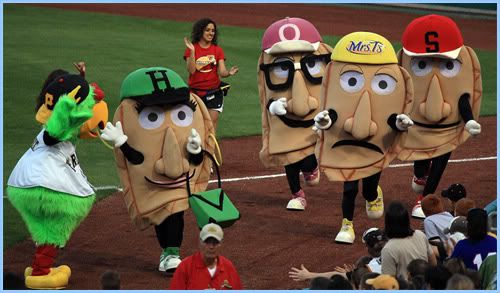
The Parrot and the Pierogi.
(Yes, like "cannoli," "pierogi" is plural.)
The Pirates will play "Take Me Out to the Ballgame" during the 7th inning stretch, but they do not seem to have an additional song, the way the Mets do with "Lazy Mary," the Orioles with "Thank God I'm a Country Boy," and others.
While there are several music legends native to the Pittsburgh area – Perry Como, Bobby Vinton, Lou Christie, the Dell-Vikings, the Vogues, and others – there doesn't seem to be a particular song that the special-effects people choose, although Christie's "Lightning Strikes" could be appropriate, and "Blue Moon," a song often reworked by English soccer fans (sometimes obscenely so), was done in doo-wop fashion by the Pittsburgh group the Marcels in 1961.
In case you're wondering, Willie Stargell liked "We Are Family" because of the image of togetherness that Sister Sledge were singing about, not because they had anything to do with Pittsburgh. In fact, they were from the opposite end of the State, in Philadelphia.
After the Game. There are attractions near PNC Park, but most of these are museums, such as the one dedicated to native Pittsburgher Andy Warhol, and will be closed after the games. The next bridge over from the Clemente is the Andy Warhol Bridge. Warhol was interested in baseball: He painted this image, in his style, of Mickey Mantle in 1962. He also did paintings of Tom Seaver and Pete Rose.
Between PNC Park and Heinz Field, across from where Three Rivers Stadium used to be, is Jerome Bettis' Grille 36, named for the Steeler legend and his uniform number. It's at 393 North Shore Drive.
I searched the Internet for bars in the Pittsburgh area that cater to New Yorkers. Usually, I can at least find something that welcomes Giant or Jet fans on their gamedays, but I guess the Steelers are so ingrained in Western Pennsylvania culture that establishing an outpost for "foreign fans" is anathema to them. (Anathema? Didn't Rocky Graziano knock him out in Buffalo? No, wait, that was Quinella.)
The closest I could come was a suggestion that Carson City Saloon, at 1401 E. Carson Street, was a
Jet fans' hangout. Number 48 or 51 bus from downtown. When I did this piece in 2013, I was told by a Pittsburgh native that the Brillo Box was owned by a New Yorker, but, not having been to Pittsburgh since, I cannot confirm this. And one source I found to back it up calls it a "hipster" place. If you want to take your chances, it's at 4104 Penn Avenue at Main Street. Number 88 bus from downtown.
If you visit Pittsburgh during the European soccer season, which starts up again next month, the city's leading soccer bar is Piper's Pub, at 1828 East Carson Street. No matter what club you support, you can almost certainly find its game on TV there. Bus 48. Unless you're a Liverpool fan, in which case you may prefer their outpost in the Steel City (Pittsburgh, not Sheffield): Cain's Saloon, at 3239 W. Liberty Avenue, 4 miles down the South Side. Red Line to Dormont Junction.
Sidelights. UPDATE: On November 30, 2018, Thrillist published a list of "America's 25 Most Fun Cities," and Pittsburgh came in 24th.
As I mentioned, Exposition Park, home of the Pirates from 1891 to 1909, was nearly on the site of PNC Park. The 1st home of the Pirates, Recreation Park, was roughly on the site of Heinz Field.
This was also the site of the 1st football game played by an openly professional player. Yale University star William "Pudge" Heffelfinger was paid $500 (about $12,800 in today's money) to play for the Allegheny Athletic Association against the Pittsburgh Athletic Club, and scored the game's only points in a 4-0 Allegheny win. (Under the scoring system of the time, a touchdown was 4 points.)
There are historical markers in the complex for both Exposition Park (as one of the sites, along with the Huntington Avenue Grounds in Boston, of the 1st World Series) and Recreation Park (as the site of the 1st professional football game -- though the 1st all-professional game was in 1895 in nearby Latrobe).
Three Rivers, the center of the sports world in the 1970s
The Steelers hosted the AFC Championship Game in the stadium's 1st season, 2001 (losing it to the New England Patriots, and again in 2004 (losing to the Pats again), 2008 (beating the Baltimore Ravens) and 2010 (beating the Jets).
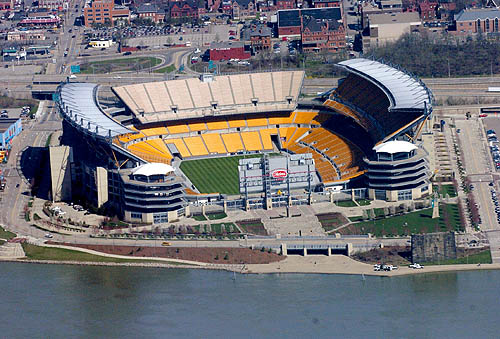
Heinz Field also hosted the 2011 NHL Winter Classic, in which the Pittsburgh Penguins lost 3-1 to the Washington Capitals. In 2017, it hosted an NHL Stadium Series game, in which the Penguins beat the Philadelphia Flyers 4-2. In the Summer of 2014, it hosted a soccer game, in which defending English champions Manchester City beat Italian giants AC Milan 5-1. 100 Art Rooney Avenue. (Three Rivers' address, famously, was 600 Stadium Circle.)
* Senator John Heinz History Center. It includes the Western Pennsylvania Sports Museum, open daily from 10 AM to 5 PM. (Senator Heinz, of the condiment-making family, was the 1st husband of Teresa Heinz Kerry, who nearly became First Lady in 2004.) 1212 Smallman Street at 12th Street, a couple of minutes' walk from Union/Penn Station and Greyhound.
* Forbes Quadrangle, intersection of Forbes Avenue and Bouquet Street. This set of buildings, part of the University of Pittsburgh campus, was the site of Forbes Field, home of the Pirates from 1909 to 1970, the Steelers from 1933 to 1963, and the Homestead Grays of the Negro Leagues from 1929 to 1950.
Included on the site is the last standing remnant of Forbes Field, part of the outfield wall, with ivy still growing on it. (Wrigley Field in Chicago wasn't the only park with ivy on its outfield wall.) Where the wall stops, you'll see a little brick path, and eventually you’ll come to a plaque that shows where the ball hit by Mazeroski crossed over the fence to win the Series. A historical marker honoring Barney Dreyfuss is nearby.
Home plate has been preserved, in Wesley W. Posvar Hall, named for the longtime UP Chancellor. An urban legend says that, if it was in its exact original location, it would now be in a ladies' restroom. This isn't quite the case, but it's still at roughly the same spot.
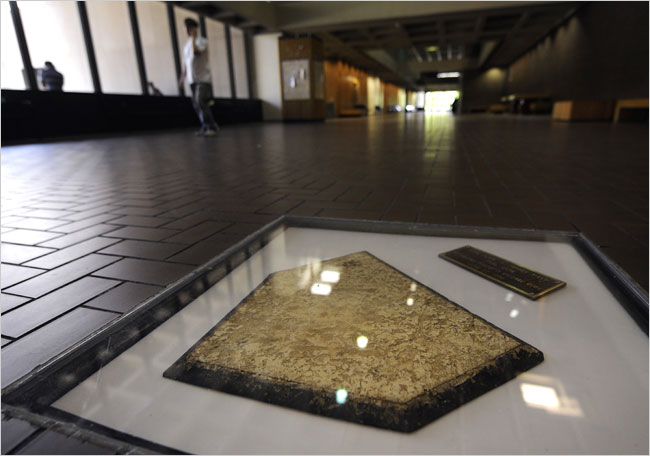
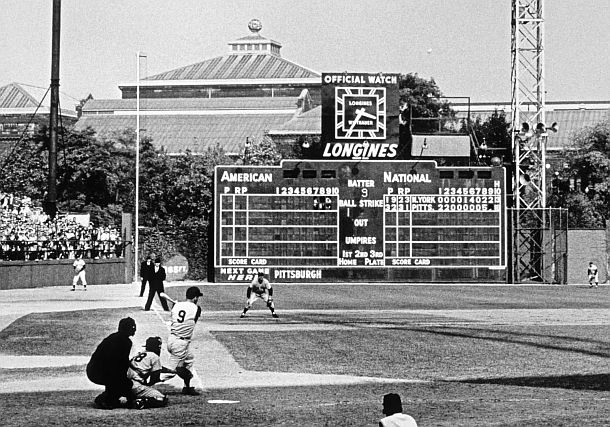
October 13, 1960, 3:34 PM. Or, as the band Chicago
would have put it, "25 or 6 to 4."
The remaining outfield wall, still with ivy on it
* Petersen Events Center. The home arena for Pitt basketball, it was built on the site of Pitt Stadium, where they played their football games from 1925 to 1999, and where the Steelers played part-time starting in 1958 and full-time starting in 1964 until 1969. Part-time from 1970 to 1999, and full-time in 2000, Pitt shared Three Rivers with the Steelers, and they've shared Heinz Field since 2001.
Pitt Stadium was home to such legends as Dr. Jock Sutherland (a dentist and football coach), Marshall "Biggie" Goldberg, Mike Ditka, Tony Dorsett, and, if you want to stretch the meaning of "legend," Dan Marino. If you're a Giants fan, this is where they played the Steelers on September 20, 1964, and Giant quarterback Y.A. Tittle got clobbered by the Steelers' John Baker, resulting in that famous picture of Tittle kneeling, with blood streaming down his bald head, providing a symbolic end to the Giants' glory days of Frank Gifford, Sam Huff and quarterbacks Charlie Conerly and Tittle.
Terrace Street and Sutherland Drive. From 1951 to 2002, before moving into Petersen, Pitt played basketball at Fitzgerald Field House. At 4,122 seats, it was very intimidating for visitors, but much too small for a major college basketball team, and most of their big-draw games had to be played at the Civic Arena. Building the Petersen Center allowed them a 12,508-seat on-campus arena. The old and new arenas are across Sutherland Drive from each other, a 5-minute walk from Forbes Quadrangle.
* Site of Greenlee Field. William Augustus "Gus" Greenlee was one of Pittsburgh's premier black businessmen -- but was both a gangster and a philanthropist. In 1932, he built Greenlee Field for the Negro League team he owned, the Pittsburgh Crawfords, named for another business he owned, the Crawford Grill.
Seating 7,500, it was the Craws' home from 1932 to 1938, when, for reasons beyond his control, he had to make changes that led to fans staying away, and he had to sell the team after the season, lasting 2 more years in other cities before folding. But, led by Hall-of-Famers Satchel Paige, Josh Gibson, Judy Johnson and James "Cool Papa" Bell, they won Pennants in 1935 and 1936.
Like Ebbets Field, it was on a Bedford Avenue. The Bedford Dwellings housing project is now on the site. 2501 Bedford Avenue, off Chauncey Drive (not Chauncey Street, as in Brooklyn), a mile and a half east of downtown. Bus 83.
* Site of Civic Arena, between Bedford Avenue, Fullerton Street, Centre Avenue and Washington Place. The official mailing address for "the Igloo" in its last few years was 66 Mario Lemieux Place. Built in 1961 for the Pittsburgh Civic Light Opera, it had a retractable roof before additional seating made such retraction impossible.
It hosted the American Hockey League's Pittsburgh Hornets from then until 1967, and then the NHL's Pittsburgh Penguins until 2010. It was officially known as the Mellon Arena from 1999 to 2010, when the naming rights expired.
The Pittsburgh Pipers, later renamed the Condors, played there, and won the 1st ABA Championship in 1968, led by Brooklyn native Connie Hawkins. Larry Holmes barely hung on to the Heavyweight Championship of the World there, getting off the canvas to knock Renaldo Snipes out on November 6, 1981.
The Beatles played there on September 14, 1964. Elvis Presley sang there on June 25 & 26, 1973 and December 31, 1976. It was demolished in 2011.
* PPG Paints Arena. Opening on August 18, 2010, for a concert by former Beatle Paul McCartney, it was known as the Consol Energy Center until last year. It seats 18,087 for Penguins and other hockey games, including the 2013 NCAA Championships (a.k.a. the Frozen Four); and 19,000 for basketball, for college tournaments and, in the unlikely event the NBA returns to Pittsburgh, the pros.
The building and opening of this arena means that, for perhaps the 1st time in franchise history, the Penguins' long-term future in Pittsburgh is secure. 1001 5th Avenue.
Pittsburgh hasn't had anything resembling a major league basketball team since the Condors moved in 1973. The new version of the ABA is officially "semi-pro," and has a team called the Steel City Yellow Jackets, who began play in the 2014-15 season. They play on the campus of the Community College of Allegheny County, at a building called the "A Giving Heart Community Center." 808 Ridge Avenue, across (or, rather, under) the elevated highway from Heinz Field.
On May 12, 2014, the New York Times printed a story that shows NBA fandom by ZIP Code, according to Facebook likes. The PPG Paints Arena is 134 miles from Cleveland's Quicken Loans Arena, but don't let that fool you into thinking that Pittsburghers toss aside their NFL-bred hatred of Cleveland to support the Cavaliers (even with the return of LeBron James): They seem to divide their fandom up among 4 "cool teams": The Chicago Bulls, the Los Angeles Lakers, the Boston Celtics and the Miami Heat. The Philadelphia 76ers, only 309 miles away? Forget it.
It's unlikely that Pittsburgh will ever seek out a new NBA team. If they did get one, the metro area would rank 22nd in population among NBA markets.
Pittsburgh has never hosted an NCAA Final Four. Duquesne University reached the 2nd Final Four (not that it was called that back then) in 1940, and Pitt did so in 1941. No Western Pennsylvania school has done so since.
In fact, Pittsburgh has never been a big basketball city: The Pittsburgh Ironmen played in the NBA's 1st season, 1946-47, and only that season, and are best known now for having had Press Maravich, father of Pistol Pete, play for them. The ABA's Pittsburgh Pipers, later the Pittsburgh Condors, won that league's 1st title in 1967-68, but that was it. (Connie Hawkins led that team, and was named to the ABA All-Time Team.) The most successful Pittsburgh basketball team may well have been the Pittsburgh Pisces in The Fish That Saved Pittsburgh.
* Duquesne Gardens. Pittsburgh's original sports arena opened in 1895, and had an unofficial limit of 8,000 spectators. It hosted minor-league hockey teams from the beginning until its closing in 1956, including the Hornets from 1936 to 1956. It hosted the Duquesne and Pitt basketball teams, and the Pittsburgh Ironmen in the NBA's 1st season, 1946-47.
Once bigger arenas like the old Madison Square Garden went up in the 1920s, seating more than twice as many people, the Duquesne Gardens was obsolete. Yet it hung on until 1956. 110 N. Craig Street, at 5th Avenue, near the Pitt campus. University housing is now on the site. Also accessible via the Number 71 bus.
The University of Pittsburgh is on the town's East Side. Penn State is 139 miles to the northeast in State College. West Virginia University, Pitt's other big rival, is 76 miles to the south in Morgantown. Greyhound provides service to State College, while Megabus does so to Morgantown.
* Highmark Stadium. As I said, Pittsburgh doesn't have a Major League Soccer team. The Pittsburgh Riverhounds play in the United Soccer League (USL), the 3rd tier of American soccer. Their home field is Highmark Stadium, and it seats a mere 3,500 fans, about the size of the average high school football stadium in New Jersey. But its placement on the south bank of the Monongahela, across from downtown, gives it a view every bit as good as the one from PNC Park. 510 W. Station Square Drive. Subway to Station Square.
* Roberto Clemente Museum. A fan group tried to buy Honus Wagner's house in nearby Carnegie and turn it into a museum, but this is the only museum devoted to a single Pittsburgh athlete, who was viewed as a supporting player on the 1960 title and the driving force behind the one in 1971, prior to his tragic death in a plane crash off Puerto Rico, trying to bring relief supplies to earthquake victims in Nicaragua on New Year's Eve 1972.
Clemente wasn't the 1st Hispanic player in the major leagues (white Cuban Charles "Chick" Pedroes played 2 games for the Cubs in 1902), nor was he the 1st black Hispanic player (Minnie Minoso debuted with the Chicago White Sox in 1949). But he was the 1st to really take hold in the public imagination, to the point where later Hispanic stars wore Number 21 in his honor, and there is a movement to have the number retired throughout baseball as was done for Jackie Robinson (but it is not likely to succeed). 3339 Penn Avenue at 34th Street. Bus 87 to Herron Avenue.
Wagner is buried at Jefferson Memorial Park, at 401 Curry Hollow Road in Pleasant Hills, about 8 miles south of downtown. Bus Y47. Josh Gibson is buried at Allegheny Cemetery, at 4734 Butler Street, about 4 miles northeast of downtown. Bus 91. Willie Stargell is buried in North Carolina, and when Clemente's plane went down in the Caribbean, his body was never recovered, so there is no final resting place for him.
No President has come from Pittsburgh, or from anywhere near it. The only President from Pennsylvania has been James Buchanan, and he was a lousy one, and he was from Lancaster, much closer to Philadelphia.
The most notable historic site in Pittsburgh is probably Point State Park, where the "three rivers" come together at the western edge of downtown. It includes the Fort Pitt Museum, telling the city's story from the days of New France Onward. 601 Commonwealth Place.
The U.S. Steel Tower, at 7th & Grant Avenues, is the tallest building in Pittsburgh, at 841 feet -- although there are 3 buildings in Philadelphia that surpass it for the title of tallest building in Pennsylvania. Built in 1970, it surpassed the 1932-built Gulf Tower, on the opposite corner from U.S. Steel.
There haven't been many TV shows set in Pittsburgh. They include My So-Called Life, Hope and Gloria, Queer as Folk, Man with a Plan, the World War II-era period piece Remember WENN, and This Is Us, which bounces around between 1980 and the present day.
Mr. Belvedere, starring Christopher Hewett as a butler to a family led by a sportswriter played by ballplayer-turned-broadcaster Bob Uecker, was set in nearby Beaver Falls, hometown of Jets legend Joe Namath, but it was filmed in Los Angeles. The most notable TV shows actually taped in Pittsburgh, at the PBS station WQED-Channel 13, were Mister Rogers' Neighborhood and Where In the World Is Carmen Sandiego?
Fred Rogers was from Latrobe, and in spite of his show's success, he never moved the taping to New York or Hollywood. He notably had Steeler receiver Lynn Swann on his show, to show that even a big tough football player (or, at least, a graceful wide receiver) could love ballet (which explained how Swannie got such nice moves in the first place). A statue of Mr. Rogers, sponsored by TV Land, is near Heinz Field, as is one of Steeler founder-owner Art Rooney.
A lot of movies have been shot in Pittsburgh, due to its varied architecture. Many have had sports scenes. You may have seen the 1994 version of Angels in the Outfield, which involved the team then known as the California Angels. The original black-and-white version came out in 1951, and the downtrodden team they featured was the Pirates, and there's some nice shots of Forbes Field in it. Some nice shots of Janet Leigh, too. (Jamie Lee Curtis' mom -- no, unlike in some other films such as Psycho, Janet doesn't flash any skin in this one, but now you know why Tony Curtis married her, and where Jamie Lee inherited the goods.)
The Fish That Saved Pittsburgh was a very silly, very Seventies movie, with Julius "Dr. J" Erving playing for the good guys and Kareem Abdul-Jabbar playing for the opposition. Sudden Death had Jean-Claude Van Damme trying to stop an assassination attempt at the Stanley Cup Finals. Both featured the old Civic Arena. Van Damme also filmed Timecop in Pittsburgh.
While most of The Dark Knight Rises was filmed in New York (with a few CGI bridges added to the skyline to create the atmosphere of the fictional Gotham City), and its 2 predecessors were filmed in Chicago, the football game scene was filmed at Heinz Field, with the fictional Gotham Rogues wearing Steeler black & gold. (They even made up a fake website for the team, including the Rogue Rag, a takeoff on the Terrible Towel.) Real-life Steeler legend Hines Ward returned the opening kickoff for a touchdown as Bane's bomb collapsed the field behind him, and playing the opposition's kicker was Luke Ravenstahl, then the Mayor of Pittsburgh in real life.
The scene where Gary Oldman goes to Matthew Modine's house to prepare for the final assault may also have been filmed in Pittsburgh, although the row-house style resembles Philadelphia. Some of the movie was filmed in Newark, but that street doesn't look like any part of Newark I've ever seen. You'd have to get as far south as Trenton to see Philly-style rowhouses in New Jersey, but then they've got 'em all along the Delaware River, in places like Bordentown, Burlington and Camden. Maybe it's a Pennsylvania thing.
One of Tom Cruise's earliest big films was All the Right Moves, a high school football movie set in Pittsburgh. He returned to Pittsburgh to film Jack Reacher. A movie with more life in it, the original 1968 Night of the Living Dead, was filmed in Pittsburgh. Its sequel Dawn of the Dead was filmed at the Monroeville Mall in the eastern suburbs, and the concluding chapter Day of the Dead back in the city.
Gung Ho, with Michael Keaton, spoofed the decline of Pittsburgh industry. Flashdance, with Jennifer Beals, turned the declining Pittsburgh dream on its head. Boys On the Side seemed to wink at it.
Groundhog Day starts in Pittsburgh before moving east to Punxsatawney. However, those aren't sports movies. (Although, with Jennifer Beals, Drew Barrymore and Andie MacDowell in them, there may be some heavy breathing.) PNC Park was used in the recent films She's Out of My League and
Abduction.
But the greatest movie shot in Western Pennsylvania was the 1977 hockey classic Slap Shot. Nancy Dowd wrote it about her brother Ned's experience with the Johnstown Jets, who played at the Cambria County War Memorial Arena. That arena, and minor-league arenas in New York State's Syracuse, Utica and Clinton, were used as filming locations, even though the film's Charlestown Chiefs were said to be in the Charlestown section of Boston. After the real Jets moved out, the replacement team was named the Johnstown Chiefs in honor of the crew led by player-coach Reggie Dunlop, played by Paul Newman.
The 4,000-seat arena, built in 1950, still stands, and is now home to a team called the Johnstown Tomahawks. 326 Napoleon Street in Johnstown, 67 miles east of Pittsburgh. It's a 15-minute walk from the Amtrak station, and the museum honoring the Johnstown Flood of 1889 is along the way.
*
Pittsburgh is a terrific city that loves its sports, and PNC Park is one of the best of the retro ballparks. Check it out.



:max_bytes(150000):strip_icc()/Washington-Union-Station-5942f59f5f9b58d58aa8e6a8.jpg)



/cdn.vox-cdn.com/uploads/chorus_image/image/60419849/1000541862.jpg.0.jpg)