This is mostly about sports, and then mostly about baseball. It will favor the New York Yankees, the New Jersey Devils, Rutgers University football, and the London soccer club Arsenal. You got a problem with that? Make your own blog.
As weird as this sounds, the freaky play that ended Game 3 of the 2013 World Series is a good thing for baseball.
It's gotten people talking about baseball, even on a night when there's been big college football games, not to mention the Devils' miraculous win against another Boston team (2 goals in the last 2 minutes against the Bruins to go from 3-2 down to winning 4-3).
Even tomorrow, when it's an NFL Sunday, with a couple of major rivalry games (Giants vs. Philadelphia Eagles, Pittsburgh Steelers vs. Oakland Raiders), people are still going to be talking about what's probably already being called The Middlebrooks Play.
The game, between the Red Sox and the St. Louis Cardinals at the new Busch Stadium, was tied 4-4 in the bottom of the 9th. With 1 out, Yadier Molina, Cardinal hero of the 2006 NLCS against the Mets, singled to right.
Matt Adams struck out swinging, catcher Jarrod Saltalamacchia to 1st baseman David Ortiz. Allen Craig pinch-hit for Trevor Rosenthal, and he Sox brought in their closer, Koji Uehara. Craig doubled to left, but Molina, known for his defense, wasn't fast enough to score, so he only got to 3rd.
The batter was Jon Jay, the Cardinal center fielder. He grounded to 2nd, and Dustin Pedroia dove for it, and threw home to throw Molina out. That was the 2nd out, and it was completely legitimate.
Had Sox catcher Jarrod Saltalamacchia simply held onto the ball, the play would have ended right there, Craig would have safely advanced to 3rd, and the Sox would've needed just 1 more out to get out of the jam and send it to extra innings.
The next batter was Pete Kozma, the shortstop, who was 0-for-4 at that point, and couldn't buy a base hit: In the NLCS and World Series combined, he's 1-for-19 (although he did bat .400 in the NLDS and have 3 walks and an RBI in the NLCS). So the Sox' chances were good.
But when Saltalamacchia saw Craig going for 3rd, he threw to Will Middlebrooks, and he couldn't handle it. He dove for it, but it went past him into left field. Craig, naturally, got up from his slide, and broke for home...
Except he tripped over Middlebrooks, whose legs seemed to rise in such a way that he was attempting to trip Craig up. He was then thrown out at home by Sox left fielder Daniel Nava...
But 3rd base umpire and crew chief Jim Joyce, who infamously got a call wrong at 1st base to deny Detroit Tiger pitcher Armando Galarraga a perfect game (and even a no-hitter) in 2010, ruled that Middlebrooks interfered with Craig, and that Craig's run would have scored without the interference, and declared that the run counted, and the Cardinals had won, 5-4.
To me, it doesn't look like an obvious attempt to obstruct. However, those legs going up, which did trip the runner up, sure look suspicious.
The NFL's standard for instant replay is that a call has to have been obviously wrong for it to be overturned; otherwise, the call has to stand. I can't say that I see enough evidence to decide that this call was obviously wrong.
Many of you have seen the play, also in Game 3, in the 1975 World Series, where Ed Armbrister of the Cincinnati Reds seemed to interfere with Carlton Fisk, apparently costing the Sox Game 3 and, by extension, that classic Series that went 7 games (all but one of them very good games, and Game 6 is regarded as one of the best games ever played, and Game 7 was damn good as well). Home plate umpire Larry Barnett got death threats over that refusal to call Armbrister out for interference.
I've seen that play many times (even though I wasn't yet old enough to watch baseball on TV, especially at such a late hour), and in that case, whether there was purposeful interference was even less clear. But Sox fans have been moaning about that play for 38 years, and now one of their guys has been caught "doing the same thing."
Two more things to keep in mind:
1. This Series is not over. Not by a long shot. There will still be a Game 4 and a Game 5. If the Sox can win those, they'll only have to win 1 of the last 2 at Fenway. If they split, they'll have to take the last 2, but those games would be at home.
2. For all the steroid use by Red Sox players, and for all the purpose pitches (hitting batters on purpose for purposes of intimidation), Sox fans need to shut the fuck up about this call. They have gotten more breaks from the "government" (in this case, umpires and Commissioner Bud Selig) than a "too big to fail" corporation.
If they end up losing this Series, especially if it goes to 7 games, they deserve it.
Maybe this is The Curse of the Bambino reasserting itself, as it may have done in September 2011. The Curse lives? 1918 * Forever!
Active ballparks in bold type, and ranked. Parks no longer in use (regardless of whether they're still standing) in normal type. Ties broken by most recent. For those that have not yet hosted, ties broken by most LCS hosted, then most LDS, then age (newest, therefore gone less without having hosted, to oldest, therefore gone longer).
Yankee Stadium, New York (1923 version), 36, between 1923 and 2003.
Polo Grounds, New York (1911 version), 13, between 1911 and 1954.
Sportsman's Park (a.k.a. Busch Stadium, 1909 version), St. Louis, 10, between 1926 and 1964.
11. SkyDome/Rogers Centre, Toronto, 2: 1992, 1993.
Metrodome, Minneapolis, 2: 1987, 1991.
Candlestick Park, San Francisco, 2: 1962, 1989.
12. Royals/Kauffman Stadium, Kansas City, 2: 1980, 1985.
Three Rivers Stadium, Pittsburgh, 2: 1971, 1979.
Cleveland Municipal Stadium, 2: 1948, 1954.
13. Yankee Stadium, New York (2009 version), 1: 2009.
14. Tropicana Field, St. Petersburg, 1: 2008.
15. Coors Field, Denver, 1: 2007.
16. U.S. Cellular Field, Chicago, 1: 2005.
17. Minute Maid Park, Houston, 1: 2005.
18. Angel Stadium, Anaheim, 1: 2002.
19. Bank One Ballpark/Chase Field, Phoenix, 1: 2001.
20. Turner Field, Atlanta, 1: 1999.
Metropolitan Stadium, Minneapolis, 1: 1965.
Los Angeles Memorial Coliseum, 1: 1959.
League Park, Cleveland, 1920.
Baker Bowl, Philadelphia, 1: 1915.
South Side Park, Chicago, 1: 1906.
Columbia Park, Philadelphia, 1: 1905.
Polo Grounds, New York (1890 version), 1: 1905.
Exposition Park, Pittsburgh, 1: 1903.
Huntington Avenue Grounds, Boston, 1: 1903.
21. Safeco Field, Seattle: 2 ALCS, 2000, 2001.
22. Oriole Park at Camden Yards, Baltimore: 2 ALCS, 1996, 1997.
23. Great American Ballpark, Cincinnati: 2 NLDS, 2010, 2012.
24. Miller Park, Milwaukee: 2 NLDS, 2008, 2011.
25. PNC Park, Pittsburgh: 1 NLDS, 2013.
26. Nationals Park, Washington: 1 NLDS, 2012.
27. Target Field, Minneapolis: 1 ALDS, 2010.
28. Petco Park, San Diego: 1 NLDS, 2006.
29. Marlins Park, Miami: No postseasons in 2 years.
30. Citi Field, New York: No postseasons in 5 years.
That the Mets are dead last among active ballparks is a quirk, due to having a relatively new stadium. That the Yankees are 13th among active ballparks is a shock, but remember: Like Citi Field, the new Yankee Stadium only opened in 2009.
Some of you may be confused by some of these dates:
In 1914, the Boston Braves left their home, the South End Grounds, and shared the larger, newer Fenway Park with the Red Sox until Braves Field could open. So when the Braves won the Pennant, they played their World Series home games at Fenway. The next season, Braves Field opened, with a larger capacity, and they returned the favor to the Red Sox, who played World Series "home games" there in 1915, 1916 and 1918.
Similarly, in 1918, the Chicago White Sox allowed the Cubs the use of Comiskey Park, which was larger than Wrigley Field, for the World Series. Wrigley did not host a World Series game until 1929, and Fenway, after 1914, did not do so again until 1946.
The Dodgers played in the L.A. Coliseum from 1958 to 1961, and then moved into Dodger Stadium.
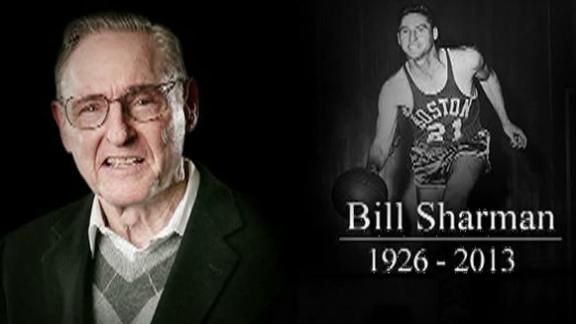
Bill Sharman might have been the best shooter in basketball history. He was also 1 of only 2 men to be involved in both a Boston Celtics NBA Title and a Los Angeles Lakers NBA Title. He was also 1 of only 2 men to coach an NBA Champion and an ABA Champion.
And I'll bet over half of you have never heard of him. Which is unfortunate, because he died yesterday.
*
William Walton Sharman -- no relation to William Theodore Walton III, a.k.a. Bill Walton -- was born on May 25, 1926 in Abilene, Texas, and grew up in Porterville, California, in the San Joaquin Valley. After serving in the U.S. Navy during World War II, he went to the University of Southern California on the G.I. Bill.
Traditionally, USC is known for football, and their arch-rivals, the University of California at Los Angeles, is known for basketball. But Bill Sharman played at USC, before UCLA ever reached what we would now call the Final Four, and was better than any player UCLA ever produced, except for Kareem Abdul-Jabbar (then known as Lew Alcindor) or that other William Walton.
Upon graduation, he played both baseball and basketball professionally. Like actor Chuck Connors (The Rifleman, Branded), he was in uniform for both the Celtics and the Brooklyn Dodgers. Also like Connors, his time in a Dodger uniform was brief: While Connors got into just 1 game for the Dodgers, before being traded to the Chicago Cubs (and sent to their Los Angeles farm team, leading to his off-season job as a stuntman and then an acting career), Sharman's time at Ebbets Field didn't even amount to that.
He was a September callup in 1951, as the Dodgers were sputtering and their arch-rivals, the New York Giants, were on a hot streak that would end in the Bobby Thomson Game (see the October 3 entry). On September 27, with his not yet having gotten into a game, home plate umpire Frank Dascoli threw the entire Dodger bench, Sharman included, out of the game for arguing. The Dodgers lost the game to the Boston Braves, 4-3. (Only 2,086 people came out to see this Pennant-race game -- it was a Thursday, but at least it was a night game.)
To this day, 62 years later, Bill Sharman remains the only player ever thrown out of a Major League Baseball game without having gotten into one.
*
But it is for basketball that he will be remembered. He was drafted by the Washington Capitols, having caught the eye of their coach, Brooklyn-born Red Auerbach. But when Auerbach was fired, and became head coach of the Boston Celtics in 1951, he got the Caps to put Sharman in a trade. The Caps went out of business not long after giving up both Auerbach and Sharman.
Had they kept both, basketball history would be very different, and it might be the Washington Capitols, rather than the Boston Celtics, that is the NBA team that everyone learned to love to hate. (And when the NHL came to town in 1974, the team would have had to be called something other than the "Capitals" with an A.)
Like Bob Cousy and Ed Macauley, he was a star for the Celtics before they were Champions. They were worse than a team that "couldn't win the big one": They couldn't even get into the big one. But when Macauley was put into a trade package for the rights to draft Bill Russell, basketball history was changed.
The Celtics won the NBA Title in 1957, '59, '60 and '61, and reached the Finals in '58. Sharman, 6-foot-1 (even then, short for a pro basketball player), was one of the first players to regularly shoot better than 40 percent. He led the NBA in free throw percentage a record 7 times, and his mark of 93.2 percent in 1959 remained the NBA record for 18 years. He still holds the record for consecutive free throws in the Playoffs, with 56. He played in 8 NBA All-Star Games.
Celtic fans like to talk about "the ghosts of the Boston Garden," just as Yankee Fans do about Yankee Stadium and Canadiens fans do about the Montreal Forum. I've even seen footage of fans walking around the old Boston Garden dressed in sheets, pretending to be ghosts, and it wasn't even Halloween (which usually predates the start of the NBA season by a few days, anyway).
But that's a bit ironic, since, until Dennis Johnson died in 2007, the only Celtics with their numbers retired (or equivalent honors dedicated) who had died were Auerbach (coach-general manager), Walter Brown (founder-owner), Johnny Most (broadcaster), and Reggie Lewis (died while still active, and never won a title). Since then, Macauley has died, and now, so has Sharman.
*
Sharman began his coaching career in 1966-67 with the San Francisco Warriors, and in his 1st season, he led them to the Western Conference title. It is a mark of underachievement that, despite being in one of the nation's biggest markets, and a good one for producing basketball talent (especially the Oakland side of San Francisco Bay, where the Golden State Warriors play now), they have only been to 1 Finals since (winning it all in 1975, their only title since moving west from Philadelphia in 1962). So it's also a mark of Sharman's coaching skill that he could overcome this.
In 1968, the American Basketball Association lured him away, and he became the head coach of the Los Angeles Stars. They moved to Salt Lake City for the 1970-71 season and became the Utah Stars, playing at the Salt Palace, which later became the home of the NBA's Utah Jazz. (This was the 2nd building with the name, and it has now been demolished, and replaced with a 3rd, which is used only as a convention center.)
Sharman was the 1st pro coach to have his players do a pregame shootaround. Whether that was the key to their title win, I don't know. I do know that, led by Zelmo Beaty, the Stars won 57 games and went through the Playoffs beating the Dallas Chaparrals (now the San Antonio Spurs), the Indiana Pacers and, in the Finals, the Kentucky Colonels.
That made Jack Kent Cooke, the future Washington Redskins owner then owning the Lakers, take notice, and he threw a pile of money at Sharman, who came home to L.A. and took over the Lakers. Nobody could coach the Lakers: They were a team of big stars, prima donnas: Wilt Chamberlain, Jerry West, Elgin Baylor. They had lost in the NBA Finals in 1962, '63, '65, '66, '68 and, having picked up Wilt, '69 -- all to the Celtics. When they reached the Finals again in '70, and found that the Celtics had finally gotten old, and the New York Knicks would be their opponents, they figured this was their chance. But they lost again.
But early in Sharman's 1st season, Baylor got hurt, and retired. The very next game, the Lakers started a 33-game winning streak, still the longest in the history of major league sports. (The Philadelphia Flyers of 1979-80 had an unbeaten streak of 35, and the 2003-04 Arsenal squad went 49 games without losing, but those streaks included ties.) The Lakers set a new league record with 69 wins, and beat the Knicks in the Finals, finally getting their 1st NBA Championship. (To compare: The Rams had won the NFL Championship for L.A.'s 1st title in 1951, while the Dodgers had brought the city World Series wins in 1959, '63 and '65.) Sharman got the Lakers to the Finals again in 1973, but this time they lost to the Knicks.
He remained head coach of the Lakers until 1976, and remained in their front office until his death yesterday. As a result of that employment, between the Celtics and the Lakers, he received 15 NBA Championship rings. That's not a record, although I don't know if anyone other than Auerbach (16) has beaten it.
Sharman's Number 21 was retired by the Celtics. He was named to the NBA's 25th Anniversary Team in 1971 and its 50th Anniversary 50 Greatest Players in 1996, attending the ceremony at which the players were introduced at the 1997 All-Star Game. (All but Pete Maravich were then still alive, and of those 49, all but West and Shaquille O'Neal attended. Why they didn't is a story for another time, but West comes off a whole lot better in it than Shaq does.)
Of the 10 men named to the 25th Anniversary team, only Bob Pettit, Dolph Schayes, and Sharman's Celtic teammates Russell, Cousy and Sam Jones are still alive. (The others, besides Sharman, were Paul Arizin and Joe Fulks of the old Philadephia Warriors, George Mikan of the Minneapolis Lakers, and Bob Davies of the Rochester Royals, the team now known as the Sacramento Kings.)
Of the 50th Anniversary 50 Greatest Players, Sharman's death leaves 44 still alive, including the following men he either played with or coached: Russell, Cousy, Jones, West, Baylor, Kareem (in Sharman's last year as Laker coach, 1975-76), Nate Thurmond and Rick Barry. (John Havlicek was also one of the 50GP and is still alive, but just missed being a teammate of Sharman's.)
Sharman is 1 of 3 men to have been elected to the Basketball Hall of Fame as both a player and a coach. The others are John Wooden and Lenny Wilkens. (The Basketball Hall does not differentiate between a person's collegiate and professional contributions.) Of our major-sport halls of fame, only College Football also does this. (So there is no one elected to the Baseball, Pro Football or Hockey Halls of Fame as both a player and a manager/head coach. Hardly any would be, anyway.)
For the record: The other man to be involved with a Celtic title and a Laker title, and the only one to play on both, was Clyde Lovellette, who played with the Lakers when they won their last title in Minneapolis in 1954, and won with the Celtics in 1963 and '64.
And the other man to coach an NBA Champion and an ABA Champion was Alex Hannum, who won in he NBA with the St. Louis Hawks in 1958 (beating Sharman's Celtics) and the Philadelphia 76ers in 1967 (beating Sharman's Warriors), and in the ABA with the Oakland Oaks in 1969.
UPDATE: Sharman was buried in Hillcrest Cemetery in his hometown of Porterville.
October 26, 1985: Time travel is first demonstrated at the Twin Pines Mall (or is that the Lone Pine Mall?) in Hill Valley, California -- or, rather, is dramatized in the film Back to the Future. The demonstration by Dr. Emmett Brown (Christopher Lloyd) and Marty McFly (Michael J. Fox) was actually filmed at the Puente Hills Mall in Industry, California. Most of the trilogy's scenes were filmed in Los Angeles County, although the Courthouse Square area was a movie set that, for whatever reason, has frequently been struck, not by lightning, but by fire. Just before the terrorist attack that forces Marty to get in the DeLorean and accidentally get sent back to 1955, Doc Brown tells Marty that he's going 25 years into the future: "I'll get to see who wins the next 25 World Series! Wouldn't that be a nice gift to have for my old age!" But in the 2nd film, partially set 30 years in the future -- 2015, just 2 years from now -- Marty sees that the Chicago Cubs have won the World Series, beating a Miami-based team whose logo is an alligator (impossible, unless MLB realigns to put the Cubs and Marlins in different leagues/conferences, to say nothing of the Cubs still being cursed). This inspires him to buy a sports almanac that he can take back to 1985, so he can know the results beforehand and bet on them: "I can't lose!" Doc warns Marty about how dangerous that can be, and convinces Marty to throw the almanac out.
But the film's antagonist, Biff Tannen (Thomas F. Wilson), picks up the thrown-out almanac, takes it with him, steals the DeLorean, and demonstrates that the Doc was right: Old Biff creates an alternate reality where Hill Valley is a mini-Las Vegas, and Biff is a cross between Fat Elvis and Tony Soprano, and, apparently having gotten connections to Richard Nixon, has even gotten the 22nd Amendment repealed so that Nixon is running for a 5th term as President and, according to a newspaper, "Vows to end Vietnam War by 1985." (A tip of the hat to Watchmen, perhaps?) This is remedied at the end of the 2nd film. Perhaps Marty should have warned the St. Louis Cardinals about what was going to happen in Game 6 of the 1985 World Series, starting at Royals Stadium (now Kauffman Stadium) in Kansas City, about 19 hours after his trip back into time. The Cards lead the cross-State Royals 1-0, and need just 3 more outs to win the World Series. Jorge Orta is thrown out at first base. The instant replay and the photograph above confirm this.
Except 1st base umpire Don Denkinger blows the call, and calls Orta safe. The next batter, Steve Balboni, pops up, and 1st baseman Jack Clark can’t handle it, and Balboni singles on his next swing. A passed ball by ex-Royal postseason hero Darrell Porter makes it men on 2nd and 3rd, and Hal McRae is intentionally walked. Dane Iorg steps up, and singles home Orta and Balboni, and the Royals have a 2-1 walkoff win to force a Game 7 at home.
The Cardinals are furious. So are their fans. They all think Denkinger stole the World Series from them. They still think so, 27 years later. There’s just one problem with this theory: There was still one game to go. If the Cardinals had won Game 7, Denkinger’s blown call would have been just a footnote. So Cardinal manager Whitey Herzog should have taken his team into the clubhouse and said, “Men, we got screwed tonight, but there’s nothing we can do about it now. So let’s win this thing tomorrow, and what happened tonight won’t matter.” Instead, the White Rat whined about the call to the media, and let it get into his head, and into his team’s heads. The shock isn’t that the Cards lost Game 7 11-0. The shock is that the Royals won it by only 11 runs. It is the biggest blowout in Game 7 history, previously reached only by, oddly enough, the 1934 Cardinals when they beat the Detroit Tigers. So, “Cardinal Nation”: Instead of blaming Denkinger for costing you the World Series, how about blaming your manager for not getting your team to shake it off? Or how about blaming your lineup for not hitting a lick? The umpire didn’t cost your team a World Championship: Your team did. Also on this day, Monta Ellis is born in Jackson, Mississippi. A guard for the Golden State Warriors, "the Mississippi Missile" was named the NBA’s Most Improved Player in 2007. He now plays for the Dallas Mavericks.
* October 26, 1863, 150 years ago: The Football Association is formed in London. Although there were football clubs (soccer teams) in England already (and a few of these are still in operation, though most on an amateur level), the rules of the game across the country were not uniform. So this is considered the “birthday” of English football.
October 26, 1868: A crowd of 10‚000 are at the Union Grounds in Brooklyn to see the Mutual Club of New York capture the national amateur baseball championship of the year by defeating the Atlantics of Brooklyn for the 2nd time‚ 28-17.
This is the first time a New York City club has won a postseason series designed to crown the national champions of baseball – or, if you prefer, the “World Champions.” However, when the Cincinnati Red Stockings declare themselves openly professional next year, it makes this the last "world championship" won by an amateur baseball team. October 26, 1877: What we would later call "Major League Baseball" suffers its first scandal. Charles Chase, vice president of the club known as the Louisville Eclipse, confronts George Hall‚ the National League home run leader in 1876 with 5‚ and pitcher Jim Devlin with charges that they threw road games in August and September of this past season. Both admit to throwing non-league games -- an exhibition game in Lowell‚ Massachusetts on August 30 and another in Pittsburgh on September 3 -- and implicate teammates Al Nichols and Bill Craver. Hall implicates Devlin, saying that the 2 helped in losses to the NL’s Cincinnati Reds (no connection to the current team of that name) on September 6, and to the minor league Indianapolis Blues on September 24‚ but he argues that since the Reds were about to be suspended and the games nullified‚ it amounted to an exhibition game. The accused players will end up being permanently banned from baseball. October 26, 1881: The Gunfight at the O.K. Corral, Tombstone, Arizona Territory. While the Earp brothers and Doc Holliday were no angels -- by the standards of the time, the Earps were a lot like a Mob family, just like Billy the Kid, killed earlier that year, was a hitman -- the Clanton Gang was worse. So if there were any "good guys" in this fight, it was the Earps, and they won.
And while there would be setbacks -- in the next year, Morgan would be killed and Virgil badly wounded -- today, the Clantons would be forgotten if not for this. Then again, so might the Earps. October 26, 1899: William Julius Johnson is born in Snow Hill, on Maryland's Eastern Shore, and grows up in Wilmington, Delaware. Without question, “Judy” Johnson is the greatest player ever to come from the State of Delaware.
So why are some of you saying, “I've never heard of him”? Because he played long ago, and in the Negro Leagues. Even those of you who have heard of him may be asking, “Why was he called Judy?” Because he resembled an earlier Negro League player, Judy Gans of the Chicago American Giants. I don’t know why he was called “Judy.” I thought perhaps his real name was Jude, but it was Robert. Judy Johnson starred in the 1920s for the closest Negro League team to Wilmington, the Philadelphia Hilldales. He was considered the best-fielding 3rd baseman in Negro League history, and 4 times hit .390 or higher, once hitting .401. Connie Mack, owner and manager of the Philadelphia Athletics, once told Johnson, “If you were a white boy, you could name your own price.” In 1930, as a player-coach for the Homestead Grays, Johnson discovered the legendary slugger/catcher Josh Gibson. Johnson and Gibson, as well as Satchel Paige and Cool Papa Bell, played for the powerful Pittsburgh Crawfords of the mid-1930s. Johnson’s play, and his proximity to the Pittsburgh Pirates, led to easy comparisons to their .300-hitting, slick-fielding hot-corner man, then considered the best one in the majors: Just as Gibson was called “the Black Babe Ruth,” Judy Johnson was called “the black Pie Traynor.” Once the color barrier was broken in the majors by Branch Rickey and Jackie Robinson, Mack signed Johnson as the first black person in the front office of any major league team. He moved to Kansas City with the A’s, but the Phillies, much slower to integrate than the A's, allowed him to “come home” as one of their scouts, and for them he discovered the man then known as Richie Allen. Dick Allen may have been as talented as Johnson’s other great find, Josh Gibson, but he was also a parallel for Gibson in the personal difficulties department, thankfully managing to overcome these as Gibson did not, and live, thus far, to the age of 71. Johnson was elected to the Baseball Hall of Fame, and was the first person elected to the Delaware Sports Hall of Fame, whose display is located at the home field of the State’s only professional sports team, the Wilmington Blue Rocks of the Class A Carolina League. The ballpark is named Judy Johnson Field at Daniel S. Frawley Stadium. (Frawley was the Mayor who brought the team in and got the ballpark built.) Johnson did not live to see this honor, dying in 1989 at the age of 89. His daughter married Billy Bruton, an All-Star outfielder for the Milwaukee Braves, and another player that Johnson discovered. October 26, 1902: Joseph Paul Zukauskas is born in Binghamton, New York, and moved to Boston after serving in the U.S. Navy, having tried to enlist to fight in World War I but being turned down due to his age, finally being let in after the war. It was in the Navy that he learned how to box. Although a Lithuanian-American, he tapped into his adopted hometown's Irish fan base by changing his name to the more Hibernian-sounding Jack Sharkey. He was the last major fighter beaten by Jack Dempsey, in the first heavyweight fight at Yankee Stadium, in 1927, in between Dempsey’s two title fight defeats to Gene Tunney. In 1930, Sharkey came back to Yankee Stadium to fight Max Schmeling, the winner to receive the title vacated by Tunney’s retirement. But in the 4th round, Sharkey hit Schmeling with a low blow, and was disqualified; for the first and only time, a major boxing title changed hands as the result of a disqualification. In 1932, Schmeling and Sharkey fought again, this time at the Madison Square Garden Bowl in Long Island City, Queens, and Sharkey won a controversial split decision to take the title. And he never successfully defended the title, as just one year later, he fought for the first time as sitting champion, and lost (see the 1906 entry). Like many of boxing’s former champions, he later opened a restaurant in his hometown. He also became a boxing and wrestling referee and an accomplished fly fisherman, and occasionally fished with another Boston sports legend, Ted Williams. When asked if he liked fishing better than boxing, he said, "It doesn't pay as much, but then, the fish don't hit back." He died in 1994, age 91. October 26, 1906: Primo Carnera is born in Sequals, Udine, Italy. The only citizen of Italy ever to win the heavyweight title, he won it by knocking Sharkey out at MSG Bowl in 1933. Had Don King promoted the fight, he wouldn't have held it on June 29, he'd have held it on October 26 and called it "The Birthday Bash."
Carnera remains the tallest and heaviest man ever to win an undisputed boxing world championship, although there have recently been bigger men, Russians, who have won the divided, quite disputed heavyweight title. But he, too, defended the title only once, also at MSG Bowl, and was knocked out by Max Baer in 1934, leading someone to say about the Bowl, “The place is jinxed!” Baer, too, would wait almost exactly one year to defend his title, and do it at the Bowl, and lost in one of boxing’s great upsets to Jim Braddock. "Cinderella Man" Braddock was smarter: He waited a whole 2 years, and then defended his title in Chicago's Comiskey Park instead of Long Island City, but it didn't work, as he got clobbered by Joe Louis. Carnera got to the top by a lot of boxers “taking dives,” encouraged to do so by the Mob, who wanted an Italian heavyweight champ, as Carnera was not very bright and easily manipulated. The first time there was an Italian-American heavyweight champ, Rocky Marciano, he didn’t need no help from the wiseguys. In fact, they idolized him, because he was what they wanted to be: The toughest guy in the world.
Carnera moved to Los Angeles, and became yet another boxer to open a restaurant, but ended up dying young, age 60, not because the Mob became unhappy with him, but because of diabetes and drinking. October 26, 1910: The Washington Post headlines a rumored trade that would have been the biggest in baseball history in terms of the one-for-one names involved, with Walter Johnson of the Washington Senators going to the Detroit Tigers for Ty Cobb. Detroit president Frank Navin scoffs at the story‚ saying he would never trade Cobb‚ but praising Johnson "as the best pitcher in the country." Cobb was about to turn 24 and had just finished his 5th full season of baseball; Johnson was 23 and had just finished his 4th season. This would have been like trading Miguel Cabrera for Clayton Kershaw today. October 26, 1911: The Philadelphia Athletics win their 2nd straight World Series. Chippewa pitcher Albert “Chief” Bender cruises to his second victory‚ a 4-hit 13-2 breeze. The A's cap the win with a 7-run 7th‚ battering three tired Giant hurlers‚ Red Ames‚ Hooks Wiltse‚ and Rube Marquard. Overall‚ the Giants manage just 13 runs and a .175 BA off Bender‚ Jack Coombs and Eddie Plank, gaining revenge for the Christy Mathewson-dominated Series of 1905 when the Giants embarrassed the A’s. Because of the NL's extended playing season‚ and a record 6-day rain delay, this is the latest ending ever for a World Series‚ and would remain so until the strike-delayed 1981 Series. Also on this day, Sid Gillman is born in Minneapolis. With the Los Angeles Rams, he used the passing game of Norm Van Brocklin to Elroy “Crazy Legs” Hirsch and Tom Fears to win an NFL Championship as an assistant coach in 1951 and a Western Division title as head coach in 1955.
He became the first head coach of the San Diego Chargers in 1960 (they played their first season in Los Angeles before moving down the Coast), coaching quarterbacks like Jack Kemp, Tobin Rote and John Hadl, and receiver Lance Alworth, and reached 5 of the first 6 AFL Championship Games, in 1960, ’61, ’63, ’64 and ’65, winning in 1963 – still the only time in major league sports that a San Diego team has gone as far as their league allowed them to go. (They did not play the NFL Champion Chicago Bears, and if they had, it might have been the AFL’s best chance to make a statement until Joe Namath and the Jets beat the Colts 5 years later.) It was Gillman’s wide-open passing game that helped to give the AFL its first positive reviews and its reputation as a League where anything could happen at any time, contrasting with the NFL, then comparatively very conservative despite having such quarterbacks as Johnny Unitas, Sonny Jurgensen and Bart Starr.
Gillman later served as an assistant with the Philadelphia Eagles, helping head coach Dick Vermeil develop Ron Jaworski, and with the Los Angeles Express of the USFL, where he helped to develop Steve Young. Coaches who played or coached under him include Vermeil, George Allen, Al Davis, Chuck Noll and Chuck Knox. Coaches who played or coached under those men include: With Davis’ Oakland Raiders, John Madden, Tom Flores, Art Shell, Bill Walsh and Jon Gruden; with Allen’s Redskins, Jack Pardee, Richie Petitbon and Joe Bugel; with Noll’s Steelers, Bud Carson and Tony Dungy; with Vermeil’s Eagles, Herman Edwards. Walsh’s “coaching children,” and thus Gillman’s “grandchildren,” include Mike Holmgren, Jim Fassel, Sam Wyche, George Seifert and Dennis Green; through them, Gillman’s “great-grandchildren” include Andy Reid, John Fox, Mike Shanahan, Jeff Fisher, Brian Billick, Lovie Smith and Mike Tomlin. Gillman was elected to the Pro Football Hall of Fame, one of the first primarily-AFL figures to be so honored. Also on this day, Mahalia Jackson is born in New Orleans. She is often regarded as the greatest singer of gospel music ever, of any race, of any gender, of any era. She sang at the March On Washington in 1963, and, supposedly, saw Dr. Martin Luther King Jr. was wrapping up his speech, and she remembered a previous speech of his, and said to him, “Martin, tell them about the dream.” He did so, and a strong call for social justice became something larger than even all the people on that stage, which also included A. Philip Randolph, Bayard Rustin, John Lewis, Marlon Brando, Bob Dylan and Joan Baez. If the story is true, then Mahalia performed a greater service to the human race than most people ever do to the God who created it. October 26, 1917: Miller Huggins‚ a former “good-field, no-hit” 2nd baseman for the Cincinnati Reds, who managed the St. Louis Cardinals to a 3rd-place finish this season‚ is signed to run the Yankees by owner Jacob Ruppert. Co-owner Til Huston‚ who favored Brooklyn Dodger boss Wilbert Robinson for the job‚ has a falling out with partner Ruppert, and will sell his half interest to Ruppert in 1923. Huston had tried throughout the 3 men’s common tenure to get rid of Huggins, to the point that, when Ruppert finally bought Huston out and announced it to the press, the next words out of his mouth were “Miller Huggins is my manager.” And Huggins remained Yankee manager until his death in 1929, along the way leading the club to its first 6 Pennants and its first 3 World Championships. October 26, 1931: Charles Comiskey dies at age 72. One of the great players of the 1880s with the St. Louis Browns (forerunners of the Cardinals), he practically invented the way 1st base was played, and he was a major figure in the Players’ League revolt of 1890.
But when offered the chance to start, own and run a team in the new American League in 1901, which became the Chicago White Sox, he betrayed the players who followed him by pinching pennies, much as later hockey greats Wayne Gretzky and Mario Lemieux would do. Known as “the Old Roman” despite being of Irish descent, he built the ballpark that would bear his name, Comiskey Park, and built a franchise that would win 4 Pennants and 2 World Series in his lifetime. But he also indirectly caused, and made much worse, the greatest scandal in sports history, the Black Sox Scandal of 1919-21. His reputation as a great player and a smart, canny executive has been wiped out, replaced by one as a cheap, nasty old bastard.
On this same day, the Frankford Yellow Jackets defeat the Chicago Bears, 13–12 at Wrigley Field. Due to the Great Depression, the Jackets went out of business. The next day, the team's owner, the Frankford Athletic Association of Northeast Philadelphia, returned the franchise to the NFL.
On July 9, 1933, Bert Bell and Lud Wray bought the territorial rights to a Philadelphia team from the NFL. And their new team, named the Eagles after the Blue Eagle symbol of President Franklin D. Roosevelt's New Deal, at first wore the Jackets' colors, powder blue and gold. But they did not purchase the team itself, only the local rights to one. As a result, the NFL does not consider the Eagles a continuation of the Jackets, and the Eagles do not claim the Jackets' 1926 NFL Championship as one of their titles, along with those they won in 1948, 1949 and 1960.
This 1931 game also marked the last time a Philadelphia-based NFL team would win an away game over the Bears until October 17, 1999, when the Eagles defeated the Bears 20–16 at Soldier Field. October 26, 1934: Washington Senators owner Clark Griffith sells his shortstop and manager, Joe Cronin, to the Boston Red Sox for $225‚000 and Lyn Lary. Recently married to Mildred Robertson‚ Griffith's niece and adopted daughter‚ Cronin is signed to a 5-year contract, a real rarity in those days. This trade not only helps return the Red Sox to contention for the first time since Harry Frazee sold off several stars to the Yankees from 1919 to 1923, but it also helps wreck the Senators franchise, which had won the Pennant just one year earlier: For 77 years, from 1934 to 2011, only once, in 1945, had a Washington baseball team been in a major league Pennant race, only twice had they finished as high as 2nd, only 3 times as high as 3rd, and only 5 times had they had winning seasons. This includes the “old Senators” from 1935 to 1960 (when they moved to become the Minnesota Twins), the “new Senators” from 1961 to 1971 (when they moved to become the Texas Rangers), the Washington Nationals who had been terrible with flashes of fun since arriving in 2005, and the 1972-2004 interregnum when D.C.-area fans either had to go up to Baltimore, go to only the occasional exhibition game at RFK stadium, check out minor-league teams (the Maryland cities of Salisbury, Frederick and Hagerstown, or Virginia teams like nearby Prince William), or stick to TV and go without live major league ball.
And, since the Nats blew it last season by shelving Stephen Strasburg, D.C. still hasn't had a Pennant since 1933.
October 26, 1938, 75 years ago: For the first time, an ice hockey match is televised. Oddly, this does not occur in Canada, or in America. It is in England, on the BBC, between Harringay Racers of North London and Streatham Redskins of South London. Neither team exists in their 1938 form any longer.
In 1940, New York station W2XBS (forerunner of WNBC-Channel 4) would become the first station to broadcast an NHL game, a 6-2 New York Rangers win over the Montreal Canadiens at (the old) Madison Square Garden; 3 days after that, they would broadcast the first televised basketball game. That station had already broadcast the first baseball, college football and NFL games on television, all in New York in 1939.
In 1952, CBC would bring Hockey Night In Canada from radio to TV, and it quickly became, and remains, Canada's favourite (that's how it's "spelt" up there) TV show. But the U.S. -- ABC/ESPN, NBC and Fox have all tried -- has never really gotten hockey broadcasts right. "Glow puck," anyone?
October 26, 1940: Detroit Tigers outfielder Hank Greenberg is named the Most Valuable Player of the American League. Greenberg won the MVP honors in 1935 as a 1st baseman, but this season has played mostly left field, as another big slugger, Rudy York, is being tried at 1st. Greenberg will soon become the first big-name player to enlist in the U.S. armed forces in anticipation of World War II, and when he returns in 1945, York is gone to Boston, and he plays the rest of his career at his former position of 1st base. Nevertheless, he is the first player to win MVP awards while playing at 2 different positions. He has since been joined only by Robin Yount (shortstop and center field) and Alex Rodriguez (shortstop and 3rd base). October 26, 1946: Columnist Westbrook Pegler, writing for the Hearst Corporation’s papers including the New York Journal American, writes a critical piece about the off-field relationship between Dodger manager Leo Durocher‚ actor George Raft and well-known gamblers. This is the first of a number of articles that will lead up to the suspension of Durocher for the 1947 season. Pegler was an alcoholic and a lunatic, who had already called for the assassination of President Franklin D. Roosevelt, and one of his last public acts would be to do the same for Robert Kennedy, which happened. Eventually, he couldn’t be hired by anyone except the John Birch Society, and finally even they fired him for being too extreme. But, in the case of Durocher, and in a few others, Pegler turned out to be right.
The recent movie 42, about Jackie Robinson and his introduction to the white majors, suggested that Durocher was actually suspended by Commissioner A.B. "Happy" Chandler because the local Catholic Youth Organization (CYO) was threatening to boycott the Dodgers due to Durocher's affair with actress Laraine Day (whom he married as soon as his divorce from his current wife became final). Another factor is that, while Durocher was associating with known gamblers, he suggested that Yankee co-owner Larry MacPhail was doing the same, and accused Chandler of a double standard (Durocher was being targeted for it, while MacPhail was getting away with it).
Whatever the truth about MacPhail may have been (certainly, with co-owner Del Webb's Mob ties, it's possible), Durocher was suspended for what Chandler called "conduct detrimental to the game." He would return for the 1948 season, then, when Mel Ott was fired as manager of the Dodgers' arch-rivals, the New York Giants, they offered Durocher the job, and he jumped ship -- making him the most-hated figure in the history of Dodger fandom, a traitor, a turncoat. Sort of like Sol Campbell going from Tottenham captain to Arsenal star -- if, that is, the Dodgers had been pushing Durocher out, which they hadn't. So it's more like Roger Clemens going from the Red Sox to the Yankees -- if Clemens hadn't spent 2 years in Toronto in between.
October 26, 1947: Hillary Diane Rodham is born in Chicago. And, yes, growing up, she was a Cub fan. In 1994, then First Lady, Hillary Clinton was invited to throw out the ceremonial first ball on Opening Day at Wrigley Field.
I knew she was never really a Yankee Fan. But then, Michael Bloomberg was honest about having been a Red Sox fan, and I'd sooner trust Hillary to be Mayor of New York, let alone President. Of course, we still have White Sox fan Barack Obama for another 3 years and change.
October 26, 1948: Colbert Dale Harrah is born in Sissonville, West Virginia. An All-Star 3rd baseman for the Texas Rangers and the Cleveland Indians, Toby Harrah was the last active player who had been a member of the Washington Senators, the team that moved to become the Rangers in 1972.
Next-to-last was his former Ranger teammate Jeff Burroughs, and together, with players like Mike Hargrove and Ferguson Jenkins, managed by Billy Martin, they finished 2nd in 1974, the best finish the Senators/Rangers franchise had yet had in 14 years of existence. They would finish 2nd again with Harrah in 1977 and 1978, but wouldn’t win the AL West until 1994 – ironically, after Harrah’s brief tenure as Rangers manager had ended. In 1976, despite playing both games at shortstop, he went through an entire doubleheader without a single fielding chance. Despite this, he was generally regarded as a good defensive player, who also managed to hit 195 home runs despite being a middle infielder and playing his entire career in pitchers’ parks: Arlington Stadium, Cleveland Municipal Stadium (the Rangers had traded him to the Indians for 3rd baseman Buddy Bell, a trade which worked out well for both teams, though neither is known for making good trades) and, for one season, in the old Yankee Stadium with its “Death Valley” in left and center making it hard on a righthanded hitter. October 26, 1949: Stephen Douglas Rogers is born in Jefferson City, Missouri. No, not Captain America. This Steve Rogers plied his trade in Canada, as an All-Star pitcher for the Montreal Expos, and remains the all-time leader in several pitching categories for the franchise now known as the Washington Nationals.
Unfortunately, the furthest that franchise has ever gotten was a tie game in the 9th inning of the 5th and deciding Game of the 1981 NLCS, when Rogers, who had won Game 3 but was now pitching in relief on just 2 days rest, gave up a Pennant-winning home run to the Dodgers’ Rick Monday. He deserves to be remembered for more than that, as he, not Randy Johnson or Pedro Martinez (neither of whom stayed in Montreal for very long) was the greatest pitcher in that franchise’s history, and even if Stephen Strasburg does more for them than Rogers did in an Expo uniform, Rogers will still be the greatest pitcher the city of Montreal has ever had. (Former Dodgers manager and Montreal Royals lefty Tommy Lasorda may dispute that, but the Royals were the minors, the Expos – no matter how inept they sometimes were on the field and in the front office – were the majors.)
He was a 5-time All-Star, won 158 games in the major leagues, had a 3.17 ERA, and now lives not far from me, in West Windsor, New Jersey, employed by the players’ union, the Major League Baseball Players Association. October 26, 1950: Branch Rickey resigns as president of the Brooklyn Dodgers, and Walter O'Malley succeeds him. Rickey sells his 25 percent interest in the club for a reported $1.05 million. O’Malley had tried to push Rickey out, and got his chance when another partner died and his heirs wanted to sell his shares. O’Malley, in this as in everything else a money-grubbing bastard who didn’t care who he hurt in the process, tried to lowball Rickey, offering him only his original investment in the club, the $350,000 he had paid in 1942. But Rickey and O'Malley, despite some stark differences, were more alike than either cared to admit. One way in which they were alike is that both were lawyers who knew all the tricks. Rickey knew that an agreement in the Dodger partnership said that if any of the partners got an offer for their shares, and another partner wanted to buy, that other partner had to match the offer. Rickey found someone willing to pony up a million, and so O’Malley had to pay through the nose: The $350,000 of ’42 was worth $548,000 in inflation-adjusted dollars, while the $350,000 of ’50 was worth just $223,000, so O’Malley was really offering Rickey a 57 percent loss. Instead, O’Malley had to pay Rickey a 92 percent profit. Today, Rickey’s original ’42 investment is worth $4.8 million, O’Malley’s ’50 offer $3.1 million, and Rickey’s $1.05 million becomes $9.2 million. In 1969, O’Malley admitted his holdings in the Dodgers were worth $24 million, which is $143 million in 2013 dollars; at his death in 1979, at which point son Peter became owner, they were said to be worth $50 million, or today’s $150 million; when Peter sold the Dodgers in 1997, it was for $311 million, or today’s $420 million. When Magic Johnson bought the Dodger franchise, including Dodger Stadium, last year, the price was rumored to be about $2 billion. October 26, 1951: Desperate for money to pay a mounting tax bill, Joe Louis, who stood as heavyweight champion of the world longer than anyone (12 years, 1937-49) and defended the title more than anyone (25 times), climbs into the ring at the old Madison Square Garden for a purse of $300,000 – about $2.5 million in today’s money. He fights Rocky Marciano, then a rising contender who idolized Louis. Rocky had told the press, “This is the last guy I want to fight.” It is a mismatch: Marciano is 28, is in superb shape, and has a sledgehammer for a right hand; Louis is 37, struggles with his weight, and his arms and legs, once the fastest in the fight game despite his being a heavyweight, have terribly slowed. Marciano actually knocks Louis out of the ring in the 8th round. Marciano goes back to his dressing room and cries over what he has done to his greatest hero, and even goes over to see him and says, “I’m sorry, Joe.” Sugar Ray Robinson, then middleweight champion, was in Louis' dressing room to console him, and was also crying. Eleven months later, Marciano will knock out Jersey Joe Walcott to become champion. Louis, still needing money, will humiliate himself as a professional wrestler, and not a very good one. Both men’s lives will end badly: Marciano's in a plane crash in 1969, Louis' in a wheelchair, unable to pay his medical bills, with Frank Sinatra hosting a benefit concert for him in Las Vegas in 1978, which keeps Louis afloat until he finally passes away in 1981.
As a Sergeant in the Army in World War II, he is laid to rest at Arlington National Cemetery, on the order of President Ronald Reagan, and with Sinatra delivering the eulogy. October 26, 1957: Robert Perry Golic is born in Cleveland. An Ohio State Champion wrestler at Cleveland's St. Joseph’s High School, Bob Golic played defensive tackle for his hometown Browns, and was a member of the team that lost back-to-back AFC Championship Games to the Denver Broncos in the 1986 and '87 season.
He and his brother Mike Golic, also a former NFL player, are both hosts of sports-talk shows on radio (although not together), and while Mike does NurtiSystem commercials that show him losing 50 pounds, Bob, using a different diet, has lost 140 and is back to his high-school weight of 245 pounds.
October 26, 1963, 50 years ago: Natalie Anne Merchant is born in Jamestown, New York. She was the lead singer of 10,000 Maniacs -- not to be confused with a capoultra, who leads "Ultra" groups in European soccer. October 26, 1966: Jeanne Zelasko is born in Cincinnati. She was the host of Fox’s baseball pregame shows from 2001 until its cancellation in 2008, twice taking time off to have children. She now works for MLB network. She is also a survivor of thyroid cancer.
A lot of baseball fans don’t like her, but I do. She knows the game and is a very good interviewer. But at the 2005 All-Star Game in Detroit, she wore an orange dress, to match the host Tigers’ colors. She was pregnant at the time, and orange is not a good color for a maternity dress. But she still did her job well that night, and it certainly wasn’t as poor a choice as the night Hannah Storm, working the 1997 NBA Finals for NBC, did an interview with Dennis Rodman, exposing her unborn child to his weirdness. (As far as I know, both of the children in question are okay.) October 26, 1967: Keith Lionel Urban is born in Whangerei, New Zealand. At age 6, he moved with his family to Australia, and is an Australian citizen. Eventually, he moved to America and became a country singer. He is married to fellow Australian-American Nicole Kidman, which makes him not just a member but an officer of the Lucky Bastards Club. A lot of people were very upset at country singer Garth Brooks for his “side project,” The Legend of Chris Gaines, in which Brooks “played” Gaines, including doing concerts and TV appearances in character. I liked the idea -- but then, I wasn't find of Brooks' regular persona. I am now convinced that the Gaines character is based on Urban: Gaines, too, was born in 1967 (making him 5 years younger than his portrayer), was born in Australia but grew up in Los Angeles, and dealt with substance abuse at the height of his fame. October 26, 1973, 40 years ago: On the day the Yom Kippur War ends, bringing a cease-fire between Israel and its Arab neighbors, the Boston Red Sox trade pitcher Ken Tatum and outfielder Reggie Smith to the Cardinals for pitcher Rick Wise and outfielder Bernie Carbo.
This could have been one of those rare trades that worked out for both teams: Wise was the leading winner on the Sox rotation that won the 1975 AL Pennant, and Carbo hit a key home run in that year’s World Series; while Smith hit 314 career home runs – 2nd all-time among switch-hitters behind Mickey Mantle at the time of his retirement – and helped his team win 3 Pennants and a World Series. The problem was that, just as the Cards gave up on Steve Carlton too soon, trading him to the Phillies for Wise, and gave up on Jerry Reuss too soon, sending him to the Dodgers, and now give up on Wise too soon, they will later give up on Smith too soon, trading him to the Dodgers, where he and Reuss will team up on the team that dominates the NL West from 1977 to 1988.
October 26, 1976: Miikka Sakari Kiprusoff is born in Turku, Finland. He was the goaltender for the Calgary Flames, nearly helping them win the 2004 Stanley Cup with some amazing saves in the Playoffs. He recently retired. His brother Marko has also played in the NHL and now plays in their native Finland. October 26, 1983, 30 years ago: Francisco Liriano is born in San Cristobal, Dominican Republic. The Minnesota Twins’ lefthander reached the All-Star team in 2006 aged just 22, but an elbow injury has hampered his career ever since. He now pitches for the Pittsburgh Pirates, and reached the Playoffs this season.
October 26, 1984: Alexandra Pauline Cohen is born in Los Angeles. Of Russian-Jewish descent, "Sasha" Cohen won a Silver Medal in figure skating at the 2006 Winter Olympics, and has since become an actress.
She is definitely not to be confused with the also-Jewish British actor Sacha Baron Cohen, a.k.a. Ali G, Borat, Bruno, and Admiral General Hafez Aladeen. Unlike Sacha Baron Cohen, Sasha Cohen has class. October 26, 1991: Game 6 of the World Series. The Minnesota Twins even the Series at 3 games each with a 4-3 win over the Atlanta Braves, thanks to Kirby Puckett's great catch and his dramatic home run in the bottom half of the 11th inning. What has been shaping up as one of the best World Series ever will go to a Game 7 that will be worthy of it. October 26, 1993, 20 years ago: Shaquille O'Neal releases his first recording, the rap album Shaq Diesel. The album sells over a million copies, and the single "(I Know I Got) Skillz" reaches Number 35 on the Billboard magazine Hot 100. However, Shaq was wise to not quit his day job. October 26, 1996: Has it really been 17 years? Yes. Yankees 3, Braves 2, clinching the Yankees' 23rd World Championship, their first in 18 years, at Yankee Stadium. The Yanks scored all 3 runs in the bottom of the 3rd, including a triple off Greg Maddux by catcher Joe Girardi. Now that Girardi is the Yankee manager, it's easy to forget what kind of a player he was. He was a good defensive catcher, but hitting a triple off Maddux in a World Series game was really unexpected. It wasn’t quite the U.S. college kids beating the “amateur” hockey players in their 30s put up by the Soviet Union in the 1980 Olympics, nor was it quite Buster Douglas knocking out Mike Tyson in 1990. But it was a shock. A beautiful shock – which may be the first time Joe Girardi has ever been associated with the word “beautiful.” (Let’s face it, from Casey Stengel’s wrinkles to Billy Martin’s nose, from Joe Torre to Girardi, successful Yankee managers have rarely been good-looking men.) When Mariano Rivera, then the “bridge” reliever, was on the mound in the 8th, Fox announcer Tim McCarver said, "There's not a lot of secret as to what you're gonna get from Mariano Rivera: A lot of high gas." It would be the next year, when Mo succeeded John Wetteland as the closer, that he developed the cut fastball that made him the greatest relief pitcher of all time. When Mo got a strikeout to end the 8th, McCarver and Joe Buck wisely didn’t say a word, and let the roar of the crowd be what took them to commercial. Those cheers seemed to contain not a word, but they spoke volumes. Some who were there said that the old Yankee Stadium actually shook at that moment. An inning later, Wetteland, who became the first reliever ever to save all 4 of his team's wins in a World Series (and remains the only one) and was named MVP, got Mark Lemke to pop up to third base, and Charlie Hayes caught it. As John Sterling said on WABC (the Yankees’ radio station at the time), “Hayes... makes the catch! Yankees win! Theeeeeeee Yankees win!” (He didn’t start adding "Ballgame over!" until the next year, and didn't start adding “(name of series) over!” until the next.) Never mind how I felt about the Braves, though like many fans I was already sick of them. This was about the Yankees winning the World Series for the first time since 1978 – and since my parents made me go to bed early in 1977 and ’78, this was the first time I had ever seen the Yankees win a World Series as it happened. And when you live in a town full of Met fans, and see Met fans every day on the local news, and hear all the time about 1969 and 1986, then 18 years really does feel as long as 86 years ended up feeling to Red Sox fans. Add the fact that a lot of Met fans switched sides, either temporarily (like Joan Hodges, Gil’s wife, and son Gil Jr.) or permanently (like Spike Lee), and the fact that the Yankees’ ticker-tape parade attracted 4 million people, more than attended either of the Mets’ parades, and more than attended the Rangers’ parade in 1994 (have I ever mentioned that the Rangers SUCK?), and this was the most satisfying sports championship I had ever experienced. Even more than the Devils’ first Stanley Cup the year before. More than the various sports titles won by East Brunswick High. Even the football State Championship won, at long last, by E.B. in 2004 cannot top this. The ’98 and ’99 Yanks? Great victories, but ’96 would always been the sweetest sports win of my life. Or so I thought. More on that in a moment. Sterling was interviewed on WABC-Channel 7’s Eyewitness News the next day. He was not yet known as the hyper-partisan, victory-yammering “Pa Pinstripe” that he later became; we did not yet think of him as "the Voice of the Yankees" like we did Phil Rizzuto, and generations before thought of Mel Allen. And he knew that this team had won just 92 games in the regular season, faced a tough challenge from the Baltimore Orioles to win the AL East, lost Game 1 of the ALDS to the Texas Rangers and were losing in Game 2 before they came back to win that, Game 3 and Game 4; and then had the Jeffrey Maier incident in Game 1 of the ALCS and lost Game 2 before sweeping 3 in Baltimore, and finally coming back from 2 games to 0 to take the next 4 of the World Series against the Braves. This Yankee team’s greatness was not in their numbers or in their star power – remember, Derek Jeter was a rookie, so was Jorge Posada (and he wasn’t even the starting catcher yet), and Rivera and Andy Pettitte were both in Year 2 – but in their performance, their courage and their resilience. As George Steinbrenner said afterwards, “They’re battlers, and New York is a city of battlers. You battle for everything in this town: For cabs, for a seat in a restaurant, everything.” And Sterling summed the ’96 Yankees up: “They’re not a great team, but they’re a team that plays great together.” Beautiful. Then in 1998, the Yankees became the greatest single-season team of all time. October 26, 1997: Game 7 of the World Series at whatever the combined Marlins-Dolphins stadium in the Miami suburbs was called at the time. The Cleveland Indians jump out to a 2-0 lead over Florida‚ and are just 2 outs away from winning their first World Series in 49 years.
But Jose Mesa, not for the first time nor for the last, blows the save, and the Marlins claw their way back and tie the score in the bottom of the 9th on a sacrifice fly by Craig Counsell. In the last half of the 11th‚ Edgar Renteria gets his 3rd hit of the game‚ driving home Counsell with the winning run‚ as Florida wins Game 7 by a score of 3-2. This was, after 1962, only the 2nd World Series where neither team won back-to-back games: The Marlins won Games 1, 3, 5 and 7; the Indians won Games 2, 4 and 6. This was also the Series with the greatest extremes of weather: The 4 games in South Florida were the 4 warmest on record for Series games, while the 3 in Cleveland were 3 of the 4 coldest (the previous coldest, in New York in 1976, remains 3rd), and Game 4 is the only Series game to be played in a snowfall except for one in Chicago in 1906. The Marlins, in just their 4th season of existence (as opposed to the Indians, in their 97th), thus become the fastest team in baseball history to win a World Series title‚ 3 years quicker than the 1969 Mets. Livan Hernandez, the pitcher who fled Cuba (and would soon be followed by his brother Orland “El Duque” Hernandez) is named Most Valuable Player of the Series. This Series is sweet vindication for manager Jim Leyland, who lost 3 straight NLCS while managing the Pittsburgh Pirates; for Bobby Bonilla, who played for Leyland on those Pirates, bad-attituded his way out of his native New York with the Mets, and flopped the year before with the Baltimore Orioles; for Alex Fernandez, who pitched for the talented Chicago White Sox team that fell just short in 1990, lost the ALCS in ’93 and was screwed over by the strike in ’94, and was injured and unable to pitch in the postseason, so his teammates put his Number 32 on their caps; and for Gary Sheffield, who was already gaining a reputation as a bad apple that nobody wanted to keep around for very long, despite his obvious talent for power hitting, and this remained his only World Series win. For the Indians, who hadn’t won a Series since 1948, went from 1954 to 1995 without winning a Pennant, went from 1959 to 1994 without even being in a Pennant race, stood to be the AL’s Wild Card if the standings at the time of the Strike of ’94 had held to the end of the season, lost the ’95 Series despite winning 100 of 144 games in the regular season, lost the ’96 ALDS to an inferior Oriole team, and won just 86 games in this regular season but had defeated the favored Yankees and the Seattle Mariners before this crushing defeat, it is not just a crushing defeat, where they came closer to winning the World Series without doing so than any team ever had except the ’86 Red Sox (and now the 2011 Texas Rangers).
No, this loss meant that, like the Red Sox, the Indians now have a reputation of being a choking team. They have never shaken it, despite return trips to the postseason in 1998, ’99, 2001 and ’07 – blowing a 2-1 lead in the ’98 ALCS and a 3-1 lead in the ’07 ALCS. October 26, 1999: Game 3 of the World Series. Andy Pettitte did not have his good stuff, but Tino Martinez, Chad Curtis and Chuck Knoblauch helped the Yankees come from 5-1 down to send the game to extra innings. Curtis led off the bottom of the 10th, and knocked one out for a 6-5 win. The Yanks wrapped up the sweep, the 25th World Championship, the title of Team of the Decade (it ain’t about Division Titles, Braves fans), and the title, as NBC’s Bob Costas said that next night, of “Most Successful Franchise of the Century.” October 26, 2000: Game 5 of the World Series at Shea Stadium. Jeter and Bernie Williams homered off Al Leiter. Pettitte and Leiter gave it their all. The game was tied 2-2 in the top of the 9th.
Two outs. Posada on 2nd, Scott Brosius on 1st. Not great speed on the basepaths. Luis Sojo, playing 2nd base because Knoblauch’s fielding difficulties limited him to DH status, was coming up to bat. Leiter had thrown 141 pitches. A number that would not have caused Catfish Hunter and Tom Seaver to flinch, but by the standards of the 1990s and 2000s, a lot. Met Manager Bobby Valentine’s choices were not good: A, stick with an exhausted Leiter, who would be pitching on brains, courage and fumes, and pray that he gets the out that sends it to the bottom of the 9th still tied; B, put in Armando Benitez, who led the National League in saves that year and saved Game 3, but also blew Game 1 for Leiter and also blew a Division Series game against the Giants (which the Mets ended up winning anyway), and had previously messed up 2 ALCS games against the Yankees for the Orioles (including the Jeffrey Maier Game); or C, put in John Franco, who was the winning pitcher in Game 3 and also pitched well in Game 4, but would be pitching for the 3rd day in a row, and was 39, and there was a reason Valentine had taken the closer’s job from Franco and given it to Benitez. Valentine decided a tired Leiter was better than an aging, potentially tired Franco and an inconsistent, unreliable Benitez. Although I frequently accused Valentine of overmanaging, and sometimes outright stupidity, I can’t fault him for this choice; if he had put in the very popular New York native Franco and lost anyway, he might have gotten away with it; but if he had put in the already suspicious Benitez and he blew yet another, Valentine would have been run out of Flushing on the Long Island Railroad. Leiter threw his 142nd pitch to Sojo. He knocked it up the middle. A Met fan once told me that Rey Ordonez would have stopped this grounder. This Met fan was a fool: Ordonez would not have gotten it. Mike Bordick was the shortstop that night, and he couldn’t quite get it. Base hit for Sojo. Posada came around 3rd. Center fielder Jay Payton’s throw... never made it to Mike Piazza at the plate, instead hitting Posada in the back and getting away, toward the backstop. This enabled not only Posada to score the tiebreaking run by Brosius to score an insurance run as well. It was Yankees 4, Mets 2. Bottom of the 9th. Two out. The Mets get a man on. Piazza comes up to the plate. If you’re a Met fan, this is the man you want up: The best offensive player the Mets have ever had (cough-steroids-cough), one of the best fastball hitters of his time, power hitter against power pitcher, Mariano Rivera.
But if you’re a Yankee Fan, there’s no one you’d rather have on the mound, and there’s no one you’d rather get as the final out. It was similar to the final matchup of the 1978 Boston Tie Party, with Carl Yastrzemski, one of the greatest fastball hitters ever, and the most beloved player in his franchise's history (remember, Sox fans didn't always love Ted Williams), coming up to try to save his club against one of the fastest and most fearsome pitchers ever, Rich "Goose" Gossage. Yaz popped up to end that game in victory for the Yankees; 22 years later, Piazza got considerably better wood on his pitch, and hit one deep to straightaway center field.
For a moment, many of us, myself included, thought, “Uh-oh, no!” Translation: “Tie game, Mets will go on to win it, and take the next 2 in The Bronx, and the Yanks will have choked it away.” Because we had grown up with the Mets as the team that won and the Yanks as the team that fell short. We had the arrogance of Yankee Fans of old, but deep down, in places we don’t like to talk about at parties, we had the fears that came so easily to fans of the Cubs, the Indians, the pre-2004 Red Sox, the pre-2007 Phillies -- and the post-2006 Mets. But Piazza had juuuust gotten under it. The ball had too much height and not enough distance. Bernie stood on the warning track, it was an easy catch, and it was over. Jeter became the first player ever to be named Most Valuable Player of the All-Star Game and the World Series in the same season. Still, he has never been named MVP of a regular season. For the first time, the Mets had the chance -- their first, their best, maybe their last -- to beat the Yankees in a Subway Series, and to irrevocably “take over New York.” And while they had their chances and fought hard, in the end, the better team won. The Yankees have beaten the Mets in a World Series – the other way around has never happened. And it never will. Never, never, never. Or, in the words of Flushing’s own Fran Drescher, “It begins with an N and ends with an A: Nev-a.” As a Yankee Fan said then, “The Yankees have scoreboard over the Mets for all time.” This was the 26th World Championship. And for those of us who grew up as Yankee Fans during the Mets’ “glory” years of 1984 to 1990, the Dynasty That Never Was, and had to deal with the unearned arrogance of the Flushing Heathen, the filthy bastards, delusional that their 2 titles outweighed our 22 (until 1996; now 27), damn fools to believe that the 1986 Mets could have beaten the Yankees of 1927, 1938, 1941, 1953, 1961 and 1978, and eventually even the 1998 juggernaut... for us, this was the greatest, sweetest moment of them all. We beat the Mets. And it wasn’t close: All 5 games were close, but winning in 5 games is domination. And we clinched at their place, on their field, at the William A. Shea International Airport, at the Flushing Toilet. This was the 13th World Series game played at Shea. An unlucky 13th. It was also the last, which no one (not even a wiseass Yankee Fan like me) could have predicted at the time. There were 25,000 people at Shea chanting “Let’s Go Yankees!” and “We’re Number 1!” Eventually, the owner came out to talk to the press, and he and the announcers couldn’t talk, because the Yankee Fans were so loud, chanting “Thank you, George!” Imagine that, thousands of people saluting George Steinbrenner at Shea Stadium. I loved it. October 26, 2000 – actually, the final out came just before midnight, so it was really October 27 that we celebrated – remains my favorite moment as a sports fan. To the Flushing Heathen: I’d tell you to go to hell, but you’re already Met fans. So, instead, you and your 2 long-ago rings can kiss my Pinstriped ass. Or you can kiss my 27 rings, 7 of which came since your ’69 title and 5 of which came after you got lucky in ’86. Yes, you got lucky that the Red Sox had their choke of chokes against you in Game 6. Sure, the Yankees have had luck. But they have earned all their victories. That’s why every Yankee Fan can, on occasion, say the words of Yankee legend Lou Gehrig: “Today, I consider myself the luckiest man on the face of the Earth.” After all, we could have had worse luck, and it would have been all our own fault. We could have chosen to be Met fans. We chose Yankees. We chose greatness. October 26, 2002: Game 6 of the World Series, at what was then known as Edison International Field of Anaheim – the former “Big A” briefly nicknamed “the Big Ed.” The San Francisco Giants lead the Series 3 games to 2, and lead 5-0 after 6½ innings, thanks to home runs by Shawon Dunston and Barry Bonds. The Anaheim Angels score 3 runs in the 7th to make it 5-3, but the Giants are still just 9 outs away from their first World Championship since moving to San Francisco 45 years earlier, their first in any city since they were in New York 48 years earlier.
But they choke. The Angels, having already scored the 3 runs in the 7th, score 3 more in the 8th on a home run by Scott Spiezio, and win, 6-5. The Series will go to a Game 7 in Anaheim tomorrow night. October 26, 2004: The Red Sox win Game 3 of the World Series with a 4-1 win over the St. Louis Cardinals at Busch Memorial Stadium. Finally making his first World Series start, Pedro Martinez hurls 7 shutout innings to put the Sox up 3-games-to-0. Manny Ramirez homers and drives in a pair of runs for the Sox‚ while Larry Walker hits one out for the Cards. The Sox can achieve their 86-year-old dream tomorrow night. Also on this day, Bobby Avila dies at age 79. A three-time All-Star, the 2nd baseman was not the first major league player born in Mexico – that was Red Sox outfielder Mel Almada in 1933, an outfielder who batted .284 over 7 seasons in the bigs – but he may have been the best, at least until Fernando Valenzuela came along, and the best hitter until Vinny Castilla arrived. In 1954, despite a broken thumb, he won the AL batting title with a .341 average, and helped the Indians win the Pennant. But it was the NL’s batting champion, Willie Mays, who was the star of the World Series as the Giants swept the heavily-favored Tribe. October 26, 2005: The Chicago White Sox shut out the Astros‚ 1-0 at Minute Maid Park in Houston‚ to sweep the World Series and win their first World Championship since 1917, the first for either Chicago team in that time. Freddy Garcia gets credit for the win‚ as Jermaine Dye drives home the game's only run. Dye is named the Series MVP. Ozzie Guillen, a native of Venezuela, becomes the first foreign-born manager to win a World Series. The Astros, in the Series for the first time in their 44-season history, are still, through 2013, winless in World Series games. Considering they've lost at least 106 games in each of the last 3 seasons, it looks like the only way the Astros are going to see a World Series anytime soon is if they pay their cable bill. October 26, 2008: In a 10-2 rout of the Rays in Game 4 of the World Series, right-hander Joe Blanton hits a home run, the first pitcher to do so in a Series game in 34 years. Ken Holtzman of the A's was the last hurler to accomplish the feat when he went deep off Andy Messersmith of the Dodgers in 1974.
October 25, 2003, 10 years ago: The Florida Marlins win their 2nd World Championship as World Series MVP Josh Beckett hurls a 5-hit shutout in defeating the Yankees‚ 2-0‚ in Game 6. Luis Castillo's 5th-inning single brings home Florida's 1st run‚ the only one Beckett needs as he outduels Andy Pettitte. Thus the Marlins conclude their 2nd winning season in the past 11 years in the same manner they concluded their 1st winning season. This was a particularly frustrating loss for this Yankee Fan, as we were just one run away from being up 3 games to 1, until Jeff Fucking Weaver gave up a walkoff home run to "the other Alex Gonzalez." And we go out meekly on our field, to this crummy squad that still looks like an expansion team (and now appears to be a fraud, as catcher Ivan Rodriguez is a suspected steroid user). And the last play of the game was a pathetic one, Jorge Posada hitting a meek grounder back to Beckett.
At this point, I didn't like Beckett, solely for what he did to the Yankees in this Series. After 2 more seasons in the Miami suburbs, he would be traded to the Red Sox, and I would dislike him just for belonging to that team. But after observing him a few times in a Boston uniform, I realized there was a perfectly legitimate reason to hate his guts: His personality.
This turns out to be the 99th and last World Series game played at the original Yankee Stadium. The
Yankees went 63-36 in these games.Thankfully, we now have the ABC TV series Castle, with a much better Beckett, a Detective loyal to New York, and played by the magnificent Stana Katic. A character who, while not explicitly a Yankee Fan, did get a thrill in one episode from meeting, as she called him, "Joe Freakin' Torre."
* October 25, 1867: In Brooklyn, local clubs the Uniques and the Monitors meet in a contest for the “championship of colored clubs.” October 25, 1884: Charlie “Old Hoss” Radbourn of the National League Champion Providence Grays wins his 3rd straight over the American Association Champion New York Metropolitans – the first team to be known as the New York Mets, predating the Amazin’s by 80 years – concluding the 3-game series and making the Grays the World Champions of baseball, which they had also become in 1879 by winning the NL Pennant.
Only 500 diehard fans show up in the cold‚ since Providence had already clinched by winning the first two games.
October 25? Cold weather? And they were still playing baseball at that time of year in the 1880s? Hey, Bud Selig’s moronic scheduling is just trying to get baseball back to its roots!
On this same day, Lafayette College defeats Lehigh University in football, 56-0. The Lehigh Valley rivals, separated by 17 miles along U.S. Route 22 (the Lafayette Leopards in Easton, the Lehigh Engineers in Bethlehem), will go on to produce the most-played rivalry in college football. Their next meeting will be their 149th, due to having played twice and even, during World War II with travel restrictions, 3 times in some seasons. Lafayette leads the rivalry, 76-67-5.
October 25, 1888, 125 years ago: The Giants clinch New York's first World Championship, 6 games to 2 by trouncing the St. Louis Browns (forerunners of the Cardinals),11-3. Tim Keefe gets his 4th win of the series.
Of course, this is New York’s first World Championship at the major league level, or even the professional level. This doesn’t count amateur championships won from 1845 to 1870 by teams like the Knickerbockers, the New York Club, the Mutuals, and Brooklyn teams like the Atlantics, the Excelsiors and the Eckfords.
October 25, 1889: Howard Ellsworth Wood is born in Kansas City, and grows up in Ouray, Colorado. Because of his blazing fastball, his Boston Red Sox teammates nicknamed him Smoky Joe. In 1911, he pitched a no-hitter. In 1912, he went 34-5 for the Red Sox, including 16 straight wins. Since 1912, there have been 2 seasons of 31 wins, 1 of 30, 1 of 28 and 2 of 27, but 34 is not going to happen again unless rules or ballpark conditions are radically changed.
Shortly before a heavily hyped game against the Washington Senators on September 6, 1912, between Wood and the man generally agreed to be the best pitcher of the day, Walter Johnson, Johnson said, "Can I throw harder than Joe Wood? Listen, my friend, there's no man alive can throw harder than Smoky Joe Wood!" Reminded of Johnson's assessment 60 years later, Wood said, "Oh, I don't think there was ever anybody faster than Walter." Wood and the Sox won, 1-0. He went on to help them win the World Series by coming in to relieve the clinching Game 8. Counting the Series, he was 37-6 on the year.
Unfortunately, Wood injured his thumb in spring training in 1913, and he was never the same pitcher. The Red Sox traded him to the Cleveland Indians, where he was reunited with his former Boston teammate Tris Speaker and converted into an outfielder. He still pitched well enough to go 15-5 and lead the AL in ERA with 1.49 in 1915, giving him a career record of 117-56 at age 25. But he never won another game. Still, his hitting and fielding helped the Indians win the 1920 World Series, and he finished his career with a lifetime batting average of .283 and an OPS+ of 110. No other pitcher with at least 95 wins can top that. (Babe Ruth won 94.)
In 1965, Lawrence S. Ritter interviewed Wood for his book The Glory of Their Times. In 1981, Ritter and Donald Honig included him in their book The 100 Greatest Baseball Players of All Time. They explained what they called "the Smoky Joe Wood Syndrome," where a player of truly exceptional talent but a career curtailed by injury should still, in spite of not having had career statistics that would quantitatively rank him with the all-time greats, be included on their list of the 100 greatest players.
In addition to Wood himself, the players they included in this category were Dizzy Dean, Pete Reiser (see the 1981 entry) and Herb Score. But not Tony Conigliaro. Nor Mark Fidrych. Nor Lyman Bostock. And, of course, they could not yet have known about Dwight Gooden or Kerry Wood.
Wood later became the baseball coach at Yale University, and died in 1985, age 95, the last survivor of the 1912 World Series, and the next-to-last survivor of the 1920 World Series (with Bill Wambsganss outliving him by 4 months). His son, actually named Joe Wood, pitched 3 games for the Red Sox in 1944, due to wartime-stretched rosters, but never really made it even at the Triple-A level, and retired at age 31 in 1947. At least, like his dad, he lived to a ripe old age, making it to 86 in 2002.
October 25, 1911: In Game 5 of the World Series at the Polo Grounds, New York Giants 2nd baseman Larry Doyle scores on a sacrifice fly to give the New York Giants a 4-3 victory over the Philadelphia Athletics. According to home plate umpire Bill Klem, commenting after the game, Doyle, in his jubilation about scoring the winning run, really never touches home plate, but the A’s fail to notice the gaffe, and do not appeal.
Nobody seemed to remember this, even though it evoked the mistake Doyle's teammate, 1st baseman Fred Merkle, made 3 years earlier in a game that effectively cost the Giants the Pennant. But then, it wasn't caught on film or television, and it ended up not mattering, because the A's ended up winning the World Series the next day anyway.
October 25, 1917: Leland Stanford MacPhail Jr. is born in Nashville. The son of pioneering baseball executive Larry McPhail, Lee MacPhail was general manager of the Yankees and the Baltimore Orioles, and from 1974 to 1983 was President of the American League.
Unfortunately, Yankee Fans remember him best for overruling the correct ruling of the umpires in the Pine Tar Game of July 24, 1983, and giving George Brett a home run and the Kansas City Royals a win they did not deserve.
Larry and Lee are the only father-son combination in the Baseball Hall of Fame, and Lee is now the oldest living member of the Hall. Lee’s son Andy was general manager of the Minnesota Twins and president of the Chicago Cubs executive.
October 25, 1923, 90 years ago: Robert Brown Thomson is born in Glasgow, Scotland, and grows up in Staten Island, New York. If you don't know what he's famous for, you either have a lot to learn, or you've never seen ESPN Classic.
October 25, 1940: Robert Montgomery Knight is born in Massillon, Ohio. He was the sixth man on the Ohio State basketball team that won the 1960 National Championship, led by Jerry Lucas and John Havlicek. Like Vince Lombardi and Bill Parcells, he was an assistant coach at the U.S. Military Academy at West Point. Unlike them, Bobby Knight became head coach at “Army.” He moved on to Indiana University, and led them to National Championships in 1976 (still the last undefeated season in men’s college basketball history), 1981 and 1987.
But controversy has followed him, ranging from assaulting a police officer at a preseason tournament in Puerto Rico, to sexist comments, to profanity-laden press conferences, to the infamous chair toss to protest the officiating in a 1985 loss to arch-rival Purdue, to assaulting his own players, including his own son, Pat Knight. IU finally had no choice but to fire him in 2000, but he resurfaced at Texas Tech, and brought them more NCAA Tournament success than they’d ever had before.
With 902 wins, he was the winningest coach in men’s college basketball history, although he has been surpassed by his former assistant at West Point, Duke University coach Mike Krzyzewski.
October 25, 1944: James Carville is born in... Carville, Louisiana. The town was named for his grandfather, who'd been a postmaster nearby. The political campaign genius played football at Louisiana State University, and remains a big fan of LSU and the New Orleans Saints.
October 25, 1948: A good day for an NBA center to be born. David William Cowens is born in Newport, Kentucky. He succeeded Bill Russell as the center for the Boston Celtics, and led them to NBA Championships in 1974 and 1976. His Number 18 was retired, and he was elected to the Basketball Hall of Fame and the NBA’s 50th Anniversary 50 Greatest Players.
Also on this day, Daniel Paul Issel is born in Batavia, Illinois. He led the Louisville-based Kentucky Colonels to the 1975 ABA Championship, and starred for the Denver Nuggets after the NBA-ABA merger in 1976. At his retirement, he was the NBA’s 4th-leading all-time point-scorer, trailing only Kareem Abdul-Jabbar, Wilt Chamberlain and Julius Erving. The Nugs retired his Number 44, and he is a member of the Hall of Fame. He wasn't named to the 50 Greatest Players, but perhaps he should have been.
Also on this day, Dan Gable is born in Waterloo, Iowa. He is the greatest wrestler in American history, and I ain’t talking about that crap that Jon Cena does. Through high school and college, at Iowa State University, he lost only one match, his last, at the 1972 National Championships. He won a Gold Medal at the 1972 Olympics, not allowing a single point against the best wrestlers in the world at his weight class (150 pounds).
He began coaching Iowa State’s biggest rival, the University of Iowa, in 1976, and from 1978 to 1986 they won 9 straight National Championships, eventually winning 15 National Championships and the Big 10 Championship all 21 years he was at Iowa, making him arguably, as hard as it would have been to believe in 1972, a greater success as a coach than as a performer in his sport. As a player, he was his sport’s Lew Alcindor/Kareem Abdul-Jabbar; as a coach, he was his sport’s John Wooden. He coached the U.S. Olympic wrestling team in 1980 (not competing due to the Soviet boycott), 1984 and 2000. He is now an assistant athletic director at Iowa.
October 25, 1954: Mike Eruzione is born in Winthrop, Massachusetts, just oustide Boston. He starred for the storied hockey team at Boston University, and was named Captain of the U.S. team at the 1980 Winter Olympics. It was his goal that gave the U.S. the 4-3 lead and ultimately the victory over the Soviet Union. Two days later, they beat Finland for the Gold Medal. As the Captain, it was Eruzione who stood on the medal stand to receive the flag-raising and the National Anthem. Afterward, he invited all his teammates onto the stand with him, and they all raised their fingers in the “We’re Number 1” salute.
Despite offers, Eruzione decided not to play pro hockey, becoming a broadcaster. He now works for Boston University and tours the nation as a motivational speaker. Wouldn’t you be motivated by the guy who captained the team that beat the Russians?
At the 2002 Winter Olympics, Eruzione and his 1980 teammates were invited to be the torchbearers for the lighting of the Olympic Flame. Wearing their 1980 jerseys (or perhaps replicas of them), they recreated the We’re Number 1 pose, 22 years later.
In the 1981 made-for-TV movie Miracle on Ice, Eruzione was portrayed by actor Andrew Stevens. In the 2004 Disney film Miracle, he was portrayed by actor Patrick O'Brien Demsey, who had also played collegiate hockey in Massachusetts, at Fitchburg State College -- and is not to be confused with Patrick "Dr. McDreamy" Dempsey.
October 25, 1957: Albert Anastasia, the founder of what became New York's Gambino crime family, is whacked. He entered the barbershop of the Park Sheraton Hotel (in whose ballroom Jackie Gleason staged and filmed The Honeymooners, and it's now the Park Central Hotel), on 56th Street & 7th Avenue in New York. His bodyguard parked the car in an underground garage and then, most conveniently, decided to take a little stroll.
As Anastasia relaxed in the barber chair, two men – scarves covering their faces – rushed in, shoved the barber out of the way, and fired at Anastasia. After the first volley of bullets, Anastasia allegedly lunged at his killers. However, the stunned Anastasia had actually attacked the gunmen's reflections in the wall mirror of the barber shop. The gunmen continued firing and Anastasia finally fell to the floor, dead.
His murder remains officially unsolved. It is widely believed that the contract was given to Joe Profaci, who passed it on to Crazy Joe Gallo from Brooklyn, who then performed the hit with one of his brothers. Gallo was the subject of Bob Dylan's song "Joey."
Anastasia was one of the most powerful mob bosses ever, but, today, he is best known for the way he died, which was fictionally portrayed near the end of the film The Godfather. In an episode of M*A*S*H, temporarily blinded, a blindfolded Hawkeye Pierce feels around an empty chair by the door and jokingly says, "Ah, Albert Anastasia's bodyguard." This is an anachronistic error, as the Korean War ended in 1953, 4 years before the Anastasia murder. (A moment later, finding an empty bed, Hawkeye cites the actor who starred in The Invisible Man: "Ah, Claude Rains." This is a different kind of mistake, as the Invisible Man could not be seen, but could be felt.)
In an episode of The West Wing, the question of when Anastasia was killed comes up, and White House Communications Director Toby Ziegler asks his visiting father, former Murder, Incorporated officer Julius (a.k.a. Julie), when it happened. Julie says, "October, 1957." He later tells Toby he should know things like that, and Toby tells him he does know, that he knows all about Julie's Mob activities back then. Julie's attempt to admonish is ironic, since he gave the year and the month, but not the day.
In an episode of The Sopranos, Uncle Junior says that he wishes the mob were like they were in the Fifties when it was peaceful. Tony replies by saying he remembered seeing the picture of Anastasia in a pool of blood on the barbershop floor. I guess even nostalgia ain't what it used to be.
Also on this day, Donna Lauria is born in Queens. But she, too, will be murdered in New York City. On July 29, 1976, she becomes the first victim of the Son of Sam.
October 25, 1958: Kornelia Ender is born in Plauen, Saxony, Germany. She won 4 Gold Medals in swimming for East Germany at the 1976 Olympics, all in world-record times. She had help, as did many of East Germany’s Olympic athletes, and it rhymed with “spheroids.”
October 25, 1966: Wendel Clark is born in Kelvington, Saskatchewan. The All-Star left wing played for several teams, but is best known for his three tenures with the Toronto Maple Leafs. He scored 330 goals in his 15-year career.
The Leafs do not retire numbers (with 2 exceptions, Bill Barilko's 5 and Ace Bailey's 6), but made Clark's 17 one of their "Honoured Numbers." He is a cousin of former NHL player Joey Kocur and ESPN commentator and former NHL coach Barry Melrose.
October 25, 1970: Joshua Ade Adande is born in Los Angeles. The ESPN commentator, whose former work writing sports columns for the Los Angeles Times got him a Pulitzer Prize, is a mainstay on ESPN’s Around the Horn. When he wins, and he’s won 239 times in the show's 11 in the show’s 10 years, he takes viewers to “The J.A. Adande Lounge,” where some celebrities, sports and otherwise, are present, and delivers his “30 seconds of face time.” He’s just as good funny as he is serious.
October 25, 1971: Pedro Martinez emerges from Emperor Palpatine’s laboratory, deep within the Dominican Republic, ready to do the Emperor’s bidding and cause great mayhem throughout the galaxy’s baseball parks.
October 25, 1973, 40 years ago: Abebe Bikila dies. The first black African to win a Gold Medal in the Olympics, the Ethiopian won the marathon in 1960 and 1964 – running the ’60 marathon barefoot. But a car accident in 1969 left him a paraplegic, and he never recovered from his injuries. He was only 41 when he died.
Also on this day, the Chicago Cubs trade 6-time 20-game winner Ferguson Jenkins to the Texas Rangers for third baseman Bill Madlock and utility man Vic Harris. Fergie has led the Cubs in wins in each of the past seven seasons‚ the only pitcher ever to do so for a club and then be traded.
Although Madlock will win 2 batting titles with the Cubs, they will be out of contention while he is with them. By contrast, Jenkins will pitch the Rangers to second-place finishes in 1974 and ’78, their best-ever finishes until 1994. He will, however, return to the Cubs and help them win the 1984 Division Title.
Meanwhile‚ the San Francisco Giants trade 3-time home run champion Willie McCovey‚ a Giant since 1959‚ together with a minor leaguer‚ to the San Diego Padres for pitcher Mike Caldwell. This was a bad trade, as Caldwell did nothing for the Giants, but developed one of the best curveballs in the game in helping the Milwaukee Brewers mature into a Pennant winner. As Jenkins did with the Cubs, McCovey rejoins the Giants, a second act that would include his 500th career home run. October 25, 1977 -- maybe, I've also seen 1971, 1972 and 1975 cited: Persia White is born in Miami. She played Lynn Searcy on Girlfriends, and worked her real-life activism for veganism and animal rights, and her unconventional spiritual and sexual beliefs, into the character. All by herself, she was the biggest difference between that show and the earlier sitcom Living Single.
She has released 2 albums, first with the industrial rock band XEO3 and now solo, and appears as Abby Bennett on The Vampire Diaries.
October 25, 1978: Gaylord Perry of the San Diego Padres becomes the first pitcher to win the Cy Young Award in each league. Perry copped the NL honors with a 21-6 record and a 2.72 ERA. He also won it with the AL’s Cleveland Indians in 1972. This also makes him, at 39, the oldest man to win the Award. This is the 13th straight season that Perry has won 15 or more games‚ second only to Cy Young's 15 straight 15+ seasons.
Perry’s achievement of Cy Youngs in both Leagues has been matched by Roger Clemens and Pedro Martinez, but he remains the oldest winner, slightly outpacing Clemens’ last award.
October 25, 1981: Shaun Wright-Phillips is born in the Greenwich section of London. He is a midfielder for West London's Queens Park Rangers Football Club, having previously won 2 Premier League titles with the far bigger West London club Chelsea. He is the adopted son of Arsenal legend and TV soccer pundit Ian Wright (and has often worn his father’s Number 8), and the half-brother and former Man City teammate of Bradley Wright-Phillips, who now plays for the New York Red Bulls.
Also on this day, the Los Angeles Dodgers win Game 5 of the World Series, as back-to-back homers by Pedro Guerrero and Steve Yeager off Yankee ace Ron Guidry give the Dodgers their 3rd consecutive win, 2-1. Afterwards‚ Yankee owner George Steinbrenner scuffles with 2 (he says) fans in a hotel elevator and emerges with a fat lip and a broken hand.
Also on this day, Pete Reiser dies at the age of 62. His relatively early death may have been hastened by the various injuries, including head injuries, he sustained as an outfielder for the Brooklyn Dodgers. Like Lenny Dykstra in the 1980s and ‘90s, he was a center fielder who frequently crashed into the outfield wall trying to make catches. Unlike Dykstra, he played in the 1940s when outfield walls had no padding.
Branch Rickey, the general manager of the Cardinals, claimed he began scouting Reiser when he was just 12 years old, and while Reiser signed with the Dodgers instead, they were brought together when Rickey was hired as Dodger president in 1942. As a rookie in 1941, he won the National League batting title while the Dodgers took home the Pennant. (There was no Rookie of the Year award in those days; if there was, that year’s awards would surely have gone to Reiser in the NL and Phil Rizzuto of the Yankees in the American League.)
The following year, he was hitting .380 until he ran into a concrete outfield wall while running at full speed. That incident robbed him of any more effective play that year, and led to Brooklyn's painful drop in the NL standings. He led the NL in stolen bases in 1942 and ’46, but a broken ankle in ’47 robbed him of his great speed and hastened the end of his career. The Dodgers traded him after the ’48 season, and he was done after ’52, just 33 years old.
My Grandma used to tell the story of listening to the Dodgers on the radio in the Forties, and hearing that a player had crashed into the wall. She could never remember which player it was, but, considering his tendencies, it has to have been Reiser. As Reiser was being carried off the field on a stretcher, the public-address annoucer at Ebbets Field, Tex Rickards (nicknamed after Tex Rickard, the boxing promoter who built the old Madison Square Garden and the old Boston Garden), asked why Reiser was being taken out of the game. Some less-than-fully-educated Brooklyn guy must’ve told him, “He don’t feel good.” And Grandma could hear the announcement over the radio: “Ladies and gentlemen, Reiser has to leave the game, because he don’t feel good!” Grandma said she knew that Dodger broadcaster Red Barber, a Southerner but a cultured gentleman, would have a fit over this poor grammar from the PA announcer. Sure enough, he did.
Reiser’s first big-league manager, Leo Durocher, always said that Willie Mays was the greatest player he ever saw, let alone managed, but thought nearly as highly of Reiser: “Willie Mays had everything. Pete Reiser had everything but luck.” (An ironic statement, since he was born on March 17, 1919, St. Patrick’s Day – although he was of German descent, not Irish.)
Durocher later hired Reiser as one of his coaches, and he was named Minor League Manager of the Year by The Sporting News in 1959. But in 1965, while managing the Spokane Indians of the Pacific Coast League, he suffered a heart attack and resigned. His replacement there was the same man who had replaced him as center fielder in Brooklyn in 1947, Duke Snider, a considerably luckier man who made the Hall of Fame and lived until 2011.
October 25, 1986: Dave Henderson steps to the plate at 11:59 PM, and hits a home run off Rick Aguilera, to give the Boston Red Sox a 4-3 lead over the New York Mets in the top of the 10th inning of Game 6 of the World Series.
By the time he crosses the plate, it's 12:00 midnight, October 26. The Red Sox will extend their lead to 5-3 before their half of the inning is over. All they need now is 3 more outs in the bottom of the 10th.
They get the first 2. You know the rest. But do you really remember? Red Sox pitcher Calvin Schiraldi, an ex-Met, allows a single to Gary Carter. Then he allows a single to Kevin Mitchell. Carter to 2nd. Then he allows a single to Ray Knight. Carter scores, Mitchell to 2nd, 5-4 Red Sox. Then Sox manager John McNamara pulls Schiraldi, and calls on Bob Stanley, once a very good reliever, but by this point in his career a lost cause.
Stanley faces William Hayward "Mookie" Wilson, and gets to 2 strikes. There were 13 separate pitches that could have ended this game in victory and a first World Championship in 68 years for the Red Sox. The 13th almost hit Mookie. He jumps out of the way, and it rolls to the backstop. Wild pitch. Mitchell scores, Knight to 2nd, 5-5 tie.
The Red Sox had blown it. According Dan Shaughnessy, the Boston Globe columnist, in his book The Curse of the Bambino, somebody later calculated that the odds of the Red Sox blowing a 2-run, 2-out, 2-strike lead at that point were 320-1.
Think about that for a moment: A baseball regular season lasts 162 games. So if you had those conditions every single game -- 2 outs, 2 strikes on the batter, and you're up by 2 runs -- the odds are that you would win every single game in a season, and nearly every single game in a second season, up to Game 158 of that second season, before you would lose one.
Some teams have meltdowns that last 2 months, like the 1978 Red Sox, the 1969 Chicago Cubs, and the 1995 California Angels. Some teams have meltdowns that last 1 month, like the 2011 Red Sox and the 2007 Mets. Some teams have meltdowns that last 2 weeks, like the 1964 Philadelphia Phillies. Some teams have meltdowns that last 1 week, like the 1987 Toronto Blue Jays. Some teams have meltdowns that last less than a week, like the 2004 and 2012 Yankees. The 1986 Red Sox had a meltdown that lasted 10 minutes.
You'll notice that there's a name I haven't mentioned yet: That of Red Sox first baseman Bill Buckner. The Red Sox had already blown a lead that is the closest any team, in any of the 4 major league sports, has ever been to winning a World Championship without actually getting it. Even the 1999 Bayern Munich soccer team that allowed goals in the 91st minute to Teddy Sheringham and in the 93rd to Ole Gunnar Solskjaer to blow the UEFA Champions League Final didn't come that close. The Sox had blown what should have been an insurmountable lead, and Bill Buckner had absolutely nothing to do with it.
Then Stanley threw Mookie another pitch. It was, as Los Angeles Dodger broadcaster Vin Scully, leading the broadcast team for NBC, described, a "little roller up along first":
It remains the most famous defensive miscue in the history of sports, over Fred Snodgrass' 1912 "$30,000 Muff," over Mickey Owen's 1941 passed ball, over any missed tackle in football, over any goalie's mistake in hockey or soccer, over any hockey or soccer player's own goal.
Buckner had injuries on both legs, and, as Yogi Berra might have said, even when he could run, he couldn't run. He was not going to beat Mookie to the bag, and Stanley hadn't run over to 1st to cover the base and take a throw. Mookie would have made it to 1st, and the bases would have been loaded. Granted, the next batter was light-hitting shortstop Rafael Santana, but, at that point, no one would have bet against the Mets.
Scully was right: "If one picture is worth a thousand words, we have seen about a million words tonight!"
There will be time to tease the Mets about their 27 years of failure since October 1986. This is about how the Red Sox are cursed. So cursed they needed to cheat to interrupt the curse. And, as we now know, the curse still lives. It's been 95 years since they won a World Series fair and square.
In spite of how much many Yankee Fans already hated them, it would take the Nomar/Pedro/Papi Era, 1998 to the present, for the Red Sox to truly become The Scum. But, retroactively, they deserved The Buckner Game.
In 1975, the Red Sox won a World Series Game 6 that was a game for the ages. But for 25 years, you could have said the words "Game Six" in New England, or to a New Englander wherever he might be, and, instead of bringing a smile to his face, you would bring him to say, "Which one?"
October 25, 1987: The Minnesota Twins defeat the St. Louis Cardinals, 4-2 at the Metrodome in Minneapolis, in Game 7 and win the World Series. It is the first-ever World Championship for a Minnesota baseball team, the first for the franchise since they were the Washington Senators in 1924 (63 years), and the first for any Minnesota team since the Lakers won the 1954 NBA Championship (33 years). Game 7 starter Frank Viola is named Series MVP.
The Twins won Games 1, 2, 6 and 7 at the Metrodome. The Cards won Games 3, 4 and 5 at Busch Memorial Stadium in St. Louis. This is the first time every game of a World Series has been won by the home team. It has happened since in 1991 (again the Twins, over the Braves) and 2001 (Diamondbacks over Yankees).
October 25, 1995: Bobby Riggs dies at age 77. He really was a great tennis player once, winning both Wimbledon and the U.S. Open. But that was all the way back in 1939. By 1973, he was a 55-year-old hustler, countering the era’s trend of “women’s liberation” by being a proud male chauvinist pig. He challenged one of the era’s top women’s tennis players, Margaret Smith Court, and he beat her. Next, he challenged the top woman in the game at the time, Billie Jean King.
On September 20, 1973, “the Battle of the Sexes” was held at the Astrodome in Houston. Billie Jean, who had already done so much to advance the causes of both tennis and women’s sports, took no chances and showed no mercy: She beat Riggs 6-3, 6-2, 6-2, and while Riggs was unrepentant in his chauvinism, he never challenged another high-profile female player.
A few weeks later, the two of them guest-starred on The Odd Couple, lampooning Riggs’ hustler image (he bet Felix that “Bobby Riggs” would kiss him and he’d like it, sending a gorgeous woman named Roberta Riggs to do it) and their match (Billie Jean beat Riggs at table tennis).
In 2000, ABC, which had televised that episode and the original “Battle,” aired the TV-movie When Billie Beat Bobby, with Holly Hunter as King and Ron Silver, in a rare mustache-less role for him, as Riggs.
October 25, 1999: Payne Stewart and 5 friends die in the crash of a Learjet. The golfer best known for wearing old-time golf clothing, including ivy caps and plus-fours for pants, had recently participated in the U.S.' win in the Ryder Cup, and had also won the year's U.S. Open. He previously won it in 1991 and won the PGA Championship in 1989. The plane was flying from Orlando to Dallas, and suffered a loss of cabin pressure, meaning that everyone on board was dead well before the plane finally ran out of gas and went down, far off course, in Mina, South Dakota.
Stewart was 42. The section of Interstate 44 that goes through his hometown of Springfield, Missouri has been named the Payne Stewart Memorial Highway.
October 25, 2000: Game 4 of the World Series at Shea Stadium. The Mets won Game 3 last night, to close within 2 games to 1.
Now, Bobby Jones is the Game 4 starter, and he’s not especially good. However, the Yankees will have to choose between an aging and struggling David Cone, a struggling Denny Neagle, and Andy Pettitte on 3 days rest. This bodes well for the Mets, and if they win this one, then the Series is tied and they’ve really got momentum. In Game 5, also at Shea, Al Leiter can outpitch Pettitte as he did in Game 1, and maybe this time the bullpen won’t blow it; after all, after blowing the save in Game 1, Armando Benitez got it in Game 3. Then the Mets only have to win 1 of 2 at Yankee Stadium to win the Subway Series and reclaim New York from the Yankees. The Yanks will start Roger Clemens in Game 6, and after the bat-throwing incident in Game 2, the Mets will be loaded for bear, and Mike Hampton can’t possibly have as bad a start in Game 6 as he had in Game 2, right? And if it still goes to Game 7, it’ll be Rick Reed against Orlando Hernandez again, and Reed showed in Game 3 he could outpitch “El Duque.”
So, if you’re a Met fan at this point, you don’t have a lot of reason to be confident of ultimate victory, but your position is quite defensible, your team is hardly in deep trouble following the Game 3 win, and as the one man who has ever managed both these teams to Pennants, Yogi Berra, has said, "It ain't over 'til it's over." This World Series is far from over, and if you are a Met fan, at this point, you do have some reason to be optimistic.
Game 4 begins, and that reason lasts all of one pitch. The first pitch of the game is from Jones to Derek Jeter, who knocks it over the left-field fence for a home run. Neagle struggles in the 5th, and manager Joe Torre plays a huge hunch, bringing Cone out of the bullpen (where he had once been a superb Met starter) to face the dangerous Mike Piazza with the bases loaded. Cone got Piazza to pop up, ending the threat. Cone never throws another postseason pitch, but he got the job done.
The Yankees hang on to win the game, 3-2, and take a 3 games to 1 lead in the Series. They can wrap it up tomorrow night. Met fans, who began the day feeling like it was still possible, are no longer using Tug McGraw’s old rallying cry of “Ya Gotta Believe!” Now, they’re using another familiar rallying cry, that of “Yankees Suck!”
But all is not good news in Yankeeland. Darryl Strawberry, who was introduced to stardom and drug as a Met, and has been one of George Steinbrenner’s reclamation projects, Yankees OF Darryl Strawberry is arrested and jailed after leaving a treatment center following a weekend drug binge.
October 25, 2005: Game 3 of the World Series at Minute Maid Park in Houston. This is the first World Series game ever played in the State of Texas. Geoff Blum's 14th inning homer off Ezequiel Astacio leads the Chicago White Sox to a 7-5 victory over the Astros. Houston led‚ 4-0‚ before Chicago scored 5 runs in the 5th inning off Roy Oswalt to take the lead. Joe Crede also homers for the Sox‚ while Jason Lane connects for the Astros. Damaso Marte gets the win in relief.
At 5 hours, 41 minutes‚ the contest is the longest in Series history in terms of time. It also ties the mark for longest game in terms of innings played.
Also on this day, Wellington Mara dies. He had been involved with the New York Giants since their founding in 1925 by his father, Tim Mara, who made his son the bellboy. The NFL’s TV-revenue-sharing plan was his idea, bringing the irony of the biggest market in the League, New York, saving the smallest market, Green Bay.
His son John Mara now runs the Giants, another son Chris is the Giants’ chief scout, and Chris’ daughters Kate Mara and Rooney Mara are actresses. Chris’ wife and Kate’s mother is Katherine Rooney, daughter of Pittsburgh Steelers owner Dan Rooney and granddaughter of Steelers founder Art Rooney, which makes Kate the great-granddaughter of the founders of 2 of the NFL’s greatest franchises. At the Giants’ first home game after his grandfather’s death – the first one the franchise ever played without Wellington Mara being on hand, after 80 years – Kate sang the National Anthem.
October 25, 2009: With a 5-2 victory over the Angels at the new Yankee Stadium, the Yankees win their 40th American League Pennant. The Bronx Bombers, after a 6ix-year absence from the Fall Classic and 2 previous Playoff defeats against the Anaheim club, will play the Phillies in quest of their 27th World Championship.
Central New Jersey, where men are men, and the women also root for the Yankees., United States
Born in North Jersey. Raised in Central Jersey. Yankee Fan and Rutgers fan since 1977. Devils fan since they arrived in 1982. Arsenal fan since 2008. Former Nets fan, now an NBA free agent. No NFL team. Single, interested in changing that status. No children, but uncle to two teenage girl athletes and one in the making. Liberal Democrat and damn proud of it. Hopefully, in sports as well as politics, I can live up to the words of the late John Spencer on "The West Wing": "We are going to raise the level of debate in this country, and let that be our legacy."