Showing posts with label lou piniella. Show all posts

Wednesday, May 20, 2026

May 20, 1976: The Yanks-Sox '76 Brawl

Left: Lou Piniella and Carlton Fisk. Right: Bill Lee.

May 20, 1976, 50 years ago: The New York Yankees and the Boston Red Sox begin a 4-game series at Yankee Stadium in The Bronx.

In 1967, there had been an exchange of beanballs there that led to a bench-clearing brawl. In 1973, at Fenway Park in Boston, a home-plate collision between the teams' All-Star catchers, Carlton Fisk at the plate and baserunner Thurman Munson, led to another big brawl. Now, as the Sox were defending American League Pennant winners, and the Yankees were trying to start a new dynasty, the old rivalry was well and truly back on.

In the bottom of the 6th, with the Yankees leading, 1-0, Lou Piniella on 2nd base and Graig Nettles on 1st base, Otto Vélez singled to right field. Piniella came around to score, but Fisk got the throw from Dwight Evans in right. "Sweet Lou" barreled into "Pudge," hoping to make him drop the ball, but it's no use: Fisk hung on, and Piniella was, unquestionably, out.

In retaliation, Fisk shoved Piniella, and here we go again. This one was even nastier than the brawls of '67 at The Stadium and '73 at Fenway -- or the one in 2004 at Fenway. Being a Red Sox catcher and starting a fight with Alex Rodriguez is one thing; starting one with Lou Piniella is another, because Lou didn't take any crap: He shoved it back.

The combatants were separated, but Sox reliever Bill Lee -- who may have hated the Yankees more than any Red Sock ever, at least until the Roid Sox of 2003-16 -- started yelling at Nettles, claiming that Nettles had hurt his shoulder. Spewing obscenities like a typical drunken lout Sox fan, "the Spaceman" (may NYPD Detective Sam Tyler of Life On Mars, wherever he is, forgive me) called Nettles out.

Lee was a pretty good pitcher up until this point, but this incident may have been the effect of drugs on his brain. (He has occasionally expressed his liking of marijuana, which usually leaves one much mellower than this.) If you call Graig Nettles out, he's going to clobber you. He did. Yeah, it was a sucker punch, but then, Lee was a sucker.

The Sox went on to win the game, 8-2, but lost the fight, only split that 4-game series, and were well back of the Yankees, who went on to win the Pennant.
Lee later said, "The Yankees fought like hookers swinging their purses." First of all, How would he know how hookers fight? And second of all, What does it say about him that he still lost the fight?

Sox fans like to say that Nettles ruined Lee, a great pitcher until then, but who never recovered. Actually, Lee was only a pretty good pitcher until then, and Lee did recover -- after yet another brilliant Sox trade, sending Lee to the Montreal Expos for Stan Papi. Not the Papi that Sox fans like to remember.

Tuesday, October 20, 2020

How Long It's Been: The Cincinnati Reds Won a World Series (Or Even a Pennant)

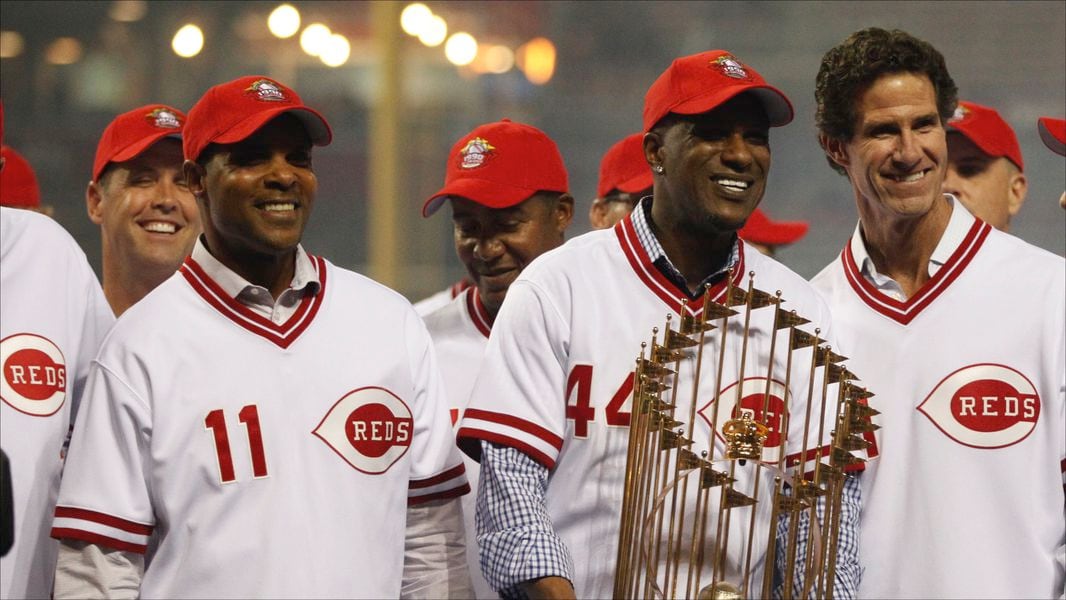
Barry Larkin (11), Eric Davis (44) and Paul O'Neill (21)
with the 1990 World Series trophy.

October 20, 1990, 30 years ago: The Cincinnati Reds beat the Oakland Athletics, 2-1 in Game 4 of the World Series, at the Oakland Coliseum. What had been predicted as an easy victory, possibly even a 4-game sweep, by the A's, the defending World Champions on their 3rd straight American League Pennant, became a 4-game sweep in the other direction, by the National League's Reds. 

As he had in Game 1, José Rijo outpitched Dave Stewart, to win Most Valuable Player honors. With the A's leading 1-0 going into the top of the 8th inning, Barry Larkin singled, Herm Winningham beat out a bunt for a hit, and Paul O'Neill reached on an error to load the bases. The tying and winning runs scored rather undramatically, on a groundout by Glenn Braggs and a sacrifice fly by Hal Morris, respectively.

It remains one of the greatest upsets in World Series history: The Reds won 91 regular-season games to the 103 for the A's, but outscored the A's 22-8. This title also reversed the result of the 1972 World Series, when the Reds, in their "Big Red Machine" era, lost to the A's in 7 games, despite Oakland's best player, Reggie Jackson, being unavailable due to injury.

This time, the Reds lost both Eric Davis and Billy Hatcher, who batted a record .750 (9-for-12) in the Series, in the clinching Game 4, but didn't need them.

It was the 5th World Series won by the Reds. They also won in 1919, 1940, 1975 and 1976, while winning Pennants but losing the World Series in 1939, 1961, 1970 and, as said, 1972.

The Reds haven't won a Pennant since. They led the NL Central Division when the Strike of '94 hit. They won the Division in 1995, and swept the Los Angeles Dodgers in the NL Division Series, but were then swept by the Atlanta Braves in the NL Championship Series. They lost a Playoff for the NL Wild Card in 1999 -- to the Mets. How embarrassing.

They didn't get close to the postseason again until 2006, finishing 3 1/2 games out of 1st place. They won the Division in 2010 and 2012, but lost the NLDS to the Philadelphia Phillies and the San Francisco Giants, respectively. In 2013, they lost the NL Wild Card Game to the Pittsburgh Pirates. They then had 6 straight seasons of 86 or more losses, 4 of them of 94 or more, until this season, when they made the COVID-19-forced expanded Playoffs, and got swept in 2 straight for the Braves.

So, in the last 30 years, the Reds have had their moments. But it's been 30 years to the day since they last won the World Series. And 30 years and 8 days, since October 12, 1990, since they won a Pennant -- or even a single NLCS game. How long has that been?

*

Those Reds were managed by Lou Piniella, the former Yankee outfielder and manager, who was hired the year before, after the biggest of all Reds legends, Pete Rose, was permanently banned from baseball. By a weird turn of events, Piniella and the Oakland manager, Tony La Russa, grew up in Tampa and were teammates on an American Legion baseball team.

He inherited a team that had Larkin, who went to the Hall of Fame; O'Neill, just coming into his own, a right fielder who would go on to help the Yankees win 4 World Series; Hatcher, who had previously helped the Houston Astros win a Division title; Davis, a center fielder who looked like he would become an all-time legend, but who would be limited by injuries to 282 home runs, 349 stolen bases and 3 Gold Gloves; and Chris Sabo, a former Rookie of the Year who would be a 3-time All-Star.

The pitching was good: Rijo would go on to lead the NL in strikeouts in 1993. That year, Danny Jackson would help his team win the Pennant, although that team would be the Phillies, not the Reds. Tom Browning had thrown a perfect game, and won 123 games before a broken arm ended his career. And they had a trio of relievers known as "The Nasty Boys": Rob Dibble, Norm Charlton and Randy Myers, the latter a member of the Mets' 1986 World Series winners.

Major League Baseball had 26 teams, but had not yet expanded to Florida or the Mountain Time Zone. The Montreal Expos hadn't yet moved to Washington. There were no Asian players, no Interleague Play, and, a year earlier, the SkyDome in Toronto (now the Rogers Centre) became the 1st MLB stadium with a retractable roof.

The Chicago White Sox were about to move from the 80-year-old Comiskey Park to a new stadium with the same name (now U.S. Cellular Field). They were 1 of 4 teams still using a ballpark built before World War I, 6 using one built before World War II, and 8 built before the Space Age. (Now, each of those 3 categories is down to 2.) Today, only 7 teams are using the same stadium they were using in 1990: The A's, the Royals, the Red Sox, the Dodgers, the Chicago Cubs, the Toronto Blue Jays, and the team now known as the Los Angeles Angels. In 2002, the Reds closed Riverfront Stadium, and moved to the new Great American Ball Park the next season.

The Giants hadn't won the World Series in 36 years (and not at all since moving to San Francisco), the Cleveland Indians 42 years, the Red Sox 72 years, the White Sox 73 years, and the Cubs 82 years. All but the Indians have since ended their droughts.

The Colorado Rockies, the Miami Marlins, the Tampa Bay Rays and the Arizona Diamondbacks hadn't begun play yet. Those 4 teams, plus the Blue Jays, the Angels, the Houston Astros, the Texas Rangers, the Braves since they moved to Atlanta, and the Expos/Nationals franchise hadn't yet won the Pennant. The Marlins, the D-backs, the Jays, the Angels, the Braves since they moved to Atlanta, and the Expos/Nats hadn't yet won the World Series. All of those achievements have since been reached.

A month earlier, Bobby Thigpen of the White Sox set a new record of 57 saves, which would stand for 18 years. A few weeks before that, Ken Griffey Sr. and Ken Griffey Jr. of the Seattle Mariners became the 1st father and son to play on the same team at the same time, and hit back-to-back home runs.

The Yankees, besieged by injuries, finished last for the only time since 1966. George Steinbrenner fired Bucky Dent as manager while the Yankees were playing a series with the Red Sox at Fenway Park, site of Bucky's greatest moment as a player. When he was invited to return for Old-Timers' Day -- the one OTD between 1951 and 1998 that neither Joe DiMaggio nor Mickey Mantle appeared -- Dent got a huge ovation, and a "Steinbrenner sucks!" chant went up.

George would soon be suspended by Commissioner Fay Vincent for hiring Howard Spira, a Mob-connected compulsive gambler who had worked for Dave Winfield's charitable foundation, to dig up dirt on the slugger. He failed, George got caught, and was given a lifetime ban, with the opportunity to be reinstated after 2 years (which he was). George had already traded Winfield to the Angels by the time he was banned. With Gene Michael put in charge of baseball operations, the rebuilding of the Yankees began.

Emblematic of this awful Yankee season was Andy Hawkins pitching 8 innings of no-hit ball against the White Sox in the last game the Yankees ever played at Comiskey, but losing 4-0 because of his walks and 3 8th-inning errors. Although he pitched a complete game and didn't allow any hits, MLB decided to not credit him with a no-hitter. Nolan Ryan was, for the 6th time, and also won his 300th game (although not in the same game).

In the NFL, there were 2 teams in Los Angeles, and no team in Oakland, St. Louis or Baltimore. Those cities would get teams again, while Los Angeles lost out, and then gained 2 new teams -- actually, 2 old teams, 1 of which was 1 of the 2 they lost in 1994. There was no team in Carolina, Jacksonville or Tennessee, but those places would get teams. There was a team in Houston, but it was the Oilers, not the Texans.

The NBA has since added Toronto, Vancouver (who moved to Memphis) and a new Charlotte team to replace the one that moved to New Orleans; while the Seattle SuperSonics were moved to Oklahoma City. The NHL has added 11 teams, and moved 5: Since 1990, Minnesota, Quebec City, Winnipeg, Hartford and Atlanta have all lost their teams; while only Minnesota and Winnipeg have gotten their teams replaced.

Baseball legends Joe DiMaggio, Ted Williams, Bob Feller, Warren Spahn, Billy Herman and Charlie Gehringer were still alive. Ryan, George Brett, Robin Yount and Carlton Fisk would hang on as active players until 1993. The other defining players of my childhood had all retired.

In addition to Larkin, Ryan, Brett, Yount and Fisk, the following players were then active, and are now in the Baseball Hall of Fame: Bert Blyleven, Goose Gossage, Dave Winfield, Gary Carter, Jack Morris, Andre Dawson, Alan Trammell, Eddie Murray, Ozzie Smith, Paul Molitor, Tim Raines, Lee Smith, Harold Baines, Ryne Sandberg, Cal Ripken, Wade Boggs, Tony Gwynn, Kirby Puckett, Greg Maddux, Edgar Martinez, Tom Glavine, Roberto Alomar, Craig Biggio, Randy Johnson, John Smoltz, Larry Walker, Ken Griffey Jr. and, a rookie that season, Frank Thomas.

And, from the defeated A's, Dennis Eckersley and Rickey Henderson, along with manager La Russa. But not Dave Stewart or Dave Parker (neither quite had the career stats), and not Mark McGwire or
José Canseco (now known to be steroid cheats).

Mariano Rivera had just debuted in professional baseball that summer. Derek Jeter had just started high school. Alex Rodriguez, David Ortiz and Jimmy Rollins were in junior high, Albert Pujols was 10, CC Sabathia was 9, Robinson Cano and current Royals ace James Shields were 8. David Wright, Justin Verlander and Miguel Cabrera were 7, Max Scherzer was 6, Felix Hernandez was 4, Buster Posey was 3, Clayton Kershaw and Stephen Strasburg were 2, Madison Bumgarner was 1, Giancarlo Stanton was 11 months old, José Altuve was 5 months old, Gerrit Cole was 6 weeks old, and Mike Trout, Christian Yelich, Aaron Judge, Mookie Betts, Bryce Harper, Clint Frazier, Gleyber Torres and Juan Soto weren't born yet. (Those players are all listed in descending order of birth, oldest to youngest.)

Current Reds manager David Bell was in the farm system of the Cleveland Indians, for whom his father, Buddy Bell, had played. Aaron Boone of the Yankees was in high school. Luis Rojas of the Mets was 9 years old.

Tom Thibodeau of the Knicks was an assistant coach with the Minnesota Timberwolves. Barry Trotz of the Islanders was an assistant coach for the minor-league Baltimore Skipjacks. Lindy Ruff of the Devils was playing for the Rangers. David Quinn, now the head coach of the Rangers, was out of hockey due to battling a long-term illness. Steve Nash of the Nets and Ronny Deila of New York City FC were in high school. Gerhard Struber of the Red Bulls was 13 years old. Adam Gase of the Jets was 12. Joe Judge of the Giants was 10. And Walt Hopkins of the Liberty was 5.

In addition to the A's, the defending World Champions were the San Francisco 49ers in football, the Detroit Pistons in basketball, and the Edmonton Oilers in hockey. (The Oilers haven't won since, either.) The Heavyweight Champion of the World was James "Buster" Douglas, who had knocked out the previously unbeaten Mike Tyson 6 months earlier, but was about to lose it to Evander Holyfield.

The Olympic Games have since been held in America twice, France, Spain, Norway, Japan, Australia, Greece, Italy, China, Canada, Britain and Russia. The World Cup, which had recently been held in Italy, with Germany winning it (as they did this year), has since been held in America, France, Japan, Korea, Germany, South Africa and Brazil.

There were 26 Amendments to the Constitution of the United States. The idea that corporations were "people" and had the rights thereof was considered ridiculous -- but so was the idea that a person could legally marry a person of the same gender. No Justices then on the Supreme Court are still on it.

The President of the United States was George H.W. Bush. His son George W., having failed spectacularly in business, had recently (with more than a little help from his "friends") bought the Texas Rangers. Ronald Reagan, Jimmy Carter, Gerald Ford, Richard Nixon, their wives, and the widows of Lyndon Johnson and John F. Kennedy were still alive.

Bill Clinton was about to be elected to a 5th term as Governor of Arkansas. Barack Obama was President... of the Harvard Law Review. Joe Biden was Chairman of the Senate Judiciary Committee. Kamala Harris was newly hired as an Assistant District Attorney in her native Alameda County, California -- Oakland, the city just dethroned as World Champions of baseball. Mike Pence was a lawyer who was about to become 0-for-2 in races for Congress. And Donald Trump was between wives and bankruptcies. His life was a mess. The more things change, the more they stay the same.

The Governor of New York was Mario Cuomo, whose son, current Governor Andrew Cuomo, was Chairman of the New York City Homeless Commission, reporting to Mayor David Dinkins. The Governor of New Jersey was Jim Florio. The Governor of Ohio was Richard Celeste, although former Cleveland Mayor George Voinovich was about to be elected to replace him. The Mayor of Cincinnati was Charles Luken.

The current holders of those offices? I've told you of Andrew Cuomo. Current New York Mayor Bill de Blasio was an aide to Dinkins. Current New Jersey Governor Phil Murphy was a rising star at Goldman Sachs. Current Ohio Governor Mike DeWine was in Congress, and was about to be elected Lieutenant Governor on Voinovich's ticket. And current Cincinnati Mayor John Cranley was in high school.

There were still living veterans of the Spanish-American War, the Boxer Rebellion, the Philippine Campaign, the Mexican Revolution, the Boer War and the Russo-Japanese War. There were still living survivors of the Johnstown Flood of 1889, the sinking of the General Slocum in 1904, and the San Francisco Earthquake of 1906.

Soviet President Mikhail Gorbachev was about to be awarded the Nobel Peace Prize. The Pope was John Paul II. The current Pope, Francis, Jorge Mario Bergoglio, was a bishop in Buenos Aires in his native Argentina.

The Prime Minister of Canada was Brian Mulroney. The head of state for Canada, and Britain, was Queen Elizabeth II -- that hasn't changed -- but Prime Minister Margaret Thatcher was about to lose her job to John Major, due to her support of an onerous poll tax. There have since been 5 Presidents of the United States, 7 Prime Ministers of Britain, and 3 Popes.

England's Football League had recently been won by Liverpool for a record 18th time -- but they haven't won it since. Manchester United had won the FA Cup, their 1st trophy under manager Alex Ferguson, who said he was determined to beat Liverpool and "knock them off their fucking perch." It would take until 1993, but he would do it.

Major novels of 1990 included Clear and Present Danger by Tom Clancy, Jurassic Park by Michael Crichton, L.A. Confidential by James Ellroy, Get Shorty by Elmore Leonard, The Bourne Ultimatum by Robert Ludlum, and The Burden of Proof by Scott Turow. The last of these became a TV miniseries the next year, while the rest all became major feature films. Stephen King was working on Needful Things. George R.R. Martin, frustrated that his screenplays and teleplays were getting cut, or dropped completely, decided to return to fantasy novels, and began the process that led to Game of Thrones. J.K. Rowling was on a long train trip from Manchester to London, when she got the idea that would become the Harry Potter series.

Major films of the Autumn of 1990 included Goodfellas, Pacific Heights, Avalon, Henry & June, Miller's Crossing, Mr. Destiny, Jacob's Ladder, Rocky V, Misery, and Home Alone. Steven Spielberg was directing Hook, a story of a grownup Peter Pan (played by Robin Williams) returning to Neverland, and George Lucas helped him out on it.

TV series that were beginning in the new 1990-91 season included The Fresh Prince of Bel-Air, Law & Order, Beverly Hills 90210, Evening Shade, Tiny Toon Adventures, Captain Planet & the Planeteers, the even more cartoonish Dream On, and The Flash, starring John Wesley Shipp as DC Comics' Scarlet Speedster.

Michael Keaton was reaping the benefits of the previous year's Batman film, Christopher Reeve was still thought of as Superman, Lynda Carter was still thought of as Wonder Woman, and Nicholas Hammond was still the most recent live-action Spider-Man. Timothy Dalton had played James Bond in the previous year's Licence to Kill, but quit, and legal wrangling kept the 007 franchise in limbo for a while. So was Doctor Who, recently canceled with the last and Seventh Doctor having been Sylvester McCoy.

NBC made a sitcom, Ferris Bueller, based on the 1986 John Hughes film. But it moved the action from the suburbs of Chicago to those of Los Angeles, made Ferris a year younger than his sister Jeanie rather than a year older, and made Sloane a blonde instead of a brunette. Despite having The Fresh Prince of Bel-Air as its lead-in, it tanked, and was canceled after 12 of the 13 episodes were aired. It was replaced on NBC's schedule by Blossom. But even Ferris Bueller was a success compared to ABC's combination of a cop show and a musical, the execrable Cop Rock.

Jerry Seinfeld was known, but no one had yet heard of George Costanza, Elaine Benes and Cosmo Kramer. Or of Deadpool, Buffy Summers, Fox Mulder, Ross Geller & Rachel Greene, Bridget Jones, Xena, Carrie Bradshaw, Jed Bartlet, Tony Soprano, Leroy Jethro Gibbs, Rick Grimes, Lisbeth Salander, Bella Swan, Don Draper, Katniss Everdeen, Walter White or Richard Castle.

Ricky Nelson's twin sons, Matthew and Gunnar, recording as "Nelson," had the Number 1 song in the country, "(Can't Live Without Your) Love and Affection." If people were shocked by how "Rick" looked at the "Garden Party" in 1971, they would have been appalled at the twins' long bleach-blond, metal-esque hair. Still, it gave the Nelson family the 1st father & son Number 1 hits in the Rock and Roll Era.

Paul McCartney was touring for his album Flowers In the Dirt. Celine Dion gave her 1st English-language concert. A band named for basketball star Mookie Blaylock debuted, but soon changed its name to Pearl Jam. 2 Live Crew were acquitted of obscenity charges.

The Geto Boys, The Rembrandts and The La's released their self-titled debut albums, Bob Dylan Under a Red Sky, George Michael Listen Without Prejudice, Vol. 1, Neil Young Ragged Glory, Warrant Cherry Pie, AC/DC The Razor's Edge (including "Thunderstruck"), Megadeth Rust In Peace, Roseanne Cash Interiors, Mary Chapin Carpenter Shooting Straight In the Dark, and Paul Simon The Rhythm of the Saints, including what remains his last hit, "The Obvious Child," which has the lyric, "The cross is in the ballpark."

Kris Jenner was in the process of divorcing Robert Kardashian, so she could marry 1976 Olympic hero Bruce Jenner. None of the children of any of the 3 of them was famous yet. Kanye West and Shakira were 13 years old; Sean Murray and Stana Katic 12; Katie Holmes, Heath Ledger and Pink 11; Cote de Pablo 10; Christina Aguilera, Alicia Keys, Hyden Christensen, Jessica Alba, Natalie Portan, Chris Evans and Beyonce 9; Britney Spears, Sienna Miller, Cobie Smulders, Hayley Atwell, Kirsten Dunst, Cory Monteith and Elisabeth Moss 8; Matt Smith, Anne Hathaway, Henry Cavill and Andrew Garfield 7; Emily Wickersham 6; Katy Perry and Scarlett Johansson 5; Lady Gaga, Robert Pattinson and Lea Michele 4; Emilia Clarke, Kit Harington, Naya Rivera and Rose Leslie 3; Rhianna 2; Emma Stone and Daniel Radcliffe 1; Taylor Swift 9 months, Kristin Stewart and Emma Watson 5 months; and Cardi B, Selena Gomez, Demi Lovato, Miley Cyrus, Ariana Grande, Justin Bieber, Halsey, all of the members of One Direction, all of the members of BTS, and all of the Modern Family kids hadn't been born yet.

Inflation was such that what $1.00 bought then, $1.99 would buy now. A U.S. postage stamp cost 25 cents, and a New York Subway ride $1.15. The average price of a gallon of gas was $1.22, a cup of coffee $1.49, a McDonald's meal (Big Mac, fries, shake) $5.23, a movie ticket $4.23, a new car $15,045, and a new house $150,100. The Dow Jones Industrial Average closed the preceding day, a Friday, at 2520.79.

The World Wide Web was about to debut, but hardly anybody would know about it for a while. Mobile phones were still the size of the original Star Trek series' communicators. The Hubble Space Telescope had been launched, but it wasn't working, and would need to be repaired by a later shuttle mission. The 1st digital camera was sold in the U.S. The leading home video game system was the Sega Genesis. The birth control pill was long-established, but there was, as yet, no Viagra.

In the Autumn of 1990, Operation Desert Shield was launched, to ready American troops to push Saddam Hussein's Iraqi army out of Kuwait. Presidents Bush and Gorbachev met in Helsinki, Finland to discuss the situation, and those of the breakaway Soviet republics. Germany was reunified for the 1st time since 1945, and under a free government for the 1st time since 1933. A devastating civil war began in the African nation of Rwanda. China opened its 1st McDonald's and its 1st Pizza Hut. Walmart opened its 1st store in the Northeast, in York, Pennsylvania. 

Leonard Bernstein, and William S. Paley, and Cookie Lavagetto died. Jennifer Lawrence, and John Wall, and John Tavares were born.

October 20, 1990. The Cincinnati Reds won the World Series, after winning the National League Pennant. They have never won another of either.

Will they win them in the near future? Stay tuned.

Tuesday, April 25, 2017

Yankees vs. Red Sox, The Defining Moments: Part III, 1967-1982

April 14, 1967, Yankee Stadium. The Yankees hold their home opener, and the Sox start a rookie, Billy Rohr. He comes within 1 strike of a no-hitter, partly thanks to an amazing 9th-inning catch of a Tom Tresh line drive by Carl Yastrzemski, the kind of play that makes you think, "If he wasn't going to lose the no-hitter on that play, he's not going to lose it."

But Elston Howard -- ironically, to join the Sox late in the season to help with their Pennant race -- singled to right to break it up. Rohr finishes it up, and the Red Sox win, 3-1. Five days later, at Fenway, Rohr beats the Yankees again. But he would win only 1 more game in his career, wash out, and become a lawyer. He got a huge hand at the Fenway Park Centennial celebration in 2012.


June 21, 1967, Yankee Stadium. Thad Tillotson beans Sox 3rd baseman Joe Foy, later to be a part of one of the biggest bonehead trades in history -- not surprisingly, by the Mets. When Tillotson comes up to bat (there will be no designated hitter until 1973), Jim Lonborg beans Tillotson. The benches empty, and all hell breaks loose. Red Sox 8, Yankees 1.

Despite the acrimony from this brawl, this was an anomaly in the team's relationship in the era. It was not the beginning of the modern Yanks-Sox rivalry. That was still to come.

October 1, 1967, Fenway Park. Lonborg, putting together a Cy Young season, goes the distance, Yastrzemski ties the game with a bases-loaded single to clinch the Triple Crown (MLB's last until 2012), and the Red Sox go on to beat the Minnesota Twins 5-3. When the Detroit Tigers only split a doubleheader against the California Angels, the Sox have won their 1st Pennant in 21 years, only their 2nd in 49 years.
Yaz '67

While the Sox were putting together their "Impossible Dream" season, the one that gets remembered as the one that began "Red Sox Nation," the Yankees finished 9th in the 10-team AL. The Sox took the World Series to 7 games, before losing to the St. Louis Cardinals.
Fenway Park, 1967

September 28, 1968, Fenway Park. Mickey Mantle pops up to shortstop Rico Petrocelli in the top of the 1st inning, and is replaced at 1st base by Andy Kosco. The Boston crowd gives him a standing ovation, suspecting, as they had with Babe Ruth in 1934, that this was the last time they would see him. Indeed, it was the last game of his career, as he did not enter the next day's game, the regular season finale.

Joe Pepitone hits a home run in the top of the 9th inning off Lonborg, who tailed off considerably this season due to an off-season injury, and the Yankees win, 5-4.

April 7, 1970, Yankee Stadium. This was Opening Day, and, at first glance, it might not have any more significance than that. But it was the 1st Yankee game of my lifetime. It didn't end so well for the Good Guys, as only 21,379 came out to the big ballyard to see Mel Stottlemyre give up an RBI double to opposing pitcher Gary Peters. Red Sox 4, Yankees 3.

The Yanks did finish 2nd, with 93 wins, far ahead of the Sox, but the Baltimore Orioles ran away with the Division and won the World Series.

September 15, 1970, Yankee Stadium. Curt Blefary's time with the Yankees wasn't as good as his preceding time with the Orioles, but he did hit a pinch-hit walkoff homer in this game, against Mike Nagy. Yankees 3, Red Sox 2.

March 22, 1972, Fort Lauderdale Stadium, Fort Lauderdale, Florida. The Yankees and Red Sox complete what remains the biggest trade between the teams since Harry Frazee's selloff in the late 1910s and early 1920s. The Sox send wacky relief pitcher Albert "Sparky" Lyle to the Yankees, in exchange for Danny Cater and a player to be named later, who turns out to be Mario Guerrero.
The Sox didn't know how to handle Lyle, and their reasoning for obtaining Cater was that he hit well at Fenway Park, so why not let him play there 81 times a year? It didn't work, as Cater's batting average dropped from .276 in 1971 to .237. You see, the reason that Cater hit so well at Fenway is that he was batting against Red Sox pitchers. Now, he wasn't doing that anymore. Guerrero was never more than the stereotypical "good-field-no-hit" middle infielder.

Sparky, in 1972, set an American League record (though it was broken a year later) with 35 saves, and set the standard for Yankee relievers that was followed by Goose Gossage,Dave Righetti, John Wetteland and Mariano Rivera.
Sparky Lyle and Thurman Munson.
Along with Reggie Jackson, Chris Chambliss, Mickey Rivers,
Willie Randolph, Dick Tidrow,  and eventually Goose Gossage,
Yankee opponents in the late 1970s had to fear the 'stache.

April 6, 1973, Fenway Park. Opening Day. Ron Blomberg bats for the Yankees, and becomes the 1st official player to come to bat as a designated hitter. He draws a walk. It doesn't help: The Red Sox win, 15-5.

This was also the 1st game as Yankee owner for George Steinbrenner, a Cleveland-born, Tampa-based shipbuilding tycoon. He said, "I won't be active in the day-to-day operations of the club at all. I've got enough headaches with my shipbuilding company." It would soon be clear that he was lying. But he would also do whatever it took, including going with the new rules of free agency and big spending, to build the Yankees back into World Champions.

August 1, 1973, Fenway Park. In 1972, the Yanks and Sox were both still in the Pennant race as late as August for the 1st time since 1953. But it would not be the 1st time since 1951 that both were still in it as late as September. That would have to wait until 1974.

On this day, with the game tied 2-2 in the top of the 9th, Yankee catcher Thurman Munson leads off with a double, and is sacrificed to 3rd. With Gene Michael at the plate, manager Ralph Houk orders a suicide squeeze. (You see, Houk was a smart man, and he knew "Stick" Michael couldn't hit a beach ball with a telephone pole.)

Michael misses the pitch anyway, and Munson, a dead duck at home, tries the only thing that might save him, to dislodge Sox catcher Carlton Fisk from the ball, only to have Fisk flip Munson aside. The two catchers already don't like each other, and they go at it, clearing the benches. A rivalry is reborn, and the Sox win this battle. Red Sox 3, Yankees 2.

Neither team won the Division (the Orioles did). In 1974, the Yanks and Sox would chase each other into September as the top 2 teams. Then the Orioles got into the act again, and smacked the Sox, who collapsed to 3rd place. The O's then swept a doubleheader at Shea Stadium (the Yanks had to play '74 and '75 at the Flushing Toilet while The Stadium was being renovated) in late September to take the Division. The Sox did win the Pennant in '75, losing an epic World Series to the Cincinnati Reds in 7 games. And then...

May 20, 1976, Yankee Stadium. Bottom of the 6th. Lou Piniella comes around to score, but Fisk gets the ball. Sweet Lou barrels into Pudge, but it's no use, he's out. Fisk shoves Piniella, and here we go again. This one was even nastier than the brawls of '67 at The Stadium and '73 at Fenway.

The combatants are separated, but Sox reliever Bill Lee -- who may have hated the Yankees more than any Red Sock ever, at least until the Roid Sox of 2003-present -- starts yelling at 3rd baseman Graig Nettles, claiming that Nettles had hurt his shoulder. Spewing obscenities like a typical drunken lout Sox fan, "the Spaceman" (may NYPD Detective Sam Tyler, wherever he is, forgive me) calls Nettles out.

Lee was a pretty good pitcher up until this point, but this incident may have been the effect of drugs on his brain. (He has occasionally expressed his liking of marijuana, which usually leaves one much mellower than this.) If you call Graig Nettles out, he's going to clobber you. He did. Yeah, it was a sucker punch, but then, Lee was a sucker.

The Sox won the game, 8-2, but lost the fight, only split that 4-game series, and were well back of the Yankees, who went on to win the Pennant.
Lee later said, "The Yankees fought like hookers swinging their purses." First of all, How would he know? Second of all, what does it say about him that he still lost the fight?

Sox fans like to say that Nettles ruined Lee, a great pitcher until then, but who never recovered. Actually, Lee was only a pretty good pitcher until then, and Lee did recover -- after yet another brilliant Sox trade, sending Lee to the Montreal Expos for Stan Papi.
July 9, 1976, Boston. Tom Yawkey dies of leukemia at the age of 73. His widow Jean inherits the team. From this point onward, the tenor of the Sox changes. Tom was always willing to spend big in the hope of winning. But the money was Jean's now, and she was going to keep as much of it as she could. Which helped the Sox' opponents.

July 25, 1976, Yankee Stadium. Chris Chambliss turns a 5-3 Sox lead in the bottom of the 9th into a 6-5 Yankee win with a home run off Tom House -- known today as a pitching coach and as the man who, standing in the Atlanta Braves' bullpen in 1974, caught the ball Hank Aaron hit for his 715th career home run. This was foreshadowing of the Pennant-winning walkoff Chambliss would hit against the Kansas City Royals less than 3 months later.

June 18, 1977, Fenway Park. Jim Rice was a great power hitter, but was also slow as molasses. Yet Reggie Jackson misplays his looper, and Rice ends up on 2nd base. Manager Billy Martin pulls Reggie out of the game in mid-inning, and they end up shouting at each other in the dugout. Billy says something that ticks Reggie off, and Reggie tells Billy that all the alcohol he's has been ingesting has been getting into his brain.

How many Yankee catching legends turned coaches does it take to restrain Billy Martin? Two, apparently: Yogi Berra and Elston Howard. And the whole country (well, anyone in the country who wanted to watch baseball) sees this on the NBC Game of the Week. Red Sox 10, Yankees 4.

The Sox finish a series sweep the next day, and it takes several players, including Captain Thurman Munson and even Reggie himself -- who knows that Billy getting fired would be the worst thing for him, public-relations-wise -- to talk Yankee owner George Steinbrenner out of firing Billy.

June 24, 1977, Yankee Stadium. The Yanks need a win over these bastards. Bad. They trail in the bottom of the 9th. But Roy White, the senior Yankee at this point, knocks one out to send it to extra innings. In the bottom of the 11th, Reggie gets his first real chance to prove his clutch bona fides in New York, and singles home Nettles with the winning run. Yankees 6, Red Sox 5. This begins a Yank sweep, and the race is back on.

September 14, 1977, Yankee Stadium. The Yanks already won last night, and the Sox need this one badly if they want to win the Division. This was the only way to make the Playoffs from 1969 to 1993 -- no Wild Cards.

Going into the bottom of the 9th, Ed Figueroa and Reggie Cleveland are both pitching shutouts. (Yes, kids, they both went the whole way.) Munson opens the inning with a single up the middle, and Reggie cranks one. Yankees 2, Red Sox 0.

The Sox win the next night, but as soon as the ball left Reggie's bat on this night, the American League Eastern Division race was effectively over. After a very nasty year, Reggie had won over his teammates and the New York fans. He did some hitting in the postseason, too.
It's easy to find a photo of Billy Martin smiling.
Same with Reggie Jackson. But smiling together? Rare.

This was Reggie's 2nd walkoff homer for the Yankees. He would make it 4, but this was the only one against the Sox.
After leading the AL East for most of the season, the Sox ended up finishing 2 1/2 games behind the Yankees, tied with the Baltimore Orioles for 2nd place. But this blowing of a Division lead was just foreshadowing for the next year.
Yankee Stadium, after the 1973-76 renovation

November 23, 1977, Fenway Park. Mike Torrez signs as a free agent with the Sox. He had won 17 games in the regular season, including 14 after being traded from Oakland to New York. This did not include losing the game in June where Reggie and Billy set it off in the Fenway dugout. But then, nor did it include his wins in Games 3 and 6 in the World Series.
In spite of Sox fans' love of Luis Tiant and Bill Lee, it was actually Torrez, with 16 wins, who was 2nd on the '78 Sox in wins, behind the 20 of another off-season pickup, Dennis Eckersley, who had won 14, including a no-hitter, for the '77 Cleveland Indians. (Incidentally, Torrez wore Number 21 for the Sox, a number that had previously been worn by 1946 Pennant hero Tex Hughson, and would later be worn by Roger Clemens. He had worn 24 for most of his career, including with the Yankees, but Dwight Evans was wearing that number in Boston.)

Taking such a key pitcher off the Yankees, let alone bringing him in to themselves, should have been a big boost for the Sox and a big blow for the Yanks. And for a long time, it sure looked that way: As Billy Martin said, "Torrez is a hoss," and he was every bit the hoss for the '78 Sox that he was for the '77 Yanks -- and the '76 A's, for whom he won 16; and the '75 Orioles, for whom he won 20; and the '72 and '74 Montreal Expos, for whom he won 16 and 15, respectively.

And yet, there had to be a reason that Torrez kept changing teams. He won another 16 for the Sox in '79, but never won that many again.  In 1983, they let him get away to the Mets (wearing Number 30 for them, as did Nolan Ryan), where in 1984 he (accidentally, I think) beaned Houston Astro shortstop Dickie Thon, curtailing what was shaping up to be a very good career. His own ended that season, and although he won 185 games, he also lost 160, and has never been seriously considered for the Hall of Fame.

If he was a bad teammate, it's never been publicized, and he's always been invited back to Yankee Stadium for Old-Timers' Day -- which has often included him pitching to Bucky Dent. More on that in a moment.

June 27, 1978, Yankee Stadium. The Sox are flying. The Yanks are reeling and hurting.  The Yanks need a win, very badly. Graig Nettles gives it to them, hitting a 2-run shot off Dick Drago to win it in the bottom of the 9th. Yankees 6, Red Sox 4.

July 4, 1978, Fenway Park. The Sox are still flying. The Yanks are still reeling and hurting. The Sox won last night. The Fenway Faithful are cackling with glee, as it looks like the Sox will run away with the AL East title. The Yanks are desperate.

And the game is rained out. This turns out to be tremendously important, as the game is rescheduled for September 7, the beginning of what will now be a 4-game series, instead of a 3-gamer.

This was also the day after NewsChannel 4's Dr. Frank Field predicted beautiful weather for the 4th of July, claiming it would be perfect for the beach, the boardwalk, and fireworks, and the rain that soaked New England also soaked the New York Tri-State Area. The only fireworks that day were on the NBC switchboard, from furious viewers, and Field shows up for the 6:00 news with a noose around his neck. It was meant as a joke. I think.

I was 8 years old, and so upset over the postponement of the fireworks at Point Pleasant Beach, New Jersey. Little did I know how much this would end up benefiting the Yankees...

July 17, 1978, Yankee Stadium. Billy gives Reggie a bunt sign in the bottom of the 9th. He hasn't bunted in 6 years. After strike 1, Billy takes the bunt sign off. Reggie decides he's been shown up, so he's going to show Billy up in return -- almost exactly what happened at Fenway the previous year. He bunts foul with 2 strikes, and thus strikes out. The Yankees lose 9-7 to the Kansas City Royals in 11 innings.

The Yankees are now in 4th place, 14 games behind the Red Sox. Overall, the Sox lead by 9 games over the Milwaukee Brewers. Billy suspends Reggie for 5 games -- and the Yankees win all 5, in Minnesota against the Twins and Chicago against the White Sox.

Reggie's suspension ends. While boarding the plane that will take the Yankees from Chicago to Kansas City, Billy is asked by a reporter how he'll handle Reggie. He mumbles something about Reggie, and something about George Steinbrenner, and then says, "You know, they're made for each other. One's a born liar, the other's convicted." Billy was referencing George's conviction for violating campaign finance laws as the director of Ohio Democrats for Nixon in 1972, for which he avoided jail time, and was later pardoned by a later Republican President, Ronald Reagan.

George flies out to Kansas City, and word of this gets to Billy. Like Nixon, Billy knows he'll be "impeached" if he doesn't resign. He does. George hires Bob Lemon, the Hall of Fame Cleveland Indians pitcher who'd recently been fired as manager of the White Sox. He calms the team down, tells them to just go out and play, and sees them get healthy.

August 3, 1978, Yankee Stadium. After playing 14 innings the night before, a rule that is no longer in place, that no inning may start in an American League game after 1:00 AM, is invoked. The game is restarted, and the Sox win 7-5 in 17 innings. The Sox are leading the regularly-scheduled game 8-1 after 7, when it starts raining, and it's called.

The Yankees were now 8 1/2 games back, with 55 to play. It looked like it was over. But the Yankees' injuries began clearing up. Jim "Catfish" Hunter recovered from shoulder woes and won 6 straight decisions. And the Sox developed injuries, and, unlike the Yankees, they did not have a bench equal to the task.

September 7, 1978, Fenway Park. The Yanks got healthy and got hot, and had turned a 14-game deficit on July 20 into a 4-game deficit. Little-known fact: The Sox actually led the AL East by 10 games over Milwaukee on July 8, 9 on August 13, and 7 as late as August 31. So, while the Yankees gained 14 games, technically, the Sox "only" blew a 10-game lead.
Now it was the Sox were hurting and slumping, and their bench was to be tested. As the kids are saying these days, "Epic fail."
The 1st game was played on the night that Who drummer Keith Moon died from a drug overdose. Some Sox fans began to wish they could join him. Willie Randolph got 3 hits before Butch Hobson, the Sox' badly injured 3rd baseman and Number 9 hitter, even came to bat. Yankees 15, Red Sox 3.

September 8, 1978, Fenway Park. The 2nd game is a near-repeat performance, as Mickey Rivers got 3 hits before Hobson, elbow chips and all, could reach the plate. Yankees 13, Red Sox 2.

September 9, 1978, Fenway Park. The 3rd game is an NBC Game of the Week, and it is each team's ace, Ron Guidry (having the greatest season any Yankee pitcher had ever had) against Dennis Eckersley (having the greatest season any Sox pitcher had between Jim Lonborg in '67 and Roger Clemens in '86). Sox fans were confident that all they had to do was take these last 2 games, and the Yanks would have wasted all those runs and hits for nothing.
But the Yanks smacked the Eck around. Yankees 7, Red Sox 0. Someone wrote, "This is the first time a first-place team has been eliminated from the race."

September 10, 1978, Fenway Park. The Sox come close in the series finale, getting the tying run to the plate late, but... Yankees 7, Red Sox 4.

Tied for 1st. The defining image of the series is of Sox Captain and legend Carl Yastrzemski leaning against the scoreboard at the base of the Green Monster, head bowed, as if to say, "Please... I'll do anything you say... Just don't hurt us anymore... " (Sadly, I can't find a copy of that photo to put here.)

An urban legend said that someone got on top of a bar somewhere in New England, and said, "The sons of bitches killed our grandfathers, they killed our fathers, and now they've come for us."

Except it wasn't over. In 1904 and 1949, it took 154 games to decide a Yanks-Sox race.  In 1977, it took 161 out of the 162 games. This time, it would require a Game 163, as the Sox won 12 of their last 14, including their last 8, while the Yankees lost their Game 162.

October 2, 1978, Fenway Park. I like to call it the Boston Tie Party. Red Sox fans like to call it something else. This game had so many twists and turns, and, with the possible exception of the 1951 Dodger-Giant Playoff (the Bobby Thomson Game), it has probably had more books written about it than any single game in the history of baseball.

What can I say about this game that hasn't already been said, including by myself? Probably nothing, so I'll simply say, "Bucky Blessed Dent."
"Destiny 5, Red Sox 4" -- that's what the headline in the next day's Boston Herald-American said. Well, of course: "DESTINY" ends with "NY." The Yanks went on to win the World Series again.
The difference between this Sox loss to the Yankees and the one 25 years later is stark. When Nettles caught Yaz's popup for the final out, the Sox, as can be seen on the videotape, sort of slink back into their dugout, looking as if they were thinking, "If we couldn't do it this time, we'll never be able to do it." And, sure enough, the next time they got close, in 1986, only 8 years later, only 3 players were left from '77 and '78: Rice, Evans and Bob Stanley. And only Rice and Evans were still there from the '75 World Series.
They had won 196 games in 2 seasons -- just as they had won 192 in 1948-49 -- and, as in that 1940s instance, they hadn't even made baseball's official postseason, partly because they'd lost a one-game playoff at home. (In '48, it was to the Indians.)
November 13, 1978, Yankee Stadium. A year after letting the Sox sign Torrez, the Yanks turn the tables, and sign free agent pitcher Luis Tiant.
Tiant was, and remains, one of the most popular players in Sox history -- he is their "barbecue stand guy," the way Boog Powell is in Baltimore and Greg Luzinski is in Philadelphia -- and, with a 229-172 career record, a 1.199 WHIP and 2,416 strikeouts, is one of the best pitchers not in the Hall of Fame.
Was he a good pickup for the Yankees, even at age (we think) 38? Well, in 1979, he went 13-8 for a team that didn't do too well. He pitched a 2-hit shutout against the A's that included a grounder that went up the middle, right to his foot, which he kicked up and caught, and threw to 1st for an out. But in 1980, age finally caught up with him, and he was just 8-9, and his ERA went up by a full run. The Yanks chose not to re-sign him after that. Still, he pitched 2 more seasons in the majors before hanging 'em up.
Although his Yankee teammates liked him, and he has occasionally returned to New York for Old-Timers' Day, and had some of his best years in Cleveland, it's easy to forget now that he played for anyone other than the Red Sox.
When the Yanks fell apart in 1979, the Sox were unable to take advantage: They won 91 games, but that was 11 behind the Orioles. In 1980, they were just 83-79, and, through a bureaucratic mixup, they let Carlton Fisk and Fred Lynn get away after the season.

Part IV follows.

Monday, March 21, 2016

Top 10 Yankee Left Fielders

This is a tough one. Several center and right fielders in Yankee history have also played left field at various times in their careers, including Major League Baseball All-Century Team honorees Babe Ruth and Mickey Mantle. I decided to limit this to only players who are best known for playing the position.

That gets harder when you consider that, from 1955 to '58, the Yankees' main left fielder was Elston Howard, who was a catcher by trade, but was waiting behind Yogi Berra. In 1959, Yogi's decline began, although he could still hit, and he and Ellie switched positions. So both Yogi, who remained the starting left fielder until 1962, and Ellie could be among the Top 10 Yankee Left Fielders -- even among the Top 5. But I won't, since I've already included them in the Top 10 Yankee Catchers. That means there's going to be a big gap from 1955 to 1962, one of the most successful periods in Yankee history. This also lets out Johnny Damon.

Honorable Mention to William "Birdie" Cree, 1908-15. The 1st time I did this, I put him at Number 10. He got his nickname because he liked to whistle. He twice batted over .300 and helped the Highlanders/Yankees finish 2nd in 1910. In 1911, he batted .348 with 30 doubles, 22 triples, 4 homers and 88 RBIs.

Dishonorable Mention to Ben Chapman (1930-36) and Jake Powell (1936-40). Chapman was a member of the 1932 World Champions, a .302 lifetime hitter, a 4-time All-Star, and one of the few base-stealing threats the Yankees had between the 1920 arrival of Babe Ruth and the 1975 return of Billy Martin.

But as manager of the Philadelphia Phillies in 1947, he led the most vicious bench-jockeying any athlete has ever received, the noxious racial abuse hurled by the Phils at Jackie Robinson. The backlash got so bad that it was recommended that, when the Dodgers got to Philadelphia, the two men pose for a conciliatory picture. But the Alabama-born Chapman refused to shake hands with Robinson, settling instead for posing with the two of them holding the same bat.

The next year, with the Phillies having rising stars like Richie Ashburn and Robin Roberts but still far behind the National League lead, Chapman was fired, and, except for a brief tenure as a Reds coach, never worked in the game again. And the Phillies began to get better, winning the Pennant in 1950. This was the last NL Pennant won by an all-white team, and the Phils would be the last NL team to integrate, in 1957.

Years later, Chapman would admit he had gone too far with Robinson. Powell did not. He was, effectively, Champman's replacement as Yankee left fielder, and was a member of the 4 straight World Championship teams of 1936-39.

But in 1938, with the Yankees in Chicago, White Sox broadcaster Bob Elson interviewed him for a pregame radio show, and asked Powell what he did in the off-season. The native of the suburbs of Washington, D.C. said he was a police officer in Dayton, Ohio. Asked what he did to keep in shape, Powell told Elson, "Crack (N-word)s over the head with my nightstick."

Even as notorious a racist as Baseball Commissioner Kenesaw Mountain Landis knew this was too much – and, as a former federal judge, probably also cared that his claim of being a lawman was a bald-faced lie – and he suspended Powell for 8 games. Two years later, Powell was out of The Bronx, and was out of the game by 1945. In 1948, arrested for public drunkenness, he grabbed a cop's gun and shot himself, an ironic end considering what he’s best known for.

10. Brett Gardner, 2008-present. Along with Alex Rodriguez, Gardy is the last remaining Yankee who played home games at the old Yankee Stadium. Like Willie Randolph, he was born in Holly Hill, South Carolina; unlike Willie, his family stayed there, and he grew up there. Like Willie, he became a Yankee star.

He's best known for his speed, having stolen 202 bases in his career. In 2011, he led the American League with 49 steals. In 2013, he led the AL with 10 triples. Last season, he was named an All-Star for the 1st time. He's never won a Gold Glove, which is ridiculous.

He probably won't get a Plaque in Monument Park or his Number 11 retired, but he was a member of the 2009 World Champions, and he deserves our thanks for that.

9. Tim Raines, 1996-98. He spent just 3 seasons in Pinstripes, but they were all Playoff seasons, and '96 and '98 were World Championship seasons. "Rock" batted .321 in '97 and .290 in '98, despite being 37 and 38 years old in those seasons. In Game 3 of the ’96 Series, he led off the game with a walk, and scored on Bernie Williams' single to give the Yanks their first lead of the Series, and later started a double play. His 2-out walk in the top of the 10th led to his scoring the winning run in Game 4.

Overall for his career, he was a 7-time All-Star, with a .294 average, a 123 OPS+, 2,605 hits, and a whopping 808 stolen bases, 5th all-time and the most of anybody not in the Hall of Fame. Judging by Baseball-Reference.com's HOF Monitor (90 of 100), HOF Standards (47 of 50), and Top 10 Most Similar Batters (4 of 10 already in), he's got a very good case.

His Number 30 was retired by the Montreal Expos, but Willie Randolph was coaching with the Yankees at the time, so Raines took 31. If that number is ever retired by the Yankees, it will be for someone else on this list.

UPDATE: Raines was elected to the Hall of Fame in 2017.

8. Roy White, 1965-79. He was the 1st Yankee (or former Yankee) I ever actually met (if you'll pardon the choice of that word), and all the talk about him being classy was an understatement.

His timing was bad, arriving just as the old dynasty was collapsing, but he was a 2-time All-Star, led the American League in walks in 1972 and runs in 1976, and finally got to play in 3 World Series, winning 2. His 1st-inning homer in Game 3 of the '78 Series gave the Yanks their 1st lead of the Series, and in Game 4 he scored the winning run in the 10th. It was against his hometown team, the Los Angeles Dodgers: Like Brooklyn and L.A. Dodger legend Duke Snider, Roy was, literally, straight outta Compton.

He never batted .300, hit 25 homers or had 100 RBIs, although he came close to each. But he won games and he won titles. He wasn’t a headline, but he helped make them. He later became a Yankee coach. His Number 6 has been retired, although not for him. But he was the 1st former player introduced at the old Yankee Stadium finale in 2008, and deservedly got a big hand.

7. Gene Woodling, 1949-54. He was from Akron, Ohio – the 1st Yankee star to be born there, but Thurman Munson ensured that he wouldn't be the last – and became the last Yankee star to be purchased from the San Francisco Seals of the Pacific Coast League.

He helped the Yankees win the next 5 World Series, batting over .300 in 1952 and '53. Not that anybody knew it at the time, but he led the AL in on-base percentage in '53, .429. He bobbled what should have been the last out of the 1950 Series, costing rookie Whitey Ford a shutout, but in a far tighter situation (ahead by 2 with the winning run at the plate in Game 7, as opposed to the earlier 5-run lead in a sweep-clincher), caught the last out of the '52 Series.

The Yankees included him in the biggest trade in baseball history, the 18-player deal with the Baltimore Orioles after the '54 season that brought in 2 pitchers who would make their mark in Pinstripe history: Don Larsen, still the only man to pitch a no-hitter in the World Series; and Bob Turley, the 1st Yankee to win the Cy Young Award. It was with the O’s that he reached his only All-Star Game, in '59. (A guy named Ted Williams being in the AL and having the one subpar year of his career in '59 had something to do with that.)

6. Tom Tresh, 1961-69. He had a cup of coffee with the M&M Boys' Yankees, then was the AL Rookie of the Year in 1962, playing shortstop while Tony Kubek was spending most of the season in the Army. He moved to the outfield when Kubek came back, and, depending on how big the field was in a ballpark and how much Mickey Mantle's legs were bothering him, spent much of the next 4 seasons switching between left and center with Mickey.

An All-Star in '62 and '63 and a Gold Glove in '65, his homer won Game 5 of the '62 Series, and his homer in Game 1 of '63 broke up a no-hitter by Sandy Koufax (though it didn't stop Koufax from fanning 15, then a Series record and still a Series record for lefties).

He never batted .300 or had 100 RBIs, but topped 20 homers 4 times – and, like Mantle, was a switch-hitter, so he wasn't just taking advantage of the pre-renovation Stadium's right field "short porch," and in fact was hurt by its left and center field Death Valley.

He grew up outside Detroit, where his father Mike Tresh grew up; unlike his father, who played mostly for the White Sox, he finished his career with their hometown Tigers. His own son, Mickey (named for Mantle), was a Yankee farmhand, but never got past Double-A ball.

5. Lou Piniella, 1974-84. The 1969 AL Rookie of the Year with the Kansas City Royals, he didn't get along with management there, so they sent him to the Yankees for lefty reliever Lindy McDaniel. This was a great trade for both teams. McDaniel was washed up, but he was practically an extra pitching coach for the Royals' young staff. Piniella, well, let’s just say he was called "Sweet Lou" for his swing, not for his disposition.

Originally, he played mostly right field, with White in left. By the time Reggie Jackson arrived for 1977, White was mostly a bench player and Lou was the main man in left, and he became a pretty good left fielder, his catch taking a home run away from Ron Cey of the Dodgers in Game 4 of the World Series. In the 1978 Playoff with the Red Sox, Reggie was the DH, Roy was in left and Lou in right, and he made 2 key plays in that game to save it.

And what a hitter: .291 lifetime average, 109 OPS+, 6 .300 seasons (4 with the Yankees), and always seemed to come through in key situations. As a boy, I enjoyed Nathan Salant's book This Day In Yankee History, and as he wrote of the 1978 "Boston Massacre" series, he mentioned that Reggie had been intentionally walked: "That made no sense at all, because the next batter was the Red Sox killer himself, Lou Piniella."

Salant was right: Piniella went 10-for-16 with 5 RBIs in that series. He also batted .305 with 2 homers and 6 RBIs in his 5 ALCS appearances, and .319 with 10 RBIs (albeit none on homers) in his 4 World Series. His single in the 10th inning won Game 4 of the '78 Series, driving in the aforementioned White. If it was October, and Lou was batting against you, you were not thinking it was sweet.

He retired, and became the Yankees hitting instructor, then, except for a brief 5th term for Billy Martin, was the Yankees' manager from 1985 to '88, getting them in the AL East race 4 straight seasons, but never getting that 1 extra starting pitcher he needed from George Steinbrenner. He helped make Don Mattingly a great hitter, but had to go to the Cincinnati Reds – where he helped make Paul O’Neill a great hitter, if one with a similarly explosive temper – to win a Pennant and a World Series as a manager. (The opposing manager was Tony La Russa of the Oakland Athletics -- he and Lou played high school ball together in Tampa.) He remains the only manager to lead the Seattle Mariners to a postseason berth, 4 of them.

It's unlikely that the Number 14 he wore as a Yankee will be retired anytime soon, but Lou was a classic Yankee, and one of my 5 favorite players of my time.

4. Bob Meusel, 1920-29. "Long Bob" and his brother Emil (known as Irish even though the family was of German descent) were from San Jose, and among the earliest Californians to reach the majors – or, as the people involved in or rooting for teams in the Pacific Coast League said until 1957, "the eastern leagues." Both went to New York, Irish to the Giants, Bob to the Yankees, and they opposed each other in 3 straight World Series, the Giants winning in 1921 and ’22, the Yankees in '23. Bob also helped the Yankees win the '26 Pennant and the '27 and '28 World Series.

He was a lifetime .318 hitter, who was a perfect fit in the Yankee lineup, 5th after Babe Ruth batted 3rd and Lou Gehrig 4th – hence, in his last full season, 1929, the 1st season in which the Yankees wore uniform numbers, Meusel was the first to wear the Number 5 that would be solely identified with Joe DiMaggio (who, of course, did not always bat 5th).

Five times, Meusel drove in at least 100 runs, and led the AL in homers and RBIs in 1925. He played with the Cincinnati Reds in 1930, then headed back west and ended his career in the PCL. He died in 1977, at age 81.

3. Charlie Keller, 1939-49, with a brief return in '52. He was big and strong and hairy, and for this they called him "King Kong" – though not to his face, as he hated the nickname. (This was also true of Joe Medwick, who was called "Muscles" because you didn't use "Ducky" in front of him.) This guy formed one of the greatest outfields ever, with Joe DiMaggio in center and Tommy Henrich in right.

His best known hit was a double off the right-field wall at Ebbets Field to complete the rally after Mickey Owen’s muff kept the Yanks alive in Game 4 of the 1941 World Series. He was hitting at a Hall of Fame pace, averaging a .296 batting average, 24 homers and 98 RBIs in his 1st 5 seasons, 4 of which ended with Yankee Pennants (1939, '41, '42 and '43) and 3 with World Series wins (all but ’42).

Then he went off to war, and when he got back, a back injury slowed him down. He helped the Yankees win a 4th and 5th Series in '47 and '49, but that was pretty much it for him: His last great year was at age 29, and he packed it in at 35. He returned to his native Maryland and trained racehorses at his Yankeeland Ranch, many of them with "Yankee" in their names.

2. Hideki Matsui, 2003-09. In his 1st home game at a Yankee Stadium, he hit an Opening Day grand slam. In his last home game at a Yankee Stadium, he went 3-for-4 with a homer and 6 RBIs to clinch a World Championship for the team, and the World Series MVP for himself. In between, he gave us a bunch of memories, including one of the 4 straight hits off Pedro Martinez in 2003 ALCS Game 7, maybe the best game ever played at the old Stadium.

In U.S. play, he batted .282 with 175 home runs. In 4 seasons, he drove in 100 or more runs for the Yankees; twice, he batted over .300. In the U.S. and Japan combined, he hit 507 homers. I know, it doesn't work that way.

"Godzilla" was a beast. I wonder if he'll be the 1st Yankee to get a Plaque with part of its text not in English? His Number 55 is currently being worn by relief pitcher Bryan Mitchell. That's a travesty: If you're not going to retire it, at least give it to a better player.

But then, look who's gotten Number 31 since the guy at Number 1 on this list: Good players like the aforementioned Tim Raines, Lance Johnson, Glenallen Hill, Ichiro Suzuki, and currently (though he'll miss the entire 2016 season due to injury) Greg Bird; but also the disappointing Hensley "Bam Bam" Meulens, Aaron Small and Jose Veras; a once-good but washed-up Frank Tanana, the execrable Javier Vazquez in his totally unnecessary 2nd go-round in Pinstripes; and nonentities like Brian Dorsett, Mike Humphreys, Xavier Hernandez, Brian Boehringer, Dan Naulty, Steve Karsay, Jason Anderson, Edwar Ramirez, Josh Phelps, Michael Dunn, Pedro Feliciano, Gregorio Petit and Ramon Flores.

No, it's about time the Steinbrenner brothers put their father's grudge against this man behind them, and retired Number 31 and gave a Plaque in Monument Park to...

1. Dave Winfield, 1981-90. In the strictest sense, Big Dave was the Yankees' main left fielder for only 3 seasons: 1981, '82 and '83, before moving over to right field. (Steve Kemp was the main one in '84, Ken Griffey Sr. in '85, Dan Pasqua in '86, Gary Ward in '87, Rickey Henderson moving from center to left for '88, then Mel Hall taking over after Rickey was traded in '89.)

Big Dave went 1-for-21 in the 1981 World Series, and that led George Steinbrenner to eventually call him "Mr. May." It was totally unfair, and even less fair was how George got rid of him -- which led to baseball temporarily getting rid of George, and Dave getting the hit that clinched the 1992 Series for the Toronto Blue Jays.

He collected 3,110 hits, including 540 doubles and 465 home runs, 205 of those as a Yankee.  He had 1,833 RBIs, 17th all-time, 6th among players born after World War II, and if you take away steroid users he is thus surpassed only by Eddie Murray and Ken Griffey Jr.

He is in the Hall of Fame, and had most of his great years with the Yankees. No ring? Don Mattingly has a Plaque but no ring, and he was not a better player than Winfield. The ovations Dave gets when he comes back for Old-Timers' Day are not enough: Hank, Hal, give him his Plaque! And don't ever let another kid just off the Columbus -- excuse me, Scranton -- Shuttle sully his 31!

Monday, March 17, 2014

Tampa Bay's All-Time Baseball Team

When you consider that North and Central Florida is such a baseball-rich area, even though it didn't have a major league team until 1998, and that the team has now been a Playoff contender for 6 straight seasons, you'd think the locals would support that team better.

But they don't. They don't even support a winning team.

I wonder if they'd support this one. It has a very good infield, a solid outfield, a decent catcher, and a very interesting (to say the least) pitching staff.

And if any Rays fans are reading this, and don't like that I've posted a picture of a Yankee, tough cookies. And if any Red Sox fans are reading this, and don't like that I've posted a picture of this particular Yankee, tough shit.

27. Tampa Bay's All-Time Baseball Team

To be eligible for this team, you need to be from the Tampa Bay Rays' region, which includes every Florida County except the following: Broward, Collier, Dade, Lee, Martin, Monroe, Palm Beach and St. Lucie. Anyone from one of those will be assigned to the Miami Marlins' region.

I don't name general managers for these teams. Even if I did, I would not make Billy Beane the GM for this team. A weak-hitting outfielder from Orlando, he's been GM in Oakland since 1998, but anybody who's a big-league GM for as long as he's been, and has never built a Pennant-winner, is no genius. Maybe if the A's still had "genius" manager Tony LaRussa (who I'll get to later), LaRussa and Beane would have won one together. Maybe not.

1B Fred McGriff of Tampa. The Yankees had him at Class A ball when, on December 9, 1982, they traded him, didn't-work-out speedster Dave Collins, and pitcher Mike Morgan to the Toronto Blue Jays for an injured Dale Murray and a never-made-it Tom Dodd. How bad a trade was this? Aside from the Red Sox selling Babe Ruth to the Yankees with 665 homers to go, McGriff's 493 post-Yankee homers may be the most round-trippers ever traded away.

But the Yanks already had Mattingly, and McGriff still didn’t reach the majors until 1986, by which point Mattingly was the best player in baseball, and they had plenty of DHs, so, really, what could the Yanks have done? However, McGriff and Morgan were still productive players 19 years later -- and don’t forget, the Arizona Diamondbacks would not have won the 2001 World Series against the Yanks without Morgan.

McGriff, known as Crime Dog after the public-service announcements starring animated canine detective McGruff the Crime Dog, made 5 All-Star teams, led each League in homers once, helped make the Jays respectable and the Atlanta Braves a quasi-dynasty, including 2 homers in the 1995 World Series. He became the 1st Tampa Bay-area native to play for the Devil Rays when they started in 1998, along with Wade Boggs. Its a shame he couldn't get the 7 more homers to reach 500, but he was done. He should be in the Hall of Fame.

Honorable Mention to Tino Martinez of Tampa. Four years behind McGriff at Tampa's Jefferson High School, the Bamtino was a big part of the Seattle Mariner team that saved big-league baseball in the Northwest with that 1995 American League Western Division title, and he sure didn't let up in the Division Series against the Yankees.

So out went Donnie Regular Season Baseball, and in came Tino, who had worn Number 23 in Seattle, and didn't need enough reminders of who he was replacing. So he switched to 24, and with a lefty swing tailor-made for Yankee Stadium’s short right-field porch, and a glove not that far behind Mattingly's, Tino helped the Yankees win the World Series in 1996 (immediately placing him ahead of Mattingly in my mind), 1998, 1999 and 2000, and almost in 2001.

In 1997, a year when the Yankees didn't win the Pennant, he got the hit that clinched the first-ever regular-season series against the Mets, which makes him a huge hero in my eyes. That same year, he hit 44 homers (most by a Yankee between 1961 and 2005) with 144 RBIs (most by a Yankee between 1985 and 2007). His grand slam in Game 1 of the 1998 World Series and his down-to-the-last-out, game-tying homer in Game 4 in 2001 still rank among the most thrilling homers in Yankee history.

The Yankees made a mistake in letting him go after 2001, especially since Jason Giambi never lived up to the hype. Tino went to St. Louis and helped the Cardinals reach the 2002 postseason, and did he ever get a nice hand in 2003 when the Cards game to The Bronx for an Interleague series. Tino played for his hometown Devil Rays in 2004 before one last, reasonably productive season with the Yanks. With 339 homers (192 as a Yankee), he’ll never make the Hall of Fame, but so what. He deserves a Plaque in Monument Park at the new Stadium.

Honorable Mention to Prince Fielder of Melbourne. He doesn't turn 30 until May 9, but in 8 full seasons, he's already batted .286, put up a 141 OPS+, and hit 285 home runs. The 25 he hit last year was his lowest full-season total; he led the National League 50 in 2007 with the Milwaukee Brewers. He's had 6 100+ RBI seasons.

He helped the Brewers win the NL Wild Card in 2008 and the NL Central Division in 2011 -- and that's as many Playoff berths in 4 seasons as the Brewers have otherwise reached without him. He has since added 2 more, including the 2012 AL Pennant, with his father Cecil's former team, the Detroit Tigers. Cecil qualifies for the Dodgers' region -- and for comparison's sake, due to a late start, he finished with just 319 homers, meaning Prince could pass him this season. Cecil was named to 3 All-Star teams, Prince has already been named to 5.

Honorable Mention to Glenn Davis of Jacksonville. A 2-time All-Star, in 1986 he led the Houston Astros to the NL West title and finished 2nd to Mike Schmidt in the Most Valuable Player voting. He was, for a time, the Astros' all-time home run leader, hitting 166 despite playing his home games in the pitcher-friendly Astrodome. A good fielder, too.

But a back injury in 1990 curtailed his career. Before the 1991 season, the Astros traded him to the Baltimore Orioles for Steve Finley, Pete Harnisch and Curt Schilling. It looked like a good trade for both teams, but it turned into a bad one for both: Finley didn't get good until after he left the Astros, Harnisch had personal issues that wrecked his career, and Schilling didn't blossom until the Astros traded him to Philadelphia. As for Davis, the injury meant he wouldn’t be able to take advantage of the close RF wall at Camden Yards. His career OPS+ was 123, but because of the injury he was finished at 32, with "only" 192 homers.

Honorable Mention... sort of... to Steve Garvey of Tampa. Like Kirk Gibson, he played both baseball and football at Michigan State University. Ten times an All-Star, 5 times a Gold Glove, 5 times a 100-RBI man, once an MVP in the NL (1974) and twice in the All-Star Game. He was the Los Angeles Dodgers' Mr. Clean, their Captain America, their... let’s face it, their Ken Doll.

He was the red-white-and-blue good guy of the 1970s, in contrast to the green-and-gold gangbangers in Oakland; the funky, Afro-wearing (including a couple of the white guys) street hustlers in Philly; the garish, black-and-gold disco pimps in Pittsburgh; and the wiseass goombas in The Bronx. Or so the believers in the O'Malley/Lasorda/Garvey Dodger Blue myth tried to tell us.

Garvey played every day (his 1,207 consecutive games played is still an NL record and 4th all-time), and he played well, winning 5 Pennants (4 with L.A. and 1, as Chicago Cub fans don't like to be reminded, with the San Diego Padres) and the 1981 World Series. That year, at a point in his career when it looked like he would one day rank among the game's all-time greats, Lawrence Ritter and Donald Honig included him in their book The 100 Greatest Baseball Players of All Time.

So why isn't this guy in the Hall of Fame? On Baseball-Reference.com, their Hall of Fame Monitor, which has a Likely HOFer at 100, has Garvey at 130; but their Hall of Fame Standards, which has the Average HOFer at 50, has him at only 32.

So what gives? Well, it's not that he didn't just plain stop hitting or get his career curtailed by injury: His last productive season was at age 37. But, while from age 25 to 31, he was one of the top 10 players in baseball, after that, he was only a pretty good one, not putting together the kinds of seasons true greats still do in their early 30s. Only once did he hit more than 28 home runs (granted, Dodger Stadium is a pitcher's park), finishing with 272, not a HOF total. He collected 2,599 hits, a very good total but not, by itself, HOF material. His career OPS+ was 116, very good but, again, not HOF level. And, with Reggie Smith and usually at least 2 really good pitchers, a case can be made that Garvey was never even the best player on his own team.

It has nothing to do with the fact that Garvey's Mr. Clean image was shattered, leading to the infamous bumper sticker (probably most popular with Giants and Angels fans), "STEVE GARVEY IS NOT MY PADRE." At least the Padres retired his Number 6; the Dodgers still haven't.

Very Honorable Mention to John "Buck" O'Neil of Carrabelle, in the Florida Panhandle. The longtime star and manager of the Kansas City Monarchs became a household name thanks to Ken Burns' miniseries Baseball, and afterward founded the Negro Leagues Museum, just a few blocks from the site of the Monarchs' (and minor-league K.C. Blues', and Athletics', and original Royals') ballpark, Municipal Stadium. That he is not in the Hall of Fame is, as the French say, worse than a crime, it is a blunder.

2B Rickie Weeks of Altamonte Springs. I considered putting former Met manager Davey Johnson here, since he was born in Orlando. But he went to high school in San Antonio, which would put him in the Astros' region. But until Weeks blossomed, I would have had to cheat and put Davey there.

Weeks has spent his entire career with the Brewers, and was Fielder's teammate on their Playoff teams of 2008 and '11. He's only a .247 lifetime hitter, but his OPS+ is a slightly better-than-average 103. He's got some power, peaking at 29 home runs and 83 RBIs in 2010. He was an All-Star the next year. He's also an expert in getting hit by pitches, twice leading the NL. But he also strikes out a lot, having seasons of 184 and 169 K's. (Oddly, Prince has never topped 138, which is still a lot.)

SS David Eckstein of Sanford. I had the good fortune to watch him a few times for the Trenton Thunder in their 1999 Division Title-winning season (though they didn't win a Pennant until 2007). But, with former Thunder player Nomar Garciaparra having a hammerlock on the position at the big-league level, the Boston Red Sox let him go, and he made his debut with the Anaheim Angels (as the team was then officially known).

In 2002, he batted .293 with 63 RBIs, and led the AL in both sacrifice hits and hit-by-pitch, and became the 1st Thunder alumnus to play on a World Champion, hitting .310 with 3 RBIs in the Series. The Angels traded him to the Cardinals in 2005, and he helped them win a Series in 2006, being named the Series' MVP. Now retired, the Thunder have retired his Number 22, along with Nomar's Number 5 and Tony Clark's Number 33 (and, of course, Jackie Robinson's Number 42). He now works as an agent -- not for athletes, but for his wife, actress Ashley Eckstein.

Honorable Mention to Jay Bell of Pensacola, who split time between short and second, and had 195 homers, but I couldn’t bring myself to put him at either position on this team.

3B Wade Boggs of Tampa. I almost missed him, because he was born in Omaha, Nebraska. He won 5 batting titles, including a peak of .368 in 1985. Career batting average of .328, career OPS+ of 130. The first man to hit a home run for his 3,000th career hit. Only 118 homers, but a whopping 578 doubles. An All-Star 12 times... in a row. Six straight times led the AL in intentional walks, despite being in a powerful Boston lineup. Won 2 Gold Gloves. Hall of Fame. When The Sporting News announced its 100 Greatest Baseball Players in 1999, he came in at Number 95.

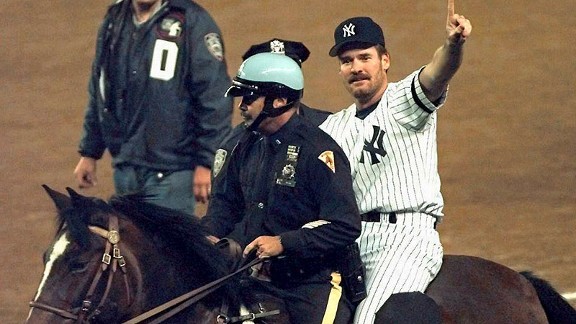
After the heartbreak of the 1986 World Series with the Red Sox, he finally won one with the Yankees in 1996, and who will ever forget him riding behind the police officer on the horse around the warning track at Yankee Stadium.

The Red Sox have not yet retired his Number 26, although they have elected him to their team Hall of Fame. Nor have the Yankees retired his Number 12 or given him a Monument Park Plaque. But when he closed his career with his hometown Devil Rays, they retired Number 12 for him. Yeah, he had his issues, and maybe trying to avoid them makes me... chicken. So what.

Honorable Mention... sort of... to Larry Wayne Jones Jr. of Deland. Yeah, Chipper. A .303 batting average, a 141 OPS+, 468 home runs, 549 doubles, 2,726 hits, the 1999 NL MVP, 8 All-Star Games, and 12 postseason appearances for the Atlanta Braves... but only 1 ring. As far as I know, he's clean, and will be eligible for the Hall of Fame in 2018.

Honorable Mention to Howard Johnson of Clearwater. By a weird occurrence, the Mets have won 2 World Series, and each time, the starting 3rd baseman was from the Tampa Bay region. In 1969, they platooned a pair of Tampa Bay guys, Ed Charles of St. Petersburg and Wayne Garrett of Sarasota (who also started on their 1973 Pennant-winners).

After helping the Detroit Tigers win the 1984 World Series, the Mets got HoJo for pitcher Walt Terrell, and he platooned with Ray Knight for a couple of years, including 1986. Knight breaks the pattern, but not by much: He's from Albany, Georgia, but the Rays aren't that much further to the south than the Braves are to the north.

In 1987, '89 and '91, HoJo was the 2nd Met, after Darryl Strawberry, to hit 30 homers and steal 30 bases in the same season; I often joked that he was actually a 30-30-30 man, having also made 30 errors, but the most he ever made was 24, not good but hardly an atrocious total for a 3rd baseman. With a .249 lifetime batting average and 228 homers, he'll never make the Hall of Fame, but he's still the best hot-corner man the Mets have ever had -- and will be until David Wright wins a World Series (don’t hold your breath). He's now the Mariners' hitting instructor.

Honorable Mention to Larry Parrish of Winter Haven. An All-Star once with the Montreal Expos and once with the Texas Rangers, statistically he had a better career than HoJo (256 homers despite not playing in a hitters' park), but his only trip to the postseason was in 1981 with the Expos, so HoJo made a bigger impact. Not to be confused with Lance Parrish, nor any relation.

Honorable Mention to Dean Palmer of Tallahassee. Also a 3rd baseman for the Rangers, and later for the Tigers. Hit 275 home runs and had 4 100-RBI seasons.

LF Tim Raines of Sanford. This seems like a tough one at first, because I could have gone with a very similar player, Vince Coleman of Jacksonville, who stole 752 bases in his career, including at least 107 in each of his 1st 3 seasons, but really tailed off before he was 30 years old. By contrast, "Rock" Raines batted .304 as a 21-year-old rookie with the 1981 Expos, and .290 as a 38-year-old veteran with the 1998 Yankees, making the postseason each time.

He had to get to the Yankees to win a ring in 1996 and another in '98, but it was well worth it. He led the NL with a .336 batting average in 1986, but fell victim to collusion, and in his 1st 2 games back with the Expos in '87, on May 1 and 2, torched the Mets -- I was at the May 2 game at Shea, and the Met fans gave him a nice hand because they knew he was a good guy who got screwed.

Actually, he wasn't always a good guy, as he had to overcome a cocaine addiction, but overcome it he did. His lifetime batting average was .294, OPS+ 123, 2,605 hits and 808 stolen bases. He has been eligible for the Hall of Fame since 2008, Baseball-Reference.com's HOF Monitor has him at 90 of a "necessary" 100, their HOF Standards has him at 47 out of 50. He belongs, but, as Coleman did to him, he may be suffering in comparison to Rickey Henderson.

His son, center fielder Tim Raines Jr., played briefly with the Orioles, including the 2002 season with his father, joining the Ken Griffeys as the only father-son combo to play for the same team at the same time. Tim Sr. is now the manager of the Atlantic League's Newark Bears, and Tim Jr. plays for them.

I could have given an Honorable Mention to Luis Gonzalez of Tampa, a Jefferson H.S. teammate of Tino. Not to do so would suugest that I'm still upset over his World Series-winning hit against the Yankees in 2001. (Well, I am.)

But he's just too suspicious. He debuted in 1990, and from then until 1997, his peak homer year was 18. Then, in 1998, at age 30, he suddenly starts jacking them out: Seasons of 23, 26 and 31, and then, in the Arizona Diamondbacks' World Championship year of 2001, 57. And, just like that, he drops again, to 28, 26, 17, 24, 15, 15, and 8 when he retired. He finished with 354 homers. Something's not right there. The D-backs retired his Number 20, making him the 1st player they so honored.

CF Johnny Damon of Orlando. I missed him at first because he was born at Fort Riley, Kansas, where his father was stationed at the time (and where Jackie Robinson was stationed in World War II). But he grew up in Orlando, putting him in the Rays' territory.

He did not play in 2013, but hopes to play this year at age 40. He has a .284 lifetime batting average, 2,769 hits, and 235 home runs and 408 stolen bases. He led the AL in hits and stolen bases in 2000 (with the Kansas City Royals), led it in triples in 2002 (with the Red Sox), and, along with Ramiro Mendoza and Eric Hinske, is one of only 3 men in the last 95 years to have won World Series with both the Red Sox and the Yankees.

But Baseball-Reference has him at 90 on its Hall of Fame Monitor and 45 on its HOF Standards, meaning he doesn't quite make it. If he doesn't play again, he'll be eligible for the Hall in 2018, just like Chipper.

RF Lou Piniella of Tampa. Now best known as a chunky manager, who led the Cincinnati Reds to the 1990 World Championship, the Mariners to every postseason berth they've ever had, and the Cubs to a couple of NL Central titles, he was one heck of a hitter. Won the 1969 AL Rookie of the Year award with the Royals, before being traded to the Yankees after the 1973 season, a great trade for the Yanks as all they gave up was aging reliever Lindy McDaniel.

He had 6 .300 seasons, and although he always seemed to be platooning between left, right and the DH spot with Reggie Jackson and Roy White, he was productive when it counted. It seemed like he saved his best games for the arch-rival Red Sox (including 2 tremendously important defensive plays in the 1978 AL East Playoff), the ALCS against the Royals (revenge for getting rid of him, maybe?) and the World Series against the Dodgers (his 10th-inning single drove home White with the winning run in Game 4 in 1978).

Known as "Sweet Lou" for his swing, not for his personality: While his teammates loved him, he had a temper that Everett would have envied. I'll never forget him getting nailed at the plate in the '78 ALCS -- looking at the replay years later, it's clear that he was out -- and then going into a tirade that led one sportswriter to call him "the Wild Man of Borneo."

As manager in The Bronx, Cincy, Seattle, Tampa and North Side Chicago, everyone waited for bad calls by the umpires to see "the Eruption of Mount Lou." (He's been compared to Italian volcanoes Mt. Vesuvius and Mt. Etna, but is, in fact, descended from immigrants from Spain.) From the time I first became aware of baseball, he's been one of my favorite personalities in the game. If you don’t like Lou Piniella, you’re a sad case. Or a Red Sox, Royals or Dodgers fan.

Honorable Mention to Derek Bell of Tampa, one of the "Killer B's" with Jeff Bagwell and Craig Biggio on the Astros' 1997-98-99 NL Central Champions. He also helped the Mets win the 2000 NL Pennant, but got hurt and was out of baseball after just one more year. Had he played longer, he might have the starting nod here.

Dishonorable Mention to Gary Sheffield of Tampa. Dwight Gooden's nephew seems to have Hall of Fame credentials, including the 1992 NL batting title, a career OPS+ of 140, 2,689 hits, 509 home runs, 467 doubles and, surprisingly, 253 stolen bases. And, let's face it, we all had to applaud when he faced that guy who was trying to extort his wife, who posed for some racy photos before becoming a gospel singer. Sheff called first his bluff and then the cops. Great.

But... Eight different teams wanted to get him, but all 8 teams ended up wanting to get rid of him. He reached the postseason with 3, but only won 1 Pennant, winning the 1997 World Series with the Marlins. When the Yankees got him in 2004, I was against it, using the cliche "clubhouse cancer."

Well, he didn't look like it through that regular season, but he disappeared at the plate during those last 4 ALCS games against the Red Sox. He put up another great regular season in 2005, but again didn't get the job done in October. In 2006, he got hurt, and didn't get the job done in any month, including the embarrassing ALDS loss to the Tigers, and my prophecy was, sadly, fulfilled. He played with the Mets in 2009, and gave them some big hits at age 40, but got hurt again, and was released.

And then, of course... Seriously, Gary, you didn't know "the cream" had a steroid in it? He may be many things, but he's not stupid. But he didn't respect the baseball establishment, or baseball fans, enough to give us the truth, or even enough to give us a plausible lie. He does not make this team, and, while he stands to become eligible for the Hall of Fame next year, I hope he doesn't get in.

DH Hal McRae of Sebring. One of the first players to make his name as a designated hitter, he helped the Kansas City Royals to 10 postseason appearances -- every one they've ever made, including the 1980 Pennant and the 1985 World Championship. A career OPS+ of 122, he led the AL in doubles in 1977 and in doubles and RBIs in 1982. He was less successful as a manager, and although his son Brian McRae also played in the majors, he wasn’t nearly as successful as his father.

UT Desmond DeChone "Chone" Figgins of Brandon -- originally missed by me because he was born in Leary, Georgia. He's played every position except 1st base, catcher and pitcher, and not just once or twice: Each position he's played, he's played at least 27 times, with 3rd base his most frequent position.

A rookie with the Anaheim Angels' World Champions of 2002, he drove the Yankees crazy in the 2002, '05 and '09 postseasons, and was a big reason why the Angels reached the postseason 6 times in 8 years. He has a .277 lifetime batting average and 337 stolen bases, leading the AL with 62 in 2005. After sitting out last season, he has been signed to a contract by the Dodgers. He's 36 and versatile, and he may be just the kind of player the "nearly men" Dodgers need to get over the hump.

C Al Lopez of Tampa. A very good defensive catcher for the Brooklyn Dodgers and Pittsburgh Pirates, and in fact once held the record for most games played at the position. Not a great hitter, but did bat .301 in 1933.

And the next-best catchers for the Rays' region are Mike Heath of Tampa, Thurman Munson's backup on the 1978 World Champions, who later became a starter in Oakland and Detroit; and Zack Taylor, Gabby Hartnett’s backup on the 1929 NL Champion Cubs, who is better known as the St. Louis Browns manager who Bill Veeck usurped for "Grandstand Managers Night" in 1951. I originally had him as the manager on this team, but subsequent achievements by another led me to change my mind.

Honorable Mention to Anthony John "A.J." Pierzynski of Orlando. Went to Dr. Phillips H.S. with Damon. A 2-time All-Star, he reached the postseason with the 2003 Minnesota Twins, before becoming a key figure in the Chicago White Sox' 2005 World Series run, with that controversial missed 3rd strike in the ALCS. A lot of people who aren't White Sox fans hate him. I think he's a gamer, and if the Yankees ever got him, I'd be fine with it.

SP Jack Billingham of Orlando. Helped the Cincinnati Reds win 3 Pennants and 2 World Series in the 1970s, on his way to 145 career wins.

SP Don Sutton of Pensacola -- originally missed by me because he was born in Clio, Alabama, which also happens to be the birthplace of another somewhat disreputable character, George Wallace. True, Sutton was caught cheating (sandpaper taped to his glove hand, good way to hide it until, of course, he couldn't), but he apparently didn't do it for his entire career. He only won 20 once, in 1976, but won 324 games in his career, and struck out 3,574 batters. Of pitchers with more wins – Nolan Ryan has exactly as many – only Roger Clemens and Steve Carlton have more strikeouts. His career WHIP is 1.142.

Hall of Fame, Number 20 retired by the Los Angeles Dodgers, whom he got to the postseason in 1974, '77, '78 and (through a one-game Playoff for the NL West title) '80. He also reached the postseason with the Houston Astros in '81, the Milwaukee Brewers in '82, and the California Angels in '86. He never won a World Series, though: He was re-signed by the Dodgers in 1988, but was released in August, just before they won the Series (as they had in '81, when he was in Houston).

SP Dwight Gooden of Tampa. At age 19 and 20, Doctor K was one of the best pitchers we'll ever see. From 21 to 26, he was one of the best pitchers in baseball. From 27 to 35, he was just another pitcher as he battled his demons -- which, don't forget, included injuries as well as drugs. And at 35, much too soon, he was done.

He should have been 194-112 at the 2/3rds mark of his career, but that was his final record. But he did pitch a no-hitter (as a Yankee, not a Met), and he did win 3 World Series (1986 as a Met, 1996 and 2000 as a Yankee).

SP Mike Hampton of Crystal River. A 2-time All-Star, he helped the Astros to 3 straight postseason appearances, going 22-4 in the last of those seasons, 1999. So the Mets made him a rent-a-star in 2000, and he led them to a Pennant, pitching the NLCS clincher in Game 5 at Shea. But the Mets chose not to sign him to a new contract, and he chose to sign with the Colorado Rockies.

So, Hamp, how good are the schools in the Denver area? Injuries dogged him thereafter, and he retired after the 2010 season, having appeared in only 44 games after 2005. His career record was 148-115.

SP Tim Wakefield of Melbourne. From 1991 to 2012, the Boston Red Sox reached the postseason 8 times in 21 seasons, and he was there for all of them: 1995, '98, '99, 2003, '04, '05, '07 and '08. Before that, he was on the Pirates' 1992 NL East Champions, their last postseason bid for 21 years.

He knuckleballed his way to an even 200 wins, and that doesn't count beating the Yankees in Games 1 and 4 of the 2003 ALCS, before giving up Aaron Boone’s homer in Game 7. Still, he has been as much a part of the Sox’ success, throughout their history, as anyone.

Honorable Mention to Zack Greinke of Orlando. He won the 2009 AL Cy Young Award, going 16-8 with an ERA of 2.16, an ERA+ of 205, and a WHIP of 1.073, all leading the League. A far cry from the 5-17 he had with the Kansas City Royals in 2005. Last year, with the Dodgers, he went 15-4 and led the NL with a .789 winning percentage.

That awful '05 season has left his career record at a relatively pedestrian 106-82, but his career ERA+ is 116, and at only 30, pitching in pitcher-friendly Dodger Stadium, with their run support, he should be very effective for some time to come. I'm not sure whether he would surpass Billingham, Hampton or Wakefield when he makes the rotation, though.

Dishonorable Mention to Kenny Rogers of Plant City (initially missed by me because he was born in Savannah, Georgia, Braves territory). True, he went 219-156 for a .528 winning percentage, and his career ERA of 108 isn't bad, but his career WHIP is 1.403, and he's a known cheater and a massive jackass.

Plus, how many players can say they screwed over both New York baseball teams? The Yankees came back from 6-0 down in Game 4 of the 1996 World Series, but the reason they were in that hole is because Rogers, 12-8 that regular season but with a 14.14 ERA in the postseason, put them there. And he threw the biggest base on balls in baseball history in Game 6 of the 1999 NLCS, walking Andruw Jones with the bases loaded to give the Atlanta Braves the Pennant against the Mets. His name may have been Kenny Rogers, but it was a manager bringing him in who was "The Gambler."

RP Tom Gordon of Avon Park. A pretty good starter for the Royals, finishing 2nd in the AL Rookie of the Year voting in 1989, he became a great reliever for the Red Sox. In 1998, he saved 46 for the Sox, and Sox fan Stephen King wrote a fantasy novel titled The Girl Who Loved Tom Gordon. This is how strong the Curse of the Bambino -- if it actually existed -- was: Gordon got hurt the next season, which may have prevented the Sox from beating the Yanks in the ’99 ALCS.

He was with the Yankees in 2004, and... lost in the ALCS to the Red Sox! He finally got a ring with the 2008 Phillies. A 3-time All-Star, he finished with 138 wins and 158 saves. But a good career.

Honorable Mention to Bobby Thigpen of Tallahassee. For a few years, he was a great closer with the Chicago White Sox. In 1990, he saved 57 games, a record that stood until 2008. But injury cut his career short at age 30, with 201 saves. He did make it into a World Series, with the Phillies in 1993.

Dishonorable Mention to Jonathan Papelbon of Jacksonville. Yes, he has 286 career saves going into the 2014 season. Yes, he's a 5-time All-Star. And, yes, he helped the Red Sox win the World Series in 2007, and was on the mound for the final out, a strikeout. But he got rocked in the 2009 AL Division Series against the Angels, was a big factor in the Sox' 2011 choke, and wasn't especially effective for the Phillies the last 2 seasons after the Sox decided his antics were no longer worth it.

At his best, Papelbum hasn't been better than the best of either Gordon or Thigpen -- and, at 33, we may have seen the last of his best.

MGR Tony LaRussa of Tampa. He made his big-league debut with the Kansas City Athletics in 1963, only 18, while still at Jefferson High, the same alma mater as McGriff, Tino and Gonzalez. But only once did he have more than 53 major league at-bats in a season, and he played his last game in 1973, only 28, with a lifetime batting average of .199. (Bob Uecker jokes about his playing and his lifetime batting average of exactly .200. But that was better than LaRussa's.)

But this weak-hitting middle infielder did what a lot of guys who had brains and a love of the game, but not the talent to match, did: He went into coaching and managing. He managed his 1st big-league game in 1979, when Jimmy Carter was President, desktop computers were new, portable phones were a foot long. and fans of the team he was hired to manage, the Chicago White Sox, were telling us that disco, the dominant form of popular music of the time, sucked (and they were right).

He managed his last big-league game in 2011, when Barack Obama was President, computers could fit in your pocket, they essentially had a telephone among their apps, and Justin Bieber was making teenage girls scream with lust and everyone else scream with indignation.

He managed the White Sox to the 1983 AL West title, their only 1st-place finish between 1959 and 1993. He managed the Oakland Athletics in their steroid-ridden "Bash Brothers" years, in a span of 5 seasons winning 4 AL West titles, 3 AL Pennants and the 1989 World Series. He moved on to the St. Louis Cardinals, and made 9 postseason appearances, including winning 3 Pennants (and just missing 1 other) and the 2006 and 2011 World Series. That last big-league game I mentioned that he managed? Game 7 of the 2011 World Series, following a thrilling Game 6, and he won it.

After Sparky Anderson, he was just the 2nd manager to win World Series in both Leagues. (The only other managers to win Pennants in both Leagues: Joe McCarthy, Yogi Berra, Alvin Dark, Dick Williams and Jim Leyland.) He won 2,728 games as a manager. He was just elected to the Baseball Hall of Fame and the Cards' team Hall of Fame, and they also retired his Number 10 -- which the A's haven't done.