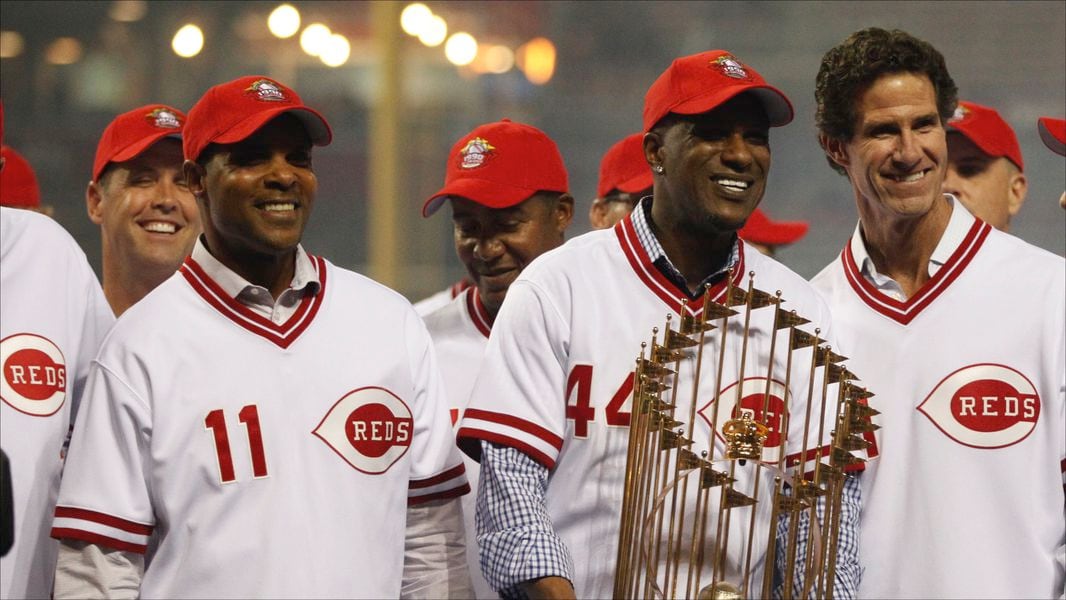
Barry Larkin (11), Eric Davis (44) and Paul O'Neill (21)
with the 1990 World Series trophy.
October 20, 1990, 30 years ago: The Cincinnati Reds beat the Oakland Athletics, 2-1 in Game 4 of the World Series, at the Oakland Coliseum. What had been predicted as an easy victory, possibly even a 4-game sweep, by the A's, the defending World Champions on their 3rd straight American League Pennant, became a 4-game sweep in the other direction, by the National League's Reds.
As he had in Game 1, José Rijo outpitched Dave Stewart, to win Most Valuable Player honors. With the A's leading 1-0 going into the top of the 8th inning, Barry Larkin singled, Herm Winningham beat out a bunt for a hit, and Paul O'Neill reached on an error to load the bases. The tying and winning runs scored rather undramatically, on a groundout by Glenn Braggs and a sacrifice fly by Hal Morris, respectively.
It remains one of the greatest upsets in World Series history: The Reds won 91 regular-season games to the 103 for the A's, but outscored the A's 22-8. This title also reversed the result of the 1972 World Series, when the Reds, in their "Big Red Machine" era, lost to the A's in 7 games, despite Oakland's best player, Reggie Jackson, being unavailable due to injury.
This time, the Reds lost both Eric Davis and Billy Hatcher, who batted a record .750 (9-for-12) in the Series, in the clinching Game 4, but didn't need them.
It was the 5th World Series won by the Reds. They also won in 1919, 1940, 1975 and 1976, while winning Pennants but losing the World Series in 1939, 1961, 1970 and, as said, 1972.
The Reds haven't won a Pennant since. They led the NL Central Division when the Strike of '94 hit. They won the Division in 1995, and swept the Los Angeles Dodgers in the NL Division Series, but were then swept by the Atlanta Braves in the NL Championship Series. They lost a Playoff for the NL Wild Card in 1999 -- to the Mets. How embarrassing.
They didn't get close to the postseason again until 2006, finishing 3 1/2 games out of 1st place. They won the Division in 2010 and 2012, but lost the NLDS to the Philadelphia Phillies and the San Francisco Giants, respectively. In 2013, they lost the NL Wild Card Game to the Pittsburgh Pirates. They then had 6 straight seasons of 86 or more losses, 4 of them of 94 or more, until this season, when they made the COVID-19-forced expanded Playoffs, and got swept in 2 straight for the Braves.
So, in the last 30 years, the Reds have had their moments. But it's been 30 years to the day since they last won the World Series. And 30 years and 8 days, since October 12, 1990, since they won a Pennant -- or even a single NLCS game. How long has that been?
*
Those Reds were managed by Lou Piniella, the former Yankee outfielder and manager, who was hired the year before, after the biggest of all Reds legends, Pete Rose, was permanently banned from baseball. By a weird turn of events, Piniella and the Oakland manager, Tony La Russa, grew up in Tampa and were teammates on an American Legion baseball team.
He inherited a team that had Larkin, who went to the Hall of Fame; O'Neill, just coming into his own, a right fielder who would go on to help the Yankees win 4 World Series; Hatcher, who had previously helped the Houston Astros win a Division title; Davis, a center fielder who looked like he would become an all-time legend, but who would be limited by injuries to 282 home runs, 349 stolen bases and 3 Gold Gloves; and Chris Sabo, a former Rookie of the Year who would be a 3-time All-Star.
The pitching was good: Rijo would go on to lead the NL in strikeouts in 1993. That year, Danny Jackson would help his team win the Pennant, although that team would be the Phillies, not the Reds. Tom Browning had thrown a perfect game, and won 123 games before a broken arm ended his career. And they had a trio of relievers known as "The Nasty Boys": Rob Dibble, Norm Charlton and Randy Myers, the latter a member of the Mets' 1986 World Series winners.
Major League Baseball had 26 teams, but had not yet expanded to Florida or the Mountain Time Zone. The Montreal Expos hadn't yet moved to Washington. There were no Asian players, no Interleague Play, and, a year earlier, the SkyDome in Toronto (now the Rogers Centre) became the 1st MLB stadium with a retractable roof.
The Chicago White Sox were about to move from the 80-year-old Comiskey Park to a new stadium with the same name (now U.S. Cellular Field). They were 1 of 4 teams still using a ballpark built before World War I, 6 using one built before World War II, and 8 built before the Space Age. (Now, each of those 3 categories is down to 2.) Today, only 7 teams are using the same stadium they were using in 1990: The A's, the Royals, the Red Sox, the Dodgers, the Chicago Cubs, the Toronto Blue Jays, and the team now known as the Los Angeles Angels. In 2002, the Reds closed Riverfront Stadium, and moved to the new Great American Ball Park the next season.
The Giants hadn't won the World Series in 36 years (and not at all since moving to San Francisco), the Cleveland Indians 42 years, the Red Sox 72 years, the White Sox 73 years, and the Cubs 82 years. All but the Indians have since ended their droughts.
The Colorado Rockies, the Miami Marlins, the Tampa Bay Rays and the Arizona Diamondbacks hadn't begun play yet. Those 4 teams, plus the Blue Jays, the Angels, the Houston Astros, the Texas Rangers, the Braves since they moved to Atlanta, and the Expos/Nationals franchise hadn't yet won the Pennant. The Marlins, the D-backs, the Jays, the Angels, the Braves since they moved to Atlanta, and the Expos/Nats hadn't yet won the World Series. All of those achievements have since been reached.
A month earlier, Bobby Thigpen of the White Sox set a new record of 57 saves, which would stand for 18 years. A few weeks before that, Ken Griffey Sr. and Ken Griffey Jr. of the Seattle Mariners became the 1st father and son to play on the same team at the same time, and hit back-to-back home runs.
The Yankees, besieged by injuries, finished last for the only time since 1966. George Steinbrenner fired Bucky Dent as manager while the Yankees were playing a series with the Red Sox at Fenway Park, site of Bucky's greatest moment as a player. When he was invited to return for Old-Timers' Day -- the one OTD between 1951 and 1998 that neither Joe DiMaggio nor Mickey Mantle appeared -- Dent got a huge ovation, and a "Steinbrenner sucks!" chant went up.
George would soon be suspended by Commissioner Fay Vincent for hiring Howard Spira, a Mob-connected compulsive gambler who had worked for Dave Winfield's charitable foundation, to dig up dirt on the slugger. He failed, George got caught, and was given a lifetime ban, with the opportunity to be reinstated after 2 years (which he was). George had already traded Winfield to the Angels by the time he was banned. With Gene Michael put in charge of baseball operations, the rebuilding of the Yankees began.
Emblematic of this awful Yankee season was Andy Hawkins pitching 8 innings of no-hit ball against the White Sox in the last game the Yankees ever played at Comiskey, but losing 4-0 because of his walks and 3 8th-inning errors. Although he pitched a complete game and didn't allow any hits, MLB decided to not credit him with a no-hitter. Nolan Ryan was, for the 6th time, and also won his 300th game (although not in the same game).
In the NFL, there were 2 teams in Los Angeles, and no team in Oakland, St. Louis or Baltimore. Those cities would get teams again, while Los Angeles lost out, and then gained 2 new teams -- actually, 2 old teams, 1 of which was 1 of the 2 they lost in 1994. There was no team in Carolina, Jacksonville or Tennessee, but those places would get teams. There was a team in Houston, but it was the Oilers, not the Texans.
The NBA has since added Toronto, Vancouver (who moved to Memphis) and a new Charlotte team to replace the one that moved to New Orleans; while the Seattle SuperSonics were moved to Oklahoma City. The NHL has added 11 teams, and moved 5: Since 1990, Minnesota, Quebec City, Winnipeg, Hartford and Atlanta have all lost their teams; while only Minnesota and Winnipeg have gotten their teams replaced.
Baseball legends Joe DiMaggio, Ted Williams, Bob Feller, Warren Spahn, Billy Herman and Charlie Gehringer were still alive. Ryan, George Brett, Robin Yount and Carlton Fisk would hang on as active players until 1993. The other defining players of my childhood had all retired.
A month earlier, Bobby Thigpen of the White Sox set a new record of 57 saves, which would stand for 18 years. A few weeks before that, Ken Griffey Sr. and Ken Griffey Jr. of the Seattle Mariners became the 1st father and son to play on the same team at the same time, and hit back-to-back home runs.
The Yankees, besieged by injuries, finished last for the only time since 1966. George Steinbrenner fired Bucky Dent as manager while the Yankees were playing a series with the Red Sox at Fenway Park, site of Bucky's greatest moment as a player. When he was invited to return for Old-Timers' Day -- the one OTD between 1951 and 1998 that neither Joe DiMaggio nor Mickey Mantle appeared -- Dent got a huge ovation, and a "Steinbrenner sucks!" chant went up.
George would soon be suspended by Commissioner Fay Vincent for hiring Howard Spira, a Mob-connected compulsive gambler who had worked for Dave Winfield's charitable foundation, to dig up dirt on the slugger. He failed, George got caught, and was given a lifetime ban, with the opportunity to be reinstated after 2 years (which he was). George had already traded Winfield to the Angels by the time he was banned. With Gene Michael put in charge of baseball operations, the rebuilding of the Yankees began.
Emblematic of this awful Yankee season was Andy Hawkins pitching 8 innings of no-hit ball against the White Sox in the last game the Yankees ever played at Comiskey, but losing 4-0 because of his walks and 3 8th-inning errors. Although he pitched a complete game and didn't allow any hits, MLB decided to not credit him with a no-hitter. Nolan Ryan was, for the 6th time, and also won his 300th game (although not in the same game).
In the NFL, there were 2 teams in Los Angeles, and no team in Oakland, St. Louis or Baltimore. Those cities would get teams again, while Los Angeles lost out, and then gained 2 new teams -- actually, 2 old teams, 1 of which was 1 of the 2 they lost in 1994. There was no team in Carolina, Jacksonville or Tennessee, but those places would get teams. There was a team in Houston, but it was the Oilers, not the Texans.
The NBA has since added Toronto, Vancouver (who moved to Memphis) and a new Charlotte team to replace the one that moved to New Orleans; while the Seattle SuperSonics were moved to Oklahoma City. The NHL has added 11 teams, and moved 5: Since 1990, Minnesota, Quebec City, Winnipeg, Hartford and Atlanta have all lost their teams; while only Minnesota and Winnipeg have gotten their teams replaced.
Baseball legends Joe DiMaggio, Ted Williams, Bob Feller, Warren Spahn, Billy Herman and Charlie Gehringer were still alive. Ryan, George Brett, Robin Yount and Carlton Fisk would hang on as active players until 1993. The other defining players of my childhood had all retired.
In addition to Larkin, Ryan, Brett, Yount and Fisk, the following players were then active, and are now in the Baseball Hall of Fame: Bert Blyleven, Goose Gossage, Dave Winfield, Gary Carter, Jack Morris, Andre Dawson, Alan Trammell, Eddie Murray, Ozzie Smith, Paul Molitor, Tim Raines, Lee Smith, Harold Baines, Ryne Sandberg, Cal Ripken, Wade Boggs, Tony Gwynn, Kirby Puckett, Greg Maddux, Edgar Martinez, Tom Glavine, Roberto Alomar, Craig Biggio, Randy Johnson, John Smoltz, Larry Walker, Ken Griffey Jr. and, a rookie that season, Frank Thomas.
And, from the defeated A's, Dennis Eckersley and Rickey Henderson, along with manager La Russa. But not Dave Stewart or Dave Parker (neither quite had the career stats), and not Mark McGwire or
José Canseco (now known to be steroid cheats).
Mariano Rivera had just debuted in professional baseball that summer. Derek Jeter had just started high school. Alex Rodriguez, David Ortiz and Jimmy Rollins were in junior high, Albert Pujols was 10, CC Sabathia was 9, Robinson Cano and current Royals ace James Shields were 8. David Wright, Justin Verlander and Miguel Cabrera were 7, Max Scherzer was 6, Felix Hernandez was 4, Buster Posey was 3, Clayton Kershaw and Stephen Strasburg were 2, Madison Bumgarner was 1, Giancarlo Stanton was 11 months old, José Altuve was 5 months old, Gerrit Cole was 6 weeks old, and Mike Trout, Christian Yelich, Aaron Judge, Mookie Betts, Bryce Harper, Clint Frazier, Gleyber Torres and Juan Soto weren't born yet. (Those players are all listed in descending order of birth, oldest to youngest.)
Current Reds manager David Bell was in the farm system of the Cleveland Indians, for whom his father, Buddy Bell, had played. Aaron Boone of the Yankees was in high school. Luis Rojas of the Mets was 9 years old.
Tom Thibodeau of the Knicks was an assistant coach with the Minnesota Timberwolves. Barry Trotz of the Islanders was an assistant coach for the minor-league Baltimore Skipjacks. Lindy Ruff of the Devils was playing for the Rangers. David Quinn, now the head coach of the Rangers, was out of hockey due to battling a long-term illness. Steve Nash of the Nets and Ronny Deila of New York City FC were in high school. Gerhard Struber of the Red Bulls was 13 years old. Adam Gase of the Jets was 12. Joe Judge of the Giants was 10. And Walt Hopkins of the Liberty was 5.
In addition to the A's, the defending World Champions were the San Francisco 49ers in football, the Detroit Pistons in basketball, and the Edmonton Oilers in hockey. (The Oilers haven't won since, either.) The Heavyweight Champion of the World was James "Buster" Douglas, who had knocked out the previously unbeaten Mike Tyson 6 months earlier, but was about to lose it to Evander Holyfield.
The Olympic Games have since been held in America twice, France, Spain, Norway, Japan, Australia, Greece, Italy, China, Canada, Britain and Russia. The World Cup, which had recently been held in Italy, with Germany winning it (as they did this year), has since been held in America, France, Japan, Korea, Germany, South Africa and Brazil.
There were 26 Amendments to the Constitution of the United States. The idea that corporations were "people" and had the rights thereof was considered ridiculous -- but so was the idea that a person could legally marry a person of the same gender. No Justices then on the Supreme Court are still on it.
The President of the United States was George H.W. Bush. His son George W., having failed spectacularly in business, had recently (with more than a little help from his "friends") bought the Texas Rangers. Ronald Reagan, Jimmy Carter, Gerald Ford, Richard Nixon, their wives, and the widows of Lyndon Johnson and John F. Kennedy were still alive.
Bill Clinton was about to be elected to a 5th term as Governor of Arkansas. Barack Obama was President... of the Harvard Law Review. Joe Biden was Chairman of the Senate Judiciary Committee. Kamala Harris was newly hired as an Assistant District Attorney in her native Alameda County, California -- Oakland, the city just dethroned as World Champions of baseball. Mike Pence was a lawyer who was about to become 0-for-2 in races for Congress. And Donald Trump was between wives and bankruptcies. His life was a mess. The more things change, the more they stay the same.
The Governor of New York was Mario Cuomo, whose son, current Governor Andrew Cuomo, was Chairman of the New York City Homeless Commission, reporting to Mayor David Dinkins. The Governor of New Jersey was Jim Florio. The Governor of Ohio was Richard Celeste, although former Cleveland Mayor George Voinovich was about to be elected to replace him. The Mayor of Cincinnati was Charles Luken.
The Governor of New York was Mario Cuomo, whose son, current Governor Andrew Cuomo, was Chairman of the New York City Homeless Commission, reporting to Mayor David Dinkins. The Governor of New Jersey was Jim Florio. The Governor of Ohio was Richard Celeste, although former Cleveland Mayor George Voinovich was about to be elected to replace him. The Mayor of Cincinnati was Charles Luken.
The current holders of those offices? I've told you of Andrew Cuomo. Current New York Mayor Bill de Blasio was an aide to Dinkins. Current New Jersey Governor Phil Murphy was a rising star at Goldman Sachs. Current Ohio Governor Mike DeWine was in Congress, and was about to be elected Lieutenant Governor on Voinovich's ticket. And current Cincinnati Mayor John Cranley was in high school.
There were still living veterans of the Spanish-American War, the Boxer Rebellion, the Philippine Campaign, the Mexican Revolution, the Boer War and the Russo-Japanese War. There were still living survivors of the Johnstown Flood of 1889, the sinking of the General Slocum in 1904, and the San Francisco Earthquake of 1906.
Soviet President Mikhail Gorbachev was about to be awarded the Nobel Peace Prize. The Pope was John Paul II. The current Pope, Francis, Jorge Mario Bergoglio, was a bishop in Buenos Aires in his native Argentina.
The Prime Minister of Canada was Brian Mulroney. The head of state for Canada, and Britain, was Queen Elizabeth II -- that hasn't changed -- but Prime Minister Margaret Thatcher was about to lose her job to John Major, due to her support of an onerous poll tax. There have since been 5 Presidents of the United States, 7 Prime Ministers of Britain, and 3 Popes.
England's Football League had recently been won by Liverpool for a record 18th time -- but they haven't won it since. Manchester United had won the FA Cup, their 1st trophy under manager Alex Ferguson, who said he was determined to beat Liverpool and "knock them off their fucking perch." It would take until 1993, but he would do it.
Major novels of 1990 included Clear and Present Danger by Tom Clancy, Jurassic Park by Michael Crichton, L.A. Confidential by James Ellroy, Get Shorty by Elmore Leonard, The Bourne Ultimatum by Robert Ludlum, and The Burden of Proof by Scott Turow. The last of these became a TV miniseries the next year, while the rest all became major feature films. Stephen King was working on Needful Things. George R.R. Martin, frustrated that his screenplays and teleplays were getting cut, or dropped completely, decided to return to fantasy novels, and began the process that led to Game of Thrones. J.K. Rowling was on a long train trip from Manchester to London, when she got the idea that would become the Harry Potter series.
Major films of the Autumn of 1990 included Goodfellas, Pacific Heights, Avalon, Henry & June, Miller's Crossing, Mr. Destiny, Jacob's Ladder, Rocky V, Misery, and Home Alone. Steven Spielberg was directing Hook, a story of a grownup Peter Pan (played by Robin Williams) returning to Neverland, and George Lucas helped him out on it.
TV series that were beginning in the new 1990-91 season included The Fresh Prince of Bel-Air, Law & Order, Beverly Hills 90210, Evening Shade, Tiny Toon Adventures, Captain Planet & the Planeteers, the even more cartoonish Dream On, and The Flash, starring John Wesley Shipp as DC Comics' Scarlet Speedster.
Michael Keaton was reaping the benefits of the previous year's Batman film, Christopher Reeve was still thought of as Superman, Lynda Carter was still thought of as Wonder Woman, and Nicholas Hammond was still the most recent live-action Spider-Man. Timothy Dalton had played James Bond in the previous year's Licence to Kill, but quit, and legal wrangling kept the 007 franchise in limbo for a while. So was Doctor Who, recently canceled with the last and Seventh Doctor having been Sylvester McCoy.
NBC made a sitcom, Ferris Bueller, based on the 1986 John Hughes film. But it moved the action from the suburbs of Chicago to those of Los Angeles, made Ferris a year younger than his sister Jeanie rather than a year older, and made Sloane a blonde instead of a brunette. Despite having The Fresh Prince of Bel-Air as its lead-in, it tanked, and was canceled after 12 of the 13 episodes were aired. It was replaced on NBC's schedule by Blossom. But even Ferris Bueller was a success compared to ABC's combination of a cop show and a musical, the execrable Cop Rock.
Jerry Seinfeld was known, but no one had yet heard of George Costanza, Elaine Benes and Cosmo Kramer. Or of Deadpool, Buffy Summers, Fox Mulder, Ross Geller & Rachel Greene, Bridget Jones, Xena, Carrie Bradshaw, Jed Bartlet, Tony Soprano, Leroy Jethro Gibbs, Rick Grimes, Lisbeth Salander, Bella Swan, Don Draper, Katniss Everdeen, Walter White or Richard Castle.
Ricky Nelson's twin sons, Matthew and Gunnar, recording as "Nelson," had the Number 1 song in the country, "(Can't Live Without Your) Love and Affection." If people were shocked by how "Rick" looked at the "Garden Party" in 1971, they would have been appalled at the twins' long bleach-blond, metal-esque hair. Still, it gave the Nelson family the 1st father & son Number 1 hits in the Rock and Roll Era.
Paul McCartney was touring for his album Flowers In the Dirt. Celine Dion gave her 1st English-language concert. A band named for basketball star Mookie Blaylock debuted, but soon changed its name to Pearl Jam. 2 Live Crew were acquitted of obscenity charges.
The Geto Boys, The Rembrandts and The La's released their self-titled debut albums, Bob Dylan Under a Red Sky, George Michael Listen Without Prejudice, Vol. 1, Neil Young Ragged Glory, Warrant Cherry Pie, AC/DC The Razor's Edge (including "Thunderstruck"), Megadeth Rust In Peace, Roseanne Cash Interiors, Mary Chapin Carpenter Shooting Straight In the Dark, and Paul Simon The Rhythm of the Saints, including what remains his last hit, "The Obvious Child," which has the lyric, "The cross is in the ballpark."
Kris Jenner was in the process of divorcing Robert Kardashian, so she could marry 1976 Olympic hero Bruce Jenner. None of the children of any of the 3 of them was famous yet. Kanye West and Shakira were 13 years old; Sean Murray and Stana Katic 12; Katie Holmes, Heath Ledger and Pink 11; Cote de Pablo 10; Christina Aguilera, Alicia Keys, Hyden Christensen, Jessica Alba, Natalie Portan, Chris Evans and Beyonce 9; Britney Spears, Sienna Miller, Cobie Smulders, Hayley Atwell, Kirsten Dunst, Cory Monteith and Elisabeth Moss 8; Matt Smith, Anne Hathaway, Henry Cavill and Andrew Garfield 7; Emily Wickersham 6; Katy Perry and Scarlett Johansson 5; Lady Gaga, Robert Pattinson and Lea Michele 4; Emilia Clarke, Kit Harington, Naya Rivera and Rose Leslie 3; Rhianna 2; Emma Stone and Daniel Radcliffe 1; Taylor Swift 9 months, Kristin Stewart and Emma Watson 5 months; and Cardi B, Selena Gomez, Demi Lovato, Miley Cyrus, Ariana Grande, Justin Bieber, Halsey, all of the members of One Direction, all of the members of BTS, and all of the Modern Family kids hadn't been born yet.
Inflation was such that what $1.00 bought then, $1.99 would buy now. A U.S. postage stamp cost 25 cents, and a New York Subway ride $1.15. The average price of a gallon of gas was $1.22, a cup of coffee $1.49, a McDonald's meal (Big Mac, fries, shake) $5.23, a movie ticket $4.23, a new car $15,045, and a new house $150,100. The Dow Jones Industrial Average closed the preceding day, a Friday, at 2520.79.
The World Wide Web was about to debut, but hardly anybody would know about it for a while. Mobile phones were still the size of the original Star Trek series' communicators. The Hubble Space Telescope had been launched, but it wasn't working, and would need to be repaired by a later shuttle mission. The 1st digital camera was sold in the U.S. The leading home video game system was the Sega Genesis. The birth control pill was long-established, but there was, as yet, no Viagra.
In the Autumn of 1990, Operation Desert Shield was launched, to ready American troops to push Saddam Hussein's Iraqi army out of Kuwait. Presidents Bush and Gorbachev met in Helsinki, Finland to discuss the situation, and those of the breakaway Soviet republics. Germany was reunified for the 1st time since 1945, and under a free government for the 1st time since 1933. A devastating civil war began in the African nation of Rwanda. China opened its 1st McDonald's and its 1st Pizza Hut. Walmart opened its 1st store in the Northeast, in York, Pennsylvania.
Leonard Bernstein, and William S. Paley, and Cookie Lavagetto died. Jennifer Lawrence, and John Wall, and John Tavares were born.
October 20, 1990. The Cincinnati Reds won the World Series, after winning the National League Pennant. They have never won another of either.
Will they win them in the near future? Stay tuned.


