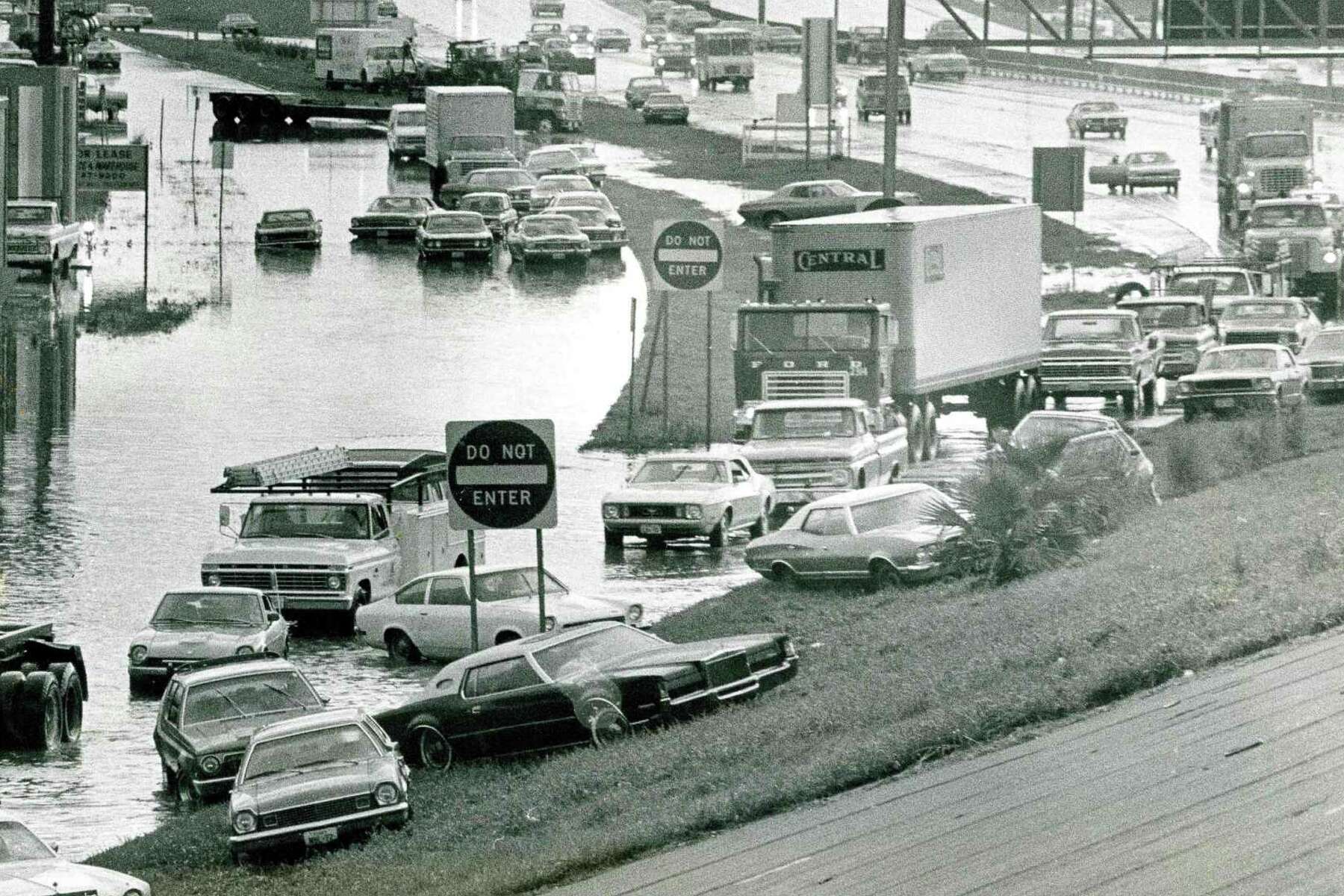
June 15, 1976, 50 years ago: A baseball game scheduled for the Astrodome in Houston is rained out.
Seriously. And while it was the weirdest event in baseball that day, it was far from the most consequential.
Until then, only one game at the Astrodome had ever been not been played, and the reason had nothing to do with the weather. On April 7, 1968, 3 days after the assassination of Dr. Martin Luther King, an exhibition game was canceled, as part of a day of mourning. But no regular-season games at the Dome, from its April 9, 1965 opening until June 15, 1976, were postponed. It was thought that preventing rain from falling onto the field would prevent that.
The Houston Astros were supposed to play the Pittsburgh Pirates. But heavy rain hit South Texas, and massive flooding resulted in Houston. At most, it was 13 inches deep at the Ship Channel on the city's East Side. On South Main Street, on the Southwest Side, near the Astrodome, the water was 7 inches deep.
This prevented all but a few fans from reaching the stadium. The Pirates were staying at the Shamrock Hilton. In normal weather, from there to the Astrodome would have been a 10-minute drive on the team bus. The driver had to go so gingerly, it ended up taking 30 minutes.
Both teams had arrived early for practice, and, according to Tal Smith, then the Astros' general manager, the field was dry, and there was no reason for which the home team was responsible that the game could not be played.
About 15 minutes after the Pirates got in, Tom Gorman, the crew chief for the umpires -- also including John McSherry, Paul Pryor and Art Williams -- called Smith, and told him that their car had stalled out in high water, and they couldn't get to the game. Only a few concession and security workers made it in. The broadcast crews for KPRC, both radio (950 AM) and television (Channel 2), were unable to reach the Dome, meaning that, if the game had gone on, there would be no coverage.
At 5:00 PM Central Time that day, faced with a 7:35 PM start time, the teams agreed to call the game off. Refunds were offered for 20 fans who did show up. Tables were brought onto the field, and the teams ate dinner together. The 20 fans were served separately, but it was free.
"Buffet-type, if I recall," said Pirate outfielder Al Oliver. "The Astro organization really did a great job. I tip my cap to 'em." And the players didn't seat themselves Astros at one end, Pirates at the other, or one team on each side. They mixed and mingled. "Most of us knew each other," Oliver added.

The players still couldn't get home, due to the flooding. Both teams bedded down inside their clubhouses. Having the Astroworld Hotel on the Astrodome campus didn't help: They still would have had to wade their way through the flooding to get there.
Although the Astros still had a home series with Pittsburgh in August, this game was made up at Three Rivers Stadium in Pittsburgh in July. The Pirates swept, 8-6 and 3-0.
The Astros played 35 seasons in the Astrodome, 1965 to 1999. In 2000, they moved into what's now known as Daikin Park, which has a retractable roof. This game remains their only regular-season home postponement.
*
No other Major League Baseball games was postponed that day. Among those that were played, the New York Yankees beat the Minnesota Twins, 4-2 at Metropolitan Stadium in the Minneapolis suburb of Bloomington, Minnesota. Dock Ellis outpitched Pete Redfern. Thurman Munson went 4-for-4 with a home run and 3 RBIs. Rod Carew went 0-for-3, but had an RBI on a sacrifice fly.
June 15 was then the trading deadline -- it was moved to July 31 in 1986 -- and the Yankees traded pitchers Rudy May, Scott McGregor, Felix "Tippy" Martinez and Dave Pagan, and catcher Rick Dempsey, to the Baltimore Orioles for pitchers Ken Holtzman, Doyle Alexander, Grant Jackson and Jimmy Freeman, and catcher Elrod Hendricks.
Although Holtzman, Alexander and Jackson turned out to be key for the Yankees winning their 1st American League Pennant in 12 years, and Holtzman would also feature in their winning the 1977 World Series, this trade hurt them in the long run.
May, McGregor and Martinez all became key parts of the Oriole rotation, and Dempsey became one of the game's top catchers. In 1979, Yankee catcher Thurman Munson was killed in a plane crash, and Dempsey was no longer there to succeed him, helping the Orioles run away with the American League Eastern Division title, and eventually the Pennant. When the O's won the World Series in 1983, Dempsey was named the Series' Most Valuable Player.

Rick Dempsey at Yankee Stadium.
Right guy. Right position. Right ballpark. Wrong uniform.
The Yankees did reacquire May -- no relation to Lee May, who played for the Orioles, and his brother Carlos May, who played for the Yankees, in each case including in that 1976 season -- and he helped them win the 1980 Division title and the 1981 Pennant. Would having Dempsey as catcher, instead of Rick Cerone, and later Butch Wynegar and Don Slaught, have made a difference? Maybe not. The Yankees did need that 1976 Pennant, to help set up '77 and '78, and possibly also '81. Maybe it was a wash, but it sure felt like a bad trade after Munson's crash.
*
Also that day, the Oakland Athletics beat the Boston Red Sox, 3-2 at the Oakland Coliseum. Gene Tenace hit a home run off Fergie Jenkins in the bottom of the 9th inning to win it.
This was the day that A's owner Charlie Finley sold outfielder Joe Rudi and relief ace Rollie Fingers to the Red Sox for $1 million each, and pitcher Vida Blue to the Yankees for $1.5 million. None of those players got into this game for either team, but they did walk across the field, into their new dugout, and into their new clubhouse, and put on their new uniforms.
Charles Oscar Finley built a team that won 5 straight American League Western Division titles, 1971 to '75. And 3 straight World Series, 1972 to '74. But their attendance was never all that high. In only 2 of the 21 seasons that he owned the team in Kansas City and Oakland, 1960 to '80, did the A's get over 1 million in official attendance, '73 and '75. And the '73 figure of 1,000,763 is in dispute, because some people think Charlie O tinkered with it.
He discovered what Connie Mack, known for building up winners and then breaking them up with the earlier A's in Philadelphia, discovered: It brings in more fans if you have a good team that stays in the race most of the way and doesn't win, than if you have one that runs away with the Pennant. And then, when the players don't win, you don't have to give them big raises.
Pitcher Jim "Catfish" Hunter had it written into his contract that Finley had to pay toward an annuity -- and when Finley didn't, Hunter took Finley to an arbitrator, and Catfish was declared a free agent. Finley didn't lift a finger to re-sign him, and lots of other teams did. Of course, the fingers that George Steinbrenner of the Yankees lifted were clutching a lot of money.
Without Catfish, the A's still won the West in 1975, but got swept by the Red Sox in the AL Championship Series. At the dawn of the '76 season, Reggie Jackson (who liked to say that Finley gave him his chance in baseball, "Lord, but the man was cheap, though") and Ken Holtzman were traded to Baltimore for Don Baylor and Mike Torrez. Within a year, none of them was on either of the teams involved in this trade.
On June 15, then the trading deadline, Finley sold Vida Blue to the Yankees for $1.5 million, and Joe Rudi and Rollie Fingers to the Red Sox for $1 million each. Finley had players and the lust for money. Steinbrenner of the Yankees and Tom Yawkey of the Red Sox had money and the desire for a championship. These sounded like good deals for all 3 owners.
Bowie Kuhn, the Commissioner of Baseball, didn't think so. He usually bent over backwards to help the owners and screw the players. Certainly, Blue could make more money with the Yanks, and Rudi and Fingers with the Sox, than anyone was making with the A's. But Kuhn hated Finley (and the feeling was mutual), and ordered the Yanks and Sox not to play their new acquisitions until he could straighten everything out.
Fingers and Gene Tenace signed with the San Diego Padres, owned by Ray Kroc, the man who built McDonald's. Rudi signed with the team then known as the California Angels, owned by Gene Autry, the movies' former "Singing Cowboy" who had made millions buying and operation radio stations.
He discovered what Connie Mack, known for building up winners and then breaking them up with the earlier A's in Philadelphia, discovered: It brings in more fans if you have a good team that stays in the race most of the way and doesn't win, than if you have one that runs away with the Pennant. And then, when the players don't win, you don't have to give them big raises.
Pitcher Jim "Catfish" Hunter had it written into his contract that Finley had to pay toward an annuity -- and when Finley didn't, Hunter took Finley to an arbitrator, and Catfish was declared a free agent. Finley didn't lift a finger to re-sign him, and lots of other teams did. Of course, the fingers that George Steinbrenner of the Yankees lifted were clutching a lot of money.
Without Catfish, the A's still won the West in 1975, but got swept by the Red Sox in the AL Championship Series. At the dawn of the '76 season, Reggie Jackson (who liked to say that Finley gave him his chance in baseball, "Lord, but the man was cheap, though") and Ken Holtzman were traded to Baltimore for Don Baylor and Mike Torrez. Within a year, none of them was on either of the teams involved in this trade.
On June 15, then the trading deadline, Finley sold Vida Blue to the Yankees for $1.5 million, and Joe Rudi and Rollie Fingers to the Red Sox for $1 million each. Finley had players and the lust for money. Steinbrenner of the Yankees and Tom Yawkey of the Red Sox had money and the desire for a championship. These sounded like good deals for all 3 owners.
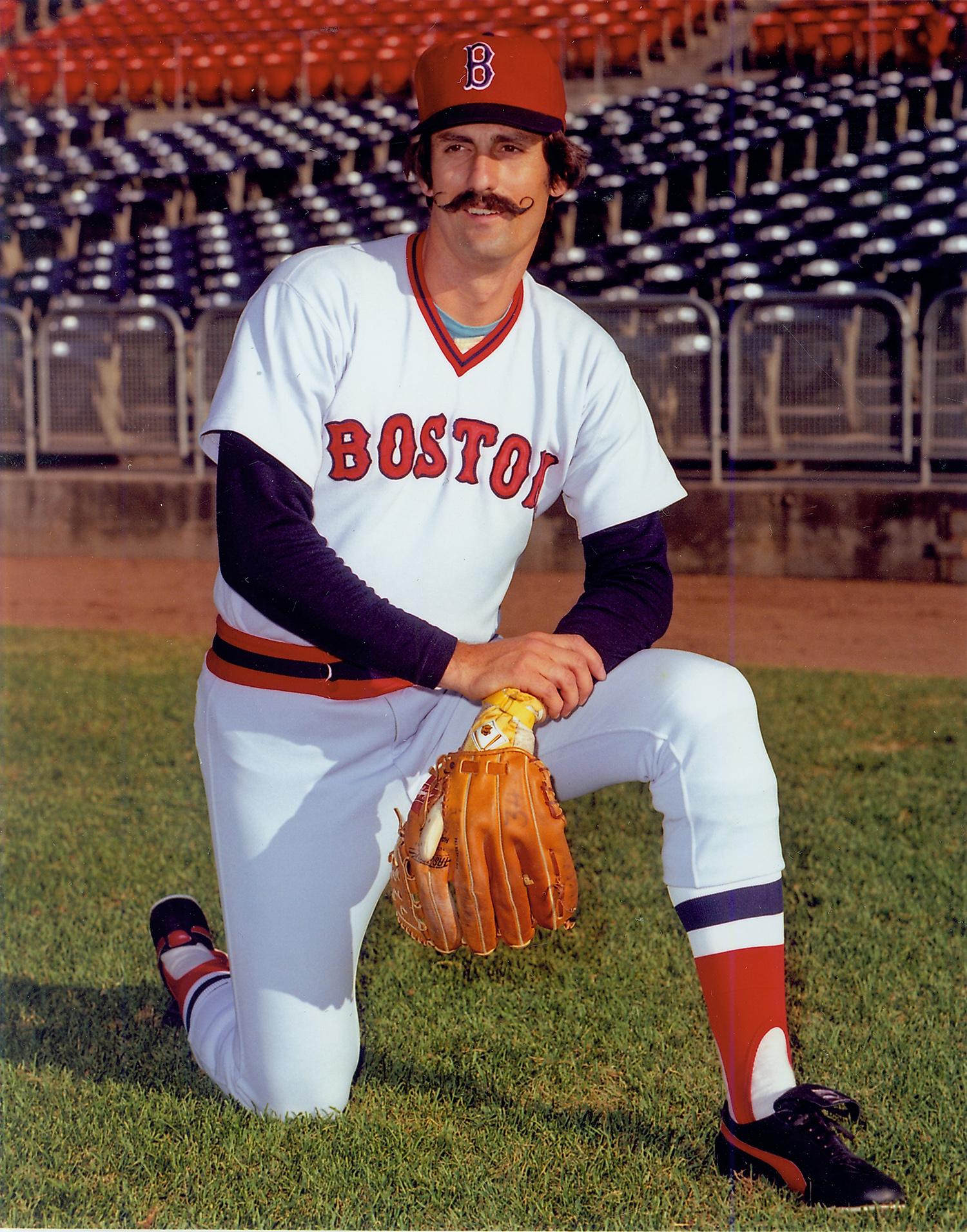
Rollie Fingers, a Red Sock for 3 days
Kuhn thought about it for 3 days, then canceled the deals, citing "the best interest of baseball." He said he didn't want Pennants to be bought outright.
Well, what the hell did he think the Yankees were doing all through the 1920s, '30s, '40s, '50s and into the '60s? What did he think Steinbrenner had been doing the last 3 years? What did he think Yawkey, who was then dying of leukemia, had been trying to do for over 40 years?
Well, what the hell did he think the Yankees were doing all through the 1920s, '30s, '40s, '50s and into the '60s? What did he think Steinbrenner had been doing the last 3 years? What did he think Yawkey, who was then dying of leukemia, had been trying to do for over 40 years?
It's professional baseball. The players are paid for their services. Every championship has been bought, since the 1869 Cincinnati Red Stockings.
Clearly, Kuhn put the kibosh on the deals for one reason, and one reason only: He hated Finley. Whether this was the best thing for baseball is a debate for another time; whether the Yankees, or the Red Sox, or both, would have been better off if the deals had gone through, is still another debate.
So let's have that debate:
* The Red Sox needed a better bullpen. It's why they signed Bill Campbell in the following off-season. Fingers would have helped. But they were loaded with outfielders. They didn't need Rudi. And with the dissension they already had, things could have gotten worse. The fact that Yawkey had leukemia, and died on July 9, didn't help: His wife, Jean, inherited the team, and the guys she let run the team made a lot of mistakes over the next few years.
* But the Yankees would have had a bigger problem: Blue's drug problem. George Steinbrenner would have had to get rid of him. And who would have taken him, knowing he had that problem? Having Blue would have made no difference in the 1976 World Series, and might have prevented them from winning the Pennant over the Kansas City Royals in 1976, '77 and '78.
* So who would have benefited the most from the sales, if they had gone through? The Orioles would both have been able to take advantage of the Yanks' and Sox' problems. The Royals did take advantage of the A's' problems. And, if the Yankees or the Red Sox had managed to get past the Orioles, as the Yankees did in '76, '77, '78 and '80 (but not '79, when the California Angels beat the Royals out for the AL West title), the Royals would have faced a more troubled and possibly weaker New York or Boston team.
So, after the '76 season that we know, in which the weakened A's won 87 games, and finished 2nd in the AL West behind the Royals, came the first off-season in which free agency came into play in more than the infrequent example, such as Hunter in '74 and Ken Harrelson in '67 -- both let go by Finley, interestingly enough.
Fingers and Gene Tenace signed with the San Diego Padres, owned by Ray Kroc, the man who built McDonald's. Rudi signed with the team then known as the California Angels, owned by Gene Autry, the movies' former "Singing Cowboy" who had made millions buying and operation radio stations.
Like Steinbrenner and Yawkey, Kroc and Autry had no issue with spending big bucks, if they thought it would bring them big results. They both ended up doing better than Jean Yawkey did after Tom died. But neither did as well as Steinbrenner. A's team captain Sal Bando signed with the Milwaukee Brewers, and Bert Campaneris signed with the Texas Rangers.
In 1977, with only Blue and Bill North left from the '74 World Champs, the A's lost 98 games, and finished dead last, half a game behind the expansion Seattle Mariners.
In '78, having finally dumped off Blue (to the San Francisco Giants) and North (to the Los Angeles Dodgers), it was 93 losses. In '79, 108 losses -- the most by an AL team since the 1939 St. Louis Browns lost 111. Even the AL expansion teams of 1961, 1969 and 1977 hadn't lost that many. Attendance at the Oakland Coliseum was 306,763. That's not for a weeklong homestand, that's for an entire season, 81 home games. That's 3,787 per game. I've been to a high school basketball game with a better attendance than that. The place became known as the Mausoleum.
In the 1977-78 off-season, fed up with baseball, Finley came very close to selling the A's to Marvin Davis, who wanted to move the team to Denver and Mile High Stadium, but the deal fell through. A year later, he tried to sell them to a group that would have moved them to the Superdome in New Orleans. In 1979-80, again, he tried to sell the team to Davis, but it didn't happen.
In '78, having finally dumped off Blue (to the San Francisco Giants) and North (to the Los Angeles Dodgers), it was 93 losses. In '79, 108 losses -- the most by an AL team since the 1939 St. Louis Browns lost 111. Even the AL expansion teams of 1961, 1969 and 1977 hadn't lost that many. Attendance at the Oakland Coliseum was 306,763. That's not for a weeklong homestand, that's for an entire season, 81 home games. That's 3,787 per game. I've been to a high school basketball game with a better attendance than that. The place became known as the Mausoleum.
In the 1977-78 off-season, fed up with baseball, Finley came very close to selling the A's to Marvin Davis, who wanted to move the team to Denver and Mile High Stadium, but the deal fell through. A year later, he tried to sell them to a group that would have moved them to the Superdome in New Orleans. In 1979-80, again, he tried to sell the team to Davis, but it didn't happen.
Finally, in 1980, having hired Billy Martin as manager, the A's fortunes turned around, and Charlie O found a buyer, Levi Strauss heir Walter Haas, who kept the team in Oakland, saving the team for the East Bay for the 1980s, 1990s, 2000s and 2010s.
In 2024, A's owner John Fisher, unwilling to do what it took to get a new ballpark in or around Oakland, announced he was moving the team to Las Vegas. The new domed stadium there is on schedule to open for the 2028 season. In the interim, they're playing in the Class AAA ballpark in West Sacramento, California.


No comments:
Post a Comment