
From the 1967 EBHS Yearbook
November 19, 1966, 60 years ago: East Brunswick High School, in Middlesex County, New Jersey, which would one day be my Alma Mater, beats Sayreville War Memorial High School at home, 33-0. This clinches the school's 1st State Championship in football, in only its 6th season.
EBHS had opened in 1958, due to the growth that the Township of East Brunswick had already had, and was forecast to have in the 1960s, thus taking its students out of next-door South River High School, which was, and has frequently been since, a football powerhouse.
EB's 1st varsity season was 1961, under head coach Jay Doyle. They went 4-4. They went 2-7 in 1962, and Doyle, also the school's 1st athletic director and its 1st head coach in wrestling, handed the head football coaching job over to his assistant, Ron Gonier. "Rock" led the Bears to records of 5-2-2 in 1963, and 6-3 in 1964 and 1965.
EB opened the 1966 season on September 24, home to Madison, a next-door neighbor, and won, 35-6. In 1975, to avoid confusion with Madison Borough in Morris County, Madison Township changed its name to the Township of Old Bridge. But the name of the school was changed from Madison Township to Madison Central. The town had opened a 2nd high school, Cedar Ridge, in 1969. In 1994, the 2 schools were reconsolidated due to declining enrollment, and have been Old Bridge High School ever since.
The next game was away to Woodbridge. I talked to Wayne Beck Jr., an EBHS baseball player in the late 1980s, whose father Wayne Beck Sr. played in the 1966 season. Wayne Jr. said his father told him that it poured that day, and that Woodbridge Stadium (now Nicholas A. Priscoe Stadium) was practically a field of soup. Not surprisingly, the game ended in a 0-0 tie.
The next game, at home on October 8, was against South River, who, naturally, became our 1st arch-rival. EB had Dave Wohl at quarterback, and he would go on to become the first (and still only) EBHS graduate to play in the NBA. South River's quarterback was senior Joe Theismann (then pronounced "THEEZE-man," it was at Notre Dame where it was changed to "THIGHS-man" to rhyme with the Heisman Trophy he ended up not winning), and his top receiver was sophomore Drew Pearson, who succeeded him as SRHS quarterback, and then opposed Theismann in some classic Washington Redskins vs. Dallas Cowboys games. The Rams beat us, 27-0. EB were now 1-1-1, and there was no indication that this would be a special season.
In spite of this rough start, EB won the rest of their games. They went to Edison, and won, 34-12. They went to Perth Amboy, who had beaten them the last 2 years, and won, 13-6. They came home to face Essex Catholic, and won, 32-14. This was the 1st time EB had ever played a religion-affiliated school. Essex Catholic was established in Newark in 1957, moved to East Orange in 1980, and was closed due to declining enrollment in 2003.
On November 5, EB hosted John F. Kennedy Memorial High School of Woodbridge, so named because JFK was assassinated while it was under construction, and won, 26-0. On November 12, they beat New Brunswick at their Memorial Stadium, 31-21.
They closed on November 19, at home, beating Sayreville, 33-0. This gave us the Championship of the Greater Jersey Group IV Conference, Central Division II, our 1st league title. And, due to our 7-1-1 record, it also gave us a share of their 1st Central Jersey Group IV Championship. Our first "State Championship." Plainfield, placed in Central Jersey despite being in Union County, which should have put it in North Jersey Section 2, also had a 7-1-1 record, and so EB shared the title with them.
EB would repeat the story in 1972: We went 7-1-1, with our only loss being to South River, but won the Championship of the Middlesex County Athletic Conference, and a Co-Championship in Central Jersey Group IV. At the end of the year, Jay Doyle died of a heart attack, only 41 years old. The EBHS stadium, not yet named, was named Jay Doyle Field in his memory.
In 1974, the New Jersey State Interscholastic Athletic Association (NJSIAA) dropped the best-record method, and came up with a "power points" system based on record and strength of schedule (in other words, the records of the teams that a team beat) to assign Playoff seedings.
East Brunswick would just miss the Central Jersey Group IV Playoffs under the 4-teams-per-section-and-group format in 1977, '78, '81, '86, '92 and '95; reach the Quarterfinals in 1998 after the expansion to 8-teams-per-section-and-group; reach the Semifinals in 1980, '87, '88, '90 and '94; and the Finals in 1984 and '85.
A series of shocking moments, reminiscent of the Boston Red Sox, the Chicago Cubs, the Philadelphia Phillies and the New York Rangers before those teams finally ended their World Championship droughts, and the Buffalo Bills and Minnesota Vikings who still have them as of 2022, prevented EB from winning another State Championship. Finally, in 2004, everything fell into place, and we won another, ending a 32-year drought. We won another in 2009, and have made the Playoffs again in 2010, '14 and '21.
*
That title clincher against Sayreville was played the same day as the Michigan State-Notre Dame Number 1 vs. Number 2 game, at Spartan Stadium in East Lansing, Michigan, that was one of those occasional games that gets hyped as "The Game of the Century."

Spartan Stadium
Michigan State University, coached by Hugh "Duffy" Daugherty and known as "Duffy's Toughies," defending National Champions and now back-to-back Big Ten Champions, were undefeated, and ranked Number 1 in one of the major polls in use at the time and Number 2 in the other.
The University of Notre Dame, based in South Bend, Indiana, coached by Ara Parseghian, was also undefeated, and ranked 1st in one poll and 2nd in the other.

Ara Parseghian (left) and Duffy Daugherty
ABC televised the game nationally, albeit on a tape delay, with Chris Schenkel and former Oklahoma coach Bud Wilkinson calling it. This was the 1st time, except for New Year's Day bowl games, that a single college football game went coast-to-coast over national television -- and it was broadcast in color, no less.
This was a time when the words "in color" and "coast-to-coast" still had a special meaning, because neither of them, as yet, was a given. The 1965-66 TV season was when most American TV series, if they had not already done so, switched from black & white to color. But that still wasn't a given for unscripted shows like sports broadcasts.
As for "coast-to-coast": Even today, ABC/ESPN and CBS split some of their games regionally: While the East Coast and the Midwest might see, for example, Ohio State vs. Penn State, the South and the West Coast might see, say, Southern California vs. Texas. But each network usually staggers its schedule so that, on any given Saturday, there's at least one game that most of the country, unless their own team is otherwise occupied, will want to see. In 1966, such a thing was still a novelty.
These two teams weren't even supposed to play each other, let alone on this day. Notre Dame had usually played the University of Iowa on the 3rd Saturday in November from 1945 onward. But after 1964, Iowa opted out of that arrangement. Since Michigan State only had 9 regular-season games scheduled, and it was a relatively short trip -- 149 miles, or 2 1/2 hours by road -- the game was set up, and as luck would have it, they both came in undefeated, Number 1 vs. Number 2.
The teams had first played each other in 1897, before either one was a major football power. At this point, they had played each other every year since 1948, with 1966 having started out as an exception.
Michigan State had gone to the Rose Bowl the year before. At the time, the Big Ten Conference had 2 unbelievably stupid rules: No team could go to the Rose Bowl in back-to-back years, and only the Conference Champion -- or, if disqualified by the preceding stupid rule, the 2nd-place team -- could go to any bowl game. This meant that, regardless of the result of their game against Notre Dame, MSU were not going to play in a bowl game. (Purdue, quarterbacked by future Miami Dolphin Super Bowl winner Bob Griese, finished 2nd, and went on to their 1st-ever Rose Bowl, and won it for what remains the only time in their history.)
Notre Dame had a policy against bowl games, and hadn't been to one since Knute Rockne's legendary "Four Horsemen" (Harry Stuhldreher, Jim Crowley, Don Miller & Elmer Layden) beat Ernie Nevers' Stanford in the Rose Bowl on New Year's Day 1925. They wouldn't stop turning down bowl invitations until the 1970 season. So for both the Spartans and the Fighting Irish, this was it.
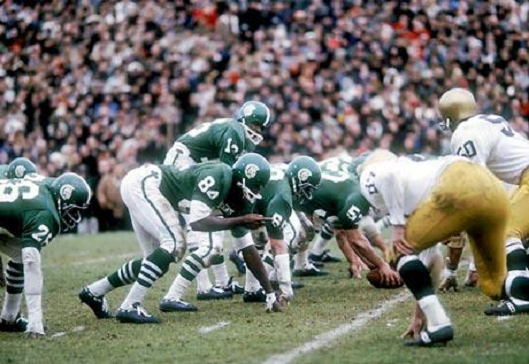
Michigan State in the home green.
Notre Dame in the road white.
At first, it didn't go too well for Notre Dame: Their leading rusher, Nick Eddy, did not play due to a shoulder injury. Quarterback Terry Hanratty got sacked by the massive (for the time, anyway) Spartan defensive lineman (and future actor) Charles "Bubba" Smith, and had to leave the game with an injury. Center George Goeddeke hurt his ankle while blocking for a punt.
Early in the 2nd quarter, the Spartans took a 7-0 lead on a Regis Cavender touchdown. God only knows what Regis Philbin, at age 32 already a known entertainer, and a Notre Dame graduate, so much of a fan that his request to be buried in the school's Cedar Grove Cemetery was granted, thought of a man named Regis scoring against his beloved Irish.
Dick Kenney, a barefooted kicker, added a field goal to make it 10-0 Michigan State. Barefoot kickers are now illegal in high school in every State except Massachusetts and Texas. They're still legal in college and in the NFL, but have been very rare since the 1980s.
Notre Dame came back. Backup quarterback Coley O'Brien threw a touchdown pass to Bob Gladieux, and it was 10-7 Spartans at the half. On the 1st play of the 4th quarter, Joe Azzaro kicked a field goal to tie it for the Irish. There was still plenty of time left for either team to win the game.
A Spartan pass play gave both teams a good chance to score: Quarterback Jimmy Raye -- a black quarterback, not the first at Michigan State but rare on national television at that point -- attempted to pass to Gene Washington but Washington outran the pass, doubled back, and Tom Schoen intercepted it. That gave the Irish a chance, but Azzaro just missed what could have been a game-winning field goal.
(This Gene Washington went on to play for the Minnesota Vikings and the Denver Broncos, and should not be confused with the man of the same name who went on to All-Pro honors with the San Francisco 49ers, and then became an executive in the NFL's main office.)
The last series of the game began with 1 minute and 10 seconds left on the clock, and Notre Dame had the ball on its own 30-yard line. Gaining 40 yards in 70 seconds would have put them in position for Azzaro to try again to win it with a field goal.
But Parseghian chose to run out the clock. He called 4 running plays, one of which gained a 1st down, then O'Brien was sacked by Bubba Smith, and then O'Brien ran up the middle on the final play. None of these plays got the ball across midfield, let alone within field goal range. Final score, Michigan State 10, Notre Dame 10. The home crowd booed the final play-call.
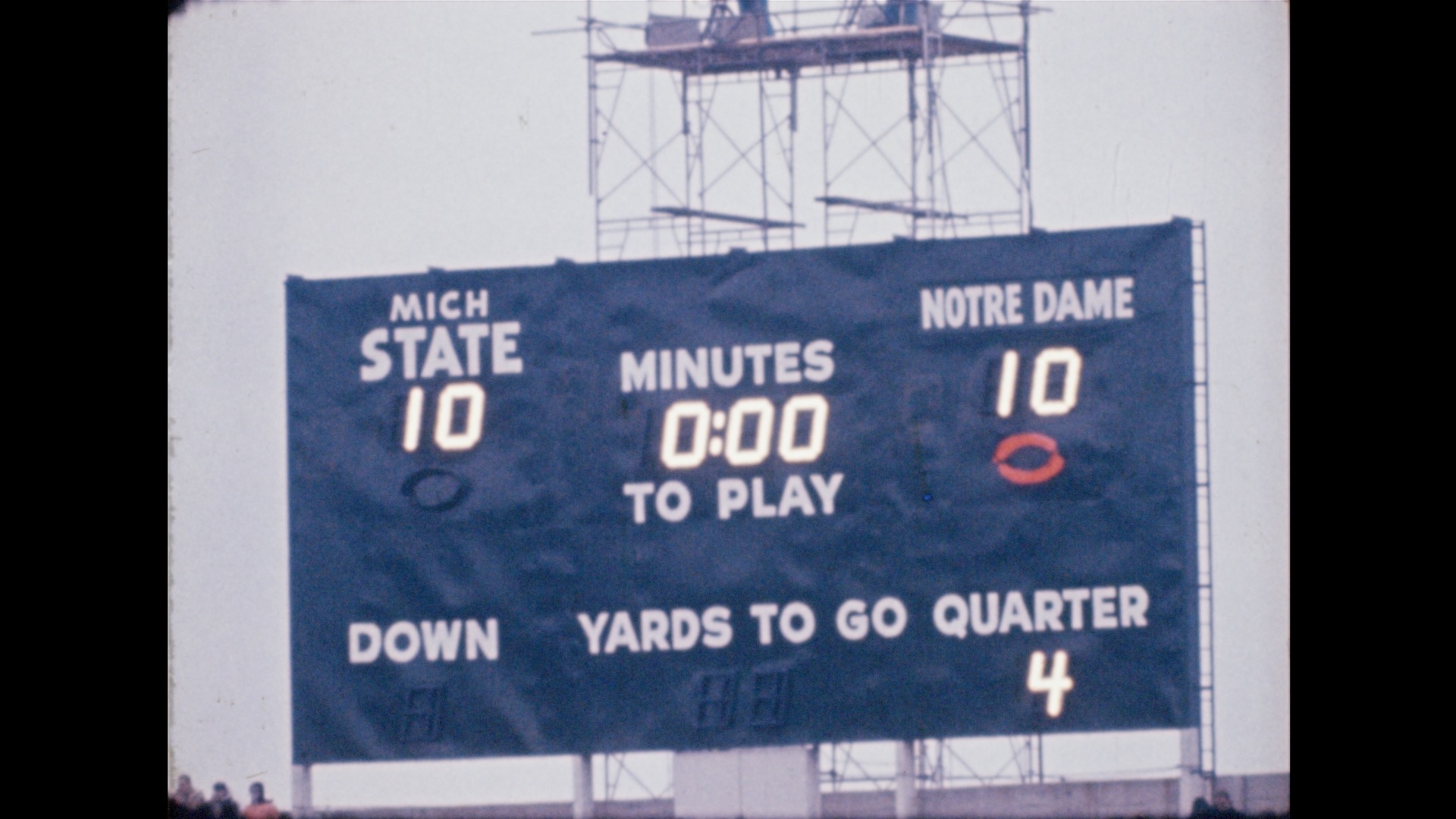
Normally, the national media gives Notre Dame the benefit of the doubt, since they are so swept up in the myth of the Golden Dome -- Knute Rockne, George Gipp and Rockne's "Win One for the Gipper" speech, the Four Horsemen, Frank Leahy and "Leahy's Lads," and Paul Hornung... and this was well before Rudy Ruettiger and his movie, Joe Montana, and Lou Holtz's tenure.
Not this time. In Sports Illustrated's writeup of the game, Dan Jenkins, until his death in 2019 perhaps the greatest living writer on the subject of college football, titled his article "Tying One for the Gipper." Jenkins quoted one observer as saying, "Parseghian had no guts."
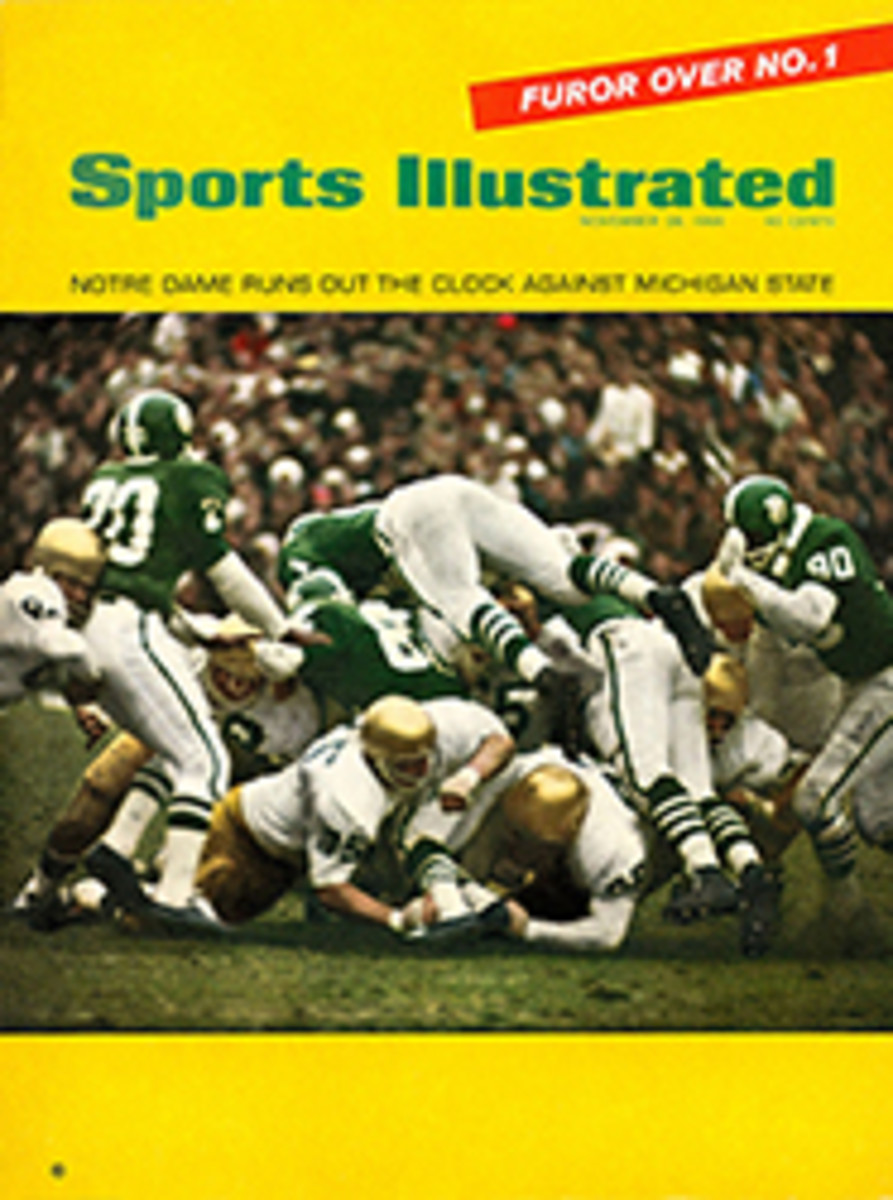
Both teams ended the season 9-0-1. And the polls? Both the Associated Press (the college football writers) and United Press International (the coaches), still issuing their final polls before the bowl games, ranked Notre Dame Number 1 in their last poll, Michigan State Number 2, and undefeated Alabama Number 3.
Alabama, led by Paul "Bear" Bryant and actually having a bowl game to win, did so, beating Number 6 Nebraska in the Sugar Bowl, and finishing 11-0. They should have thus gotten their 3rd straight National Championship, having won both major polls in 1964, and winning the AP poll in 1965, while UPI gave their title to Michigan State.
Both Notre Dame and Alabama claim to be the 1966 National Champions, but Notre Dame still gets the official recognition. Keith Dunnavant came out with a book about the '66 Crimson Tide squad and how they were screwed by the polls, titling it The Missing Ring.
Ara Parseghian won another National Championship at Notre Dame in 1973, this time beating Alabama in a Number 1 vs. Number 2 matchup in the Sugar Bowl. That year, Ohio State and Michigan played to a 10-10 tie, thus tying for the Big Ten title, and the Conference sent Ohio State to the Rose Bowl. Despite this, Ohio State coach Woody Hayes joined with Bo Schembechler, once his player and assistant coach but now the Michigan coach and his arch-rival, in his outrage, and together they got the only-the-Rose-Bowl rule changed for the 1975 season.
Ara Parseghian won another National Championship at Notre Dame in 1973, this time beating Alabama in a Number 1 vs. Number 2 matchup in the Sugar Bowl. That year, Ohio State and Michigan played to a 10-10 tie, thus tying for the Big Ten title, and the Conference sent Ohio State to the Rose Bowl. Despite this, Ohio State coach Woody Hayes joined with Bo Schembechler, once his player and assistant coach but now the Michigan coach and his arch-rival, in his outrage, and together they got the only-the-Rose-Bowl rule changed for the 1975 season.
Duffy Daugherty remained Michigan State's coach until 1972, and lived until 1987, seeing the 20th Anniversary of this game. Parseghian retired after the 1974 season, and became a broadcaster in the sport. He died in 2017, at the age of 94, living long enough to see the 50th Anniversary of this game. He never took his good health for granted, and continued to raise money for research into diseases that have hit his family. Until the Kardashians became famous, he was easily the most famous American of Armenian descent. A statue of him stands outside Notre Dame Stadium. Yet, even in death, he still gets dogged by charges of cowardice for 1966.
I'm not a Notre Dame fan. Indeed, I once did a blog post of "The Top 10 Reasons to Hate Notre Dame." Ara's successor, Dan Devine, who led them to the 1977 National Championship with Joe Montana at quarterback, once said, "There's Notre Dame fans, and then there's Notre Dame haters, and, frankly, they're both a pain in the ass."
But I think we can let Ara off the hook. Like Schembechler, Ara both played for Hayes and coached under him at Miami University of Ohio before becoming a great head coach himself. Woody's philosophy was simple: Run the football. Or, as it became known, "Three yards and a cloud of dust."
Woody did not come up with those words himself: In 1955, Max Tolbert, an assistant to Brigham Young University head coach Charles "Chick" Atkinson, came up with, "A cloud of dust and four yards." It must not have worked, because BYU went 1-9 that season. But Woody did hate the passing game, and he did say, "There are three things that can happen when you throw the football, and two of them are bad." In other words, an incomplete pass and an interception.
When Ara had 70 seconds of play remaining, and 70 yards to go for a touchdown, and at least 40 yards to go for a field goal, no doubt he heard Woody's wisdom in his mind. After all, at the time, the man was still, along with Bryant, recognized as one of the top 2 coaches in college football, well ahead of some men who would soon be adding to their records: Parseghian himself, Darrell Royal at Texas, John McKay at USC, Bob Devaney at Nebraska, and Joe Paterno, then in his 1st season at Penn State.
At the time, Woody and the Bear were it. Ara wanted to be "it," and, to do that, he couldn't lose this game. So he chose to not risk losing on an interception that might put Michigan State in position to win with a last-second field goal. It worked, and, as times changed, Ara became part of that top tier of great college football coaches.
In 1946, Army was undefeated and ranked Number 1, and Notre Dame was undefeated and ranked Number 2, and they finished the regular season against each other, at the original Yankee Stadium, in the 1st college football game to get the "Game of the Century" tag from the national media.
That game did not live up to the hype, ending in a 0-0 tie. As they would say in that other kind of football, soccer, it was "a turgid nil-nil draw." The word "turgid" so perfectly suits 0-0 draws, regardless of what game you call "football."
Frank Leahy, Notre Dame's coach at the time, had "tied one for the Gipper" 20 years before Ara. Yet he never got the derision that Ara got. Probably because it wasn't on television: In order to see this game in its entirety, you had to be inside The Stadium. Newsreel highlights in movie theaters wouldn't have shown you all you needed to see. Nobody's ever said, "Leahy had no guts." Essentially, he played for a tie, and got away with it.
Duffy Daugherty didn't exactly go for the win, either. And it really did cost his team the National Championship. But nobody mocked him for it, and nobody, in the State of Michigan or elsewhere, holds it against him now. Even fans of the arch-rival University of Michigan don't mock him for it, possibly because they hate Notre Dame (and, of course, Ohio State) more than they hate Michigan State.
Also, the odds were against the Fighting Irish. Michigan State had the home field. They were the defending National Champions. They were favored to win. And Notre Dame went into the game with a major injury, to their top rusher; and got more of them as the game went on, to their starting quarterback and center. And still, they held Michigan State to just 10 points at home and avoided a loss. That's a pretty good achievement.
Finally, a win wasn't necessary. The polls proved it, giving Notre Dame the National Championship anyway. Ara knew that a loss would kill their national title dreams, just as they had against USC 2 years earlier. But a tie would still leave them undefeated.
And, at that point, as they nearly always do (except where this one game was concerned), the national media gave Notre Dame the benefit of the doubt, and crowned them National Champions, even though Alabama, undefeated and untied in 11 games as opposed to undefeated but tied in 10 games, was a more deserving National Champion.
Sounds like Ara Parseghian had more guts than the media: Not only were they gutless in claiming him to be a coward, but they ended up rolling over for the Irish anyway. If not for Ara himself.
Notre Dame and Michigan State did not play each other from 2018 to 2025. They played each other again this past September 19, and Notre Dame won, 27-10 in South Bend, raising their lead in the rivalry to 48-29-1. It should be 50-29-1, but due to the discovery of their use of ineligible players, the NCAA vacated all of their wins, including their wins over Michigan State, in the 2012 and 2013 seasons. They will play each other again next season, in East Lansing.
*
November 19, 1966 was, of course a Saturday. Other notable college football games played that day:
* In the 2nd half of ABC's nationally-telecast doubleheader, Number 8 UCLA beat Number 7 USC, 14-7 at the Los Angeles Coliseum. This game forced a tie for the Championship in the Athletic Association of Western Universities (AAWU), and, head-to-head, UCLA should have had the tiebreaker. The next week, Notre Dame went into the Coliseum, and walloped USC, 51-0.
But USC still got the Rose Bowl bid, and lost to Purdue. UCLA, hampered by a rule in the league now known as the Pac-12 similar to the Big Ten's, couldn't go to a bowl, despite finishing the regular season 9-1. Wow, if ever a 20th Century college football season needed a playoff, this was it. The next season, USC and UCLA would play a "Game of the Century."
* Number 3 Alabama and Number 4 Nebraska both had the week off. The following week, Nebraska lost to arch-rival Oklahoma. But they still won the Big Eight Conference title. Alabama beat Southern Mississippi and then arch-rival Auburn, and beat Nebraska in the Sugar Bowl.
* Number 10 Purdue crushed arch-rival Indiana, 51-0 at Ross-Ade Stadium in West Lafayette, Indiana.
* Michigan beat Ohio State, 17-3 at Ohio Stadium in Columbus.
* Wisconsin beat Minnesota, 7-6 at Camp Randall Stadium in Madison, Wisconsin.
* Southern Methodist beat Baylor, 24-22 at the Cotton Bowl in Dallas, clinching the Southwest Conference title. But they lost the Cotton Bowl to Georgia, who were off this week, and ranked Number 7.
* Harvard beat Yale, 17-0 at Harvard Stadium in Boston.
* Penn State beat Pittsburgh, 48-24 at Pitt Stadium.
* Army and Navy both had the week off. The following week, Army beat Navy, 20-7 at John F. Kennedy Stadium in Philadelphia.
* In New York City, Columbia beat Brown, 40-38 at Baker Field.
* In New Jersey, Princeton beat Cornell, 7-0 at Palmer Stadium in Princeton.
* And Rutgers lost to Colgate, 26-7 at Rutgers Stadium in Piscataway.


No comments:
Post a Comment