Showing posts with label sandy koufax. Show all posts

Thursday, October 23, 2025

Why I Hate the Los Angeles Baseball Team, and So Should You

Tomorrow night, Game 1 of the 2025 World Series will be played at the Rogers Centre in Toronto. The American League Champions, the Toronto Blue Jays, will host the National League Champions, the Los Angeles Dodgers, in Games 1 and 2, and, if necessary, Games 6 and 7. Games 3 and 4, and, if necessary, 5 will be played at Dodger Stadium in Los Angeles.

The Blue Jays are the American League Champions for the 1st time since their only previous Pennants, the back-to-back World Series wins of 1992 and 1993 -- 32 years, almost a third of a century.

The Dodgers are the National League Champions for the 2nd year in a row, and the 5th time in the last 9 seasons.

Before that, they hadn't won a Pennant in 29 years, 1988 to 2017. Before that, they won 5 in a span of 15 years, 1974 to 1988. Before that, they hadn't won one in 8 years, 1966 to 1974. Before that, including their last few years as the Brooklyn Dodgers, they won 10 in 20 years and, if you extend it back 1 more year, just missed 4 others, 1946 to 1966.

They've won the World Series in 1955 in Brooklyn; and, in Los Angeles, in 1959, 1963, 1965, 1981, 1988, 2020 and 2024, and will likely be favored to win it again this year.

On a Facebook page titled "MLB Shit Talking !!!" (space, then 3 exclamation points), a Dodger fan named Lee Salomon wrote, and I haven't altered his text at all: 

You sorry ass people can't list ONE (1) LOGICAL reason for hating the Dodgers.
You try to make it about money, but almost every owner is a billionaire.
You try to make it about the Dodgers fans, but the Dodgers lead MLB in home AND road attendance every season.
.
Colin Cowherd said the Dodgers are the best run team in American sports. He is 100% correct.

I repeat, you sorry ass people can't list ONE (1) LOGICAL reason for hating the Dodgers 

This was my response:

You're missing the point. The reasons DON'T have to be logical. Playing baseball requires a great deal of logic. Being a baseball fan requires none. It's all based on feelings.

Up until 1957, the Dodgers represented not just the Borough of Brooklyn, and, by extension, the City of New York, but a state of mind. They were a team of the people. Their players lived in neighborhoods alongside the team's fans. They played in a small ballpark, where the players were close to the fans. They were visible as human beings. Being a Dodger fan meant being a part of a community.

When Jackie Robinson arrived in 1947, that community grew, but instead of diffusing it and weakening it, it made the community stronger, and ennobled it. Long before the Dallas Cowboys were created and took up that ridiculous slogan "America's Team," the Brooklyn Dodgers were a team for all America. Certainly, for underdogs, as they stood up to the more successful New York Giants, and then the even more successful New York Yankees. The Dodgers were blue-collar; the Yankees, white-collar. The Giants, whose success was earlier, could, I suppose, be called stiff-collar.

(Those teams represented something very different, but no less important. Life is full of defeats, so we look for teams that will win and lift us up. The Giants represented that up until the end of the 1930s, and the Yankees have since the early 1920s.)

Having risen from essentially team clerk in 1942 to owning 25 percent of the team to owning 75 percent of the team and bullying the owners of the remainder in 1950, in 1957, Walter O'Malley took the Dodgers out of Brooklyn, and moved them to Los Angeles.

While some of the Brooklyn "Boys of Summer" hung on for a while -- Gil Hodges until 1961, Duke Snider 1 more year -- by the time that Sandy Koufax and Don Drysdale, who barely pitched in Brooklyn, became baseball's dominant pitching tandem and led them to a title in 1963, they bore no real connection to their former identity, and that's how O'Malley wanted it.

They represented something else: Greed. To build their stadium, O'Malley saw to it that the people living on the land had their homes stolen from them. He maneuvered the City of Los Angeles into letting him have all the parking revenue, when the original offer was half. He refused to install water fountains in the ballpark, because he didn't want fans to have anything for free.

He was so devoted to the reserve clause and holding salaries down that he even gave his managers only one-year contracts, and after he died in 1979, his son Peter continued this until selling the team in 1997. Walter Alston got 23 one-year contracts; Tommy Lasorda, 20.

They also represented Hollywood glitz and fakery, instead of the real people of Los Angeles. They wanted Frank Sinatra and Steve McQueen to come to the games. They didn't want Joe Washington from Crenshaw or Ricardo Gonzalez from East L.A. I'd be interested to know how old Walter would have felt had he lived to see Fernandomania in 1981: How would he have felt about all those Mexicans coming into Dodger Stadium, his monument to himself? Aside from those 5 years, 1962 to 1966, when the blue-collar Jewish hero Koufax pitched every 4 days, it was the first time the Dodgers seemed human.

Rather, the Dodger hero of choice was Steve Garvey: Mr. Clean, the All-American Boy with the perfect hair, the perfect teeth, the beautiful blonde TV talk-show host wife, the powerful swing and the nice glove, who was actually a supreme hypocrite, leading to the "Steve Garvey is not my Padre" jokes after he went to San Diego and didn't have the protection of the L.A. media anymore.

And speaking of supreme hypocrites: Lasorda treated his players like family, except for Glenn Burke, whom he dumped after seeing baseball's first openly gay player get a little too friendly with Tommy Jr., whom Tommy Sr. insisted until his own death was not gay, and refused to accept that Jr.'s death from pneumonia was aided by AIDS. Lasorda didn't just eat too much: He was so fat because he was full of crap.

O'Malley was never baseball's best owner, Lasorda was never baseball's best manager, and wasn't even a very good one. Vin Scully was never baseball's best broadcaster. And Dodger Stadium wasn't even the best ballpark in Southern California. But all those ideas were pushed by the L.A. media machine, which is as strong as New York's and stronger than Boston's and Chicago's.

Then, in 1997, Peter O'Malley sold the Dodgers -- to Rupert Murdoch, the Fox News baron, who, by aiding people such as Margaret Thatcher, Ronald Reagan, George W. Bush, and eventually Donald Trump and Britain's Brexit movement, has done more damage to the world than any living person, even Vladimir Putin. That is a stain that can never be washed away, and makes the sins of Walter O'Malley look tame by comparison.

Murdoch sold the Dodgers to Frank McCourt in 2004. He had to sell the team in 2012, to a group whose public face is basketball legend Earvin "Magic" Johnson, who is rightly beloved. But the current regime has actually embraced the team's Brooklyn past, including putting a statue of Robinson outside the stadium. At first glance, this would seem like a good thing to do. After all, while he never played for the team in Los Angeles, Robinson grew up in nearby Pasadena.

Except the current regime wants it both ways. They want both the Los Angeles legacy (Koufax, Lasorda, Fernando Valenzuela, Kirk Gibson) and the Brooklyn legacy (Robinson, Roy Campanella, Duke Snider). And it doesn't work that way. The Giants can sort-of get away with it, because Willie Mays did play for them in both New York and San Francisco. Same with the Braves, with Hank Aaron playing in both Milwaukee and Atlanta. But the A's barely even mentioned their Philadelphia success.

The Dodgers' owners want you to think Jackie Robinson played for them. Jackie Robinson did not play for the Los Angeles Dodgers. Not one damn game. Not only did he not play for Los Angeles, but Walter O'Malley actively resisted his acquisition, told manager Alston to move him around and eventually bench him, and finally traded him to the arch-rival Giants, before Jackie announced his retirement, which he had planned anyway, but it became a "To Hell with me? No, to Hell with YOU" moment.

Now, I do have some grudging respect for the Dodgers' ownership group. Yes, they spend a lot of money. But they should. It's professional baseball. The last team to win a World Championship without "buying it" was the 1868 New York Mutuals. The Dodgers do this. So do the Yankees, my team. So do the Mets. So have some other teams at various times, even though some no longer do so, and others have gone the other way, from not trying it to trying it. To paraphrase Michael Douglas in the film The American President, Yes, my team IS trying to buy the World Series, the question is, Why isn't YOURS, Bob?

I also have some respect for the Dodgers' owners for NOT demanding that the governments of City of Los Angeles, or the County of Los Angeles, or the State of California build them a new stadium at taxpayer expense, or else they will move, as happened with elsewhere in California, with the owners of the Oakland Athletics and the NFL's Oakland Raiders and San Diego Chargers. They have maintained and updated Dodger Stadium, and let's give them credit for that. They can build 10 new ballparks and pay every penny of the cost themselves, and never miss the money. They don't do that, but they don't demand that the people do it for them, either.

But the Dodgers remain an organization built in Walter O'Malley's image. They represent what he represented: Greed and bigotry. Those things are irrational. So don't you DARE demand that we come up with a rational reason to hate them. We don't need one.

O'Malley was a man who, if he thought he could make more money by staying in Brooklyn, or by moving them to Miami, or to Tokyo, or to Moscow, or to Antarctica, than he could by moving them to Los Angeles, then that is where the Dodgers would have been playing since 1958. NYC construction czar Robert Moses wouldn't condemn the land on which he wanted to build his new stadium. But O'Malley could have gotten around Moses if he really wanted to stay in Brooklyn. He didn't.

So don't ask me to like or respect the Los Angeles Baseball Team, and don't ask me to come up with a rational reason for why.

Let's go, Blue Jays. Beat L.A., eh?

Tuesday, October 14, 2025

October 14, 1965: The Mystique of Sandy Koufax

October 14, 1965, 60 years ago: A World Series loaded with storylines comes to a classic end.

After surviving a long and hard National League Pennant race with their arch-rivals, the San Francisco Giants, the Los Angeles Dodgers were in the Series for the 3rd time in the last 7 seasons. If you count their time in Brooklyn, it had been 9 times (with 3 other near-misses) in 19 years.

Although 2-time former batting champion Tommy Davis had been injured for most of the season, they still had the premier base thief of the era, Maury Wills, the starting pitching tandem of lefthander Sandy Koufax and righthander on Drysdale, and an exceptional defense. It surprised no one that they were back in the Fall Classic.

But the American League Champions were a surprise, because they were not the New York Yankees. For various reasons, the team that had won 29 of the last 44 AL Pennants, including the last 5, had collapsed, falling to 6th place.

After a few years of improvement, the Minnesota Twins, who had been the Washington Senators until 1960, surged to 1st place. Although their main slugger, Harmon Killebrew, had an injury-plagued season that kept his power stats down, they also had power in Bob Allison and Don Mincher, their own 2-time batting champion in Tony Oliva, and their own Wills equivalent in shortstop Zoilo Versalles.

"Zorro" batted .273, and led the AL in total bases, doubles, triples and runs scored -- but also in strikeouts -- and finished 2nd to Oliva in hits. He added 19 home runs and 77 RBIs from the leadoff spot in the order. He was also awarded a Gold Glove. Versalles and Koufax were named their respective Leagues' Most Valuable Players.

For the Twins franchise, it was their 1st Pennant since 1933, as the Senators, and they were seeking their 1st World Series since 1924. The Minneapolis Millers of the American Association had won a Pennant as recently as 1958.

It was a bitter reality for Senators fans, who lost their team because owner Calvin Griffith was not only a cheapskate, but a racist, who wanted to move from a majority-black city to one with hardly any black people. (That has since changed, tremendously.) An expansion team named the Washington Senators replaced them, but was terrible, and became the Texas Rangers for the 1972 season. To make matters worse, the Twins' Pennant-clinching game was against the "New Senators." The Washington Nationals finally came along in 2005, and won a World Series in 2019.

The Dodgers were favored, due to their pitching and their overall experience. But they had a problem: Game 1 was scheduled for October 6. On the Jewish calendar, that coincided with Yom Kippur, the Day of Atonement, the faith's holiest day. And Koufax was Jewish.

It doesn't fall on the same day of the Christian calendar every year. In 1934, it fell on September 19, and the Detroit Tigers had a key game on that date, and their biggest star, Hank Greenberg, sat it out. The Tigers ended up winning the Pennant, anyway. But Koufax told manager Walter Alston that he wouldn't pitch Game 1. So it would be Drysdale instead, starting against a black pitcher, Jim "Mudcat" Grant.

October 6, 1965: In Britain, serial killer Ian Brady was arrested for murder in Manchester. His accomplice, Myra Hindley, was arrested 5 days later. Steve Scalise, later elected to Congress from Louisiana, was born.

The 1st World Series game ever played in Minnesota got underway at Metropolitan Stadium, selected for a site in suburban Bloomington because it was roughly the same distance from downtown Minneapolis and downtown St. Paul, and the Twins wanted to pander to both of the "Twin Cities" by not offending either one.

The Dodgers' Ron Fairly opened the scoring with a home run in the top of the 2nd inning. But Mincher hit one to tie the game in the bottom of the 2nd. And the bottom dropped out on Drysdale in the bottom of the 3rd. He gave up 6 runs on 6 hits, including a 3-run homer by Versalles, plus a walk and an error. When Alston came to the mound to take him out, he said, "I bet you wish I was Jewish, too!" Meaning, that he wasn't available to have such a bad outing. In contrast, Grant cruised after the Mincher homer, going the distance, and the Twins won, 8-2.

October 7, 1965: The Soviet Union announced that their probe, Lunik 7, had landed on the Moon. What they didn't say was that it landed so hard, it was destroyed, and was unable to send any information back to Earth. British intelligence picked this up, and told the NATO alliance, including the U.S.

The refusal to pitch on Yom Kippur raised Koufax from the level of a superstar to that of an all-time Jewish-American icon. But the extra day of rest did neither him nor the Dodgers any good. He and Twins starter Jim Kaat traded goose eggs until the bottom of the 6th, but an error by Wills to start that inning opened the door to 2 Minnesota runs. The teams traded runs in the 7th, and Kaat helped his own cause with a 2-RBI single in the 8th. The Twins won, 5-1.

The Series went west, and the Twins had a 2-0 lead, and they had already beaten Koufax and Drysdale once each. Their confidence was at an all-time high.

October 8, 1965: A travel day in the Series. The International Olympic Committee accepted West Germany and East Germany as separate nations, to present separate teams starting in 1968. They would continue to do so through 1988.

The Post Office Tower, now the BT Tower, opened in London. At 619 feet, it was then the tallest structure in the United Kingdom.

President Lyndon B. Johnson ended Bethesda Naval Medical Center, in the Washington suburb of Bethesda, Maryland, for surgery to remove his gall bladder. He stayed for 2 weeks, and upon his return to the White House, enjoyed showing the White House press corps his scar. In 2022, my mother, who was then older than LBJ lived to be, had her gall bladder removed. She was released 2 days later.

October 9, 1965: At a nursing home in Seriate, Italy, 8 elderly women died, and another 7 were seriously injured, after all 15 had been given seemingly routine injections of a "heart tonic" as part of their regular treatment. The deaths all happened within 2 hours after they were given the shots. No cause was ever found, and no one was ever punished for the deaths.

The Dodgers were desperate. They had the home crowd behind them, but they would be facing Twins pitcher Camilo Pascual. If Koufax had the best curveball in the NL at the time, then Pascual had the best one in the AL.

But John Roseboro singled home 2 runs in the bottom of the 4th, Lou Johnson doubled 1 home in the 5th, Wills doubled 1 home in the 6th, and Claude Osteen pitched a 4-hit shutout. The Dodgers won, 4-0, and were back in the Series.

October 10, 1965: A 24-day strike by New York City's newspapers ends. However, it will end up being the final blow for the New York Herald-Tribune (a.k.a. The Trib), the New York Journal-American, and the New York World-Telegram & Sun (a.k.a. The World-Telly). All would fold the following Spring, leaving The New York Times, the Daily News, and the New York Post.

Actor Chris Penn was born. He became an actor, like his brother, Sean Penn, but never achieved the same level of notoriety, and died of heart disease in 2006.

The starters for Game 4 would be the same as those of Game 1. This time, the Dodgers got to Grant early, scoring a run in the 1st and another in the 2nd. Killebrew and the Dodgers' Wes Parker traded home runs in the 4th. Oliva hit a home run in the 6th, but the Dodgers answered right back, chasing Grant with 3 runs. Johnson added a homer in the 8th.

Drysdale was on his game, going the distance and striking out 11. The Dodgers won, 7-2, to tie the Series. And Koufax would be pitching Game 5. True, he would have only 3 days' rest, but so had Drysdale.

October 11, 1965: Dorothea Lange, who documented the effects of poverty during the Great Depression through her photography, including the iconic 1936 photo Migrant Mother, died at the age of 70. And the Indianapolis Times, a newspaper founded in 1888, published its last issue.

Pitching through pain, Koufax allowed just 4 hits and 1 walk, striking out 10. Kaat didn't make it out of the 3rd inning. In the 7th, Koufax himself had an RBI single off Jim Perry. The Dodgers won, 7-0, and now led the Series 3-2.

The Twins' sky-high confidence had vanished in 3 days. However, they would be going home, where they had already beaten the Dodgers twice. And if they won Game 6, they would have to face either Drysdale on 3 days' rest or Koufax on 2 in Game 7, so they liked their chances.

This was also (probably) the day on which Orlando Hernández Pedroso was born in Villa Clara, Cuba. "El Duque," brother of fellow pitcher and fellow Cuban escapee Livan Hernández, pitched for the 2 most demanding bosses in the Western Hemisphere: Fidel Castro and George Steinbrenner. He won 4 World Series: 1998, 1999 and 2000 with the Yankees, and 2005 with the Chicago White Sox.

October 12, 1965: Another travel day in the Series. Hirokazu Yasuhara, the Japanese video game designer who created Sonic the Hedgehog, was born.

October 13, 1965: Grant pitched on just 2 days' rest, and he was fine. He went the distance, allowed just 1 run, a homer by Fairly in the 7th, and hit a home run of his own in the 6th. Allison hit a home run in the 4th, and the Twins won, 5-1. The Series was going to a Game 7.

Twins manager Sam Mele decided to start Jim Kaat for the 3rd time. Alston decided to skip over Drysdale and go with Koufax. Both men would be going on 2 days' rest. The difference was, Kaat had been knocked out of Game 5 early. Koufax had pitched a complete game.

What's more, the circulatory issue in his left arm, which would lead him to retire after 1 more season, made throwing his amazing curveball too painful. He was going to the mound with everybody in the ballpark, including the Twins' hitters, knowing that he was going to throw a fastball on every single pitch.

And the Twins had a good lineup, and The Met was a hitter-friendly ballpark. And, so far, every game in the Series had been won by the home team.

October 14, 1965, 60 years ago: American poet Randall Jarrell was hit by a car in Chapel Hill, North Carolina, and died. He was only 51 years old, and had been prescribed heavy drugs due to depression. And Steve Coogan, the British comedian famous for playing inept newscaster Alan Partridge, was born in the Manchester suburb of Middleton.

Jim Gilliam singled for the Dodgers in the top of the 1st, but it came to nothing. With 2 outs in the bottom of the 1st, Koufax walked Oliva and Killebrew, but struck Earl Battey out to end the threat. The Dodgers began the top of the 3rd by Roseboro hitting a double, Koufax drawing a walk, and both men advancing on a groundout by Wills. But neither Gilliam nor Willie Davis (no relation to the injured Tommie) could bring them around. Versalles singled with 1 out in the bottom of the 3rd, but did not score.

The top of the 4th began with Johnson hitting a home run, Fairly a double, and Parker a single. Down 2-0, Mele took Kaat out, and replaced him with Al Worthington. He ended the threat, but, essentially, the game was over. In spite of his pain, Koufax sent the Twins down 1-2-3 in the 4th. With 1 out in the 5th, he allowed a double to Frank Quilici and a walk to Rich Rollins, but got out of it.

The Dodgers got 2 men on in the 6th, and 2 more in the 7th, but none of them scored. Koufax sent the Twins down 1-2-3 in the 6th, the 7th, and the 8th. In the 9th, he got Oliva to ground out, but Killebrew singled to left. That brought the tying run to the plate with only 1 out. Koufax must have been in agony at this point. But he struck Battey out on 3 pitches. With a 2-2 count, he struck Allison out to end it. Dodgers 2, Twins 0. The Dodgers were the World Champions, and Koufax accepted handshakes -- with, of course, his pain-free right hand.

He had thrown 122 pitches to 33 batters. He allowed no runs on 3 hits and 3 walks striking out 10. The game was still in doubt when he threw his last pitch.

For the 2nd time, the 1st in 1963, Sandy Koufax was named the Most Valuable Player of the World Series. This was after he had refused to pitch on his religion's holiest day. Whatever he had to atone for, refusing to pitch on that day was not part of it.

Would his place in history actually be higher if he had lost Game 7, and his refusal to pitch on Yom Kippur had cost the Dodgers the World Series? It would have been a point of pride for some American Jews, and for people of any faith who like to say, "It's only a game" (or "It's just a game").

Instead, in spite of how much it hurt, he got to have it all: He was true to his faith, he was true to himself, and he got the job done for his team. Because of this, Sandy Koufax is one of the few baseball players ever who can truly be said to have had a "mystique."

The Dodgers won the Pennant again in 1966, but lost the World Series to the Baltimore Orioles. Koufax then bowed to the pain and retired, just short of turning 31. Three years after that, Drysdale also had to retire due to injury, only 33. The Dodgers went into rebuilding mode, and began building a team that won 5 Pennants and a World Series between 1974 and 1981 -- and then, with another rebuild, made it 8 Division titles, 6 Pennants and 2 World Series between 1974 and 1988.

The Minnesota Twins would fall just short of the Pennant in 1967, and win the newly-created AL Western Division in 1969 and 1970, but lose the AL Championship Series both times. In 1982, they and the NFL's Minnesota Vikings left Metropolitan Stadium for the Metrodome in downtown Minneapolis. The Twins won the World Series in 1987 and 1991. Each time, they won all their home games, and lost all their away games. To this day, the Twins' all-time record in World Series games is 0-9 on the road, but 11-1 at home. The only loss was 1965 Game 7.

There are 5 members of the 1965 Dodgers who are still alive, 60 years later. Koufax, 1st baseman Wes Parker and 2nd baseman Dick Tracewski played in Game 7. On the roster, but not playing in that game, were 2nd baseman Jim Lefebvre and pitcher Claude Osteen.
Sandy Koufax, throwing out a ceremonial first ball
in the 2018 World Series

Playing for the Twins in this game, and still alive, are 5 men: Right fielder Tony Oliva, center fielder Joe Nossek, and 3 pitchers named Jim: Jim Kaat, Jim Merritt and Jim Perry. Also on the roster and still alive: 1st baseman Rich Reese, 2nd baseman Bernie Allen, 3rd baseman Frank Kostro, center fielder Jimmie Hall, right fielder Andy Kosco, catcher John Sevchik, and pitchers Camilo Pascual, Al Worthington, Dick Stigman, Bill Pleis, Jerry Fosnow, Pete Cimino and Garry Roggenburk. So, 18 players.

Worthington is 1 of 6 surviving former New York Giants. Roggenburk, along with the late Rich Rollins and Don Mincher, and the late Dodger Tommy Davis, would play for the ill-fated 1969 Seattle Pilots.

Koufax is also 1 of the last 4 living former Brooklyn Dodgers, and the last survivor of their 1955 World Series winners. If he makes it to December 30, he will be 90 years old.

He shares that birthday with:

* From sports: Baseball players Frank Torre, A.J. Pierzynski; football players Jim Marshall, Mel Renfro and Carson Wentz, and executive Ron Wolf; basketball players Steve Mix, Kenyon Martin and LeBron James; hockey pioneer Lester Patrick; soccer stars Gordon Banks, Berti Vogts, Charlie Nicholas; boxer Laila Ali (daughter of Muhammad Ali); disgraced sprinter Ben Johnson; and, if you count golf as a sport, which I don't, Eldrick "Tiger" Woods.

* From show business: Authors Rudyard Kipling and Douglas Coupland; actors Joseph Bologna, Russ Tamblyn, Fred Ward, Daniel Sunjata; actresses Jeannette Nolan, Concetta Tomei, Patricia Kalember, Sheryl Lee Ralph, Tracey Ullman, Eliza Dushku, Kristin Kreuk and Caity Lotz; TV director James Burrows; singers Bo Diddley, Skeeter Davis, Del Shannon, Paul Stookey (of Peter, Paul & Mary), Michael Nesmith and Davy Jones of The Monkees, Patti Smith, Jeff Lynne, Suzy Bogguss, Tyrese Gibson, Ellie Goulding, and Kim Tae-hyung (a.k.a. V of BTS); Miss America Pageant host Bert Parks;  rock musician and producer Felix Pappalardi; and TV journalists Meredith Vieira and Matt Lauer. And, sort of, "Hollywood Madam" Heidi Fleiss.

* And from politics: Coca-Cola founder and Atlanta Mayor Asa Griggs Candler, New York Governor and 1928 Democratic Presidential nominee Alfred E. Smith, Japanese general and war criminal Hideki Tojo, Fox News host Sean Hannity, and former Secretary of State Mike Pompeo.

Tuesday, September 9, 2025

September 9, 1965: Sandy Koufax's Perfect Game

September 9, 1965, 60 years ago: The Los Angeles Dodgers host the Chicago Cubs at Dodger Stadium in Los Angeles. In the 1st 152 seasons of what we now call Major League Baseball, no game has ever had fewer hits, both teams combined.

Sandy Koufax started for the Dodgers. He had pitched a no-hitter in each of the last 3 seasons: 1962, 1963 and 1964. He was pitching as well as anybody ever had in the history of baseball.

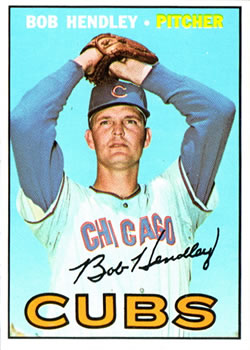
Bob Hendley started for the Cubs. He was not a particularly well-known pitcher. On this night, he pitched the game of his life. Unfortunately for him, it was only the 2nd-best pitched game... in that game.
Neither pitcher allowed a single baserunner until the bottom of the 5th. Cliché Alert: Walks can kill you, especially the leadoff variety. So can errors. Hendley walked Lou Johnson to start the inning. Ron Fairly sacrificed Johnson over to 2nd base. Johnson tried to steal 3rd base. Cub catcher Chris Krug made a bad throw, allowing Johnson to score. Johnson would also get a hit, the Dodgers' only hit: A "Texas Leaguer" double to right field with 2 out in the 7th, but would be stranded.

The Dodgers had 1 run, without a hit contributing to it. That was all Koufax needed: One run. He went to a 3-balls, 2-strikes count on Ernie Banks in the top of the 5th, but struck him out. He went to another full count on Billy Williams in the 7th, but got him to fly out. He struck out the side in the 8th: Ron Santo, Banks, and Byron Browne.

He went into the 9th inning without having allowed a baserunner. Krug led off. He got to a 2-and-2 count, before Koufax struck him out swinging. Joey Amalfitano came up. Koufax struck him out on 3 pitches, the last a swing and a miss.

Cub manager Lou Klein sent Harvey Kuenn up to bad for Hendley, who had pitched 8 innings, allowing 1 run, 1 hit, and 1 walk, striking out 3. Ordinarily, even in that pitching-friendly era of baseball, it would have been enough to win. Not on this night.

Kuenn was 34 years old, and nearing the end of the line. But he was a .303 lifetime hitter, the 1953 American League Rookie of the Year, the 1959 AL batting champion with a .353 average, a 4-time AL leader in hits, a 3-time AL leader in doubles, an All-Star in 8 seasons (including 2 in which there were 2 All-Star Games, so he's sometimes listed as a 10-time All-Star), and, while not really a power hitter, topping off at 12 home runs in 1956, he was certainly capable of driving in runs, topping off at 88 RBIs that same year. He had spent most of his career with the Detroit Tigers, but had helped the San Francisco Giants win the 1962 NL Pennant.

No less than Casey Stengel had said that Kuenn was "one of the most dangerous hitters in baseball. The guy can hurt you a million ways. He has no weakness at the plate that I have ever noticed." However, he was now batting just .217. He had previously made the last out in Koufax's 2nd no-hitter, over the Giants in 1963.

There is no surviving film or videotape of this game, just a recording of Vin Scully's broadcast on radio station KFI, 640 on the AM dial: "It is 9:46 PM. Two and two to Harvey Kuenn. One strike away. Sandy into his windup. Here's the pitch: Swung on and missed, a perfect game!" (Note: That's 9:46 PM Pacific Time, so it was 12:46 AM Eastern Time on September 10.)

The perfect game was also his 4th no-hitter, breaking the record of 3, which had been shared by Larry Corcoran, Cy Young and Bob Feller. Young's 2nd no-hitter was a perfect game.

Koufax threw 113 pitches, 79 of them for strikes. He struck out 14 batters. Home plate umpire Ed Vargo didn't have the chance to make bad calls. His single-game strikeout peak was 18, having done it in 1959 (before he found his control) and 1962. The 14 from this game would be part of a total of 382, a major league record at the time. Nolan Ryan would raise the record to 383 in 1973, a year in which he pitched 2 no-hitters. Koufax's 382 remains a National League record, and a major league record for lefthanded pitchers.

Koufax's 4 no-hitters would be a record until Ryan pitched a 5th in 1981, eventually reaching 7 -- although none of those was a perfect game. In a weird twist of events, Jeff Torborg caught Koufax's last no-hitter, and also caught Ryan's 1st in 1973. That made him the 2nd catcher to catch no-hitters in both leagues, following Gus Triandos. They have since been joined by Darrell Porter, Ron Hassey and Drew Butera.

Torborg also caught Bill Singer's no-hitter for the Dodgers, in 1970, so he was the 1st catcher to catch 3 no-hitters. Jason Varitek now holds the record, with 4.

The Dodgers went on to win the World Series. Koufax would be the story of that Series, in more ways than one.

Harvey Kuenn would go on to manage the Milwaukee Brewers to their 1st Pennant, in 1982. He died in 1988. Ed Vargo died in 2008. Lou Johnson, who got the Dodgers' only hit, died in 2020. Vin Scully died in 2022. Jeff Torborg died early this year. As of September 9, 2025, Sandy Koufax and Bob Hendley are still alive.

*

September 9, 1965 was a Thursday. Future basketball star Dan Majerle was born. This was also the day that both the U.S. Department of Housing and Urban Development and Gatorade made their debuts.

Friday, August 22, 2025

August 22, 1965: The Marichal-Roseboro Incident

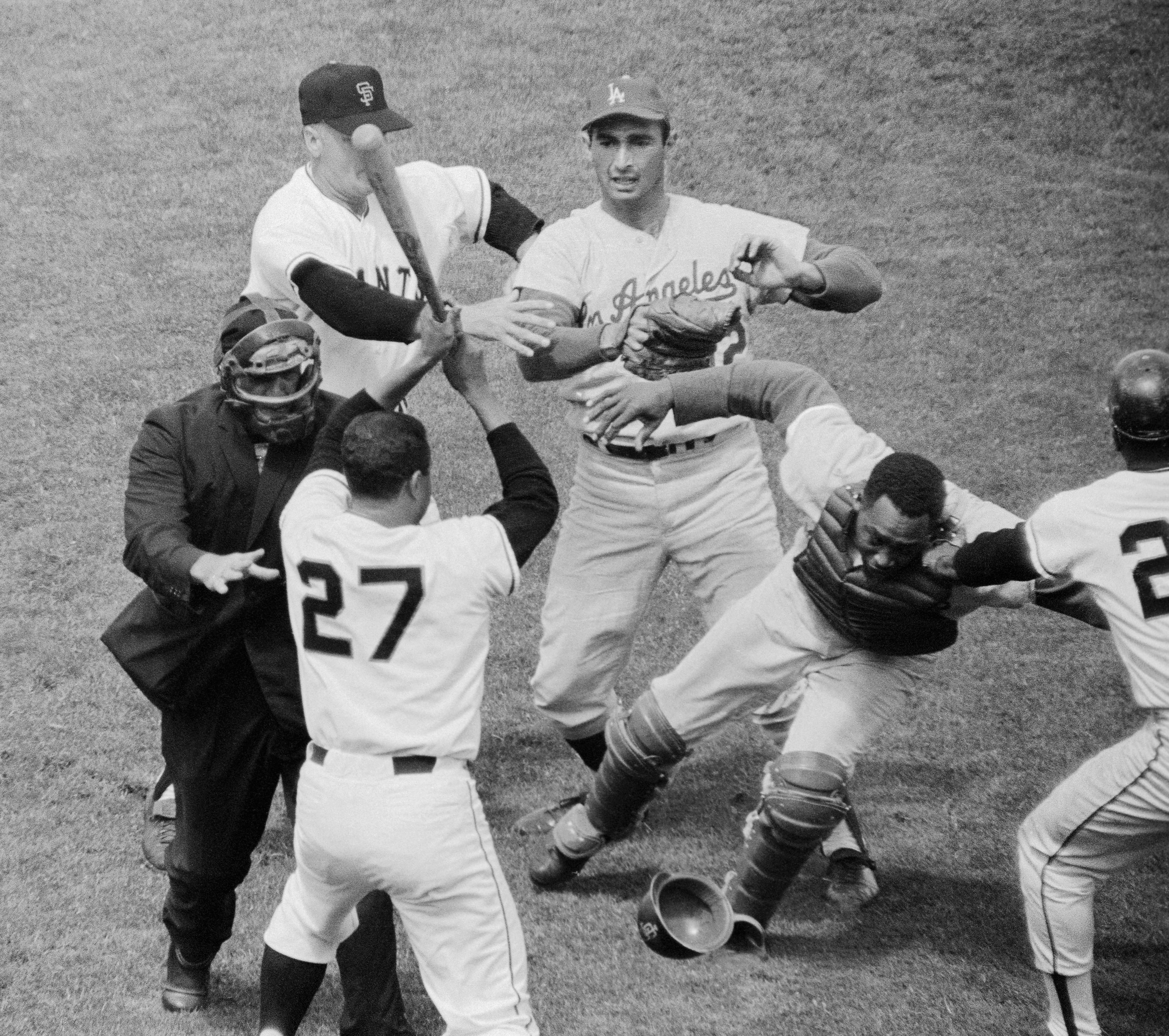
August 22, 1965, 60 years ago: The ugliest moment in the nasty rivalry between the Dodgers and the Giants occurs at Candlestick Park in San Francisco. As bad as it was when it was the Brooklyn Dodgers and the New York Giants from 1889 to 1957, nothing like this ever happened then. Nor has it happened between the Los Angeles Dodgers and the San Francisco Giants since.

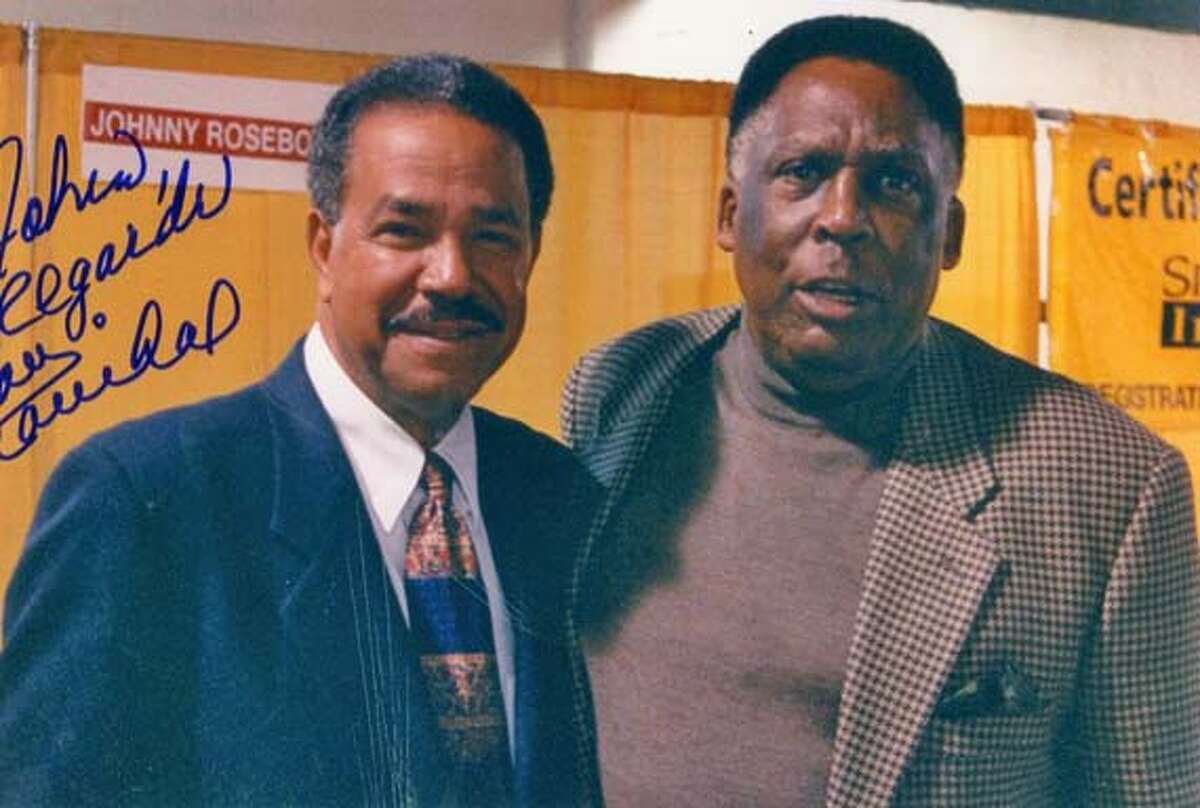
The key figures were Dodger catcher John Roseboro and Giant pitcher Juan Marichal. It was all the more shocking because both men were normally even-tempered and seemed to avoid controversy.

Roseboro was 32 years old, a native of Ashland, Ohio, had succeeded Roy Campanella as the Dodgers' starting catcher in 1958, their 1st season in Los Angeles. By this point, he had won a Gold Glove, made 5 All-Star Games, and helped the Dodgers win the 1959 and 1963 World Series.

But all was not well. A few days earlier, Watts, a neighborhood on the south side of Los Angeles, had broken out in a race riot. Roseboro lived a short distance from the worst of it, and was deeply troubled by it.

Marichal was 27, his age matching his uniform number. A native of the Dominican Republic, he had appeared in 4 All-Star Games, including being named the Most Valuable Payer in the Game played the previous month, had helped the Giants win the 1962 National League Pennant, and had pitched a no-hitter in 1963. Along with the Dodgers' Sandy Koufax and the St. Louis Cardinals' Bob Gibson, he was 1 of the 3 best pitchers in the game.

But all was not well. His country was locked in a civil war, which would be ended with the intervention of American troops and the scheduling of free elections. From his apartment in San Francisco, Marichal and his wife Alma were concerned for the safety of the family they had left behind.

So Roseboro at home, and Marichal abroad, had conflict weighing heavily on their minds as their teams took the field at Candlestick Park on August 22. At the start of the day's games, the Dodgers led the NL by half a game over the Milwaukee Braves, a game and a half over the Giants, and 2 1/2 over the Cincinnati Reds. It was a 4-way race, and still within striking distance, making it possibly a 6-team race, were the Philadelphia Phillies, 6 back; and the Pittsburgh Pirates, 8 1/2.

The opposing pitchers were Marichal and Koufax. The aces. And it was the rivalry in the NL, maybe in all of baseball. So a full house of 42,807 was on hand.

(The rivalry between the New York Yankees and the Boston Red Sox had gone dormant in 1952, when the Sox' Ted Williams went into the Korean War, and it had not yet recovered. Even a brawl at Yankee Stadium in 1967 didn't really revive it. The revival would take a brawl at Fenway Park in 1973.)

The game began with Maury Willis, the Dodgers' speed-demon shortstop, bunting for a hit. Marichal thought bunting was a cheap way to get on base. When Wills came up in the 2nd inning, Marichal threw a knockdown pitch that sent Wills sprawling. Two at-bats earlier, Roseboro had singled home Wes Parker to give the Dodgers a 2-0 lead.

In the bottom of the 2nd, Willie Mays led off, and Koufax threw a pitch over Mays' head. Neither Marichal nor Koufax was known for intentionally throwing at batters, but the messages had been sent and received. Cap Peterson hit a home run to close the Giants to within 2-1. That should have been the end of it.

It wasn't. In the top of the 3rd, Ron Fairly came up, having doubled Wills home in the 1st. Marichal nearly hit Fairly, and he hit the deck. Home plate umpire Shag Crawford had seen enough: He warned both dugouts that any further retaliations would result in ejections. That should have been the end of it.

It wasn't. Marichal led off the bottom of the 3rd. He took Koufax' 1st 2 pitches. After the 2nd pitch, Roseboro threw the ball back, close to Marichal's head. Marichal claimed the pitch actually hit his ear. Roseboro later admitted it, saying it was retaliation from Marichal throwing at Wills, and that he had done it before.

Marichal, whose English was heavily accented but very good, turned around and yelled at Roseboro. Roseboro rose from his crouch and clenched the fist of his ungloved right hand.

When Marichal eventually told his side of the story, he said that he was afraid Roseboro was about to hit him. He raised his bat and hit Roseboro over the head. He swung repeatedly, hitting Roseboro at least twice on his no-longer-helmeted head, opening a 2-inch gash that left blood on his face, needing 14 stitches.

Both dugouts emptied. Each team's best player, Mays and Koufax, tried to act as peacemaker. It took 14 minutes before the game could be restarted. Marichal, naturally, was thrown out of the game. Bob Schroder was sent up to pinch-hit. Jeff Torborg replaced Roseboro as Dodger catcher. Koufax got Schroder and Tito Fuentes out. But he later admitted that he was unsettled by the incident, and he walked Jim Davenport and Willie McCovey, and Mays hit a home run, giving the Giants a 4-2 lead.

Ron Herbel replaced Marichal on the mound, and pitched into the 9th inning. He ran out of gas, and Giant manager Herman Franks had to bring in Masanori Murakami, who would be baseball's only Asian pitcher until 1994. He nailed down the save. Giants 4, Dodgers 3.

NL President Warren Giles find Marichal $1,750, then a League record. (It's equivalent to $17,800 today.) That doesn't seem like much, but he also suspended Marichal for 8 games -- which turned out to be 2 starts. Those starts turned out to be the 1st game of a doubleheader in Pittsburgh on August 26, which Herbel started, and the Giants lost to the Pirates, 8-0; and in New York on August 29, with Bobby Bolin starting, and the Giants beat the Mets, 8-3.

Now, there's no guarantee that Marichal would have won that game on August 26. The Pirates had 4 hitters batting at least .288, led by Roberto Clemente at .340. And they beat Gaylord Perry in the 2nd game of that doubleheader, 6-5.

But when the season ended, the Dodgers had won the Pennant by 2 games over the Giants. Had Marichal been available for both games, and won both? The Dodgers would have won the Pennant by 1 game. So, in the end, it didn't make a difference.

Or... did it? Giles also suspended Marichal for the remaining 2 games between the teams, at Dodger Stadium on September 6 and 7. But, no, that didn't make a difference, either, because he wouldn't have appeared in them, anyway: He won the last game before that, away to the Chicago Cubs; and the Giants won both of those games at Chavez Ravine.

The Giants went 26-16 after August 22, including a 14-game winning streak that put them in 1st place by 4 1/2 games. But a 3-7 run that began on September 21 doomed them. Marichal was 19-9 when the clubbing occurred; he went 3-4 the rest of the way (although he did also have a save). Maybe he was unduly affected by what he did, but it looks like his team was not.

The Dodgers won the World Series in 1965. Marichal didn't face the Dodgers again until a Spring Training game on April 3, 1966 -- and Roseboro hit a home run off him. The Dodgers won the Pennant again in 1966, but lost the World Series. Neither team reached the postseason again until the Giants won the NL Western Division in 1971.

In 1975, running out the string, Marichal was signed by the Dodgers. Los Angeles fans revolted -- but Roseboro, who retired after the 1970 season, spoke up on his behalf, saying he'd forgiven Marichal, and asked the Dodger fans to do the same. He pitched only 2 games for the Dodgers, and was released, retiring with a career record of 243-142. He was the all-time winningest Hispanic pitcher until surpassed by Dennis Martínez (245-193), and later by Bartolo Colón (247-188).

He became eligible for the Baseball Hall of Fame in 1981, but didn't make it. Nor did he make it in the election of 1982. It was widely speculated that the main reason for members of the Baseball Writers Association of America not voting for him was his clubbing of Roseboro. Roseboro made a public statement supporting Marichal's election, and he was elected in 1983. This built a friendship that lasted until Roseboro's death in 2002. Marichal served as an honorary pallbearer at his funeral.
As of August 22, 2025, Marichal is still alive. 

Monday, October 2, 2023

October 2, 1963: Sandy Koufax Conquers the Yankees

October 2, 1963, 60 years ago: Game 1 of the World Series. Ten years to the day after Carl Erskine struck out 14 Yankees for the Brooklyn edition of the Dodgers, Sandy Koufax fanned 15 of them for the Los Angeles version, stunning opposing pitcher Whitey Ford and 69,000 fans at Yankee Stadium.

After the 1962 season, knowing that they had Joe Pepitone coming up to play 1st base, the Yankees traded Bill "Moose" Skowron, who had helped them win 7 Pennants and 4 World Series, to the Dodgers for pitcher Stan Williams. Moose made them pay for that in this game, singling home the Dodgers' 1st run in the 2nd inning. This was followed by a single by Dick Tracewski and a home run by John Roseboro. The Dodgers were up 4-0, and the game was effectively over.

Koufax allowed 6 hits and 3 walks, but was completely dominant. He had a perfect game until the 5th inning, when Elston Howard singled. Perhaps the most surprising thing about this game is that Koufax didn't pitch a shutout: Tom Tresh hit a 2-run home run in the 8th, but that's all the Yankees got, losing 5-2.

After the game, in which he did not play, leading up to his retirement as a player and his subsequent hiring to replace Ralph Houk as the Yankees' manager, Yogi Berra said, "I understand how he won 25 games. What I don't understand is how he lost 5."

Koufax was already known to be a great pitcher. But, in those days, the way baseball was covered in the media, sometimes a player needed the spotlight of the World Series to show how great he was. Now, the whole country saw how great Sandy Koufax was.

This game would be referenced in the 1975 film version of One Flew Over the Cuckoo's Nest, in which the head nurse, Mildred Ratched (Louise Fletcher), won't let the inmates watch it on television, so Randle McMurphy (Jack Nicholson) points them to the unplugged TV, and provides an imaginary broadcast for them. This deviates from the novel by Ken Kesey, because it was published in 1962, before the game in question.

Friday, June 30, 2023

The 24 Major League Pitchers to Have Pitched a Perfect Game, In Perspective

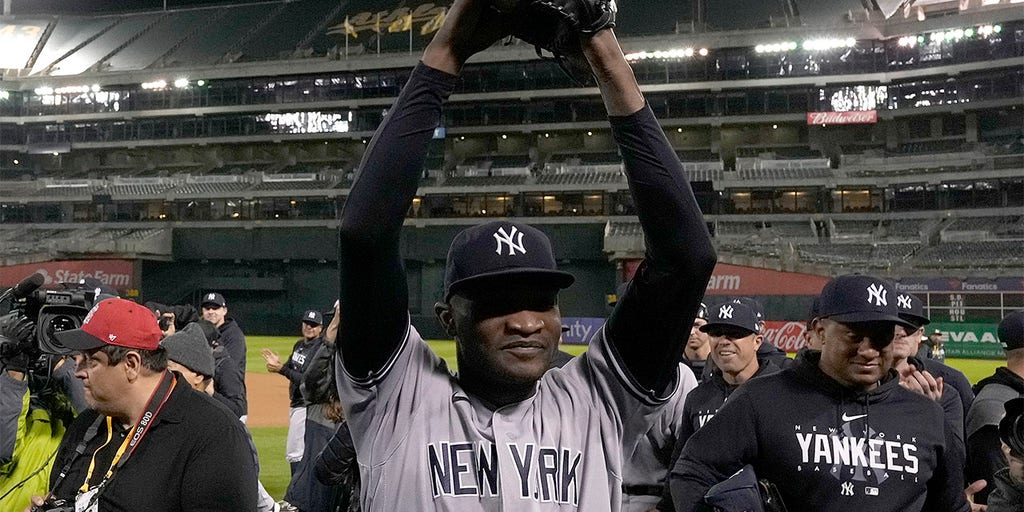
With Domingo Germán having pitched a perfect game on Wednesday night, this is a good occasion on which to look back at previous perfect pitching performances.

A shutout is a complete game pitched without allowing any runs. A no-hitter is a complete game pitched without allowing any hits, although allowing a run is still possible. A perfect game is a complete game pitched without allowing any baserunners: 27 men up, 27 men down. All 9 players in the lineup go up 3 times, and none of them reach base on any occasion. A perfect game is also a no-hitter and a shutout.

1. Lee Richmond, Oberlin, Ohio (outside Cleveland), 1857-1929, lefthanded, Worcester Brown Stockings, caught by Charlie Bennett, against the Cleveland Blues, winning 1-0, at the Worcester Agricultural Fairgrounds in Worcester, Massachusetts, outside Boston, on June 12, 1880.

Like the world at large, baseball was very different then, in particular because of pitching. For one thing, it really was "pitching," underhanded, not "throwing," overhanded. You've heard the expression of the pitcher being "knocked out of the box"? Well, in those days, there was no pitcher's mound, just a chalked off box, the center of which was 45 feet from home plate.

The Brown Stockings moved in 1883, becoming the Philadelphia Phillies. The Blues went out of business after the 1884 season. Charlie Bennett would help the Detroit Wolverines win the National League Pennant in 1887, then lose his legs in a train accident, but would still catch the ceremonial first ball on every Opening Day in Detroit until his death in 1927.

In 1896, Detroit's new ballpark was named Bennett Park for him. In the 1911-12 off-season, it was torn down, and a new ballpark was built on the site, named Navin Field for the Tigers' owner, Frank Navin. Bennett was still invited back. The ballpark would later be renamed Tiger Stadium.

2. John Montgomery Ward, Bellefonte, Pennsylvania, 1860-1925, righthanded, Providence Grays, caught by Emil Gross, against the Buffalo Bisons, winning 5-0, at the Messer Street Grounds in Providence, Rhode Island, on June 17, 1880, just 5 days after Richmond's perfecto.

At 20, "Monte" Ward remains the youngest pitcher ever to throw a perfect game in the major leagues, and the only one to later switch to another position, playing mostly shortstop, but also frequently 2nd base. He won the National League Pennant with the New York Giants in 1888 and 1889, and was the leading figure in the Players' League of 1890. In spite of this blatant act of betrayal of the team owners, he was elected to the Baseball Hall of Fame.

The Grays and the Bisons both went out of business after the 1885 season -- and played their last game against each other.

In 1881, the pitching distance was moved back to 50 feet. In 1884, overhand throwing was made legal. In 1887, a new rule meant that pitchers had to have their back foot in contact with the back line of the pitcher's box, which was 5 1/2 feet behind the front line. That meant the distance was now 55 feet, 6 inches from home plate. In 1893, the box was converted into a raised mound of dirt, usually around 15 inches high (but not yet mandated as such), and was moved back another 5 feet, to the current 60 feet, 6 inches.

So that's where the extra 6 inches, which looks so odd next to an otherwise round number, came from. There was an urban legend that a groundskeeper misread "60 feet, 0 inches" "60 feet, 6 inches," and it stuck. But it's not true.

3. Denton True Young, Gilmore, Ohio, 1867-1955, righthanded, Boston Americans, caught by Lou Criger, against the Philadelphia Athletics, winning 3-0, at the Huntington Avenue Grounds in Boston, Massachusetts, on May 5, 1904.

Cy Young -- shortened from "Cyclone," for his fastball -- was the 1st pitcher to pitch a no-hitter under the 60-and-6 distance. It was the 2nd of 3 no-hitters he would throw. He reached the major leagues in 1890, and was one of the few pitchers to be great both before and after the mound was moved back in 1893.

He had helped the Americans win the 1st World Series the season before, and would help them win the American League Pennant again, but the New York Giants refused to play them in a World Series. The 1904 season was also the year that the height of the mound was standardized at 15 inches. The Americans changed their name to the Red Sox in 1907.

Young won 511 games, more than any other pitcher. He also lost more than any player, and pitched more innings, and faced more batters, and so on. He was the 3rd pitcher elected to the Baseball Hall of Fame, after Christy Mathewson and Walter Johnson; and was named to the All-Century Team in 1999, 88 years after his last game. The award for the best pitcher in each League is named the Cy Young Award.

4. Adrian Joss (no middle name), Beaver Dam, Wisconsin, 1880-1911, righthanded, Cleveland Naps, caught by Nig Clarke, against the Chicago White Sox, winning 1-0, at League Park in Cleveland, Ohio, on October 2, 1908.

I have to address the names. The former Cleveland Blues renamed themselves after acquiring superstar 2nd baseman Napoleon "Nap" Lajoie, and naming themselves the Naps until he left following the 1914 season. They then became the Cleveland Indians, and became the Cleveland Guardians in 2022.

And Jay Justin Clarke, like an earlier Cleveland player, pitcher George Cuppy, was a white man who had a complexion dark enough that he was nicknamed "Nig." It's disgusting, but it's true.

"Addie" Joss needed that perfect game, because the Naps, the Chicago White Sox, and the Detroit Tigers were in a tight 3-way race for the Pennant; and Big Ed Walsh struck out 15 batters in the same game. In the end, neither team won the Pennant: The Tigers did.

Joss died of meningitis, 2 days after his 31st birthday, just before the start of the 1911 season, which would have been his 10th season in the major leagues. For that reason, he did not meet the eligibility requirement for the Hall of Fame. In 1978, no longer able to ignore that he had the lowest WHIP in history, 0.968 (Walsh was 2nd, at 1.000), and the 2nd-lowest ERA, 1.88 (Walsh was 1st, at 1.82), and accepting that he almost made it to a 10th season, and it wasn't his fault that he didn't, and that 1 game in it would have qualified him, the rule of at least 10 seasons was set aside for him, and he was elected. The Indians honored him in their team Hall of Fame.

Interlude: Ernest Grady Shore, East Bend, North Carolina, 1891-1980, righthanded, Boston Red Sox, caught by Sam Agnew, against the Washington Senators, winning 4-0, at Fenway Park in Boston, Massachusetts.

Shore did not start this game. Come to think of it, neither did Agnew. Babe Ruth was the starting pitcher for the Red Sox, and, to start the game, he faced Ray Morgan. Home plate umpire Clarence "Brick" Owens called ball 4 and put Morgan on 1st base. Ruth was so incensed that he punched Owens. Owens threw Ruth out of the game, and threw starting catcher Chester "Pinch" Thomas out, too.

Ruth was replaced by Shore, and Thomas by Agnew. Shore immediately picked Morgan off 1st, and then retired the next 26 batters in a row. Since he had retired 27 straight, Shore was given credit for a perfect game, until a 1991 ruling by Major League Baseball that Shore hadn't pitched a complete game, therefore he couldn't get credit for a perfect game or a no-hitter.

Shore pitched for the Red Sox when they won the 1915 and 1916 World Series, but was already in the service during the 1918 edition, as America had fully joined World War I.

5. Charles Culbertson Robertson, Nocona, Texas (outside Dallas), 1896-1984, righthanded, Chicago White Sox, caught by Ray Schalk, against the Detroit Tigers, winning 2-0, at Navin Field, Detroit Michigan, on April 30, 1922.

This was the 1st perfect game pitched in the post-1920 Lively Ball Era. Charlie Robertson was the 1st perfect game pitcher to be overshadowed by his catcher: At 49-80, with a .380 winning percentage, he is the least accomplished player on this list. Schalk is now generally regarded to have been elected to the Hall of Fame not so much because he was a great defensive catcher, although he was, but because he was a member of the 1919 White Sox team that wasn't in on the fix of the World Series. For many fans, if they had to drop one player from the Hall's ranks, he's the one.

6. Don James Larsen, "Gooney Bird," San Diego, California, 1929-2020, righthanded, Number 18, with Yogi Berra catching, against the Brooklyn Dodgers, in Game 5 of the World Series, at Yankee Stadium, the Yankees winning, 2-0, on October 8, 1956.

This was the 1st perfect game broadcast on radio, let alone on television; the 1st pitched with a black player on the winning side, and the 1st with one on the losing side; and the 1st pitched by a pitcher wearing a uniform number.

It was also the 1st no-hitter in postseason history, and while it is no longer the only one, or even the only one in World Series history, it remains the only perfect game in postseason history. Or, as Yogi put it, as only he could, "It's never been done before, and it still hasn't."

Larsen won the 1956 and 1958 World Series with the Yankees, losing in 1955 and 1957, and also lost to the Yankees with the San Francisco Giants in the 1962 World Series.

Interlude: Harvey Haddix (no middle name), South Vienna, Ohio (outside Columbus), 1925-1994, lefthanded, Number 31, Pittsburgh Pirates, caught by Smoky Burgess, against the Milwaukee Braves, at Milwaukee County Stadium, on May 26, 1959. Haddix is the only pitcher ever to pitch a perfect game into extra innings, and he kept it going for 12 innings: 36 men up, 36 men down.

But Lew Burdette of the Braves also had a shutout going, and he kept it going through the top of the 13th. In the bottom of the 13th, Pirate 3rd baseman Don Hoak made an error on a grounder hit by Félix Mantilla. The perfect game was off, but the no-hitter was still on. Eddie Mathews bunted Mantilla over to 2nd base. Hank Aaron was walked intentionally to set up the inning-ending double play. But Joe Adcock hit a game-winning home run. Except Aaron walked off the field without scoring, so Adcock was declared out for passing him, so what should have been a 3-0 Braves win was ruled a 1-0 win.

A 1991 ruling by Major League Baseball determined that, since Haddix lost the game, he would no longer receive credit for a no-hitter and a perfect game. He got robbed: He may not have finished the game, but did 27 up, 27 down. He should have gotten the credit.

7. James Paul David Bunning, Southgate, Kentucky (near Cincinnati), 1931-2017, righthanded, Number 14, Philadelphia Phillies, caught by Gus Triandos, against the New York Mets, winning 6-0, at Shea Stadium, on June 21, 1964.

Jim Bunning had previously pitched a no-hitter with the Detroit Tigers in 1958. This made him the 2nd pitcher, after Cy Young, to pitch a no-hitter in each League. It was Father's Day, and Bunning already had 6 children, and would eventually have 9.

The Phillies retired his number, and elected him to the Philadelphia Baseball Wall of Fame. He was elected to 9 All-Star Games, to the Baseball Hall of Fame -- and to each house of Congress, as a Republican from Kentucky. It should be noted that his conservatism was known when he was elected, which should, but won't shut up the people whining about Curt Schilling not being elected.

8. Sanford Koufax (no middle name, born Sanford Braun), Brooklyn, New York, born in 1935, lefthanded, Number 32, Los Angeles Dodgers, caught by Jeff Torborg, against the Chicago Cubs, winning 1-0, at Dodger Stadium in Los Angeles, California, on September 9, 1965.

This was the 4th and last no-hitter for Sandy Koufax, "The Left Arm of God." The opposing pitcher, Bob Hendley, allowed only 1 hit, so this game set a record that still stands for fewest hits by both teams combined in a single game.

Koufax had helped the Dodgers win the World Series in 1959 and 1963, and would do so again in 1965, and win another Pennant in 1966. He appeared in 7 All-Star Games. The Dodgers retired his number, and, due to his early retirement, he was, at 36, the youngest person ever elected to the Baseball Hall of Fame.

9. James Augustus Hunter, Hertford, North Carolina, 1946-1999, righthanded, Oakland Athletics, Number 27, caught by Jim Pagliaroni, against the Minnesota Twins, winning 4-0, at the Oakland-Alameda County Coliseum in Oakland, California, on May 8, 1968.

Jim Hunter already had the nickname "Catfish," but he didn't yet have the mustache. He helped the A's win the World Series in 1972, 1973 and 1974, and the Yankees win it in 1977 and 1978, losing the World Series in 1976. He reached 8 All-Star Games. The A's retired his number (he wore 29 with the Yankees), and he was elected to the Baseball Hall of Fame.

Interlude: Milton Stephen Pappas, Detroit, Michigan, 1939-2016, righthanded, Chicago Cubs, Number 32, caught by Randy Hundley, against the San Diego Padres, winning 8-0, at Wrigley Field in Chicago, Illinois, on September 2, 1972.

Pappas was 1 strike away from a perfect game, and had a full count on to pinch-hitter Larry Stahl, and seemed to have gotten a called 3rd strike. But home plate umpire Bruce Froemming called ball four. The instant replay showed that Froemming was wrong. Pappas then got Garry Jestadt to pop up, so he kept the no-hitter, but lost a perfect game on an obviously wrong call.

After the game, Pappas tried to reason with Froemming, pointing out that only 9 home-plate umpires had ever called a perfect game, and that he could have been only the 10th. Froemming said, "Milt, if I'd called that pitch a strike, I never would have been able to live with myself." That's when Pappas lost it, yelling, "How the hell do you live with yourself with all the other lousy calls you make?"

Froemming went on to make many more lousy calls before his retirement in 2007. The following year, a Chicago radio host got both of them on the air, and they still argued it.

10. Leonard Harold Barker, Langhorne, Pennsylvania (outside Philadelphia), born in 1955, righthanded, Cleveland Indians, Number 39, caught by Ron Hassey, against the Toronto Blue Jays, winning 3-0, at Cleveland Municipal Stadium, on May 15, 1981.

This was the 1st perfect game pitched after 1968, "The Year of the Pitcher," after which the height of the pitcher's mound was lowered from 15 to 10 inches. It was also the 1st perfect game pitching during my lifetime. Although a sportswriter remarked, "How could it be perfect? It was pitched in Cleveland."

"Large Lenny" was considered a candidate to pitch a no-hitter, but not a perfect game, because he was wild. How wild was he? In a 1978 game, pitching for the Texas Rangers against the Boston Red Sox, he threw one pitch that ended up on the Fenway Park backstop.

11. Michael Atwater Witt, Anaheim, California (outside Los Angeles), born in 1960, righthanded, California Angels, Number 39, caught by Bob Boone, against the Texas Rangers, winning 1-0, at Arlington Stadium in the Dallas suburb of Arlington, Texas, on September 30, 1984.

In 1940, Bob Feller pitched a no-hitter in his team's 1st game of the season, but this was the 1st time a pitcher threw one in the last game of the regular season. Since the Angels play their home games in Anaheim, this made Mike Witt the 1st pitcher to pitch a perfect game for his hometown team. He helped them win the AL Western Division title in 1982 and 1986, made 2 All-Star Games, and later pitched for the Yankees.

12. Thomas Leo Browning, Malone, New York, 1960-2022, lefthanded, Cincinnati Reds, Number 32, caught by Jeff Reed, against the Los Angeles Dodgers, winning 1-0, at Riverfront Stadium in Cincinnati, Ohio, on September 16, 1988.

Tom Browning helped the Reds win the World Series in 1990, and made the All-Star Game the next season. In 1994, he broke his arm in mid-pitch, and only pitched in 1 more season. The Reds elected him to their team Hall of Fame.

13. José Dennis Martínez Ortiz, Granada, Nicaragua, born 1955, righthanded, Montreal Expos, Number 32, caught by Ron Hassey, against the Los Angeles Dodgers, winning 2-0, at Dodger Stadium, on July 28, 1991. 

This made Dodger Stadium the 1st ballpark to host 2 perfect games, Hassey the 1st catcher to catch 2, and Dennis Martínez (the name he has always used) the 1st Hispanic pitcher, and the 1st pitcher born outside the United States, to pitch a perfect game.

His 245 wins surpassed Juan Marichal as the winningest Hispanic pitcher, but Bartolo Colón surpassed him with 247. "El Presidente" had helped the Baltimore Orioles reach 2 World Series, losing in 1979 and winning in 1983. He appeared in 4 All-Star Games.

14. Kenneth Scott Rogers, Dover, Florida (outside Tampa), born 1964, lefthanded, Texas Rangers, Number 37, caught by Iván Rodríguez, against the the California Angels, winning 4-0, at The Ballpark in the Dallas suburb of Arlington, Texas, on July 28, 1994.

No relation to the country singer also named Kenny Rogers (Kenneth Ray Rogers), but, in line with one of his songs, the pitcher was nicknamed "The Gambler." He made 4 All-Star Games, and the Rangers elected him to their team Hall of Fame. He appeared in the postseason with the Yankees in 1996 (winning the World Series), the New York Mets in 1999, the Minnesota Twins in 2003, and the Detroit Tigers in 2006 (reaching but losing the World Series).

It should be noted that, like a later perfecto pitcher, Domingo Germán, he got caught using illegal "sticky stuff" on the mound -- but not during his perfecto.

15. David Lee Wells, San Diego, California, born in 1963, lefthanded, New York Yankees, Number 33, with Jorge Posada catching, against the Minnesota Twins, winning 4-0, at Yankee Stadium, on May 17, 1998.

"Boomer" claimed to have been hungover when he pitched this game. He appeared in 3 All-Star Games, won the 1992 World Series with the Toronto Blue Jays, lost the 1996 AL Championship Series to the Yankees with the Baltimore Orioles, won the 1998 World Series with the Yankees, lost the 2003 World Series with the Yankees, and also reached the postseason with the 2005 Red Sox, and in 2006 with his hometown San Diego Padres.

He and Larsen both graduated from Point Loma High School in San Diego, both were known for their hard-partying ways, and both pitched perfect games for the Yankees.

16. David Brian Cone, Kansas City, Missouri, born in 1963, righthanded, New York Yankees, Number 36, with Joe Girardi catching, against the Montreal Expos, at Yankee Stadium, winning, 6-0, on July 18, 1999.

The Yankees held Yogi Berra Day, and Larsen threw a ceremonial first pitch that Berra caught. It was the 1st no-hitter ever pitched in an Interleague game. A 5-time All-Star, "Coney" won the 1994 AL Cy Young Award with the Kanas City Royals. He arrived too late to appear with the Mets in the 1986 World Series, but was a member of their 1988 NL Eastern Division Champions. He won the World Series with the Blue Jays in 1992; and with the Yankees in 1996, 1998, 1999 and 2000.

17. Randall David Johnson, Livermore, California (outside San Francisco), born in 1963, lefthanded, Arizona Diamondbacks, Number 51, with Robby Hammock catching, against the Atlanta Braves, at Turner Field in Atlanta, Georgia, winning 2-0, on May 18, 2004.

Few pitchers in the post-1968 Ten-Inch Mound Era have been as dominating as Randy Johnson. This was the 2nd no-hitter for the 6-foot-10 "Big Unit," who appeared in 10 All-Star Games, won 5 Cy Young Awards, including in both Leagues, and is the only perfect game pitcher to be a member of both the 300 Wins Club and the 3,000 Strikeouts Club. No lefty has more strikeouts than his 4,875, and, among righthanders, only Nolan Ryan has more. (Ryan pitched 7 no-hitters, but none was a perfect game.)

He reached the postseason with the Seattle Mariners in 1995 and 1997; the Houston Astros in 1998; the Diamondbacks in 2001 (winning the World Series) and 2002; and the Yankees in 2005 and 2006, The Mariners named him to their team Hall of Fame, the Diamondbacks retired his number, and he was elected to the Baseball Hall of Fame.

18. Mark Alan Buehrle, St. Charles, Missouri (outside St. Louis), born in 1979, lefthanded, Chicago White Sox, Number 56, with Ramón Castro catching, against the Tampa Bay Rays, at U.S. Cellular Field (now Guaranteed Rate Field) in Chicago, winning 5-0, on July 23, 2009.

This was Buehrle's 2nd no-hitter. A 5-time All-Star, he reached the postseason with the ChiSox in 2000, 2005 (winning the World Series) and 2008; and with the Toronto Blue Jays in 2015 (although he was injured and unavailable for the postseason roster). The White Sox retired his number.

19. Dallas Lee Braden, Stockton, California (outside Sacramento), born in 1983, lefthanded, Oakland Athletics, Number 51, with Landon Powell catching, against the Tampa Bay Rays, at the Oakland Coliseum, winning 4-0, on May 9, 2010.

Braden grew up as an A's fan, so he was the 2nd pitcher, after Mike Witt, to pitch a perfect game for his favorite team. The game was played on Mother's Day. Like David Wells, he claimed to have pitched his gem while hungover. But less than a year later, a shoulder injury meant that he would never pitch again, done at age 27.

20. Harry Leroy Halladay, Arvada, Colorado (outside Denver), 1977-2017, righthanded, Philadelphia Phillies, Number 34, with Carlos Ruiz catching, against the Florida Marlins, at Sun Life Stadium (now Hard Rock Stadium) in Miami Gardens, Florida, winning 1-0, on May 29, 2010.

Roy Halladay pitched his perfecto just 20 days after Braden's. Later in the season, he pitched MLB's 2nd postseason no-hitter, against the Cincinnati Reds, in Game 1 of the NL Division Series. He also pitched for the Phillies in the following year's postseason.  Unfortunately, like Addie Joss, "Doc" didn't live for very long after his perfect game, dying in a plane crash only 4 years after his retirement.

The Toronto Blue Jays named him to their team Hall of Fame, the Level of Excellence, and retired his Number 32. The Phillies named him to the Philadelphia Baseball Wall of Fame, and retired his Number 34. He was elected to the Baseball Hall of Fame.

Interlude: Armando Antonio Galarraga Barreto, Cumana, Venezuela, born in 1982, righthanded, Detroit Tigers, Number 58, with Alex Avila catching, against the Cleveland Indians, at Comerica Park in Detroit, winning 3-0, on June 2, 2010.

This one should have counted, but didn't. Armando Galarraga got the 1st 26 batters out. The 27th was Jason Donald, and he grounded to 1st baseman Miguel Cabrera. Galarraga ran over to cover 1st base. Cabrera made the throw, and the instant replay proved that Donald was out. But umpire Jim Joyce called him safe. Under the rules of the time, there was no provision for overturning the call with an instant replay, and so, the perfect game and the no-hitter were ruined.

Joyce had been the 2nd base umpire for Braden's perfect game, just 22 days earlier. Unlike Bruce Froemming, 38 years earlier, Joyce accepted that he blew it: "I was convinced he beat the throw, until I saw the replay." Joyce apologized to Galarraga, and was widely praised for accepting his mistake.

21. Philip Gregory Humber, Carthage, Texas, born in 1982, righthanded, Chicago White Sox, Number 41, with A.J. Pierzynski catching, against the Seattle Mariners, at Safeco Field (now T-Mobile Park) in Seattle, Washington, winning 4-0, on April 21, 2012.

Philip Humber was with the Mets in 2006, and the Minnesota Twins in 2008 and 2009, but did not appear on the postseason roster on any of those occasions. He struggled badly after his perfect game, and last appeared in the major leagues only a year and a half later. He has fewer wins than any other perfect game pitcher, including the still-active Domingo Germán.

22. Matthew Thomas Cain, Germantown, Tennessee (outside Memphis), born in 1984, righthanded, San Francisco Giants, Number 18, with Buster Posey catching, against the Houston Astros, at AT&T Park (now Oracle Park) in San Francisco, California, winning 10-0, on June 13, 2012.

Matt Cain was a 3-time All-Star, and he helped the Giants win the 2010 and 2012 World Series. However, "The Horse" was injured midway through the 2014 season, and was unable to be a part of a 3rd Series winner. The Giants elected him to their Wall of Fame.

23. Félix Abraham Hernández García, Valencia, Venezuela, bornin 1986, righthanded, Seattle Mariners, Number 34, with John Jaso catching, against the Tampa Bay Rays, at Safeco Field (now T-Mobile Park) in Seattle, winning 1-0, on August 15, 2012.

Three perfect games in 1 season, when it used to be a rare occurrence. Mariner fans called Hernández "King Felix," even though he never appeared in a single postseason game. He did, however, appear in 6 All-Star Games, and win 2 AL Cy Young Awards.

24. Domingo Germán (no middle name, unusual for a Hispanic person), San Pedro de Macorís, Dominican Republic, righthanded, Number 0 (formerly 55), with Kyle Higashioka catching, against the Oakland Athletics, at the Oakland-Alameda County Coliseum, the Yankees winning, 11-0, on June 28, 2023.

Dallas Braden was part of MLB Network's coverage of this game. This makes him the 1st man to pitch a perfect game and broadcast another. David Cone is a member of the Yankees' broadcast staff, but did not broadcast this game.

Richmond, Haddix, Koufax, Browning, Rogers, Wells, Johnson, were lefthanded. The rest were righthanded.

Richmond, Young, Shore, Hunter, Barker, Rogers, Cone, Johnson, Humber were of English descent; Ward, Browning, Wells, Braden, Halladay and Cain, Irish; Robertson and Bunning, Scottish; Joss, Swiss; Larsen, Danish; Haddix, French; Koufax, German Jewish; Pappas, Greek; Witt and Buehrle, German; Martínez, Nicaraguan; Galarraga and Hernandez, Venezuelan; and Germán, Dominican. Although Germán is a black Hispanic, no African-American pitcher has ever pitched a perfect game in the major leagues.

Robertson, Haddix (sort of), Bunning, Witt, Johnson, Halladay, Humber and Germán did it on the road; the rest did it in their home parks.

Ward, Koufax, Barker, Browning were from the Northeastern U.S.; Richmond, Young, Joss, Haddix, Pappas, Cone, Buehrle were from the Midwest; Shore, Robertson, Bunning, Hunter, Humber, Cain, the Southeast; Halladay, from the Rocky Mountains; Larsen, Witt, Wells, Johnson, Braden, the West Coast; Martínez, Galarraga, Hernández and Germán from outside the U.S.

Career wins: Young 511, Johnson 303, Wells 239, Bunning 224, Hunter 224, Rogers 219, Buehrle 214, Pappas 209, Halladay 203, Cone 194, Hernández 169, Koufax 165, Ward 164, Joss 160, Haddix 136, Browning 123, Witt 117, Cain 104, Larsen 81, Richmond 75, Barker 74, Shore 65, Robertson 49, Germán (still active) 31, Braden 26, Galarraga 26, Humber 16.

Ward, Young, Joss, Bunning, Koufax, Hunter, Johnson and Halladay have been elected to the Hall of Fame. However, Richmond, Robertson, Larsen, Barker, Braden, Galarraga, Humber and Cain retired with losing records.

Uniform numbers during their perfect games: Germán 0; Bunning 14; Larsen and Cain 18; Hunter 27; Haddix 31; Koufax, Pappas, Browning and Martínez 32; Wells 33, Halladay and Hernández 34, Cone 36, Rogers 37; Barker and Witt 39; Humber 41, Johnson and Braden 51; Buehrle 56; Galarraga 58.

Koufax, Barker, Witt, Browning, Martínez, Rogers, Wells, Cone, Johnson, Buehrle, Braden, Galarraga, Humber, Cain, Hernández and the still-active Germán are still alive.