Showing posts with label brooklyn. Show all posts

Saturday, August 15, 2026

August 15, 1926: The Dodgers Have Three Men On Base

Babe Herman

August 15, 1926, 100 years ago: Legend has it that Babe Herman of the Brooklyn Dodgers tripled into a triple play.

The legend isn't quite true. Ring Lardner, the top baseball writer of the era, wrote, "Babe Herman did not triple into a triple play, but he doubled into a double play, which is the next best thing."

Also, the Dodgers weren't even officially called the Dodgers at this point. I'll get to that at the moment.

Floyd Caves Herman was born in 1903 in Buffalo, and grew up outside Los Angeles in Glendale, California. After starring in the Southern Association for the Atlanta Crackers, the Memphis Chicks and the Little Rock Travelers; in the Texas League for the San Antonio Missions, and the Pacific Coast League for the Seattle Rainiers, he was signed by the Brooklyn Dodgers.

In 1914, the Dodgers hired former star catcher Wilbert Robinson as their manager, and they changed their name to the Brooklyn Robins, in his honor. They won the National League Pennant in 1916 and 1920, and finished 2nd in 1924.

But by the time "Babe" Herman -- nicknamed for a boxer who was from Edmonton, where Herman played early in his career, not for Babe Ruth -- reached the major leagues in 1926, the Dodgers weren't so good anymore. They became known as "The Daffiness Boys." Around this time, a fan known as Abie the Truck Driver was heard to yell, over and over, "Come on, you bums!" and was thus credited with creating the nickname that would stick with the team, first in agreement, and later, as they became good, as a term of endearment: "Dem Bums." And this was despite having Charles Arthur "Dazzy" Vance, the fastest pitcher in baseball at the time, and a future member of the Baseball Hall of Fame.
Dazzy Vance

Like Grover Cleveland Alexander, Vance was a righthander from Nebraska with a great fastball. Unlike Alexander, he was not known to have had a drinking problem. Like Alexander, he debuted in the major leagues at age 24. Unlike Alexander, who was an immediate success, Vance had precious little control, and did not gain his 1st major league win until he was 31 years old.

That was in 1922. Starting that year, over the next 9 seasons, through 1930, he went 18-12, 18-15, 28-6, 22-9, 9-10, 16-15, 22-10, 14-13 and 17-15, mostly for weak Dodger/Robin teams. He led the NL in wins twice, earned run average 3 times, shutouts 4 times, strikeouts 7 times (all in a row, which remains an NL record), and, not that anybody knew what WHIP (Walks plus hits, divided by innings pitch) was at the time, that stat 3 times.

His 28 wins in 1924, when the Robins finished 2nd, remains the most for the Dodger franchise since the pitching distance became 60 feet, 6 inches in 1893. Don Newcombe won 27 in Brooklyn in 1956, and Sandy Koufax won 27 in Los Angeles in 1966. His 262 strikeouts in 1924 were the most in the NL between the 267 of Christy Mathewson in 1903 and the 269 of Koufax in 1961.

In a way, Vance was like Koufax, in that, once he found his control, he became the best pitcher in baseball. But, whereas Koufax was shaky in the 1st 1/3rd of his career, one of the best ever in the 2nd third, and didn't have the last 3rd, retiring just before he turned 31, Vance had half a career, starting at 31, and lasting until he was 44.

If the late 1920s and early 1930s Dodgers sound like a precursor to the 1960s expansion Mets, the last team that Casey Stengel managed, there are other parallels, including the fact that, in 1934, the Dodgers became the 1st team that Stengel managed. Come to think of it, in the off-season, Casey lived in Herman's hometown, Glendale. Certainly, the Daffiness Boys could, like the early Mets, have been called "lovable losers."

It would be unfair to compare Babe Herman to "Marvelous" Marv Throneberry. It true that Babe was known as a terrible fielder. While Marv's travails at 1st base were often seen on television, Babe's poor play in right field had to be seen at the ballpark. He always insisted that he was never hit on the head by a fly ball. A writer asked him if he'd ever been hit on the shoulder, and he said, "That doesn't count." With no TV to record his travails and tribulations, his poor fielding remains a legend.

But he was a heck of a hitter. He batted .324 for his career, including .381 in 1929 and .393 in 1930. Twice, he had at least 113 RBIs in a season; 5 times, he had at least 91. Phil Rizzuto, the eventual shortstop and broadcaster for the New York Yankees, grew up in Queens as a Dodger fan, and, even after getting into the Hall of Fame himself after a long wait, believed Herman should also have been elected.

But in his rookie year, no one would have suggested it. On August 15, 1926, the Robins hosted a Sunday doubleheader at Ebbets Field, against the Boston Braves. Vance started the 1st game, and before the 1st inning was over, there was already an unusual occurrence. Prior to striking out, Eddie Brown fouled off a Vance pitch, which hit umpire Eddie Quigley, and he had to leave the game with an injury. Since major league games then had only 3 umpires, this game was now down to 2.

(Quigley shook it off, and umpired behind the plate for the 2nd game. He umpired in the major leagues from 1913 to 1938, including 6 World Series. He was also a respected referee in college football and basketball, elected to the Basketball Hall of Fame. He served as athletic director for the University of Kansas, and the school's baseball complex is named for him.)

The game was scoreless until the top of the 6th, when the Braves scored. Then came the bottom of the 7th. Bear with me: This was complicated. Johnny Butler led off by singling to left. Hank DeBerry doubled to left, scoring Butler and tying the game.

With a runner on 2nd and nobody out, it was an easy choice for Robinson: He allowed Vance to bat for himself, and bunt DeBerry over. Except it turned out not to be a sacrifice: He beat it out. And starting pitcher Johnny Werts hit Chick Fewster with a pitch. The bases were loaded, and there was nobody out. Braves manager Dave Bancroft, a Hall of Fame shortstop, took Werts out, and replaced him with veteran hurler George Mogridge. He got Merwin Jacobson to pop up to him.

That brought Herman up. He hit a drive off the screen in right field. Under the ground rules at Ebbets Field, that meant that the ball was still in play. DeBerry scored easily, making it 2-1 Robins. Vance held up right after 2nd base, to see if the ball would be caught by right fielder Jimmy Welsh. It wasn't. Vance took off for 3rd base, and thought he could score. He probably would have.

But the Dodgers' 3rd base coach was Otto Miller, who had previously managed Herman in Atlanta. He saw Fewster coming in hard for 3rd base, and yelled, "Go back! Go back!" But, being a pitcher, Vance was not used to running the bases, and thought that Miller was telling him to go back to 3rd. So he did. Fewster apparently didn't hear Miller, and kept going, and ended up on 3rd. And so did Herman, who neither heard nor saw Miller. All three men were standing on third base.
Chick Fewster, earlier in his career,
with the Cleveland Indians

The Braves' 3rd baseman, Eddie Taylor, received the ball when it came in from the outfield, and, faced with an unprecedented situation in baseball, did the only thing he could think of: He tagged all 3 runners with the ball, even though each of them had a foot on the base, and thought of himself as safe.

The 2 remaining umpires, John "Beans" Reardon (so nicknamed because he was from Boston, a.k.a. "Beantown") and Charlie Moran, discussed the situation, and applied the correct ruling: Since Vance was the lead runner, he was the only one entitled to the base, so he was safe, and Fewster and Herman had been legitimately tagged out.

Thus, the 7th inning was over, and the Robins were leading, 2-1. Herman was credited with a double and an RBI -- the game-winning RBI, as it turned out. But it entered the public memory as "Babe Herman tripled into a triple play." (It couldn't have been, as there was already 1 out.)

The Robins scored 2 more runs in the top of the 8th, and won, 4-1. They also won the nightcap, 11-3. That success tends to get forgotten, due to the "daffiness." Over the 2 games, Herman went 4-for-8 with 4 RBIs.

But the play took on a life of its own. In those days, prior to regular radio broadcasting of baseball games in New York, the legend grew of a taxi driver who pulled up to the right field corner, at Bedford Avenue and Sullivan Place, and yelled up to a fan in the last row, "Hey, how are the Dodgers doing?"

"Great!" the fan yelled down. "They have three men on base!"

"Yeah?" the cabbie asked. "Which base?"

After the 1931 season, Robinson was fired, and, with the Robins name having never really caught on, the Dodger name, still used by most Brooklynites, was officially restored.

Herman was traded to the Cincinnati Reds, and he bounced around. He had rotten luck: The Chicago Cubs won the Pennant in 1932 and 1935, but he was only with them in 1933 and 1934. The Reds brought him back, but got rid of him in 1936, winning the Pennant 3 years later. The Detroit Tigers won Pennants in 1934 and 1935, and would win another in 1940, but Herman was only with them in 1937.

The Tigers released him in the middle of that season, shortly before his 34th birthday, even though he had batted .300 in 17 games for them. He spent the 1938 season with the Jersey City Giants of the International League, and then went back home to the Pacific Coast League, playing 6 seasons for the Hollywood Stars, batting at least .307 every year.

In 1945, desperate for players due to the manpower drain of World War II, the Dodgers brought him back, at age 42. Appearing in 37 games, mainly as a pinch-hitter, he batted .265, and that was it for him. Having previously played for the Dodgers before uniform numbers were worn, in that season, he wore the Number 4 that would later be retired for Duke Snider, and the Number 32 that would later be retired for Sandy Koufax.

Lawrence Ritter interviewed him for his book The Glory of Their Times, published in 1966. Of the play, Herman said, "If there was any justice, Vance would have been the one declared out because he's the one caused the traffic jam in the first place. But down through history, for some strange reason, it's all been blamed on me."

Who knows, maybe that one play is why Babe Herman is not in the Baseball Hall of Fame. He died in 1987. He outlived Robinson, who died in 1934, while Herman was still playing; Fewster, who died in 1945, during Herman's comeback; Moran, one of the remaining umpires, who died in 1949; Quigley, the umpire who was hurt and couldn't participate in the call, who died in 1960; Vance, who died in 1961; Miller, who died in 1962; and Reardon, the umpire who made the correct ruling, who died in 1984. Taylor, the 3rd baseman who tried to tag everybody out, lived until 1992. And, of course, Herman long outlived the Brooklyn Dodgers themselves, who were moved to Los Angeles after the 1957 season; and Ebbets Field, which was torn down in 1960.

My grandmother, growing up in Queens, was a Dodger fan, but while she told me this story when I was a boy, she wasn't quite old enough to remember it herself. Her favorite poet was Ogden Nash, even though he was a fan of the Dodgers' arch-rivals, the New York Giants. In 1949, Nash, wrote "Line-Up for Yesterday" for Sport magazine, an alphabetical list of star players. For the letter V, he wrote:

V is for Vance
The Dodgers' very own Dazzy.
None of his rivals
Could throw as fast as he.

Thursday, June 25, 2026

June 25, 1966: The Brooklyn Navy Yard Closes

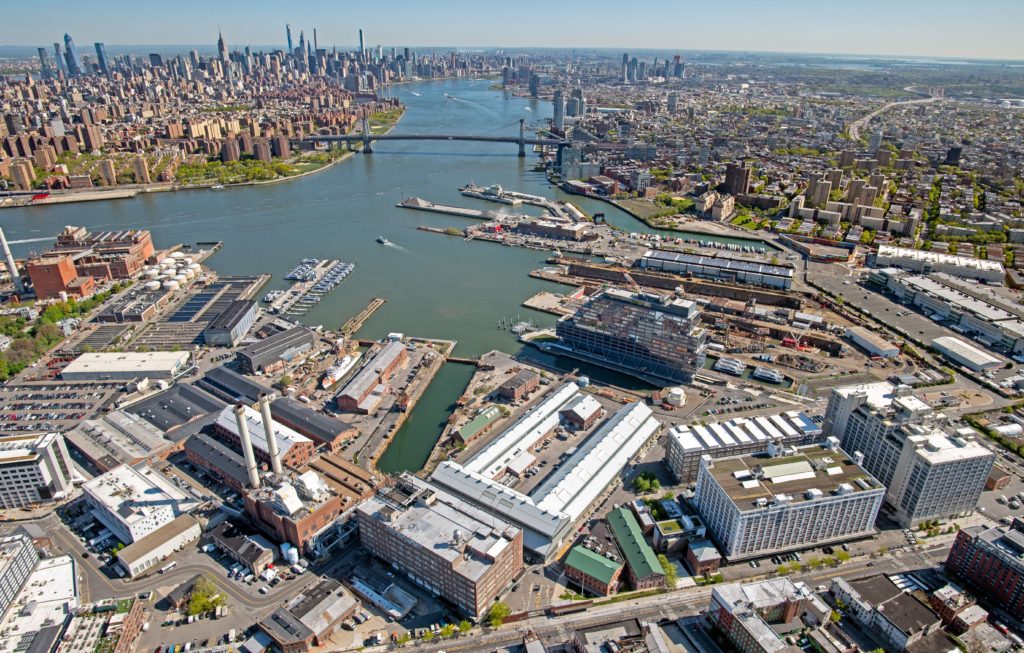
A recent photo of the Navy Yard,
which has been redeveloped for residential and retail use.
The Williamsburg Bridge is in the background.

June 25, 1966, 60 years ago: The Brooklyn Navy Yard is closed, emblematic of New York City's loss of industry.

At the height of World War II production, what was officially named the New York Naval Shipyard had 75,000 people working there. In 1947, it was down to 10,000 workers. It doubled back up to 20,000 by the end of the Korean War in 1953, but after that war ended, it was back to 10,000 again.

In 1960, with the Yard's workforce 11,000 strong, the aircraft carrier USS Constellation was being built there, and an accident caused a fire that killed 49 people. The investigation showed that, although this fact was not responsible for the fire, the Yard was obsolete, especially since it was determined that, in order to reach the open sea, ships built there had to pass under the Manhattan Bridge and the Brooklyn Bridge; and ships going there for repairs also had to pass under those bridges -- and most new ones were too big. 

And so, on June 25, 1966, a closing ceremony was held at the Yard, with work stopping for good on June 30, and the last 9,500 workers were laid off.

This was symbolic of the loss of industry in New York City. The loss of jobs crushed the Borough economically, and was much more damaging to the communities of Brooklyn than the so-often-cited move of baseball's Brooklyn Dodgers in 1957 had been.

Indeed, it was crushing to the City as a whole. It wasn't the first time industry had been phased out: The Gashouse District, between 1st Avenue and the Hudson River, from 14th to 23rd Street, its name already appropriated for baseball's St. Louis Cardinals, "the Gashouse Gang," was torn down in World War II, to build the housing projects Stuyvesant Town and Peter Cooper Village.

*

June 25, 1966 was a Saturday. Basketball Hall-of-Famer Dikembe Mutombo was born on this day. 

Sunday, November 9, 2025

Lenny Wilkens, 1937-2025

We have lost an NBA legend, one with ties to many places, and beloved among basketball fans everywhere.

Leonard Randolph Wilkens was born on October 28, 1937 in Brooklyn. One of New York City’s greatest basketball players, Lenny Wilkens starred for Brooklyn's Boys High School, where he was a basketball teammate of future baseball star Tommy Davis.

Boys High opened in a Romanesque Revival building at 832 Marcy Avenue in Bedford-Stuyvesant in 1891. Bed-Stuy was a mostly-Jewish neighborhood before World War II, and has been a mostly-black one since. In addition to Lenny and Tommy, Boys High's notable athletes included basketball players Sihugo "Si" Green, Connie Hawkins, and football quarterback and coach Allie Sherman.

Outside of sports, alumni included Congressman Emanuel Celler, Class of 1906; painter Man Ray 1908, film producer Irving Thalberg 1917, composer Aaron Copland 1918, real estate developer William Levitt 19'25, psychologist Abraham Maslow 1926, actor Norman Lloyd '32, broadcaster Howard Cosell '36, actor Lawrence Tierney '37, science fiction writer Isaac Asimov '38, jazz saxophonist Cecil Payne '40, novelist Norman Mailer '41, jazz drummer Max Roach '42, comedian Alan King '45, newspaper columnist Jack Newfield '56, singer "Little" Anthony Gourdine '59, and singer Ronnie Dyson '68.

As the name suggests, Boys High was segregated by gender, though not by race or religion. Brooklyn did have a Girls High School, also in Bed-Stuy, at 475 Nostrand Avenue. Both schools were public, but rather prestigious, and hard to get into. Girls High graduates included novelist Betty Smith 1914, singer Lena Horne '35, actress Rita Hayworth '36, actress Carol Bruce '37, Congresswoman Shirley Chisholm '42, actress Norma Donaldson '46, and actress Roxie Roker '47.

In 1975, the schools were merged into Boys and Girls High School, and moved to a new facility at 1700 Fulton Street. Graduates of the new version include basketball player Dwayne "the Pearl" Washington '82 and rapper John "Fabolous" Jackson '95.

"I learned my basketball on the playgrounds of Brooklyn," Lenny Wilkens once said. "Today, being a 'playground player' is an insult. It means all you want to do is go one-on-one. It means your fundamentals stink and you don't understand the game. But the playgrounds I knew were tremendous training grounds."

Like Queens' Bob Cousy and Jersey City's Tommy Heinsohn before him, both of whom went to the College of the Holy Cross in Worcester, Massachusetts, Lenny Wilkens left New York City to play college basketball in New England, in his case, to play for Providence College. In 1960, he was named a Second Term All-American. From 1960 to 1968, he played for the St. Louis Hawks, making 5 NBA All-Star Games. In his rookie season, 1960-61, he helped them reach the NBA Finals, something the franchise has not done since.
He would not make the move to Atlanta with the Hawks in 1968. Instead, he was traded to the Seattle SuperSonics, becoming their player-coach in 1969. He was the NBA's assists leader in 1970, and the Most Valuable Player of the All-Star Game in 1971. In 1972, he was traded to the Cleveland Cavaliers, and played his last season, 1974-75, with the Portland Trail Blazers, as player-coach that season and as head coach only the next season. All told, he was named to 9 All-Star Games, and he retired with more career assists than any player except Oscar Robertson.


The Sonics brought him back in 1977. In 1978, he led them to their 1st NBA Finals, losing to the Washington Bullets in 7 games. In 1979, he reversed that result, as the Sonics beat the Bullets in 5 games. It was the only World Championship won by a Seattle team between the Metropolitans' 1917 Stanley Cup and the Seahawks' win of Super Bowl XLVIII in 2014.

He remained with the Sonics until 1985. From 1986 to 1993, he coached the Cleveland Cavaliers. In 1993, he returned to the Hawks. On January 6, 1995, he won his 939th career regular-season game, to surpass Red Auerbach as the all-time winningest coach in NBA history. It came in a 112-90 win over the Bullets at The Omni in Atlanta. On March 1, 1996, also at The Omni, he led the Hawks past one of his former teams, the Cavs, 74-68, to become the 1st NBA head coach to win 1,000 games. (He also became the 1st to lose 1,000 games.) Later that year, with the Olympics in Atlanta, he coached the U.S. team to win the Gold Medal.

In 2000, he left the Hawks, and became head coach of the Toronto Raptors, lasting 3 years. In the 2004-05 season, he became one in a long line of coaches unable to turn James Dolan's New York Knicks into a championship team. It turned out to be his last coaching job, with a final record of 1,332-1155, a .536 winning percentage. He has since been surpassed in wins only by Gregg Popovich with 1,390 and Don Nelson with 1,335.

He returned to the Sonics in a management role. One of the oddities of his career is that the Hawks traded him immediately before moving to Atlanta in 1968, and he resigned his executive's position with the Sonics as they moved to become the Oklahoma City Thunder in 2008.

Providence retired his Number 14, and the Sonics retired his Number 19, and in each case he was the 1st on the team to be so honored. Along with John Wooden and Bill Sharman, he is one of just 3 people elected to the Basketball Hall of Fame as player and elected again a coach. But he tops them both, and everyone else, by having been elected a 3rd time, as an assistant coach on the 1992 U.S. Olympic "Dream Team," which in 2010 was elected to the Hall in its entirety.

He was also named, in 1996, as part of the NBA's 50th Anniversary celebrations, as one of its 50 Greatest Players and one of its 10 Greatest Coaches, the only man to receive both honors. In 2021, he was named to the NBA's 75th Anniversary 75 Greatest Players.

In 1962, he married Marilyn Reed. They had 3 children: Leesha, Randy and Jamie, leading to 7 grandchildren.

On June 28, 2025, a statue of Lenny Wilkens was dedicated outside the Climate Pledge Arena, built on the site of the Seattle Center Coliseum where he played and coached for the SuperSonics, a team that's officially been dormant since the original version was moved to become the Oklahoma city Thunder in 2008. He attended the ceremony.
It turned out to be his last public appearance. He died today, November 9, 2025, at his home in the Seattle suburb of Medina, Washington. He was 88 years old.

NBA Commissioner David Stern said:

Lenny Wilkens represented the very best of the NBA – as a Hall of Fame player, Hall of Fame coach, and one of the game’s most respected ambassadors. So much so that, four years ago, Lenny received the unique distinction of being named one of the league’s 75 greatest players and 15 greatest coaches of all time.

But even more impressive than Lenny’s basketball accomplishments, which included two Olympic gold medals and an NBA championship, was his commitment to service – especially in his beloved community of Seattle where a statue stands in his honor. He influenced the lives of countless young people as well as generations of players and coaches who considered Lenny not only a great teammate or coach but also an extraordinary mentor who led with integrity and true class.

Mayor Bruce Harrell of Seattle said:

Lenny was more than just a championship coach and basketball legend – he was a community hero who made it his life’s mission to uplift and empower others. His philanthropic work with the Lenny Wilkens Foundation has benefitted thousands of youth and families in our region, a testament to his compassion and generosity.

Lenny was generous with both his time and with his kindness. From the moment I met him, Lenny quickly became a personal friend and a mentor. I’ve always felt incredibly honored to have been able to spend time with him and to learn from him, and I know there are so many others who feel the same way.

Kenny Mayne of ESPN: "My favorite player growing up, then somehow a friend later in life. His foundation looked after kids who needed a little help. Classy and kind and kept his Brooklyn accent."

Golden State Warriors coach and Chicago Bulls playing legend Steve Kerr, who played for him in Cleveland: "He was an unbelievable man. Just an incredible man."

UPDATE: On November 10, Michael Wilbon of ESPN's Pardon the Interruption pointed out that, despite having coached in the NBA over a span of 36 years, Lenny Wilkens achieved all he achieved despite only coaching 1 future Hall-of-Famer in his prime: Himself. It's not quite true: He coached Bill Walton in Portland, Dennis Johnson and Paul Westphal in Seattle, and Vince Carter in Toronto..

Thursday, October 23, 2025

Why I Hate the Los Angeles Baseball Team, and So Should You

Tomorrow night, Game 1 of the 2025 World Series will be played at the Rogers Centre in Toronto. The American League Champions, the Toronto Blue Jays, will host the National League Champions, the Los Angeles Dodgers, in Games 1 and 2, and, if necessary, Games 6 and 7. Games 3 and 4, and, if necessary, 5 will be played at Dodger Stadium in Los Angeles.

The Blue Jays are the American League Champions for the 1st time since their only previous Pennants, the back-to-back World Series wins of 1992 and 1993 -- 32 years, almost a third of a century.

The Dodgers are the National League Champions for the 2nd year in a row, and the 5th time in the last 9 seasons.

Before that, they hadn't won a Pennant in 29 years, 1988 to 2017. Before that, they won 5 in a span of 15 years, 1974 to 1988. Before that, they hadn't won one in 8 years, 1966 to 1974. Before that, including their last few years as the Brooklyn Dodgers, they won 10 in 20 years and, if you extend it back 1 more year, just missed 4 others, 1946 to 1966.

They've won the World Series in 1955 in Brooklyn; and, in Los Angeles, in 1959, 1963, 1965, 1981, 1988, 2020 and 2024, and will likely be favored to win it again this year.

On a Facebook page titled "MLB Shit Talking !!!" (space, then 3 exclamation points), a Dodger fan named Lee Salomon wrote, and I haven't altered his text at all: 

You sorry ass people can't list ONE (1) LOGICAL reason for hating the Dodgers.
You try to make it about money, but almost every owner is a billionaire.
You try to make it about the Dodgers fans, but the Dodgers lead MLB in home AND road attendance every season.
.
Colin Cowherd said the Dodgers are the best run team in American sports. He is 100% correct.

I repeat, you sorry ass people can't list ONE (1) LOGICAL reason for hating the Dodgers 

This was my response:

You're missing the point. The reasons DON'T have to be logical. Playing baseball requires a great deal of logic. Being a baseball fan requires none. It's all based on feelings.

Up until 1957, the Dodgers represented not just the Borough of Brooklyn, and, by extension, the City of New York, but a state of mind. They were a team of the people. Their players lived in neighborhoods alongside the team's fans. They played in a small ballpark, where the players were close to the fans. They were visible as human beings. Being a Dodger fan meant being a part of a community.

When Jackie Robinson arrived in 1947, that community grew, but instead of diffusing it and weakening it, it made the community stronger, and ennobled it. Long before the Dallas Cowboys were created and took up that ridiculous slogan "America's Team," the Brooklyn Dodgers were a team for all America. Certainly, for underdogs, as they stood up to the more successful New York Giants, and then the even more successful New York Yankees. The Dodgers were blue-collar; the Yankees, white-collar. The Giants, whose success was earlier, could, I suppose, be called stiff-collar.

(Those teams represented something very different, but no less important. Life is full of defeats, so we look for teams that will win and lift us up. The Giants represented that up until the end of the 1930s, and the Yankees have since the early 1920s.)

Having risen from essentially team clerk in 1942 to owning 25 percent of the team to owning 75 percent of the team and bullying the owners of the remainder in 1950, in 1957, Walter O'Malley took the Dodgers out of Brooklyn, and moved them to Los Angeles.

While some of the Brooklyn "Boys of Summer" hung on for a while -- Gil Hodges until 1961, Duke Snider 1 more year -- by the time that Sandy Koufax and Don Drysdale, who barely pitched in Brooklyn, became baseball's dominant pitching tandem and led them to a title in 1963, they bore no real connection to their former identity, and that's how O'Malley wanted it.

They represented something else: Greed. To build their stadium, O'Malley saw to it that the people living on the land had their homes stolen from them. He maneuvered the City of Los Angeles into letting him have all the parking revenue, when the original offer was half. He refused to install water fountains in the ballpark, because he didn't want fans to have anything for free.

He was so devoted to the reserve clause and holding salaries down that he even gave his managers only one-year contracts, and after he died in 1979, his son Peter continued this until selling the team in 1997. Walter Alston got 23 one-year contracts; Tommy Lasorda, 20.

They also represented Hollywood glitz and fakery, instead of the real people of Los Angeles. They wanted Frank Sinatra and Steve McQueen to come to the games. They didn't want Joe Washington from Crenshaw or Ricardo Gonzalez from East L.A. I'd be interested to know how old Walter would have felt had he lived to see Fernandomania in 1981: How would he have felt about all those Mexicans coming into Dodger Stadium, his monument to himself? Aside from those 5 years, 1962 to 1966, when the blue-collar Jewish hero Koufax pitched every 4 days, it was the first time the Dodgers seemed human.

Rather, the Dodger hero of choice was Steve Garvey: Mr. Clean, the All-American Boy with the perfect hair, the perfect teeth, the beautiful blonde TV talk-show host wife, the powerful swing and the nice glove, who was actually a supreme hypocrite, leading to the "Steve Garvey is not my Padre" jokes after he went to San Diego and didn't have the protection of the L.A. media anymore.

And speaking of supreme hypocrites: Lasorda treated his players like family, except for Glenn Burke, whom he dumped after seeing baseball's first openly gay player get a little too friendly with Tommy Jr., whom Tommy Sr. insisted until his own death was not gay, and refused to accept that Jr.'s death from pneumonia was aided by AIDS. Lasorda didn't just eat too much: He was so fat because he was full of crap.

O'Malley was never baseball's best owner, Lasorda was never baseball's best manager, and wasn't even a very good one. Vin Scully was never baseball's best broadcaster. And Dodger Stadium wasn't even the best ballpark in Southern California. But all those ideas were pushed by the L.A. media machine, which is as strong as New York's and stronger than Boston's and Chicago's.

Then, in 1997, Peter O'Malley sold the Dodgers -- to Rupert Murdoch, the Fox News baron, who, by aiding people such as Margaret Thatcher, Ronald Reagan, George W. Bush, and eventually Donald Trump and Britain's Brexit movement, has done more damage to the world than any living person, even Vladimir Putin. That is a stain that can never be washed away, and makes the sins of Walter O'Malley look tame by comparison.

Murdoch sold the Dodgers to Frank McCourt in 2004. He had to sell the team in 2012, to a group whose public face is basketball legend Earvin "Magic" Johnson, who is rightly beloved. But the current regime has actually embraced the team's Brooklyn past, including putting a statue of Robinson outside the stadium. At first glance, this would seem like a good thing to do. After all, while he never played for the team in Los Angeles, Robinson grew up in nearby Pasadena.

Except the current regime wants it both ways. They want both the Los Angeles legacy (Koufax, Lasorda, Fernando Valenzuela, Kirk Gibson) and the Brooklyn legacy (Robinson, Roy Campanella, Duke Snider). And it doesn't work that way. The Giants can sort-of get away with it, because Willie Mays did play for them in both New York and San Francisco. Same with the Braves, with Hank Aaron playing in both Milwaukee and Atlanta. But the A's barely even mentioned their Philadelphia success.

The Dodgers' owners want you to think Jackie Robinson played for them. Jackie Robinson did not play for the Los Angeles Dodgers. Not one damn game. Not only did he not play for Los Angeles, but Walter O'Malley actively resisted his acquisition, told manager Alston to move him around and eventually bench him, and finally traded him to the arch-rival Giants, before Jackie announced his retirement, which he had planned anyway, but it became a "To Hell with me? No, to Hell with YOU" moment.

Now, I do have some grudging respect for the Dodgers' ownership group. Yes, they spend a lot of money. But they should. It's professional baseball. The last team to win a World Championship without "buying it" was the 1868 New York Mutuals. The Dodgers do this. So do the Yankees, my team. So do the Mets. So have some other teams at various times, even though some no longer do so, and others have gone the other way, from not trying it to trying it. To paraphrase Michael Douglas in the film The American President, Yes, my team IS trying to buy the World Series, the question is, Why isn't YOURS, Bob?

I also have some respect for the Dodgers' owners for NOT demanding that the governments of City of Los Angeles, or the County of Los Angeles, or the State of California build them a new stadium at taxpayer expense, or else they will move, as happened with elsewhere in California, with the owners of the Oakland Athletics and the NFL's Oakland Raiders and San Diego Chargers. They have maintained and updated Dodger Stadium, and let's give them credit for that. They can build 10 new ballparks and pay every penny of the cost themselves, and never miss the money. They don't do that, but they don't demand that the people do it for them, either.

But the Dodgers remain an organization built in Walter O'Malley's image. They represent what he represented: Greed and bigotry. Those things are irrational. So don't you DARE demand that we come up with a rational reason to hate them. We don't need one.

O'Malley was a man who, if he thought he could make more money by staying in Brooklyn, or by moving them to Miami, or to Tokyo, or to Moscow, or to Antarctica, than he could by moving them to Los Angeles, then that is where the Dodgers would have been playing since 1958. NYC construction czar Robert Moses wouldn't condemn the land on which he wanted to build his new stadium. But O'Malley could have gotten around Moses if he really wanted to stay in Brooklyn. He didn't.

So don't ask me to like or respect the Los Angeles Baseball Team, and don't ask me to come up with a rational reason for why.

Let's go, Blue Jays. Beat L.A., eh?

Thursday, October 16, 2025

October 16, 1950: O'Malley vs. Rickey, and the Brooklyn Dodgers' Fate Is Sealed

Branch Rickey

October 16, 1950, 75 years ago: Branch Rickey's contract as president, and de facto general manager, of the Brooklyn Dodgers expires. He is still owner of 1/4 of the franchise. With the death of quarter-owner John L. Smith, another quarter-owner, Walter O'Malley, buys Smith's share from his heirs, making him the largest owner: O'Malley 50 percent, Rickey 25 percent, and James Mulvey and his wife, Elizabeth "Dearie" Mulvey each having 12.5 percent.

Dearie was the daughter of Steve McKeever, who with his brother Ed ran the construction company that helped former sole owner Charlie Ebbets build Ebbets Field in 1912-13.

O'Malley knew he could dominate the Mulveys, and did so until he finally bought their children out in 1975. But he and Rickey were both very strong personalities, with little in common except being lawyers, cheapness, the Republican Party, the love of a good cigar, and the belief that they always had to be right.
Walter O'Malley

O'Malley hated everything about Rickey, including his favorite player, Jackie Robinson, and his favorite broadcaster, Red Barber; and would force Rickey, Robinson and Barber out of the organization -- all before moving the team, meaning he would have been a dirty bastard even if the team were still in Brooklyn to this day.

O'Malley offered to buy Rickey's quarter-share of the club. Seeing no reason to hold onto it -- he was not going to be offered a new contract as president, and thus would no longer have control over transactions and salaries -- Rickey decided to comply.

But Rickey knew a trick that O'Malley didn't know. He knew that an agreement in the Dodger partnership said that if any of the partners got an offer for their shares, and another partner wanted to buy, that other partner had to match the offer. Rickey found someone willing to pony up a million bucks, and so O'Malley had to pay through the nose: The $350,000 of '42 was worth $515,000 in inflation-adjusted dollars, while, in reverse, the $350,000 of '50 was worth just $237,000, so O'Malley was really offering Rickey a 54 percent loss. Instead, O'Malley had to pay Rickey a 104 percent profit.

Nevertheless, O'Malley got what he wanted: Control. From this day onward, the Brooklyn Dodgers were doomed. Over the next 7 years, O'Malley guided them to 4 National League Pennants, their only World Series win -- and their move from Brooklyn to Los Angeles. From his takeover in 1950 until his death in 1979, the Dodgers won 11 Pennants, including 4 World Series.

Today, Rickey's original '42 investment is worth $6.7 million, O’Malley's '50 offer $4.6 million, and Rickey's $1.05 million becomes $13.8 million. In 1969, O'Malley admitted his holdings in the Dodgers were worth $24 million, which is $208 million in 2025 dollars.

At his death in 1979, at which point his son Peter became owner, they were said to be worth $50 million, or today's $220 million. When Peter sold the Dodgers in 1998, it was for $311 million, or today's $621 million. When Magic Johnson bought the Dodger franchise, including Dodger Stadium, in 2012, the price was rumored to be about $2 billion, or today's $2.86 billion.

Rickey's son, Branch Rickey Jr. -- known as "Twig," but never to his face, or to his father's -- was already the Dodgers' farm director. After leaving the Dodgers, Branch Sr. was offered the position of general manager for the Pittsburgh Pirates. He took it, and took Branch Jr. with him to direct their farm system. Health problems forced Branch Sr. to retire in 1955, but his contributions, and those of Branch Jr., would help lead to a World Championship for Pittsburgh in 1960.

Oddly, Branch Jr., who had diabetes, died first, in 1961; Branch Sr. died in 1965. Branch Jr.'s son, Branch Barrett Rickey (never "Branch Rickey III," but that's what people call him), served as the president of the Pacific Coast League, having also worked in the Pirates' organization, and also in that of the Cincinnati Reds (which makes sense, since Branch Sr. was from Ohio). 

Thursday, July 10, 2025

Frank Layden, 1932-2025

In 1947, the Minneapolis Lakers were founded, so named because Minnesota is "The Land of 10,000 Lakes." In 1960, they moved to Los Angeles, which has the Pacific Ocean, but not much in the way of lakes.

In 1974, the New Orleans Jazz were founded, so named because New Orleans is the birthplace of jazz. In 1979, they moved to Salt Lake City, becoming the Utah Jazz. Utah's idea of music is the Mormon Tabernacle Choir and the Osmond Family. If you like either one, that's okay. But there's not much in the way of jazz in Utah.

Frank Layden once suggested that the franchises should switch names: Utah Lakers, because of the Great Salt Lake; and Los Angeles Jazz, because L.A. is the leading jazz city in the Western U.S. Neither team, nor NBA management, would go for it.

Francis Patrick Layden was born on January 5, 1932 in Brooklyn, where he went to Fort Hamilton High School. Other alumni include Basketball Hall-of-Famer Bernard King and his All-Star brother Albert King; baseball player Julio Lugo; actress Lana Parrilla; Bruce Johannesson, who became C.C. DeVille, lead guitarist for the band Poison; former U.S. Treasury Secretary Janet Yellen; and Letitia James, the Attorney General of the State of New York who convicted Donald Trump of fraud.

Frank went to Niagara University in Buffalo, then became a high school coach on Long Island. He returned to Niagara as head coach in 1968. He remained through 1976, when the Atlanta Hawks hired him as an assistant. In 1979, when the Jazz moved to Utah, he was named their general manager. In 1981, he named himself head coach.

In 1984, he got the Jazz into the Playoffs, and was named the NBA's Coach of the Year and the Executive of the Year. He remains the only man to win both in the same year. And this was before he drafted John Stockton in that year's NBA Draft, and Karl Malone in the next year's. He never got the team beyond the Western Conference Semifinals, and stepped down as head coach in 1988, giving the job to his assistant, Jerry Sloan, and remaining as general manager.

He said, "Sometimes, in the NBA, you feel like a dog. You age seven years in one. The pressure in the NBA is intense." The pressure led him to overeat, and he topped 300 pounds, saying, "I once got on a scale to have my fortune read, and it said, 'Come back again alone.'" In 1986, he managed to lose 86 pounds, but not through exercise: "I don't jog, because I want to be sick when I die."

He remained GM, and oversaw the building of the team that won the 1997 and 1998 Western Conference Championships, but lost the NBA Finals to the Chicago Bulls both times. Although Layden never played a minute in the NBA, Jazz owner Larry Miller retired the team's Number 1 for him.

When the WNBA was founded in 1997, all the charter franchises were operated by the NBA teams in their cities. Miller founded the Utah Starzz -- note the matching Double-Z's at the end -- and had Layden coach them in the 1998 and 1999 seasons. But Layden was tired, and retired as both Jazz GM and Starzz head coach.

Miller tired of owning the Starzz, and sold them to the San Antonio Spurs' owners after the 2002 season. They were moved, and became the San Antonio Silver Stars. By 2018, when WNBA teams were no longer necessarily owned by NBA teams, the team was sold again, to Mark Davis, who was in the process of moving the Oakland Raiders to Las Vegas, and he moved the Silver Stars to become the Las Vegas Aces.

Frank and his wife, Barbara, remained in Salt Lake City. They had sons Mike and Scott, and daughter Katie. Scott was an assistant coach for the Jazz, and later the general manager of the New York Knicks and the Minnesota Timberwolves.

Frank Layden died yesterday, July 9, 2025, in Salt Lake City, at the age of 93.

Wednesday, March 19, 2025

Jackie Robinson Was a Hero -- NOT a "DEI Hire"

My grandmother was from Queens. Her all-time hero, in all walks of life, was Jackie Robinson. She died well before fellow Queens native Donald Trump first ran for President, but she knew he was a fraud and a rotten guy.

Before he was the first black player in modern baseball, Robinson was the Rosa Parks of the U.S. Army -- 11 years before Rosa Parks became the Jackie Robinson of public transit.

Today, the U.S. Department of Defense removed Robinson's profile from an "Athletes Who Served" page on their website, listing him as "DEI."

Things like this are why Jackie Robinson left the Republican Party. 

Thursday, November 21, 2024

November 21, 1964: The Verrazzano-Narrows Bridge Opens

November 21, 1964, 60 years ago: The Verrazzano-Narrows Bridge opens, connecting the New York City Boroughs of Brooklyn and Staten Island, via Interstate 278. It is the last great road project of New York's "master builder," Robert Moses. And, for the next 17 years, it is the longest suspension bridge in the world. In 2024, it remains the longest in the Americas.

On April 17, 1524, 500 years ago, Italian (Florentine) explorer Giovanni da Verrazzano became the 1st European to sight the land that would become New York City, and its bodies of water, including the Hudson River (named for the later English explorer Henry Hudson) and "The Narrows," the strip of water between Brooklyn and Staten Island.

Up until the 1920s, Staten Island was isolated: Its only connections with any other land were by the Staten Island Ferry system, connecting it with Lower Manhattan, Brooklyn, and the New Jersey cities of Bayonne, Elizabeth and Perth Amboy. In 1928, the Outerbridge Crossing was built, connecting it with Perth Amboy, and the original Goethals Bridge (replaced by the current bridge in 2017) connected it with Elizabeth. In 1931, the Bayonne Bridge opened. But this didn't help people trying to get to and from the rest of New York City.

A "Liberty Bridge" and tunnel connecting the Subway system to Staten Island were proposed around this time, but federal funding for these projects was blocked by a Congressman from The Bronx -- Fiorello La Guardia, who was elected Mayor in 1933. He believed that a public necessity should not be provided by private interests. (The controversy over the Ambassador Bridge, built around that time between Detroit and the Canadian city of Windsor, Ontario, shows that he was right.)

In 1947, Moses was ready to try again, and got the federal government to approve a plan for a bridge, despite angry opposition from the people of Bay Ridge, the neighborhood where its Brooklyn anchorage would be. Considerably more people would be displaced on Staten Island, but, overall, the people of that Borough understood the benefits of having the bridge, and supported the idea. The Bay Ridge opposition led to the decision to put it, instead, at the uninhabited Fort Lafayette, so no houses would have to be demolished.

Still, it took years for the construction to be approved, and it did not begin until August 14, 1959. About 10,000 men worked on the construction. Three died: Paul Bessett, 58, who fell off the deck and struck a tower in 1962; Irving Rubin, 58, who fell off the bridge approach in 1963; and Gerard McKee, considerably younger at 19, who slipped off a catwalk in 1963. His death led to a strike by workers, demanding safety nets under the deck. After 5 days, they got the nets, and resumed work.

The opening ceremony was held on November 21, 1964, with a gold ribbon being cut by Mayor Robert F. Wagner Jr., Governor Nelson Rockefeller, and Borough Presidents Abe Stark of Brooklyn and Albert Maniscalo of Staten Island. (Stark had been a clothing store owner, who advertised on the right field wall at the Dodgers' Ebbets Field: "HIT SIGN WIN SUIT.")

The towers are 693 feet high, making each of them, easily, the tallest structures in their respective Boroughs at the time. Since 2019, 2 buildings higher than the bridge's towers have been constructed in Brooklyn. 

The towers are are 4,290 feet apart. In 1981, this world record was broken by the Humber Bridge in Hull, Yorkshire, England. In 2022, the 1915 Çanakkale Bridge, in the city of the same name in Turkey, opened, and set a new record of 6,637 feet.

There is no direct passenger rail connection between Staten Island and the rest of the City. The Staten Island Rapid Transit (SIRT) rail line goes from the St. George Ferry Terminal (St. George to South Ferry in Manhattan has long been the last remaining Staten Island Ferry) down the east and southern coast of the island to Tottenville, and is technically part of the City's Subway system. But the only way to get from it to the Subway proper is via the Ferry.

A bus line on Staten Island's Victory Boulevard was extended over the Verrazzano-Narrows Bridge to the 95th Street terminal of what's now the R Train in Brooklyn, but, unlike most Subway-to-bus (or vice versa) transfers in the City, this one is not free if done within 2 hours.

The Verrazzano -- the full name is rarely used -- is best known for 2 things: The highest tolls of any bridge or tunnel in the New York Tri-State Area, and being the starting point for the New York City Marathon. Since part of the idea for the Marathon was that it would use all Five Boroughs, the closest point between Staten Island and any other Borough was an easy choice, made even easier by the toll plaza being wide enough to accommodate thousands of runners. 

Saturday, October 5, 2024

October 5, 1824: The Father of Sportswriting

October 5, 1824, 200 years ago: Henry Chadwick (no middle name) is born in Exeter, Devon, in the West Country of England. He is, effectively, America's 1st sportswriter. Absolutely, he was the father of American sports writing.

When he was 12 years old, the Chadwick family moved to Brooklyn. Biographer Andrew Schiff writes that Chadwick "was not brought up to value possessions or with an understanding of commerce and trade; rather he received an education that was drenched in moral philosophy and science." In 1848, Chadwick married Jane Botts, and they had 3 children: Son Richard, and daughters Susan and Rose.

Like many young Englishmen, and many young Americans, of his time, Chadwick played cricket. He began covering cricket for numerous local newspapers, such as the Long Island Star. He first came across organized baseball in 1856 as a cricket reporter for The New York Times, which was founded in 1851, but was far from the "paper of record" that it would become in the early 20th Century.

He was watching a match played between a pair of New York teams, the Eagles and Gothams, at the Elysian Fields in Hoboken, New Jersey, essentially the capital of baseball at the time. Like so many, he was hooked on the American game, and abandoned the English one.

He focused his attention as a journalist and writer on baseball after joining the New York Clipper in 1857, and was also soon hired on to provide coverage for other New York papers including the Sunday Mercury.

A keen amateur statistician and professional writer, he helped sculpt the public perception of the game, as well as providing the basis for the records of teams' and players' achievements in the form of baseball statistics. Essentially, he created the 1st baseball stat: Batting average. In cricket, batting average is the total number of runs a player has scored divided by the number of times he has been out, roughly comparable, though hardly equivalent, to a baseball player's slugging percentage. Chadwick modified this so that, in baseball, a batting average is hits divided by at-bats.

He also decided that, since both words could both be abbreviated to "S," "shortstop" should be "SS," and "strikeout" should be "K," for "struck." He did not, however, invent the box score, as he is often credited with doing.

He also served on baseball rules committees and influenced the game itself. He is sometimes referred to as "the father of baseball" because he facilitated the popularity of the sport in its early days. In a more recent view, Schiff suggests that Chadwick was the father of baseball because he nurtured the sport for decades, rather than a claim to have started the American game.

From 1860 to 1881, he wrote for Beadle's Dime Base-Ball Player. (Even into the early 20th Century, the sport was often printed as 2 words, sometimes hyphenated: "Base ball" or "Base-ball.") From 1869 to 1885, he contributed to DeWitt's Base-Ball Guide

From 1878 onward, he contributed to Spalding's Official Base Ball Guide, produced by Albert Goodwill Spalding, former star pitcher who became, as we would say today, the general manager of the team we now call the Chicago Cubs. But Chadwick disagreed with Spalding on the origins of baseball: Spalding wanted to believe it was purely American, while Chadwick said it was derived from English games like cricket and rounders.

Eventually, Spalding set up a commission to determine the origins of baseball, and it came up with the story that it was invented in 1839, in Cooperstown, New York, by Abner Doubleday, who went on to become a hero of the American Civil War. Chadwick knew it was baloney, but America, eager to throw off its immigrant origins, embraced the story.

Or maybe Chadwick was just a traditionalist, and stuck to the older story out of stubbornness. As Richard Hershberger, a historian who specializes in the post-Civil War era, points out, Chadwick could be a bit of a "Get off my lawn, you filthy kids!" type in his writing.

On April 19, 1908, Chadwick was moving furniture from the 4th floor of his apartment to the 2nd floor, when he fell unconscious. He was diagnosed with pneumonia and heart failure. He awakened briefly, and asked about the game between Brooklyn and New York, but he died the next day. He was 83 years old. He was buried at Green-Wood Cemetery in Brooklyn, the final resting place of many of the early ballplayers he had covered.
In 1938, he was elected to the Baseball Hall of Fame. His plaque calls him "Baseball's Preeminent Pioneer," although it also, erroneously, calls him the inventor of the box score. In 1962, the Hall of Fame established the J.G. Taylor Spink Award, for writers. In 2021, due to his support for keeping baseball segregated, Spink's name was taken off it, and it is now the Base Ball Writers Association of America Career Excellence Award. Officially, receiving this award does not constitute being elected to the Hall of Fame. The only 2 writers actually elected have been Henry Chadwick and Sol White, the latter an early black player who went on to write about the Negro Leagues.

Thursday, September 21, 2023

Phil Sellers, 1953-2023

The greatest of all Rutgers basketball players is no longer with us.

Phillip Sellers Jr. (no middle name) was born on November 20, 1953 in Brooklyn. He graduated from Thomas Jefferson High School there, and was recruited to play for Rutgers University in New Brunswick, New Jersey by Dick Vitale, an assistant to head coach Tom Young. He helped Rutgers reach the NIT in 1973 and 1974, and reach the NCAA Tournament in 1975.

Now, under coach Tom Young, they had a basketball team ready to challenge the rest of the country. The usual starting lineup was guards Mike Dabney and Eddie Jordan, forwards Phil "the Thrill" Sellers and Hollis Copeland, and center James Bailey, a freshman.

It was one thing to beat regional rivals like Princeton and Seton Hall (also in New Jersey); Columbia, Fordham, Manhattan College and Long Island University (New York City); the University of Pennsylvania and Temple (Philadelphia); Bucknell, Lehigh, Lafayette (Northeastern Pennsylvania); the University of Delaware; the Naval Academy (Maryland); American University (Washington, D.C.); the University of Connecticut; and Boston College.

But beating bigger teams was another thing. On December 4, 1975, they beat Big Ten team Purdue. Between Christmas and New Year's, they went to Greenville, South Carolina to play in the Poinsettia Classic, and beat The Citadel (not a big deal) and Georgia Tech (which was a big deal. They beat West Virginia at Madison Square Garden on February 5.

By this point, home games at the 3,200-seat College Avenue Gymnasium were next to impossible to get into unless you were a student. It got so loud, paint chips fell from the ceiling. The decision to build a new arena was made.

Rutgers beat the University of Pittsburgh, then Syracuse. On March 1, they closed the regular season at home to St. Bonaventure, still undefeated at 25-0. The Bonnies took an early lead, but the Scarlet Knights came back, and won, 85-80. They entered the ECAC Metro Tournament at Princeton's Jadwin Gymnasium, and beat LIU and St. John's, Queens and Brooklyn, to go 28-0.

It was on to the NCAA Tournament. This was only the 2nd time RU had made the Tournament, having gotten in the year before, and going out in the 1st Round. They had gotten to the Semifinals of the NIT in 1967, with future North Carolina State coach Jim Valvano playing for them.

They played Princeton -- not in New Jersey, but at the Providence Civic Center in Rhode Island. (It's now named the Dunkin' Donuts Center. It was the closest game of the season, but Rutgers beat their ancient rivals, 54-53.

On to the Regional Semifinal, in Greensboro. Connecticut was not yet the power it would become, and Rutgers won, 93-79. That led to the Regional Final, also in Greensboro, against VMI. This time, Rutgers was solidly favored, and won, 91-75. They were undefeated. They were 31-0. They were ranked Number 4 in the country. And they were on their way to the Final Four.

Since it was 1976, the Bicentennial year, the Final Four, and the All-Star Games for MLB, the NBA and the NHL, were held in Philadelphia. On March 27, against the University of Michigan, ranked Number 9 entering the Tournament, the bubble finally burst. The Wolverines jumped out to an early lead, and the Knights just couldn't get into their game. Michigan won, 86-70, and RU were 31-1.

In those days, there was a 3rd Place Game, and Rutgers lost that, too, 106-92 to defending National Champion UCLA, to finish 31-2. Indiana, coached by Bobby Knight, and featuring future NBA players Kent Benson, Scott May and Quinn Buckner, beat Michigan, and completed an undefeated season, 32-0. There hasn't been an undefeated season in college basketball since.

Calendar year 1976 was magical for Rutgers: In the Autumn, the football team also went undefeated, 11-0, but was not invited to a bowl game.

In 1977, Rutgers moved into the Rutgers Athletic Center, across the Raritan River, on the Livingston Campus in Piscataway. Now named the Jersey Mike's Arena, it only seats 9,000, and has never been very good. Plans for renovation, or for a new arena in downtown New Brunswick, have been floated, but it looks like the current nondescript chunk of concrete is going to stay. The College Avenue Gym still stands, and hosts the RU wrestling and volleyball programs.

Despite being the team's top player, Phil Sellers played just 1 season in the NBA, with the 1976-77 Detroit Pistons. Hollis Copeland played 2 seasons with the New York Knicks. James Bailey lasted 9 seasons, playing for both the Knicks and the New Jersey Nets, among other teams.
Eddie Jordan had the most successful pro career, playing 7 seasons, 3 of them with the Nets, and 3 with the Los Angeles Lakers, including winning the 1982 NBA Championship. He later coached the NBA's Sacramento Kings, Washington Wizards and Philadelphia 76ers.

After his release by Detroit, Sellers played for the Jersey Shore Bullets in the Continental Basketball Association (CBA), and then for BV Amstelveen in the Netherlands. He tried out for the Pistons again in 1979, then coached by his former assistant coach at Rutgers, Dick Vitale, but was cut before the season began. He returned to Rutgers as an assistant coach for four years in the 1980s, before moving to work in the private sector, and doing some fundraising for the University.

He remains Rutgers' all-time leader with 2,399 points and 1,115 rebounds. In 1988, the University retired his Number 12. In 1993, it inducted him into the Rutgers Athletics Hall of Fame. In 2010, he was inducted into the New York City Basketball Hall of Fame.

After a series of health setbacks, Phil Sellers died from a stroke yesterday, September 20, 2023, at the age of 69. Having been predeceased by his wife Pat, he was survived by son Phil Sellers Jr., daughter Kendra Sellers Palmer, and a granddaughter.
RU athletic director Pat Hobbs called him "a special player, and an even better person." Teammate Eddie Jordan said, "I will miss him with all my heart."

Wednesday, September 28, 2022

September 28, 2012: The Barclays Center Opens

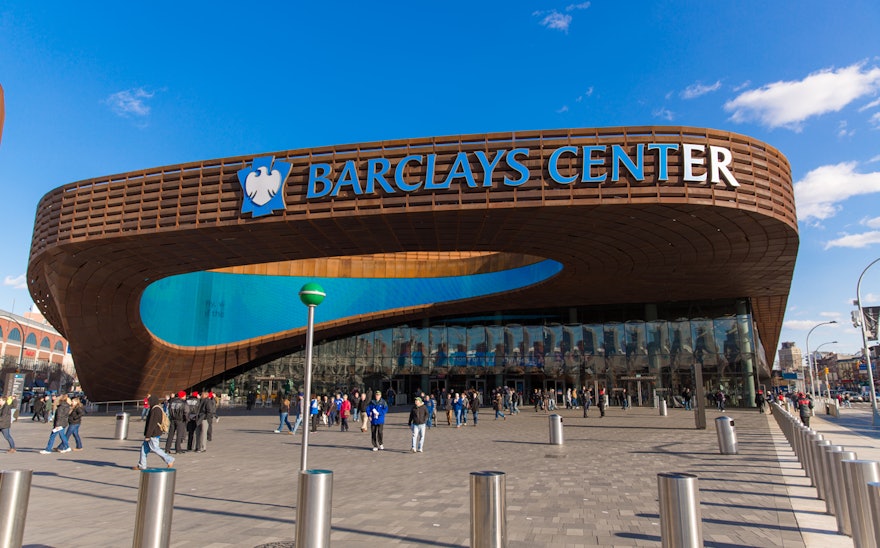
September 28, 2012, 10 years ago: The Barclays Center opens, at the eastern edge of Downtown Brooklyn. It is bounded by Atlantic Avenue on the north, 6th Avenue on the east, Dean Street on the south, and Flatbush Avenue on the west. The official address is 620 Atlantic Avenue.

It is across from the Atlantic Terminal of the Long Island Rail Road, and the Atlantic Terminal Mall. It is thus accessible via the LIRR. For this reason, it was the site chosen by Walter O'Malley in 1954 for the new home of the Brooklyn Dodgers, a domed stadium he was calling the Brooklyn Sports Center. It never happened, because Robert Moses, who controlled several City and State agencies, and had to decide whether or not to give the order to clear the land necessary for the stadium, decided not to. This became O'Malley's excuse to take the Dodgers out of Brooklyn.

It is also accessible by Subway: The Atlantic Avenue-Barclays Center station on the 2, 3, 4, 5, B, D, N, Q, R, and W Trains; and the Bergen Street station on the 2, 3 and 4 Trains.

It was part of the Atlantic Yards project, built by real estate developer Bruce Ratner, who had bought the NBA's New Jersey Nets in 2004, at the height of their success: A 3rd straight Atlantic Division title, and the 2 previous Eastern Conference titles. He said he would build an arena at the site, and move the Nets there.

Delay after delay happened. Not only were the Nets a lame-duck team even longer than baseball's Montreal Expos were, but they ended up moving in the interim, in 2010, from the Meadowlands Arena to the Prudential Center in Newark. I had hoped that the crowds in Newark, a good basketball city, would impress Rather so much that he would keep the Nets there.

Instead, the crowds were every bit as sparse at The Rock as they were at the Meadowlands. And Ratner lost so much money on the project that he had to sell the Nets, to Russian businessman Mikhail Prokhorov. Contingent on the sale was agreeing to move the team into the Barclays Center as soon as it was ready.
The 1st event at the Barclays Center was a concert by Brooklyn native Shawn Carter, a.k.a. rapper Jay-Z. Within its 1st year, the new building had surpassed its intracity rival Madison Square Garden to become America's highest-grossing venue for the category of concerts and family shows.

The Nets' 1st regular-season game there, originally intended as November 1, 2012 against the New York Knicks, was delayed due to Hurricane Sandy. Instead, it was November 3, against the Toronto Raptors, and the Nets won, 107-100.
The Nets have played there ever since. Long Island University, based a few blocks away (Brooklyn and Queens are part of Long Island geologically, if not politically or culturally), have used it for some home games since then as well. The NHL's New York Islanders used it from 2015 to 2020. And the WNBA's New York Liberty started using it as their home court in 2021. Seating capacity is 17,732 for basketball, and 15,795 for hockey.