Showing posts with label atlanta hawks. Show all posts

Wednesday, May 6, 2026

Ted Turner, 1938-2026

Ted Turner once said, "There's a fine line between being colorful and being an asshole, and I hope I'm still just colorful."

Robert Edward Turner III was born on November 19, 1938 in Cincinnati, and grew up in Savannah, Georgia. Expelled from Ivy League school Brown University for being caught with a woman in his dorm, he enlisted in the U.S. Coast Guard, so he wouldn't be drafted to fight in Vietnam during the early phase of that war. He later admitted, "I like boats," and was "deployed to some pretty sweet places -- Charleston and Fort Lauderdale."

How much did he like boats? In 1964, he competed in the U.S. Olympic Trials for yacht racing. In 1974, he entered the defender's trials for the America's Cup. On September 18, 1977,  commanding
Courageous, Ted Turner won the America's Cup, defeating Australia in a 4-race sweep.

His father committed suicide in 1963, and 24-year-old Ted took over his father's business, producing advertising billboards. Like another young man who would become a baseball mogul, George Steinbrenner, he took his father's business and grew it far beyond anything his father had imagined, making it "the largest outdoor advertising company in the Southeast."

He began buying radio stations, and, in 1969, traded them for a struggling Atlanta TV statin, WJRJ-Channel 17. He changed the call sign to WTCG, for Turner Communications Group, although he advertised it as "Watch This Channel Grow."

Initially, the station ran old movies from prior decades, along with theatrical cartoons and bygone sitcoms and drama programs. As a better syndicated product fell off the VHF stations, Turner would acquire it for his station at a very low price. WTCG ran mostly second- and even third-hand programming of the time, including fare such as I Love LucyGilligan's Island and Star Trek.

In 1972, he bought the rights to broadcast the games of baseball's Atlanta Braves and the NBA's Atlanta Hawks. In 1976, he bought those teams outright, thinking that his broadcast revenue would allow him to buy better players, and the teams would help the station grow further

On May 2, 1976, Turner announced that, instead of their surnames, the Braves players would have their nicknames above their uniform numbers on their backs. Darrell Evans had "HOWDY." Darrel Chaney had "NORT." Jimmy Wynn's nickname, "The Toy Cannon" (because he was short but powerful), was too long to fit, so his was just "CANNON." And pitcher Andy Messersmith had "CHANNEL."

Bowie Kuhn, the Commissioner of Baseball, saw through this blatant attempt by Turner to advertise for his station, and prohibited it thereafter. Turner and Kuhn were now at odds, and would remain so. (Not that he was the only owner with whom Kuhn was at odds.) On January 3, 1977, Kuhn suspended Turner for a year, for his actions in signing free agent outfielder Gary Matthews. Turner appealed the suspension, and it was overturned.

On May 11, 1977, with the team mired in a 16-game losing streak, Turner sent manager Dave Bristol on a 10-day "scouting trip," and installed himself took over as interim manager. This made him the 1st owner/manager in the major leagues since Connie Mack stepped down as manager of the Philadelphia Athletics in 1950.
That night, the Braves lost 2-1 to the Pirates. Phil Niekro went the distance, and pitched well, but fell to 0-7 on the season. He would end it 16-20. John Candelaria held the Braves to 1 run on 8 hits, 3 of them by rookie outfielder Barry Bonnell, who ended up batting .300 for the season. Dave Parker hit a home run for the Pirates, and that made the difference. Willie Stargell went 1-for- 2 with 2 walks.

The next day, National League President Charles "Chub" Feeney ordered Turner to step down as manager, citing MLB's Rule 20(e), which prohibits managers from owning any stock in the team that employs them, unless specifically granted an exemption by the Commissioner. This rule was put in place in 1927, after a situation regarding Rogers Hornsby. Mack, and also John McGraw of the New York Giants, who owned stock in their teams, were "grandfathered in." Turner appealed to Kuhn, but was never going to get anywhere with him.

The next day, with 3rd base coach Vern Benson running the team, the Braves broke their 17-game losing streak, beating the Pirates, 6-1. Bristol returned for the next game, and the team finished 61-101, in 6th and last place in the NL Western Division, 37 games behind the Los Angeles Dodgers.

Turner fired Bristol after the season, and replaced him with New York Yankees coach Bobby Cox. He got nowhere with the Braves, but their next manager, Joe Torre, led them to the NL West title in 1982, and almost did it again in 1983.

That 1982 season was the year that made the Braves a national phenomenon: Not only had Turner changed Channel 17's call letters to WTBS, for "Turner Broadcasting System," but he'd made it a national "SuperStation." Like the Chicago Cubs on WGN, his games were now broadcast nationwide, and they got a national following, not just a regional one. He even billed the Braves as "America's Team," just as football's Dallas Cowboys had done. They lost the NL Championship Series to the St. Louis Cardinals, whose vast radio network had made them something like a national team.

Cox went on to the Toronto Blue Jays, and led them to their 1st Division title in 1985, but they lost the American League Championship Series to the Kansas City Royals.

In 1990, Turner lured away the Royals' general manager, John Schuerholz. He brought Cox back to the Braves, and the next year, they began one of the most successful runs in NL history. Not counting the strike-shortened 1994 season, the Braves won their Division -- the NL West through 1993, the NL East thereafter -- every season from 1991 to 2005. They won their 1st Pennant in Atlanta in 1991, and also won in 1992, 1995, 1996 and 1999. And they won the 1995 World Series, although they lost the others, including in 1996 and 1999 to the Yankees, who were managed by... Joe Torre.

In 1980, Turner founded CNN, Cable News Network, creating the 24-hour news cycle format. It revolutionized news broadcasting, in ways both positive and not-so-positive. Due to its role in covering the Persian Gulf War, Time magazine named Turner its Man of the Year for 1991.
He sold Turner Broadcasting, including CNN, in 1996, a year after the Braves finally won the World Series. He sold the Braves and the Hawks in 2007. He became one of the largest private landowners in America, and one of the country's leading conservationists.

Turner was married and divorced three times: To Judy Nye (1960–1964), Jane Shirley Smith (1965–1988), and actress Jane Fonda (1991–2001). He had five children: Laura Turner Seydel and Robert Edward Turner Jr., a.k.a. Eddy Turner, with Judy; and Beau Turner, Rhett Turner and Jennie Turner Garlington with Jane Smith. Generally, his children have followed in Ted's philanthropic and conservationist goals.
Turner and Fonda
In a 2018 interview on CBS Sunday Morning, Turner revealed his diagnosis of Lewy body dementia, which had led comedian-actor Robin Williams to commit suicide, and would also lead to the death of baseball legend Tom Seaver. It was Turner's last public appearance. He died today, May 6, 2026, at his home in Lamont, on the Florida Panhandle, at the age of 87.
In spite of their divorce, today, Fonda spoke well of Turner on Instagram:
MY IMMEDIATE THOUGHTS ABOUT TED He swept into my life, a gloriously handsome, deeply romantic, swashbuckling pirate and I've never been the same. He needed me. No one had ever let me know they needed me, and this wasn't your average human being that needed me, this was the creator of CNN, and Turner Classic Movies, who had won the America's Cup as the world's greatest sailor. He had a big life, a brilliant mind and a soaring sense of humor.
He could also take care of me. That was new as well. To be needed and cared for simultaneously is transformative. Ted Turner helped me believe in myself. He gave me confidence. I think I did the same for him, but that's what women are raised to do. Men like Ted aren’t supposed to express need and vulnerability. That was Ted's greatest strength, I believe.
He also taught me more than any other person or school classes, mostly about nature and wildlife, hunting and fishing (hunters and fishermen who follow the law are the best environmentalists), but also about business and strategy. Ted was supremely strategic. It was likely innate, but he studied the Classics in college, knew about the Peleponesian War inside and out and the strategies used by Alexander the Great and even Genghis Khan. And sailing big boats as he did further honed those strategic talents which he then brought into his businesses to much success. He could see around corners for sure.
Next to Katharine Hepburn, Ted was the most competitive person I have ever met and that was fascinating to witness. Whether it was who'd made the most ski runs at the end of the day, to acres of land owned (stewarded is the more fitting word for his relationship to land), who had the most billions, how many countries he'd made love to his prior lover in and could I match that, it was challenging. Ted was challenging, but I've always been up for a challenge, and with Ted it was almost always worth it.
As our friend, Ron Olson, said, "Ted was a great teacher, often by example. He challenged us to think big (he once asked me to draft a resolution for the UN and the US Congress to ban all nuclear weapons; I did) and act small (for the twenty years since meeting Ted, I too, pick up trash on my walks)."
I loved Ted with all my heart. I see him in heaven now with all the wildlife he helped bring back from extinction – the black footed ferrets, the prairie dogs, Big Horned sheep, Mexican Gray Wolf, the Yellowstone wolf pack, bison, the red cockaded woodpecker and so many more, they’re all gathered at the pearly gates applauding and thanking him for saving their species.
Five children survive him, five talented, complex kids who I had the privilege of becoming stepmother to. I had four stepmothers growing up and I know how important stepmothers can be, so we all did our best to build an extended, rag tag family, and I love them to this day. If it was complicated to be married to him, think how complicated it was being his child. And they are all doing fine.
Rest in Peace, dearest Ted. You are loved and you will be remembered.
Whatever caused them to split up, clearly, Jane Fonda thought Ted Turner was still, to use his word, "colorful" -- and, to use a too-often-used phrase, a great man.
If he had still been able to run CNN in 2015, I have no doubt that there would have been a proper journalistic investigation of Donald Trump. And that fat fascist son of a bitch would have been arrested by the FBI when he got to the bottom of the damn escalator. And, today, the world would be much better off.

Sunday, April 12, 2026

April 12, 1966: Atlanta: "The City Too Busy to Hate"

Atlanta, 1966

April 12, 1966, 60 years ago: The Braves play their 1st game in Atlanta. Joe Torre hits the 1st major league home run in Atlanta Stadium, but the Pittsburgh Pirates spoil the festivities in 13 innings, 3-1, on a home run by Willie Stargell. (The stadium was renamed Atlanta-Fulton County Stadium in 1975.)

The Braves announced their move to Atlanta in 1965. That year was the high-water mark of the Civil Rights Movement. The Voting Rights Act was signed into law. The Selma-to-Montgomery March had just happened. The Civil Rights Act had been signed into law the year before. The lunch-counter sit-ins, the Freedom Rides, the March On Washington for Jobs and Freedom, and the integrations of the universities of Georgia, Mississippi and Alabama had all taken place, with mixed success in some cases and total success in others. All this had happened within the last 5 years. And Dr. Martin Luther King Jr. was the current holder of the Nobel Peace Prize.

Dr. King was from Atlanta. The Mayor at the time was Ivan Allen Jr. He ran his father's office-supply company, and took it to new heights, making himself one of the South's richest men. He lived long enough to get an offer he couldn't refuse: Staples bought him out in 1999.

In 1961, Allen ran for Mayor against segregationist Lester Maddox, who would later be elected Governor of Georgia. Allen won, and began to build on the work of his predecessor, William Hartsfield, for whom the city's famous airport is named.

As a businessman, Allen understood that he had the chance to change the image of his city. More than that, he had the chance to help change perceptions of the State of Georgia and of the South itself. The city underwent its greatest construction phase since after its burning in the Civil War 100 years earlier. He built the Memorial (now the Woodruff) Arts Center, in effect Atlanta's version of New York's Lincoln Center. He created MARTA, the Metropolitan Atlanta Rapid Transit Authority, which reworked the city's bus system, and, after he left office, built its subway. He also got Interstate 285, a beltway, a.k.a. "The Perimeter" and "The O Around the A," built.

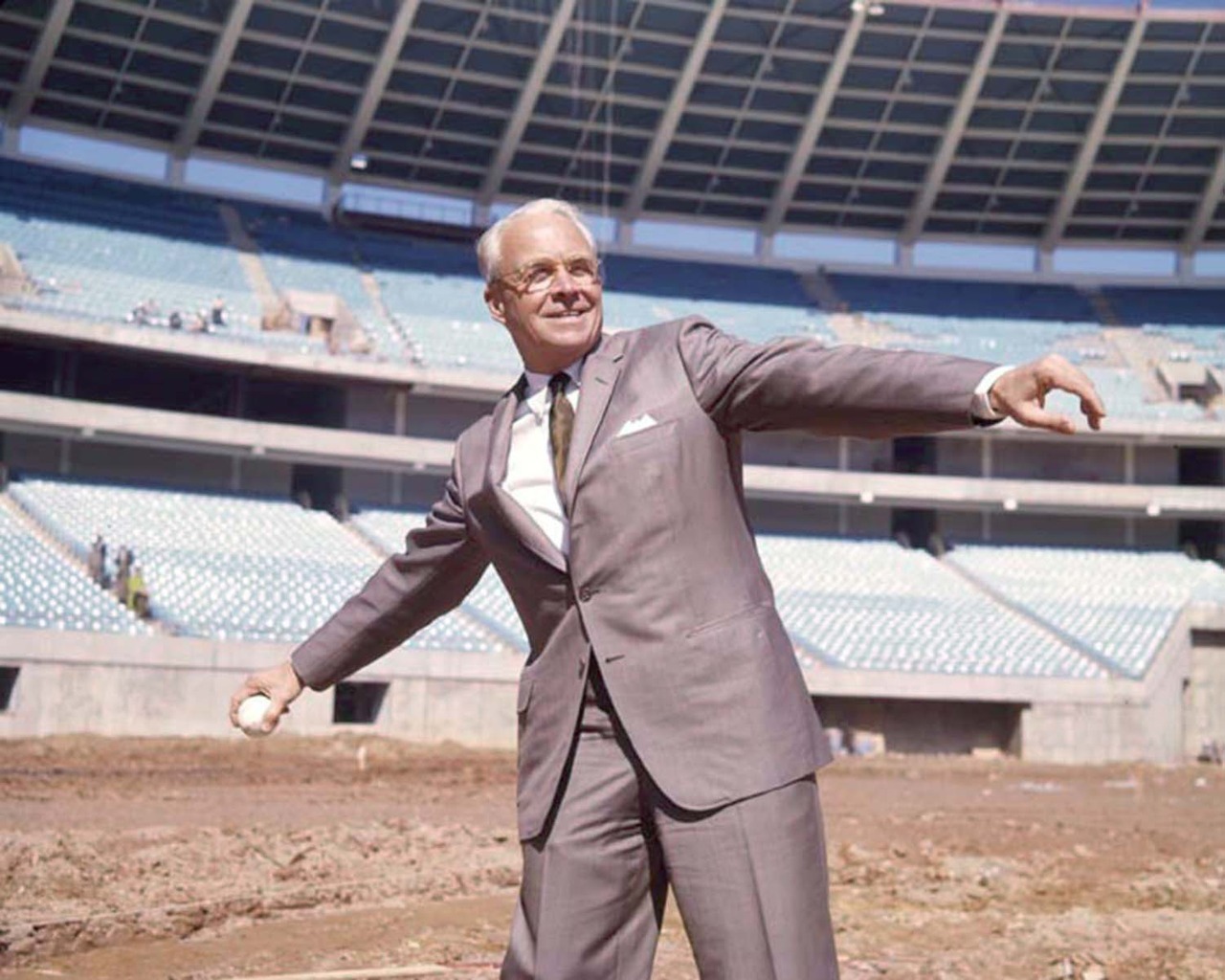
He got Atlanta Stadium (later Atlanta-Fulton County Stadium) built and, although it wouldn't open until after he left office, he got the Omni Coliseum approved. This enabled the city to go from no major league teams when he took office on January 1, 1962 to 3 of them when he left on January 1, 1970.
Allen posing inside the stadium his Administration was building, 1964.
It opened in 1965, and hosted the Beatles
before it hosted the Braves or the Falcons.

More low-income housing was built in his 8 years in office than in the previous 30. He needed to do this to alleviate the concerns of local black leaders, including Dr. Martin Luther King Sr., that he wasn't doing enough for the poor and was focusing too much on business, especially downtown -- a criticism since leveled at many urban mayors, black and white alike (including Newark's Sharpe James in the 1980s and '90s).

"It is wonderful to be idealistic and to speak about human values," Allen said, "but you are not going to be able to do one thing about them if you are not economically strong. If there is any one slogan I lived by as Mayor of Atlanta, that would be it."

So, with the concerns of both business and civil rights in mind, he brought the 2 concepts together. The day he was sworn in, he ordered all "WHITE" and "COLORED" signs removed from City Hall, and personally desegregated the City Hall cafeteria by dining with local black activists. He desegregated municipal hiring. He hired the city's first black firemen. He let it be known that black Atlanta policemen would be allowed to arrest white criminals. He desegregated the city's pools. By January 1964, 6 months before President Lyndon Johnson signed the Civil Rights Act into law, 14 Atlanta hotels had already desegregated themselves.

Allen billed Atlanta as "The City Too Busy to Hate." That made the sports establishments stand up and take notice. Atlanta also offered a bigger stadium, if not necessarily a better one, than Milwaukee County Stadium: 52,000 to 44,000. (Milwaukee County Stadium would later expand to 53,000.) Today, the Braves' team museum is named for Allen.

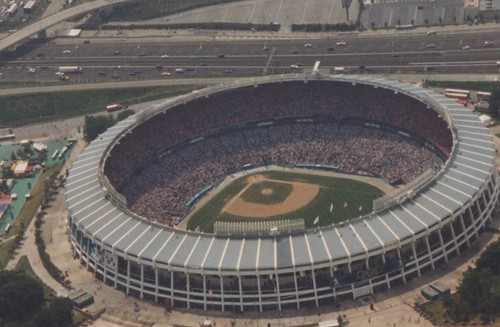
Atlanta-Fulton County Stadium was a multipurpose facility, designed to host both baseball and football, and it didn't do a good job with either one, so much so that, by 1997, both the Braves and the Falcons had gotten new stadiums and their 1st home was demolished. That process was repeated in 2017, as both teams abandoned their still relatively new stadiums for brand-new ones, the Falcons with a retractable-roof stadium next-door, the Braves for a "ballpark village" in the city's northwest suburbs.
Just another oversized concrete ashtray.
At least it had real grass, not artificial turf.

But Atlanta has seen little success. From 1966 to 1990, the Braves won just 2 Division titles and no Pennants. Then, they won their Division in every completed season from 1991 to 2005, and won 5 Pennants, but just 1 World Series. They eventually won another in 2021. The Falcons have been to just 2 Super Bowls, and lost both ignominiously.

The NBA's Hawks should be so lucky: They reached the Conference Finals their 1st 2 seasons after moving from St. Louis, 1968-69 and 1969-70; then didn't make the Conference Finals again until 2015, and again in 2021. They haven't made the NBA Finals since 1961, or won them since 1958, both times in St. Louis.

And the city has failed with 2 NHL teams: The Flames arrived in 1972 and moved to Calgary in 1980, and the Thrashers arrived in 1999 and moved to Winnipeg in 2011. A Sun Belt city that lost 2 teams to Canada: This is NHL Commissioner Gary Bettman's nightmare.

The city has had decent success with soccer. The Atlanta Chiefs won the North American Soccer League title in 1968, and reached the Final again in 1969. Atlanta United debuted in 2017, won the MLS Cup the next season, and won the U.S. Open Cup the year after that.

The Braves have a team Hall of Fame. Their inductees from their Atlanta years are: Players Hank Aaron, Rico Carty, Phil Niekro, Ralph Garr, Dale Murphy, Tom Glavine, John Smoltz, David Justice, Terry Pendleton, Javy López, Greg Maddux, Larry "Chipper" Jones, Andruw Jones (no relation) and Tim Hudson; plus managers Joe Torre and Bobby Cox, and coach Leo Mazzone; team owners Bill Bartholomay and Ted Turner; executives Bill Lucas, Paul Snyder and John Schuerholz; trainer Dave Pursley; and broadcasters Ernie Johnson Sr., Pete Van Wieren, Skip Caray, Don Sutton and Joe Simpson.

The Falcons have a Ring of Honor. Their inductees are: Tommy Nobis, Claude Humphrey, Jeff Van Note, Steve Bartkowski, Mike Kenn, William Andrews, Gerald Riggs, Jessie Tuggle, Deion Sanders, Todd McClure, Warrick Dunn, Roddy White, Matt Ryan, and team owner Arthur Blank.

The Hawks don't have a team Hall of Fame, but they do retire numbers: 9, for Bob Pettit from their St. Louis years; 21, Dominique Wilkins; 23, Lou Hudson; 44, Pete Maravich; and 55, Dikembe Mutombo. They have also witheld 40 from circulation since Jason Collier died as an active player. They also have banners honoring former owner Ted Turner and former Mayor Kasim Reed, who was involved in keeping the team from moving.

There is also a Georgia Sports Hall of Fame, in Macon. It honors State natives who excelled in sports, stars from colleges such as the University of Georgia and Georgia Tech, and these major league stars:

* Braves: Aaron, Nierko, Murphy, Smoltz, Glavine, both Joneses, Tim Hudson, Cox, Mazzone, Bartholomay, Turner, Lucas, Schuerholz, Johnson, Van Wieren, Caray, Bob Horner, Brian Jordan, Jeff Treadway (more for being a Georgia native than for being a Brave), Marquis Grissom, and executive Stan Kasten.

* Falcons: Nobis, Humphrey, Van Note, Bartkowski, Tuggle, Blank, Alfred Jenkins, Billy "White Shoes" Johnson, founding owner Rankin Smith, coach Mario Campbell, and coach Dan Reeves, elected more for being a Georgia native and a UGa player than for coaching the Falcons into their 1st Super Bowl.

* Hawks: Wilkins, Lou Hudson, Wayne "Tree" Rollins, and Shareef Abdur-Rahim.

* Through 2025, no Flames, Thrashers, Chiefs or Atlanta United have been honored.

Sunday, November 9, 2025

Lenny Wilkens, 1937-2025

We have lost an NBA legend, one with ties to many places, and beloved among basketball fans everywhere.

Leonard Randolph Wilkens was born on October 28, 1937 in Brooklyn. One of New York City’s greatest basketball players, Lenny Wilkens starred for Brooklyn's Boys High School, where he was a basketball teammate of future baseball star Tommy Davis.

Boys High opened in a Romanesque Revival building at 832 Marcy Avenue in Bedford-Stuyvesant in 1891. Bed-Stuy was a mostly-Jewish neighborhood before World War II, and has been a mostly-black one since. In addition to Lenny and Tommy, Boys High's notable athletes included basketball players Sihugo "Si" Green, Connie Hawkins, and football quarterback and coach Allie Sherman.

Outside of sports, alumni included Congressman Emanuel Celler, Class of 1906; painter Man Ray 1908, film producer Irving Thalberg 1917, composer Aaron Copland 1918, real estate developer William Levitt 19'25, psychologist Abraham Maslow 1926, actor Norman Lloyd '32, broadcaster Howard Cosell '36, actor Lawrence Tierney '37, science fiction writer Isaac Asimov '38, jazz saxophonist Cecil Payne '40, novelist Norman Mailer '41, jazz drummer Max Roach '42, comedian Alan King '45, newspaper columnist Jack Newfield '56, singer "Little" Anthony Gourdine '59, and singer Ronnie Dyson '68.

As the name suggests, Boys High was segregated by gender, though not by race or religion. Brooklyn did have a Girls High School, also in Bed-Stuy, at 475 Nostrand Avenue. Both schools were public, but rather prestigious, and hard to get into. Girls High graduates included novelist Betty Smith 1914, singer Lena Horne '35, actress Rita Hayworth '36, actress Carol Bruce '37, Congresswoman Shirley Chisholm '42, actress Norma Donaldson '46, and actress Roxie Roker '47.

In 1975, the schools were merged into Boys and Girls High School, and moved to a new facility at 1700 Fulton Street. Graduates of the new version include basketball player Dwayne "the Pearl" Washington '82 and rapper John "Fabolous" Jackson '95.

"I learned my basketball on the playgrounds of Brooklyn," Lenny Wilkens once said. "Today, being a 'playground player' is an insult. It means all you want to do is go one-on-one. It means your fundamentals stink and you don't understand the game. But the playgrounds I knew were tremendous training grounds."

Like Queens' Bob Cousy and Jersey City's Tommy Heinsohn before him, both of whom went to the College of the Holy Cross in Worcester, Massachusetts, Lenny Wilkens left New York City to play college basketball in New England, in his case, to play for Providence College. In 1960, he was named a Second Term All-American. From 1960 to 1968, he played for the St. Louis Hawks, making 5 NBA All-Star Games. In his rookie season, 1960-61, he helped them reach the NBA Finals, something the franchise has not done since.
He would not make the move to Atlanta with the Hawks in 1968. Instead, he was traded to the Seattle SuperSonics, becoming their player-coach in 1969. He was the NBA's assists leader in 1970, and the Most Valuable Player of the All-Star Game in 1971. In 1972, he was traded to the Cleveland Cavaliers, and played his last season, 1974-75, with the Portland Trail Blazers, as player-coach that season and as head coach only the next season. All told, he was named to 9 All-Star Games, and he retired with more career assists than any player except Oscar Robertson.


The Sonics brought him back in 1977. In 1978, he led them to their 1st NBA Finals, losing to the Washington Bullets in 7 games. In 1979, he reversed that result, as the Sonics beat the Bullets in 5 games. It was the only World Championship won by a Seattle team between the Metropolitans' 1917 Stanley Cup and the Seahawks' win of Super Bowl XLVIII in 2014.

He remained with the Sonics until 1985. From 1986 to 1993, he coached the Cleveland Cavaliers. In 1993, he returned to the Hawks. On January 6, 1995, he won his 939th career regular-season game, to surpass Red Auerbach as the all-time winningest coach in NBA history. It came in a 112-90 win over the Bullets at The Omni in Atlanta. On March 1, 1996, also at The Omni, he led the Hawks past one of his former teams, the Cavs, 74-68, to become the 1st NBA head coach to win 1,000 games. (He also became the 1st to lose 1,000 games.) Later that year, with the Olympics in Atlanta, he coached the U.S. team to win the Gold Medal.

In 2000, he left the Hawks, and became head coach of the Toronto Raptors, lasting 3 years. In the 2004-05 season, he became one in a long line of coaches unable to turn James Dolan's New York Knicks into a championship team. It turned out to be his last coaching job, with a final record of 1,332-1155, a .536 winning percentage. He has since been surpassed in wins only by Gregg Popovich with 1,390 and Don Nelson with 1,335.

He returned to the Sonics in a management role. One of the oddities of his career is that the Hawks traded him immediately before moving to Atlanta in 1968, and he resigned his executive's position with the Sonics as they moved to become the Oklahoma City Thunder in 2008.

Providence retired his Number 14, and the Sonics retired his Number 19, and in each case he was the 1st on the team to be so honored. Along with John Wooden and Bill Sharman, he is one of just 3 people elected to the Basketball Hall of Fame as player and elected again a coach. But he tops them both, and everyone else, by having been elected a 3rd time, as an assistant coach on the 1992 U.S. Olympic "Dream Team," which in 2010 was elected to the Hall in its entirety.

He was also named, in 1996, as part of the NBA's 50th Anniversary celebrations, as one of its 50 Greatest Players and one of its 10 Greatest Coaches, the only man to receive both honors. In 2021, he was named to the NBA's 75th Anniversary 75 Greatest Players.

In 1962, he married Marilyn Reed. They had 3 children: Leesha, Randy and Jamie, leading to 7 grandchildren.

On June 28, 2025, a statue of Lenny Wilkens was dedicated outside the Climate Pledge Arena, built on the site of the Seattle Center Coliseum where he played and coached for the SuperSonics, a team that's officially been dormant since the original version was moved to become the Oklahoma city Thunder in 2008. He attended the ceremony.
It turned out to be his last public appearance. He died today, November 9, 2025, at his home in the Seattle suburb of Medina, Washington. He was 88 years old.

NBA Commissioner David Stern said:

Lenny Wilkens represented the very best of the NBA – as a Hall of Fame player, Hall of Fame coach, and one of the game’s most respected ambassadors. So much so that, four years ago, Lenny received the unique distinction of being named one of the league’s 75 greatest players and 15 greatest coaches of all time.

But even more impressive than Lenny’s basketball accomplishments, which included two Olympic gold medals and an NBA championship, was his commitment to service – especially in his beloved community of Seattle where a statue stands in his honor. He influenced the lives of countless young people as well as generations of players and coaches who considered Lenny not only a great teammate or coach but also an extraordinary mentor who led with integrity and true class.

Mayor Bruce Harrell of Seattle said:

Lenny was more than just a championship coach and basketball legend – he was a community hero who made it his life’s mission to uplift and empower others. His philanthropic work with the Lenny Wilkens Foundation has benefitted thousands of youth and families in our region, a testament to his compassion and generosity.

Lenny was generous with both his time and with his kindness. From the moment I met him, Lenny quickly became a personal friend and a mentor. I’ve always felt incredibly honored to have been able to spend time with him and to learn from him, and I know there are so many others who feel the same way.

Kenny Mayne of ESPN: "My favorite player growing up, then somehow a friend later in life. His foundation looked after kids who needed a little help. Classy and kind and kept his Brooklyn accent."

Golden State Warriors coach and Chicago Bulls playing legend Steve Kerr, who played for him in Cleveland: "He was an unbelievable man. Just an incredible man."

UPDATE: On November 10, Michael Wilbon of ESPN's Pardon the Interruption pointed out that, despite having coached in the NBA over a span of 36 years, Lenny Wilkens achieved all he achieved despite only coaching 1 future Hall-of-Famer in his prime: Himself. It's not quite true: He coached Bill Walton in Portland, Dennis Johnson and Paul Westphal in Seattle, and Vince Carter in Toronto..

Wednesday, November 24, 2021

How to Be a New York Basketball Fan In Atlanta -- 2021-22 Edition

The New York Knicks visit the Atlanta Hawks this coming Saturday, November 27; and again on January 15, 2022. The Brooklyn Nets do so on December 10 and April 2.

Knicks vs. Hawks isn't much of a rivalry. Nor is Nets vs. Hawks. But, since the Hawks have long struggled at the box office, due to their ineptitude and Atlanta's status as a city with a lot of transplants, this will be a good chance for fans of either New York City team to get another arena under their belts. However, the Hawks' unexpected strong season in 2020-21 makes getting another road win under your belt a little tougher.

Before You Go. Being well south of New York, Atlanta is usually warmer than we are. Granted, this won't make much of a difference during Thanksgiving week, and with an indoor sport, but you should still be aware. Check the website of the Atlanta Journal-Constitution (used to be 2 papers, now 1) before you go. For the moment, they're predicting low 60s for the afternoon, and high 30s for the evening. Bring a jacket, just in case.

Although Georgia, a.k.a. The Heart of the South, seceded from the Union in 1861, it was readmitted in 1870. You do not need a passport, and you don't need to change your U.S. dollars into Confederate money. And it's in the Eastern Time Zone, so you don't have to fiddle with your watch or your phone clock. Do keep in mind, though: They think you talk as funny as you think they do.

Tickets. The Hawks averaged 15,931 fans per home game in 2019-20, about 94 percent of capacity, before COVID shut everything down. Given last season's Playoff run, you can probably throw those figures out the window, and expect a tougher time getting tickets.

In the lower level, the 100 sections, tickets are $265 between the baskets, $155 behind them. In the 200 level, $89 between and $49 behind.

Getting There. Remember: This is Thanksgiving weekend. With increased demand for transit, the regular rules and prices may not apply.

It's 868 miles from Times Square in New York to Five Points, Atlanta's center of attention. Google Maps says the fastest way from New York to Atlanta by road is to take the Holland Tunnel to Interstate 78 to Harrisburg, then I-81 through the Appalachian Mountains, and then it gets complicated from there.

No, the best way to go, if you must drive, is to take the New Jersey Turnpike/I-95 all the way from New Jersey to Petersburg, Virginia. Exit 51 will put you on I-85 South, and that will take you right into Atlanta.

You'll be in New Jersey for about an hour and a half, Delaware for 20 minutes, Maryland for 2 hours, inside the Capital Beltway (Maryland, District of Columbia and Virginia) for half an hour if you're lucky (and don't make a rest stop anywhere near D.C.), Virginia for 3 hours, North Carolina for 4 hours, South Carolina for about an hour and 45 minutes, and Georgia outside I-285 (the beltway known as the Perimeter, the Atlanta Bypass or "the O around the A") for an hour and a half.

Throw in traffic in and around New York at one end, Washington in the middle, and Atlanta at the other end, and we're talking 16 hours. Throw in rest stops, preferably in Delaware, near Richmond, near Raleigh, and in South Carolina, and it'll be closer to 19 hours. Still wanna drive? Didn't think so.

Take the bus? Greyhound has 7 buses a day leaving from Port Authority to Atlanta, but only 2 of them are no-changeover routes. It costs as much as $400 round-trip, though it can be as low as $250 on advanced purchase. And, at 24 hours each way (usually including an hour-and-a-half stopover in Richmond, Virginia), it saves you no time. At least the station is downtown, at 232 Forsyth Street at Brotherton Street, by the Garnett station on the subway.

Take the train? Amtrak's New York-to-New Orleans train, the Crescent, leaves Penn Station at 2:15 PM and arrives in Atlanta at 8:43 the next morning. That's about 18 1/2 hours. It returns at 11:29 PM (meaning you could get in and out of Atlanta in 1 night) and arrives back in New York at 6:00 PM the next day. The round-trip fare is $895, due to the fact that coach seats are sold out and only roomettes are available. The station is at 1688 Peachtree Street NW at Deering Road, due north of downtown. From there, take the 110 bus into downtown.

Perhaps the best way to get from New York to Atlanta is by plane? If you book now, United Airlines can get you from Newark Liberty International Airport to Hartsfield-Jackson International Airport (named for 2 late Mayors of Atlanta), nonstop, for $457 round-trip. True, that's more expensive than the train, but 2½ hours each way beats the hell out of 18. The Metropolitan Atlanta Rapid Transit Authority (MARTA) Gold Line or Red Line subway from Hartsfield-Jackson to Five Points takes just half an hour.

(The airport is named for 2 Mayors. William B. Hartsfield served from 1942 to 1962, and got the airport built. Maynard H. Jackson Jr. was the city's 1st black Mayor, serving from 1974 to 1982, and again from 1990 to 1994, and he got a new terminal built at the airport.)

Once In the City. When you get to your hotel in Atlanta (and, let's face it, if you went all that way, you're not going down for a single 2-hour game and then going right back up the Eastern Seaboard), pick up a copy of the Journal-Constitution. It's a good paper with a very good sports section. The New York Times may also be available, but, chances are, the Daily News and the Post won't be.

Founded in 1837, and originally named "Terminus" because it was established as a railroad center, but later renamed because the railroad in question was the Atlantic-Pacific Railroad, Atlanta is a city of about 500,000 people (slightly more than Staten Island), in a metropolitan area of about 6.4 million (still less than 1/3rd the size of the New York Tri-State Area). The sales tax in Georgia is just 4 percent, but it's 5 percent in the City of Atlanta.
The State House

Be advised that a lot of streets are named Peachtree, which can confuse the hell out of you. Even worse, the city uses diagonal directions on its streets and street signs, much like Washington, D.C.: NW, NE, SE and SW. The street grid takes some odd angles, which will confuse you further. Five Points -- Peachtree Street, Marietta Street & Edgewood Avenue -- is the centerpoint of the city.

Coke ad atop the Olympia Building in the Five Points

A building boom in the 1980s gave the city some pretty big skyscrapers, so, while it won't seem quite as imposing as New York or Chicago, it will seem bigger than such National League cities as Cincinnati and St. Louis. The building currently named Bank of America Plaza, a.k.a. the Pencil Building because of its shape, is the tallest in the State of Georgia, at 1,033 feet. It stands at 600 Peachtree Street NE at North Avenue.

ZIP Codes in Georgia start with the digits 30 and 31, with Atlanta and its suburbs using 300 to 307. The Area Code for Atlanta is 404, with 770 surrounding it, and 678 overlaid. Atlanta's electricity is supplied by Georgia Power Company.

Atlanta became majority-black in the 1960, and is now the 4th-largest majority-black city: About 51 percent black, 41 percent white, 4 percent Hispanic and 3 percent Asian. The northern half of the city is mostly white, the southern half mostly black. As a major center for both black filmmaking and hip-hop, Atlanta is, essentially, the Black Hollywood.

Both the Hispanic and the Asian populations of the city have more than doubled since 2000. And, with 12.8 percent of the population willing to classify themselves as gay or bisexual, Atlanta has the 3rd-highest gay percentage of any major city in America, behind San Francisco and Seattle.

Which is not to say that Atlanta, and Georgia in general, have been free from strife. It's still the South. The Camilla Massacre in Camilla, southwest Georgia, on September 19, 1868 resulted in the deaths of 15 people, black and white alike, attempting to assist black people in voting during the post-Civil War period known as Reconstruction. Atlanta was struck by a race riot on September 22, 1906, killing 25 black people and 2 white people. A race riot struck Augusta, the eastern Georgia city that is home to the Masters golf tournament, on May 11, 1970, resulting in 6 deaths.

And, 15 miles east of Atlanta, Stone Mountain Park opened on April 14, 1865 -- 100 years to the day after Abraham Lincoln was shot, and that is no coincidence. In 1972, a sculpture was unveiled on its north face, showing Confederate President Jefferson Davis and Generals Robert E. Lee and Thomas "Stonewall" Jackson on horseback. The carving of these 3 traitors to the United States of America is larger than that of the 4 Presidents on Mount Rushmore in South Dakota.

One thing that people tend to forget: The movie Deliverance, with its psychopathic hillbillies, is often thought to take place in West Virginia. In fact, it's set in Georgia, and was filmed on the Chattooga River, which separates eastern Georgia from western South Carolina, and on both sides of the river.

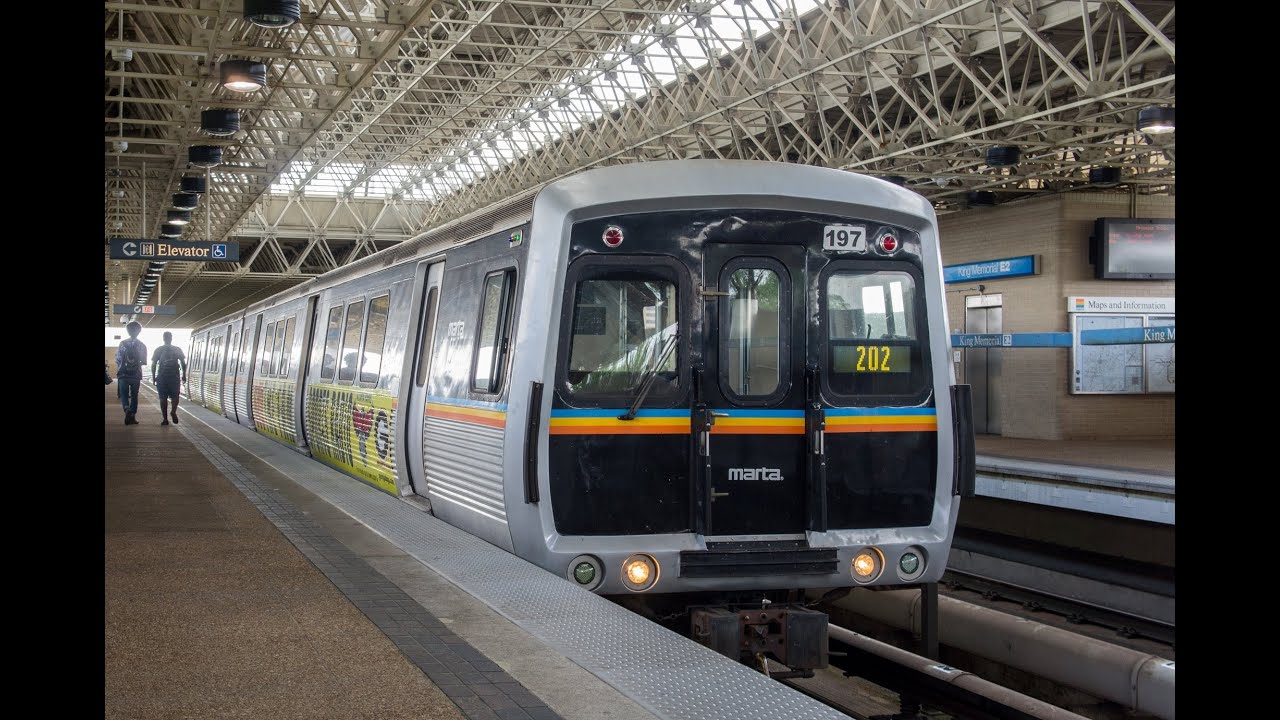
MARTA's 3-stripes logo of blue, yellow and orange is reminiscent of New Jersey Transit's blue, purple and orange. A single trip on any MARTA train is $2.50, now slightly cheaper than New York's. A 10-trip is no bargain at $25. The subway started running with tokens in 1979, and switched to farecards in 2006.
Atlanta has always been the cultural capital of the South, particularly of the "New South." In the 1950s, Mayor Hartsfield, knowing that he couldn't get investors in his city if it was believed to be racist, billed it as "the City Too Busy to Hate." And Atlanta is a majority-black city. Nevertheless, it is still in Georgia, which is still the South. There's still old touches, including the fixation on Gone With the Wind, and the fact that the State Flag, even after several redesigns, still resembles the actual flag of the Confederate States of America, "the Stars and Bars" (not the "Southern Cross," that was the Confederate Battle Flag).
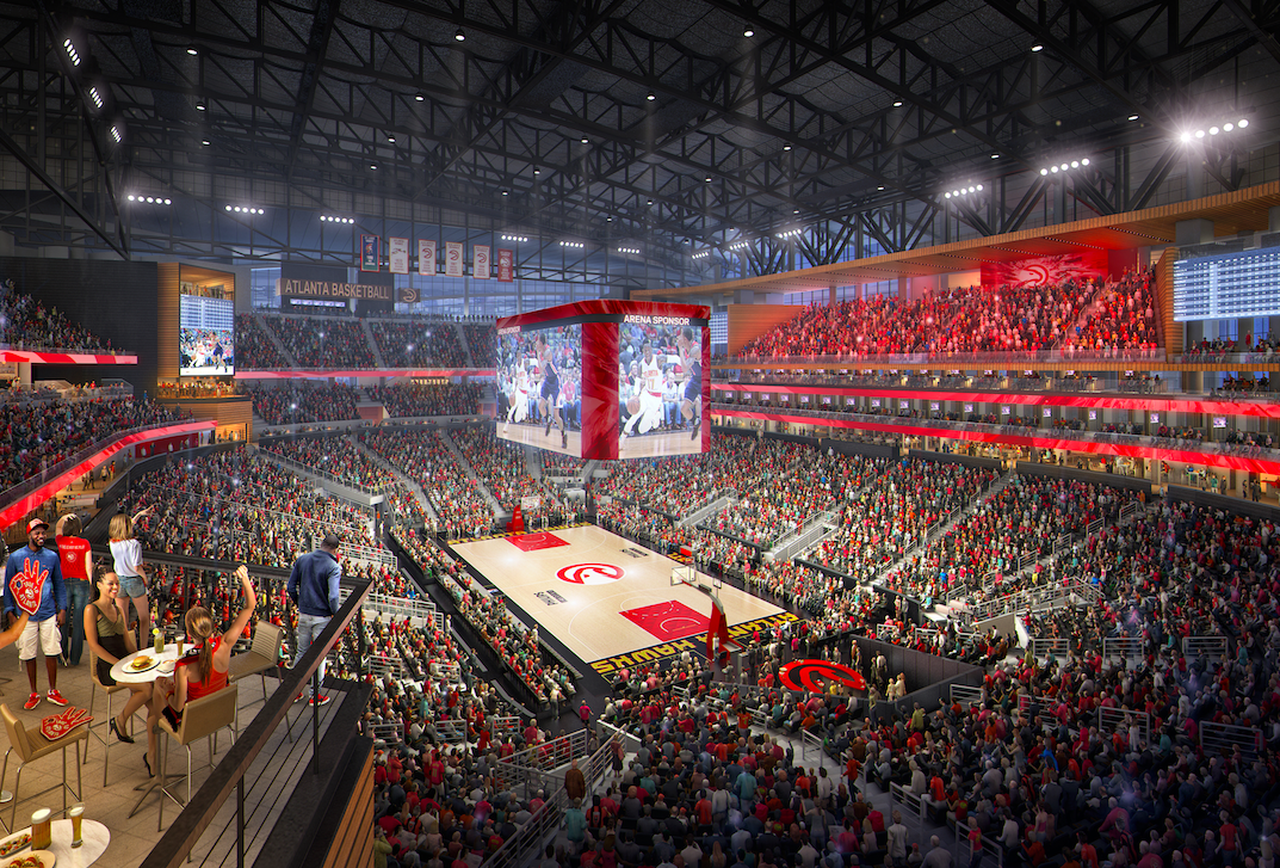
Going In. State Farm Arena, named for the insurance company -- until 2018, named Philips Arena, named for the Dutch electronics company -- and opened in 1999 on the site of the former Hawks arena, The Omni, is part of the Georgia World Congress Center complex, at Marietta Street & Centennial Olympic Park Drive NW, which also includes the Georgia Dome, the site of the new Falcons' stadium and CNN headquarters.
The official address is 1 State Farm Drive, changed from Philips Drive at the same time as the arena. If you're driving, parking costs $13. If you're not, take MARTA's Blue or Green Line to Dome-GWCC-Philips Arena-CNN Station. That's right: The name of the arena has been changed, but the names of the street and the station have not. Hawk Walk is a street that connects the station, the arena and the CNN headquarters.

There are steel columns on the Georgia Dome side of the arena that spell out "ATLANTA," and on the CNN side that spell out "CNN." Other than that, there's not much about it that's remarkable, at least not architecturally.
State Farm Arena was the home of the NHL's Atlanta Thrashers from 1999 to 2011, before they moved to become the new version of the Winnipeg Jets. The WNBA's Atlanta Dream, named for Atlanta native Martin Luther King's 1963 March On Washington speech, also plays there.

Unlike most arenas, the court is laid out on a diagonal, instead of more or less east-to-west or north-to-south: Northeast-to-southwest. The center scoreboard at State Farm Arena is the same one from The Omni, with some modern touches added.
Food. Son, Ah say son, this bein' the South, y'all can expect good eatin' and good hospitality. What the Hawks lack in history and atmosphere, they make up in food. Some arena restaurants are open only to club-seating patrons.

Available to all are RED and Taco Mac. Hawk Walk has stands for Courtside Grill, Fry Baby, Buckhead Diner Express, Backcourt BBQ, Corona Beach Hut Bar, 3 Point Play Pizza, sandwich & salad shop The Works, Nava Taqueria, Peachtree Pretzels, Italian-style sandwich bar Veni Vidi Vici, Delaney's Irish Pub, Crown Royal Bar and Rock and Roll Bar.

In the arena concourses, you can find barbecue stands Buzzer Beaters (Portals 12 and 25) and Full Court Press (3), Slam Dunk Pizza (3, 11, 15 and 26), burger & chicken place Burgers & Birds (2 and 21), chicken stand Fowl Line (27), hot dog stand Hot Diggity Dog (20), Dessert Shoppe (2) and Gluten Free Portable (12).

Team History Displays. The Hawks hang banners for their 1970 Western Division title; their 1980, 1987 and 1994 Central Division titles; and their 2015 and 2021 Southeast Division titles.
The Hawks banners, photo taken during a Thrashers game
prior to their 2011 move and the Hawks' 2015 and 2021 Division titles

The Hawks have officially retired 6 numbers: 9, forward Bob Pettit, 1954-65 (their last season in Milwaukee and their 1st 10 in St. Louis); 21, forward Dominique Wilkins, 1982-94; 23, forward Lou Hudson, 1966-77 (their last 2 seasons in St. Louis and their 1st 9 in Atlanta); 44, guard Pete Maravich, 1970-74; 55, of Dikembe Mutombo, center 1996-2001; and 59, in honor of former Mayor Kasim Reed.

Center Jason Collier played the 2004-05 season with the Hawks, and then died from an enlarged heart at age 28. The Hawks have not retired his Number 40, but they have removed it from circulation. There's also a banner honoring Ted Turner, who owned the team from 1977 to 2001.
Their retired number banners flank their title banners. They do hang a banner for their 1958 NBA Championship, won in St. Louis, complete with the logo the team used at the time.
There are 22 men in the Basketball Hall of Fame who have played for the Hawks, but only 4 played any significant time for them in Atlanta. Wilkins is the only Hall-of-Famer who played more than 5 seasons in Atlanta. Mutombo played 5 seasons for them, Maravich and Walt Bellamy for 4.

Zelmo Beaty played the last 6 seasons in St. Louis, but only the 1st in Atlanta, 1968-69. Richie Guerin played the last 5 seasons in St. Louis, but only the 1st 2 in Atlanta. Lenny Wilkens (note the spelling, so not related to Dominique) played for them in St. Louis and coached them in Atlanta, but there's no mention of him in the banners.

The St. Louis-era players that can be counted as Hawks Hall-of-Famers are Pettit, Wilkens (not Wilkins), Beaty, Guerin, Ed Macauley, Cliff Hagan, Slater Martin, Clyde Lovellette, Bob Houbregs (1 season) and Rod Thorn (2 years as a Hawks player, but elected as an executive). Pettit, Macauley, Hagan and Martin were members of the 1958 NBA Championship team.

That was also the only season as Hawks head coach for Alex Hannum, who is also in the Hall of Fame. He coached the 1967 Philadelphia 76ers and the 1969 Oakland Oaks. He thus became 1 of only 2 men, along with Bill Sharman, to coach both an NBA Champion and an ABA Champion. Martin and Lovellette were on the Minneapolis Lakers titlists earlier in the '50s, and Lovellette would later win a title with the Boston Celtics -- the only man ever to win a title with both the Lakers and the Celtics.

Pettit was named to the NBA's 25th Anniversary Team in 1971, and its 35th Anniversary Team in 1980. He, Wilkens, Maravich and Moses Malone (3 seasons in Atlanta) were named to the NBA's 50th Anniversary 50 Greatest Players in 1996; those 4 and Wilkins were named to the 75th Anniversary 75 Greatest Players in 2021. Swin Cash, who played for the Atlanta Dream in the 2014 season, was named to the WNBA Top 20 at 20 in 2016 -- in the 20th Season, rather than at the 20th Anniversary.

Hall-of-Famer Grant Hill never played for the Hawks, but he is now a part-owner. The majority stake is owned by private equity investor Tony Ressler and his wife, actress Jamie Gertz.

The Hawks do not have a team Hall of Fame. Nor did they select a 50th Anniversary Team in 2018. There is a St. Louis Sports Hall of Fame at the Blues' arena, the ScotTrade Center. It includes 7 St. Louis Hawks: Pettit, Wilkens, Cliff Hagan, Ed Macauley, Chuck Share, Harry Gallatin, and team owner Ben Kerner. There is a Georgia Sports Hall of Fame, but it's in Macon, 85 miles southeast of downtown Atlanta, and only reachable by car. It includes only 3 Hawks: Hudson, Wilkins, and 1980s center Wayne "Tree" Rollins.

Since the Hawks have never done much in Atlanta, they really don't have a rival. Geographically, the teams that would seem to be their rivals are the Charlotte Hornets, the Orlando Magic, the New Orleans Pelicans and the Memphis Grizzlies. They lost in the Playoffs to the Magic in 1996 and 2010, and beat them in 2011. They lost to the Hornets in 1998. But that's it as far as geography and the Playoffs go.

Stuff. Hawksshop stores can be found in the arena and along Hawk Walk, selling pretty much any kind of memorabilia you could find at any other arena.

While there are several good books about Atlanta's favorite team, the Braves, the Hawks have hardly any written about them. In 2016, as part of the NBA's A History of Hoops series, Jim Whiting published The Story of the Atlanta Hawks. That's about as good as it's going to get until the Hawks actually make a serious run at a title. And as for DVDs with the Hawks as the subject, I searched Amazon.com and found exactly none.

It's almost as if the Hawks don't exist. And, at the rate they're going, soon, they won't -- at least, not in the Big Peach.

During the Game. A November 13, 2014 article on DailyRotoHelp ranked the NBA teams' fan bases, and listed the Hawks' as 28th, or 3rd-least-engaged. According to the article, "Everyone loves to talk about them, but once they start doing bad, the fans stop showing up. Even when they make the Playoffs, they still don't sell out games."

NFL Falcons and Georgia Tech college football games might be good places to keep your guard up. But Hawks fans are not going to pick fights with you. As I said, they barely care enough to show up. You do not have to worry about wearing Knicks, Nets, or any other team's, gear in State Farm Arena. Hawks fans will generally not act like New York, Philadelphia or Boston fans and get snippy (or worse, rough) because of it.

None of their games this season against either the Knicks or the Nets will feature a promotion. The Hawks hold auditions for National Anthem singers, rather than have a regular performer. I do not know if Hawks fans follow their Braves-leaning lead by concluding the National Anthem not with " …and the home of the brave" but " …and the home of the Braves!" I hope they don't. It's not as dumb as the Baltimore "O! say does that… " but it's bad enough.

Foster Carson, a.k.a. "Sir Foster," is perhaps the most renowned organist in the NBA. Atlanta-based rapper and minister J4J has recorded a theme song for the Hawks. I don't know if they do the Braves' annoying Tomahawk Chop and its song, the War Chant: "Oh, oh-whoa-oh-oh… whoa-oh-oh… oh-whoa-oh-oh…"

The team's mascot is Harry the Hawk, who, like some other NBA mascots, does trick dunks. They have cheerleaders who perform dance routines -- and, given the Hawks' perennial attendance struggles, I don't envy the ladies or Harry their jobs.
Harry the Hawk

After the Game. You should have no trouble with Hawks fans on your way out, and you may even find a few of your fellow travelers ready to celebrate a Knick (or Net) win – or commiserate with you on a Knick (or Net) loss. But, if it's a night game, be sure to get on the subway and then back to your hotel. Atlanta does have a bit of a crime problem; while you'll probably be safe in the World Congress Center area and on the subway, you don't want to wander the streets late at night.

A recent Thrillist article on the best sports bars in every State called the Midway Pub the best in Georgia. However, it's in East Atlanta, 3 miles east of downtown, and not easily reachable by public transportation. 552 Flat Shoals Avenue SE.

A good way to have fun would seem to be to find a bar where New Yorkers hang out. The Hudson Grille (sure sounds like a New York-style name) is the home of the local Giants fan club, and is only a couple of blocks east of the arena, at 120 Marietta Street NW.

Mazzy's, at 2217 Roswell Road in Marietta, is the home of the local Jets fan club, but it's 20 miles north, and forget about reaching it by public transportation. There used to be a place called Bada Bing's, at 349 Decatur Street SE, just 1 stop east of Five Points on the MARTA Green Line (fitting), but they've gone out of business. Meehan's Public House is also said to be a Jet fans' hangout. 227 Sandy Springs Place, at the CityWalk shopping center, just outside I-285. MARTA Red Line to Dunwoody, transfer to the 87 bus.

A Facebook page titled "Mets Fans Living In Atlanta" was no help. Your best bet may be to research hotel chains, to find out which ones New Yorkers tend to like, and meet up with fellow N'Yawkuhs (or N'Jerseyans) there.

If your visit to Atlanta is during the European soccer season, which is now approaching its climax, your best bet to watch your favorite club is the Brewhouse Cafe, at 401 Moreland Avenue NE. MARTA Blue Line to Inman Park-Reynoldstown.

Sidelights. On November 30, 2018, Thrillist published a list of "America's 25 Most Fun Cities," and Atlanta came in 9th. 

When the Thrashers moved to become the new Winnipeg Jets in 2011, it marked the 2nd time in 31 years that Atlanta had lost an NHL team. They still have teams in MLB, the NFL and the NBA, plus an MLS team about to debut, a Division I-A college which has been successful in several sports, the annual Southeastern Conference Championships for both football and basketball, and an annual college football bowl game, the Peach Bowl.

But that doesn't make Atlanta a great sports town. All of their major league teams have tended to have trouble filling their buildings.

* The Omni. The State Farm Arena was built on the site of the previous Atlanta arena, The Omni, a.k.a. the Omni Coliseum. That arena hosted the Hawks from 1972 to 1997, the NHL's Atlanta Flames from 1972 to 1980 (when they moved to Calgary), the 1977 NCAA Final Four (Queens native and ex-Knick Al McGuire leading Marquette over Dean Smith's North Carolina), a fight by Atlanta's own Evander Holyfield, defending the Heavyweight Championship of the World against Bert Cooper on November 23, 1991.
Elvis Presley sang there on June 21, 29, 30 and July 3, 1973; April 30, May 1 and 2, 1975; and June 4, 5, 6 and December 30, 1976. It also hosted the 1988 Democratic Convention, which nominated Michael Dukakis for President, which didn't work out too well.

The Omni had to be replaced because the architects built it with steel that didn't hold up in Georgia's humid climate, and so, by the late 1990s, they had a 25-year-old arena that was in roughly the condition of one 75 years old. So The Omni had to go. The State Farm Arena is built with more resistant steel, and should last for a while. (Then again, you never know: Following the "death" of The Omni at age 25, Turner Field was converted at 20, and the Georgia Dome was imploded at 26.)

With the Thrashers gone, the closest NHL team to Atlanta is the Nashville Predators, 247 miles away. Atlanta was the 11th-largest market in the NHL, but don't expect it to ever get another team.

* Georgia Dome and Mercedes-Benz Stadium. The Georgia Dome, next-door to State Farm Arena, opened in 1992, and was until 2017 home to the Falcons, the SEC Championship Game, and the Chick-fil-A Bowl (formerly the Peach Bowl). It hosted the 2006 Sugar Bowl due to the Superdome still being unusable after Hurricane Katrina. It hosted Super Bowls XXVIII (Dallas over Buffalo) and XXXIV (St. Louis over Tennessee).

It hosted the NCAA Final Four in 2002 (Maryland beating Indiana), 2007 (Florida beating Ohio State), and 2013 (Louisville over Michigan). It's also hosted the 1996 Olympic basketball games, several SEC basketball tournaments and the 2003 Women's Final Four. It's hosted 7 soccer games, including a recent CONCACAF Gold Cup loss by the U.S. men's team to Panama, a 2014 U.S. women's team win over Russia, and games by legendary club sides AC Milan, Manchester City and Mexican side Club America. And it was "home field" for Atlanta's Evander Holyfield when he defended the Heavyweight Championship of the World against Vaughn Bean on September 19, 1998.

Mercedes-Benz Stadium, the new retractable-roof stadium for the Falcons, the SEC Championship Game, the Peach Bowl and MLS' Atlanta United, has opened just south of the Georgia Dome, which has now been demolished -- like Turner Field, remarkably soon after its construction.

The new stadium hosted the College Football Playoff National Championship on January 7, 2018 (with Alabama not caring about Georgia's near-home-field advantage, beating them in overtime), Super Bowl LIII on February 3, 2019, and the NCAA Final Four in 2020. It has been selected by the U.S. Soccer Federation as a finalist to be one of the host venues for the 2026 World Cup. (UPDATE: It was approved as a venue by FIFA.)

* Atlanta-Fulton County Stadium. Home to the Southern Association's Atlanta Crackers in their last season, 1965; to the Braves from 1966 to 1996; to the NFL Falcons from 1966 to 1991; and to the Atlanta Chiefs of the North American Soccer League (Champions 1968) from 1967 to 1973. Known simply as Atlanta Stadium until 1974, it was in what's now the parking lot north of Turner Field.

The old stadium hosted the World Series in 1991, 1992, 1995 and 1996, the last 3 games there being the Yankees' wins in Games 3, 4 and 5 of the '96 Series. It hosted NFC Playoff games in 1978 and 1991, the Peach Bowl from 1971 to 1991, the 2nd legs of the 1968 and 1971 NASL Finals hosted by the Chiefs, and 2 matches of the U.S. national soccer team: A win over India in 1968, and a win over China in 1977. It also hosted the Beatles shortly after its opening, on August 18, 1965.

In the Green Lot parking area north of the park, where Atlanta-Fulton County Stadium used to be, there is a chain-link fence about where the left-center-field fence was, and, at the approximate location of where it landed, then the Braves' bullpen, is the marker that used to be on the wall behind it, honoring Aaron's record-breaking 715th career home run, hit on April 8, 1974.

Fulton County Stadium was known as "The Launching Pad." Put it this way: If the field conditions there were the same as at Milwaukee County Stadium, Hank Aaron would still have hit over 600 home runs, but he wouldn't have gotten to 715. So the faraway distances at The Ted make it a balanced ballpark.

* Turner Field. The next home of the Braves is at the intersection of Capitol Street SE and Love Street SE, but the official address is 755 Hank Aaron Drive SE. Unfortunately, the MARTA subway doesn't get all that close to Turner Field. To make matters worse, the ballpark is separated from downtown Atlanta by the intersection of Interstates 20 and 75/85, so unless you had a hotel within a 10-minute walk of the ballpark, you weren't going to walk there. the Number 55 bus goes from Five Points Station, the centerpoint of MARTA, to Turner Field.

Turner Field opened in 1996, as the main venue for the Olympic Games held in Atlanta that year. After the Olympics, the north end was demolished, and replaced with the bleachers and main scoreboards, so that the 85,000-seat track & field stadium could become a proper 50,000-seat baseball stadium.

The Braves played the 1999 World Series there, and hosted the 2000 All-Star Game. But it never became as treasured as some of the other neo-retro stadiums, such as those in Baltimore, Cleveland and Philadelphia. And, while much of it retained features from Fulton County Stadium (such as the blue fence with the yellow line on top, and the yellow distance markers), the Braves didn't build up the same kind of history there: 10 Division titles to 7, but only 1 Pennant to its predecessor's 4, and no World Championships.

Instead of being completely demolished, the stadium has, once again, been converted, into a 30,000-seat football stadium for Atlanta-based Georgia State University. Since they won't need as much parking, part of the parking lots are being converted into student housing and retail property. And the school's new baseball field is being built on the site of Fulton County Stadium, so that the Aaron 715 marker will be in the exact same place on the field that it was at the old stadium.

* Alexander Coliseum/McCamish Pavilion. The Georgia Institute of Technology (a.k.a. Georgia Tech) has played basketball here at "the Thrillerdome" since 1956, and recently completed a renovation. This building, named for legendary football coach Bill Alexander, also hosted the Hawks from their 1968 arrival from St. Louis to The Omni's opening in 1972, and again from 1997 to 1999 while State Farm Arena was built on The Omni's site.
After a 2010 renovation, funded in part by the McCamish family, it was renamed the Hank McCamish Pavilion. But everyone still calls it the Alexander Coliseum or the Thrillerdome. The WNBA's Atlanta Dream played their 2017 and '18 seasons there, due to renovations at State Farm Arena. 965 Fowler Street NW. MARTA Gold or Red to Midtown.

* Bobby Dodd Stadium at Historic Grant Field. The oldest stadium in Division I-A college football? It sure doesn't look it, having been modernized several times since its opening a little over 100 years ago, on September 27, 1913. Dodd, who played at the University of Tennessee and coached at Georgia Tech (first as an assistant to Alexander, then as head coach), is 1 of only 3 people elected to the College Football Hall of Fame as both a player and a coach.

Georgia Tech's teams have two nicknames, the Yellow Jackets and the Ramblin' Wreck. There is a 1930 Ford Model A called the Ramblin' Wreck (don't let the name fool you, they love their college traditions in the South and this vee-hicle is kept in tip-top condition) that drives onto the field before every game, carrying the Tech cheerleaders, including Buzz the Yellow Jacket, with the team running behind it.

The Falcons played a game there on October 5, 1969, against the Baltimore Colts, because the Braves unexpectedly qualified for the 1st-ever National League Championship Series against the Mets, and had dibs on what became Fulton County Stadium. (Atlanta lost both.) Atlanta United will also play its inaugural season at Dodd/Grant until at least June, at which point Mercedes-Benz Stadium should open. 177 North Avenue NW (yeah, another one of those). MARTA Gold or Red to North Avenue.

I would advise against going to Dodd/Grant or Alexander when Tech play their arch-rivals, the University of Georgia, as those games not only sell out, but have been known to involve fights. Other than that, the stadium and arena have great atmosphere. UGa is 72 miles east, in Athens. It can be reached by Greyhound.)

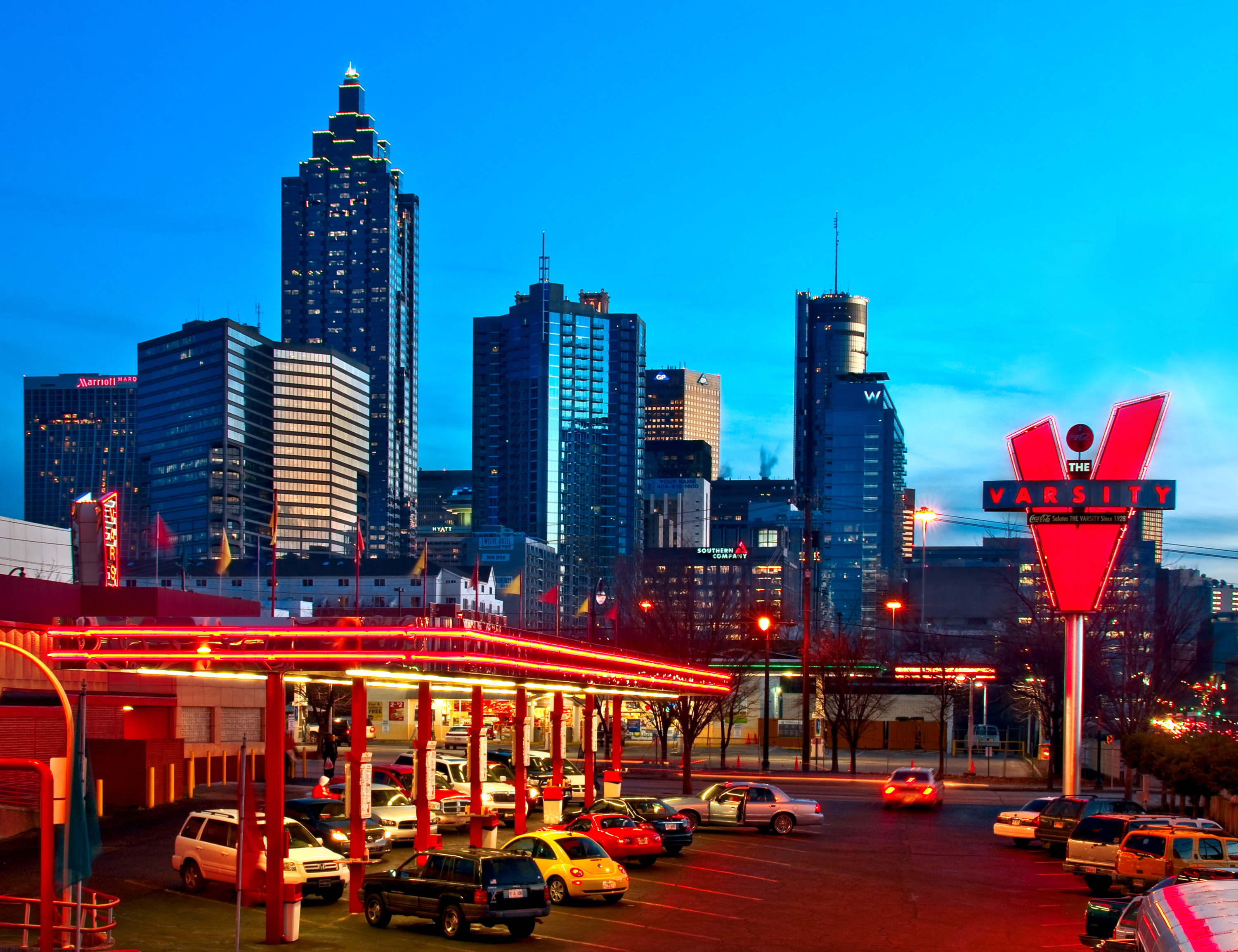
A few steps away, over the North Avenue Bridge (over I-75/85) at 61 North Avenue NW, highlighted by a huge neon letter V (as seen in the photo at the top of this post), is The Varsity. No visit to The A-T-L is complete without a stop at The Varsity. Basically, it's a classic diner, but really good. Be careful, though: They want to keep it moving, much like the Soup Nazi on Seinfeld and its real-life counterpart The Original Soup Man, and also Pat's Steaks in Philadelphia.

The place has a language all its own, and, when they ask, "What'll you have?", being a Met fan, you do not want to order what they call a Yankee Dog – or a Naked Dog, which, oddly, is the same exact thing: A hot dog whose only condiment is mustard (which hardly makes it "naked," but that's what they call it). Check out this link, and you'll get an idea of what to say and what not to say.

* Site of Ponce de Leon Park. The Southern Association's Atlanta Crackers played at 2 stadiums with this name, from 1907 to 1923, and then, after a fire required rebuilding, from 1924 to 1964. The second park seated 20,000, a huge figure for a minor league park then -- and a pretty big one for a minor league park now.

"Crackers"? The term is usually applied to a poor white Southerner, and is, effectively, black people's response to what we now call "the N-word." It has also been suggested that the term referred to plowboys cracking a whip over their farm animals, or that it was a shortened version of an earlier team called the Firecrackers, or that it comes from the Gaelic word "craic," meaning entertaining conversation, or boasting, or bantering.

The team won a Pennant in 1895, before the 1st ballpark with the name was built. In the first park, they won Pennants in 1907, 1909, 1913, 1917 and 1919. In the 2nd, they won in 1925, 1935, 1938, 1945, 1954, 1956, 1957, 1960 and 1962. So, 15 in all. After that 1962 Crackers Pennant, Atlanta would not win another until the Braves finally did it 29 years later. All told, Atlanta has won 20 Pennants.

The park was known for a magnolia tree that stood in deep center field, until 1947 when Earl Mann bought the team and moved the fence in a bit, so that the tree was no longer in fair play. Although it never happened during a regular-season professional game, in exhibition games both Babe Ruth and Eddie Mathews hit home runs that hit the tree.

The park also hosted high school football and the occasional prizefight, including the last fight of Jack Dempsey, in 1940, when he was 45 years old and beat pro wrestler Clarence "Cowboy" Luttrell.

The Southern Association, a Double-A League (since replaced by the Southern League) folded in 1961, rather than accept integrated teams. The Crackers, known (ironically, considering their location) as "the Yankees of the Minors," were accepted into the Triple-A American Association, and remained there until their final season, 1965, before the Braves arrived the next year. That last season, 1965, was played at what became Fulton County Stadium for their final season, its 52,000 seats making it the largest stadium ever to regularly host minor-league games, a record that would later be broken by the Denver Bears after Bears Stadium was expanded to 74,000 seats and became Mile High Stadium.

The Midtown Place Shopping Center is now on the site. Unlike the park, and the 1st shopping center that was on the site, before Midtown Place, the magnolia tree has never been torn down. 650 Ponce de Leon Avenue NE. MARTA Gold to North Avenue, then transfer to Number 2 bus.

* Truist Park. The new home of the Braves -- known as SunTrust Park from its 2017 opening until 2019 -- is in Atlanta's northwestern suburbs, in Cumberland, Cobb County, Georgia. The Braves have tried to justify the move by saying that this is "near the geographic center of the Braves' fan base." This may be true.

But the move also got them out of the majority-black City of Atlanta and into the center of mostly-white, Tea Party-country Georgia. Gee, I wonder if there's a connection, especially now that the famously inclusive Ted Turner no longer owns the team? (Ironically, Tea Party groups have opposed the building of the stadium, citing the taxes that would have to be implemented for it.)

It is northwest of the interchange of Interstates 75 and 285, on Circle 75 Parkway, 13 miles northwest of Five Points. MARTA Gold to Arts Center, then transfer to Number 10 bus. The Braves use a "circulator" bus system to shuttle fans to and from the stadium. 

* College Football Hall of Fame. It's just to the north of the stadium and arena complex, at 250 Marietta Street NW. MARTA Gold or Red to Dome-GWCC-Philips Arena stop.

* Dahlberg Hall. Formerly the Atlanta Municipal Auditorium, this structure opened in 1909, and was the longtime home of the Atlanta Symphony Orchestra until 1968, when Woodruff Arts Center opened. In 1970, it was the site of Muhammad Ali's return to boxing, after his legal exile. He knocked Jerry Quarry out in the 3rd round.

In 1979, Georgia State University bought the Auditorium, and converted it into their alumni hall, renaming it for alumnus Bill Dahlberg. Courtland Street & Auditorium Place SE. Just 5 blocks east of Five Points, and within walking distance.

* Gateway Center Arena. This 5,000-seat arena opened in 2019, and since then, has been the home of the WNBA's Atlanta Dream. It's attached to the Georgia International Convention Center. The address is 2000 Convention Center Concourse, in College Park, about 10 miles southwest of downtown, near the airport. MARTA Gold to College Park, then a 1-mile walk.

* Non-Sports Sites. There's the Atlanta Cyclorama and Civil War Museum, 800 Cherokee Avenue SE, which tells the true story of that fire you saw in Gone With the Wind

At the other end of the spectrum, giving all people their equal due, is the Martin Luther King Jr. National Historic Site at 449 Auburn Avenue NE, which includes the house that was Dr. King's birthplace and boyhood home, the Ebenezer Baptist Church where he and his father Martin Sr. preached, and his tomb. The King Memorial stop on MARTA's Blue and Green Lines serves both the King Center and the Cyclorama.

The Carter Center, housing Jimmy Carter's Presidential Library and Museum, and the Carter Center for Nonviolent Social Change, is at 453 Freedom Parkway. Bus 3 or 16 from Five Points stop on MARTA. The Carters have announced that, unlike most recent Presidents, they will not be buried at their Presidential Library, but rather in their hometown of Plains, 158 miles south of Atlanta.

From 1924 onward, Franklin D. Roosevelt had a retreat at Warm Springs, which became known as the Little White House when he became President in 1933. He died there on April 12, 1945. 401 Little White House Road, 73 miles southwest of Atlanta.

Atlanta also has museums honoring Gone With the Wind author and Atlanta native Margaret Mitchell, Atlanta's native drink Coca-Cola, and Atlanta's native news network CNN. And there's the city's major shopping district, Underground Atlanta, in the Five Points area.

Elvis sang at the historic Fox Theater early in his career, giving 6 shows in 2 days, March 14 and 15, 1956. 660 Peachtree Street NE at Ponce de Leon Avenue. MARTA Gold or Red to North Avenue. He topped that from June 22 to 24, giving 10 shows in 3 days (including a personal record 4 on the 23rd -- he was a lot younger then) at the Paramount Theater, next-door to the Loew's Grand Theater, famous for being the site of the world premiere of Gone With the Wind. Both the Paramount and the Loew's Grand (which burned in a suspected insurance scam in 1978) have been demolished, and replaced by the Georgia-Pacific Tower. John Wesley Dobbs Avenue & Peachtree Street NE. MARTA Gold or Red to Peachtree Center.

In addition to the preceding, Elvis played 2 shows at the City Auditorium in Waycross on February 22, 1956. 865 Pendleton Street, 238 miles southeast, actually closer to Jacksonville. He played the Bell Municipal Auditorium in Augusta on March 20 and June 27, 1956. 712 Telfair Street, 148 miles east.

He played 2 shows at the Savannah Sports Arena on June 25, 1956. Since demolished, it stood at 2519 E. Gwinnett Street, 250 miles southeast. He played the Savannah Civic Center on February 17, 1977. 301 W. Oglethorpe Avenue. And he played the Macon Coliseum on April 15, 1972 (2 shows); April 24, 1975; and August 31, 1976 He was supposed to sing there again on April 2, 1977, but his lifestyle was catching up with him, and the show was postponed, and done on June 1. 200 Coliseum Drive, 84 miles south.

The Royal Peacock Club was a longtime hotspot for jazz and rhythm & blues. On November 29, 1964, soul singer Sam Cooke gave what turned out to be his last concert there. Now known as the Royal Peacock Lounge, it is billed as "Atlanta's oldest reggae club," in other words a dance club. 186 1/2 Auburn Avenue NE, at Piedmont Avenue, just northeast of downtown and a block north of the Georgia State campus. Bus 3.

Atlanta is the home base of actor-writer-producer-director Tyler Perry, and all his TV shows and movies are set there. The house that stands in for the home of his most famous character, Mabel "Madea" Simmons, is at 1197 Avon Avenue SW, 3 miles southwest of downtown. MARTA Gold or Red to Oakland City, then a 10-minute walk north. I think it's a private home, so don't bother whoever lives there. Especially if there's somebody living there who's like Madea.

The most famous TV show set in Georgia was The Dukes of Hazzard. The State in which Hazzard County was located was never specified in the script, but the cars had Georgia license plates, and Georgia State Highway signs could be clearly seen. The first few episodes were filmed in Covington, about 37 miles southeast of Five Points; after returning from a Christmas break from filming in 1978-79, new sets were built in Southern California to mimic a small Southern town's courthouse square.

Years later, the 1988-92 TV version of In the Heat of the Night would also film in Covington. The 1967 movie version, like the TV version set in the fictional town of Sparta, Mississippi, was filmed in Tennessee and Illinois, as Sidney Poitier refused to cross the Mason-Dixon Line to film his scenes.

Atlanta has attracted the supernatural, including The Walking Dead, The Vampire Diaries and the TV series version of Teen Wolf. Much of Andy Griffith's ole-country lawyer show Matlock was filmed around the Fulton County Government Center and the State Capitol along MLK Drive, centered on Central Avenue.

But, for the most part, Matlock, like another Atlanta-based show, Designing Women, was filmed in L.A. The house that stood in for Julia Sugarbaker's home, at 1521 Sycamore Street in the show (the address does exist in neighboring Decatur), isn't even in Georgia: It's in Little Rock, Arkansas, hometown of series co-creator and writer Harry Thomason. (His co-creator and writer Linda Bloodworth-Thomason is from Poplar Bluff, Missouri.)

The most famous movie scene ever filmed in Georgia wasn't any scene in Gone With the Wind (that was filmed in Hollywood), but the town square scene in Forrest Gump. That was filmed in Chippewa Square, at Bull and Hull Streets, in Savannah, 250 miles southeast of Atlanta. The bench has been moved to the nearby Savannah History Museum, 303 Martin Luther King Jr. Blvd. Most of the movie was filmed in Beaufort, South Carolina, 42 miles to the northeast, 287 miles southeast of Atlanta, and 71 miles southwest of Charleston.

*

Atlanta is an acquired taste, especially for a New Yorker. Is it worth going? That's up to you to decide.

But if your mission is simply to have a good time in an unfamiliar city, and to "cross one more arena off your list," then, by all means, go, stay safe, and have fun.