Showing posts with label ralph terry. Show all posts

Saturday, February 21, 2026

Bill Mazeroski, 1936-2026

Only one human being, living or dead, has ever hit a home run in the bottom of the 9th inning of a Game 7 to win a World Series. Now, he is no longer living.

And the odd thing is, he was a great fielder first, and a timely hitter second.

William Stanley Mazeroski was born on September 5, 1936 in Wheeling, West Virginia, and grew up on the other side of the Ohio River, in Tiltsonville, Ohio. He starred in baseball and basketball in high school.

In 1988, Sports Illustrated published an article on "The Valley Boys." The were all from the same area in southeastern Ohio: Mazeroski, knuckleballing baseball pitchers Phil and Joe Niekro, basketball star Alex Groza, his football-playing brother Lou Groza, and basketball star John Havlicek. Mazeroski turned out to be the last survivor of that group.

Also contemporaries from that place and time, but not mentioned in the article: Bill's Pirate teammate Gene Freese, football coach Lou Holtz, and football stars Bob Gain, Calvin Jones, Chuck Howley and Bob Jeter. Baseball relief pitcher Rollie Fingers, a bit younger, moved with his family to California before he reached high school.

Mazeroski turned down college scholarship offers from nearby schools Duquesne, Ohio State and West Virginia to play baseball. He signed with the Pittsburgh Pirates as a shortstop, but made a lot of errors. Branch Rickey, running the Pirates after building winners of multiple Pennants with the St. Louis Cardinals and then the Brooklyn Dodgers, saw how good he was at turning double plays, and had him moved to second base. It was a decision that changed the history of baseball.

He made his major league debut on July 7, 1956, at the Polo Grounds in New York. Batting 8th, playing 2nd base, and wearing the Number 9 he would wear throughout his career, he went 1-for-3, as the Pirates lost to the New York Giants, 3-2.

In 1958, despite playing his home games at Pittsburgh's Forbes Field, whose dimensions were similar to those of the pre-renovation original Yankee Stadium -- 300 feet to right field, but 457 to center, and 360 to left, not good for a righthanded hitter like Mazeroski or his teammate Roberto Clemente -- Mazeroski hit 19 home runs, which would remain his career high. He batted .275 with 68 RBIs. It was the 1st of 7 seasons that would see him reach the All-Star Game, and the 1st of 8 in which he would win the National League's Gold Glove at 2nd base.

After a dropoff in 1959, in 1960, he batted .273, with 11 home runs and 64 RBIs. He helped the Pirates win their 1st NL Pennant since 1927 -- 33 years. They hadn't won a World Series since 1925, and were facing the team that had beaten them in 1927, the New York Yankees, who were heavily favored.

The Yankees won Game 2, 16-3. They won Game 3, 10-0. They won Game 6, 12-0. But the Pirates won Game 1, 6-4. They won Game 4, 3-2. And they won Game 5, 5-2. The Series went to a Game 7. On that Thursday afternoon, 36,683 people jammed themselves into Forbes Field. Millions more listened to Pirates announcer Bob Prince and Yankees announcer Mel Allen call the game for television on NBC. Still more millions listened to NBC radio, with Baltimore Orioles announcer Chuck Thompson and Chicago Cubs announcer Jack Quinlan.
Forbes Field

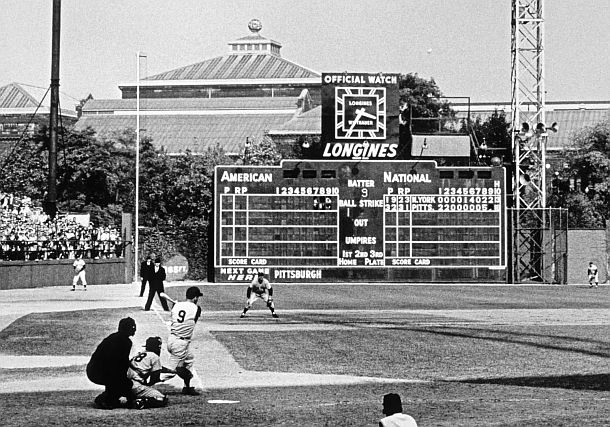
The game went back and forth, and was tied, 9-9, going to the bottom of the 9th inning. On NBC radio, Chuck Thompson, usually the voice of the Baltimore Orioles, said, "Well, a little while ago, when we said this one was going right down to the wire, little did we know." Mazeroski led off, against Yankee pitcher Ralph Terry. His 1st pitch was high, ball 1. Terry threw a 2nd pitch. The time was 3:36 PM. Thompson's call on radio:

Here's a swing, and a high fly ball, going deep to left, this may do it! Back to the wall goes Berra, it is over the fence, home run, the Pirates win!
In case you're curious, the building behind the scoreboard
is the Carnegie Library of Pittsburgh.

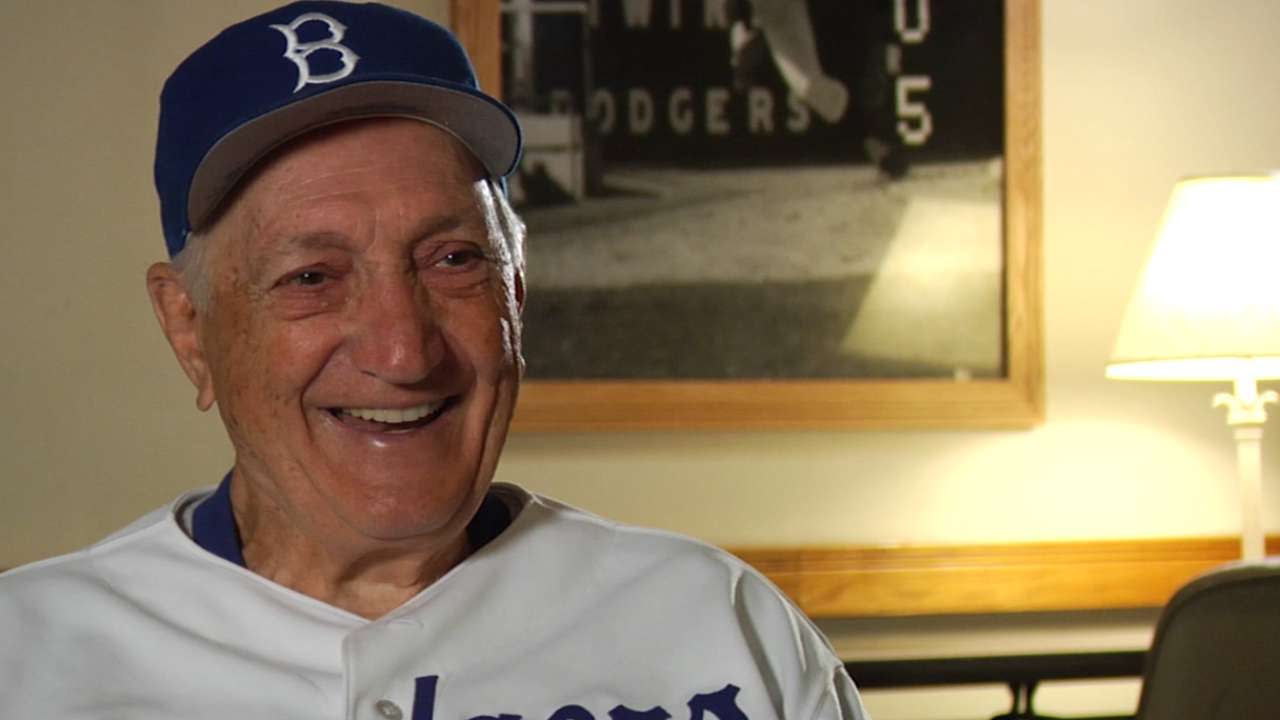
"I don't know it's out," Mazeroski recalled during a Pirates telecast in 2015, 55 years after the fact. "I don’t know it's a home run. But I know I;m going to end up on third if he misplays that ball off the wall. So I;m busting my tail getting around there, and by the time I hit second base, I looked down the line and the fans went crazy. From second base, I didn't touch the ground all the way in."

After pausing to let the cheering be heard, Thompson started again, and was so excited, he got the score wrong at first:

Ladies and gentlemen, Mazeroski has hit a one-nothing pitch over the left field fence at Forbes Field to win the 1960 World Series for the Pittsburgh Pirates by a score of ten to nothing! Once again, that final score, the Pittsburgh Pirates, the 1960 World Champions, defeat the New York Yankees. The Pirates ten, and the Yankees nine! And Forbes Field is an insane asylum!

Mel Allen, so often accused of being a "homer" for the Yankees, called it this way on TV for NBC:

There's a drive into deep left field, look out now! That ball is going, going, gone! And the World Series is over! Mazeroski hits it over the left field fence, and the Pirates win it, 10–9, and win the World Series!

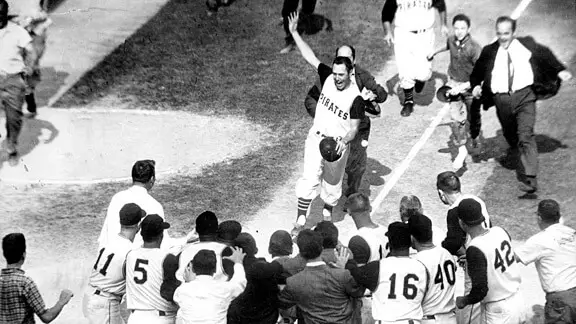
The ball went over Berra's head, at around the 406-foot mark in left field, and landed among the cherry trees in Schenley Park. Mazeroski took off his batting helmet and swung it around as he circled the bases. 
The ball was found by Andy Jerpe, 14 years old. Mazeroski would sign the ball for him, but he foolishly used the ball in a neighborhood game, and it was lost. No one knows where it is now. The Pirates don't have it. Neither does the Baseball Hall of Fame.

The Yankees outscored the Pirates 55-27 during the Series, but the Pirates won it, 4 games to 3. Richardson had a Series record 12 RBIs, and remains the only player from a losing side to be named the MVP of a World Series. Mazeroski? He batted .320 in that Series, and that was his 2nd homer in it, for his 5th RBI in it, and he played his usual good games in the field. He got robbed. But I'm sure he'd rather have the title.

Not being old enough to remember 1960, I can hardly begrudge the Pirates that amazing victory. But there are Yankee Fans who are old enough to remember, and it still hurts. It shouldn't: They won the next two World Series, and another seven since. And Mazeroski was always a good guy.

There's a bronze statue of a young Mazeroski -- arms outstretched, cap in his right hand, right leg kicked up behind him -- along the Allegheny River outside PNC Park. The likeness is surrounded by a brick wall that includes an actual section of the outfield wall over which Mazeroski homered; the 406-foot marker is still visible in white.

Another part of Forbes Field's outfield wall still stands in place in Pittsburgh's Oakland neighborhood, just off Roberto Clemente Drive, and there’s a plaque recognizing the spot where Mazeroski homered. Every Oct. 13, the "Game 7 Gang" gathers at that site, listens to the radio broadcast and celebrates the anniversary of Mazeroski's famous home run at exactly 3:36 PM.
"That doesn't happen anywhere else, does it?" Mazeroski said with a smile in February 2020, approaching the 60th Anniversary of the event.

*

He never again batted higher .271. He never again hit more than 16 home runs in a season. He peaked at 82 RBIs in 1966. But it's as a fielder that he became best-known. He led NL 2nd basemen in double plays turned every year from 1960 to 1967. He led them in fielding percentage in 1960, '65 and '66, and retired with a career .983 fielding percentage. He led them in assists 9 times, and led all of the big leagues in 5 of those seasons. He still holds the Major League record for double plays turned by a 2nd baseman, with 1,706.

For the record, the holders at the other positions are: 1st base, Mickey Vernon, 2,044; shortstop, Omar Vizquel, 1,734; 3rd base, Brooks Robinson, 618; catcher, Ray Schalk, 222; center field, Tris Speaker, 146; pitcher, Greg Maddux, 98; right field, Harry Hooper, 86; left field, Joe Vosmik, 23.

Mazeroski was involved in 2 triple plays in his career, in 1966 and 1968. He never hit into one in real life. But on June 27, 1967, at Shea Stadium, he was filmed staging such an event for the film version of The Odd Couple: Just before the regular game, he was filmed batting against Jack Fisher of the Mets. The play required 2 takes, as he hit the 1st ball foul. The point of the scene was that a phone call from Felix Ungar (played by Jack Lemmon) to Oscar Madison (Walter Matthau) in the press box at Shea causes Oscar to miss a triple play that ends the game in victory for the Mets. (Felix's surname was spelled "Ungar" in the play and the film, "Unger" in the TV show.)

Mazeroski and Clemente were the only 1960 Pirates still there when they won the World Series again in 1971. Mazeroski retired after the 1972 season, with a lifetime batting average of .260, and 2,016 hits including 138 home runs.

For many years, he was considered one of the best players not in the Baseball Hall of Fame. The argument for him was that the best-fielding player, ever, at every position should be in, and he was the best-fielding 2nd baseman ever. The argument against him is that he wasn't good enough of a hitter, and that nobody's defense made enough of a difference to put him over the top. In 2001, he was finally elected.

People who were against his election to the Hall have claimed that the real reason he's in is that home run. I would make the exact opposite argument: 

I think the home run changed people's perception of him. Think about it: The 1st thing that comes to mind when you hear his name is, "He hit the home run that won the 1960 World Series." Imagine that the Series had ended any other way, even one favorable to the Pirates. Suppose Mazeroski had led the inning off with a single, and scored the title-winning run on somebody else's hit. Then, the 1st thing that would come to mind when you hear his name is, "He's the greatest-fielding 2nd baseman who ever lived." He probably would have gotten in much sooner.
At a still-standing, ivy-covered piece of the
Forbes Field outfield wall, October 13, 2010,
the 50th Anniversary of the home run.


The Pirates retired his Number 9, and dedicated a statue of him outside PNC Park, depicting him running around the bases, swinging his batting helmet around. They also elected him to their team Hall of Fame. He was also elected to the National Polish-American Sports Hall of Fame.


He retired to a suburb of Pittsburgh. In 1987, he ran for the Democratic Party's nomination for Westmoreland County Commissioner, but lost. Eventually, he and his wife the former Milene Nicholson, moved to Panama City, Florida, enabling him to go down to Bradenton to serve as a Spring Training instructor for the Pirates. They had 2 sons: Darren, who became a college baseball coach; and Dave, an atmospheric scientist.


On October 23, 1993, Joe Carter became the 2nd player to end a World Series by hitting a home run, for the Toronto Blue Jays over the Philadelphia Phillies, at the SkyDome (now named the Rogers Centre) in Toronto. However, that was in a Game 6, not a Game 7. It appears that Mazeroski and Carter never met.


Bill Mazeroski died yesterday, February 20, 2026, in the Pittsburgh suburb of Landsale, Pennsylvania. He was 89 years old.


With his death, there are 3 surviving players from the 1960 World Champion Pittsburgh Pirates: Bob Skinner, Vernon Law and Bennie Daniels.


There are 4 surviving players who played in Game 7 of that World Series: Skinner and Law of the Pirates, and Bobby Richardson and Tony Kubek of the Yankees. Kubek, famously, had to leave the game when a ground ball hit a pebble in Forbes Field's poor infield and struck him in the throat, helping to keep the Pirates' 8th-inning rally alive, and make Mazeroski's 9th-inning heroism possible.


And there are 11 surviving players from the 1971 World Champion Pittsburgh Pirates: Al Oliver, Steve Blass, Manny Sanguillén, Bob Robertson, Gene Alley, Richie Hebner, Luke Walker, Bob Johnson, Milt May, Dave Cash and Carl Taylor.


How did Mazeroski want his career to be remembered: For his Hall of Fame defense, or for hitting arguably the greatest home run of all time?


"Oh," he said, laughing, "I'll take the home run."


If it had been me, so would I.

Sunday, October 16, 2022

October 16, 1962: Terry to McCovey to Richardson

October 16, 1962, 60 years ago: Game 7 of the World Series at Candlestick Park in San Francisco. Oddly, the Yankees' 1956 World Series hero, Don Larsen, is available to pitch against them, for the San Francisco Giants.

Tony Kubek, who missed much of the season due to military service, grounds into a double play in the 5th inning, but a run scores on the play. The score remains Yankees 1, Giants 0 in the bottom of the 9th. With 2 outs and Matty Alou on 1st‚ Willie Mays rips a double to right off Ralph Terry‚ but great fielding by Roger Maris keeps Alou from scoring.

The Yankees now have a choice to make: Have the righthanded Terry, who gave up Bill Mazeroski's Series-winning homer in Game 7 in 1960, pitch to the next batter, the dangerous lefthander Willie McCovey; or walk him to load the bases, and set up the Series-clinching out at any base, and pitch to the equally dangerous but righthanded Orlando Cepeda. (Keep in mind, Mazeroski was righthanded.)

Between them, they would hit 900 home runs in the major leagues: McCovey 521, Cepeda 379. Nobody knows that yet, but everybody knows that both were already All-Stars, and that both had been Rookie of the Year: Cepeda in 1958, McCovey in '59. It's like choosing between the guillotine and the hangman's noose.

Oddly, despite all the talk about whether to pitch to McCovey or Cepeda, removing Terry for a relief pitcher, possibly a lefthander to pitch to the lefthanded McCovey, seems never to have been discussed.

They decide to pitch to McCovey. "Stretch" hits a screaming liner toward right field‚ but 2nd baseman Bobby Richardson takes one step to his left and snares it. Ballgame over, Yankees win, theeeeeeee Yankees win. Barely. It is the 1st World Series Game 7 that ends 1-0. There has since been only one more, in 1991, and that one went 10 innings.

It is the Yankees' 20th World Championship, their 2nd in a row. Terry, who had also won 23 regular season games, Game 5 of the Series, and soon the Cy Young Award, is awarded the Series MVP award. He is fully redeemed for having given up the Mazeroski homer.

However, the Yankees will not win another World Series for 15 years. The Giants? They would have to wait another 27 years just to get into another Series, and won't win one until 2010.

Peanuts cartoonist Charles Schulz, a Giants fan living in nearby Santa Rosa, soon draws a cartoon having Charlie Brown yell to the heavens, "Why couldn't McCovey's drive have been just three feet higher?" McCovey did his job, and the Giants took the Series to the last out of the last game. They just got beat by a team that was a little bit better.

Still alive from the 1962 World Champion Yankees, 60 years ago, are 8 players: Richardson, Kubek, Bud Daley, and Hector Lopez; plus Joe Pepitone, Rollie Sheldon, Jack Reed and Jake Gibbs, who never got into any of the Series games. Surviving from the Giants are 6 players: Cepeda, Willie Mays, Juan Marichal, Felipe Alou, Gaylord Perry and Bobby Bolin.

Saturday, March 19, 2022

Ralph Terry, 1936-2022

Who is the greatest Yankee ever to wear Number 23? Don't tell me Don Mattingly. This man accomplished far more.

Ralph Willard Terry was born on January 9, 1936 in Big Cabin, Oklahoma, about 40 miles southwest of future teammate Mickey Mantle's hometown of Commerce. Other Yankee stars from Oklahoma have included Bobby Murcer, from Oklahoma City; and Allie Reynolds, from Bethany, just outside Oklahoma City.

Terry starred in football and basketball in high school, but, like Mantle, his high school didn't have a baseball team, and he had to find amateur teams on which to play. He was at the University of Missouri at Kansas City in 1953, when the Yankees signed him.

He made his major league debut on August 6, 1956, at Fenway Park in Boston. Wearing Number 21, he started, pitched 5 2/3rds innings, allowing 3 runs on 7 hits and 3 walks, striking out 4. He gave up a home run to Jimmy Piersall, and gave up a walk and a single to Ted Williams before retiring him on a comeback grounder. Mantle went 0-for-3, but the Yankees got 2 hits each from Yogi Berra, Elston Howard and Jerry Coleman, and beat the Boston Red Sox, 4-3. Terry had his 1st major league win.

Unfortunately, he was destined for "The Kansas City Shuttle": The Kansas City Blues had been the Yankees' top farm team, and when the Philadelphia Athletics moved to Kansas City in 1955, the Yankees continued to treat the destination like a farm team, sending prospects and/or washed-up players there in exchange for a player or two who could help them win the Pennant that season.

On June 15, 1957, Terry, 2nd baseman Billy Martin and right fielder Bob Martyn were sent to the A's, for pitcher Ryne Duren, and outfielders Harry "Suitcase" Simpson (so nicknamed because he was traded so often) and Jim Pisoni. That trade is far better remembered for Martin's exile from the Yankees, which didn't end until he was hired as manager in 1975. He wasn't punished for his bad behavior off the field: That was just a convenient excuse. The truth was, he simply wasn't hitting, and Bobby Richardson was ready to replace him.

On May 26, 1959, the Yankees brought Terry back, also acquiring outfielder Hector Lopez for pitchers Johnny Kucks and Tom Sturdivant and infielder Jerry Lumpe, a man manager Casey Stengel once described as, "He looks like the greatest player in the world, until you play him."

Now wearing Number 23, Terry had a bad season in 1959, but improved to 10-8 in 1960. In the bottom of the 9th inning of Game 7 of the World Series against the Pittsburgh Pirates, Stengel brought him in to pitch. He faced one batter, Bill Mazeroski. He was already known as the best-fielding 2nd baseman in the game, but was not known for his hitting. Nevertheless, he hit a home run, and it gave the Pirates the Series. Terry was now the only man ever to give up a walkoff home run in a World Series Game 7, and still is.

If that awful distinction bothered him, he didn't pitch like it thereafter. In 1961, he went 16-3, and helped the Yankees reach the World Series again. Unfortunately, the only game they lost in the Series was Terry's start, in Game 2.

In 1962, he went 23-12, and made the All-Star Game for the only time in his career. At the time, the Cy Young Award went to the best pitcher in both leagues, and it was given to Don Drysdale of the Los Angeles Dodgers, a travesty. (The Dodgers did not win their Pennant.) Again, Terry lost Game 2 of the World Series, this time to the San Francisco Giants. But he won Game 5, and a rain delay meant that he was available for Game 7.

The Yankees scored a run on a double play in the top of the 5th inning, and that 1-0 lead held into the bottom of the 9th. Terry didn't allow a hit until the 6th inning, a single by, ironically, the opposing pitcher, Jack Sanford. He gave up a triple to Willie McCovey in the 7th, but struck Orlando Cepeda out to end the threat. Those were the only 2 hits Terry allowed over the 1st 8 innings.

But Matty Alou led off the 9th with a bunt single. Terry struck out Matty's brother, Felipe Alou, then struck out Chuck Hiller. But Willie Mays doubled down the right field line. A great throw by Roger Maris was the only thing preventing Matty from scoring.

One more out needed to win the World Series. But the tying run was on 3rd base, and the winning run was on 2nd. The batter was McCovey. Yankee manager Ralph Houk had a big decision to make. No one ever talks about the possibility of bringing in a fresh arm to face McCovey: Despite this being the 31st batter of the game that Terry would face (his pitch count is not listed in the box score), he was going to be left in.

The question was: Do we let the righthanded Terry pitch to the dangerous lefthander McCovey, or walk him, setting up a force play at every base, and pitch to the also-dangerous righthander Cepeda? No one yet knew that McCovey would finish his career with 521 home runs, or that Cepeda would finish his with 379, giving the 2 men 900 home runs even between them. Their reputations as hard hitters were already established.

Houk, Terry, catcher Elston Howard, and the infielders talked it over, and they decided to pitch to McCovey. Terry threw, and McCovey hit a vicious line drive that looked like it might drive home the runs to make the Giants the World Champions. But Richardson took 1 step to his left, and snared it. The Yankees had won, 1-0. Terry was fully redeemed for 1960, and was named the Series' Most Valuable Player.

In 1963, he went 17-15, leading the American League in games started for the 2nd straight year. After leading in innings pitched and batters faced the year before, he led in complete games and WHIP. The Yankees won another Pennant, but were swept in the World Series by the Dodgers. Terry pitched only 3 innings in the Series, and did not figure into a decision.

All that throwing caught up with him. In 1964, he only went 7-11, and only pitched 2 innings in the Yankees' World Series loss to the St. Louis Cardinals. On October 21, 1964, Terry was sent to the Cleveland Indians, as the player to be named later in the deal that brought in Pedro Ramos.

He went 11-6 for the Indians in 1965, but felt he was treated poorly by management, and was traded to the A's for 1966. He battled injury, and in mid-season, was traded to the Mets. He made 2 appearances for them, on April 14 and 22, and was released on May 16, never to pitch again. His career record was 107-99, and he had exactly 1,000 strikeouts.

In a 1989 interview, Terry said, “I got to play with Roger Maris when he hit 61 home runs. I got to play with Mickey Mantle, one of the greatest baseball players who ever lived. I got to play for Casey Stengel. I played on seven pennant winners, pitched in five World Series. I screwed one up, and I won one. That’s a lot to happen to one guy.”

He left sports to become a professional golfer. He was good at it: He won the 1980 Midwest PGA Championship, qualifying for the 1981 PGA Tour. In 1986, he started playing on the Senior PGA Tour. He retired to Larned, Kansas, where he was an insurance agent. He married Tanya Simmons in 1960, and they were together to the end. They had sons Raif and Gabe, 2 grandchildren, and 2 great-grandchildren.
On December 31, 2021, he slipped on a patch of ice and hit his head. He had to be taken to a long-term care facility, where he died this past Wednesday, March 16, 2022. He was 86 years old.

With his death, there are now:

* 3 living players from the 1956 World Champion New York Yankees: Bobby Richardson, Billy Hunter and Lou Skizas.

* 7 living players from the 1961 World Champion New York Yankees: Richardson, Tony Kubek, Hector Lopez, Billy Gardner, Rollie Sheldon, Bud Daley and Jack Reed.

* 8 living players from the 1962 World Champion New York Yankees: Richardson, Kubek, Lopez, Sheldon, Daley, Reed, Joe Pepitone and Jake Gibbs.

* 14 living men who played on the Yankees for Casey Stengel: Richardson, Hunter, Skizas, Kubek, Lopez, Art Schallock, Bobby Shantz, Zach Monroe, Gary Blaylock, Jim Bronstad, Gordie Windhorn, Fred Kipp, Hal Stowe and Johnny James.

* 9 living players who were interviewed for the 1987 documentary New York Yankees: The Movie: Richardson, Roy White, Lou Piniella, Ron Guidry, Willie Randolph, Tommy John, Dave Righetti, Dave Winfield and Don Mattingly. (Footage of interviews with Reggie Jackson and Rickey Henderson was shown, but they didn't sit for new interviews.)

* And 2 living men who pitched complete-game shutouts in Game 7 of a World Series: Sandy Koufax of the 1965 Los Angeles Dodgers, and Jack Morris of the 1991 Minnesota Twins.

Tuesday, October 13, 2020

October 13, 1960: The Bill Mazeroski Game

In case you're curious, the building behind the scoreboard
is the Carnegie Library of Pittsburgh.

October 13, 1960, 60 years ago: Perhaps the greatest game in the history of baseball is played. But if you are among Yankee Fans age 65 and over, mention it at your peril.

The 1960 World Series may have been the wildest Fall Classic ever. The Pittsburgh Pirates, Champions of the National League for the 1st time in 33 years, faced the New York Yankees, the team they faced in their last appearance. Since that 1927 World Series, the Yankees had appeared in 19 of them, winning 16.

In Pittsburgh, the Pirates won Game 1, 6-4., but the Yankees won Game 2, 16-3. In New York, the Yankees won Game 3, 10-0, but the Pirates won Game 4, 3-2, and Game 5, 5-2. The Series went back to Pittsburgh, and the Yankees won Game 6, 12-0.

And so, on this Thursday afternoon, 36,683 people jammed themselves into Forbes Field for Game 7. Millions more listened to Pirates announcer Bob Prince and Yankees announcer Mel Allen call the game for television on NBC. Still more millions listened to NBC radio, with Baltimore Orioles announcer Chuck Thompson and Chicago Cubs announcer Jack Quinlan.

*

A few hours later, both networks, and CBS, and ABC would broadcast the 3rd of 4 Presidential Debates, with Vice President Richard Nixon, Republican, and Senator John F. Kennedy, Democrat, seeking to succeed the current President, Dwight D. Eisenhower, Republican. Donald Trump was 14 years old, Joe Biden was 17, Mike Pence was 16 months old, and Barack Obama, Melania Trump and Kamala Harris had not been born yet.

The Governor of New York was Nelson Rockefeller, the Mayor of New York was Robert Wagner Jr., and the Governor of New Jersey was Robert Meyner.

The teams currently known as the New York Mets, the Broooklyn Nets, the New York Islanders and the New Jersey Devils did not yet exist. The New York Jets had just begun play, under the name "New York Titans." The old Penn Station, the old Madison Square Garden and the old Belmont Park grandstandwere still being used. The Empire State Building was still the tallest building in the world.

The Andy Griffith Show and The Flintstones had recently debuted on TV. The Tonight Show was hosted by Jack Paar. Spartacus and The Magnificent Seven were in theaters. James Bond had not yet made the jump from novels to films. Gene Roddenberry was writing for television, especially the Western Have Gun -- Will Travel, and hadn't yet come up with the idea for Star Trek. George Lucas was 16, Steven Spielberg 13, and George R.R. Martin 12.

The most controversial comedian in America was the foul-mouthed Lenny Bruce. Sportswriter Dick Schaap took him into the press box as his guest for the game, because Bruce had told him that he'd never been to a baseball game before. Bruce made a lot of bad choices in his brief life, but this was a good one.

The Number 1 song in America was "Save the Last Dance for Me" by The Drifters, with Ben E. King on the lead. Frank Sinatra was riding high with his film Ocean's Eleven. Elvis Presley was out of the Army, and had recently topped the chart with "It's Now Or Never," with "Are You Lonesome Tonight?" about to debut. Chubby Checker had recently hit with "The Twist." The Beatles were still struggling in Hamburg, Germany, and Bob Dylan was doing so in Minneapolis. Michael Jackson was 2 years old.

Inflation was such that what $1.00 bought then, $8.78 would buy now. A U.S. postage stamp cost 4 cents, and a New York Subway ride 15 cents. The average price of a gallon of gas was 29 cents, a cup of coffee 20 cents, a McDonald's meal (Big Mac, fries, shake) 49 cents, a movie ticket 75 cents, a new car $2,752, and a new house $11,900. The Dow Jones Industrial Average closed that day at 591.42.

Telephone numbers were still based on "exchanges," based on the letters on a rotary dial. So a number that, today, would be (718) 293-6000 (this is the number for the Yankees' ticket office, so I’m not hurting anyone's privacy), would have been CYpress 3-6000. There were no ZIP Codes, either. They ended up being based on the old system: The old New York Daily News Building, at 220 East 42nd Street, was "New York 17, NY"; it became "New York, NY 10017."

While 90 percent of American homes now had at least one television set, only 1/3rd of those sets were color. There were telephones in cars, but not mobile phones as we understand that term today. Computers could take up an entire floor of a city building. There was no Internet. Steve Jobs, Bill Gates and Tim Berners-Lee were all 5 years old.

Credit cards were still a relatively new thing, and there were no automatic teller machines in America. There were artificial kidneys, but no artificial hearts. Transplanting a kidney was possible, but not a heart, lung or liver. The first birth control pills had recently hit the market, but there was no Viagra. Satellites, including some with live animals, had been put into in orbit; but the 1st attempt to do it with a human being was still 6 months away.

The Organization of Petroleum Exporting Countries, OPEC, had just been formed. The African nations of Nigeria and Cameroon had gained their independence a few days earlier. Soviet Premier Nikita Khrushchev, attenting the United Nations' annual meeting of its General Assembly, protested a speech by poundin ghis fist (not his shoe, as some believed) on his desk. 

Within a few days of this game, Mack Sennett, and Clark Gable, and Oscar Hammerstein II died. So did Baseball Hall-of-Famers Fred Clarke and Bobby Wallace. Jean-Claude Van Damme, and Billy Hatcher, and Diego Maradona were born.

*

That's what the world was like on October 13, 1960, as Game 7 of the World Series began at Forbes Field, precisely at 1:00 PM, Eastern Daylight Time, as home plate umpire Bill Jackowski said, "Play ball!" The other umpires: at 1st base, Nestor Chylak; and 2nd base, Dusty Boggess; at 3rd base, Johnny Stevens; in left field, Stan Landes; and in right field, Jim Honochick.
Forbes Field

The starting pitcher for the Pirates was Vernon Law, who would be named the winner of the Cy Young Award. Leading off for the Yankees was 2nd baseman Bobby Richardson, who lined out to short. Shortstop Tony Kubek popped up to 2nd. Right fielder Roger Maris closed the inning by popping up to 3rd.

The starting pitcher for the Yankees was Bob Turley, who had won the Cy Young and the World Series Most Valuable Player awards in 1958. He got center fielder Bill Virdon to fly to left, and shortstop Dick Groat, who would be named NL MVP that season, to pop up to his opposite number, Kubek.

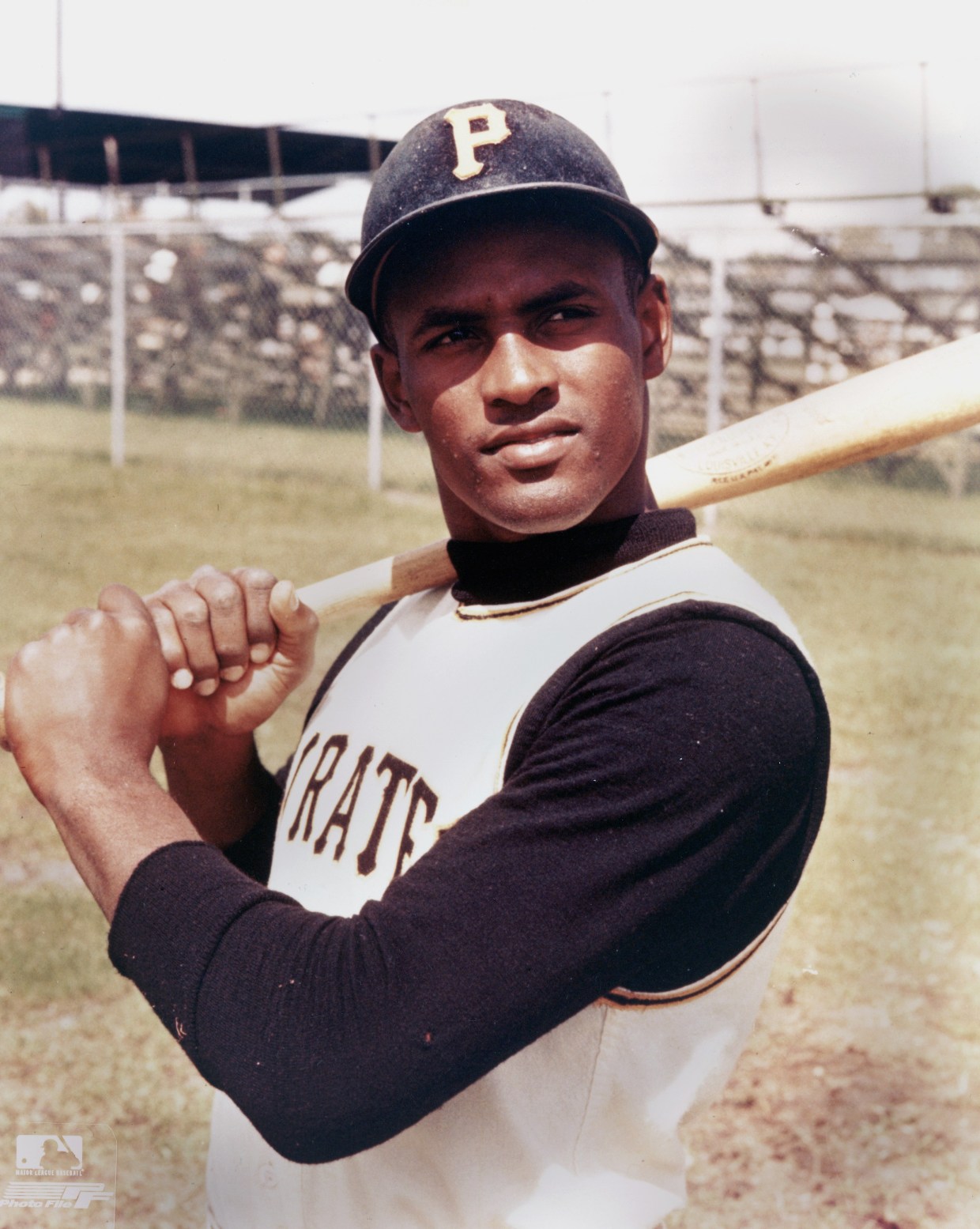
Cliché Alert: Walks can kill you. Turley walked left fielder Bob Skinner. Then 1st baseman Rocky Nelson hit a home run to right field. Turley got right fielder Roberto Clemente -- eventually to become the most famous Pirate player who ever lived -- to pop up to 2nd, but after 1 inning, it was Pirates 2, Yankees 0.
Roberto Clemente

Things would get worse for the Yankees in the 2nd inning. Center fielder Mickey Mantle flew to center. Yogi Berra, now playing left field after switching positions with Elston Howard, now the catcher, grounded to 3rd. And 1st baseman Bill "Moose" Skorwon grounded to short.

Pirate catcher Smoky Burgess led off the bottom of the 2nd with a single to right. Perhaps overreacting to a bad 1st inning by Turley, Yankee manager Casey Stengel replaced him with Bill Stafford. This didn't work: Stafford walked 3rd baseman Don Hoak, and 2nd baseman Bill Mazeroski beat out a bunt.

Law grounded back to Stafford, who started a double play, eliminating Burgess at the plate and Law at 1st. But Hoak advanced to 3rd, Mazeroski to 2nd. Virdon singled to right, scoring Hoak. Maris mishandled the ball, allowing Mazeroski to score and Virdon to reach 2nd. Stafford got Groat to ground to 3rd, but after 2, it's Pirates 4, Yankees 0.

It got no better for the Yankees. In the top of the 3rd, Johnny Blanchard, catching in place of the injured Howard, grounded back to Law. The 3rd baseman, Clete Boyer, popped up to 2nd. Stengel sent Hector Lopez up to pinch-hit for Stafford, and he singled to left, but Richardson flied to left.

The new Yankee pitcher was Bobby Shantz, the 1952 AL MVP with the Philadelphia Athletics, whom Stengel put in the bullpen, and was rewarded by Shantz helping to win the 1958 World Series. He got Skinner to ground to 1st, walked Nelson, and got Clemente to ground into a 4-6-3 double play. End of 3, Pirates 4, Yankees 0.

Kubek popped to short. Maris hit a sinking liner to right that Clemente caught. Mantle singled to right, but Berra flew out in that direction. Shantz got Burgess and Hoak to both ground to 2nd, and Mazeroski to pop to short. Maybe Stengel should have started Shantz. After 4, Pirates 4, Yankees 0.

Skowron led off the 5th with a home run, but that's all the Yankees got. Blanchard flied to center, Boyer lined to 2nd, and, allowed to bat for himself, Shantz popped up to 1st. Shantz then got Law to ground to 3rd, Virdon to ground to 2nd, and Groat to hit a line shot right back at him, which he caught. End of 5, Pirates 4, Yankees 1.

Finally, in the top of the 6th, the Yankees woke up. Richardson singled to center. Kubek worked Law for a walk. Pirate manager Danny Murtaugh had seen enough, and replaced Law, bringing his closer, Roy Face, into the game in the 6th inning. Big risk, and it didn't work: He got Maris to pop up to 3rd, but Mantle singled up the middle to score Richardson, and Berra hit one down the right field line, for a 3-run homer, giving the Yankees the lead. Face got Skowron to pop to 3rd and Blanchard to ground to 1st, but the damage was done.

Shantz breezed through the Pirates in the bottom of the 6th, getting Skinner to line to right, Nelson to ground to 1st, and Clemente to ground back to him. Yankees 5, Pirates 4. Now, we had a game worth of Game 7 of the World Series.

The 7th inning was comparatively uneventful. Boyer flied to center. Shantz was again allowed to bat for himself, and rewarded Stengel's confidence by singling to left. Richardson grounded to 3rd, resulting in a force play that eliminated Shantz at 2nd. Kubek lined to right, and the 7th Inning Stretch was on.

Shantz allowed Burgess to single to center. Murtaugh sent Joe Christopher in to run for him. Hoak lined to left, and the fine-fielding Mazeroski got a taste of his own medicine, as he grounded to short, resulting in a Kubek-to-Richardson-to-Skowron double play. End of 7, Yankees 5, Pirates 4.

The 8th inning moved this game from merely interesting to classic. Hal Smith took Burgess' place behind the plate for Pittsburgh, and this would prove crucial. Maris grounded back to Face. Mantle lined to short. But, again, comes the cliche about the danger of walks: Berra drew one, and this was followed by a single by Skowron, and RBI single by Blanchard, and an RBI double by Boyer. Stengel again allowed Shantz to bat for himself, but he lined out to right. However, it was now 7-4 Yankees.

But the Pirates were far from done. Murtaugh sent Gino Cimoli up to bat for Face, and he singled to right. And then came a play that changed baseball history. Forbes Field was known for having the worst infield in the major leagues. And Virdon hit a grounder to short. It should have been an easy play for Kubek, and the start of a double play. But the ball hit a pebble, and jumped up and struck Kubek in the throat. He went down like a ton of bricks.

He had to leave the game. Stengel put Joe DeMaestri in to play short, and got Jim Coates up in the bullpen. The delay in getting Kubek off the field gave Coates time to get ready -- perhaps, a little too much time. Groat singled Cimoli home, to make it 7-5 Yankees. Stengel finally removed the heroic Shantz, and brought in Coates. Skinner bunted the runners over. Nelson flied out to right. But Clemente singled home Virdon, and Smith, batting for the 1st time in the game, hit a home run to left. The Pirates had the lead again.

Stengel brought Ralph Terry in to pitch. He got Hoak to fly to left. But after 8 innings, it was Pirates 9, Yankees 7. The Buccos were just 3 outs away from their 1st World Championship in 35 years.

But the Bronx Bombers refused to go down quietly. Bob Friend, who had been the Pirates ace before Law came into his own that year, was brought in to close it out. But Richardson dunked a single into short left-center. Dale Long, himself a former Pirate, who hit home runs in a record 8 straight games for them in 1956, was sent up to pinch-hit for DeMaestri. Now, Stengel would need his 3rd shortstop of the game. He singled to right, and, just like that, the tying runs were on with nobody out.

Murtaugh brought in Harvey Haddix. The previous year, Haddix had pitched a perfect game against the Milwaukee Braves for 12 innings. But because Lew Burdette, hero of the Milwaukee Braves' 1957 World Series triumph over the Yankees, was also pitching a shutout, the game kept going, and the Braves not only broke up the perfect game, the no-hitter and the shutout in the 13th inning, but won the game. Now, Haddix was being asked to save Game 7 of the World Series.

He got Maris to pop up to Smith. But Mantle, the Yankee superstar of the era, singled to right, scoring Richardson. Gil McDougald, who had announced his retirement and, win or lose, was playing in his last game, pinch-ran for Long. He would go in to play 3rd base, and Boyer would move to short -- if the Yankees could get that 9th run (or more) and send the game to a bottom of the 9th.

Yogi Berra was the batter. He hit a sharp grounder to 1st. Had the Pirates' other 1st baseman been in place, Dick Stuart, this could have been a disaster: Although he hit the ball nearly as far as Mantle, he was an atrocious fielder, eventually earning the nicknames "Stonefingers" and "Dr. Strangeglove." But Nelson grabbed the ball, and ran to 1st for the 2nd out. He should have tagged Mantle for the out that won the World Series.

But Mickey, not the brightest of men off the field, was a genius on it. He executes a head-fake, and makes Nelson think he's going to break for 2nd. That makes Nelson look toward Mazeroski at 2nd, and allows Mantle to get back to 1st base safely, and allows McDougald to score. Tie ballgame. Haddix got Skowron to ground to short for a force play, but the inning ended with the score tied 9-9.

On NBC radio, Thompson said, "Well, a little while ago, when we said this one was going right down to the wire, little did we know." He also mentioned that Art Ditmar was throwing -- but did not specify, "in the Yankee bullpen." That led a lot of Yankee Fans to incorrectly hold Ditmar responsible for what happened next, and he got a lot of nasty mail about it, and he got very bitter about it.

The leadoff batter in the bottom of the 9th was Mazeroski, 24 years old, born in Wheeling, West Virginia, and grown up on the other side of the Ohio River, 14 miles to the north, in Rush Run, Ohio. He grew up as a fan of his home State's Cleveland Indians, but Rush Run is considerably closer to the site of Forbes Field, 53 miles, than it is to that of Cleveland Municipal Stadium, 141 miles.

He had debuted with the Pirates in 1956, and had already become regarded as the best-fielding 2nd baseman in the major leagues. But he wasn't really known as a hitter: He had batted .273 that season, with 11 home runs and 64 RBIs. Those were decent numbers, especially for a righthanded hitter in that ballpark: Similar to Yankee Stadium at the time, Forbes had a 300-foot right field pole, but a 457-foot center field fence and was 360 feet to left. So, Maz was a good hitter, but not the player who would be expected to be the big hitting hero.

Terry's 1st pitch to Mazeroski was high, ball 1. Blanchard didn't like that, and went out to talk to Terry for a moment. Terry threw a 2nd pitch. The time was 3:36 PM. Chuck Thompson's call on radio:

Here's a swing, and a high fly ball, going deep to left, this may do it! Back to the wall goes Berra, it is over the fence, home run, the Pirates win!
Yogi played in 75 World Series games, more than anyone.
This is one he probably wanted back.

After pausing to let the cheering be heard, Thompson started again, and was so excited, he got the score wrong at first:

Ladies and gentlemen, Mazeroski has hit a one-nothing pitch over the left field fence at Forbes Field to win the 1960 World Series for the Pittsburgh Pirates by a score of ten to nothing! Once again, that final score, the Pittsburgh Pirates, the 1960 World Champions, defeat the New York Yankees. The Pirates ten, and the Yankees nine! And Forbes Field is an insane asylum!

Mel Allen, so often accused of being a "homer" for the Yankees, called it this way on TV for NBC:

There's a drive into deep left field, look out now! That ball is going, going, gone! And the World Series is over! Mazeroski hits it over the left field fence, and the Pirates win it, 10–9, and win the World Series!

The ball went over Berra's head, at around the 406-foot mark in left field, and landed among the cherry trees in Schenley Park. Mazeroski took off his batting helmet and swung it around as he circled the bases. 
The ball was found by Andy Jerpe, 14 years old. Mazeroski would sign the ball for him, but he foolishly used the ball in a neighborhood game, and it was lost. No one knows where it is now. The Pirates don't have it. Neither does the Baseball Hall of Fame.

The Yankees outscored the Pirates 55-27 during the Series, but the Pirates won it, 4 games to 3. Richardson had a Series record 12 RBIs, and remains the only player from a losing side to be named the MVP of a World Series. Mazeroski? He batted .320 in that Series, and that was his 2nd homer in it, for his 5th RBI in it, and he played his usual good games in the field. He got robbed. But I'm sure he'd rather have the title.

After the game, Berra issued one of his "Yogi-isms," saying, "We made too many wrong mistakes." Mantle would later say that, of the 12 World Series he played in, this was the only time he believed that the better team lost. He also said he cried on the entire flight home, and this was confirmed by multiple teammates.

*

Was Yogi right? Did the Yankees make too many mistakes, "wrong" or "otherwise"? Pirate outfielder Gino Cimoli told Bob Prince, the Pirates' Hall of Fame broadcaster, in the locker room afterward, "They broke all the records, and we won the game! How 'bout that!" (So he closed by invoking the catchphrase of Allen, the Yankees' Hall of Fame broadcaster)

So why did the Yankees lose? How did the Pirates win?

Top 5 Reasons You Can't Blame the Yankees for Losing the 1960 World Series

5. The Managerial Distraction. Stengel had been hospitalized for 10 days in June, with coach Houk, already a Pennant-winning manager at the Triple-A level, filling in. Casey soon turned 70, and speculation mounted -- correctly, as it turned out -- that Topping and Webb would fire him and replace him with Houk, even if he won.

Furthermore, expansion was coming, with 2 new teams in the AL the next season, and 2 new ones in the NL the year after that. Throw in the usual amount of firings, and there a good chance that, by Opening Day 1962, Houk would be managing in the major leagues somewhere, and the Yankees didn't want to lose him.

Indeed, in 1962, Casey himself was managing the expansion Mets. By 1963, another of his 1960 coaches, Eddie Lopat, was managing the Kansas City Athletics. Other Stengel players who became major league managers included Yogi, Billy Martin, and Hank Bauer, who led the Baltimore Orioles to their 1st title in 1966.

4. Transition. The Yankees were in the process of making changes. The stars of the 1950s, including the ones that had won 4 straight American League Pennants from 1955 to 1958, were on their way out. As a result, a lot of players -- 1960 AL Most Valuable Player Roger Maris, for one -- may have been good enough to be Yankees, but hadn't yet won the big one as Yankees.

The Yankees had last won the World Series in 1958, and would next win it in 1961, the year after the Mazeroski Game. How many players were on the World Series roster on both sides of this 3-year gap? Only 7: Mickey Mantle, Yogi Berra, Whitey Ford, Bill "Moose" Skowron, Elston Howard, Bobby Richardson and Tony Kubek. Bob Turley could have made it 8, but he was injured, and didn't play in the '61 Series.

The 1960 season was also the 1st in which catcher Yogi Berra and left fielder Elston Howard, whose natural position was catcher, had been switched, which is why Yogi was the left fielder tracking Mazeroski's homer, and it's his head, along with the outfield wall, that it went over.

3. Home Field Advantage. Although Forbes Field had dimensions very similar to the pre-renovation Yankee Stadium, including a right-field pole 300 feet from home plate and a center field 457 feet away, it had only 35,000 seats, making it about half the size. As a result, while the noise at Yankee Stadium could be overwhelming, the fans were much closer to the field in Pittsburgh. Hence, Thompson's declaration that it was "an insane asylum."

Forbes Field was also known for having the worst infield in the National League. Even by the standards of ballparks that went up before World War II (and there were still 13 of the 16 teams, including the Yankees and the Pirates, playing in such ballparks in 1960), it was known to be bad. Since the Pirates, unlike any other team, played there regularly, they knew how to handle the comparatively high grass, the hard dirt, and the pebbles that were all over the place in said dirt. Which leads us to... 

2. The Pebble. In the bottom of the 8th inning, with the Yankees leading 7-4, and Cimoli on 1st, Virdon hit a grounder to short. It should have been an easy double play: Kubek to Richardson to Skowron, putting them 4 outs away from the title. But the ball hit a little rock, jumped up, and hit Kubek in the throat, knocking him down, forcing him out of the game, replaced by reserve infielder Joe DeMaestri -- and allowing Virdon to reach 1st and Cimoli to reach 2nd.

Dick Groat singled home Cimoli. Skinner moved the runners over with a sacrifice bunt, making the 1st out of the inning. Rocky Nelson flew to right for the 2nd out. Coates got to 2 strikes on Clemente, but Clemente hit a Baltimore chop toward 1st, Coates couldn't cover 1st properly, and Skowron had no one to throw the ball to, allowing Virdon to score. And Smith hit a home run, capping a 5-run inning and putting the Pirates up 9-7. The Yankees would tie it in the top of the 9th, and then Mazeroski hit the winning homer. (Really, even if Mazeroski had singled or walked, and been driven in by somebody else, this would still have been one of the greatest games ever played.)

Kubek is still alive, at age 85. If you should meet him, do not mention this play. Better yet, do not mention this World Series. If that ground ball hadn't jumped up and smacked him, he would have handled the ball, and started a double play, Groat wouldn't have had anyone to single home, Skinner wouldn't have bunted with 2 outs, and, at the most, Nelson's fly would've been the 3rd out. No runs would've scored, and the Yankees would almost certainly have won the game and the Series. 

If that pebble had happened to any of the the game's legendary losers -- such as the Boston Red Sox, the Chicago Cubs, the Philadelphia Phillies, the Cleveland Indians, or, even though they didn't exist yet, the Mets -- it would be forever known as The Pebble, Capital T, Capital P, and we would never stop talking about it.

But it happened to the Yankees, so hardly anybody makes a big deal out of it. And, of those who do, most think the Yankees had it coming.

And, of course, we must give due credit to the other team:

1. The Pittsburgh Pirates. In this exercise, the tendency is to make Reason Number 1 "The opposition was better." I'm not going to tell you that, in 1960, the Pirates were a better team than the Yankees, or a more talented one. But they were worthy champions. They led the NL in batting average, on-base percentage, OPS, runs, hits and doubles; and were 2nd in slugging percentage and triples.

Groat batted .325 in a season that got him named NL MVP. Clemente batted .314. Of their usual 8 starters, 6 had an OPS+ of 109 or higher: Clemente 121, Hoak 120, Dick Stuart 114, Groat 110, Smoky Burgess 110 and Skinner 109.

Only Stuart (23) had more than 16 home runs, a by-product of Forbes Field being a terrible park for righthanded hitters, and the team was 6th in the NL in homers. And none had at least 100 RBIs. But Clemente had 94, Skinner 86, Stuart 83, Hoak 79, and Mazeroski 64. Groat only had 50, a very low total for an MVP. Smith had only half as many plate appearances as you would get in a full season, and still had 45 RBIs.

In spite of Stuart -- not yet known as "Dr. Strangeglove" or "Stonefingers," but already known as a terrible 1st baseman, a born DH if ever there was one -- and the bad infield, the Pirates were good defensively. Mazeroski's defensive prowess was already unquestioned: He did for 2nd base what Brooks Robinson later did for 3rd base. Despite the bad infield, Hoak only made 25 errors, and that was the most on the team. Groat, at shortstop, the most error-prone position, made 24. Stuart made 14 (a bad number for a 1st baseman, especially playing only 108 games, as Nelson was a frequent sub), Mazeroski only 10 in 151 games (an astoundingly low figure for a 2nd baseman).

The Pirates' .979 fielding percentage led the NL, and their 128 errors for their entire team were 3rd in the NL. In other words, this was a team that did not beat themselves.

Then there was the pitching. Between them, Law, Friend, Wilmer "Vinegar Bend" Mizell (later a Congressman from Mississippi) and Harvey Haddix (he of the 1959 game where he pitched 12 perfect innings but lost in the 13th, but was the winning pitcher in 1960 World Series Game 7) made 123 of the Pirates' 155 starts (the standard for the time, 154, plus a rainout makeup). Law went 20-9, Friend 18-12, Mizell 13-5 and Haddix 11-10. ERAs: Friend 3.00, Law 3.08, Mizell 3.12, Haddix 3.97. ERA+: Friend 125, Law 122, Mizell 121, Haddix 95. WHIP: Law 1.126, Friend 1.128, Mizell 1.201, Haddix 1.317.

The Pirates didn't really need a bullpen: Friend completed 37 of his 38 starts, Law all 35 of his, Haddix 28 of his 29, and Mizell all 23 of his. That's 121 complete games out of 123 starts, or 98.4 percent. (Don't show this stat to Brian Cashman.) It was when a 5th starter was needed that relief ace Face was needed, appearing 68 times, all in relief, a record at the time.

Face was the apparent inventor of the forkball, the pitch that was the "father" of the split-fingered fastball, and he used it to set a record for highest winning percentage in a season with at least 13 decisions: .947, 18-1, in 1959. A year later, he helped the Pirates win the World Series with a record of 10-8, 24 saves, and a glittering WHIP of 1.064.

Think about this: Baseball-Reference.com, a website which is your friend, whether you know it or not, lists photos of each team, each year, with its Top 12 Players according to WAR. And Clemente, a Hall-of-Famer, one of the Top 25 players of all time, is only 5th in WAR among '60 Bucs, behind Groat, Hoak, Friend and Law.

Were the 1960 Pittsburgh Pirates a better team than the 1960 New York Yankees? Talent-wise, probably not. But they were good, well-balanced, and efficient. No one can say they didn't belong on the same field as Mantle, Berra, Ford and the rest. They beat the Yankees fair and square, 4 out of 7, with a little bit of luck, but without apparent cheating -- the poor condition of Forbes Field's infield doesn't count -- and that's what a World Series winner is supposed to do.

VERDICT: Not Guilty. The Yankees weren't cheated, and they didn't give the Series away. They were simply defeated by a good team.

*

This was a Thursday during football season, so no NFL or AFL games were played. And the NBA season hadn't started yet. There was one NHL game that day: The Montreal Canadiens beat the Detroit Red Wings, 4-3 at the Montreal Forum.

After the Series, Yankee owners Del Webb and Dan Topping fired manager Casey Stengel. They made Casey read a statement in which he said he is resigning. When Casey finished reading the statement, he put the paper down, and told the press, "I guess this means they fired me." He later said that they forced him out due to his age: "I'll never make the mistake of being 70 again."

Competitively, firing Casey may have been the right decision: Ralph Houk managed the Yankees to the next 3 American League Pennants, and the next 2 World Championships. Given that 4 new teams were being expanded into existence, and managerial changes are common, the Yankees would have lost Houk if they hadn't made him manager.

Still, Casey was treated shabbily. Topping and Webb could have done something. Casey was rich, having made savvy investments when he was younger, and owning a bank in the Los Angeles suburb of Glendale, California, where he lived in the off-season. They could have sold him a piece of the ownership. They could have made him a well-paid special consultant. They could have let him stay, or walk away, with dignity.

Instead, they canned him. It would be 10 more years, after they sold the team, before new Yankee president Mike Burke invited Casey back, to make peace and to retire his Number 37.

The Bill Mazeroski Game was also the last game as Yankee general manager for George Weiss. For all his cheapness and bigotry, Weiss was an organizational genius. First as farm system director from 1932 to 1947, and then as GM, he helped to build 23 Pennants (counting the 4 won in the 4 years after he left), and 17 World Series.

But he saw the writing on the wall. He knew that the system he used, of trading multiple players, usually a mix of over-the-hill veterans and prospects, for 1 of 2 players who could help the Yankees win the Pennant that year, couldn't work much longer, as the farm system was drying up.

He also knew that Topping and Webb didn't care, as they were planning to sell. At his resignation, Weiss told the press, "I give it 5 years." He was right: 1961, they won the Pennant and the World Series; 1962, they won the Pennant and the World Series; 1963, they won the Pennant but lost the World Series; 1964, they won the Pennant but lost the World Series; 1965, they finished in 6th place, the 1st of 7 straight seasons without even coming close to contending.

The Baseball Gods were cruel to Ralph Terry that day in Pittsburgh, but they would be kind to him for the next 2 years, allowing him to win 39 regular-season games for back-to-back Yankee World Championship teams, to add the 1962 Cy Young Award to his honors, and to add his own shutout in Game 7 of the 1962 World Series. So, as bad as certain moments of Yankee history, such as the Bill Mazeroski Game, have been, there's usually a sequel that sets it all right, and goats become heroes.
Ralph Terry

Still, this game stands out in the minds of Yankee Fans old enough to remember it. Don't ever ask actor-comedian Billy Crystal, who was 12 years old at the time, about it. You certainly can't ask paleontologist Stephen Jay Gould, then 19 and attending Antioch College in western Ohio, about it, since he died in 2002. But, when interviewed on the subject by Ken Burns for his 1994 miniseries Baseball, Gould said, "The one thing that must never be mentioned in my presence is Game 7 of the 1960 World Series."

In 1993, Joe Carter hit what we would now call a "walkoff home run" to win the World Series for the Toronto Blue Jays over the Philadelphia Phillies. His home run actually took the Jays from behind, 6-5, to win, 8-6. Mazeroski's team was tied when he came to the plate. But the Jays were already up 3 games to 2, and it was Game 6. Mazeroski remains the only player ever to win Game 7 of a World Series with a walkoff home run.

The image of Mazeroski swinging his helmet around in his right hand would later serve as the model for a statue of him that now stands outside the Pirates' current home, PNC Park. After the Pirates moved to Three Rivers Stadium in 1970, playing there until 2000, Forbes Field was demolished, and the University of Pittsburgh built classrooms on the site. The (approximate) location of Forbes Field is preserved under lucite, and it is the same plate (it wasn't moved to Three Rivers, although that stadium's plate was moved to PNC Park), so you can "touch" the plate that Mazeroski touched.

Part of the outfield wall was left standing. A line of bricks marks where the rest of the wall was, and a plaque marks the spot there the ball went over it.
The Pirates would also retire Mazeroski's Number 9, following a career that included 10 All-Star Games and 8 Gold Gloves, and ended in 1972. He and Clemente would be the only 2 players on this 1960 World Series-winning team still with the Pirates when they won their next World Series in 1971.

But it took until 2001 for him to be elected to the Baseball Hall of Fame. Why? Some people think he doesn't deserve it at all, because he doesn't have the hitting stats, and that he's only in because of the home run.

I think it's the exact opposite: I think the home run changed people's perception of him. Think about it: The 1st thing that comes to mind when you hear his name is, "He hit the home run that won the 1960 World Series."

Now, imagine that the Series had ended any other way, even one favorable to the Pirates. Suppose Mazeroski had led the inning off with a single, and scored the title-winning run on somebody else's hit. Then, the 1st thing that would come to mind when you hear his name is, "He's the greatest-fielding 2nd baseman who ever lived." He probably would have gotten in much sooner.

Today, William Stanley Mazeroski is 84 years old, retired and living in Panama City, Florida, and is a spring-training fielding instructor for the Pirates. 
At a still-standing, ivy-covered piece of the
Forbes Field outfield wall, October 13, 2010,
the 50th Anniversary of the home run.

Of the men who played in that game, 60 years ago, the following are still alive:

Pirates: 2nd baseman Bill Mazeroski, shortstop Dick Groat, center fielder Bill Virdon, left fielder Bob Skinner, pinch-runner Joe Christopher (lost in the 1962 expansion draft to the Mets), and pitchers Vernon Law and Elroy Face. Not entering the game but on the roster and still alive: Shortstop Dick "Ducky" Schofield, outfielder Roman Mejias, catcher Bob Oldis, and pitcher Bennie Daniels.

Yankees: Pitchers Ralph Terry and Bobby Shantz, 2nd baseman Bobby Richardson, shortstop Tony Kubek, and pinch-hitter Hector Lopez. Not entering the game but on the roster and still alive: Pitchers Art Ditmar, Bill Short, Fred Kipp, Johnny James and Hal Stowe. So the Pirates have 11 survivors, the Yankees 10.

UPDATE: As of the 65th Anniversary, October 13, 2025, 5 '60 Pirates are still alive: Mazeroski, Skinner, Law, Face and Daniels; and 6 '60 Yankees are: Shantz, Richardson, Kubek, Kipp, James and Stowe.

One more note: Game 7, for all of its scoring, pitching changes, and other stops in the action, lasted 2 hours and 36 minutes, from first pitch to Mazeroski touching the plate. In fact, except for Game 2 going 3:14, none of these games went longer than 2:41.

For 2 hours and 36 minutes, the New York Yankees and the Pittsburgh Pirates may have provided the greatest game in the history of baseball. And it definitely had the greatest ending in the history of baseball.

Of course, as a Yankee Fan, I have trouble enjoying it. But not as much trouble as I would have if I were old enough to remember it.

So, since I'm not, I can say, with no bitterness, "Happy Bill Mazeroski Day."

Friday, September 17, 2010

Top 10 Sports Atonements

Sundown today marks the beginning of Yom Kippur, the Jewish Day of Atonement. Jews are not to do any work from sundown today to sundown tomorrow, nor are they to spend any of that time in the pursuit of happiness. Rather, they are to spend the day in prayer and reflection, and to seek forgiveness for whatever harm they have done in the past year, as all of us have done some harm.

Yankee broadcaster Suzyn Waldman, being Jewish, has not made the trip to Baltimore to broadcast this 3-game series with John Sterling. I was previously under the impression that Sterling was Jewish as well, and that "John Sterling" was a nom de broadcast, but this is not the case.

Baseball Hall-of-Famers Hank Greenberg and Sandy Koufax had to face the decision of whether to play on Yom Kippur, Greenberg during a tight Pennant race in 1934 and Koufax on the day of Game 1 of the 1965 World Series. Both chose not to play, and became bigger heroes than ever, to Jews and Gentiles alike. Here's a link to an ESPN story on the history of Jewish players and how they handled the issue.

That story mentions Al Rosen. But it doesn't mention this: In 1978, Rosen was the general manager of the Yankees, and flew to Boston to attend the Playoff for the American League Eastern Division title. It was played on Rosh Hashanah, the Jewish New Year. The Yankees, of course, won, 5-4, largely thanks to a home run by that mensch Bucky Dent.

The next day, back in New York, Rosen got a phone call from a woman saying that Rosen had disappointed her and many other Jews by being at the game.

"Ma'am," Rosen asked, "how did you know I was at the game?"

"I saw it on television," he said.

"Why were you watching television on Rosh Hashanah?"

How do you say, "Gotcha!" in Yiddish?

Top 10 Sports Atonements

Before I begin this list -- which, oddly enough, has no fully Jewish people on it -- let me say that one name that will not be on it is Kobe Bryant. I don't care what he's won since, or how he's kept his nose clean since: He should have gone to prison for taking advantage of that girl in Colorado, and he hasn't atoned for squat.

10. Alex Rodriguez. As the 2009 season began, he had much to atone for, both personally and professionally. While I am in no position to say that his personal life is settled, in baseball terms he answered every question, becoming a major force in the Yankees going through the regular season and eventually winning the World Series.

Granted, I'm a bit miffed at the way he ended the Yankees' last game on Wednesday night, but he's proven that he can atone for such things, and I wouldn't put it past him to, uh, repeat.

9. Earnest Byner. To be fair, his fumble late in the 1987 AFC Championship Game did not, by itself, cost the Cleveland Browns a trip to Super Bowl XXII. After all, they were losing, and a touchdown and extra point only have tied the game.

He did later star for the Washington Redskins in winning Super Bowl XXVI, including scoring a touchdown in the game. For all the good that does people in Northern Ohio: They still have to deal with memories of "The Fumble." Byner does not: He atoned.
8. Maurice Richard. "The Rocket" had led the Montreal Canadiens to Stanley Cup wins in 1944, 1946 and 1953. On March 13, 1955, he got into a fight, and when linesman Cliff Thompson (himself a former Bruins player) tried to break it up, Richard hit him, too.

NHL President Clarence Campbell suspended him for the rest of the season: One regular-season game, at the Montreal Forum against the Detroit Red Wings on March 17, that would determine the top seed for the Stanley Cup Playoffs, and the entirety of the Playoffs themselves.

Campbell made the mistake of going to that game, and was harassed for his apparent anti-French bias. Someone threw a smoke bomb onto the ice, the game was called off, and the Forum was cleared. Angry Canadiens fans rioted in the streets of Montreal.

 The next day, Richard went on radio and TV, and, in French and English, asked the fans to stop. He said they shouldn't be doing this on his account, that he would take his punishment, and that he hoped the Canadiens could win the Cup without him.
They didn't, as the Wings, having clinched home-ice advantage due to the March 17 forfeit, won in 7 games. But Richard came back the next season, and they won the next 5 straight Stanley Cups. Richard then retired as an 8-time World Champion.

 In 2000, the two most popular people in the history of the Province of Quebec died, Maurice Richard in May and former Prime Minister Pierre Trudeau in October. Richard had more people lining the streets for his funeral procession than the greatest political leader Canada has ever had.
7. Eddie Shore. What Richard did on March 13, 1955 was bad, and he was lucky there was no ESPN (TSN in Canada) in those days to show the clip over and over again. But what Shore did on December 12, 1933 was far worse.

The Boston Bruins defenseman, who had already helped them win the 1929 Stanley Cup, was hit from behind by Toronto Maple Leafs' defenseman Frank "King" Clancy and crashed into the boards.

A little woozy, he went after Clancy, but his still-blurry vision led him to the wrong man, left wing Irvine Wallace "Ace" Bailey. Shore high-sticked Bailey to the ground, and Bailey hit his head and was knocked out. He nearly died, and although he recovered, it became clear he would never play again, after being part of a team that re-established the Leafs as a hockey power, winning the 1932 Stanley Cup.

Bailey accepted Shore's apology, and Shore was suspended for 16 games -- at the time, 1/3rd of a regular season.

On February 14, 1934, a benefit game for the Bailey family was held at Maple Leaf Gardens. Although not officially counted as such, this is generally treated as the first NHL All-Star Game, with the Leafs taking on a team made up of players from every other team in the League at that time, including New York Rangers Bill Cook and Ivan "Ching" Johnson, and New York Americans Red Dutton and Normie Himes. (Rangers coach-general manager Lester Patrick was their head coach.)

Before the puck was dropped, Shore skated over to Bailey, who was dressed in a suit and sitting on the Leafs' bench. They smiled and shook hands, and a tremendous ovation went up. The Leafs beat the NHL All-Stars, 7-3.
Shore helped the Bruins win another Cup in 1939, before buying the nearby Springfield Indians and beginning a long career as a minor-league executive and coach, with the Bruins eventually retiring his Number 2. Bailey remained in the Leafs' organization until his death in 1992, and his Number 6 was the first number they retired.

Despite Shore's actions and the comparative brevity of Bailey's career, both men are in the Hall of Fame.

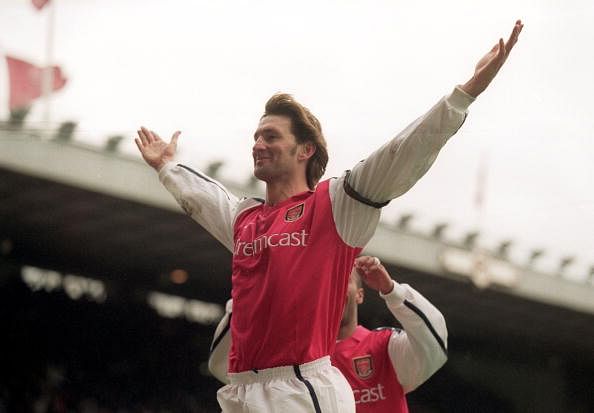
6. Tony Adams. The centreback was named Captain of London soccer club Arsenal when he was just 21 years old, and led them to the championship of England's Football League in 1989 at 22.

 On May 6, 1990, he crashed his car and pled guilty to drunken driving. Contrary to what I had previously believed, this wasn't why he was not included on the England roster for the 1990 World Cup. It might have, but he had already been excluded from selection by manager Bobby Robson, who had previously selected him for Euro 88.

Adams spent December 19, 1990 to February 15, 1991 in prison, and was released in time to lead Arsenal to another League title. It took until 1996 for him to finally quit drinking, and he published a harrowing memoir titled Addicted.

In 1997-98, his first full season completely sober, he led Arsenal to win the Premier League (successor to the Football League) and the FA Cup -- "winning The Double." Arsenal accomplished this again in 2002, his final season.
The man known as "Mr. Arsenal" went on to manage Wycombe Wanderers and Portsmouth, and now manages Gabala FC in Azerbaijan, and runs Sporting Chance Clincic, an alcohol and drug rehabilitation clinic in his native London.

5. Ralph Terry. In Game 7 of the 1960 World Series, Terry, pitching for the New York Yankees, gave up a game-winning, World Championship-winning, home run to Bill Mazeroski of the Pittsburgh Pirates. This remains the only home run ever to win a World Series Game 7.

Two years later, Terry pitched a 3-hit shutout in Game 7 of the 1962 World Series against the San Francisco Giants. He'd also started and won Game 5.

 No, he didn't pitch Game 7 on 2 days' rest, although this would later be done by Bob Gibson in 1964 (he won), the aforementioned Sandy Koufax in 1965 (he won), Jim Lonborg in 1967 (he lost) and Mickey Lolich in 1968 (he won). A rain delay allowed a rejiggering of the rotations and for Terry, who'd also pitched for the Yanks' in the 1961 World Series victory, to get full redemption.
4. Roberto Durán. He might have been the greatest lightweight boxing champion ever, and was a hero in Latin America, in particular treated nearly as a god in his native Panama. In 1980, in front of 60,000 people at the Olympic Stadium in Montreal, he defeated Sugar Ray Leonard to win the welterweight championship.

But a few months later, a rematch was held in front of 70,000 people in the Superdome in New Orleans. This time, Leonard fought better, and was taunting Durán. At the end of the 8th round, Durán, trailing on all cards, turned to the referee, also a Latin American, Octavio Meyran of Mexico, and said to him in Spanish, "I don't want to fight with this clown," and he went back to his corner and quit.

Broadcasting the fight for ABC, Howard Cosell said -- erroneously, as it turned out -- that what Durán had told the ref was, "No más" -- "No more." Leonard was declared the winner by technical knockout, and regained the title. To make matters worse, the official excuse for Durán quitting was "stomach cramps." If he had them before the fight, it should have been postponed.

The man known as Hands of Stone was viewed to have feet of clay. Back in Panama, both his house and his mother's were vandalized. Graffiti appeared in Panama City calling him a coward, a traitor, and even "maricón" -- roughly, the Caribbean Spanish word for the anti-gay slur "faggot.

(This was the word Benny "the Kid" Paret had used at Emile Griffith during the weigh-in for their 1962 Welterweight Championship and trilogy-decider fight, that led Griffith to pound away at him so hard during the fight that Paret died.)

In 1983, Durán fought Super Welterweight Champion Davey Moore in front of a mostly-Latino crowd at Madison Square Garden, hoping to see the return of a former hero to heroic status. 

It was no contest: Durán crushed Moore, whose cornermen threw in the towel -- appropriately enough, in the 8th round, the same round that did Durán in 3 years earlier. Durán regained not only a title (if not the same one), but also his strong, masculine image, his pride, his reputation, and his fans.
Interesting that SI correctly put an accent mark on the A in "No más,"
but, incorrectly, not on the one in "Durán."

3. George Steinbrenner. From bullying his shipbuilding company's employees into helping him make illegal contributions to President Nixon's 1972 re-election campaign to hiring a compulsive gambler to dig up dirt on Dave Winfield, to all those firings and otherwise unfairly treating employees, "The Boss" became the most hated man in baseball since Walter O'Malley moved the Dodgers out of Brooklyn.

Forced in 1990 to step aside and let "my baseball people" run the show, they did, and rebuilt the Yankee Dynasty. And, from 1996 until his death earlier this year, at ballparks and ticker-tape parades, Yankee Fans chanted, "Thank you, George!" And, to his credit, he understood and appreciated how far he had come to receive that.
2. Muhammad Ali and George Foreman. I make this a dual entry because the two men are forever linked, and Ali's atonement made Foreman's necessary.

Ali was stripped of the heavyweight boxing title in 1967, when he refused to accept being drafted into the U.S. Army during the Vietnam War. In 1968, Foreman won an Olympic Gold Medal (as Ali, then still named Cassius Clay, had done in 1960 and their later opponent Joe Frazier had done in 1964). Foreman, saying he did it as a gesture of pride rather than to position himself as an "anti-Ali," celebrated by holding up a small American flag in the ring.

 Foreman became a hero to those who hated Ali, and not since Jack Johnson, the first black champion (1908 to 1915), had an American athlete been so widely hated.

In 1974, with Foreman now champion and as yet undefeated as a professional, he and Ali stepped into the ring in Kinshasa, Zaire (now the Democratic Republic of the Congo), and Ali pulled off a stunning victory.

In just 7 years -- 7 years that showed just how wrong both the Vietnam hawks and the Ali-haters, usually one and the same, were -- Ali went from being nearly universally reviled by whites and frequently so by many blacks, to being the biggest sports hero on the planet for his amazing comeback.

But Foreman was never the same fighter, and he struggled for 3 years until retiring. He became an ordained minister, and in 1987 returned to fighting after 10 years to raise money for his Houston church.

 In 1991, 42 years old, he fought then-champion Evander Holyfield to a near-standstill. Holyfield won by decision, but everyone seemed to think that Big George, who had turned himself from a near-monster to a big, cuddly man of God, had proven his point.

Everyone, that is, except George. He continued to fight, and in 1994, age 45, wearing the exact same trunks he wore against Ali 20 years earlier, knocked out then-champion Michael Moorer, to become the oldest man ever to hold the title. It lasted only a year (I won't get into that story here), but what a story.
1. Ralph Branca. The one exception on this list: He is Italian and Catholic on his father's side, and is a practicing Catholic, but is Jewish on his mother's side.

Of course, we all know that Branca gave up the home run to the late Bobby Thomson that sent the 1951 National League Pennant from Branca's Brooklyn Dodgers to Thomson's New York Giants, the Dodgers' arch-rivals.

What some of you may not know is that Branca is one of the founders and directors of the Baseball Assistance Team (BAT). The assistance provided takes many forms. Health care, financial grants, rehabilitative counseling or whatever form is required to attain some type of comfort and dignity for former players and their families with demonstrated needs.
Gives a whole new meaning to the words "relief pitcher."