Showing posts with label quarterback. Show all posts

Friday, February 6, 2026

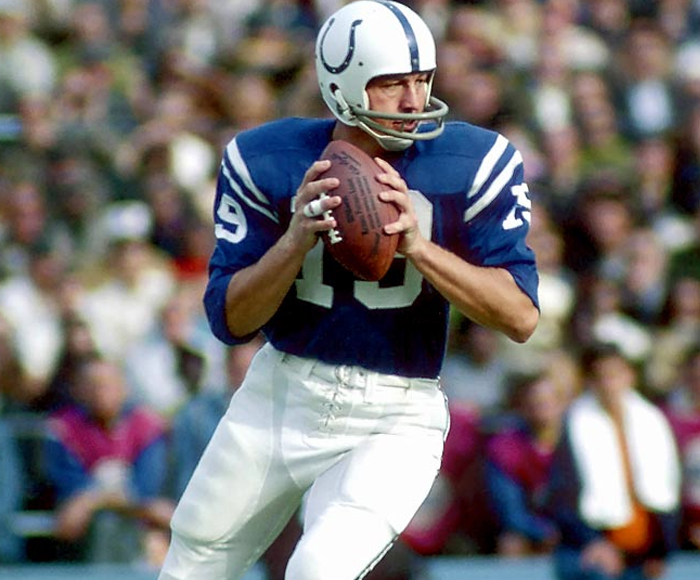
Sonny Jurgensen, 1934-2026

Who led the NFL in touchdown passes in the 1960s? It wasn't Johnny Unitas, or Bart Starr, or Joe Namath, or Fran Tarkenton. It was Sonny Jurgensen.

Christian Adolph Jurgensen III was born on August 23, 1934 in Wilmington, North Carolina. He starred in football, baseball and basketball at New Hanover High School. Other notable alumni include fellow NFL stars Roman Gabriel, Clyde Simmons and Alge Crumpler; baseball star Trot Nixon; and TV journalist David Brinkley.

"Sonny" was chosen to start at quarterback for the North Carolina all-stars in the annual Shrine Bowl against the South Carolina All-Stars in Charlotte. He then went to Duke University in Durham, where he was not only a quarterback, but a fine defensive back, and led them to the 1954 ACC title and a win over Nebraska in the 1955 Orange Bowl. It's funny how, with all the great basketball players who have gone to Duke, the school's greatest athlete from the State that they're actually in is a football player.

He became Norm Van Brocklin's backup on the Philadelphia Eagles, winning the 1960 NFL Championship. Van Brocklin retired, and Sonny became the starter in 1961, making the 1st of 5 Pro Bowl teams, leading the NFL in passing yards 5 times and in touchdown passes twice.

In 1964, the Eagles named Joe Kuharich as head coach. Kuharich was a massive prude, and Sonny liked the nightlife, so Joe traded Sonny to the Washington Redskins for their starting quarterback of the time, Norm Snead.

This trade was so dumb! How dumb was it? Over the rest of the decade, the Eagles floundered, while the Redskins got better, eventually becoming the team (albeit quarterbacked by Billy Kilmer, with Sonny as an aging backup) that won the 1972 NFC Championship.

I mentioned that Sonny threw more touchdown passes in the 1960s than any other quarterback. Guess which quarterback threw more interceptions in the 1960s than any other. Did I telegraph the punch enough? It was Norm Snead. And Joe Kuharich traded Sonny for Norm.

It took the Redskins a while to go from terrible to great, and by the time the process was finished, so was Sonny, pretty much. Typical of this period of Washington football was their game against the Giants on November 27, 1966, at District of Columbia Stadium (renamed Robert F. Kennedy Memorial Stadium in 1969). The 'Skins scored 72 points, the 2nd-highest total in NFL history. But their defense was so weak, the Giants scored 41. The 113 combined points remains an NFL record. Sonny only threw 16 passes, completing 10, for 145 yards, for 3 touchdowns and no interceptions. But a balanced rushing attack got 209 yards for Washington.

On September 15, 1968, the Redskins beat the Chicago Bears, 38-28 at Wrigley Field in Chicago. Sonny went 14-for-21 for 276 yards, 4 touchdowns, and no interceptions. In the 2nd quarter, with the ball on his own 1-yard line, Sonny threw the ball to Gerry Allen, who caught the ball at the Washington 35, and ran the remaining 65 yards. It was a 99-yard touchdown pass, tying an unbreakable NFL record. It was the 5th time it had happened. It has now happened 11 times, although not since 2011, when Eli Manning and Victor Cruz combined for it.

Sonny Jurgensen led the NFL in pass completions 4 times, 5 times in passing yards, 5 times in yards per game, twice in passing touchdowns, made 5 Pro Bowls, and had the highest career "quarterback rating" of any player before the 1978 rule changes that opened up the passing game: 82.6.

Vince Lombardi, who coached the Redskins in the last season of his life, 1969, said, "If we would have had Sonny Jurgensen in Green Bay, we'd never have lost a game." And this is a man who had Bart Starr, the only man to quarterback 5 NFL Championship teams without cheating. Although the thought of Sonny Jurgensen and Paul Hornung playing together on Saturday night before they played together on Sunday afternoon is a scary thought.

Lombardi began the Redskins' resurgence, but he died of cancer in 1970. In 1971, George Allen was named head coach, and Jurgensen should have been his kind of guy, a seasons veteran for Allen's "Over-the-Hill Gang." But injuries struck him, and Billy Kilmer was named the starter. It was Kilmer who led them to the Playoffs in 1971, and to the NFC Championship in 1972. Jurgensen did not play in Super Bowl VII, and the Redskins lost to the Miami Dolphins.

It was the NFL's 1st real quarterback controversy since Van Brocklin and Bob Waterfield on the early 1950s Los Angeles Rams. Just as with the Mickey Mantle and Roger Maris home run record chase in 1961, fans took sides, putting "I Love Billy" or "I Love Sonny" bumper stickers on their vehicles. The defensive-minded Allen preferred Kilmer's conservative, ball-control style of play to Jurgensen's more high-risk approach. Despite the controversy, Jurgensen was helpful to his rival. Even until his death, Kilmer still stayed at Jurgensen's house when he was in town.

In 1974, at the age of 40 and in his final season, Jurgensen won his 3rd NFL passing crown, even though he was still splitting time with Kilmer. In the final game of his NFL career, Jurgensen made his 1st and only appearance as a quarterback in an NFL postseason game, in the Redskins' 19–10 loss to the Rams in the Divisional Round of the Playoffs. He came off the bench in relief of Kilmer, and completed 6 of 12 passes, but also threw 3 interceptions.

Sonny was named to the College and Pro Football Halls of Fame, the Duke Sports Hall of Fame, the NFL's 1960s All-Decade Team, the Philadelphia Eagles Hall of Fame and the Washington Redskins Ring of Fame. In 1975, just after he retired, he and Hall of Fame linebacker Sam Huff formed a beloved broadcasting team for the Redskins. Sam retired from this role in after the 2012 season, Sonny after 2018.
For most of their history, the team now known as the Washington Commanders did not officially retire uniform numbers, with Sammy Baugh's 33 being the lone exception. But Sonny Jurgensen's Number 9 has only been given out once since he retired after the 1974 season.

That was in 2002, by new head coach Steve Spurrier, to one of his former University of Florida quarterbacks, Shane Matthews. He also gave Number 7, worn by Joe Theismann, to another of his Florida quarterbacks, Danny Wuerffel. Redskin fans were so angry that, before the regular season started, Spurrier got the message, and switched Wuerffel to 17 (which was Kilmer's number, but there was no outcry over that) and Matthews to 6. In 2022, at the age of 88, Sonny Jurgensen finally got his Number 9 retired by the Washington Commanders.

He met his 1st wife, Suzanne Long, while they were students at Duke. They had 2 sons, Greg and Scott, before later divorcing. Jurgensen married Margo Hurt in 1967. That couple also had 2 sons, Erik and Gunnar.

Sonny died on February 6, 2026, at 91. That day, on ESPN's Pardon the Interruption, co-hosts Tony Kornheiser and Michael Wilbon, both former sports columnists for The Washington Post, paid tribute to an old friend. In spite of his not having won a title there (his only title coming as a Philadelphia backup), Tony said, "Sonny Jurgensen could possibly be the most popular pro athlete in Washington, ever." Mike, who had been part of a pregame and postgame show with Sonny in the 1980s, said, "I am honored and humbled to have been able to work with Sonny Jurgensen."

With Sonny's death, there are 6 surviving players from the 1960 NFL Champion Philadelphia Eagles: Jerry Reichow, Billy Ray Barnes, Ted Dean, Theron Sapp, J.D. Smith and John Wilcox.

Friday, January 24, 2020

Super Bowl Starting Quarterbacks' Records by Uniform Number

Super Bowl starting quarterbacks' records by uniform number:
1: 0-1. Cam Newton lost Super Bowl 50.

2: 0-1. Matt Ryan lost LI.

3: 1-2. Daryle Lamonica lost II, Russell Wilson won XLVIII and lost XLIX (but it was Pete Carroll's fault).

4: 1-1. Brett Favre won XXXI and lost XXXII.

5: 1-1. Donovan McNab lost XXXIX, Joe Flacco won XLVII.

6: 0-0. No quarterback wearing the number has ever started an NFL Championship Game, under any name.
7: 5-10. Craig Morton lost XII. Ron Jaworski lost XV. Ken Anderson lost XVI. Joe Theismann won XVII and lost XVIII. John Elway lost XXI, XXII and XXIV, and won XXXII and XXXIII. Boomer Esiason lost XXIII. Ben Roethlisberger won XL and XLIII and lost XLV. Colin Kaepernick lost XLVII.

8: 5-2. Troy Aikman won XXVII, XXVIII and XXX. Steve Young won XXIX. Trent Dilfer won XXXV. Matt Hasselbeck lost XL. Rex Grossman lost XLI.

9: 3-1. Jim McMahon won XX. Steve McNair lost XXXIV. Drew Brees won XLIV. Nick Foles won LII.

10: 2-3. Fran Tarkenton lost VIII, IX and XI. Eli Manning won XLII and XLVI. Jimmy Garoppolo, take note.

11: 2-3. Joe Kapp lost IV. Tony Eason lost XX. Phil Simms won XXI. Mark Rypien won XXVI. Drew Bledsoe lost XXXI.
12: 17-14. This will take a while. Joe Namath won III. Roger Staubach won VI and XII, and lost X and XIII. Bob Griese lost VI, and won VII and VIII. Terry Bradshaw won IX, X, XIII and XIV. Ken Stabler won XI. Jim Kelly lost XXV, XXVI, XXVII and XXVIII. Stan Humphries lost XXIX. Chris Chandler lost XXXIII. Kerry Collins lost XXXV. Tom Brady won XXXVI, XXXVIII, XXXIX, XLIX, LI and LII, and lost XLII, XLVI and LII. Rich Gannon lost XXXVII. Aaron Rodgers won XLV.

13: 1-3. Dan Marino lost XIX. Kurt Warner won XXXIV, and lost XXXVI and XLIII.

14: 1-2. Craig Morton lost V. Neil O'Donnell lost XXX. Brad Johnson won XXXVII.

15: 4-2. Bart Starr won I and II. Earl Morrall lost III and won V. Vince Ferragamo lost XIV. Jeff Hostetler won XXV. Patrick Mahomes, take note.

16: 7-3. Len Dawson lost I and won IV. Jim Plunkett won XV and XVIII. Joe Montana won XVI, XIX, XXIII and XXIV. David Woodley lost XVII. Jared Goff lost LIII.

17: 1-2. Billy Kilmer lost VII. Doug Williams won XXII. Jake Delhomme lost XXXVIII.

18: 2-2. Peyton Manning won XLI and 50, and lost XLIV and XLVIII.

19: 0-0. Johnny Unitas played in 2, but wasn't the Colts' quarterback of record in either: He came off the bench in III, but couldn't save them; and started V, but was hurt, and Earl Morrall won it.

Saturday, May 7, 2016

Top 5 Reasons You Can't Blame the Pittsburgh Steelers for Cutting Johnny Unitas

May 7, 1933: John Constantine Unitas is born in Pittsburgh. He died on September 11, 2002 in Baltimore. In the intervening 68 1/2 years, he became, quite possibly, the best quarterback who ever lived.

He could have done it for his hometown team, the Pittsburgh Steelers. But you don't see his Number 14 on the wall at Heinz Field, do you? (Note: That photograph above is real, not photoshopped.)

The Steelers drafted him in 1955, but cut him before the season started. They also had, in their training camps of the 1950s, Len Dawson and Jack Kemp -- all at a time when Terry Bradshaw was still a little kid.

The quarterbacks they kept for the 1955 season? The starter was Jim Finks. He's in the Pro Football Hall of Fame... as an executive. Most fans who know him as an executive have never seen film of him playing, and I'm sure a lot of them didn't even know that he played.

The backups? One was Ted Marchibroda, who opposed Unitas' Louisville for St. Bonaventure. That school, which dropped football while he was there, allowing him to transfer to the University of Detroit Mercy, hosted the Steelers' training camp in Olean, New York. Why there? Because the athletic director was Father Dan Rooney, brother of Steelers founding owner Art Rooney.

Marchibroda, too, would be an important figure in the history of Baltimore football, coaching the Colts to 3 straight AFC Eastern Division titles in the 1970s, after Unitas retired; and becoming the 1st coach of the Ravens. The other backup that the Steelers kept in '55 was Vic Eaton, from the University of Missouri, who didn't get far in the NFL.

The Steelers' head coach was Walt Kiesling. Once a good offensive lineman by the standards of his time (the 1920s), he was an idiot as a coach. Because of him, the Steelers were the last NFL team to drop the single-wing formation that had dominated football in the 1st half of the 20th Century, before the T formation began to take over in the 1940s.

He seemed to have one play: Handing the ball off to Fran Rogel, a running back from Penn State (making him a "local hero," I suppose). Steeler fans, not happy about this, would chant, "Hi diddle diddle, Rogel up the middle." It usually didn't work.

"Kiesling was an introverted guy," Marchibroda said, half a century later, "who had very little correspondence with the players. It seemed all head coaches in the pros were more distant then, but he was more distant than most. I'm not sure Keez even knew that John was there."

Clearly: Unitas wasn't sent out to take a single snap in the Steelers' exhibition games. So he would spend time after practice getting in more practice, tossing the ball around with Art Rooney's sons: Art Jr., Dan and Pat. They would all remember how good Unitas' arm was, even then.

It would be the late 1960s, and the total collapse of a once-promising team (the Steelers just missed Division titles, and berths in the NFL Championship Game, in 1962 and '63), before Art Sr. finally gave up, and turned control of the team over to his sons. They built a team that dominated the 1970s, including going 4-0 in Super Bowls. If Art Sr. had listened to Art Jr., Dan and Pat in the Summer of '55, maybe "The Man With the Golden Arm" would have been a Steelers legend.

To make matters worse -- Met fans may remember how Omar Minaya made Willie Randolph fly across the country on a roadtrip before firing him and sending him back -- instead of telling Unitas before the last exhibition game, which was in his hometown of Pittsburgh, that he was cutting him, Kiesling waited until they got back to Olean, before Keez dropped the other shoe.

"You know," Unitas later claimed he'd said to Kiesling, "I wouldn't mind being released or being cut if I'd had an opportunity to play and I screwed up very badly. But you never gave me the damn opportunity to do it!" Later still, Johnny U said, "I was really, really ugly with Kiesling. I called him every name I could think of."

Years later, when Unitas was playing in Baltimore under head coach Wilbur "Weeb" Ewbank, Weeb told John about a meeting he had with Nick Skorich, one of Kiesling's assistants. Skorich told Weeb that Kiesling said John was "just too dumb," that he "couldn't keep the plays straight in the huddle."

After the Philadelphia Eagles won the 1960 NFL Championship, coach Buck Shaw retired, and Skorich was named head coach. The team collapsed. Skorich later coached the Cleveland Browns. He never made the Playoffs as a head coach. Who looks dumb now?

Surely, there had to be reasons for the Steelers to cut a hometown guy who turned into such a great quarterback...

Top 5 Reasons You Can't Blame the Pittsburgh Steelers for Cutting Johnny Unitas

5. The Mentality of the Times. The following men were great quarterbacks in the NFL in 1955: Otto Graham of the Cleveland Browns, Bobby Layne of the Detroit Lions, Norm Van Brocklin of the Los Angeles Rams, Y.A. Tittle of the San Francisco 49ers... and that's it. George Blanda is in the Pro Football Hall of Fame, with those other 4, but for what he did later on in the AFL, not for what he was doing in the Fifties with the Chicago Bears.

This is because it was still a game where running the ball was considered the key. Most coaches in the Fifties thought the same way that Woody Hayes, the head coach at Ohio State University, thought: "There are three things that can happen when you throw the football, and two of them are bad." (A completed pass, an incomplete pass, and an interception.)

It was Graham, Layne, and, in a few years, Unitas who helped turn it around, and make the passing game a serious weapon in the NFL. Before them, a great quarterback was an outlier: Sid Luckman of the Bears, and Sammy Baugh of the Washington Redskins. But Graham and Layne paved the way, and Unitas really started the age of the quarterback.

But Kiesling was still coaching the 1920s game in the 1950s. And, while intense loyalty was frequently one of Art Rooney's great virtues, there were times when it was a drawback. "The Chief" was too loyal to old friend Keez, who never got him into the NFL Championship Game.

4. Size Matters. Unitas wanted to play for the University of Notre Dame. coached by Frank Leahy, a pretty good judge of football talent. He had coached 2 Heisman Trophy-winning quarterbacks in Angelo Bertelli and Johnny Lujack.

Unitas got a tryout, but Leahy never saw him. Not figuratively, as in not getting noticed, like with Kiesling, but literally: Leahy never stopped what he was doing long enough to look at Johnny Unitas, who could have been the next great Notre Dame quarterback.

Instead, assistant coach Bernie Crimmins, a former All-American halfback for the Fighting Irish, looked at Unitas. Crimmins said, "Jeez, I like what you do, but, God, you're so small. You're 5-11, 130-some pounds. We're liable to be sued for manslaughter up here."

Even in his senior year at the University of Louisville, he was 6-foot-1, but only around 170 pounds. Playing against defenders who'd been in The War just 10 years earlier, or maybe even Korea more recently than that, ready to look on anybody on the other team as "the enemy," and who had no qualms about purposely injuring an enemy?

After all, then as now, football was "a man's game." Johnny U had the height -- we're not talking about 5-foot-9-3/4-inch Doug Flutie here, or the 5-foot-7 Eddie LeBaron then quarterbacking the Redskins -- but not the bulk.

3. Johnny Who? At the time, Unitas was a nobody. Today, a great quarterback coming out of the football-rich region of Western Pennsylvania would have college recruiters all over him by his junior year of high school. Unitas is a big reason why that became true. Conversely, that region's reputation for producing great quarterbacks was not yet in place.

Nor were the means to find him: This was before the Internet, and before modern recruiting tools were available. A recruiter's tools at the time were his eyes for watching a player, his ears for hearing rumors of a great player, and his car for getting to games.

Lujack was the 1st great quarterback from Western Pennsylvania, and had done well for the Bears, but he was now out of the NFL. And he had thus far been followed only by Vito "Babe" Parilli, who had starred for Paul "Bear" Bryant at the University of Kentucky, but was, at this point, in the Canadian Football League. (He would later lead the Boston Patriots, as the New England team was then known, into the 1963 AFL Championship Game, and was Namath's backup on the Jets' Super Bowl team.)

Despite having a decent career at St. Justin's High School, major colleges weren't beating down the door to get Unitas in 1950. It didn't help that St. J's was in Pittsburgh's B League, the league for Catholic schools with small enrollments. (Today, a quarterback of Unitas' talent coming out of a small school in Pittsburgh would have not major colleges, but prep schools, beating down his door, to get him to transfer to them for his senior year, to win games for them and get more exposure to him: "Oh, he's at that school now? He must be a serious player, if they were interested in him.")

Thanks to the contacts of his coach, Max Carey (his real name was James, but he was nicknamed Max after the Baseball Hall-of-Famer of the same name), he got a tryout at Notre Dame. But, as I said, he was turned down for being too skinny. Carey also knew someone at Indiana University, but they took a look at Unitas, and passed on him.

The 2 big schools in Western Pennsylvania? The University of Pittsburgh offered him a scholarship, but he failed the entrance exam. And it appears that Penn State, then coached by Rip Engle with Joe Paterno in his 1st year as an assistant, and not yet the powerhouse it would become with Paterno as head coach, didn't look at him at all.

Nor did any of the other major football-playing Catholic schools of the time, such as Fordham in New York and Boston College, take a serious look at him. The aforementioned Woody Hayes did not recruit him for Ohio State. Nor did the aforementioned Bear Bryant, the great University of Alabama coach, then leading Kentucky to that season's Southeastern Conference Championship. Nor did Bud Wilkinson at the University of Oklahoma.

Nor did Bennie Oosterbaan of the University of Michigan, Big Ten Champions. Nor did Blair Cherry of the University of Texas, Southwest Conference Champions. Nor did Pappy Waldorf of the University of California, Champions of the league now known as the Pac-12. Nor did Darrell Royal, the great University of Texas coach, then at Mississippi State University, and a former quarterback himself at Oklahoma under Wilkinson.

Unitas was accepted at the University of Louisville. While that school has produced a few decent college quarterbacks from the 1990s onward, it was not known for football in the Fifties. It wasn't even known for basketball then.

Under the rules of the time, freshmen were eligible at Louisville, giving him 4 years to impress the pro scouts. But they went just 12-22 in his 3 years on the varsity: 5-4 in 1951, 3-5 in 1952, 1-7 in 1953, and 3-6 in 1954, his senior year. Due to injuries, Unitas didn't even have the most passing yards on his own team that last year.

And even when the Steelers went to camp, having drafted Unitas in 1955, he didn't seem to impress anyone. Maybe that was down to Walt Kiesling (or Nick Skorich) being an idiot, but Ted Marchibroda and Jim Finks, 2 of the other 3 quarterbacks in camp, weren't impressed, either, and they both proved to be very smart football men. Marchibroda remembered:

To be honest with you, Finks and I hardly noticed him, either. Later, when we had reason to think back, Jim and I talked about it. What had we missed? Neither one of us could remember a single thing John had done. 

2. The Other NFL Teams. The Steelers drafted Unitas in the 9th round. How far down is that? Today, the NFL Draft only has 7 rounds. Think about what that means: It means that all 12 teams then in the NFL -- the Steelers, the Browns, the Lions, the Rams, the Bears, the Redskins, the Eagles, the Chicago Cardinals, the Green Bay Packers, the New York Giants, the San Francisco 49ers, and, yes, the Colts, the team that eventually did sign him -- had eight chances to draft him, and all twelve refused all eight.

Or, should I say, those teams had an average of 8 picks. The Steelers had 6 chances, before finally drafting Unitas with their 7th possible pick. (Unless you really know your Steeler history, you've never heard of any of the 1st 6.)

The Colts actually had 10 chances. So did the Cards, and they didn't go to an NFL Championship Game (under that name or the Super Bowl name) again until the 2008 season. The Lions had 11 chances to draft Johnny Unitas -- they sure could have used him after they dumped Bobby Layne, and they haven't won an NFL Championship, or even reached an NFL Championship Game (or Super Bowl), since the 1957 season.

The Rams also had 11 chances, and they didn't reach an NFL Championship Game (or Super Bowl) between 1955 and 1979. The Browns had 9 chances. The Bears, the Packers, the Eagles and the 49ers each had 8 chances. The Redskins had 7, and the Giants only 5.

He was the 102nd pick. One hundred and one players were chosen in the NFL Draft before Johnny Unitas. Or, to put it another way: Take the Steelers, the team that actually did draft him, out of the equation, and there were 95 chances for 1 of the other 11 teams to have drafted Unitas. Ninety-five. Not one of those chances was taken.

To give you more perspective: The Colts did take a quarterback with the 1st pick in the 1955 NFL Draft. Not Unitas, but George Shaw. Who? The guy Johnny U replaced as Colts starting quarterback in 1956.

That was a bonus lottery pick, for having been so bad. With the 3rd pick, their regular pick, the Colts took the Heisman Trophy winner, Alan Ameche of the University of Wisconsin. Just 4 seasons later, Unitas would hand off to Ameche, who would take the ball into the end zone and win the 1958 NFL Championship. They also won the 1959 title together.

Darris McCord was drafted by the Lions, in the 3rd Round. The Giants took Rosey Grier in the 3rd, Mel Triplett in the 5th, and Jimmy Patton in the 8th. But, aside from Ameche, those were the most notable players taken ahead of Unitas.

What I'm trying to say is, If the Steelers were fools for taking until the 9th round to draft Johnny Unitas, and fools for releasing him before he ever took a regular-season snap, it makes things look worse for the 11 teams that didn't draft him, including the Colts, who would sign him for 1956, and change the course of football history.
Why is this man smiling? Because he's playing for Weeb Ewbank,
not sitting on the bench for Walt Kiesling. And it's working.

1. Lady Luck. As ESPN said when they did The Top 5 Reasons You Can't Blame the Portland Trail Blazers for Drafting Sam Bowie (instead of Michael Jordan), "The draft is a crapshoot." This has always been true for all 4 major North American sports. But it went well beyond that in football in the 1950s.

Football scouting in the Fifties was a tricky business. There was no ESPN to allow pro scouts, coaches and general managers to see who was a great pro prospect, who was a good college player but might not be adaptable to the pros, and who was someone you should pass by completely. There was no sharing of game footage between college and pro teams. You could see a player on a good day, and then find out that this was as good as he got, and that your draft pick was wasted; or you could see a great player on a bad day, and pass him up.

In other words, you can't blame the Steelers for not knowing what they had in Unitas, for the same reason you can't blame the other 11 teams for not drafting him at all. Nobody knew very much. To find a great player, you either had to have somebody right there in town, making it easy and cheap to send someone to go see him (this was before TV discovered the NFL, and the NFL discovered revenue sharing), or you had to get lucky.

Lady Luck did not smile on the Pittsburgh Steelers in 1955, the year the film version of Guys and Dolls featured Marlon Brando singing "Luck Be a Lady." A year later, she did smile on the Baltimore Colts, and a legend was born.

In 1969, the Steelers went 1-13, and the best quarterback in the team's 37-season history to that point was the aging Bobby Layne, who nearly got them into the Playoffs in 1962, then retired. They got the top pick in the 1970 NFL Draft, and, with Art Rooney turning the reins over to sons Dan and Art Jr., they used it to draft a little-known quarterback from a small school starting with L -- in that case, Louisiana Tech, which, like Unitas' Louisville, would become better known for basketball (in their case, women's hoops).

The quarterback's name was Terry Bradshaw. Like Unitas, he would be a member of 4 NFL Championship teams, make his team one of the iconic ballclubs of North American sports, and make the Pro Football Hall of Fame.

But it would be a painful process for T.B. It could have been very different. He could have had Johnny U to mentor him on the Steelers.
I was hoping to find a photo
of the 2 of them together, but I couldn't.

Johnny Unitas retired after the 1973 season, after an incongruous final season with the San Diego Chargers. He was elected to the Pro Football Hall of Fame in 1979, saw the Colts moved from Baltimore to Indianapolis in 1984, threw out a ceremonial first ball (a football) alongside Brooks Robinson before the Orioles' last game at Memorial Stadium in 1991, handed the game ball to the officials before the Ravens' 1st game at Memorial Stadium in 1996, and died in 2002, shortly after demolition of Memorial Stadium began.
Cal Ripken and Johnny Unitas

A statue of him now stands outside M&T Bank Stadium in Baltimore. There is a statue outside Heinz Field in Pittsburgh, but it's of Art Rooney, not any quarterback, not even Terry.

Thursday, January 22, 2015

Top 10 Quarterbacks of All Time

The Super Bowl is coming up. What is the purpose of a quarterback? To lead his team to victory -- ultimately, in the Super Bowl.

That's how great quarterbacks are measured. Dan Marino: Great passer, but never won a Super Bowl. Earl Morrall, Doug Williams, Jeff Hostetler, Mark Rypien, Trent Dilfer, Brad Johnson? Not sensational quarterbacks, but all won a Super Bowl, and so all are ahead of Marino.

Period.

Top 10 Quarterbacks of All Time

You'll notice that Russell Wilson of the Super Bowl-bound Seattle Seahawks is not on this list. Check back in 10 years. Same for Ben Roethlisberger, Drew Brees, Aaron Rodgers and Joe Flacco.

You'll notice that Tom Brady of the Super Bowl-bound New England Patriots is not on this list. You know why.

And you'll notice that neither of the Manning brothers is on this list. Eli's not here because, although I once called him the greatest quarterback in New York history in a previous post on this blog, and still think so, I don't think he's ahead of any of these guys.

Peyton's not here because, for all his talent, and for all his records, he is the most disappointing quarterback of all time. Yes, he's won a title. So has Alex Rodriguez. Now, I'm not saying Peyton cheats -- although I think shilling for Papa John is a greater slap in the face of the people watching him than A-Rod using steroids -- but I am saying that I get the feeling that, if Brady and the Patriots hadn't cheated, Peyton still might have only the 1 ring.

10. Bob Griese. No, he wasn't a great passer. But think of it this way: 15 quarterbacks have led their team to back-to-back NFL Championships. One of those led his team to an undefeated season, from kickoff of Week 1 to the final gun of the title game. And that was Bob Griese of the 1972-73 Miami Dolphins.

True, you can have a lucky year. But he led his team to 2 straight titles, 3 straight Super Bowl appearances, and they dominated the AFC East in the 1970s. Someone directed that offense. That someone was Bob Griese.

If you don't like his son Brian, for whatever reason, don't hold it against Bob.

9. Roger Staubach. I hate the Dallas Cowboys, as does everyone with taste. But he was "Captain Comeback." I take him ahead of Troy Aikman because Aikman had better weapons. Aikman had Emmitt Smith his whole career, while Staubach only had a great running back, Tony Dorsett, towrd the end. Aikman had Michael Irvin and Jay Novacek to pass to his entire career, while Staubach's options were Drew Pearson and... Golden Richards?

8. Sid Luckman. The 1st quarterback to master the T formation in the NFL, he led the Chicago Bears to 4 titles in the 1940s -- and it might have been more if he didn't miss 2 seasons in World War II.

7. Sammy Baugh. Along with Luckman, the 1st modern quarterback. Also the only quarterback to lead his team to an NFL championship, under any name, as a rookie.

6. Otto Graham. The only quarterback to get his team into his league's championship game 10 straight seasons. That's all 4 that were played in the All-America Football Conference, leading the Cleveland Browns to win all 4: 1946, 1947, 1948 and 1949. Then 6 in the NFL, winning in 1950, 1954 and 1955, losing in 1951, 1952 and 1953.

5. Bart Starr. The only quarterback to win 5 NFL Championships, taking the Green Bay Packers all the way in 1961, 1962, 1965 1966 and 1967, including the 1st 2 Super Bowls, in which he was the MVP. Brett Favre may hold a lot of records, but he wasn't better than Starr. He might make the Top 20, but not the Top 10.

4. Terry Bradshaw. Maybe I'm a little biased, because, along with Staubach, he was the defining quarterback of my childhood. You could add Fran Tarkenton to that, but he went 0-3 in Super Bowls. You could also add Joe Namath, but after fulfilling his guarantee in Super Bowl III, he never won another Playoff game -- and only appeared in 1 more.

TB won 4 Super Bowls, and was the MVP in 2 of them. He told his teammates, "You might not win with me, but you can't win without me." Like Broadway Joe, Luziana Terry backed it up. In Super Bowl XIII, Cowboy linebacker Thomas "Hollywood" Henderson said the Cowboys would win 31-0 and that, "Terry Bradshaw is so dumb, he couldn't spell 'cat' if you spotted him on the C and the A." Well, he got the Cowboy score right: The Steelers won 35-31. Bradshaw said, "Ask Hollywood how dumb I am now." He proved that, while his brain might not work as well as yours and mine does outside of a football milieu, within it, he was pretty goldurn smart.

3. John Elway. Before Favre, he won more games than any quarterback. And while it took him 4 tries, he did eventually win a Super Bowl. And then another, going out as on top as any athlete ever has, winning the World Championship and the MVP in the title game that turned out to be his last game.

2. Johnny Unitas. He replaced Baugh (or maybe Graham) as the defining figure among quarterbacks, and he may still be. When I was a kid, the answer to, "Who is the greatest quarterback who ever lived?" was, inevitably, "Johnny U."

He made the Baltimore Colts "America's Team" before the Dallas Cowboys ever played a down, made the NFL must-see-TV, and made the quarterback the greatest glamour position in American sports. And he was always grounded about it: He knew he was great, but he never went out of his way to tell people he was.

I never saw Unitas play during his career -- he played his 1st NFL game in Dwight D. Eisenhower's 1st term as President and his last in Richard Nixon's 2nd term -- but I've seen plenty of film of him. There is no doubt in my mind that he would excel just as much in today's game, especially with the liberalization of rules concerning passing and receiving, and with the bigger linemen of today to protect him from the bigger and faster defenders of today. And, despite those iconic black high-top shoes, he could even run a little.

1. Joe Montana. This was a tough call. Maybe I picked Montana simply because, unlike Unitas, who was already in the Hall of Fame before I ever heard of him, I got to see Montana all the way through.
Despite winning 4 Super Bowls with the San Francisco 49ers, and being awarded the MVP in 3 of them, I think the difference between Johnny U and Joe Cool is just a hair. And I mean one of Johnny's little short crew-cut hairs, not one of Joe's long blond hairs.

Monday, December 2, 2013

Franchise Quarterbacks

"How do you have 1 fucking franchise QB in 40 years? This makes Sandy look like a genius."

Those are the words of Twitterer @PinotGreggio, who appears to be a trifle miffed at the New York Jets.

So I decided to compare the Jets to the other teams in the NFL, and here's what I came up with.

I decided to define "franchise quarterback" as "quarterback who is, or will be, or should be, in the Pro Football Hall of Fame who had a title, or near-title, season with said team."

Then I counted the number of "franchise quarterbacks" all 32 teams had. Then I divided that number by the number of seasons they'd played.

I'm also counting moved teams as single franchises, so that the Baltimore and Indianapolis versions of the Colts, and the Los Angeles and St. Louis versions of the Rams, are together. But so are both versions of the Cleveland Browns, while the Baltimore Ravens are separate.

Ties in the rankings are broken by actual HOFers.

The first number after the team's name is the number of seasons per "franchise quarterback," followed by the number they've had in how many seasons they've played.

Here's what I came up with:

1. Oakland/Los Angeles Raiders, 10.8, 5 in 54: Daryle Lamonica, George Blanda, Ken Stabler, Jim Plunkett and Rich Gannon.

2. San Francisco 49ers, 11.3, 6 in 68: Y.A. Tittle, John Brodie, Joe Montana, Steve Young, Jeff
Garcia and Colin Kaepernick.

3. Cleveland/Los Angeles/St. Louis Rams, 12.8, 6 in 77: Bob Waterfield, Norm Van Brocklin, Roman Gabriel, Pat Haden, Jim Everett and Kurt Warner.

4. Philadelphia Eagles, 13.5, 6 in 81: Tommy Thompson, Norm Van Brocklin, Sonny Jurgensen, Ron Jaworski, Randall Cunningham and Donovan McNabb. No, I'm not counting Michael Vick. And I sure as hell am not counting Norm Snead.

5. Washington Redskins, 13.7, 6 in 82: Sammy Baugh, Sonny Jurgensen, Billy Kilmer, Joe Theismann, Doug Williams and Mark Rypien. I'm not counting Robert Griffin III yet.

6. New York Giants, 14.8, 6 in 89: Benny Friedman, Charlie Conerly, Y.A. Tittle, Fran Tarkenton, Phil Simms and Eli Manning. No, I'm not counting Jeff Hostetler. And the day I count Kerry Collins as a "franchise quarterback" is the day you can shoot me.

7. New Orleans Saints, 15.7, 3 in 45: Billy Kilmer, Archie Manning and Drew Brees.

8. Atlanta Falcons, 16.0, 3 in 46: Steve Bartkowski, Michael Vick and Matt Ryan. Yes, I'm counting all 3. What Vick did in Virginia has no bearing on whether he was a "franchise quarterback" in Georgia.

9. Minnesota Vikings, 17.7, 3in 53: Joe Kapp, Fran Tarkenton and Warren Moon. No, I'm not counting Randall Cunningham, except with the Eagles.

10. Jacksonville Jaguars, 18.0, 1 in 18: Mark Brunell.

11. Dallas Cowboys, 18.0, 3 in 54: Don Meredith, Roger Staubach and Troy Aikman. 2 of the 3 in the Hall, and their 2 are better than the Oilers/Titans' 2. No, I'm not counting Craig Morton as a Cowboy. Nor Danny White. Certainly not Tony Romo.

12. Houston Oilers/Tennessee Titans, 18.0, 3 in 54: George Blanda, Warren Moon and Steve McNair. 2 of the 3 in the Hall. No, I'm not counting Dan Pastorini.

13. San Diego Chargers, 18.0, 3 in 54: John Hadl, Dan Fouts and Philip Rivers. 1 of the 3 in the Hall. No, I'm not counting Stan Humphries, even if he did get them into their only league championship game since Lyndon Johnson was a popular President.

14. Baltimore Ravens, 19.0, 1 in 19: Joe Flacco. And their 1 is better than the Bucs' 2, who are better than the Panthers' 1. No, I'm not counting Trent Dilfer.

15. Tampa Bay Buccaneers, 19.0, 2 in 38: Doug Williams and Brad Johnson. Yes, I'm counting them both. No, I'm not counting Steve Spurrier.

16. Carolina Panthers, 19.0, 1 in 19: Jake Delhomme. No, I'm not counting Cam Newton yet.

17. Cincinnati Bengals, 23.0, 2 in 46: Ken Anderson and Boomer Esiason. No, neither one is in the Hall of Fame, but both of them got the freakin' Bengals into a Super Bowl, which is a monumental achievement.

18. Green Bay Packers, 23.3, 4 in 93: Arnie Herber, Bart Starr, Brett Favre and Aaron Rodgers. No, I'm not counting Lynn Dickey.

19. Miami Dolphins, 24.0, 2 in 48: Bob Griese and Dan Marino.

20. Pittsburgh Steelers, 26.7, 3 in 80: Bobby Layne, Terry Bradshaw and Ben Roethlisberger. No, I'm not counting Neil O'Donnell, because I'm not an idiot.

21. Kansas City Chiefs, 27.0, 2 in 54: Len Dawson and Joe Montana. Both in the Hall. Yes, Montana was only a Chief for 2 years, but he's the only man to get the Chiefs into an AFC Championship Game. Ever. (Dawson got them into 3 AFL Championship Games, winning them all, including 1 as the Dallas Texans, but all came before the 1970 merger.)

22. Buffalo Bills, 27.0, 2 in 54: Jack Kemp and Jim Kelly. 1 in the Hall, and perhaps the other should be. No, I'm not counting Doug Flutie.

23. Denver Broncos, 27.0, 2 in 54: Craig Morton and John Elway. 1 in the Hall. I'm not counting Peyton Manning with the Broncos yet.

24. New England Patriots, 27.0, 2 in 54: Drew Bledsoe and Tom Brady. Neither in the Hall yet. Again, I'm not counting Doug Flutie.

25. Chicago Bears, 31.3, 3 in 94: Sid Luckman, Bill Wade and Jim McMahon. No, I'm not counting Rex Grossman.

26. Cleveland Browns, 32.5, 2 in 65: Otto Graham and Bernie Kosar.

27. Baltimore/Indianapolis Colts, 34.0, 2 in 68: Johnny Unitas and Peyton Manning. I'm not counting Andrew Luck yet, or Bert Jones or Jim Harbaugh ever.

28. Seattle Seahawks, 38.0, 1 in 38: Matt Hasselbeck. No, I'm not counting Jim Zorn or Dave Krieg. Nor, yet, Russell Wilson.

29. New York Jets, 54.0, 1 in 54: Joe Namath. No, I'm not counting Richard Todd, or Vinny Testaverde. And even though Mark Sanchez got them to 2 AFC Championship Games, I'm not counting him, either.

30. Detroit Lions, 80.0, 1 in 80: Bobby Layne. Yeah, that's it. No, I'm not counting Matthew Stafford yet. Nor Rodney Peete, nor Gary Danielson, nor Bill Munson.

31. Chicago/St. Louis/Arizona Cardinals, 94.0, 1 in 94: Kurt Warner. Yup, that's it. Jimmy Conzelman (1925 NFL Champions) wasn't a quarterback as we now understand the term, and Paul Christman (1947 NFL Champions) wasn't any better than Trent Dilfer.

32. Houston Texans, infinite, none in 12.

So, the Jets aren't the worst. It should be noted, though, that, of the 3 worse ones, 1 has only been around since 2002; while the other 2 haven't won a World Championship since 1957 and 1947, respectively -- making the Jets' 1968-69 title seem comparatively recent.

Wednesday, February 8, 2012

Top 10 New York Quarterbacks

The Giants' Super Bowl win, their 2nd with Eli Manning as their quarterback, leads to the question of who are New York's best quarterbacks.

Honorable Mention: Ed Danowski, Giants, 1934-41. The position of quarterback was not yet what it would become during the course of his career, largely thanks to Sammy Baugh of the Washington Redskins and Sid Luckman of the Chicago Bears. But with Danowski (1911-1997) as quarterback, the Giants reached 5 NFL Championship Games, winning 2, in 1934 and 1938.

He was the 1st New York quarterback to start in, and the 1st New York quarterback to win, 2 NFL Championship Games. Phil Simms could have been the second, had he not gotten hurt; Eli Manning now is.

Ed's son John Danowski was a successful lacrosse coach at Hofstra University, and has been even more successful at Duke. John's son Matt Danowski is the all time Division I career leader in total points in NCAA lacrosse history.

Honorable Mention: Clarence "Ace" Parker, of the football version of the Brooklyn Dodgers, 1937-41. A great all-around athlete out of Duke University before anyone ever heard of Dick Groat, never mind Mike Gminski or Christian Laettner, he was another pre-Baugh quarterback who nonetheless became an offensive and defensive star.

He also played for the Philadelphia Athletics in 1936 and 1937. This coming May 17, if he makes it, will be his 100th birthday, making him both the oldest living pro football player, the 2nd-oldest living Major League Baseball player, and the oldest living member of any of the 4 major league sports' halls of fame.

10. Jeff Hostetler, Giants, 1984-92. A star at West Virginia University, he married the daughter of his coach, Don Nehlen. He was mainly Simms' backup at the Meadowlands, and only made 25 regular-season starts, nearly all of them in his last 2 seasons with the club. But when Simms was hurt late in the 1990 regular season, it was Hoss who got the Giants all the way through to victory in Super Bowl XXV. In 1993, he went to the Los Angeles Raiders, and got them into the Playoffs.

He is now 50 years old, and has returned to Morgantown, where he runs a construction company.

9. Richard Todd, Jets, 1976-84. Somebody had to succeed Broadway Joe as the Jets' starting quarterback, and, like Joe, he had the University of Alabama pedigree. And while he was mercilessly ripped in the media for not being Broadway Joe, he did get the Jets into the Playoffs twice (same number of times as Joe) and into the 1982 AFC Championship Game.

He is now 58, and works in the finance industry in his native Alabama.

8. Ken O'Brien, Jets, 1983-92. That great "Quarterback Class of '83" included Hall-of-Famers John Elway, Dan Marino and Jim Kelly, All-Pro Todd Blackledge, and Tony Eason whose career wasn't great but he did get the New England Patriots to their first AFL or AFC Championship.

O'Brien wasn't as good as Elway, Marino or Kelly, but he did make a Pro Bowl like Blackledge, passed for over 25,000 yards, and led the NFL with the lowest rate of interceptions in 1985, 1987, and 1988. In 1986 he battled Marino in one of the best-remembered Jet games ever, the 51-46 win over the Dolphins at the Meadowlands.

On a Monday Night Football broadcast, Frank Gifford, who's seen every quarterback since the early Fifties, said of O'Brien, "When he gets the time to throw the football, no one throws it any better than he does."

O'Brien is now 51, and has been a college assistant coach, having coached a Heisman Trophy winner, USC's Carson Palmer, and runs quarterbacking clinics.

7. Vinny Testaverde, Jets, 1998-2003 & 2005. Speaking of Heisman Trophy-winning quarterbacks, Vinny was one at the University of Miami, after being born in Brooklyn and raised just outside New York City in Elmont, Long Island, location of the Belmont Park horse racing track.

His pro career, like that of too many other Heisman winners, looked like it was going to be a bust, until he reached the Jets at age 34. The 1998 season was, and remains, the Jets' best season since the 1968-69 Super Bowl season, as Vinny led Bill Parcells' J-E-T-S-Jets-Jets-Jets to within half an hour of a Super Bowl appearance.

A severed Achilles tendon in the 1st game of the next season ruined things for that group of Jets, but he bounced back, remaining the Jets' starter until 2002, when he was replaced by Chad Pennington (who does not make this list -- nor does current Jets starter Mark Sanchez). Still, he remained in the NFL until 2007, age 44. Think about that: When Barack Obama was beginning his 1st campaign for President, there was a man taking snaps in the NFL who had been born when John F. Kennedy was in the White House.

Vinny is now 48, and will be eligible for the Pro Football Hall of Fame next year. Will he make it? Maybe: He passed for over 46,000 yards, threw 275 touchdown passes (but also 267 interceptions), and holds records for most seasons with at least one touchdown pass (21) and touchdown passes to the most different players (70).

6. Fran Tarkenton, Giants, 1967-71. He's best remembered as the 1st, and then the best, quarterback for the Minnesota Vikings, whom he led to 3 NFC Championships -- but lost the Super Bowl all 3 times. Still, he became the 1st NFL quarterback known for running to avoid a sack and keep a play alive, which became known as "scrambling." This allowed him to set all kinds of NFL records (most since broken), including most completions, passing yards and touchdowns, and reach the Pro Football Hall of Fame.

During his tenure at Yankee Stadium, the Giants weren't a very good team, but it was hardly his fault: A faulty defense meant that the best record the team would have in those years was 9-5 in 1970 -- not unlike the Yankees, whose best finish between 1964 and 1976 was their 93-win season in 1970, but 15 games behind the Pennant-winning Baltimore Orioles. At a time when Broadway Joe was leading the Jets to glory and glamour, Fran the Scrambler was keeping the Giants relevant.

Fran just turned 72, and became a gazillionaire by getting in on the ground floor of the computer industry. He's hosted and co-hosted TV shows, including ABC's That's Incredible!, been a commentator on Monday Night Football, written a self-help book: What Losing Taught Me About Winning, and co-authored a mystery novel, Murder at the Super Bowl.

5. Y.A. Tittle, Giants, 1961-64. Formerly the signal-caller for the Baltimore Colts and the San Francisco 49ers, Yelberton Abraham became, sort of, the Vinny Testaverde of his day. He debuted for the Giants just before turning 35, and got them into the next 3 NFL Championship Games, and it was hardly his fault that they lost them all.

Unfortunately, he is probably best remembered for one of his last games, in 1964, in which he got clobbered by the Pittsburgh Steelers as the great Giants teams of 1956 to 1963 suddenly seemed to get old all at once, a prelude to what would happen to the Yankees the following spring. The photo by Morris Berman of the Pittsburgh Post-Gazette has become a symbol of the price that football players pay for putting their bodies on the line for money.

Tittle is now 85, and retired from the insurance industry. In the film Any Given Sunday, he played the head coach of the Chicago team. He was the 1st quarterback to be elected to the Pro Football Hall of Fame without having led his team to an NFL Championship -- and that's including Ace Parker, who was elected a year after Tittle.

4. Charlie Conerly, Giants, 1948-61. Since Danowski was a pre-Baugh, pre-Luckman quarterback, Charlie (1921-1996) was the 1st "real quarterback" to lead the Giants to a title, in 1956. He was also the first great quarterback out of the University of Mississippi, predating Jake Gibbs, and Archie and Eli Manning.

After the arrival of Tittle led him to retire, he owned a string of shoe stores and appeared as the Marlboro Man in cigarette commercials -- before cigarette advertising was rightly banned from television. Although a member of the College Football Hall of Fame, he has never been elected to the Pro Hall.

3. Joe Namath, Jets, 1965-76. True, he only reached the Playoffs twice. Statistically speaking, Joe's credentials for the Hall of Fame are actually kind of skimpy -- he had far more interceptions (220) than touchdown passes (173), and his career completion percentage was barely over half (50.1). And due to injuries, he had his last good season at age 29, and was done at 34.

But how many New York quarterbacks have won Super Bowls? Four. And how many quarterbacks, for all teams, have won iconic championships? Very few. Joe's Super Bowl III win was one – along with Johnny Unitas and the 1958 NFL Championship Game, one of the top 2 of all time.

Joe is now 68 years old. Since retiring, and being elected to the Hall, he's been an actor and a sportscaster, and has had his personal difficulties. But he's still beloved by fans for his achievement and his personality, and respected by football people for his talent and his determination to succeed despite injuries. And, while he may have been drunk at the time of the interview, I don't blame him for wanting to kiss Suzy Kolber.

2. Phil Simms, Giants, 1979-93. Okay, Phil wasn't the Giants' starting quarterback in Super Bowl XXV, due to injury, but they wouldn't have gotten there without him. And he did complete 22 out of 25 passes in Super Bowl XXI, giving the G-Men their first World Championship of the modern era. Considering how many injuries -- and how many boos -- he got at the beginning of his career, it's amazing how loved he now is.

Now 57, Phil has been CBS' top NFL color commentator for the last few years, although CBS having the AFC package has led him to call a lot more Jet games than Giant games. His son Chris Simms has also been an NFL quarterback, although the less said about Chris' off-field activities, the better.

1. Eli Manning, Giants, 2004–present. Phil Simms led the Giants to 2 Super Bowl seasons and was Super Bowl MVP in 1 of them. Eli has now been named MVP of 2 Super Bowls, and both were better games than the ones Simms and Namath played in. And let's not forget: Much like the Jets were in Super Bowl III, the Giants were underdogs in both of their Supes with the Patriots.

Indeed, being the younger brother of Peyton Manning, having played his college ball at the University of Mississippi rather than a more storied football school, having been greeted with skepticism by Giant fans upon their acquisition of him following the 2004 NFL Draft, and playing in the NFC East with the Philadelphia Eagles' Donovan McNabb and Michael Vick and the Dallas Cowboys' Tony Romo, it can be argued that Eli was an underdog for the first 31 years of his life.

No more. At the beginning of this season, he was asked if he was "an elite quarterback." He said he was. He has now proven it. It will take a mistake of O.J. Simpson or Pete Rose proportions to keep him out of Canton now -- and he and Peyton will probably become the 1st brother combination to both be in the Hall, unless Clay Matthews (father of the Packer linebacker of the same name) joins his brother Bruce (and he should).

Eli at his best still isn't as good as Peyton was at his best, but he's won 2 NFL Championships. Here's a list of the NFL quarterbacks who've done that since Baugh and Luckman rewrote the rules for the passing game:

1. Sid Luckman, 1940, '41, '43 and '46 Chicago Bears
2. Sammy Baugh, 1937 & '42 Washington Redskins
3. Tommy Thompson, 1948 & '49 Philadelphia Eagles
4. Bob Waterfield, 1945 Cleveland & '51 Los Angeles Rams
5. Bobby Layne, 1952 & '53 Detroit Lions (hurt for '57 Championship Game)
6. Otto Graham, 1950, '54 & '55 Cleveland Browns
7. Johnny Unitas, 1958, '59 & '70 Baltimore Colts
8. Bart Starr, 1961, '62, '65, '66 & '67 Green Bay Packers
9. Bob Griese, 1972 & '73 Miami Dolphins
10. Terry Bradshaw, 1974, '75, '78 & '79 Pittsburgh Steelers
11. Roger Staubach, 1971 & '77 Dallas Cowboys
12. Jim Plunkett, 1980 Oakland & '83 Los Angeles Raiders
13. Joe Montana, 1981, '84, '88 & '89 San Francisco 49ers
(Not quite - Phil Simms, 1986 & '90 New York Giants)
14. Troy Aikman, 1992, '93 & '95 Dallas Cowboys
15. John Elway, 1997 & '98 Denver Broncos
16. Tom Brady, 2001, '03 & '04 New England Patriots *
17. Eli Manning, 2007 & '11 New York Giants

And of those, how many have been Super Bowl MVP twice? Just 5: Starr, Bradshaw, Montana, Brady (*) and Elway.

Pretty good company, Eli. He didn't walk off the field either time holding up the "We're Number 1" finger like Namath. But he could have. On the list of the greatest quarterbacks in the history of New York Tri-State Area football, Eli Manning is Number 1. And, hopefully, he's got a few more years to go.