Showing posts with label houston texans. Show all posts

Wednesday, February 11, 2026

NFL Championships, 1920-2025

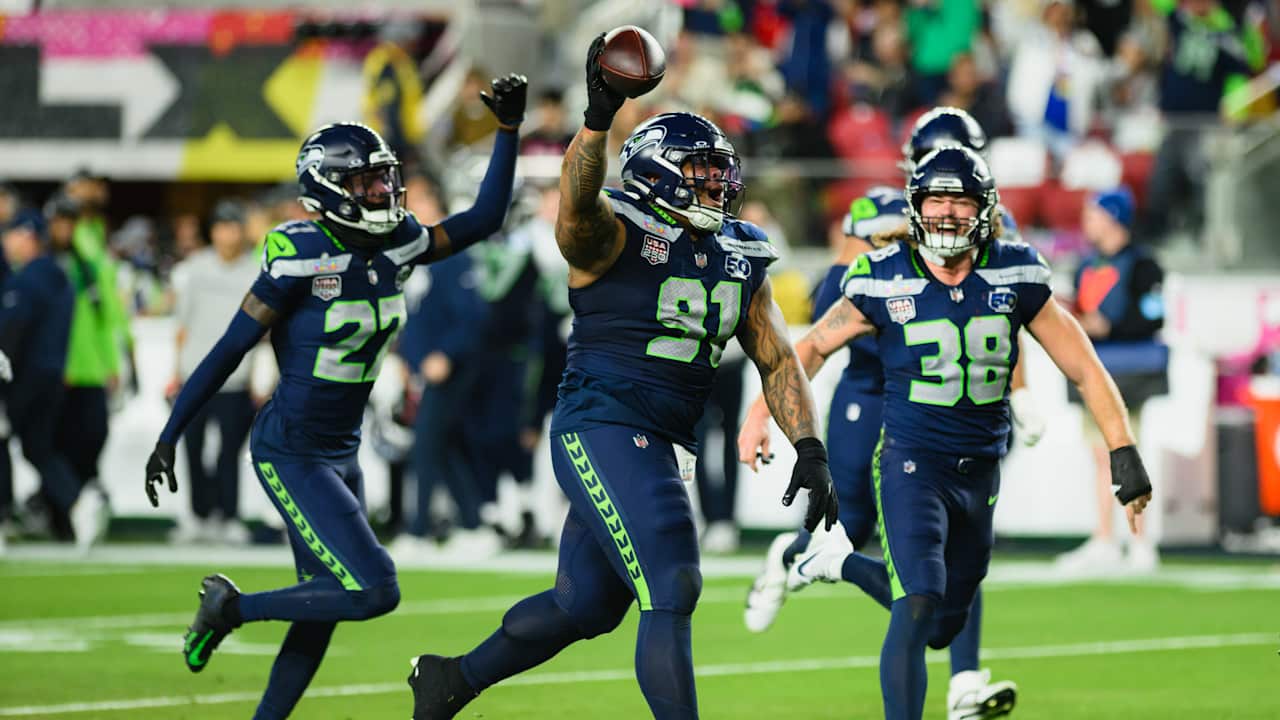
Years posted are of the season, not the year in which the Super Bowl happened. In other words, the Seattle Seahawks just became the 2025 NFL Champions. Teams ranked by most titles including pre-Super Bowl NFL Championships, then by most Championship Games including Super Bowls; then, for teams that have not won the title, fewest seasons without one:

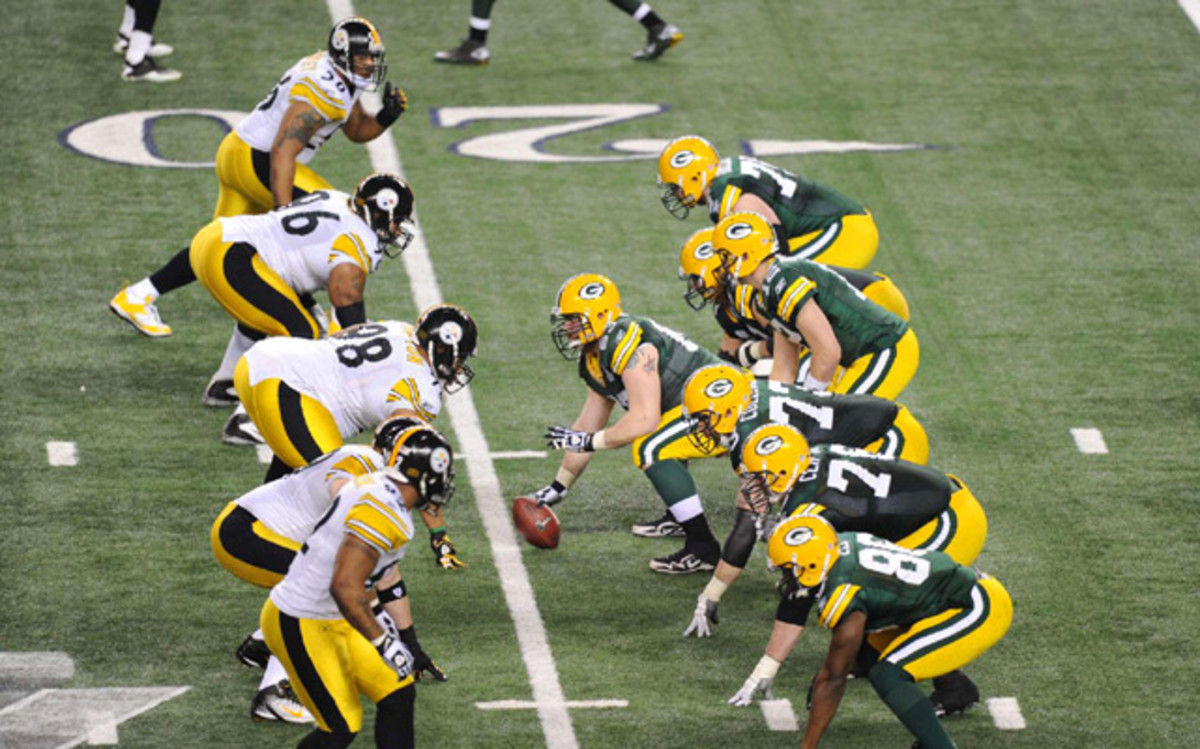
1. 13 Titles, Green Bay Packers: 1929, 1930, 1931, 1936, 1939, 1944, 1961, 1962, 1965, 1966, 1967, 1996, 2010

2. 9 Titles, Chicago Bears: 1921, 1932, 1933, 1940, 1941, 1943, 1946, 1963, 1985

3. 8 Titles, New York Giants: 1927, 1934, 1938, 1956, 1986, 1990, 2007, 2011

4. 6 Titles, New England Patriots: 2001, 2003, 2004, 2014, 2016, 2018; 6 Super Bowls lost: 1985, 1996, 2007, 2011, 2017, 2025

5. 6 Titles, Pittsburgh Steelers: 1974, 1975, 1978, 1979, 2005, 2008; 2 Super Bowls lost: 1995, 2010

6. 5 Titles, Washington Commanders: 1937, 1942, 1982, 1987, 1991 as Washington Redskins; 5 Championship Games lost: 1940, 1943, 1945, 1972, 1983

7. 5 Titles, Philadelphia Eagles: 1948, 1949, 1960, 2017, 2024; 4 Championship Games lost: 1947, 1980, 2005, 2022

8. 5 Titles, San Francisco 49ers: 1981, 1984, 1988, 1989, 1994; 3 Super Bowls lost: 2012, 2019, 2023; 11 NFC Championship Games lost

9. 5 Titles, Dallas Cowboys: 1971, 1977, 1992, 1993, 1995; 3 Super Bowls lost: 1970, 1975, 1978; 6 NFC Championship Games lost

10. 4 Titles, Cleveland Browns: 1950, 1954, 1955, 1964; 4 AAFC Championships: 1946, 1947, 1948, 1949

11. 4 Titles, Kansas City Chiefs: 1969, 2019, 2022, 2023; 3 AFL Championships: 1962 as Dallas Texans, 1966, 1969; 3 Super Bowls lost: 1966, 2020, 2024; 3 AFC Championship Games lost

12. 4 Titles, Los Angeles Rams: 1945 as Cleveland Rams, 1951 as Los Angeles Rams, 1999 as St. Louis Rams, 2022 as Los Angeles Rams; 3 NFL Championship Games lost: 1949, 1950, 1955; 7 NFC Championship Games lost

13. 4 Titles, Indianapolis Colts: 1958, 1959, 1970 as Baltimore Colts, 2006; 2 NFL Championship Games lost, 1964, 1968

14. 4 Titles, Detroit Lions: 1935, 1952, 1953, 1957; 1 NFL Championship Game lost, 1954

15. 3 Titles, Denver Broncos: 1997, 1998, 2015; 5 Super Bowls lost: 1977, 1986, 1987, 1989, 2013 

16. 3 Titles, Las Vegas Raiders: 1976, 1980 as Oakland Raiders, 1983 as Los Angeles Raiders; 2 Super Bowls lost: 1967, 2002

17. 2 Titles, Miami Dolphins: 1972, 1973; 3 Super Bowls lost: 1971, 1982, 1984

18. 2 Titles, Seattle Seahawks: 2013, 2025; 2 Super Bowls lost: 2005, 2014; 1 AFC Championship Game lost

19. 2 Titles, Baltimore Ravens: 2002, 2012; no Super Bowls lost; 3 AFC Championship Games lost

20. 2 Titles, Arizona Cardinals: 1925, 1947, both as Chicago Cardinals; 1 NFL Championship Game lost, 1948 as Chicago Cardinals; 1 NFC Championship Game lost

21. 2 Titles, Tampa Bay Buccaneers: 2002, 2020; no Super Bowls lost; 2 NFC Championship Games lost

22. 1 Title, New Orleans Saints: 2009; no Super Bowls lost; 2 NFC Championship Games lost

23. 1 Title, New York Jets: 1968; no Super Bowls lost; 3 AFC Championship Games lost

24. 2 AFL Championships, Tennessee Titans: 1960, 1961 as Houston Oilers; 7 AFL or AFC Championship Games lost

25. 2 AFL Championships, Buffalo Bills: 1964, 1965; 6 AFL or AFC Championship Games lost

26. 1 AFL Championship, Los Angeles Chargers: 1963 as San Diego Chargers; 7 AFL or AFC Championship Games lost

27. 4 NFC Championships, Minnesota Vikings: 1969, 1973, 1974, 1976; 6 NFC Championship Games lost

28. 3 AFC Championships, Cincinnati Bengals: 1981, 1988, 2021; 1 AFC Championship Game lost

29. 2 NFC Championships, Atlanta Falcons: 1998, 2016; 2 NFC Championship Games lost

30. 2 NFC Championships, Carolina Panthers: 2003, 2014; 2 NFC Championship Games lost

31. 3 AFC Championship Games lost, Jacksonville Jaguars: 1996, 1999, 2017

32. Never reached AFC Championship Game, Houston Texans: Best performance is reaching AFC Division Playoff, last in 2025

Tuesday, February 10, 2026

NFL Championship Droughts, as of Super Bowl LXI

Years posted are of the season, not the year in which the Super Bowl happened. In other words, the Seattle Seahawks just became the 2025 NFL Champions. Teams ranked by their most recent title; then, for teams that have not won the title, fewest seasons without one:

1. Current Champions, Seattle Seahawks, 2025
2. 1 year, Philadelphia Eagles, 2024
3. 2 years, Kansas City Chiefs, 2023
4. 3 years, Los Angeles Rams, 2022
5. 5 years, Tampa Bay Buccaneers, 2020
6. 7 years, New England Patriots, 2018
7. 10 years, Denver Broncos, 2015
8. 13 years, Baltimore Ravens, 2012
9. 14 years, New York Giants, 2011
10. 15 years, Green Bay Packers, 2010
11. 16 years, New Orleans Saints, 2009
12. 17 years, Pittsburgh Steelers, 2008
13. 19 years, Indianapolis Colts, 2006
14. 30 years, Dallas Cowboys, 1995
15. 31 years, San Francisco 49ers, 1994
16. 34 years, Washington Commanders, 1991 as Washington Redskins
17. 40 years, Chicago Bears, 1985
18. 42 years, Las Vegas Raiders, 1983 as Los Angeles Raiders
19. 42 years, Miami Dolphins, 1973
20. 57 years, New York Jets, 1968
21. 61 years, Cleveland Browns, 1964
22. 68 years, Detroit Lions, 1957
23. 78 years, Arizona Cardinals, 1947 as Chicago Cardinals
24. Never in 13 years, Houston Texans, joined NFL in 2002
25. Never in 30 years, Carolina Panthers, joined NFL in 1995
26. Never in 30 years, Jacksonville Jaguars, joined NFL in 1995
27. Never in 55 years, Buffalo Bills, founded in 1960 in AFL, joined NFL in 1970
28. Never in 55 years, Los Angeles Chargers, founded in 1960 in AFL, joined NFL in 1970 as San Diego Chargers
29. Never in 55 years, Tennessee Titans, founded in 1960 in AFL, joined NFL in 1970 as Houston Oilers
30. Never in 55 years, Cincinnati Bengals, founded in 1968 in AFL, joined NFL in 1970
31. Never in 59 years, Atlanta Falcons, joined NFL in 1966
32. Never in 64 years, Minnesota Vikings, joined NFL in 1961

If I were ranking the teams that have not yet won titles by how close they have come:

24. Buffalo Bills, last won AFL Championship in 1965, last won AFC Championship in 1993
25. Los Angeles Chargers, last won AFL Championship in 1963, last won AFC Championship in 1994, both as San Diego Chargers
26. Tennessee Titans, last won AFL Championship in 1961 as Houston Oilers, last won AFC Championship in 1999
27. Cincinnati Bengals, last won AFC Championship in 2021
28. Atlanta Falcons, last won NFC Championship in 2016
29. Carolina Panthers, last won NFC Championship in 2014
30. Minnesota Vikings, last won NFC Championship in 1976
31. Jacksonville Jaguars, last reached AFC Championship Game in 2017
32. Houston Texans, best performance is reaching AFC Division Playoff, last in 2025

Tuesday, November 4, 2025

Major League Sports Team Rankings (If You Count Moves)

Note: This includes Major League Baseball, the National Football League, the National Basketball Association, and the National Hockey League. If a team currently in one of those leagues won a title in a previous league, that gets counted as a trip to the Finals, but not as a World Championship. It does not include the Women's National Basketball Association, Major League Soccer, or the National Women's Soccer League.

But it counts all titles won by a franchise, even if it moved. Ties broken by titles won in another league (if any), then by whether a move was involved, then by most Finals appearances, then by Semifinals appearances, then by most recent World Championship.

1. New York Yankees, 27 World Series
2. Montreal Canadiens, 24 Stanley Cups
3. Boston Celtics, 18 NBA Championships
4. Los Angeles Lakers, 17 NBA Championships, including 5 as Minneapolis Lakers
5. Atlanta Braves, 16 MLB Championships including 13 as Boston Braves and 1 as Milwaukee Braves, including 4 World Series, 6 Finals, 13 Semifinals
6. Sacramento Athletics, 9 World Series including 5 as Philadelphia Athletics and 4 as Oakland Athletics, 15 Finals
7. St. Louis Cardinals, 13 MLB Championships including 11 World Series, 23 Finals
8. Toronto Maple Leafs, 13 Stanley Cups, 21 Finals
9. Green Bay Packers, 13 NFL Championships including 4 Super Bowls, 16 Finals
10. Los Angeles Dodgers, 12 MLB Championships including 4 as Brooklyn Dodgers, including 9 World Series
11. Detroit Red Wings, 11 Stanley Cups
12. Boston Red Sox, 10 World Series
13. San Francisco Giants, 10 MLB Championships including 7 as New York Giants, 8 World Series, 16 Finals, 18 Semifinals
14. Chicago Bears, 9 NFL Championships including 1 Super Bowl
15. New York Giants, 8 NFL Championships including 4 Super Bowls, 20 Finals
16. Chicago Cubs, 7 MLB Championships including 3 World Series, 17 Finals
17. Golden State Warriors, 7 NBA Championships including 2 as Philadelphia Warriors
18. Pittsburgh Pirates, 7 MLB Championships including 5 World Series, 9 Finals
19. Boston Bruins, 6 Stanley Cups, 20 Finals
20. Chicago Blackhawks, 6 Stanley Cups, 12 Finals
21. New England Patriots, 6 Super Bowls, 11 Finals
22. Pittsburgh Steelers, 6 Super Bowls, 8 Finals
23. Chicago Bulls, 6 NBA Championships, 6 Finals
24. Detroit Pistons, 5 World Championships including 3 NBA Championships and 2 NBL Championships as Fort Wayne Pistons, 11 Finals
25. Cincinnati Reds, 5 World Series, 10 Finals, 13 Semifinals
26. Washington Commanders, 5 NFL Championships including 3 Super Bowls as Washington Redskins, 11 Finals including 1 as Boston Redskins, 12 Semifinals, only the 12th as Washington Commanders 
27. Philadelphia Eagles, 5 NFL Championships including 2 Super Bowls, 9 Finals
28. Edmonton Oilers, 5 Stanley Cups, 9 Finals, 13 Semifinals
29. Dallas Cowboys, 5 Super Bowls, 8 Finals
30. San Francisco 49ers, 5 Super Bowls, 7 Finals
31. San Antonio Spurs, 5 NBA Championships, 6 Finals, 14 Semifinals
32. Pittsburgh Penguins, 5 Stanley Cups, 6 Finals, 10 Semifinals
33. Cleveland Browns, 4 NFL Championships, none of them Super Bowls, 12 Finals
34. New York Rangers, 4 Stanley Cups, 11 Finals
35. Kansas City Chiefs, 4 Super Bowls, 8 Finals including 1 AFL Championship as Dallas Texans
36. Detroit Tigers, 4 World Series, 7 Finals
37. Indianapolis Colts, 4 NFL Championships including 3 as Baltimore Colts, 2 Super Bowls, 6 Finals, 9 Semifinals
38. Detroit Lions, 4 NFL Championships, none of them Super Bowls, 5 Finals, 8 Semifinals including 1 as Portsmouth Spartans
39. New York Islanders, 4 Stanley Cups, 5 Finals, 7 Semifinals
40. Los Angeles Rams, 4 NFL Championships including 1 as Cleveland Rams and 1 as St. Louis Rams, including 2 Super Bowls, 10 Finals
41. Denver Broncos, 3 Super Bowls, 8 Finals
42. Baltimore Orioles, 3 World Series, 7 Finals including 1 as St. Louis Browns
43. Minnesota Twins, 3 World Series including 1 as Washington Senators, 6 Finals, 9 Semifinals
44. Miami Heat, 3 NBA Championships, 6 Finals, 8 Semifinals
45. Chicago White Sox, 3 World Series, 5 Finals, 7 Semifinals
46. New Jersey Devils, 3 Stanley Cups, 5 Finals, 7 Semifinals
47. Las Vegas Raiders, 3 NFL Championships, all as Super Bowls, 2 as Oakland Raiders and 1 as Los Angeles Raiders, 5 Finals
48. Tampa Bay Lightning, 3 Stanley Cups, 4 Finals
49. Colorado Avalanche, 3 Stanley Cups, 4 Finals including 1 WHA Championship at Quebec Nordiques
50. Philadelphia 76ers, 3 NBA Championships including 1 as Syracuse Nationals, 9 Finals, 12 Semifinals
51. Philadelphia Flyers, 2 Stanley Cups, 8 Finals
52. Philadelphia Phillies, 2 World Series, 7 Finals, 12 Semifinals
53. New York Knicks, 2 NBA Championships, 6 Finals, 15 Semifinals
54. Cleveland Guardians, 2 World Series, 6 Finals, 9 Semifinals, all but the 9th Semifinal as Cleveland Indians
55. Houston Astros, 2 World Series, 5 Finals, 11 Semifinals
56. New York Mets, 2 World Series, 5 Finals, 9 Semifinals
57. Oklahoma City Thunder, 2 NBA Championships including 1 as Seattle SuperSonics, 5 Finals, 8 Semifinals
58. Miami Dolphins, 2 Super Bowls, 5 Finals, 7 Semifinals
59. Kansas City Royals, 2 World Series, 4 Finals, 8 Semifinals
60. Houston Rockets, 2 NBA Championships, 4 Finals, 8 Semifinals
61. Milwaukee Bucks, 2 NBA Championships, 3 Finals, 9 Semifinals
62. Toronto Blue Jays, 2 World Series, 3 Finals, 8 Semifinals
63. Los Angeles Kings, 2 Stanley Cups, 3 Finals, 5 Semifinals
64. Arizona Cardinals, 2 NFL Championships as Chicago Cardinals, 3 Finals, 4 Semifinals
65. Baltimore Ravens, 2 Super Bowls, 2 Finals, 5 Semifinals
66. Tampa Bay Buccaneers, 2 Super Bowls, 2 Finals, 4 Semifinals
67. Florida Panthers, 2 Stanley Cups, 3 Finals, 3 Semifinals
68. Miami Marlins, 2 World Series, 2 Finals, 2 Semifinals
69. Dallas Stars, 1 Stanley Cup, 5 Finals including 2 as Minnesota North Stars
70. Atlanta Hawks, 1 NBA Championship, 4 Finals, all as St. Louis Hawks, 14 Semifinals
71. St. Louis Blues, 1 Stanley Cup, 4 Finals, 8 Semifinals
72. Washington Wizards, 1 NBA Championship as Washington Bullets, 4 Finals including 1 as Baltimore Bullets, 5 Semifinals
73. Cleveland Cavaliers, 1 NBA Championship, 4 Finals, 4 Semifinals
74. Carolina Hurricanes, 1 Stanley Cup, 3 Finals including 1 WHA Championship as New England Whalers, 8 Semifinals
75. Portland Trail Blazers, 1 NBA Championship, 3 Finals, 7 Semifinals
76. Seattle Seahawks, 1 Super Bowl, 3 Finals, 4 Semifinals
77. Calgary Flames, 1 Stanley Cup, 3 Finals, 4 Semifinals
78. Texas Rangers, 1 World Series, 3 Finals, 3 Semifinals
79. Sacramento Kings, 1 NBA Championship as Rochester Royals, 2 Finals, 10 Semifinals including 4 as Rochester Royals, 4 as Cincinnati Royals, 1 as Kansas City Kings
80. Dallas Mavericks, 1 Super Bowl, 2 Finals, 5 Semifinals
81. Anaheim Ducks, 1 Stanley Cup, 2 Finals, 5 Semifinals
82. Vegas Golden Knights, 1 Stanley Cup, 2 Finals, 4 Semifinals
83. Arizona Diamondbacks, 1 World Series, 2 Finals, 3 Semifinals
84. Washington Capitals, 1 Stanley Cup, 2 Finals, 2 Semifinals
85. Denver Nuggets, 1 NBA Championship, 1 Final, 6 Semifinals
86. Los Angeles Angels, 1 World Series, 1 Final, 6 Semifinals
87. New York Jets, 1 Super Bowl, 1 Final, 6 Semifinals
88. New Orleans Saints, 1 Super Bowl, 1 Final, 3 Semifinals
89. Washington Nationals, 1 World Series, 1 Final, 2 Semifinals including 1 as Montreal Expos
90. Toronto Raptors, 1 NBA Championship, 1 Final, 1 Semifinal
91. Buffalo Bills, 6 Finals including 2 AFL Championships
92. Indiana Pacers, 5 Finals including 3 ABA Championships
93. Brooklyn Nets, 4 Finals including 2 ABA Championships
94. Minnesota Vikings, 4 Finals
95. Winnipeg Jets, 3 Finals including 3 WHA Championships
96. Phoenix Suns, 3 Finals, 10 Semifinals
97. Tennessee Titans, 3 Finals including 2 AFL Championships as Houston Oilers, 7 Semifinals
98. Cincinnati Bengals, 3 Finals, 4 Semifinals
99. Vancouver Canucks, 3 Finals, 3 Semifinals
100. Los Angeles Chargers, 2 Finals as San Diego Chargers including 1 AFL Championship, 7 Semifinals
101. Utah Jazz, 2 Finals, 6 Semifinals, 17 Quarterfinals
102. Buffalo Sabres, 2 Finals, 6 Semifinals, 15 Quarterfinals
103. Carolina Panthers, 2 Finals, 4 Semifinals, 7 Quarterfinals
104. Atlanta Falcons, 2 Finals, 4 Semifinals, 6 Quarterfinals
105. Orlando Magic, 2 Finals, 4 Semifinals, 5 Quarterfinals
106. San Diego Padres, 2 Finals, 3 Semifinals
107. Tampa Bay Rays, 2 Finals, 2 Semifinals
108. San Jose Sharks, 1 Final, 4 Semifinals
109. Milwaukee Brewers, 1 Final, 3 Semifinals, 8 Quarterfinals, 11 Playoff Berths
110. Ottawa Senators, 1 Final, 3 Semifinals, 7 Quarterfinals
111. Nashville Predators, 1 Final, 1 Semifinal, 5 Quarterfinals
112. Colorado Rockies, 1 Final, 1 Semifinal, 4 Quarterfinals
113. Seattle Mariners, 4 Semifinals
114. Jacksonville Jaguars, 3 Semifinals, 6 Quarterfinals
115. Minnesota Timberwolves, 3 Semifinals, 3 Quarterfinals
116. Los Angeles Clippers, 1 Semifinal, 9 Quarterfinals including 3 as Buffalo Braves
117. Memphis Grizzlies, 1 Semifinal, 4 Quarterfinals
118. Utah Mammoth, 1 Semifinal as Phoenix Coyotes
119. Houston Texans, 6 Quarterfinals
120. Charlotte Hornets, 3 Quarterfinals
121. New Orleans Pelicans, 2 Quarterfinals
122. Minnesota Wild, 1 Quarterfinal, 14 rounds of 16
123. Columbus Blue Jackets, 1 Quarterfinal, 6 rounds of 16
124. Seattle Kraken, 1 Quarterfinal, 1 round of 16

Tuesday, January 10, 2023

Lovie Smith Appreciation Post

Attend the tale of Lovie Smith. A man you shouldn't tangle with.

Lovie Lee Smith was born on May 8, 1958 in Gladewater, Texas, and grew up in nearby Big Sandy, about 110 miles east of Dallas. He was named for a great aunt, Lavana. He was one of the greatest defensive players that Texas high school football has ever had, and was an All-American linebacker at the University of Tulsa.

He never played professionally, going right into coaching. After returning to his Almas Mater, both Big Sandy High School and Tulsa, he coached at Wisconsin, Arizona State, Kentucky, Tennessee and Ohio State. From 1996 to 2000, he was part of the revival of the Tampa Bay Buccaneers, where he was linebackers coach, helping to make Derrick Brooks a Hall-of-Famer. In 2001, he became the defensive coordinator of the St. Louis Rams, helping them win the NFC Championships, although they lost Super Bowl XXXVI.

In 2004, at a time when there were few black head coaches in the NFL, he was named head coach of the Chicago Bears, and he led them to the 2006 AFC Championship, although they lost Super Bowl XLI. That remains the Bears' only Super Bowl appearance in the last 37 years. He remained their head coach until 2012. He coached the Buccaneers in 2014 and '15. In 2016, he was hired as head coach at the University of Illinois. He led them to a bowl game in 2019, but was fired after a losing season in 2020.

The Houston Texans had interviewed him for their head coaching position in 2012, and hired him as defensive coordinator in 2021, under head coach David Culley. From 2011 to 2019, the Texans had won 6 AFC South Division titles, but were now in rebuilding mode, having lost quarterback Deshaun Watson because they had to drop him after his scandal, and defensive end J.J. Watt after an internal dispute.

Someone in Texans management made the decision to sacrifice at least the next 2 seasons, in the hope of getting big draft picks with which to rebuild. The team finished 4-13 in 2021, giving them the 3rd pick in the 2022 NFL Draft. They used it on a cornerback, Derick Stingley Jr., son of an Arena Football League player and grandson of ill-fated New England Patriots receiver Darryl Stingley. But the Texans really needed a quarterback, and that draft was so weak at that position that only 1 was chosen in the 1st 73 picks.

And Culley, who is black, was made the scapegoat for a poor season, even though he had very little to do with the Texans' struggles. Smith was appointed to replace him, but things were no better. Most of the Texans' problems were in place before Culley, let alone Smith, was there, and there was only so much that Smith could do.

After a season-opening tie with the Indianapolis Colts, the Texans lost 12 of their next 13 games. And 6 of those losses were within one score, so they weren't that far from respectability, if only team management had decided to try a little harder.

The Texans went into their season finale, away to the Colts, with a record of 2-13-1. A loss would have given them the top pick in the 2023 NFL Draft. After the performance he put up this season, including in last night's 65-7 demolition of Texas Christian University, the top pick is likely to be Stetson Bennett, who has now quarterbacked the University of Georgia to back-to-back National Championships.

But Texans management had let Smith know that he would be fired after the game, no matter what. They would go into the 2023 NFL Draft and season with a new head coach. For the 2nd year in a row, they would make the head coach pay for their previous mistakes. At the least, this was a rotten thing to do, to both Culley and Smith. At most, it was a message: We'll hire black coaches to make ourselves look inclusive, but we won't keep them if they lose for us.

Lovie Smith wasn't having it. He knew that if the Texans won their last game, it would be his former team, the Chicago Bears, who also desperately need a new quarterback, who would get the top pick. Lovie followed the lead of a previous black NFL head coach, Herman Edwards, "You play to win the game." More than that, in a great example of what English soccer fans would call "shithousery," he did it to spite the team officials who had set him, and Culley, up for failure. The Texans won, 32-31.

Lovie Smith is a mensch. He has heart, he has guts, and he has just the right amount of pride: Not so much that it would cause his fall, but enough that he will fight for the honor of himself, his players, his team's fans, and his sport. Which, to paraphrase Groucho Marx, is more than the Texans' officials had done.

I don't know what Lovie is going to do next season. I don't know what the Texans are going to do next season. But they are going to do it without either Lovie Smith or Stetson Bennett. And team owners Janice and Cal McNair, and general manager Nick Caserio, have nobody to blame but themselves.

Bravo, Lovie.

Wednesday, November 24, 2021

How to Be a New York Football Fan In Houston -- 2021 Edition

The New York Jets are a bad football this year. So are the Houston Texans. They will play each other this coming Sunday, in Houston. A tie is possible, but they can't both lose, can they?

Before You Go. It's Texas. If you're still concerned about COVID, don't go. If you do, and anybody gives you trouble for wearing a mask, ignore them. Don't even tell them that they're the idiots.

Most Americans hear "bayou" and think "Louisiana." But Houston is known as, among other things, the Bayou City. It can get hot, it can get humid, and it gets a lot of rain. Why do you think the world's 1st indoor stadium designed for baseball and football was built there? So while the Texans play in a stadium with a retractable roof, the weather could still be a factor.

The Houston Chronicle is predicting daytime temperatures in the mid-60s, and nighttime temperatures in the high 40s, plus rain for much of the day. So even though the roof will probably be closed, this is not going to be fun.

Houston is in the Central Time Zone, so you'll be an hour behind New York time. Although Texas is a former Confederate State, you will not need your passport, and you won't need to change your money.

Tickets. The Texans averaged 71,793 fans per game in 2019, the last pre-COVID season, close to a sellout. Being the NFL's newest team (whether you count moved teams as "new" or not), they don't having much of a tradition. But getting tickets may still be tough.

Seats in the lower level, the 100 sections, are $197 on the sidelines and $121 in the end zone. Seats in the upper level, the 600 sections, are $95 and $59. Every level in between is club seating, and prohibitively expensive.

Getting There. Remember: This is Thanksgiving weekend. Due to increased travel demand, the usual rules and prices might not apply.

It's 1,665 miles from Times Square in New York to downtown Houston, and 1,668 miles from MetLife Stadium to NRG Stadium. You're probably thinking that you should be flying.

Flying nonstop to Houston George Bush Intercontinental Airport (That's named for the father, not the son) can be done for as little as $587. Considering how far it is, that is a bargain. Bus 102 will get you from the airport to downtown in an hour and 20 minutes.

Getting to Houston by train is like the old saying about catching the knuckleball: There are 2 ways to do it, and, unfortunately, neither of them work. One is to change trains in Chicago, and then change to a bus in Longview, Texas. The other is to change trains twice, in Washington and New Orleans, and then stay overnight in New Orleans. No, I'm not making that up. You don't want that -- and don't be fooled by the fact that Houston's Union Station and the ballpark are next-door to each other, because Amtrak uses a different station a mile away, at 902 Washington Street. 

Ordinarily, round-trip fare would be around $500. This time, it's already sold out. So, let's move on.

Greyhound has 8 runs a day from Port Authority Bus Terminal to Houston, averaging 42 hours, and requiring you to change buses in Atlanta and New Orleans. It's a whopping $884 round-trip, but it can drop to $662 with advanced purchase -- in other words, flying could be less. The Houston Greyhound station is at 2121 Main Street, a mile from the arena.

If you actually think it's worth it to drive, get someone to go with you so you'll have someone to talk to and one of you can drive while the other sleeps. You'll be taking Interstate 78 across New Jersey and into Pennsylvania to Harrisburg, where you'll pick up Interstate 81 and take that through the narrow panhandles of Maryland and West Virginia, down the Appalachian spine of Virginia and into Tennessee, where you'll pick up Interstate 40, stay on that briefly until you reach Interstate 75, and take that until you reach Interstate 59, which will take you into Georgia briefly and then across Alabama and Mississippi, and into Louisiana, where you take Interstate 12 west outside New Orleans. Take that until you reach Interstate 10. Once in Texas, Exit 770 will get you to downtown Houston.

If you do it right, you should spend about an hour and a half in New Jersey, 3 hours in Pennsylvania, 15 minutes in Maryland, half an hour in West Virginia, 5 and a half hours in Virginia, 3 hours and 45 minutes in Tennessee, half an hour in Georgia, 4 hours in Alabama, 2 hours and 45 minutes in Mississippi, 4 hours and 30 minutes in Louisiana and 2 hours in Texas. Including rest stops, and accounting for traffic, we're talking about a 40-hour trip.

Even if you're only going for one game, no matter how you got there, get a hotel and spend a night. You'll be exhausted otherwise. Trust me, I know: Trains and buses are not good ways to get sleep.

Once In the City. Houston was founded in 1836 as Allen's Landing, and was renamed for Sam Houston, "the Father of Texas." It would take until December 29, 1845 for Texas to be admitted to the Union as the 28th State. It seceded from the Union on February 23, 1861, and was readmitted on March 30, 1870.

There are 2.2 million people in Houston proper, making it the 4th-largest in America, and 6.3 million in the metropolitan area, making it 5th. But with multiple teams, it's only the 10th-largest market in the NBA, and the 7th-largest in MLB and the NFL.

The weather in Houston is so bad! (How bad is it?) A "bayou" (BYE-yoo) is a body of water, typically found in a flat, low-lying area, and can be either an extremely slow-moving stream or river, often with a poorly-defined shoreline, or a marshy lake or wetland. And Houston is known as the Bayou City.

When people talk about "the bayou," they usually mean Louisiana. But Southeast Texas is also bayou country, and it frequently leaves Houston hot, humid and muggy. It's a breeding ground for mosquitoes. The Astrodome had to be built not just to promote Houston, or to protect people from the heat, but to protect them from the bugs. Baseball legend Sandy Koufax said, "Some of those mosquitoes are twin-engine jobs."

Fortunately, just as there's an overhead walkway system in Minneapolis, and an "Underground City" in Montreal, in their cases to protect pedestrians from their cities' notoriously cold Winter, there is a "Houston Tunnel System," begun in the 1930s, and inspired by New York itself, by the system under Rockefeller Center. Regardless of how much this may help, remember to stay hydrated.

The sales tax in the State of Texas is 6.25 percent, but in the City of Houston it goes up to 8.25 percent. The city doesn't appear to have a "centerpoint," where the address numbers start at 1, but there is a Main Street, running northeast/southwest. ZIP Codes in the Houston area start with the digits 77. The Area Codes are 713, with 281, 346 and 832 as overlays.

Houston has not 1, not 2, but 3 beltways: Interstate 610, a.k.a. the Inner Loop; Beltway 8, a.k.a. the Sam Houston Tollway; and State Highway 99, a.k.a. the Grand Parkway.

Like most Texas cities now, Houston has a Hispanic plurality, if not yet a majority: 44 percent. It's about 26 percent white, 24 percent black, and 6 percent Asian. It's mostly white on the west side; mostly black on the south, northwest and northeast sides; and mostly Hispanic on the north, east and southeast sides.

Houston, and South Texas, have had some racial disturbances. On August 13, 1906, in Brownsville on the Rio Grande (the border between Texas and Mexico), a white bartender was killed and a Hispanic policeman was wounded by gunshots. The blame fell on a segregated unit of black soldiers at nearby Fort Brown.

Following a U.S. Army Inspector General's report, President Theodore Roosevelt, in his role as Commander-in-Chief, ordered dishonorable discharges for 167 of those soldiers, costing them pensions and the right to serve in federal service jobs. This is a blot on TR's record, and in 1972, President Richard Nixon pardoned them and rewrote their discharges as honorable.

There were 21 deaths in a riot in Houston on August 23, 1917, when members of the all-black 24th United States Infantry Regiment at Camp Logan fought back against the all-white Houston Police Department. After a series of courts-martial that could only have been a kangaroo court, there were 19 executions, and 41 soldiers were sentenced to life imprisonment.

There was a race riot in Beaumont, about 85 miles east of Houston, on June 15, 1943, with 3 deaths. On May 17, 1967, there was a riot on the campus of the historically-black Texas Southern University, leading to the death of a police officer and the arrests of 500 students. But once it was found that the officer had died from "friendly fire," the ricochet of a fellow officer's bullet, all charges against the students were dropped. And there was a race riot in the Moody Park neighborhood of north Houston on May 7, 1978, with no deaths.

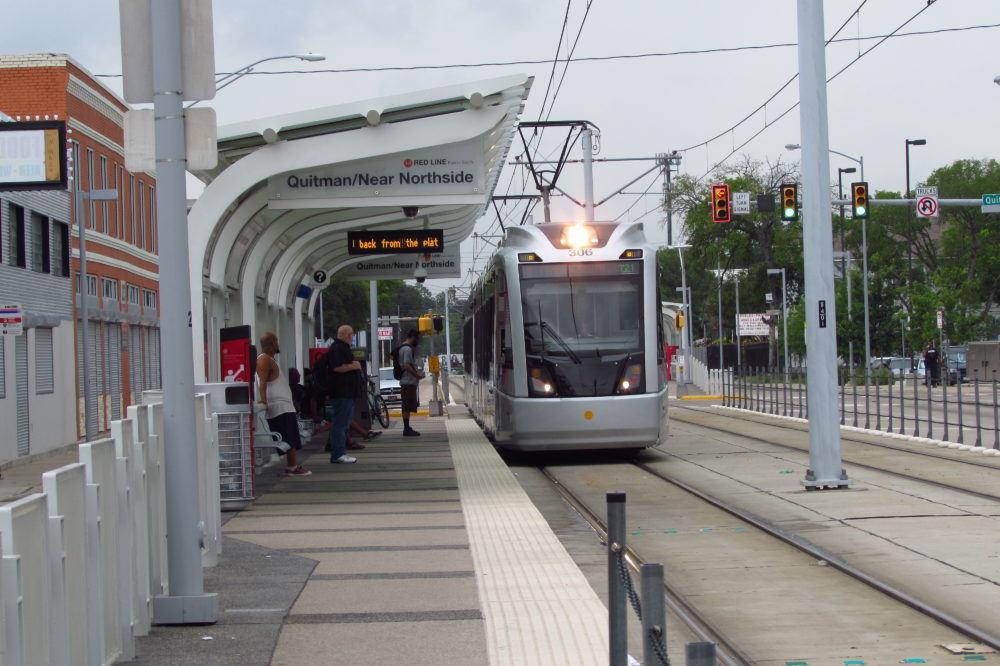
There is a light rail system, called METRORail, but you probably won't need it to get from a downtown hotel to the arena. One zone is $1.25, and the price rises to $4.50 for 4 zones, so a daypass is a better bargain at $3.00.
Going In. In 1965, the Astrodome opened, and was nicknamed "The Eighth Wonder of the World." It sure didn't seem like an exaggeration: The first roofed sports stadium in the world. (Supposedly, the Romans built stadia with canvas roofs, but that's hardly the same thing.) The Astros played there until 1999, and then moved into Enron Field/Minute Maid Park for the 2000 season.

The AFL/NFL's Oilers played at the Astrodome from 1968 to 1996, when, with the "Luv Ya Blue" days long over and the "House of Pain" era already concluded, they moved to Tennessee to become the Titans. The 1st team named the Houston Texans played the 1974 World Football League season there. And the USFL's Gamblers played there in 1984 and 1985.

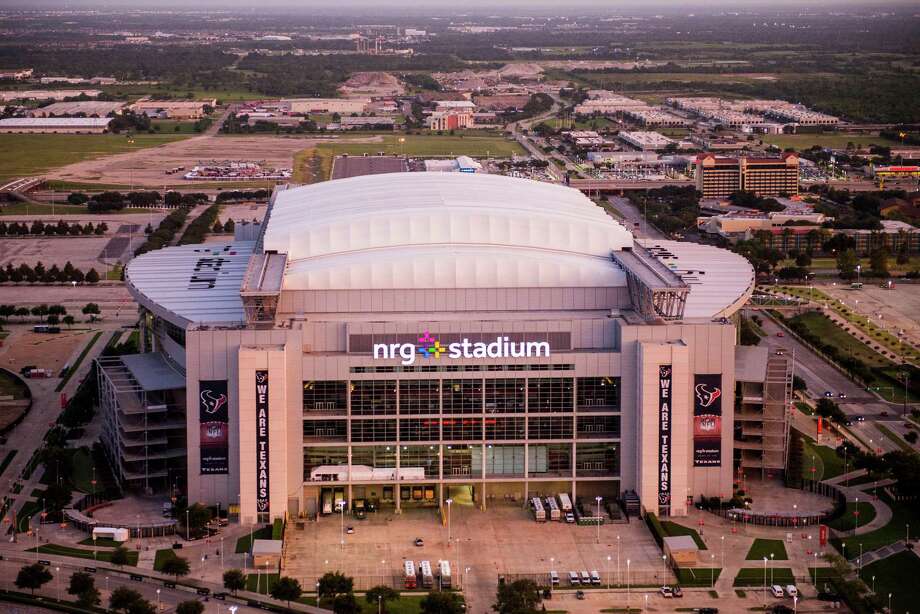
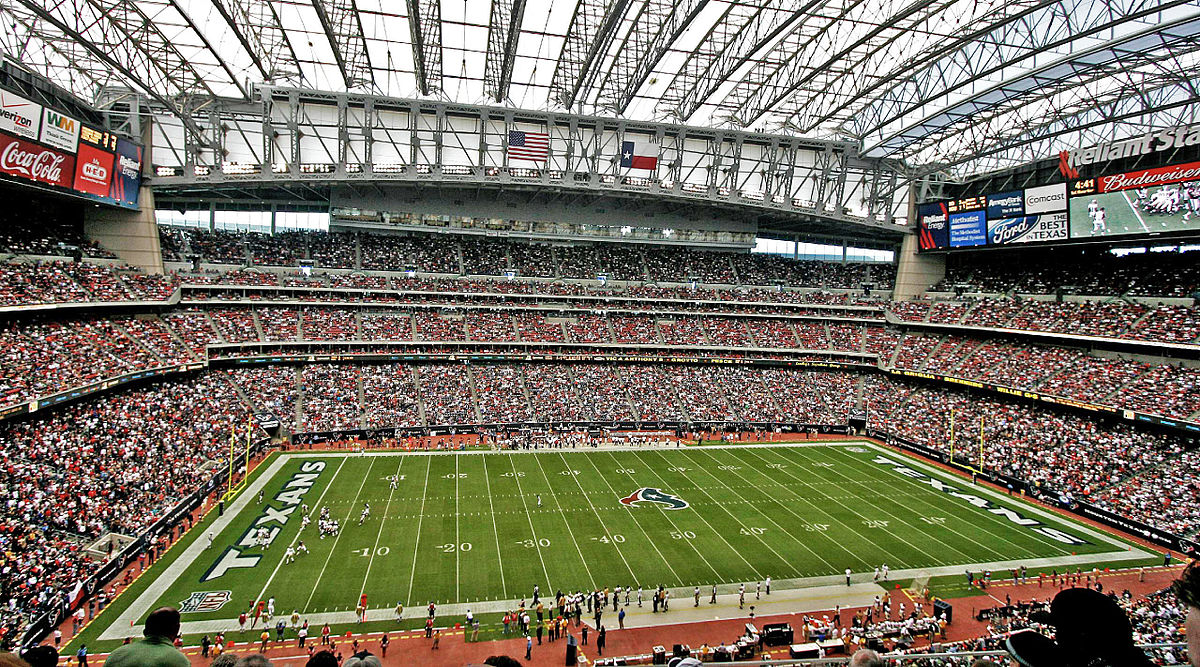
In 2002, the new NFL team, the Houston Texans, began play next-door to the Astrodome, just to the west, at Reliant Stadium, renamed NRG Stadium for the Houston-based energy company in 2014. Like Minute Maid Park, it has a retractable roof. Suddenly, the mostly-vacant Astrodome seemed, as one writer put it, like a relic of a future that never came to be. (This same writer said the same thing of Shea Stadium and, across Roosevelt Avenue, the surviving structures of the 1964 World's Fair.)
As you can see, the new stadium dwarfs the old one.

The NRG complex, including the Astrodome, is at 8400 Kirby Drive at Reliant Parkway -- about 9 miles southwest of downtown -- although the stadium's official address is One NRG Parkway. Reliant Park station on METRORail.

Once, the Astrodome was flashy enough to be the site of movies like The Bad News Bears in Breaking Training and Murder at the World Series. (Both were released in 1977. In the latter, the Astros, who had never yet gotten close to a Pennant, played the Series against the Oakland Athletics, who had just gotten fire-sold by owner Charlie Finley.)

The Astrodome also hosted the legendary 1968 college basketball game between Number 1 UCLA (with Kareem Abdul-Jabbar, then still Lew Alcindor) and Number 2 University of Houston (whose Elvin Hayes led them to victory, before UCLA got revenge in that year's Final Four); the 1971 NCAA Final Four, with UCLA defeating Villanova in the Final; and the cheese-tastic 1973 tennis match between Billie Jean King and Bobby Riggs, the "Battle of the Sexes."

The Astrodome hosted 3 fights for the Heavyweight Champion of the World, with the defending Champion winning all 3 by knockout: Muhammad Ali over Cleveland Williams on November 14, 1966; Ali over Ernie Terrell on February 6, 1967; and Larry Holmes over Randall "Tex" Cobb on November 26, 1982.

Elvis Presley sang there on February 27, 28 and March 1, 1970 and on March 3, 1974. It hosted Selena's last big concert before her murder in 1995, and when Jennifer Lopez starred in the film Selena, it was used for the re-creation. In 2004, the same year NRG (then Reliant) Stadium hosted the Super Bowl (which was won by... Janet Jackson, I think), the Astrodome was used to film a high school football playoff for the film version of Friday Night Lights; the old Astros division title banners can be clearly seen.

Today, though, the Astrodome seems, like the Republican Party that held a ridiculously bigoted Convention there in 1992, stuck in the past, and not just because they renominated failed President George H.W. Bush.

The former Eighth Wonder of the World is now nicknamed the Lonely Landmark, and while it served as a shelter for people displaced from New Orleans by Hurricane Katrina in 2005, since 2008, when it was hit with numerous code violations, only maintenance workers and security guards had been allowed to enter. With Harris County's recent decision to scrap of the Astrodome Revitalization Project, there is no current plan as to what to do with the Astrodome.

NRG Stadium was built roughly on the site of Colt Stadium, which was the baseball team's home in their first 3 seasons, 1962, '63 and '64, when they were known as the Houston Colt .45's (spelled with the apostrophe), before moving into the dome and changing the name of the team. Astrohall, built in 1971, was torn down in 2002 to make way for parking for the new stadium (which, after all, was built on Astrodome parking).

The climate-controlled Astrodome was necessary because of not just the heat and the humidity, but because of the mosquitoes. Later, seeing the artificial turf that was laid in the Astrodome for 1966 after the grass died in the first season, due to the skylights in the dome having to be painted due to the players losing the ball in the sun, Koufax, he of the mosquito quip, said, "I was one of those guys who pitched without a cup. I wouldn't do it on this stuff." And Dick Allen of the Philadelphia Phillies, looking at the first artificial field in baseball history, said, "If a horse can't eat it, I don't want to play on it."

The Astrodome hosted a 1988 match between the national soccer teams of the U.S. and Ecuador, which Ecuador won. NRG Stadium has hosted 2 such matches, a 2008 draw with Mexico and a 2011 win over Panama. The Mexico team has made it a home-away-from-home, playing 10 matches there between 2003 and 2013. The stadium hosted the 2010 MLS All-Star Game, in which a team of MLS players lost to Manchester United.

NRG Stadium hosts the annual Texas Bowl, which more or less replaced the Bluebonnet Bowl, formerly an Astrodome fixture. It hosted the Final Four in 2011, when Connecticut beat Butler in the Final. It hosted the Final Four again in 2016, with Villanova beating North Carolina in a thriller of a Final.

NRG Stadium hosted the Final Four in 2011 (Connecticut beating Butler in the Final), and earlier this year (Villanova beating North Carolina). It hosted Super Bowl LI in 2017, with (take your pick: The Atlanta Falcons choking, or the New England Patriots cheating). It hosted 4 games each in the CONCACAF Gold Cups of 2005 and 2007, and 2 games each in that tournament in 2009, 2011, 2019 and 2021.

It will host the 2023 NCAA Final Four and the 2023-24 College Football National Championship Game, and it has been selected by the U.S. Soccer Federation as a finalist to be one of the host venues for the 2026 World Cup. (UPDATE: FIFA approved it as a venue.)

Since the Astrodome is to the east of NRG Stadium, that's the side of the stadium on which you are least likely to enter. If you come in from METRORail, you will have a half-mile walk west on Reliant Parkway, and you will most likely enter from the north gate. And I recommend METRORail, because parking is a whopping $33. Tailgating is permitted, within the rules as spelled out on the Texans' website.
The field has always been artificial, despite the retractable roof, and is laid out north-to-south, like most football fields, even though closing the roof makes this due-to-the-sun setup unnecessary.
On September 12, 2017, Thrillist had an article ranking all 31 NFL stadiums. NRG Stadium ranked 14th, in the top half:

Built to function as an intimate indoor arena but have the feel of the open air, the stadium rocks open-to-the-field concourses... Two colossal, 50-feet-by-277-feet HD screens sit pretty above each end zone, pumping up a crowd that admittedly plays home to a mixed bag of NFL fans (is anyone actually from Houston?). You’ll find the loudest home-team crew in the "Bull Pen," a raucous bleacher section behind the north end zone.

Food. Being a "Wild West" city, you might expect Houston to have Western-themed stands with "real American food" at its stadium. Being a Southern State, you might also expect to have barbecue. And you would be right on both counts.

Unfortunately, a major feature of NRG Stadium concessions is Papa John's Pizza. I understand Texas not caring that Papa John is a racist, and a bastard to his employees, but they should at least care enough not to promote Peyton Manning, an AFC South Division rival quarterback!

They also have several stands each for Quizno Subs, Menchie's Frozen Yogurt, 5 Star Dogs (hot dogs), and a few other chains whose logos I can't quite make out on their map.

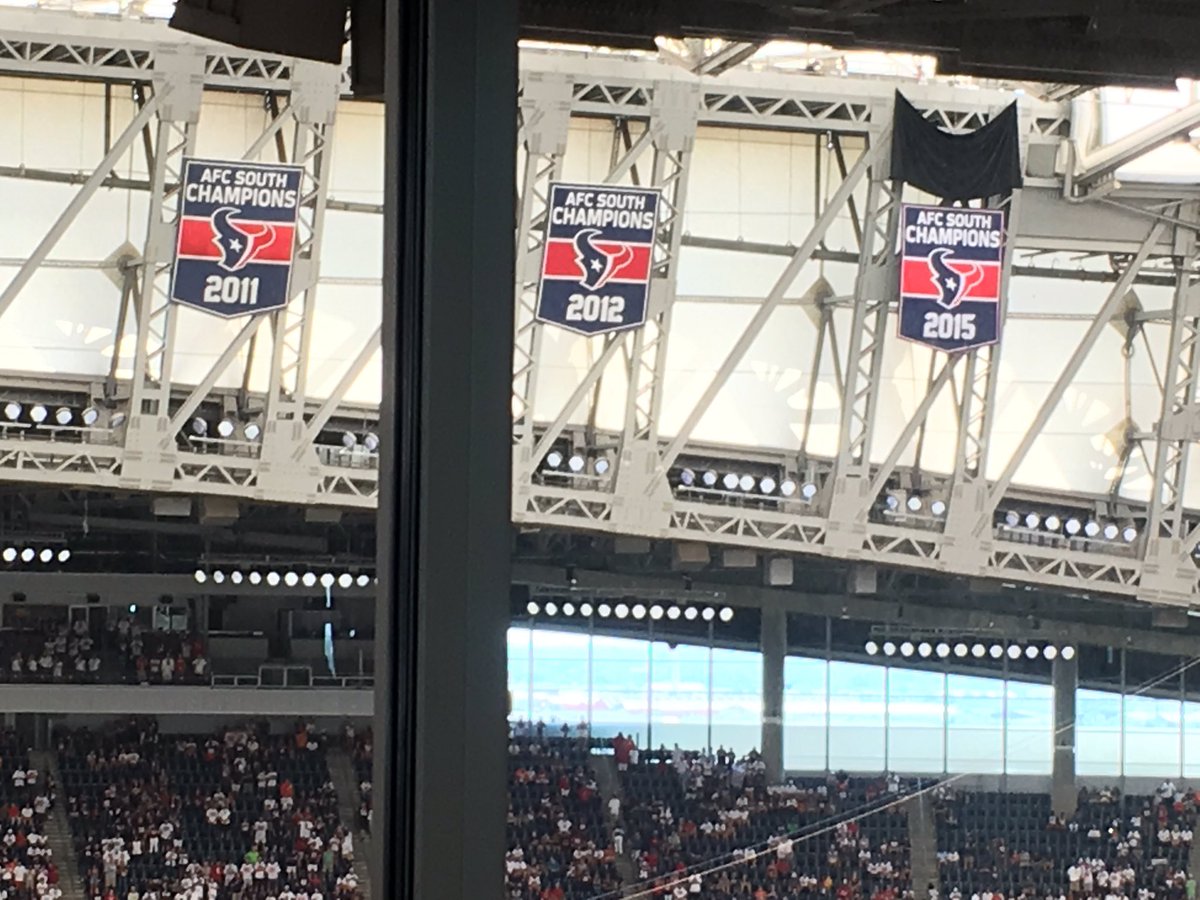
Team History Displays. The Texans were founded in 2002. Barring a move in the next few years, they will remain, by any way you measure it, the NFL's newest team. So there isn't much history to display. They won the AFC South Division 6 times in a 9-year span: 2011, 2012, 2015, 2016, 2018 and 2019, but fell apart last year, and are doing poorly this season as well.
So far, though, they haven't had any players good enough to get their uniform numbers retired or be elected to the Pro Football Hall of Fame (except for Ed Reed, who only played his last season, 2013, in Houston), nor named to the NFL Network's 2010 broadcast of its 100 Greatest Players. Maybe J.J. Watt, Number 99, will be the 1st. Shane Lechler, a punter, was named to the NFL's 100th Anniversary Team, but he spent considerably more seasons with the Oakland Raiders.

They did establish a Ring of Honor in 2017, and their 1st honoree was 2003-14 wide receiver Andre Johnson, though his Number 80 remains in circulation. Founding owner Bob McNair (1999-2018) has also been added.
Most of Houston's pro football history is wrapped up in the Oilers. George Blanda, Charlie Hennigan, George Webster, Miller Farr and Bob Talamini were named to the AFL's All-Time Team. Ken Houston and Billy "White Shoes" Johnson were named to the NFL's 75th Anniversary Team in 1994. Blanda, Ken Houston and Earl Campbell were named to The Sporting News' 100 Greatest Football Players in 1999. Campbell and Bruce Matthews were named to the aforementioned NFL Network's 100 Greatest Players. Campbell, Mathews, Houston and Johnson were named to the NFL's 100th Anniversary Team.

The Pro Football Hall of Fame includes Oilers Blanda, Ken Houston, Campbell, 1970s defensive end Elvin Bethea, early 1970s receiver Charlie Joiner (later to star with the San Diego Chargers), 1970s defensive tackler Curley Culp, late 1970s and early '80s linebacker Robert Brazile, early 1980s tight end Dave Casper (better remembered as a Raider), 1980s guard Mike Munchak, 1980s and early '90s offensive lineman Bruce Matthews, and late '80s and early '90s quarterback Warren Moon. And Jim Kelly, later to reach the Hall of Fame as the quarterback for the Buffalo Bills, starred for the USFL's Houston Gamblers. But there is no display at NRG Stadium honoring ex-Oilers or ex-Gamblers.

Despite being the NFL's newest franchise, the Texans have already had 3 Heisman Trophy winners: Running back Ron Dayne (1999 Wisconsin, with the Texans in 2006 and '07), quarterback Matt Leinart (2004 USC, 2010 and '11), and running back Mark Ingram (2009 Alabama, 7 games in 2021).

The Oilers had 4 before moving to Tennessee, all running backs: Billy Cannon (1959 Louisiana State, 1960-63), Texas (but North) native Earl Campbell (1977 Texas, 1978-84), Mike Rozier (1983 Nebraska, 1985-90) and Eddie George (1995 Ohio State, 1996 and moved with them to Tennessee the next year). Dayne (Pine Hill) and Rozier (Camden) are both from Camden County, New Jersey; George is from the other side of Philadelphia, in Abington, Pennsylvania.

The Governor's Cup, formerly awarded to the winner of the Oilers-Cowboys game, has been restored for the winner of the Texans-Cowboys game. The Cowboys lead the regular season series with the Texans, 3-2. Counting games against the Oilers, the count is 18-13 in Dallas' favor.

Stuff. The Go Texans Store is in the southeastern corner of the stadium. The usual NFL fan gear can be found there. Since this is Texas, you might find cowboy hats, boots or belt buckles with the Texans logo on them.

As the NFL's newest team, books about the Texans are few and far between. Museum of Fine Harts Houston curator Anne Wilkes Tucker and legendary Houston sportswriter (first for the defunct Houston Post, now for the Chronicle) Mickey Herskowitz collaborated on First Down, Houston: The Birth of an NFL Franchise in 2002 and '03. Other than that, probably the best you can get is The Story of the Houston Texans by Gordon Pueschner, which came out in time for the 2009 season, thus missing the closest thing the Texans have yet had to "glory days."

As far team videos, you're out of luck: No Super Bowl win means no commemorative highlight video of either the game or the season; and, being a franchise whose last anniversary was their 10th, and whose greatest moment to date is a pair of wins in the Wild Card round of the Playoffs, an anniversary DVD would, for the moment, be a bit silly.

During the Game. A recent Thrillist article on "The Most Obnoxious Fans In the NFL" ranked Texans fans 27th -- that is, the 6th-least obnoxious:

You know that King of the Hill episode where Hank and the gang kinda grudgingly go watch the Texans practice because it’s a lot closer than the Cowboys and they figure, hey, it’s football? There’s your fanbase. No, they’re not America’s Team. No, they’re not Texas’ team -- that one wears burnt orange. Hell, they’re not even Houston’s team, since THAT team plays in Nashville. But, hey, it’s a big city, and it's football, and it’s an excuse to go grill something on a Sunday, so why not? And since you're all just kind of Texans fans by default, nobody gets too worked up about things.

I guess when you've only been around for 14 seasons, and the closest opposing team (the Dallas Cowboys) isn't a Division opponent, and you haven't had a shocking Playoff moment (in your favor or not), it doesn't bring up much nastiness.

From September 1 to 7, 2017, at the beginning of the NFL National Anthem protest controversy,
FiveThirtyEight.com polled fans of the 32 NFL teams, to see where they leaned politically. Texans fans were said to be 5 percent more conservative than liberal, 2nd only to Tampa Bay.

If you were wearing Dallas Cowboy gear, or gear of the ex-Oilers, now the Tennessee Titans (who are an AFC South opponent), to a Houston Texans game, you might be in trouble. But Texans fans aren't especially hostile to New Yorkers, so safety won't be an issue.

The Texans' mascot is Toro the Bull. The Texans hold auditions instead of having a regular National Anthem singer. Their pregame introduction song is "Thunderstruck" by AC/DC. Their theme song is "It's Football Time In Houston" by country-signing native Clay Walker, their fight song is "Battle Red," their defense's theme song is "Bulls On Parade" by Rage Against the Machine (I'll bet that leftist band goes over really well in rural Texas), and an unofficial rap song titled "Houston" was recorded by locals Slim Thug, Paul Wall and ZRo, getting over 1 million YouTube views. But the team does not appear to have a postgame victory song.
Houston's mascots, left to right: Clutch the Bear of the Rockets,
Dynamo the Fox of the Dynamo, Toro the Bull of the Texans,
and Orbit the Alien of the Astros.

The north end zone is the home of the Bull Pen, an attempt to mimic student sections at college football games. (I'd suggest soccer "ultras," but, in spite of back-to-back MLS Cups by the Dynamo, Houstonians might not get the reference.) They shout their players' last names during team introductions, shout, "Houston... Texans!" after each first down, and even have their own Pep Band. I guess, when (to borrow a saying from English soccer) "You ain't got no history," you come up with your own traditions.

After the Game. Houston is a comparatively low-crime city, and as long as you behave yourself, the home fans will probably behave themselves, win or lose.

There's a Starbucks at NRG Center, the convention center, to the northeast of the stadium. Other than that, the closest restaurants are a Denny's at Main Street and South Loop West Freeway (the service road for Houston's beltway, Interstate 610), and, where Old Spanish Trail splits from Main Street, an Olive Garden, a Chipotle and a Sonic.

I had hoped to find a listing for bars for New Yorkers living in the Houston area, but the previous options I had listed have since closed, probably due to COVID.

If your visit to Houston is during the European soccer season (which we are now in), and you want to watch your favorite club play, the best place to do so is Hugh O'Connor's, at the Marq-E Entertainment Center (a mall), 7620 Katy Freeway (Interstate 10), about 8 miles west of downtown. Bus 85 to Northwest Transit Center, then a half-hour walk.

Sidelights. On November 30, 2018, Thrillist published a list of "America's 25 Most Fun Cities," and Houston came in 18th. On February 3, 2017, Thrillist made a list ranking the 30 NFL cities (New York and Los Angeles each having 2 teams), and Houston came in 16th, just on the bottom side of the halfway mark. They wrote: 

If you're going to eat meat, be it steak or ribs or burgers or kolaches filled with sausage, there is nary a better city in this country to get down in. If you're going to sit in traffic in the worst humidity I've ever experienced outside of a rainforest (I went to a rainforest once, NBD) in a city that would give LA a run for its money in sprawl, Houston is also very good at that. 

Houston's sports history is pretty much wrapped up in the decaying corpse of the Astrodome, whose history I've already discussed. But there are other sites worth mentioning.

* Minute Maid Park. The new home of the Astros opened in 2000, at 501 Crawford Street, attached to Union Station. The Astros were able to play on God's own grass for the 1st time since 1965, and under God's own sky for the 1st time since 1964. They have now reached the postseason there 4 times: The 2001 National League Division Series, the 2004 NL Championship Series, the 2005 World Series, and the 2015 American League Division Series. Preston Station on METRORail.

* Site of Sam Houston Coliseum. The Houston Aeros, with Gordie Howe and his sons Mark and Marty, won the World Hockey Association championships of 1974 and 1975, while playing here, before moving into the Summit in 1975 and folding in 1978. Elvis sang there on October 13, 1956, and the Beatles played there on August 19, 1965. It was built in 1937 and demolished in 1998.

It replaced Sam Houston Hall, where the 1928 Democratic Convention nominated Governor Alfred E. Smith of New York, who thus became the 1st Catholic nominated for President by a major party.

The Hobby Center for the Performing Arts is now on the site. 801 Bagby Street, at Rusk Street, downtown.

With even the minor-league Aeros gone, the closest NHL team to Houston is the Dallas Stars, 242 miles away, although some Houstonians would rather vote for a gay black Democrat than root for a Dallas team. If Houston ever did get an NHL team, it would rank 11th in population among NHL markets.

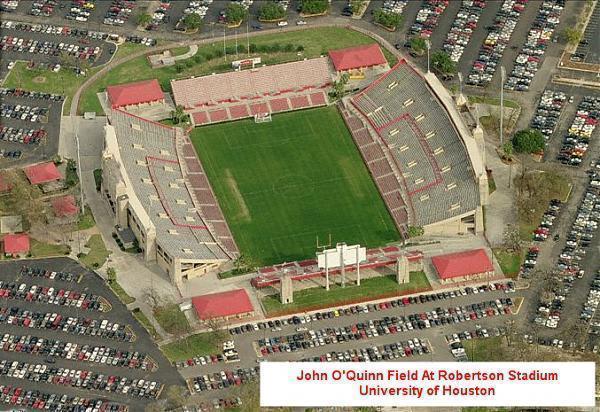
* TDECU Stadium and site of Jeppesen/Robertson Stadium. The Houston Oilers played at Jeppesen Stadium from 1960 to 1964. They won the 1960 AFL Championship Game there, won the 1961 title game on the road, and lost the 1962 title game there -- and, as the Oilers and the Tennessee Titans, haven't gone as far as the rules allowed them to since 1961.
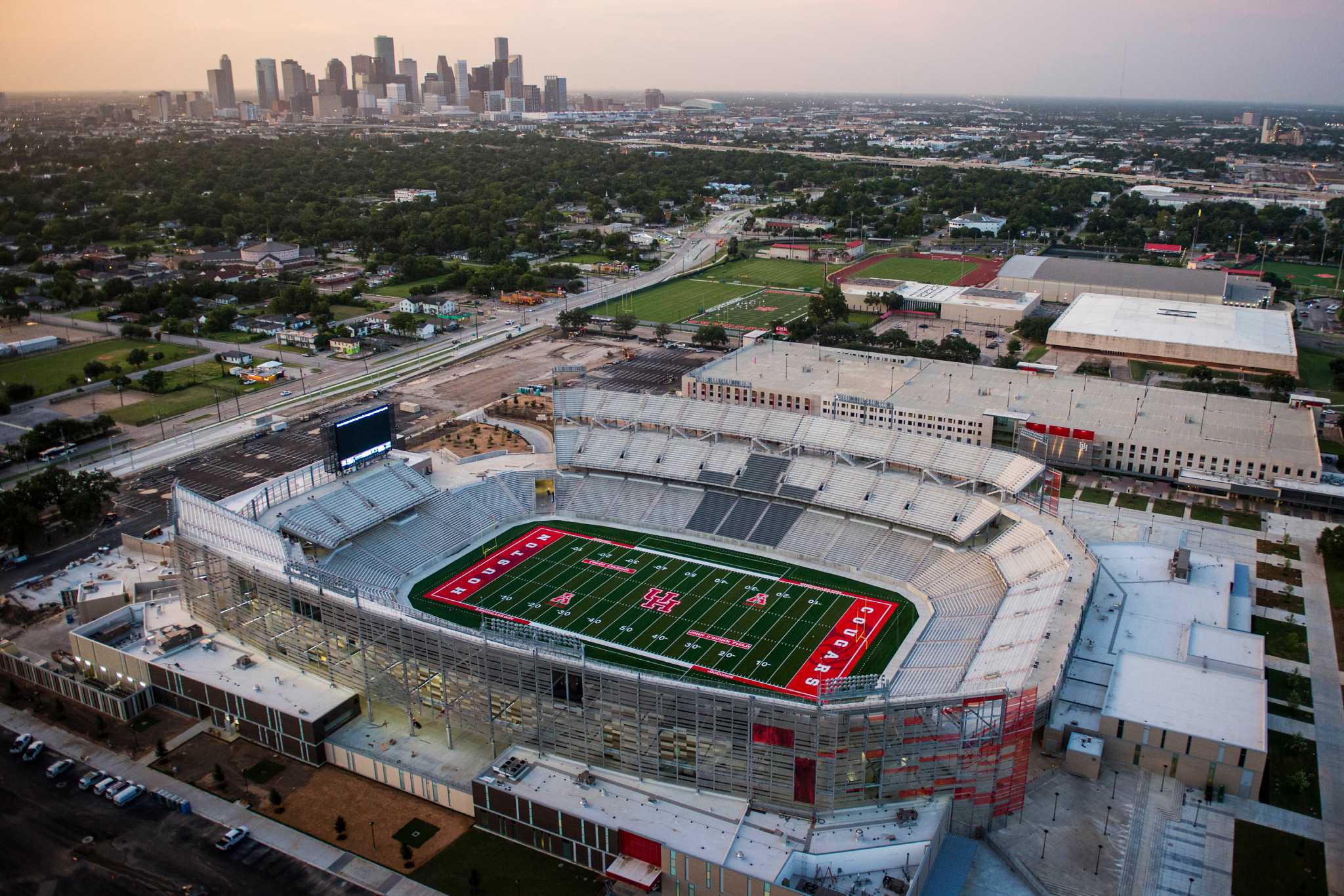
Built in 1942, it became Robertson Stadium, and was the former home of the University of Houston football team and the former home of MLS' Houston Dynamo, who won the 2006 and 2007 MLS Cups while playing there. The new John O'Quinn Field at TDECU Stadium (named for Texas Dow Employees Credit Union) has been built at the site. 3874 Holman Street at Cullen Blvd., 4 miles southeast of downtown. Number 52 bus.
* PNC Stadium. Formerly known as BBVA Compass Stadium, the home of the Dynamo and the National Women's Soccer League's Houston Dash opened in 2012 at 2200 Texas Avenue at Dowling Street, within walking distance of downtown. It is also the home field of the football team at Texas Southern University, which won the National Championship of black college football in 1952 and 2010.

On January 29, 2013, it hosted its first U.S. national team match, a draw with Canada. The U.S. women's team beat Mexico 6-2 there on April 8, 2018. It hosted 2 games of the CONCACAF Gold Cup in 2013 and 2017. The USMNT played there again on March 26, 2019, a 1-1 draw in a friendly with Chile. It hosted 6 games of the 2021 CONCACAF Gold Cup. 

* Rice Stadium. Home of Rice University football since 1950, the Oilers played the 1965, '66 and '67 seasons here. Although probably already obsolete by the 1973 season, it seated a lot more people than did the Astrodome, and so Super Bowl VIII was played there, and the Miami Dolphins won it -- and haven't won a Super Bowl since.
It has been significantly renovated, and now seats 47,000, down from the 71,882 that crammed in for the Super Bowl on January 13, 1974. University Blvd. at Greenbriar Street, although the mailing address is 6100 S. Main Street, 5 miles southwest of downtown. METRORail to Dryden/TMC, then walk or Number 084 bus.

* Site of Buffalo Stadium. Before there were the Astros, or even the Colt .45's, there were the Houston Buffaloes. The Buffs played at Buffalo Stadium, a.k.a. Buff Stadium, for most of their history, from 1928 to 1961, when the Colt .45's made them obsolete.

They were a farm team of the St. Louis Cardinals, and as a result in its last years Buff Stadium was renamed Busch Stadium. The Cardinal teams of the 1930s that would be known as the "Gashouse Gang" came together in Houston, with Dizzy and Daffy Dean, Joe Medwick, Pepper Martin and Enos Slaughter. Later Buff stars included Cleveland Indians 3rd baseman Al Rosen, Pittsburgh Pirates pitcher Wilmer "Vinegar Bend" Mizell, Negro League legend Willard Brown, Cardinal MVP Ken Boyer, and Phillies shortstop Ruben Amaro Sr.

Wanting to lure in more customers but also to beat the infamous Houston heat, lights were installed in 1930, 5 years before any major league park had them. The Buffs won 8 Texas League Pennants: 1928, 1931, 1940, 1947, 1951, 1954, 1956 and 1957. The stadium was at the southwest corner of Leeland Street & Cullen Blvd., about 2 1/2 miles southeast of downtown. A furniture store is on the site now. Number 20 bus.

* Toyota Center. The new home of the NBA's Rockets replaced the Summit. It took 8 years from Rockets owner Les Alexander's demand for a new arena until first tipoff, in which time NBA Commissioner David Stern announced that the Rockets would have to move without a new arena (not that there was anything wrong with the Summit, aside from a low number of luxury boxes), and NHL Comissioner Gary Bettman announced that Houston would not get an NHL team. But tip off the Rockets did, on October 30, 2003.

It's hosted the Rockets ever since, the WNBA's Houston Comets from 2003 until they folded after the 2007 season, and the Houston Aeros of the American Hockey League (not the old WHA team of the same name) from 2003 until 2013, when their parent club, the Minnesota Wild, moved them to Des Moines, where they became the Iowa Wild. It's also hosted wrestling, Ultimate Fighting, concerts (including by Houston native Beyoncé, both with and without the rest of Destiny's Child) and the Latin Grammys.

1510 Polk Street, also bounded by Jackson, Bell and La Branch Streets. It's downtown, 5 blocks east of Main Street and the light rail, with Bell Street the closest station.

* The Summit. Before the Toyota Center, the Rockets played at The Summit, later known as the Compaq Center, from 1975 to 2003, and the Comets from 1997 to 2003. Elvis sang at The Summit on August 28, 1976. It's been converted into the Lakewood Church Central Campus, a megachurch presided over by Dr. Joel Osteen. 3700 Southwest Freeway at Timmons Lane. Number 53 bus.

Before that, between their 1971 move from San Diego and the 1975 opening of The Summit, they played some home games at the Astrodome, some at the Astrohall, some at the Sam Houston Coliseum, and some at the Hofheinz Pavilion.

There's another notable sports site in Houston: The U.S. Military Entry Processing Station, in the Customs House, where Muhammad Ali, then living and training in Houston, had to report to fulfill his draft obligation. He did report there, on April 28, 1967, and refused to be drafted. (To be fair, they did call his birth name, Cassius Clay, not his legal name, Muhammad Ali.) Ali was convicted of draft evasion and stripped of the Heavyweight Title. He stayed out of prison on appeal, and the case went all the way to the Supreme Court, which overturned the conviction.

The Customs House is still standing, and still used in part by the U.S. Department of Defense. 701 San Jacinto Street. Central Station on METRORail.

In addition to the preceding, Elvis sang at Hofheinz Pavilion on November 12, 1971; and June 4 and 5, 1975. He also sang at the City Auditorium on October 8, 1955 and April 21, 1956. It's better known as the venue where R&B singer Johnny Ace mistakenly shot himself before a show on Christmas Day, December 25, 1955. The Jones Hall for the Performing Arts replaced it in 1966. 615 Louisiana Street at Capitol Street, downtown.

Also, early in his career, Elvis sang in Houston at the Paladium Club (8100 S. Main Street, near the Astrocomplex) on November 26, 27 and 28, 1954; Cook's Hoedown (603 Capitol Street, around the corner from Jones Hall) on November 27 and December 28, 1954, and April 24 and August 7, 1955; Magnolia Gardens (12044 Riverside Street, no public transit) on April 24, May 22, June 19 and August 7, 1955; and Eagles Hall at 2204 Louisiana Street on January 1 and March 19, 1955 (2204 Louisiana Street, downtown). All of these have since been demolished.

Elvis sang near the University of Texas campus in Austin, 160 miles to the northwest, at Dessau Hall on March 17, 1955, the Sportscenter on August 25, 1955, the Skyline Club on January 18, 1956, and the Municipal Auditorium on March 28, 1977. And he sang near the Texas A&M campus, 100 miles to the northwest, at the Rodeo Grounds in Bryan on August 23, 1955 and the G. Rolle White Coliseum in College Station on October 3, 1955;

Elvis also sang in South Texas at the City Auditorium in Beaumont, 85 miles to the northeast, on June 20 and 21, 1955 and January 17, 1956; at the football stadium at Conroe High School, 40 miles to the north, on August 24, 1955; in Corpus Christi, 200 miles to the southwest, at the Hoedown Club on July 3, 1955 and the Memorial Coliseum on April 16, 1956; in Galveston, 50 miles to the southeast, at the City Auditorium on January 16, 1956; at the baseball field in Gonzales, 130 miles to the west, on August 26, 1955; at Woodrow Wilson High School in Port Arthur, 90 miles to the east on November 25, 1955; and at Southwest Texas State University (LBJ's alma mater, now "Texas State"), 165 miles to the west, on October 6, 1955.

There are other places that might be considered "South Texas" where he sang, but I'll include them with "West Texas" when I do this for the San Antonio Spurs.

The tallest building in Houston, and in all of Texas, is the JPMorgan Chase Tower, formerly the Texas Commerce Tower. It was built in 1982 at 600 Travis Street at Texas Avenue, downtown, and stands 1,002 feet tall, rising 75 stories above the concrete over the bayou. It is the tallest 5-sided building in the world.

Houston's version of New York's American Museum of Natural History is the Houston Museum of Natural Science, in Hermann Park, at Main Street and Hermann Park Drive. The Sam Houston Monument is a few steps away. The Houston Museum of Fine Arts is at 1001 Bissonnet Street, just 5 blocks away. Both can be reached by the Number 700 bus.

Of course, the name "Houston" is most connected with two things: Its namesake, the legendary Senator, Governor and war hero Sam Houston; and the Johnson Space Center, the NASA control center named after President Lyndon B. Johnson, who, as Senate Majority Leader, wrote the bill creating NASA and the Space Center, because he thought it would bring a lot of jobs and money to Houston (and he was right).

Aside from his Monument, most historic sites relating to Sam are not in the city that bears his name. As for reaching the Johnson Space Center, it's at 1601 NASA Parkway and Saturn Lane. The Number 249 bus goes there, so if you don't have a car, Houston, you won't have a problem.

Although Houston is the post-Presidential home for George H.W. Bush, his Presidential Library is at Texas A&M University, 100 miles away in College Station. I don't know the Bushes' address, and, in the interest of privacy, I wouldn't print it here if I did. Former First Lady Barbara Bush died on April 17, 2018; and George followed on November 30. Both were buried at the Library at TAMU. As a former baseball player, Bush is the only President so far who had his Library designed by HOK, designer of several sports facilities including our own MetLife Stadium.

The Alley Theatre, downtown at 615 Texas Avenue, opened in 1968, and in 1976 hosted the Vice Presidential debate between Senators Walter Mondale and Bob Dole. This is where Dole named World War I, World War II, and the Korean and Vietnam Wars as "all Democrat wars" -- forgetting that the Republicans wanted America to get into all but World War II, and didn't want that one because they liked the Nazis' anti-union status; and that it was actually the Republicans who got us into Vietnam.

There have been a few TV shows set in Houston, but the only one that lasted was Reba, starring country singer Reba McIntire. But it was filmed in Los Angeles, so if you're a fan, you won't find the house in Houston.

Congressman Matthew Santos, a Houston native played by Jimmy Smits, was inaugurated as President on the last episode of The West Wing. Of interest to me was Outlaws, in which a sheriff tried to capture his former gang, but all 5 of them were transported from 1899 to 1986. Realizing they needed each other, they teamed up, and, with the gold that was transported with them, they bought what they needed and formed a private detective agency. It lasted just 1 season.

Films set in Houston, in addition to the sports-themed ones, include Brewster McCloud (which also used the Astrodome), Logan's Run (which used the Houston Hyatt Regency for some scenes),
Telefon (set there but filmed in California), Terms of EndearmentReality Bites, and, perhaps most iconically, Urban Cowboy.

*

Houston can be hot, but it's a good sports town, and, best of all, it's not Dallas. So there can be a good old time in the hot town tonight.
Monday, September 17, 2018

How to Be a New York Football Fan In Houston -- 2018 Edition

Having looked very bad in their 1st 2 games of the season, the New York Giants will try to get into the win column this coming Sunday, as they visit the Houston Texans.

Before You Go. Most Americans hear "bayou" and think "Louisiana." But Houston is known as, among other things, the Bayou City. It can get hot, it can get humid, and it gets a lot of rain. Why do you think the world's 1st indoor stadium designed for baseball and football was built there? So while the Texans play in a stadium with a retractable roof, the weather could still be a factor.

The Houston Chronicle is predicting daytime temperatures in the high 80s, and nighttime temperatures in the mid-70s, plus rain. This is not going to be fun.

Houston is in the Central Time Zone, so you'll be an hour behind New York time. Although Texas is a former Confederate State, you will not need your passport, and you won't need to change your money.

Tickets. The Texans averaged 71,774 fans per game last season, a sellout. Being the NFL's newest team (whether you count moved teams as "new" or not), they don't having much of a tradition. But getting tickets may still be tough.

Seats in the lower level, the 100 sections, are $190 on the sidelines and $100 in the end zone. Seats in the upper level, the 600 sections, are $78 and $49. Every level in between is club seating, and prohibitively expensive.

Getting There. It's 1,665 miles from Times Square in New York to downtown Houston, and 1,668 miles from MetLife Stadium to NRG Stadium. You're probably thinking that you should be flying.

Flying nonstop to Houston George Bush Intercontinental Airport (That's named for the father, not the son) can be done for as little as $470. Considering how far it is, that is a bargain. Bus 102 will get you from the airport to downtown in an hour and 20 minutes.

There are 2 ways to get there by train. One is to change trains in Chicago, and then change to a bus in Longview, Texas. The other is to change trains twice, in Washington and New Orleans, and then stay overnight in New Orleans. No, I'm not making that up. You don't want that -- and don't be fooled by the fact that Houston's Union Station and the ballpark are next-door to each other, because Amtrak uses a different station a mile away, at 902 Washington Street. Round-trip fare is $511, and that could be more than by flying. Maybe we should just forget Amtrak, and move on.

Greyhound has 8 runs a day from Port Authority Bus Terminal to Houston, averaging 42 hours, and requiring you to change buses in Atlanta and New Orleans. It's $566 round-trip, but it can drop to $402 with advanced purchase -- in other words, flying could be less. The Houston Greyhound station is at 2121 Main Street, a mile from the arena.

If you actually think it's worth it to drive, get someone to go with you so you'll have someone to talk to and one of you can drive while the other sleeps. You'll be taking Interstate 78 across New Jersey and into Pennsylvania to Harrisburg, where you'll pick up Interstate 81 and take that through the narrow panhandles of Maryland and West Virginia, down the Appalachian spine of Virginia and into Tennessee, where you'll pick up Interstate 40, stay on that briefly until you reach Interstate 75, and take that until you reach Interstate 59, which will take you into Georgia briefly and then across Alabama and Mississippi, and into Louisiana, where you take Interstate 12 west outside New Orleans. Take that until you reach Interstate 10. Once in Texas, Exit 770 will get you to downtown Houston.

If you do it right, you should spend about an hour and a half in New Jersey, 3 hours in Pennsylvania, 15 minutes in Maryland, half an hour in West Virginia, 5 and a half hours in Virginia, 3 hours and 45 minutes in Tennessee, half an hour in Georgia, 4 hours in Alabama, 2 hours and 45 minutes in Mississippi, 4 hours and 30 minutes in Louisiana and 2 hours in Texas. Including rest stops, and accounting for traffic, we're talking about a 40-hour trip.

Even if you're only going for one game, no matter how you got there, get a hotel and spend a night. You'll be exhausted otherwise. Trust me, I know: Trains and buses are not good ways to get sleep.

Once In the City. Houston was founded in 1836 as Allen's Landing, and was renamed for Sam Houston, "the Father of Texas." There are 2.2 million people in the city proper, making it the 4th-largest in America, and 6.3 million in the metropolitan area, making it 5th. But with multiple teams, it's only the 10th-largest market in the NBA, and the 7th-largest in MLB and the NFL.

The weather in Houston is so bad! (How bad is it?) A "bayou" (BYE-yoo) is a body of water, typically found in a flat, low-lying area, and can be either an extremely slow-moving stream or river, often with a poorly-defined shoreline, or a marshy lake or wetland. And Houston is known as the Bayou City.

When people talk about "the bayou," they usually mean Louisiana. But Southeast Texas is also bayou country, and it frequently leaves Houston hot, humid and muggy. It's a breeding ground for mosquitoes. The Astrodome had to be built not just to promote Houston, or to protect people from the heat, but to protect them from the bugs. Sandy Koufax of the Los Angeles Dodgers said, "Some of those mosquitoes are twin-engine jobs."

Fortunately, just as there's an overhead walkway system in Minneapolis, and an "Underground City" in Montreal, in their cases to protect pedestrians from their cities' notoriously cold Winter, there is a "Houston Tunnel System," begun in the 1930s, and inspired by New York itself, by the system under Rockefeller Center. Regardless of how much this may help, remember to stay hydrated.

The sales tax in the State of Texas is 6.25 percent, but in the City of Houston it goes up to 8.25 percent. The city doesn't appear to have a "centerpoint," where the address numbers start at 1, but there is a Main Street, running northeast/southwest. ZIP Codes in the Houston area start with the digits 77. The Area Codes are 713, with 281, 346 and 832 as overlays.

Houston has not 1, not 2, but 3 beltways: Interstate 610, a.k.a. the Inner Loop; Beltway 8, a.k.a. the Sam Houston Tollway; and State Highway 99, a.k.a. the Grand Parkway.

Like most Texas cities now, Houston has a Hispanic plurality, if not yet a majority: 44 percent. It's about 26 percent white, 24 percent black, and 6 percent Asian. It's mostly white on the west side; mostly black on the south, northwest and northeast sides; and mostly Hispanic on the north, east and southeast sides.

There is a light rail system, called METRORail, but you probably won't need it to get from a downtown hotel to the arena. One zone is $1.25, and the price rises to $4.50 for 4 zones, so a daypass is a better bargain at $3.00.
Going In. In 1965, the Astrodome opened, and was nicknamed "The Eighth Wonder of the World." It sure didn't seem like an exaggeration: The first roofed sports stadium in the world. (Supposedly, the Romans built stadia with canvas roofs, but that's hardly the same thing.) The Astros played there until 1999, and then moved into Enron Field/Minute Maid Park for the 2000 season.

The AFL/NFL's Oilers played at the Astrodome from 1968 to 1996, when, with the "Luv Ya Blue" days long over and the "House of Pain" era already concluded, they moved to Tennessee to become the Titans. The 1st team named the Houston Texans played the 1974 World Football League season there. And the USFL's Gamblers played there in 1984 and 1985.

In 2002, the new NFL team, the Houston Texans, began play next-door to the Astrodome, just to the west, at Reliant Stadium, renamed NRG Stadium for the Houston-based energy company in 2014. Like Minute Maid Park, it has a retractable roof. Suddenly, the mostly-vacant Astrodome seemed, as one writer put it, like a relic of a future that never came to be. (This same writer said the same thing of Shea Stadium and, across Roosevelt Avenue, the surviving structures of the 1964 World's Fair.)
As you can see, the new stadium dwarfs the old one.

The NRG complex, including the Astrodome, is at 8400 Kirby Drive at Reliant Parkway -- about 9 miles southwest of downtown -- although the stadium's official address is One NRG Parkway. Reliant Park station on METRORail.

Once, the Astrodome was flashy enough to be the site of movies like The Bad News Bears in Breaking Training and Murder at the World Series. (Both were released in 1977. In the latter, the Astros, who had never yet gotten close to a Pennant, played the Series against the Oakland Athletics, who had just gotten fire-sold by owner Charlie Finley.)

The Astrodome also hosted the legendary 1968 college basketball game between Number 1 UCLA (with Kareem Abdul-Jabbar, then still Lew Alcindor) and Number 2 University of Houston (whose Elvin Hayes led them to victory, before UCLA got revenge in that year's Final Four); the 1971 NCAA Final Four, with UCLA defeating Villanova in the Final; and the cheese-tastic 1973 tennis match between Billie Jean King and Bobby Riggs, the "Battle of the Sexes."

The Astrodome hosted 3 fights for the Heavyweight Champion of the World, with the defending Champion winning all 3 by knockout: Muhammad Ali over Cleveland Williams on November 14, 1966; Ali over Ernie Terrell on February 6, 1967; and Larry Holmes over Randall "Tex" Cobb on November 26, 1982.

Elvis Presley sang there on February 27, 28 and March 1, 1970 and on March 3, 1974. It hosted Selena's last big concert before her murder in 1995, and when Jennifer Lopez starred in the film Selena, it was used for the re-creation. In 2004, the same year NRG (then Reliant) Stadium hosted the Super Bowl (which was won by... Janet Jackson, I think), the Astrodome was used to film a high school football playoff for the film version of Friday Night Lights; the old Astros division title banners can be clearly seen.

Today, though, the Astrodome seems, like the Republican Party that held a ridiculously bigoted Convention there in 1992, stuck in the past, and not just because they renominated failed President George H.W. Bush. The former Eighth Wonder of the World is now nicknamed the Lonely Landmark, and while it served as a shelter for people displaced from New Orleans by Hurricane Katrina in 2005, since 2008, when it was hit with numerous code violations, only maintenance workers and security guards had been allowed to enter.

On February 13, 2018, the Harris County Commissioners, the Dome's overseers, approved the Astrodome Revitalization Project, which will raise the stadium's floor and use the space underneath as a huge parking garage. Construction is expected to be completed sometime in 2020.

NRG Stadium was built roughly on the site of Colt Stadium, which was the baseball team's home in their first 3 seasons, 1962, '63 and '64, when they were known as the Houston Colt .45's (spelled with the apostrophe), before moving into the dome and changing the name of the team. Astrohall, built in 1971, was torn down in 2002 to make way for parking for the new stadium (which, after all, was built on Astrodome parking).

The climate-controlled Astrodome was necessary because of not just the heat and the humidity, but because of the mosquitoes. Later, seeing the artificial turf that was laid in the Astrodome for 1966 after the grass died in the first season, due to the skylights in the dome having to be painted due to the players losing the ball in the sun, Koufax, he of the mosquito quip, said, "I was one of those guys who pitched without a cup. I wouldn't do it on this stuff." And Dick Allen of the Philadelphia Phillies, looking at the first artificial field in baseball history, said, "If a horse can't eat it, I don't want to play on it."

The Astrodome hosted a 1988 match between the national soccer teams of the U.S. and Ecuador, which Ecuador won. NRG Stadium has hosted 2 such matches, a 2008 draw with Mexico and a 2011 win over Panama. The Mexico team has made it a home-away-from-home, playing 10 matches there between 2003 and 2013. The stadium hosted the 2010 MLS All-Star Game, in which a team of MLS players lost to Manchester United.

NRG Stadium hosts the annual Texas Bowl, which more or less replaced the Bluebonnet Bowl, formerly an Astrodome fixture. It hosted the Final Four in 2011, when Connecticut beat Butler in the Final. It hosted the Final Four again in 2016, with Villanova beating North Carolina in a thriller of a Final.

NRG Stadium hosted the Final Four in 2011 (Connecticut beating Butler in the Final), and earlier this year (Villanova beating North Carolina). It hosted Super Bowl LI in 2017, with (take your pick: The Atlanta Falcons choking, or the New England Patriots cheating). It hosted 4 games each in the CONCACAF Gold Cups of 2005 and 2007, and 2 games each in that tournament in 2009, 2011, 2019 and 2021.

It will host the 2023 NCAA Final Four and the 2023-24 College Football National Championship Game, and it has been selected by the U.S. Soccer Federation as a finalist to be one of the host venues for the 2026 World Cup.

Since the Astrodome is to the east of NRG Stadium, that's the side of the stadium on which you are least likely to enter. If you come in from METRORail, you will have a half-mile walk west on Reliant Parkway, and you will most likely enter from the north gate. And I recommend METRORail, because parking is a whopping $33. Tailgating is permitted, within the rules as spelled out on the Texans' website.
The field has always been artificial, despite the retractable roof, and is laid out north-to-south, like most football fields, even though closing the roof makes this due-to-the-sun setup unnecessary.
On September 12, 2017, Thrillist had an article ranking all 31 NFL stadiums. NRG Stadium ranked 14th, in the top half:

Built to function as an intimate indoor arena but have the feel of the open air, the stadium rocks open-to-the-field concourses... Two colossal, 50-feet-by-277-feet HD screens sit pretty above each end zone, pumping up a crowd that admittedly plays home to a mixed bag of NFL fans (is anyone actually from Houston?). You’ll find the loudest home-team crew in the "Bull Pen," a raucous bleacher section behind the north end zone.

Food. Being a "Wild West" city, you might expect Houston to have Western-themed stands with "real American food" at its stadium. Being a Southern State, you might also expect to have barbecue. And you would be right on both counts.

Unfortunately, a major feature of NRG Stadium concessions is Papa John's Pizza. I understand Texas not caring that Papa John is a racist, and a bastard to his employees, but they should at least care enough not to promote Peyton Manning, an AFC South Division rival quarterback!

They also have several stands each for Quizno Subs, Menchie's Frozen Yogurt, 5 Star Dogs (hot dogs), and a few other chains whose logos I can't quite make out on their map.

Team History Displays. The Texans were founded in 2002. Barring a move in the next few years, they will remain, by any way you measure it, the NFL's newest team. So there isn't much history to display. They have won the AFC South Division 4 times in a 6-year span: 2011, 2012, 2015 and 2016.
So far, though, they haven't had any players good enough to get their uniform numbers retired or be elected to the Pro Football Hall of Fame, nor named to the NFL Network's 2010 broadcast of its 100 Greatest Players -- not even a washed-up star returning home to close out his career. Maybe J.J. Watt, Number 99, will be the 1st. But they did establish a Ring of Honor in 2017, and their 1st honoree was 2003-14 wide receiver Andre Johnson, though his Number 80 remains in circulation.
Most of Houston's pro football history is wrapped up in the Oilers. George Blanda, Charlie Hennigan, George Webster, Miller Farr and Bob Talamini were named to the AFL's All-Time Team. Ken Houston and Billy "White Shoes" Johnson were named to the NFL's 75th Anniversary Team in 1994. Blanda, Ken Houston and Earl Campbell were named to The Sporting News' 100 Greatest Football Players in 1999. Campbell and Bruce Matthews were named to the aforementioned NFL Network's 100 Greatest Players.

The Pro Football Hall of Fame includes Oilers Blanda, Ken Houston, Campbell, 1970s defensive end Elvin Bethea, early 1970s receiver Charlie Joiner (later to star with the San Diego Chargers), 1970s defensive tackler Curley Culp, late 1970s and early '80s linebacker Robert Brazile, early 1980s tight end Dave Casper (better remembered as a Raider), 1980s guard Mike Munchak, 1980s and early '90s offensive lineman Bruce Matthews, and late '80s and early '90s quarterback Warren Moon. And Jim Kelly, later to reach the Hall of Fame as the quarterback for the Buffalo Bills, starred for the USFL's Houston Gamblers. But there is no display at NRG Stadium honoring ex-Oilers or ex-Gamblers.

Despite being the NFL's newest franchise, the Texans have already had 2 Heisman Trophy winners: Running back Ron Dayne (1999 Wisconsin, with the Texans in 2006 and '07), and quarterback Matt Leinart (2004 USC, 2010 and '11).

The Oilers had 4 before moving to Tennessee, all running backs: Billy Cannon (1959 Louisiana State, 1960-63), Texas (but North) native Earl Campbell (1977 Texas, 1978-84), Mike Rozier (1983 Nebraska, 1985-90) and Eddie George (1995 Ohio State, 1996 and moved with them to Tennessee the next year). Dayne (Pine Hill) and Rozier (Camden) are both from Camden County, New Jersey; George is from the other side of Philadelphia, in Abington, Pennsylvania.

There is no trophy for the winner of the Texans-Cowboys game. The Cowboys lead the regular season series 3-1. There was a Governor's Cup for the winner of the Oilers-Cowboys game. Counting games against the Oilers, the count is 21-14 in Dallas' favor.

Stuff. The Go Texans Store is in the southeastern corner of the stadium. The usual NFL fan gear can be found there. Since this is Texas, you might find cowboy hats, boots or belt buckles with the Texans logo on them.

As the NFL's newest team, books about the Texans are few and far between. Museum of Fine Harts Houston curator Anne Wilkes Tucker and legendary Houston sportswriter (first for the defunct Houston Post, now for the Chronicle) Mickey Herskowitz collaborated on First Down, Houston: The Birth of an NFL Franchise in 2002 and '03. Other than that, probably the best you can get is The Story of the Houston Texans by Gordon Pueschner, which came out in time for the 2009 season, thus missing the closest thing the Texans have yet had to "glory days."

As far team videos, you're out of luck: No Super Bowl win means no commemorative highlight video of either the game or the season; and, being a franchise whose last anniversary was their 10th, and whose greatest moment to date is a pair of wins in the Wild Card round of the Playoffs, an anniversary DVD would, for the moment, be a bit silly.

During the Game. A recent Thrillist article on "The Most Obnoxious Fans In the NFL" ranked Texans fans 27th -- that is, the 6th-least obnoxious:

You know that King of the Hill episode where Hank and the gang kinda grudgingly go watch the Texans practice because it’s a lot closer than the Cowboys and they figure, hey, it’s football? There’s your fanbase. No, they’re not America’s Team. No, they’re not Texas’ team -- that one wears burnt orange. Hell, they’re not even Houston’s team, since THAT team plays in Nashville. But, hey, it’s a big city, and it's football, and it’s an excuse to go grill something on a Sunday, so why not? And since you're all just kind of Texans fans by default, nobody gets too worked up about things.

I guess when you've only been around for 14 seasons, and the closest opposing team (the Dallas Cowboys) isn't a Division opponent, and you haven't had a shocking Playoff moment (in your favor or not), it doesn't bring up much nastiness.

From September 1 to 7, 2017, at the beginning of the NFL National Anthem protest controversy,
FiveThirtyEight.com polled fans of the 32 NFL teams, to see where they leaned politically. Texans fans were said to be 5 percent more conservative than liberal, 2nd only to Tampa Bay.

If you were wearing Dallas Cowboy gear, or gear of the ex-Oilers, now the Tennessee Titans (who are an AFC South opponent), to a Houston Texans game, you might be in trouble. But Texans fans aren't especially hostile to New Yorkers, so safety won't be an issue.

The Texans' mascot is Toro the Bull. The Texans hold auditions instead of having a regular National Anthem singer. Their pregame introduction song is "Thunderstruck" by AC/DC. Their theme song is "It's Football Time In Houston" by country-signing native Clay Walker, their fight song is "Battle Red," their defense's theme song is "Bulls On Parade" by Rage Against the Machine (I'll bet that leftist band goes over really well in rural Texas), and an unofficial rap song titled "Houston" was recorded by locals Slim Thug, Paul Wall and ZRo, getting over 1 million YouTube views. But the team does not appear to have a postgame victory song.
The north end zone is the home of the Bull Pen, an attempt to mimic student sections at college football games. (I'd suggest soccer "ultras," but, in spite of back-to-back MLS Cups by the Dynamo, Houstonians might not get the reference.) They shout their players' last names during team introductions, shout, "Houston... Texans!" after each first down, and even have their own Pep Band. I guess, when (to borrow a saying from English soccer) "You ain't got no history," you come up with your own traditions.

After the Game. Houston is a comparatively low-crime city, and as long as you behave yourself, the home fans will probably behave themselves, win or lose.

There's a Starbucks at NRG Center, the convention center, to the northeast of the stadium. Other than that, the closest restaurants are a Denny's at Main Street and South Loop West Freeway (the service road for Houston's beltway, Interstate 610), and, where Old Spanish Trail splits from Main Street, an Olive Garden, a Chipotle and a Sonic.

Lucky's Pub appears to be the go-to bar for New Yorkers living in the Houston area. It is at 801 St. Emanuel Street at Rusk Street, a 12-minute walk from the United Center, adjacent to BBVA Compass Stadium, the new home of MLS' Houston Dynamo. I've also heard that Twin Peaks is a Giant fans' bar, at 4527 Lomitas Avenue, about 4 miles southwest of downtown, Bus 041; and that Stadia Sports Grill is a Jet fans' bar, at 11200 Broadway Street in Pearland, 16 miles south of downtown, and unreachable by public transportation.

If your visit to Houston is during the European soccer season (which we are now in), and you want to watch your favorite club play, the best place to do so, because of its early opening, is BarMunich, 2616 Louisiana Street at Dennis Street, just south of downtown. Light Rail to McGowen.

Sidelights. Houston's sports history is pretty much wrapped up in the decaying corpse of the Astrodome, whose history I've already discussed. But there are other sites worth mentioning.

UPDATE: On November 30, 2018, Thrillist published a list of "America's 25 Most Fun Cities," and Houston came in 18th. 

On February 3, 2017, Thrillist made a list ranking the 30 NFL cities (New York and Los Angeles each having 2 teams), and Houston came in 16th, just on the bottom side of the halfway mark. They wrote: 

If you're going to eat meat, be it steak or ribs or burgers or kolaches filled with sausage, there is nary a better city in this country to get down in. If you're going to sit in traffic in the worst humidity I've ever experienced outside of a rainforest (I went to a rainforest once, NBD) in a city that would give LA a run for its money in sprawl, Houston is also very good at that. 

* Minute Maid Park. The new home of the Astros opened in 2000, at 501 Crawford Street, attached to Union Station. The Astros were able to play on God's own grass for the 1st time since 1965, and under God's own sky for the 1st time since 1964. They have now reached the postseason there 4 times: The 2001 National League Division Series, the 2004 NL Championship Series, the 2005 World Series, and the 2015 American League Division Series. Preston Station on METRORail.

* Site of Sam Houston Coliseum. The Houston Aeros, with Gordie Howe and his sons Mark and Marty, won the World Hockey Association championships of 1974 and 1975, while playing here, before moving into the Summit in 1975 and folding in 1978. Elvis sang there on October 13, 1956, and the Beatles played there on August 19, 1965. It was built in 1937 and demolished in 1998.

It replaced Sam Houston Hall, where the 1928 Democratic Convention nominated Governor Alfred E. Smith of New York, who thus became the 1st Catholic nominated for President by a major party.

The Hobby Center for the Performing Arts is now on the site. 801 Bagby Street, at Rusk Street, downtown.

With even the minor-league Aeros gone, the closest NHL team to Houston is the Dallas Stars, 242 miles away, although some Houstonians would rather vote for a gay black Democrat than root for a Dallas team. If Houston ever did get an NHL team, it would rank 11th in population among NHL markets.

* TDECU Stadium and site of Jeppesen/Robertson Stadium. The Houston Oilers played at Jeppesen Stadium from 1960 to 1964. They won the 1960 AFL Championship Game there, won the 1961 title game on the road, and lost the 1962 title game there -- and, as the Oilers and the Tennessee Titans, haven't gone as far as the rules allowed them to since 1961.
Built in 1942, it became Robertson Stadium, and was the former home of the University of Houston football team and the former home of MLS' Houston Dynamo, who won the 2006 and 2007 MLS Cups while playing there. The new John O'Quinn Field at TDECU Stadium (named for Texas Dow Employees Credit Union) has been built at the site. 3874 Holman Street at Cullen Blvd., 4 miles southeast of downtown. Number 52 bus.
* BBVA Compass Stadium. The new home of the Dynamo and the National Women's Soccer League's Houston Dash opened in 2012 at 2200 Texas Avenue at Dowling Street, within walking distance of downtown. It is also the home field of the football team at Texas Southern University, which won the National Championship of black college football in 1952 and 2010.

On January 29, 2013, it hosted its first U.S. national team match, a draw with Canada. The U.S. women's team beat Mexico 6-2 there on April 8, 2018. It hosted 2 games of the CONCACAF Gold Cup in 2013 and 2017, and will do so again next year.

UPDATE: The USMNT played there again on March 26, 2019, a 1-1 draw in a friendly with Chile. It hosted 6 games of the 2021 CONCACAF Gold Cup. And it is now named PNC Stadium.

* Rice Stadium. Home of Rice University football since 1950, the Oilers played the 1965, '66 and '67 seasons here. Although probably already obsolete by the 1973 season, it seated a lot more people than did the Astrodome, and so Super Bowl VIII was played there, and the Miami Dolphins won it -- and haven't won a Super Bowl since.
It has been significantly renovated, and now seats 47,000, down from the 71,882 that crammed in for the Super Bowl on January 13, 1974. University Blvd. at Greenbriar Street, although the mailing address is 6100 S. Main Street, 5 miles southwest of downtown. METRORail to Dryden/TMC, then walk or Number 084 bus.

* Site of Buffalo Stadium. Before there were the Astros, or even the Colt .45's, there were the Houston Buffaloes. The Buffs played at Buffalo Stadium, a.k.a. Buff Stadium, for most of their history, from 1928 to 1961, when the Colt .45's made them obsolete.

They were a farm team of the St. Louis Cardinals, and as a result in its last years Buff Stadium was renamed Busch Stadium. The Cardinal teams of the 1930s that would be known as the "Gashouse Gang" came together in Houston, with Dizzy and Daffy Dean, Joe Medwick, Pepper Martin and Enos Slaughter. Later Buff stars included Cleveland Indians 3rd baseman Al Rosen, Pittsburgh Pirates pitcher Wilmer "Vinegar Bend" Mizell, Negro League legend Willard Brown, Cardinal MVP Ken Boyer, and Phillies shortstop Ruben Amaro Sr.

Wanting to lure in more customers but also to beat the infamous Houston heat, lights were installed in 1930, 5 years before any major league park had them. The Buffs won 8 Texas League Pennants: 1928, 1931, 1940, 1947, 1951, 1954, 1956 and 1957. The stadium was at the southwest corner of Leeland Street & Cullen Blvd., about 2 1/2 miles southeast of downtown. A furniture store is on the site now. Number 20 bus.

* Toyota Center. The new home of the NBA's Rockets replaced the Summit. It took 8 years from Rockets owner Les Alexander's demand for a new arena until first tipoff, in which time NBA Commissioner David Stern announced that the Rockets would have to move without a new arena (not that there was anything wrong with the Summit, aside from a low number of luxury boxes), and NHL Comissioner Gary Bettman announced that Houston would not get an NHL team. But tip off the Rockets did, on October 30, 2003.

It's hosted the Rockets ever since, the WNBA's Houston Comets from 2003 until they folded after the 2007 season, and the Houston Aeros of the American Hockey League (not the old WHA team of the same name) from 2003 until 2013, when their parent club, the Minnesota Wild, moved them to Des Moines, where they became the Iowa Wild. It's also hosted wrestling, Ultimate Fighting, concerts (including by Houston native Beyonce, both with and without the rest of Destiny's Child) and the Latin Grammys.

1510 Polk Street, also bounded by Jackson, Bell and La Branch Streets. It's downtown, 5 blocks east of Main Street and the light rail, with Bell Street the closest station.

* The Summit. Before the Toyota Center, the Rockets played at The Summit, later known as the Compaq Center, from 1975 to 2003, and the Comets from 1997 to 2003. Elvis sang at The Summit on August 28, 1976. It's been converted into the Lakewood Church Central Campus, a megachurch presided over by Dr. Joel Osteen. 3700 Southwest Freeway at Timmons Lane. Number 53 bus.

Before that, between their 1971 move from San Diego and the 1975 opening of The Summit, they played some home games at the Astrodome, some at the Astrohall, some at the Sam Houston Coliseum, and some at the Hofheinz Pavilion.

There's another notable sports site in Houston: The U.S. Military Entry Processing Station, in the Customs House, where Muhammad Ali, then living and training in Houston, had to report to fulfill his draft obligation. He did report there, on April 28, 1967, and refused to be drafted. (To be fair, they did call his birth name, Cassius Clay, not his legal name, Muhammad Ali.) Ali was convicted of draft evasion and stripped of the Heavyweight Title. He stayed out of prison on appeal, and the case went all the way to the Supreme Court, which overturned the conviction.

The Customs House is still standing, and still used in part by the U.S. Department of Defense. 701 San Jacinto Street. Central Station on METRORail.

In addition to the preceding, Elvis sang at Hofheinz Pavilion on November 12, 1971; and June 4 and 5, 1975. He also sang at the City Auditorium on October 8, 1955 and April 21, 1956. It's better known as the venue where R&B singer Johnny Ace mistakenly shot himself before a show on Christmas Day, December 25, 1955. The Jones Hall for the Performing Arts replaced it in 1966. 615 Louisiana Street at Capitol Street, downtown.

Also, early in his career, Elvis sang in Houston at the Paladium Club (8100 S. Main Street, near the Astrocomplex) on November 26, 27 and 28, 1954; Cook's Hoedown (603 Capitol Street, around the corner from Jones Hall) on November 27 and December 28, 1954, and April 24 and August 7, 1955; Magnolia Gardens (12044 Riverside Street, no public transit) on April 24, May 22, June 19 and August 7, 1955; and Eagles Hall at 2204 Louisiana Street on January 1 and March 19, 1955 (2204 Louisiana Street, downtown). All of these have since been demolished.

Elvis sang near the University of Texas campus in Austin, 160 miles to the northwest, at Dessau Hall on March 17, 1955, the Sportscenter on August 25, 1955, the Skyline Club on January 18, 1956, and the Municipal Auditorium on March 28, 1977. And he sang near the Texas A&M campus, 100 miles to the northwest, at the Rodeo Grounds in Bryan on August 23, 1955 and the G. Rolle White Coliseum in College Station on October 3, 1955;

Elvis also sang in South Texas at the City Auditorium in Beaumont, 85 miles to the northeast, on June 20 and 21, 1955 and January 17, 1956; at the football stadium at Conroe High School, 40 miles to the north, on August 24, 1955; in Corpus Christi, 200 miles to the southwest, at the Hoedown Club on July 3, 1955 and the Memorial Coliseum on April 16, 1956; in Galveston, 50 miles to the southeast, at the City Auditorium on January 16, 1956; at the baseball field in Gonzales, 130 miles to the west, on August 26, 1955; at Woodrow Wilson High School in Port Arthur, 90 miles to the east on November 25, 1955; and at Southwest Texas State University (LBJ's alma mater, now "Texas State"), 165 miles to the west, on October 6, 1955.

There are other places that might be considered "South Texas" where he sang, but I'll include them with "West Texas" when I do this for the San Antonio Spurs.

The tallest building in Houston, and in all of Texas, is the JPMorgan Chase Tower, formerly the Texas Commerce Tower. It was built in 1982 at 600 Travis Street at Texas Avenue, downtown, and stands 1,002 feet tall, rising 75 stories above the concrete over the bayou. It is the tallest 5-sided building in the world.

Houston's version of New York's American Museum of Natural History is the Houston Museum of Natural Science, in Hermann Park, at Main Street and Hermann Park Drive. The Sam Houston Monument is a few steps away. The Houston Museum of Fine Arts is at 1001 Bissonnet Street, just 5 blocks away. Both can be reached by the Number 700 bus.

Of course, the name "Houston" is most connected with two things: Its namesake, the legendary Senator, Governor and war hero Sam Houston; and the Johnson Space Center, the NASA control center named after President Lyndon B. Johnson, who, as Senate Majority Leader, wrote the bill creating NASA and the Space Center, because he thought it would bring a lot of jobs and money to Houston (and he was right).

Aside from his Monument, most historic sites relating to Sam are not in the city that bears his name. As for reaching the Johnson Space Center, it's at 1601 NASA Parkway and Saturn Lane. The Number 249 bus goes there, so if you don't have a car, Houston, you won't have a problem.

Although Houston is the post-Presidential home for George H.W. Bush, his Presidential Library is at Texas A&M University, 100 miles away in College Station. I don't know the Bushes' address, and, in the interest of privacy, I wouldn't print it here if I did. Former First Lady Barbara Bush died on April 17, 2018. She was buried at the Library at TAMU. When George dies, he will be buried alongside her.

UPDATE: George H.W. Bush died later in 2018, and was also buried at the Library at TAMU. As a former baseball player, Bush is the only President so far who had his Library designed by HOK, designer of several sports facilities including our own MetLife Stadium.

The Alley Theatre, downtown at 615 Texas Avenue, opened in 1968, and in 1976 hosted the Vice Presidential debate between Senators Walter Mondale and Bob Dole. This is where Dole named World War I, World War II, and the Korean and Vietnam Wars as "all Democrat wars" -- forgetting that the Republicans wanted America to get into all but World War II, and didn't want that one because they liked the Nazis' anti-union status; and that it was actually the Republicans who got us into Vietnam.

There have been a few TV shows set in Houston, but the only one that lasted was Reba, starring country singer Reba McIntire. But it was filmed in Los Angeles, so if you're a fan, you won't find the house in Houston.

Congressman Matthew Santos, a Houston native played by Jimmy Smits, was inaugurated as President on the last episode of The West Wing. Of interest to me was Outlaws, in which a sheriff tried to capture his former gang, but all 5 of them were transported from 1899 to 1986. Realizing they needed each other, they teamed up, and, with the gold that was transported with them, they bought what they needed and formed a private detective agency. It lasted just 1 season.

Films set in Houston, in addition to the sports-themed ones, include Brewster McCloud (which also used the Astrodome), Logan's Run (which used the Houston Hyatt Regency for some scenes),
Telefon (set there but filmed in California), Terms of EndearmentReality Bites, and, perhaps most iconically, Urban Cowboy.

*

Houston can be hot, but it's a good sports town, and, best of all, it's not Dallas. So there can be a good old time in the hot town tonight.