Showing posts with label wrigley field. Show all posts

Monday, August 3, 2026

Yanks Escape Chicago, Make Important Trades at Deadline

New Yankee Luis García Jr.


Seven days in Chicago, seven games for the Yankees. They split four with the White Sox, their fellow American Leaguers. Now, it was time for three with the National League's Cubs.

And the Thursday afternoon finale with the South Siders was followed by a Friday afternoon game on the North Side, at Wrigley Field.

The Yankees got solo home runs by Amed Rosario in the 4th inning and Spencer Jones in the 5th -- and that was it. Fortunately, they also got a fantastic start by Will Warren: 6 2/3rds innings, no runs, 4 hits, no walks, and 7 strikeouts. Paul Blackburn finished the 7th and pitched the 8th, and David Bednar finished a 5-hit shutout. Yankees 2, Cubs 0.

The Yankees would not be so fortunate on Saturday night. They got an RBI single by José Caballero in the 5th, and another Homer by Jones in the 7th. (Not to be confused with the late Homer Jones, the New York Giants receiver who invented spiking the football in the 1960s, or the character in Jerry Reed's 1971 country classic "When You're Hot, You're Hot.")

But a great start by Max Fried was wasted: 5 1/3rd innings (remember, he's still being worked back up after his injury), 1 run, 2 hits, 1 walk and 7 strikeouts. But Fernando Cruz blew the game in the 7th inning. Cubs 5, Yankees 2.

So the Sunday afternoon game felt like a must-win. Gerrit Cole sure pitched like it, going 5 1/3rd innings, allowing 1 run on 4 hits and 3 walks, with 5 strikeouts. This time, the bullpen held, allowing no runs, no hits and 3 walks the rest of the way.

Ryan McMahon led off the top of the 3rd eith a single, and Caballero hit a home run. That was all the Yankees got, but, with that pitching, that was all they would need, beating the Cubs, 2-1.

So they won 2 out of 3 at Wrigley, despite scoring only 6 runs. I guess the famous wind there was blowing in, except when they needed it to blow out.

They won 5 of 7 in Chicago. Counting the earlier series in Philadelphia, they won 6 of 10 on the long roadtrip. Considering that Aaron Judge, Giancarlo Stanton and Cody Bellinger are all injured, that's not bad.

*

So here's how things stand as we come into August: The Yankees are 63-49, 2 1/2 games behind the Tampa Bay Rays in the American League Eastern Division, 3 in (Cliché Alert) the all-important loss column. The Boston Red Sox are 5 games back, the Baltimore Orioles 11 1/2, and the Toronto Blue Jays 13 1/2.

Today was the trading deadline. Brian Cashman did some good: He got rid of relief pitchers Camilo Doval, Jake Bird and Yovanny Cruz. Cliché Alert: Great trades, who did we get?

For Doval, they got catcher-1st baseman Omar Alfonzo and outfielder Luis Cruz (no relation to Yovanny). Those two are at Somerset now, so they won't help this season. I'm just glad to be rid of Bird and, to a lesser extent, Cruz. To fill a bullpen spot, they called Kervin Castro up from Class AAA Scranton/Wilkes-Barre.

Then, today, Cashman really filled a need, for a big bat. He got Luis García Jr., the 26-year-old 1st baseman for the Washington Nationals, who was leading the National League in slugging percentage, for Yovanny Cruz; Bird; Jack Cebert, a starting pitcher, who was at Class AA Somerset and looked like he wasn't going to make it; and Ben Grable, a reliever, who was also at Somerset, and had a better chance, but was unlikely to help this season. That is an absolute steal. Outfielder Max Schuemann was sent down to even out the roster slots. Cruz was given the Number 26, last worn on the team by DJ LeMahieu.

Also today, the Yankees made a trade with the San Francisco Giants, sending pitcher Henry Lalane and shortstop Kaeden Kent, both of them at Class A, for Heliot Ramos, a 26-year-old Puerto Rican left fielder with righthanded power. That should also help.

But there were other notable trades. The Los Angeles Dodgers got Tarik Skubal from the Detroit Tigers, one of the best pitchers in the game, for next to nothing. That won't affect the Yankees much, but at least he didn't go to the Rays, the Red Sox, or the Houston Astros.

But the Red Sox did get Adley Rutschman, All-Star catcher, from the Orioles. That's going to hurt, as the Sox are on a tear. It's almost as if their new way to cheat has kicked in. The Astros got All-Star center fielder Daulton Varsho from the Jays. 

The Rays? They got Freddy Peralta from the Mets. Peralta was supposed to be the ace that was going to help the Mets get off the deck and back into the postseason. It didn't work out that way. Now, with him in their rotation, suddenly, the Rays look like less of a favorite to win the Division.

The Mets also traded former Yankee Clay Holmes to the Cubs. Cliché Alert: They may well be blowing it all up and starting over.

The Cleveland Guardians, another contender for the AL Pennant, also made a deal with the Nationals, getting pitcher Foster Griffin. And the Phillies got 3-time batting champion Luis Arraez from the Giants. Whether either will help remains to be seen.

There are 50 games left in the regular season. The Yankees start them at home, with an Interleague series against the St. Louis Cardinals. Come on you Pinstripes!

Thursday, June 11, 2026

June 11, 1986: "Ferris Bueller's Day Off" Premieres

June 11, 1986, 40 years ago: The film Ferris Bueller's Day Off premieres.

John Hughes directed Matthew Broderick as high school senior Ferris, Jennifer Grey as his sister Jeanie, Lyman Ward and Cindy Pickett as his parents, Alan Ruck as Ferris' best friend Cameron Frye, Mia Sara as his luscious girlfriend Sloane Peterson (Ferris? Cameron? Sloane? Who gives kids last names as first names?), Jeffrey Jones as vice principal Edward R. Rooney, Edie McClurg as Rooney's secretary Grace, Ben Stein as an economics professor (presaging his similar role in the TV series The Wonder Years), and Charlie Sheen as a ginker who Jeanie meets at the police station.

The action takes place in Chicago and in the fictional town of Shermer, Illinois, 15 miles northwest of the city, based on Hughes' real-life hometown of Northbrook. (Until he was 12, he lived in Grosse Pointe, Michigan, a suburb of Detroit. Hence, Cameron wears a Red Wings jersey with Gordie Howe's name and Number 9.)

Northbrook's original name was Shermerville, and his alma mater, Glenbrook North High School, is on Shermer Road. We know it's 15 miles because of the differences in the mileage on the odometer on the Ferrari between North Lake Shore Drive and Cameron's house.

Hughes set a lot of his films in this fictional town, including Weird Science, The Breakfast Club, Sixteen Candles and Pretty in Pink. The "home" scenes of National Lampoon's VacationPlanes, Trains and Automobiles, and Home Alone were also set there. Not all were filmed in Northbrook: Some of these were filmed in nearby Winnetka, Illinois. The Bueller house and the streets around it were in Long Beach, California; the rest of the movie was shot in Chicago and the suburbs, including the Frank Lloyd Wright-ish Frye house, in Highland Park, Illinois.

In the film, Ferris decides this spring weekday (I usually think it's April, but this is not specified in the script) in his senior year at Shermer High School is too nice a day to spend in school. So he fakes out his parents, pretends to be sick, convinces Cameron (who appears to actually be sick) that neither one of them is sick, and gets his girlfriend Sloane out of school on a phony death in the family. Then they head for the big city, have some fun, run a couple of cons, and head home, and have to face the consequences of their actions... sort of.

All the while, Mr. Rooney is trying to catch Ferris cutting school. That Sloane is also cutting appears to be incidental to him. That Cameron is also cutting appears not to be something he's even aware of. He heads for the mall, thinking Ferris might be there, and gets embarrassed. He goes to the Bueller home, and gets nearly shredded by their Rottweiler and attacked by Jeanie (who's also trying to catch Ferris in the act, and fails, hence the police station).

How many times have I seen this movie? Nine times? More than that: Maybe 15. After 40 years, it remains the only movie I have ever gone to the theater to see, and literally laughed all the way home from. And it helped make Jennifer Grey a star, which is a good thing. Although Mia Sara didn't become a big star: Other than this, her biggest movie has been Timecop, and that was 8 years later.

Yeah, Ferris was a legend. A great guy. Right? As ESPN's Lee Corso would say, "Not so fast, my friend!":

* He lied to his parents.

* He got away with that, and he rubbed the fact in his sister's face.

* He cut school. A lot. How many times, in that semester, alone? Say it with me: "Nine times!" "If I go for 10," he admitted in one of his periodic breaks of the fourth wall, as he set up his synthesizer to produce fake sounds of snoring, sneezing and coughing, "I'm probably gonna have to barf up a lung, so I'd better make this one count." Gee, not real big on remorse, are ya, F.B.?

I mean, think about it: Since he knew Spring was coming, and that he would probably want to take a day off to enjoy it, shouldn't he have saved up his sick days, instead of using so many? It's like in basketball: You get a limited number of fouls per game, before you get tossed. It's 6 in the NBA, 5 in college, usually 5 in high school. Use them wisely.

* He took advantage of his sick best friend. Cameron was sick. Probably with the flu. Does Ferris consider this? Does Ferris consider that spending the day with a clearly sick Cameron might make him sick? Does Ferris consider that it might make Sloane, the girl he allegedly loves, sick? Does he consider that it might make anyone else Cameron interacts with sick? Not by a long shot. And then, Ferris steals a car, a 1961 Ferrari 250 GT California, belonging to Cameron's father.

* He took advantage of his girlfriend. No, I don't mean in a sexual way – at least, not onscreen. First, Ferris has Sloane thinking that her grandmother has died. Remember her reaction? This was not the face of a girl who knew that her boyfriend was behind this. It wasn't until she saw Ferris – standing in front of the Ferrari, wearing the trenchcoat, the shades and the hat, impersonating her father – that she realized, "My Grandma's alive! And my boyfriend is awesome!" No, he's not: He had you thinking your Grandma was dead! All so he could cut school.

* He scammed the entire Chicago metropolitan area. "SAVE FERRIS" signs went up everywhere, from the Shermer water tower to the electronic portion of the familiar Wrigley Field marquee!

I can see getting an entire school to think you're sick as a dog. But conning the Cubs? Well, maybe. We're not talking about an organization that's been known for smart decisions. Besides, pay a sports team enough money, and they'll put anything (short of profanity or defamation) on one of their signs or boards.

But the water tower? This was not some kid spray-painting it on: This was a professionally-painted "SAVE FERRIS," which would not have been approved by the municipal government unless they were convinced that the kid in question needed contributions to pay for his health care.

And, since we've seen the Bueller house, and we know that Mrs. Bueller is a real estate agent and Mr. Bueller works in a high-rise office downtown, apparently as some kind of executive rather than a cubicle drone, we know they're not exactly hurting for cash, if not stinking rich like the Fryes. They can afford health insurance for their kids.

So why would the town allow this message on their water tower? Maybe it was a bribe. Nah, can't be. After all, it's not like the Chicago area is known for political corruption...

* Don't get me started on the fact that the attempt to get into Chez Quis, the fancy French restaurant on the Near North Side, was a rotten thing to do, and should have failed, for a dozen reasons, and almost did.

* He hijacked a parade. Bueller is a German name, and German-Americans – by 1986, they no longer had to worry about discrimination or suspicion like they did in the era of the World Wars – celebrate their heritage on Steuben Day, on or around September 17, the anniversary of the birth of Baron Friedrich Wilhelm von Steuben, who left the Prussian army under dubious circumstances, and then helped George Washington whip the Continental Army into shape during the War of the American Revolution.

Parades in his memory are held in New York, Philadelphia and, as seen in the movie, Chicago. Hughes filmed during Chicago's real Steuben Day parade on September 28, 1985, so while the film has it in the Spring, for some reason, at least it really was Steuben Day when they filmed.

So how did a high school student playing hooky get to jump on a float in a municipal parade (i.e. sponsored by the City government) and sing Wayne Newton's semi-German song "Danke Schoen" and the Beatles' cover version of the Isley Brothers' "Twist and Shout"? In real life, someone who tried that would have been pulled off the float by the cops before finishing the 1st verse! (Well, maybe Ferris could have bribed the cops to look the other way. Another bribe? Nah... )

* And he got away with it all, thus inspiring others to try things they shouldn't do. Remember what Rooney told Grace, his secretary, near the beginning of the film? "What bothers me about Ferris Bueller is that he gives good kids bad ideas."

A 2011 article by Cezary Jan Strusiewicz that Cracked magazine put in its online edition included FBDO on a list of movies whose bad guys weren't so bad after all:

Mr. Rooney was the mean old Dean of Students who spent the entire movie trying to prove that Ferris was skipping school while pretending to be sick. What a mistrustful tight-ass. Why the hell does he care so much if one student takes a day off?

Let's get the obvious out of the way: this is his goddamned job... People are always all up the public schools system's digestive tract for not taking a more active interest in their students and that's exactly what Mr. Rooney was doing. It doesn't matter if, on a personal level, he's a dick or not -- he is literally paid with your tax money to make sure kids aren't doing exactly what Ferris did. The kid can go to a museum and drive a sports car on the weekend. During the week, he and the other kids are Rooney's responsibility so they can, you know, get an education.

And you know what? He was right all along. Ferris was skipping school. Worse yet, he lied to his parents and friends about being sick and pretty much got the whole town involved in the farce. He lied, he stole, and he caused millions in property damage by destroying Cameron's dad's beautiful car. That's not adorable, that's just being an egocentric cock. It wouldn't have been a satisfying movie ending to see Rooney expose Bueller for his douchebaggery, but it would have been by far the more just outcome. What happens instead is that Rooney loses his wallet and almost has his nipples ripped off by a Rottweiler.


In the end, Ferris gets saved by Jeanie, his sister – posing as his mother! This is one thing I've always hated about movies & TV shows set in high schools: The kids are, all too often, played by grownups. At the time of filming, September through November 1985, Broderick was 23 and had a serious 5:00 shadow. Grey was 25, and didn't make Jones' Rooney think, "Wait a minute, Mrs. Bueller looks damn good for 45." She pretended to be Ferris' mother, and Rooney bought it. And Ruck was a whopping 29. Only Sara, 18, was actually of high school age. Considering the things Jeanie was saying and thinking about Ferris all through the movie, this is really out of character.

True, her police-station conversation with Charlie Sheen (oh, yeah, there's something you want to go through in real life) made her think differently, but, come on: This guy (in addition to being Charlie Sheen, but you didn't yet know what he was going to become) was a damn ginker! (Metalhead, for those of you who didn't grow up where I did.) He admitted that he was arrested for drugs. (I'm presuming possession, if not also intent to sell.) Anything he says, I'm taking with an entire mine of salt.

And Strusiewicz and I aren't the only ones upset that Ferris keeps putting one over on the film's adults. Social scientist Martin Morse Wooster said the film "portrayed teachers as humorless buffoons whose only function was to prevent teenagers from having a good time."

Looking back, it's easy to see that Ferris wasn't such a great guy. And the movie has its flaws. In her book Screening Generation X: The Politics and Popular Memory of Youth in Contemporary Cinema, author Christina Lee said it was a "splendidly ridiculous exercise in unadulterated indulgence," and the film "encapsulated the Reagan era's near solipsist worldview and insatiable appetite for immediate gratification -- of living in and for the moment."

Indeed, with its Reagan Era selfishness, showing teenage neuroses and at the same time ignoring them, its synthesizer-driven soundtrack, and its protagonists getting to avoid serious consequences, this might be the most Eighties movie there is.

On the other hand, Ben Stein, who played the economics teacher – and who had previously been a speechwriter for President Richard Nixon, who probably would have called Ferris one of "these bums, you know, blowing up the campuses" – and was very much a Reagan guy, and remains a political conservative, gave the film his seal of approval, and not just because it launched his career as an actor and a game-show host:

It will never die, because it responds to and calls forth such human emotions. It isn't dirty. There's nothing mean-spirited about it. There's nothing sneering or sniggering about it. It's just wholesome. We want to be free. We want to have a good time. We know we're not going to be able to all our lives. We know we're going to have to buckle down and work. We know we're going to have to eventually become family men and women, and have responsibilities and pay our bills. But just give us a couple of good days that we can look back on.

And you know what? This is a good thing. For 1 hour and 43 minutes, Ferris Bueller's Day Off lets you relax and laugh. Should we think about all this stuff while we're watching it? No. Save that for afterward. While the movie is rolling, enjoy the escapist fare.

I sure did. Many times. And I will again. After all, like the man said, "Life moves pretty fast. If you don't stop and look around once in a while, you could miss it."

But then, it's a movie. If you miss it, you can play it again.

Then there's the "Ferris Club" theory: That the whole thing is happening in Cameron's head, and Ferris isn't real. That's a story for another time.

The Chicago Cubs game shown on the TV? It's from June 5, 1985, against the Atlanta Braves, and while the score was indeed tied in the 8th inning, it was 2-2, not "nothin'-nothin'." The Braves went on to win, 4-2 in 11 innings. But the game at which Broderick, Sara and Ruck were filmed was on September 24, 1985, and the Cubs lost to the Montreal Expos by a football score, 17-15.

Director John Hughes died in 2009, of a heart attack, only 59 years old. Del Close, who played the unnamed English teacher ("In... what... way... "), died in 1999. Virginia Capers, the school nurse who tells Sloane about her grandmother's death, not knowing that it isn't true, died in 2004.

Larry "Flash" Jenkins, along with Richard Edson one of the parking garage attendants who takes the Ferrari for a joyride, died in 2019. Comedian Louie Anderson, in an early role as a deliveryman for a florist, died early in 2022. Joey D. Vieira, the pizza guy who gives Rooney the "nothin''-nothin'" score, and then, when asked, "Who's winning?" tells him, "The Bears," died in 2025. As of June 11, 2026, every other notable actor from the film is still alive.

Friday, December 12, 2025

December 12, 1965: The Gale Sayers Game

December 12, 1965, 60 years ago: The most amazing one-man, one-game performance in NFL history occurs.

On November 28, 1929, the Chicago Cardinals beat the Chicago Bears, 40-6 at Wrigley Field in Chicago. Ernie Nevers of the Cardinals set a single-game record by scoring all 40 points: 6 rushing touchdowns and 4 kicked extra points.

On November 25, 1951, the Cleveland Browns beat the Bears, 42-21 at Cleveland Municipal Stadium. William "Dub" Jones scored 6 touchdowns, 4 rushing and 2 receiving. His son would also become an NFL star, 1970s Baltimore Colt quarterback Bert Jones.

On December 25, 2020, Christmas Day, the New Orleans Saints beat the Minnesota Vikings, 52-33 at the Superdome in New Orleans. Alvin Kamara rushed for 6 touchdowns.

But what Gale Sayers did on December 12, 1965 was even more amazing. Not just because, unlike the others, he was a rookie, but because the weather was miserable.

*

Sayers scored 22 touchdowns in 1965, setting an NFL record that stood for 10 years. Think about that: 22 NFL touchdowns at age 22: 14 rushing, 6 receiving, a punt return and a kickoff return. On October 17, against the Minnesota Vikings, he had a rushing touchdown, a receiving touchdown, and a kickoff return for a touchdown in the same game. That would not happen in the NFL again until 2016, when Tyreek Hill did it for the Kansas City Chiefs.

After that October 17, 1965 game, Bears founder-owner-general manager-head coach George "Papa Bear" Halas compared Sayers favorably to old-time Bears Red Grange and George McAfee. As it turned out, the Kansas Comet was just getting warmed up.

This was also the rookie season for Dick Butkus, who would revolutionize the position of middle linebacker, becoming the most ferocious player of his generation.
The Bears had opened the season, and thus Sayers' and Butkus' careers, on September 19 at Kezar Stadium in San Francisco, and lost 52-24. On December 12, the 49ers came to Wrigley Field, and the Bears wanted revenge. I don't think anybody expected it to take this form, though.
Wrigley Field, with football bleachers added

It rained all day, and the field on which Grange and McAfee -- and Bronko Nagurski, and Bill Osmanski, and Willie Galimore -- had run was practically a swamp. How anybody could get any speed on it was a mystery.

On that field, Gale Sayers had 113 rushing yards, 89 receiving yards, and 134 punt return yards. He scored 4 touchdowns rushing, 1 receiving, and 1 on a punt return. He had 326 total yards. He scored 6 touchdowns. Talk about "announcing your presence with authority."

The Bears pounded the 49ers, 61-20. One of the 49ers' receivers that day was Bernie Casey, who went on to become one of the top black actors of the 1970s.

The Bears finished the season at 9-5. With 2,272 all-purpose yards, 1,371 of them rushing, Sayers was an easy choice for NFL Rookie of the Year.

Sadly, injuries would cut Sayers' career short. He retired after the 1971 season, having played only 68 regular-season games -- enough to add up to a shade over 4 full seasons -- and, like Butkus, who hung on for 2 years longer despite his own ravaged knees, never appeared in a Playoff game, because the players from the Bears' 1963 NFL Champions had gotten old, and, except for the all-time greats Sayers and Butkus, there weren't any good players coming up to replace them.

In 1969, the year immortalized in Sayers' book I Am Third, and in the movie based on it, Brian's Song, starring Billy Dee Williams as Sayers and James Caan as ailing running back Brian Piccolo, the Bears went 1-13.

Halas, in his 70s and set in his ways, gave up coaching after the 1967 season, but it would take another decade or so before he turned operational control of the team over to his son, George Halas Jr., known as "Mugs," and Jim Finks. But Mugs died in 1979, of a heart attack, only 54 years old. Since Papa Bear wasn't willing to give control to his daughter, Virginia, he gave it to her husband, "Big Ed" McCaskey, who handed some to their son, Mike McCaskey. This would result in short-term glory, but not enough, and long-term problems. 

Sayers was elected to both the College and Pro Football Halls of Fame in 1977. He was 34 years old, the youngest player ever elected to the Pro Football Hall. He became a successful businessman and a college sports administrator. Butkus was elected to the Pro Football Hall in 1979, and the College Football Hall in 1983. He became an actor, especially known for his commercials for Miller Lite Beer, playing on his tough-guy image.
It took until 1994, in a nationally-televised halftime ceremony during a Monday Night Football game on a miserably rainy and cold Halloween Night, for the Bears to formally retire the Number 40 of Gale Sayers and the Number 51 of Dick Butkus. As the Bears were losing to the Green Bay Packers, their arch-rivals, most of the fans stayed long enough to cheer the honorees and boo Mike McCaskey, and then left without watching the 2nd half.

Sayers died in 2020, Butkus in 2023.

Friday, October 10, 2025

October 10, 1945: "The World's Worst Series"

Hal Newhouser

October 10, 1945, 80 years ago: Game 7 of the World Series is played at Wrigley Field in Chicago. It would be the last game in what would later be called Major League Baseball to be affected by the manpower drain of World War II, as V-J Day had come 2 months earlier, but many players were still in the service.
How drained was the game at this point? Frank Graham, the sports columnist for the New York Journal-American, called it "the fat men versus the tall men at the office picnic." Warren Brown, writing for the Chicago Herald-American, wrote, "I don't think either one of them can win it." A year later, he published a book titled Win, Lose or Draw, in which he called this contest the "World's Worst Series."
Wartime travel restrictions, which led to the cancellation of the All-Star Game for the 1st time (it wouldn't happen again until the COVID shutdown of 2020), meant that the location of the Series would shift only once, regardless of length, instead of a potential twice: The 1st 3 games would be played at the home of the American League Champions, and any games after that would be played at the home of the National League Champions.
The AL Pennant-winners turned out to be the Detroit Tigers, for the 4th time in a 12-season span. Hank Greenberg, the slugging 1st baseman who had been the 1st major league player to enlist in the armed forces, was one of the earliest to be discharged, and had hit a grand slam on the last day of the season to clinch the Pennant.
In 1944, Tiger ace Hal Newhouser went 29-9 with a 2.22 ERA. In 1945, he went 25-9 with a 1.89 ERA. There was no Cy Young Award at the time, but, both times, he was named the AL's Most Valuable Player. Fans arguing that he was merely taking advantage of war-strapped teams were silenced in 1946, when, against fully-restocked teams, he went 26-9 with a 1.94 ERA, and finished 2nd in the MVP vote behind Ted Williams of the Pennant-winning Boston Red Sox. It capped a 3-year stretch in which he went 80-27.
The NL Champions were the Chicago Cubs. Their 1st baseman, Phil Cavarretta, batted .355 to win the batting title, and was named the NL's MVP. Hank Wyse went 22-10, but a bigger story was Hank Borowy: The native of Bloomfield, Essex County, New Jersey had been a big reason why the New York Yankees won the 1943 World Series. But on July 27, the Cubs paid $97,000 to get him from the Yankees. Having gone 10-5 for the Yankees, he went 11-2 for the Cubs the rest of the way, finishing 21-7.
Hank Borowy

The Series began on October 3, at Briggs Stadium (later renamed Tiger Stadium) in Detroit. Borowy pitched a 6-hit shutout, outpitching Newhouser. Cavarretta hit a home run, and the Cubs won, 9-0. A Greenberg homer gave the Tigers a 4-1 win in Game 2. Claude Passeau pitched a 1-hit shutout in Game 3, the only hit a single by Rudy York in the 2nd inning, and the Cubs won, 3-0, taking a 2-1 into the Detroit phase of the Series.
*
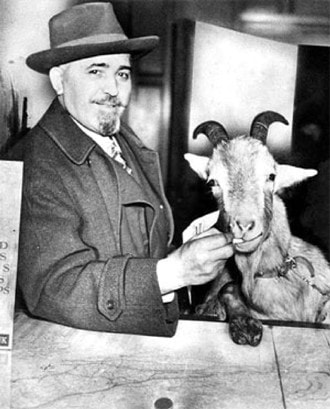
Billy Sianis and his 1945 mascot

Game 4 of the World Series is held at Wrigley Field on October 6. The Chicago Cubs are preparing to host the Detroit Tigers, with the Cubs leading 2 games to 1.

William "Billy Goat" Sianis was the owner of the Billy Goat Tavern, across from Chicago Stadium, home of the NHL's Blackhawks and the Midwest’s premier boxing venue. He had a goat as his bar's mascot, and he bought 2 tickets to this game, one for himself and one for the goat. At the time, there was no rule against bringing an animal into the ballpark. But fans around him complained to the ushers that the goat smelled bad, and Sianis and his goat were kicked out of the ballpark.
Wrigley Field during the 1945 World Series.
Note that the now-famous marquee includes the words
"NATIONAL LEAGUE CHAMPIONS."
It would be a long time before it could say that again.
Game 4, at Wrigley Field, was the source of "The Curse of the Billy Goat." William "Billy Goat" Sianis, owner of the Billy Goat Tavern, across from Chicago Stadium, bought 2 tickets to this game: One for himself, and one for his bar's mascot, a goat. At the time, there was no rule against bringing an animal into the ballpark. But fans around him complained to the ushers that the goat smelled bad, and Sianis and his goat were kicked out of the ballpark.
A Greek immigrant and a superstitious man, Sianis put a curse on the Cubs. The Tigers won the game, 4-1, with all their runs coming in the 4th inning, after Sianis and the goat were kicked out.
Newhouser outpitched Borowy in Game 5, and the Tigers won, 8-5, taking a 3-2 lead. In Game 6, the Tigers scored 4 runs in the top of the 8th, and the game went to extra innings. Stan Hack doubled Bill Schuster home in the bottom of the 12th, giving the Cubs an 8-7 win, and forcing a Game 7 on their home field.
Cubs manager Charlie Grimm used Borowy, on no rest, for the last 4 innings of Game 6, making him the winning pitcher. Game 7 was pushed back a day due to rain, and Grimm decided that, despite having pitched 18 innings in the preceding 7 days, Borowy was his best choice to pitch Game 7. Tiger manager Steve O'Neill went with Newhouser, who had pitched 12 innings to that point, but would be on 2 days' rest. Maybe, as the teams took the field on October 10, Warren Brown was right: Neither team could win.
The game was decided before Newhouser faced a single batter. Borowy had gotten the Cubs to within 1 win of a title, but he had nothing left to give: He began the game by giving up singles to Skeeter Webb, Eddie Mayo and Doc Cramer.
Already down 1-0, Grimm took the exhausted Borowy out, and brought in Paul Derringer, who'd helped the Cincinnati Reds win the 1940 World Series. He got an out, then Grimm ordered an intentional walk to load the bases and set up a play at any base, and Derringer got a 2nd out. But a bases-loaded walk made it 2-0, and Paul Richards hit a bases-clearing double to make it 5-0.
Cavarretta singled a run home in the bottom of the 1st, but that was as close as the Cubs would get. Newhouser went the distance, striking out 10 batters, and the Tigers won, 9-0. Within minutes of the last out, Billy Sianis sent a telegram to Cubs owner Philip K. Wrigley, asking, "Who stinks now?"
Billy Sianis, and the 1945 edition of his mascot
This also remained, for 71 years, the last World Series game the Chicago Cubs had ever played. Left fielder Ed Mierkowicz was the last survivor from the '45 Tigers, while shortstop Lennie Merullo was the last survivor from the '45 Cubs. From Merullo's death on May 30, 2015 until October 25, 2016, there were no living people who had played in a World Series game for the Chicago Cubs.
Newhouser's 170 wins during the 1940s made him the winningest pitcher of the decade. Later, as a scout, he discovered Jim Palmer, whose 186 wins during the 1970s made him the winningest pitcher of that decade.

Tuesday, July 29, 2025

Ryne Sandberg, 1959-2025

The Chicago Cubs are the oldest continuously-operating professional sports franchise in the United States of America, having been founded in 1870 as the Chicago White Stockings. They have had many heroes. Some have been problematic: Adrian "Cap" Anson, Mike "King" Kelly, Lewis "Hack" Wilson, "Slammin' Steroids" Sammy Sosa. Some have been golden: Frank Chance "The Peerless Leader," Charles "Gabby" Hartnett, "Mr. Cub" Ernie Banks.

Ryne Sandberg was one of the golden heroes of Chicago Cub baseball.

Ryne Dee Sandberg was born on September 18, 1959 in Spokane, Washington. His father, Derwent "Sandy" Sandberg, was a Yankee Fan, and named his son after the Yankees' top reliever at that time, Ryne Duren.

In the late 1970s, there were 3 great athletes in the Spokane area, each of them a high school star in baseball, in basketball, and as a quarterback in football: Ryne Sandberg of North Central; Mark Rypien of Shadle Park, North Central's arch-rivals, who went on to play for the Washington Redskins, and was the Most Valuable Player of Super Bowl XXVI; and John Stockton of Gonzaga Prep, who starred for the Utah Jazz.

Also graduates of North Central: Singer-actor Bing Crosby and actress Dyan Cannon. Shadle Park produced a few other pro athletes, including Rypien's brother Brett. Gonzaga Prep produced Pro Football Hall-of-Famer Ray Flaherty, House Speaker Tom Foley, actress Julia Sweeney, and Stockton's son David, who briefly played for the Sacramento Kings.

Like Rypien later did, Sandberg signed a letter of intent to play quarterback at Washington State University, in nearby Pullman. But he chose baseball instead, and was drafted by the Philadelphia Phillies in 1978. He debuted with them on September 2, 1981: Wearing Number 37, and pinch-running for Bob Boone in the top of the 9th inning, he was singled home by Pete Rose, but the Phils lost to the Atlanta Braves, 3-2 at Atlanta-Fulton County Stadium.

At this point, Sandberg was mainly a 3rd baseman. But it was too soon to need a successor to Mike Schmidt. So, on January 27, 1982, the Phillies traded him and starting shortstop Larry Bowa to the Chicago Cubs, for their starting shortstop, Iván de Jesús. Cub general manager Dallas Green, who had managed the Phillies to win the 1980 World Series, moved him to 2nd base, and gave him Number 23.

The 1984 season would be an epic one. The Cubs were now owned by The Tribune Company, which owned, among other things, the Chicago Tribune newspaper, radio station WGN (which stood for what the Trib used to call itself, "the World's Greatest Newspaper"), TV station WGN-Channel 9, and its new nationwide cable "SuperStation WGN."

Since Wrigley Field did not yet have lights, Cub home games were nationally broadcast in the afternoons. The whole country could hear broadcaster Harry Caray -- previously broadcasting for the crosstown Chicago White Sox, and, for many years before that, for the Cubs' arch-rivals, the St. Louis Cardinals -- the Cubs got off to a great start, and became a national phenomenon, far beyond the "Chicagoland" area.

On June 15, then the trading deadline, they picked up pitcher Rick Sutcliffe, and he went on to win the National League's Cy Young Award. On June 23, the Cubs played the Cardinals at Wrigley, and NBC covered it for their national Saturday Game of the Week.

In the 9th inning, and again in the 10th inning, Sandberg tied the game by hitting home runs off Bruce Sutter, the Hall of Fame reliever that the Cubs had let get away, helping the Cards win the 1982 World Series. The Cubs won it in the 11th inning, 12-11. Now, baseball fans who didn't have cable -- it wasn't even a majority of Americans yet -- had Cub fever. 

The fact that it turned out to be the New York Mets, who had been dreadful for several years, who bounced back and battled the Cubs for the NL Eastern Division title, thus the biggest and 3rd-biggest markets getting involved, made it an even bigger story. When they had their magical season of 1969, cut short by the Mets' own "Miracle," they made themselves beloved in the Chicago area; but in 1984, they excited the whole country.

And it turned out to be not that close: The Cubs went 96-65, and won the Division by 6 1/2 games. It was their 1st postseason appearance since winning the Pennant in 1945. Sandberg was named the NL's Most Valuable Player. He was named to the 1st of 10 All-Star Games. He won the 2nd of 9 Gold Gloves.

With that great 1984 season, Ryne Sandberg, Rick Sutcliffe and Harry Caray not only thrilled a nation, but saved Wrigley Field for at least two more generations. A fine legacy to leave. I was a Yankee Fan, and the fact that the Cubs were driving Met fans up the wall made it fun to watch. The 1984 Cubs
made a world that scared the hell out of an already-troubled 14-year-old kid, on multiple levels, a bit more bearable.

And they beat the NL Western Division Champions, the San Diego Padres, in their 1st postseason appearance, in the 1st 2 games of the NL Championship Series, in front of adoring crowds at Wrigley. But the Padres took all 3 games in San Diego, including a walkoff extra-inning home run by Steve Garvey in Game 4, and a key error by 1st baseman Leon Durham in Game 5 -- presaging the one 2 years later in the World Series, by former Cub 1st baseman Bill Buckner.

It was a result that was heartbreaking for anyone who didn't root for the Padres (or the Mets, or the White Sox, or the Cardinals), and as staggering as, the next month, Walter Mondale losing 49 out of 50 States to Ronald Reagan in the Presidential election.

The Cubs couldn't sustain it, and struggled for most of Sandberg's tenure with the team. Finally adding lights to Wrigley Field in 1988 didn't help much. They did win another NL East title in 1989. They lost the NLCS to the San Francisco Giants, although there was no heartbreaking moment: They simply got beat by a better team. In 1990, the Cubs hosted the All-Star Game, and Sandberg led the NL with 40 home runs, and reached 100 RBIs for the 1st time, but they were nowhere near a Playoff berth.

The switch to the 3-Division setup in 1994, and the move of the Cubs to the NL Central Division, didn't help much. Sandberg got off to a slow start, and on June 13, for reasons that had nothing to do with the upcoming strike, he announced his retirement at the age of 34. He admitted, "The reason I retired is simple: I lost the desire that got me ready to play on an everyday basis for so many years."

When the strike ended in 1995, he still sat out the entire season. He returned in 1996, and broke Joe Morgan's career record for home runs by a 2nd baseman. He played his last game on September 21, 1997. He finished with a .285 batting average, 2,386 hits, including 403 doubles, 76 triples (a very high figure for the post-1920 Lively Ball Era), 282 home runs, 277 of them as a 2nd baseman. (Jeff Kent now holds the record, with 351.)

He also stole 344 bases. Here's a list of the players with at least as many home runs and at least as many stolen bases as Ryne Sandberg, in chronological order: Bobby Bonds, Rickey Henderson, Barry Bonds, Craig Biggio and Bobby Abreu. That's it. That's the list. (Barry Bonds had already exceeded Sandberg in both categories before, it is believed, he started cheating. Willie Mays almost did it, stealing 339.)

The trade of Sandberg from The Vet to Wrigley has been called one of the most lopsided trades in baseball history. It's not. Let the record show that, from 1982 to 1997, when Sandberg played his last game, the Phillies won 2 Pennants, in 1983 and 1993; while the Cubs won none.

The Cubs retired his Number 23, and dedicated a statue of him outside Wrigley Field. In 1999, he was named as one of the 100 finalists to the Major League Baseball All-Century Team. In 2005, he was elected to the Baseball Hall of Fame. As a member, he lobbied for the election of fellow Cubs legends Ron Santo and Andre Dawson. Both were elected, but while Dawson lived long enough to see it (and is still alive as of this writing), Santo didn't.

In 2007, Sandberg returned to the Cubs' organization as a minor-league manager. In 2010, with the Des Moines-based Iowa Cubs, he was named the Pacific Coast League's Manager of the Year. (Iowa in the Pacific Coast League? Geography has never been baseball's strong suit. After all, the NL once had Chicago and St. Louis in the East, and Atlanta and Cincinnati in the West. The NFL has been even worse: They still have Dallas in the NFC East.)

In 2011, Sandberg returned to the Phillies' organization, and managed their top farm team, the Allentown, Pennsylvania-based Lehigh Valley IronPigs, to their 1st Playoff appearance. Baseball America magazine named him the 2011 Minor League Manager of the Year.

In 2013, he was named the Phils' 3rd base coach. When Charlie Manuel, who had managed them to win the 2008 World Series, was fired on August 16, Sandberg was named manager. But the timing was bad: The Phils' 2007-11 quasi-dynasty had collapsed, and there was little he could do. After the 2015 season, he was fired. His managerial record was 119-159.

In 2016, the Cubs named him a team ambassador. That was the year they finally won their 1st Pennant since 1945, and their 1st World Series since 1908. Like Billy Williams, Fergie Jenkins and Rick Sutcliffe, but unlike Ernie Banks, Ron Santo, Jack Brickhouse and Harry Caray, Ryne Sandberg had lived to see this magical moment.

He married twice. With his high school sweetheart, Cindy, he had son Justin and daughter Lindsey. With his 2nd wife, Margaret, he raised her 3 children from a previous marriage. Ryne's nephew, Jared Sandberg, played 3rd base for the Tampa Bay Devil Rays from 2001 to 2003.
Ryne and Margaret Sandberg, Opening Day 2024

Early in 2024, Ryne Sandberg announced that he had prostate cancer. He died yesterday, July 28, 2025, at his home in the Chicago suburbs, at the age of 65. Although he didn't win a Pennant with the Cubs, he remains one of the most beloved athletes in Chicago history.

Monday, May 12, 2025

May 12, 1955: The 1st Black Pitcher to Throw a Major League No-Hitter

May 12, 1955, 70 years ago: The Chicago Cubs beat the Pittsburgh Pirates, 4-0 at Wrigley Field in Chicago. Sam Jones of the Cubs pitched a no-hitter. This made him the 1st black pitcher to do so in the previously all-white major leagues.

It was far from a perfect game: He walked 7 batters. But he was also lucky. He walked Dale Long in the 2nd inning, but he was thrown out trying to steal 2nd base. He walked Toby Atwell to lead off the 3rd, but stranded him. He walked Long again to lead off the 5th, but got George Freese to ground into a double play.

The opposing pitcher, Vernon Law, nearly hit a home run to straightaway center field, but Eddie Miksis, who went 2-for-4 with an RBI on the day, caught it. He walked Long a 3rd time, leading off the 8th, and gave up another long fly to center, to Freese, by Miksis caught this one, too. Then Jones got Toby Atwell to ground into a double play.

In addition to Miksis' heroics, shortstop Ernie Banks went 3-for-5 with an RBI, and right fielder Ted Tappe went 2-for-5, with a home run and 2 RBIs. Despite being a Cub and having an unusual surname, Ted was no relation to Elvin "El" Tappe, a teammate, and later part of the Cubbies' dumb "College of Coaches" experiment. El did have a brother, Melvin -- El and Mel -- who pitched professionally.

Then came the 9th. Jones walked Freese, and threw a wild pitch that got him to 2nd base. That ended up not mattering, because he walked Preston Ward. Then he walked Tom Saffell. Bases loaded, nobody out, and the next 3 batters were Dick Groat, a rookie named Roberto Clemente, and Frank Thomas. (Not the later Chicago White Sox "Big Hurt," but a powerful slugger in his own right.) Suddenly, not just the no-hitter, but the game was in doubt: Thomas represented the tying run.

Jones buckled down, struck Groat out looking, struck Clemente out swinging, and struck Thomas out looking. It was a brilliant comeback, and he had his no-hitter.

Jones was born in 1925 in Stewartsville, Ohio, near Steubenville, and also near Wheeling, West Virginia. Because of the earlier star Yankee pitcher with the same name, he, too, was nicknamed "Sad Sam." He was also known as "Toothpick Sam": Like 1970s stars Dusty Baker and U L Washington, he was frequently seen chewing on a toothpick.

Having gotten his start in the Negro Leagues, in 1952, he pitched for the Cleveland Indians, and his catcher was a former Cleveland Buckeyes teammate, Quincy Trouppe. This made them the 1st all-black "battery" in the American League, 3 years after Don Newcombe and Roy Campanella had been the 1st in the modern major leagues, and 75 years after George Stovey had pitched to Moses "Fleet" Walker.

Jones was named to the All-Star Game in 1955 and 1959. He led the National League in strikeouts in 1955 and 1956. In 1959, with the San Francisco Giants, he led it in strikeouts, wins and earned-run average, the Triple Crown of Pitching. Had the Cy Young Award then been given out to the best pitcher in each League, he would have won it for the NL. But it was given to the best pitcher in both Leagues from its 1956 inception until 1966, and in 1959, he finished 2nd in the voting to Early Wynn of the Chicago White Sox.

He pitched for mostly struggling teams, resulting in a career record of 103-104. And his timing was bad. He pitched for the Indians in 1951 and 1952, missing their 1948 and 1954 Pennants. He pitched for the Giants from 1959 to 1961, missing their 1962 Pennant. He pitched for the Detroit Tigers in 1962, a year after their best performance since 1945, although it's hard to imagine him making an 8-game difference. He pitched for the St. Louis Cardinals in 1963, missing their 1964 World Series win. And his last major league season was 1964, finishing just 2 games behind the Yankees for the Baltimore Orioles, 2 years before their 1966 World Series win.

He pitched beyond 1962 despite having been diagnosed with cancer in his neck. He fought it bravely until it took his life in 1971, when he was only 45 years old.

In 2007, pitcher-turned-broadcaster Jim "Mudcat" Grant included Jones in his book Black Aces, about the 13 black pitchers, including himself, who had won 20 or more games in a major league season. Newcombe was the only one to accomplish the feat before Jones. Since the book was published, 2 more have done it: CC Sabathia, the only Yankee on the list, in 2010; and David Price, with the 2012 Tigers.

Monday, November 25, 2024

November 25, 1934: The NFL's 1st 1,000-Yard Rusher

November 25, 1934, 90 years ago: The Chicago Bears beat their crosstown rivals, the Chicago Cardinals, 17-6 at Wrigley Field. They move to 11-0 on the season.

Beattie Feathers, a rookie running back out of the University of Tennessee, rushes for 42 yards, giving him 1,004 rushing yards on the season. This makes him the 1st player in the NFL's history, 15 seasons thus far, to rush for more than 1,000.

Unfortunately, Feathers was injured in the game. He would miss the Bears' Thanksgiving Day win over the Detroit Lions, their season finale against the Lions, and the NFL Championship Game against the New York Giants, which the Bears lost, ruining what had been, up until then, an undefeated season.

William Beattie Feathers was born on August 20, 1909 in Bristol, Virginia, on the State Line with Tennessee. He led Tennessee High School to a State Championship, but turned down Virginia, Virginia Tech, and every other football-playing college in the Old Dominion to play for Bob Neyland at the University of Tennessee.

He played with the Bears from 1934 to 1937, with the football version of the Brooklyn Dodgers in 1938 and 1939, and with the Green Bay Packers in 1940. He was the head football coach at Appalachian State University in 1942; coached football at North Carolina State from 1944 to 1951, and also coached their baseball team in 1945; was head baseball coach and assistant football coach at Texas Tech from 1954 to 1960; and, at Wake Forest University, was assistant football coach from 1961 to 1977, and head baseball coach from 1972 to 1975.

He was elected to the College Football Hall of Fame and the Virginia Sports Hall of Fame. He died on March 11, 1979 in Winston-Salem, North Carolina, near the Wake Forest campus.

The NFL would settle on a 12-game schedule in 1947, expanding to 14 in 1961, 16 in 1978, and 17 in 2021. The number of yards a player has had to average per game to reach 1,000 for the season has dropped to 84, then to 72, then to 63, and now to 59. As a result, 1,000 yards rushing in a season, so long a benchmark for an elite running back, now has very little meaning.

To put that into perspective: Jim Brown set a record in 1963, with 1,863 yards; O.J. Simpson raised it to 2,000 in 1973; and Eric Dickerson raised it to 2,105 in 1984 -- thus, Brown averaged 133, Simpson averaged 143, and Dickerson averaged 132, and to break his record in a 17-game season, a player would have to average 124 per game. 

Monday, September 9, 2024

Few Things Worth Having Are Easy

There are 3 weeks left in the Major League Baseball season. Despite all the ups and downs, we can be pretty sure who the 6 Playoff teams will be in the American League: The New York Yankees, the Baltimore Orioles, the Cleveland Guardians, the Kansas City Royals, the Minnesota Twins and the Houston Astros.

These 6 teams are within 6 games of each other. The next-best 3 teams -- the Boston Red Sox, the Detroit Tigers and the Seattle Mariners -- are 4 games in the loss column behind the Twins, the team that currently stands to be the 6th seed. It's just a matter of where the seeds fall.

*

Last Monday, Labor Day, the Yankees began a series away to the Texas Rangers, at Globe Life Field in the Dallas suburb of Arlington, Texas. Gerrit Cole pitched 6 strong innings, to outpitch Jack Leiter, son of Al Leiter, nephew of Mark Leiter Sr., and 1st cousin of current Yankee Mark Leiter Jr. Giancarlo Stanton hit a home run, Gleyber Torres went 3-for-5 with 2 RBIs, and the Yankees won, 8-4.

The rest of the series was bad. How bad was it? The Tuesday night game was bad enough to stick in our minds if we end up losing the Division by 1 game. Carlos Rodón was brilliant, allowing only 1 hit in 6 innings, a home run by Josh Hung. He walked only 2, and struck out 11.

But because Brian Cashman cares more about pitch counts than winning, and Rodón had thrown 99 pitches, he was taken out. Tommy Kahnle allowed a run in the 7th. Jake Cousins was shaky in the 8th, allowed a run, and had to be bailed out by Tim Hill. The Yankees still took a 4-3 lead into the bottom of the 9th, with RBIs coming on a groundout by Jose Trevino, a single by Alex Trevino, and 2 on a single by Anthony Volpe.

Cashman could have told Aaron Boone to leave Hill in to pitch the 9th. Instead, Clay Holmes, officially the closer, was brought in. He got Travis Jankowski to ground out. Then he allowed a single to Carson Kelly, walked Josh Smith, walked Marcus Semien to load the bases, and gave up a grand slam to Wyatt Langford. Rangers 7, Yankees 4.

It was Holmes' 11th blown save of the season. Right now, he is the top reason the Yankees aren't a sure bet to win the AL East.

On Wednesday night, for the 1st of 2 times in the week, the Yankees faced a pitcher that Cashman let get away. Nathan Eovaldi limited the Yankees to 2 runs over 7 innings. In contrast, Marcus Stroman didn't get out of the 4th inning. Three Rangers -- Langford, Nathaniel Lowe and Ezequiel Durán -- each got 3 hits. Juan Soto and Trent Grisham hit home runs, but the Rangers won, 10-6.

*

So the Yankees' roadtrip went on, with an Interleague series against the Chicago Cubs at Wrigley Field. Luis Gil came off the Injured List, and allowed 1 hit over 6 innings on Friday afternoon. (Despite having had lights since 1988, the Cubs still play mostly day games at home.) A double by Aaron Judge and a single by Austin Wells, both in the 3rd, accounted for all the runs in the game, and the Yankees won, 3-0.

Clarke Schmidt also came off the Injured List, and he started the Saturday game. He allowed 4 hits in 4 2/3rds innings. Nestor Cortés wasn't happy about being the odd man out in the rotation, but he pitched the rest of the way, allowing only 1 walk and keeping the 4-hit shutout. The Yankees only got 4 hits themselves, but Wells had an RBI on a groundout, and another run scored on an error. Yankees 2, Cubs 0.

Sunday was Cole's 34th birthday, and his turn in the rotation. He had a shaky 1st inning, and an error by Torres didn't help. But the story of the day was another pitcher that Cashman let get away, Jameson Taillon, who limited the Yankees to 1 run over 6 innings. Cubs 2, Yankees 1.

It was the 1st series in 10 years in which the Yankees' pitchers allowed no home runs. The 2 teams combined for 8 runs in 3 games. The wind must have been blowing in at Wrigley.

*

The Yankees are 82-61, the Orioles 81-61. So the Orioles are half a game back, but -- Cliché Alert: -- a full game back in the all-important loss column. The Boston Red Sox trail by 10 games, the Tampa Bay Rays by 11, and the Toronto Blue Jays by 14 1/2.

The Yankees have 19 games left, the Orioles 20, including 3 against each other, at Yankee Stadium II, on September 24, 25 and 26, with each team then beginning its final series of the regular season. The Magic Number is 19: Any combined number of Yankee wins and Oriole losses, the rest of the way, adding up to 19, and the Yankees win the Division.

Tonight, the Yankees come home, and begin a series against the Royals, who trail the Guardians by 2 1/2 games in the AL Central. These will not be easy games.

Few things worth having are easy.

Sunday, December 17, 2023

December 17, 1933: The 1st NFL Championship Game

Hewitt's lateral to Karr

December 17, 1933, 90 years ago: The 1st official NFL Championship Game is played. Appropriately, it's between the League's founding team, the Chicago Bears; and its team in the biggest market, the New York Giants.

There had been controversies for the League title in 1921 and 1925, so having a definitive title game would have helped. In 1932, the Bears and the Portsmouth Spartans (who became the Detroit Lions in 1934) finished tied for first: The Bears were 6-1-6, the Spartans 6-1-4. (At the time, ties were not counted in winning percentage.) So a playoff game was set, and the Bears won it, 9-0.

So, for the 1933 season, the NFL was divided into Eastern and Western Divisions, and the winners were to meet in a Championship Game. The Giants won the East, going 11-3. The Bears won the West, 10-2-1. So the decider was set for Wrigley Field. (Until the Super Bowl began, regardless of which team had the better record, the West winners would host the game in odd-numbered years, and the East winners would do so in even-numbered years.

Coached by Steve Owen, the Giants had some fantastic players: Quarterback Harry Newman, running back Ken Strong, end Ray Flaherty, and the man regarded for decades to come as the best center in NFL history, Mel Hein.

George Halas, one of the co-founders of the NFL, coached the Bears. They had 2 of the defining players of NFL history, speedy halfback Harold "Red" Grange and bruising fullback Bronislau "Bronko" Nagurski. They also had center George Trafton, tackles Link Lyman and George Musso, and end Bill Hewitt, who famously played without a helmet, at a time when that was still allowed, even though everybody knew it was a bad idea. All of them are in the Pro Football Hall of Fame.

Another difference in this new season was a liberalization of the passing rules. The Bears, the 1st NFL team to use the T formation, took advantage of this. The Giants had not done so as much. Nevertheless, when meeting with the officials before the game, Newman told them the Giants would be trying some trick plays, checking to ensure they would be legal.

The game kicked off at 1:45 PM Central Time (2:45 Eastern). It was broadcast on Chicago radio station WGN and a few other stations, but not on a national network. Nor was it broadcast on radio in New York.

Early in the game, the Giants' offensive line shifted, so that Hein was now on the end, and thus an eligible receiver. Hein snapped the ball to Newman, who handed it right back to him, then ran out to fake a run. While the Bears keyed on Newman, Hein took off. By the time the Bears caught on and caught up with him, he had gotten to the Bears' 15-yard line. But Chicago managed to, as their later fight song said "Bear Down," and hold the Giants to a field goal attempt, which the normally reliable Strong missed.

Jack Manders, so reliable he was known as "Automatic Jack," kicked field goals in each of the 1st 2 quarters, and the Bears led 6-0. But just before the half, Newman threw a 29-yard touchdown pass to Badgro, and the Giants went into the locker room up 7-6.

Manders kicked another field goal in the 3rd quarter, but a Giant drive resulted in Max Krause scoring from the 1-yard line, making it 14-9 New York. Finally, late in the quarter, Nagurski, not known as a passer, or as a jumper -- his style was to take the ball, crash into the line, and let the defenders fall where they may -- threw a jump pass to Bill Karr, who ran it in 8 yards for a touchdown, and the Bears led, 16-14.

The Giants had another trick play in them, early in the 4th quarter. Newman took off on a 30-yard run, then lateraled to Strong, who finished the touchdown, and then kicked the extra point. It was 21-16 Giants.

The minutes ticked away, and another Manders field goal would have done the Bears no good. Quarterback Carl Brumbaugh drove them to the Giants' 36 with less than 2 minutes left. He passed to Hewitt, and the Giant defense was ready to tackle him. But pulled the "hook and ladder play": He spun and lateraled to Karr, who took it in for a touchdown. The Bears led, 23-21.

The Giants got the ball back, and there was still time for them to get within Strong's field goal range. They got to their own 40, and again set Hein up as an eligible receiver. Running back Dale Burnett tried an option pass, and Hein was wide open on the Bear 30. But the pass was a bad one, and fell well short.

There was time for one more play. Newman passed to Badgro, who was ready to copy the earlier Hewitt-to-Karr hook and ladder. But this was the era of two-platoon football, where, no matter how big a star you were, you had to play both offense and defense. And there was no bigger star in football than Grange. He immediately figured out what was about to happen, and ran to Badgro, and wrapped his arms around Badgro's arms. Any lateral Badgro made wouldn't go very far. The clock ran out. Halas, eventually the grand old man of football, would later call it the greatest defensive play he ever saw.

The Bears were NFL Champions for the 3rd time, having won it in controversial fashion in 1921, and then definitively in 1932. The Giants had won in 1927, and would get revenge over the Bears in 1934, in the Polo Grounds, in a frigid contest known as The Sneaker Game.

These 2 teams would also meet in the NFL Championship Game in 1941, 1946, 1956 and 1963, with the Giants winning only in 1956. They've since met in the NFC Playoffs in the seasons of 1985, with the Bears winning; and 1990, with the Giants winning; and, each time, it was a good omen, as the winner went on to win the Super Bowl.

In 1981, John Thorn left his comfort zone, baseball, and published Pro Football's 10 Greatest Games. He included this game as the earliest of them.

Saturday, October 14, 2023

October 14, 2003: The Steve Bartman Game

October 14, 2003, 20 years ago: David Wells hurls the Yankees to a 4-2 win over the Red Sox and a 3-games-to-2 lead in the American League Championship Series. Karim Garcia, victim of a Pedro Martinez fastball off his back in Game 3, delivers the key hit with a 2-run single in the 3rd.

But despite the implications of a Yankees-Red Sox postseason game, and everything that happened in Game 3 of that series, today's action at Fenway Park pales in comparison to what happens at Major League Baseball's other surviving pre-World War I ballpark, Wrigley Field in Chicago.

By advancing to the National League Championship Series, the Chicago Cubs had already won a postseason series for the 1st time in 95 years. Now, leading the Florida Marlins 3-0 with 1 out in the 8th inning, and with ace Mark Prior on the mound, the Cubs are just 5 outs away from their 1st Pennant in 58 years. Wrigley and the surrounding streets are jammed with people anticipating the Cubs' 1st trip to the World Series since 1945, shortly after World War II ended.

But Marlins' 2nd baseman Luis Castillo – Met fans will recognize that name from his 2009 miscue against the Yankees – hits a fly ball down the left-field line. Cub left fielder Moisés Alou – another name Met fans will go on to remember with regret – reaches for the ball at the fence, but he can’t get it. A Cub fan named Steve Bartman reaches for it, and knocks it away.

Despite appeals from the Cubs, umpire Mike Everitt correctly rules there was no interference, that Bartman had not reached out into the field of play, and thus was entitled to try to catch the ball every bit as much as Alou was.

Castillo, with his at-bat extended, draws a walk. Iván Rodríguez singles, to make it 3-1 Cubs. Miguel Cabrera hits a ground ball to to Cub shortstop Alex Gonzalez – the Marlins had a shortstop of the same name – and he bobbles the ball. He could have turned a double play to end the inning and preserve the Cubs' lead. Instead, all runners are safe, and the bases are loaded. Derrek Lee doubles, tying the score and chasing Prior from the game.

Cub manager Dusty Baker brings in a new pitcher, Kyle Farnsworth. Foreshadowing his later Yankee screwups, he delivers an intentional walk to load the bases and set up a force play. But he gives up a sacrifice fly that scores Cabrera with the go-ahead run. He repeats the set-up-the-DP intentional walk, and then gives up a double to Mike Mordecai that clears the bases and makes it 7-3. The Marlins score another run for the final score of 8-3, and tie up the series.

In 2010, the MLB Network listed this game at 7th on their list of MLB's 20 Greatest Games -- limited in scope, due to the availability of surviving videotape, to 1975 onward.

Before the game ended, Bartman had to be led away from the park under security escort for his own safety, as Cubs fans shouted profanities towards him, and others threw debris onto the field and towards the exit tunnel from the field. News footage of the game showed him surrounded by security as passersby pelted him with drinks and other debris.

Bartman's name, as well as personal information about him, appeared on Major League Baseball’s online message boards minutes after the game ended. As many as 6 police cars gathered outside of his home to protect Bartman and his family following the incident.

Afterwards, Governor Rod Blagojevich of Illinois suggested that Bartman join a witness protection program. Governor Jeb Bush of Florida offered Bartman asylum. For once, Jeb Bush was a better man than a Democrat -- "Blago" was eventually impeached and removed by the State legislature, and went to prison for public corruption -- but, of course, living on Fisher Island, 15 miles from Joe Robbie Stadium, Jeb's gesture could be seen as a rather snarky one.

Shortly after the incident, Bartman released a statement, saying he was "truly sorry." He added, "I had my eyes glued on the approaching ball the entire time and was so caught up in the moment that I did not even see Moisés Alou much less that he may have had a play."

His family changed their phone number to avoid harassing phone calls. He requested that any gifts sent to him by Marlins fans be donated to the Juvenile Diabetes Research Foundation, a Cub cause celebre due to its association with former star-turned-broadcaster Ron Santo.

Prior and former Cubs pitcher-turned-broadcaster Rick Sutcliffe spoke out in defense of Bartman. Even Jay Mariotti, then a Chicago Sun-Times columnist and a panelist on ESPN's Around the Horn, who seems to revel in the miseries of his favorite team, defended Bartman. But Michael Wilbon, columnist for the Washington Post and co-host of ESPN's Pardon the Interruption, a Chicago native and a huge Cub fan, has repeatedly said that he refuses to forgive Bartman.

The Cubs have finally won a Pennant and a World Series. The team even sent Bartman a World Series ring. But, to this day, Bartman refuses to make public appearances to talk about it, despite huge offers. I'm waiting for someone to do a Chris Crocker-style video and say, "Leave Bartman alone!"

Saturday, October 1, 2022

October 1, 1932: Babe Ruth's Called Shot

 
October 1, 1932, 90 years ago: Game 3 of the World Series is played at Wrigley Field in Chicago. There was bad blood between the New York Yankees and the Chicago Cubs, because the Cubs had acquired former Yankee shortstop Mark Koenig late in the season, he'd helped them win the Pennant, and had announced that, whatever their individual players' shares of the World Series money would be, he would get only half as much.

The Yankees, including Babe Ruth himself, publicly called the Cubs cheap, and there was some rough stuff in the 1st 2 games at Yankee Stadium. When Ruth and his wife Claire got off the train at Union Station in Chicago, Cub fans were waiting for them, throwing garbage at them, and spitting on them. Neither was naive: The Babe had been treated badly before, and Mrs. Ruth, under her maiden name of Claire Hodgson, was an actress, and used to rough customers. But this was over the line.

The Yankees took a 4-1 lead, including home runs by Ruth and Lou Gehrig. But the Cubs tied it up in the bottom of the 4th. Ruth led off the top of the 5th, and the Cub fans were abusing him like crazy. In the Cubs dugout, the "bench jockeying" was nasty as well.

Ruth was no stranger to this. Because of his large, wide nose and big lips, there had been suggestions that he was part black. Research into his family history showed him to be almost completely German -- in fact, because his grandparents were born in Pennsylvania, before moving to Baltimore, they were "Pennsylvania Dutch" -- ethnically Amish, if practicing Catholics.

But that didn't stop people from indulging in rumors, and one of the names he was sometimes called was "(N-word) Lips." On one memorable occasion, which may be apocryphal, he heard this particular insult, walked over to the opposing dugout, and said, "Listen, you guys, call me 'bastard' or 'cocksucker,' or whatever you want, but lay off the personal stuff, would ya?"

Charlie Root was pitching for the Cubs, and he threw a called strike. The Babe didn't like the pitch, and the Cubs' bench jockeying got worse. A home movie -- sadly, silent, and with all the crowd noise, we probably wouldn't be able to hear what the players were saying anyway -- shows Ruth waving he hand at the Cub dugout, a classic "Ah, go on, ya bum" gesture.

The way the story is usually told, including on a newsreel by Ruth himself, there were only 3 pitches in this at-bat. In fact, Root's next 2 pitches were out of the strike zone, and called balls. His 4th pitch was called a strike. The home movie shows Ruth pointing directly at Root -- twice. His arm is not extended. Contrary to legend, he is not pointing at a spot beyond the outfield fence, as if to say, "I'm going to hit the next pitch there."

But he is sending a message. Cubs catcher Gabby Hartnett claimed Ruth said, "It only takes one." Another source said Ruth said, "You got one more, kid!" (To the Babe, who was terrible with names, if you were a young guy, you were "Kid"; if you were older, you were "Doc"; and if he didn't like you, or sometimes even if he did, you were "You son of a bitch!") Gehrig, in the on-deck circle, told a reporter that what Ruth yelled at Root was, "I'm gonna hit the next pitch right down your goddamned throat!"

So, yes, Babe Ruth called his shot.

Root threw him one more pitch. The Babe crushed it to dead center field. Longtime Cub observers said it was the longest home run ever hit in Wrigley Field to that point. The now-familiar center field scoreboard wouldn't go up until 1937, and no player has ever hit it with a home run. Had it been there in 1932, the Babe's blast might have hit it.

The crowd knew that the Babe had made his point, and, like the Russian fans turning from Drago to Balboa in Rocky IV, switched sides, and cheered him.

The next batter was Gehrig, and he also hit his 2nd home run of the game. The Yankees hung on to win, 7-5, and completed the sweep the next day.

Ruth's Called Shot remains, along with Bobby Thomson's 1951 Pennant-winning "Shot Heard 'Round the World," one of the two most talked-about home runs in baseball history, more so even than the World Series Game 7-winning shot by Bill Mazeroski in 1960, or the home runs that broke Ruth's records: Single-season, 61 by Roger Maris in 1961, then 70 by Mark McGwire in 1998, then 73 by Barry Bonds in 2001; and career, 715 by Hank Aaron in 1974, then 756 by Bonds in 2007.