
John Hughes directed Matthew Broderick as high school senior Ferris, Jennifer Grey as his sister Jeanie, Lyman Ward and Cindy Pickett as his parents, Alan Ruck as Ferris' best friend Cameron Frye, Mia Sara as his luscious girlfriend Sloane Peterson (Ferris? Cameron? Sloane? Who gives kids last names as first names?), Jeffrey Jones as vice principal Edward R. Rooney, Edie McClurg as Rooney's secretary Grace, Ben Stein as an economics professor (presaging his similar role in the TV series The Wonder Years), and Charlie Sheen as a ginker who Jeanie meets at the police station.
The action takes place in Chicago and in the fictional town of Shermer, Illinois, 15 miles northwest of the city, based on Hughes' real-life hometown of Northbrook. (Until he was 12, he lived in Grosse Pointe, Michigan, a suburb of Detroit. Hence, Cameron wears a Red Wings jersey with Gordie Howe's name and Number 9.)
Northbrook's original name was Shermerville, and his alma mater, Glenbrook North High School, is on Shermer Road. We know it's 15 miles because of the differences in the mileage on the odometer on the Ferrari between North Lake Shore Drive and Cameron's house.
Hughes set a lot of his films in this fictional town, including Weird Science, The Breakfast Club, Sixteen Candles and Pretty in Pink. The "home" scenes of National Lampoon's Vacation, Planes, Trains and Automobiles, and Home Alone were also set there. Not all were filmed in Northbrook: Some of these were filmed in nearby Winnetka, Illinois. The Bueller house and the streets around it were in Long Beach, California; the rest of the movie was shot in Chicago and the suburbs, including the Frank Lloyd Wright-ish Frye house, in Highland Park, Illinois.
In the film, Ferris decides this spring weekday (I usually think it's April, but this is not specified in the script) in his senior year at Shermer High School is too nice a day to spend in school. So he fakes out his parents, pretends to be sick, convinces Cameron (who appears to actually be sick) that neither one of them is sick, and gets his girlfriend Sloane out of school on a phony death in the family. Then they head for the big city, have some fun, run a couple of cons, and head home, and have to face the consequences of their actions... sort of.
All the while, Mr. Rooney is trying to catch Ferris cutting school. That Sloane is also cutting appears to be incidental to him. That Cameron is also cutting appears not to be something he's even aware of. He heads for the mall, thinking Ferris might be there, and gets embarrassed. He goes to the Bueller home, and gets nearly shredded by their Rottweiler and attacked by Jeanie (who's also trying to catch Ferris in the act, and fails, hence the police station).
How many times have I seen this movie? Nine times? More than that: Maybe 15. After 40 years, it remains the only movie I have ever gone to the theater to see, and literally laughed all the way home from. And it helped make Jennifer Grey a star, which is a good thing. Although Mia Sara didn't become a big star: Other than this, her biggest movie has been Timecop, and that was 8 years later.
Yeah, Ferris was a legend. A great guy. Right? As ESPN's Lee Corso would say, "Not so fast, my friend!":
* He lied to his parents.
* He got away with that, and he rubbed the fact in his sister's face.
* He cut school. A lot. How many times, in that semester, alone? Say it with me: "Nine times!" "If I go for 10," he admitted in one of his periodic breaks of the fourth wall, as he set up his synthesizer to produce fake sounds of snoring, sneezing and coughing, "I'm probably gonna have to barf up a lung, so I'd better make this one count." Gee, not real big on remorse, are ya, F.B.?
I mean, think about it: Since he knew Spring was coming, and that he would probably want to take a day off to enjoy it, shouldn't he have saved up his sick days, instead of using so many? It's like in basketball: You get a limited number of fouls per game, before you get tossed. It's 6 in the NBA, 5 in college, usually 5 in high school. Use them wisely.
I can see getting an entire school to think you're sick as a dog. But conning the Cubs? Well, maybe. We're not talking about an organization that's been known for smart decisions. Besides, pay a sports team enough money, and they'll put anything (short of profanity or defamation) on one of their signs or boards.
But the water tower? This was not some kid spray-painting it on: This was a professionally-painted "SAVE FERRIS," which would not have been approved by the municipal government unless they were convinced that the kid in question needed contributions to pay for his health care.
And, since we've seen the Bueller house, and we know that Mrs. Bueller is a real estate agent and Mr. Bueller works in a high-rise office downtown, apparently as some kind of executive rather than a cubicle drone, we know they're not exactly hurting for cash, if not stinking rich like the Fryes. They can afford health insurance for their kids.
So why would the town allow this message on their water tower? Maybe it was a bribe. Nah, can't be. After all, it's not like the Chicago area is known for political corruption...
I mean, think about it: Since he knew Spring was coming, and that he would probably want to take a day off to enjoy it, shouldn't he have saved up his sick days, instead of using so many? It's like in basketball: You get a limited number of fouls per game, before you get tossed. It's 6 in the NBA, 5 in college, usually 5 in high school. Use them wisely.
* He took advantage of his sick best friend. Cameron was sick. Probably with the flu. Does Ferris consider this? Does Ferris consider that spending the day with a clearly sick Cameron might make him sick? Does Ferris consider that it might make Sloane, the girl he allegedly loves, sick? Does he consider that it might make anyone else Cameron interacts with sick? Not by a long shot. And then, Ferris steals a car, a 1961 Ferrari 250 GT California, belonging to Cameron's father.
* He took advantage of his girlfriend. No, I don't mean in a sexual way – at least, not onscreen. First, Ferris has Sloane thinking that her grandmother has died. Remember her reaction? This was not the face of a girl who knew that her boyfriend was behind this. It wasn't until she saw Ferris – standing in front of the Ferrari, wearing the trenchcoat, the shades and the hat, impersonating her father – that she realized, "My Grandma's alive! And my boyfriend is awesome!" No, he's not: He had you thinking your Grandma was dead! All so he could cut school.
* He scammed the entire Chicago metropolitan area. "SAVE FERRIS" signs went up everywhere, from the Shermer water tower to the electronic portion of the familiar Wrigley Field marquee!
I can see getting an entire school to think you're sick as a dog. But conning the Cubs? Well, maybe. We're not talking about an organization that's been known for smart decisions. Besides, pay a sports team enough money, and they'll put anything (short of profanity or defamation) on one of their signs or boards.
But the water tower? This was not some kid spray-painting it on: This was a professionally-painted "SAVE FERRIS," which would not have been approved by the municipal government unless they were convinced that the kid in question needed contributions to pay for his health care.
And, since we've seen the Bueller house, and we know that Mrs. Bueller is a real estate agent and Mr. Bueller works in a high-rise office downtown, apparently as some kind of executive rather than a cubicle drone, we know they're not exactly hurting for cash, if not stinking rich like the Fryes. They can afford health insurance for their kids.
So why would the town allow this message on their water tower? Maybe it was a bribe. Nah, can't be. After all, it's not like the Chicago area is known for political corruption...
* Don't get me started on the fact that the attempt to get into Chez Quis, the fancy French restaurant on the Near North Side, was a rotten thing to do, and should have failed, for a dozen reasons, and almost did.
* He hijacked a parade. Bueller is a German name, and German-Americans – by 1986, they no longer had to worry about discrimination or suspicion like they did in the era of the World Wars – celebrate their heritage on Steuben Day, on or around September 17, the anniversary of the birth of Baron Friedrich Wilhelm von Steuben, who left the Prussian army under dubious circumstances, and then helped George Washington whip the Continental Army into shape during the War of the American Revolution.
Parades in his memory are held in New York, Philadelphia and, as seen in the movie, Chicago. Hughes filmed during Chicago's real Steuben Day parade on September 28, 1985, so while the film has it in the Spring, for some reason, at least it really was Steuben Day when they filmed.
So how did a high school student playing hooky get to jump on a float in a municipal parade (i.e. sponsored by the City government) and sing Wayne Newton's semi-German song "Danke Schoen" and the Beatles' cover version of the Isley Brothers' "Twist and Shout"? In real life, someone who tried that would have been pulled off the float by the cops before finishing the 1st verse! (Well, maybe Ferris could have bribed the cops to look the other way. Another bribe? Nah... )
* He hijacked a parade. Bueller is a German name, and German-Americans – by 1986, they no longer had to worry about discrimination or suspicion like they did in the era of the World Wars – celebrate their heritage on Steuben Day, on or around September 17, the anniversary of the birth of Baron Friedrich Wilhelm von Steuben, who left the Prussian army under dubious circumstances, and then helped George Washington whip the Continental Army into shape during the War of the American Revolution.
Parades in his memory are held in New York, Philadelphia and, as seen in the movie, Chicago. Hughes filmed during Chicago's real Steuben Day parade on September 28, 1985, so while the film has it in the Spring, for some reason, at least it really was Steuben Day when they filmed.
So how did a high school student playing hooky get to jump on a float in a municipal parade (i.e. sponsored by the City government) and sing Wayne Newton's semi-German song "Danke Schoen" and the Beatles' cover version of the Isley Brothers' "Twist and Shout"? In real life, someone who tried that would have been pulled off the float by the cops before finishing the 1st verse! (Well, maybe Ferris could have bribed the cops to look the other way. Another bribe? Nah... )
* And he got away with it all, thus inspiring others to try things they shouldn't do. Remember what Rooney told Grace, his secretary, near the beginning of the film? "What bothers me about Ferris Bueller is that he gives good kids bad ideas."
A 2011 article by Cezary Jan Strusiewicz that Cracked magazine put in its online edition included FBDO on a list of movies whose bad guys weren't so bad after all:
Mr. Rooney was the mean old Dean of Students who spent the entire movie trying to prove that Ferris was skipping school while pretending to be sick. What a mistrustful tight-ass. Why the hell does he care so much if one student takes a day off?
Let's get the obvious out of the way: this is his goddamned job... People are always all up the public schools system's digestive tract for not taking a more active interest in their students and that's exactly what Mr. Rooney was doing. It doesn't matter if, on a personal level, he's a dick or not -- he is literally paid with your tax money to make sure kids aren't doing exactly what Ferris did. The kid can go to a museum and drive a sports car on the weekend. During the week, he and the other kids are Rooney's responsibility so they can, you know, get an education.
And you know what? He was right all along. Ferris was skipping school. Worse yet, he lied to his parents and friends about being sick and pretty much got the whole town involved in the farce. He lied, he stole, and he caused millions in property damage by destroying Cameron's dad's beautiful car. That's not adorable, that's just being an egocentric cock. It wouldn't have been a satisfying movie ending to see Rooney expose Bueller for his douchebaggery, but it would have been by far the more just outcome. What happens instead is that Rooney loses his wallet and almost has his nipples ripped off by a Rottweiler.
In the end, Ferris gets saved by Jeanie, his sister – posing as his mother! This is one thing I've always hated about movies & TV shows set in high schools: The kids are, all too often, played by grownups. At the time of filming, September through November 1985, Broderick was 23 and had a serious 5:00 shadow. Grey was 25, and didn't make Jones' Rooney think, "Wait a minute, Mrs. Bueller looks damn good for 45." She pretended to be Ferris' mother, and Rooney bought it. And Ruck was a whopping 29. Only Sara, 18, was actually of high school age. Considering the things Jeanie was saying and thinking about Ferris all through the movie, this is really out of character.
A 2011 article by Cezary Jan Strusiewicz that Cracked magazine put in its online edition included FBDO on a list of movies whose bad guys weren't so bad after all:
Let's get the obvious out of the way: this is his goddamned job... People are always all up the public schools system's digestive tract for not taking a more active interest in their students and that's exactly what Mr. Rooney was doing. It doesn't matter if, on a personal level, he's a dick or not -- he is literally paid with your tax money to make sure kids aren't doing exactly what Ferris did. The kid can go to a museum and drive a sports car on the weekend. During the week, he and the other kids are Rooney's responsibility so they can, you know, get an education.
And you know what? He was right all along. Ferris was skipping school. Worse yet, he lied to his parents and friends about being sick and pretty much got the whole town involved in the farce. He lied, he stole, and he caused millions in property damage by destroying Cameron's dad's beautiful car. That's not adorable, that's just being an egocentric cock. It wouldn't have been a satisfying movie ending to see Rooney expose Bueller for his douchebaggery, but it would have been by far the more just outcome. What happens instead is that Rooney loses his wallet and almost has his nipples ripped off by a Rottweiler.
In the end, Ferris gets saved by Jeanie, his sister – posing as his mother! This is one thing I've always hated about movies & TV shows set in high schools: The kids are, all too often, played by grownups. At the time of filming, September through November 1985, Broderick was 23 and had a serious 5:00 shadow. Grey was 25, and didn't make Jones' Rooney think, "Wait a minute, Mrs. Bueller looks damn good for 45." She pretended to be Ferris' mother, and Rooney bought it. And Ruck was a whopping 29. Only Sara, 18, was actually of high school age. Considering the things Jeanie was saying and thinking about Ferris all through the movie, this is really out of character.
True, her police-station conversation with Charlie Sheen (oh, yeah, there's something you want to go through in real life) made her think differently, but, come on: This guy (in addition to being Charlie Sheen, but you didn't yet know what he was going to become) was a damn ginker! (Metalhead, for those of you who didn't grow up where I did.) He admitted that he was arrested for drugs. (I'm presuming possession, if not also intent to sell.) Anything he says, I'm taking with an entire mine of salt.
And Strusiewicz and I aren't the only ones upset that Ferris keeps putting one over on the film's adults. Social scientist Martin Morse Wooster said the film "portrayed teachers as humorless buffoons whose only function was to prevent teenagers from having a good time."
Looking back, it's easy to see that Ferris wasn't such a great guy. And the movie has its flaws. In her book Screening Generation X: The Politics and Popular Memory of Youth in Contemporary Cinema, author Christina Lee said it was a "splendidly ridiculous exercise in unadulterated indulgence," and the film "encapsulated the Reagan era's near solipsist worldview and insatiable appetite for immediate gratification -- of living in and for the moment."
And Strusiewicz and I aren't the only ones upset that Ferris keeps putting one over on the film's adults. Social scientist Martin Morse Wooster said the film "portrayed teachers as humorless buffoons whose only function was to prevent teenagers from having a good time."
Looking back, it's easy to see that Ferris wasn't such a great guy. And the movie has its flaws. In her book Screening Generation X: The Politics and Popular Memory of Youth in Contemporary Cinema, author Christina Lee said it was a "splendidly ridiculous exercise in unadulterated indulgence," and the film "encapsulated the Reagan era's near solipsist worldview and insatiable appetite for immediate gratification -- of living in and for the moment."
Indeed, with its Reagan Era selfishness, showing teenage neuroses and at the same time ignoring them, its synthesizer-driven soundtrack, and its protagonists getting to avoid serious consequences, this might be the most Eighties movie there is.
On the other hand, Ben Stein, who played the economics teacher – and who had previously been a speechwriter for President Richard Nixon, who probably would have called Ferris one of "these bums, you know, blowing up the campuses" – and was very much a Reagan guy, and remains a political conservative, gave the film his seal of approval, and not just because it launched his career as an actor and a game-show host:
It will never die, because it responds to and calls forth such human emotions. It isn't dirty. There's nothing mean-spirited about it. There's nothing sneering or sniggering about it. It's just wholesome. We want to be free. We want to have a good time. We know we're not going to be able to all our lives. We know we're going to have to buckle down and work. We know we're going to have to eventually become family men and women, and have responsibilities and pay our bills. But just give us a couple of good days that we can look back on.
And you know what? This is a good thing. For 1 hour and 43 minutes, Ferris Bueller's Day Off lets you relax and laugh. Should we think about all this stuff while we're watching it? No. Save that for afterward. While the movie is rolling, enjoy the escapist fare.
I sure did. Many times. And I will again. After all, like the man said, "Life moves pretty fast. If you don't stop and look around once in a while, you could miss it."
It will never die, because it responds to and calls forth such human emotions. It isn't dirty. There's nothing mean-spirited about it. There's nothing sneering or sniggering about it. It's just wholesome. We want to be free. We want to have a good time. We know we're not going to be able to all our lives. We know we're going to have to buckle down and work. We know we're going to have to eventually become family men and women, and have responsibilities and pay our bills. But just give us a couple of good days that we can look back on.
And you know what? This is a good thing. For 1 hour and 43 minutes, Ferris Bueller's Day Off lets you relax and laugh. Should we think about all this stuff while we're watching it? No. Save that for afterward. While the movie is rolling, enjoy the escapist fare.
I sure did. Many times. And I will again. After all, like the man said, "Life moves pretty fast. If you don't stop and look around once in a while, you could miss it."
But then, it's a movie. If you miss it, you can play it again.
Then there's the "Ferris Club" theory: That the whole thing is happening in Cameron's head, and Ferris isn't real. That's a story for another time.
The Chicago Cubs game shown on the TV? It's from June 5, 1985, against the Atlanta Braves, and while the score was indeed tied in the 8th inning, it was 2-2, not "nothin'-nothin'." The Braves went on to win, 4-2 in 11 innings. But the game at which Broderick, Sara and Ruck were filmed was on September 24, 1985, and the Cubs lost to the Montreal Expos by a football score, 17-15.
Director John Hughes died in 2009, of a heart attack, only 59 years old. Del Close, who played the unnamed English teacher ("In... what... way... "), died in 1999. Virginia Capers, the school nurse who tells Sloane about her grandmother's death, not knowing that it isn't true, died in 2004.
Larry "Flash" Jenkins, along with Richard Edson one of the parking garage attendants who takes the Ferrari for a joyride, died in 2019. Comedian Louie Anderson, in an early role as a deliveryman for a florist, died early in 2022. Joey D. Vieira, the pizza guy who gives Rooney the "nothin''-nothin'" score, and then, when asked, "Who's winning?" tells him, "The Bears," died in 2025. As of June 11, 2026, every other notable actor from the film is still alive.




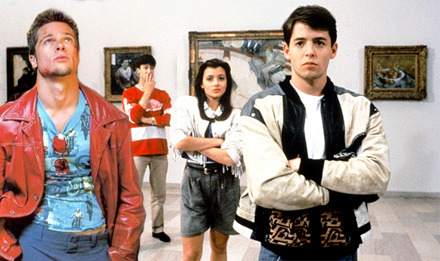


* If Ferris' life is so great, why would Cameron fantasize about a villain (Rooney) to go after him and try to ruin it all? Based on his conversation with Ferris in the Bueller kitchen after impersonating Sloane's father over the phone, clearly, Cameron hates Rooney. (Which pokes a hole in the idea that Rooney doesn't know Cameron exists.) Maybe he wants to see Rooney get some comeuppance. But if he really wants to fantasize about Ferris doing all this stuff and getting away with it, why have the villain at all? Or, better yet, why not imagine himself as the one who gives Rooney his comeuppance?
* Finally, here is the kicker for me, the biggest reason why, for all the reasons that many of the events in the movie don't make any freaking sense, it can't all be just in Cameron's head: The penultimate sequence, before Ferris' race against his parents (and, he realizes too late, Rooney).
If you believe that everything that happens in the movie is leading toward the moment of clarity in the glassy, Frank Lloyd Wright "prairie style house" garage, where Cameron realizes that he needs to stand up for himself, to face his fears, starting with his fear of his father, then your moment of clarity has to be when you realize...
Cameron doesn't need Ferris anymore.
Ferris is willing to take the bullet for Cameron. And Cameron says, "No."
Cameron: My father will see what I did. I can't hide this. He'll come home and he'll have to deal with me. I don't care, I really don't. I'm just tired of being afraid. Hell with him... I'd just like to see the look on the bastard's face when...
(He puts his foot on the bumper, and that makes the car back up and, in reverse, crash through the window and fall into the ravine.)
Cameron: What'd I do? (Hearing no answer) What'd I do?
Ferris: You killed the car.
Cameron: (Going to the window and seeing what he's done) Whoa... Holy shit.
Ferris: Cameron, it's my fault. I'll take the heat for it. When he comes home, we'll tell him that I did it. He hates me, anyway.
Cameron: No, I'll take it. I'll take it.
Ferris: No. You don't want this much heat.
Cameron: I want it. I want it. If I didn't want it, I wouldn't have let you take the car.
Ferris: I made you take that car.
Cameron: I could have stopped you. It is possible to stop Mr. Ferris Bueller, you know.
And while he's still got to be terrified on the inside, for the first and only time in the movie, he's outwardly calm. He's not sniffling, he's not sweating, he's not screaming, he's not worrying. He's not even scared on the outside. He's completely calm.
*
But should he be? In my 25th Anniversary piece, I wondered about what I called "the dangling epilogue." We don't know what happens to them in the end. I wondered about things:
* Jeanie now has the hammer over Ferris. She could say, "You owe me, big brother. I saved your ass from Rooney." And he knows it. How that would manifest itself, we may never know. Maybe, when Ferris hits it big as a standup comedian, he'll pay for Jeanie's nosejob. (A reference to Jennifer Grey in real life, and to the short-lived TV version with the location moved to the L.A. suburbs, Charlie Schlatter as Ferris, Brandon Douglas as Cameron, Monkee Micky's daughter Ami Dolenz as Sloane, Richard Riehle as Rooney, and a pre-Friends Jennifer Aniston as Jeanie, who in that version was the older sibling.) Jennifer Grey wasn't yet "Baby" from Dirty Dancing, but, if Jeannie wanted to, she absolutely could have put Ferris in a corner.
* Sloane's parents may well find out about Ferris' ruse involving the grandmother. Can you imagine Sloane's mother yelling, "You told the principal my mother was dead!" at Ferris, and the parents telling him to stay away, and forbidding Sloane from ever seeing him again?
* Rooney is unlikely to give up. And, after letting Ferris give him the worst beating of his academic career, he is now more determined than ever to get Ferris. There's still a few weeks left before graduation. He can find a reason to hold Ferris back.
* There was a built-in sequel, although it's now too late. Early on, Rooney said, "Fifteen years from now, when he looks back at the ruin his life's become, he is going to remember Edward Rooney." Fifteen years would have been 2001. I can easily imagine Ferris' dreams shattered when he reaches a point where his schemes stop working, because he's faced with an adult smarter and meaner than Rooney. He might have to do a "Jack Black in School of Rock" and go back to Shermer High and become a substitute teacher. If Rooney's still there, he gets denied the job. If Rooney's not still there, Ferris might now be in the position that Mr. Vernon (Paul Gleeson) was in Breakfast Club: The Shermer High teacher who has to discipline rebellious students, who can't possibly imagine that this guy, whom they only know as Mr. Bueller the middle-aged teacher, was ever cool.
But the true "elephant in the room" is Morris Frye, Cameron's as-yet-unseen father. If he's everything Cameron has spent the last hour and a half telling the audience he is, then Cameron is toast. His ass is grass. There is no way Dad is going to think it over, and forgive and forget. He's going to take the damage to the car, and the garage, out of Cameron's college fund. He could write Cameron out of his will, which, considering the house and the car, is probably substantial, even for a guy with enough money to afford all that in the first place.
He might even kick his son out of the house. He'll be on his own -- and for a kid, who doesn't have the safety net of home and/or college, and has to make his own way, that is scary as hell. (Now who's "gonna be a frycook on Venus"?) And if the Buellers then won't take him in, that might make Cameron very bitter toward Ferris. And he might then be willing to drop the dime on Ferris, telling Rooney what he knows.
And yet, Cameron is thinking that, maybe, just maybe, he and his father can talk this out rationally. And, if not? Then he still looks ready to face the fear.
Think about what Cameron has spent most of the movie doing: Believing himself to be sick, thinking of reasons not to do things (both the small, going out at all; and the large, Ferris and Sloane getting married on the fly), twitching, sniffling, pounding the seat of his dinky little car (which, in one of the rare moments where a censoring actually improves the script, Ferris, in the TV-altered version, calls "a piece of tin" rather than "a piece of shit"), worrying that Ferris is going to get caught, finally kicking his father's car.
The only time Cameron seems even slightly confident is when Ferris tells him he's doing great in impersonating Sloane's father over the phone. But in this denouement, Ferris -- being a standup guy for the first time in the film -- is willing to take the fall for Cameron, telling him, "You don't want this kind of heat." And Cameron says, "I want it."
He's still scared. But courage is not the absence of fear. Courage is looking fear dead in the eye, and saying, "To hell with you, I'm moving forward, and you won't stop me."
There it is. Cameron is ready to be, if not Oedipus (he doesn't seem to like his mother much, either), then Luke Skywalker, using the Force that he has found within himself, becoming the mentor he wished he could be, so that he can not only face his big bad father, but to turn his father away from the Dark Side, to find the good that is still within him. (In this analogy, the Ferrari is the X-Wing fighter, and the garage is the Death Star.)
But, ultimately, Ferris and Cameron are not Tyler Durden and the never-named narrator of Fight Club, respectively. Nor are they Obi-Wan Kenobi and Luke Skywalker in the Star Wars saga.
A closer parallel is to a movie that, like FBDO and Star Wars Episode IV: A New Hope, is one of my all-time top 5: They are V and Evey Hammond of V for Vendetta. Ferris certainly lives up to the Macbeth line that V quotes to Evey: "I dare do all that may become a man. Who dares more is none." The Beatles' version of "Twist and Shout" and the paintings in the Museum aren't exactly banned, and Ferris only takes Cameron to the top of the city's best-known building, rather than enlisting his help in destroying it.
But as V did with Evey, Ferris has put Cameron into a position where he can truly see what's possible, but has also put him in a position where everything he held dear was at stake, and now he's learned how to conquer his fear.
Which, I suppose, makes Jeanie, the antagonist who realizes she's been on the wrong side all along, Inspector Eric Finch. But does that make Rooney Chancellor Adam Sutler? No, Rooney's not particularly cruel. Although the school may well end up "being buried beneath the avalanche of (his) inadequacies," so maybe he's Party Leader Peter "Creepy" Creedy. (Rooney's portrayer, Jeffrey Jones, did turn out to be rather creepy in real life.)
And, as with V for Vendetta, it's not a man, not even "the system," but our own apathy, and our own fear of enjoying life, that is the true villain of the movie.
When Cameron stands there in the garage, surveying the shattered glass on the floor, and the banjaxed Ferrari in the ravine, he's done being what he was. He's no longer a sniveling, quivering, pathetic mess who needs a hero to prop him up. The process of propping up is done. He's ready, willing and able to face his father. He's ready to become the hero he's always wanted to be, to save the person he's always needed to save: Himself.
After all, while V killed most of the bad guys, and lured Sutler to his doom by Creedy's hand, he and Creedy ended up killing each other. Which left it to Evey to carry out V's mission. Like V, Ferris "dies"; like Evey, Cameron must become his mentor/tormentor.
Only in his case, if you presume the movie takes place all in Cameron's mind, then it goes farther than Evey's case: Cameron must "kill Ferris" in order to "become Ferris." Only by eliminating this part of himself can he be truly whole, and be what he wants to be.
Which doesn't mean that you should face your fear by blowing up a government building (like in V for Vendetta or in Fight Club), or by destroying your father's car and garage (like in Ferris Bueller's Day Off).
But each of us comes to a time when we have to face our fears. We can move forward, and risk success, or failure. Or we can refuse to face the fear, and let it consume us.
Cameron chose to take the risk.
*
In case you're wondering, of my top 5 all-time favorite movies, the two I haven't yet mentioned are Casablanca and Midnight Run. Two movies with little in common, except that, in the latter, Charles Grodin is Victor Laszlo (the wanted man), and Robert De Niro is Rick Blaine (the slick operator who's a haunted man, facing the woman he once loved, and ultimately deciding to return to being a patriot to the human race).