Showing posts with label walter johnson. Show all posts

Monday, February 2, 2026

February 2, 1936: The 1st Baseball Hall of Fame Election

Top left: Christy Mathewson. Top right: Honus Wagner.
Center: Ty Cobb.
Bottom left: Babe Ruth. Bottom right: Walter Johnson.

February 2, 1936, 90 years ago: The Baseball Hall of Fame holds its 1st election for players.

Members of the Baseball Writers' Association of America (BBWAA) were given authority to select individuals from the 20th Century; while a special Veterans Committee, made up of individuals with greater familiarity with the 19th Century game, was polled to select deserving individuals from that era. The intent was for 15 honorees to be selected before the ceremony that would open the Hall's Museum in 1939: 10 from the 20th Century and 5 from the 19th; and that additional players from both eras would be selected in later years.

The Voters were given free rein to decide for themselves in which group a candidate belonged, with neither group knowing the outcome of the other election; some candidates had their vote split between the elections as a result: Cy Young, the pitcher with most wins in Major League history, finished 8th in the BBWAA vote, and 4th in the Veterans vote.

In addition, there was no prohibition on voting for active players, a number of whom received votes. Individuals who had been banned from baseball, such as "Shoeless" Joe Jackson and Hal Chase, were also not formally excluded, though few voters chose to include them on ballots.

In the BBWAA election, voters were instructed to cast votes for 10 candidates, the same number of desired selections. In the Veterans' election, voters were also instructed to vote for 10, although the desire for only 5 initial selections led to revisions in the way the votes were counted. Any candidate receiving votes on at least 75 percent of the ballots in either election would be honored with induction to the Hall upon its opening in the sport's supposed centennial year of 1939.

A total of 226 ballots were cast, with 2,231 individual votes for 47 specific candidates, an average of 9.87 per ballot. 170 votes were required for election.
PlayerVotesPercent
Ty Cobb22298.2
Babe Ruth21595.1
Honus Wagner21595.1
Christy Mathewson20590.7
Walter Johnson18983.6
Nap Lajoie14664.6
Tris Speaker13358.8
Cy Young11149.1
Rogers Hornsby10546.4
Mickey Cochrane8035.3
George Sisler7734.0
Eddie Collins6026.5
Jimmy Collins5825.6
Grover Cleveland Alexander5524.3
Lou Gehrig5122.5
Roger Bresnahan4720.7
Willie Keeler4017.6
Rube Waddell3314.6
Jimmie Foxx219.2
Ed Walsh208.8
Ed Delahanty177.5
Pie Traynor167.1
Frankie Frisch146.1
Lefty Grove125.3
Hal Chase114.8
Ross Youngs104.4
Bill Terry93.9
Johnny Kling83.5
Lou Criger73.1
Mordecai Brown62.6
Johnny Evers62.6
Frank Chance52.2
John McGraw41.7
Ray Schalk41.7
Al Simmons41.7
Chief Bender20.8
Joe Jackson20.8
Edd Roush20.8
Frank Baker10.4
Bill Bradley10.4
Fred Clarke10.4
Sam Crawford10.4
Kid Elberfeld10.4
Connie Mack10.4
Rube Marquard10.4
Nap Rucker10.4
Dazzy Vance10.4
Charlie Gehringer00
Gabby Hartnett00
Billy Sullivan00
Note: All players whose names are in italics here have since been elected. Eddie Collins and Jimmy Collins were not related, but they were teammates, on the 1907 and 1908 Philadelphia Athletics, at the end of Jimmy's playing career and near the beginning of Eddie's.

Still active at the time of the vote: Hornsby, Cochrane, Gehrig, Foxx, Traynor, Frisch, Grove, Simmons, Gehringer and Hartnett. Ruth had played his last game only 8 months earlier.

The Hall would eventually ban from its balloting all players declared ineligible by Major League Baseball, so, as of February 2, 2022, Chase and Jackson have never been elected. Nor have, from this list, Kling, Criger, Bradley, Elberfeld and Rucker. None of those have many advocates at this point. 

Cobb finished 1st in the voting. This made him, unofficially, not just in baseball, but the 1st member of any major sport's Hall of Fame. As time passed, however, despite neither man playing a game in the interim -- Ruth was the most recently-retired of the 5, having played his last game on May 30, 1935 -- Ruth came to surpass Cobb in fans' minds as the greatest player in the history of the sport.

Brief profiles:

* Tyrus Raymond Cobb, born on December 18, 1886 in Narrows, Georgia, and grew up in Royston, Georgia. Nicknamed "The Georgia Peach."

Center field, Detroit Tigers, 1905-26; Philadelphia Athletics, 1927-28. .366 lifetime batting average, still an all-time record. 4,189 hits, formerly a record, still 2nd all-time. 892 stolen bases, formerly a record. 168 OPS+. (His hit total had long been listed as 4,191, and thus his batting average at .367, but a later check of records showed that 1 game, and thus 2 of his hits, had mistakenly been counted twice.)
This photo is colorized, but real.

* George Herman Ruth Jr., born on February 6, 1895 in Baltimore, Maryland, and grew up there. Nicknamed "Babe" because his teammates, referring to the scout who signed him, called him "Jack Dunn's Baby." Also known as "The Great Bambino," "The Sultan of Swat," and a lot of similar hard-hitting royal nicknames.

Boston Red Sox, 1914-19; New York Yankees, 1920-34; Boston Braves, 1935. As a pitcher, most of it from 1914 to 1918: 94-46 record, 2.28 ERA, 122 ERA+, 1.159 WHIP, so he was on his way to a Hall of Fame level at that before his hitting meant that he had to be was switched to an everyday player. As an offensive player, mostly from 1918 onward: .342 batting average. 714 home runs, formerly a record. 2,214 RBIs, formerly a record. .474 on-base percentage, 2nd all-time. .690 slugging percentage, still a record. 206 OPS+, still a record. 
The Yankees did not put the interlocking N-Y logo
on their jerseys permanently until 1936,
so Ruth never wore such a jersey.

* John Peter Wagner, born February 24, 1874 in Carnegie, Pennsylvania, outside Pittsburgh. Being of German descent, he was called the German variation of John, "Hans," which became "Honus." Known for his speed as "The Flying Dutchman," keeping in mind that "Dutch" was a name given to people of German descent, as well as to people descended from the Netherlands.

Shortstop, Louisville Colonels, 1897-99; Pittsburgh Pirates, 1900-17. .328 batting average. 3,420 hits, the record until surpassed by Cobb. 723 stolen bases. Considered the best defensive player of his era. 151 OPS+.
* Christopher Mathewson, born August 12, 1880 in Factoryville, in the Lehigh Valley of Pennsylvania. Nicknamed "Christy," "Matty" and "Big Six," because he was 6 feet tall, at a time when that was considered big. Pitcher, New York Giants, 1900-16, concluding that last year with the Cincinnati Reds. 373-188, 2.13 ERA, 136 ERA+, 1.058 WHIP.
Colorized, but definitely a photo, not a painting.

* Walter Perry Johnson, born November 6, 1887 in Humboldt, Kansas, and grew up in Fullerton, California, outside Los Angeles. Nicknamed "The Big Train" early in his career, and "Old Barney" in his later years. Pitcher, Washington Senators, 1907-27. 417-279, 2.17 ERA, 147 ERA+ 1.061 WHIP.
These men became known as "The First Five," or "The First Class." Their plaques are located in an X pattern, with leading vote-getter Cobb's in the middle, at the center of the back wall of the Hall's Gallery.

Cobb was infamous for being difficult to get along with, including with Ruth, but the men eventually put aside their personal and, in terms of baseball playing, stylistic rivalry, and formed a friendship. Cobb had no problem getting along with the others, nor did any of them with each other.
Cobb visiting with Mathewson, 1911 World Series

In 1999, The Sporting News named its 100 Greatest Baseball Players. Ruth had last played 64 years earlier; Cobb, 71; Johnson, 72; Wagner, 82; Mathewson, 83. The number of people who could accurately remember watching them play was already pretty small. The rankings: Ruth came in 1st, Cobb 3rd, Johnson 4th, Mathewson 7th, Wagner 13th. (In between: Willie Mays was 2nd, Hank Aaron 5th, Lou Gehrig 6th, Ted Williams 8th, Hornsby 9th, Stan Musial 10th, Joe DiMaggio 11th, and Alexander 12th.)

In 2022, ESPN listed their Top 100. Ruth's last game was now further back that Mathewson's was in the earlier vote. Ruth came in 1st again, with David Schoenfeld writing for their article, "The baseball we watch today is Babe Ruth's game. Many players make an impact, a few become folk heroes, but nobody changed a sport like Ruth did when he joined the Yankees and transformed baseball into a game of power."

Cobb came in 4th, Johnson 9th, Wagner 12th, Mathewson 25th. (In between: Mays 2nd, Aaron 3rd, Williams 5th, Gehrig 6th, Mickey Mantle 7th, Barry Bonds a steroid-aided 8th, Musial 10th, Pedro Martinez a stupid 11th, Ken Griffey Jr. 13th, Greg Maddux 14th, Mike Trout a laughable 15th, DiMaggio 16th, Roger Clemens 17th, Mike Schmidt 18th, Frank Robinson 19th, Hornsby 20th, Young 21st, Tom Seaver 22nd, Rickey Henderson 23rd, and Randy Johnson -- no relation to Walter, although nearly as fast -- 24th.)

Lajoie, Speaker and Young were elected to the Hall of Fame in its 2nd election, in 1937; Alexander in 1938; Anson, Eddie Collins, Ewing, Keeler, Radbourn, Sisler and, in a special election due to his fatal illness, Gehrig, in 1939.

In addition, elected as managers were Connie Mack and John McGraw in 1937; elected as executives or "pioneers" were Morgan Bulkeley, Ban Johnson and George Wright in 1937; Alexander Cartwright and Henry Chadwick in 1938; and Charles Comiskey, Candy Cummings and Al Spalding in 1939.

So there were 25 inductees when the Hall had its opening ceremony in Cooperstown, New York, already known not to really be the sport's birthplace, on June 12, 1939. There were 11 still alive: Cobb, Ruth, Wagner, Johnson, Lajoie, Speaker, Young, Alexander, Eddie Collins, Sisler and Mack. Transportation links being what they were at the time, Cobb had difficulty getting there, and arrived just too late to appear in the photograph taken of the other 10.

Cobb did turn out to be the last survivor of the First Five, living until 1961. Mathewson had died in 1925, well before the vote; Johnson in 1946, and Ruth in 1948; both too young and from cancer; and Wagner in 1955. Sisler was the last of the Initial Inductees, living until 1973.

Wednesday, October 15, 2025

October 15, 1925: Walter Johnson's Rainy Last Stand

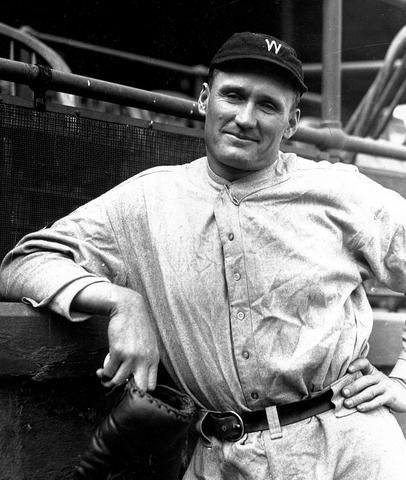
Walter Johnson

October 15, 1925, 100 years ago: The World Series comes to a soggy end at Forbes Field in Pittsburgh. It is one of the rare major league sports finals that is better remembered for the losing side, or for someone on it.

In the American League, the Washington Senators, winners of the previous season's World Series, won the Pennant again, by 8 1/2 games over the resurgent Philadelphia Athletics, getting into their 1st Pennant race in 11 years. Bucky Harris, their 28-year-old 2nd baseman and "Boy Manager," led a team highlighted by Walter Johnson, the "Big Train," one of the greatest pitchers who ever lived. The winningest pitcher in American League history finally became a World Series hero the year before, pitching innings 9 through 12 of Game 7 against the New York Giants.

The New York Yankees, who the Senators had edged the season before, and had won the previous 3 Pennants, fell apart: Babe Ruth developed a mysterious illness in Spring Training that kept him out for a month and a half, and several other established stars simply stopped hitting. They would be replaced by new players who would lead a new dynasty starting the next season, including Lou Gehrig.

In the National League, the Giants' 4-year run as Pennant winners came to an end, as they finished 8 1/2 games ahead of the Pittsburgh Pirates. Only pitcher Charles "Babe" Adams, now 43 but a rookie on their 1909 World Series winners, remained on that team. Their hitting stars included slick-fielding 3rd baseman Harold "Pie" Traynor, right fielder Hazen "Kiki" Cuyler, and speedy center fielder Max Carey, who was not well-known for his nickname, although it was "Scoops," which suggests he was a very good fielder.

*

October 7, 1925: Game 1 was played at Forbes Field. a Wednesday. Johnson started for the Senators, and he was aided by a home run by Joe Harris (no relation to Bucky), as the Senators win, 4-1. The only Pirate run came on a home run by Traynor. In the 5th inning, Peckinpaugh made an error, but it didn't amount to anything.

Late in the game, word reached the ballpark of the death that day of Christy Mathewson, the star pitcher for the Giants in the 1900s and 1910s. A series of lung ailments led to his death at the age of 45. The flag at Forbes Field was lowered to half-staff, and it remained so there and at Griffith Stadium in opposing Washington for the remainder of the Series. The Commissioner of Baseball, Kenesaw Mountain Landis, orders that black armbands be applied to both teams' uniforms, even though Mathewson had never been involved with either of the teams playing.

October 8, 1925: Game 2 was played at Forbes Field. Home runs were hit in the 2nd by the Senators' Joe Judge and in the 4th by the Pirates' Glenn Wright. In the 8th, Peckinpaugh made an error that did end up mattering, which that led to a home run by Cuyler. He made another error later in the inning, which did not matter. The Senators loaded the bases with nobody out in the top of the 9th, but they only got 1 run home, and the Senators won, 3-2. The Series was tied going to Washington.

*

October 10, 1925: Game 3 was played at Griffith Stadium. Peckinpaugh made his 4th error of the Series in the 6th, which led to an unearned run. Joe Harris singled home a run to put the Senators up 4-3 in the bottom of the 7th.

In the 8th, Earl Smith hit a drive to right-center field. Sam Rice leapt for it, and fell into the temporary stands that had been constructed. For a moment, a World Series crowd went silent, not knowing what had happened. Rice stood up, and held up the ball, indicating that he had made the catch. The umpires ruled the catch legal, and the Senators hung on to win, going up 2-1.
Sam Rice

Edgar Charles Rice (one of his minor-league managers changed his name to "Sam") is one of several great players virtually forgotten because their team no longer exists in its current form: They became the Minnesota Twins in 1961. And don't look for his retired uniform number anywhere: While he did last in the major leagues until 1934 and did wear numbers, none is retired for him, anywhere. If one was -- he wore 2 for the Senators in 1931 and 22 for them in 1932 and '33 -- he might be better remembered.

He might also be better remembered if he'd gotten into the 3,000 Hit Club. Instead, he fell just short: He collected 2,987 hits, the closest any player has gotten to 3,000 without getting it. (Unless you count Stan Ross, the Bernie Mac character in Mr. 3000.)

Rice later said, "The truth of the matter is, I did not even know how many hits I had. A couple of years after I quit, (Senators owner) Clark Griffith told me about it, and asked me if I'd care to have a comeback with the Senators and pick up those 13 hits. But I was out of shape, and didn't want to go through all that would have been necessary to make the effort. Nowadays, with radio and television announcers spouting records every time a player comes to bat, I would have known about my hits and probably would have stayed to make 3,000 of them."

He had a .322 lifetime batting average, a 112 OPS+, 498 doubles, 184 triples, and 351 stolen bases. He is in the Baseball Hall of Fame. But, today, when he is remembered at all, he is remembered for his 1925 World Series catch. Too bad there's no film of it: While a highlight film did capture some action in that Series, the catch is not part of it.

Also on October 10, the football team of the Olympic Club of San Francisco traveled across San Francisco Bay, and beat the University of California 15-0, in front of a crowd of 50,000 at California Memorial Stadium in Berkeley.

This ended a 50-game unbeaten streak for the Golden Bears, who had been 46-0-4. They hadn't lost since November 27, 1919, away to the University of Washington. The stadium was nicknamed "The House That Andy Built," as head coach Andy Smith made the team so good, ticket receipts alone covered the $1.4 million cost in 1923. It was seriously renovated in 2012.

Coaching took a severe toll on Smith, who went just 6-3 with Cal in 1925. On a visit to Philadelphia, where he had coached the University of Pennsylvania from 1909 to 1912, he was hospitalized with pneumonia, and died on January 8, 1926, only 49 years old. His career coaching record was 116-32-13, including 74-16-7 at Cal.

Also on this day, James Buchanan Duke died at his mansion at 1 East 78th Street, on 5th Avenue across from Central Park in New York. He was 68. "Buck" Duke is essentially the father of the American cigarette industry, and is thus responsible for the deaths of millions of people.

He's also responsible for the Duke Endowment, which contributed $40 million after his death (about $594 million in today's money) to Trinity College in his hometown of Durham, North Carolina. In his memory, it was renamed Duke University. So he's also responsible, if rather indirectly, for Coach K and the Cameron Crazies.

The James B. Duke House now hosts the New York University Institute of Fine Arts.
*

October 11, 1925: Game 4 was played at Griffith Stadium. Leon "Goose" Goslin, the greatest player ever to come from South Jersey -- he's in the Hall of Fame, and, as of the end of the 2025 regular season, Mike Trout does not yet have the career stats to get in -- and Joe Harris hit home runs. Johnson needed no more than that, as he pitched a 6-hit shutout. The Senators won, 4-0, and went up 3-1. Just 1 more win to go.

Washington baseball would not find that 1 more win for another 94 years.

On the same day, having already played some minor and semi-pro teams, the New York Giants football team plays its 1st game against an actual NFL team, although it's not one that most modern fans will recognize. At the Cycledrome in Providence, Rhode Island, a stadium built for bicycle racing (a big sport in the Roaring Twenties), they lose 14-0 to the Providence Steam Roller.

This team, officially having no S on the end, was no pushover, and deserves to be remembered today: It will win the NFL Championship in 1928 (73 years before the Patriots will win New England’s next NFL title), and host the NFL’s first night game in 1930 (5 years before Major League Baseball allows games to be played under lights), before the Great Depression put it out of business in 1931.

Although the Pawtucket Red Sox and the Providence Bruins are at the highest minor-league levels in their respective sports, the State of Rhode Island has never had another major league sports team: The closest they've come since is the Patriots, who since 1971 have played in stadiums in Foxboro, Massachusetts, 10 miles from the State Line, and closer to Kennedy Square in Providence than to Downtown Crossing in Boston.

Also on this day, Elmore John Leonard Jr. was born in New Orleans, but grew up in Detroit and was a hard-core Tigers fan. Or, perhaps I should say, "hard-boiled," as he was the writer of hard-boiled crime fiction.

Among his works that got turned into movies are Hombre (a Paul Newman film), 3:10 to Yuma
(made with Glenn Ford and Van Heflin in 1957, and Russell Crowe and Christian Bale in 2007), Mr. Majestyk (starring Charles Bronson), Get Shorty (with John Travolta), Out of Sight (in which George Clooney is a thief fooling around with the cop trying to catch him, played by Jennifer Lopez), and Rum Punch (which became the Quentin Tarantino film Jackie Brown starring Pam Grier). He is also responsible for the story that became the TV series Justified. He died in 2013.

*

October 12, 1925: The Senators wanted to wrap the Series up at home in Game 5. But the Pirates took a 2-1 lead in the 3rd, a 4-2 lead in the 7th, and won, 6-3, despite a 3rd homer in the Series by Joe Harris. Peckinpaugh made an error in the 6th inning, his 5th of the Series.

October 13, 1925: Game 6 was played back in Pittsburgh. Goslin hit a home run in the 1st inning, and the Senators made it 2-0 in the 2nd. But the Pirates tied the game in the 3rd, and Eddie Moore hit a home run in the 5th, giving the Pirates a 3-2 lead the held to the end, tying the Series. Peckinpaugh made his 6th error of the Series in the 7th inning.

Also on this day, Leonard Alfred Schneider was born in Mineola, Long Island, New York. We knew him as Lenny Bruce. According to sportswriter Dick Schaap, who collaborated with Lenny on his book Stamp Help Out!, Lenny attended only 1 Major League Baseball game in his short life (he died from drugs on August 3, 1966). It was as Schaap's guest, as a birthday present. It was October 13, 1960, and it was Game 7 of the World Series, the Bill Mazeroski Game, another World Series that the Pirates won in improbable fashion. Lenny wasn't a baseball fan, but he told Schaap he liked the drama.

Also on this day, Margaret Hilda Roberts was born in Grantham, Lincolnshire, England. How about that: Lenny Bruce and Margaret Thatcher were born on the exact same day. He didn't live long enough to have heard of her. If he had, with his sick sense of humor, I suspect there would have been a few jokes about her sex life (possibly suggesting that she had none), and about Bobby Sands (possibly, "For letting him starve, she can eat me!") and the Brighton Bombing.

One thing's for sure: In serving as Prime Minister of Britain, the 1st woman to do so, from 1979 to 1990, "The Iron Lady" treated all English soccer fans as if they were hooligans. She is widely believed to have been involved in the cover-up of the police's actions, both the negligent ones and the intentionally harmful ones, at the Hillsborough Stadium Disaster on April 15, 1989.

When her friend and fellow 1980s conservative icon, Ronald Reagan, died in 2004, most of his political opponents maintained a respectful silence. When the Iron Bitch died in 2013, a majority of Great Britain cheered, and was more than willing to say what a horrible person she was.

October 14, 1925: Game 7 was supposed to be played at Forbes Field, but the game was called off due to rain. They would have to try again tomorrow.

*

October 15, 1925: A steady downpour, continuing from the day before into this day, has left the field at Forbes Field a muddy mess, as Game 7 of the World Series is scheduled to be played. The weather forecast suggested rain for the next 3 days for both cities involved, Pittsburgh and Washington. So moving the game to Washington would have been pointless, and Commissioner Landis was anxious to get it over with. So, they would play through the rain.

I've never seen film of this game. I don't even know if any survives, although YouTube has footage from earlier in the Series, and of the Game 7s of 1924 and 1926. Maybe the film crews didn't want to risk getting electrocuted in the rain. At any rate, all we have to go on for the inclement weather are news reports.

On August 8, 2025, as commemorations for the 100th Anniversary of this Series began, I saw a photograph of a rather dubious method of drying the infield: Dousing it with gasoline and setting it on fire.
This insane tactic actually happened. It wasn't the only time, either.

But it would have been just plain wrong to play if the rain were as bad as what Philadelphia and Tampa Bay faced when Game 5 of the 2008 Series was suspended. There was a 6-day delay due to rain in 1911, and there were 3-day delays in 1962 and 1975. It could have been done again.

It was a short day for Pirate starter Vic Aldridge: 3 walks and 2 hits‚ and he was out of there with just 1 out in the 1st. Walter Johnson took a 4-0 lead to the mound. In what became known as "Johnson's Last Stand," the Bucs clobbered the 38-year-old Big Train for 15 hits‚ good for 24 total bases. Max Carey's 4-for-5 gave him a Series-high batting average of .458.

The Senators made the most of 7 hits‚ scoring 7 runs. But in the bottom of the 7th, Eddie Moore led off with a grounder to short, and Peckinpaugh made his 7th error. Carey doubled the run home. Cuyler bunted Carey over to 3rd base. Clyde Barnhart grounded out, and Carey couldn't score. But Traynor hit a triple down the right-field line, and that scored Carey. Traynor tried to stretch it into an inside-the-park home run, but was thrown out at the plate.

In the top of the 8th, Peckinpaugh hit a home run‚ the 12th homer of the Series by both teams combined‚ then a Series record, despite Forbes Field and Washington's Griffith Stadium both having some of the most distant fences in the game. That made it 7-6 Senators.

With the rain still coming down, Johnson got the 1st 2 outs in the bottom of the 8th. But Earl Smith doubled, and Pirate manager Owen "Donie" Bush sent Emil Yde (that's "EE-dee"), normally a pitcher, in to pinch-run for him. Johnson walked Moore. Carey grounded to short, and Peckinpaugh tried to turn a force play at 2nd. But he made a bad throw, his 8th error. The bases were loaded, and Cuyler cleared them with a double down the right field line. Red Oldham, in relief of Ray Kremer, got the Senators out 1-2-3 in the 9th, and the Pirates were 9-7 victors.
Roger Peckinpaugh

They became the 1st team to come from 3 games to 1 down to win a World Series. They would also be the 3rd and the 4th, in 1971 and 1979, respectively, both times against the Baltimore Orioles. The 2nd would be the 1958 Yankees, against the Milwaukee Braves.

Peckinpaugh's 8 errors are still a record for a single World Series. The rest of the Senators combined only made 1 error in the 7 games.

In the next day's New York TimesJames Harrison wrote, "In a grave of mud was buried Walter Johnson's ambition to join the select panel of pitchers who have won three victories in one World Series. With mud shackling his ankles and water running down his neck, the grand old man of baseball succumbed to weariness, a sore leg, wretched support and the most miserable weather conditions that ever confronted a pitcher."

The last surviving member of the 1925 Pirates was shortstop Glenn Wright, who lived until 1984.

Thursday, October 10, 2024

October 10, 1924: The Washington Senators Win the World Series

October 10, 1924, 100 years ago: With the score tied at 3-3 and one out in the bottom of the 12th in Game 7 of the World Series at Griffith Stadium in Washington, Muddy Ruel, catcher for the Washington Senators, lifts a high catchable foul pop-up, which New York Giants catcher Hank Gowdy misses when he stumbles over his own mask.
Given a second chance, Ruel doubles. Earl McNeely then hits a grounder that strikes a pebble, and soars over the head of rookie Giant 3rd baseman Freddie Lindstrom, and drives home Ruel with the winning run making the Senators World Champions.
Walter Johnson, who had brilliantly toiled 18 seasons for a team known as "Washington: First in war, first in peace, and last in the American League," and had lost Games 1 and 4, pitched the 9th through 12th innings in relief, and not only had finally won a World Series game, but had won a World Series.
President Calvin Coolidge, running for a term in office in his own right after succeeding the late Warren Harding the year before, and his wife Grace were in attendance. He didn't like baseball, but Grace did.
The Senators had their 1st World Championship in 24 years of trying. Outfielder George "Showboat" Fisher was the last survivor of the 1924 Senators, living until 1994, age 95. It took 95 years for another Washington baseball team has won another postseason series, but Nationals, having squandered National League Eastern Division titles in 2012, '14, '16 and '17, won the 2019 World Series.
In 1981, baseball historian John Thorn published Baseball's 10 Greatest Games. He included this game as one of them.

Sunday, September 12, 2021

Members of the 3,000 Strikeout Club, In Perspective, 1923-2021

Congratulations to Max Scheer, for joining the 3,000 Strikeout Club. He did so this afternoon, at Dodger Stadium, in the Los Angeles Dodgers' 8-0 win over the San Diego Padres. He pitched the 1st 8 innings of a 1-hitter, with Justin Bruihl pitching the 9th.

For the record, here's the 19 current members of the 3,000 Strikeout Club, in chronological order of when they reached it:

1. Walter Perry Johnson, nicknamed "The Big Train," Humboldt, Kansas, 1887-1946, Washington Senators, vs. Stan Coveleski of the Cleveland Indians, at League Park in Cleveland, July 22, 1923.

He surpassed Cy Young with 2,803 to become the all-time leader. He finished with 3,508, and held the all-time record long after his death. He won the World Series with the Senators in 1924. 

He played before the era of uniform numbers, but was the Senators' manager when they adopted uniform numbers in 1931, wearing 28 that year and 25 in 1932. He then managed the Cleveland Indians most of the next 3 seasons, wearing 10 throughout, making it the number he wore the most. 

The Senators did not retire 28 or 25 for him (and it wouldn't have made sense for them to retire 10 for him), but dedicated a monument to him at Griffith Stadium, which was moved to Walter Johnson High School in nearby Bethesda, Maryland. A statue of him stands outside Nationals Park in Washington.

2. Robert Gibson (no middle name), nicknamed "Bob," "Hoot," and, most often, "Sir," Omaha, Nebraska, 1935-2020, St. Louis Cardinals, vs. Cesar Geronimo of the Cincinnati Reds, at Busch Memorial Stadium in St. Louis, July 17, 1974.

This made Gibson the 1st National Leaguer to reach the mark. He finished with 3,117. He not only won the World Series with the Cardinals in 1964 and 1967, but, each time, was named its Most Valuable Player. The Cardinals retired his Number 45, and a statue of him stands outside the current Busch Stadium.

3. Gaylord Jackson Perry, Williamston, North Carolina, born 1938, San Diego Padres, vs. Joe Simpson of the Los Angeles Dodgers, at what was then named San Diego Stadium, October 1, 1978.

He finished with 3,534. He won his only Pennant as a rookie with the 1962 San Francisco Giants, and also appeared in the postseason with the 1971 Giants and the 1980 Yankees. He was the 1st pitcher to win the Cy Young Award in both Leagues, with the 1972 Cleveland Indians and the 1978 Padres. The Giants retired his Number 36.

4. Lynn Nolan Ryan, nicknamed "The Ryan Express," from the Houston suburb of Alvin, Texas, born 1947, Houston Astros, vs. the same Cesar Geronimo that was Gibson's 3,000th victim, at the Astrodome, July 4, 1980.

He won his only Pennant and his only World Series with the 1969 New York Mets, subsequently appearing in the postseason with the 1979 California Angels, and the 1980, '81 and '86 Astros. But he achieved his milestones after the Mets traded him away.

He once shared the record for most strikeouts in a game (19, and he remains the only man to do that more than twice, having done it 4 times), and still holds the major league records for strikeouts in a season (383 with the 1973 Angels) and in a career. He was the 1st pitcher to surpass Johnson at 3,508, and the 1st to reach 4,000, and remains the only one to top 5,000. He finished with 5,714.

The team now known as the Los Angeles Angels retired his Number 30, while both the Astros and the Texas Rangers retired his Number 34. The Rangers dedicated a statue of him outside Globe Life Park. A road going past the Globe Life complex, which now includes the new Globe Life Field, is named the Nolan Ryan Freeway.

5. George Thomas Seaver, nicknamed "Tom Terrific" and "The Franchise," Fresno, California, 1944-2020, Cincinnati Reds, vs. Keith Hernandez of the St. Louis Cardinals (later of the Mets), at Riverfront Stadium in Cincinnati, April 18, 1981.

He finished with 3,640. He was the key to the Mets winning the 1969 World Series, and also reached the postseason with the Mets in 1973 (Pennant), the Reds in 1979 (NL West title), and the Boston Red Sox in 1986 (he was not included on the postseason roster, but got a big hand at Shea Stadium when introduced during the pregame festivities in the World Series). 

The Mets retired his Number 41, and announced that a statue of him will be dedicated outside Citi Field. The ballpark's address is now 41 Seaver Way.

6. Steven Norman Carlton, nicknamed "Steve" and "Lefty," Miami, Florida, born 1944, Philadelphia Phillies, vs. Tim Wallach of the Montreal Expos, at Veterans Stadium in Philadelphia, April 29, 1981, 11 days after Seaver reached the milestone.

He was the 1st lefthander to reach 3,000, traded all-time leadership with Ryan for a brief time in 1983, became the 2nd player (after Ryan) to reach 4,000, and finished with 4,136. He helped the Cardinals win the World Series in 1967 and the Phillies to do it in 1980. He also appeared in the postseason with the 1968 Cards and the 1976, '77, '78, '81 and '83 Phils. The Phils retired his Number 32, and dedicated a statue to him outside Citizens Bank Park.

He was renowned for being reluctant to talk to the media, resulting in the 1981 joke that the 2 best lefthanded pitchers in baseball were Fernando Valenzuela and Steve Carlton, and neither one of them spoke English.

7. Ferguson Arthur Jenkins, nicknamed "Fergie," Chatham, Ontario, born 1942, Chicago Cubs, vs. Garry Templeton of the San Diego Padres, at Wrigley Field in Chicago, May 25, 1982.

He finished with 3,192. He never appeared in the postseason, having close calls with the Cubs in 1969, '70 and '73; the Texas Rangers in 1974, '78, '79 and '81; and the Red Sox in 1977. The Cubs retired his Number 31. He was the 1st Canadian elected to the Baseball Hall of Fame, and was finally joined this past week with the induction of Larry Walker.

8. Donald Howard Sutton, nicknamed "Don" and "Little D," Molino, Florida, 1945-2021, Milwaukee Brewers, vs. Alan Bannister of the Cleveland Indians, at Milwaukee County Stadium, June 24, 1983.

He finished with 3,574. Team-wise, he had bad luck: He was a member of Pennant-winners with the Los Angeles Dodgers in 1966, '74, '77 and '78, but was not with them when they won the 1981 World Series. He was with the Houston Astros that year, and the strike-forced Division Series was won by the Dodgers over the Astros.

He was with the Brewers when they won the 1982 Pennant, but they lost the World Series. He was with the Angels in 1986, but they lost the AL Championship Series. And he was with the Dodgers in 1988, but he was released before the postseason, and missed out on their World Series win.

The Dodgers retired his Number 20. He became a broadcaster for the Atlanta Braves and the Washington Nationals, and the Braves elected him to their team Hall of Fame. He was 1 of only 3 professional athletes to be a panelist on the 1973-82 version of Match Game, and the only one to appear for more than 1 week, in his case 4 of them. The others were football players Rosey Grier and Alex Karras.

9. Philip Henry Niekro, nicknamed "Phil" and "Knucksie," Lansing, Ohio, 1939-2020, New York Yankees, vs. Larry Parrish of the Texas Rangers, at Arlington Stadium, July 4, 1984.

He finished with 3,342. Although he also got his 300th career win as a Yankee, he is best remembered as an Atlanta Brave -- and was the last active player with the Milwaukee Braves. He won NL West titles with the Braves in 1969 and 1982, but never a Pennant.

The Braves retired his Number 35, and dedicated a statue of him outside Fulton County Stadium, which has been moved to Turner Field and now to Truist Park.

10. Rik Aalbert Blyleven, nicknamed "Bert," born in Zeist, the Netherlands and raised in the Los Angeles suburb of Garden Grove, California, born 1951, Minnesota Twins, vs. Mike Davis of the Oakland Athletics, at the Metrodome in Minneapolis, August 1, 1986.

He finished with 3,701, 3rd all-time at that point (1992). He reached the postseason at age 20 with the Twins (winning the AL West in 1970), age 29 with the Pittsburgh Pirates (winning the World Series in 1979), and at age 37 with the Twins (winning the World Series in 1987). The Twins have retired his Number 28.

11. William Roger Clemens, nicknamed "The Rocket," Vandalia, Ohio (he didn't get to Houston, Texas until he was in high school), born 1962, Toronto Blue Jays, vs. Randy Winn of the Tampa Bay Devil Rays, Rogers Centre in Toronto, July 5, 1998.

He finished with 4,672, 2nd all-time when he retired. To put it politely, he is the most controversial pitcher of all time. He reached the postseason with the Red Sox in 1986, '88 and '90; with the Yankees in 1999, 2000, '01, '02, '03 and '07; and with his "hometown" Astros in 2004 and '05. He won Pennants in 1986, '99, 2000, '01, '03 and '05; and the World Series in 1999 and 2000 with the Yankees.

The Red Sox have elected him to their team Hall of Fame, but neither the Blue Jays nor the Astros have, the Yankees have not put him in Monument Park, and no one has retired his uniform number (21 in Boston and Toronto, 22 in New York and Houston). "Innocent until proven guilty," but what he has been proven guilty of makes him, if not a cheater at the game of baseball, a rotten person.

12. Randall David Johnson, nicknamed "Randy" and "the Big Unit," from the San Francisco (or, rather, the Oakland) suburb of Livermore, California, born 1963, Arizona Diamondbacks, vs. Mike Lowell of the team then known as the Florida Marlins, at the stadium then known as Sun Life Stadium in Miami Gardens, Florida, September 10, 2000.

He finished with 4,875, making him currently 2nd all-time to Ryan. He reached the postseason with the Seattle Mariners in 1995 and '97, the Astros in '98, the Diamondbacks in '99, 2001 (winning the World Series) and '02; and the Yankees in 2005 and '06.

The Mariners have elected him to their team Hall of Fame, and the Diamondbacks have retired his Number 51. The Mariners may do the same, but Ichiro Suzuki also wore 51.

13. Gregory Alan Maddux, nicknamed "Greg," lived all over but was trained to play baseball in Las Vegas, Nevada, born 1966, Chicago Cubs, vs. Omar Vizquel of the San Francisco Giants, at Wrigley Field, July 26, 2005.

He finished with 3,371. He reached the postseason with the Cubs in 1989; with the Atlanta Braves in 1993, '95, '96, '97, '98, '99, 2000, '01, '02 and '03; and with the Los Angeles Dodgers in 2006 and '08. The Cubs and Braves both retired his Number 31.

14. Curtis Montague Schilling, nicknamed "Curt" (or "Crybaby Curt"), Phoenix, Arizona, born 1966, Boston Red Sox, vs. Nick Swisher of the Oakland Athletics (later of the Yankees), at the Oakland Coliseum, August 30, 2006.

He finished with 3,116. He reached the postseason with the Phillies in 1993, the Diamondbacks in 2001 and '02, and the Red Sox in 2004, '05 and '07. He has been elected to the Philadelphia Baseball Wall of Fame and the Boston Red Sox Hall of Fame, but no team has retired his Number 38.

15. Pedro Jaime Martínez, Manoguayabo, Dominican Republic, born 1971, New York Mets, vs. Aaron Harang of the Cincinnati Reds, at Great American Ballpark in Cincinnati, September 3, 2007.

He finished with 3,154. He reached the postseason with the Red Sox in 1998, '99, 2003 and '04; the Mets in 2006; and the Phillies in 2009. He was in position to do so with the Montreal Expos before the Strike of '94 hit. The Red Sox retired his Number 45, and elected him to their team Hall of Fame.

16. John Andrew Smoltz, from the Detroit suburb of Warren, Michigan, born 1967, Atlanta Braves, vs. Felipe Lopez of the Washington Nationals, at Turner Field in Atlanta, April 22, 2008.

Finished with 3,084. Reached the postseason with the Braves in 1991, '82, '93, '95, '96, '97, '98, '99, 2001, '02, '03, '04 and '05 (missing the 2000 season due to injury); and with the Cardinals in 2009. The Braves retired his Number 29.

17. Carsten Charles Sabathia Jr., nicknamed "CC"
 (I also call him The Big Fella), from the San Francisco (or, rather, the Oakand) suburb of Vallejo, California, born 1980, New York Yankees, vs. John Ryan Murphy of the Arizona Diamondbacks, at Chase Field in Phoenix, April 30, 2019.

He finished his career with 3,093. He reached the postseason with the Cleveland Indians in 2001 and '07, the Milwaukee Brewers in 2008, and the Yankees in 2009, '10, '11, '12, '15, '17, '18 and '19.

The Yankees will probably give him a Plaque in Monument Park one day, and Indians will likely put him in Heritage Park, their equivalent behind center field at Progressive Field. Whether either team retires his Number 52 remains to be seen.

18. Justin Brooks Verlander, from the Richmond suburb of Goochland, Virginia, born 1983, Houston Astros, vs. Kole Calhoun of the Los Angeles Angels, at Angel Stadium in Anaheim, September 28, 2019.

Verlander is the only pitcher whose 3,000th strikeout counts as a strikeout, but not as an out: His catcher, Robinson Chirinos, let the ball get away, and Calhoun reached 1st base. The Astros still won the game, 6-3.

He has reached the postseason with the Detroit Tigers in 2006, '11, '12, '13 and '14; and with the Astros in 2017, '18 and '19, winning the 2017 World Series, but missing nearly all of the 2020 season, including the postseason, with an injury.

Officially still an active player, injuries have left him with only 1 major league appearance since his 3,000th strikeout game. He will be 39 next Opening Day, and his contract with the Astros will have run out, so it remains to be seen if he ever adds to his current total of 3,013 strikeouts. The Tigers and the Astros may both retire his Number 35.

19. Maxwell Martin Scherzer, from the St. Louis suburb of Chesterfield, Missouri, born 1984, Los Angeles Dodgers, vs. Eric Hosmer of the San Diego Padres, at Dodger Stadium in Los Angeles, September 12, 2021.

He has only 674 career walks. For the moment, that’s the fewest walks of anyone in the Club. He has reached the postseason with the Tigers in 2011, '12, '13 and '14 (as a teammate of Verlander); and with the Washington Nationals in 2017, '18 and '19, winning the 2019 World Series.

*

Verlander (at least officially) and Scherzer are is still active. Sabathia will become eligible for the Baseball Hall of Fame in the election whose results will be announced in January 2025. All of the others are already in the Hall, except for Clemens and Schilling.

Despite pitchers' reputation as poor hitters, only Walter Johnson and Pedro Martinez got Number 3,000 against an opposing pitcher.

Career win totals for these pitchers: Walter Johnson 417, Maddux 355, Clemens 354, Carlton 329, Ryan 324, Sutton 324, Niekro 318, Perry 314, Seaver 311, Randy Johnson 303, Blyleven 287, Jenkins 284, Sabathia 251, Gibson 251, Verlander 226, Martinez 219, Schilling 216, Smoltz 213, Scherzer 188. Smoltz was used as a reliever from 2001 to 2004, due to an injury, so, in addition to his 213 wins, he had 154 saves.

After Verlander and Scherzer, these active pitchers have at least 2,000: Zack Greinke with 2,799, Cole Hamels with 2,560, Clayton Kershaw with 2,653, Jon Lester with 2,469, Chris Sale with 2,037, and David Price with 2,037. Given their ages and injury records, Greinke and Kershaw should make it, Sale might, and Hamels, Lester and Price probably won't.

With 2,855, Jim Bunning comes the closest among retired pitchers to 3,000 strikeouts without reaching the milestone, but he is in the Hall of Fame. At 2,832, Mickey Lolich replaced Warren Spahn, and was replaced by Carlton, as the lefthander with the most. At the moment, he trails Clemens and Schilling for the most career strikeouts without being elected to the Hall.

Perry (1980-81), Niekro (1984-85), Clemens (1999-2003 and 2007), Randy Johnson (2005-06) and Sabathia (2009-19) pitched for the Yankees. Niekro, Clemens and Sabathia reached the milestone as Yankees. The Yankees' all-time leader -- that is, the man with the most batters struck out as a Yankee pitcher -- is Andy Pettitte with 2,020. The Mets' all-time leader, as you might guess, is Seaver, with 2,541 of his 3,640 coming in Orange & Blue.

No pitcher from a Northeastern State has ever done it, while 6 were from the Southeast: Perry, Ryan, Carlton, Sutton, Clemens and Verlander; 5 were from the Midwest: Walter Johnson, Gibson, Niekro, Smoltz and Scherzer; 4 were from the West Coast: Seaver, Blyleven, Randy Johnson and Sabathia; 2 were from the Rocky Mountains: Maddux, Schilling; 1 was from Canada: Jenkins; and 1 was from the Caribbean: Martinez.

By ethnicity: Martinez is the only Hispanic to do it thus far, and will remain so for the foreseeable future. Gibson, Jenkins and Sabathia are black. The Johnsons, Carlton, Sutton and Clemens were English; Ryan, Perry and Seaver are Irish; Maddux, Schilling, Smoltz, Verlander and Scherzer are German, Blyleven is Dutch, and Niekro is Polish.

Gibson, Perry, Ryan, Seaver, Carlton, Jenkins, Sutton, Blyleven, Clemens, Maddux, Smoltz and Scherzer did it at their home field. The rest did it on the road.

Uniform numbers: Walter Johnson as a manager, 10; Sutton, 20; Clemens as a Red Sock and a Blue Jay, 21; Clemens as a Yankee and an Astro, and Blyleven as a Pirate, 22; Blyleven for most of his career, 28; Smoltz, 29; Ryan as a Met and an Angel, 30; Jenkins, Maddux, and Scherzer as a National and a Doger, 31; Carlton, 32; Ryan as an Astro and a Ranger, 34; Niekro and Verlander, 35; Perry, 36; Scherzer as a Tiger, 37; Schilling, 38; Seaver, 41; Gibson and Martinez, 45; Randy Johnson, 51; Sabathia, 52.

All have had a number retired by at least 1 of their teams except Walter Johnson (played before numbers were worn), Clemens (although not making it official, the Red Sox have removed 21 from circulation), Sabathia, and the still-active Verlander and Scherzer.

All but the 1st, Walter Johnson, were still alive until August 31, 2020. Since then, Seaver, Gibson, Niekro and Sutton have died.

Tuesday, April 14, 2020

Old-Time Pitchers: 5 Who Would Be Great In the Modern Era (And 5 Who Would Have Trouble)

April 14, 1920, 100 years ago today: Babe Ruth makes his debut for the New York Yankees. It doesn't go so well for them: They lose 3-1 to the Philadelphia Athletics, at Shibe Park in Philadelphia.

In the 1st inning, Wally Pipp hit a home run, followed immediately by Ruth's 1st Yankee at-bat, a single to right field. He then struck out in the 4th, beat out a grounder to 2nd base in the 6th, and popped up to 3rd base in the 8th. So he went 2-for-4.

But, for the A's, Cy Perkins hit a game-tying home run in the 5th, and the Yankees' center fielder misplayed a fly ball in the 8th, leading to the winning runs, as Philadelphia's Scott Perry outpitched Yankee ace Bob Shawkey. The Yankees' center fielder that day? Babe Ruth. Yes, "the GOAT" (Greatest Of All Time) was "the goat" (scapegoat).

The 1920 season was a watershed for baseball. It wasn't just that Ruth hit home runs farther and more frequently than anyone had before. Pitching changed as well. Doctoring the baseball -- scuffing it, and putting various substances on it, including human saliva, all of which got put under the category of "spitball" -- was banned. Also, new balls were put into play as soon as possible, to keep them whiter and easier to see, thus less dangerous.

As a result, a new era of big hitting began, the Lively Ball Era. And pitching feats like winning 30 games in a season fell by the wayside.

Some pitchers who were great before 1920 managed to adjust. Some didn't. Some didn't get that far, having already retired.

There have been other major changes since. After "The Year of the Pitcher" in 1968, the pitcher's mound was lowered from 15 inches high at its crest to 10 inches. The strike zone, allegedly, has also been changed. We still saw lots of "high strikes" in the 1970s, but in the 1980s, they became fewer and farther between.

I wonder: Which pitchers from the Dead Ball Era (1900 to 1919) -- or even the pre-Divisional Play Era (up until 1968) would have excelled in today's game? And which would have had trouble?

10. Would Be Great: Cy Young

Denton True Young (pictured above) originally had the nickname "Cyclone," because an early minor-league manager said the fence he was throwing his fastball against looked like a cyclone, or a tornado, had hit it. It was shortened to "Cy." Good thing he wasn't called "Tornado": You think MLB would have established a "Tor Young Award"?

He pitched in the majors from 1890 to 1911, and he successfully adjusted to both the 1893 and the 1901-03 changes. Given that he began to rely more on his curveball as he got older, I have no doubt that he could have handled big sluggers -- be they Babe Ruth, Mickey Mantle, Reggie Jackson or Aaron Judge -- with finesse.

The trick would have been to see how he would have adjusted to pitch or innings limits. Cy didn't just win an all-time far-and-away record 511 games: He pitched 7,356 innings, including 749 complete games. Don't show those stats to Brian Cashman, or he might have a stroke.

9. Would Have Had Trouble: Jack Chesbro (And Any Other Spitballer)
"Happy Jack" pitched in the majors from 1899 to 1909, winning Pennants with the Pittsburgh Pirates in 1901 and 1902, and almost doing so with the Yankees (then known as the New York Highlanders) in 1904, winning 41 games. However, his spitball got away from him in his last start, resulting in a wild pitch that let in the winning run, costing the proto-Yankees the game against the Boston Red Sox (then known as the Boston Americans) and giving them the Pennant.

These days, finding a catcher who can catch a decent knuckleball is hard. Can you imagine finding one willing to catch regularly doctored balls? From guys like Chesbro? Ed Walsh? Stan Coveleski? Red Faber? Burleigh Grimes? All 5 of those guys made the Hall of Fame. They would have to have adjusted to not having their "money pitch" today, as well as to today's boom-boom-boom game.

8. Would Be Great: Christy Mathewson
Pitching for the New York Giants from 1900 to 1916, "Big Six" won 373 games. He had the greatest array of pitches the game had yet seen. A good fastball, a good curveball, and he was the 1st major league pitcher to master the screwball, which he called the "fadeaway." There aren't too many guys today who can hit it.

Most of all, Matty had exceptional control. And he was hailed as the smartest pitcher of his era. It's not hard to imagine him "pitching with his head," like Catfish Hunter or David Cone.

7. Would Have Had Trouble: Walter Johnson
In their 1981 book The 100 Greatest Baseball Players of All Time, Lawrence S. Ritter and Donald Honig wrote, "He had just one pitch, a fastball -- but what a fastball!" The fastest pitcher of his era? It helped "The Big Train" win 417 games from 1907 to 1927, 1st all-time in American League play, including a record 113 shutouts, and his record of 3,508 strikeouts stood until 1983.

But without a 2nd pitch, managers would be skeptical. He might be converted into a reliever. A closer with just a fastball? How well does that work for today's fastest pitcher, Aroldis Chapman? Usually, very well. Sometimes, however... Let's face it: Jose Altuve didn't need anyone to cheat, he knew a fastball was coming.

6. Would Be Great: Grover Cleveland Alexander
"Old Pete" pitched from 1911 to 1930, and won 373 games (tied with Mathewson for 3rd all-time and 1st among National Leaguers -- Cy Young spread his 511 over both Leagues) against just 208 losses. From 1911 to 1920, he had 6 seasons of at least 27 wins, 3 of at least 30. But from 1921 to 1930, he still managed seasons of 22-12 (at age 36), 12-5, 21-10 and 16-9.

In 1923, 1926 and 1927, he led the NL in WHIP (not that anyone knew about that stat at the time). From 1921 onward, he had 7 seasons with an ERA+ of at least 120 (making him 20 percent better, or more, at preventing runs than the average pitcher of the time), and peaked at 160 in 1927 -- at age 40, his 21-10 season.

Thanks to the 1952 film The Winning Team, starring Ronald Reagan in the role, the image of Alexander now is of the old drunk coming in because he was needed to save the day for the St. Louis Cardinals against the Yankees in Game 7 of the 1926 World Series, and working through both the hangover and the Bronx Bombers to do it. By his own account, he wasn't hungover at the time, but he did mix his pitches up to strike Tony Lazzeri out. That shows quick thinking.

Also, today, both his alcoholism (already present before he served in World War I, but what he dealt with in the war made it worse) and his epilepsy (which began in the war) would be properly treated. There was no Betty Ford (or, given his era and the epilepsy, Ida McKinley) Center back then. There is now. And medication would have helped. "Alexander the Great" could absolutely have been a good pitcher had he come along 100 years later, especially since he wouldn't have had to go off to war.

5. Would Have Had Trouble: Dizzy Dean
But another Cardinal great wouldn't be. Jay Hanna Dean might have had the talent to pitch today, but nobody would put up with his antics. His braggadocio would have ticked his teammates off, never mind the opposition. On September 21, 1934, he and his brother Paul, a.k.a. Daffy Dean, both pitched shutouts in a doubleheader. Except Paul's was also a no-hitter. And Diz said, "Gee, Paul, if I'd a-known you was gonna throw a no-hitter, I'd a-thrown one, too." As it turned out, that was something Diz ended up never doing.

It's easy to imagine "Ol' Diz" getting into a feud with an opposing hitter with a big mouth. It's easy to imagine him getting into a Twitter war, something not possible in the 1930s.

If you're familiar with his career, you know that a good but not great Cardinal team won the 1934 World Series mainly on the right arms of Diz (30-7, the last 30-win season in the NL, plus 2-1 in the Series) and Daff (19-11, plus 2-0 in the Series).

You may also know that, in the 1937 All-Star Game, Diz took a line drive off the bat of Earl Averill off his foot. Looking at an X-ray, the doctor told him that the big toe was fractured. Diz said, "Fractured, hell, the damn thing's broken!" And in order to favor the toe, he changed his pitching motion, and that hurt his arm. Goodbye, fastball: He was done in 1941, age 31.

You might think that better medical techniques would have saved his arm, and allowed him to pitch until he was 40 or so. Probably not: That requires the patient listening to the doctor, and Diz didn't listen to anybody.

Furthermore, without his fastball, he was finished. After the Cardinals traded him to the Chicago Cubs in 1938, he had a memorable "last stand," helping them win the Pennant and holding the Yankees off for 8 innings in Game 2 of the World Series, but they ultimately got to him. He would have needed another pitch to make it today, and he really didn't have one.

4. Would Be Great: Bob Feller
Like Walter Johnson, "Rapid Robert" was believed to be the fastest pitcher of his era. Unlike the Big Train, he also had a very good curveball. He won 266 games, despite losing most of 4 seasons in his prime to serving in World War II. He won 93 in his last 4 seasons before The War, and 65 in his 1st 3 full seasons after it -- in each case, an average of 23. Given that he came back in late 1945, The War probably cost him around 80 wins, which would have given him 356, nearly as much as Mathewson, Alexander, and Warren Spahn (363).

Given that he started in 1936, when he was still just 17 and in high school, it's not surprising that he threw his last professional pitch in 1956, at 37. But as late as the Cleveland Indians' 1954 Pennant season, at 35, he was still 13-3, with an ERA+ of 120 and a WHIP of 1.186.

3. Would Have Had Trouble: Satchel Paige
"Ol' Satch" is more myth than man. He pitched in the Negro Leagues from 1926 to 1947, before finally getting called up to the major leagues at age 42 in 1948, helping the Indians win the World Series. He lasted in the majors until 1953, plus a 3-inning one-shot deal in 1965, making him, at 59, the oldest player in MLB history.

And what an array of pitches he allegedly had, and what great control he had. He claimed he could throw a pitch over the top of a soda bottle, and, "I ain't never thrown an illegal pitch. But, sometimes, I throw a pitch that ain't been seen before -- by this generation."

Now, imagine Leroy Robert Paige coming along 50 years later. Integration would have been a fact of life. Had he reached the majors in 1976, the mystery would have been gone pretty quickly. He might have had a career like that of Fernando Valenzuela: Sensational at first, but soon, hitters like Wade Boggs and Tony Gwynn would have used videotape to break his mechanics down, discovered any weaknesses he had, and rendered him a good, but not great, pitcher.

2. Would Be Great: Sandy Koufax
Break the Koufax career into thirds. From 1955 to 1960, he was talented, but erratic. Then, Los Angeles Dodger scout Kenny Myers showed him how to correct a hitch in his windup, and catcher Norm Sherry told him to ease up on his fastball a little, and work on his curve. He had been trying too hard to strike everybody out.

By not trying to do that, he ended up striking out more batters than anybody had ever seen, and, from 1961 to 1966, he was maybe the best pitcher the Lively Ball Era would ever see. Then, with his arm wracked with arthritis, he retired just before turning 31, so we never got to see the final third of his career.

If Koufax had come along 50 years later, in 2005, his problems would have been addressed at age 19, not 25. The arthritis issue could also have been dealt with early, given modern technology. Given a great fastball and an equally unhittable curveball, a Koufax who reached the majors in 2005 could still have been excelling in 2019, at 33.

1. Would Have Had Trouble: Nolan Ryan
But "The Ryan Express" had just the fastball. He didn't get it really controlled until he went to the team then known as the California Angels in 1972, at 25. Now, imagine he came along 40 years later. A 2006 debut, with hitters studying his fastball, might have meant he got clobbered.

Speaking of clobbering, lots of fans not old enough to remember the "unhittable" Ryan of the mid-1970s know him from his elderly no-hitters of 1990 and 1991, and his "noogie" of Robin Ventura in his last season, 1993. Now, imagine old Nolan Ryan facing the insane, steroid-boosted Manny Ramirez of 2003. It would have been Tyson vs. Spinks, and Ryan would not have been Tyson.