Showing posts with label vietnam. Show all posts

Wednesday, April 30, 2025

April 30, 1975: The Fall of Saigon

April 30, 1975, 50 years ago: The People's Army of Vietnam (PAVN, representing "the Democratic Republic of Vietnam," a.k.a. North Vietnam) and the National Liberation Front of South Vietnam (NLF, or "Viet Cong") capture the capital of the Republic of Vietnam, a.k.a. South Vietnam, Saigon. The Vietnam War is finally over: Vietnam is united, and it is Communist.

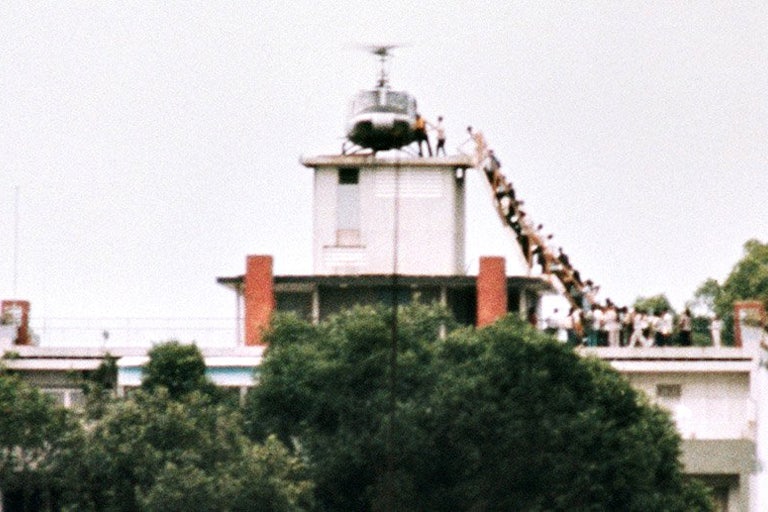
The capture of the city was preceded by Operation Frequent Wind, the evacuation of almost all American civilian and military personnel in Saigon, more than 2 years after combat operations there had ended; along with tens of thousands of South Vietnamese civilians who had been associated with the Republic of Vietnam regime.

The sight of civilians climbing a staircase in a desperate attempt to reach the last helicopter, on the roof of the American Embassy, became a symbol of America's 1st true military defeat. The War of 1812 may have been a stalemate, but tends to get treated like a victory. There was no way to spin the Vietnam War as a win for America, or even a draw.

In 1976, the National Assembly of the united Socialist Republic of Vietnam, in the national capital of Hanoi, which had been the capital of North Vietnam, renamed Saigon for the founder of North Vietnam: Hồ Chí Minh City.

Today, with the country still a corrupt one-party state, but embracing free-market reforms since 1986, and thus Communist in name only, Hồ Chí Minh City is home to 9.4 million people, more than New York or London. And the former U.S. Embassy is home to the country's Oil Ministry.
 

Wednesday, February 12, 2025

February 12, 1955: The 1st American "Advisors" Are Sent to Vietnam

February 12, 1955, 70 years ago: President Dwight D. Eisenhower sends the 1st U.S. "advisors" to South Vietnam. This comes 9 months after the Battle of Dien Bien Phu saw the Communist Viet Minh defeat the French Army, and 7 months after the Geneva Conference divided the country into a Communist North and a "free" South, just like Korea.

These "advisors" -- some of them U.S. Army officers, some of them CIA officers, some of them civilian diplomats -- were supposed to guide South Vietnam toward 3 things: Governmental stability, economic stability, and freedom.

To the American public, most of whom barely knew of Vietnam's existence in those early days of television -- "Indochina" was still the more common name, but that also encompassed Cambodia, Laos, Burman (now Myanmar), Thailand, and Peninsular Malaysia -- let alone could find it on a world map, freedom was the most important part.

But, in all fairness, it would have been a miracle if the country were stable enough to hold together, let alone enough to hold off attacks -- either military or spying -- from North Vietnam.

Since the Vietnam War finally came to an end in 1975, Republicans have usually blamed the American role in the war on President Lyndon B. Johnson, for the Gulf of Tonkin Resolution in 1964 and his subsequent escalation of the war; or on President John F. Kennedy, who increased the U.S. presence in Vietnam in 1961, '62 and '63. JFK and LBJ were both Democrats.

These Republicans tend to ignore the fact that Republican Richard Nixon, after being elected President in 1968, largely on the basis of saying he would end the war, only took the last U.S. combat troops out after being sworn in for a 2nd term in 1973.

Let the record show that the 1st President to send U.S. troops to Vietnam was a Republican, Dwight D. Eisenhower. And his Vice President was Richard Nixon.

Saturday, September 7, 2024

September 7, 1964: The Daisy Spot Is Aired

September 7, 1964, 60 years ago: The most famous political advertisement ever runs. It only runs the once, but it was enough.

The Cuban Missile Crisis of October 1962 scared the world. The following year, a public opinion survey showed that 90 percent of respondents believed that a nuclear war was possible, and 38 percent thought it was likely.

Having resolved the Missile Crisis without going to nuclear or any other kind of war, President John F. Kennedy and Soviet Premier Nikita Khrushchev worked toward a Nuclear Test Ban Treaty, that took effect in September 1963. This seemed like a big step forward. Then Kennedy was assassinated in November, and Vice President Lyndon B. Johnson became President. A Democrat like Kennedy, he immediately took steps to run for a full term in 1964.

The Republican Party nominated Senator Barry M. Goldwater of Arizona for President. An archconservative, he and his supporters didn't want Communism "contained" to where it already was, they wanted it "rolled back."

In hindsight, LBJ is considered -- not completely fairly -- the man who started the Vietnam War, but it was the Republican Administration of President Dwight D. Eisenhower (with Nixon as Vice President) that started the U.S. role in what had been a civil war in Vietnam. Republicans supported that war all the way, to the point where, in 1992, Republican President George H.W. Bush ripped Democratic nominee Bill Clinton for having opposed the war, 17 years after the last U.S. troops left -- and it made Bush look ridiculous, and it was one of the reasons (although hardly the biggest reason) that Clinton won.

But in the Summer of 1964, most Americans weren't hearing much about Vietnam. Many couldn't find it on a map. It didn't look like it would be a major issue.

But Goldwater had been 1 of 14 Senators to vote against the Test Ban Treaty. And he gave an interview suggesting that he would give U.S. Army field commanders the right to use small, "tactical" nuclear weapons in combat. He went out of his way to say, "I don't think we would ever use them." But that's not what people remembered: They were too shocked at the suggestion to "see" the denial.

And so, the Johnson campaign took Goldwater's slogan, "In your heart, you know he's right," and twisted it. "Yeah, far right." "In your guts, you know he's nuts." And a campaign pin with a red button and a finger pointed right at it, with the inscription, "In your heart, you know he might."

The Goldwater campaign struck back, showing a group of children reciting the Pledge of Allegiance, until their voices are drowned out by a voice pretending to be Khrushchev: Of course, Khrushchev didn't say it in English -- as far as I can tell, he didn't speak it -- but the actor quoted him directly: "We will bury you" and "Your children will be Communists!"

So the LBJ campaign worked with the famed advertising agency Doyle Dane Bernbach (now known as DDB Worldwide Communications Group) to make a devastating ad. Written by Tony Schwartz, it is officially titled, "Peace, Little Girl." It is on black-and-white film, and shows a 3-year-old girl, sitting in Highbridge Park in Upper Manhattan, with the Henry Hudson Parkway behind her. She's pulling the petals off a daisy, hence it became known as "The Daisy Spot" or "The Daisy Ad."

As she pulls the petals, and birds chirp, she counts, not quite right, and this was left in because it made her seem more innocent: "One, two, three, four, five, seven, six, six, eight, nine... " And then she runs out of petals, and says, "Nine" one more time. Then, a heavily-echoed adult male voice yells, "Ten!" And starts counting down. When he gets to eight, the girl looks up, as if she hears him. Her image freezes, and the camera zooms in on her right eye.

As her iris fills the screen, the countdown reaches, "Zero!" And there's a flash of light. It's a nuclear explosion. And the voice of LBJ is heard, saying, "These are the stakes: To make a world in which all of God's children can live, or to go into the dark. We must either love each other, or we must die." The screen then goes black except for these words, in white: "VOTE FOR PRESIDENT JOHNSON ON NOVEMBER 3." And a 3rd male voice -- I can find no record of whose it was, and the LBJ Presdiential Library responded to my request by saying it was probably a Doyle Dane Bernbach employee -- says, ominously, "Vote for President Johnson on November 3rd. The stakes are too high for you to stay at home."

The ad aired only once. The program chosen was The NBC Monday Movie, in this case a Biblical epic, the 1951 film David and Bathsheba, starring Gregory Peck and Susan Hayward. (This was before ABC began showing Monday Night Football.) The time chosen was 9:50 PM, a time at which it would be expected that children would be in bed, so they would be less likely to be scared by it, but parents would still be watching, and would imagine their children in place of the little girl.

White House Press Secretary Bill Moyers later told LBJ, who wanted it shown again, that it accomplished its purpose in one showing. He was right: Goldwater had been gaining in the polls, but the ad finished him, even though it never even mentioned his name.

Republicans blaming the media for an election defeat, or for a bad poll that suggests an upcoming election defeat, began 2 years earlier, when Richard Nixon lost his election for Governor of California. But now, conservatives blamed the media for distorting what Goldwater meant by his statement on nuclear weapons: The common cry was, "Don't quote what he says, say what he means!"

Would such an ad running today work? Probably not: The huge number of channels available today would mean that fewer people would see it -- at first. But by the next morning, the news channels would have shown it, and, unlike in 1964, analyzed the hell out of it. This would include exposing its flaws, real and perceived. And somebody supporting the targeted candidate would be interviewed, explaining that it totally distorts the candidate's position.

But in 1964, with NBC having a much larger market share, and there being no CNN, MSNBC, Fox News, etc., the one-time showing, without quick comeback analysis, allowed the ad to make a far greater impression. And it totally worked: Goldwater was seen as a "mad bomber," while Johnson was seen as "the peace candidate."

On Election Day, November 3, Johnson set a new record with 61.1 percent of the popular vote. Goldwater won only 6 States: His home State of Arizona (barely), and 5 Southern States, not so much happy with him for having opposed the Civil Rights Act of 1964 as they were angry with Johnson for supporting and signing it.

Few people yet realized just how deep America was into Vietnam's civil war. By the time the 1968 election cycle began in 1967, a joke was making the rounds: "I was told that if I voted for Goldwater, we would be at war, and there would be riots in the streets. Well, I voted for Goldwater, and we are at war, and we do have riots in the streets."

Johnston dropped out of the race for a 2nd full term in 1968, and died in 1973. Goldwater returned to the Senate in the 1968 election, and served 3 more terms, living until 1998. Tony Schwartz, creator of the ad, went on to create Presidential campaign ads for Hubert Humphrey, George McGovern, Jimmy Carter and Ted Kennedy. He also hosted a radio show on WNYC, New York City's public radio station, and lived until 2008.

The girl in the ad? Her name was Monique Corzilius, and she and her family lived in Pine Beach, on the New Jersey shore, across the Toms River from the town of the same name. Her mother took her into New York to audition for commercials. Most commercials from that era are forgotten, but the Daisy Spot lives on. Her parents were paid $105 for the ad -- a shade over $1,000 in 2022 money.

In 1975, the Corzilius family moved to Philippsbourg, France. In 1983, at age 22, Monique married Manuel Luiz, a Portuguese citizen, and they moved to Phoenix, Arizona -- ironically, Goldwater's hometown. She became a human resources supervisor at a bank, and claimed she never saw the ad until searching for it on the Internet in the 2000s.
In 2016, she appeared in a campaign ad for Hillary Clinton, showing Donald Trump acting like a lunatic on the subject of nuclear weapons. She said, "The fear of nuclear war that we had as children, I never thought our children would ever have to deal with that again. And to see that coming forward in this election is really scary." She even closed the ad with nearly the same words that the 1964 ad used: "Vote for Hillary Clinton on November 8th. The stakes are too high for you to stay home." This time, it didn't work, and Trump became President anyway.

As of September 7, 2024, she is still alive, age 63.
Sunday, August 4, 2024

August 4, 1964: The Gulf of Tonkin Incident

USS Maddox

August 4, 1964, 60 years ago: The Gulf of Tonkin Incident occurs. What happened? That is still in dispute.

On August 2, the destroyer USS Maddoxwhile performing a signals intelligence patrol, was approached by three North Vietnamese torpedo boats. The Maddox fired warning shots, and the North Vietnamese boats attacked with torpedoes and machine gun fire. In the ensuing engagement, one U.S. aircraft, which had been launched from aircraft carrier USS Ticonderogawas damaged, all of the North Vietnamese torpedo boats were damaged, and four North Vietnamese sailors were killed, with six more wounded. There were no U.S. casualties. According to its report, the Maddox was "unscathed except for a single bullet hole from a Vietnamese machine gun round."

Two days later, on August 4, another destroyer, the USS Turner Joyjoined Maddox on its mission. That evening, the ships opened fire on radar and sonar returns that had been preceded by communications intercepts which U.S. forces claimed meant an attack was imminent. The commander of the Maddox task force, Captain John Herrick, reported that the ships were being attacked by North Vietnamese boats -- when in fact, there were no North Vietnamese boats present.

While Herrick soon reported doubts regarding the task force’s initial perceptions of the attack, the Administration of President Lyndon B. Johnson relied on wrongly interpreted National Security Agency communications intercepts to conclude that the attack was real.

While doubts regarding the perceived second attack have been expressed since 1964, it was not until years later that it was shown conclusively never to have happened. In the 2003 documentary The Fog of War -- the title taken from a German expression for the uncertainty in situational awareness experienced by participants in military operations -- Robert S. McNamara, the U.S. Secretary of Defense from 1961 to 1968, admitted that the August 2 attack on the Maddox happened; but that the August 4 attack, for which LBJ authorized retaliation, never happened.

The outcome of these two confrontations was the passage by the U.S. Congress of the Gulf of Tonkin Resolution, which granted LBJ the authority to assist any Southeast Asian country whose government was considered to be jeopardized by "Communist aggression." The resolution served as Johnson's legal justification for deploying U.S. conventional forces to South Vietnam, and the commencement of open warfare against North Vietnam.

The Resolution passed the House of Representatives unanimously, 416-0. It passed the Senate by a vote of 88-2. While 10 Senators were not present for the vote, the only ones to vote against it were Ernest Gruening of Alaska and Wayne Morse of Oregon, both Democrats. (Morse, first elected in 1944 as a Republican, became an independent in 1952 because of disgust over McCarthyism, and switched to the Democrats so he could be in the majority and chair committees after the Democratic takeover following in the 1954 elections.)

On the NBC TV series The West Wing, John Spencer played Leo McGarry, White House Chief of Staff, and a U.S. Air Force veteran who had been shot down over North Vietnam in 1970, and barely rescued before he could be taken prisoner. In one 2001 episode, where a military operation has gone badly, he tells President Jed Bartlet, played by Martin Sheen, that if he could go back in time to any moment, it would be to August 4, 1964, to tell Johnson, "Mr. President, don't do it."

But Johnson was running for re-election. All the polls showed he would easily beat the Republican nominee, Senator Barry Goldwater of Arizona. But he was concerned that, if he let the Gulf of Tonkin Incident go, he would be seen as "weak" and "soft on Communism." Instead of saying, "Let them say that, the American people know I'm handling things well," he panicked, and sent America down a path that led to nearly 60,000 deaths in 8 years -- around 36,000 by the time he left office on January 20, 1969 -- taking all his accomplishments, and they were many, some of them changing things tremendously for the better, and giving them the rebuttal, "Yes, but... "

After leaving office, he told historian Doris Kearns Goodwin, who was working on his authorized biography, "I knew from the start that, if I left the woman I loved, the Great Society, in order to fight that bitch of a war, then I would lose everything. All my programs. All my hopes. All my dreams." He had blown it, and he knew it.

Greuning and Morse were both defeated for re-election to the Senate in 1968: Gruening by 2,000 votes, Morse by 3,500.

USS Maddox, launched in 1944 during World War II, was the 3rd ship named for Captain William Maddox, U.S. Marine Corps, a hero of the Battle of Santa Clara in the Mexican-American War in 1847. It remained in service until 1972, was sold to Taiwan, and scrapped in 1985. Her Captain, John Herrick, lived until 1997. His brother, Curtis Herrick, was a General in the U.S. Army.

USS Turner Joy, launched in 1958, was named for an Admiral who served as Superintendent of the U.S. Naval Academy. Only this 1 ship, as yet, has been named for him. Since 1991, she has been a museum ship berthed at Puget Sound Naval Shipyard in the Seattle suburb of Bremerton, Washington. Her commanding officer, Commander Robert C. Barnhart Jr., lived until 2012.