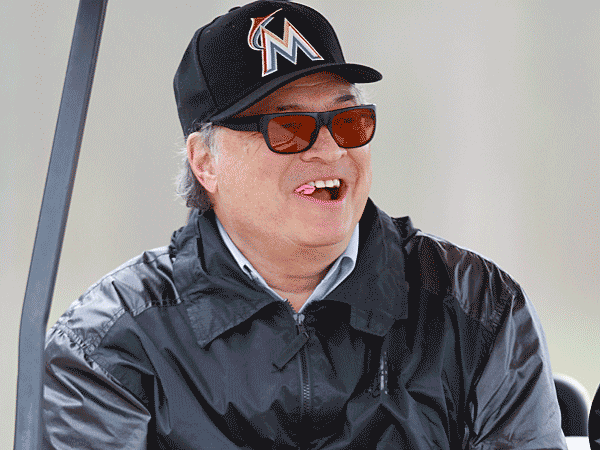
Nope, that M stands for Miami, not Montreal.
This week, the Mets are in Washington, District of Columbia to play the Washington Nationals
The Mets should be playing these games in Montreal, Quebec, Canada, against the Montreal Expos, the team the Nationals were from 1969 to 2004.
Washington is a great city. Of course, it deserves to have a Major League Baseball team. But so does Montreal, and they got screwed.
Downtown Montreal
Most frequently blamed for the Expos' move is Jeffrey Loria. In 1999, the New York-based art dealer, former owner of the minor-league Oklahoma City 89ers, and unsuccessful bidder for the Expos in 1991 and the Baltimore Orioles in 1994, bought the Expos for $12 million (U.S.).
He demanded a new ballpark to replace the 1976 Olympic Stadium -- which still wasn't paid off (and, as it turned out, wouldn't be until 2006). But the City of Montreal wouldn't pay for it. Nor would the Province of Quebec. To make matters worse, Loria didn't get a TV contract for the Expos for the 2000 season -- on either an English station or a French one.
In 2002, a musical chairs of ownership saw Loria sell the Expos to the other 29 MLB owners, Florida Marlins owner John W. Henry sell his team to Loria, and Henry buy the Boston Red Sox from the Yawkey Trust. Then Loria moved the Expos' entire front office staff, on-field staff, and even broadcast staff (including Hall of Fame broadcaster Dave Van Horne) to Miami to join the Marlin organization. He even took the Expos' office equipment (which, to be fair, he did legally own), leaving them with, essentially, nothing but the players and the coaching staff.
Near the end of the 2004 season, Baseball Commissioner Bud Selig (effectively, the Expos' controlling owner) announced that the team had been purchased by a group that would move it out of Canada and into America's capital, becoming the Washington Nationals.
Montreal has had preseason exhibitions at the Olympic Stadium in 2014, '15 and '16, but has been without an MLB team for 12 seasons now. And, despite speculation and jokes about the Oakland Athletics and the Tampa Bay Rays moving in the next few years, the odds of Montreal getting a replacement team are long. It took Washington 33 years to get a new team, and it may take Montreal longer than that.
And to really add insult to injury, in 2003, the Marlins won the World Series. In 2012, Loria got what he wanted in Montreal, but got it in Miami: A new stadium with a retractable roof, close to downtown.
Montreal still has a weird and empty stadium, not well-suited to baseball, and no baseball team to play in it (although the CFL's Alouettes and MLS' Impact do play some home games there).
So, Loria is the biggest reason the Expos moved, right? It would seem that way. But, as ESPN host Brain Kenny said on their series
The Top 5 Reasons You Can't Blame... , "Things aren't always what they seem."
Note that Loria's ownership of the Marlins has nothing to do with the following. How he's mishandled them is a whole other debate.
Top 5 Reasons You Can't Blame Jeffrey Loria for the Montreal Expos Moving to Washington
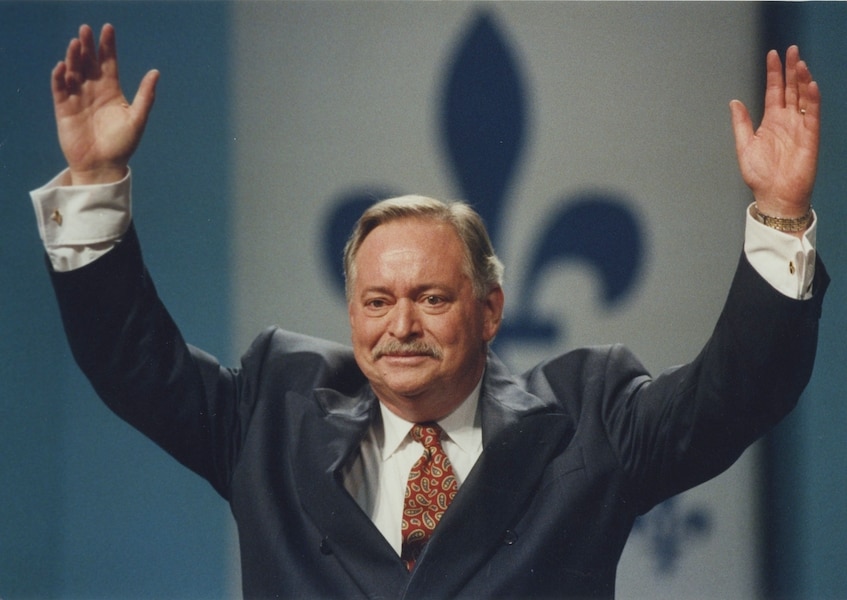
5. Quebec Separatists. Jacques Parizeau led the separatist
Parti Quebecois to victory in Quebec's 1994 Provincial election, making him the Premier of the Province, equivalent to the Governor of one of our States -- and, with about 8 million people, Quebec has more people than all Provinces except Ontario, and all but 12 of our States.
Parizeau immediately set about putting a referendum on independence on the ballot. On October 30, 1995, with Quebec nationalists led by Parizeau and Canadian nationalists led by Prime Minister Jean Chretien, himself a Quebec native, both having advertised heavily and having held massive rallies, the
Non side just barely triumphed over the
Oui side. The number of spoiled ballots was actually larger than the margin of victory.
Jacques Parizeau. He looks like a businessman putting
profits before people in a 1980s TV drama, doesn't he? The kind
who would have been a villain on Quincy, M.E. or Knight Rider.
Having failed by the slimmest of margins, Parizeau (not exactly slim himself, one critic called him "the Elephant Seal") resigned as Premier. Lucien Bouchard, leader of the federal Parliament's version of the PQ, the
Bloc Quebecois (that's right, the federal government had a party devoted to taking 1/4 of its people away), was elected the new Premier.
And when Loria demanded a new ballpark, Bouchard told the National Assembly, Quebec's Provincial legislature, that they shouldn't pay for it. His successor, Bernard Landry, also refused. Even when the Liberal Party won the 2003 election, and installed Jean Charest as a Premier that wanted to keep Quebec in Canada, the NA wanted to focus on things that a Provincial/State government should focus on. Considering Quebec's high standard of living, in 2004 and in 2016, I can't say they were wrong.
In addition, the Quebec separatists cast the Province in a very bad light for the rest of Canada. Independence would have cut the Maritime Provinces (New Brunswick, Nova Scotia, Prince Edward Island, and Newfoundland and Labrador), all of them considerably closer in road and air miles to the Expos than to the Toronto Blue Jays, off from the rest of Anglophone Canada. Lots of people began to assume that the
Pequistes would keep trying until they finally got what they wanted, calling it "The Never-endum."
There had been an earlier referendum in 1980, but it lost 60-40. It is now believed that the current PQ government won't schedule another until they think they can win with room to spare, as they don't want another loss, which would be humiliating in ways that 1980 and 1995 were not.
The 1995 referendum depressed attendance. When you don't know for sure what country you're going to be living in this time next year, even though you have no intention of moving out of your current building, your next thought is not likely to be, "Hey, the Cubs are in town, let's go to the ballpark and watch the local nine toss the ol' horsehide around!"
More likely, it could be, "What if I want to visit my brother in Ottawa? My Canadian passport is going to be no good anymore!" Or, "
Les Anglais in Toronto and New York won't trade with us, so our economy is in tatters, and my
Banque du Québec $5 bill is worth more as toilet paper than as currency!" (At least, at the time, Russia was run by Boris Yeltsin rather than Vladimir Putin, so not being part of NORAD anymore wasn't going to be a problem if Quebec separated.)
Then, of course, there was the question of what the Montreal Canadiens would call themselves.
4. The Exchange Rate. On January 18, 2002, I was in Montreal. It was a good day to be there. Not because of the weather -- it was very cold and snowing, as you might expect of Montreal in mid-January -- but because this was the day in history on which the U.S.-Canada exchange rate most favored Americans: US$1.00 = C$1.60, or C$1.00 = US 62 cents.
That, plus Canada's taxes (see, they actually pay for social services, instead of demanding said services but also demanding low taxes, and, as any idiot knows, and any non-asshole accepts, you can't have both high services and low taxes), meant that it was harder for the Expos (and the Blue Jays) to pay for anything, including player salaries, than it was for U.S.-based teams.
In 1994, the Expos had Pedro Martinez, Jeff Fassero, Ken Hill and John Wetteland on their pitching staff. Their lineup had Larry Walker, Marquis Grissom, Rondell White and Moises Alou. And they had the best record in baseball before the Strike of '94 hit. But they couldn't afford to keep those guys.
In contrast, in their last season in Montreal, 2004, they had a Cabrera (the decent Orlando, not the superstar Miguel or the steroid-aided star Melky), a Hernandez (a washed-up Livan, not a still-serviceable Orlando), 2 Beltrans (pitchers Francis and Rigo, neither of them a hitter like Carlos), a Cordero (Chad, not Wil), a Tony Armas (Jr., a decent but not great pitcher, instead of Sr., once a very good hitter), a Hill (Shawn, not Ken), a relief pitcher from Korea named Kim (Sun Woo, not Byung-hyun), a catcher named Diaz (Einar, not the late Phillies All-Star Bo), a Batista (Tony, not Jose Bautista), a Chavez (slick-fielding outfielder Endy, not good-hitting 3rd baseman Eric), a Rivera who once played for the Yankees (outfielder Juan, not pitcher Mariano), a banged-up Nick Johnson, a genuine All-Star in Jose Vidro, and an all-time great in Frank Robinson (a 68-year-old manager, not a 25-year-old Pennant-winning MVP or a 30-year-old World Series-win-captaining Triple Crown winner).
3. The Strike of '94. The Expos never really recovered from it. Not on the field, and not at the box office. Fans began to get the idea of, "What's the point?" And this was a few years before Loria bought the team.
2. Claude Brochu. The owner before Loria is hardly blameless. He could have managed the fallout from the Strike better, and he could have pushed for a new ballpark anytime between his June 14, 1991 purchase of the team -- by which point Camden Yards in Baltimore was under construction, and changing the rules for stadium and arena construction -- and the August 12, 1994 date of the Strike. He didn't.
It wasn't that he didn't want to. It was that he couldn't. He and his investors simply didn't have the money. They stepped in to stop the Expos from being moved to Phoenix, but it only delayed what might have been an inevitable. It's worth asking if a completed 1994 season, with the Expos winning the World Series, would have made a difference.
(Maybe not. The Boston Braves won a Pennant in 1948; 5 years later, they were in Milwaukee. They finished only 5 games out of 1st in 1964; after 1 more season, they moved to Atlanta. The Brooklyn Dodgers won a Pennant in 1956; after 1 more season, they moved to Los Angeles. And those are just examples from baseball.)
And if you still think Loria is more to blame than Brochu, just remember that it was Brochu who sold the team to Loria. Brochu wasn't a bad guy, he just seriously miscalculated his ability to run the team. He certainly wasn't as malicious about it as Loria -- the old saying is, "Never ascribe to malice that which can be blamed on incompetence "-- but he's at least as much to blame.
1. Bud Selig. Allan Huber Selig was the Commissioner of Baseball -- Acting Commissioner after Fay Vincent was fired in 1992, and then full Commissioner from 1998 to 2015. Theoretically, the owners could have ganged up on him and demanded something, and, if they didn't get it, fired him.
That was never going to happen, because, for 28 years, from 1970 when he purchased the Seattle Pilots and moved them to his hometown so that they could become the Milwaukee Brewers, until 1998 when he was named full Commissioner (including 1992 until 1998, making him a walking conflict of interest), he was one of them. The owners rarely turn on one of their own. Bill Veeck and Charlie Finley were the last exceptions, and they both sold out in 1980.
Kind of looks like a James Bond villain, doesn't he?
If Selig wanted the Expos to stay in Montreal, he would have made it happen. Instead, he wanted Montreal out of MLB, and Washington in, and both happened.
Or maybe Charles Gray's take on Bond's nemesis
Ernst Stavro Blofeld in Diamonds Are Forever,
filmed during the Brewers' 1st season of 1970,
made him look like a baseball team owner.
The Verdict: Not Guilty. On the lesser charge of being a jerk, Loria is unquestionably guilty. But the Expos were probably doomed before he came along.
I hope MLB returns to Montreal soon. If it's the Rays, who are probably never getting a replacement for their stupid dome in St. Petersburg, a real dome somewhere in the Tampa Bay area, at least they wouldn't have to be moved out of the American League Eastern Division. It would make scheduling easier, and there would be the built-in rivalry with Toronto.