Showing posts with label san diego chicken. Show all posts

Tuesday, April 9, 2024

April 9, 1974: The Chicken Debuts and the Padres Lay an Egg

April 9, 1974, 50 years ago: The San Diego Padres begin the new baseball season. They were very close to beginning it elsewhere. They may have wished they had.

After 5 seasons in the National League, all in last place, all losing money, founding owner C. Arnholdt Smith reached an agreement to sell the Padres to Joseph Danzansky, who was going to move the team to Washington, D.C., which had lost the Senators 2 years earlier.

New uniforms were designed. A choice of new names was down to 2: Washington Stars or Washington Nationals. There were even baseball cards produced by Topps, showing "SAN DIEGO" replaced by "WASHINGTON NAT'L LEA." -- but also a backup sheet, keeping the Padres name, just in case the deal fell apart.
As if seeing the recently-acquired "Stretch" in any uniform 
other than that of the San Francisco Giants wasn't weird enough.
This was one of those post-trade "Topps airbrush jobs."

It did fall apart: The sale became tied up in lawsuits, and on January 25, 1974, Smith instead sold the team to Ray Kroc, CEO of fast-food chain McDonald's, for $12 million. And he decided to keep the Padres right where they were.

On April 9, 1974, the Padres opened the season at home, at San Diego Stadium. The Padres started Steve Arlin. Having gone 9-19, 10-21 and 11-14 the last 3 years, he was the closest thing the Padres had to an ace. The opponents were the Houston Astros. They started their ace, Larry Dierker. A crowd of 39,083 people came out to a stadium whose capacity was then listed as 47,634.

Among the figures on the field for the pregame ceremony were Kroc, team president and former Los Angeles Dodgers general manager Emil J. "Buzzie" Bavasi, and... the KGB Chicken. No, not a Soviet spy. KGB was a San Diego radio station, 1360 on the AM dial. (In 2020, the former KFMB, at 760 AM, became KGB, and has an all-sports format.)

KGB broadcast football and basketball games for San Diego State University, and hired Ted Giannoulas, a 20-year-old journalism student at the school, to wear a chicken suit with the letters K G B (spread-out, possibly so people in that very patriotic city, home to a major naval base, wouldn't make the "Commie" connection), to distribute Easter eggs at the famed San Diego Zoo. This having worked well, the station made a deal with the Padres to make him a mascot.

Kroc spoke to the fans before the game, saying, "With your help, and God's help, we'll give 'em hell tonight." He and Bavasi then moved to the owner's box to watch the game together.

They may have been better off going to a McDonald's. Certainly, they would have ended up less salty. The Astros scored 3 runs in the 1st inning, and 3 more in the 2nd. The Padres scored single runs in the 2nd and 3rd, but 6-2 was as close as they would get. In the 4th, with the bases loaded and 1 out, Bobby Tolan popped up to the catcher. Thinking that was the 3rd out, Matty Alou -- mind you, entering his 15th big-league season, and, as it turned out, his last -- walked off 2nd base, and was doubled off. Then, in a stadium not yet 7 years old, a pipe burst in a concession stand, flooding the area. So things were also going badly off the field.

The Padres allowed a run in the 5th. In the top of the 8th, Padre reliever Mike Corkins allowed another run, on a single by César Cedeño. With Bob Watson up, he thought he could pick Cedeño off 1st base. Instead, he threw the ball away, and Cedeño got all the way to 3rd base. Watson then hit a sacrifice fly to make the score 9-2 Houston.

That really burned Kroc's sesame seed buns. He sent aide Dennis Walsh to the public address announcer's booth, manned by John DeMott, to ask DeMott if he could address the crowd. DeMott said yes, and, in the middle of the 8th inning, Kroc, whose voice was also carried over the radio, said, "Ladies and gentlemen, I suffer with you. I've never seen such stupid ball playing in my life!"
Ray Kroc

And then a streaker jumped onto the field, with security officers pursuing him. Still on the mike, Kroc yelled, "Get that man out of here! Arrest him!"

The Astros mounted a minor comeback, but the game ended Astros 9, Padres. 5. Willie McCovey, the newly-acquired former (and future) San Francisco Giants slugger, told Kroc he'd gone too far, and that the players were going to boycott the next game. Kroc wrote an apology, and asked McCovey to read it to the players. He did, and the boycott didn't happen.

McCovey told the reporters, "I've never heard anything like that in my 19 years in baseball. None of us likes being called stupid. We're pros, and we're doing the best we can. His words will ring in the players' ears for a long time." But Padre fans, having had 5 horrible seasons of poor play and seemingly apathetic ownership, knew they now had an owner who cared.

On June 15, 1974, having a 1-7 record and a 5.91 ERA, Steve Arlin was traded to the Cleveland Indians for pitchers Brent Strom and Terry Ley. Ley, as it turned out, had pitched his only 6 games in the majors for the New York Yankees in 1971, and never got out of the minors again. Strom gave the Padres decent seasons in 1975 and '76, then faded. Arlin pitched 11 times for the Indians over the rest of 1974, and never appeared in another major league game. So the Padres came out slightly ahead in that trade.

The Padres finished 60-102, their exact same record from the year before, again finishing 6th and last in the NL Western Division. To his credit, Kroc was willing to pay big if he thought it could bring big results. He tried picking up the pieces of the dismantled Oakland Athletics dynasty, signing relief ace Rollie Fingers and 1st baseman Gene Tenace, and nearly signing slugging right fielder Reggie Jackson before the Yankees' owner, George Steinbrenner, reminded Reggie that, while Kroc was offering a higher salary, Reggie could make more money in endorsements in New York than in San Diego.

The 1978 Padres featured 4 future Hall-of-Famers: Fingers, Gaylord Perry in a Cy Young Award-winning season, Dave Winfield just entering his prime, and a young shortstop named Ozzie Smith. They also had slugger Oscar Gamble, speedy Gene Richards, a briefly revitalized Mickey Lolich, and established Padre ace Randy Jones. Despite all this talent, they only managed a franchise-best 84-78. And they were mocked for having some of the worst uniforms in baseball history.

They did not win an NL West title, or an NL Pennant, until 1984. By that point, they had almost a completely different team, now led by batting champion Tony Gwynn. Kroc had died earlier in the year. In 1990, his widow, Joan Kroc, sold the team to Tom Werner, later a part-owner of the Boston Red Sox. He sold them to John Moores in 1994.

Seeking a new ballpark, Moors threated a move to, yes, Washington. But the team's 1998 Pennant led to a favorable vote on a bond issue that built Petco Park, so the Padres have stayed put. In 2005, the Montreal Expos moved to the nation's capital, and took on the name Washington Nationals.

The Padres are the only team left in San Diego: They had lost the NBA's Rockets in 1971, lost the ABA's Sails in 1975, lost the WHA's Mariners in 1977, gained the NBA's Clippers in 1978 but lost them in 1984, and lost the NFL's Chargers in 2017.

San Diego Stadium opened in 1967, for the AFL's San Diego Chargers. The Padres debuted there in 1969. In 1980, it was renamed Jack Murphy Stadium, in honor of the San Diego Union sportswriter who had so long advocated for the city to reach the major leagues. A statue of him was placed outside the stadium. His brother was Bob Murphy, the Hall of Fame broadcaster for the New York Mets.

In 1997, the stadium was renamed Qualcomm Stadium. In 1998, it hosted Super Bowl XXXII, with the Denver Broncos beating the Green Bay Packers; and the World Series, with the Padres losing to the New York Yankees. This made it the only stadium to host the Super Bowl and the World Series in the same calendar year.

(The Metrodome, in Minneapolis, hosted both events and the NCAA Final Four between October 1991 and April 1992, but not all in the same calendar year. Prior to the Super Bowl era, the Polo Grounds hosted both the World Series and the NFL Championship Game in the same calendar year in 1936; Cleveland Municipal Stadium did it in 1954; and Yankee Stadium in 1956, 1958 and 1962.)

The Padres moved into Petco Park in 2004. The NFL's San Diego Chargers played there until 2016, then moved to Los Angeles. The football team at San Diego State University continued to play there until 2019. In 2020, the stadium was torn down, and San Diego State's new home, Snapdragon Stadium, opened on the site in 2021.

As for the Chicken: Giannoulas became an indelible fixture on the San Diego sports scene. On the film of the 1978 Chargers-Raiders game, he can be seen, in his original costume, fainting in disbelief in the stands over what became known as the "Holy Roller" play.

In 1979, KGB fired Giannoulas, and they hired a new man to wear the Chicken suit. Fans knew it wasn't the same guy, and they booed him. In June, Giannoulas won a lawsuit, which allowed him to resume performing in a chicken suit, on the conditions that it wasn't the same suit, and that it made no reference to radio station KGB.

On June 29, a full house of 47,000 people came out to see his "grand opening." A giant egg was brought onto the field. As Also Sprach Zarathustra (a.k.a. the theme from 2001: A Space Odyssey) was played, it hatched, and Giannoulas emerged in his new costume, to a standing ovation.

Now known officially as "The Famous Chicken," but usually called "The San Diego Chicken" or just "The Chicken," he had surpassed Mr. Met and the Phillie Phanatic as baseball's most popular mascot. In 1981, he joined the cast of NBC's children's show The Baseball Bunch, hosted by Johnny Bench, with remote guest appearances by Dodger manager Tommy Lasorda as "The Dugout Wizard."

Bench liked the Chicken in real life, but, as characters on the show, they had a rivalry. Lasorda hated all mascots, and eventually had tussles with both the Chicken and the Phanatic. To this day, the Dodgers have never had an on-field mascot.

Since 1996, the Padres have had a costumed representation of their "Swinging Friar" logo as their regular mascot. In 2016, though long past his peak of popularity, but still very much in demand all over the country, Giannoulas gave an interview in which he said he was cutting back on appearances. He said, "It's not the end, but I can see it from here." As the 2024 season dawns, he still performs, at age 70.

Tuesday, May 31, 2022

How to Be a Met Fan In San Diego -- 2022 Edition

This coming Monday, the Mets begin a 3-game series away to the San Diego Padres.

Unlike their fellow National League teams in California, the San Francisco Giants and the Los Angeles Dodgers, the Padres are a team in their original city, with no connection to New York. They've never even played the Mets in the Playoffs -- but they have played the Yankees in the World Series. (The Chargers, no longer in San Diego, have played the Jets in the Playoffs. San Diego has no NHL team, and has only had an NBA team briefly and not currently.)

Before You Go. Unlike the Seattle and San Francisco Bay Areas, but like the Los Angeles area, the San Diego area has very consistent weather. It's a nice place to visit, and there's little threat of earthquakes, mudslides and smog -- but there have been wildfires, including one that led to a Chargers home game being moved to Phoenix a few years ago.

The website of the San Diego Union-Tribune (yet another paper that, not that long ago, used to be two separate papers), is predicting high 60s by day, the low 60s by night, and, as you might expect for San Diego, no precipitation for the entire weekend. A short-sleeve shirt should be enough, no jacket necessary. Just in case, you may want to bring sunscreen.

San Diego is in the Pacific Time Zone, 3 hours behind New York. Adjust your timepieces accordingly.

If you want to take a side trip into Mexico, it's about 140 miles from downtown L.A. to the Tijuana border station. You will need a passport. GoToBus runs buses from Los Angeles to Tijuana, $44 and 4 hours, 45 minutes -- each way. If you drive in, you will need Mexican driving insurance, which you can probably buy at the Mexican consulate, either in New York or Los Angeles. For the moment, $1.00 = 19.60 pesos, while 1 peso =  a shade over a nickel.

Tickets. The Padres averaged 29,856 fans per home game in 2019, the last pre-COVID season, at a park with a seating capacity of 42,524. That's about 71 percent of capacity. Getting tickets shouldn't be a problem.

Field View seating is $68, Field Boxes are $54, Terrace Infield (2nd level) is $53, Left Field and Right Field Lower Boxes are $53, Terrace Pavilion are $46, Field Pavilion (outfield corners) are $47, Terrace Reserved is $41, Left Field Bleachers are $42, and Upper Infield, Upper Pavilion and Right Field Reserved are $27.

Getting There. It's 2,803 miles from Times Square in New York to downtown San Diego, including Petco Park. In other words, if you're going, you're flying. After all, even if you get someone to go with you, and you take turns, one drives while the other one sleeps, and you pack 2 days' worth of food, and you use the side of the Interstate as a toilet, and you don't get pulled over for speeding, you'll still need over 2 full days. Each way.

But, if you really, really want to, well, in order to get there in time for this series, you're too late to see the whole thing. So, for future reference... You'll need to get on the New Jersey Turnpike. Take it to Exit 14, to Interstate 78. Follow I-78 west all the way through New Jersey, to Phillipsburg, and across the Delaware River into Easton, Pennsylvania. Continue west on I-78 until reaching Harrisburg. There, you will merge onto I-81. Take Exit 52 to U.S. Route 11, which will soon take you onto I-76. This is the Pennsylvania Turnpike, the nation's 1st superhighway, opening in 1940.

The Turnpike will eventually be a joint run between I-76 and Interstate 70. Once that happens, you'll stay on I-70, all the way past Pittsburgh, across the little northern panhandle of West Virginia, and then across Ohio, Indiana and Illinois, into Missouri.

At St. Louis, take Exit 40C onto Interstate 44 West, which will take you southwest across Missouri into Oklahoma. Upon reaching Oklahoma City, take Interstate 40 West, through the rest of the State, across the Texas Panhandle and New Mexico, into Arizona. At Flagstaff, take Interstate 17 South, which will take you into Phoenix. Take Interstate 10 West to Exit 112 for Arizona Route 85 South, to Gila Bend, right on Arizona route 238 West, which will flow into Interstate 8 West. This will take you across Arizona and California to San Diego.

If you do it right, you should spend about an hour and 15 minutes in New Jersey, 5 hours and 30 minutes in Pennsylvania, 15 minutes in West Virginia, 3 hours and 45 minutes in Ohio, 2 hours and 45 minutes in Indiana, another 2 hours and 45 minutes in Illinois, 5 hours in Missouri, 6 hours in Oklahoma, 3 hours in Texas, 6 hours and 15 minutes in New Mexico, 6 hours in Arizona, and 3 hours in California.  That's about 45 hours and 30 minutes. Counting rest stops, you're probably talking about 57 hours.

That's still faster than the bus or the train. Greyhound takes about 70 hours, changing buses anywhere from 2 to 4 times, $692 round-trip, although it can drop to $506 with advanced purchase. The station is at 1313 National Avenue at Commercial Street -- 3 blocks from the ballpark!)

Amtrak takes nearly 72 hours, and you'd have to take 3 separate trains -- each way. The Lake Shore Limited leaves Penn Station at 3:40 PM Eastern Time on Friday and arrives at Union Station in Chicago at 10:12 AM Central Time on Saturday. The Southwest Chief leaves Chicago at 2:50 PM on Saturday, and arrives at Union Station in Los Angeles at 8:00 AM Pacific Time on Monday. Finally, switch to the Pacific Surfliner, leaving Los Angeles at 9:55 AM and arriving in San Diego's Santa Fe Depot at 1:07 PM. The round-trip fare is $712. The Santa Fe Depot is at 1050 Kettner Blvd. at Broadway.

Given Amtrak's and Greyhound's usual New York-to-San Diego price, you could, conceivably, get a non-stop flight from Newark to San Diego International Airport, also known as Lindbergh Field, for less. Not by much this week, though: It'll be a little under $700. The airport is only 5 miles northwest of downtown, and the Green Line trolley can get you downtown in less than half an hour.

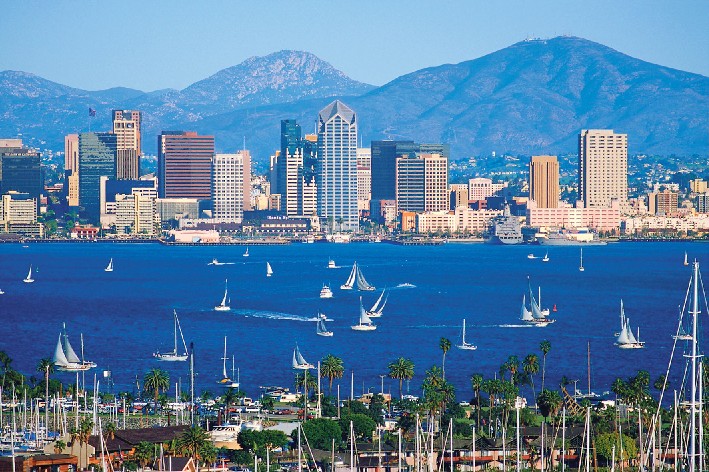
Once In the City. San Diego was founded by Spain as a mission, San Diego of Alcalá (Saint Didacus in Latin), in 1769. Well into the 19th Century, it was larger than San Francisco, and even at the dawn of the 20th Century, was larger than Los Angeles. Being (just about literally) tucked away in a corner of the country, it was pretty much bypassed, but World War II led to a U.S. Navy base being built there, and its population took off again, to where it was major-league capable by the 1960s.

Today, over 1.4 million people live within the city limits, making it the 8th-largest city in the country. About 3.3 million live in the metro area. Front Street is the delineator between streets with East and West as prefixes, while Broadway is that for those running North and South. The city does not have a beltway, although Interstate 8 (north), Interstate 805 (east), California Route 54 (south) and Harbor Drive (west) could be said to fit that function.

Sales tax is a minimum 7.5 percent in the State of California, and 8 percent in San Diego County, which includes, but is not contiguous with, the City of San Diego. ZIP Codes in the San Diego area start with the digits 919, 920 and 921, and the Area Codes are 619, 760 and 858. San Diego Gas & Electric (SDGE) is he power company. The City of San Diego is about 48 percent white, 29 percent Hispanic, 16 percent Asian and 7 percent black.
Public transportation in San Diego is pretty good, with the San Diego Metropolitan Transit System (MTS) running buses, trolleys and light rail. Petco Park is accessible on the Orange Line at Gaslamp Quarter station, and on the Orange and Blue Lines at 12th & Imperial Transit Center station. The fare is $2.50. A 1-day pass is $5.00, and a 4-day pass (the best value if you're going for all 4 games) is $15.
The Chargers' move back to Los Angeles makes San Diego the only city with a Major League Baseball team, but no teams in any of the other major league sports -- including, if you count them, the WNBA and soccer, men's or women's.

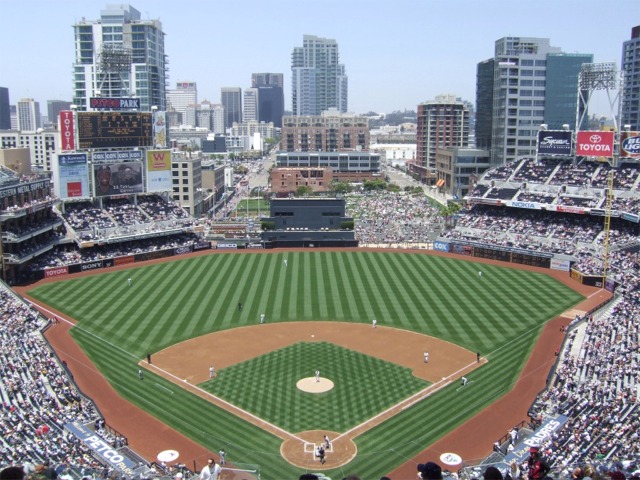
Going In. Petco Park (sometimes listed incorrectly in ALL CAPS), named for the San Diego-headquartered chain of pet and pet supplies stores, opened in 2004. It has an official address, with the name and uniform number of the greatest Padre of them all (so far), of 19 Tony Gwynn Drive. It is bounded by 7th Avenue/Gwynn Drive on the 3rd base and home plate sides, Park Blvd. on the 1st base side, 10th Avenue on the right field side, and K Street on the center field side. It points north, with a good view of the downtown skyscrapers.
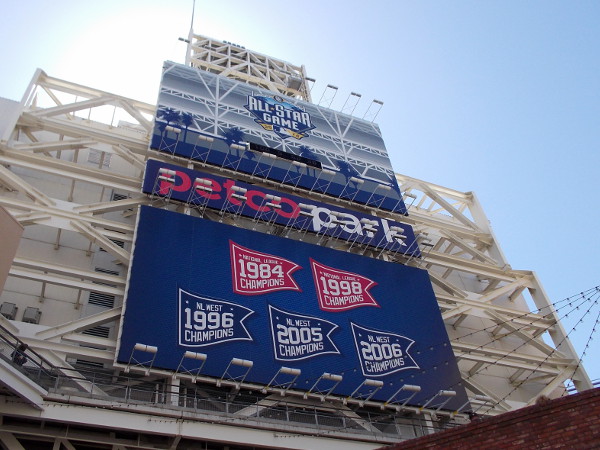
Petco Park, with the Convention Center in the background

Parking starts at $10, though most spaces will be $15. Padre fans living north of downtown can also do what they used to do, and park at Qualcomm Stadium (except when it's also hosting an event), and take the Trolley in.

The Gaslamp Gate and the Downtown Gate are in left field. The Balboa Park Gate, the East Village Gate (not to be confused with Lower Manhattan's East Village or the Broadway's Village Gate Theater) and the Park Blvd. Gate are in right field. And the Home Plate Gate is, well, you can probably guess.
Being in the California sunshine, the field has nearly always looked good. The left-field corner has the former Western Metal Supply Company warehouse, built into the stadium complex, as was the Baltimore & Ohio Railroad warehouse into Camden Yards in Baltimore. Unlike Baltimore, however, seating sections were built into this warehouse.
As with most of the "retro ballparks" built in the 1990s and 2000s, the field is not symmetrical. The left field pole is 334 feet from home plate, straightaway left is 367, left-center is 390, center is 396, right-center is 391, straightaway right is 382, and the right-field pole is a deceptive 322. The field is natural grass, and points north. The home plate is the same one used at the old stadium, so it's been used since 1969.

This is a pitcher's park, although a placement hitter like Gwynn or Dave Winfield would have been fine with it. The longest home run at the park is 471 feet, by Adrian Gonzalez, then with the Padres, in 2009. The longest home run at San Diego/Jack Murphy/Qualcomm Stadium was 499, by Mark McGwire in 1998.

Petco Park's 1st concert was on November 11, 2005, with the Rolling Stones. Among others, it's also hosted Madonna in 2008, Paul McCartney in 2014, Aerosmith and Taylor Swift in 2015 (not on the same bill), Billy Joel in 2016, and Metallica in 2017.

Food. Being just 15 miles from the Mexican border, you might expect Petco Park to feature Mexican and Southwestern-style food. Your expectations would be fulfilled: Behind home plate, on the Field Level, there is Bull Taco and La Cantina Bar; in the Upper Level, another La Cantina Bar is in left field and the Padres Mexican Cafe is in right field.

Team-themed stands abound: Friar Franks are all over, a health-food Friar Fit stand is at Field Level behind home plate, and the PCL Club (named for the city's old-time home, the Pacific Coast League) is at Field Level behind 1st base. On Terrace Level, behind 1st base, are Club 19 (for Gwynn) and Randy Jones BBQ (a variation of the Baltimore Boog Powell and Philadelphia Greg Luzinski theme). And the Hall of Fame Bar & Grill is on Terrace Level in left field.

There are also stands with local flavor: Anthony's Fish Grotto, home of the Padres' famed fish tacos, is behind home plate on both the Field and Terrace Levels. According to a recent Thrillist article on the best food at each MLB stadium, the best food at Petco Park is Ahi poke tacos (basically, sushi tacos) at The Patio, at Section 228. The Brickhouse Deli is on Field Level in left field, inside the warehouse. The Harbor Grill is on Terrace Level behind home plate, the Trolley Station Grill is on Terrace Level behind 1st base, and the Bayview Grill is on Upper Level behind home plate.

Team History Displays. The Padres have 5 retired numbers, displayed in center field, atop the batter's eye wall. They are: 6, Steve Garvey, 1st base 1983-87; 19, Tony Gwynn, right field 1982-2001; 31, Dave Winfield, right field 1973-80; 35, Randy Jones, pitcher 1973-80; and 51, Trevor Hoffman, pitcher 1993-2008. Also mounted on top of the wall is Jackie Robinson's universally-retired Number 42.
The team has also honored, with notations painted in gold on the front of the press box, former owner Ray Kroc (1974-84) with his initials RAK, and broadcaster Jerry Coleman, the former Yankee 2nd baseman and broadcaster who called games for the team from 1972 to 2013 -- except for 1980, when he served as manager, with unsatisfying results, and returned to the booth in 1981.

Instead of retiring a number for him, or mounting an "SD" for San Diego or his initials JC (or GFC for Gerald Francis Coleman), they've hung a star, for his catchphrase for a home run or a great defensive play: "Oh, doctor! You can hang a star on that baby!"

The Padres have a team Hall of Fame, placed on a "Ring of Honor" on the press box, which has been named for Coleman. It has 14 members, including all the retired number honorees except Garvey.
* From the early days, it includes Kroc, Coleman, Jones, Winfield, Emil "Buzzie" Bavasi, the team's 1st president, 1969-77, previously general manager of the Dodgers; and 1st baseman Nate Colbert, 1969-74. It does not, however, include these Hall-of-Famers who played for the Padres in this period: 1st baseman Willie McCovey, 1974-76; pitcher Rollie Fingers, 1977-80; pitcher Gaylord Perry, 1978-79; and shortstop Ozzie Smith, 1978-81.

* From the 1984 Pennant, it includes Kroc (who died that year), Coleman, Gwynn; manager Dick Williams, 1982-85, and in the Hall of Fame; general manager Jack McKeon, 1980-90 (the native of South Amboy, New Jersey also served as manager, 1988-90); and shortstop Garry Templeton, 1982-91, famously traded by "Trader Jack" McKeon in both position and uniform number, 1, for Ozzie Smith. By the end of the 1984 season, that was seen as a fairly even trade, though Ozzie's continued success changed that perception. The Hall/Ring does not, however, include Hall of Fame pitcher Rich "Goose" Gossage, 1984-87.

* From between the 1984 Pennant and the 1996 Division title, it includes Coleman, Gwynn, McKeon, and catcher Benito Santiago, 1986-92. It does not, however, include Hall of Fame 2nd baseman Roberto Alomar, 1988-90.

* From the 1996 Division title and the 1998 Pennant, it includes Coleman, Gwynn, Hoffman; 3rd baseman Ken Caminiti, 1995-98; team president Larry Lucchino and general manager Kevin Towers. It does not, however, include Hall of Fame left fielder Rickey Henderson, who played for the Padres in the 1996 and '97 seasons, and returned in 2001.

* From the 2005 and 2006 Division titles, it includes Hoffman, Lucchino and Towers. Hall of Fame catcher Mike Piazza, best known as a Met, was a Padre in 2006. Hall of Fame pitcher Greg Maddux played for the Padres after this, in 2007 and '08. Neither has been honored by the Padres, however.

* Due to his contributions to San Diego baseball history, Ted Williams (no relation to Dick) has also been elected to the team's Hall of Fame and Ring of Honor. Also elected, crossing the eras, was broadcaster Ted Leitner, 1980-2020.
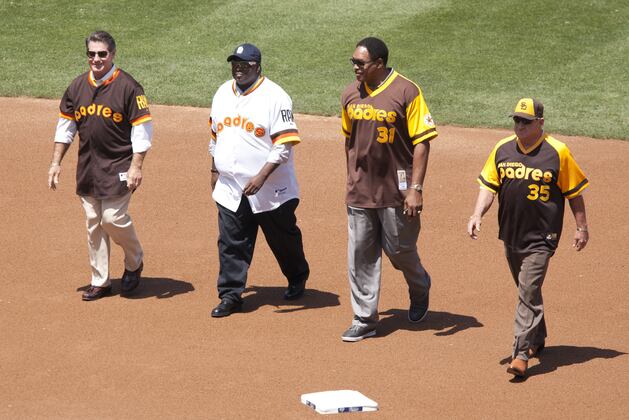
Garvey, Gwynn, Winfield and Jones,
at Petco Park's opening, 2004

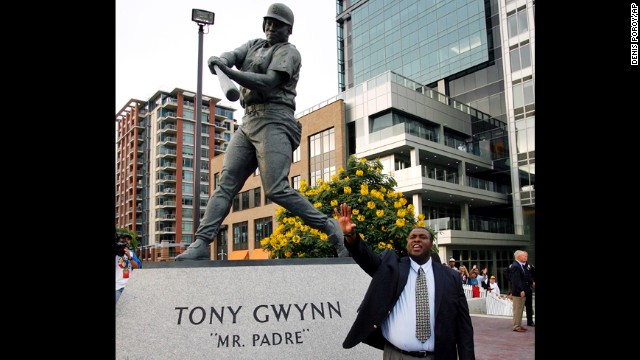
Gwynn, Winfield, Fingers and Smith (and Ted Williams) were named to The Sporting News' 100 Greatest Baseball Players in 1998. Gwynn was also chosen by Padres fans as their team's representative in the 2006 DHL Hometown Heroes poll. A statue of him stands outside the ballpark. Fortunately, he lived long enough to see all of these honors.
In 2022, ESPN named its 100 Greatest Baseball Players. Among players who played significant time for the Padres, Gwynn was ranked 44th, Winfield 56th, Ozzie Smith 69th, and Roberto Alomar '86.

The Padres have won National League Pennants in 1984 and 1998, and NL Western Division titles in those years, plus 1996, 2005 and 2006. They have never reached the Playoffs by way of the Wild Card, although they lost a play-in game for the Wild Card to the Colorado Rockies in 2007. These titles are noted on the video board. The Wild Card berth of 2020 is not.
The original Padres, Ted Williams' 1st pro team, won Pacific Coast League Pennants in 1937 (with Williams), 1954, 1962, 1964 and 1967. There is no notation for them at Petco Park. But, considering that the PCL had a level of quality so high up until the arrival of the Dodgers and Giants in California, its fans called the American League and the National League not "the major leagues" but "the eastern leagues," it can be argued that the 1937 and '54 PCL Pennants meant just as much as the 1984 and '98 NL Pennants, giving San Diego 4 legitimate major league flags, not 2.

Of note is the fact that, assuming you count Johan Santana's highly asteriskable performance in 2012 as a "Met No-Hitter," the Padres were the last team among MLB's 30 current that had never pitched a no-hitter. It was finally done on April 9, 2021, by Joe Musgrove.

As you might guess, due to distance, the Padres' biggest rivals are the Los Angeles Dodgers. As you might also guess, giving the Padres' relatively lackluster history, the Dodgers lead the all-time series. The Dodgers have won 500 games between them, the Padres 411.

Stuff. The Padres have a number of team stores, including their main one at the Gaslamp Gate in left field. The good news is, they sell all kinds of Padres merchandise. The bad news is, they sell all kinds of Padres merchandise, including the various uniforms the Padres have worn, ranging from the mustard-yellow and brown uniforms of the 1970s to the "camouflage" jerseys they wear on home Sundays in honor of San Diego's tradition as a military city.

As far as I know, Padres merchandise does not include monks' (friars') robes with team logos, or a fake "monk wig" simulating a ring of hair around a bald head.

Although the Padres have been around for over 50 years now, and have some history, there aren't very many good books about the team. Baseball in San Diego: From the Plaza to the Padres by Bill Swank, in cooperation with the San Diego Historical Society, is probably the best one, covering the history of professional baseball in the city from the 1899 San Diego Fullers of the Southern California League to the 2004 opening of Petco Park.

Following the Chargers' departure, John Franey published The Curse of The Murph: Why It Sucks to Be a San Diego Sports Fan. I'd never seen it until doing the research for this post, so I haven't had a chance to read it and see his explanation for why the stadium is "cursed."

Since the Padres have not yet won a World Series, there is no DVD collection of World Series highlight films; you'd have to, separately, get the 1984 (won by the Detroit Tigers) and 1998 (by the Yankees) films.

As of yet, the only team-history video available is Nineteen Summers: Padres 1969-1988 (which would actually be 20 summers), and if you want that, it's only available on Amazon.com on VHS, not DVD. There's also a VHS tape titled Tony Gwynn: Mr. Padre that covers his entire playing career. As yet, there is no Essential Games of the San Diego Padres DVD.

During the Game. A recent Thrillist article on "Baseball's Most Intolerable Fans" ranks Padres fans 26th -- in other words, the 5th most tolerable. Despite San Diego's background as a military city (Navy base, Marine Corps base not far away in Oceanside), these are not particularly aggressive people. Having good weather 350 days out of the year will keep you calmer than typical Northeastern, Midwestern or Northwestern weather will.

The Padres' greatest rivals, as you might guess, are the closest NL team, the Los Angeles Dodgers. The AL's Angels are 30 miles closer, but even with Interleague play, Padres fans and Angels fans don't seem to care about each other or their teams -- or maybe they just band together and consider the Dodgers a common enemy.

But due to Fernando Valenzuela having made his name as a Dodger before his brief stopover with the Padres, when Mexican fans come over the border for Padres-Dodgers games, the cheering is about even when the Bums come to San Diego. The Padres also have a budding rivalry with the next-closest team, the Arizona Diamondbacks. But the locals do fit the reputation of the laid-back Southern Californian. No one is going to fight you.

The Wednesday game features a promotion, hats with Fernando Tatis Jr.'s picture on them.

Ted Giannoulas, known in costume as The Famous Chicken, began as the KGB Chicken. No, he wasn't a Russian spy: He was a student at San Diego State University, working for a San Diego radio station, KGB-FM. (He can be seen in his original costume on NFL Films' production of the 1978 Charger-Raider "Holy Roller" game, passing out at the successful result of the Raiders' blatant cheating.)

Following a contract dispute with the station, he got a new costume (one not copyrighted by the station) and was reborn, or rather hatched out of a giant egg, on the field at San Diego Stadium in June 1979 as "the San Diego Chicken."

Starting in 1981, he was part of the cast of NBC's Saturday pregame show The Baseball Bunch, starring Johnny Bench, where he was referred to as simply "The Chicken." He became so much in demand that he could no longer belong only to his hometown, and now goes everywhere.

He, the Phillie Phanatic, and the Phoenix Suns' Go the Gorilla were the 1st 3 inductees into the Mascot Hall of Fame, in 2005. The Chicken and the Phanatic have done more to elevate the baseball mascot to icon status than anyone -- even if they weren't the first guys in silly costumes to entertain at baseball games. (Mr. Met was the 1st official such mascot, but even he was unofficially preceded by the Brooklyn Dodger Sym-Phony Band.)
He takes a mucking, and keeps on clucking.

Since 1996, the Padres have made their Swinging Friar logo a live-action mascot, and he (sans bat) is the official mascot. As I said earlier, like many cities in California, San Diego was founded by Spanish missionaries -- hence "Padres," Spanish for "Fathers," or priests, monks, friars.
The Friar, possibly doing the wrong kind of "swinging,"
since priests are supposed to be celibate.

The Padres hold auditions for National Anthem singers, as opposed to having a regular. It will not be Roseanne Barr, who infamously, and purposely, butchered the Anthem at Jack Murphy Stadium in 1990. They also had a controversy in 2016, when a recording of a woman singing the Anthem was played over the San Diego Gay Men's Chorus singing it live on the team's sponsored Pride Night. They made it up to the SDGMC by bringing them back earlier this year, and they sang it without a hitch.

The Padres don't have a special song to play along with "Take Me Out to the Ballgame" during the 7th Inning Stretch. This could be due to the relative lack of songs about the city, or famous singers or bands from the city. However, with the city's nautical tradition, a foghorn sounds after every Padre home run -- not common, as Petco is one of the best pitcher's parks in the majors. Their postgame victory song is "San Diego" by Blink-182, a band from nearby Poway, California.

After the Game. San Diego's Gaslamp District has plenty of nightspots, so finding a good place for a postgame meal or drink shouldn't be too hard. And although the city has a reputation for gang violence -- as Met fans, you may have heard San Diegan Kevin Mitchell tell horror stories about it -- downtown is very safe.

If you're looking for New Yorker-friendly establishments, Henry's Pub, at 618 5th Avenue between G & Market Streets, is the home of the local New York Jets fan club. It is 6 blocks from the ballpark.

I have heard of 2 separate bars as being home of local Giants fan clubs. The Knotty Barrel is at 844 Market Street at 9th Avenue, 5 blocks from PETCO. And the U-31 Cocktail Lounge is at 3112 University Avenue at 31st Street, but that is 6 miles northeast of the ballpark. Even if the Knotty Barrel is not a Big Blue hangout, you'd be advised to choose that over the U-31.

If you visit San Diego during the European soccer season, which starts up again next month, the main "football pub" in town is Shakespare Pub & Grill. 3701 India Street and Winder Street, in the Five Points area, about 3 miles northwest of downtown. Green Line to Washington Street.

Sidelights. San Diego has produced more native sons (and daughters) who were great athletes than its teams have. As a result, there isn't a lot of glory associated with these teams.

Some have suggested that there's a curse on the city, with the most common being "The Curse of Bambi," based on the 1971 selling of the city's 1st great major league star, Chargers receiver Lance Alworth, to the Dallas Cowboys. Alworth, a.k.a. Bambi, won Super Bowl VI with the Cowboys the very next season.

No San Diego major league team has gone as far as the rules allowed them to do since Alworth and the 1963 Chargers, AFL Champions, who did not get to play that year's NFL Champions, the Chicago Bears, in a Super Bowl.

On November 30, 2018, Thrillist published a list of "America's 25 Most Fun Cities," and San Diego came in 8th. 

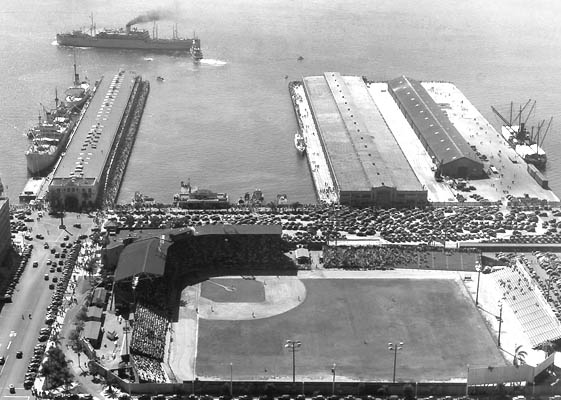
* Lane Field. Home to the PCL Padres from 1936 to 1957, including the 1937 PCL Pennant that featured a 19-year-old San Diego kid named Ted Williams. By the time the Padres won another Pennant in 1954, the 8,000-seat pitcher's park, on the waterfront, with a Spanish-style entrance and faraway fences except at the right field pole, was termite-ridden and had to be abandoned.
Broadway, Harbor Drive and Pacific Highway. The Santa Fe Depot and the USS Midway Museum (a retired WWII aircraft carrier) are adjacent to the site. Number 7 bus. The Maritime Museum of San Diego is 3 blocks to the north.

* Westgate Park. The PCL Padres' next home was in Mission Valley, at (appropriately enough) Friars Road and the Cabrillo Freeway. This park seated only a few more than Lane Field, but it had the advantage of a roof covering the entire seating area, to protect fans from the hot, nearly-Mexican sun.
Supposedly, it was expandable to 40,000, in the event that San Diego could do what Los Angeles and San Francisco had done, and bring in a major league team, through a move or expansion. But the Chargers wanted a modern stadium, too, so one stadium was built for both teams. The Padres won Pennants at Westgate in 1962, 1964 and 1967, their last season there. The Fashion Valley Mall is now on the site. Fashion Valley Transit Center station on the Green Line.

* San Diego/Jack Murphy/Qualcomm Stadium and Snapdragon Stadium. From 1967 until 2016, this was the home of the Chargers, and remains the home of the San Diego State University football team, the Aztecs. It was built to the east of Westgate.
Met fans, take note: It was beloved broadcaster Bob Murphy's brother, Jack Murphy, sports editor of the old San Diego Union newspaper, who advocated for the city as a major league sports site, and when he died in 1980, the stadium was named for him -- at least, until the city sold off the naming rights. Statues of Jack and his dog Abe remain outside the stadium.
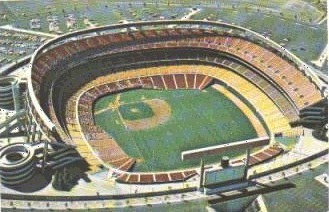
Before the 1990s expansion

It's hosted the Holiday Bowl and the Poinsettia Bowl, and has hosted 3 Super Bowls: XXII (won by the Washington Redskins), XXXII (Denver Broncos) and XXXVII (Tampa Bay Buccaneers). The Chargers only reached the Super Bowl once, in the 1994-95 season, although they were usually in the Playoff hunt. The NFL has now gone out of its way to say that the city won't host another Super Bowl until it builds a new stadium. With the Chargers gone, that's out the window.

From 1978 to 1997, the Holiday Bowl featured the Champions of the Western Athletic Conference. Brigham Young University won the WAC many times, including 1984, when they beat the University of Michigan 24-17 (not particularly impressively) in the Holiday Bowl, to clinch a 13-0 season. As the only undefeated team in what was then called Division I-A, they were awarded the National Championship. But their non-conference schedule wasn't exactly imposing, so this was one of the more dubious National Championships.

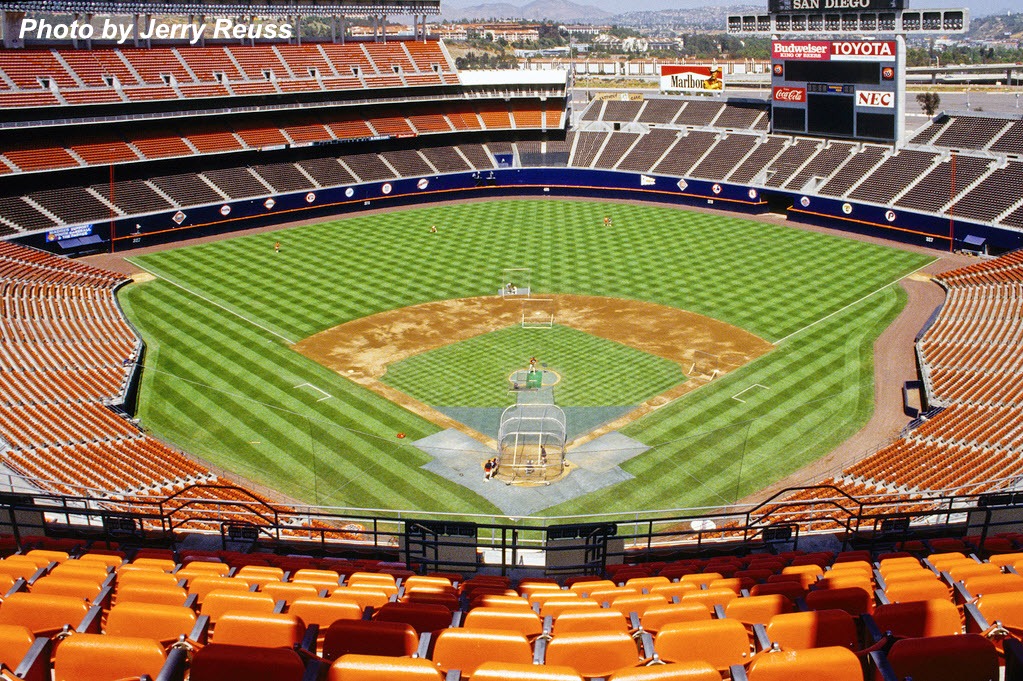
The PCL Padres played their last season here, 1968, and then in 1969 the NL Padres came in. Holding 47,000 for baseball for most of its history, it was expanded to 65,000 by 1996, and during the 1998 World Series between the Padres and Yankees, the noise was remarkable for an open-air facility -- not that it helped the Padres.
After the expansion

The San Diego Sockers of the original North American Soccer League played there from 1978 to 1984. The stadium, as a neutral site, hosted Soccer Bowl '82, with the New York Cosmos defeating the Seattle Sounders 1-0 on a 31st minute goal by Giorgio Chinaglia.

The U.S. national soccer team played there 8 times, but not well, winning just 1 game, drawing 5 and losing 2. The most recent match was a turgid 0-0 draw in a friendly with Serbia this past January 29. (The word "turgid" may have been coined to describe a soccer game where little seems to happen and the game ends in a scoreless tie.) Tottenham Hotspur of North London beat AS Roma of Rome 4-1 there last Summer. It's hosted games of the CONCACAF Gold Cup: 3 in 1996, 3 in 2000, and 2 in 2017.

The 1st concert there was by ZZ Top in 1976. Other notable concerts were by the Rolling Stones in 1981, The Who in 1982, Guns N' Roses and Metallica in 1992, the Eagles in 1994, Billy Joel and Elton John in 1995, Bob Dylan in 2008, U2 in 2017, Beyonce and Jay-Z in 2018.

The Padres moved out after the 2003 season, and the Chargers got out as well, moving back up the Coast to Los Angeles, from whence they came. On September 19, 2017, it was renamed SDCCU Stadium, as the San Diego County Credit Union bought the naming rights. The San Diego Fleet of the short-lived Alliance of American Football played there in 2019.

The last tenant was San Diego State football, winning the last game there on November 30, 2019, beating Brigham Young University, 13-3. It was demolished in 2020, and the Aztecs played their 2020 and 2021 seasons at Dignity Health Sports Park in Carson, California, 114 miles northwest of campus.

Snapdragon Stadium was built on the site. Qualcomm thus reclaimed naming rights, because Snapdragon is a brand of semiconductor they make. It will seat 35,000, and be expandable to 55,000. San Diego State will open it on September 3, against the University of Arizona. 9449 Friars Road, at Mission Village Drive, just off Interstate 15, 5 Green Line stops away from Westgate/Fashion Valley, at what's now Qualcomm Stadium station.

Snapdragon Stadium will also be the home field for the San Diego Wave of the National Women's Soccer League. 

* Balboa Park, the San Diego Zoo, and Museums. After starting in the AFL at the Los Angeles Coliseum in 1960, the Chargers moved to San Diego for 1961. Barron Hilton, son of hotel magnate Conrad Hilton -- and the 1st brother-in-law of Elizabeth Taylor, and the grandfather of Paris and Nicky Hilton -- ran the Carte Blanche credit card company, and named the team after the card, sort of: The Chargers, although a horse (also a "charger") and a lightning bolt (which gives off a "charge") has always been the team's logo.

He's still alive, now 90 years old, and although he no longer has anything to do with the team, he is the last surviving member of "The Foolish Club," the 8 original AFL owners, following the recent deaths of Ralph Wilson of the Buffalo Bills and Bud Adams of the Houston Oilers/Tennessee Titans.

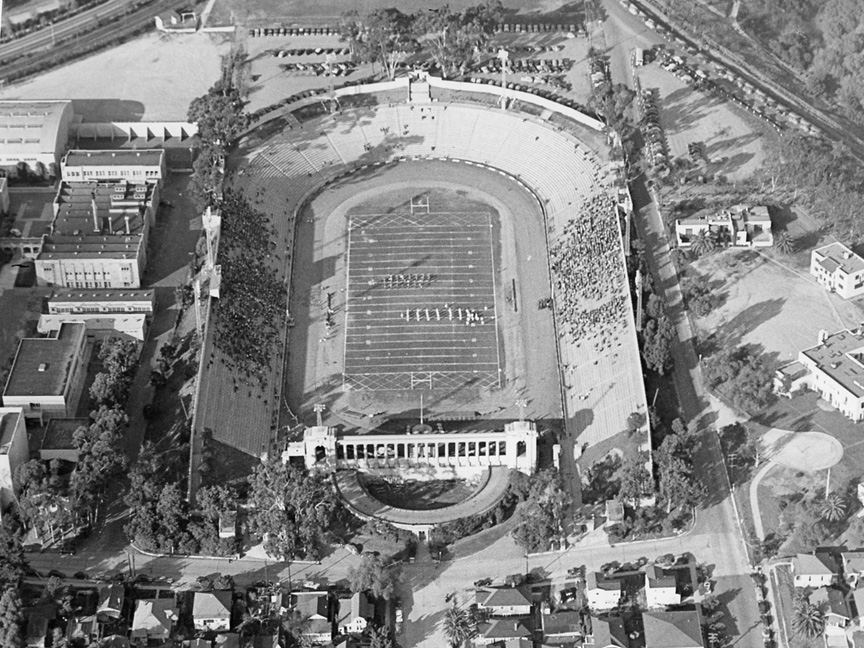
The existing Balboa Stadium, built in 1914 in Balboa Park (named for the Spanish explorer), was expanded to 34,000 seats for the Chargers. While it had a lot of atmosphere, including a columned front gate, and was home to the Chargers' 1963 AFL Championship team, it was too small for the proposed AFL-NFL merger, so what's now Qualcomm Stadium was built.
In 1965, at Balboa Stadium, Jim Ryun became the 1st American high schooler to break the 4-minute mile. On August 28, 1965, the Beatles played there. In 1968, the San Diego Toros played the Atlanta Chiefs in the North American Soccer League Final, a 2-legged series whose 1st leg was played at Balboa Stadium, a 0-0 draw. Atlanta won 3-0 at what became Fulton County Stadium to take the title.

The old Balboa Stadium was demolished and replaced in 1978, and now hosts high school football and track. Like Soldier Field in Chicago, its columned gate was retained. Russ Blvd. & 16th Street.
  
Balboa Park is also home to the famed San Diego Zoo. My mother says her favorite day in her life was the day she spent at the Zoo. Park Road & Zoo Place. 

Adjacent is the Federal Building, which hosts the San Diego Hall of Champions, honoring area natives such as Ted Williams, Bill Walton, Bob Skinner, Alan Trammell, Dave Roberts, Tony Clark, and Yankee stars Graig Nettles, Chris Chambliss and David Wells, as well as stars from area teams. Padres honored are Nettles, Jones, Winfield, Fingers, Gwynn, Bavasi, Templeton, Gossage and Hoffman.

Of additional interest to Yankee Fans might be Don Larsen (who, like Wells, went to Point Loma High School), and the father-and-son combo of Ray and Bob Boone -- grandfather and father, respectively, of Aaron (and Bret). 2131 Pan American Plaza. 

The Park is also home to the San Diego Museum of Art, the Timken Museum of Art, the Reuben H. Fleet Science Center, the San Diego Air & Space Museum, the San Diego Automotive Museum, the Museum of Photographic Arts, and the San Diego Museum of Man. The Number 7 bus takes you to the Park and places you within a short walk of all its sites.

* San Diego Sports Arena. Built in 1966, this was the home of the NBA's San Diego Rockets from 1967 to 1971, until they moved to Houston; the NBA's San Diego Clippers from 1978 to 1984, until they moved to Los Angeles; and the World Hockey Association's San Diego Mariners from 1974 to 1977. It's also hosted some minor-league hockey teams, including the current version of the San Diego Gulls.

It hosted the 1975 NCAA Final Four, which included John Wooden's last 2 games as head coach at UCLA, winning his 10th and final National Championship, beating Kentucky. The Sockers became the Major Indoor Soccer League's most successful franchise while playing here from 1980 to 1996. (They played both an NASL and an MISL season from 1980 to 1984.) Elvis Presley sang here on November 15, 1970; April 26, 1973; and April 24, 1976.

The Arena was recently renamed the Valley View Casino Center, although it is not a casino. 3500 Sports Arena Blvd. at Kemper Street. Blue Line light rail to Old Town, then transfer to the Number 9 bus, which drops off outside.

Elvis had previously sung in San Diego on April 4 and 5, and June 6, 1956, at the San Diego Arena, a.k.a. the Glacier Gardens, home of the San Diego Skyhawks, 1949 Pacific Coast Hockey League Champions. Built in 1939, the Sports Arena made it obsolete, and it was torn down in 1966. 8th Street and Harbor Drive, adjacent to the site of the Convention Center, and across Harbor Drive and the railroad from where Petco Park went up. 

San Diego seems not to have forgiven the Clippers for leaving, and after 30 years of the Lakers nearly always the better team, they are easily the most popular NBA team in town. According to a May 12, 2014 article in the New York Times, the Lakers take about 40 percent of the San Diego area's NBA fandom. The Los Angeles teams, playing in the Staples Center, remain the closest NBA teams, 123 miles from downtown San Diego, while the Anaheim Ducks are the closest NHL team, 93 miles away, and are more popular in the San Diego area than the Los Angeles Kings (also in the Staples Center).

The Clippers missed the Playoffs by 2 games in their 1st season, 1978-79, but didn't come close again until well after moving to L.A. The main reason was that native son Bill Walton was continually injured. He is the only San Diego Clipper who made the NBA's 50th Anniversary 50 Greatest Players, and he and fellow UCLA alumnus Gail Goodrich (better known as a Laker) were the only ones who made the Basketball Hall of Fame.

The Mariners, formerly the Madison Square Garden-based New York Raiders, the New York Golden Blades and the Cherry Hill-based Jersey Knights, made the Playoffs all 3 seasons they were in San Diego, and got to the WHA Semifinals in 1975 before losing to the Howe family and the rest of the Houston Aeros. But they never made any money, and folded in 1977. Their Andre Larcoix was named to the WHA's All-Time Team.

* Torero Stadium. This 6,000-seat stadium on the campus of the University of San Diego is the stopgap home of the expansion San Diego Wave, and is the regular home of San Diego Loyal SC of the United Soccer League, the 2nd tier of American soccer. 

When the Women's United Soccer Association played from 2001 to 2003, it had a team there, the San Diego Spirit. NFL teams have used it as a practice facility for games away to the Chargers. 5998 Alcala Park. Just to the north of the stadium is USD's basketball arena, the Jenny Craig Pavilion, built with contributions from weight-loss mogul Craig and her late husband Sid, leading to it having one of the best sports venue nicknames, the Slim Gym. Green Line to Morena/Linda Vista station.

San Diego has tried to get a team in Major League Soccer. Unless and until they do, they'll have to settle for the new NASL, the 2nd division in the American "soccer pyramid." Until the NASL team starts next Spring, the highest-ranking soccer team in town is the new version of the San Diego Sockers, playing in an indoor league at the Valley View Casino Center.

Despite its size, San Diego has already lost teams in 3 of the "Big Four" sports, leaving the Padres as the only team in town, so don't expect them to get an NBA team (they'd rank 20th in the league's markets by population) or an NHL team (19th). They still might get an MLS team, especially if that North County stadium is built (they'd rank 19th).

* Del Mar Thoroughbred Club. You usually don't think of horse racing when you think of sports in San Diego. And, to be fair, this 44,000-seat track, opening in 1937, isn't exactly close to downtown. But it is nearby, and hosted the 2017 Breeders' Cup. 2260 Jimmy Durante Blvd., 21 miles north of downtown. Coaster rail line to Solana Beach, then Bus 408.

Tony Gwynn is buried at Dearborn Memorial Park, 14361 Tierra Bonita Road in Poway, 24 miles northeast of downtown. Difficult to reach by public transit.

San Diego was the hometown former WBC Heavyweight Champion Ken Norton, who became only the 2nd man to beat Muhammad Ali, at the San Diego Sports Arena on March 31, 1973. But neither man held the title at the time. The city has hosted only 1 fight for the Heavyweight Championship of the World, and that was all the way back on March 28, 1906. Tommy Burns successfully defended the title against Jim O'Brien at the National Athletic Club. I can find no record of where in the city it was.

San Diego hasn't had a lot of history, good or bad, happen within its limits. No President has come from the area, so there's no Presidential Birthplace or Library nearby. The closest you can come is Richard Nixon's La Casa Pacifica, a.k.a. the Western White House, 57 miles up the coast in San Clemente. It's still a private residence, and not open to tours, so if you're interested, just take a glance (and/or a picture), and leave them alone.

There are 3 Presidential connections to the city, and they all came in 1996. Sort of: Pete Wilson, Governor of California, former Senator, and the city's former Mayor (credited with launching the slogan "America's Finest City"), launched his campaign in 1995, but his theme of bashing the poor and immigrants, so successful at getting him re-elected Governor in the Republican backlash year of 1994, didn't play well outside California (and has, essentially, poisoned the State for Republicans who weren't action-movie stars ever since), and so he dropped out after the Iowa Caucuses.

The 1996 Republican Convention nominated Senator Bob Dole for President, and former pro quarterback (including for the hometown Chargers), former Congressman from Buffalo, and former Secretary of Housing & Urban Development Jack Kemp for Vice President. That Convention was at the San Diego Convention Center, at 111 W. Harbor Drive, across the railroad and Harbor Drive from the ballpark. And Dole had his 2nd and last debate with President Bill Clinton at the Shiley Theatre on the campus of the University of San Diego, about a 15-minute walk west of Torero Stadium and the Jenny Craig Pavilion.

San Diego isn't known for its skyscrapers, not for their height (as is L.A.) nor for their style (as is San Francisco). The tallest building in town, and then just barely (2 others are within 3 feet of it) is One America Plaza, 500 feet even, at 600 West Broadway at Keltner Blvd. downtown.

In 2016, Fox made San Diego, and indeed Petco Park itself, the setting and shooting location for what is (almost be default) the best TV show ever produced about baseball: Pitch, starring Kylie Bunbury as screwballing Padres pitcher Ginny Baker, the (fictional) 1st woman ever to play in Major League Baseball. Alas, it was canceled after 1 season, and on a cliffhanger (Ginny hurting her arm late in what would have been a no-hitter, and leaving us not knowing if she would need career-shortening surgery).

Between San Diego's naval base and the Marines' Camp Pendleton, 40 miles up the coast in Oceanside, several TV shows with a military theme have been set in or near San Diego, including Gomer Pyle, U.S.M.C.; C.P.O. Sharkey; and Major Dad, which was set at Camp Pendleton in its 1st season before being moved to Marine Corps headquarters in Quantico, Virginia.

Simon & Simon (which launched Gerald McRaney to stardom before he starred on Major Dad) was set in San Diego. So were John from Cincinnati and the Disney Channel series Drake & JoshVeronica Mars was set in Neptune, a fictional town said to be a suburb of San Diego.

Queen of Swords, about a female version of Zorro, was set in colonial California in the 1810s, the years before Mexico's independence from Spain, and San Diego was said to be the nearest city to the show's fictional setting of Santa Helena. Fox tried to copy the success of their Wisconsin-based That '70s Show by setting That '80s Show in San Diego in 1984, the year the Padres first won the Pennant, but it bombed, worse than the Padres did in the World Series.

Currently airing and set in San Diego are The Fosters on ABC Family and Grace and Frankie on Netflix, with their female leads and their gay issues flying in the face of the city's macho military history.

San Diego has been much more successful as a location for movie settings, especially military-themed ones: Sands of Iwo Jima (John Wayne's troops train at Pendleton), Hellcats of the Navy (the one and only film that Ronald Reagan and his wife, still billed as "Nancy Davis," ever made together), Top Gun and its parody Hot Shots!Flight of the Intruder and Antwone Fisher. Then there was the 1978 horror-film parody Attack of the Killer Tomatoes, the cheerleading-themed Bring It On, the drug movie Traffic, and a movie about a different kind of drug, alcohol: Sideways. But the movie most associated with the city is Anchorman: The Legend of Ron Burgundy, with Will Ferrell's signoff: "Stay classy, San Diego!"

If the Zoo wasn't enough for you, San Diego, like Orlando and San Antonio, has a Sea World. 500 Sea World Drive at Mission Bay Drive. Green Line to Old Town Transit Center, then transfer to the Number 9 bus.

*

So, if you can afford it, go on out and join your fellow Met fans in going coast-to-coast, enjoy the matchup with the Padres, and enjoy the sights and sounds of what Pete Wilson, while he was Mayor, called "America's Finest City." Even if the games aren't good, the weather will be.

Wednesday, May 1, 2019

How to Be a Met Fan In San Diego -- 2019 Edition

This coming Monday, the Mets begin a 3-game series away to the San Diego Padres.

Unlike their fellow National League teams in California, the San Francisco Giants and the Los Angeles Dodgers, the Padres are a team in their original city, with no connection to New York. They've never even played the Mets in the Playoffs -- but they have played the Yankees in the World Series. (The Chargers, no longer in San Diego, have played the Jets in the Playoffs. San Diego has no NHL team, and has only had an NBA team briefly and not currently.)

Before You Go. Unlike the Seattle and San Francisco Bay Areas, but like the Los Angeles area, the San Diego area has very consistent weather. It's a nice place to visit, and there's little threat of earthquakes, mudslides and smog -- but there have been wildfires, including one that led to a Chargers home game being moved to Phoenix a few years ago.

The website of the San Diego Union-Tribune (yet another paper that, not that long ago, used to be two separate papers), is predicting mid-60s by day, the high 50s by night, and, as you might expect for San Diego, no precipitation for the entire weekend. A short-sleeve shirt should be enough, no jacket necessary. Just in case, you may want to bring sunscreen.

San Diego is in the Pacific Time Zone, 3 hours behind New York. Adjust your timepieces accordingly.

If you're planning on making a side trip to Tijuana, Mexico, 25 miles south of downtown San Diego, be sure to bring your passport. If you don't have a passport, it's too late to get one for this trip, so if you're going to San Diego, do not attempt to cross the Border. Also, the crossing cannot be done by public transportation: You'll need a car. The exchange rate heavily favors America: $1.00 currently = 18.94 pesos, while 1 peso is a shade over a nickel.

Tickets. The Padres averaged 26,8371 fans per home game last season, at a park with a seating capacity of 42,524. That's about 65 percent of capacity. Getting tickets shouldn't be a problem.

Field View seating is $68, Field Boxes are $42, Terrace Infield (2nd level) is $41, Left Field and Right Field Lower Boxes are $34, Terrace Pavilion are $34, Field Pavilion (outfield corners) are $34, Terrace Reserved is $41, Left Field Bleachers are $32, and Upper Infield, Upper Pavilion and Right Field Reserved are $18.

Getting There. It's 2,803 miles from Times Square in New York to downtown San Diego, including Petco Park. In other words, if you're going, you're flying. After all, even if you get someone to go with you, and you take turns, one drives while the other one sleeps, and you pack 2 days' worth of food, and you use the side of the Interstate as a toilet, and you don't get pulled over for speeding, you'll still need over 2 full days. Each way.

But, if you really, really want to, well, in order to get there in time for this series, you're too late to see the whole thing. So, for future reference... You'll need to get on the New Jersey Turnpike. Take it to Exit 14, to Interstate 78. Follow I-78 west all the way through New Jersey, to Phillipsburg, and across the Delaware River into Easton, Pennsylvania. Continue west on I-78 until reaching Harrisburg. There, you will merge onto I-81. Take Exit 52 to U.S. Route 11, which will soon take you onto I-76. This is the Pennsylvania Turnpike, the nation's 1st superhighway, opening in 1940.

The Turnpike will eventually be a joint run between I-76 and Interstate 70. Once that happens, you'll stay on I-70, all the way past Pittsburgh, across the little northern panhandle of West Virginia, and then across Ohio, Indiana and Illinois, into Missouri.

At St. Louis, take Exit 40C onto Interstate 44 West, which will take you southwest across Missouri into Oklahoma. Upon reaching Oklahoma City, take Interstate 40 West, through the rest of the State, across the Texas Panhandle and New Mexico, into Arizona. At Flagstaff, take Interstate 17 South, which will take you into Phoenix. Take Interstate 10 West to Exit 112 for Arizona Route 85 South, to Gila Bend, right on Arizona route 238 West, which will flow into Interstate 8 West. This will take you across Arizona and California to San Diego.

If you do it right, you should spend about an hour and 15 minutes in New Jersey, 5 hours and 30 minutes in Pennsylvania, 15 minutes in West Virginia, 3 hours and 45 minutes in Ohio, 2 hours and 45 minutes in Indiana, another 2 hours and 45 minutes in Illinois, 5 hours in Missouri, 6 hours in Oklahoma, 3 hours in Texas, 6 hours and 15 minutes in New Mexico, 6 hours in Arizona, and 3 hours in California.  That's about 45 hours and 30 minutes. Counting rest stops, you're probably talking about 57 hours.

That's still faster than the bus or the train. Greyhound takes about 70 hours, changing buses anywhere from 2 to 4 times, $648 round-trip, although it can drop to $438 with advanced purchase. The station is at 1313 National Avenue at Commercial Street -- 3 blocks from the ballpark!)

Amtrak takes nearly 72 hours, and you'd have to take 3 separate trains -- each way. The Lake Shore Limited leaves Penn Station at 3:40 PM Eastern Time on Friday and arrives at Union Station in Chicago at 9:50 AM Central Time on Saturday. The Southwest Chief leaves Chicago at 2:50 PM on Saturday, and arrives at Union Station in Los Angeles at 8:00 AM Pacific Time on Monday. Finally, switch to the Pacific Surfliner, leaving Los Angeles at 9:55 AM and arriving in San Diego's Santa Fe Depot at 12:50 PM. The round-trip fare is $678. The Santa Fe Depot is at 1050 Kettner Blvd. at Broadway.

Given Amtrak's and Greyhound's usual New York-to-San Diego price, you could, conceivably, get a non-stop flight from Newark to San Diego International Airport, also known as Lindbergh Field, for less. Not this weekend, though: It'll be a little under $1,000. The airport is only 5 miles northwest of downtown, and the Green Line trolley can get you downtown in less than half an hour.

Once In the City. San Diego was founded by Spain as a mission, San Diego of Alcalá (Saint Didacus in Latin), in 1769. Well into the 19th Century, it was larger than San Francisco, and even at the dawn of the 20th Century, was larger than Los Angeles. Being (just about literally) tucked away in a corner of the country, it was pretty much bypassed, but World War II led to a U.S. Navy base being built there, and its population took off again, to where it was major-league capable by the 1960s.

Today, over 1.4 million people live within the city limits, making it the 8th-largest city in the country. About 3.3 million live in the metro area. Front Street is the delineator between streets with East and West as prefixes, while Broadway is that for those running North and South. The city does not have a beltway, although Interstate 8 (north), Interstate 805 (east), California Route 54 (south) and Harbor Drive (west) could be said to fit that function.

Sales tax is a minimum 7.5 percent in the State of California, and 8 percent in San Diego County, which includes, but is not contiguous with, the City of San Diego. ZIP Codes in the San Diego area start with the digits 919, 920 and 921, and the Area Codes are 619, 760 and 858. San Diego Gas & Electric (SDGE) is he power company. The City of San Diego is about 48 percent white, 29 percent Hispanic, 16 percent Asian and 7 percent black.
Public transportation in San Diego is pretty good, with the San Diego Metropolitan Transit System (MTS) running buses, trolleys and light rail. Petco Park is accessible on the Orange Line at Gaslamp Quarter station, and on the Orange and Blue Lines at 12th & Imperial Transit Center station. The fare is $2.50. A 1-day pass is $5.00, and a 4-day pass (the best value if you're going for all 4 games) is $15.
The Chargers' move back to Los Angeles makes San Diego the only city with a Major League Baseball team, but no teams in any of the other major league sports -- including, if you count them, the WNBA and soccer, men's or women's.

Going In. Petco Park (sometimes listed incorrectly in ALL CAPS), named for the San Diego-headquartered chain of pet and pet supplies stores, opened in 2004. It has an official address, with the name and uniform number of the greatest Padre of them all (so far), of 19 Tony Gwynn Drive. It is bounded by 7th Avenue/Gwynn Drive on the 3rd base and home plate sides, Park Blvd. on the 1st base side, 10th Avenue on the right field side, and K Street on the center field side. It points north, with a good view of the downtown skyscrapers.
Petco Park, with the Convention Center in the background

Parking starts at $10, though most spaces will be $15. Padre fans living north of downtown can also do what they used to do, and park at Qualcomm Stadium (except when it's also hosting an event), and take the Trolley in.

The Gaslamp Gate and the Downtown Gate are in left field. The Balboa Park Gate, the East Village Gate (not to be confused with Lower Manhattan's East Village or the Broadway's Village Gate Theater) and the Park Blvd. Gate are in right field. And the Home Plate Gate is, well, you can probably guess.
Being in the California sunshine, the field has nearly always looked good. The left-field corner has the former Western Metal Supply Company warehouse, built into the stadium complex, as was the Baltimore & Ohio Railroad warehouse into Camden Yards in Baltimore. Unlike Baltimore, however, seating sections were built into this warehouse.
As with most of the "retro ballparks" built in the 1990s and 2000s, the field is not symmetrical. The left field pole is 334 feet from home plate, straightaway left is 367, left-center is 390, center is 396, right-center is 391, straightaway right is 382, and the right-field pole is a deceptive 322. The field is natural grass, and points north. The home plate is the same one used at the old stadium, so it's been used since 1969.

This is a pitcher's park, although a placement hitter like Gwynn or Dave Winfield would have been fine with it. The longest home run at the park is 471 feet, by Adrian Gonzalez, then with the Padres, in 2009. The longest home run at San Diego/Jack Murphy/Qualcomm Stadium was 499, by Mark McGwire in 1998.

Petco Park's 1st concert was on November 11, 2005, with the Rolling Stones. Among others, it's also hosted Madonna in 2008, Paul McCartney in 2014, Aerosmith and Taylor Swift in 2015 (not on the same bill), Billy Joel in 2016, and Metallica in 2017.

Food. Being just 15 miles from the Mexican border, you might expect Petco Park to feature Mexican and Southwestern-style food. Your expectations would be fulfilled: Behind home plate, on the Field Level, there is Bull Taco and La Cantina Bar; in the Upper Level, another La Cantina Bar is in left field and the Padres Mexican Cafe is in right field.

Team-themed stands abound: Friar Franks are all over, a health-food Friar Fit stand is at Field Level behind home plate, and the PCL Club (named for the city's old-time home, the Pacific Coast League) is at Field Level behind 1st base. On Terrace Level, behind 1st base, are Club 19 (for Gwynn) and Randy Jones BBQ (a variation of the Baltimore Boog Powell and Philadelphia Greg Luzinski theme). And the Hall of Fame Bar & Grill is on Terrace Level in left field.

There are also stands with local flavor: Anthony's Fish Grotto, home of the Padres' famed fish tacos, is behind home plate on both the Field and Terrace Levels. According to a recent Thrillist article on the best food at each MLB stadium, the best food at Petco Park is Ahi poke tacos (basically, sushi tacos) at The Patio, at Section 228. The Brickhouse Deli is on Field Level in left field, inside the warehouse. The Harbor Grill is on Terrace Level behind home plate, the Trolley Station Grill is on Terrace Level behind 1st base, and the Bayview Grill is on Upper Level behind home plate.

Team History Displays. The Padres have 5 retired numbers, displayed in center field, atop the batter's eye wall. They are: 6, Steve Garvey, 1st base 1983-87; 19, Tony Gwynn, right field 1982-2001; 31, Dave Winfield, right field 1973-80; 35, Randy Jones, pitcher 1973-80; and 51, Trevor Hoffman, pitcher 1993-2008. Also mounted on top of the wall is Jackie Robinson's universally-retired Number 42.
The team has also honored, with notations painted in gold on the front of the press box, former owner Ray Kroc (1974-84) with his initials RAK, and broadcaster Jerry Coleman, the former Yankee 2nd baseman and broadcaster who called games for the team from 1972 to 2013 -- except for 1980, when he served as manager, with unsatisfying results, and returned to the booth in 1981.

Instead of retiring a number for him, or mounting an "SD" for San Diego or his initials JC (or GFC for Gerald Francis Coleman), they've hung a star, for his catchphrase for a home run or a great defensive play: "Oh, doctor! You can hang a star on that baby!"

The Padres have a team Hall of Fame, placed on a "Ring of Honor" on the press box, which has been named for Coleman. It has 14 members, including all the retired number honorees except Garvey.
* From the early days, it includes Kroc, Coleman, Jones, Winfield, Emil "Buzzie" Bavasi, the team's 1st president, 1969-77, previously general manager of the Dodgers; and 1st baseman Nate Colbert, 1969-74. It does not, however, include these Hall-of-Famers who played for the Padres in this period: 1st baseman Willie McCovey, 1974-76; pitcher Rollie Fingers, 1977-80; pitcher Gaylord Perry, 1978-79; and shortstop Ozzie Smith, 1978-81.

* From the 1984 Pennant, it includes Kroc (who died that year), Coleman, Gwynn; manager Dick Williams, 1982-85, and in the Hall of Fame; general manager Jack McKeon, 1980-90 (the native of South Amboy, New Jersey also served as manager, 1988-90); and shortstop Garry Templeton, 1982-91, famously traded by "Trader Jack" McKeon in both position and uniform number, 1, for Ozzie Smith. By the end of the 1984 season, that was seen as a fairly even trade, though Ozzie's continued success changed that perception. The Hall/Ring does not, however, include Hall of Fame pitcher Rich "Goose" Gossage, 1984-87.

* From between the 1984 Pennant and the 1996 Division title, it includes Coleman, Gwynn, McKeon, and catcher Benito Santiago, 1986-92. It does not, however, include Hall of Fame 2nd baseman Roberto Alomar, 1988-90.

* From the 1996 Division title and the 1998 Pennant, it includes Coleman, Gwynn, Hoffman; 3rd baseman Ken Caminiti, 1995-98; and general manager Kevin Towers. It does not, however, include Hall of Fame left fielder Rickey Henderson, who played for the Padres in the 1996 and '97 seasons, and returned in 2001.

* From the 2005 and 2006 Division titles, it includes Hoffman and Towers. Hall of Fame catcher Mike Piazza, best known as a Met, was a Padre in 2006. Hall of Fame pitcher Greg Maddux played for the Padres after this, in 2007 and '08. Neither has been honored by the Padres, however.

* Due to his contributions to San Diego baseball history, Ted Williams (no relation to Dick) has also been elected to the team's Hall of Fame and Ring of Honor.
Garvey, Gwynn, Winfield and Jones,
at Petco Park's opening, 2004

Gwynn, Winfield, Fingers and Smith (and Ted Williams) were named to The Sporting News' 100 Greatest Baseball Players in 1998. Gwynn was also chosen by Padres fans as their team's representative in the 2006 DHL Hometown Heroes poll. A statue of him stands outside the ballpark. Fortunately, he lived long enough to see all of these honors.
The Padres have won National League Pennants in 1984 and 1998, and NL Western Division titles in those years, plus 1996, 2005 and 2006. They have never reached the Playoffs by way of the Wild Card, although they lost a play-in game for the Wild Card to the Colorado Rockies in 2007. These titles are noted on the video board.
The original Padres, Ted Williams' 1st pro team, won Pacific Coast League Pennants in 1937 (with Williams), 1954, 1962, 1964 and 1967. There is no notation for them at Petco Park. But, considering that the PCL had a level of quality so high up until the arrival of the Dodgers and Giants in California, its fans called the American League and the National League not "the major leagues" but "the eastern leagues," it can be argued that the 1937 and '54 PCL Pennants meant just as much as the 1984 and '98 NL Pennants, giving San Diego 4 legitimate major league flags, not 2.

Of note is the fact that, assuming you count Johan Santana's highly asteriskable performance in 2012 as a "Met No-Hitter," the Padres are now the only team among MLB's 30 current that have never pitched a no-hitter. This is their 51st season of play.

As you might guess, due to distance, the Padres' biggest rivals are the Los Angeles Dodgers. As you might also guess, giving the Padres' relatively lackluster history, the Dodgers lead the all-time series. The Dodgers have won 464 games between them, the Padres 393.

Stuff. The Padres have a number of team stores, including their main one at the Gaslamp Gate in left field. The good news is, they sell all kinds of Padres merchandise. The bad news is, they sell all kinds of Padres merchandise, including the various uniforms the Padres have worn, ranging from the mustard-yellow and brown uniforms of the 1970s to the "camouflage" jerseys they wear on home Sundays in honor of San Diego's tradition as a military city.

As far as I know, Padres merchandise does not include monks' (friars') robes with team logos, or a fake "monk wig" simulating a ring of hair around a bald head.

Although the Padres have been around for 50 years now, and have some history, there aren't very many good books about the team. Baseball in San Diego: From the Plaza to the Padres by Bill Swank, in cooperation with the San Diego Historical Society, is probably the best one, covering the history of professional baseball in the city from the 1899 San Diego Fullers of the Southern California League to the 2004 opening of Petco Park.

Following the Chargers' departure, John Franey published The Curse of The Murph: Why It Sucks to Be a San Diego Sports Fan. I'd never seen it until doing the research for this post, so I haven't had a chance to read it and see his explanation for why the stadium is "cursed."

Since the Padres have not yet won a World Series, there is no DVD collection of World Series highlight films; you'd have to, separately, get the 1984 (won by the Detroit Tigers) and 1998 (by the Yankees) films.

As of yet, the only team-history video available is Nineteen Summers: Padres 1969-1988 (which would actually be 20 summers), and if you want that, it's only available on Amazon.com on VHS, not DVD. There's also a VHS tape titled Tony Gwynn: Mr. Padre that covers his entire playing career. As yet, there is no Essential Games of the San Diego Padres DVD.

During the Game. A recent Thrillist article on "Baseball's Most Intolerable Fans" ranks Padres fans 26th -- in other words, the 5th most tolerable. Despite San Diego's background as a military city (Navy base, Marine Corps base not far away in Oceanside), these are not particularly aggressive people. Having good weather 350 days out of the year will keep you calmer than typical Northeastern, Midwestern or Northwestern weather will.

The Padres' greatest rivals, as you might guess, are the closest NL team, the Los Angeles Dodgers. The AL's Angels are 30 miles closer, but even with Interleague play, Padres fans and Angels fans don't seem to care about each other or their teams -- or maybe they just band together and consider the Dodgers a common enemy.

But due to Fernando Valenzuela having made his name as a Dodger before his brief stopover with the Padres, when Mexican fans come over the border for Padres-Dodgers games, the cheering is about even when the Bums come to San Diego. The Padres also have a budding rivalry with the next-closest team, the Arizona Diamondbacks. But the locals do fit the reputation of the laid-back Southern Californian. No one is going to fight you.

The Monday night and Wednesday afternoon games will be Friar Family Days, with family-themed discounts. The Tuesday night game will be Taco Tuesday, with cheaper tacos.

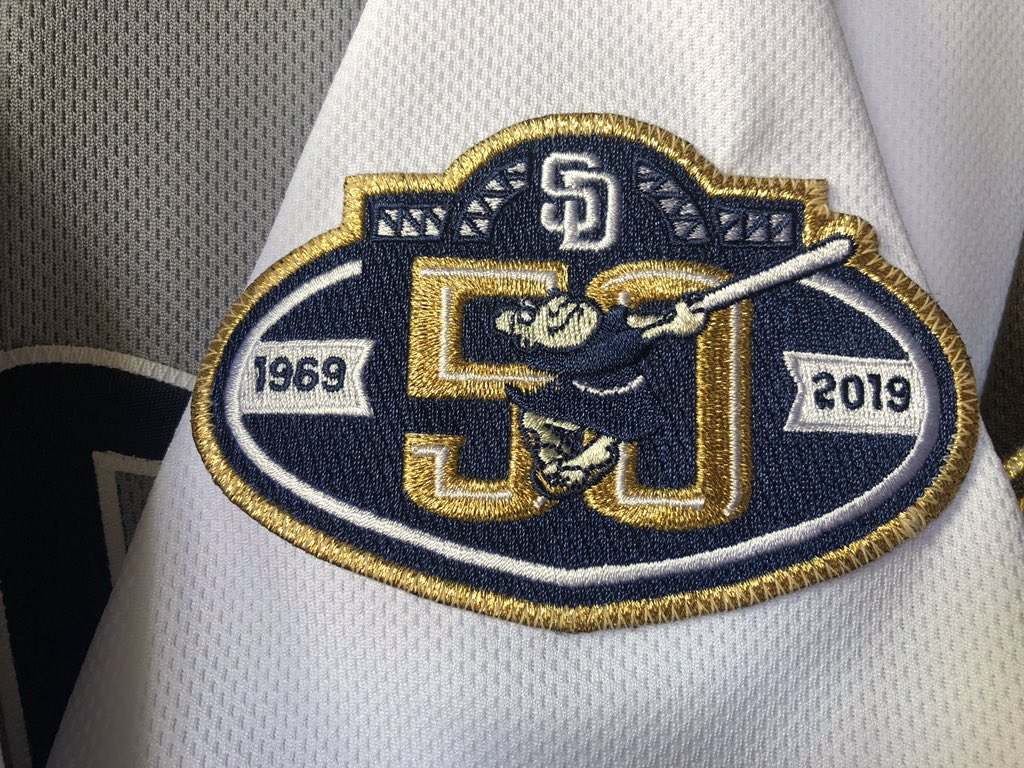
The Padres are wearing 50th Anniversary patches on their uniform sleeves, in addition to the MLB 150 logo.
Ted Giannoulas, known in costume as The Famous Chicken, began as the KGB Chicken. No, he wasn't a Russian spy: He was a student at San Diego State University, working for a San Diego radio station, KGB-FM. (He can be seen in his original costume on NFL Films' production of the 1978 Charger-Raider "Holy Roller" game, passing out at the successful result of the Raiders' blatant cheating.)

Following a contract dispute with the station, he got a new costume (one not copyrighted by the station) and was reborn, or rather hatched out of a giant egg, on the field at San Diego Stadium in June 1979 as "the San Diego Chicken."

Starting in 1981, he was part of the cast of NBC's Saturday pregame show The Baseball Bunch, starring Johnny Bench, where he was referred to as simply "The Chicken." He became so much in demand that he could no longer belong only to his hometown, and now goes everywhere.

He, the Phillie Phanatic, and the Phoenix Suns' Go the Gorilla were the 1st 3 inductees into the Mascot Hall of Fame, in 2005. The Chicken and the Phanatic have done more to elevate the baseball mascot to icon status than anyone -- even if they weren't the first guys in silly costumes to entertain at baseball games. (Mr. Met was the 1st official such mascot, but even he was unofficially preceded by the Brooklyn Dodger Sym-Phony Band.)
He takes a mucking, and keeps on clucking.

Since 1996, the Padres have made their Swinging Friar logo a live-action mascot, and he (sans bat) is the official mascot. As I said earlier, like many cities in California, San Diego was founded by Spanish missionaries -- hence "Padres," Spanish for "Fathers," or priests, monks, friars.
The Friar, possibly doing the wrong kind of "swinging,"
since priests are supposed to be celibate.

The Padres hold auditions for National Anthem singers, as opposed to having a regular. It will not be Roseanne Barr, who infamously, and purposely, butchered the Anthem at Jack Murphy Stadium in 1990. They also had a controversy in 2016, when a recording of a woman singing the Anthem was played over the San Diego Gay Men's Chorus singing it live on the team's sponsored Pride Night. They made it up to the SDGMC by bringing them back earlier this year, and they sang it without a hitch.

The Padres don't have a special song to play along with "Take Me Out to the Ballgame" during the 7th Inning Stretch. This could be due to the relative lack of songs about the city, or famous singers or bands from the city. However, with the city's nautical tradition, a foghorn sounds after every Padre home run -- not common, as Petco is one of the best pitcher's parks in the majors.

And, in a bit of a cliche, their postgame victory song is "Celebration" by Kool & the Gang -- one of our local groups, from Jersey City.

After the Game. San Diego's Gaslamp District has plenty of nightspots, so finding a good place for a postgame meal or drink shouldn't be too hard. And although the city has a reputation for gang violence -- as Met fans, you may have heard San Diegan Kevin Mitchell tell horror stories about it -- downtown is very safe.

If you're looking for New Yorker-friendly establishments, Henry's Pub, at 618 5th Avenue between G & Market Streets, is the home of the local New York Jets fan club. It is 6 blocks from the ballpark.

I have heard of 2 separate bars as being home of local Giants fan clubs. The Knotty Barrel is at 844 Market Street at 9th Avenue, 5 blocks from PETCO. And the U-31 Cocktail Lounge is at 3112 University Avenue at 31st Street, but that is 6 miles northeast of the ballpark. Even if the Knotty Barrel is not a Big Blue hangout, you'd be advised to choose that over the U-31.

If you visit San Diego during the European soccer season, which starts up again next month, the main "football pub" in town is Shakespare Pub & Grill. 3701 India Street and Winder Street, in the Five Points area, about 3 miles northwest of downtown. Green Line to Washington Street.

Sidelights. San Diego has produced more native sons (and daughters) who were great athletes than its teams have. As a result, there isn't a lot of glory associated with these teams.

Some have suggested that there's a curse on the city, with the most common being "The Curse of Bambi," based on the 1971 selling of the city's 1st great major league star, Chargers receiver Lance Alworth, to the Dallas Cowboys. Alworth, a.k.a. Bambi, won Super Bowl VI with the Cowboys the very next season.

No San Diego major league team has gone as far as the rules allowed them to do since Alworth and the 1963 Chargers, AFL Champions, who did not get to play that year's NFL Champions, the Chicago Bears, in a Super Bowl.


On November 30, 2018, Thrillist published a list of "America's 25 Most Fun Cities," and San Diego came in 8th. 

* Lane Field. Home to the PCL Padres from 1936 to 1957, including the 1937 PCL Pennant that featured a 19-year-old San Diego kid named Ted Williams. By the time the Padres won another Pennant in 1954, the 8,000-seat pitcher's park, on the waterfront, with a Spanish-style entrance and faraway fences except at the right field pole, was termite-ridden and had to be abandoned.
Broadway, Harbor Drive and Pacific Highway. The Santa Fe Depot and the USS Midway Museum (a retired WWII aircraft carrier) are adjacent to the site. Number 7 bus. The Maritime Museum of San Diego is 3 blocks to the north.

* Westgate Park. The PCL Padres' next home was in Mission Valley, at (appropriately enough) Friars Road and the Cabrillo Freeway. This park seated only a few more than Lane Field, but it had the advantage of a roof covering the entire seating area, to protect fans from the hot, nearly-Mexican sun.
Supposedly, it was expandable to 40,000, in the event that San Diego could do what Los Angeles and San Francisco had done, and bring in a major league team, through a move or expansion. But the Chargers wanted a modern stadium, too, so one stadium was built for both teams. The Padres won Pennants at Westgate in 1962, 1964 and 1967, their last season there. The Fashion Valley Mall is now on the site. Fashion Valley Transit Center station on the Green Line.

* San Diego/Jack Murphy/Qualcomm Stadium. From 1967 until 2016, this was the home of the Chargers, and remains the home of the San Diego State University football team, the Aztecs. It was built to the east of Westgate.
Met fans, take note: It was beloved broadcaster Bob Murphy's brother, Jack Murphy, sports editor of the old San Diego Union newspaper, who advocated for the city as a major league sports site, and when he died in 1980, the stadium was named for him -- at least, until the city sold off the naming rights. Statues of Jack and his dog Abe remain outside the stadium.
Before the 1990s expansion

It's hosted the Holiday Bowl and the Poinsettia Bowl, and has hosted 3 Super Bowls: XXII (won by the Washington Redskins), XXXII (Denver Broncos) and XXXVII (Tampa Bay Buccaneers). The Chargers only reached the Super Bowl once, in the 1994-95 season, although they were usually in the Playoff hunt. The NFL has now gone out of its way to say that the city won't host another Super Bowl until it builds a new stadium. With the Chargers gone, that's out the window.

From 1978 to 1997, the Holiday Bowl featured the Champions of the Western Athletic Conference. Brigham Young University won the WAC many times, including 1984, when they beat the University of Michigan 24-17 (not particularly impressively) in the Holiday Bowl, to clinch a 
13-0 season. As the only undefeated team in what was then called Division I-A, they were awarded the National Championship. But their non-conference schedule wasn't exactly imposing, so this was one of the more dubious National Championships.

The PCL Padres played their last season here, 1968, and then in 1969 the NL Padres came in. Holding 47,000 for baseball for most of its history, it was expanded to 65,000 by 1996, and during the 1998 World Series between the Padres and Yankees, the noise was remarkable for an open-air facility -- not that it helped the Padres.
After the expansion

The San Diego Sockers of the original North American Soccer League played there from 1978 to 1984. The stadium, as a neutral site, hosted Soccer Bowl '82, with the New York Cosmos defeating the Seattle Sounders 1-0 on a 31st minute goal by Giorgio Chinaglia.

The U.S. national soccer team has played there 8 times, but not well, winning just 1 game, drawing 5 and losing 2. The most recent match was a turgid 0-0 draw in a friendly with Serbia this past January 29. (The word "turgid" may have been coined to describe a soccer game where little seems to happen and the game ends in a scoreless tie.) Tottenham Hotspur of North London beat AS Roma of Rome 4-1 there last Summer. It's hosted games of the CONCACAF Gold Cup: 3 in 1996, 3 in 2000, and 2 in 2017.

The 1st concert there was by ZZ Top in 1976. Other notable concerts have been by the Rolling Stones in 1981, The Who in 1982, Guns N' Roses and Metallica in 1992, the Eagles in 1994, Billy Joel and Elton John in 1995, Bob Dylan in 2008, U2 in 2017, Beyonce and Jay-Z in 2018.

The Padres moved out after the 2003 season, and now the Chargers have gotten out as well, moving back up the Coast to Los Angeles, from whence they came. But San Diego State still plays there. On September 19, 2017, it was renamed SDCCU Stadium, as the San Diego County Credit Union bought the naming rights. The San Diego Fleet of the short-lived Alliance of American Football played there this Winter.

9449 Friars Road, at Mission Village Drive, just off Interstate 15, 5 Green Line stops away from Westgate/Fashion Valley, at what's now Qualcomm Stadium station.

UPDATE: San Diego/Jack Murphy/Qualcomm/SDCCU Stadium was demolished in early 2021. San Diego State's new Aztec Stadium is set to open in September 2022. SDSU will play its 2021 home games at Dignity Health Sports Park in the Los Angeles suburb of Carson, California.

* Balboa Park, the San Diego Zoo, and Museums. After starting in the AFL at the Los Angeles Coliseum in 1960, the Chargers moved to San Diego for 1961. Barron Hilton, son of hotel magnate Conrad Hilton -- and the 1st brother-in-law of Elizabeth Taylor, and the grandfather of Paris and Nicky Hilton -- ran the Carte Blanche credit card company, and named the team after the card, sort of: The Chargers, although a horse (also a "charger") and a lightning bolt (which gives off a "charge") has always been the team's logo.

He's still alive, now 90 years old, and although he no longer has anything to do with the team, he is the last surviving member of "The Foolish Club," the 8 original AFL owners, following the recent deaths of Ralph Wilson of the Buffalo Bills and Bud Adams of the Houston Oilers/Tennessee Titans.

The existing Balboa Stadium, built in 1914 in Balboa Park (named for the Spanish explorer), was expanded to 34,000 seats for the Chargers. While it had a lot of atmosphere, including a columned front gate, and was home to the Chargers' 1963 AFL Championship team, it was too small for the proposed AFL-NFL merger, so what's now Qualcomm Stadium was built.
In 1965, at Balboa Stadium, Jim Ryun became the 1st American high schooler to break the 4-minute mile. On August 28, 1965, the Beatles played there. In 1968, the San Diego Toros played the Atlanta Chiefs in the North American Soccer League Final, a 2-legged series whose 1st leg was played at Balboa Stadium, a 0-0 draw. Atlanta won 3-0 at what became Fulton County Stadium to take the title.

The old Balboa Stadium was demolished and replaced in 1978, and now hosts high school football and track. Like Soldier Field in Chicago, its columned gate was retained. Russ Blvd. & 16th Street.
  
Balboa Park is also home to the famed San Diego Zoo. My mother says her favorite day in her life was the day she spent at the Zoo. Park Road & Zoo Place. 

Adjacent is the Federal Building, which hosts the San Diego Hall of Champions, honoring area natives such as Ted Williams, Bill Walton, Bob Skinner, Alan Trammell, Dave Roberts, Tony Clark, and Yankee stars Graig Nettles, Chris Chambliss and David Wells, as well as stars from area teams. Padres honored are Nettles, Jones, Winfield, Fingers, Gwynn, Bavasi, Templeton, Gossage and Hoffman.

Of additional interest to Yankee Fans might be Don Larsen (who, like Wells, went to Point Loma High School), and the father-and-son combo of Ray and Bob Boone -- grandfather and father, respectively, of Aaron (and Bret). 2131 Pan American Plaza. 

The Park is also home to the San Diego Museum of Art, the Timken Museum of Art, the Reuben H. Fleet Science Center, the San Diego Air & Space Museum, the San Diego Automotive Museum, the Museum of Photographic Arts, and the San Diego Museum of Man. The Number 7 bus takes you to the Park and places you within a short walk of all its sites.

* San Diego Sports Arena. Built in 1966, this was the home of the NBA's San Diego Rockets from 1967 to 1971, until they moved to Houston; the NBA's San Diego Clippers from 1978 to 1984, until they moved to Los Angeles; and the World Hockey Association's San Diego Mariners from 1974 to 1977. It's also hosted some minor-league hockey teams, including the current version of the San Diego Gulls.

It hosted the 1975 NCAA Final Four, which included John Wooden's last 2 games as head coach at UCLA, winning his 10th and final National Championship, beating Kentucky. The Sockers became the Major Indoor Soccer League's most successful franchise while playing here from 1980 to 1996. (They played both an NASL and an MISL season from 1980 to 1984.) Elvis Presley sang here on November 15, 1970; April 26, 1973; and April 24, 1976.

The Arena was recently renamed the Valley View Casino Center, although it is not a casino. 3500 Sports Arena Blvd. at Kemper Street. Blue Line light rail to Old Town, then transfer to the Number 9 bus, which drops off outside.

Elvis had previously sung in San Diego on April 4 and 5, and June 6, 1956, at the San Diego Arena, a.k.a. the Glacier Gardens, home of the San Diego Skyhawks, 1949 Pacific Coast Hockey League Champions. Built in 1939, the Sports Arena made it obsolete, and it was torn down in 1966. 8th Street and Harbor Drive, adjacent to the site of the Convention Center, and across Harbor Drive and the railroad from where Petco Park went up. 

San Diego seems not to have forgiven the Clippers for leaving, and after 30 years of the Lakers nearly always the better team, they are easily the most popular NBA team in town. According to a May 12, 2014 article in the New York Times, the Lakers take about 40 percent of the San Diego area's NBA fandom. The Los Angeles teams, playing in the Staples Center, remain the closest NBA teams, 123 miles from downtown San Diego, while the Anaheim Ducks are the closest NHL team, 93 miles away, and are more popular in the San Diego area than the Los Angeles Kings (also in the Staples Center).

The Clippers missed the Playoffs by 2 games in their 1st season, 1978-79, but didn't come close again until well after moving to L.A. The main reason was that native son Bill Walton was continually injured. He is the only San Diego Clipper who made the NBA's 50th Anniversary 50 Greatest Players, and he and fellow UCLA alumnus Gail Goodrich (better known as a Laker) were the only ones who made the Basketball Hall of Fame.

The Mariners, formerly the Madison Square Garden-based New York Raiders, the New York Golden Blades and the Cherry Hill-based Jersey Knights, made the Playoffs all 3 seasons they were in San Diego, and got to the WHA Semifinals in 1975 before losing to the Howe family and the rest of the Houston Aeros. But they never made any money, and folded in 1977. Their Andre Larcoix was named to the WHA's All-Time Team.

* Torero Stadium. This 6,000-seat stadium on the campus of the University of San Diego will be the home of the city's new team in the new version of the North American Soccer League, starting next Spring. They will play there until they can build a stadium that they're planning for the "North County," in the northern suburbs. The team was just announced this past June 26, only 3 weeks ago, and does not yet have a name other than "San Diego NASL."

When the Women's United Soccer Association played from 2001 to 2003, it had a team there, the San Diego Spirit. NFL teams have used it as a practice facility for games away to the Chargers. 5998 Alcala Park. Just to the north of the stadium is USD's basketball arena, the Jenny Craig Pavilion, built with contributions from weight-loss mogul Craig and her late husband Sid, leading to it having one of the best sports venue nicknames, the Slim Gym. Green Line to Morena/Linda Vista station.

San Diego has tried to get a team in Major League Soccer. Unless and until they do, they'll have to settle for the new NASL, the 2nd division in the American "soccer pyramid." Until the NASL team starts next Spring, the highest-ranking soccer team in town is the new version of the San Diego Sockers, playing in an indoor league at the Valley View Casino Center.

Despite its size, San Diego has already lost teams in 3 of the "Big Four" sports, leaving the Padres as the only team in town, so don't expect them to get an NBA team (they'd rank 20th in the league's markets by population) or an NHL team (19th). They still might get an MLS team, especially if that North County stadium is built (they'd rank 19th).

* Del Mar Thoroughbred Club. You usually don't think of horse racing when you think of sports in San Diego. And, to be fair, this 44,000-seat track, opening in 1937, isn't exactly close to downtown. But it is nearby, and hosted the 2017 Breeders' Cup. 2260 Jimmy Durante Blvd., 21 miles north of downtown. Coaster rail line to Solana Beach, then Bus 408.

Tony Gwynn is buried at Dearborn Memorial Park, 14361 Tierra Bonita Road in Poway, 24 miles northeast of downtown. Difficult to reach by public transit.

San Diego was the hometown former WBC Heavyweight Champion Ken Norton, who became only the 2nd man to beat Muhammad Ali, at the San Diego Sports Arena on March 31, 1973. But neither man held the title at the time. The city has hosted only 1 fight for the Heavyweight Championship of the World, and that was all the way back on March 28, 1906. Tommy Burns successfully defended the title against Jim O'Brien at the National Athletic Club. I can find no record of where in the city it was.

San Diego hasn't had a lot of history, good or bad, happen within its limits. No President has come from the area, so there's no Presidential Birthplace or Library nearby. The closest you can come is Richard Nixon's La Casa Pacifica, a.k.a. the Western White House, 57 miles up the coast in San Clemente. It's still a private residence, and not open to tours, so if you're interested, just take a glance (and/or a picture), and leave them alone.

There are 3 Presidential connections to the city, and they all came in 1996. Sort of: Pete Wilson, Governor of California, former Senator, and the city's former Mayor (credited with launching the slogan "America's Finest City"), launched his campaign in 1995, but his theme of bashing the poor and immigrants, so successful at getting him re-elected Governor in the Republican backlash year of 1994, didn't play well outside California (and has, essentially, poisoned the State for Republicans who weren't action-movie stars ever since), and so he dropped out after the Iowa Caucuses.

The 1996 Republican Convention nominated Senator Bob Dole for President, and former pro quarterback (including for the hometown Chargers), former Congressman from Buffalo, and former Secretary of Housing & Urban Development Jack Kemp for Vice President. That Convention was at the San Diego Convention Center, at 111 W. Harbor Drive, across the railroad and Harbor Drive from the ballpark. And Dole had his 2nd and last debate with President Bill Clinton at the Shiley Theatre on the campus of the University of San Diego, about a 15-minute walk west of Torero Stadium and the Jenny Craig Pavilion.

San Diego isn't known for its skyscrapers, not for their height (as is L.A.) nor for their style (as is San Francisco). The tallest building in town, and then just barely (2 others are within 3 feet of it) is One America Plaza, 500 feet even, at 600 West Broadway at Keltner Blvd. downtown.

In 2016, Fox made San Diego, and indeed Petco Park itself, the setting and shooting location for what is (almost be default) the best TV show ever produced about baseball: Pitch, starring Kylie Bunbury as screwballing Padres pitcher Ginny Baker, the (fictional) 1st woman ever to play in Major League Baseball. Alas, it was canceled after 1 season, and on a cliffhanger (Ginny hurting her arm late in what would have been a no-hitter, and leaving us not knowing if she would need career-shortening surgery).

Between San Diego's naval base and the Marines' Camp Pendleton, 40 miles up the coast in Oceanside, several TV shows with a military theme have been set in or near San Diego, including Gomer Pyle, U.S.M.C.; C.P.O. Sharkey; and Major Dad, which was set at Camp Pendleton in its 1st season before being moved to Marine Corps headquarters in Quantico, Virginia.

Simon & Simon (which launched Gerald McRaney to stardom before he starred on Major Dad) was set in San Diego. So were John from Cincinnati and the Disney Channel series Drake & JoshVeronica Mars was set in Neptune, a fictional town said to be a suburb of San Diego.

Queen of Swords, about a female version of Zorro, was set in colonial California in the 1810s, the years before Mexico's independence from Spain, and San Diego was said to be the nearest city to the show's fictional setting of Santa Helena. Fox tried to copy the success of their Wisconsin-based That '70s Show by setting That '80s Show in San Diego in 1984, the year the Padres first won the Pennant, but it bombed, worse than the Padres did in the World Series.

Currently airing and set in San Diego are The Fosters on ABC Family and Grace and Frankie on Netflix, with their female leads and their gay issues flying in the face of the city's macho military history.

San Diego has been much more successful as a location for movie settings, especially military-themed ones: Sands of Iwo Jima (John Wayne's troops train at Pendleton), Hellcats of the Navy (the one and only film that Ronald Reagan and his wife, still billed as "Nancy Davis," ever made together), Top Gun and its parody Hot Shots!Flight of the Intruder and Antwone Fisher. Then there was the 1978 horror-film parody Attack of the Killer Tomatoes, the cheerleading-themed Bring It On, the drug movie Traffic, and a movie about a different kind of drug, alcohol: Sideways. But the movie most associated with the city is Anchorman: The Legend of Ron Burgundy, with Will Ferrell's signoff: "Stay classy, San Diego!"

If the Zoo wasn't enough for you, San Diego, like Orlando and San Antonio, has a Sea World. 500 Sea World Drive at Mission Bay Drive. Green Line to Old Town Transit Center, then transfer to the Number 9 bus.

*

So, if you can afford it, go on out and join your fellow Met fans in going coast-to-coast, enjoy the matchup with the Padres, and enjoy the sights and sounds of what Pete Wilson, while he was Mayor, called "America's Finest City." Even if the games aren't good, the weather will be.