
That's Life was the title of a satirical consumer affairs "programme" on British TV network BBC1 from 1973 to 1994. "That's Life" was also the title of a song written by Dean Kay and Kelly Gordon, best known in its 1966 version by Frank Sinatra.
This might surprise some of you, who know I'm a Yankee Fan, and might expect it to be "Theme from New York, New York," but my favorite Frank Sinatra song is "That's Life":
Sinatra knew. So did Kevin Keegan, a man who was called "King."
Joseph Kevin Keegan was born on February 14, 1951 in Armthorpe, South Yorkshire, England. It's about 4 miles east of central Doncaster, 28 miles northeast of Sheffield, 87 miles east of Anfield in Liverpool where he would one day ply his trade, 125 miles south of St. James' Park in Newcastle where he would later ply it, and 175 miles north of Central London.
But it might as well have been on the other side of the world from one of the world's great capitals. The reason he was born in Armthorpe was because his aunt lived there, and her house had something his parents' house didn't have: Electricity, thus making it safer for childbirth. In the last full year of the reign of King George VI, nearly 6 years after V-E Day, and with television coming into homes in the developed nations of the world, electricity was still an issue in some parts of Great Britain.
His father's parents emigrated from Ireland to Newcastle, in the North-East of England. This made the Keegans "Geordies." Theories as to where the name comes from varies, the most popular being that the local miners used "Geordie safety lamps," designed by George Stephenson. "Geordie" is also the name of the dialect, which sounds a bit like Scottish. Charles Culpepper, an American sportswriter who wrote a book about English soccer, Bloody Confused!, said that Newcastle is "where England starts to think about turning into Scotland." (But don't tell any Englishman, even a Geordie, that. And absolutely don't tell a Scotsman that!)
At the age of 15, Keegan had impressed a player for Scunthorpe United, in Lincolnshire. He played for them at a senior level from 1968 to 1971, when Liverpool FC bought him. Manager Bill Shankly paired him up with Welsh forward John Toshack, and it was a brilliant choice: Together, they helped Liverpool win the Football League First Division and Europe's secondary tournament, the UEFA Cup (now known as the UEFA Europa League), in 1973; and the FA Cup in 1974, with Keegan scoring 2 goals in the Final.
This put Liverpool in the annual season-opening exhibition game, the FA Charity Shield (now known as the Community Shield), which annually pits the winners of the previous season's League title and FA Cup against each other at Wembley Stadium in London. Liverpool defeated title holders Leeds United, but not before a brawl broke out, which resulted in both Keegan and Leeds Captain Billy Bremner were sent off, both of them taking their shirts off as they left the pitch. Both were fined and suspended.
Having already planned to do so before that display of poor sportsmanship, Shankly then retired, and handed the team over to his top assistant, Bob Paisley. With Keegan and Toshack leading the line, the Mersey Reds won the League and the UEFA Cup again in 1976; and the League again, and Liverpool's 1st of 6 European Cups (the tournament now known as the UEFA Champions League) in 1977. But a loss to Manchester United in the FA Cup Final denied them what would have been England's 1st-ever "European Treble." (United would win that in 1999, and Manchester City have since won it in 2023.)
Like a lot of sports stars, Keegan thought he should be paid more. English teams weren't willing to go high enough. German team Hamburger SV paid £500,000 for him, a new transfer record for both countries. He got his hair restyled in a "poodle perm" that set a trend among English footballers.

In 1978, and again in 1979, France Football magazine awarded Keegan the Ballon d'Or (Golden Ball) as World Footballer of the Year. In 1979, he led Hamburg to the championship of the German league, the Bundesliga. That same year, with his celebrity higher than ever, he recorded "Head Over Heels In Love." As songs sung by athletes go, it's not bad. It reached Number 31 on the British chart, and Number 10 on the German one. The Bundesliga title qualified Hamburg for the 1979-80 European Cup, and they got all the way to the Final, but lost it to an English side, defending Champions Nottingham Forest. Hamburg fans, noting that he was just 5-foot-8 but very talented, nicknamed him "Mighty Mouse," after the cartoon character.
(Liverpool didn't miss him much: They bought Kenny Dalglish from Glasgow team Celtic FC, gave him Keegan's former Number 7 shirt, and had the greatest era in their history -- "King Kev" replaced by "King Kenny." Liverpool's Number 7 has subsequently been worn by such stars as Peter Beardsley, Vladimír Šmicer, Harry Kewell, Luis Suárez and James Milner.)
But he fell into dispute with Hamburg's manager, a Croatian named Branko Zebec. Rumors abounded that he would be sold, including one that would have brought him to America with the Washington Diplomats, which would have made him a teammate of Dutch superstar Johan Cruijff.
Instead, he was sold back to England, to Southampton FC in Hampshire on the South Coast. There, he was a teammate of team star Mick Channon, former Everton star Alan Ball, and former Arsenal star Charlie George, who had famously, if temporarily, traded in his long locks for a poodle perm. In 2 seasons with Keegan, the "Saints" finished 6th and 7th.
He played 63 matches for England, scoring 21 goals, but England failed to qualify for the 1974 and 1978 World Cups, or for Euro 76. He played in Euro 80, and captained England at the 1982 World Cup.

The 1982 World Cup edition remains my "favourite" England "kit."
In 1982, he joined the team his family had loved, Newcastle United FC. They had fallen into the Second Division in 1978, but in just 2 seasons, Keegan guided them to promotion back to the First. He said that it felt like coming home, despite the distance between Doncaster and Newcastle, and said no one had ever made him feel more welcome. He had lost a step, and decided to retire after the promotion, before he could go into a noticeable decline.

After appearing as an analyst for ITV soccer broadcasts, he went into management, taking over at Newcastle in 1992. They had gotten relegated again in 1989, but he got them promoted to the newly-created Premiere League in his 1st season. The club had not finished 1st in the 1st division, under any name, since 1927. But on February 10, 1996, with forward Alan Shearer leading them, they were in 1st place, having lost only 3 League games all season. They were 9 points ahead of Manchester United, and had a game in hand.
Then came an 8-game stretch where they won 2, drew 1 and lost 5. They bounced back, winning 3 straight. Man U now led them by 3 points, although Newcastle still had a game in hand: 2 games remaining, to Man U's 1.
On April 29, after beating Leeds, Keegan was interviewed on Sky Sports, and went on an epic rant about Man U's manager, the master of mind games, Alex Ferguson. Ferguson stoked tensions when he cast doubt on the commitment of the likes of Leeds and Nottingham Forest to try as hard against Newcastle as they did against his Manchester United team, suggesting that Forest, who were due to play the Magpies for Stuart Pearce's testimonial, might even "let Newcastle win." Keegan was incensed, and said:
When you do that with footballers, like he said about Leeds, and when you do things like that about a man like Stuart Pearce, I've kept really quiet, but I'll tell you something, he went down in my estimation when he said that.
We have not resorted to that, but I'll tell you, you can tell him now if you're watching it, we're still fighting for this title, and he's got to go to Middlesbrough and get something, and -- and -- I'll tell you, honestly, I will love it if we beat them, love it!
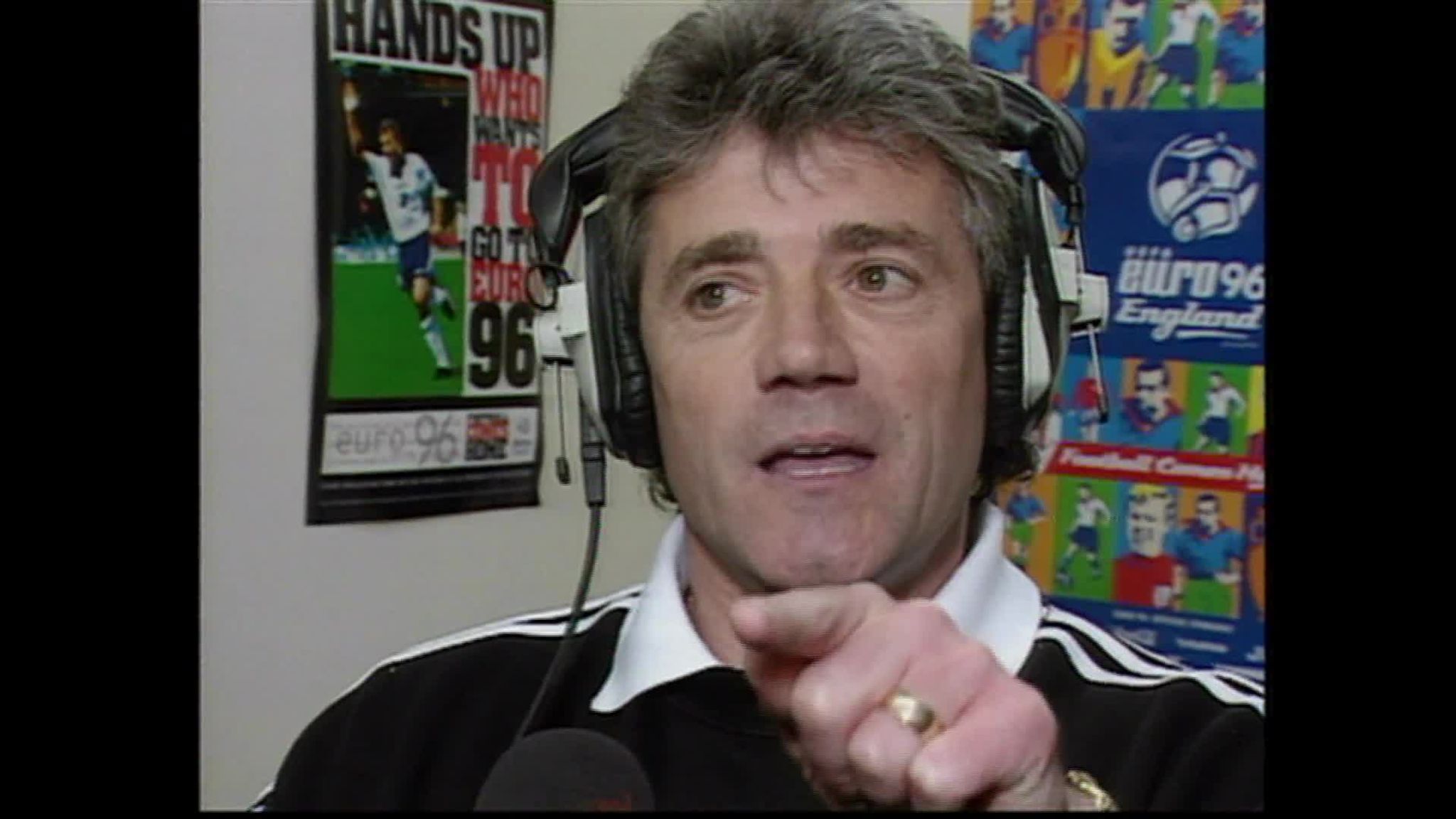
Pretty much everybody who didn't love Man United loved hearing him say it. But pretty much everybody, regardless of how they felt about Man United, thought that King Kev had fallen victim to Fergie's mind games -- that he had, as they say in England, "lost the plot." On May 2, Newcastle could only manage a 1-1 draw with Nottingham Forest, handing the League title to the idle Man United. They won the title by 4 points, and went on to win "The Double" by winning the FA Cup Final on May 11, beating Liverpool, 1-0 at Wembley Stadium in West London.
Once again, the words of the Sinatra song come to mind: "That's life, that's what all the people say. You're riding high in April, shot down in May."
Keegan was still one of the most popular figures in NUFC history, but the club fired him after 1 more season. He went to West London team Fulham, and got them promoted to the Premier League in 1999. He was then named manager of England, but couldn't get out of the Group Stage in Euro 2000.
Afterward, England played Germany in the last event at the old Wembley, before it was demolished so a new stadium could be built on the site. Germany won, 1-0. Afterward, the media cornered him in the bathroom of the dressing room, and he resigned. And so, Wembley's history as the home of English football ended with "Keegan quits in the toilet." (In England, "the toilet" is the entire rest room, not just the bowl.) Although Keegan has had a few managing jobs since, he has never again managed any national side.
He got Manchester City promoted to the Premier League in 2002, but left in 2005. In 2008, Newcastle owner Mike Ashley, famously despised by the team's fans, quickly hired as manager, clashed with, and fired the 2 most popular figures in the club's recent history: Keegan and Shearer. The "Magpies" were relegated, and no one blamed either Keegan or Shearer. Number 7 and Number 9 remained beloved in "The Toon" (Geordiespeak for "The Town"). Everyone blamed Ashley.
Fans of opposing teams serenaded both Keegan and Shearer with "Stayed on the telly, you should have stayed on the telly." Both went back to punditry, Shearer on the BBC, and Keegan on ITV.

As the song goes, "But I'm gonna change that tune, when I get right back up, right back up in June."
Keegan remained there until earlier this year, when he was diagnosed with stomach cancer. He died yesterday, July 20, 2026, at the age of 75, leaving behind his wife of nearly 52 years, Jean Woodhouse, and their 2 daughters.
That's life, that's life and I can't deny it.
Many times I've thought about quittin', baby, but my heart ain't gonna buy it.
But if there's nothing shaking come this here July
I'm gonna roll myself up in a big ball and die.
My, my.
Liverpool FC said his "indomitable spirit" would be "forever etched in our history. His later club called him "the beating heart of Newcastle United." The President of the Football Association, William, Prince of Wales, called him "a truly remarkable footballer and manager." And Alan Shearer called him "My hero. My manager. My friend. Sleep easy Boss."
King Kev wasn't the only player to have the nickname "King." Indeed, it's also been given to Pelé, Denis Law, Kenny Dalglish, French stars Eric Cantona and Thierry Henry, Liberia's George Weah, and Japanese star Kazuyoshi Miura. But, in England, Kevin Keegan was the most popular of all of these.
As Mel Brooks once said, "It's good to be the King."


No comments:
Post a Comment