Showing posts with label roger maris. Show all posts

Tuesday, April 21, 2026

Yankees vs. Red Sox, The Defining Moments, Part II, 1939-1966

April 20, 1939, Yankee Stadium. Opening Day, and while one legend, Lou Gehrig, is fading, another debuts. Ted Williams strikes out against Red Ruffing in his 1st major league at-bat. But in his 2nd, he strokes a double, and "Teddy Ballgame" is underway. In spite of Ted's debut, the Yankees win, 2-0, as Ruffing outduels Lefty Grove. The Yankees go on to win the World Series for the 4th consecutive season.

From 1938 to 1949, the Red Sox would finish 2nd to the Yankees 6 times, and would finish 3rd an additional 3 times in the 1950s. But only twice did they finish ahead of the Yankees in any season from 1919 to 1965: In 1946 and 1948.

April 23, 1941, Yankee Stadium. Rookie Phil Rizzuto -- not exactly a musclebound slugger -- hits his 1st major league home run, taking Charlie Wagner deep in the bottom of the 11th inning. It was the 1st of only 38 big-league round-trippers for the Scooter, and none of the 37 to come was a walkoff. I wonder if he yelled, "Holy cow!"

July 2, 1941, Yankee Stadium. Joe DiMaggio beats the Sox, and the 95-degree heat, and hits a home run to extend his hitting streak to a record 45 games. Yankees 8, Red Sox 4.

Williams goes on to hit .406, the last man to hit over .400 (or even over .390 in a full season), but DiMaggio's streak reaches 56 games, carrying the Yankees from 4th place when it starts to a big lead when it ends. He leads the Yankees to win the World Series over the Brooklyn Dodgers, and he, rather than Williams, deservedly wins the American League's Most Valuable Player award.

In case you're wondering: That season, DiMaggio, 26 years old and in his 6th major league season, was paid $37,500 (about $866,000 in 2026 money); Williams, who turned 23 during the season, his 3rd, was paid less than half as much, $18,000 ($415,000).

August 12, 1942, Yankee Stadium. Charlie Keller clobbers a Mike Ryba pitch for a grand slam in the bottom of the 9th, giving the Yankees an 8-4 win.

Williams wins the Triple Crown, leading the AL in batting average, home runs and runs batted in. But, again, it's a Yankee who is correctly voted the AL's MVP: 2nd baseman Joe Gordon.

August 10, 1946, Yankee Stadium. Aaron Robinson is not especially remembered, but someone had to be the Yankee catcher between Bill Dickey and Yogi Berra. He took Clem Dreiswerd deep in the bottom of the 9th to win, 7-5.

However, several Yankees, including Joe DiMaggio, Tommy Henrich and Phil Rizzuto, hadn't found their batting stroke just yet, after returning from World War II. And Charlie Keller hurt his back, curtailing what could have been a Hall of Fame career. The result was that the Yankees never seriously challenged for the Pennant, and the Sox won a Boston sports record 104 games.
The left field Wall, 1946. The next year, the ads were taken off,
and it became known as the Green Monster.
As with a sign at the Phillies' Baker Bowl, a joke was made:
"The Red Sox use Lifebuoy" -- and they still stink!
Note the Cities Service sign. In 1965, the company's name changed,
and it became the CITGO sign.

However, they lost the World Series to the St. Louis Cardinals, although the Cards were a much more experienced team, having been in 3 of the previous 4 World Series, winning 2 of them, including a 1942 win and a 1943 loss to the Yankees.

May 12, 1947, Fenway Park. Berra turns 22, and hits a home run. He becomes the 3rd Yankee to hit a home run against the Red Sox on his birthday. He remains the youngest. I guess it never occurred to him to say, "I was the youngest one to do it, but that's because all the other guys were older." At any rate, the Sox win anyway, 4-3. But the Yankees go on to dethrone the Sox as Pennant winners, and win the World Series.

Williams joined Rogers Hornsby as the only players to win the Triple Crown twice. But, again, he is denied the MVP, as one voter didn't put Ted on his Top 10 at all -- forgetting, he said. That gave DiMaggio the award by one point over Williams.

Sox fans have fumed about this ever since, saying DiMaggio only got the MVP because the press liked him and hated Williams. Well, whose fault was that? DiMaggio treated the press well, because he wanted to be treated well in return; while Williams acted like he didn't care what the press thought, and paid for it, dearly.

October 3, 1948, Fenway Park. The Sox beat the Yankees, 10-5, clinching at least a tie for the AL Pennant, and knocking the Yanks out of a chance for it, in the 154th and final game of the regular season. (The AL adopted the current 162-game schedule after it expanded in 1961; the National League did the same the following season.)

Williams went 2-for-4 with 2 RBI doubles. Sox center fielder Dom DiMaggio, Joe's younger brother, and a very good hitter and a very good center fielder in his own right, goes 3-for-4, including a solo home run. Joe goes went 4-for-5 with 2 doubles and 3 RBIs -- meaning that, between them, the DiMaggios go 7-for-9 with 3 extra-base hits and 4 RBIs. And brother Vince, who also reached the majors, wasn't even in this game! Although he was there, as were their parents.

Joe gets a standing ovation from the Boston fans during this game, and later called it one of the biggest thrills of his life. Boston fans, showing class? It used to happen all the time.

The next day, the Sox lost a playoff for the Pennant to the Cleveland Indians, 8-3, as Tribe shortstop-and-manager Lou Boudreau hit 2 home runs to cement his place as the AL's MVP, ahead of the Yankee Clipper and the Splendid Splinter.

April 30, 1949, Yankee Stadium. Tommy Henrich was nicknamed "Ol' Reliable" by Yankee broadcaster Mel Allen, and he lived up to that name on this day, by taking Tex Hughson downtown in the bottom of the 9th, to win, 4-3.

Five months later, Henrich would do it to Don Newcombe in Game 1 of the World Series, becoming the 1st MLB player to hit a walkoff homer in postseason play. He lived to the age of 96, but never really got the credit he deserved for his clutch play.

June 28, 29 and 30, 1949, Fenway Park. After missing the entire season thus far with a heel spur -- developing it after serving in World War II, not before serving in war like Donald Trump would later claim for himself, to keep himself out of it -- DiMaggio says he is ready to play again.

In a 3-game series, he goes 5-for-9, with 4 home runs and 9 RBIs. The Yankees sweep, winning 5-4, 9-7 and 6-3. During the 3rd game, a fan flies a plane over Fenway, trailing a banner reading "THE GREAT DIMAGGIO."
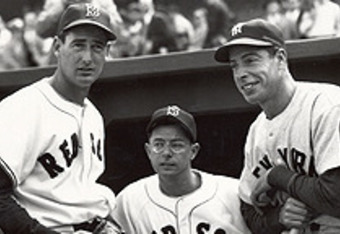
Ted Williams, Dom DiMaggio, Joe DiMaggio.

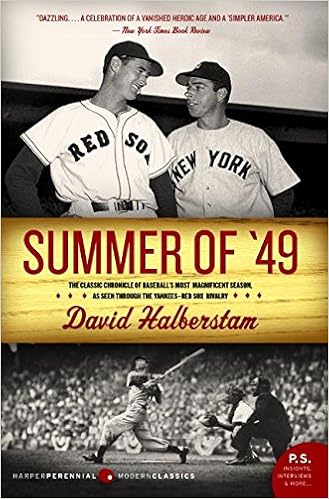
The Pennant race that was well-chronicled by both Peter Golenbock in his book Dynasty: The New York Yankees, 1949-1964, and David Halbertsam in his book Summer of '49, is well and truly on.

October 1, 1949, Yankee Stadium. Believe it or not, the Yankees blew a 12-game lead, and trailed the Sox by 1 game with 2 to play -- and these 2 were against the Sox at The Stadium. The Yanks hold Joe DiMaggio Day, since Dom plays for the Sox, and thus the whole family can attend. Joe has been ill with pneumonia, but has kept playing, and says, "I'd like to thank the Good Lord for making me a Yankee." (I guess he didn't have an agent back in 1934.)

The Sox, acting like more recent Red Sox teams, blow a 4-0 lead, Johnny Lindell hits an 8th-inning homer, and the race is tied. Yankees 5, Red Sox 4. Allie Reynolds didn't get out of the 3rd inning, but Joe Page allowed just 1 hit over the last 6 2/3rds innings. In the 1901 to 1968 era of 2 single-division leagues, 1949 was the only season in which both leagues' races were unresolved as the final day of the regular season dawned: The Brooklyn Dodgers needed a win or a St. Louis Cardinals loss to win the Pennant, and they got their win.

October 2, 1949, Yankee Stadium. This is for the Pennant. The Yanks lead 1-0 in the 8th, when Joe McCarthy, managing the Sox after all those Pennants with the Yankees, relieves starter Ellis Kinder. Big mistake, as a Jerry Coleman double clears the loaded bases. But Vic Raschi falters a bit in the 9th, partly due to DiMaggio, still sick, dropping an easy fly ball. Normally so good out there, Joe walks off the field, taking himself out of the game.

The tying runs are on, the run that could win the Pennant is at the plate, and Yogi Berra goes out to talk to Raschi. "The Springfield Rifle" angrily says, "Gimme the goddamned ball, and get the hell out of here!" Yogi does as he's told, and Raschi gets the final out, as Birdie Tebbetts pops up to 1st base, and Henrich, playing out of position, catches it. Yankees 5, Red Sox 3.

The Yanks beat the Dodgers in the World Series. In the last 2 seasons, the Sox had won 192 games, and didn't even win a Pennant.

This time, falling just short of the AL batting title to Detroit's George Kell, and this oh-so-slightly losing out on a unique 3rd Triple Crown, Williams was awarded the MVP. It could have gone to Rizzuto, who won it in 1950; or to Berra, who won it in 1951, '54 and '55. Instead, it went to Williams in a year in which he did not lead the Sox to a Pennant. So Sox fans can shut up about how Ted was robbed in '41, '42 and '47.

That season, DiMaggio was paid $100,000 (about $1.4 million in today's money), only the 2nd player ever to reach 6 figures, following Hank Greenberg. Williams was paid $75,000 ($1.1 million).

April 18, 1950, Fenway Park. Opening Day. Reynolds had nothing, and Mel Parnell was pitching well. After 4 innings, the Red Sox led, 9-0. The Yankees scored 4 runs in the 6, 9 in the 8th and 2 in the 9th, and won, 15-10. Don Johnson (no relation to the actor of the same name) was the winning pitcher, while Parnell gave out and Walt Masterson was the losing pitcher.

Oddly, the Yankees did this without hitting any home runs. 3rd baseman Billy Johnson had 3 RBIs. So did 2nd baseman Billy Martin, making his major league playing debut, and he didn't even start the game.

September 23, 1950, Yankee Stadium. Red Smith of the New York Herald Tribune called this 2-game series "the itsy-bitsy World Series." Eddie Lopat pitched a shutout, and the Yankees won, 8-0.

September 24, 1950, Yankee Stadium. The Yankees are leading the Red Sox, 9-5 in the 9th inning, when word comes in that Cleveland has beaten Detroit, clinching the Pennant for the Yankees. They finish the game off.

April 17, 1951, Yankee Stadium. The Yankees open the season at home against the Red Sox. Although it isn't obvious yet, it will be the final season for DiMaggio. It is the 1st season, and the 1st game, for Mickey Mantle -- who will also end up playing his last game against the Red Sox. His 1st at-bat is a groundout against Sox starter Mickey McDermott. This is also the debut as Yankee public address announcer for Bob Sheppard, who stays for 57 years.

In the 6th inning, Mantle gets his 1st hit and his 1st RBI, singling home Jackie Jensen against Bill Wight, helping the Yankees win 5-0. DiMaggio goes 1-for-4 with an RBI. Williams goes 1-for-3. Raschi pitches a shutout.
Joe DiMaggio, Mickey Mantle, Ted Williams

September 28, 1951, Yankee Stadium. The Yanks can clinch the Pennant with a win, and need just 1 more out. Even more, Allie Reynolds needs one more out for his 2nd no-hitter of the year. But who's at bat? Ted Williams. "The Superchief" gets "the Splendid Splinter" to hit an easy popup... which Yogi drops! Fortunately, it's in foul territory, but you don't give Ted Williams a second chance.

But in an example of what Yankee haters would call "Yankee luck," Ted pops it up again, and this time, Yogi catches it. Yankees 8, Red Sox 0. The Yanks go on to beat the Giants in the World Series.
Yankee Stadium. Judging by the scoreboard, the green seats,
and the off-white outer wall, this has to be between 1959 and 1966.

Early the next season, Williams was called back into the Marine Corps for the Korean War, as he had been in World War II.  He was unavailable from May 1, 1952 to July 28, 1953, and by the time he came back, the Red Sox "glory years" of 1946-51 were over, as most of the other good players had retired or been traded away.

The Yanks-Sox rivalry went dormant as a result, leading Boston Globe columnist Dan Shaughnessy, born in 1953, to later remark that it had become like a conversation between Humphrey Bogart and Peter Lorre in the film Casablanca, a script written by Julius and Philip Epstein, the grandfather and great uncle of future Sox general manager Theo Epstein:

Ugarte: "You despise me, don't you, Rick?"
Rick: "Well, if I gave you any thought, I probably would."

April 23, 1953, Yankee Stadium. For the 1st time in his career, Mantle hits a walkoff home run. It's a 3-run job off Ellis Kinder, and the Yankees beat the Red Sox, 6-3. They had led 3-1 after 8, but the Sox scored 3 in the 9th to tie it. Mickey won it.

April 14, 1955, Fenway Park. The Red Sox host the Yankees in their home opener, and win, 8-4. This game is notable as the major league debut of Elston Howard, who thus becomes the 1st black player for the Yankees in a regular season game. In the bottom of the 6th inning, he replaces Irv Noren in left field, and in his first at-bat, drives in Mickey Mantle with a single in the 8th.

At this time, there were still 3 major league teams that had not introduced a black player: The Philadelphia Phillies, the Detroit Tigers, and the Red Sox, who would be the last, with Elijah "Pumpsie" Green in 1959. 

September 16, 1955, Yankee Stadium. Yogi Berra is remembered as one of the best clutch hitters ever, and he backed that up with 7 walkoff home runs, including this one, also off Ellis Kinder, for a 5-4 Yankee win.

April 28, 1957, Yankee Stadium. Yogi does it against the Sox again, off Ike Delock in the 10th inning, giving the Yankees a 3-2 win.

September 5, 1957, Yankee Stadium. Bob Grim becomes the 2nd Yankee pitcher to hit a walkoff home run -- and the 2nd to do it against Boston. He decides Nixon's the one -- Willard Nixon, that is -- and homers off him to give the Yankees a 5-2 win.

September 3, 1958, Yankee Stadium. Yogi torments the Sox again. This time, the walkoff victim is Leo Kelly, and the Yankees win, 8-5.

October 2, 1960, Yankee Stadium. Dale Long is remembered for hitting home runs in 8 straight games in 1956 (with the Pittsburgh Pirates), and being one of baseball's rare lefthanded catchers in 1958 (with the Chicago Cubs). On this day, for the Yankees, he hit a walkoff homer against Arnold Early of the Red Sox.

It had been exactly 11 years since the Yankees had won a Pennant by beating the Sox, and it would be exactly 18 years later that Sox fans would come to hate Bucky Dent.

Ted Williams had made his last appearance for the Sox in their home finale on September 28, hitting a home run, the 521st of his career, in his last at-bat. His salary was a record $135,000 (about $1.5 million in today's money).

October 1, 1961, Yankee Stadium. The Yankees beat the Red Sox 1-0. The only run of the game comes in the 4th inning, on a home run by Roger Maris. It is Maris' 61st home run of the season, breaking the record that Babe Ruth set in 1927.
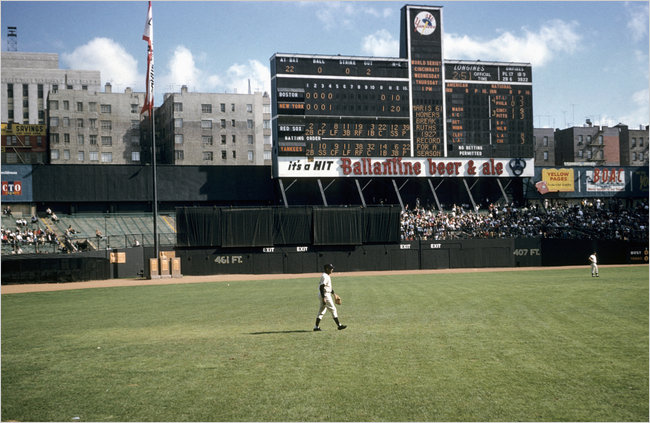
The Yankee Stadium scoreboard, right after Maris' 61st

Williams had been replaced in Boston's left field by a native of Southampton, Long Island -- a working-class "townie" rather than a rich Summer-home owner there. His name was Carl Yastrzemski. He made $10,000 ($111,000). For his record-setting 61 home runs and AL-leading 142 RBIs, the Yankees paid Maris $32,000 ($355,000). For his 54 homers, Mantle was paid $70,000 ($776,000) -- and the greatest player of his generation, over even Willie Mays and Hank Aaron, never got a penny over $100,000.

July 7, 1966, Yankee Stadium. The Mick strikes again, with his 10th career walkoff home run, off Don McMahon, a relief pitcher who gave the Yankees trouble with the Milwaukee Braves in the 1957 and '58 World Series. The Yankees win, 5-2, and the winning pitcher, as 1960s Yankee pitcher Jim Bouton would say, was "Dooley Womack. The Dooley Womack!"

September 10, 1966, Fenway Park. Roger Maris turns 32, and hits a home run, the 4th Yankee to do so on his birthday. The Yankees win 5-1.

By this point, the Yankees had collapsed, but no one knew that, in the following season, the Sox were in for the defining season in their history, the one that took them from an afterthought -- and very nearly moved, at least out of Fenway Park, possibly to the suburbs, maybe out of the Boston area altogether -- to being New England's most beloved sports team.

Part III follows.

Friday, September 8, 2023

September 8, 1998: Mark McGwire Hits His 62nd Home Run

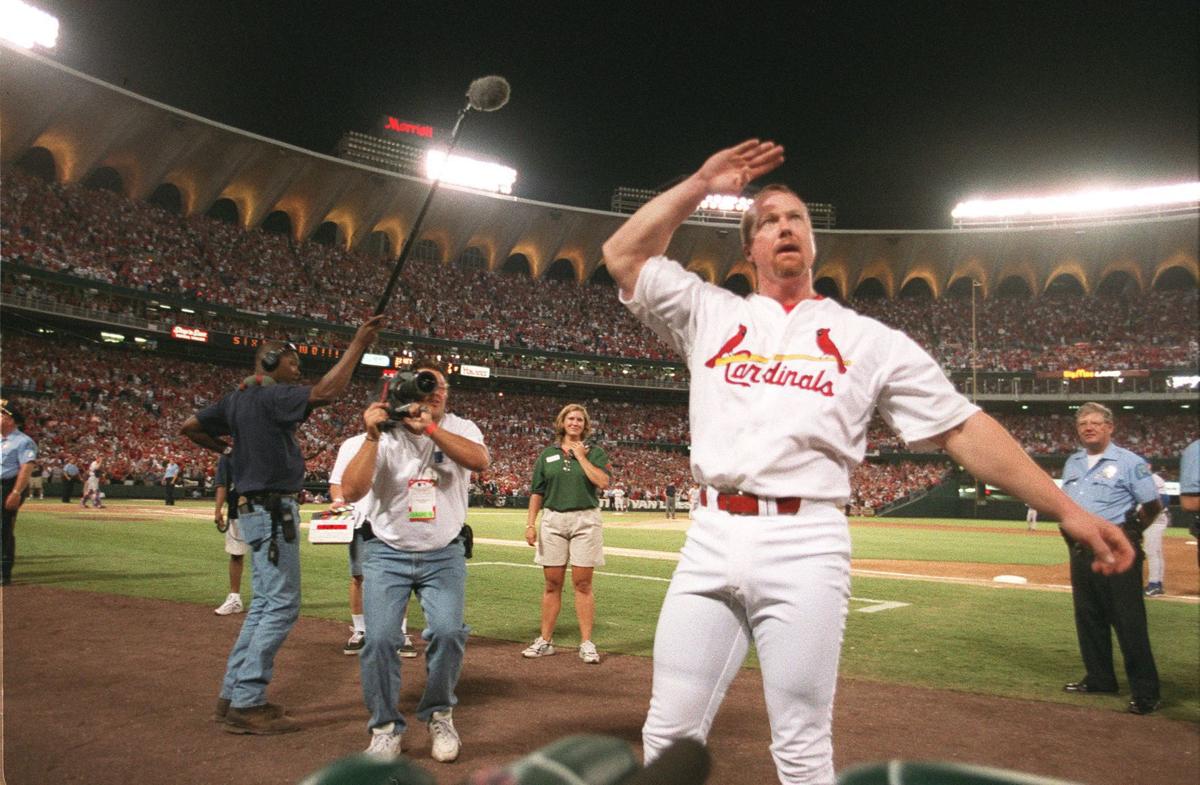
September 8, 1998, 25 years ago: The St. Louis Cardinals beat their arch-rivals, the Chicago Cubs, 6-3 at Busch Memorial Stadium in St. Louis. Ray Lankford and Ron Gant hit home runs for the Cardinals. Nobody remembers those. What they remember is the home run hit by Mark McGwire. It is his 62nd of the season, setting a new single-season record.

Babe Ruth had raised the record to 29 in 1919, 54 in 1920, 59 in 1921 and 60 in 1927. Another right fielder for the New York Yankees, Roger Maris, raised it to 61 in 1961. In spite of the media, especially in New York, seeming to not want Maris to break the record, he ended up holding it longer than Ruth did: 37 years to 34.

While there were serious challenges to Ruth's 60 before Maris' 61 -- Hack Wilson hit 56 in 1930, Jimmie Foxx 58 in 1932, and Hank Greenberg 58 in 1938 -- challenges to Maris' 61 were fewer. In 1969, Reggie Jackson, in his 2nd full season with the Oakland Athletics, had 41 home runs through August 2, and, in his memoir, said, "People were now saying I was dating a lady named Ruth Maris." But he only hit 6 more the rest of the way, and didn't even lead the American League: Harmon Killebrew topped him, 49 to 47.

Willie Mays hit 52 in 1965, but no other National Leaguer hit 50 again until George Foster hit 52 in 1977. And no American Leaguer hit 50 after Maris until 1990, when Cecil Fielder hit 51. When the Strike of '94 hit, Matt Williams was leading the majors with 43, and Ken Griffey Jr. led the AL with 40. Both were thought to have a chance at 61, but that went out the window.

And despite accusations of a "juiced ball" in 1987, no player hit 50 that season. Each League's leader hit 49: Andre Dawson of the Chicago Cubs and... Mark McGwire of the Athletics. McGwire thus set a record for home runs in a season by a rookie.

The 1st baseman was 6-foot-5 and 215 pounds, and had an even taller younger brother, Dan McGwire, who played quarterback for 5 seasons in the NFL, mostly as a backup for the Seattle Seahawks. Still, at the time, Mark was seen as big and solidly built, but not out of regular human proportions. He didn't look like a superhero, or a bodybuilder such as Arnold Schwarzenegger.

He and Jose Canseco became known as the Bash Brothers, helping the A's win 3 straight Pennants and the 1989 World Series. Through the 1992 season, he was 29 years old, and had hit 220 home runs, making 6 All-Star Games, and had even won a Gold Glove. He looked like he was headed for the Hall of Fame. So did Canseco, who was 28 and already had 231 home runs.

But between the A's perennial cash flow problems and his bad attitude, Canseco became expendable, and was traded after that season. McGwire wasn't, falling victim to injuries, making only 279 plate appearances in '93 and '94 combined.

The fact that Canseco used steroids wasn't publicly known, but it was one of the worst-kept secrets in baseball. McGwire found out that a steroid called androstendione, or "andro" for short, could make it easier to return from injury and regrow lost muscle. He came back with a bang in 1995 -- 39 bangs, in fact, and made the All-Star Game again.

In 1996, now with a goatee and his arms bulging like the cartoon character Popeye's, he led the AL with 52 home runs, the most any AL player had hit since Maris. And he was doing this while playing his home games at the Oakland Coliseum, a pitcher's park. Suddenly, the idea that Maris' record could fall was taken seriously for the 1st time.

But, again, A's management was losing money, and on July 31, 1997, with McGwire having hit 34 home runs already, he was traded to the Cardinals for pitchers Eric Ludwick, T.J. Mathews and Blake Stein. Ludwick won just 1 game for the A's, and was traded after the season. Stein did poorly, and was traded in 1999. Mathews pitched well in relief for them, but they traded him in 2001. None of these men appeared in a major league game after the 2002 season. Still, the A's had Jason Giambi coming up, and he replaced McGwire at 1st base, so the trade was pretty much a wash for them.

McGwire was warmly embraced by Cardinal fans. He seemed just the kind of wholesome player that fit in with the Midwest, and "the Best Baseball City in America." He finished the season with 58 homers, while Griffey, with the Seattle Mariners, finished with 56. Now, the national media seemed to treat the breaking of Maris' record no longer as an "if," but as a "when." In cheering on McGwire, and to a lesser extent (because he was black, of course) Griffey, it was as if the media was once again rooting against Maris, who died in 1985, and could not speak up on his own behalf.

And it wasn't just that McGwire and Griffey were hitting so many home runs, it was how far they were going. Griffey was the only batter who ever reached the upper deck of the Kingdome in Seattle, and he had now done it a few times. McGwire was hitting balls 500 feet. Not since Mickey Mantle -- not even Killebrew or Jackson -- had a guy hit the ball that far that often. McGwire may have been a righthanded batter, playing outside New York, and hadn't pitched since he was at USC, but he really was treated as if he was the closest thing to Ruth since Ruth. He was a folk hero.

As it turned out, 1998 became not only "The Year of the Home Run," but it was a 3-way race: McGwire and Griffey were joined by Sammy Sosa of the Cubs. A Dominican, Sosa had never hit more than 40 in a season, and had made just 1 All-Star Game by age 29. But he kept pace with McGwire and Griffey. In June, he topped both of them, and everybody else, too: He hit 20 home runs, still a record for a single player in a single month. When June was over, it was McGwire 37, Sosa 33, Griffey 33.

Neither McGwire nor Sosa added any homers by the All-Star Break on July 7, while Griffey had overtaken Sosa with 35. But all 3 got going after the Break: July ended with McGwire 45, Sosa 42, Griffey 41. McGwire got to 50 on August 20, Sosa on August 23. Griffey went into a slump, so, when August ended, it was McGwire 55, Sosa 55, Griffey 47.

August was also the month that the scandal surrounding President Bill Clinton and his affair with former White House intern Monica Lewinsky got more serious, with Special Counsel Kenneth Starr and the Republican-controlled Congress amping up the pressure. The general consensus was that Clinton had done something immoral, but there didn't appear to be anything illegal, and that Starr and Congress were going too far in trying to prove it. The home run race provided a distraction, much as Hank Aaron's pursuit of Babe Ruth's career record of 714 helped to distract from Richard Nixon and Watergate in 1973 and '74.

By this point, the scoreboard at Busch Memorial Stadium was keeping a running total of McGwire's and Sosa's totals -- but not Griffey's. Also by now, Steve Wilstein, a reporter for the Associated Press, had made public the fact that he had seen a bottle of andro in McGwire's locker. McGwire said it was legal -- which, at the time, it was. He said it was no big deal -- which, at the time, the public accepted.

Indeed, fans turned on Wilstein for reporting it: How dare he ruin this wonderful story with an accusation that "Big Mac" was cheating! What next? Was "Slammin' Sammy" also cheating? Was Junior cheating?

On September 5, McGwire hit his 60th, Sosa hit his 58th, and Griffey hit his 48th. Griffey was having a historic season, and yet was hopelessly behind the Southern Californian and the Dominican. On September 7, Griffey hit Numbers 49 and 50. That same day, McGwire hit Number 61, and Cardinal broadcaster Jack Buck said, "Flight 61, now leaving for Planet Maris!"

Fox Sports broadcast the September 8 Cardinals-Cubs game at Busch live, figuring that it would be the night that the record was broken. The Cardinals, for whom Maris had played his last 2 seasons, 1967 and '68, invited his widow, Pat Maris, and their 5 now-grown children to attend. Pat felt ill and couldn't go, but the kids all did.

McGwire grounded to short in the 2nd inning. With 2 out in the 4th, he again came up against Cub pitcher Steve Trachsel. He hit a screaming liner down the left-field line. Joe Buck, Jack's son, had the call: "Down the left field line! Is it enough? Gone! Number 62! Touch first, Mark: You've made history!" In his excitement, McGwire rounded 1st base without touching it, and had to go back to do so. At 341 feet, it was his shortest home run of the season.

Greeting him at home plate was his 11-year-old son Matt, a Cardinal batboy, whom he gave a huge hug. Sosa had run in from right field, and he hugged McGwire as well. McGwire then went over to where the Marises were sitting, and hugged them, too. With those andro-boosted arms.

But the home run race wasn't over: There was no guarantee that McGwire would even end up leading the NL in homers. Sosa hit his 59th on September 11 and his 60th on September 12. A week earlier, in the entire history of Major League Baseball, there had been only 2 men ever to hit 60 home runs in a season. Now, that total had doubled. On September 13, Sosa hit his 61st and his 62nd. He and McGwire were now tied. Griffey was at 51.

McGwire hit his 63rd on September 15, Sosa his the next day. McGwire hit his 64th on September 18, and his 65th on September 20. On September 23, Sosa hit his 64th and 65th. Griffey was up to 55. On September 25, against José Lima of the Houston Astros at the Astrodome, Sosa hit his 66th, making him the all-time single-season leader -- for a few minutes. This was shortly followed by McGwire's 66th.

Nobody knew it yet, but Sosa wouldn't hit another homer that season, finishing with 66. Griffey would finish with 56. On September 26, the next-to-last day of the season, back at Busch, McGwire hit his 67th off Dustin Hermanson, giving him the lead for good; and hit his 68th later in the game. On the last day, September 27, he hit his 69th, and finally, he cracked a barrier that nobody thought was possible, hitting Number 70 off Carl Pavano, then a rookie with the Montreal Expos. Joe Buck had the call: "Into left field! Number 70! How much more can you give us, Big Mac?"

The answer, at least for that season, was, "No more." The Cardinals finished 73-89, and were nowhere near the NL Pennant race. But the Cubs had finished in a tie with the San Francisco Giants for the NL's Wild Card berth, and won a Playoff at Wrigley Field. Sosa did not hit a homer, which, since this was officially a regular-season game, would have counted as his 67th. But the starting and winning pitcher for the Cubs? Steve Trachsel. That, not giving up McGwire's 62nd, was his most important moment of the year.

And, since the Cubs made the Playoffs, and the Cardinals didn't, Sosa was named the NL's Most Valuable Player, not McGwire. Nevertheless, Sports Illustrated named them joint Sportsmen of the Year -- not their first retroactively problematic choice for that title, and not their last.

In 1999, McGwire hit 65 home runs, while Sosa hit 63. Griffey led the AL with 48. Both McGwire and Sosa had, by comparison, off-seasons in 2000: Sosa 50, still enough to lead the NL; McGwire, 32. Griffey had been traded to the Cincinnati Reds, and hit 40. In 2001, Sosa hit 64. But McGwire battled injuries, hit 29 homers, and retired after the season, with 583 for his career. Griffey also faced injuries, and was limited to 22 homers.

In 2001, the Fox TV show Dark Angel, set in a dystopian future of 2020 -- the dystopia being due to an electromagnetic pulse in 2009 having led to an economic depression and a fascist government, not an epidemic and a nearly-fascist government, as actually happened -- had a story about the theft of the ball that Sosa hit for his 756th home run, breaking Hank Aaron's career record.

Barry Bonds of the San Francisco Giants hit 37 home runs in 1998, having reached a career high, to that point, of 46 in 1993. He became intensely jealous of the attention heaped on McGwire, Sosa and Griffey, and knowing he was a better all-around player than any of them (well, maybe not Griffey), and began using steroids after the 1998 season.

In 1999, he hit 34 homers. In 2000, he hit a new career high, 49. In 2001, he set a new single-season record, with 73. That record still stands. Sosa, who again led the NL in 2002, with 49, would end up with 609. Griffey would finish with 630, and, as far as is publicly known, he did that without ever using steroids. Bonds would be the one to break Aaron's record, finishing with 762 in 2007.

By then, McGwire and Sosa had already irreparably damaged their reputations: The 2005 Congressional hearings into steroid use in baseball had made them both look foolish. Sosa has never confessed to using steroids. McGwire has, and this admission allowed him to get back into baseball's good graces, as he has served as a hitting instructor for the Cardinals and the San Diego Padres. However, the section of Interstate 70 -- a convenient number -- running through St. Louis had been named the Mark McGwire Highway. In 2010, the signs were changed to honor an earlier local hero, who was a baseball fan: It became the Mark Twain Highway.

Through the 2022 election, neither McGwire, nor Sosa, nor Bonds has ever been elected to the Baseball Hall of Fame. Griffey was elected in his 1st year of eligibility. However, with known steroid cheats David Ortiz, Mike Piazza and Iván Rodríguez already in, keeping McGwire, Sosa, Bonds, Alex Rodriguez, and any other player known to have used steroids -- or, like Roger Clemens, widely believed to have used them -- out of the Hall on the basis of steroid use seems stupid: Either cheating matters, or it doesn't. If it doesn't bother you, let all of them in; if it does, keep all of them out. Be consistent.

Jose Canseco would finish his career with 462 home runs. In other words, he's a borderline candidate for the Hall of Fame even with his admission of cheating.

The Summer of '98 has been called baseball's best season, for all the home run heroics. Certainly, Yankee Fans, getting to watch a team go 114-48 in the regular season and 11-2 in the postseason, loved it. But the knowledge that McGwire and Sosa cheated to reach and pass 61 home runs taints it, irrevocably. The U.S. Senate may have acquitted Clinton, but history has convicted McGwire, Sosa and Bonds.

Friday, June 9, 2023

Yankees vs. Red Sox, The Defining Moments, Part II, 1939-1966

April 20, 1939, Yankee Stadium. Opening Day, and while one legend, Lou Gehrig, is fading, another debuts. Ted Williams strikes out against Ruffing in his 1st 2 major league at-bats. But in his 3rd, he strokes a double, and "Teddy Ballgame" is underway. In spite of Ted's debut, the Yankees win, 2-0, and go on to win the World Series.

From 1938 to 1949, the Red Sox would finish 2nd to the Yankees 6 times, and would finish 3rd an additional 3 times in the 1950s. But only twice did they finish ahead of the Yankees in any season from 1919 to 1965: In 1946 and 1948.

April 23, 1941, Yankee Stadium. Rookie Phil Rizzuto -- not exactly a musclebound slugger -- hits his 1st major league home run, taking Charlie Wagner deep in the bottom of the 11th inning. It was the 1st of only 38 big-league round-trippers for the Scooter, and none of the 37 to come was a walkoff. I wonder if he yelled, "Holy cow!"

July 2, 1941, Yankee Stadium. Joe DiMaggio beats the Sox, and the 95-degree heat, and hits a home run to extend his hitting streak to a record 45 games. Yankees 8, Red Sox 4.

Williams goes on to hit .406, the last man to hit over .400 (or even over .390 in a full season), but DiMaggio's streak reaches 56 games, he leads the Yankees to win the World Series over the Brooklyn Dodgers, and he, rather than Williams, deservedly wins the AL's Most Valuable Player award.

August 12, 1942, Yankee Stadium. Charlie Keller clobbers a Mike Ryba pitch for a grand slam in the bottom of the 9th, giving the Yankees an 8-4 win.

August 10, 1946, Yankee Stadium. Aaron Robinson is not especially remembered, but someone had to be the Yankee catcher between Bill Dickey and Yogi Berra. He took Clem Dreiswerd deep in the bottom of the 9th to win, 7-5.

However, several Yankees, including Joe DiMaggio, Tommy Henrich and Phil Rizzuto, hadn't found their batting stroke just yet, after returning from World War II. And Charlie Keller hurt his back, curtailing what could have been a Hall of Fame career. The result was that the Yankees never seriously challenged for the Pennant, and the Sox won a Boston sports record 104 games.
The left field Wall, 1946. The next year, the ads were taken off,
and it became known as the Green Monster.
As with a sign at the Phillies' Baker Bowl, a joke was made:
"The Red Sox use Lifebuoy" -- and they still stink!
Note the Cities Service sign. In 1965, the company's name changed,
and it became the CITGO sign.

However, they lost the World Series to the St. Louis Cardinals, although the Cards were a much more experienced team, having been in 3 of the previous 4 World Series, winning 2 of them, including a 1942 win and a 1943 loss to the Yankees.

May 12, 1947, Fenway Park. Berra turns 22, and hits a home run. He becomes the 3rd Yankee to hit a home run against the Red Sox on his birthday. He remains the youngest. I guess it never occurred to him to say, "I was the youngest one to do it, but that's because all the other guys were older." At any rate, the Sox win anyway, 4-3. But the Yankees go on to dethrone the Sox as Pennant winners, and win the World Series.

October 3, 1948, Fenway Park. The Sox beat the Yankees, 10-5, clinching at least a tie for the AL Pennant, and knocking the Yanks out of a chance for it, in the 154th and final game of the regular season. (The AL adopted the current 162-game schedule after it expanded in 1961; the National League did the same the following season.)

Williams went 2-for-4 with 2 RBI doubles. Sox center fielder Dom DiMaggio, Joe's brother, goes 3-for-4, including a solo home run. Joe goes went 4-for-5 with 2 doubles and 3 RBIs -- meaning that, between them, the DiMaggios go 7-for-9 with 3 extra-base hits and 4 RBIs. And brother Vince, who also reached the majors, wasn't even in this game! Although he was there, as were their parents.

Joe gets a standing ovation from the Boston fans during this game, and later called it one of the biggest thrills of his life. Boston fans, showing class? It used to happen all the time.

The next day, the Sox lost a playoff for the Pennant to the Cleveland Indians, 8-3, as Tribe shortstop-and-manager Lou Boudreau hit 2 home runs to cement his place as the AL's MVP, ahead of the Yankee Clipper and the Splendid Splinter.

April 30, 1949, Yankee Stadium. Tommy Henrich was nicknamed "Ol' Reliable" by Yankee broadcaster Mel Allen, and he lived up to that name on this day, by taking Tex Hughson downtown in the bottom of the 9th, to win, 4-3.

Five months later, Henrich would do it to Don Newcombe in Game 1 of the World Series, becoming the 1st MLB player to hit a walkoff homer in postseason play. He lived to the age of 96, but never really got the credit he deserved for his clutch play.

June 28, 29 and 30, 1949, Fenway Park. After missing the entire season thus far with a heel spur, DiMaggio is ready to play again. In a 3-game series, he goes 5-for-9, with 4 home runs and 9 RBIs. The Yankees sweep, winning 5-4, 9-7 and 6-3. During the 3rd game, a fan flies a plane over Fenway, trailing a banner reading "THE GREAT DIMAGGIO."
Ted Williams, Dom DiMaggio, Joe DiMaggio.

The Pennant race chronicled by Peter Golenbock in his book Dynasty: The New York Yankees, 1949-1964, and by David Halbertsam in his book Summer of '49, is well and truly on.

October 1, 1949, Yankee Stadium. Believe it or not, the Yankees blew a 12-game lead, and trailed the Sox by 1 game with 2 to play -- and these 2 were against the Sox at The Stadium. The Yanks hold Joe DiMaggio Day, since his brother Dom plays for the Sox, and thus the whole family can attend. Joe has been ill with pneumonia, but has kept playing, and says, "I'd like to thank the Good Lord for making me a Yankee." (I guess he didn't have an agent back in 1934.)

The Sox, acting like more recent Red Sox teams, blow a 4-0 lead, Johnny Lindell hits an 8th-inning homer, and the race is tied. Yankees 5, Red Sox 4. In fact, in the 1901 to 1968 era of 2 single-division leagues, 1949 was the only season in which both leagues' races were unresolved as the final day of the regular season dawned.

October 2, 1949, Yankee Stadium. This is for the Pennant. The Yanks lead 1-0 in the 8th, when Joe McCarthy, managing the Sox after all those Pennants with the Yankees, relieves starter Ellis Kinder. Big mistake, as a Jerry Coleman double clears the loaded bases. But Vic Raschi falters a bit in the 9th, partly due to DiMaggio, still sick, dropping an easy fly ball. Normally so good out there, Joe walks off the field, taking himself out of the game.

The tying runs are on, the run that could win the Pennant is at the plate, and Yogi Berra goes out to talk to Raschi. "The Springfield Rifle" angrily says, "Gimme the goddamned ball, and get the hell out of here!" Yogi does as he's told, and Raschi gets the final out, as Birdie Tebbetts pops up to 1st base, and Henrich, playing out of position, catches it. Yankees 5, Red Sox 3.

The Yanks beat the Dodgers in the World Series. In the last 2 seasons, the Sox had won 192 games, and didn't even win a Pennant.

April 17, 1951, Yankee Stadium. The Yankees open the season at home against the Red Sox. Although it isn't obvious yet, it will be the final season for DiMaggio. It is the 1st season, and the 1st game, for Mickey Mantle -- who will also end up playing his last game against the Red Sox. His 1st at-bat is a groundout against Sox starter Mickey McDermott. This is also the debut as Yankee public address announcer for Bob Sheppard, who stays for 57 years.

In the 6th inning, Mantle gets his 1st hit and his 1st RBI, singling home Jackie Jensen against Bill Wight, helping the Yankees win 5-0. DiMaggio goes 1-for-4 with an RBI. Williams goes 1-for-3. Raschi pitches a shutout.
Joe DiMaggio, Mickey Mantle, Ted Williams

September 28, 1951, Yankee Stadium. The Yanks can clinch the Pennant with a win, and need just 1 more out. Even more, Allie Reynolds needs one more out for his 2nd no-hitter of the year. But who's at bat? Ted Williams. "The Superchief" gets "the Splendid Splinter" to hit an easy popup... which Yogi drops! Fortunately, it's in foul territory, but you don't give Ted Williams a second chance.

Incredibly, Ted pops it up again, and this time, Yogi catches it. Yankees 8, Red Sox 0. The Yanks go on to beat the Giants in the World Series.
Yankee Stadium. Judging by the scoreboard, the green seats,
and the off-white outer wall, this has to be between 1959 and 1966.

Early in the 1952 season, Williams was called back into the Marine Corps for the Korean War, as he had been in World War II.  He would miss the rest of '52 and all but the last few weeks of '53, and by the time he came back the Red Sox "glory years" of 1946-51 were over, as most of the other good players had retired or been traded away.

The Yanks-Sox rivalry went dormant as a result, leading Boston Globe columnist Dan Shaughnessy, born in 1953, to later remark that it had become like a conversation between Humphrey Bogart and Peter Lorre in the film Casablanca, a script written by the grandfather and great uncle of future Sox general manager Theo Epstein:

Ugarte: "You despise me, don't you, Rick?"
Rick: "Well, if I gave you any thought, I probably would."

April 23, 1953, Yankee Stadium. For the 1st time in his career, Mantle hits a walkoff home run. It's a 3-run job off Ellis Kinder, and the Yankees beat the Red Sox, 6-3. They had led 3-1 after 8, but the Sox scored 3 in the 9th to tie it. Mickey won it.

April 14, 1955, Fenway Park. The Red Sox host the Yankees in their home opener, and win, 8-4. This game is notable as the major league debut of Elston Howard, who thus becomes the 1st black player for the Yankees in a regular season game. In the bottom of the 6th inning, he replaces Irv Noren in left field, and in his first at-bat, drives in Mickey Mantle with a single in the 8th.

At this time, there were still 3 major league teams that had not introduced a black player: The Philadelphia Phillies, the Detroit Tigers, and the Red Sox, who would be the last, with Elijah "Pumpsie" Green in 1959. 

September 16, 1955, Yankee Stadium. Yogi Berra is remembered as one of the best clutch hitters ever, and he backed that up with 7 walkoff home runs, including this one, also off Ellis Kinder, for a 5-4 Yankee win.

April 28, 1957, Yankee Stadium. Yogi does it against the Sox again, off Ike Delock in the 10th inning, giving the Yankees a 3-2 win.

September 5, 1957, Yankee Stadium. Bob Grim becomes the 2nd Yankee pitcher to hit a walkoff home run -- and the 2nd to do it against Boston. He decides Nixon's the one -- Willard Nixon, that is -- and homers off him to give the Yankees a 5-2 win.

September 3, 1958, Yankee Stadium. Yogi torments the Sox again. This time, the walkoff victim is Leo Kelly, and the Yankees win, 8-5.

October 2, 1960, Yankee Stadium. Dale Long is remembered for hitting home runs in 8 straight games in 1956 (with the Pittsburgh Pirates), and being one of baseball's rare lefthanded catchers in 1958 (with the Chicago Cubs). For the Yankees, he hits a walkoff homer against Arnold Early of the Red Sox.

It had been exactly 11 years since the Yankees had won a Pennant by beating the Sox, and it would be exactly 18 years later that Sox fans would come to hate Bucky Dent.

Ted Williams had made his last appearance for the Sox in their home finale on September 28, hitting a home run, the 521st of his career, in his last at-bat.

October 1, 1961, Yankee Stadium. The Yankees beat the Red Sox 1-0. The only run of the game comes in the 4th inning, on a home run by Roger Maris. It is Maris' 61st home run of the season, breaking the record that Babe Ruth set in 1927.
The Yankee Stadium scoreboard, right after Maris' 61st

July 7, 1966, Yankee Stadium. The Mick strikes again, with his 10th career walkoff home run, off Don McMahon, a relief pitcher who gave the Yankees trouble with the Milwaukee Braves in the 1957 and '58 World Series. The Yankees win, 5-2, and the winning pitcher, as 1960s Yankee pitcher Jim Bouton would say, was "Dooley Womack. The Dooley Womack!"

September 10, 1966, Fenway Park. Roger Maris turns 32, and hits a home run, the 4th Yankee to do so on his birthday. The Yankees win 5-1.

By this point, the Yankees had collapsed, but no one knew that, in the following season, the Sox were in for the defining season in their history, the one that took them from an afterthought -- and very nearly moved, at least out of Fenway Park, possibly to the suburbs, maybe out of the Boston area altogether -- to being New England's most beloved sports team.

Part III follows.

Wednesday, October 5, 2022

62 and 257 -- That's Not the Yankees' Record When They Score 2 Or Fewer Runs

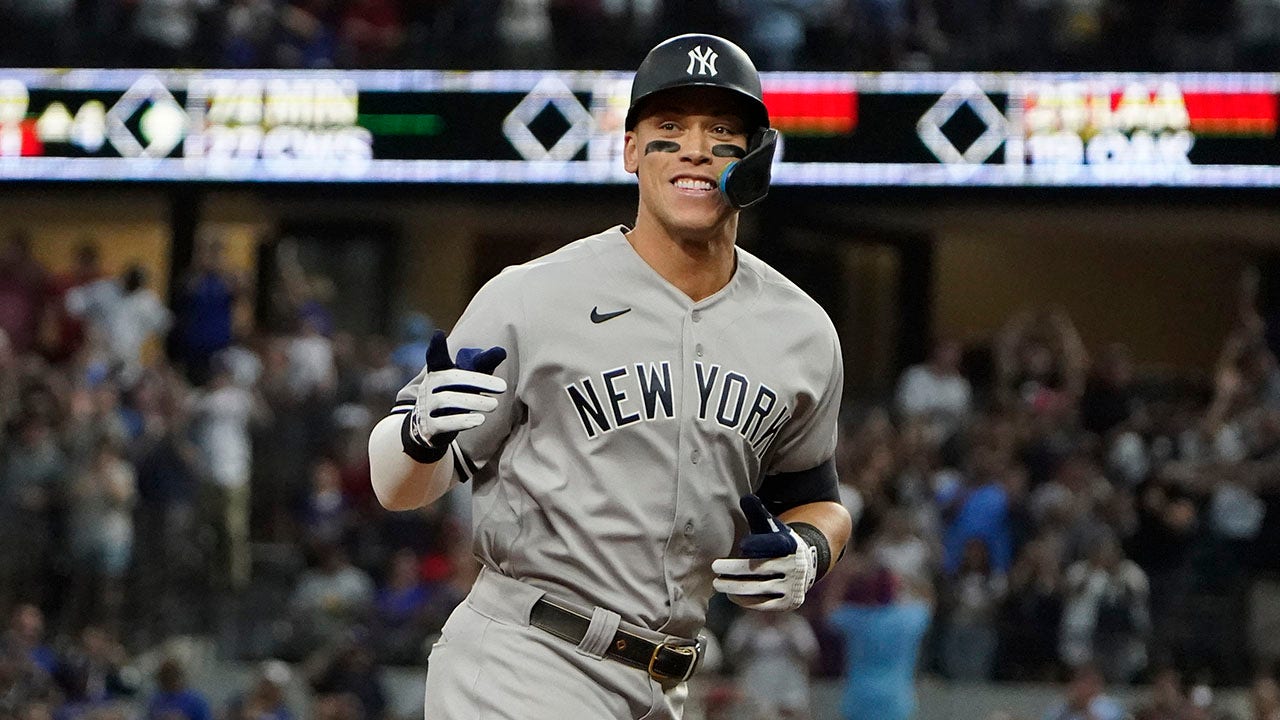
First batter of last night's game between the New York Yankees and the Texas Rangers: Aaron Judge. Pitcher: Jesus Tinoco. On a 1-1 count, Judge drilled a ball deep into the left-field stands at Globe Life Park in Arlington, Texas, 391 feet. It was his 62nd home run of the season, surpassing Roger Maris, the most that any American League player -- the most that any player has ever hit without evidence of cheating -- in a single season in the 152-season history of Major League Baseball.
How the tabloids told it

Unfortunately, as the great WCBS-Channel 2 sportscaster Warner Wolf would say, "Turn your sets off right there!" The Yankees loaded the bases in the top of the 1st inning after the Judge milestone, but couldn't get any of those runs home. Giancarlo Stanton hit a home run in the 5th, but that was all that the Yankees were going to get.

Gerrit Cole started, and pitched 6 innings, striking out 9, setting a new Yankee single-season record of 257 strikeouts, breaking the 1978 record of 248 set by Ron Guidry. But he didn't get the run support he needed. After the Stanton homer, the Yankees got only 2 baserunners, both walks.

Rangers 3, Yankees 2. WP: Kolby Allard (1-2). SV: Matt Moore (4). LP: Cole (13-8). The Yankees' record dropped to 99-62 -- the number of wins matching Judge's uniform number, and the number of losses matching his home run total. Of course, the 2 milestone numbers, 62 and 257, suggest what the Yankees' record might be in games in which they score 2 runs or less. (In fact, it's 12-39. It's when 20-48 when they score at least 3, 30-52 when they score at least 4, 47-47 when they score at least 5, 64-49 when they score at least 6.)

The series, and the regular season, conclude this afternoon. Domingo Germán pitches for the Yankees, Glenn Otto for the Rangers. Judge is being rested, so he finishes the season with 62 homers. He also led the AL with 131, and batted .311, which was nearly enough to win the AL batting title and thus the Triple Crown.


Thursday, September 29, 2022

Judge 61 and -.0013, Cole 248

Let's not bury the lead: Last night, Aaron Judge hit his 61st home run of the season. It drove in the tying and go-ahead runs, and the Yankees beat the Toronto Blue Jays, 8-3 at the Rogers Centre in Toronto.

It tied the American League record set by a previous Yankee right fielder, Roger Maris, in 1961. It surpassed the record that Maris broke, set by yet another Yankee right fielder, Babe Ruth, with 60 in 1927.

Judge magnanimously says that Barry Bonds' 73 in 2001 is the real record. With all due respect to the man who is putting up the greatest season I've ever seen from any player -- noting that he's played great defense, too -- he's wrong about this. Bonds' 73 for a season and his 762 for a career are fake. The career record remains 755 by Hank Aaron. And Roger Maris Jr., who hugged Judge's mother in the stands after the record-tying home run, is right that Major League Baseball should officially recognize 61, or whatever number Judge finishes with.

The Blue Jays began the game by walking Judge. In all fairness, he has worked full counts on most of these walks. But Oswaldo Cabrera then walked as well, and you know what leadoff walks can do. Josh Donaldson and Oswald Peraza hit RBI singles. (We're gonna have to start calling these guys "Ozzie C" and "Ozzie P.") Harrison Bader grounded out, but Marwin González singled home a run. It was 3-0 Yankees before Gerrit Cole even took the mound.

And he was in pursuit of a record, too. In 1978, Ron Guidry stuck out 248 batters to set the Yankee single-season record. Cole came close to breaking it last year. Last night, he had a perfect game going through 5 innings, and had struck out 4 batters, to tie the record.

But he couldn't get the 249th. Worse, he gave up another home run to lead off the 6th, and ended up blowing the lead. It was 3-3 when Aaron Hicks led off the top of the 7th with a single. Pressure on Judge? Maybe late, game-on-the-line pressure was just what he needed. He took ball 1 from Tim Mayza, and then sent a no-doubt-about-er way over the left field fence. Number 61. Yankees lead, 5-3.

A fan tried to catch it, but it bounced off his glove, and down into the Blue Jays' bullpen. As it turned out, his name -- I swear, I'm not making this up -- was Frankie Lasagna, and he owns an Italian restaurant in Toronto. And he couldn't catch it.

The puns have flown. "That's a spicy meet-a-ball." "It got pasta him." "Frankie, ricotta catch that!" My own response was to paraphrase the late, great Ray Liotta in Goodfellas: It was revenge for 1985, and 1993, and a lot of other things. And there was nothing he could do about it. Judge was a made man, and Frankie wasn't. And he just had to sit there and take it.

The Yankees got another run in the 7th, on a Bader single. Two more runs came thanks to sloppy Toronto fielding in the 9th. Cole got the 1st out in the 7th, but had thrown 92 pitches, so Aaron Boone took him out. Zack Britton got the 2nd out, but walked 2 batters. Scott Effross got the 3rd out. Clarke Schmidt pitched a scoreless 8th. And Aroldis Chapman, who doesn't need added pressure, and had hardly any, pitched a perfect 9th.

Yankees 8, Blue Jays 3. WP: Cole (13-7). No save. LP: Mayza (8-1).

The Yankees have today off. Tomorrow, they start a 3-game home series against the Baltimore Orioles, so Judge will have a great chance to hit Number 62 at home. Then, we close the regular season with 4 games away to the Texas Rangers. Then, we wait to see who we play in the American League Division Series, which gives us a chance to properly set our rotation up.

If everybody takes their regular turn in the rotation, then Cole would get his chance to surpass Guidry this coming Tuesday, October 4. Regardless of how he does, that would work out just fine for him to start Game 1 of the ALDS, because he'd get 6 days' rest, as it's on Tuesday, October 11.

The ALCS would run from October 19 to, if it goes to a Game 7, October 26; and the World Series will start, weather permitting, on October 29, and a Game 7 would set a new record for latest-in-the-year MLB game ever, November 5. Why so late? The lockout that began this season, pushing the regular season's start back a week. In other words, without that, Game 7 of the World Series would have been on October 29.

Judge also still has a good shot at the Triple Crown. He easily leads the AL in both home runs and runs batted in. In the race for the highest batting average, he has .3134, trailing Luis Arráez of the Minnesota Twins at .3147 -- .0013 behind. Xander Bogaerts of the Boston Red Sox had been neck-and-neck with Judge, but he has slipped to .309.

Wednesday, September 21, 2022

Judge's 60th, Stanton's Walkoff Beat Buccos

Strange things, or at least things strange to me, happened in last night's Yankee game. They were playing a National League team, in this case the Pittsburgh Pirates, and it wasn't the World Series. They didn't get the pitching they needed, and they won, anyway. Also, a man hit his 60th home run of the season, and, as far as we can tell, didn't cheat to get it. And that wasn't even the biggest home run of the game.

Nestor Cortes started, and, again, was limited to 5 innings, allowing just 1 run on 5 hits and 2 walks. Ron Marinaccio and Lou Trivino pitched the 6th, Jonathan Loáisiga the 7th, and Clay Holmes the 8th. Each of them allowed at least 1 run. Aroldis Chapman was put in for the 9th, in what looked at the time like a non-pressure situation, and he got all 3 batters out. It was 8-4 Pirates going to the bottom of the 9th.

Harrison Bader, the injured center fielder that the Yankees got from the St. Louis Cardinals in the Jordan Montgomery trade, finally made his Yankee debut. He went 2-for-4 with 3 RBIs, driving in a run with a single in the 5th inning and 2 with a single in the 6th. Had the game ended 8-4, his performance would have been the silver lining in a very cloudy game.

Aaron Judge led off the bottom of the 9th, against Pirate pitcher Wil Crowe -- whose great-grandfather was a brother of Yankee Hall-of-Famer Red Ruffing. Now, Crowe has a new claim to fame: Judge hit Number 60 off him, a no-doubt-about-er over the left-center-field bleachers. Judge joined Babe Ruth and Roger Maris to be the only players ever to hit 60 home runs in a major league season without cheating.

It was 8-5. The Yankees needed more baserunners. They got them, as the crowd of 40,157 seemed to feed off of Judge's homer, and the players seemed to feed off the crowd's energy. The homer was followed by a double by Anthony Rizzo. Gleyber Torres drew a walk. The tying run was at the plate. Josh Donaldson singled to load the bases with nobody out. Would the Yankees pull this out, or would the Buccos shut them down and make this another tease, another "Yankee RISPfail"?

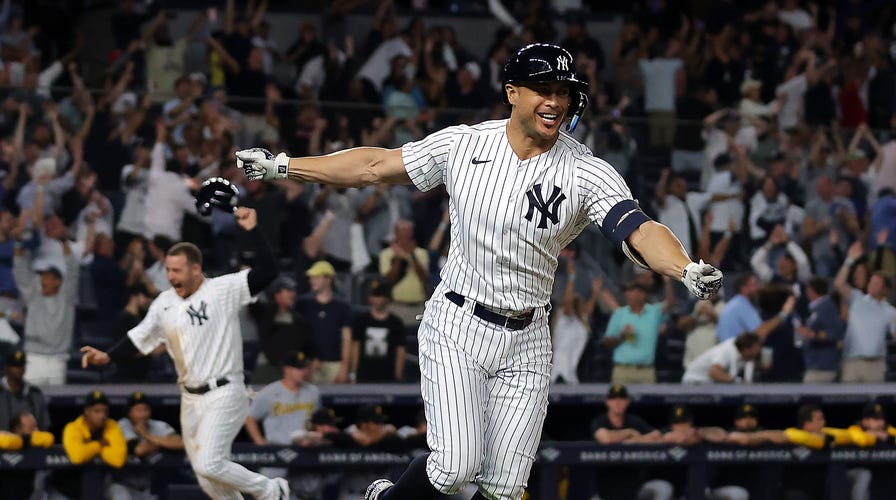
The batter was Giancarlo Stanton. He hit a screaming liner that just barely cleared the left field fence. Home run. Grand slam. Ballgame over. Yankees win. Theeeeeeee Yankees win!

Yankees 9, Pirates 8. WP: Chapman (3-3). No save. LP: Crowe (5-10).

The Toronto Blue Jays also won, so the Yankees' Magic Number was reduced to 10. Of course, 60 home runs is also a magic number. But the main story was the win, thus Stanton's homer. YES announcer Michael Kay made the point that Stanton, presumably clean, had hit 59 homers with the Miami Marlins in 2017, and yet nobody remembers it. This walkoff grand slam was his 27th homer of this season, still a pretty good total, even before you factor in the fact that, yet again, he missed a big chunk of the season due to injury.

The short series with the Pirates concludes tonight. Luis Severino has been activated from the Injured List, and is scheduled to start against Roansy Contreras. Is this the night for Judge to hit Number 61, to tie the American League (and real major league) record held by Roger Maris? Or even to also hit Number 62 to break it? Stay tuned.

Saturday, October 9, 2021

The 1961 New York Yankees: The Best Team Ever?

October 9, 1961, 60 years ago: Led by a pair of 5-run innings at Crosley Field, the Yankees win the World Series, beating the Reds in Game 5, 13-5. Johnny Blanchard, a reserve player who will collect 10 hits in 29 at-bats in 5 Fall Classics, hits 2 home runs and bats .400, en route to the Bronx Bombers' 19th World Championship.

Mickey Mantle barely played in this Series, but Roger Maris hit an unofficial 62nd home run of the season, while Whitey Ford broke the record for most consecutive scoreless innings pitched in the World Series, running his total to 30. The previous record? It was 29 2/3rds, set by a Boston Red Sox lefthander named… Babe Ruth.

Whitey would raise the record to 33 in 1962. Mariano Rivera would slightly break this record, pitching 33 1/3 consecutive scoreless innings in postseason play, but not all of it in World Series play.

The 1961 Yankees were, like the 2021 Yankees, a bit streaky. They lost their season opener, then won 5 straight games. They followed this by losing 3 straight. At this point, April 26, Ralph Houk, a rookie manager having been handed the job after the firing of Casey Stengel, then made a switch, putting Maris 3rd in the batting order and Mantle 4th. This gave Maris the protection he needed to be a better hitter, and launched the Yankees on an 8-1 run.

Then came another mediocre stretch, 3-9. But they straightened it out: From June 4 to 15, the Yankees went 13-2; from June 20 to 26, 6-1; from June 30 to July 27, 20-6; from August 2 to 11, 11-1; and from August 16 to 27, 9-3.

The Yankees would go on to hit 240 home runs, a major league record that stood until 1996, and a team record that stood until 2009. Mantle and Maris both seemed like they could break Babe Ruth's single-season record of 60, set in 1927. Mantle got sick near the end of the season, and finished with a career-high 54. Maris hit his 59th of the season on September 20, which turned out to be the Pennant-clincher; his 60th on September 26; and his 61st on the last day of the regular season, October 1, off Tracy Stallard of the Boston Red Sox, for the only run in a 1-0 Yankee win.

Bill "Moose" Skowron led the team's righthanded hitters with 28 home runs. The 1960 season was the 1st in which usual catcher Lawrence "Yogi" Berra and left fielder Elston Howard had switched positions. In 1961, the Yankees got 22 homers from Berra, 21 from Howard, and another 21 from Johnny Blanchard, who was also a catcher, and played the outfield, including filling in at right field after Maris moved over to center at the end, in place of the ailing Mantle. So the Yankees got 64 home runs from their catchers.

The defense was exceptional, with an infield of Skowron at 1st base, Bobby Richardson at 2nd, Tony Kubek and shortstop, and Clete Boyer at 3rd base. Before Brooks Robinson of the Baltimore Orioles in 1970 and Graig Nettles of the Yankees in 1978, Boyer would be the 1st man to put on a spectacular fielding display at 3rd base in a World Series.

Berra had been a great catcher, Howard was now one as well. Berra was all right in left field, Mantle was really good in center (if not quite the equal of his predecessor Joe DiMaggio or his contemporary Willie Mays), and Maris might have been the best defensive right fielder the Yankees ever had.

The pitching was strong. Under Stengel, Edward "Whitey" Ford, the team's ace, would be moved up or back in the rotation, to bypass lesser teams and face tougher ones. Houk let him pitch every 4th day, no matter what, and Whitey responded not just with his 1st 20-win season, but with a 25-4 season that earned him the Cy Young Award -- from its establishment in 1956 until 1966, given to the top pitcher in both Leagues.

Ralph Terry went 16-3, and would go 23-12 the next year, winning the Cy Young. Bill Stafford went 14-9, Rollie Sheldon 11-5, and Luis Arroyo 15-5 with 29 saves, then a major league record. Bob Turley, the 1958 Cy Young Award winner, battled injury much of the year, and was only 3-5.

Still, this would not be a typical Yankee season, where they ran away with the Pennant, and the American League once again became "The New York Yankees and the Seven Dwarfs" -- especially since expansion meant the birth of the Los Angeles Angels and the "new" Washington Senators, who replaced the old team, which had moved to become the Minnesota Twins.

Because the Detroit Tigers hung tough, with future Hall-of-Famers Al Kaline and Jim Bunning, and All-Stars Rocky Colavito, Norm Cash, Bill Bruton, Dick McAuliffe, Don Mossi, and a pitcher whose wins over the Yankees the last few years had gotten him nicknamed "The Yankee Killer," Frank Lary.

On Friday, September 1, with the Yankees leading them by a game and a half, the Tigers came into The Bronx for a showdown. The game was won by 3 straight singles with 2 outs in the bottom of the 9th, by Howard, Berra and Skowron: 1-0 Yankees. The Yankees won the Saturday game, 7-2, thanks to 2 Maris homers, 1 off Lary.

The Sunday game was a back-and-forth affair that the Yankees led 4-1 after 5 innings, then trailed 5-4 going to the bottom of the 9th. But Mantle led off the inning with a home run, and, following a Berra single, an Arroyo sacrifice bunt, an intentional walk of Skowron, and a flyout by Boyer, Howard won it with a home run, 8-5.

The Yankees now led by 4 1/2 games, and it was the start of a 13-game winning streak that would put them 11 1/2 ahead. A last-gasp 4-game series at Tiger Stadium wasn't enough, as the Tigers could only manage a split. When it was over, the Yankees had 109 wins, the Tigers 101.

Mantle only played 1 game in the World Series, but it wasn't necessary. The Reds won Game 2, but the Yankees won the rest.

Pitcher Duane "Duke" Maas, who made 1 relief appearance in April, was the 1st '61 Yankee to die, in 1976. Howard died in 1980, Maris in 1985, reserve 1st baseman Earl Torgeson in 1990, Mantle in 1995, Stafford in 2001, reliever Hal Reniff and reserve catcher Jesse Gonder in 2004, Boyer in 2007, reserve outfielder Tom Tresh (who would be the AL Rookie of the Year in 1962) in 2008, Blanchard in 2009, reliever Danny McDevitt (also the Dodger who won the last game at Ebbets Field in 1957) in 2010, Skowron in 2012, reserve 1st baseman Bob Hale in 2012, Turley in 2013, Berra in 2015, Arroyo and reserve infielder Joe DeMaestri in 2016, reserve outfielder Bob Cerv in 2017, relievers Tex Clevenger and Jim Coates in 2019, Ford in 2020, and reliever Art Ditmar in 2021.

There are still 7 living members of the 1961 World Champion New York Yankees: Richardson, Kubek, Terry, Daley, reserve outfielder Hector Lopez, reserve infielder Billy Gardner, and reserve outfielder Jack Reed. Reserve outfielders Johnny James and Lee Thomas, who appeared in 1 and 2 games, respectively, before being traded to the Angels to get Cerv back, are also still alive. So is Al Downing, who made only 5 appearances and did not make the World Series roster, but became a key starter by 1963.

Mantle called the 1961 Yankees, "the best team I ever saw." The 1927, 1936 and 1998 Yankees have also been listed among the greatest teams ever. The 1961 Yankees were the first such team in the television era, aided by the Maris & Mantle "M&M Boys" home run record chase, and thus have stuck in fans' minds ever since.

*

October 9, 1701, 320 years ago: "The Collegiate School" is founded in Saybrook Colony, in what is now Old Saybrook, Connecticut. It is moved to New Haven in 1716, and in 1718 is renamed for a benefactor: Yale College.

Elihu Yale was born in 1649 in Boston, but his father soon moved the Welsh family back to London for business. Yale rose through the East India Company, trading with India and the East Indies, and was named president of their office in Madras (now named Chennai). But he was dismissed when the company learned he had made his fortune through dishonest means. He was also involved in the slave trade of the era.

Perhaps his donations to the Collegiate School that would bear his name was a way of making up for that. He died in 1721. The school was renamed Yale University in 1887, and had already begun to be vital in the development of American education and American sports.

Also in honor of Eli Yale, the University is sometimes known as "Old Eli," and its students and alumni "Yalies" or "Elis." The school newspaper is The Yale Daily News, nicknamed The Daily Yalie.

October 9, 1779: Count Casimir Pulaski, "the Father of the American Cavalry," is wounded during the Siege of Savannah, which is now doomed to failure. He dies on October 11, at age 34, and the siege is called off on October 18. The Georgia seaport city remains under British control until the Treaty of Paris of 1783 gives it back to America.

*

October 9, 1891, 130 years ago: Lyman L. Frimodig is born in Laurium, Michigan. He is the only athlete in the history of Michigan State University (then still named Michigan State College) to earn 10 varsity letters: 4 in baseball, 4 in basketball, and 2 in football.

From 1920 to 1922, he was their basketball coach. From then until 1960, he taught at the school. From 1933 to 1937, he was Mayor of East Lansing, where the school is located. He was elected to the Michigan Sports Hall of Fame, and lived until 1972.

Also on this day, Otto Young Schnering is born in Chicago. In 1916, he founded the Curtiss Candy Company. He named it after his mother's family, since World War I was going on and naming it after himself, with a German name, was a bad idea.

In 1920, he named a candy bar the Baby Ruth, after the biggest star in baseball. When Ruth sued for the use of his name without his permission, Schnering told the court that the bar was named after Ruth Cleveland, daughter of Grover Cleveland. Ruth had died at age 13, and the country went into mourning, so he named the bar in tribute to her. Nobody bought it: The country not only hadn't gone into mourning, and had already forgotten Grover, let alone Ruth Cleveland. Well, 12 people bought it: The jury. He won.

The Great Depression almost knocked Curtiss out, until he launched the Butterfinger bar, and it saved him. He died in 1953. By 1977, Curtiss was owned by Standard Brands, and in honor of Reggie Jackson, who followed Babe Ruth by becoming the 2nd player to hit 3 home runs in a World Series game, they launched the Reggie! Bar. It was basically a round version of the Baby Ruth. By the 21st Century, the Baby Ruth was the official candy bar of Major League Baseball, putting an end to the pretense.

*

October 9, 1919: The Cincinnati Reds defeat the Chicago White Sox, 10-5, taking Game 8 and the best-5-out-of-9 World Series. It is the 1st World Championship for Cincinnati – or, at least, the 1st since the unofficial one for the Cincinnati Red Stockings, the first openly professional baseball team, in 1869, half a century earlier.

Sox pitcher Claude "Lefty" Williams gets one man out in the 1st before departing, having allowed 4 runs. The Reds go on to give Hod Eller plenty of offense. White Sox left fielder "Shoeless" Joe Jackson hits the only home run of the Series. Eddie Collins’ 3 hits give him a total of 42 in Series play‚ a record broken in 1930 by Frank Frisch‚ and bettered by Lou Gehrig in 1938. A stolen base by Collins is his 14th in Series competition‚ a record tied by Lou Brock in 1968.

How could the White Sox have lost? "Everybody" said they were the superior team. Actually, while the ChiSox were more experienced – they had won the Series 2 years earlier – they had won 88 games that season, but the Reds had won more, 95. And the Reds had Hall-of-Famer Edd Roush, and several players who would have been multiple All-Stars had there been an All-Star Game at the time.

Still, everybody seemed to think the Sox were better. And yet, the betting shifted to make the Reds the favorites. What had happened?

On September 28, 1920, 8 White Sox players were indicted for conspiracy to throw the Series: Jackson, Williams, pitcher Eddie Cicotte, right fielder Oscar "Happy" Felsch, 1st baseman Arnold "Chick" Gandil, shortstop Charles "Swede" Risberg, reserve infielder Fred McMullin (only in on the fix because he overheard Felsch and Gandil talking about it), and 3rd baseman George "Buck" Weaver (who refused to take part, but was indicted because he knew about it and refused to report it).

Although all were acquitted, Commissioner Kenesaw Mountain Landis banned them all permanently.
For the rest of their lives, Roush, the last survivor (he lived until 1988), and the other '19 Reds insisted that, if the Series had been on the up-and-up, they would have won anyway.

Really? Here's something else to consider: Down 4 games to 1 in that best-5-out-of-9, the Sox won Games 6 and 7, playing to win because the gamblers hadn't come through with their payments, and Williams only caved in for Game 8 because his wife and children had been threatened if he did not comply. Williams was 0-3 for the Series, a record not "achieved" honestly until 1981 and George Frazier of the Yankees.

Trust me on this one: If you want to get closer to the facts of the case, see the film Eight Men Out; but if you want to see a movie that makes you feel good, see the factually-challenged but beautiful
Field of Dreams.

*

October 9, 1921, 100 years agoGame 4 of the 1st all-New York World Series. After a rainout, a Sunday crowd of 36,371 watches Carl Mays of the Yankees and Phil Douglas of the Giants square off. Among them are a group of Prohibition agents, who cause a near-riot by trying to barge their way into the game by saying they were there on "official business." When ticket takers refuse to let them in, the police are called to forcibly remove the agents from the line as angry fans look on.

Tomorrow, federal Prohibition Commissioner Roy Haynes will issue orders barring agents from using their badges to gain admission to places of amusement. This may not be the most bizarre moment in the history of the movement and execution of Prohibition, but it may be the dumbest, and was typical of the men enforcing it being every bit as corrupt as those who broke the most-broken law in American history.

Mays works 5 hitless innings, while a run-scoring triple by Wally Schang gives the not-yet-Bronx Bombers a 1–0 lead. Mays then apparently tires, and the Giants club 7 hits in the last 2 innings for 4 runs. Babe Ruth's 1st World Series homer comes in the 9th, but the Giants win 4–2.

We can say, "apparently," because, just 2 years after the Black Sox threw a Series, there would soon be accusations that Mays threw the game. Mays, the son of a Kentucky minister, was known to refuse to pitch on Sundays, and, though it was his turn in the rotation, losing on purpose, and screwing over his teammates, may have been his way of objecting.

Is that, rather than having thrown the pitch that killed Ray Chapman of the Indians the year before, the real reason he's never been elected to the Hall of Fame? He had a 209-126 record for his career, for a winning percentage of .622. He was also a member of 6 Pennant-winning teams, taking 4 World Championships (1915, '16 and '18 with the Reds Sox, 1923 with the Yankees).

Here's a neat little piece of baseball trivia: Mays is the only Red Sox pitcher to pitch 2 complete-game victories on the same day. It was on August 30, 1918. That same day, the greatest player in Red Sox history, Ted Williams, was born.

Former Minnesota Twins closer Joe Mays is a distant cousin, but, being born 4 years after Carl's death in 1971, they never met. Until the day he died, over half a century after the incident, Carl still insisted that he did not hit Chapman intentionally. The best piece of evidence in his favor is that the ball rebounded back to him, and he fielded it and threw it to 1st, suggesting that, at that point, he thought Chapman had hit it.

Also on this day, Dorothy Elsie Wilkinson is born in Phoenix. A softball and bowling star from the 1930s to the '60s, Dot Wilkinson turns 100 today, and a member of both sports' halls of fame, and the Arizona Sports Hall of Fame.

October 9, 1928: At Sportsman's Park in St. Louis, the Yankees beat the Cardinals, 7-3, completing their 2nd consecutive sweep of the World Series. The Bronx Bombers, who win the 3rd World Championship in franchise history, live up to their name as they slug 5 homers in the game, a feat which will not be matched until 1989, when Oakland does it against San Francisco. Three of the homers are hit by Babe Ruth, who had done it at the same park 2 years earlier. This time, though, the Yankees win the Series.

In 2009, seeing Hideki Matsui collect 6 RBIs, including a home run, in Game 6, Yankee broadcaster John Sterling cited the man who was, at the time, the only other player to hit 3 homers in a Series game, and asked his listeners, "Has anybody, outside of Reggie Jackson, ever had a better Series-clinching game?" Yes, one man has. But only one. The Great Bambino. Ruth, Jackson, Matsui. The Sultan of Swat, Mr. October, and Godzilla. Pretty good company.

Shortstop Mark Koenig was the last survivor of the 1928 Yankees, living until 1993.

Also on this day, Clare James Drake is born in Yorkton, Saskatchewan. He is the most successful coach in Canadian Interuniversity Sport (CIS) men's hockey history. He coached the University of Alberta to 6 University Cup titles, and also coached Team Canada at the 1980 Winter Olympics. He has also worked in the front offices of some NHL teams, and was an assistant coach for the Winnipeg Jets. He died in 2018, having lived just long enough to see his election to the Hockey Hall of Fame. He was also a member of the Saskatchewan Sports Hall of Fame.

*

October 9, 1931, 90 years ago: Homer Austin Smith is born in Omaha, Nebraska. A teammate of Kazmaier at Princeton, he was All-Ivy League as a fullback. But he became better known as a coach. In 1969, he led Davidson College of North Carolina to the Southern Conference title.

He served as the head coach at the University of the Pacific in 1970 and 1971, and from 1974 to 1978 was the head coach at Army. His only pro coaching job was as offensive coordinator with the Kansas City Chiefs in 1987, and his last job was the same one at the University of Arizona in 1996. He died in 2011.

Also on this day, Canada's 1st television station begins broadcasting. It is VE9EC in Montreal, owned by radio station CKAC and newspaper La Presse. Many early radio stations were owned by newspapers, and many early TV stations were owned by one or the other, or both.

VE9EC doesn't last. Canada's 1st permanent TV station would also be in Montreal, and it would be CBFT, Channel 2, part of the Canadian Broadcasting Company (CBC). Two days later, Toronto's 1st TV station would follow, CBLT, also a CBC station, on Channel 9 until 1956, then 6 until 1972, then 5.

October 9, 1938: The Yankees beat the Cubs, 8-3, and complete a 4-game World Series sweep at Yankee Stadium. It is the Yankees' 7th World Championship, and their 3rd in a row. To this day, the only franchises that have as many as 7 are the Cardinals with 11, the A's with 9 (and even then you have to combine the 5 from Philadelphia with the 4 from Oakland), and the Red Sox with 9 (with the last 4 of those tainted). And, to this day, the only franchises to have won 3 in a row are the Yankees and the 1972-74 A's.

This would be the last game as owner of the Yankees for Jacob Ruppert, who bought the team in 1915, signed manager Miller Huggins, purchased or traded for the players who made the 1st Yankee Dynasty, and provided the money that built Yankee Stadium. He oversaw the Yankees' 1st 10 Pennants and their 1st 7 World Series wins. He died on January 13, 1939.

As with the 1937, 1939 and 1941 World Champion Yankees, the last survivor of the 1938 team was Ol' Reliable himself, Tommy Henrich.

*

October 9, 1940: Joseph Anthony Pepitone is born in Brooklyn. He was a backup to Bill "Moose" Skowron at 1st base in 1962, and received a World Series ring. The Yankees thought so highly of Pepitone that they traded Moose before the 1963 season.

Pepitone helped the Yankees win the 1963 and '64 AL Pennants, and hit a grand slam in Game 6 of the '64 World Series. He made 3 All-Star Teams and won 3 Gold Gloves. He had 182 career home runs before he turned 30. Joe was a New York kid playing for the local team, and he was very good. This made him enormously popular in New York at the time.

He had a bit of a nose, and was actually balding, but you couldn't tell that while he was wearing a cap or a batting helmet. (He had 2 toupees: A small one for during games, and a bigger "Guido" hairpiece for being out on the town.) Women wanted him, men wanted to be him. He was a matinee idol, and a hero to many, not just to his fellow Italian-Americans.

But, he would later admit, his father's death left him depressed, and he looked for comfort in New York's nightlife, in drinking and women -- "wine, women and song," as the old saying goes. He still hit a few home runs, and he still, as Yankee broadcaster Frank Messer put it, "played first base like he owned it," although he switched to center field in 1967 and '68 so that Mickey Mantle, with no DH in those days, could ease the strain on his legs by playing 1st base.

But if you're going to carouse like Mantle, you'd better be able to play like Mantle. Like all but maybe 20 men who have ever played the game, Pepitone was not at that level.

It didn't help that he came into his own just as the old Yankee Dynasty was collapsing. By 1970, he would no longer be a Yankee -- and, as it turned out, he and Mel Stottlemyre were the last remaining Yankees who had played on a Pennant winner. By 1973, he would be out of the major leagues, and playing in Japan, not hitting well, and begging off games with injuries, then getting caught dancing in Tokyo's discos. In Japan, "Pepitone" became a slang term for a person who goofed off.

He would do time on Rikers Island on gun charges in 1988, although drug charges against him were dropped. And he would have continued alcohol and marriage problems, getting arrested again in 1995, when he drunkenly crashed his car inside the Queens-Midtown Tunnel.

He has stayed out of trouble since then, and now lives on Long Island, getting by and then some at memorabilia shows. Still, he knows he could have been so much more, and he knows he blew it: He titled his 1975 autobiography Joe, You Coulda Made Us Proud. Jim Bouton had portrayed him poorly in his own 1970 book, Ball Four, and Joe has never forgiven Jim; but Joe followed Jim by writing his own tell-all, and it is considerably more lurid, and less funny.

But the bad things Joe has done are no excuse for what Cosmo Kramer did in that episode of Seinfeld. He had no right to hit Joe with a pitch at that fantasy camp. For crying out loud, Joe was 52 years old! You don't plunk a 52-year-old man! (Seinfeld co-creator Larry David would write his name into 2 more episodes, and into 2 episodes of Curb Your Enthusiasm. He's also been mentioned on The Golden Girls, The Sopranos, The West Wing and Rescue Me.)

Tony Conigliaro was a very similar player in Boston, but his career was curtailed by injury as much as by wasting his talent. New England fans have often suggested that, had he stayed healthy, Tony C would have been their Mantle. But now that Tony C is dead, and the Boston press no longer has to protect the popular, handsome, ethnic local boy, some less-than-savory details about his life have come out. Perhaps Sox fans should consider that Conigliaro, rather than their Mantle, could have become their Pepitone.

There was also a famous musician born on this day, in Liverpool, England, named John Winston Lennon. He would end up living in New York as well. I could swear that I once saw a picture of him wearing a Yankee cap, but I can't find it online.

Apparently, Pepitone didn't listen to Lennon, who seemed to believe that "All You Need Is Love." What Pepitone could have been, we can only "Imagine." (And, yes, I know there's a Christian rock song titled "I Can Only Imagine." I am aware of the irony of using a Christian song in connection with John Lennon.)

None of the Beatles appeared to have been much of a sports fan, except for Paul McCartney, who has expressed support for Everton. Pete Best, the drummer dumped in favor of Ringo Starr before the band hit it big, has been much more vocal in his support for Everton.

*

October 9, 1941, 80 years ago: Chester Trent Lott is born in Grenada, Mississippi, and grows up in nearby Pascagoula. He was born the same year as Emmett Till. Yet, in 1955, Till was murdered in Mississippi because he was a black boy whistling at a white woman (and it wasn't even true), while Trent Lott (he dropped his first name) went on to become one of the most powerful men in America.

He was a senior at the University of Mississippi when President John F. Kennedy federalized the State's National Guard to allow James Meredith to become the University's 1st black student. He also led his fraternity to maintain a whites-only policy.

In 1968, he became administrative assistant to his district's Congressman, William Colmer, a segregationist Democrat who was then chairing the House Rules Committee. When Colmer retired in 1972, Lott ran for his set -- as a Republican. He won, because the white voters of that district knew where he stood on race.

He was the House Minority Whip from 1981 until 1989, when he ran for the seat of retiring Senator John Stennis, and held it until 2007. He became Senate Majority Whip with the Republicans' takeover in 1995, and Majority Leader with Bob Dole's resignation in 1996.

On December 5, 2002, at a dinner honoring the 100th birthday of Senator Strom Thurmond of South Carolina, who had run for President in 1948 on a segregationist platform, launched a filibuster to stop the Civil Rights Act of 1957 (he failed), and switched to the Republican Party following the passage of the Civil Rights Act of 1964. Lott said of his home State of Mississippi, "When Strom Thurmond ran for President, we voted for him. We're proud of it! And if the rest of the country had followed our lead, we wouldn't have had all these problems over the years, either!" He was forced to resign.

Trent Lott is still alive, and still respected in the Republican Party. Emmett Till has been dead for 66 years.

October 9, 1944: The only all-St. Louis World Series ever ends as Emil Verban drives in 3 runs, and the Cardinals defeat the Browns 3-1, and win in 6 games. Within 10 years, the Browns will realize that the Cardinals will always be the Number 1 team in St. Louis, and move and take up the name of several previous teams in their new home town, the Baltimore Orioles.

The 1944 Orioles won the Pennant of the International League, despite Oriole Park having burned down on the 4th of July, necessitating a move to Municipal Stadium, a football stadium a few blocks away. At the exact same time that the Cards were dusting off the Browns, a crowd of 52,833, then a record for a minor league game, sees the Orioles fall to the Louisville Colonels, 5-4 in Game 4 of the "Junior World Series." But the Orioles would win the series in 6 games.

This team, and how well it drew (it's not the fault of the teams involved, but Sportsman's Park seated only 30,804 people, so the Junior World Series brought in more fans than the senior version), raised Baltimore's profile, and made its return to the majors for the first time since 1902 possible.

The last survivor of the 1944 Cardinals was Stan "the Man" Musial, living until 2013. The last survivor of the only Browns Pennant winner was Don Gutteridge, who lived until 2008.

October 9, 1946, 75 years ago: James Robert Qualls is born in Exeter, in the Central Valley of California. An outfielder, Jim Qualls played 4 seasons in the major leagues, debuting with the ill-fated 1969 Chicago Cubs, finishing with a weak batting average of .223.

But he will be forever remembered for his clean single to left-center that broke up Tom Seaver's perfect game and no-hitter with 2 outs to go on July 9, 1969. The Mets won the game anyway, 4-0 at Shea Stadium. Qualls is still alive.

October 9, 1949: The Yankees beat the Brooklyn Dodgers, 10-6 at Ebbets Field, and win the World Series in 5 games. The 2 teams had combined to win Pennants in the only season in the history of the single-division Leagues, 1901 to 1968, that both Leagues' Pennants remained undecided on the last day of the regular season.

With Jackie Robinson, Duke Snider and Carl Furillo, rookies from 1947, and older players Pee Wee Reese and Gil Hodges, bolstered by the 1948 arrivals of Roy Campanella, Billy Cox, Preacher Roe and Carl Erskine, and 1949 arrival Don Newcombe, "the Boys of Summer" had arrived. But they were not ready to beat the Yankees. Once again, the Dodgers had to "Wait Till Next Year." The Yankees, now winners of 12 World Championships, would enjoy many "next years" to come.

Bobby Brown died this year, the last surviving member of the '49 Yankees, one of the iconic teams in Pinstripe history due to Joe DiMaggio's midseason comeback from injury and their regular-season finale against the Red Sox.

Also on this day, Shep Norman Messing is born in The Bronx, and grows up in Roslyn, Long Island. A goalkeeper, he played at both New York University and Harvard, before making the North American Soccer League with the New York Cosmos in 1973. He had 3 tenures with the team, including their 1977 NASL Championship season.

He later managed the Oakland Stompers, and was a player-manager with the New York Arrows, who played in the Major Indoor Soccer League at the Nassau Coliseum. He is now a broadcaster for the New York Red Bulls.

*

October 9, 1951, 70 years ago: Game 5 of the World Series. The Giants score 1st, but a Gil McDougald grand slam in the 3rd and a Joe DiMaggio double in the 7th are the keys to a 13-1 demolition by the Yankees. Eddie Lopat goes the distance for the win.

This was the last World Series game the Giants would lose at the Polo Grounds. The Yankees clinched the next day at Yankee Stadium.

Also on this day, Robert Wuhl (no middle name) is born in Union Township, Union County, New Jersey. The actor has many sports connections: Pitching coach Larry Hockett in Bull Durham, Marty in Blue Chips, sportswriter Al Stump in Cobb, and sports superagent Arliss Michaels in Arli$$. But he's probably best known as Alexander Knox, reporter for The Gotham Gazette, in the 1989 film version of Batman.

October 9, 1958: The Yankees complete a 3-games-to-1 comeback – only the 2nd in World Series history, after the 1925 Pirates – by gaining revenge on the Braves, 6-2 at Milwaukee County Stadium, and take their 18th World Championship.

After being defeated by former Yankee farmhand Lew Burdette 3 times in the '57 Series, including getting shut out in Game 7, this time, the Yanks knock Burdette out of the box in Game 7. Bill "Moose" Skowron's 3-run 8th-inning homer off last year's Series nemesis puts the game on ice. Eddie Mathews strikes out for the 11th time‚ a record that will stand until 1980 when broken by Willie Wilson of the Kansas City Royals (and then again in 2009 by Ryan Howard of the Philadelphia Phillies). The Braves' 53 strikeouts are also a new Series record.

Bob Turley, about to become the Yankees' 1st Cy Young Award winner, had lost Game 2, but won Game 5 and saved Game 6, and now wins Game 7 on no rest. Mickey Mantle catches the final out in center field, the only time he was ever involved in a World Series' final play (hitting or fielding).

This is Casey Stengel's 7th World Championship‚ tying him with Joe McCarthy for the most Series won. No one would have believed it at the time, but it will be his last. It's also the 1st time that the official World Series highlight film, which had been produced since 1943, is in color.

There are 4 surviving players from the 1958 Yankees, 63 years later: Bobby Shantz, Bobby Richardson, Tony Kubek and Zach Monroe.

The Yankees would miss the World Series in 1959, but would be back in each of the next 5 years. The Braves, on the other hand, would not return to the Fall Classic for another 33 years, and, by then, they would be in Atlanta. The City of Milwaukee would not get back for another 24 years, and then with the Brewers, and only that once since.

At the time, Dwight D. Eisenhower, a member of the Republican Party, was the President of the United States. In the 63 years since, the Yankees have won 9 World Series, all when the President was a member of the Democratic Party: John F. Kennedy in 1961 and 1962; Jimmy Carter in 1977 and 1978; Bill Clinton in 1996, 1998, 1999 and 2000; and Barack Obama in 2009. They also lost the World Series under Democratic Presidents JFK in 1963 and Lyndon Johnson in 1964.

Under Republican Presidents, the Yankees have lost World Series in 1960 (Eisenhower), 1976 (Gerald Ford), 1981 (Ronald Reagan), 2001 (George W. Bush) and 2003 (Dubya again). Under Richard Nixon, their best performance was 2nd place in the AL East in 1970. Under the elder George Bush, they never even had a winning season. Under Donald Trump, they made the Playoffs all 4 years, but didn't win a Pennant. Now, in the 1st year of Democratic President Joe Biden, they have failed again.

Since 1958, the Yankees have had 29 seasons under a Democratic President, winning 11 Pennants and 9 World Series; and 34 full seasons under a Republican President, winning just 5 Pennants, and losing the World Series each time. The Curse of Ike Lives.

October 9, 1966: For the 2nd consecutive day, the Orioles win a World Series game, 1-0, at home at Memorial Stadium, in a contest decided by a home run, when Frank Robinson takes a Don Drysdale pitch deep over the left field fence in the 4th inning. The lone run being scored on a homer for only the 5th time in the history of the Fall Classic, and the complete-game shutout thrown by Dave McNally, Baltimore completes a 4-game sweep over the Dodgers.

It is the 1st World Championship won by a Baltimore baseball team in 70 years, since the original version of the Orioles won the 1896 National League Pennant. For the Dodgers, 33 consecutive innings without scoring a run is a Series record for futility. Their streak would run to 38 innings before they scored in the 5th inning of Game 1 of the 1974 World Series, and remains a record.

There are 7 players still alive from the '66 O's World Series roster, 55 years later: Hall of Fame 3rd baseman Brooks Robinson, Hall of Fame shortstop Luis Aparicio (the only ring the White Sox legend ever won), Hall of Fame pitcher Jim Palmer (the only man on all 3 Oriole World Champions: '66, '70 & '83), 1st baseman John "Boog" Powell, 2nd baseman Davey Johnson (later the manager of the '86 Mets), outfielder Russ Snyder and pitcher Wally Bunker. 

*

October 9, 1971, 50 years ago: The defending Stanley Cup Champion Montreal Canadiens open a new season by retiring the Number 4 of their recently retired Captain, Jean Béliveau. They play the New York Rangers to a 4-4 tie at the Montreal Forum.

Also on this day, the film The French Connection premieres. It is a dramatization of the New York Police Department's 1961 breaking of the drug-trafficking scheme that ran from Istanbul, Turkey across the Mediterranean Sea to Marseille, France, and finally to New York.

The breakers were Detectives Sonny Grosso and Eddie Egan. Robin Moore turned it into a book, and William Friedkin turned it into the film. The lead character of Jimmy "Popeye" Doyle, based on Egan, was played by Gene Hackman. Egan himself became an actor, and died of cancer in 1995. Grosso was fictionalized as Buddy Russo, played by Roy Scheider. Grosso died in 2020, at age 89.

The iconic car chase happens in the Bensonhurst section of Brooklyn, where Hackman's Doyle drives a 1971 Pontiac LeMans (ironically, a car with a French name) under the BMT West End Line, now the D Train, from 86th Street to 62nd Street.

In 1972, the Buffalo Sabres acquired right wing René Robert, and put him on a forward line with center Gilbert Perreault and left wing Rick Martin, also French-Canadians. The line became known as The French Connection, and would remain together through 1979, including a berth in the 1975 Stanley Cup Finals and a defeat of the Soviet Red Army team on their 1976 tour of North America. 

October 9, 1973: The Capital Bullets debut, having been the Baltimore Bullets for the preceding 10 years. They don't quite move into the nation's capital, Washington, D.C., instead opening the new saddle-roofed Capital Centre in the suburb of Landover, Maryland, just 33 miles from the Baltimore Civic Center.

To put that in perspective: The San Francisco 49ers' Levi's Stadium is 46 miles from downtown San Francisco, and only 9 miles from downtown San Jose, but they have kept the "San Francisco" name.

The Bullets play their 1st game on the road, against the Atlanta Hawks at the Omni, and lose 128-114. Mike Riordan leads the Bullets with 26 points, but Super Lou Hudson scores for 41 for the hosts.

They will reach the NBA Finals 3 times before the decade is out, winning the NBA title in 1978. They will change their name to the Washington Bullets the next season, and in 1997 to the Washington Wizards, to help offset the District of Columbia's image as "the murder capital of America." That same year, they will leave the suburbs for the District, opening the arena now known as the Verizon Center. The Cap Centre was demolished in 2002, and was replaced with a mall.

Amazingly, the Baltimore Civic Center still stands, under the name Royal Farms Arena. The city is finally working on a plan to replace it with a more modern arena, in the hopes of attracting an NBA or NHL team.

October 9, 1974: The NHL's 2 new expansion teams both make their debut on this day. The Washington Capitals, like the Bullets making their home at the suburban Cap Centre, get pounded by the New York Rangers 6-3. Jim Hryculk scored the Caps' 1st goal.

The Caps' 1st season was historically bad, including not winning a single game on the road until their last, after which they skated around the ice with a garbage can as if it were the Stanley Cup. They would seem snakebit, losing Playoff series they should have, including the 4-overtime "Easter Epic" Game 7 against the New York Islanders in 1987.

Moving to the MCI Center in downtown D.C. in 1997 seemed to help, as they went on to make their 1st Stanley Cup Finals in their 1st season there. But they got swept in 4 straight, and continued to fall short, as the name of the arena was changed to the Verizon Center. But with the name changed again to the Capital One Arena, they finally got back to the Finals in 2018, and won their 1st Cup.

Also on this day, the Kansas City Scouts are no luckier than were the Caps. They lose their debut 6-2 to the Toronto Maple Leafs at Maple Leaf Gardens. After 2 bankrupt years at Kansas City's Kemper Arena, they move to Denver in 1976, becoming the Colorado Rockies. They are not appreciably better, making the Playoffs only in 1978, and in 1982 they move again... becoming the New Jersey Devils.

The Devils now hang Scouts and Rockies jerseys in a display case at their current home, the Prudential Center in Newark. These are pretty much the only nods they make to their pre-Jersey history. While the NHL would return to Denver in 1995, and both the Islanders and the Pittsburgh Penguins would threaten to move to Kansas City's new Sprint Center arena as bargaining chips to get their own new arenas, the NHL has never gone back to K.C.

October 9, 1976: For the 1st time, the New York Yankees play an American League Championship Series game. For the 1st time, a Kansas City team plays a postseason game in Major League Baseball. The experience is far better for New York, as 2 1st-inning errors by the Royals’ best player, 3rd baseman George Brett, helps Catfish Hunter go the distance in a 4-1 Yankee win at Royals Stadium (now Kauffman Stadium).

Philadelphia plays its 1st postseason game in 26 years, but in spite of ace Steve Carlton being on the mound -- usually described by the Phillies as "Win Day" -- Don Gullett retires 21 of his last 22 batters to outduel the legendary Lefty, and the Cincinnati Reds defeat the Phillies, 6-3.

But the Royals and Phillies still have a better day than Bob Moose. The Pirates pitcher was driving to a golf course owned by former teammate Bill Mazeroski in Martin's Ferry, Ohio -- also the home town of the Niekro brothers -- when his car crashes, killing him. To make matters worse, it's his birthday. He was 36.

Also on this day, the Rutgers football team beats the University of Connecticut 38-0, at Rutgers Stadium in Piscataway, New Jersey. The undefeated season continues.

October 9, 1977: The Yankees come back from deficits of 1-game-to-none, 2-games-to-1, and 3-0 down in the 8th inning of Game 5, to defeat the Kansas City Royals, 5-3 at Royals Stadium (now Kauffman Stadium), to win their 31st American League Pennant.

The Royals had won 102 games, still a record for any Kansas City team (the A's never got close to a Pennant race in their K.C. years), and with the home-field advantage in Games 3, 4 and 5, and with lefthanded pitching from Paul Splittorff and Larry Gura that they could use to neutralize Yankee sluggers like Reggie Jackson, Graig Nettles and Chris Chambliss, they were sure they were the better team. They were wrong. The Yankees go on to face the Dodgers in the World Series for the 9th time.

Indeed, this series was the source of the long-since-debunked, but still popular, idea of "The Yankees can't hit lefthanded pitching, especially in the postseason." Reggie just couldn't hit Splittorff or Gura, and Billy Martin benched him for the deciding Game 5 -- sending Reggie's best friend on the team, backup catcher Fran Healy, to tell him, because Billy was too much of a coward to do it himself.

But when Splittorff tired, and was replaced by righthander Doug Bird, Billy sent Reggie up to pinch-hit for righthanded DH Cliff Johnson. It was a most un-Reggie-like hit, but it got the job done: A looper, nearly but not quite caught by center fielder Amos Otis, got home a run to cut the deficit to 3-2, before the Yankees won it in the 9th.

The game ended when Freddie Patek, on his 33rd birthday, grounded into a double play. It was Patek's 33rd birthday. Veteran 2nd baseman Cookie Rojas, who had also been a member of the collapsing 1964 Phillies, had announced his retirement, and Patek, with whom Rojas had jumped into the Royals Stadium fountains after they clinched the Division last year, was shown by the NBC camera crying in the dugout, because Rojas would never play in a World Series. Cookie didn't crumble, but Freddie did. Yeah, sometimes, there is crying in baseball.

Patek's rotten luck would continue. He would lose the ALCS to the Yankees with the Royals again i 1978, then miss the Playoffs in 1979 when the California Angels won the AL West. After the season, he was traded to the Angels. But the next 2 seasons, the Angels didn't make the Playoffs with him, while the Royals made the Playoffs without him, including winning their 1st Pennant in 1980, beating the Yankees. He retired after the 1981 season... and the Angels won the AL West in 1982.

*

October 9, 1980: This is one October 9 that did not work out well for the Yankees. In Game 2 of the ALCS, with the Yankees trailing the Royals 3-2 with 2 outs in the top of the 8th inning, George Steinbrenner is caught on live national television jumping out of his seat and shouting what appears to be profanities when Willie Randolph is tagged out at home on a relay throw by George Brett.

The Boss wants 3rd base coach Mike Ferraro fired on the spot, but manager Dick Howser refuses, and the skipper will lose his job when the team is swept in 3 games by the Royals, despite a 1st place finish in the American League East, compiling a 103-59 record, best in the majors that season.

Also on this day, the Calgary Flames make their debut, at home at the Stampede Corral. Having spent the previous 8 seasons as the Atlanta Flames, they play the Quebec Nordiques to a 5-5 tie. Calgary had previously had teams in the old West Coast Hockey League of the 1920s, and the World Hockey Association of the 1970s, but this was the city's 1st NHL game.

In 1983, they moved from the Corral, at 6,450 seats the smallest arena in NHL history, to the Saddledome, built for the 1988 Winter Olympics. They reached the Stanley Cup Finals in 1986, won the Cup in 1989, and reached the Finals again in 2004. Their "Battle of Alberta" rivalry with the Edmonton Oilers is as intense as any in the sport.

Now the NHL's 2nd-oldest arena, behind Madison Square Garden, a plan is in place for the Saddledome's replacement, to the north in the Victoria Park area. Construction is currently scheduled to begin in early 2022, in time to open for the 2024-25 season, and for the dome's subsequent demolition.

Also on this day, Henrik Zetterberg (no middle name) is born in Njurunda, Sweden. The left wing starred for the Detroit Red Wings, having made 2 All-Star Teams, and won the 2008 Stanley Cup and the Conn Smythe Trophy as Playoff MVP. He also won a Gold Medal with Sweden at the 2006 Winter Olympics.

In 2015, he was awarded the King Clancy Memorial Trophy, named for the 1920s Ottawa Senator and 1930s Toronto Maple Leaf defense legend, and awarded to the player "who best exemplifies leadership qualities on and off the ice and who has made a significant humanitarian contribution to his community." Having been the Wings' Captain since 2013, he retired in 2018 due to a back injury. He will be eligible for the Hockey Hall of Fame in 2021.

October 9, 1981, 40 years ago: The Oakland Athletics beat the Kansas City Royals, 4-1 at the Oakland Coliseum, and complete a 3-game sweep of the strike-forced Division Series for the AL West title. Dave McKay, later to coach on 3 Pennant winners each with the A's and the St. Louis Cardinals under Tony La Russa, hits a home run.

Either the A's or the Royals had won the AL West in every season since 1971, except for 1979 when it was the California Angels. But that included the A's' 1977 crash and their 1980 rebuild.

October 9, 1984: For the 1st time, a World Series game is played in San Diego. It doesn't go so well for the host Padres: Larry Herndon hits a 2-run homer, and Jack Morris goes the distances, as the Tigers win Game 1 3-2 at Jack Murphy Stadium.

October 9, 1988: Game 4 of the National League Championship Series at Shea Stadium. The Mets lead the Los Angeles Dodgers 2 games to 1. This is the 1st time the Mets have entered postseason play against either of the former National League teams from New York, either the former Brooklyn Dodgers or the New York-turned-San Francisco Giants, whose move to California after the 1957 season made the Mets' creation desirable for so many (if not really necessary.)

Dwight Gooden is one out away from giving the Mets a win in Game 4 of the NLCS. If Gooden had simply gotten through the inning allowing less than 2 runs, the Mets would have won, and been up 3 games to 1. They could have won the Pennant without having to go back to Los Angeles. And if the weak-hitting Dodgers could beat the Oakland Athletics in the World Series, surely the Mets could have. (The A's completed a 4-game sweep over the Boston Red Sox the same day, winning the American League Pennant.)

It would have been the Mets' 2nd World Championship in 3 years, and deepened their status as New York's Number 1 team. Keep in mind, the Yankees hadn't won a Pennant in 7 years and a World Series in 10 years -- by their standards, an eternity.

Maybe that hypothetical glorious Mets team would have been kept together. Maybe Gooden and Strawberry don't fall back into drug problems. (Humor me here.) Maybe the Mets find suitable replacements for Keith Hernandez and Gary Carter, both 34 years old, the glue of their 1986 World Champions. Maybe things change so much that the Mets never give the hearts and minds of New Yorkers and New Jerseyans back to the Yankees, and the Yankees never get into position to take them back.

But here's what actually happened. Gooden fulfilled the cliche that walks can kill you, especially the leadoff variety. He walked John Shelby to lead off the top of the 9th. The next batter was Mike Scioscia, a very good catcher, but not known for his hitting. He hit a home run to tie the game.

The game went to extra innings. Roger McDowell spit the bit (I'm sorry, but the joke was too good to not use), giving up a home run to Kirk Gibson in the 12th inning. Gibson was 1-for-16 in the postseason up until that moment.

Jesse Orosco, who got the clinching outs for the 1986 Pennant and World Series for the Mets, had been traded to the Dodgers, but nearly blew it in the 12th. Dodger manager Tommy Lasorda called Hershiser, who'd won Game 1 and then, given an extra day because of a rainout, pitched 7 innings in Game 3 the day before this, out of the bullpen, to get the last out. He did.

Dodgers 4, Mets 2. Series tied. The Dodgers won the series in Game 7 in Los Angeles.

This was the hinge day in Met history, when it all started to go wrong. It was the 1st major instance of what I've come to call "The Curse of Kevin Mitchell." Maybe, maybe, maybe? Since Scioscia's homer 32 years ago, "maybes" are pretty much all the Mets have had.

The Mets have frequently used the slogan "The Magic Is Back." October 9, 1988 was the day the magic died.

Also on this day, Jackie Milburn dies of lung cancer in his hometown of Ashington, Nothumberland, England. He was 64. The forward remains the most beloved player in the history of English soccer team Newcastle United, having helped them win the FA Cup in 1951, 1952 and 1955 -- and they haven't won it since.

He also served as player-manager for Belfast club Linfield, winning Northern Ireland's league in 1959, and both the Irish League and the Irish Cup in 1960.

October 9, 1989: Televising Game 5 of the NLCS, a 3-2 Giants victory over the Cubs from Candlestick Park, NBC broadcasts its final edition of The Game of the Week. This is the 1st Pennant for the Giants in 27 years.

The next season, CBS's sporadic and less frequent coverage of a regular season weekly game led many to believe the network was really only interested in airing the All-Star Game and post-season contests.

*
October 9, 1993: The expansion Florida Panthers, representing the Miami region, play their cross-State rivals, the Tampa Bay Lightning, for the 1st time. The Panthers win 2-0 at the ThunderDome (now Tropicana Field) in Tampa.

The attendance is 27,227, then a record for an NHL game. It would stand for 10 years, before the rise of "Heritage Classics," "Stadium Series" and "Winter Classics," but it remains the record for an indoor game. Currently, the record for any NHL game is 105,491, at Michigan Stadium in Ann Arbor, for the 2014 NHL Winter Classic, a 3-2 win for the Toronto Maple Leafs over the host Detroit Red Wings.

October 9, 1996, 25 years ago: Game 1 of the American League Championship Series was scheduled for a 4:00 start, so it wouldn't go on in prime time against the Vice Presidential debate, in St. Petersburg, Florida, between the Democratic incumbent, Vice President Al Gore, and the Republican nominee, Jack Kemp, a former Congressman representing Buffalo, and President George H.W. Bush's Secretary of Housing & Urban Development. Gore was running with President Bill Clinton, Kemp with former Senate Majority Leader Bob Dole.

Jack French Kemp -- sometimes called "The Republican JFK," and a darling of the anti-tax wing of the conservative movement -- had also been a quarterback, leading the Buffalo Bills to their only titles, the 1964 and 1965 American Football League Championships. He would often say, "I got 11 concussions in my football career. Nothing left to do, but go into politics!" It was considered funny then. It's not so funny now.

Gore begins the debate by offering Kemp a deal: "If you won't use any football stories, I won't tell any of my warm and humorous stories about chlorofluorocarbon abatement." Kemp: "It's a deal. I can't even pronounce it!"

Kemp had a great sense of humor, based on his reputation as a know-it-all who talked too much. Later in the debate, told he had 90 seconds to answer, he said, "Ninety seconds? I can't even clear my throat in ninety seconds!" He also liked to say (but didn't on this occasion), "People say I'm arrogant, but I know better!"

Most observers felt that Kemp did all right, but that Gore "won," simply by not losing. Clinton and Gore won the election, and Kemp, whom many people were sure would become President one day -- he did run in 1988, but finished 3rd in Republican delegates -- never tried again, and died of cancer in 2009. Although he was 12 years younger, Kemp has now been survived by Dole by 12 years.

Pepperdine University in Malibu, California has established the Jack F. Kemp Institute of Political Economy -- not quite a Presidential Library, but a legacy of which he would probably approve. Oddly, while he did come from Los Angeles, and did go to an L.A.-area school, it wasn't Pepperdine. It was Occidental College, which did produce a President -- Barack Obama, before he transferred to Columbia, graduated from there, and then from Harvard Law. Kemp was on both the football and track teams at "Oxy," and, like a later quarterback, Terry Bradshaw, was an excellent javelin thrower.

Also on this day, Isabella Khair Hadid is born in Washington, D.C., and grows up in Los Angeles. Like her mother Yolanda and her older sister Gigi, Bella Hadid is a major fashion model.

October 9, 1998: The Cleveland Indians beat the Yankees, 6-1, in Game 3 of the ALCS at Jacobs Field. Jim Thome homers twice, Manny Ramirez and Mark Whiten once each. The Indians lead 2 games to 1.

Suddenly, after 114 wins -- 118 wins if the postseason thus far is counted -- the 1998 New York Yankees, already being hailed as one of the greatest teams in history, are in serious, serious trouble of not even making it to the World Series.

The Yankees will not lose a game that counts again until April 5, 1999.

October 9, 1999: The Mets win a postseason series. Stop laughing. They defeat the Arizona Diamondbacks‚ 4-3‚ on backup catcher Todd Pratt's 10th inning homer. Pratt is in the game for starter Mike Piazza‚ who is unable to play because of a thumb injury. John Franco gets the victory in relief for the Mets.

On the same day, the Yankees defeat the Texas Rangers‚ 3-0‚ to sweep the ALDS. Roger Clemens hurls 7 shutout innings for the win‚ as Darryl Strawberry’s 3-run homer in the 1st provides all the runs in the game. This is the 1st time the Yankees and the Mets have both clinched anything on the same day, so it's kind of appropriate that one of the heroes is Darryl, who played for both teams.

*

October 9, 2004: The Yankees finish off the Twins with a come-from-behind 6-5 win in 11 innings at the Metrodome, and win their Division Series. Ruben Sierra's 3-run homer ties the game in the 8th inning, and Alex Rodriguez scores the winning run on a wild pitch.

And yet, it will take the Yankees 5 years to win another postseason series. When they do, that one, too, will be against the Twins.

October 9, 2005: At Minute Maid Park, Chris Burke's 18th-inning homer ends the longest postseason game in baseball history to that point, as the Astros defeat the Braves, 7-6, to advance to the NLCS. Atlanta's 5-run lead late in the game is erased with an 8th inning grand slam by Lance Berkman and a 2-out 9th inning solo shot by Brad Ausmus, which barely clears Gold Glove center fielder Andruw Jones' outstretched hand.

When this game ended, I called my grandmother. Sure enough, she likened it to that 16-inning game in Houston in the 1986 NLCS, the Mets winning the Pennant over the Astros in the Astrodome, her favorite game of all time. She would watch the 2005 LCS and World Series and enjoy them. They would be the last baseball games she would ever see.

October 9, 2009: Game 2 of the ALDS. The Yankees trail the Twins 3-1 in the bottom of the 9th, when Alex Rodriguez hits an opposite-field home run to send the game to extra innings -- easily the biggest hit he's ever gotten for the Yankees, or anyone else, to this point.

In the bottom of the 11th, Mark Teixeira, who had never hit a postseason home run before, sends a line drive down the left-field line. It is just barely fair, and just barely over the fence. Yankee broadcaster John Sterling doesn't even have time to go into his usual, "It is high! It is far! It is... " before, as surprised as anyone else, he realizes it's... "Gone! Gone!" Yankees 4, Twins 3. The Yankees take a 2-games-to-none lead in the series as it heads to the Metrodome.

Also on this day, the film The Damned United premieres, based on the novel by David Peace. It is a dramatization of the rivalry between soccer managers Brian Clough, played by Michael Sheen, and Don Revie, played by Star Trek actor Colm Meaney.

*

October 9, 2011, 10 years agoThe new Winnipeg Jets, previously the Atlanta Thrashers, end the Manitoba capital's 15-year exile from the NHL, playing their inaugural game at the new MTS Centre (now named Bell MTS Place). Nik Antropov scores their 1st goal, but that's all they get, and the Montreal Canadiens beat them, 5-1.

October 9, 2018: For the 1st time, in any sport, I attended a major league postseason game. My sister's company has "behind the moat" seats at the new Yankee Stadium, and when the guy who was going to use them for Game 4 of the ALDS against the hated Red Sox had to back out, her boss, who knew she was a nominal Yankee Fan and her brother was a sick, twisted, demented Yankee Fan, offered them to her.

She couldn't go, so she offered them both to me. I mentioned it on Facebook, and took the first yes I got, from a London native turned Brooklyn resident that I met through watching Arsenal games. My sister and mother thought this could have been something, as it was a woman around my age, but no, she's been married before, and says she's "one and done."

The Yankees had to win to force a Game 5 at Fenway Park. Bucky Dent, the against-the-Sox hero of 40 years before, threw out the ceremonial first ball. But that was a bad sign, because he'd also done so before Game 7 of the 2004 ALCS, and it didn't work, and it was the end of the Curse of the Bambino.

CC Sabathia gave up 3 runs in the top of the 3rd. The Sox scored another run in the 4th. The Yankees got a run back in the 5th, but it was still 4-1 Boston going to the bottom of the 9th. Aaron Judge led off with a walk against Craig Kimbrel, and Didi Gregorius singled. The good news: The tying run was at the plate. The bad news: It was Giancarlo Stanton. He had 16 runners on base in this series, and he moved a grand total of 3 of them over -- 2 of them on groundouts. He completed his failed series by striking out.

Kimbrel walked Luke Voit to load the bases, and then forced in a run by hitting Neil Walker with a pitch -- probably uninentionally, but with the Red Sox, you never know. Gary Sanchez made it 4-3 with a sacrifice fly. The batter was rookie sensation Gleyber Torres. He grounded to 3rd, but the play at 1st base was close enough for a video review. He was, correctly, ruled out, and the Sox had eliminated the Yankees.

It was a great experience and a great game, with a lousy ending. The Yankees had won 100 games, but walked away with nothing, and were eliminated on their home field by their arch-rivals, who went on to win the World Series. A disgrace.

Manager Aaron Boone was allowed to keep his job, because it was only his 1st season, and by that standard, he had done well. General manager Brian Cashman, who had now failed for the 17th time in 18 seasons, was also allowed to keep his job, because he had sold a lot of tickets and kept the Yankees under the luxury tax threshold. I'm beginning to wonder if the only thing that would get him fired would be, to borrow a saying from politics, getting caught with a dead girl or a live boy.

October 9, 2042: As he was sentenced to 30 years in prison, this is the earliest date on which disgraced former Penn State defensive coordinator Jerry Sandusky can be released. He would be 98 years old.