From 1938 to 1949, the Red Sox would finish 2nd to the Yankees 6 times, and would finish 3rd an additional 3 times in the 1950s. But only twice did they finish ahead of the Yankees in any season from 1919 to 1965: In 1946 and 1948.
April 23, 1941, Yankee Stadium. Rookie Phil Rizzuto -- not exactly a musclebound slugger -- hits his 1st major league home run, taking Charlie Wagner deep in the bottom of the 11th inning. It was the 1st of only 38 big-league round-trippers for the Scooter, and none of the 37 to come was a walkoff. I wonder if he yelled, "Holy cow!"
July 2, 1941, Yankee Stadium. Joe DiMaggio beats the Sox, and the 95-degree heat, and hits a home run to extend his hitting streak to a record 45 games. Yankees 8, Red Sox 4.
Williams goes on to hit .406, the last man to hit over .400 (or even over .390 in a full season), but DiMaggio's streak reaches 56 games, carrying the Yankees from 4th place when it starts to a big lead when it ends. He leads the Yankees to win the World Series over the Brooklyn Dodgers, and he, rather than Williams, deservedly wins the American League's Most Valuable Player award.
In case you're wondering: That season, DiMaggio, 26 years old and in his 6th major league season, was paid $37,500 (about $866,000 in 2026 money); Williams, who turned 23 during the season, his 3rd, was paid less than half as much, $18,000 ($415,000).
August 12, 1942, Yankee Stadium. Charlie Keller clobbers a Mike Ryba pitch for a grand slam in the bottom of the 9th, giving the Yankees an 8-4 win.
August 12, 1942, Yankee Stadium. Charlie Keller clobbers a Mike Ryba pitch for a grand slam in the bottom of the 9th, giving the Yankees an 8-4 win.
Williams wins the Triple Crown, leading the AL in batting average, home runs and runs batted in. But, again, it's a Yankee who is correctly voted the AL's MVP: 2nd baseman Joe Gordon.
August 10, 1946, Yankee Stadium. Aaron Robinson is not especially remembered, but someone had to be the Yankee catcher between Bill Dickey and Yogi Berra. He took Clem Dreiswerd deep in the bottom of the 9th to win, 7-5.
However, several Yankees, including Joe DiMaggio, Tommy Henrich and Phil Rizzuto, hadn't found their batting stroke just yet, after returning from World War II. And Charlie Keller hurt his back, curtailing what could have been a Hall of Fame career. The result was that the Yankees never seriously challenged for the Pennant, and the Sox won a Boston sports record 104 games.

However, they lost the World Series to the St. Louis Cardinals, although the Cards were a much more experienced team, having been in 3 of the previous 4 World Series, winning 2 of them, including a 1942 win and a 1943 loss to the Yankees.
May 12, 1947, Fenway Park. Berra turns 22, and hits a home run. He becomes the 3rd Yankee to hit a home run against the Red Sox on his birthday. He remains the youngest. I guess it never occurred to him to say, "I was the youngest one to do it, but that's because all the other guys were older." At any rate, the Sox win anyway, 4-3. But the Yankees go on to dethrone the Sox as Pennant winners, and win the World Series.
August 10, 1946, Yankee Stadium. Aaron Robinson is not especially remembered, but someone had to be the Yankee catcher between Bill Dickey and Yogi Berra. He took Clem Dreiswerd deep in the bottom of the 9th to win, 7-5.
However, several Yankees, including Joe DiMaggio, Tommy Henrich and Phil Rizzuto, hadn't found their batting stroke just yet, after returning from World War II. And Charlie Keller hurt his back, curtailing what could have been a Hall of Fame career. The result was that the Yankees never seriously challenged for the Pennant, and the Sox won a Boston sports record 104 games.
The left field Wall, 1946. The next year, the ads were taken off,
and it became known as the Green Monster.
As with a sign at the Phillies' Baker Bowl, a joke was made:
"The Red Sox use Lifebuoy" -- and they still stink!
Note the Cities Service sign. In 1965, the company's name changed,
and it became the CITGO sign.
May 12, 1947, Fenway Park. Berra turns 22, and hits a home run. He becomes the 3rd Yankee to hit a home run against the Red Sox on his birthday. He remains the youngest. I guess it never occurred to him to say, "I was the youngest one to do it, but that's because all the other guys were older." At any rate, the Sox win anyway, 4-3. But the Yankees go on to dethrone the Sox as Pennant winners, and win the World Series.
Williams joined Rogers Hornsby as the only players to win the Triple Crown twice. But, again, he is denied the MVP, as one voter didn't put Ted on his Top 10 at all -- forgetting, he said. That gave DiMaggio the award by one point over Williams.
Sox fans have fumed about this ever since, saying DiMaggio only got the MVP because the press liked him and hated Williams. Well, whose fault was that? DiMaggio treated the press well, because he wanted to be treated well in return; while Williams acted like he didn't care what the press thought, and paid for it, dearly.
October 3, 1948, Fenway Park. The Sox beat the Yankees, 10-5, clinching at least a tie for the AL Pennant, and knocking the Yanks out of a chance for it, in the 154th and final game of the regular season. (The AL adopted the current 162-game schedule after it expanded in 1961; the National League did the same the following season.)
Williams went 2-for-4 with 2 RBI doubles. Sox center fielder Dom DiMaggio, Joe's younger brother, and a very good hitter and a very good center fielder in his own right, goes 3-for-4, including a solo home run. Joe goes went 4-for-5 with 2 doubles and 3 RBIs -- meaning that, between them, the DiMaggios go 7-for-9 with 3 extra-base hits and 4 RBIs. And brother Vince, who also reached the majors, wasn't even in this game! Although he was there, as were their parents.
Joe gets a standing ovation from the Boston fans during this game, and later called it one of the biggest thrills of his life. Boston fans, showing class? It used to happen all the time.
The next day, the Sox lost a playoff for the Pennant to the Cleveland Indians, 8-3, as Tribe shortstop-and-manager Lou Boudreau hit 2 home runs to cement his place as the AL's MVP, ahead of the Yankee Clipper and the Splendid Splinter.
April 30, 1949, Yankee Stadium. Tommy Henrich was nicknamed "Ol' Reliable" by Yankee broadcaster Mel Allen, and he lived up to that name on this day, by taking Tex Hughson downtown in the bottom of the 9th, to win, 4-3.
Five months later, Henrich would do it to Don Newcombe in Game 1 of the World Series, becoming the 1st MLB player to hit a walkoff homer in postseason play. He lived to the age of 96, but never really got the credit he deserved for his clutch play.
June 28, 29 and 30, 1949, Fenway Park. After missing the entire season thus far with a heel spur -- developing it after serving in World War II, not before serving in war like Donald Trump would later claim for himself, to keep himself out of it -- DiMaggio says he is ready to play again.
Williams went 2-for-4 with 2 RBI doubles. Sox center fielder Dom DiMaggio, Joe's younger brother, and a very good hitter and a very good center fielder in his own right, goes 3-for-4, including a solo home run. Joe goes went 4-for-5 with 2 doubles and 3 RBIs -- meaning that, between them, the DiMaggios go 7-for-9 with 3 extra-base hits and 4 RBIs. And brother Vince, who also reached the majors, wasn't even in this game! Although he was there, as were their parents.
Joe gets a standing ovation from the Boston fans during this game, and later called it one of the biggest thrills of his life. Boston fans, showing class? It used to happen all the time.
The next day, the Sox lost a playoff for the Pennant to the Cleveland Indians, 8-3, as Tribe shortstop-and-manager Lou Boudreau hit 2 home runs to cement his place as the AL's MVP, ahead of the Yankee Clipper and the Splendid Splinter.
April 30, 1949, Yankee Stadium. Tommy Henrich was nicknamed "Ol' Reliable" by Yankee broadcaster Mel Allen, and he lived up to that name on this day, by taking Tex Hughson downtown in the bottom of the 9th, to win, 4-3.
Five months later, Henrich would do it to Don Newcombe in Game 1 of the World Series, becoming the 1st MLB player to hit a walkoff homer in postseason play. He lived to the age of 96, but never really got the credit he deserved for his clutch play.
June 28, 29 and 30, 1949, Fenway Park. After missing the entire season thus far with a heel spur -- developing it after serving in World War II, not before serving in war like Donald Trump would later claim for himself, to keep himself out of it -- DiMaggio says he is ready to play again.
In a 3-game series, he goes 5-for-9, with 4 home runs and 9 RBIs. The Yankees sweep, winning 5-4, 9-7 and 6-3. During the 3rd game, a fan flies a plane over Fenway, trailing a banner reading "THE GREAT DIMAGGIO."
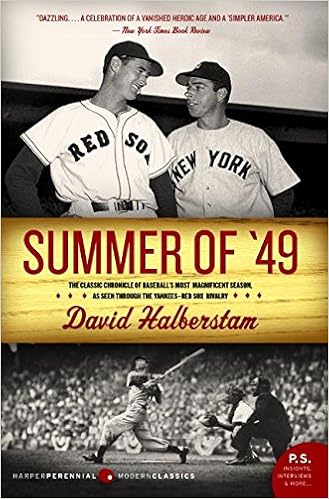
The Pennant race that was well-chronicled by both Peter Golenbock in his book Dynasty: The New York Yankees, 1949-1964, and David Halbertsam in his book Summer of '49, is well and truly on.
October 1, 1949, Yankee Stadium. Believe it or not, the Yankees blew a 12-game lead, and trailed the Sox by 1 game with 2 to play -- and these 2 were against the Sox at The Stadium. The Yanks hold Joe DiMaggio Day, since Dom plays for the Sox, and thus the whole family can attend. Joe has been ill with pneumonia, but has kept playing, and says, "I'd like to thank the Good Lord for making me a Yankee." (I guess he didn't have an agent back in 1934.)
The Sox, acting like more recent Red Sox teams, blow a 4-0 lead, Johnny Lindell hits an 8th-inning homer, and the race is tied. Yankees 5, Red Sox 4. Allie Reynolds didn't get out of the 3rd inning, but Joe Page allowed just 1 hit over the last 6 2/3rds innings. In the 1901 to 1968 era of 2 single-division leagues, 1949 was the only season in which both leagues' races were unresolved as the final day of the regular season dawned: The Brooklyn Dodgers needed a win or a St. Louis Cardinals loss to win the Pennant, and they got their win.
October 2, 1949, Yankee Stadium. This is for the Pennant. The Yanks lead 1-0 in the 8th, when Joe McCarthy, managing the Sox after all those Pennants with the Yankees, relieves starter Ellis Kinder. Big mistake, as a Jerry Coleman double clears the loaded bases. But Vic Raschi falters a bit in the 9th, partly due to DiMaggio, still sick, dropping an easy fly ball. Normally so good out there, Joe walks off the field, taking himself out of the game.
The tying runs are on, the run that could win the Pennant is at the plate, and Yogi Berra goes out to talk to Raschi. "The Springfield Rifle" angrily says, "Gimme the goddamned ball, and get the hell out of here!" Yogi does as he's told, and Raschi gets the final out, as Birdie Tebbetts pops up to 1st base, and Henrich, playing out of position, catches it. Yankees 5, Red Sox 3.
The Yanks beat the Dodgers in the World Series. In the last 2 seasons, the Sox had won 192 games, and didn't even win a Pennant.
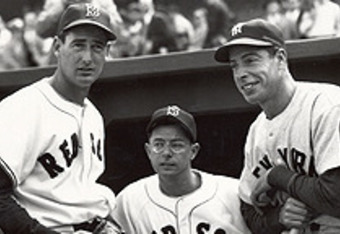
Ted Williams, Dom DiMaggio, Joe DiMaggio.
The Pennant race that was well-chronicled by both Peter Golenbock in his book Dynasty: The New York Yankees, 1949-1964, and David Halbertsam in his book Summer of '49, is well and truly on.
October 1, 1949, Yankee Stadium. Believe it or not, the Yankees blew a 12-game lead, and trailed the Sox by 1 game with 2 to play -- and these 2 were against the Sox at The Stadium. The Yanks hold Joe DiMaggio Day, since Dom plays for the Sox, and thus the whole family can attend. Joe has been ill with pneumonia, but has kept playing, and says, "I'd like to thank the Good Lord for making me a Yankee." (I guess he didn't have an agent back in 1934.)
The Sox, acting like more recent Red Sox teams, blow a 4-0 lead, Johnny Lindell hits an 8th-inning homer, and the race is tied. Yankees 5, Red Sox 4. Allie Reynolds didn't get out of the 3rd inning, but Joe Page allowed just 1 hit over the last 6 2/3rds innings. In the 1901 to 1968 era of 2 single-division leagues, 1949 was the only season in which both leagues' races were unresolved as the final day of the regular season dawned: The Brooklyn Dodgers needed a win or a St. Louis Cardinals loss to win the Pennant, and they got their win.
October 2, 1949, Yankee Stadium. This is for the Pennant. The Yanks lead 1-0 in the 8th, when Joe McCarthy, managing the Sox after all those Pennants with the Yankees, relieves starter Ellis Kinder. Big mistake, as a Jerry Coleman double clears the loaded bases. But Vic Raschi falters a bit in the 9th, partly due to DiMaggio, still sick, dropping an easy fly ball. Normally so good out there, Joe walks off the field, taking himself out of the game.
The tying runs are on, the run that could win the Pennant is at the plate, and Yogi Berra goes out to talk to Raschi. "The Springfield Rifle" angrily says, "Gimme the goddamned ball, and get the hell out of here!" Yogi does as he's told, and Raschi gets the final out, as Birdie Tebbetts pops up to 1st base, and Henrich, playing out of position, catches it. Yankees 5, Red Sox 3.
The Yanks beat the Dodgers in the World Series. In the last 2 seasons, the Sox had won 192 games, and didn't even win a Pennant.
This time, falling just short of the AL batting title to Detroit's George Kell, and this oh-so-slightly losing out on a unique 3rd Triple Crown, Williams was awarded the MVP. It could have gone to Rizzuto, who won it in 1950; or to Berra, who won it in 1951, '54 and '55. Instead, it went to Williams in a year in which he did not lead the Sox to a Pennant. So Sox fans can shut up about how Ted was robbed in '41, '42 and '47.
That season, DiMaggio was paid $100,000 (about $1.4 million in today's money), only the 2nd player ever to reach 6 figures, following Hank Greenberg. Williams was paid $75,000 ($1.1 million).
April 18, 1950, Fenway Park. Opening Day. Reynolds had nothing, and Mel Parnell was pitching well. After 4 innings, the Red Sox led, 9-0. The Yankees scored 4 runs in the 6, 9 in the 8th and 2 in the 9th, and won, 15-10. Don Johnson (no relation to the actor of the same name) was the winning pitcher, while Parnell gave out and Walt Masterson was the losing pitcher.
Oddly, the Yankees did this without hitting any home runs. 3rd baseman Billy Johnson had 3 RBIs. So did 2nd baseman Billy Martin, making his major league playing debut, and he didn't even start the game.
September 23, 1950, Yankee Stadium. Red Smith of the New York Herald Tribune called this 2-game series "the itsy-bitsy World Series." Eddie Lopat pitched a shutout, and the Yankees won, 8-0.
September 24, 1950, Yankee Stadium. The Yankees are leading the Red Sox, 9-5 in the 9th inning, when word comes in that Cleveland has beaten Detroit, clinching the Pennant for the Yankees. They finish the game off.
April 17, 1951, Yankee Stadium. The Yankees open the season at home against the Red Sox. Although it isn't obvious yet, it will be the final season for DiMaggio. It is the 1st season, and the 1st game, for Mickey Mantle -- who will also end up playing his last game against the Red Sox. His 1st at-bat is a groundout against Sox starter Mickey McDermott. This is also the debut as Yankee public address announcer for Bob Sheppard, who stays for 57 years.
In the 6th inning, Mantle gets his 1st hit and his 1st RBI, singling home Jackie Jensen against Bill Wight, helping the Yankees win 5-0. DiMaggio goes 1-for-4 with an RBI. Williams goes 1-for-3. Raschi pitches a shutout.
Joe DiMaggio, Mickey Mantle, Ted Williams
September 28, 1951, Yankee Stadium. The Yanks can clinch the Pennant with a win, and need just 1 more out. Even more, Allie Reynolds needs one more out for his 2nd no-hitter of the year. But who's at bat? Ted Williams. "The Superchief" gets "the Splendid Splinter" to hit an easy popup... which Yogi drops! Fortunately, it's in foul territory, but you don't give Ted Williams a second chance.
But in an example of what Yankee haters would call "Yankee luck," Ted pops it up again, and this time, Yogi catches it. Yankees 8, Red Sox 0. The Yanks go on to beat the Giants in the World Series.

Yankee Stadium. Judging by the scoreboard, the green seats,
and the off-white outer wall, this has to be between 1959 and 1966.
Early the next season, Williams was called back into the Marine Corps for the Korean War, as he had been in World War II. He was unavailable from May 1, 1952 to July 28, 1953, and by the time he came back, the Red Sox "glory years" of 1946-51 were over, as most of the other good players had retired or been traded away.
The Yanks-Sox rivalry went dormant as a result, leading Boston Globe columnist Dan Shaughnessy, born in 1953, to later remark that it had become like a conversation between Humphrey Bogart and Peter Lorre in the film Casablanca, a script written by Julius and Philip Epstein, the grandfather and great uncle of future Sox general manager Theo Epstein:
Ugarte: "You despise me, don't you, Rick?"
Rick: "Well, if I gave you any thought, I probably would."
April 23, 1953, Yankee Stadium. For the 1st time in his career, Mantle hits a walkoff home run. It's a 3-run job off Ellis Kinder, and the Yankees beat the Red Sox, 6-3. They had led 3-1 after 8, but the Sox scored 3 in the 9th to tie it. Mickey won it.
April 14, 1955, Fenway Park. The Red Sox host the Yankees in their home opener, and win, 8-4. This game is notable as the major league debut of Elston Howard, who thus becomes the 1st black player for the Yankees in a regular season game. In the bottom of the 6th inning, he replaces Irv Noren in left field, and in his first at-bat, drives in Mickey Mantle with a single in the 8th.
At this time, there were still 3 major league teams that had not introduced a black player: The Philadelphia Phillies, the Detroit Tigers, and the Red Sox, who would be the last, with Elijah "Pumpsie" Green in 1959.
September 16, 1955, Yankee Stadium. Yogi Berra is remembered as one of the best clutch hitters ever, and he backed that up with 7 walkoff home runs, including this one, also off Ellis Kinder, for a 5-4 Yankee win.
April 28, 1957, Yankee Stadium. Yogi does it against the Sox again, off Ike Delock in the 10th inning, giving the Yankees a 3-2 win.
September 5, 1957, Yankee Stadium. Bob Grim becomes the 2nd Yankee pitcher to hit a walkoff home run -- and the 2nd to do it against Boston. He decides Nixon's the one -- Willard Nixon, that is -- and homers off him to give the Yankees a 5-2 win.
September 3, 1958, Yankee Stadium. Yogi torments the Sox again. This time, the walkoff victim is Leo Kelly, and the Yankees win, 8-5.
October 2, 1960, Yankee Stadium. Dale Long is remembered for hitting home runs in 8 straight games in 1956 (with the Pittsburgh Pirates), and being one of baseball's rare lefthanded catchers in 1958 (with the Chicago Cubs). On this day, for the Yankees, he hit a walkoff homer against Arnold Early of the Red Sox.
It had been exactly 11 years since the Yankees had won a Pennant by beating the Sox, and it would be exactly 18 years later that Sox fans would come to hate Bucky Dent.
Ted Williams had made his last appearance for the Sox in their home finale on September 28, hitting a home run, the 521st of his career, in his last at-bat. His salary was a record $135,000 (about $1.5 million in today's money).
October 1, 1961, Yankee Stadium. The Yankees beat the Red Sox 1-0. The only run of the game comes in the 4th inning, on a home run by Roger Maris. It is Maris' 61st home run of the season, breaking the record that Babe Ruth set in 1927.
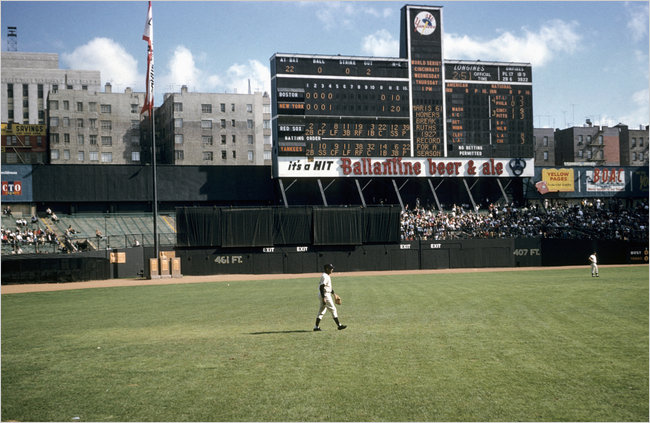
The Yankee Stadium scoreboard, right after Maris' 61st
Williams had been replaced in Boston's left field by a native of Southampton, Long Island -- a working-class "townie" rather than a rich Summer-home owner there. His name was Carl Yastrzemski. He made $10,000 ($111,000). For his record-setting 61 home runs and AL-leading 142 RBIs, the Yankees paid Maris $32,000 ($355,000). For his 54 homers, Mantle was paid $70,000 ($776,000) -- and the greatest player of his generation, over even Willie Mays and Hank Aaron, never got a penny over $100,000.
July 7, 1966, Yankee Stadium. The Mick strikes again, with his 10th career walkoff home run, off Don McMahon, a relief pitcher who gave the Yankees trouble with the Milwaukee Braves in the 1957 and '58 World Series. The Yankees win, 5-2, and the winning pitcher, as 1960s Yankee pitcher Jim Bouton would say, was "Dooley Womack. The Dooley Womack!"
September 10, 1966, Fenway Park. Roger Maris turns 32, and hits a home run, the 4th Yankee to do so on his birthday. The Yankees win 5-1.
By this point, the Yankees had collapsed, but no one knew that, in the following season, the Sox were in for the defining season in their history, the one that took them from an afterthought -- and very nearly moved, at least out of Fenway Park, possibly to the suburbs, maybe out of the Boston area altogether -- to being New England's most beloved sports team.
Part III follows.


No comments:
Post a Comment