Poster from Miracle, the 2004 film
about the 1980 U.S. Olympic hockey victory
My hip replacement surgery, this past Wednesday afternoon, went very well. My recovery, however, has been another story. Everybody tells me I'm doing great, but it sure doesn't feel like it.
I have never read the novel The Fault In Our Stars, written by John Green and published in 2012, or seen the movie made of it in 2014, starring Shailene Woodley. I am familiar with the story.
A teenage girl, stricken with cancer, is told to rate her pain on a scale of 0 to 10. She is told to "save her 10," for the most painful thing she ever feels. She meets a boy her own age, who is also enduring cancer, and falls in love with him. When he dies, at his funeral, she says, "This is my 10."
I don't want to minimize anyone else's suffering. I know there are people who have it far worse than I do, physically and psychologically. But knowing that hasn't made the pain I have felt any easier -- before or after.
At the hospital, they asked me to ask me to rate the pain on a scale of 0 to 10. I figured, any pain that makes you at least moan has got to be at least an 8. It took 7 separate painkilling drugs to get it down to a 4.
Since I got home from the hospital on Thursday night, it has varied from an 8 down to a 2. Right now, on this Saturday morning, using Oxycodone, Tylenol and ice, it's a 4.
The whole point of getting this surgery was to make the pain stop. On occasion, the pain would be so bad that it woke me up at night. Since the surgery, including since I came home, the pain has woken me up at night. However, given my drug schedule, that's actually not that bad a thing.
My mobility has improved. I can get around the house, or at least around the ground floor on the house, with a walker. I haven't tried the stairs yet, but I can get to and from the kitchen and the bathroom with no problem.
My appetite is fine -- no surprise there -- and I don't have a problem standing up and using the bathroom. But I have not yet, how shall I put this, had to sit down. People are concerned about that, but I just haven't felt the need.
Physical therapy and occupational therapy have already been scheduled. Personally, I think it would be better to call the latter "operational therapy." Calling it "occupational" makes it sound like assistance at work.
Eventually, the pain will stop. By that point, my mobility should improve to the point where I can start looking for work again. Maybe, just maybe, I'll be able to return and get paid, and have a nice Summer. I haven't had a nice Summer in a long time.
(UPDATE: At this point, for most Americans, COVID-19 was just a nasty rumor. We had no idea that it was going to shut everything down by March 12, which ended up messing up my physical therapy schedule. So, there was no "Summer of 2020.")
And maybe I can go out with my family, and enjoy nice things again. One of the last things we did together as a family before my father died was a trip to the Bronx Zoo. It was terrific, but the place is just too big, and my legs were really feeling it at the end.
My nieces love Six Flags Great Adventure. I haven't been there in 35 years, and I know the place is huge. It would have been a mistake for me to go there last year, but, this year, maybe I can do it.
And as for going into New York, that City involves so much walking around, that it made it a problem for me. And you never realize just how big the Port Authority Bus Terminal is, until you come out of the Subway at 42nd Street and 8th Avenue, and have to get to your bus' gate on the top floor at 40th Street and 9th Avenue. It doesn't sound like much, but for someone with bad legs and a bad back, it is.
Every so often, we hear the expression "the miracle of modern medicine." This kind of surgery used to lay people up for months on end. Now, it should only be a few weeks for me. I just hope it's only the first couple of weeks that will be the truly painful part.
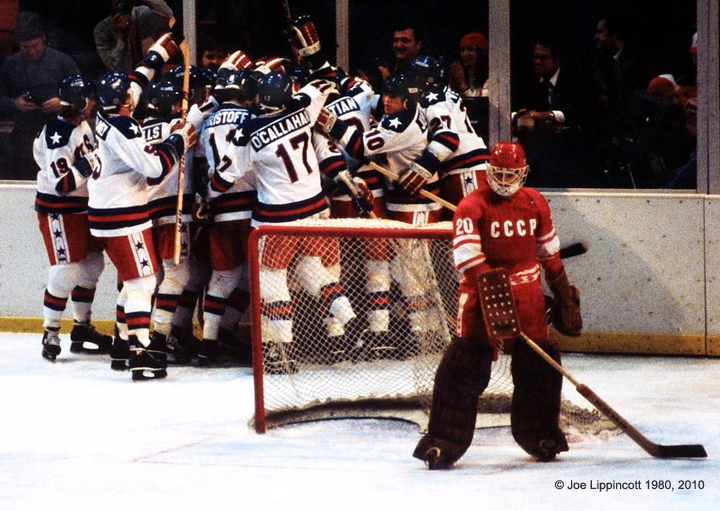
On the 30th Anniversary of the event, I wrote a piece about how the victory of the U.S. hockey team over the Soviet Union's at the 1980 Winter Olympics wasn't actually a miracle, and that it could be explained by forces less than supernatural or divine.
Then again, I did cite the Biblical story of David vs. Goliath as my Number 1 reason, and pointed out that David's victory wasn't really a miracle, either.
David's victory, circa 1000 BC, was the 1st step in uniting the 12 Tribes of Israel into a single nation. My surgery has united some far-flung tribes as well.
Among my family's friends, there is a tremendous range of people, including friends of my mother and my sister that I've never met, who have stood up and expressed their warmest wishes, and shown themselves, in the words of Thomas Paine, to be "winter soldiers," and not just "sunshine patriots."
I want to take this opportunity to thank everyone -- at the hospital, and online. (I haven't had the chance to go out into the world yet. Then again, I haven't needed to.)
Sometimes, social media can seem like a cauldron of uncontrolled emotion, with people casting all filters aside just to make a point that might make sense only to them, on politics, sports, music, fashion, whatever.
But what I've seen has brought people together. The ability of these formats to act as a worldwide support group for anyone who might need it is staggering.
This week, there was a story about a 9-year-old boy in Australia. He is an Aboriginal, and he is also a dwarf. He said that the bullying he receives for his race and his disability is so bad, it makes him want to take his own life. People all over the world have taken up his cause, to let him know that he's not alone, and that going on is worth it.
When I was 9 years old, my problems weren't as bad as his, but there were so many times when I felt totally alone, and it felt like nobody cared.
Today, the whole world can show someone that they care. The means to show that simply wasn't available when I was 5 years old, the last time that hip was operated on, lying in a dark hospital room in New York, with metal stitches causing me "10 pain." That means is available now, for terrified 9-year-olds and for hopeful if aching 50-year-olds, wherever they may be.
As they used to sing on Sesame Street, "And if that isn't a true blue miracle, I don't know what one is."