The Draft has had some sour moments. New York Jets fans, especially when the Draft is held in New York, tend to go, and their reactions to their team's 1st round pick is usually vociferous. Like the nursery rhyme about the girl with the curl in the middle of her forehead, when it's good, it's very, very good; but when it's bad, it's horrid.
But Jet fans have nothing on fans of the Philadelphia Eagles. As NFL Films co-founder, producer and writer Steve Sabol (a Philadelphia area native) put it, to be read by John Facenda, the local news anchor who was the voice of NFL Films from 1967 until his death in 1984, put it, "In Philadelphia, a fan learns to boo before he can walk."
In 1998, the Heisman Trophy was won by Ricky Williams of the University of Texas, who had broken the NCAA's career record for rushing yardage. That record lasted for just 1 year, broken by Ron Dayne of Wisconsin, who would play for the New York Giants.
Williams seemed to push all the right buttons. He was big. He was strong. He was very fast. He was from one of college football's marquee schools. He had excelled in one of college football's toughest leagues, the Big 12 Conference. He had come through in high-profile games. He seemed nice. He seemed smart. He was respectful of the game's history: When Doak Walker, often regarded as the greatest Texas-born player, was dying, Ricky visited him in the hospital, and, for one game, switched from his usual Number 34 to Walker's legendary 37. And, at the time, there were no red flags.
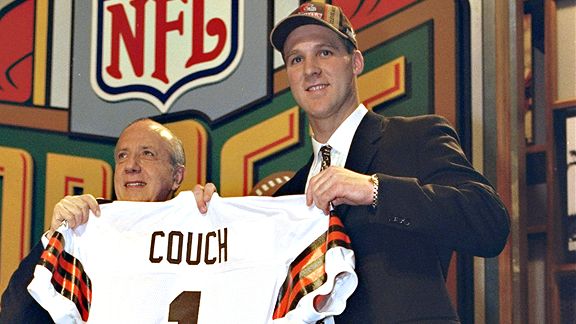
 He should have been the top pick in the NFL Draft. Except that 1999 was the year the restored Cleveland Browns were beginning play, and they had the top pick. They made it known that they would be picking a quarterback. That turned out to be Tim Couch of the University of Kentucky. He turned out to be a bust, partly because he wasn't that good, partly because the Browns handled him badly. But that's a story for another time.
 The 2nd pick belonged to the Eagles, 3-13 the season before. Their quarterbacks were Rodney Peete (decent but injury-prone), Bobby Hoying (a reasonable backup, but shouldn't have been a starter) and Koy Detmer (not even the best quarterback in his own family, and his brother Ty wasn't so hot as a pro, either).
Drafting a seemingly good quarterback is not a cure-all, especially for his rookie year. In the previous year's Draft, the Indianapolis Colts had the 1st pick, the San Diego Chargers the 2nd. The top 2 picks were going to be Peyton Manning of Tennessee and Ryan Leaf of Washington State, and pretty much everybody was thinking that you couldn't go wrong with either one. The Colts picked Manning, and he had a rough rookie year, but became a Hall-of-Famer. The Chargers picked Leaf, and it was a disaster even beyond his rookie year.
But the Eagles also needed to boost their running game. Their 2 best running backs were Duce Staley (good, but not great) and Charlie Garner (occasionally good, at best). Furthermore, given that they were 3-13, the Eagles could have gone with the cliché of drafting "the best available athlete." At the time, it wasn't hard to believe that this was Ricky Williams.
Angelo Cataldi, then as now the morning show host for all-sports radio station WIP (then 610 AM, now 94.1 FM), knowing that the Browns were likely drafting Couch, promoted the idea of the Eagles drafting Williams. He arranged for a group of Eagles fans to attend the Draft at The Garden. Some of them even wore Eagle jerseys with Williams' name and Number 34 on them, presumably paid for out of their own pockets, not out of WIP's bank account. (UPDATE: Cataldi retired in 2023.)
At the Draft, NFL Commissioner Paul Tagliabue announced, "With the 2nd pick, the Philadelphia Eagles select... Donovan McNabb... " The rest of his words could not be heard, as the Eagle fans in attendance overwhelmed it with boos.
They had been betrayed by team management, and not for the 1st time. Or so they believed. And they booed their lungs out. Why?
But Jet fans have nothing on fans of the Philadelphia Eagles. As NFL Films co-founder, producer and writer Steve Sabol (a Philadelphia area native) put it, to be read by John Facenda, the local news anchor who was the voice of NFL Films from 1967 until his death in 1984, put it, "In Philadelphia, a fan learns to boo before he can walk."
In 1998, the Heisman Trophy was won by Ricky Williams of the University of Texas, who had broken the NCAA's career record for rushing yardage. That record lasted for just 1 year, broken by Ron Dayne of Wisconsin, who would play for the New York Giants.
Williams seemed to push all the right buttons. He was big. He was strong. He was very fast. He was from one of college football's marquee schools. He had excelled in one of college football's toughest leagues, the Big 12 Conference. He had come through in high-profile games. He seemed nice. He seemed smart. He was respectful of the game's history: When Doak Walker, often regarded as the greatest Texas-born player, was dying, Ricky visited him in the hospital, and, for one game, switched from his usual Number 34 to Walker's legendary 37. And, at the time, there were no red flags.
Drafting a seemingly good quarterback is not a cure-all, especially for his rookie year. In the previous year's Draft, the Indianapolis Colts had the 1st pick, the San Diego Chargers the 2nd. The top 2 picks were going to be Peyton Manning of Tennessee and Ryan Leaf of Washington State, and pretty much everybody was thinking that you couldn't go wrong with either one. The Colts picked Manning, and he had a rough rookie year, but became a Hall-of-Famer. The Chargers picked Leaf, and it was a disaster even beyond his rookie year.
But the Eagles also needed to boost their running game. Their 2 best running backs were Duce Staley (good, but not great) and Charlie Garner (occasionally good, at best). Furthermore, given that they were 3-13, the Eagles could have gone with the cliché of drafting "the best available athlete." At the time, it wasn't hard to believe that this was Ricky Williams.
Angelo Cataldi, then as now the morning show host for all-sports radio station WIP (then 610 AM, now 94.1 FM), knowing that the Browns were likely drafting Couch, promoted the idea of the Eagles drafting Williams. He arranged for a group of Eagles fans to attend the Draft at The Garden. Some of them even wore Eagle jerseys with Williams' name and Number 34 on them, presumably paid for out of their own pockets, not out of WIP's bank account. (UPDATE: Cataldi retired in 2023.)
At the Draft, NFL Commissioner Paul Tagliabue announced, "With the 2nd pick, the Philadelphia Eagles select... Donovan McNabb... " The rest of his words could not be heard, as the Eagle fans in attendance overwhelmed it with boos.
They had been betrayed by team management, and not for the 1st time. Or so they believed. And they booed their lungs out. Why?
Well, from previous bad drafts and bad free agent signings, to the financial difficulties of former owner Leonard Tose and the cheapness of former owner Norman Braman, Eagle fans were used to the organization not doing right by them. New owner Jeffrey Lurie had promised better. So far, he hadn't delivered. Drafting McNabb instead of Williams seemed like another crack in the promise.
The team that can run the ball the best controls the clock. The team that controls the clock usually wins the game. And, as former Eagle cornerback Herman Edwards, then an assistant coach with the Tampa Bay Buccaneers, would later say as head coach of the New York Jets, "You play to win the game!"
And, as I said, the Eagles needed to boost their running game, possibly more than they needed a good quarterback. This was largely due to the fact that, from 1995 to 1997, they had put their faith in a different Ricky W: Ricky Watters had helped the San Francisco 49ers win a Super Bowl, and the Eagles signed him as a free agent, but he didn't work out for them, appearing to take a nonchalant attitude, which is anathema to Philadelphia fans. And, as I also said, Williams seemed like "the best available athlete."
And, as I said, the Eagles needed to boost their running game, possibly more than they needed a good quarterback. This was largely due to the fact that, from 1995 to 1997, they had put their faith in a different Ricky W: Ricky Watters had helped the San Francisco 49ers win a Super Bowl, and the Eagles signed him as a free agent, but he didn't work out for them, appearing to take a nonchalant attitude, which is anathema to Philadelphia fans. And, as I also said, Williams seemed like "the best available athlete."
McNabb came out of Syracuse University. In 1997, he got them to 9-4. Their wins included these over opponents that were then nationally ranked in the Top 25: The Kickoff Classic at the Meadowlands against Number 24 Wisconsin, and home to Number 17 West Virginia. But he also lost at home to North Carolina State, and away to Oklahoma and Number 22 Virginia Tech.
In 1998, he got them to 8-4. They won away to Number 13 Michigan, and home to Number 16 Virginia Tech (with Michael Vick as a senior). However, they again lost to North Carolina State and West Virginia, this time away in both cases; and lost at home to Number 10 Tennessee.
In both seasons, he led the Orangemen to the Championship of the Big East Conference. But the Big East was never seen as an elite football league. In basketball, yes; in football, no. In both seasons, he got them to a major bowl game: The 1997 Fiesta Bowl against Number 10 Kansas State (actually played on New Year's Eve that season) and the 1999 Orange Bowl against Number 7 Florida (played on New Year's Day). However, they lost both games. In both seasons, he got them to a Top 25 ranking: 20th in 1997 and 24th in 1998.
 In other words, he looked like a good college quarterback. And there were other choices, aside from the already-drafted Couch. With the 3rd pick, the Cincinnati Bengals drafted Akili Smith, who had led Oregon to an 8-4 season. With the 11th pick, the Minnesota Vikings drafted Dante Culpeper, who had led Central Florida to 9-2. With the 12th pick, the Chicago Bears drafted Cade McNown, who had led UCLA to 10-2, the Pac-10 title, and victory in the Rose Bowl. In the 2nd round, the Tampa Bay Buccaneers drafted Shaun King, who had led Tulane to an undefeated 12-0 season and the Number 7 ranking in the country (albeit against, at best, what college basketball fans would call a mid-major schedule).
In other words, McNabb had a good college football career, but was he clearly the best quarterback in that Draft? The best, maybe. Clearly the best, no.
In 1998, he got them to 8-4. They won away to Number 13 Michigan, and home to Number 16 Virginia Tech (with Michael Vick as a senior). However, they again lost to North Carolina State and West Virginia, this time away in both cases; and lost at home to Number 10 Tennessee.
In both seasons, he led the Orangemen to the Championship of the Big East Conference. But the Big East was never seen as an elite football league. In basketball, yes; in football, no. In both seasons, he got them to a major bowl game: The 1997 Fiesta Bowl against Number 10 Kansas State (actually played on New Year's Eve that season) and the 1999 Orange Bowl against Number 7 Florida (played on New Year's Day). However, they lost both games. In both seasons, he got them to a Top 25 ranking: 20th in 1997 and 24th in 1998.
In other words, McNabb had a good college football career, but was he clearly the best quarterback in that Draft? The best, maybe. Clearly the best, no.
And, as I said, Williams seemed to have all the prerequisites: Good guy, great player, filled a need for the Eagles. And he was available. But they didn't take him. And their fans booed.
They shouldn't have. The Eagles needed a quarterback. When the Detroit Lions chose Rodney Peete in the 6th round out of USC in 1989, there was nothing wrong with wanting a healthy eete on your team. But he got hurt in his 1st preseason, and this began a string of injuries. By the time the Eagles got him in 1995, having a healthy Peete was pretty much a lost cause. And, as I said, neither Bobby Hoying nor Koy Detmer was going to be the answer.
The best college running backs often turn out to be pro busts -- figuratively or, through injury, literally. Eagles fans found that out when they won 2 games late in the 1968 season, costing them the chance to draft the eventually felonious O.J. Simpson, and instead got Leroy Keyes, who fell well short of expectations.
The Eagles had won their last NFL Championship in 1960. Just between then and 1998, and just among Heisman Trophy winners: Ernie Davis never played a pro down due to a fatal illness, Steve Owens lasted just 5 seasons and rushed for less than 2,500 yards, John Cappelletti lasted 10 years and rushed for less than 3,000, Archie Griffin lasted 7 years and rushed for less than 3,000, Charles White lasted 9 years and rushed for just over 3,000, and Rashaan Salaam lasted 4 years and rushed for less than 1,800. Since then, the aforementioned Ron Dayne lasted for 8 years and rushed for less than 4,000.
In addition to those, Billy Sims and Bo Jackson, both Heisman winners, looked like they were headed for the Hall of Fame. But Sims wrecked his knee in his 5th season, and Jackson hurt his hip in his 4th, and neither ever played again. Ki-Jana Carter was the 1st pick in the 1995 NFL Draft, but wrecked his knee in a preseason game in his rookie year. played in just 59 games over a span of 10 seasons, and rushed for just 1,144 yards.
So drafting a running back in the 1st round, even a great college running back like Ricky Williams, wasn't necessarily a great idea.
And what about other teams? They made this Draft even stranger. The Browns didn't draft Williams, either. Once they drafted Couch, and the Eagles drafted McNabb, the Bengals could have drafted Williams. Here's where it gets really strange: The New Orleans Saints offered the Bengals 9 draft picks for their pick, so they could draft Williams. Nine of them. The Bengals turned them down, and drafted Akili Smith.
The 4th pick belonged to the Indianapolis Colts. The Saints tried to make a deal with them, too, but they wouldn't budge. But they also didn't pick Williams. They drafted a different running back, Edgerrin James of the University of Miami. And while Couch and Smith were both busts, James was not: He went to the Hall of Fame.
Finally, the Saints got the Washington Redskins to agree to a deal: The 5th pick in that Draft, in exchange for the Saints' entire 1999 Draft except for the 2nd round, and their 1st and 3rd round picks for 2000. The Saints drafted Williams. The Redskins did some more maneuvering, and packaged 3 of the picks they got from the Saints to send to the Bears for a pick they ended up using on University of Georgia cornerback Champ Bailey, who made the Hall of Fame.
Incidentally, the Saints' general manager at the time was Bill Kuharich, son of Joe Kuharich, who, as Eagles head coach and general manager in 1964, made what is generally regarded as the worst trade in Eagles history: Sending Sonny Jurgensen to the Washington Redskins for Norm Snead.
Jurgensen was a carouser, and the moralistic Joe Kuharich hated that. Snead was a straight arrow. With the Redskins, Jurgensen continued his Hall of Fame career, throwing the most touchdown passes of any quarterback in the 1960s. The quarterback with the most interceptions in that decade? You may have guessed: Snead.
Anyway, what all this means is that 5 teams passed on drafting Ricky Williams: First the Browns, then the Eagles, then the Bengals, then the Colts, and lastly the Redskins. As we will soon see, the Browns and Bengals might have been better off if they'd taken him. Between what we will soon see, and what we have already seen, the Eagles and Colts might not have been.
Bears legend Mike Ditka was the Saints' head coach at the time, and they went just 3-13 in 1999. Williams rushed for 884 yards. Ditka was fired, and replaced with Jim Haslett. It was a huge improvement, as they went 10-6, and, each for the 1st time in franchise history, won their Division (the NFC West) and won a Playoff game. Williams rushed for 1,000 yards even, despite missing half the season due to injury. And then they slid back down to 7-9 in 2001, despite Williams rushing for 1,245 yards. He was getting personal success, but not much team success.
He didn't fit in. His Saints teammate Joe Horn said, "Ricky's just a different guy. People he wanted to deal with, he did. And people he wanted to have nothing to do with, he didn't. No one could understand that. I don't think guys in the locker room could grasp that he wanted to be himself. You know, quiet."
He was traded to the Miami Dolphins for 4 draft picks, and 2002 turned out to be his best NFL season. He rushed for a League-leading 1,853 yards. He rushed for another 1,372 yards in 2003. In those seasons, they went 9-7 and 10-6, but didn't make the Playoffs either time. Still, it looked like the Saints had blown it, both in getting him and in getting rid of him.
 And then, in the run-up to the 2004 season, he was suspended for testing positive for marijuana. On August 2, he announced his retirement.
It's become a meme in the years since: ESPN's Stephen A. Smith telling NFL players to "Stay off the weed!" Or, as he pronounces it, "the weeeeeeee-duh!" Physically speaking, Ricky Williams was as gifted as any running back in NFL history. Emotionally speaking, he was at the other extreme, eventually being diagnosed with clinical depression and social anxiety disorder. He chose smoking pot over playing football.
The Dolphins seemed to prove his point, that they needed him more than he needed them, going 4-12 in 2004. Williams patched things up with them, served his mandatory 4-game drug-test suspension, and rushed for 743 yards in 12 games. The Dolphins went 9-7 in 2005, and just missed the Playoffs again. And then, in early 2006, Williams was suspended for the entire upcoming season, for violating the NFL's drug policy for a 2nd time.
The Canadian Football League had a less stringent drug policy, and Williams signed with the Toronto Argonauts. But his season with the Argos was stricken with injuries: A broken bone in his arm and a damaged Achilles tendon limited him to 11 games and 526 yards. The CFL instituted what's become known as "The Ricky Williams Rule": No longer would a player under suspension by the NFL be eligible to be signed by a CFL team, although a "grandfather clause" meant that Williams himself could stay.
He didn't: After claiming that yoga had helped him to stop using marijuana, he entered into negotiations with Commissioner Tagliabue, and was granted reinstatement. He returned on November 26, 2007, playing for the Dolphins against the Pittsburgh Steelers on Monday Night Football. But it would be the only game he played that season, as he suffered a shoulder injury.
He played all 16 games of the 2008 season, rushing for 659 yards, and helping the Dolphins win the AFC East. He played all 16 games of the 2009 season, rushing for 1,121 yards, making him only the 7th player in NFL history to rush for at least 1,000 at age 32 or later, but the Dolphins only went 7-9. In 2010, he rushed for 673 yards, and the Dolphins went 10-6, but missed the Playoffs.
His contract with the Dolphins had run out, and he signed with the Baltimore Ravens for 2011. He played in every game, rushed for 444 yards, and on January 1, 2012, he joined the 10,000 Yards Club. The Ravens went 12-4, won the AFC North, and advanced to the AFC Championship Game.
But, a month later, Williams announced his retirement, for good this time. He was not quite 35, with 10,009 rushing yards, 342 receptions for 2,606 yards, and 74 touchdowns.
He has since become a certified yoga instructor, and an advocate for medical marijuana. Apparently, the former hasn't actually turned him off from the latter; but, together, they have helped him deal with his mental health difficulties.
He is in the College Football Hall of Fame, but not the Pro Football Hall of Fame, for which he has been eligible since 2017. There are 31 players with at least 10,000 rushing yards. The only ones eligible but not yet in are Fred Taylor, Steven Jackson, Corey Dillon, Warrick Dunn, Ricky Watters, Jamal Lewis, Thomas Jones, Tiki Barber, Eddie George, Ottis Anderson... and Ricky Williams.
Two of those players, Williams and Lewis, have had drug issues. The rest haven't. Based on statistics, it appears that 12,000 yards -- or, more precisely, 12,074 -- is the actual threshold: Every player with at least that many is in, except for the not-yet-eligible Gore and Peterson. So maybe it's not the drug issue that's holding Williams back, since there are never-suspended players with more rushing yards who aren't in Canton.
Nevertheless, Williams was a headache for 2 different NFL franchises, New Orleans and Miami. Neither team has elected him to their team hall of fame. If you ask the average Dolphin fan to name his all-time team, his running backs are going to be those on the 1972-73 Super Bowl teams, Larry Csonka and either Jim Kiick or Mercury Morris. (A little ironic, since Morris had to overcome a more severe drug problem than Williams, and did.)
Even in the 22 years since Williams arrived in the NFL, or in the 17 years since he was first suspended, America's understanding of mental health issues has improved. It is entirely possible that the same issues would have reared their heads had he been drafted by the Eagles instead of the Saints.
And that would have been very bad for his mental health. Can you imagine Eagle fans reacting to Ricky Williams' drug and psych issues? They would have tried to destroy him. And, away from the more laid-back atmospheres in Louisiana and South Florida, it would have been much worse for him. Instead of accepting him, Eagle fans would have compounded the problem.
Now, imagine that the Eagles drafted the top quarterback available the next year. Because they still would have needed one. Who would that have been? There were 12 quarterbacks drafted. The 1st was Chad Pennington, who had a decent career with Miami and the Jets. Of the 11 after him, the best was... Tom Brady, taken in the 6th round by the New England Patriots. And we'll never know for sure if he would have won even one single solitary NFL game without being the perpetrator, or at least the beneficiary, of cheating.
And, given how close the Eagles were to winning the Super Bowl with McNabb but without Williams, would they have been any better the other way around? With Pennington as quarterback and Williams in the backfield? It's unlikely.
Because the quarterback they did draft turned out to be pretty good. Suppose you rooted for a struggling NFL team. And suppose I told you that they were going to draft a quarterback who gave his college back-to-back seasons of a Conference Championship and a bid to a New Year's Day bowl game. And that he would lead your team to the Playoffs in only his 2nd season, and that this would be the 1st of 8 trips to the Playoffs -- without any guarantee as to how any of those berths would turn out. Would you like your chances? Would you take this? I think most fans would.
He didn't fit in. His Saints teammate Joe Horn said, "Ricky's just a different guy. People he wanted to deal with, he did. And people he wanted to have nothing to do with, he didn't. No one could understand that. I don't think guys in the locker room could grasp that he wanted to be himself. You know, quiet."
He was traded to the Miami Dolphins for 4 draft picks, and 2002 turned out to be his best NFL season. He rushed for a League-leading 1,853 yards. He rushed for another 1,372 yards in 2003. In those seasons, they went 9-7 and 10-6, but didn't make the Playoffs either time. Still, it looked like the Saints had blown it, both in getting him and in getting rid of him.

It's become a meme in the years since: ESPN's Stephen A. Smith telling NFL players to "Stay off the weed!" Or, as he pronounces it, "the weeeeeeee-duh!" Physically speaking, Ricky Williams was as gifted as any running back in NFL history. Emotionally speaking, he was at the other extreme, eventually being diagnosed with clinical depression and social anxiety disorder. He chose smoking pot over playing football.
The Dolphins seemed to prove his point, that they needed him more than he needed them, going 4-12 in 2004. Williams patched things up with them, served his mandatory 4-game drug-test suspension, and rushed for 743 yards in 12 games. The Dolphins went 9-7 in 2005, and just missed the Playoffs again. And then, in early 2006, Williams was suspended for the entire upcoming season, for violating the NFL's drug policy for a 2nd time.
The Canadian Football League had a less stringent drug policy, and Williams signed with the Toronto Argonauts. But his season with the Argos was stricken with injuries: A broken bone in his arm and a damaged Achilles tendon limited him to 11 games and 526 yards. The CFL instituted what's become known as "The Ricky Williams Rule": No longer would a player under suspension by the NFL be eligible to be signed by a CFL team, although a "grandfather clause" meant that Williams himself could stay.
He didn't: After claiming that yoga had helped him to stop using marijuana, he entered into negotiations with Commissioner Tagliabue, and was granted reinstatement. He returned on November 26, 2007, playing for the Dolphins against the Pittsburgh Steelers on Monday Night Football. But it would be the only game he played that season, as he suffered a shoulder injury.
He played all 16 games of the 2008 season, rushing for 659 yards, and helping the Dolphins win the AFC East. He played all 16 games of the 2009 season, rushing for 1,121 yards, making him only the 7th player in NFL history to rush for at least 1,000 at age 32 or later, but the Dolphins only went 7-9. In 2010, he rushed for 673 yards, and the Dolphins went 10-6, but missed the Playoffs.
His contract with the Dolphins had run out, and he signed with the Baltimore Ravens for 2011. He played in every game, rushed for 444 yards, and on January 1, 2012, he joined the 10,000 Yards Club. The Ravens went 12-4, won the AFC North, and advanced to the AFC Championship Game.
But, a month later, Williams announced his retirement, for good this time. He was not quite 35, with 10,009 rushing yards, 342 receptions for 2,606 yards, and 74 touchdowns.
He has since become a certified yoga instructor, and an advocate for medical marijuana. Apparently, the former hasn't actually turned him off from the latter; but, together, they have helped him deal with his mental health difficulties.
He is in the College Football Hall of Fame, but not the Pro Football Hall of Fame, for which he has been eligible since 2017. There are 31 players with at least 10,000 rushing yards. The only ones eligible but not yet in are Fred Taylor, Steven Jackson, Corey Dillon, Warrick Dunn, Ricky Watters, Jamal Lewis, Thomas Jones, Tiki Barber, Eddie George, Ottis Anderson... and Ricky Williams.
Two of those players, Williams and Lewis, have had drug issues. The rest haven't. Based on statistics, it appears that 12,000 yards -- or, more precisely, 12,074 -- is the actual threshold: Every player with at least that many is in, except for the not-yet-eligible Gore and Peterson. So maybe it's not the drug issue that's holding Williams back, since there are never-suspended players with more rushing yards who aren't in Canton.
Nevertheless, Williams was a headache for 2 different NFL franchises, New Orleans and Miami. Neither team has elected him to their team hall of fame. If you ask the average Dolphin fan to name his all-time team, his running backs are going to be those on the 1972-73 Super Bowl teams, Larry Csonka and either Jim Kiick or Mercury Morris. (A little ironic, since Morris had to overcome a more severe drug problem than Williams, and did.)
Even in the 22 years since Williams arrived in the NFL, or in the 17 years since he was first suspended, America's understanding of mental health issues has improved. It is entirely possible that the same issues would have reared their heads had he been drafted by the Eagles instead of the Saints.
And that would have been very bad for his mental health. Can you imagine Eagle fans reacting to Ricky Williams' drug and psych issues? They would have tried to destroy him. And, away from the more laid-back atmospheres in Louisiana and South Florida, it would have been much worse for him. Instead of accepting him, Eagle fans would have compounded the problem.
Now, imagine that the Eagles drafted the top quarterback available the next year. Because they still would have needed one. Who would that have been? There were 12 quarterbacks drafted. The 1st was Chad Pennington, who had a decent career with Miami and the Jets. Of the 11 after him, the best was... Tom Brady, taken in the 6th round by the New England Patriots. And we'll never know for sure if he would have won even one single solitary NFL game without being the perpetrator, or at least the beneficiary, of cheating.
And, given how close the Eagles were to winning the Super Bowl with McNabb but without Williams, would they have been any better the other way around? With Pennington as quarterback and Williams in the backfield? It's unlikely.
Because the quarterback they did draft turned out to be pretty good. Suppose you rooted for a struggling NFL team. And suppose I told you that they were going to draft a quarterback who gave his college back-to-back seasons of a Conference Championship and a bid to a New Year's Day bowl game. And that he would lead your team to the Playoffs in only his 2nd season, and that this would be the 1st of 8 trips to the Playoffs -- without any guarantee as to how any of those berths would turn out. Would you like your chances? Would you take this? I think most fans would.
Certainly, McNabb's pro career could have been better. He was 10-8 in Playoff games, 1-4 in NFC Championship Games including 2 losses at home, and 0-1 in Super Bowls. And, so far, voters for the Pro Football Hall of Fame have not seen fit to elect him.
But Donovan McNabb turned out to be, if not the greatest, then the most statistically successful quarterback in Eagles history. He joined Fran Tarkenton, John Elway and Steve Young as only the 4th quarterback in NFL history to have 30,000 passing yards, 200 touchdown passes, 3,000 rushing yards and 20 touchdown runs. He made 6 Pro Bowls. He won 5 NFC East titles.
As I said, he went 10-8 in Playoff games with the Eagles. But look at it another way: In 11 seasons with Donovan McNabb as their starting quarterback, the Eagles won 10 postseason games; in 78 seasons with all other starting quarterbacks (1933 to 1998, and 2010 to 2021), they have won just 13. In fact, until Nick Foles came along, it was 9 postseason wins in 73 years without McNabb.
The Eagles reached 5 NFC Championship Games with him. They only reached 1 Super Bowl, and lost it -- but that was to the Patriots, so how do we know it was on the up-and-up? We don't. With the Pats, we presume they're guilty until they're proven innocent.
You can say that other Eagles quarterbacks -- Norm Van Brocklin, Sonny Jurgensen, Ron Jaworski, Randall Cunningham, Nick Foles and Carson Wentz -- were better than Donovan McNabb. Certainly, some of those were more talented. But results matter. Van Brocklin was only in Philadelphia for 3 seasons; Foles, 2. Long-term, McNabb is the Eagles' best quarterback ever.
So the people booing his selection at the 1999 NFL Draft owe him an apology. Yes, Ricky Williams looked like the better pick at the time. But he wasn't. McNabb was.