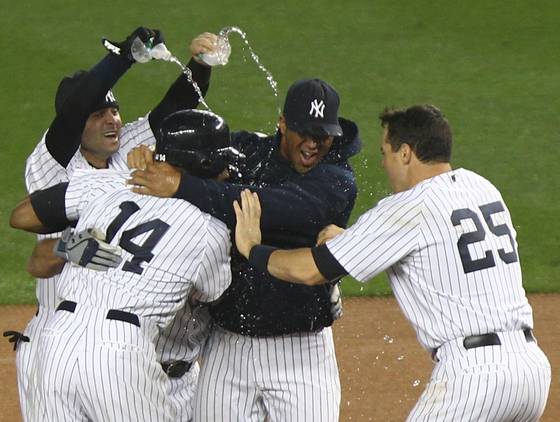
There's already a rumor going around that the greatest Japanese Yankee, Hideki Matsui, talked him into it. If so, and Tanaka turns out to be everything we've heard he is, that deepens Matsui's status as a Yankee Legend.
A 6-foot-2, 205-pound, 25-year-old righthanded pitcher from Itami, Hyogo Prefecture (what we call a State, they call a Prefecture), Japan -- 14 miles northeast of Kobe, and about 300 miles west of Tokyo -- he had pitched for the Tohoku Rakuten Golden Eagles, of the Japanese city of Sendai, since 2007. Overall, his won-lost record is 99-35.
He went 24-0 with a 1.27 ERA in 2013, helping Rakuten win the Pacific League pennant and the Japan Series. They won the Japan Series by beating Japan's foremost sports team, the Tokyo-based Yomiuri Giants. (Like our 2 major leagues, their 2 have a dispute over the designated hitter: The Pacific League uses the DH, the Central League does not.)
To be fair, the standard of play in Japanese baseball is roughly equivalent to North America's Class AAA (Triple-A) ball. Still, 24-0 is 24-0. And your control isn't affected by how good the opposing hitters are: In 2013, Tanaka's WHIP was a miniscule 0.943; in his career, a nifty 1.108.
You don't hear the word "nifty" very often these days. It's a good word.
The Yankees were also impressed by what Yankees.com called his "businesslike demeanor." Translation: He'll be a lot more like Derek Jeter and Hideki Matsui than he will like Robinson Cano and Melky Cabrera.
He wore Number 18 with the Golden Eagles -- currently worn on the Yankees by his countryman Hiroki Kuroda. He has not currently been assigned a uniform number. The following numbers lower than 60 -- not counting the officially or unofficially retired -- are currently unassigned: 14, 17, 19, 24, 33, 34, 39, 40, 45, 48, 55 and 57. Might he get 55, Matsui's number? It's not like it's being considered for retirement, as it was given to both Russell Martin (who was good in it) and Lyle Overbay (who was occasionally passable in it). (UPDATE: He got 19.)
Presuming Tanaka doesn't flame out, or get hurt, in spring training -- and nobody else does, either -- and no further transactions are made involving pitchers, he will give the 2014 Yankees a starting rotation of (though not necessarily in this order) CC Sabathia, Tanaka, Kuroda, Ivan Nova and David Phelps, unless Michael Pineda really is back from the injury that's caused him to miss the last 2 seasons, in which case Phelps becomes the long man out of the bullpen.
*
Japan has loved baseball from the first time it arrived there, except for the World War II years, when it was held up as an example of Western decadence. After the war, when General Douglas MacArthur was military governor, he had baseball restarted there, and the rest is history.
Trying to determine who are the...
Top 10 Baseball Players From Japan
...is a difficult exercise, because, until 1995, with one exception, they didn't play over here, so we have no idea of how they would have played against major league competition.
However, 59 players born in Japan have played in the North American major leagues, and, surely, we can get a Top 10 from that.
There is a Japanese Baseball Hall of Fame, located at the Tokyo Dome, home of the Yomiuri Giants. It currently has 97 inductees -- including Sadaharu Oh, whose 868 home runs for the Giants is the most of any player in any country's "major leagues" -- and 2 North Americans, Lefty O'Doul (who should be in our Hall of Fame, but isn't) and Horace Wilson, a Maine-born professor who is said to have introduced baseball to Japan in 1872.
The JBHOF, as yet, includes only one of the following, who have made their mark in North America, one of whom will hopefully be displaced by Tanaka in the coming years:
Honorable Mention to Masanori Murakami, the 1st Japanese player in the North American major leagues. He made 9 appearances for the San Francisco Giants in 1964, and 45 more in 1965, all but 1 of them as a relief pitcher. He went 5-1 with 8 saves and a 3.75 ERA (a 106 ERA+). But contractual obligations required him to go back to Japan, where he continued pitching until 1982. He became a pitching coach and a scout, and now broadcasts MLB games for Japanese TV network NHK.
Honorable Mention to Dave Roberts, born the son of a Japanese woman and a black U.S. soldier on Okinawa. He and Johnny Damon, the son of a Thai woman and a white U.S. soldier who met in Thailand (but was born at Fort Riley, Kansas, though he did live for a time on Okinawa) were both key figures in the Red Sox' 2004* run. I say Roberts gets an "Honorable Mention" because, as far as I know, he did not take the dishonorable route of performance-enhancing drugs.
10. Masato Yoshii. The 1st Japanese player for the Mets, the pitcher went 18-16 for them in 1998 and '99, helping them reach the Playoffs in the latter year. Then they traded him to the Colorado Rockies for one of the Bobby Joneses, and he was never the same pitcher, going 6-15 for them in 2000, and pitching poorly for the Montreal Expos in 2001 and '02, and that was it.
Shortly thereafter, the Mets got another Japanese player, Kazuo Matsui. When he arrived in Flushing in 2004, Met fans boasted that they had the best Matsui in New York. Yeah, right: The biggest thing he did for the Mets was force them to move Jose Reyes from shortstop to 2nd base, and experiment that ended the next season when they were switched. But he did hit a decent .267 for a career included stops with the Rockies and Houston Astros, and ended in 2010.
9. Hideki Irabu. Save your jokes, and have some respect for the dead. For a while, the guy could pitch. He arrived in New York in 1997, and went 24-16 for the Yankees in 1998 and '99, helping them win the World Series both times. He was sent to the Montreal Expos, and pitched for them in 2000 and '01, before finishing up with the Texas Rangers in 2002. Injuries doomed him to a career record of just 34-35.
Irabu gave me 2 fond memories in July 1999, when, within a span of 3 weeks, I saw him pitch the Yankees to victories over the Mets at Shea Stadium and the Red Sox at Fenway Park (the latter being that rare feat of a complete game with Joe Torre as manager).
8. Shigetoshi Hasegawa. He arrived in 1997 with the team then known as the Anaheim Angels, and, no doubt with Ichiro in mind, signed with the Seattle Mariners in 2002, and remained with them until 2005. He was a middle reliever, but still managed to save 16 games in his All-Star season of 2003. His career ERA+ was 125.
7. So Taguchi. A very versatile player, he could play all outfield positions and 2nd base. Arriving with the St. Louis Cardinals in 2002, he had 3 seasons batting at least .288, and appeared in the postseason 4 times, including winning World Series rings with the Cardinals in 2006 and the Philadelphia Phillies in 2008. He finished his career with the Chicago Cubs in 2009, batting .279 lifetime.
6. Daisuke Matsuzaka. Not even Nomo was this hyped upon his arrival in North America as this pitcher was. When "Dice-K" came to the Red Sox in 2007, the rumor was that he had a "gyroball" that was "unhittable." Not quite, but he did go 15-12, and won a game each in the AL Championship Series and the World Series. In 2008, he went 18-3 as the Sox came within a game of another Pennant.
But that was it: He's been very hittable ever since, crashing out with the infamous 2012 Sox (apparently, Bobby Valentine can only manage Japanese players in Japan), and clowning through 7 games for the Mets last year (wearing Dwight Gooden's Number 16, which may be a desecration if you're a Met fan). He is currently without a club. And he's only 33.
5. Hiroki Kuroda. He arrived with the Dodgers in 2008, and pitched for them until 2012, then coming to the Yankees. His career record stands at just 68-70, but his ERA+ is a strong 118, his WHIP a nifty 1.179. (Yeah, I like saying "nifty.") He's appeared in the postseason with the Dodgers in 2008 and '09 and the Yankees in '12.
4. Yu Darvish. In just 2 seasons pitching for the Rangers, he is already 29-18. He finished 3rd in the American League's Rookie of the Year voting in 2012 and 2nd in its Cy Young Award voting in 2013. Last year, he led the AL in strikeouts, and in both most strikeouts and fewest hits per 9 innings. He's only 27, so he should have several more good years left.
3. Hideo Nomo. When "the Tornado" debuted for the Dodgers in 1995, he became the 1st Japanese player in our major leagues in 30 years, and the excitement he brought to Southern California was reminiscent of Mexican pitching legend Fernando Valenzuela in 1981, Fernandomania presaging Nomomania. He was the National League's Rookie of the Year and its starting pitcher in the All-Star Game.
In 1996, he won 16 games (a career high he would reach 3 times) and pitched a no-hitter -- the only one ever thrown at homer-happy Coors Field in Denver. But injuries interfered, and he bounced around, including finishing the 1998 season with the Mets.
In 2001, pitching for the Red Sox, he threw another gem -- the only one ever thrown at homer-happy Camden Yards in Baltimore -- becoming only the 4th pitcher to toss no-hitters in both leagues. (There are now 5.) He's also one of the few pitchers to have led both leagues in strikeouts.
But the injury bug struck again, and after missing the entire 2006 and '07 seasons, he struggled through 3 games with the Kansas City Royals in 2008, and retired with a career record of 123-109, striking out 1,908 batters. He is the only one of these 10 players already in the Japanese Baseball Hall of Fame -- presumably, they waited 5 years like ours does, as he was just elected.
2. Hideki Matsui. The left fielder known (stereotypically) as Godzilla starred for the Yankees for 7 seasons. In his first home game at Yankee Stadium (the old one), the 2003 home opener, he hit a grand slam. In his last home game at Yankee Stadium (the new one), Game 6 of the 2009 World Series, he hit a single, a double and a home run, for 6 RBIs (tying a Series single-game record), clinching the World Championship for his team and the Series MVP award for himself. He played 1 season each for the Los Angeles Angels, the Oakland Athletics and the Tampa Bay Rays, before hanging up his spikes in 2012.
Between Yomiuri and The Bronx, he hit over 500 home runs. His major league batting average was .282, his OPS+ 118, and while he didn't hit 50 home runs in any season (as many predicted he would, with a swing that was tailor-made for Yankee Stadium, topping out at 31 in 2004), he helped the Yankees reach the postseason in 6 of his 7 seasons with them.
1. Ichiro Suzuki. I said Matsui was "the greatest Japanese Yankee," but he's not the greatest Japanese player to have played for the Yankees. Ichiro will, however, be best known for his 12 seasons with the Seattle Mariners, starting in 2001, when he became the 2nd player (after Fred Lynn of the 1975 Red Sox) to be named Rookie of the Year and MVP in the same season (even though he was no rookie, except by MLB's strict definition of being a player in his 1st season in MLB).
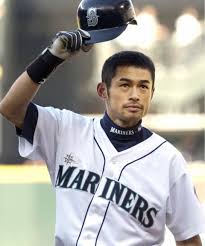 He has made 10 All-Star Teams. He has won 10 Gold Gloves, with a right-field arm that compares favorably with those of Hall-of-Famers Roberto Clemente and Dave Winfield. He has 2,742 hits -- in the North American major leagues alone. Counting what he did in Japan, he has over 4,000 hits.
He's led the American League in hits 7 times, including 2004 when he got 262, breaking the record of 257 set by George Sisler 84 years earlier. He's topped .300 10 times, .350 4 times, and topped out at .372 in 2004, the 2nd of his 2 batting titles. His lifetime average is .319 -- 4th-highest among active players with at least 3,000 plate appearances. He's stolen 472 bases.
When he arrived, I didn't like the hype over him, and thought, "He can't be that good." I even called him "Fluky Suzuki." Boy, was I wrong: He has stood the test of time. And now, he's a Yankee.
If any Japanese player is going to reach our Hall of Fame, based on what he did here, it's going to be Ichiro.
*
Japan has loved baseball from the first time it arrived there, except for the World War II years, when it was held up as an example of Western decadence. After the war, when General Douglas MacArthur was military governor, he had baseball restarted there, and the rest is history.
Trying to determine who are the...
Top 10 Baseball Players From Japan
...is a difficult exercise, because, until 1995, with one exception, they didn't play over here, so we have no idea of how they would have played against major league competition.
However, 59 players born in Japan have played in the North American major leagues, and, surely, we can get a Top 10 from that.
There is a Japanese Baseball Hall of Fame, located at the Tokyo Dome, home of the Yomiuri Giants. It currently has 97 inductees -- including Sadaharu Oh, whose 868 home runs for the Giants is the most of any player in any country's "major leagues" -- and 2 North Americans, Lefty O'Doul (who should be in our Hall of Fame, but isn't) and Horace Wilson, a Maine-born professor who is said to have introduced baseball to Japan in 1872.
The JBHOF, as yet, includes only one of the following, who have made their mark in North America, one of whom will hopefully be displaced by Tanaka in the coming years:
Honorable Mention to Masanori Murakami, the 1st Japanese player in the North American major leagues. He made 9 appearances for the San Francisco Giants in 1964, and 45 more in 1965, all but 1 of them as a relief pitcher. He went 5-1 with 8 saves and a 3.75 ERA (a 106 ERA+). But contractual obligations required him to go back to Japan, where he continued pitching until 1982. He became a pitching coach and a scout, and now broadcasts MLB games for Japanese TV network NHK.
Honorable Mention to Dave Roberts, born the son of a Japanese woman and a black U.S. soldier on Okinawa. He and Johnny Damon, the son of a Thai woman and a white U.S. soldier who met in Thailand (but was born at Fort Riley, Kansas, though he did live for a time on Okinawa) were both key figures in the Red Sox' 2004* run. I say Roberts gets an "Honorable Mention" because, as far as I know, he did not take the dishonorable route of performance-enhancing drugs.
10. Masato Yoshii. The 1st Japanese player for the Mets, the pitcher went 18-16 for them in 1998 and '99, helping them reach the Playoffs in the latter year. Then they traded him to the Colorado Rockies for one of the Bobby Joneses, and he was never the same pitcher, going 6-15 for them in 2000, and pitching poorly for the Montreal Expos in 2001 and '02, and that was it.
Shortly thereafter, the Mets got another Japanese player, Kazuo Matsui. When he arrived in Flushing in 2004, Met fans boasted that they had the best Matsui in New York. Yeah, right: The biggest thing he did for the Mets was force them to move Jose Reyes from shortstop to 2nd base, and experiment that ended the next season when they were switched. But he did hit a decent .267 for a career included stops with the Rockies and Houston Astros, and ended in 2010.
9. Hideki Irabu. Save your jokes, and have some respect for the dead. For a while, the guy could pitch. He arrived in New York in 1997, and went 24-16 for the Yankees in 1998 and '99, helping them win the World Series both times. He was sent to the Montreal Expos, and pitched for them in 2000 and '01, before finishing up with the Texas Rangers in 2002. Injuries doomed him to a career record of just 34-35.
Irabu gave me 2 fond memories in July 1999, when, within a span of 3 weeks, I saw him pitch the Yankees to victories over the Mets at Shea Stadium and the Red Sox at Fenway Park (the latter being that rare feat of a complete game with Joe Torre as manager).
8. Shigetoshi Hasegawa. He arrived in 1997 with the team then known as the Anaheim Angels, and, no doubt with Ichiro in mind, signed with the Seattle Mariners in 2002, and remained with them until 2005. He was a middle reliever, but still managed to save 16 games in his All-Star season of 2003. His career ERA+ was 125.
7. So Taguchi. A very versatile player, he could play all outfield positions and 2nd base. Arriving with the St. Louis Cardinals in 2002, he had 3 seasons batting at least .288, and appeared in the postseason 4 times, including winning World Series rings with the Cardinals in 2006 and the Philadelphia Phillies in 2008. He finished his career with the Chicago Cubs in 2009, batting .279 lifetime.
6. Daisuke Matsuzaka. Not even Nomo was this hyped upon his arrival in North America as this pitcher was. When "Dice-K" came to the Red Sox in 2007, the rumor was that he had a "gyroball" that was "unhittable." Not quite, but he did go 15-12, and won a game each in the AL Championship Series and the World Series. In 2008, he went 18-3 as the Sox came within a game of another Pennant.
But that was it: He's been very hittable ever since, crashing out with the infamous 2012 Sox (apparently, Bobby Valentine can only manage Japanese players in Japan), and clowning through 7 games for the Mets last year (wearing Dwight Gooden's Number 16, which may be a desecration if you're a Met fan). He is currently without a club. And he's only 33.
5. Hiroki Kuroda. He arrived with the Dodgers in 2008, and pitched for them until 2012, then coming to the Yankees. His career record stands at just 68-70, but his ERA+ is a strong 118, his WHIP a nifty 1.179. (Yeah, I like saying "nifty.") He's appeared in the postseason with the Dodgers in 2008 and '09 and the Yankees in '12.
4. Yu Darvish. In just 2 seasons pitching for the Rangers, he is already 29-18. He finished 3rd in the American League's Rookie of the Year voting in 2012 and 2nd in its Cy Young Award voting in 2013. Last year, he led the AL in strikeouts, and in both most strikeouts and fewest hits per 9 innings. He's only 27, so he should have several more good years left.
3. Hideo Nomo. When "the Tornado" debuted for the Dodgers in 1995, he became the 1st Japanese player in our major leagues in 30 years, and the excitement he brought to Southern California was reminiscent of Mexican pitching legend Fernando Valenzuela in 1981, Fernandomania presaging Nomomania. He was the National League's Rookie of the Year and its starting pitcher in the All-Star Game.
In 1996, he won 16 games (a career high he would reach 3 times) and pitched a no-hitter -- the only one ever thrown at homer-happy Coors Field in Denver. But injuries interfered, and he bounced around, including finishing the 1998 season with the Mets.
In 2001, pitching for the Red Sox, he threw another gem -- the only one ever thrown at homer-happy Camden Yards in Baltimore -- becoming only the 4th pitcher to toss no-hitters in both leagues. (There are now 5.) He's also one of the few pitchers to have led both leagues in strikeouts.
But the injury bug struck again, and after missing the entire 2006 and '07 seasons, he struggled through 3 games with the Kansas City Royals in 2008, and retired with a career record of 123-109, striking out 1,908 batters. He is the only one of these 10 players already in the Japanese Baseball Hall of Fame -- presumably, they waited 5 years like ours does, as he was just elected.
2. Hideki Matsui. The left fielder known (stereotypically) as Godzilla starred for the Yankees for 7 seasons. In his first home game at Yankee Stadium (the old one), the 2003 home opener, he hit a grand slam. In his last home game at Yankee Stadium (the new one), Game 6 of the 2009 World Series, he hit a single, a double and a home run, for 6 RBIs (tying a Series single-game record), clinching the World Championship for his team and the Series MVP award for himself. He played 1 season each for the Los Angeles Angels, the Oakland Athletics and the Tampa Bay Rays, before hanging up his spikes in 2012.
Between Yomiuri and The Bronx, he hit over 500 home runs. His major league batting average was .282, his OPS+ 118, and while he didn't hit 50 home runs in any season (as many predicted he would, with a swing that was tailor-made for Yankee Stadium, topping out at 31 in 2004), he helped the Yankees reach the postseason in 6 of his 7 seasons with them.
1. Ichiro Suzuki. I said Matsui was "the greatest Japanese Yankee," but he's not the greatest Japanese player to have played for the Yankees. Ichiro will, however, be best known for his 12 seasons with the Seattle Mariners, starting in 2001, when he became the 2nd player (after Fred Lynn of the 1975 Red Sox) to be named Rookie of the Year and MVP in the same season (even though he was no rookie, except by MLB's strict definition of being a player in his 1st season in MLB).
He's led the American League in hits 7 times, including 2004 when he got 262, breaking the record of 257 set by George Sisler 84 years earlier. He's topped .300 10 times, .350 4 times, and topped out at .372 in 2004, the 2nd of his 2 batting titles. His lifetime average is .319 -- 4th-highest among active players with at least 3,000 plate appearances. He's stolen 472 bases.
When he arrived, I didn't like the hype over him, and thought, "He can't be that good." I even called him "Fluky Suzuki." Boy, was I wrong: He has stood the test of time. And now, he's a Yankee.
If any Japanese player is going to reach our Hall of Fame, based on what he did here, it's going to be Ichiro.