Showing posts with label 1951. Show all posts

Wednesday, August 19, 2026

August 19, 1951: The Eddie Gaedel Game

August 19, 1951, 75 years ago: Eddie Gaedel makes his major league debut. He reaches base in his 1st plate appearance. He never makes a 2nd.

Born on February 9, 1914 in Chicago, William Louis Veeck Jr. was the son of a Chicago Cubs executive, and, in 1937, was responsible for putting the ivy on the brick outfield wall at Wrigley Field, and supervised the building of the hand-operated scoreboard atop the bleachers. He later bought the minor-league version of the Milwaukee Brewers, who won 3 American Association Pennants. After serving in World War II, he bought the Cleveland Indians, and built the team that won the 1948 World Series.

He got divorced the next year, and, needing cash, he sold the Indians. In 1951, he bought the St. Louis Browns, the most embarrassing team in the American League. Although they owned Sportsman's Park, leasing it to the National League's St. Louis Cardinals, they were pathetic, and had hardly any attendance at all. Veeck thought he could save the Browns, and drive the Cardinals, despite their 4 Pennants and 2 other near-misses in the 1940s, out of town.

Veeck held all kinds of promotions, including races between players and track stars, cow-milking contests, things like that. He once said, "There is nothing in the world more beautiful than a baseball stadium full of people having fun." But, despite a seating capacity of just 30,804, Sportsman's Park wouldn't fill, even for these promotions, leading Veeck to say, "You can draw more people with a losing team plus bread and circuses than with a losing team and a long, still silence."
In 1951, the American League celebrated its 50th Anniversary. All 8 teams wore anniversary sleeve patches. Veeck decided to celebrate the anniversary on August 19, with a large cake, which had wheeled onto the field between games of a Sunday doubleheader, against the Detroit Tigers. The Tigers won the 1st game, 5-2.

Out of the cake popped Eddie Gaedel, a 3-foot-7-inch, 65-pound dwarf. The term "dwarf" comes from German folklore, and referred to supernatural beings with a human appearance. Scientifically speaking, a "dwarf," or a "person with dwarfism," is defined as an adult with a height of less than 4 feet, 10 inches. The average adult height among people with dwarfism is about 4 feet even.

The term "midget" comes from "midge," a tiny biting insect, and has historically been used for any person considered short; but, unlike "dwarf," it does not have a scientific definition. Various other small things have had the tag applied: Small cars are used in "midget racing," a kids' hockey team is sometimes called "midget hockey," and so on." But people with dwarfism consider "midget" to be a slur, and it is not used as often anymore. On TV nostalgia networks' rebroadcasts of old shows, when the word "midget" was originally used, it is sometimes bleeped out.

While Eddie Gaedel was, medically speaking, a dwarf, he has gone down in history as "the midget who played baseball." Born on June 8, 1925, and also a Chicagoan, he had worked as a riveter during World War II, as he was small enough to climb into spaces fully-grown men couldn't. After the war, he became a professional entertainer, and was the model for the "Mercury Man" logo of Mercury Records.

Gaedel popped out of the cake wearing a Browns uniform with the Number 1/8 (one-eighth) on it. The uniform belonged to Bill DeWitt Jr., the Browns' batboy, and the son of Bill DeWitt Sr., the Browns' general manager. The fans got a kick out of it.
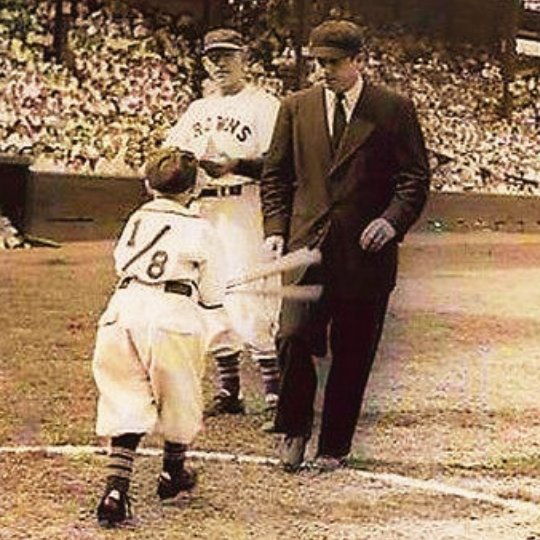
Bill DeWitt Jr. wearing the unusual number

But that wasn't the end of it. In the bottom of the 1st inning, Gaedel walked to the plate, to pinch-hit for the alleged leadoff hitter, right fielder Frank Saucier. He was announced by the public-address announcer. The fans went wild -- although there were just 18,369 of them, so the stunt didn't get a big crowd.

The home plate umpire, Ed Hurley, wasn't having it. He called time-out, and looked over to Browns manager Zack Taylor. But Taylor was ready: He walked out, and took a rolled-up piece of paper from his pocket. It was Gaedel's contract, signed not only by him and by Veeck, but by the President of the American League, Will Harridge. Clearly, Harridge signed it with no idea that the player involved was 3-foot-7. The subject of signing a midget to a contract had never come up before. So the contract was real and official. Hurley had no choice: He had to allow the at-bat.
Note the height of the ball in the mitt, compared to Gaedel's.
Note also Gaedel's crouching stance.

With his height, and a crouching batting stance, Gaedel had the smallest strike zone in baseball history, not much larger than the ball itself. The idea was that the pitcher, Bob Cain, wouldn't come close to a strike, and that Gaedel would walk on 4 straight pitches.

Veeck told Gaedel that there was a sniper on the roof of Sportsman's Park, ready to shoot him if he swung at any pitch. Veeck never said whether there actually was a sniper. If there really was one, he never came forward and admitted it. And whether Gaedel took this threat seriously, only he knew.

What everyone else knew is that catcher Bob Swift got onto his knees, and told Cain, "Keep it low." Cain threw 4 pitches. The 1st 2 were serious attempts at strikes, and did get over the plate, but were too high. Realizing it was hopeless, Cain threw the last 2 at half-speed, still getting them over the plate, but at about the level of Gaedel's head.

After ball 4, Hurley told Gaedel, "Take your base," and Gaedel trotted to 1st base. Jim Delsing then ran out to pinch-run for him. Like a real major-league ballplayer, which he now was, Gaedel slapped Delsing on the rear and, and trotted off the field -- to a standing ovation.

Delsing remained in the game, played center field as former Yankee Cliff Mapes moved from center to right, and went 1-for-3. It was no use: The Tigers got a fine pitching performance from Cain, a home run from Jerry Priddy, and 3 hits each from George Kell and Pat Mullin, and completed the sweep, 6-2.

The next day, AL President Harridge publicly said that Veeck was making a mockery of the game, and voided Gaedel's contract. In response, Veeck, who always hated the New York Yankees, told the Chicago press that he was going to request an official ruling on whether Phil Rizzuto, the Yankees' shortstop and the previous season's AL Most Valuable Player, was "a short ballplayer or a tall dwarf." 

Rizzuto was listed at 5-foot-6, and that may have been generous by an inch. Nevertheless, he was also the best shortstop in baseball at that point, and had batted .324 the season before, getting 200 hits. And, while his 92 walks that season were a career high, that was hardly an extraordinary total, probably was not much aided by his lack of height. Rizzuto's reaction to Veeck's request is unrecorded, but it would probably have been something like, "Veeck, you huckleberry. Holy cow."

Nevertheless, Gaedel got paid for his appearance: $100, his standard fee at the time. (In 2026 money, it works out to about $1,290.) Some time later, he was a guest on the radio show of Chicago-based talk show host Louis "Studs" Terkel. He complained that "Mr. Veeck" wouldn't let him swing the bat, and that he wanted to do that, just once. Terkel, then 39 years old and not looking much like a man who had ever been any kind of athlete, consoled him by saying, "You are exactly what I wish I was: An ex-big-league ballplayer!"

(Terkel would later play Chicago sportswriter Hugh Fullerton in Eight Men Out, the film about the 1919 Black Sox Scandal, and be interviewed by Ken Burns, including on the subject of Gaedel, for his miniseries Baseball.)

Veeck had hoped to run the financially troubled Cardinals out of St. Louis. But, early in 1953, they were bought by Anheuser-Busch chairman Gussie Busch. With Busch's beer fortune behind them, Veeck knew the Browns could not afford to compete for St. Louis' baseball fans.

He didn't particularly care about St. Louis: He just wanted to eliminate the competition and be Number 1 in whatever city he was in, as he had been in Milwaukee and Cleveland. With that option no longer available in St. Louis, he tried to get the Browns moved to Baltimore. The other AL owners, seeing a chance to get rid of him, voted to approve the move, on the condition that Veeck sell the team. He did. But in 1959, he bought the Chicago White Sox.

On May 26, 1959, as Harvey Haddix of the Pittsburgh Pirates was pitching his perfect-but-then-not game, 90 miles to the north in Milwaukee, Eddie Gaedel worked for Bill Veeck again. A helicopter carrying Gaedel and 3 other dwarves dressed in spacesuits landed on the infield at Comiskey Park. They came bearing gifts: Ray guns. They gave these to White Sox stars Luis Aparicio (who was 5-foot-9) and Nellie Fox (5-foot-10). In a parody of the alien visitors' trope, "Take me to your leader," Gaedel told them, "I don't want to be taken to your leader. I've already met him." The White Sox won the Pennant that season.

On June 18, 1961, Gaedel was found dead in his bed by his mother, with bruises all over his body. He was just 36 years old. His killer has never been identified.

By this point, Veeck had sold the White Sox, to pay for his medical expenses, as he had been told he was dying. This turned out to be a misdiagnosis, as he recovered, and he later owned the White Sox again, from 1975 to 1980. He lived until 1986.

But as a result of his 1961 illness, he was unable to attend Eddie Gaedel's funeral. Indeed, only one person with any connection with baseball did: Bob Cain, the pitcher who faced him. They had never even formally met.

Catcher Bob Swift died in 1966. Umpire Ed Hurley lived until 1969. Will Harridge served as AL President from 1931 to 1959, and died in 1971. Browns manager Zack Taylor lived until 1974. Bob Cain lived until 1997. Pinch-runner Jim Delsing lived until 2006. Frank Saucier, for whom Gaedel pinch-hit, was 1 of the last 3 surviving former St. Louis Browns, along with Ed Mickelson and Billy Hunter. All 3 of those men died in 2025, Hunter turning out to be the last survivor of them.

Bill DeWitt Jr. donated his uniform, Gaedel's uniform, to the Baseball Hall of Fame in Cooperstown, New York. He later became the principal owner of the St. Louis Cardinals, and got the uniform back, where it is on display at the St. Louis Cardinals Hall of Fame and Museum, across Clark Avenue from the current Busch Stadium, which also features artifacts from the Browns and St. Louis-area natives who played for other teams, such as Yogi Berra. 

Officially, the shortest players in MLB history have been Edmund "Stubby" Magner, who played 13 games for the New York Highlanders (forerunners of the Yankees) in 1911; and Pompeyo "Yo-Yo" Davalillo, who played 19 games for the Washington Senators in 1953. Both were listed at 5-foot-3.

In 1978, in his 2nd go-round as White Sox owner, Veeck promoted Harry Chappas to the majors, telling the media that he was, after Gaedel, the shortest player in MLB history, at 5-foot-3. This was a lie, but, fittingly, a small one: He was really 5-foot-5, the same height as the man then considered the shortest in the majors, Freddie Patek of the Kansas City Royals. Magner, Davalillo, Chappas and Patek were all, by a quirk of fate, shortstops.

Jon Rauch appeared in the major leagues from 2002 to 2013, including for the Montreal Expos when they moved to become the Washington Nationals in 2004-05, and for the Minnesota Twins in 2009 and 2010, enabling him to appear in postseason play. Sean Hjelle made his big-league debut with the San Francisco Giants in 2022. Both are 6-foot-11, and thus the tallest players in MLB history. Loek van Mil, a 7-foot-1 native of the Netherlands, appeared in professional baseball from 2006 to 2018, but only got as high, if you'll pardon the choice of words, as Class AAA. All 3 of these men are relief pitchers.

Sunday, August 16, 2026

August 16, 1951: The Delaware Memorial Bridge Opens

August 16, 1951, 75 years ago: The Delaware Memorial Bridge opens, connecting New Castle, New Castle County, Delaware and Pennsville, Salem County, New Jersey, over the Delaware River. It is operated by the Delaware River and Bay Authority.

It is 5 miles southeast of Rodney Square in Wilmington; 34 miles southwest of Center City, Philadelphia; 50 miles north of Legislative Hall (Delaware's State Capitol building) in Dover, 118 miles southwest of Midtown Manhattan; 70 miles northwest of Atlantic City; 73 miles northeast of downtown Baltimore; 91 miles northwest of Rehoboth Beach; and 108 miles northeast of downtown Washington, D.C.

Until 1926, the year what's now known as the Ben Franklin Bridge opened between Philadelphia and Camden, there was no way to get from Delaware's largest city, Wilmington in New Castle County, to New Jersey, except by train. But if, say, you only needed to go 20 miles to Salem, New Jersey, it made no sense to make the 30-mile train trip to Philadelphia, and then another 40 miles to Salem. The aforementioned Bridge only made things a little easier.

A ferry was established as a stopgap measure. Some stopgap: After debating whether a bridge or a tunnel should be built, Congress approved construction of a bridge in 1946. It finally opened 5 years later, bannered as U.S. Route 40 (which had been using the ferry). Soon, it became the southern end of the New Jersey Turnpike. In 1956, the Delaware Turnpike opened, connecting each State's most important highway.

The opening of the Turnpikes put too many cars on the span, and a 2nd bridge was ordered. On September 12, 1968, what's now the westbound span (toward Delaware) was opened, with the original span carrying eastbound traffic (toward New Jersey). In addition to Route 40, the "Twin Span" now carried Interstate 295. Its 174-foot-high towers are arguably the most famous structures in Delaware.

Even though the Bridges were 84 miles from the house in Central Jersey where I grew up, if a trip takes me in that direction, getting over the eastbound span meant I was back in New Jersey, so it felt like I was close to home, just as it did when I would come through the Lincoln Tunnel getting back from New York, 36 miles from home.

Thursday, July 16, 2026

July 16, 1951: "The Catcher in the Rye" Is Published

July 16, 1951, 75 years ago: The Catcher in the Rye is published by Little, Brown and Company. The author, J.D. (Jerome David) Salinger, was then 32 years old, a native of the Upper East Side of Manhattan, and had already published several short stories.

The novel tells the story of Holden Caulfield, a name that Salinger had used in earlier stories based on his experiences serving in World War II. In this novel, taking place during the Christmas season of 1948, Holden, obviously a different character, is 16 years old.

He has been expelled from a private prep school in Pennsylvania, and goes home to New York to see his family, especially his younger sister, Phoebe, to whom he is close. While there, he has a number of disappointing experiences, with people he ultimately describes as "phonies."

He hears a boy singing, "If a body catch a body comin' through the rye." He begins to imagine himself as a protector of children playing in a field of rye near the edge of a cliff, and catching them when they start to fall off.

But Phoebe, only 10 years old, correctly reminds him that the line in Robert Burns' 1782 poem is, "If a body meet a body... " His beautiful illusion shattered by the last person who still matters to him, Holden starts crying. He ends up in a psychiatric ward, and tells conflicting stories of his goals: Either he will live with his brother, D.B., a Hollywood screenwriter, or go to another private school.

Some schools, including East Brunswick High School in New Jersey, which I attended in the mid-1980s, have included the novel in their English Department curriculum. Other schools have banned it, because Holden mentions seeing graffiti reading, "FUCK YOU." (Ironically, Holden might have agreed with them: The graffiti was near an elementary school, and he didn't want small children finding out the words' meaning.)

The novel has never been filmed. Salinger was furious with the way one of his stories was adapted for a film, and shut down attempts to film CITR. He stopped writing in 1965, and retreated to a house on a hilltop in New Hampshire, seeing as few people as possible.

In 1962, as part of his parody album Allan Sherman's Mother Presents My Son, the Celebrity, Sherman sang:

Do not make a stingy sandwich.
Pile the cold cuts high.
Customers should see salami
coming through the rye.

On December 8, 1980, Mark David Chapman, having read the novel, bought a new copy in New York, went to the Dakota Arms Hotel at 72nd Street and Central Park West, waited for former Beatle John Lennon, shot him, and then sat down on the sidewalk, pulled out the new copy of the book, and started reading it. Lennon died within minutes. Chapman claimed that Lennon, by abandoning what he had once been, had become "the ultimate phony." Chapman was convicted, has been in prison ever since, and the book will always have that cloud over it.

In 1982, W.P. Kinsella published Shoeless Joe, in which a farmer in Iowa tracks Salinger down, rekindles Salinger's love of baseball, and takes Salinger with him on a journey that ends at the Iowa farm with the baseball field built into it. In 1989, the film Field of Dreams was released, based on the novel. However, to avoid a lawsuit, the author character was changed to the fictional Terence Mann, his race from white to black, the character's favorite baseball team from the New York Giants to the Brooklyn Dodgers, and his peak years of writing from the 1950s to the 1960s.

The character of William Forrester, played by Sean Connery, in the 2000 film Finding Forrester is also based on Salinger. In 2017, Nicholas Hoult played Salinger in the film Rebel in the Rye, which may be as close as we ever get to a film version of CITR.
A rare photo of an older Salinger. Rarer still because he's smiling.

Salinger married 3 times, and died in Cornish, New Hampshire in 2010, at the age of 91. He had 2 children, both with his 2nd wife, Claire Douglas. His daughter Margaret Salinger wrote a memoir of him, titled Dream Catcher.

His son Matt Salinger became an actor, and played superhero Captain America in a 1990 film, before moving into producing plays and films. He has said of his sister's memoir, "I can't say with any authority that she is consciously making anything up. I just know that I grew up in a very different house, with two very different parents from those my sister describes."

Sunday, June 28, 2026

June 28, 1951: Everybody Turns On "Amos 'n' Andy" -- and Not In a Good Way

Top: Tim Moore as George "Kingfish" Stevens.
Bottom: Spencer Williams as Andy Brown (left)
and Alvin Childress as Amos Jones.

June 28, 1951, 75 years ago: After 23 years on radio, Amos 'n' Andy premieres on CBS' television network. When people heard white actors on radio, pretending to be black, they loved it. But when they saw the roles they thought they knew played by actual black actors -- Alvin Childress as Amos Jones, Spencer Williams as Andy Brown, Tim Moore as George "Kingfish" Stevens, and Ernestine Wade as Kingfish's wife Sapphire -- they didn't like it. The NAACP objected as well, saying it indulged in racial stereotypes.

A total of 78 half-hour episodes were eventually produced. Childress and Williams were instructed to keep their voices and speech patterns close as possible to those of the roles' originators, Freeman Gosden and Charles Correll, respectively. Nevertheless, the show was a bust, lasting just 2 seasons.

Even if the show had succeeded, they would have had to replace Moore after his death in 1958. Williams lived until 1969, Wade until 1983, and Childress until 1986. To the end, though, Childress said he never thought the show was a negative portrayal of black people, because it was the only television show of the time to show them as businessmen, policemen, judges and doctors, rather than in subservient roles such as maids and janitors.

Black actors Redd Foxx and Marla Gibbs, both of whom starred in later sitcoms, emphasized the importance of the show featuring black actors in lead roles and expressed disagreement with the NAACP's objections that had contributed to the program's downfall.

The shows were preserved, and have been released on DVD, so that current viewers may decide for themselves if the show indulged in stereotypes, or was just good clean fun.

Thursday, May 28, 2026

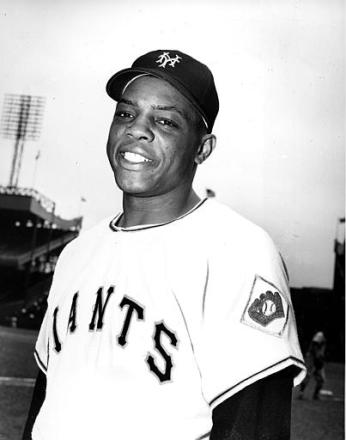
May 28, 1951: Willie Mays Says Hello

May 28, 1951, 75 years ago: Willie Mays makes his real major league debut.

Not his actual major league debut. Depending on how you measure it, that was either sometime in 1948, or on May 25, 1951. It was 3 days after that latter date that he began to show the wider world what he could do.

Willie Howard Mays Jr. was born on May 6, 1951 in Westfield, Alabama, and grew up in nearby Fairfield, both outside Birmingham. His father, Willie Sr., nicknamed Kitty-Kat, had played semi-pro baseball, though not officially in what became known as the Negro Leagues. Willie Jr. was signed to play in those, in 1948, by the Birmingham Black Barons. He was just 17, but was good enough to help them win the Pennant, before losing the Negro World Series to the Pittsburgh-based Homestead Grays.

While playing with the Black Barons in 1949, he was pursued by several teams. He could have ended up with the Brooklyn Dodgers, on the same team with Jackie Robinson and Roy Campanella. He would have played center field, and the Dodgers would have solved their left field problem by moving Duke Snider over.

But the Dodgers didn't make the deal, because an official in their front office, Wid Matthews, had seen him play, and told team president Branch Rickey that he could not hit a curveball. Matthews was a former outfielder, who had played all of 192 games in the major leagues in the 1920s. Who couldn't hit a curveball? Well, maybe we shouldn't be too hard on Wid: It was he who told Branch Rickey, president of the Dodgers, in 1945 that Robinson had a good ability to "protect the strike zone."

Mays could have ended up with the Boston Red Sox, because they had offered him a tryout, because they had offered his manager in Birmingham, Piper Davis, a contract. But a Sox scout told team owner Tom Yawkey the same thing that Matthews had told Rickey: That Mays "couldn't hit a curveball."

He was 18 years old, and had never yet attempted to hit a white man's curveball. And Davis was too old to keep, and was released. And that's why the Red Sox became the last major league team to integrate, in 1959. And that's also how the Red Sox could have ended up with Ted Williams in left field and Willie Mays in center field, but didn't.

The Boston Braves were also interested in Mays. But they had a quota on the number of black players in their system, and they'd already hit it. So they could have had Willie Mays in center field and Hank Aaron in right field -- perhaps not soon enough to save them from moving to Milwaukee in 1953, but the Braves could have dominated the National League for years to come.

Or, the New York Giants could have. Because their scout, Ed Montague, signed Willie, and they were also interested in Hank. "I had the Giants' contract in my hand," Aaron would later say, "but the Braves offered $50 a month more. That's the only thing that kept Willie Mays and me from being teammates: Fifty dollars." $50 in 1952, with inflation, is about $700 in 2026 money. So, to us, $700 a year, $8,400 a year. Doesn't sound like much, does it? On such hinge moments does the history of a sport sometimes hang in the balance.

For 1950, the Giants assigned Mays to their Class A team, the Trenton Giants. This was the end of the line for minor-league baseball in New Jersey: The Giants moved both their Trenton and their Jersey City farm teams after the season, while the New York Yankees moved their Newark Bears farm team a year earlier. The Negro Leagues' Newark Eagles folded after 1951.

Negro League stars being picked up by the white majors hurt them, but what really killed the Negro Leagues and many of the minor-league teams, and in some cases entire minor leagues, was television: Why should a fan get in his car and drive 20 miles, and then pay to get in, to watch a minor-league team when he could stay home, and watch the closest major league team for free, on a TV set he'd already paid for, with food and drinks he'd already paid for and didn't have to stand on line for?

Mays did well enough with Trenton that he was promoted to the Giants' top farm team for 1951, the Class AAA Minneapolis Millers. He was batting .477, and had just turned 20. Clearly, he could hit a major league white man's curveball. So, on May 25, 1951, he made his debut with the Giants. Wearing Number 14, playing center field and batting 3rd, he went 0-for-5 against the Philadelphia Phillies at Shibe Park in Philadelphia. The Giants won, anyway, 8-5.

The next day, against Phils ace Robin Roberts, he went 0-for-3 with 2 walks. The Giants won, anyway, 2-0. The next day, he went 0-for-4. The Giants won, anyway, again 2-0. He had played flawlessly in center field. But at the plate, he was 0-for-12. His batting average was .000. His slugging percentage was .000. Counting the 2 walks, his on-base percentage was .143.

He told Giant manager Leo Durocher that he didn't think he was ready. Leo showed confidence in him, saying, "I don't care if you go 0-for-50. I'm the manager, and you're my center fielder."

The next night, May 28, was Mays' 1st home game, at the Polo Grounds at 157th Street and 8th Avenue in Upper Manhattan, with Harlem to the south, Washington Heights to the west, and the Harlem River and The Bronx to the north and east -- including Yankee Stadium, one mile due east. The Giants were starting a series with the Boston Braves. For this game, Mays was given a new uniform number, 24.

In the 1st inning, the Braves -- who did not yet have Aaron, or their other Hall of Fame hitter of the era, Eddie Mathews -- tagged Sheldon Jones for 3 runs in the top of the 1st inning. In the bottom of the 1st, batting 3rd for the 4th game in a row, was Mays. The Braves' starting pitcher was Warren Spahn, also a future Hall-of-Famer.

The distance from the middle of the pitching rubber to the middle of home plate is 60 feet 6 inches. Spahn threw Mays a fastball, and, after the game, told the press, "For the 1st 60 feet, that was a hell of a pitch." Mays hit it over the left field roof. It was the 1st of 3,283 career hits, the 1st of 660 home runs, and the 1st of 1,903 runs batted in. But it was the only run Spahn allowed, as the Braves won, 4-1.

Mays finished the game 1-for-4. He was now batting .063, on-base .261, slugging .250. Many years later, years in which Mays had terrorized the National League with his hitting, running and fielding, at an All-Star Game, with Mays within earshot, Stan Musial of the St. Louis Cardinals jokingly told Spahn, "If you'd just struck him out, we might have been rid of him forever!"

Mays' performance in the field had led to the moving of Bobby Thomson from center field to 3rd base. When Thomson hit "The Shot Heard 'Round the World" to give the Giants the Pennant, a little more than 4 months later, Mays was on deck. He had finished a season in which he batted .274 with 20 home runs, 61 runs batted in, and some sensational catches, which led to him telling his teammates, "Say, hey, didn't you see that play?" Which led to him being nicknamed "The Say Hey Kid." He was named the NL's Rookie of the Year.

Willie Mays had said hello to America. When he announced his retirement 22 years later, he told the crowd that he had realized that the time had come to tell himself, "Willie, say goodbye to America."

Thursday, May 14, 2026

May 14, 1951: TV's 1st Sitcom Is Blacklisted

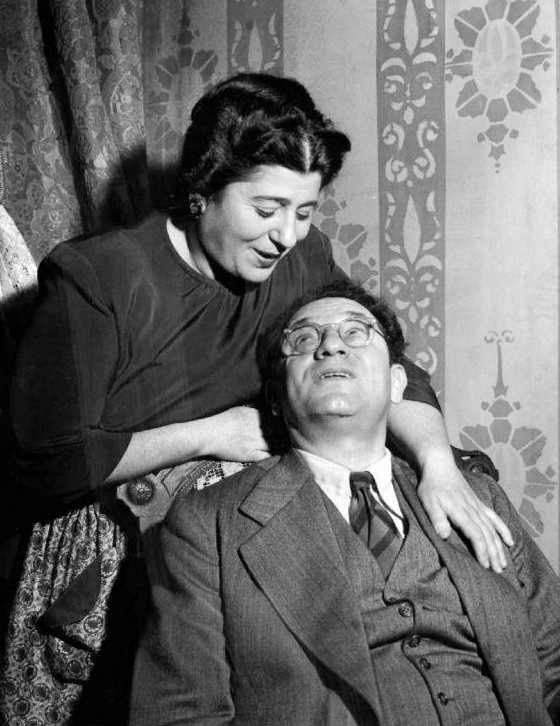
Gertrude Berg (left) and Philip Loeb

May 14, 1951, 75 years ago: American TV's 1st sitcom is canceled, because its creator and star stood up for her co-star when he was blacklisted.

Gertrude Berg had created the radio program The Rise of the Goldbergs for NBC radio in 1929. From the beginning, she played Molly Goldberg, described by an announcer as "a woman with a place in every heart and a finger in every pie." In 1936, it moved to CBS and became simply The Goldbergs.

According to the show, Molly lived at 1038 East Tremont Avenue in The Bronx, New York City, with her husband Jake, their son Sammy, their daughter Rosalie, and Molly's Uncle David. The generation gap was typical of immigrant families in America at the time: David, who came over on the boat, was still very much an "old country" man; Molly and Jake, who had grown up in New York, wanted to be Americans without giving up any of their Jewish heritage; while Sammy and Rosalie wanted to be totally assimilated.

Berg was not averse to incorporating serious real-world issues which affected Jewish families. One 1939 episode addressed Nazi Germany, including a rock through the family window as the Goldbergs had their Passover Seder. Other episodes during World War II alluded to friends or family members trying to escape the Holocaust.

But these were sporadic deviations from the show's main theme of family, neighborhood and the balance between old world values and new world assimilation. Molly shows viewers the strong matriarch she is by constantly helping others with their dilemmas, and proving to be the hero time and time again.

The role of husband Jake Goldberg was originally played by Himan Brown, and later, James R. Waters. When Waters died suddenly in 1945, Berg resisted recasting the role. Instead, she simply had Molly refer to Jake, occasionally setting up dialogue in which his reply was not heard when she spoke to him.

On September 26, 1949, The Goldbergs premiered on CBS television, and it is considered to be American TV's 1st "situation comedy" or "sitcom." Philip Loeb was cast as Jake. Eli Mintz played Uncle David, Larry Robinson played Sammy, and Arlene McQuade played Rosalie.

Each episode began with Berg opening her window and yelling to a neighbor, "Yoo-hoo, Mrs. Bloom!" Mrs. Bloom was never seen, and was thus TV's first unseen character, paving the way for the titular detective's wife on Columbo, Phyllis Lindstrom's husband Lars on The Mary Tyler Moore Show, Carlton the Doorman on Rhoda, the bullying Gooch on Diff'rent Strokes, Norm Peterson's wife Vera on Cheers, and Niles Crane's wife Maris on Frasier.

Berg, now 50 years old, continued to write every episode. By this point, World War II was over, and the State of Israel had won its war of independence. But she knew that hearing about situations was one thing, while seeing them was another. So she avoided issues that could be considered political, while still using Jewish mannerisms. It worked: Not only was the TV version of the show a hit, but, in 1950, she won the 1st Emmy Award for Best Actress.

(The transition from sound to pictures was a reason that Amos & Andy, one of the most popular radio shows, didn't make a successful transition to TV: It was one thing for white Americans to hear white men pretending to be black men for comedic effect, it was another thing to see black men, and they didn't like it.)

But, shortly after that, Loeb was named as a Communist in the publication Red Channels: The Report of Communist Influence in Radio and Television. He denied it. But General Foods, whom Berg had personally recruited as the show's main sponsor, demanded that Loeb be dropped from the show. She refused. On May 14, 1951, CBS aired the show's 2nd season finale, and received word that General Foods had canceled their sponsorship. CBS canceled the show.

Berg didn't give up. She tried to find other sponsors, but none would stand up for Loeb. Finally, Loeb sacrificed himself, telling Berg to go on without him, and to recast the character. On January 7, 1952, 8 months later, NBC agreed to pick up the show, with Harold Stone playing Jake. Robert H. Harris took over the role the next season, and played it for the rest of the show's run.

The show continued into 1955, when the family moved from The Bronx to Haverville, a fictional suburb, presumably also in the State of New York. In-universe, the family's adjustment was initially difficult, but they and their new suburban neighbors soon adapted to each other. In reality, though, the move was the death knell for the show, as the viewers now saw the Goldbergs as fish out of water.

The final episode aired on February 26, 1957 -- pretty much mirroring the move of baseball's Brooklyn Dodgers to Los Angeles at the end of the year. This would be mirrored in the 1991-93 CBS series Brooklyn Bridge, created by Gary David Goldberg (no relation), about a Jewish family in Brooklyn, and the show's final episode discussed the launch of Sputnik 1 on October 4, 1957, 10 days after the last game at Ebbets Field, and 4 days before the Dodgers officially announced the move.

Philip Loeb did not last as long as the show that made him famous: In 1955, he took an overdose of sleeping pills. He was 65 years old. The right-wing fanatics who drove him to it never expressed so much as one single unit of remorse. They didn't have a guilty conscience. They had no conscience.

Berg lived until 1966, shortly before her 67th birthday. Mintz, who played a character a generation older than Molly and Jake, was actually younger than either Berg or Loeb, and lived until 1988. Harris lived until 1981, Stone until 2005, Robinson until 2006, and McQuade until 2014.

In 2013, ABC debuted a sitcom titled The Goldbergs. Aside from the title, and the family's obvious Jewishness, it had nothing in common from the original show. It was more like Brooklyn Bridge, in that it was created by someone with the surname, Adam Goldberg; and took place in the past, in this case in the 1980s, in the suburbs of Philadelphia. It ran for 10 seasons.

Tuesday, April 21, 2026

April 21, 1951: The Bill Barilko Game and the Rochester Royals' Title

April 21, 1951, 75 years ago: Bill Barilko becomes hockey's version of Bobby Thomson -- nearly 6 months before Thomson becomes baseball's version of Barilko.

Barilko was a 24-year-old defenseman of Ukrainian descent, from the mining town of Timmins, Ontario. He had already helped the Toronto Maple Leafs win the Stanley Cup in 1947, 1948 and 1949. The 1951 Stanley Cup Finals against the Montreal Canadiens was unusual in that every game went to overtime.

Game 1, at Maple Leaf Gardens in Toronto, was won 5 minutes and 51 seconds in, on a goal by Sid Smith. Game 2 in Toronto was won after 2:55 by the Canadiens' Maurice Richard, a.k.a. "The Rocket," the greatest and most popular player in the sport at the time. The action shifted to the Montreal Forum, but the Leafs won Game 3 4:47 into overtime on a goal by Ted Kennedy. Then they won Game 4 5:15 into overtime on a goal by Harry Watson.

(Unlike the longtime U.S. Senator from Massachusetts and brother of President John F. Kennedy, who was one of many men named Edward who ended up being nicknamed "Ted" or "Teddy," the man who scored the Game 3 winner was born Theodore Samuel Kennedy, was nicknamed "Teeder," and was the Leafs' Captain at the time.)

The series returned to Toronto for Game 5. There was no scoring in the 1st period. Richard scored midway through the 2nd period, but Tod Sloan tied it back up. Paul Meger gave the Canadiens a 2-1 lead less than 5 minutes into the 3rd period, but Sloan equalized with just 32 seconds left in regulation.

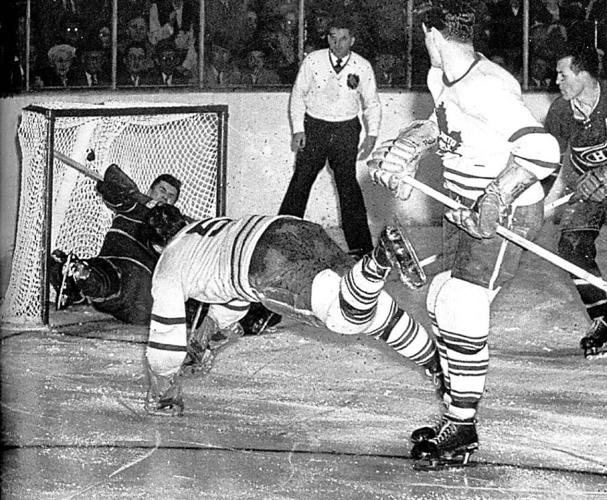
At the 2:53 mark of overtime, Barilko, much like Bobby Orr would be in overtime of Game 4 of the 1970 Finals, was tripped up, but still managed to get a shot off. It went past Canadien goalie Gerry McNeil, and the Leafs won the game 3-2, and the series 4-1.

"It was as clean as a hound's tooth," Toronto Daily Star writer Red Burnett said. "McNeil never had a chance." Hockey fans tend to blame goaltenders who give up big goals considerably less than baseball fans blame pitchers who give up big home runs. And so, McNeill, who would be the starting goalie when the Habs won the Cup in 1953, before giving way to Jacques Plante, would not live in infamy. He lived until 2004.
The most familiar photo of the goal, taken by Nat Turofsky

It was the Leafs' 4th Cup in the last 5 years, and their 10th overall. At the time, no other team had more: The Canadiens had 6.
Another angle, showing Barilko's face,
and that of Maurice Richard, who clearly knows it's over.

The Leafs were a great team, with 4 players who went on to be elected to the Hockey Hall of Fame: Centers Kennedy and Max Bentley, defenseman Fern Flaman, and goaltender Walter "Turk" Broda. Barilko could have become another of them: He was a classic "defensive defenseman," a hard checker who enjoyed rough play. He wasn't regarded as dirty, so no one begrudged him his status as a national hero across Canada -- at a time when there were only 6 teams in the National Hockey League, and just 2 of them in Canada, the Leafs and the Canadiens.

A little over 4 months after his epic goal, Barilko went on a fishing trip with his dentist, Henry Hudson. Hudson was a licensed pilot, and he took Barilko on a Fairchild 24 floatplane, from Timmins to Waskaganish, Quebec, on James Bay.

There was some irony in this. James Bay is an extension of Hudson Bay, where an earlier Henry Hudson, the discoverer of the river in New York that would be named for him, disappeared in June 1611, on a voyage to find the Northwest Passage.

Barilko and Hudson caught a few fish, and, the weekend over, on August 26, 1951, they boarded the Fairchild. Hudson headed it back for Timmins, about 400 miles away.

They never arrived. Plane disappearances in the northern reaches of North America were nothing new. The last attempt at the 1st nonstop flight between the European and North American continents before Charles Lindbergh successfully did it took off from France, and was believed to have been crashed in the woods of northern Maine, or the Canadian Province of New Brunswick, and has still never been found. But this was different: Bill Barilko, the man who had won the most recent Stanley Cup, a new national hero, was missing.

Barilko did not live long enough to build a Hall of Fame career. But the Leafs did retire his Number 5. Or, at least, they thought they had: In 1992, someone working in the front office discovered that, while no player had worn the uniform number in 41 years, there had never been an official retirement ceremony for it. One was held on October 17, 1992.

The Leafs stopped winning. Over the next 7 seasons, of the 14 available places in the Stanley Cup Finals, 7 were won by the Canadiens (in other words, they made it every year), 4 by the Detroit Red Wings, and 3 by the Boston Bruins. The Leafs rebuilt, and got back to the Finals in 1959 and 1960, but lost to the Canadiens both times.

On April 22, 1962, the Leafs won the Cup again, dethroning the Chicago Black Hawks in the Finals. Had Barilko not died, he would have been 35 years old, and could still have been playing. Certainly, Leafs head coach and general manager George "Punch" Imlach was known to favor veterans.

Just 45 days after that Cup win, on June 6, helicopter pilot Ron Boyd was flying about 60 miles north of Cochrane, Ontario, when he spotted the wreckage of a plane. He reported it, and it was discovered to be Dr. Henry Hudson's Fairchild 24. His body, and Barilko's, were remarkably well preserved in the cold after 11 years. The wreck and the records were examined, and it was determined that Hudson's inexperience as a pilot, too much cargo (too many fish?), and bad weather doomed the plane.

There was something poetic about Barilko being found only after the Leafs won the Cup again, beginning a run of 3 straight, and 4 in 7 years -- at which point Barilko would have been 40 and, knowing Imlach, could still have been getting game time.

But since the last of those Cups, in 1967, they have never even reached the Stanley Cup Finals again. This time, there was no harbinger of trouble, like a plane crash. It was just bad management.

*

April 21, 1951 was a Saturday. The NBA Championship was also decided that day, and also in overtime, but in a Game 7. The Rochester Royals defeated the New York Knicks, 79-75 at the Edgerton Park Arena in Rochester, New York.
Left to right: Bill Calhoun, Bob Davies, Paul Noel, Joe McNamee,
Arnie Risen, Jack Coleman, Arnie Johnson and Bobby Wanzer

For the Knicks: Max Zaslofsky and Vince Boryla each scored 16 points, Harry Gallatin 12, Nat "Sweetwater" Clifton (the 1st black player signed to an NBA contract) and Connie Simmons 11, Ernie Vandeweghe (father of future NBA player Kiki) 5, Dick McGuire (brother of Hall of Fame college coach and announcer Al) 4, and Ray Lumpp none.

It wasn't enough, as Arnie Risen scored 24, and former Seton Hall star Bob Davies scored 20. Scoring 2 points for the Royals in this game was William "Red" Holzman. Ed Mikan, brother of Minneapolis Lakers star George, was on the Royals' roster at the start of the season, but was traded.

The Knicks would win 3 straight NBA Eastern Division Championships, but lose the Finals all 3 times: This one to the Royals, and 1952 and '53 to the Lakers. It would take them until 1970 to win their 1st title, with Holzman as their coach. They won again in 1973. But haven't won one since, also losing in the Finals in 1972, 1994 and 1999.

At least the Knicks still exist. The Royals don't, at least not under that name. Rochester proved too small a market for a growing sports league. In 1957, they moved, becoming the Cincinnati Royals. In 1972, they moved again. Since Kansas City already had a baseball team called the Royals, they became the Kansas City Kings. And in 1985, they became the Sacramento Kings. In the early 2010s, they came close to moving yet again, to Anaheim and to Seattle, before the building of their new arena was negotiated. Come to think of it, Minneapolis lost the Lakers to Los Angeles in 1960.

Nevertheless, at their arena, the Golden 1 Center, the Kings still hang a banner proclaiming themselves to be the 1951 NBA Champions.
Davies, Wanzer, Risen, and Holzman as a coach have been elected to the Basketball Hall of Fame. The Kings retired Davies' Number 11. Nevertheless, when the NBA named its 50th Anniversary 50 Greatest Players in 1996, the '51 Royals were 1 of 4 teams with no representatives, the others being the 1947 Philadelphia Warriors, the 1948 Baltimore Bullets, and the 1979 Seattle SuperSonics.

Also on that day, actor Tony Danza was born.

Friday, April 17, 2026

April 17, 1951: Mickey Mantle's 1st Major League Game

April 17, 1951, 75 years ago: Opening Day at Yankee Stadium. There are 2 significant debuts on this day. Yankee co-owner Dan Topping had owned the football edition of the Brooklyn Dodgers, whose public address announcer was a professor of speech at St. John's University in Queens. Topping hired him, and he held the Yankee PA job for the next 57 seasons. His name was Bob Sheppard. Yankee Hall-of-Famer Reggie Jackson would dub him "The Voice of God."

The 1st name he introduced was that of the leadoff hitter for the visiting Boston Red Sox, their center fielder, Dom DiMaggio, brother of the Yankees' biggest star and center fielder, Joe DiMaggio. Making his major league debut that day, in right field, but being groomed to be Joe's successor in center, was a 19-year-old switch-hitter from the northeastern corner of Oklahoma, wearing Number 6. His name was Mickey Mantle.

The kid was overwhelmed by New York. Attendance on Opening Day was 44,860. His native Ottawa County was home to just 31,000. As he would say, many years later, "New York was tough on me. Playing baseball was the easy part."

Easy? Maybe if you're among the most talented baseball players who have ever lived. Batting against Red Sox starter Bill Wight, he grounded to 2nd base in the 1st inning, popped up to 3rd in the 3rd, singled home a run and later scored himself in the 6th, and flew out against Mickey McDermott in the 8th.

Jackie Jensen, later to win a Most Valuable Player award with the Red Sox, hit a home run for the Yankees. Joe DiMaggio went 1-for-4, Yogi Berra 1-for-2 with an RBI, Phil Rizzuto 0-for-3. For the Red Sox, Dom DiMaggio went 2-for-3 with a walk, and Ted Williams went 1-for-3 with a walk. Vic Raschi went the distance, and the Yankees won, 5-0.

Mantle struggled a bit that season, and even got sent down to the minors, but recovered, before getting hurt in the World Series. The rest is history... and myth.

Sheppard would later say that Mantle was his favorite name to announce. Mantle told him, "I got goose bumps when you announced my name." Sheppard told him, "So did I."
Bob Sheppard

*

April 17, 1951 was a Tuesday. These other Major League Baseball games were played that day:

* The New York Giants beat the Boston Braves, 4-0 at Braves Field in Boston. As with the other teams in the National League, they wore special uniform patches in honor of the League's 75th Anniversary.
* The Brooklyn Dodgers lost to the Philadelphia Phillies, 5-2 at Ebbets Field. Robin Roberts outpitched Carl Erskine. Jackie Robinson hit a home run, and he, Duke Snider and Gil Hodges each had 2 hits, but it wasn't enough. The Dodgers started the season one game behind the Giants, and would end the season the same way. Little did anyone know how that would come about.

* The Washington Senators beat the Philadelphia Athletics, 6-1 at Shibe Park in Philadelphia. It was the start of the 51st season for the A's, and their 1st regular-season game with a manager other than Connie Mack: Jimmy Dykes. As with the other teams in the American League, including the Yankees, they were wearing special uniform patches in honor of the League's 50th Anniversary.
* The Pittsburgh Pirates beat the St. Louis Cardinals, 5-4 at Forbes Field in Pittsburgh. Stan Musial went 1-for-2 with 2 walks, but the Cards lost, anyway.

* The Cleveland Indians beat the Detroit Tigers, 2-1 at Briggs Stadium in Detroit. (It was renamed Tiger Stadium in 1961.) Bob Lemon outpitched Hal Newhouser, and both went to the Baseball Hall of Fame. Newhouser would join Lemon on the Indians' 1954 American League Pennant winners.

* The Chicago Cubs beat the Cincinnati Reds, 8-3 at Wrigley Field in Chicago.

* And the Chicago White Sox beat the St. Louis Browns, 17-3 at Sportsman's Park in St. Louis. Bill Veeck, who had built the Indians into the 1948 World Champions, had bought the Browns, and this would be the season in which he tried everything to bring fans in, including "Grandstand Managers Night" and letting a 3-foot-7 Eddie Gaedel come to bat.

Football was out of season. But the NBA Finals were underway. The Rochester Royals led the New York Knicks, 3 games to 2. The next day, the Knicks would win Game 6. But on April 21, in overtime, the Royals would win Game 7. As the Rochester Royals (1952-57), the Cincinnati Royals (1958-72), the Kansas City-Omaha Kings (1973-75), the Kansas City Kings (1976-85) and the Sacramento Kings (1986-2022), they have not been back to the NBA Finals since. The Knicks would not get so close to their 1st NBA Championship again until 1970.

And Game 3 of the Stanley Cup Finals was played. The Toronto Maple Leafs beat the Montreal Canadiens, 2-1 at the Montreal Forum, with Ted "Teeder" Kennedy scoring the winning goal, 4:47 into overtime. Unlike a lot of Teds and Teddys who were actually born Edward, including the future U.S. Senator Edward Moore Kennedy, this Ted Kennedy actually started out with the name Theodore.

All 5 games in this Finals would go to overtime. Sid Smith won Game 1 for the Leafs, Maurice "the Rocket" Richard won Game 2 for the Habs, Harry Watson won Game 4 for the Leafs, and, on April 21, the same day that the NBA Finals were decided, Bill Barilko, a hard-hitting but little-scoring young defenseman, won Game 5 and the Cup with an overtime goal.

Four months later, Barilko and a friend would take a fishing trip with a friend, an inexperienced pilot. The plane went off course, crashed, and wasn't found for 11 years.

Also, actress Olivia Hussey was born on this day. 

Saturday, April 11, 2026

April 11, 1951: President Harry Truman Fires General Douglas MacArthur

April 11, 1951, 75 years ago: President Harry S Truman fires General of the Army Douglas MacArthur as Supreme Commander of United Nations forces in the Korean War.

MacArthur's offense: Insubordination. Truman had given him orders not to further engage the Chinese forces in Korea. MacArthur had sent a letter to Representative Joseph W. Martin of Massachusetts, the Republican Party's leader in the U.S. House of Representatives -- he had been Speaker in the 1947-48 session, and would be again in that of 1953-54 -- objecting to Truman's orders.

Had Martin not mentioned this letter to the media of the time, MacArthur probably would have gotten away with it. But Truman was incensed, and decided to give MacArthur, a 5-star General and perhaps the most popular living military man in America, a lesson that every American needs to learn: One of the guiding principles of the country is civilian control of the military.

But America did not accept this at first. MacArthur returned home, and was treated as a hero. The City of New York gave him the biggest ticker-tape parade in its history, breaking the record set for Charles Lindbergh in 1927, and lasting until the Mets won the 1969 World Series.

Martin talked his opposite number in the Democratic Party, Speaker Sam Rayburn of Texas, into letting MacArthur speak before a Joint Session of Congress on April 19. There was nothing Truman could do: He did not control Congress, and had already sent Mac into forced retirement. (Mac shouldn't still have been on active duty, anyway: He was 71 years old.)

He reminisced about his time as a young soldier, and quoted "one of the most popular barrack ballads of that day, which proclaimed, most proudly, that 'Old soldiers never die, they just fade away.' And like the old soldier of that ballad, I now close my military career and just fade away, an old soldier who tried to do his duty, as God gave him the light to see that duty. Good Bye."
For the record, the line is, "Old soldiers never die, they simply fade away."

MacArthur was more popular than ever, and people began to speculate that he would run for the Republican Party's nomination for President in 1952 -- and that he would win, easily.

He refused to campaign for that nomination, figuring he didn't need to work for it, because a popular groundswell would lead to his nomination. He was wrong: It was the man he had once called "the best clerk I ever had," Dwight D. Eisenhower, who was nominated due to a popular groundswell, the closest thing to a "draft" any Presidential candidate has ever had.

Truman could have run for what would have amounted to a 3rd term -- due to the 22nd Amendment to the Constitution having been ratified a few weeks earlier, he was the last President who could have done so -- but he chose not to. He would have lost badly, as Governor Adlai Stevenson of Illinois, who turned out to be the Democratic nominee, did.

MacArthur lived until 1964. By that point, Truman's reputation, in the dumps when he left office, had recovered. He lived until 1972.

Sunday, March 15, 2026

March 15, 1926: Norm Van Brocklin Is Born

March 15, 1926, 100 years ago: Norman Mack Van Brocklin is born in Parade, South Dakota, and grows up in the San Francisco suburb of Walnut Creek, California. He left high school to enter the U.S. Navy during World War II, and starred at the University of Oregon, before playing for the Los Angeles Rams, debuting with them in 1949.

This led to perhaps the NFL's 1st great "quarterback controversy," as the Rams already had Bob Waterfield, who had already led them to the NFL Championship in 1945, their last season in Cleveland. In 1949, Waterfield started 11 of 12 games, and the Rams reached the NFL Championship Game, but lost it to the Philadelphia Eagles. In 1950, Van Brocklin started 7 games, Waterfield 5, and again, they reached the Championship Game, losing it to the Cleveland Browns. Both times, Waterfield started, but Van Brocklin did play.

In 1951, Waterfield started 10 games, Van Brocklin only 2. One of those was on September 28, against the woebegone football version of the New York Yankees. He completed 27 of 41 passes for 554 yards. Despite all the advances in the passing game over the last 75 years, that is a single-game record that still stands. Once again, the Rams reached the Championship Game. Once again, head coach Joe Stydahar, previously a Hall of Fame lineman with the Chicago Bears, named Waterfield the starter. This time, the Rams beat the Browns.

In 1952, Van Brocklin started 7 games, Waterfield 5. Waterfield then retired. Van Brocklin got them back to the Championship Game in 1955. In 1958, he was traded to the Philadelphia Eagles. In training camp in 1959, a young tackle was injured, and Van Brocklin taught him how to watch film. That tackle never played a down of pro ball, but a coach was born that day: John Madden. He also tutored the Eagles' young backup quarterback, future Hall-of-Famer Christian "Sonny" Jurgensen.
I think that's Ray Nitschke,
the Packers' Hall of Fame linebacker, behind him.

In 1960, Van Brocklin led the Eagles to a 12-2 record, winning the NFL Championship Game over the Green Bay Packers, 17-13 at Franklin Field in Philadelphia. This made him the 1st quarterback to lead 2 different teams to the NFL title. There have been 2 since: Peyton Manning and Tom Brady *.

After that game, Van Brocklin retired as a player, and, with Eagles head coach Buck Shaw also retiring, fully expected to be named head coach. He wasn't, and 1960 remained their last NFL Championship for 57 years. The Curse of the Dutchman? Oddly, when they won again in the 2017 season, it was in part because they had to change quarterbacks late in the season, as Carson Wentz got hurt, and Nick Foles led them the rest of the way.

For the 1961 season, Van Brocklin was named the 1st head coach of the expansion Minnesota Vikings, leading them through 1966. He tutored their 1st starting quarterback, future Hall-of-Famer Fran Tarkenton. From 1968 to 1974, he coached the Atlanta Falcons. He never reached the Playoffs as a coach.
Tarkenton and Van Brocklin

He died on May 2, 1983, only 57 years old, after battling brain cancer: After leaving the hospital, he said he got a brain transplant: "They gave me a sportswriter's brain, to make sure I got one that hadn't been used." A 9-time Pro Bowler, he is in the Pro Football Hall of Fame. Oddly, neither the Rams nor the Eagles have retired his Number 11.

Monday, March 2, 2026

March 2, 1951: The 1st NBA All-Star Game

Walter Brown, owner of the Boston Garden,
and thus owner of the Boston Celtics (and Bruins),
and host of the game, flanked by the Celtics named to the game,
Ed Macauley (22) and Bob Cousy (14).

March 2, 1951, 75 years ago: The 1st NBA All-Star Game is played, at the Boston Garden.

The players for this game were chosen by sportswriters, without regard to position, and the only rule was that a writer could not select a player from his own city. On February 13, the NBA's President (the title wouldn't be "Commissioner" until 1967), Maurice Podoloff, announced the 10 players on each team.

From the Eastern Division, wearing white jerseys, coached by Joe Lapchick of New York:

* From the Baltimore Bullets: Center Red Rocha. This version of the Bullets went out of business in 1954. In 1961, the Chicago Packers were formed. They became the Chicago Zephyrs in 1962, the new Baltimore Bullets in 1963, then moved to the D.C. area for 1973-74, becoming the Capital Bullets. That name was every bit as dumb as a football fan might perceive "Chicago Packers" to be, so for 1974-75, they became the Washington Bullets. In 1997, they became the Washington Wizards.

* From the Boston Celtics: Guard Bob Cousy and center Ed Macauley.

* From the New York Knickerbockers: Forwards Vince Boryla and Harry Gallatin, and guard Dick McGuire. Then as now, hardly anybody used the team's full name: To all and sundry, they have been, and are, the Knicks.

* From the Philadelphia Warriors: Forwards Joe Fulks and Paul Arizin, and guard Andy Phillip. They became the San Francisco Warriors in 1962, then moved across the Bay to Oakland in 1971, becoming the Golden State Warriors. Despite moving back to San Francisco in 2019, they have kept the Golden State name.

* From the Syracuse Nationals: Forward Dolph Schayes. They moved in 1963, taking the Warriors' place in the City of Brotherly Love, becoming the Philadelphia 76ers.

From the Western Division, wearing blue jerseys, coached by John Kundla of Minneapolis:

* From the Fort Wayne Pistons: Forwards Larry Foust and Fred Schaus. They moved to Detroit in 1957.

* From the Indianapolis Olympians: Guard Ralph Beard and center Alex Groza. They went out of business in 1953.

* From the Minneapolis Lakers: Center George Mikan, and forwards Jim Pollard and Vern Mikkelsen. They moved to Los Angeles in 1960.

* From the Rochester Royals: Guard Bob Davies. They became the Cincinnati Royals in 1957, the Kansas City Kings in 1972, and the Sacramento Kings in 1985.

* From the Tri-Cities Blackhawks: Guard Frank Brian and forward Dwight Eddleman. This team was based in Moline, Illinois, and the region, which also includes Rock Island, Illinois and Davenport and Bettendorf, Iowa is now widely known as the Quad Cities. They became the Milwaukee Hawks the next season, the St. Louis Hawks in 1955, and the Atlanta Hawks in 1968.

Due to the limited size of the rosters, the NBA is the only one of the "Big Four" North American sports leagues that doesn't guarantee every team at least one player in its All-Star Game. Nevertheless, all 10 teams were represented. (The season had started with 11, but the Washington Capitols had gone out of business early on.)

The game was not broadcast on television, only on radio. At the end of the 1st quarter, the East led 31-22. At halftime, the East led 53-42. After 3 quarters, the East led 83-64. The final score was East 111, West 94.

Points scored, East: Macauley 20 for the game's Most Valuable Player award, Fulks 19, Schayes 15, Arizin 15, Boryla 9, Cousy 8, Rocha 8, Phillip 6, McGuire 6, Gallatin 5. West: Groza 17, Brian 14, Davies 13, Mikan 12, Mikkelsen 11, Schaus 8, Eddleman 7, Beard 6, Pollard 4, Foust 2. So everybody who got into the game scored. Schayes led all players with 14 rebounds, and McGuire did so with 10 assists.
Bob Cousy in 2023

At the age of 97, Cousy is the only surviving player.

Friday, February 27, 2026

February 27, 1951: The 22nd Amendment Is Ratified

February 27, 1951, 75 years ago: The 22nd Amendment to the Constitution of the United States is ratified, when the Minnesota legislature approves it, becoming the 36th State to do so. That made it 36 out of 48, the three-quarters of the States necessary. The Amendment limits the President of the United States to two terms.

Congress passed the Amendment on March 21, 1947. It was a Republican-controlled Congress, the first since the 1929-30 session. They passed it as a slap at the memory of the late President Franklin D. Roosevelt, the Democrat who had won 4 elections, all by landslide wins over Republican candidates: Incumbent President Herbert Hoover in 1932, Governor Alfred M. Landon of Kansas in 1936, corporate lawyer with no political experience Wendell Willkie in 1940, and Governor Thomas E. Dewey of New York in 1944.

Except... the Republicans put in a grandfather clause, allowing the President at the time the Amendment was ratified to run for, and serve out, a 3rd term, if he so chose. It was a cynical move: They figured the Amendment wouldn't be ratified by the necessary 36 States until after January 20, 1949, the next Inauguration Day. And they were sure that the new President, Harry Truman, who took office after FDR's death on April 12, 1945, would be so unpopular that he would lose the 1948 election, and the Republican President who succeeded him would keep getting re-elected, and eventually surpass FDR's record of 12 years, 1 month and 8 days in office.

And when they held their 1948 Convention, they nominated Dewey again. He was only 46 years old. At the conclusion of 3 terms, in 1960, he would have been only 58, 4 years younger than FDR. (As it turned out, he lived until 1971, which, in the Republicans' dream scenario, would have been more than halfway through his 6th term.)

The Republicans had the timing right: The Amendment didn't pass until what would have been early in the 3rd year of Dewey's 1st term. But Truman won the 1948 election. So, had he so chosen, he could have run again in 1952, for what would have amounted to a 3rd term.

He decided not to. He was tired of the job, and his wife was tired of being First Lady. He said that if he had run again, "Bess would have impeached me."

Finally, in 1952, the Republicans got their next President. Ironically, the 1st 2 Presidents limited by the Amendment, and 3 of the 1st 4, were Republicans.

This begs the question: Which 2-term Presidents could have won a 3rd term, had they been eligible for it, and had they wanted it?

* Dwight D. Eisenhower, elected in 1952 and 1956. In 1960, "Ike" was 70 years old, the oldest President ever to that point. And he wanted to retire. But he was still popular. And, given that his considerably less popular Vice President, Richard Nixon, came close to beating Senator John F. Kennedy of Massachusetts, it's likely that Ike would have beaten him. Unless, of course, JFK figured that Ike probably couldn't be beaten in 1960, and had waited until 1964.

As we know, JFK was assassinated before he could start running for a 2nd term, let alone a 3rd. And his successor, Lyndon B. Johnson, had started to run for a 2nd full term in 1968, but backed out. The 22nd Amendment allowed a President who had served less than 2 years of his predecessor's term to still serve 2 full terms.

Richard Nixon, one step ahead of impeachment, resigned nearly halfway through his 2nd term. Gerald Ford lost his bid for a term of his own in 1976. He would not have been eligible to run again in 1980. Jimmy Carter was, but lost. But since he only served one term, he could have run for another. Given that he is still alive at this writing, he could, theoretically, run again in 2024, when he would be 100 years old, and, if successful, be allowed to serve.

* Ronald Reagan, elected in 1980 and 1984. In 1988, he was 77, breaking Ike's record for oldest President. He might have wanted to serve a 3rd term, had he been allowed to. But, given that his mental capacity was already clearly in decline (for those willing to admit it), he probably would have been talked out of it. If he had run again in 1988, he was popular enough to win again. But by 1992, he, rather than his Vice President and successor, George H.W. Bush, would have been blamed for the recession, and his historical reputation would have been shattered.

* Bill Clinton, elected in 1992 and 1996. In 2000, he was 56, and still popular. Given that his Vice President, Al Gore, a man with a serious charisma deficit, actually beat Governor George W. Bush of Texas in the popular vote, Clinton would have destroyed Bush. Given Clinton's heart trouble in 2004, he might not have run for a 4th term. But, had that been taken care of, we could, theoretically, now be in Bill Clinton's 9th term as President. Ninth.

* George W. Bush, elected in 2000 and 2004. In 2008, he was 62, and very unpopular, due to a very rough recession and the Iraq War. He wouldn't have had a chance.

* Barack Obama, elected in 2008 and 2012. In 2016, he was 55, and still popular. And he had as much skill as Hillary Clinton, and none of her baggage. And we know from the birth certificate story of 2011 that he wouldn't have been timid about going after Donald Trump. He would have won.

When Obama left office, I joked: "The Republicans were determined to do anything to stop President Obama. Anything. So, after failing at everything else, they went back in time to 1947, and got a Constitutional Amendment passed, limiting the President to 2 terms. It worked."

It never occurred to Donald Trump's supporters that, if, as they so stupidly believed, he really did win again in 2020, then he wasn't eligible to be elected again in 2024.