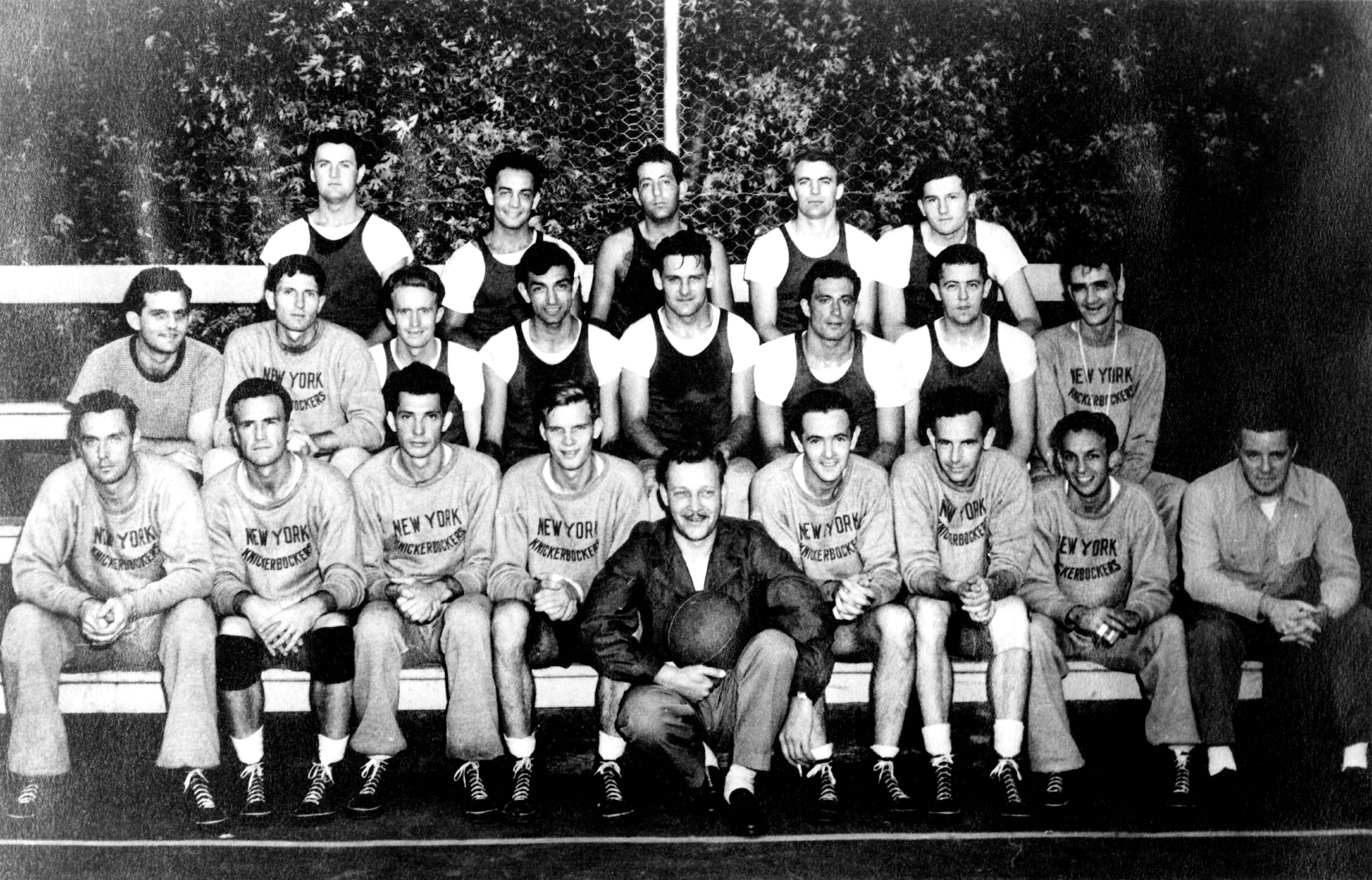
November 1, 1946, 70 years ago: The the 1st NBA game is played at Maple Leaf Gardens
in Toronto. (Until 1949, the National Basketball Association was known as the
Basketball Association of America, or the BAA.) A crowd of 7,090 -- about half
of capacity -- attends, and the New York Knickerbockers beat the Toronto
Huskies, 68-66. That photo above is from that game.
The Huskies go out of business after just 1 season, and the NBA does not return to Toronto until 1995 with the Raptors. The Knicks are 1 of only 2
charter NBA teams still playing in their current city. The other is the Boston
Celtics. These 2 teams have just started their 71st season.
The original 1946-47 New York Knickerbockers
Neither, however, is pro basketball's oldest franchise. The Philadelphia SPHAs were founded in
1917, as the team of the South Philadelphia Herbrew Association. They, too,
were a charter BAA/NBA team, as the Philadelphia Warriors. They are still
playing today, as the Golden State Warriors, in Oakland, although they are
building a new arena to open near the Giants' ballpark in downtown San Francisco,
with the start of the 2019-20 season as the target date.
Ossie Schectman, a former Long Island University star who scored the
1st NBA basket, died on July 30, 2013, at the age of 94. He was the last
surviving player from the original 1946-47 New York Knickerbockers.
Ossie Schectman, in 2006, the 60th Anniversary,
holding up a copy of the box score.
As far as I can tell, thanks to some information presented by a commenter, the last surviving player from the NBA's 1st season, and its 1st Champions, the 1947 Philadelphia Warriors, was Jerry Rullo, who died just a few days ago.
*
November 1, 1800: The Executive Mansion opens in Washington, D.C. President John Adams moves in, even though he will have to move out by the following March 4. No word on whether "The Atlas of Independence" invited any of the original Philadelphia 76ers.
When it became known as the White House is uncertain, but it was already called that before the British burned it during the War of 1812, so the myth that it got the name from the white paint hiding the burns on the outer wall is untrue. But the tradition of inviting newly-crowned World Champions to visit began with Richard Nixon, who was, in addition to being a crook, a sport nut.
November 1, 1816, 200 years ago: James Monroe, then Secretary of State, is elected the 5th President of the United States. The nominee of the Democratic-Republican Party, forerunner of today's Democratic Party, defeats Rufus King, then a Senator from New York, and the nominee of the Federalist Party, 183 Electoral Votes to 34, taking every State but Massachusetts (22 EVs right there), Connecticut and Delaware.
Popular votes were not counted in every State, so it's not clear how many votes Monroe and King got. Still, this was the last gasp of the Federalist Party.
November 1, 1820: Monroe is re-elected almost without opposition. The Federalists did not nominate a candidate for President. This was in spite of the Panic of 1819 having hurt the country's economy.
Monroe got 228 Electoral Votes -- all but 1. William Plumer, an Elector from New Hampshire who had served that State as Senator and Governor, cast his vote for Monroe's Secretary of State, John Quincy Adams. Contrary to legend, Plumer was not trying to ensure that George Washington would forever be the only man to be elected by a unanimous Electoral Vote, although that remains the result. Rather, he admittedly preferred Adams as President to Monroe. Four years later, with Monroe respecting the 2-term tradition established by Washington, Thomas Jefferson and James Madison, he got his wish.
The Democratic-Republicans would face opposition, but not under the Federalist banner. By 1832, the dominant party was renamed the Democratic Party, and the Whig Party had replaced the Federalists was the pro-business party in America. By 1860, they'd be out as such, and the Republican Party would be in.
November 1, 1844: James Knox Polk is elected the 11th President of the United States. The Democrat, who had served as Speaker of the U.S. House of Representatives and then as Governor of Tennessee, defeated Senator Henry Clay of Kentucky, who thus became the 1st man to go 0-for-3 in Presidential elections. Others have done so, but Clay is the only man to be nominated 3 times and lose all 3.
The popular vote was actually very close, since Clay, a leading figure in American politics for over 30 years, was better-known nationally than Polk: Polk won 49.5 percent of the popular vote, making him the 1st plurality President since the popular vote began being recorded from every State then in the Union (starting in 1828); while Clay won 48.1 percent. The Electoral Vote was less close, as Polk won 170-105.
*
November 1, 1859: John Alexander McPhee is born in Massena, New York, on the St. Lawrence River, and thus the Canadian border. I can find no reference to how he got his nickname, but "Bid" McPhee was the last man to play 2nd base in the major leagues without a glove -- and the best 2nd baseman of the 19th Century.
When the Cincinnati Red Stockings were founded in the American Association in 1882 -- and, contrary to what the team, which renamed itself the Reds when they joined the National League in 1890, would have you believe, they are not a continuation of the 1st professional baseball team of 1869-70 -- he was a charter member, and helped them win the AA Pennant. It was the only Pennant he won, as he played for them through 1899.
He led the AA in home runs in 1886 -- with 8. It was a different game. He stole 568 bases in his career. He died in 1943, and was elected to the Baseball Hall of Fame in 2000 -- 101 years after his last game. Only Deacon White (123 years, 1890-2013) and Negro Leaguer Frank Grant (103 years, 1903-2006) had to wait longer.
November 1, 1870: The Mutuals of New York visit the Chicago White Stockings at
Dexter Park in Chicago before 6,000 people. With Chicago leading 7-5 after 8 innings, the
Mutuals score 8 runs in the to of the 9th, to make it 13-7.
In the bottom of the 9th, Chicago adopts a waiting game, and the
Mutuals' pitcher, Dutch-born Reinder Albertus "Rynie"
Wolters, loads the bases on walks‚ and complains that the umpire is not
calling strikes. A few hits and passed balls make the score 13-12 in favor of
the Mutes when McAfee‚ the next batter for the Whites‚ lets a dozen balls go by
without swinging. Wolters throws up his hands and walks off. The ump reverts
the score to the 8th inning and the Whites win‚ 7-5.
Chicago has now defeated the Mutes twice since they took the
Championship away from the Atlantics. The controversial ending of the game
makes the Mutual club unwilling to give up the Championship.
The New York Clipper, the closest thing America had to
a sports-only publication in those days, says‚ "In 1867 the Union
club happened to defeat the Atlantics two games out of three of the regular
series them played between them-only one series being played between clubs at
that time. By this victory a precedent was established giving the championship
title only to the club that defeated the existing champions two games while
they were the champions. Of course this is an absurd rule but it has prevailed
ever since."
November 1, 1874: The National Association season ends today, with the Boston
Red Stockings being declared the Champions with a record of 43-17. Boston
actually had a record of 52-18, but the Committee running the league throws out
the games played by the Baltimore Canaries (not "Orioles"), because
they did not complete their schedule. The Mutuals finish 2nd.
November 1, 1880: Henry Grantland Rice is born in Murfreesboro, Tennessee. After playing baseball at Vanderbilt University in Nashville, he moved into journalism. There must have already been a well-known man named Henry Rice at that point, because Grantland Rice used his middle name from then onward.
He became the leading sports voice in the South, at Nashville's The Tennessean, and the New York Tribune would syndicate him nationally. He succeeded Walter Camp as the man who selected college football's All-America team. In 1924, he covered the Army-Notre Dame game at the Polo Grounds in New York, and gave Notre Dame's backfield its nickname: The Four Horsemen. He also helped popularize Red Grange nationally, although, contrary to popular belief, he did not come up with Grange's nickname, the Galloping Ghost.
If the 1920s truly were "The Golden Age of Sports," Rice's writings were a big reason why, promoting Grange and Knute Rockne's Notre Dame in football, Babe Ruth in baseball, Jack Dempsey in boxing, Bill Tilden in tennis and Bobby Jones in golf. He helped to popularize golf among the masses, through his championing of Jones and, starting in 1934, his tournament, The Masters.
He died in 1954, at which point it was easy to remember his most famous writing, though everyone forgets its source, a poem titled Almnus Football:
For when the One Great Scorer comes
to mark against your name
He writes, not that you won or lost
but how you played the Game.
In 1966, a few years after the Baseball Hall of Fame established its J.G. Taylor Spink Award, tantamount to election for sportswriters, it gave the award to Rice.
November 1, 1884: The Gaelic Athletic Association is founded at Hayes's Hotel in Thurles, County Tipperary, in what's now the Republic of Ireland. The GAA governs the traditional Irish sports such as hurling and Gaelic football -- but not Irish soccer, which is governed by the Football Association of Ireland (FAI). The Northern Ireland equivalent is the Irish Football Association (IFA).
November 1, 1893: Alexander Thomson
Burr is born in Chicago. Usually listed as "Alex Burr" in baseball
reference sources, but known as "Tom Burr" to his friends, he became a star pitcher in prep school, and was signed by the Yankees.
But Tom Burr appeared in exactly 1 major league game, on April 21,
1914, at the Polo Grounds, and not as a pitcher. He played center field
for the New York Yankees -- not yet an exalted position. He only played in the
field, in the 10th inning, had no fielding chances, and never came to bat -- a
true "Moonlight Graham." The Yankees went on to beat the Washington
Senators 3-2. He was soon released, and never reached the majors again. He
played 7 games for the Jersey City Skeeters of the International League. He
went back to college, but when the U.S. got into World War I in April 1917, he
enlisted in the U.S. Army without getting his degree, and became a pilot.
On October 12, 1918, just 1 month before the Armistice ended the war, Tom Burr
was killed in action in a plane crash, in Cazaux, France. It was an accident:
Rather than being shot down, another U.S. pilot crashed into him -- what
became known as "friendly fire." His plane caught fire, and crashed
into a lake. It took 12 days to find his body. He wasn't quite 25 years old. He was 1 of 8 major league players
killed in "The War to End All Wars."
For all their history, and for all their attention to it, the Yankees make no
mention at Yankee Stadium of the one and only player from their ranks to have
died in military service. This becomes all the more glaring when you remember
how much longtime team owner George Steinbrenner pandered to patriotism and to our armed
forces, down to the Monument to the 9/11 victims and rescuers in Yankee
Stadium's Monument Park.
Where did The Boss go to college? Williams, also the alma mater of Tom Burr.
You'd think he would have seen some kind of memorial there, and remembered it.
November 1, 1894: Former Providence
Grays pitcher Charlie Sweeney is convicted of manslaughter in San Francisco,
after killing a man in a bar fight.
Just 10 years earlier, he had been the toast of the baseball world, becoming
the 1st pitcher to strike out 19 batters in a major league game. But the fame went to his head: He began
drinking, staying out late, and feuding with the Grays' other starting pitcher
(only 2 were necessary in those days), Charles "Old Hoss" Radbourn.
He was finally released after choosing to spend the morning with his girlfriend
in Woonsocket rather than report to the Providence ballpark, the Messer Street
Grounds, for a scheduled start.
No other National League team would take him, and although he got picked up by
the St. Louis Maroons, who dominated the Union Association so much that the
league folded after a year. Sweeney overworked himself, and was never as good
on the mound again. In an 1886 game, he gave up 7 home runs, still a major league
single-game record. He threw his last major league pitch in 1887, only 24 years
old.
He
served 8 years in prison before being released, when it was obvious that
he was dying, from tuberculosis. He returned to his hometown of San Francisco,
and died there in 1902, just 38.
*
November 1, 1913: The football team at the U.S. Military Academy at West Point, New York -- usually referred to as just "Army" -- hosts a little-known Catholic school in South Bend, Indiana, at "The Plain," originally (and, once Michie Stadium was built, again) a parade ground, but, then, Army's football field.
It should have been an easy victory. After all, Army was one of the top teams in the country. Whenever they lost, including to Jim Thorpe and the Carlisle Indian School the year before, it was a big deal. And who were these guys? Who is Notre Dame?
They were a team that included a quarterback named Charles "Gus" Dorais, and a Norwegian immigrant at end, named Knute Rockne. Just 7 years earlier, the forward pass had been legalized, but hardly anybody used it. But Dorias threw to Rockne, gaining enough yards that Notre Dame beat Army 35-13. A legend was born. Nobody would ever again have to ask, "Who is Notre Dame?"
It was the only game Army lost all season. They avenged the defeat the next season, beating Notre Dame 20-7. In fact, it was the only game Army lost between November 30, 1912 and October 16, 1915.
Both Dorais and Rockne went on to play pro football, in those last few years before the founding of the NFL. Both were elected to the College Football Hall of Fame as coaches: Rockne at Notre Dame himself, and Dorais at Gonzaga and the University of Detroit (now Detroit Mercy). Rockne was killed in a plane crash in 1931. Dorais, who also coached baseball and basketball at Notre Dame, lived until 1954.
November 1, 1914: Connie Mack begins cleaning house, putting together what would,
today, be called a fire sale. The Philadelphia Athletics' manager and
part-owner -- effectively, also the general manager, although that term wasn't
used in baseball in those days -- asks waivers on pitchers Eddie Plank, Albert
"Chief" Bender and Jack Coombs -- 2 future Hall-of-Famers, and a man
who would have been a perennial All-Star if there'd been an All-Star Game back
then.
Colby Jack goes to the Brooklyn Dodgers. Gettysburg Eddie and the Chief escape
Mack's maneuvering by jumping to the Federal League. Although all have some
life left in their soupbones‚ they are near their careers' end‚ and their
departure is more sentimental than serious.
Mack's excuse: Retrenchment. Despite the Pennant‚ Philadelphia fans did not
come out to Shibe Park in sufficient numbers, and the club lost $50‚000.
It doesn't sound like much -- even with a century's worth of inflation factored
in, it's a little under $1.2 million -- but by 1914 baseball standards, it was
a fortune.
This is the 1st
time a great A's team is broken up to save money. Mack would do it
again starting in 1932, because he had lost all of his non-baseball investments
in the stock market Crash of 1929, and needed cash badly. In Oakland, Charlie
Finley would do it in 1974-76, and Billy Beane in 2007 and 2011. Only on the
last occasion did the A's "get away with it," competitively speaking.
November 1, 1916, 100 years ago: Harry Harrison Frazee‚ New York theater owner and producer‚
and Hugh Ward buy the Red Sox for $675‚000 (slightly under $15 million in today's money,
although one report puts the figure at $750‚000, or $16.6 million) from Joseph
Lannin. Bill Carrigan announces that he will retire as Red Sox manager to
pursue his interests in Lewiston‚ Maine.
Frazee was the owner of the Red Sox when they won the World Series in 1918, but then began to break up the team. Not because he needed money, because his shows were doing well, but because he was a typically tyrannical baseball team owner who didn't put up with players acting up and demanding more money -- including Babe Ruth. After the 1919 season, Ruth would make it all but impossible to keep him. He, not Frazee, is to blame for the Sox getting rid of him.
Frazee sold the Red Sox in 1923, and his health began to decline. He died of kidney disease in 1929.
November 1, 1918: The worst rapid transit accident in American history occurs at 6:42 PM, under the intersection of Malbone Street and Flatbush Avenue in Brooklyn, not far from Ebbets Field. At least 93 deaths, sometimes listed as 102, are ascribed to the Malbone Street Wreck. All other accidents in the system's 112-year history: 38.
The tunnel being used was a temporary one, and was soon replaced. So was the name of the street, so deep was the name "Malbone Street" embedded in the minds of New Yorkers. It is now known as Empire Boulevard.
*
November 1, 1920: Frederick James Arthur Cox is born in Reading, Berkshire, England. A right winger, he was one of the few players to play for both major soccer teams in North London, starting at Tottenham Hotspur, and then wising up and going to Arsenal, with whom he won the 1950 FA Cup and the 1953 League title.
After that title, he was sold to West Midlands club West Bromwich Albion. They just missed the League title in 1954, but won the FA Cup, although Freddie Cox did not play in the Final. He later managed Hampshire club Portsmouth, and died in 1973, only 52 years old.
November 1, 1925: After 3
defeats, plus 5 games against non-NFL teams, the expansion New York Giants finally win
a game against another NFL team, defeating the 3-time defending Champion
Cleveland Bulldogs, 19-0 at the Polo Grounds.
However, the win is not as impressive as it may seem, because the
champs had fallen apart due to a dispute over the rights to pro football in the
Cleveland area. And only 18,000 fans came out. Still, for the Giants, a win is
a win.
November 1, 1927: Victor Felipe Pellot Pove is born in Arecibo, Puerto Rico. Personally, he called himself Victor Pellot. In baseball, he was called Vic Power. Based on his performance with the Triple-A Kansas City Blues in 1952 and '53, he should have been the 1st black Yankee. But he was called a "hot dog." Later, it was discovered that the real reason he wasn't called up is that he was a black man who dated white women.
The Yankees traded him to the Kansas City Athletics, and with them and the Cleveland Indians, he became a 6-time All-Star, and won the American League Gold Glove winner at 1st base the 1st 7 times it was awarded. Despite his "stage name" (which he adopted because "Pellot" sounded too close to an inconvenient piece of French-Canadian slang when he played minor-league ball in Quebec), he hit only 126 home runs, but his lifetime batting average was a decent .284.
He returned to Puerto Rico, was involved in youth baseball, and lived until 2005.
*
November 1, 1932: Alger Joseph Arbour is born in Sudbury, Ontario. A defenseman, he won the Stanley Cup with 3 different teams: The 1954 Detroit Red Wings, the 1961 Chicago Blackhawks and the 1962 and '64 (but not '63) Toronto Maple Leafs. He also reached the Stanley Cup Finals with the 1968, '69 and '70 St. Louis Blues.
But it's as a coach that he's remembered, taking the New York Islanders from expansion team (though not as their very first head coach) to 4 straight Stanley Cups in 1980, '81, '82 and '83. His 1,500 games and 740 games won are each 2nd all-time in NHL history behind Scotty Bowman, his coach in St. Louis. He's in the Hockey Hall of Fame, and the Islanders hang a banner at the Barclays Center with "1500," his wins standing in for his "retired number." He died last year.
November 1, 1936, 80 years ago: Edward Colman (no middle name) is born in Salford, Greater Manchester, England. A winger, Eddie Coleman was one of manager Matt Busby's "Busby Babes," helping Manchester United win the League in 1956 and 1957. However, he was killed in the Munich Air Disaster on February 6, 1958. At 21, he was the youngest person to die in the crash.
November 1, 1938: In a rare "match race" between champion horses, Seabiscuit, the leading handicap-winner of the last 2 years, defeats the heavily-favored War Admiral, the 1937 Triple Crown winner, at Pimlico Race Course in Baltimore. It is probably the most match race in North American history.
Also on this day, Charlie Weeghman dies of a stroke in Chicago. The fast-food pioneer who owned the Chicago Whales of the Federal League, and then the Chicago Cubs from 1916 to 1918, and built Weeghman Park, which became Wrigley Field and still stands and hosted the World Series this week, was 64.
November 1, 1942: Brooklyn Dodger president Larry MacPhail, already a hero of
World War I (how much of one depends on who's telling the story), reenters the U.S. Army, and gives up his ownership stake in the club. The Dodgers look to St. Louis for
leadership. After 2 decades at Sportsman's Park, Branch Rickey splits with
Cardinals owner Sam Breadon. He will sign to become the president of the
Dodgers.
As Cardinal GM, he had already changed the game, by inventing the
farm system. As Dodger president, he will change the world, by signing, and
sticking by, Jackie Robinson. MacPhail, upon his return, will join with Del
Webb and Dan Topping, and remake the New York Yankees.
November 1, 1943: Thomas Lee Mack is born in Cleveland. A guard, and the son of major league 2nd baseman Ray Mack (but no relation to Connie Mack), Tom Mack came from Ohio, but Ohio State's Woody Hayes let him get away to the University of Michigan, whom he helped win the 1964 Big Ten title and the 1965 Rose Bowl.
Drafted by the Los Angeles Rams, he was an 11-time Pro Bowler, although the Rams never reached the Super Bowl until the year after he retired. He was elected to the Pro Football Hall of Fame, and is still alive.
Also on this day, Theo van Duivenbode is born in Amsterdam, the Netherlands. A left back, he played for hometown club AFC Ajax, helping them win the Eredivisie (the Dutch league) in 1966, 1967 and 1968. He then moved to their arch-rivals, Feyenoord of Rotterdam, and helped them win the European Cup in 1970 (beating Ajax to be the 1st Dutch club to do so) and the Eredivisie in 1971.
Apparently, all was forgiven by Ajax, because he is now a member of their board of supervisors.
November 1, 1945: Branch Barrett
Rickey, a.k.a. Branch Rickey III, is born in New York. Like his famous
grandfather, he played baseball at Ohio Wesleyan University, and also wrestled
there. He became a wrestling referee, and officiated in the Olympics.
He served in the Peace Corps in 1971, and the next year joined the
Kansas City Royals organization. He later served in the Pittsburgh Pirates and
Cincinnati Reds organizations. He became President of the American Association,
1 of 3 Triple-A leagues at the time, along with the International League and
the Pacific Coast League. In 1997, a realignment led to the elimination of the
AA and the absorption of its teams into the IL and the PCL, and Ricky was named
President of the PCL, a title he still holds.
November 1, 1946, 70 years ago: The right foot of Cleveland owner Bill Veeck is amputated‚ a
result of a war injury in the South Pacific 2 years before.
At this point, Veeck has already had a tremendous impact on promotion in a half season of
ownership. A minor but typical change is the regular posting of NL scores on
the Cleveland scoreboard‚ a departure from the long-standing practice of both
Leagues, whose teams would only post the scores from around their own League.
Veeck doesn't let the amputation slow him down. He walks around on
a prosthesis, and frequently stubs out his cigarette on it. He even says,
"I'm not disabled. I'm crippled." In other words, his ability was
reduced, but not eliminated. And, as long as his brain worked (however
strangely at times), he had plenty of ability.
Also on this day, Richard Lee Baney is born in the Los Angeles
suburb of Fullerton, California. Dick Baney pitched for the Seattle Pilots in
1969, and was mentioned a few times in Jim Bouton's book Ball Four.
He also pitched for the Cincinnati Reds in 1973 and '74. He now invests in and
manages real estate.
November 1, 1947: Theodore Paul Hendricks is born in Guatemala City, Guatemala, his mother's hometown and his father's place of employment. The family moved to the Miami suburbs, and Ted was an All-America linebacker at the University of Miami.
"The Mad Stork" won Super Bowl V with the Baltimore Colts, and Super Bowls XI, XV and XVIII with the Oakland/Los Angeles Raiders. He was an 8-time All-Pro. He is a member of the College and Pro Football Halls of Fame, and the NFL's 1970s and 1980s All-Decades and 75th Anniversary Teams. He was named to The Sporting News' 100 Greatest Football Players in 1999, and the NFL Network's 100 Greatest Players in 2010.
The Raiders don't have a team hall of fame, and the Indianapolis Colts, while carrying over their Baltimore retired numbers, don't honor their Baltimore-era players with a display. But the Baltimore Ravens have inducted him, among other Colts stars, into their Ring of Honor.
*
November 1, 1951: Karl-Heinz Granitza is born in Lünen, Germany. A striker, he starred in his homeland for Hertha Berlin. Then he came to America, and helped the Chicago Sting win the North American Soccer League title in 1981 and 1984 (the League's last season).
He continued to pay for Chicago teams in the Major Indoor Soccer League. When he returned to Berlin, he opened an American-themed sports bar named for a prominent Chicago thoroughfare: State Street. He is a member of America's National Soccer Hall of Fame.
November 1, 1957: The Mackinac Straits Bridge opens, finally providing a road connection between Michigan's Lower and Upper Peninsula. This makes it far easier for people in the UP -- "Yoopers" -- to go down to Detroit, Ann Arbor or East Lansing to see their home-State teams. Previously, it was easier for them to drive to Green Bay, Milwaukee and Minneapolis.
Also on this day, Charlie Caldwell dies in Princeton, New Jersey. He was only 56. The native of Bristol, Virginia played baseball, football and basketball at Princeton University. He pitched 3 games for the Yankees in 1925, without a decision.
He left baseball (at least as a player), and turned to coaching. He was an assistant football coach at Princeton from 1925 to 1927. He moved to Williams College in Williamstown, Massachusetts, and was their head football coach from 1928 to 1944, their head basketball coach from 1928 to 1939, and their head baseball coach from 1931 to 1944. In other words, from 1931 to 1939, he coached all 3 sports simultaneously.
In 1945, Princeton brought him back, to coach baseball and football, but not basketball. He left baseball entirely after the 1946 season. In 1950, he was named National Coach of the Year. In 1951, he coached Dick Kazmaier to the Heisman Trophy, and it remains the last one won by an Ivy League player.
His career record was 146-67-9 in football, 118-96 in baseball, and 78-66 in basketball -- overall, 342-229-9, a winning percentage of .597. He must have been worn out, because before the 1957 season began, he handed the reins of Princeton football over to his assistant, Dick Colman, and soon died.
Caldwell and Colman both used the single wing formation after most coaches switched to the T formation and its variants. Indeed, Colman's last season at Princeton was 1969, and he was the last Division I coach to use the single wing. Nevertheless, both Caldwell and Colman were elected to the College Football Hall of Fame.
November 1, 1959: Jacques Plante of the Montreal Canadiens, who'd been experimenting with a mask in practice. gets hit in the face with a puck in a game against the New York Rangers at the old Madison Square Garden.
"Jake the Snake" gets up, skates over to coach Hector "Toe" Blake, and tells him he's not going back out there without the mask. Blake, knowing how much Plante has meant to the Habs (4 straight Stanley Cups), relents. The Canadiens win, 3-1, and go on to win their 5th straight Cup.
Clint Benedict of the Montreal Maroons wore a crude leather facemask following his return from a broken nose, starting on February 20, 1930. He stopped after 5 games because the part covering his nose obscured his vision. Plante's version was better, and by the 1970s nearly every goalie wore one. Now, goalies wear gaudily decorated helmets, and baseball catchers wear similarly-designed helmets rather than their old wire masks.
*
November 1, 1960: Fernando Valenzuela Anguamea is born in Navojoa,
Sonora, Mexico. In 1981, the chunky, screwballing lefthander for the Los
Angeles Dodgers was the hottest thing in baseball, He won his 1st 8 starts,
with 5 shutouts and an ERA of 0.50. He was only 20 years old.
On May 15, 1981, I was
traveling with my family to a weekend vacation in Williamsburg, Virginia. We
stopped off at a rest area on Interstate 95, and I saw the new Sports
Illustrated. Fernando was on the cover, with the headline,
"UNREAL!" No, the cover didn't jinx him: He was 7-0 at that point,
and won his next start, before falling to 8-1. That night, Len Barker of the
Cleveland Indians pitched the 1st major league perfect game of my lifetime.
"Fernandomania"
made the Dodgers what they remain to this day: Mexico's favorite team, despite
the San Diego Padres playing a short drive from the border. It was tamed
somewhat by the strike, as he went just 5-7 after his amazing start. But he
pitched a complete-game win over the Yankees in Game 3 of the World Series. The
Dodgers won in Game 6; had it gone to Game 7, he would have started it.
He had his only 20-win
season in 1986, and struck out a record-tying 5 straight batters in that
season's All-Star Game. He missed most of the 1988 season due to injury, but
still got a 2nd World Series ring. He was released in 1991, and bounced around,
signing with the Padres.
In 1996, the Padres
played 3 games in Monterrey, the 1st regular-season games ever played in
Mexico. He started the opener against the Mets, and benefited from a 15-0 lead.
The Mets came back, and he left to a standing ovation. The Padres hung on to
win, 15-10. He retired after the season, his career record 173-153.
A member of the Hispanic
Heritage Baseball Museum Hall of Fame and the Caribbean Baseball Hall of Fame,
the Dodgers have not officially retired his Number 34 -- aside from Jim
Gilliam, they don't do that unless the man in question is elected to the
Baseball Hall of Fame -- but they've kept it out of circulation.
He is now a broadcaster
for the Dodgers' Spanish network, bringing up memories of his struggles to
learn English. It was said in 1981 that, "The two best lefthanded pitchers
don't speak English: Fernando Valenzuela and Steve Carlton." (Referencing
Carlton's refusal to talk to the media.) Manager Tommy Lasorda said the only
English words he knows are "beer," "food" and "light
beer." On The Tonight Show, Johnny Carson said, "Fernando
Valenzuela learned another English word today: 'Million.'"
Also on this day, Alan Harper (no middle name) is born in Liverpool, Merseyside, England. No, he's not the Jon Cryer character from Two and a Half Men, and this soccer defender does not wear uniform Number 2 1/2. He played for his boyhood club Liverpool FC, but never made it there.
So he was purchased by the other team in town, Everton, and helped them win the 1984 FA Cup, the 1985 European Cup Winners' Cup (he did not play in either Final, or in the 1985 FA Cup Final that Everton lost), and the 1985 and 1987 League titles. He later served as a scout for Bolton Wanderers, and back at Liverpool as the same.
November 1, 1961: Anne Theresa Donovan is born in Ridgewood, Bergen County, New Jersey. A graduate of Paramus Catholic High School, she led Norfolk's Old Dominion University to the AIAW title, the closest thing women's college basketball then had to a National Championship, in 1980. But she had to go abroad to play pro ball, and played in Japan and Italy.
She went into coaching, and was head coach at East Carolina and back home at Seton Hall. In the WNBA, she has coached the Indiana Fever, the Charlotte Sting, the Seattle Storm, the New York Liberty and the Connecticut Sun.
She played for the U.S. teams that won the Olympic Gold Medal in 1984 in Los Angeles and 1988 in Seoul, Korea; and coached them to the Gold Medal in 2004 in Athens, Greece and 2008 in Beijing, China.
November 1, 1963: Leslie Mark Hughes is born in Wrexham, Wales. If you fancied yourself a tough footballer (soccer player), you'd probably want to call yourself Les or Mark, rather than Leslie. Hughes chose Mark.
A forward, he and Norman Whiteside were proof that Manchester United were a bunch of cheating bastards before Alex Ferguson became manager, diving and dirty-tackling their way to the 1985 FA Cup. With Ferguson, he won the Cup again in 1990 and 1994, the UEFA Cup Winners' Cup in 1991, the League Cup in 1992, and the Premier League in 1993 and 1994 (doing the Double).
With West London club Chelsea, he won the FA Cup in 1997, and the League Cup and the Cup Winners' Cup in 1998. With Lancashire club Blackburn Rovers, he won the League Cup in 2002.
He has been less successful as a manager, but no less dirty. He managed Wales from 1999 to 2004 (as a player-manager), then Blackburn through 2008, then Manchester City through 2009, then West London club Fulham from 2010 to 2011, then West London club Queens Park Rangers in 2012, and Staffordshire club Stoke City since 2013.
Arsene Wenger, manager of North London club Arsenal, describes Hughes' management style by defining his players as dirty: After an incident at Man City, Wenger said, "You ask 100 people, 99 will say it's very bad, and the 100th will be Mark Hughes."
November 1, 1964: Clifford "Doc" Carlson dies in Ligonier, Pennsylvania at age 70. He helped the University of Pittsburgh win National Championships -- retroactively awarded -- in 2 different sports. He was an All-America end on their 1917 football team, and coached their basketball team to the National Championship in 1928 and 1930, and to the NCAA Final Four in 1941. He was elected to the Basketball Hall of Fame.
*
November 1, 1970: The 1st regular-season game is played between the Giants and the Jets. Despite having the home-field advantage in front of 63,903 fans at Shea Stadium, and being less than 2 years from their Super Bowl win, the Jets are overwhelmed by the Giants, 22-10.
It was the 4th game of a 6-game winning streak for the Giants, who finished 9-5. The Jets, on the other hand, looked nothing like a recent champion, as this was the 5th game of a 6-game losing streak, and they finished 4-10.
November 1, 1971: Cold Spring Harbor,
the 1st album by Billy Joel, is released. The record is made at the wrong
speed, and the songs don't sound right. Billy gets out of his contract, signs
with Columbia Records, releases Piano Man 2 years later, and
the rest is history.
Before Game 3 of the 1979 Stanley Cup Finals at Madison Square Garden, Billy,
by then one of the biggest music stars in the world on the back-to-back
successes of The Stranger and 52nd Street, sang
the National Anthem. When he's done, Ranger Captain Dave Maloney skates up
behind him, and swats him on the rear end with the blade of his stick. The
Rangers lost to the Montreal Canadiens, 4-1, and won the Cup in Game 5,
although I don't think Maloney's childishness with Billy had anything to do
with it.
Before Game 1 of the 1986 World Series at Shea Stadium, Billy, on the success
of a new album, The Bridge, sang the Anthem. The Mets and Boston
Red Sox players left him alone. The Sox won a thriller, 1-0.
On June 22, 1990, Billy became the 1st non-festival music act to play Yankee
Stadium, hosting the 1st of 2 sold-out concerts. On July 16 and 18, 2008, he
played the last 2 concerts at Shea. He has never been invited to perform at
halftime of the Super Bowl, but he sang the Anthem at numbers XXIII (1989) and
XLI (2007) -- both in Miami. In 2017, Super Bowl LI will be in Minnesota -- not Miami. No word yet on who will sing the Anthem, but it probably won't be Billy.
Last year, Billy sang the Anthem before Game 3 of the World Series at Citi
Field. In the middle of the 8th inning, as they have all season long, the Mets
played "Piano Man," and the fans sang along, looking at Billy in the
owner's box. He had a puzzled look on his face, as if to say, "No, this is
not a happy sing-along song." Actually, the Bronx-born, Long Island-raised
Billy is a Yankee Fan, so the real question to ask was, "Man, what
are you doing here?" Oh la, da, da-dee-da, la-da, da-dee-dah,
da-dum.
November 1, 1972: Paul Dickov, no middle name, is born in Livingston, Scotland. A forward, a Scotsman of Bulgarian descent, he was a member of the Arsenal team that won the 1994 Cup Winners' Cup, but couldn't break through with Alan Smith and Ian Wright both being world-class strikers.
He was sold to Manchester City, who had crashed all the way to England's 3rd Division, but he got them back-to-back promotions in 1999 and 2000, and then got Leicester City promoted in 2003. On the last day of the 2003-04 season, with Arsenal going for the completion of an unbeaten League season at home at Highbury, against a Leicester side already relegated, Dickov scored a shocking opener against his old club, with the announcer saying, "That wasn't in the script!" Arsenal won 2-1, anyway.
Leicester would again be relegated, but he got them back up from the 3rd to the 2nd division in 2009, and then helped get Leeds United, which had crashed after a financial disaster in 2004 (Arsenal blew them out in 2 League matches and an FA Cup match that season) promoted to the 2nd in 2010.
He became a player-manager at Manchester area club Oldham Athletic, and also managed Yorkshire club Doncaster Rovers.
November 1, 1979: Edward Bennett Williams buys the Baltimore Orioles from
Jerold Hoffberger for a reported $12.3 million (about $40.9 million in today's
money). NFL rules prohibit a majority owner from being the majority owner of a
team in another sport, so he sells some stock in the Washington Redskins to
former Los Angeles Lakers and Kings owner Jack Kent Cooke.
In 1983, Williams becomes the 1st, and still only, owner to win championships
in both football and baseball in the same calendar year. Not long thereafter,
he will sell the rest of his Redskins stock to Cooke.
He remains Orioles owner until his death in 1988. Orioles fans were afraid that
the Washington "superlawyer" would move the team to D.C., especially
after the NFL's Colts were moved out of town in 1984. But, not long before his
death, he cut a deal with the State of Maryland to build the ballpark that
became Oriole Park at Camden Yards.
Also on this day, in separate deals‚ the Yankees acquire
outfielder Ruppert Jones from the Seattle Mariners, and catcher Rick
Cerone and pitcher Tom Underwood from the Blue Jays. They give up 7
players‚ including popular 1st baseman Chris Chambliss‚ shortstop Damaso
Garcia‚ aging outfielder Juan Beniquez‚ and young pitchers Jim
Beattie and Paul Mirabella.
This could have been a great pair of trades for the Yankees, as
Cerone filled in admirably in the wake of the death of Thurman Munson, and he
and Underwood were key in winning the American League Eastern Division in
1980 and the Pennant in 1981. But Jones, named the Mariners' 1st-ever
All-Star in their expansion season of 1977, and essentially acquired to replace
the traded Mickey Rivers, crashed into an outfield fence making a great
catch in 1980, injured his shoulder, and was never the same player. The
Yankees, the team of Earle Combs, Joe DiMaggio, Mickey Mantle and Bobby Murcer,
wouldn't find a great regular center fielder again until Bernie Williams.
The M's and Jays didn't even do that well. None of the players they got from
the Yankees did much. Chambliss did absolutely nothing for the Jays,
through no fault of his own: They traded him, almost immediately, to the
Atlanta Braves for outfielder Barry Bonnell. Once an All-Star, Bonnell was
terrible in Toronto, while Chambliss helped the Braves win the NL West in 1982
and nearly did so again in 1983. Ironically, it was his tenure with the Braves,
not the Yankees, that did the most to make him a major league coach: The
Braves' manager at that time was Joe Torre.
Also on this day, Covelli Loyce Crisp is born in Los Angeles. His siblings nicknamed him "Coco Crisp" because of a perceived resemblance to a cereal box character. The left fielder started his career with the Cleveland Indians, and is now back with them, playing in the World Series.
In between, he won the Series with the Boston Red Sox in 2007 *, and reached the postseason with the Oakland Athletics in 2012. He led the AL in stolen bases in 2011, and has a lifetime batting average of .265, 1,572 hits including 130 home runs, and 309 stolen bases. He shows no signs of slowing down.
*
November 1, 1984: The Los Angeles Clippers play their 1st home game after
moving up the California coast from San Diego, at the Los Angeles Sports Arena.
They had played 2 away games first. Oddly enough, their 1st game under the Los
Angeles name was away to the Utah Jazz, the team they beat in their last game
in San Diego.
The Clips beat the Knicks, 107-105. Last season's breakout Knicks
star, Bernard King, scores 25, but some players who had won NBA Championships
elsewhere lead the Clips to victory: 1971 Milwaukee Buck Junior Bridgeman, 1980
and '82 Laker Norm Nixon, and, overcoming a never-ending foot injury, 1977
Portland Trail Blazer, San Diego native and UCLA star Bill Walton.
For
several years, this opener stood as the highlight of Los Angeles Clipper
basketball, as, much like the Nets behind the Knicks in the New York Tri-State
Area, they have been stuck behind the Lakers, partly due to the older team
being so well-established, successful and popular, and partly due to their own
perennial losing, due to team owner Donald Sterling caring only about
schmoozing his pals at the games rather than winning.
To make matters worse, since 1999 they have had to share the Staples Center
with the Lakers, whereas they only had to share the Sports Arena with USC
basketball; from 1999 onward, not only were they the worst pro basketball team
in their city, they’re not even the best basketball team in their own
building. Indeed, despite a recent Playoff revival, with the NHL's Kings
having won 2 Stanley Cups, the Clips could arguably be said to have been the
3rd-best sports team in their own building.
But now, they're rid of
the cheap racist Sterling, and they've gotten good, while the Lakers have
gotten old. Maybe the next title at the Staples Center will go to the Clippers.
November 1, 1987: Tom Parker dies in his hometown of Southampton, Hampshire, England, shortly before his 90th birthday. A right back, he starred for hometown club Southampton in the 1920s, before being purchased by Arsenal in 1926. He made 172 consecutive appearances, which is still a club record.
He captained Arsenal to the League title in 1931 and 1933, and to the FA Cup Final in 1927 (lost to Cardiff City), 1930 (beat Huddersfield Town) and 1932 (lost to Newcastle United). That 1930 FA Cup was the club's 1st major trophy, so he was the 1st Arsenal Captain to lift a major trophy. The introduction of the famous red shirt with white sleeves also made him the 1st man to captain Arsenal in that shirt.
Despite his stardom, he was only called to the England team once, for a 1925 game against France. After retiring as a player following the 1933 title, he was named manager at Norfolk side Nortwich City, getting them promoted from the 3rd to the 2nd division in 1934. He later managed Southampton, and then Norwich again, and then returned to Southampton as a scout, retiring in 1975.
November 1, 1988: Masahiro Tanaka is born in Itami,
Hyōgo Prefecture, Japan. After starring in his homeland for the Sendai-based
Tohoku Rakuten Golden Eagles, he signed with the Yankees in 2014, and became an
All-Star in his rookie season.
He was named the
starting pitcher of last year's American League Wild Card game, but lost 3-0,
because the Yankees didn't hit for him. Still, he is the closest thing to a
real ace that New York baseball current has. (And I don't want to hear about
any of the Mets' starting pitchers.) He was 99-36 in Japan, and is 39-16 for the Yankees.
November 1, 1996, 20 years ago: The Philadelphia 76ers play their 1st game at their new arena, then named the CoreStates Center, losing 111-103 to the Milwaukee Bucks. The arena is now known as the Wells Fargo Center, and the 76ers have reached the NBA Finals only once since moving in, in 2001.
November 1, 1997: The Negro Leagues Baseball Museum opens in its new home in
Kansas City‚ Missouri. It had been occupying a temporary site there for 4
years.
November 1, 1999: Chicago Bears legend Walter Payton dies of a rare liver disease in the Chicago suburb of South Barrington, Illinois. The NFL's former all-time leading rusher, and one of the real good guys of sports history, was only 45.
*
November 1, 2000: George Armstrong dies at Hemel Hempstead Hospital in Hertfordshire, England, after collapsing the day before, from a brain hemorrhage while guiding a training session (we would say, "practice") at the Arsenal Training Centre at nearby London Colney. He was only 56 years old.
A 17-year-old apprentice electrician when he made his debut for Arsenal, the North London soccer giants, in 1962, he never grew beyond 5-foot-6, yet on either the right wing (wearing the Number 7 shirt, as English soccer teams used to assign uniform numbers to positions rather than to players) or the left wing (Number 11), "Geordie" Armstrong became known for his tireless running up what we would call the sideline, and then crossing the ball for another attacker to put into the goal.
He was able to accurately pass with either foot. Therefore, while naturally right-footed, it was his left foot that assisted Ray Kennedy's headed goal against North London arch-rivals Tottenham Hotspur on May 3, 1971, which gave Arsenal the Football League title for the 1st time in 18 years. Just 5 days later, they beat Liverpool in the FA Cup Final at the old Wembley Stadium, giving Arsenal "The Double."
With him, Arsenal also won the 1970 Inter-Cities Fairs Cup, precursor to today's UEFA Europa League, and reached the Finals, but lost, of the 1968 and '69 League Cups and the 1972 FA Cup. When he last played for Arsenal in 1977, he had played in 621 competitive matches, a club record that has since been surpassed only by David O'Leary and Tony Adams.
After playing 2 more seasons, he went into management. He was the manager of the Kuwait national team when Iraq invaded in 1990, and managed to escape. He rejoined Arsenal, and became part of their coaching staff for the next 10 years, until his life came to a stunning early end.
He was the 1st member of the 1970-71 Double side to die; only reserve centreback John Roberts has followed him. (In a sad oddity, only 1 member of Arsenal's 1989 and 1991 League title teams has died, and it was also a Number 7 with spectacular footwork: David Rocastle.)
Arsenal's George Armstrong was not related to the Hockey Hall-of-Famer of the same name, who captained the Toronto Maple Leafs' 4 Stanley Cup wins in 1962, '63, '64 and '67. It is possible that they may have met: Arsenal played an exhibition game, a "friendly," in Toronto in the Summer of 1973.
November 1, 2001, 15 years ago: Game 5 of the World Series at Yankee Stadium. Steve Finley
and Rod Barajas hit solo home runs for the Arizona Diamondbacks in the 5th
inning, and those remain the only runs of the game going into the bottom of the
9th.
In the top of the 8th, with the rumor going around that Paul O'Neill will retire after the Series (which turned out to be true), and, knowing that, win or lose, this was his last game at Yankee Stadium, Yankee Fans start chanting his name. It was a rare moment when Yankee Fans decided that there was something more important than winning: In this case, saying, "Thank you" to a team legend.
In an amazing case of history repeating itself‚ the Yankees again come from 2
runs down with 2 outs in the 9th inning, to win 3-2 in 12 innings.
Byung-Hyun Kim is again victimized‚ this time by Scott Brosius' 2-run HR in the
9th. Alfonso Soriano's single wins it in the 12th. Steve Finley and Rod Barajas
homer in the 5th for Arizona's runs.
In 97
previous years of World Series play, only twice had teams come from 2 or more
runs down in the bottom of the 9th to win a game. The Yankees had now done it
on back-to-back nights -- albeit in different months (October 31 &
November 1).
Also on this day, the
Memphis Grizzlies play their 1st game, after 6 seasons in Vancouver. But they
get torched by 34 points from Jerry Stackhouse, and lose 90-80 to the Detroit
Pistons, at the arena then named the Great American Pyramid.
November 1, 2004: The A-League, Australia's new soccer league, is formed. Along with accepting previously-established teams Perth Glory (founded December 1, 1995), Newcastle Jets (founded sometime in 2000), and Adelaide United (founded September 12, 2003), the following teams are founded with it: Brisbane Roar, Central Coast Mariners, Gold Coast United, Melbourne Victory, New Zealand Knights, North Queensland Fury and Sydney Football Club.
On March 19, 2007, Wellington Phoenix would be formed, following the collapse of the Auckland-based Knights, and were admitted the following season. Melbourne Heart were founded on June 12, 2009, and were renamed Melbourne City upon their purchase by England's Manchester City Football Club in 2014. North Queensland Fury folded in 2011. Western Sydney Wanderers were founded on April 12, 2012, and took the place of Gold Coast United, who folded.
Although there are rivalries -- "derbies" in soccerspeak -- between the 2 Sydney teams and the 2 Melbourne teams, the biggest rivalry in the country remains Sydney FC vs. Melbourne Victory, the biggest teams in each of the country's 2 largest and (aside from the much smaller national capital of Canberra) most powerful cities.
November
1, 2005: A bronze sculpture featuring the
friendship of Pee Wee Reese and Jackie Robinson is unveiled at Brooklyn's
KeySpan Park, home of the Mets' Single-A team, the Brooklyn Cyclones. (The
stadium is now named MCU Park.)
The William Behrends sculpture captures the moment when the Dodger captain
showed support by putting his arm around his black teammate's shoulder, hushing
an unruly crowd hurling racial slurs at his teammate at Crosley Field in
Cincinnati in 1947. It's been alleged that the incident never happened, and people who supposedly remembered it disagreed on the day on which it happened.
November 1, 2009: Game 4 of the World Series at Citizens Bank Park.
Yankee manager Joe Girardi starts CC Sabathia, ALCS MVP but loser of Game 1, on
3 days' rest. It seems to work, as the Yankees lead the Philadelphia Phillies
4-2 going into the bottom of the 7th.
One of the Phils' runs shouldn't have counted, because Ryan Howard didn't touch
the plate. This could have been an epic controversy. And it might have been,
because Chase Utley hit a home run off CC in the 7th, and Pedro Feliz hit one
off Joba Chamberlain in the 8th to tie it.
But in the 9th, Johnny Damon fouls off pitch after pitch from Brad Lidge
before singling with 2 outs. Mark Teixeira was up, and the Phils go into
their lefthanders' switch. This is an echo of the shift used by the Cardinals
on Ted Williams of the Red Sox in the 1946 World Series. But Damon realizes that, if he steals 2nd, he could steal 3rd, too, because no one would be
covering. He goes for it, bringing up memories of another factor of the '46
Series, Enos Slaughter's "Mad Dash" that won Game 7 for the
Cardinals.
Unnerved, Lidge accidentally hits Teix, and Alex Rodriguez gets the biggest hit
of his career (and it remained so), a double to score Damon. Jorge Posada singles home Teix and A-Rod, and
Mariano Rivera shuts the Phils down it the bottom of the 9th, securing a 7-4
Yankee victory, stunning the defending World Champions in their own raucous,
not strangely silence, house. The Yanks can wrap it up tomorrow night.
November 1, 2010: The Giants win
their 1st World Series since moving to San Francisco. Edgar Renteria, who drove
in the winning run for the Florida Marlins against the Cleveland Indians in the
11th inning during Game 7 of the 1997 Fall Classic, joins Yankees legends Lou
Gehrig, Joe DiMaggio and Yogi Berra as only the 4th player in baseball history
to collect two World Series-winning hits. (He had also made the last
out for the St. Louis Cardinals as the Boston Red Sox won the 2004 World
Series *.)
The Series MVP's 3-run homer off Cliff Lee in the 7th inning leads to San
Francisco's 3-1 victory over the Rangers, and brings an end to 56 seasons of
what some Giants fans had been, in recent days, describing as
"torture." (Clearly, they'd never been truly tortured.)
November 1, 2013: The Brooklyn Nets play their home opener at the Barclays Center, and retire the Number 5 of Jason Kidd. Although he is currently their head coach, and remains the only player to lead the team to the NBA Finals (in New Jersey in 2002 and 2003), Kidd never played for the Brooklyn edition of the team. They beat the defending Eastern Conference Champion Miami Heat of LeBron James and Dwyane Wade, 101-100.
November 1, 2015: Game 5 of the World Series at Citi Field. Curtis Granderson hits a home run in the bottom of the 1st inning, giving the Mets a 1-0 lead over the Kansas City Royals. The Mets make it 2-0 in the 6th, and Matt Harvey holds that lead into the top of the 9th.
But the Mets pull off a unique feat: They blow leads in every single game of a World Series. (Including in Game 3, which they came back to win anyway.) Only the Mets, right? Harvey convinces manager Terry Collins to leave him in, and he walks the leadoff hitter, Lorenzo Cain. Eric Hosmer doubles Cain home, and Collins now pulls Harvey for Jeurys Familia. A groundout gets Hosmer to 3rd, and a fielding blunder by the Mets (surprise, surprise) results in the tying run coming home. Familia's 8 blown saves in a single postseason ties the record set by Robb Nen of the 2002 San Francisco Giants -- who, unlike Familia, does have a World Series ring, with the 1997 Florida Marlins.
The game goes to the 12th inning. Royals catcher Salvador Pérez singles off Addison Reed. Royals manager Ned Yost sends Jarrod Dyson in to pinch-run for him. Christian Colón singles him home, and then the unrelated Bartolo Colón is brought in, and he melts down. The Royals win the game 7-2, and win their 2nd World Series, their 1st in 30 years.
The Royals proved what the Yankees had proven in the regular season, what Chase Utley proved in the NL Division Series, and what nobody else, not the other Dodgers, nor the Chicago Cubs in the NLCS, seemed willing to prove: Stand up to the Mets, and they will fold. This pattern held in 2016, as the Mets reached the NL Wild Card game, but losing it.
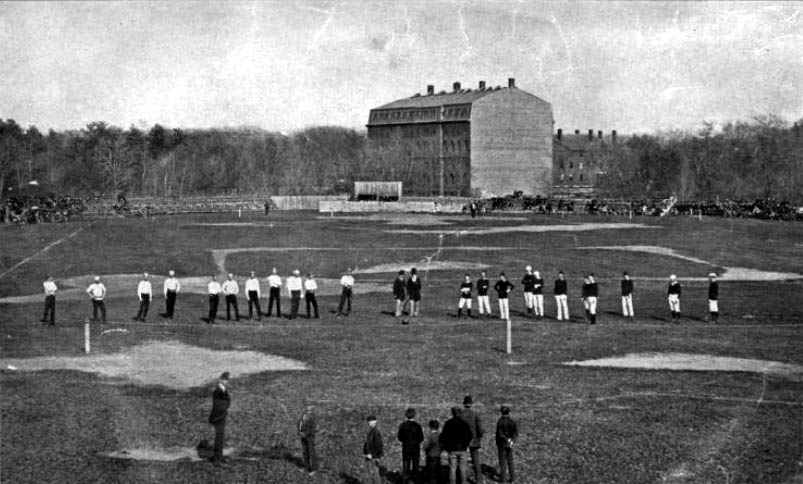

 So if you want to know why America plays the gridiron game instead of the sport that most of the rest of the world calls "football" or some variant, blame Harvard and McGill.