Showing posts with label 1870. Show all posts

Tuesday, October 26, 2021

October 26, 1921: The 1st NBA Star Is Born

October 26, 1921, 100 years ago: Joseph Franklin Fulks is born in Birmingham, Kentucky. Jumpin' Joe starred at Murray State University in his home State, and they retired his Number 26. He served in the U.S. Marine Corps in World War II.

When the NBA was founded as the Basketball Association of America in 1946, he played for the Philadelphia Warriors, and averaged 23.2 points per game to become the league's 1st scoring champion. He led the Warriors to the 1st Championship of the league, beating the Chicago Stags 4 games to 2 in the Finals, clinching on April 22, 1947, at home at the Philadelphia Arena.

From the dawn of the league until Elgin Baylor's 64 points in a 1959 game, Fulks held the NBA single-game point-scoring record, topping out at 63 on February 10, 1949, against the Indianapolis Jets. He played in the 1st 2 NBA All-Star Games, in 1951 and 1952, and retired after the 1954 season.

He worked as the recreation director of the Kentucky State Penitentiary until March 21, 1976. Ironically, it was a crime outside the prison walls that killed him: His girlfriend, Roberta Bannister, had a son named Gregg, and they argued over a gun, and Gregg shot Joe with it. Joe was only 54 years old.

On a 1996 ESPN Classic broadcast, sports columnist and basketball historian Bob Ryan tried to put the pre-24-second-shot-clock era (1946-54) into perspective, and said, "I'm not gonna kid you: I don't think Jumpin' Joe Fulks makes it in today's NBA, except maybe as a 12th man."

Nevertheless, Fulks was named to the NBA's 25th Anniversary Team in 1971, and was posthumously elected to the Basketball Hall of Fame in 1978. He is also a member of the Kentucky Sports Hall of Fame and the Philadelphia Sports Hall of Fame. But the Warriors have not retired the Number 10 he wore for them.

They moved to the Bay Area in 1962, and the Syracuse Nationals became the Philadelphia 76ers the next season. The Sixers have retired 10, but for Maurice Cheeks, and they don't acknowledge the Dubs' achievements in their city.

*

October 26, 1863: The Football Association is formed at the Freemasons Tavern in Holborn, Central London. Although there were football clubs (soccer teams) in England already (and a few of these are still in operation, though most on an amateur level), the rules of the game across the country were not uniform. So the founding of the FA is considered the "birthday" of English football.

The meeting was held after Ebenezer Cobb Morley, chairman of Barnes Football Club in South London, and possessor of a name the still-living Charles Dickens could have thought up had Morley not been born in 1831, before Dickens was ever published, wrote a letter to Bell's Life, a London newspaper, suggesting that football should have a unified set of rules.

Morley drafted the first "Laws of the Game," was hired as the FA's 1st secretary, and its 2nd president, serving from 1867 to 1874. And he was still a player, though 35 years old: He played for Barnes against Richmond in the 1st game played under his rules. (As opposed to Alexander Cartwright, who, in 1846, was the umpire in the 1st non-intrasquad baseball game played under the rules he has been widely credited with writing.)

Morley was a lawyer, was also active in rowing, and later served as a member of the Surrey County council and a Justice of the Peace. He died in 1924.

October 26, 1868: A crowd of 10‚000 is at the Union Grounds in Brooklyn to see the Mutual Club of New York capture the national amateur baseball championship of the year by defeating the Atlantics of Brooklyn for the 2nd time‚ 28-17.

This is the 1st time that a New York City club has won a postseason series designed to crown the national champions of baseball – or, if you prefer, the “World Champions.” However, when the Cincinnati Red Stockings declare themselves openly professional next year, it makes this the last "world championship" won by an amateur baseball team.

October 26, 1870: In a rematch of the game that finally ended their unbeaten streak at the Capitoline Grounds in Brooklyn the previous June, the Cincinnati Red Stockings take on the Atlantics of Brooklyn‚ on neutral ground in Philadelphia. Led by 1st baseman Joe Start, the Atlantics score 5 runs in the bottom of the 9th to beat the mighty Reds‚ 11-7.

This was, effectively, the end of the 1st era of organized baseball, the all-amateur era. The next season, the National Association, the 1st professional league, began play. The Boston Red Stockings were formed, taking about half of the Cincinnati players, and they continued to dominate baseball in the 1870s. The National League came along in 1876. The Boston club won NA Pennants in 1872, '73, '74 and '75, and NL Pennants in 1877 and '78, before poachings from other teams finally forced them off their perch. They won just 1 Pennant between 1878 and 1891, before starting a new dynasty.

The Atlantics weren't so lucky, as they refused to join the NA, and lost most of their good players to that league. They continued to play an independent schedule until folding in 1882, baseball's first great team (founded in 1855) going out not with a bang, but with a whimper.

It would be the late 1880s before Brooklyn had another championship-quality team, the one that would eventually become the Dodgers. While Brooklyn outpaced Manhattan in the 1860s and the early 1870s, it would be the other way around until the late 1890s. The Dodgers (then the Superbas) won Pennants in 1899 and 1900.

But in 1902, John McGraw became Giants manager, and Manhattan ruled the City (with the brief exception of the 1916 and 1920 Brooklyn Pennants) until the original Yankee Stadium opened in The Bronx in 1923, and the northernmost Borough ruled until the 1969 Met Miracle. So Queens ruled NYC baseball in the first half of the 1970s and the latter half of the 1980s. Other than that, it's been all Bronx since the end of the Harding Administration. The Mets' 2015 Pennant and 2016 Wild Card berth hasn't changed that.

October 26, 1877: What we would later call "Major League Baseball" suffers its 1st scandal. Charles Chase, vice president of the club known as the Louisville Eclipse, confronts George Hall‚ the National League home run leader in 1876 with 5‚ and pitcher Jim Devlin with charges that they threw road games in August and September of this past season.

Both admit to throwing non-league games -- an exhibition game in Lowell‚ Massachusetts on August 30, and another in Pittsburgh on September 3 -- and implicate teammates Al Nichols and Bill Craver. Hall implicates Devlin, saying that the 2 helped in losses to the NL's Cincinnati Reds (no connection to the current team of that name) on September 6, and to the minor league Indianapolis Blues on September 24‚ but he argues, that since the Reds were about to be suspended and the games nullified‚ it amounted to an exhibition game. The accused players will end up being permanently banned from baseball.

Also on this day, Eustace James Newton is born in Indianapolis. A pitcher, "Doc" Newton pitched in the major leagues from 1900 to 1909, including 1905 to 1990 with the New York Highlanders, the team that became the Yankees in 1913. His career record was 54-72, and he died in 1931.

*

October 26, 1881, 140 years ago: The Gunfight at the O.K. Corral (the initials stood for "Old Kindersley") is fought in Tombstone, Arizona Territory -- actually on Fremont Street, a couple of blocks from where the Corral was.

While the Earp brothers and Dr. John Holliday were no angels -- by the standards of the time, the Earps were a lot like a Mob family (just as Henry McCarty, a.k.a. William H. Bonney, a.k.a. Billy the Kid, killed in the New Mexico Territory earlier that year, was essentially a hitman) -- the Clanton Gang, a.k.a. "The Cowboys," was worse. So if there were any "good guys" in this fight, it was the Earps, and they won.

For the record: Wyatt Earp was not hit, Morgan Earp was hit in the shoulder but recovered quickly, Virgil Earp was shot through the calf and also recovered quickly, and Doc Holliday (a dentist, so it wasn't just a nickname) was saved when a bullet hit his holster, allowing him to escape with only a bruise; Cowboys leader Ike Clanton and Billy Claiborne were both unarmed, and ran away from the scene without being hit, while the other 3 -- Tom's brother Billy Clanton and the brothers Frank and Tom McLaury -- were killed. (Frank was 33, Tom was 28, Billy Clanton just 19.)

As was the case in the major cities of the East in those days, there was a partisan divide reflected in competing newspapers. The Tombstone Nugget took the Cowboys' side, saying, "Blood flowed as water, and human life was held as a shuttle cock." The Tombstone Epitaph (one of the best newspaper names ever) took the Earps' side, saying, "The feeling among the best class of our citizens is that the Marshal was entirely justified in his efforts to disarm these men, and that being fired upon they had to defend themselves which they did most bravely."

Since the Epitaph had gotten the sanction of the Associated Press, that's the version that the public outside Arizona would come to accept as the truth. The coroner's report backed it up, essentially proving that Billy Clanton did not have his hands raised, thus making Ike Clanton a liar when he said Billy was trying to surrender, thus vindicating the Earps from the charge that it was murder instead of self-defense.

It didn't help the Cowboys' case that none of them lived past 1887 (Ike was shot while resisting arrest for stealing a horse, age 40; Billy Claiborne was killed by Frank Leslie a year after the Corral shootout, just 22), while both Wyatt and Virgil Earp lived into the 20th Century, with Wyatt spreading tall tales about his deeds all the way up to his death in 1929, 48 years after the shootout. (He was 80. Virgil died in 1905, age 62.)

And while there would be setbacks -- in the next year, Morgan would be killed (30) and Virgil badly wounded -- today, the Clantons would be forgotten if things had been settled peacefully. Then again, so might the Earps and Doc Holliday. (The Doc was already suffering from tuberculosis, and died in 1887, age 36. His last words were a comment on the fact that he was dying in bed, with bare feet, rather than in a gunfight with his boots on: "This is funny.")

The incident inspired the films My Darling Clementine in 1946, Gunfight at the O.K. Corral in 1957, and both Wyatt Earp and Tombstone in 1994. It also inspired, ironically, TV science fiction, first with an episode of Doctor Who in 1966; and, more recently, with Wynonna Earp, with a supernaturally-immortal Holliday helping Wyatt's great-great-granddaughters fight monsters (and having a baby with the titular Wynonna, a choice forced on the scriptwriters by star Melanie Scrofano's real-life pregnancy).

In the 1983-84 TV season, NBC aired a series titled The Rousters, starring Chad Everett as Wyatt Earp III, who ran both a carnival and a bounty-hunting business. In spite of that show and the later Wynonna Earp, in real life, Wyatt is not known to have had any children.

DeForest Kelley played Ike Clanton in a TV version of Gunfight at the O.K. Corral on a 1955 episode of You Are There, played Morgan Earp in the 1957 film adaptation, and in the Star Trek episode "Spectre of the Gun," his Dr. Leonard "Bones" McCoy was forced by an alien to stand in for Tom McLaury.

That episode nearly aired on the anniversary: October 25, 1968. Captain James T. Kirk (William Shatner) was forced to stand in for Ike Clanton, Chief Engineer Montgomery Scott (James Doohan) as the considerably younger Billy Clanton, Science Officer Spock (Leonard Nimoy) as Frank McLaury, and Ensign Pavel Chekov (Walter Koenig) as Billy Claiborne.

Tombstone, founded in 1879, was a frontier boomtown of 5,300 people, due to nearby silver mines, with a population of about 14,000 by the time of the gunfight -- a huge amount for a town in the West in that era. An 1886 fire ended the boomtown status, but its status as a County Seat saved it from being completely abandoned by the time Arizona gained Statehood in 1912.

In 1964, Detroit-based investors bought the Corral and several other historic buildings, and turned Tombstone into a "living history museum," a Wild West counterpart to Colonial Williamsburg. They also bought The Tombstone Epitaph. In 1975, the daily paper was converted into a weekly. It is the oldest continuously published newspaper in Arizona.

Today, the population of "The Town Too Tough to Die" is listed as 1,380 -- and they may get that population doubled in tourists. It is 184 miles southeast of Phoenix, 70 miles southeast of Tucson, and 35 miles north of the Mexican border.

*

October 26, 1910: The Washington Post headlines a rumored trade that, had it gone through, would have been the biggest in baseball history in terms of the one-for-one names involved, with Walter Johnson of the Washington Senators going to the Detroit Tigers for Ty Cobb.

Tigers president Frank Navin scoffs at the story‚ saying he would never trade Cobb‚ but praising Johnson "as the best pitcher in the country." Cobb was about to turn 24 and had just finished his 5th full season of baseball; Johnson was 23 and had just finished his 4th season. This would have been like trading Juan Soto for Julio Urías now.

Also on this day, John Joseph Krol is born in Cleveland. Cardinal Krol was Archbishop of Philadelphia from 1961 to 1988, a period that included the construction of Veterans Stadium and The Spectrum, the 76ers' NBA Championships of 1967 and 1983, the Flyers' Stanley Cups of 1974 and 1975, the Phillies' World Series win in 1980, and Villanova's 1985 National Championship. He died in 1996.

October 26, 1911, 110 years ago: The Philadelphia Athletics win their 2nd straight World Series. Chippewa pitcher Albert "Chief" Bender cruises to his second victory‚ a 4-hit 13-2 breeze. The A's cap the win with a 7-run 7th‚ battering three tired Giant hurlers‚ Red Ames‚ Hooks Wiltse‚ and Rube Marquard.

Overall‚ the Giants manage just 13 runs and a .175 batting average off Bender‚ Jack Coombs and Eddie Plank, gaining revenge for the Christy Mathewson-dominated Series of 1905 when the Giants embarrassed the A's.

Because of the NL's extended playing season‚ and a record 6-day rain delay, this is the latest ending ever for a World Series‚ and would remain so until the strike-delayed 1981 Series.

The last survivor of the 1911 A's was center fielder Amos Strunk, who lived until 1979.

Also on this day, Sidney Gillman (no middle name) is born in Minneapolis. With the Los Angeles Rams, Sid Gillman used the passing game of Norm Van Brocklin to Elroy "Crazy Legs" Hirsch and Tom Fears to win an NFL Championship as an assistant coach in 1951 and a Western Division title as head coach in 1955.

He became the 1st head coach of the San Diego Chargers in 1960 (they played their 1st season in Los Angeles before moving down the Coast), coaching quarterbacks like Jack Kemp, Tobin Rote and John Hadl, and receiver Lance Alworth, and reached 5 of the 1st 6 AFL Championship Games, in 1960, '61, '63, '64 and '65, winning in 1963 – still the only time in major league sports that a San Diego team has gone as far as their league allowed them to go. (They did not play the NFL Champion Chicago Bears, and if they had, it might have been the AFL's best chance to make a statement until Joe Namath and the Jets beat the Colts 5 years later.)

It was Gillman's wide-open passing game that helped to give the AFL its first positive reviews and its reputation as a League where anything could happen at any time, contrasting with the NFL, then comparatively very conservative despite having such quarterbacks as Johnny Unitas, Sonny Jurgensen and Bart Starr.  

Gillman later served as an assistant with the Philadelphia Eagles, helping head coach Dick Vermeil develop Ron Jaworski, and with the Los Angeles Express of the USFL, where he helped to develop Steve Young.

NFL coaches who played or coached under him include Vermeil, George Allen, Al Davis, Chuck Noll and Chuck Knox. Coaches who played or coached under those men include: With Davis' Oakland Raiders, John Madden, Tom Flores, Art Shell, Bill Walsh and Jon Gruden; with Allen’s Redskins, Jack Pardee, Richie Petitbon and Joe Bugel; with Noll's Steelers, Bud Carson and Tony Dungy; with Vermeil's Eagles, Herman Edwards. Walsh's "coaching children," and thus Gillman's "grandchildren," include Mike Holmgren, Jim Fassel, Sam Wyche, George Seifert and Dennis Green; through them, Gillman's "great-grandchildren" include Andy Reid, John Fox, Mike Shanahan, Jeff Fisher, Brian Billick, Lovie Smith and Mike Tomlin.

Gillman was elected to the Pro Football Hall of Fame in 1983, one of the 1st primarily-AFL figures to be so honored. He is also a member of the Minnesota Sports Hall of Fame and the San Diego Hall of Champions.

Also on this day, Mahalia Jackson (no middle name) is born in New Orleans. She is often regarded as the greatest singer of gospel music ever, of any race, of any gender, of any era. As far as I know, she had nothing to do with sports, but I want to mention her anyway.

She sang at the March On Washington in 1963, and, supposedly, saw Dr. Martin Luther King Jr. was wrapping up his speech, and she remembered a previous speech of his, and said to him, "Martin, tell them about the dream." He did so, and a strong call for social justice became something larger than even all the people on that stage, which also included A. Philip Randolph, Bayard Rustin, Roy Wilkins, Whitney Young, John Lewis, Daisy Bates, Rosa Parks, Walter Reuther, Josephine Baker, Marian Anderson, Lena Horne, Jackie Robinson, Ruby Dee, Sammy Davis Jr., James Baldwin, Harry Belafonte, Diahann Carroll, Burt Lancaster, Marlon Brando, Paul Newman, Joanne Woodward, James Garner, Charlton Heston, Peter Yarrow, Paul Stookey, Mary Travers, Bob Dylan and Joan Baez.

If that story is true, then Mahalia performed a greater service to the human race than most people ever do to the God who created it, and to whom she sang so superbly.

October 26, 1921, 100 years ago: Roland Joseph McLenahan is born in Fredericton, New Brunswick, Canada. A defenseman, he was one of the players more or less frozen out by the NHL's 1942-67 6-team structure. He played 8 games for the Detroit Red Wings in 1946, but that was it. On the other hand, he played for minor-league teams in Washington, Indianapolis, Cleveland, Buffalo and Cincinnati from 1935 to 1957, and was a 4-time All-Star at that level.

In 1957-58, his 1st season after retiring as a player, he coached the Rochester Americans to the Calder Cup, the championship of the American Hockey League. He served as a scout with the Montreal Canadiens, and served his country and his Province in youth sports until his death in 1984. He was elected to the New Brunswick Sports Hall of Fame in 1982, and that Hall gives out an annual Roly McLenahan Award to an outstanding amateur athlete from the Province.

Also on this day, Frances Scott Fitzgerald is born in St. Paul, Minnesota. She would be the only child born to either F. Scott Fitzgerald or his wife Zelda Sayre. "Scottie" became a journalist, writing for The Washington Post and The New Yorker magazine. She married twice, and had 4 children, all with her 1st husband, and died of cancer in 1986.

Also on this day, the Chicago Theatre opens, inside the Loop at 175 North State Street. The 3,880-seat theater was a big movie palace, straddling the silent and talking eras, and also featured live jazz, making it not at all a surprise when its famed marquee became the logo for the 2003 film version of the musical Chicago, which was set in 1927. Since 2007, it has been owned by the Madison Square Garden Corporation.

*

October 26, 1930: Fair Park Stadium opens in Fair Park on the east side of Dallas. In 1937, with the establishment of the city's New Year's Day "bowl game," it was renamed the Cotton Bowl.

Seating 92,000, it hosted the Cotton Bowl Classic from 1937 to 2009. It was home to Southern Methodist University football from 1932 to 1978, and SMU used it for home games again from 1995 to 1999. Two short-lived teams called the Dallas Texans used it, the NFL team of 1952 that became the Baltimore Colts the next year, and the AFL team of 1960 to 1962 that became the Kansas City Chiefs. Those Texans won the 1962 AFL Championship there.

It was the 1st home of the Dallas Cowboys, from 1960 to 1971, when Texas Stadium opened. The North American Soccer League's Dallas Tornado used it in 1967 and 1968, and the Major League Soccer team formerly known as the Dallas Burn, now just "FC Dallas," used it from 1996 to 2005.

Today, with both the Cowboys and the Cotton Bowl Classic playing at AT&T Stadium in Arlington, the Cotton Bowl is mainly the host of 2 games: The annual Red River Rivalry between the Universities of Texas and Oklahoma every 2nd Saturday in October, during the Texas State Fair; and the Heart of Dallas Bowl.

October 26, 1931, 90 years ago: Charles Comiskey dies of heart disease at age 72. One of the great players of the 1880s with the St. Louis Browns (forerunners of the Cardinals), he practically invented the way 1st base was played, and he was a major figure in the Players' League revolt of 1890.

But when offered the chance to start, own and run a team in the new American League in 1901, which became the Chicago White Sox, he betrayed the players who followed him by pinching pennies, much as later hockey greats Art Ross, Conn Smythe, Wayne Gretzky and Mario Lemieux would do.

Known as "the Old Roman" despite being of Irish descent, he built the ballpark that would bear his name, Comiskey Park, and built a franchise that would win 4 Pennants and 2 World Series in his lifetime. But he also indirectly caused, and made much worse, the greatest scandal in sports history, the Black Sox Scandal of 1919-21. His reputation as a great player and a smart, canny executive has been wiped out, replaced by one as a cheap, nasty old bastard.

On this same day, the Frankford Yellow Jackets defeat the Chicago Bears, 13–12 at Wrigley Field. Due to the Great Depression, this turned out to be the last game the Jackets ever played. The next day, the team's owner, the Frankford Athletic Association of Northeast Philadelphia, returned the franchise to the NFL, and the Frankford Yellow Jackets were out of business.

On July 9, 1933, former University of Pennsylvania football teammates Bert Bell and James Ludlow "Lud" Wray bought the territorial rights to a Philadelphia team from the NFL. And their new team, named the Eagles after the Blue Eagle symbol of President Franklin D. Roosevelt's New Deal, at first wore the Jackets' colors, powder blue and gold, switching to green and white in 1954.

But they did not purchase the Yellow Jackets team itself, only the local rights to a team. As a result, the NFL does not consider the Eagles to be a continuation of the Jackets, and the Eagles do not claim the Jackets' 1926 NFL Championship as one of their titles, along with those they won in 1948, 1949, 1960 and 2017.

This 1931 game also marked the last time a Philadelphia-based NFL team would win an away game over the Bears until October 17, 1999, when the Eagles defeated the Bears 20–16 at Soldier Field.

October 26, 1938: The Arsenal Stadium, a.k.a. Highbury after its North London neighborhood, hosts a match between the England national team and a team representing "The Rest of Europe." The game commemorates, on the actual anniversary day, the 75th Anniversary of the founding of the Football Association. A crowd of 40,185, including King George VI, sees England win 3-0. It was the 2nd full England match to be shown live on British television.

The England team consisted of Arsenal's left back Eddie Hapgood (Captain) and left half Wilf Copping, Chelsea's goalkeeper Vic Woodley, Tottenham's right back Bert Sproston and inside right Willie Hall, Huddersfield's right half Ken Willingham, Wolverhampton Wanderers' centre half (and future title-winning manager) Stan Cullis, Stoke City's outside right Stanley Matthews, Everton's centre forward Tommy Lawton and outside left Walter Boyes, and West Ham United's inside left Len Goulden. Hall, Lawton and Goulden scored.

The Rest of Europe team included 5 players from recent World Cup winners Italy, 2 Germans, a Frenchman, a Belgian, a Hungarian, and a Norwegian. Only 1 of the 5 Italians was on the forward line, so even then, Italy was a defense-first footballing nation. It was Silvio Piola, considered too young for their 1934 World Cup winners, but starred on the 1938 version while playing his club soccer for Lazio in Rome. The Belgian, Ray Braine, was his country's 1st professional footballer, when he signed for Sparta Prague in 1930.

The last survivor of each team was Cullis, who lived until 2001; and Pietro Rava of Italy and Juventus, who lived until 2006.

Also on this day, for the 1st time, an ice hockey match is televised. Oddly, this does not occur in Canada, or in America, or in any of the European nations that we now associate with the game, such as Russia or Sweden. It is in England, on the BBC, between Harringay Racers of North London and Streatham Redskins of South London. The broadcaster, at least, was a Canadian: Winnipeg-born Stuart MacPherson.

I don't have a record of the result, although Harringay finished ahead of Streatham in the English National League in the 1938-39 season. Harringay won it the preceding season, 1937-38, and Streatham had won it in 1934-35. Harringay folded in 1957, and have since been replaced by a new team using the name. Streatham are still in business.

In 1940, New York station W2XBS (forerunner of WNBC-Channel 4) would become the 1st TV station to broadcast an NHL game, a 6-2 New York Rangers win over the Montreal Canadiens at the old Madison Square Garden. Just 3 days after that, they would broadcast the 1st televised basketball game, also at the old Garden. That station had already done, all in New York City in 1939, the 1st TV broadcasts of baseball, at Ebbets Field; college football, at Columbia University's Baker Field; and the NFL, at the Polo Grounds.

In 1952, CBC would bring Hockey Night In Canada from radio to TV, and it quickly became, and remains, Canada's favourite (that's how it's "spelt" up there) TV show. But the U.S. -- ABC/ESPN, NBC and Fox have all tried -- has never really gotten hockey broadcasts right. "Glow puck," anyone?


*

October 26, 1941, 80 years ago: The 1st Superman movie premieres -- sort of. For Paramount Pictures, Max Fleischer produces, and his brother Dave Fleischer directs, Superman, a.k.a. The Mad Scientist. It runs 10 minutes, and is the 1st of 17 cartoon serials produced by Fleischer Studios and its successor, Famous Studios. They are still known as "the Fleischer Superman Cartoons."

This 1st one begins by detailing Superman's origin: Born on Krypton, sent to Earth by his scientist father to escape the planet's explosion, he is found and adopted by the Kents, discovers his powers growing up as Clark Kent, gets a job as a reporter for the Daily Planet newspaper in Metropolis, and fights crime and stops disasters as Superman.

This intro borrows a few Superman clichés that had debuted on radio the year before: "Faster than a speeding bullet! More powerful than a locomotive! Able to leap tall buildings in a single bound!" "Look! Up in the sky! It's a bird! It's a plane! It's Superman!" And Clark's role as a "mild-mannered reporter for a great metropolitan newspaper." And "a never-ending battle for truth and justice!" The 1952-58 TV series The Adventures of Superman would use all of these, expanding the last to "...for truth, justice and the American Way!" This serial also debuts the nickname "the Man of Steel," and the idea of Clark changing clothes in a Planet storeroom. (The phone booth idea would come later.)

The voice of Superman is Bud Collyer, who had already played him on radio, and would later host the TV game show To Tell the Truth. Lois Lane is voiced by Joan Alexander, and Perry White by Julian Noa, also reprising their radio roles, but the character of Jimmy Olsen does not appear.

Another fictional strongman whose cartoons were produced by Fleischer, Popeye, was voiced by Jack Mercer, who plays the mad scientist here -- but he is not named, and it is never suggested that he is the man who is already Superman's nemesis, Lex Luthor. The narrator is Jackson Beck, who voiced Popeye's nemesis, Bluto (listed as "Brutus" on occasion).

October 26, 1946, 75 years ago: Columnist Westbrook Pegler, writing for the Hearst Corporation's papers, including the New York Journal American, writes a critical piece about the off-field relationship between Brooklyn Dodger manager Leo Durocher‚ actor George Raft and well-known gamblers. This is the first of a few articles that will lead up to the suspension of Durocher for the entire 1947 season.

Pegler was an alcoholic and a lunatic, who had already called for the assassination of President Franklin D. Roosevelt, which nearly happened in 1933. In the 1950s, due to her civil rights activism, he would call for the assassination of FDR's widow, Eleanor Roosevelt. And one of his last public acts would be to do the same in 1968, for Robert Kennedy, which did happen. After that, he couldn't be hired by anyone except the John Birch Society -- the Tea Party/MAGAts of their day -- and, finally, even they fired him for being too extreme. But, in the case of Durocher, and in a few others, Pegler turned out to be right.

The recent movie 42, about Jackie Robinson and his introduction to the white major leagues, suggested that Durocher was actually suspended by Commissioner A.B. "Happy" Chandler because the local Catholic Youth Organization (CYO) was threatening to boycott the Dodgers due to Durocher's affair with actress Laraine Day (whom he married as soon as his divorce from his current wife became final).

Another factor is that, while Durocher was associating with known gamblers (big mistake), and didn't think it should be considered a big deal (bigger mistake, at least as far as his baseball career was concerned), he suggested that Yankee co-owner Larry MacPhail was doing the same, and accused Chandler of a double standard: Durocher was being targeted for it, while MacPhail was getting away with it. The fact that MacPhail had previously been the Dodgers' president, and thus Durocher's boss, and that their relationship was always stormy, didn't help.

Another of the Yankee ownership triumverate, Del Webb, definitely had Mob ties, through his construction empire. The 3rd member, Dan Topping, was no angel, but he was almost certainly not mobbed up. With MacPhail, it was possible, but less likely than with Webb. Yet Durocher accused MacPhail, not Webb. Whatever the truth may have been, Durocher was suspended for what Chandler called "conduct detrimental to the game." 

He would return for the 1948 season, then, when Mel Ott was fired as manager of the Dodgers' arch-rivals, the New York Giants, the Giants called Dodger president Branch Rickey, and asked him if they could offer Durocher the job. Rickey, one of the great moralizers of the era, who had kept Durocher as long as he could stand him, was happy to offer permission, and Leo took the job.

Durocher was fully authorized, and completely within his rights, to jump ship. But Dodger fans didn't understand this, which made him the most-hated figure in the history of Dodger fandom, a traitor, a turncoat. Sort of like Sol Campbell going from Tottenham captain to Arsenal star -- if, that is, the Dodgers had been actively pushing Durocher out, which they hadn't. So it's more like Roger Clemens going from the Red Sox to the Yankees -- if Clemens hadn't spent 2 years in Toronto in between.

Also on this day, Gran Estadio de La Habana opens in the Cuban capital of Havana. A full house of 31,000 sees a game between Havana teams Almendares (named for a Havana neighborhood and popularly known as the Scorpions) and Cienfuegos (named for a team from that city, but playing home games in Havana and known as the Oilers). Almendares win, 9-1.

The aforementioned Branch Rickey used it as the Dodgers' Spring Training headquarters in 1947, to ease the pressure on Jackie Robinson. He would use it again in Spring Training 1953, when he was president of the Pittsburgh Pirates. From 1954 to 1960, it was the home of the Havana Sugar Kings of the Class AAA International League. But in 1961, Fidel Castro banned professional sports in Cuba. There are those who believe that, if Cuba had never gone Communist, eventually, Major League Baseball would have expanded to Havana.

Later known as Estadio Cerro, and now as Estadio Latinoamericano, the ballpark, with its short fences (poles 325 feet away, power alleys just 345) is home to the Cuban national team, and to one of the state-sponsored (and thus not really "amateur") teams, Industriales, which has won so much and has gained so many fans all over the country, they are considered "the Yankees of Cuba."

Estadio Latinoamericano and the national team also hosted exhibition games against the Baltimore Orioles in 1999 (preceded by a visit of the Cuba team to Baltimore's Camden Yards) and the Tampa Bay Rays in 2016, the latter attended by the respective Presidents, Barack Obama and Fidel's brother Raul Castro.


Also on this day, Patrick Leonard Sadjak is born in Chicago. We know him as Pat Sajak, a simplification of the pronunciation of his birth name. Since 1981, he has been the host of the syndicated TV game show Wheel of Fortune. If he continues to host through 2026, he will surpass Bob Barker, formerly of The Price Is Right, as the longest-running host of any single game show.

I used to say that he bore a resemblance to Vice President Dan Quayle, who was born a few months later. As it turns out, they share crazy right-wing politics, too.

October 26, 1947 Hillary Diane Rodham is born in Chicago, and grows up in the nearby suburb of Park Ridge. And, yes, growing up, she was a Cub fan. In 1994, then First Lady, Hillary Clinton was invited to throw out the ceremonial first ball on Opening Day at Wrigley Field.
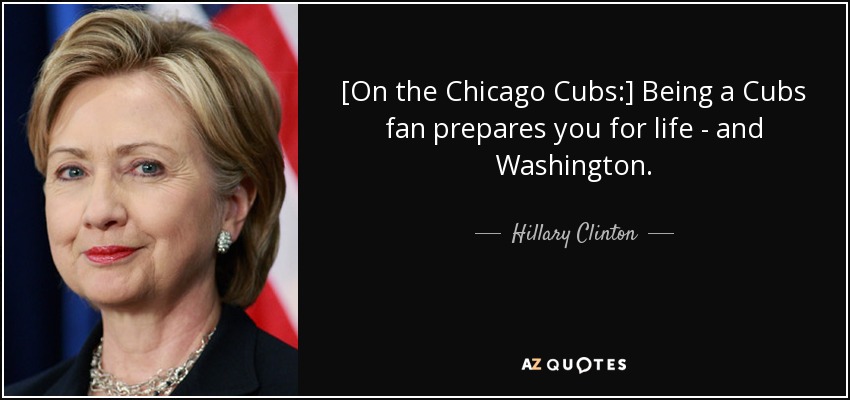
I knew she was never really a Yankee Fan. But then, Michael Bloomberg was honest about having been a Red Sox fan, and I'd sooner trust Hillary to be Mayor of New York, let alone President.

Donald Trump claims to be a Yankee Fan. Can't we trade him? To a team on Mars, or further away?

*

October 26, 1951
, 70 years ago: Desperate for money to pay a mounting tax bill, Joe Louis, who stood as Heavyweight Champion of the World longer than anyone (12 years, 1937-49) and defended the title more than anyone (25 times), climbs into the ring at the old Madison Square Garden for a purse of $300,000 – about $3.16 million in today's money. He fights Rocky Marciano, then a rising contender who idolized Louis. Rocky had told the press, "This is the last guy I want to fight." It had nothing to do with his own ability, or whatever Louis had left.

It is a mismatch: Marciano is 28, is in superb shape, and has a sledgehammer for a right hand; Louis is 37, struggles with his weight, and his arms and legs, once the fastest in the fight game despite his being a heavyweight, have terribly slowed. Marciano actually knocks Louis out of the ring in the 8th round.

Marciano goes back to his dressing room and cries over what he has done to his greatest hero, and even goes over to see him and says, "I'm sorry, Joe." Sugar Ray Robinson, then Middleweight Champion, was in Louis' dressing room to console him, and was also crying.

Eleven months later, Marciano knocked Jersey Joe Walcott out to become the Heavyweight Champion. Louis, still needing money, humiliated himself as a professional wrestler, and not a very good one. Both men's lives ended badly: Marciano's in a plane crash in 1969, just before his 46th birthday; Louis' in a wheelchair, unable to pay his medical bills, with Frank Sinatra hosting a benefit concert for him in Las Vegas in 1978, which kept Louis afloat until he finally passed away in 1981, at 67.

As a Sergeant in the U.S. Army in World War II, he was laid to rest at Arlington National Cemetery, on the order of President Ronald Reagan, and with Sinatra delivering the eulogy.

October 26, 1955: The Stadio Olimpico del Ghiaccio -- Olympic Ice Stadium -- opens in Cortina d'Ampezzo, Veneto, in the Italian Alps, near the border with Austria. It was the main stadium for the 1956 Winter Olympics, then seating 65,000.

With just 5,842 people according to Italy's most recent census, Cortina is one of the smallest municipalities ever to host an Olympic Games. Nevertheless, it has been selected again, as the site of the 2026 Winter Olympics. The Stadio Olimpico del Ghiaccio still stands, and will host the curling events at the '26 Games. But, having been converted to an all-seater facility, its capacity is down to 27,958, and so a larger stadium will be built for the Opening and Closing Ceremonies.

October 26, 1957: The Cincinnati Royals play their 1st regular-season game after moving from Rochester. They beat the Syracuse Nationals 110-100 at the Cincinnati Gardens.

Despite having future Hall-of-Famers in Oscar Robertson, Jerry Lucas and Jack Twyman, they never won a title, only getting as far as the 1963 and 1964 NBA Eastern Conference Finals.

In 1972, they moved again, to Kansas City. Since that city already had a baseball team named the Royals, they didn't want to make the same mistake that the NFL's Chicago Cardinals made when they moved to St. Louis, so they changed the name but kept the royalty theme, and became the Kansas City Kings. In 1985, they moved again, and became the Sacramento Kings.

Being small markets, neither Rochester, nor Cincinnati, nor Kansas City has ever regained an NBA team.

Speaking of small: Also on this day, Harry Perry Chappas is born in the Washington suburb of Mount Rainier, Maryland, and, well, grows up in the Miami suburb of Davie, Florida. In 1978, 27 years after sending the 3-foot-7 inch Eddie Gaedel to bat for the St. Louis Browns, Bill Veeck, now the owner of the Chicago White Sox, signed the shortest "real player" in MLB history, measured at 5-foot-3. Chappas insisted that he was really 5-foot-5, and that Veeck exaggerated so as to make him seem shorter than the shortest player in the majors then, Kansas City Royals shortstop Freddie Patek, 5-foot-4.

Also a shortstop, Chappas hit .267 in 20 games as a September callup. In 1979, Veeck named former Chicago Cubs shortstop Don Kessinger his manager, making Kessinger, to this day, the last player-manager in the American League. Kessinger respected Chappas' effort enough to name him, rather than himself, as the Opening Day starter. But just 2 weeks into the season, Chappas missed a sign, and Kessinger could not forgive that, sending him down to the minors.

Kessinger didn't last much longer himself, as the team was losing, and he resigned on August 2, 1979, and also retired as a player. That game was a White Sox win over the Yankees, and Kessinger's last game was also Thurman Munson's last game. From 1991 to 1996, he was a successful head coach at his alma mater, the University of Mississippi. He is still alive, but has never been involved in professional baseball again.

Chappas was called back up, but only played 26 games in 1979 and 26 more in 1980. He continued to play in the minor leagues until 1983. He is still alive.

*

October 26, 1961, 60 years ago: Keith B. Griffin is born in Columbus, Ohio. (I can find no record of what the B stands for.) Despite being born in the hometown of Ohio State University, and being the younger brother of O-State's Heisman Trophy winner Archie Griffin, the running back instead attended the University of Miami. He was the player shown on the cover of Sports Illustrated after Miami's shocking win over Nebraska in the 1984 Orange Bowl gave them the National Championship.

He wasn't done winning. He played 5 seasons for the Washington Redskins, and was a member of their Super Bowl XXII winners. Archie's pro career was an injury-induced bust. He did reach Super Bowl XVI with his home-State Cincinnati Bengals, but they lost. He lost a fumble during the game, but that ended up not mattering.

Also on this day, Mark Anthony McDermott is born in the New York suburb of Waterbury, Connecticut. We know him as Dylan McDermott. He played Bobby Donnell on The Practice. He also starred in each of the 1st 2 seasons of American Horror Story, although as different characters, as each season of that show tells a different story.

Also on this day, Uhuru Muigai Kenyatta is born in Nairobi, Kenya. The son of Jomo Kenyatta, the country's founding father and 1st President, he was elected its 4th President in in 2013, and re-elected in 2017.

The Swahili word "uhuru" means "freedom." It is for this reason that the black African character on the original Star Trek series was named Uhura. There was also a Jamaican reggae band named Black Uhuru.


*

October 26, 1971, 50 years ago: 
Anthony Deane Rapp is born in Chicago. He played Mark Cohen in the original 1996 Broadway production of the musical Rent, and again in the 2005 film version. He now plays Lieutenant Commander Paul Stamets, Chief Engineer aboard the eponymous starship, on the TV series Star Trek: Discovery. This is the 1st openly gay character in a Star Trek series.

October 26, 1974: The Richfield Coliseum opens in Richfield, Ohio. The location was chosen because it was about halfway between the downtowns of Cleveland and Akron. This was a very stupid thing to do.

It was home to the NBA's Cleveland Cavaliers from 1974 to 1994, the World Hockey Association's Cleveland Crusaders from 1974 to 1976, the NHL's Cleveland Barons from 1976 to 1978, the Major Indoor Soccer League's Cleveland Force from 1978 to 1988, their successors the Cleveland Crunch from 1989 to 1992, and the International Hockey League's Cleveland Lumberjacks from 1992 to 1994.

In 1975, Muhammad Ali had his 1st defense of his regained Heavyweight Championship of the World there, surprisingly getting knocked down by Chuck Wepner before flooring the otherwise overmatched "Bayonne Bleeder" in the 15th and final round. This fight inspired Sylvester Stallone to write Rocky.

The location was terrible, and the Cavs could never fill its 20,000 seats, so the Gateway Arena (now the Rocket Mortgage FieldHouse) Arena was built downtown. The Coliseum was demolished in 1999, and the site is now part of a National Forest.

October 26, 1984: Michael Jordan makes his NBA debut. He scores 16 points and has 11 assists, and is outscored by 3 Chicago Bulls teammates: Orlando Woolridge with 28, Quintin Dailey with 25 and Steve Johnson with 18. The Bulls beat the Washington Bullets, 109-93 at Chicago Stadium.

*

October 26, 1985: Time travel is first demonstrated at the Twin Pines Mall (or is that the Lone Pine Mall?) in Hill Valley, California -- or, rather, is dramatized in the film Back to the Future. But even more dramatic events are unfolding at 
Game 6 of the 1985 World Series, starting at Royals Stadium (now Kauffman Stadium) in Kansas City, about 19 hours after Marty McFly (played by Michael J. Fox) made his trip back into time.

The St. Louis Cardinals lead the cross-State Kansas City 
Royals 1-0, and need just 3 more outs to win the World Series. Jorge Orta hits a ground ball to 1st baseman Jack Clark. Clark flips to reliever Todd Worrell, who is covering the base. Orta is unquestionably out. The instant replay cameras and the photograph above confirm this. Except 1st base umpire Don Denkinger blows the call, and calls Orta safe.

The next batter, Steve Balboni, pops up, and Clark can’t handle it, and Balboni singles on his next swing. A passed ball by Darrell Porter, a Royal postseason hero from 1980 but now the Cardinal catcher (having been their postseason hero in 1982), makes it men on 2nd and 3rd, and Hal McRae is intentionally walked. Dane Iorg steps up, and singles home Orta and Balboni, and the Royals have a 2-1 walkoff win to force a Game 7 at home.

The Cardinals are furious. So are their fans. Understandably so. They all think Denkinger stole the World Series from them. They still think so, 36 years later.

There's just one problem with this theory: There was still 1 game to go. If the Cardinals had won Game 7, Denkinger's blown call would have been just a footnote.


So Cardinal manager Whitey Herzog should have taken his team into the clubhouse and said, "Men, we got screwed tonight, but there's nothing we can do about it now. So let's win this thing tomorrow, and what happened tonight won't matter." Instead, the White Rat whined about the call to the media, and let it get into his head, and into his team's heads.

The shock isn't that the Cards lost Game 7 by a whopping 11-0. The shock is that the Royals won it by only 11 runs. It is the biggest blowout in Game 7 history, previously reached only by, oddly enough, the Cardinals, when they beat the Detroit Tigers in 1934 (the Joe Medwick Game).


In 2015, someone did a "Win Expectation" study of that game. Before the swing, the Cardinals had an 81 percent chance of winning the game -- meaning a 1 in 5 chance of losing. That's hardly ridiculous. If the right call had been made, giving the Cardinals an out, they would have had an 89 percent chance -- a 1 in 11 chance of losing, unlikely but still not outrageous for the Royals to have come from behind to win. Even with the call blown, the Cards had a 67 percent chance -- a 2/3rds chance. They still should have won it.

Don Denkinger was still respected enough by the baseball establishment to be put behind the plate for the 1987 All-Star Game, and named crew chief for the 1988 American League Championship Series, the 1991 World Series, and the 1992 ALCS, before retiring in 1998 after 30 season in the majors, 22 as a crew chief. He is now 85 years old, and still lives in his hometown of Cedar Falls, Iowa.

The Cardinals have since won 3 World Series. For those among their fans who have not yet done so, it's time to move on.

*

October 26, 1991, 30 years ago: Game 6 of the World Series. The Minnesota Twins are hosting the Atlanta Braves at the Metrodome in Minneapolis, broadcast live on CBS. While the game is still going on, NBC airs Saturday Night Live.

This episode would be the debut of Ellen Cleghorne's character Queen Shenequa, but it opens with their version of NBC's political talk show The McLaughlin Group, with Dana Carvey playing host John McLaughlin. He and all the panelists are wearing Halloween costumes. Then, Carvey keels over with a knife in his back, and the real McLaughlin takes over -- but stays in character, exaggerating his tagline, "Wrong!" the way Carvey does.

When host Christian Slater comes out, he sees the entire audience doing the Braves' Tomahawk Chop and War Chant. He turns and sees McLaughlin and executive producer Lorne Michaels watching the game, rather than watching hthe show they're actually working on, doing the Chop with the big red foam Tomahawks, and wearing Indian headdresses. With the game in extra innings, Michaels says, "Braves in 6." McLaughlin says, "Wrong! Braves in 7!" 

They're both wrong: Kirby Puckett makes a great catch and hits a dramatic home run in the bottom half of the 11th inning, to give the Twins a 4-3 win, and tie the Series. What has been shaping up as one of the best World Series ever will go to a Game 7 that will be worthy of it.

October 26, 1994: Had the baseball season been permitted to reach a conclusion, Game 4 of the World Series would have been played on this day, at the home park of the American League Champions.

October 26, 1995
: The KeyArena opens at the Seattle Center complex, taking the place of the Seattle Center Coliseum. The Seattle SuperSonics make the NBA Finals in their 1st season there, but are moved to Oklahoma City in 2008. 

It was also home to the WNBA's Seattle Storm and the basketball teams of Seattle University. It has now been replaced by the 3rd arena on the site, the Climate Pledge Arena, for the Seattle Kraken, an expansion team that just debuted in the NHL. Seattle also hopes it will become the home of a moved or expansion NBA team that will become the new Sonics. In the interim, the Storm played at Hec Edmondson Pavilion on the campus of the University of Washington.


*

October 26, 1997: Game 7 of the World Series at whatever the combined Marlins-Dolphins stadium in the Miami suburbs was called at the time. The Cleveland Indians jump out to a 2-0 lead over Florida‚ and are just 2 outs away from winning their 1st World Series in 49 years.

But Jose Mesa, not for the first time nor for the last, blows the save, and the Marlins claw their way back and tie the score in the bottom of the 9th on a sacrifice fly by Craig Counsell. In the last half of the 11th‚ Edgar Renteria gets his 3rd hit of the game‚ driving home Counsell with the winning run‚ as Florida wins Game 7 by a score of 3-2.

This was, after 1962, only the 2nd World Series where neither team won back-to-back games: The Marlins won Games 1, 3, 5 and 7; the Indians won Games 2, 4 and 6. This was also the Series with the greatest extremes of weather: The 4 games in South Florida were the 4 warmest on record for Series games, while the 3 in Cleveland were 3 of the 4 coldest (the previous coldest, in New York in 1976, remains 3rd), and Game 4 is the only Series game to be played in a snowfall except for one in Chicago in 1906.

The Marlins, in just their 4th season of existence (as opposed to the Indians, in their 97th), thus become the fastest team in baseball history to win a World Series title‚ 3 years quicker than the 1969 Mets. Livan Hernandez, the pitcher who fled Cuba (and would soon be followed by his brother Orlando "El Duque" Hernandez) is named Most Valuable Player of the Series.

This Series is sweet vindication for manager Jim Leyland, who lost 3 straight NLCS while managing the Pittsburgh Pirates; for Bobby Bonilla, who played for Leyland on those Pirates, bad-attituded his way out of his native New York with the Mets, and flopped the year before with the Baltimore Orioles; for Alex Fernandez, who pitched for the talented Chicago White Sox team that fell just short in 1990, lost the ALCS in ’93 and was screwed over by the strike in ’94, and was injured and unable to pitch in the postseason, so his teammates put his Number 32 on their caps; and for Gary Sheffield, who was already gaining a reputation as a bad apple that nobody wanted to keep around for very long, despite his obvious talent for power hitting, and this remained his only World Series win.

For the Indians, who hadn't won a Series since 1948, went from 1954 to 1995 without winning a Pennant, went from 1959 to 1994 without even being in a Pennant race, stood to be the AL's Wild Card if the standings at the time of the Strike of '94 had held to the end of the season, lost the '95 Series despite winning 100 of 144 games in the regular season, lost the '96 ALDS to an inferior Oriole team, and won just 86 games in this regular season but had defeated the favored Yankees and the Seattle Mariners before this crushing defeat, it is not just a crushing defeat, where they came closer to winning the World Series without doing so than any team ever had except the '86 Red Sox (and now the 2011 Texas Rangers).

No, this loss meant that, like the Red Sox, the Indians now have a reputation of being a choking team. They have never shaken it, despite return trips to the postseason in 1998, '99, 2001 and '07 – blowing a 2-1 lead in the '98 ALCS, 3-1 leads in the '07 ALCS and the '16 World Series, and a 2-0 lead in the '17 ALDS.

Also on this day, D.C. United wins its 2nd MLS Cup, in the league's 2nd season, beating the Denver-based Colorado Rapids, 2-1 on home soil at Robert F. Kennedy Stadium in Washington. Jaime Moreno and Tony Sanneh score the goals.

October 26, 1999: Game 3 of the World Series. Andy Pettitte did not have his good stuff, but Tino Martinez, Chad Curtis and Chuck Knoblauch helped the Yankees come from 5-1 down to send the game to extra innings. Curtis led off the bottom of the 10th, and knocked one out for a 6-5 win.

The following night, the Yanks wrapped up the sweep, the 25th World Championship, the title of Team of the Decade (it ain't about Division Titles, Braves fans), and the title, as NBC's Bob Costas said that next night, of "Most Successful Franchise of the Century."


Like fellow late 1990s Yankee Dynasty players Roger Clemens and John Wetteland, Curtis was among the most faith-vocal players of his era. Also like Clemens and Wetteland, he would later be accused of what would once have been quaintly called "morals charges," relating to his time as a high school athletic trainer in Michigan. He was sentenced to 7 to 15 years in prison, and served 7.

*

October 26, 2000: The Euro, the currency of the European Union, which had started, on January 1, 1999, at $1.10 in comparison to the American dollar, drops to 83 cents. This remains its all-time low. Its all-time high is $1.60, achieved on July 15, 2008.

More importantly for me, on this day, Game 5 of the World Series is played at Shea Stadium. Jeter and Bernie Williams homer off Al Leiter. Pettitte and Leiter give it their all. The game is tied 2-2 in the top of the 9th. Two outs. Posada on 2nd, Scott Brosius on 1st. Not great speed on the basepaths. 

Luis Sojo, playing 2nd base because Knoblauch's fielding difficulties limited him to DH status, is coming up to bat. Leiter had thrown 141 pitches. A number that would not have caused Catfish Hunter and Tom Seaver to flinch, but by the standards of the 1990s and 2000s, a lot.

Met Manager Bobby Valentine's choices are not good:

* A: Stick with an exhausted Leiter. He would be pitching on brains, courage and fumes, and pray that he gets the out that sends it to the bottom of the 9th still tied.

* B: Put in Armando Benítez. He led the National League in saves that year and saved Game 3, but also blew Game 1 for Leiter, and also blew a Division Series game against the Giants (which the Mets ended up winning anyway), and had previously messed up 2 ALCS games against the Yankees for the Orioles (including the Jeffrey Maier Game). Or...

* C: Put in John Franco. He was the winning pitcher in Game 3, and also pitched well in Game 4, but would be pitching for the 3rd day in a row. And he was 39: There was a reason Valentine had taken the closer's job from Franco and given it to Benítez.

Valentine decided a tired Leiter was better than an aging, potentially tired Franco and an inconsistent, unreliable Benítez. Although I frequently accused Valentine of overmanaging, and sometimes outright stupidity, I can't fault him for this choice. If he had put in the very popular New York native Franco and lost anyway, he might have gotten away with it. But if he had put in the already suspicious Benítez and he blew yet another, Valentine would have been run out of Flushing on the Long Island Railroad.


Leiter throws his 142nd pitch to Sojo. He knocks it up the middle. A Met fan once told me that Rey
Ordóñez would have stopped this grounder. This Met fan was a fool: Ordóñez would not have gotten it. Mike Bordick was the shortstop that night, and he was a good shortstop, and he couldn't quite get it.

Base hit for Sojo. Posada comes around 3rd. Center fielder Jay Payton's throw... never makes it to Mike Piazza at the plate, instead hitting Posada in the back and getting away, toward the backstop. This enables not only Posada to score the tiebreaking run, but also Brosius to score an insurance run as well. Yankees 4, Mets 2.

Bottom of the 9th. Two out. The Mets get a man on. Piazza comes up to the plate. If you're a Met fan, this is the man you want up: The best offensive player the Mets have ever had (cough-steroids-cough), one of the best fastball hitters of his time, power hitter against power pitcher, Mariano Rivera.

But if you're a Yankee Fan, there’s no one you'd rather have on the mound, and there's no one you’d rather get as the final out. It was similar to the final matchup of the 1978 Boston Tie Party, with Carl Yastrzemski, one of the greatest fastball hitters ever, and the most beloved player in his franchise's history (remember, Sox fans didn't always love Ted Williams), coming up to try to save his club against one of the fastest and most fearsome pitchers ever, Rich "Goose" Gossage.

Yaz popped up to end that game in victory for the Yankees; 22 years later, Piazza gets considerably better wood on his pitch, and hits one deep to straightaway center field.

For a moment, many of us, myself included, think, "Uh-oh, no!" Translation: "Tie game, Mets will go on to win it, and take the next 2 in The Bronx, and the Yanks will have choked it away."

Because we had grown up with the Mets as the team that won and the Yanks as the team that fell short. We had the arrogance of Yankee Fans of old, but deep down, in places we don't like to talk about at parties, we had the fears that came so easily to fans of the Indians, the pre-2004 Red Sox, the pre-2007 Phillies, the pre-2016 Cubs -- and the post-2006 Mets.

But Piazza had juuuust gotten under it. The ball has too much height and not enough distance. As the clock strikes 12:00 midnight, Bernie stands on the warning track, it's an easy catch, and it's over.

Jeter becomes the 1st player ever to be named Most Valuable Player of the All-Star Game and the World Series in the same season. Still, he would never be named MVP of a regular season. At the site of his 1st game as a manager, 23 years earlier, Torre is picked up by his grateful players, and carried off the field.

There were 25,000 people at Shea chanting "Let's Go Yankees!" and "We're Number 1!" Eventually, the owner came out to talk to the press, and he and the announcers couldn't talk, because the Yankee Fans were so loud, chanting "Thank you, George!" Imagine that, thousands of people saluting George Steinbrenner at Shea Stadium.

I loved it. October 26, 2000 – actually, the final out came just before midnight, so it was really October 27 that we celebrated – remains my favorite moment as a sports fan.

For the 1st time, the Mets had the chance -- their first, their best, maybe their last -- to beat the Yankees in a Subway Series, and to irrevocably "take over New York." And while they had their chances and fought hard, in the end, the better team won.

The Yankees have beaten the Mets in a World Series. The other way around has never happened. And it never will. Never, never, never. Or, in the words of Flushing's own Fran Drescher, "It begins with an N and ends with an A: Nev-a." As a Yankee Fan said then, "The Yankees have scoreboard over the Mets for all time."


This was the 26th World Championship. And for those of us who grew up as Yankee Fans during the Mets' "glory" years of 1984 to 1990, the Dynasty That Never Was, and had to deal with the unearned arrogance of the Flushing Heathen, the filthy bastards, delusional that their 2 titles outweighed our 22 (until 1996; now 27), damn fools to believe that the 1986 Mets could have beaten the Yankees of 1927, 1938, 1941, 1953, 1961 and 1978, and eventually even the 1998 juggernaut... for us, this was the greatest, sweetest moment of them all.


We beat the Mets. And it wasn't close. All 5 games were close, but winning in 5 games is domination. And we clinched at their place, on their field, at the William A. Shea International Airport, at the Flushing Toilet.


This was the 13th World Series game played at Shea. An unlucky 13th. It was also the last, which no one (not even a wiseass Yankee Fan like me) could have predicted at the time.

No matter how bad the 2004 ALCS was, losing the 2000 World Series to the Mets would have been 10 times worse. As we saw in 2015, we don't have to live around very many Red Sox fans with their cheated-for arrogance, but we do have to live around Met fans with their unearned arrogance.

How arrogant are Met fans? Some insist that 2000 and the other World Series the Yankees have won since 1978 don't count, because they used steroids; therefore, the count since 1986 is 1 to 0, and the count since 1962 is 2-2. These fans are idiots: We have more evidence against the 2000 Mets (Piazza) than we do against the 1996-2009 Yankees. So if 1996, 1998, 1999, 2000 and 2009 don't count for the Yankees, then 2000 doesn't count for the Mets, either.

For the moment, the count remains 27 to 2, and 5 to 0 since 1986.

I once saw a Met fan with a cap that had the 2000 World Series logo on the side, but razored off, with some of the stitching still visible. That's how much it bothers them. It should bother them: It basically erased their team's reason to exist.

As we've seen, the Yankees are (depending on your point of view: again, or still) the better team now. And let us not pretend that any Met World Series win -- be it 1969, 1986, or any future win -- is better than all of the Yankees' World Series wins.

Most of all, winning the 2000 World Series means that, as Paul Louis, an online friend who was the same age I am, put it, "The Yankees have scoreboard over the Mets for all time."

Sadly, early in 2021, Paul died from COVID. He was born right after his beloved New York Jets won the Super Bowl, and never lived to see them win another.

Also on this day, The Euro, the currency of the European Union, which had started on January 1, 1999 at $1.10 in comparison to the American dollar, drops to 83 cents. This remains its all-time low. Its all-time high is $1.60, achieved on July 15, 2008.

*

October 26, 2002: Game 6 of the World Series, at what was then known as Edison International Field of Anaheim – the former "Big A" briefly nicknamed "the Big Ed." The San Francisco Giants lead the Series 3 games to 2, and lead 5-0 after 6½ innings, thanks to home runs by Shawon Dunston and Barry Bonds.


The Anaheim Angels score 3 runs in the 7th to make it 5-3, but the Giants are still just 9 outs away from their 1st World Championship since moving to San Francisco 45 years earlier, their 1st in any city since they were in New York 48 years earlier.

But they choke. The Angels, having already scored the 3 runs in the 7th, score 3 more in the 8th on a home run by Scott Spiezio, and win, 6-5. The Series will go to a Game 7 in Anaheim tomorrow night.

October 26, 2004: The Red Sox win Game 3 of the World Series with a 4-1 win over the St. Louis Cardinals at Busch Memorial Stadium. Finally making his 1st World Series start, Pedro Martinez hurls 7 shutout innings to put the Sox up 3-games-to-0. Manny Ramirez homers and drives in a pair of runs for the Sox‚ while Larry Walker hits one out for the Cards. The Sox can achieve their 86-year-old dream tomorrow night.

October 26, 2005: The Chicago White Sox shut out the Astros‚ 1-0 at Minute Maid Park in Houston‚ to sweep the World Series and win their 1st World Championship since 1917, the 1st for either Chicago team in that time. Freddy Garcia gets credit for the win‚ as Jermaine Dye drives home the game's only run. Dye is named the Series MVP.

Ozzie Guillen, a native of Venezuela, becomes the 1st foreign-born manager to win a World Series. The Astros, in the Series for the 1st time in their 44-season history, are still, through 2016, winless in World Series games. Their all-time record in postseason games is 24-38.

He was the starting goaltender for North London club Arsenal, winning the League title in 1948 and 1953 and the FA Cup in 1950. He later managed the club from 1958 to 1962, but not well. He also managed Peterborough United, Norwich City, Kettering Town, Cardiff City and Corby Town.

October 26, 2008: In a 10-2 rout of the Tampa Bay Rays in Game 4 of the World Series at Citizens Bank Park, Philadelphia Phillies right-hander Joe Blanton hits a home run, the 1st pitcher to do so in a Series game in 34 years. Ken Holtzman of the A's was the last hurler to accomplish the feat when he went deep off Andy Messersmith of the Dodgers in 1974 -- also in Game 4.

October 26, 2009: Castle airs the Halloween-themed episode "Vampire Weekend." When 2 college kids -- one an artist who dressed as a vampire, the other a writer who dressed as a werewolf -- who were writing a graphic novel about a present-day vampire in New York are killed, mystery writer Richard Castle (Nathan Fillion) and the detectives at the NYPD's 12th Precinct connect the murders to one committed 18 years earlier.

*

October 26, 2013: Game 3 of the World Series is played at Busch Stadium in St. Louis, and it has the weirdest ending of any Series game ever. (Even weirder than Game 4 of 2020.)

In the bottom of the 9th inning, with the score tied 4-4, Red Sox pitcher Brandon Workman gives up a 1-out single to Yadier Molina. Boston closer Koji Uehara is brought in to face pinch-hitter Allen Craig, who doubles on the 1st pitch. Jon Jay hits a grounder to 2nd baseman Dustin Pedroia, who makes a sensational diving stab, and throws home to catcher Jarrod Saltalamacchia, who tags out the sliding Molina for the 2nd out.

But then Saltalamacchia throws to 3rd, trying to get Craig, who was running on the play, and decided to slide towards Will Middlebrooks, knocking him down. However, the ball glanced off Middlebrooks' glove and Craig's body, caroming into foul territory down the left field line. When Craig starts toward home, he runs over Middlebrooks, who winds up slowing Craig down as he tries to take off for home.

The 3rd base umpire, Jim Joyce, calls obstruction on the play. Home plate umpire Dana DeMuth
determines that Craig would have scored without the obstruction, and awards the Cardinals the run, giving them a 5-4 win, and a 2–1 lead in the World Series. As far as I know, this is the only game in baseball history where a game-winning run was awarded without the runner having touched the plate.

This was 28 years to the day after an umpire's incorrect call set in motion a series of events that cost the Cardinals a World Championship. Had the Cardinals gone on to win the Series, it would have become an epic moment, and Red Sox fans would fume about getting screwed for the rest of their lives -- even though, unlike the Denkinger call in 1985, this call was correct. We know they would have forever fumed, because Sox fans old enough to remember the 1975 World Series are still fuming about the alleged "interference" of Ed Armbrister of Cincinnati in the 10th inning of another Game 3.

But, of course, the Sox won the Series (by cheating), so this play is a footnote. A bizarre footnote, but a footnote nonetheless.

October 26, 2015: Supergirl premieres on CBS. After its 1st season, it moves to The CW, becoming part of its "Arrowverse" franchise of superhero dramas. Melissa Benoist plays Kara Zor-El, a native of Krypton who, in a manner of speaking, has 2 secret identities: Kara Danvers, a media figure; and the titular superheroine.

The original version of the character debuted in May 1959, in Action Comics #252, as a cousin to Superman, a.k.a. Clark Kent, a.k.a. Kal-El. Superan's father, Jor-El, and Supergirl's father, Zor-El, were brothers and scientists. The character had previously been show in the 1984 film Supergirl, starring Helen Slater, as part of the franchise started by the Christopher Reeve Superman films.

Nods were given to previous superhero franchises, including Dean Cain, Superman in the 1990s series Lois & Clark, as Jeremiah Danvers, Kara's adoptive father; and Lynda Carter, the title character on the 1970s Wonder Woman series, as Olivia Marsden, President of the United States, who has to resign when it is revealed that she is, herself, an alien. The show will conclude in a few weeks after 6 seasons.

October 26, 2016: Game 2 of the World Series. Behind the pitching of Jake Arrieta, The Chicago Cubs beat the Cleveland Indians 5-1 at Progressive Field, and even the Series. 

After winning all 8 games he managed with the Boston Red Sox, and winning game one with the Indians, this was the 1st time Terry Francona lost a World Series game as a manager. He was 9-0. It was the 1st World Series game the Cubs had won since Game 6 in 1945.

October 26, 2018: Game 3 turns out to be the longest game in World Series history. Joc Pederson gives the Dodgers the lead with a home run in the 3rd inning, and Jackie Bradley Jr. ties it for the Red Sox with a home run in the 8th, to make it 2-2.

The Red Sox scored in the top of the 13th on a walk, a wild pitch and a single-and-error. But the Dodgers tied it on a walk, a fly out, and a single-and-error of their own. As the game went on and on, Twitter users began making jokes about its length: This game had started at Ebbets Field in Brooklyn and was moved to Dodger Stadium in Los Angeles; Sandy Koufax had started the game for the Dodgers, Cy Young for the Red Sox; Ted Williams and Jackie Robinson had traded home runs in the 14th, and so on.

Max Muncy nearly hit a walkoff home run in the bottom of the 15th, but his drive hooked just foul. He finally hit one in the bottom of the 18th, giving the Dodgers a 3-2 win. Nathan Eovaldi, normally a starting pitcher, had thrown 7 innings in relief before taking the loss. His effort helped save the Boston bullpen, keeping their relievers fresh. This would be the only game the Dodgers would win in the Series.

The 18 innings broke the Series record of 14, set by the same teams in 1916, and tied by the Chicago White Sox and Houston Astros in Game 3 in 2005. The first pitch was at 5:10 PM Pacific Time (8:10 Eastern), and it ended at 12:30 AM (3:30 Eastern). At 7 hours and 20 minutes, it broke the record of that 2005 Game 3, 5 hours and 41 minutes, and tied the record for longest postseason game ever, set in Game 4 of the 2005 National League Division Series, won by the Astros on Chris Burke's home run against the Cardinals. This game was longer than the entire 1939 World Series, a 4-game sweep by the Yankees over the Reds, which took a combined 7 hours and 5 minutes to play.

Sunday, November 1, 2020

Happy 60th Birthday, Fernando Valenzuela!

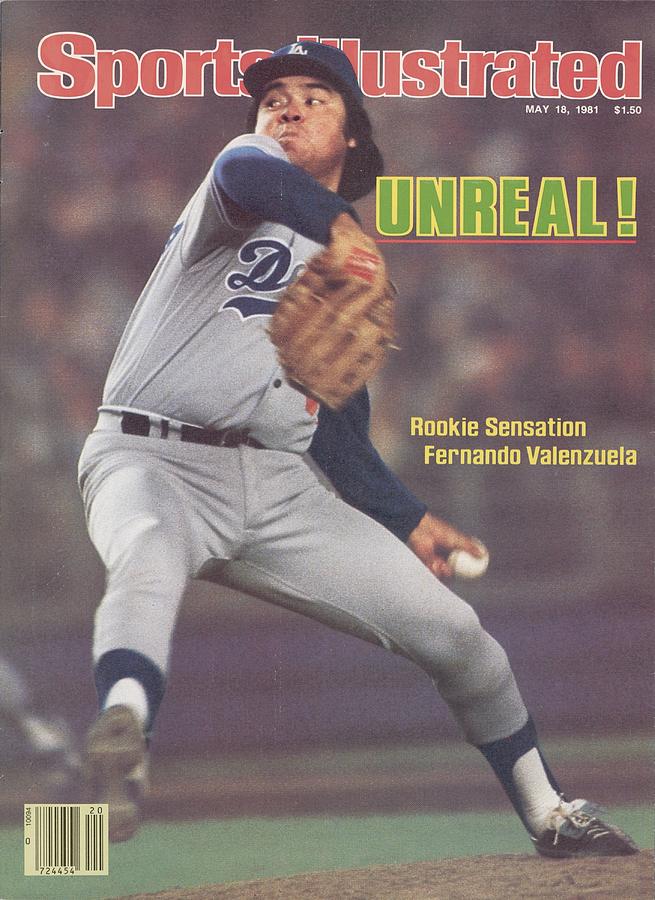
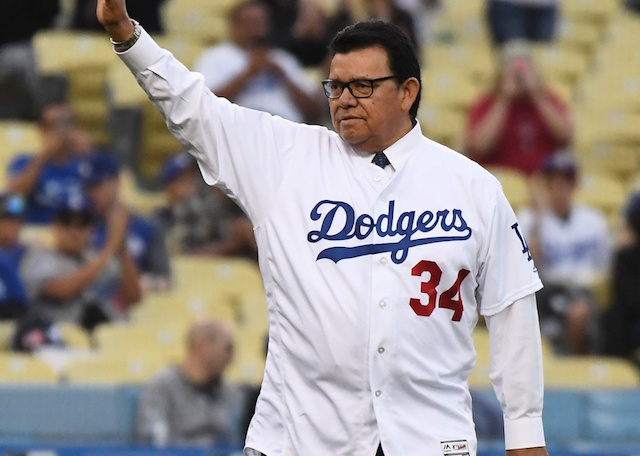
November 1, 1960, 60 years ago: Fernando Valenzuela Anguamea is born in Navojoa, Sonora, Mexico. In 1981, the chunky, screwballing lefthander for the Los Angeles Dodgers was the hottest thing in baseball, He won his 1st 8 starts, with 5 shutouts and an ERA of 0.50. He was only 20 years old.

On May 15, 1981, I was traveling with my family to a weekend vacation in Williamsburg, Virginia. We stopped off at a rest area on the New Jersey Turnpike, and I saw the new Sports Illustrated. Fernando was on the cover, with the headline, "UNREAL!" No, the cover didn't jinx him: He was 7-0 at that point, and won his next start, before falling to 8-1. That night, in a totally unrelated development, Len Barker of the Cleveland Indians pitched the 1st major league perfect game of my lifetime.

"Fernandomania" made the Dodgers what they remain to this day: Mexico's favorite team, despite the San Diego Padres playing a short drive from the border. The mania was tamed somewhat by the midseason strike, as he went just 5-7 after his amazing start. But he pitched a complete-game win over the Yankees in Game 3 of the World Series. The Dodgers won in Game 6; had it gone to Game 7, he would have started it.

He had his only 20-win season in 1986, and struck out a record-tying 5 straight batters in that season's All-Star Game: Don Mattingly, Cal Ripken, Jesse Barfield, Lou Whitaker, and the opposing pitcher, Teddy Higuera. Higuera, 3 years older, was frequently compared to Fernando: He was also a chunky Mexican lefthander who threw the screwball. He would go 94-64 in his career. Both men pitched 3 scoreless innings in that game, which the American League won, 3-2.

Fernando missed most of the 1988 season due to injury, but still got a 2nd World Series ring. He was released in 1991, and bounced around, signing with the Padres.

In 1996, the Padres played 3 games in Monterrey, the 1st regular-season games ever played in Mexico. Fernando started the opener against the Mets, and benefited from a 15-0 lead. The Mets came back, and he left to a standing ovation. The Padres hung on to win, 15-10.

He should have retired after the season, having gone 13-8 with an ERA of 3.62, helping the Padres reach the Playoffs for the 1st time in 12 years. Instead, he hung on for 1 more year, going 2-12. His career record finished at 173-153.

A member of the Hispanic Heritage Baseball Museum Hall of Fame and the Caribbean Baseball Hall of Fame, the Dodgers have not officially retired his Number 34 -- aside from Jim Gilliam, they don't do that unless the man in question is elected to the Baseball Hall of Fame -- but they've kept it out of circulation.
He is now a broadcaster for the Dodgers' Spanish network, bringing up memories of his struggles to learn English. It was said in 1981 that, "The two best lefthanded pitchers don't speak English: Fernando Valenzuela and Steve Carlton." (Referencing Carlton's refusal to talk to the media.) Manager Tommy Lasorda said the only English words he knows are "beer," "food" and "light beer." On The Tonight Show, Johnny Carson said, "Fernando Valenzuela learned another English word today: 'Million.'"

*

November 1, 1604: The Tragedy of Othello, the Moor of Venice is first staged, at Whitehall Palace, then the main residence of the monarchs of England. This is established by a contemporary account that attributes authorship to "Shaxberd." In other words, William Shakespeare, a.k.a. The Bard of Avon.

This play is unusual for a few reasons. We have, for all intents and purposes, confirmation that Shakespeare wrote it. Many historians have questioned whether Shakespeare, both an actor and a theater owner at the time, wrote any of his plays, and some have publicly wondered if he existed at all. We also have a definitive date for its 1st staging, which is rare for his plays.

Finally, we have a main character -- who, like Macbeth, starts out as a heroic figure, but certainly doesn't end up as one -- who is not a white man, but is married to a white woman, Desdemona. Othello's rival, Iago, is right up there with King Richard III as Shakespeare's greatest out-and-out, curtain-to-curtain, villain. (Even King Claudius, the villain of Hamlet, shows some remorse.) The character of Othello was usually played in blackface, or sometimes with makeup and clothing making him look like an Arab.

But in the 20th Century, it became standard practice to cast a black actor. It is the best known role of Paul Robeson, who first played the role on Broadway in 1943, and, after the blacklisting of Communists a few years later, made ends meet by playing the role in London and on the European continent. Other black actors noted for playing Othello have been William Marshall, James Earl Jones and Chiewetel Ejiofor.

In 1816, Gioachino Rossini turned it into an opera, Otello. In 1997, Patrick Stewart staged it, and racially inverted it, playing a white Othello with an otherwise all-black cast. In 1998, director Tim Blake Nelson turned it into a modern movie about high school basketball players, O, with Mekhi Phifer as Odin James (this was written before LeBron James became famous), Julia Stiles as Desi Brable (the Desdemona role), and Josh Hartnett as Hugo Goulding (Iago).

November 1, 1611: The Tempest is performed for the first time. It is considered, chronologically, the last of Shakespeare's great plays. A "tempest" is a storm. Someone making a big deal out of nothing is said to have made "a tempest in a teapot."

In the 20th Century, this play was turned into the poem "The Sea and the Mirror" by W.H. Auden in 1944, the pioneering science fiction film Forbidden Planet in 1956, the Star Trek episode "Requiem for Methuselah" in 1969, the Paul Mazursky film Tempest in 1982 (moved to a Greek island in a modern setting), and the 1998 TV-movie The Tempest, starred Peter Fonda as a Civil War-era plantation owner who learned voodoo from his slaves.

It is believed by many that Shakespeare also had a hand in writing the King James Bible, which appeared earlier the same year. The fact that King James I (known in Scotland as King James VI) commissioned a Bible is understandable, given the times, just 6 years after Guy Fawkes and the Gunpowder Plot, because he needed to show both Protestants (of which he was one, but not all Protestants believed it) and Catholics that he wasn't going to discriminate against either.

In hindsight, though, it's a little bit funny. Right-wing bigots love to quote the King James Version (KJV) and its language against homosexuality. But King James himself was gay. As James himself, who also made a public statement against the use of tobacco, would not have said, "Put that in your pipe and smoke it!"

November 1, 1762: Spencer Perceval is born in Mayfair, in what is now West London. He was first elected to Britain's Parliament in 1796, and in 1809 became Prime Minister. In 1810, he got a bill through that referenced the porphyria-induced insanity of King George III, appointing the King's son as Prince Regent. He would serve as such for 10 years, until his father finally died, and became King George IV.

On May 11, 1812, Percival was shot to death in the lobby of the House of Commons. He was 49, and remains the only Prime Minister of Great Britain ever to be assassinated. He was survived by a wife and 12 children. He was succeeded by Robert Jenkinson, 2nd Earl of Liverpool. Not quite 42 years old, he remains the youngest Prime Minister in British history.

The assassin was John Bellingham, a merchant said he had been unjustly imprisoned in Russia, and had been refused compensation by the British government. He was immediately arrested, and was tried, convicted and hanged within 7 days.

*

November 1, 1800, 220 years ago: The Executive Mansion opens in Washington, D.C. President John Adams moves in, even though he will have to move out by the following March 4. No word on whether "The Atlas of Independence" invited any of the other "original Philadelphia 76ers."

When it became known as the White House is uncertain, but it was already called that before the British burned it during the War of 1812, so the myth that it got the name from the white paint hiding the burns on the outer wall is untrue. But the tradition of inviting newly-crowned World Champions to visit began with Richard Nixon, who was, in addition to being a crook, a sports nut.

November 1, 1816: James Monroe, then Secretary of State, is elected the 5th President of the United States. The nominee of the Democratic-Republican Party, forerunner of today's Democratic Party, defeats Rufus King, then a Senator from New York, and the nominee of the Federalist Party, 183 Electoral Votes to 34, taking every State but Massachusetts (22 EVs right there), Connecticut and Delaware.

Popular votes were not counted in every State, so it's not clear how many votes Monroe and King got. Still, this was the last gasp of the Federalist Party.

November 1, 1820, 100 years ago: Monroe is re-elected, almost without opposition. The Federalists did not nominate a candidate for President. This was in spite of the Panic of 1819 having hurt the country's economy.

Monroe got 228 Electoral Votes -- all but 1. William Plumer, an Elector from New Hampshire who had served that State as Senator and Governor, cast his vote for Monroe's Secretary of State, John Quincy Adams. George Washington thus remained, and still does remain, the only man to be elected President by a unanimous Electoral Vote.

Contrary to legend, that was not Plumer's intent. Rather, he publicly admitted that he preferred Adams as President to Monroe. Four years later, with Monroe respecting the 2-term tradition established by Washington, Thomas Jefferson and James Madison, Plumer got his wish.

The Democratic-Republicans would face opposition, but not under the Federalist banner. By 1832, the dominant party was renamed the Democratic Party, and the Whig Party had replaced the Federalists as the pro-business party in America. By 1860, they'd be out as such, and the Republican Party would be in.

November 1, 1844: James Knox Polk is elected the 11th President of the United States. The Democrat, who had served as Speaker of the U.S. House of Representatives and then as Governor of Tennessee, defeated Senator Henry Clay of Kentucky, who thus became the 1st man to go 0-for-3 in Presidential elections. Others have done so, but Clay is the only man to be nominated 3 times and lose all 3.

The popular vote was actually very close, since Clay, a leading figure in American politics for over 30 years, was better-known nationally than Polk: Polk won 49.5 percent of the popular vote, making him the 1st plurality President since the popular vote began being recorded from every State then in the Union (starting in 1828); while Clay won 48.1 percent. The Electoral Vote was less close, as Polk won 170-105.

*

November 1, 1859: John Alexander McPhee is born in Massena, New York, on the St. Lawrence River, and thus the Canadian border. I can find no reference to how he got his nickname, but "Bid" McPhee was the last man to play 2nd base in the major leagues without a glove -- and the best 2nd baseman of the 19th Century.

When the Cincinnati Red Stockings were founded in the American Association in 1882 -- and, contrary to what the team, which renamed itself the Reds when they joined the National League in 1890, would have you believe, they are not a continuation of the 1st professional baseball team of 1869-70 -- he was a charter member, and helped them win the AA Pennant. It was the only Pennant he won, as he played for them through 1899.

He led the AA in home runs in 1886 -- with 8. It was a different game. He stole 568 bases in his career. He died in 1943, and was elected to the Baseball Hall of Fame in 2000 -- 101 years after his last game. Only Deacon White (123 years, 1890-2013) and Negro Leaguer Frank Grant (103 years, 1903-2006) had to wait longer. The Reds elected him to their team Hall of Fame.

November 1, 1860, 160 years ago: Boise Penrose (no middle name) is born in Philadelphia. Having served Pennsylvania in both houses of the State legislature, he was elected to the U.S. Senate in 1896, 1902, 1908, 1914 and 1920, dying in office on December 31, 1921. 

November 1, 1870, 150 years ago: The Mutuals of New York visit the Chicago White Stockings at Dexter Park in Chicago before 6,000 people. With Chicago leading 7-5 after 8 innings, the Mutuals score 8 runs in the top of the 9th, to make it 13-7.

In the bottom of the 9th, Chicago adopts a waiting game, and the Mutuals' pitcher, Dutch-born Reinder Albertus "Rynie" Wolters, loads the bases on walks‚ and complains that the umpire is not calling strikes. A few hits and passed balls make the score 13-12 in favor of the Mutes when McAfee‚ the next batter for the Whites‚ lets a dozen balls go by without swinging. Wolters throws up his hands and walks off. The ump reverts the score to the 8th inning and the White Stockings win‚ 7-5.

Chicago has now defeated the Mutes twice since they took the Championship away from the Atlantics. The controversial ending of the game makes the Mutual club unwilling to give up the Championship.

The New York Clipper, the closest thing America had to a sports-only publication in those days, says‚ "In 1867 the Union club happened to defeat the Atlantics two games out of three of the regular series them played between them - only one series being played between clubs at that time. By this victory a precedent was established giving the championship title only to the club that defeated the existing champions two games while they were the champions. Of course this is an absurd rule but it has prevailed ever since."

November 1, 1871: Stephen Crane (no middle name) is born in Newark, New Jersey. He published his 1st novel in 1893, Maggie: A Girl of the Streets. Its themes of poverty, including alcoholism and prostitution, made it incredibly controversial for its time. In 1895, despite having no military experience -- indeed, he was born 6 years after the end of the war depicted in it, the American Civil War -- he published The Red Badge of Courage, and made himself a legend of American letters.

He was soon hired as a foreign correspondent for William Randolph Hearst's New York Journal, covering the Greco-Turkish War of 1897, the Spanish-American War of 1898, and the Boer War. But he developed tuberculosis, and died from it in 1900, only 28 years old.  

November 1, 1874: The National Association season ends today, with the Boston Red Stockings being declared the Champions with a record of 43-17. Boston actually had a record of 52-18, but the Committee running the league throws out the games played by the Baltimore Canaries (not "Orioles"), because they did not complete their schedule. The Mutuals finish 2nd.

November 1, 1880, 140 years ago: Henry Grantland Rice is born in Murfreesboro, Tennessee. After playing baseball at Vanderbilt University in Nashville, he moved into journalism. There had already been some well-known men named Henry Rice, so Grantland Rice used his middle name from then onward. His friends would call him "Granny."

He became the leading sports voice in the South, at Nashville's The Tennessean, before going to the
New York Tribune, which syndicated him nationally. In 1924, he covered the Army-Notre Dame game at the Polo Grounds in New York, and gave Notre Dame's backfield its nickname: The Four Horsemen. He also helped popularize Red Grange nationally, although, contrary to popular belief, he did not come up with Grange's nickname, the Galloping Ghost. Perhaps because of these connections, when Walter Camp died in 1925, the NCAA asked Rice to take over Camp's selections of college football's All-America team.

If the 1920s truly were "The Golden Age of Sports," Rice's writings were a big reason why, promoting Grange and Knute Rockne's Notre Dame in football, Babe Ruth in baseball, Jack Dempsey in boxing, Bill Tilden in tennis and Bobby Jones in golf. He helped to popularize golf among the masses, through his championing of Jones and, starting in 1934, Jones' tournament in Augusta, Georgia, The Masters.

Rice died in 1954, at which point it was easy to remember his most famous writing, though everyone forgets its source, a 1908 poem titled Alumnus Football:

For when the One Great Scorer comes
to mark against your name
He writes, not that you won or lost
but how you played the Game.

In 1966, a few years after the Baseball Hall of Fame established its J.G. Taylor Spink Award, tantamount to election for sportswriters, it gave the award to Rice.

November 1, 1884: The Gaelic Athletic Association is founded at Hayes's Hotel in Thurles, County Tipperary, in what's now the Republic of Ireland. The GAA governs the traditional Irish sports such as hurling and Gaelic football -- but not Irish soccer, which is governed by the Football Association of Ireland (FAI). The Northern Ireland equivalent is the Irish Football Association (IFA).

November 1, 1890, 130 years ago: THE... Ohio State University plays its 1st football game. They play the College of Wooster at Recreation Park, the minor-league ballpark in Columbus, Ohio, and lose 64-0. Ohio State recovered, and has become one of the top college football programs, while Wooster, located in Wooster, Ohio, is an NCAA Division III school.

November 1, 1893: Alexander Thomson Burr is born in Chicago. Usually listed as "Alex Burr" in baseball reference sources, but known as "Tom Burr" to his friends, he became a star pitcher in prep school, and was signed by the Yankees.

But Tom Burr appeared in exactly 1 major league game, on April 21, 1914, at the Polo Grounds, and not as a pitcher. He played center field for the New York Yankees -- not yet an exalted position. He only played in the field, in the 10th inning, had no fielding chances, and never came to bat -- a true "Moonlight Graham." The Yankees went on to beat the Washington Senators 3-2. 

He was soon released, and never reached the majors again. He played 7 games for the Jersey City Skeeters of the International League. He went back to college, but when the U.S. got into World War I in April 1917, he enlisted in the U.S. Army without getting his degree, and became a pilot.

On October 12, 1918, just 1 month before the Armistice ended the war, Tom Burr was killed in action in a plane crash, in Cazaux, France. It was an accident: Rather than being shot down, another U.S. pilot crashed into him -- what became known as "friendly fire." His plane caught fire, and crashed into a lake. It took 12 days to find his body. 
He wasn't quite 25 years old. He was 1 of 8 major league players killed in "The War to End All Wars." 

For all their history, and for all their attention to it, the Yankees make no mention at Yankee Stadium of the one and only player from their ranks to have died in military service. This becomes all the more glaring when you remember how much longtime team owner George Steinbrenner pandered to patriotism and to our armed forces, down to the Monument to the 9/11 victims and rescuers in Yankee Stadium's Monument Park.

Where did The Boss go to college? Williams, also the alma mater of Tom Burr. You'd think he would have seen some kind of memorial there, and remembered it.

November 1, 1894: Former Providence Grays pitcher Charlie Sweeney is convicted of manslaughter in San Francisco, after killing a man in a bar fight.

Just 10 years earlier, he had been the toast of the baseball world, becoming the 1st pitcher to strike out 19 batters in a major league game. But the fame went to his head: He began drinking, staying out late, and feuding with the Grays' other starting pitcher (only 2 were necessary in those days), Charles "Old Hoss" Radbourn. He was finally released after choosing to spend the morning with his girlfriend in Woonsocket rather than report to the Providence ballpark, the Messer Street Grounds, for a scheduled start.

No other National League team would take him, and he got picked up by the St. Louis Maroons, who dominated the Union Association so much that the league folded after a year. Sweeney overworked himself, and was never as good on the mound again. In an 1886 game, he gave up 7 home runs, still a major league single-game record. He threw his last major league pitch in 1887, only 24 years old.

He served 8 years in prison before being released, when it was obvious that he was dying, from tuberculosis. He returned to his hometown of San Francisco, and died there in 1902, just 38.

Also on this day, Czar Alexander III of Russia dies of a kidney disorder at the Livadia Palace in the Crimea, where the Yalta Conference would be held in 1945. He was only 49, and despite being known as "Alexander the Peacemaker," since no wars were fought under his 13-year reign, he took his title, "Emperor and Autocrat of All the Russias" very seriously, as civil liberties were severely curtailed.

His son becomes Czar Nicholas II -- the last Czar (or Tsar), as it turns out. We will never know what would have happened had Alexander still been alive for the failed revolution of 1905, or for the successful ones of 1917 -- at which point he would have been 72 years old, hardly an impossibility had he not been struck down. World War I might have ended very differently.

November 1, 1897: Juventus Football Club (meaning "youth") is founded in Turin, Italy. Their original kit is donated by an English club, Notts County of Nottingham, and that's why they still wear black and white stripes today. (Sometimes, Newcastle United, who also wear the colors, are said to be the donor club, but Juve's records show that it was Notts County.)

Known as La Signora Vecchia (The Old Lady), they are the country's most successful, most-loved, and most-hared sports team. Most successful, because, since 1923 they have been owned and funded by Italy's richest and most familiar corporation, Fiat Automobiles.

Most-loved, because, like Ford in the U.S., Fiat actively sought to bring workers from the South of the country to the North of it in search of good work at good wages, thus making them a nationwide team. To put it another way: Juve are the country's team, but Torino are the city's team.

Most-hated, because the club has been so successful. Indeed, most of the country believes Juve have spent decades cheating. Many a time, a team has thought they'd won the Italian league, Serie A, only to discover, in the last couple of weeks of the season, odd officials' calls against them, and Juve's opponents laying down.

As a result, the Bianconeri (Black & Whites) are also known as I Ladri: "The Thieves." Indeed, there is a saying: Amo il calcio, quindi odio Il Juve: "I love football, therefore I hate Juventus." Talk about "gufare": People on opposite sides of Milan (A.C. Milan and Internazionale), Rome (A.S. Roma or S.S. Lazio) or Genoa (Genoa or Sampdoria) will put aside their differences and "support against" Juventus.

They have won Serie A, or its predecessor, a record 38 times: 1905, 1926, 1931, 1932, 1933, 1934, 1935, 1950, 1952, 1958, 1960, 1961, 1967, 1972, 1973, 1975, 1977, 1978, 1981, 1982, 1984, 1986, 1995, 1997, 1998, 2002, 2003, 2005, 2006, 2012, 2013, 2014, 2015, 2016, 2017, 2018, 2019 and 2020. However, the 2005 and '06 titles were vacated because they finally got caught cheating, in what became known as the Calciopoli scandal. ("Calcio" is the Italian name for soccer.") They were stripped of their titles and relegated to Serie B, getting back up a year later.

They have won the Coppa Italia, Italy's version of the FA Cup, 13 times: 1938, 1942, 1959, 1960, 1965, 1979, 1983, 1990, 1995, 2015, 2016, 2017 and 2018. This means they have "done the Double" in 1960, 1995, 2015, 2016, 2017 and 2018. They have won the UEFA Champions League in 1985 (defeating Liverpool following the Heysel Stadium disaster in Brussels, Belgium) and 1996 (defeating defending champions Ajax Amsterdam); the UEFA Cup (now known as the UEFA Europa League) in 1977, 1990 and 1993; and the UEFA Cup Winners' Cup (now defunct) in 1984.

And yet, for most of their existence, they didn't have their own stadium. Finally, in 2011, the 41,507-seat Juventus Stadium, since renamed Allianz Stadium, opened, with a friendly against, fittingly, Notts County.

Also on this day, the Library of Congress building opens in Washington, D.C. The world's largest library, it is on First Street SE, to the east of the U.S. Capitol Building, and to the south of the Supreme Court of the United States, across East Capitol Street.

*

November 1, 1901: The Colored Industrial and Agricultural School is founded in Ruston, Louisiana. Like many of what will become America's "historically black colleges and universities" (HCBUs), it is founded near an all-white school, in this case Louisiana Tech.

By the time Eddie Robinson becomes its head football coach in 1941, it is known as the Louisiana Negro and Normal Institute. (In those days, colleges for teaching teachers were known as "normal schools.") In 1946, a white sawmill owner, Judson H. Grambling, donated some land on which the school could build. As a result, the school was renamed Grambling State University, and a new town, Grambling, was created.

Robinson would coach at Grambling from 1941 until 1997, when it became clear that Alzheimer's disease had begun to affect his judgement, and he died in 2007. He became the winningest coach in the history of NCAA Division I football (although Division I-AA, now called the Football Championship Subdivision of FCS), with 408 wins against 165 losses and 15 ties. He won 17 titles in the Southwest Athletic Conference (SWAC) from 1960 to 1994, and 9 "black college national championships": 1955, 1967, 1972, 1974, 1975, 1977, 1980, 1983 and 1992.

Four of his players would be elected to the Pro Football Hall of Fame: Willie Davis, Buck Buchanan, Willie Brown and Charlie Joiner. Arguably, his 1st great player also should be, Paul "Tank" Younger. He also coached Doug Williams, who became the 1st black quarterback to win a Super Bowl, and ultimately succeeded him as Grambling head coach.

His success made Grambling (the "State" is usually not referred to) perhaps America's most familiar HBCU. Its band is also renowned, and was invited to perform at Super Bowl I in 1967. The Northern Louisiana school's rivalry with formerly all-black Southern University in Baton Rouge is played every Saturday of Thanksgiving weekend at the Superdome in New Orleans, known as the Bayou Classic -- and the halftime "Battle of the Bands" is considered more important by many alumni than the actual game.

November 1, 1903: LaVern Ralph Dilweg is born in Milwaukee. Known as Lavvie Dilweg (I have to admit, it sounds dirty), he starred as a 2-way end for the football team at Washington High School in his hometown, the school whose exterior shots were used for the fictional Jefferson High on Happy Days. He stayed in Milwaukee to play for Marquette University and, in 1926, the NFL's Milwaukee Badgers.

The Badgers folded after that season, but Dilweg stayed in-State, and played 8 seasons for the Green Bay Packers. He was an 8-time All-Pro, and a 3-time NFL Champion (1929, '30 and '31). He was named to the Green Bay Packers Hall of Fame and the NFL's 1920s All-Decade Team -- but not, as yet, the Pro Football Hall of Fame.

He became a lawyer, and was elected to Congress as a Democrat in 1942, but was defeated for re-election in 1944. In 1961, President John F. Kennedy appointed him a member of the Foreign Claims Settlement Commission.

He married Eleanor Coleman, an Olympic swimmer from Milwaukee whom he'd met at Marquette. Their son Gary was a U.S. Naval Academy graduate and Marine Corps officer, who was elected to Wisconsin's State legislature -- as a Republican. A grandson, Anthony Dilweg, played quarterback at Duke and for the Packers. Lavvie Dilweg died in 1968, just 3 days after seeing the Packers win the Ice Bowl, and missing their Super Bowl II win, so he didn't quite get to see their entire revival under Vince Lombardi.

November 1, 1912: John Kiley (the only name I have for him) is born in Boston. He was the organist at the Boston Garden from 1941 to 1984, and at Fenway Park from 1953 to 1989. As the similar joke about New York's Gladys Goodding goes, Kiley is "the only man to play for the Red Sox, the Celtics and the Bruins." He died in 1993. (Gene Conley played for the Red Sox and the Celtics, but not the Bruins.)

November 1, 1913: The football team at the U.S. Military Academy at West Point, New York -- usually referred to as just "Army" -- hosts a little-known Catholic school in South Bend, Indiana, at "The Plain," originally (and, once Michie Stadium was built, again) a parade ground, but, then, Army's football field.

It should have been an easy victory. After all, Army was one of the top teams in the country. Whenever they lost, including to Jim Thorpe and the Carlisle Indian School the year before, it was a big deal. And who were these guys? Who is Notre Dame?

They were a team that included a quarterback named Charles "Gus" Dorais, and a Norwegian immigrant at end, named Knute Rockne. Just 7 years earlier, the forward pass had been legalized, but hardly anybody used it. But Dorias threw to Rockne, gaining enough yards that Notre Dame beat Army 35-13. A legend was born. Nobody would ever again have to ask, "Who is Notre Dame?"

It was the only game Army lost all season. They avenged the defeat the next season, beating Notre Dame 20-7. In fact, it was the only game Army lost between November 30, 1912 and October 16, 1915.

Both Dorais and Rockne went on to play pro football, in those last few years before the founding of the NFL. Both were elected to the College Football Hall of Fame as coaches: Rockne at Notre Dame himself, and Dorais at Gonzaga and the University of Detroit (now Detroit Mercy). Rockne was killed in a plane crash in 1931. Dorais, who also coached baseball and basketball at Notre Dame, lived until 1954.

November 1, 1914: Connie Mack begins cleaning house, putting together what would, today, be called a fire sale. The Philadelphia Athletics' manager and part-owner -- effectively, also the general manager, although that term wasn't used in baseball in those days -- asks waivers on pitchers Eddie Plank, Albert "Chief" Bender and Jack Coombs -- 2 future Hall-of-Famers, and a man who would have been a perennial All-Star if there'd been an All-Star Game back then.

Colby Jack goes to the Brooklyn Dodgers. Gettysburg Eddie and the Chief escape Mack's maneuvering by jumping to the Federal League. Although all have some life left in their soupbones‚ they are near their careers' end‚ and their departure is more sentimental than serious.

Mack's excuse: Retrenchment. Despite the Pennant‚ Philadelphia fans did not come out to Shibe Park in sufficient numbers, and the club lost $50‚000. It doesn't sound like much -- even with a century's worth of inflation factored in, it's a little over $1.3 million -- but by 1914 baseball standards, it was a fortune.

This is the 1st time a great A's team is broken up to save money. Mack would do it again starting in 1932, because he had lost all of his non-baseball investments in the stock market Crash of 1929, and needed cash badly. In Oakland, Charlie Finley would do it in 1974-76, and Billy Beane in 2007 and 2011. Only on the last occasion did the A's "get away with it," competitively speaking.

November 1, 1916: Harry Harrison Frazee‚ New York theater owner and producer‚ and Hugh Ward buy the Red Sox for $675‚000 (about $16.1 million in today's money, although one report puts the figure at $750‚000, or $17.9 million) from Joseph Lannin. Bill Carrigan announces that he will retire as Red Sox manager to pursue his business interests in Lewiston‚ Maine.

Frazee was the owner of the Red Sox when they won the World Series in 1918, but then began to break up the team. Not because he needed money, because his shows were doing well, but because he was a typically tyrannical baseball team owner who didn't put up with players acting up and demanding more money -- including Babe Ruth. After the 1919 season, Ruth would make it all but impossible to keep him. He, not Frazee, is to blame for the Sox getting rid of him.

Frazee sold the Red Sox in 1923, and his health began to decline. He died of kidney disease in 1929.

November 1, 1918: The worst rapid transit accident in American history occurs at 6:42 PM, under the intersection of Malbone Street and Flatbush Avenue in Brooklyn, not far from Ebbets Field. A total of 93 deaths are ascribed to the Malbone Street Wreck.

The Brooklyn Rapid Transit Company (BRT) was held liable for damages in the deaths of the passengers, but no one was convicted. Driver Edward Luciano quit his job, and went into the real estate business, disappearing from public view.

So deep was the name "Malbone Street" embedded in the minds of New Yorkers, the street's name was changed: It became Empire Boulevard. A small street named Malbone Street remains, between New York Avenue and Clove Road, 7 blocks east of the site in Crown Heights.

Today, the tunnel is part of the Franklin Avenue Shuttle, an "S" train that connects the stations at Prospect Park in Flatbush (the B and Q lines) with Franklin Avenue in Bedford-Stuyvesant (the A and C lines). In 1974, there was another accident at the site: A switching mistake led to a derailment. No one was injured, though.

In the 116-year history of the New York Subway system, there have been 141 deaths, with 93 of them coming in 1 crash. Since 1938, there have been 17; since 1973, 10; since 2007, none.

As far as I can tell, no Subway passengers were killed as a result of damage done by the terrorist attack on September 11, 2001, but it took 7 years to reopen the Cortland Street station on the 1 train. And, as far as I can tell, no Subway passengers were killed as a result of damage done when Hurricane Sandy struck on October 29, 2012, but repair work to several stations and the 14th Street tunnel under the East River is still ongoing.


*

November 1, 1920, 100 years ago: Frederick James Arthur Cox is born in Reading, Berkshire, England. A right winger, Freddie Cox was one of the few players to play for both major soccer teams in North London, starting at Tottenham Hotspur, and then wising up and going to Arsenal, with whom he won the 1950 FA Cup and the 1953 Football League title.

After that title, he was sold to West Midlands club West Bromwich Albion. They just missed the League title in 1954, but won the FA Cup, although he did not play in the Final. He later managed Hampshire club Portsmouth, and died in 1973, only 52 years old.


November 1, 1922: Robert J. Mullens -- I can find no record of what the J stood for -- is born on Staten Island. A guard, Bob Mullens was New York basketball all the way, playing for Brooklyn Prep, Fordham University, and on the original 1946-47 New York Knicks, including in the 1st NBA game, on his 24th birthday. More about that later. Ironically, he would be traded later that season to the Knicks' opponents in that game, the Toronto Huskies.

After that season, he was released by the Huskies, became a bond specialist in New York, and lived until 1989.

Also on this day, the Ottoman Empire is abolished after 623 years. At its peak in 1683, it stretched from just outside Kiev in the north to Mecca in the south (though it never took most of the Arabian Peninsula from tribal leaders), from Basra in the east to Oran in the west.

But being on the losing side of World War I, and a civil war led by Mustafa Kemal Atatürk, led to the establishment of the Republic of Turkey, and an end to the Empire and its Sultanate, and the exile of the last Sultan, Mehmed VI.

Mehmed lived in exile on the Italian Riviera before dying in 1926. The current pretender to the throne is a fellow descendant of Sultan Abdul Hamid II, the 89-year-old Dündar Ali Osman, a.k.a. Sultan Ali II, who, like his ancestors since 1922, has never seriously tried to reestablish the monarchy. (UPDATE: He died on January 18, 2021. He was succeeded by his half-brother Harun Osmanoğlu, a.k.a. Sultan Osman VI, 89 at the time of his accession.)

November 1, 1923: Jerome Ralph Williams is born in Spokane, Washington. A two-way back, Jerry Williams played in 3 straight NFL Championship Games for the Los Angeles Rams, winning in 1951. He later served as head coach for the University of Montana, and as an assistant with the Philadelphia Eagles as they won the NFL Championship in 1960. In this post, he invened the nickel defense, so named because it had 5 defensive backs. (A 6-man defensive backfield, having more than 5, is a dime defense.)

He became head coach of the Calgary Stampeders, and was named CFL Coach of the Year in 1967. He got them to the Grey Cup in 1968, but lost to the Ottawa Rough Riders. He was head coach of the Eagles from 1969 to 1971, then went back to Canada, and won the Grey Cup with the Hamilton Tiger-Cats in 1972. His last coaching job was in charge of the Stampeders again in 1981. He retired to his ranch in Arizona, and died in 1998.

November 1, 1924: The Boston Bruins, the National Hockey League's 1st American-based franchise, are founded by department store magnate Charles Francis Adams. They have won the Stanley Cup in 1929, 1939, 1941, 1970, 1972 and 2011, and have featured such legends as Eddie Shore, Dit Clapper, Milt Schmidt, Phil Esposito, Bobby Orr, Ray Bourque and Zdeno Chara.

November 1, 1925: After 3 defeats, plus 5 games against non-NFL teams, the expansion New York Giants finally win a game against another NFL team, defeating the 3-time defending Champion Cleveland Bulldogs, 19-0 at the Polo Grounds.

However, the win is not as impressive as it may seem, because the champs had fallen apart due to a dispute over the rights to pro football in the Cleveland area. And only 18,000 fans came out. Still, for the Giants, a win is a win.

November 1, 1926: John Gagliardi (no middle name) is born in Trinidad, Colorado. He won more games as a head football coach than anyone, living or dead, regardless of level. From 1949 to 1952, he was head coach in both football and basketball at Carroll College in Helena, Montana. It is an NAIA school, so if the NCAA had more than 3 divisions, this would be Division IV.

In 1953, he as hired to coach football and hockey at St. John's University -- not the one in Queens, New York City, but the one in Collegeville, Minnesota, another NAIA school. He quit coaching hockey in 1959 to concentrate on football. Good move: He won 27 Conference Championships, 30 counting those he won at Carroll. He won his 1st in 1950, at age 24; and his last in 2009, at 73.

He won the NAIA National Chamoinship in 1963 and 1965, and, after getting promoted the NCAA Division III National Chamionship in 1976 and 2003. When he finally retired in 2012, he had a record of 489 wins, 138 losses and 11 ties. The closest challengers in Division I: Bobby Bowden at 411, Joe Paterno at 409, and Eddie Robinson at 408. He was elected to the College Football and Minnesota Sports Halls of Fame, and died in 2018.

November 1, 1927: Victor Felipe Pellot Pove is born in Arecibo, Puerto Rico. Personally, he called himself Victor Pellot. In baseball, he was called Vic Power. Based on his performance with the Triple-A Kansas City Blues in 1952 and '53, he should have been the 1st black Yankee. But he was called a "hot dog." Later, it was discovered that the real reason he wasn't called up is that he was a black man who dated white women.


The Yankees traded him to the Kansas City Athletics, and with them and the Cleveland Indians, he became a 6-time All-Star, and won the American League Gold Glove winner at 1st base the 1st 7 times it was awarded. Despite his "stage name" (which he adopted because "Pellot" sounded too close to an inconvenient piece of French-Canadian slang when he played minor-league ball in Quebec), he hit only 126 home runs, but his lifetime batting average was a decent .284.


He returned to Puerto Rico, was involved in youth baseball, and lived until 2005. The Indians have elected him to their team Hall of Fame.


*


November 1, 1930, 90 years ago: Russell Paul Kemmerer is born in Pittsburgh. A pitcher, Russ Kemmerer appeared in the major leagues from 1954 to 1963, starting with the Boston Red Sox. He was an original Houston Colt .45 (Astro) in 1962. He later became a minister and a youth sports coach, and died in 2014.

November 1, 1931: Henry Ford (no middle name) is born, no, not in Detroit, but outside Pittsburgh in Homestead, Pennsylvania. A quarterback and defensive back at the University of Pittsburgh, he was the 1st black quarterback at a college that wasn't what we would now call a historically black college or university (HBCU).

Naturally nicknamed "Model T," Henry was drafted by the Cleveland Browns, and was a rookie on their 1955 NFL Championship team. He is 1 of 8 surviving players from that team. He played with his hometown Pittsburgh Steelers in 1956 and 1957. But a Steeler official -- probably not team owner Art Rooney -- told him that, as a black player, he couldn't date a white woman. He quit the team, and married the white woman he was dating. They're still together.

He played semi-pro ball in Arizona for 2 years, then moved back to Pittsburgh and worked in the Acme grocery store chain. In 1977, he moved to Palo Alto, California, and made a fortune on Coca-Cola's vending operations in the the San Francisco Bay Area.

November 1, 1932: Alger Joseph Arbour is born in Sudbury, Ontario. A defenseman, he won the Stanley Cup with 3 different teams: The 1954 Detroit Red Wings, the 1961 Chicago Blackhawks and the 1962 and '64 (but not '63) Toronto Maple Leafs. He also reached the Stanley Cup Finals with the 1968, '69 and '70 St. Louis Blues.

But it's as a coach that he's remembered, taking the New York Islanders from expansion team (though not as their very first head coach) to 4 straight Stanley Cups in 1980, '81, '82 and '83. His 1,500 games and 740 games won are each 2nd all-time in NHL history behind Scotty Bowman, his coach in St. Louis. He's in the Hockey Hall of Fame, and the Islanders hang a banner at the Barclays Center with "1500," his wins standing in for his "retired number." He died in 2015.


Also on this day, David S. Moore (I can't find a record of what the S stands for) is born in Lexington, Kentucky. Davey Moore defeated Hogan "Kid" Bassey in Los Angeles on March 3, 1959 to become Featherweight Champion of the World.

He was supposed to defend the title Cuban boxer Ultiminio "Sugar" Ramos in the 1st fight ever to be held at Dodger Stadium in Los Angeles, but weather delayed it, and for other reasons, it kept getting postponed until March 21, 1963. The fight was held on national television, and Ramos knocked Moore down in the 10th round. Somehow, he got up, but the referee had to stop the fight in the 11th. In his dressing room, he lost consciousness, and died 4 days later. He was only 29, and his record was 59-7-1.


The world was shocked. This was only a year after the death of Welterweight Champion Benny "the Kid" Paret at the hands of once-and-again champ Emile Griffith. No less a personality than Pope John XXIII publicly called boxing "barbaric."

Both Bob Dylan and Phil Ochs wrote and recorded songs about the events surrounding Moore's death, blaming the boxing establishment more than Sugar Ramos, who ended up holding the title until September 26, 1964, and lived until last year, age 75. Live boxing on American TV was stopped for many years, and it tended to be shown only on tape delay, on shows like ABC Wide World of Sports.

This Davey Moore should not be confused with a later boxer of the same name, a Bronx native who won the Light Middleweight Championship, but also died young, in 1988.

Also on this day, James Edward Pyburn is born outside Birmingham in Fairfield, Alabama, and grows up there at the same time as Willie Mays. Jim Pyburn wasn't much of a baseball player, a utility player for the Baltimore Orioles from 1955 to 1957, but they had to keep him on the roster for at least 2 years, under the "bonus baby" rule then in effect.

But he did make a mark in football. As an offensive end (today, we would call the position "tight end"), he set an Auburn record for receiving yards in a season (long since broken). He was drafted by the Washington Redskins, but never played pro footballl.

Instead, he became a coach, serving as Vince Dooley's defensive coordinator at the University of Georgia from 1964 to 1979. He was elected to the Alabama Sports Hall of Fame, and died in 2011.

November 1, 1934: Howard Wayne Goss is born outside Oklahoma City in Wewoka, Oklahoma. An outfielder, Howie Goss played 89 games for the 1962 Pittsburgh Pirates, and 133 games for the 1963 Houston Colt .45s (forerunner of the Astros). But he was just a .216 hitter in the major leagues, and never appeared again after that. He died in 1996.

November 1, 1936: Edward Colman (no middle name) is born in Salford, Greater Manchester, England. A winger, Eddie Coleman was one of manager Matt Busby's "Busby Babes," helping Manchester United win the League in 1956 and 1957. However, he was killed in the Munich Air Disaster on February 6, 1958. At 21, he was the youngest person to die in the crash.

Also on this day, Johnny W. Cox is born in Neon Kentucky. (He was born "Johnny," not "John," and I can find no record of what the W stood for.) A guard, he was one of the "Fiddlin' Five" that helped Ketucky win the 1958 National Champoinship. The school retired his Number 24.

He played for the Cleveland Pipers in the American Basketball League, the 1st sports team owned by George Steinbrenner, but only 1 season in the NBA, 1962-63, for the Cleveland Zephyrs. That team became the Baltimore Bullets the next season, and is now the Washington Wiards. He is still alive, and a member of the Kentucky Sports Hall of Fame.

November 1, 1938: In a rare "match race" between champion horses, Seabiscuit, the leading handicap-winner of the last 2 years, defeats the heavily-favored War Admiral, the 1937 Triple Crown winner, at Pimlico Race Course in Baltimore, home of the Preakness Stakes. It is probably the most famous match race in North American history.

Also on this day, Charlie Weeghman dies of a stroke in Chicago. The fast-food pioneer who owned the Chicago Whales of the Federal League, and then the Chicago Cubs from 1916 to 1918, and built Weeghman Park, which became Wrigley Field and still stands and hosted the World Series this week, was 64.

Also on this day, Gerald Adrian Ouellette is born in Grand Falls, New Brunswick. A career minor leaguer, limited by the 6-team structure of that era's NHL, he played 35 games, all as a right wing with the Boston Bruins in the 1960-61 season.

In 1970, their last year before being replaced by the NHL's Buffalo Sabres, Gerry Ouellette captained the Buffalo Bisons to the title in the American Hockey League. The next season, he captained the Omaha Knight to the title in the Central Hockey League.  He is still alive, and a member of the New Brunswick Sports Hall of Fame.

November 1, 1939: Bill Oliver (the only name I have for him) is born in Epes, Alabama. He is one of  the few figures to be admired on both sides of the "Iron Bowl" rivalry. A defensive back, he was a member of the University of Alabama's 1961 national Championship team.

Desite the NFL, the AFL and the CFL all being available to him, he never played pro ball. He went into coaching at the high school level, and in 1966 was hired as an assistant coach at Auburn University. Bear Bryant took him back to Tuscaloosa for his coaching staff in 1971, making him a part of the team that won National Championships in 1973, 1978 and 1979.

From 1980 to 1983, he was the head coach at the University of Tennessee at Chattanooga, which, until 1969, was separate from the UT system and known as the University of Chattanooga. This means he was their head coach at the time when, on the 1989-98 ABC sitcom Coach, Hayden Fox would have been in charge there. "Brother Bill" Oliver did all right there, going 29-14-1.

He then served as the defensive coordinator for the USFL's Memphis Showboats, coaching Reggie White, then moved on to the staff at Clemson, before returning to Alabama under Gene Stallings, building a defense that won the 1992 National Championship. In 1996, he went back to Auburn, and was their head coach for the last 5 games of the 1998 season, going 2-3. 

He then retired from coaching. He is still alive, and a member of the Alabama Sports Hall of Fame.

*

November 1, 1940, 80 years ago: Hugh W. Sloan Jr. -- I can find no record of what the W stands for -- is born in Princeton, Mercer County, New Jersey. He graduated from Princeton University, served in the U.S. Navy, worked as a fundraiser for the Republican Party, and worked in the White House for President Richard Nixon, handling the Administration's mail.

He joined Nixon's 1972 re-election campaign, and became treasurer of the Committee for the Re-Election of the President (CRP -- or, as Nixon's critics called it, "CREEP"). But he resigned when he found out about the "Plumbers" (their job was to prevent "leaks" to the media), and became a source for Washington Post reporters Bob Woodward and Carl Bernstein.

For years, he was one of the chief suspects of being Woodward's famed source "Deep Throat." That turned out to be former FBI Deputy Director Mark Felt, who specifically told them that Sloan did nothing wrong -- which seemed to be a rarity in the Nixon Administration. In their book, All the President's Men, Woodward and Bernstein said that Sloan was one of the few honest men they interviewed.

Since 1985, Sloan has been a director of Manulife Financial Corporation. In the 1976 film version of All the President's Men, he was played by Stephen Collins, later to be the star of 7th Heaven -- and, later still, a registered sex offender, making him perhaps the only person to play someone involved in Watergate who was less ethical than the man he was playing (who was, at most, tangentially involved).

Also on this day, Barry Allen Sadler is born in Carlsbad, New Mexico. He enlisted in the U.S. Air Force. Having completed his service as a radar technician, he switched to the U.S. Army, and was certified for both Airborne and Special Forces -- known for their headgear as the Green Berets -- and serving as a medic with them. He was wounded in Vietnam, and rose to the rank of Staff Sergeant.

While in recovery, he wrote and recorded "The Ballad of the Green Berets." He sang it on The Ed Sullivan Show on January 30, 1966, and it hit Number 1 on Billboard magazine's Hot 100 chart on March 2, staying at the top for 5 weeks, and becoming the biggest-selling single of the year. Young Americans were looking for rebels, but adults, still with most of the buying power in the country, outspent them by siding with this patriotic song.

He wasn't quite a one-hit wonder, but that would be the peak of both his music career and his personal life. Discharged in March 1967, he never adjusted to civilian life, making a few acting appearances (especially in TV Westerns), writing historical fiction with a Christian theme, and engaging in violent outbursts, one of which killed a man in 1978. He pled down to voluntary manslaughter, and served just 28 days in jail.

On September 7, 1988, living in Guatemala, he was shot in the head, and never fully recovered, dying on November 5, 1989, only 49 years old. He left behind a wife and 2 sons.

November 1, 1942: Brooklyn Dodger president Larry MacPhail, already a hero of World War I (how much of one depends on who's telling the story), reenters the U.S. Army, and gives up his ownership stake in the club. The Dodgers look to St. Louis for leadership. After 2 decades at Sportsman's Park,
Branch Rickey splits with Cardinals owner Sam Breadon. He will sign to become the president of the Dodgers.

As Cardinal GM, he had already changed the game, by inventing the farm system. As Dodger president, he will change the world, by signing, and sticking by, Jackie Robinson. MacPhail, upon his return, will join with Del Webb and Dan Topping, and remake the New York Yankees.

Also on this day, Marcia Karen Wallace is born in Creston, Iowa. Fittingly, one of her earliest acting roles was in a college production of a musical set in Iowa, The Music Man. She moved to New York, and her stage work made her a semiregular on The Merv Griffin Show


A 1972 appearance was seen by CBS president William Paley, who recommended her to Grant Tinker, who was preparing to produce The Bob Newhart Show. She was cast as Carol Kester, Dr. Bob Hartley's receptionist. She became a regular game show panelist, often appearing on Match Game 
with her Bob Newhart Show co-star Bill Daily.

On July 27, 1978, she and Bill were both panelists when host Gene Rayburn read this question:

"Unlucky Louise said, 'I just won the world's worst contest. First prize: A week in bed with (blank).'" Bill's answer was, "A week in bed with me. Because I wet the bed." Marcia said, "I have found, over the years, on this wonderful show, that, when you're kind of stumped, it's either 'Boobs' or 'Howard Cosell.'"

In 1989, the former New York City public schools teacher began voicing teacher Edna Krabappel on The Simpsons, and she held that role until her death from cancer in 2013.


November 1, 1943: Thomas Lee Mack is born in Cleveland. A guard, and the son of major league 2nd baseman Ray Mack (but no relation to Connie Mack), Tom Mack came from Ohio, but Ohio State's Woody Hayes let him get away to the University of Michigan, whom he helped win the 1964 Big Ten title and the 1965 Rose Bowl.


Drafted by the Los Angeles Rams, he was an 11-time Pro Bowler, although the Rams never reached the Super Bowl until the year after he retired. He was elected to the Pro Football Hall of Fame, and is still alive.


Also on this day, Theo van Duivenbode -- the surname means "pigeon messenger" -- is born in Amsterdam, the Netherlands. A left back, he played for hometown club AFC Ajax, helping them win the Eredivisie (the Dutch league) in 1966, 1967 and 1968. He then moved to their arch-rivals, Feyenoord of Rotterdam, and helped them win the European Cup in 1970 (beating Ajax to be the 1st Dutch club to do so) and the Eredivisie in 1971.


Apparently, all was forgiven by Ajax, because he is now a member of their board of supervisors.

November 1, 1944: Joseph Daniel Talbott is born in Rocky Mount, North Carolina. He led the University of North Carolina baseball team to the 1966 College World Series, and played on their freshman basketball team under Dean Smith, but gave up both to concentrate on football.

A quarterback, Danny Talbott was drafted by the San Francisco 49ers, who traded his rights to the Washington Redskins. But he was also drafted by the U.S. Army, and missed the entire 1968 season serving in the Vietnam War, and never regained his touch. He never played a down of pro ball, in any league.

UNC retired his football Number 10, and he was elected to the North Carolina Sports Hall of Fame. He died this past January 19, of cancer.

November 1, 1945, 75 years ago: Branch Barrett Rickey, a.k.a. Branch Rickey III, is born in New York. Like his famous grandfather, he played baseball at Ohio Wesleyan University, and also wrestled there. He became a wrestling referee, and officiated in the Olympics.

He served in the Peace Corps in 1971, and the next year joined the Kansas City Royals organization. He later served in the Pittsburgh Pirates and Cincinnati Reds organizations. He became President of the American Association, 1 of 3 Triple-A leagues at the time, along with the International League and the Pacific Coast League. In 1997, a realignment led to the elimination of the AA and the absorption of its teams into the IL and the PCL, and Ricky was named President of the PCL, a title he still holds.

November 1, 1946: The 1st NBA game is played at Maple Leaf Gardens in Toronto. (Until 1949, the National Basketball Association was known as the Basketball Association of America, or the BAA.) A crowd of 7,090 -- about half of capacity -- attends, and the New York Knickerbockers beat the Toronto Huskies, 68-66.


The Huskies go out of business after just 1 season, and the NBA does not return to Toronto until 1995 with the Raptors. The Knicks are 1 of only 2 charter NBA teams still playing in their current city. The other is the Boston Celtics. These 2 teams have just started their 71st season.

Neither, however, is pro basketball's oldest franchise. The Philadelphia SPHAs were founded in 1917, as the team of the South Philadelphia Hebrew Association. They, too, were a charter BAA/NBA team, as the Philadelphia Warriors. They are still playing today, as the Golden State Warriors, in Oakland, although they are building a new arena to open near the Giants' ballpark in downtown San Francisco, with the start of the 2019-20 season as the target date.


Ossie Schectman, a former Long Island University star who scored the 1st NBA basket, died on July 30, 2013, at the age of 94. He was the last surviving player from the original 1946-47 New York Knickerbockers and, as far as I can tell, the last surviving player from the NBA's 1st season.


Also on this day, the right foot of Cleveland owner Bill Veeck is amputated‚ a result of a war injury in the South Pacific 2 years before. At this point, Veeck has already had a tremendous impact on promotion in a half season of ownership. A minor but typical change is the regular posting of NL scores on the Cleveland scoreboard‚ a departure from the long-standing practice of both Leagues, whose teams would only post the scores from around their own League.

Veeck doesn't let the amputation slow him down. He walks around on a prosthesis, and frequently stubs out his cigarette on it. He even says, "I'm not disabled. I'm crippled." In other words, his ability was reduced, but not eliminated. And, as long as his brain worked (however strangely at times), he had plenty of ability.

Also on this day, Richard Lee Baney is born in the Los Angeles suburb of Fullerton, California. Dick Baney pitched for the Seattle Pilots in 1969, and was mentioned a few times in Jim Bouton's book Ball Four. He also pitched for the Cincinnati Reds in 1973 and '74. He now invests in and 
manages real estate.

Also on this day, James Earl Kennedy is born in Tulsa, Oklahoma. A middle infielder, he played 12 games in the major leagues, all for the St. Louis Cardinals in 1970, batting .125. His younger brother Junior Kennedy was a 2nd baseman in the majors from 1974 to 1983. Both are still alive.

Also on this day, William Anton Lesuk is born in Mosse Jaw, Saskatchewan. A left wing, he played 8 seasons in the NHL and 4 more in the WHA. He played 3 games for the Boston Bruins in the 1969-70 regular season, and 2 more in the Playoffs, allowing him to get his name on the Stanley Cup.

He eventually went from penthouse to outhouse, as an original 1974-75 Washington Capital, the worst team of the NHL's modern era. But he also played for the Winnipeg Jets' WHA Champions of 1976, 1978, and 1979. He is still alive.

Also on this day, Richard Roman Grech is born in Bordeaux, France, and grows up in Leicester, England. He was the bass guitarist for a progressive rock group called Family when, in 1969, he was invited to join a new "supergroup" called Blind Faith, with the other members all being far better known: Lead guitarist Eric Clapton and drummer Ginger Baker from Cream, and keyboardist Steve Winwood from Traffic. The group recorded 1 album, toured behind it, and split up upon the comparative failure of both.

In the 1970s, Grech would record with Winwood in a revived Traffic, and with Baker in Ginger Baker's Air Force. In 1974, he formed another supergroup, KGB. He was the G, while singer Ray Kennedy was the K, and guitarist Mike Bloomfield of the Paul Butterfield Blues Band was the B. This group also had drummer Carmine Appice of Vanilla Fudge and Chicago session keyboardist Barry Goldberg.

KGB went nowhere and in 1977, Grech quit music and became a carpet salesman back in Leicester. His drug use caught up with him, and he died in 1990.

November 1, 1947: Theodore Paul Hendricks is born in Guatemala City, Guatemala, his mother's hometown and his father's place of employment. The family moved to the Miami suburbs, and Ted was an All-America linebacker at the University of Miami.

"The Mad Stork" won Super Bowl V with the Baltimore Colts, and Super Bowls XI, XV and XVIII with the Oakland/Los Angeles Raiders. He was an 8-time All-Pro. He is a member of the College and Pro Football Halls of Fame, and the NFL's 1970s and 1980s All-Decades and 75th Anniversary Teams. He was ranked 64th on The Sporting News' 100 Greatest Football Players in 1999, and 82nd on the NFL Network's 100 Greatest Players in 2010.


The Raiders, now in Las Vegas, don't have a team hall of fame, and the Indianapolis Colts, while carrying over their Baltimore retired numbers, don't honor their Baltimore-era players with a display. But the Baltimore Ravens have inducted "Kick 'em In the Head Ted," among other Colts stars, into their Ring of Honor.

*

November 1, 1950, 70 years ago: Chuck Cooper, the 1st black player drafted by an NBA team, makes his NBA debut, the night after Earl Lloyd of the Washington Capitals became the 1st black player to appear in an NBA game. Cooper scores 9 points for the Boston Celtics, but they get clobbered by the Fort Wayne Pistons, 107-84 at the gymnasium of North Side High School in Fort Wayne, Indiana. (It would be 2 more years before the Pistons moved into a real arena, and another 5 before they moved to Detroit.)

Also on this day, President Harry Truman faces an assassination attempt. The Truman family is staying at Blair House, across Pennsylvania Avenue from the White House, while the White House is being renovated. Oscar Collazo and Griselio Torresola, Puerto Rican independence activists, approached Blair House with guns, hoping that killing Truman would help their cause.

Collazo shot D.C. police officer Donald Birdzell. He survived, and lived until 1991. Secret Service Agent Vincent Mroz heard this, came outside, and shot Collazo in the chest. He survived. Torresola shot White House Police Officer Leslie Coffelt. He then shot Officer Joseph Downs, but Downs was able to get up and secure a door into the house. He survived, and lived until 1978.


Torresola was reloading when Truman, having heard the shots, made a potentially terrible mistake, and looked outside his 2nd floor window, exposing him to the shooters. Secret Service Agents shouted at him to get away. He did.


Coffelt managed to return fire, hitting Torresola in the head and killing him instantly. But Coffelt was mortally wounded, and died 4 hours later. He was the 1st person ever to, as the Secret Service's saying goes, "take a bullet for the President."

Collazo was convicted and sentenced to death. Truman, a World War I veteran who said he wasn't scared, because had already "been shot at by professionals," commuted Collazo's sentence to life imprisonment. In 1979, President Jimmy Carter further commuted his sentence to time served, which turned out to be 29 years. He returned to Puerto Rico, continued to support its independence, and died in 1994.

Also on this day, Damon Knight’s story "To Serve Man" is published in Galaxy Science Fiction magazine. On March 2, 1962 – while Wilt Chamberlain was scoring 100 points in an NBA game – The Twilight Zone aired an episode based on it, with series creator Rod Serling adapting Knight's story. Each of the aliens is played by Richard Kiel, later known as Jaws in the James Bond films. Spoiler Alert for a 70-year-old story and a 58-year-old TV episode: It's a cookbook!

Also on this day, David L. Calhoun (I can't find a reference to what the L stands for) is born outside Chicago in Waukegan, Illinois. A forward, "Corky" Calhoun led the University of Pennsylvania to the NCAA East Regional Final (not yet known as the Elite Eight) in 1972. He played 8 seasons in the NBA, and won the 1977 NBA Championship as a reserve with the Portland Trail Blazers. He later became an oil company executive, and is still alive.

November 1, 1951: Shanghai Greenland Shenhua Football Club is founded in Shanghai, China's "second city." Known as Shenua -- literally "The Flower of Shanghai" -- they won China's national league in 1961, 1962, 1995 and 2003, but were stripped of the 2003 title after it was found that they'd engaged in match-fixing. They've also won the Chinese FA Cup in 1956, 1991, 1998, 2017 and 2019.

Understandably, the rivalry big enough to be called "The China Derby" is between the biggest teams in each of the country's 2 largest cities: Shanghai Shenhua and Beijing Guoan. They also play the Shanghai Derby with Shanghai SIPG. Among their recent players have been Didier Drogba, the Ivorian forward formerly of West London's Chelsea, known for his diving; and Stephan El Shaarawy, the Italian forward of Egyptian descent who previously starred for AC Milan and AS Roma.

Also on this day, Karl-Heinz Granitza is born in Lünen, Germany. A striker, he starred in his homeland for Hertha Berlin. Then he came to America, and helped the Chicago Sting win the North American Soccer League title in 1981 and 1984 (the League's last season).

He continued to pay for Chicago teams in the Major Indoor Soccer League. When he returned to Berlin, he opened an American-themed sports bar named for a prominent Chicago thoroughfare: State Street. He is a member of America's National Soccer Hall of Fame.

November 1, 1952: America successfully detonates the 1st hydrogen bomb, at Eniwetok Atoll in the Marshall Islands in the central Pacific Ocean. Its codename was "Mike." Yeah.

November 1, 1953: Timothy Richard Fox is born in Canton, Ohio. A safety, he and 2-time Heisman Trophy winner Archie Griffin were co-captains and All-Americans on the 1975 Ohio State football team. He played professionally for the New England Patriots, the San Diego Chargers and the Los Angeles Rams. He made the 1980 Pro Bowl with the Pats, who named them to their 1970s All-Decade Team; and reached the 1985 NFC Championship Game with the Rams.

He worked for communications company R.R. Donnelly & Sons, until his declining cognitive abilities made it impossible. Understanding that his condition is a result of head injuries in football, he has called himself "a living, breathing petri dish for CTE research."

November 1, 1956: I Love Lucy airs the episode "Lucy and the Loving Cup." Bandleader Ricky Ricardo (Desi Arnaz) is to present a trophy to Johnny Longden, who plays himself, for becoming, at the time, the winningest jockey in the history of American thoroughbred horse racing. But his wife Lucy (Lucille Ball) gets it stuck on her head. 

Stuff like that is why Ricky always told her she couldn't be in the show. But not once did he ever tell her, "Lu-zee, you got some 'splaining to do!"


November 1, 1957: The Mackinac Straits Bridge opens, finally providing a road connection between Michigan's Lower and Upper Peninsulas. (Peninsulii?) This makes it far easier for people in the UP -- "Yoopers" -- to go down to Detroit, Ann Arbor or East Lansing to see their home-State teams. Previously, it was easier for them to drive to Green Bay, Milwaukee, Madison and Minneapolis.


Also on this day, Charlie Caldwell dies in Princeton, New Jersey. He was only 56. The native of Bristol, Virginia played baseball, football and basketball at Princeton University. He pitched 3 games for the Yankees in 1925, without a decision.

He left baseball (at least as a player), and turned to coaching. He was an assistant football coach at Princeton from 1925 to 1927. He moved to Williams College in Williamstown, Massachusetts, and was their head football coach from 1928 to 1944, their head basketball coach from 1928 to 1939, and their head baseball coach from 1931 to 1944. In other words, from 1931 to 1939, he coached all 3 sports simultaneously.


In 1945, Princeton brought him back, to coach baseball and football, but not basketball. He left baseball entirely after the 1946 season. In 1950, he was named National Coach of the Year. In 1951, he coached Dick Kazmaier to the Heisman Trophy, and it remains the last one won by an Ivy League player.


His career record was 146-67-9 in football, 118-96 in baseball, and 78-66 in basketball -- overall, 342-229-9, a winning percentage of .597. He must have been worn out, because before the 1957 season began, he handed the reins of Princeton football over to his assistant, Dick Colman, and soon died.


Caldwell and Colman both used the single wing formation after most coaches switched to the T formation and its variants. Indeed, Colman's last season at Princeton was 1969, and he was the last Division I coach to use the single wing. Nevertheless, both Caldwell and Colman were elected to the College Football Hall of Fame.

Also on this day, Douglas Yeats (no middle name) is born in Montreal. A wrestler, Doug Yeats competed for Canada in the 1976 Olympics in his hometown. Canada boycotted the 1980 Olypics in Moscow, but he wrestled again in 1984 in Los Angeles, 1988 in Seoul, and 1992 in Barcelona. He is a member of the Quebec Sports Hall of Fame, and is still alive.

Also on this day, Lyle Pearce Lovett is born in Houston. Although he's been a country music star since 1986, he's probably best known for his 2-year marriage (1993-95) to actress Julia Roberts. But he's a man of many talents: He's good enough at equestrian competitions that he's been inducted into the Texas Cowboy Hall of Fame and received the National Reining Horse Association Hall of Fame's Lifetime Achievement Award.

November 1, 1959: Jacques Plante of the Montreal Canadiens, who'd been experimenting with a mask in practice. gets hit in the face with a puck shot by fellow future Hall-of-Famer Andy Bathgate in a game against the New York Rangers at the old Madison Square Garden.

"Jake the Snake" gets up, skates over to coach Hector "Toe" Blake, and tells him he's not going back out there without the mask. Blake, knowing how much Plante has meant to the Habs (they had won 4 straight Stanley Cups), relents. The Canadiens win, 3-1, and go on to win their 5th straight Cup.


Clint Benedict of the Montreal Maroons wore a crude leather facemask following his return from a broken nose, starting on February 20, 1930. He stopped after 5 games because the part covering his nose obscured his vision. Plante's version was better, and by the 1970s nearly every goalie wore one.


Now, goalies wear gaudily decorated helmets, and baseball catchers wear similarly-designed helmets rather than their old wire masks.

Also on this day, Jim Brown rushes for a record-tying 5 touchdowns, as the Cleveland Browns beat the Baltimore Colts 38-31 at Memorial Stadium in Baltimore.

Also, the events of the film The Apartment, released on June 15, 1960, begin to take place on this day, and run through the start of the New Year. Jack Lemmon's character narrates at the film's start:

On November 1, 1959, the population of New York City was 8,042,783. If you laid all these people end to end, figuring an average height of 5 feet, 6 1/2 inches, they would reach from Times Square to the outskirts of Karachi, Pakistan.


I know facts like this because I work for an insurance company: Consolidated Life of New York. We're one of the top 5 companies in the country. Our home office has 31,259 employees, which is more than the entire population of, uh, (looks it up), Natchez, Mississippi.


I work on the 19th floor. Ordinary Policy Department, Premium Accounting Division, Section W. desk number 861. My name is C.C. Baxter: C. for Calvin, C. for Clifford. However, most people call me "Bud." I've been with Consolidated for 3 years and 10 months, and my take-home pay is $94.70 a week.


With inflation factored in, that $94.70 comes to $847.03 in today's money. Multiply that by 4 weeks, and you've got $3,388.12. Baxter says the eponymous apartment is "in the West 60s, just half a block from Central Park" and that his rent is $85 a week, or $760 in today's money. I guarantee you, you're not going to get a room, much less an apartment, at that monthly rent in Manhattan in 2020; and even $3,388.12 might not cover a month's rent on an apartment at that particular location today.

In the film, directed by Billy Wilder, C.C. "Bud" Baxter is bullied into letting his superiors -- led by Fred MacMurray, in a rare bad-guy role for him that upset many of his fans -- use his apartment for dates with their mistresses. In the case of MacMurray's J.D. Sheldrake, that includes elevator operator Fran Kubelik (Shirley MacLaine), the woman Baxter can't bring himself to tell that he loves.

While it has some funny moments, this film is quite dark, and the tactics of Sheldrake would not be put up with in the #MeToo era. Indeed, just 20 years later, in the film 9 to 5, feminism had already made this film an anachronism. Fortunately, as he did in Mister Roberts in 1955, Lemmon plays a man who, emboldened by a horrible event, stands up to his horrible boss. Unlike in Mister Roberts, where he was serving in the Navy and on board a ship, so it wasn't possible, in The Apartment, Lemmon gets the girl.


One final note, both sad and funny, which Wilder might have appreciated: The apartment would have been just a few blocks away from the Dakota Arms, famed in film as the location of Rosemary's Baby, and in real life as the home of music legends Leonard Bernstein and, by 1972, John Lennon. 


When Lennon was killed outside the Dakota on December 8, 1980, I didn't find out until the next morning, on the way to school, and I didn't recognize his name. I knew the names Paul McCartney and Ringo Starr, because they'd both been in the news earlier in the year. But I thought the kid who told me had said "Jack Lemmon." I wanted to know why somebody would want to kill the guy who played Felix Unger in the movie version of The Odd Couple.

*


November 1, 1960, 60 years ago: Karl Michael Tilleman is born in Ogden, Utah, and grows up in Calgary. A guard, he played basketball at the University of Calgary, and led the Canadian Interuniversity Athletic Union in scoring in 1983. He played on the Canadian Olympic basketball teams in 1984 and 1988.

He was drafted by the Denver Nuggets, but never played in the NBA. A Mormon, he went back to Utah to attend law school at Brigham Young University, clerked for Supreme Court Justices Warren Burger and Clarence Thomas, and has become a successful lawyer in Phoenix. He is a member of the Alberta Sports Hall of Fame.

Also on this day, Alan Harper (no middle name) is born in Liverpool, Merseyside, England. No, he's not the Jon Cryer character from Two and a Half Men, and this soccer defender does not wear uniform Number 2 1/2. He played for his boyhood club Liverpool FC, but never made it there.

So he was purchased by the other team in town, Everton, where he did make it. He helped them win the 1984 FA Cup, the 1985 European Cup Winners' Cup (he did not play in either Final, or in the 1985 FA Cup Final that Everton lost), and the 1985 and 1987 League titles. He later served as a scout for Bolton Wanderers, and back at Liverpool as the same.

November 1, 1961: Anne Theresa Donovan is born in Ridgewood, Bergen County, New Jersey. A graduate of Paramus Catholic High School, she led Norfolk's Old Dominion University to the AIAW title, the closest thing women's college basketball then had to a National Championship, in 1980. But she had to go abroad to play pro ball, and played in Japan and Italy.

She went into coaching, and was head coach at East Carolina and back home at Seton Hall. In the WNBA, she coached the Indiana Fever, the Charlotte Sting, the Seattle Storm, the New York Liberty and the Connecticut Sun.

She played for the U.S. teams that won the Olympic Gold Medal in 1984 in Los Angeles and 1988 in Seoul, Korea; and coached them to the Gold Medal in 2004 in Athens, Greece and 2008 in Beijing, China. She died of heart failure in 2018, at age 56.

Also on this day, Derek Ervin Smith is born in Hogansville, Georgia. A guard, he was a member of the University of Louisville's National Championship team of 1980, he was named the Metro Conference's Player of the Year the next season.

He played 9 seasons in the NBA, and later served as an assistant coach with the Washington Bullets. He still held that post on August 9, 1996, when, aboard the cruise ship MS Dreamward, he suffered a heart attack and died at age 35. The ship had been rented by Abe Pollin for season ticketholders of the Bullets and the NHL's Washington Capitals, both of which he owned. Smith and Bullets layer Tim Legler were holding a basketball clinic aboard the ship when Smith was stricken.

His son Nolan Smith was just 8 years old. He went to Duke, and reached the Final Four with them in 2010. He later played 2 seasons for the Portland Trail Blazers, led Cedevita Junior to the 2014 Croatian league title, and now works in Duke's athletic department.

November 1, 1962: Anthony Kiedis (no middle name) is born in Grand Rapids, Michigan, and grows up in Los Angeles. In 1983, he and Michael Balzary, a.k.a. Flea, a classmate at L.A.'s Fairfax High School, formed the band The Red Hot Chili Peppers.

November 1, 1963: Terrance Patrick Gannon is born outside Chicago in Joliet, Illinois. In 1983, Terry Gannon was an Academic All-American on the North Carolina State team that won the National Championship, and was the contry's leading 3-point shooter.

He went into broadcasting, and broadcast basketball, football, figure skating, golf, tennis, beach volleyball, skiing, auto racing, motorcycle racing and cycling for ABC and ESPN. He has been called "the man who knows every game." Since 2010, he has broadcast for NBC.

Also on this day, Leslie Mark Hughes is born in Wrexham, Wales. If you fancied yourself a tough footballer (soccer player), you'd probably want to call yourself Les or Mark, rather than Leslie. Hughes chose Mark. His nickname, however, is "Sparky."

A forward, he and Norman Whiteside were proof that Manchester United were a bunch of cheating bastards before Alex Ferguson became manager, diving and dirty-tackling their way to the 1985 FA Cup. With Ferguson, he won the Cup again in 1990 and 1994, the UEFA Cup Winners' Cup in 1991, the League Cup in 1992, and the Premier League in 1993 and 1994 (doing the Double in '94).

With West London club Chelsea, he won the FA Cup in 1997, and the League Cup and the Cup Winners' Cup in 1998. With Lancashire club Blackburn Rovers, he won the League Cup in 2002.

He has been less successful as a manager, but no less dirty. He managed Wales from 1999 to 2004 (as a player-manager), then Blackburn through 2008, then Manchester City through 2009, then West London club Fulham from 2010 to 2011, then West London club Queens Park Rangers in 2012, Staffordshire club Stoke City from 2013 until 2018, and then Hampshire club Southampton briefly in 2018.

Arsène Wenger, longtime manager of North London club Arsenal, described Hughes' management style by defining his players as dirty: After an incident at Man City, Wenger said, "You ask 100 people, 99 will say it's very bad, and the 100th will be Mark Hughes."

November 1, 1964: Clifford "Doc" Carlson dies in Ligonier, Pennsylvania at age 70. He helped the University of Pittsburgh win National Championships -- retroactively awarded -- in 2 different sports. He was an All-America end on their 1917 football team, and coached their basketball team to the National Championship in 1928 and 1930, and to the NCAA Final Four in 1941. He was elected to the Basketball Hall of Fame.

November 1, 1965: The SouthEastern Pennsylvania Transportation Authority (SEPTA) is founded, taking over commuter rail service in the Philadelphia area from the bankrupt Pennsylvania and Reading Railroads, and bus, subway and trolley service from local agencies.

November 1, 1966: The New Orleans Saints are founded by local sports entrepreneur Dave Dixon, to begin NFL play the next season.

November 1, 1968: Star Trek airs the episode "Day of the Dove." A malevolent energy being, which feeds off hate, forces the USS Enterprise crew and a crew from a Klingon ship to fight each other for eternity, even reviving them after they are killed in combat. It takes them a little while to figure this out, and so they put aside their differences, and literally laugh it off the ship.

The Captain of the Klingon ship is Kang, played by Michael Ansara, then married to I Dream of Jeannie actress Barbara Eden. It also introduces the 1st female Klingon character seen on the show, Kang's wife and science officer, Mara, played by Susan Howard. Ansara would later return, with what is now considered proper Klingon makeup and uniform, on the Deep Space Nine episode "Blood Oath" and the Voyager episode "Flashback."

Early in the episode, Captain Kirk tells Kang, "Go to the Devil!" That was as close as you could come to saying, "Go to Hell!" on prime-time American TV in those days. Kang says, "We have no devil, Kirk. But we know the habits of yours."

In the 1991 Star Trek: The Next Generation episode "Devil's Due," Ardra (Marta DuBois in her usual form) pretends to be Fek'lhr, a Klingon character who spooks Worf (Michael Dorn). But the writers had Ardra-as-Fek'lhr claim to be "guardian of Gre'thor," making him more equivalent to Hades, ruler of the underworld in Greek mythology, known as Pluto in the Roman version. Hades was often depicted as mean and cold-hearted, but not as an ultimate evil. Therefore, the existence of Fek'lhr (at least, in script and in onscreen image) does not contradict Kang's claim that the Klingons have no devil.

November 1, 1969: The football team of East Brunswick High School, later to be my high school, beats Cedar Ridge 64-0. This game remains the highest point total, and the largest margin of victory, in E.B. football history.

Cedar Ridge, of neighboring Old Bridge, was a new school, and this was only their 5th game of varsity football. Aside from an undefeated season in 1973, they found little football success, and were reconsolidated with Madison Central as Old Bridge High School in 1994. Oddly, both E.B. (Green & White) and Cedar Ridge (Green & Gold) named their Yearbooks "The Emerald."

Today, there are Cedar Ridge High Schools in Hillsborough, North Carolina, outside Raleigh; Newark, Arkansas, about halfway between Little Rock and Memphis; and Round Rock, Texas, outside Austin.

*

November 1, 1970, 50 years ago: The 1st regular-season game between the Giants and the Jets is played. Despite having the home-field advantage in front of 63,903 fans at Shea Stadium, and being less than 2 years removed from their Super Bowl win, the Jets are defeated by the Giants, 22-10.

It was the 4th game of a 6-game winning streak for the Giants, who finished 9-5. The Jets, on the other hand, looked nothing like a recent champion, as this was the 5th game of a 6-game losing streak, and they finished 4-10.

Also on this day, the man the Jets' Winston Hill described as "the Number 1 cheap shot artist in the league," after breaking Joe Namath's cheekbone with a late hit in a 1967 game, strikes again. The Kansas City Chiefs lead the Oakland Raiders 17-14 late in the last minute of the game at Kansas City Municipal Stadium, and Chiefs quarterback Len Dawson makes a long run and gets out of bounds, seemingly sealing the win.

But Raider defensive end Ben Davidson dives into him at full speed with his helmet, a late hit that would mean 15 yards and an automatic 1st down for the Chiefs. But Chief receiver Otis Taylor sees this, and punches Davidson. The referee calls offsetting penalties, nullifying the play entirely. Now, the Chiefs have to punt, and the Raiders end up tying the game on a field goal by 43-year-old kicker and backup quarterback George Blanda.

As a result, the Raiders finish 8-4-2 and as the 1st-ever Champions of the AFC Western Division, the Chiefs 7-5-2 and out of the Playoffs entirely. (Only 1 Wild Card per Conference then.) This may be the nastiest episode in the epic rivalry between the Chiefs and the Raiders. After the season, the NFL changes its rules: A personal foul called after a play is completed will no longer affect the result of the play.

November 1, 1971: Cold Spring Harbor, the 1st album by 22-year-old Billy Joel, is released on Family Productions Records. It includes the songs "She's Got a Way" and "Everybody Loves You Now," both now thought of as among Billy's best. But the record is made at the wrong speed, and the songs don't sound right. Billy gets out of his contract, signs with Columbia Records, releases Piano Man 2 years later, and the rest is history.

Also on this day, the Toronto Sun is founded, a tabloid in both format and style, and a conservative counterpoint to the liberal broadsheet Toronto Star. Among its sports reporters have been George Gross, Jim Hunt and Ted Reeve.

November 1, 1972: Paul Dickov, no middle name, is born in Livingston, Scotland. A forward, a Scotsman of Bulgarian descent, he was a member of the Arsenal team that won the 1994 European Cup Winners' Cup, but couldn't break through with Alan Smith and Ian Wright both being world-class strikers.

He was sold to Manchester City, who had crashed all the way to England's 3rd Division, but he got them back-to-back promotions in 1999 and 2000, and then got Leicester City promoted in 2003. On the last day of the 2003-04 season, with Arsenal going for the completion of an unbeaten League season at home at Highbury, against a Leicester side already relegated, Dickov scored a shocking goal against his old club in the 26th minute, with ITV announcer Jon Champion saying, "That wasn't in the script!" Arsenal won the game anyway, 2-1.


Leicester would again be relegated, but he got them back up from the 3rd to the 2nd division in 2009, and then helped get Leeds United, which had crashed after a financial disaster in 2004 (Arsenal blew them out in 2 League matches and an FA Cup match that season) promoted to the 2nd in 2010. He became a player-manager at Manchester area club Oldham Athletic, and also managed Yorkshire club Doncaster Rovers.


November 1, 1974: Munn Ice Arena opens on the campus of Michigan State University in East Lansing. Named for Clarence "Biggie" Munn, the football coach and athletic director who had led MSU to the 1951 and 1952 National Championships (he lived to see its opening, dying a few months later), it seats 6,114 fans.

MSU lost its 1st game there, 4-3 in overtime to the defending National Champions, the University of Minnesota -- who may have been chosen for the opener because Munn himself was a Minnesota graduate. 

Munn Arena is home to college hockey's longest sellout streak: 323 games from December 19, 1985 to October 15, 2004. Having won the National Championship in 1966, playing home games at their previous rink, Demonstration Hall, the Spartans have won it while playing at Munn in 1986 and 2007.

November 1, 1975: The Summit opens on the west side of Houston, with a concert raising money for local hospitals, headlined by singer Andy Williams.

It was the home of the NBA's Houston Rockets from 1975 to 2003, the World Hockey Association's Houston Aeros from 1975 to 1978, a minor-league version of the Aeros from 1994 to 2003, and the Houston Comets of the WNBA from 1997 to 2003. The Rockets won NBA titles there in 1994 nd '95, while the Comets won the WNBA's 1st 4 titles, from 1997 to 2000. The Toyota Center opened in 2003, and the Rockets and Comets moved in. The Comets folded after the 2008 season, joining the Aeros in oblivion.

In 1998, the City of Houston sold the arena's naming rights, and it became the Compaq Center. In 2005, it was bought by Lakewood Church, for use as its Central Campus. In 2017, Hurricane Harvey hit Houston, and the megachurch's boss, the fabulously wealthy "prosperity gospel" Pastor Joel Osteen, refused to open the arena to refugees, due to severe flooding. The media proved this to be a lie: That section of Houston was not flooded. Busted, Osteen opened the building.

November 1, 1977: Steven J. Hutchinson is born in Fort Lauderdale. (I can find no record as to what the J stands for.) A guard, Steve played on the University of Michigan's 1997 National Champions (shared with Nebraska). He made 7 straight Pro Bowls, 3 with the Seattle Seahawks, 4 with the Minnesota Vikings. Now back with the Seahawks, in their front office, he was named to the Pro Football Hall of Fame and the NFL's 2000s All-Decades Team.

November 1, 1978: Bermane Stiverne (no middle name) is born in Plaine-du-Nord, Haiti, and grows up in Montreal, thus enabling him to continue to speak his native French. He won his 1st 12 professional fights, and on May 10, 2014, he knocked out Chris Arreola at USC's Galen Center in Los Angeles, to win the vacant WBC Heavyweight title.

Just 8 months later, he lost the title in a unanimous decision to Deontay Wilder in Las Vegas. In 2017, he lost a rematch with Wilder at the Barclays Center in Brooklyn. He's fought only once since, a loss, and his record currently stands at 25-4-1.


November 1, 1979: Edward Bennett Williams buys the Baltimore Orioles from Jerold Hoffberger for a reported $12.3 million (about $44.1 million in today's money). NFL rules then prohibited a majority owner from being the majority owner of a team in another sport, so he sells some stock in the Washington Redskins to former Los Angeles Lakers and Kings owner Jack Kent Cooke.

In 1983, Williams became the 1st, and remains the only, owner to win championships in both football and baseball in the same calendar year. Not long thereafter, he sold the rest of his Redskins stock to Cooke.

He remained Orioles owner until his death in 1988. Orioles fans were afraid that the Washington "superlawyer" would move the team to D.C., especially after the NFL's Colts were moved out of town in 1984. But, not long before his death, he cut a deal with the State of Maryland to build the ballpark that became Oriole Park at Camden Yards.

Also on this day, in separate deals‚ the Yankees acquire outfielder Ruppert Jones from the Seattle Mariners, and catcher Rick Cerone (a Newark native) and pitcher Tom Underwood from the Toronto Blue Jays. They give up 7 players‚ including popular 1st baseman Chris Chambliss‚ highly-touted shortstop prospect Damaso Garcia‚ aging outfielder Juan Beniquez‚ and young pitchers Jim Beattie and Paul Mirabella.

This could have been a great pair of trades for the Yankees, as Cerone filled in admirably in the wake of the death of Thurman Munson, and he and Underwood were key in winning the American League Eastern Division in 1980 and the Pennant in 1981.

But Jones, named the Mariners' 1st-ever All-Star in their expansion season of 1977, and essentially acquired to replace the traded Mickey Rivers, was injured on August 25, 1980, and was never the same player. In a game at the Oakland Coliseum, he crashed into an outfield fence, making a great catch on a drive by Tony Armas of the A's. The Yankees, the team of Earle Combs, Joe DiMaggio, Mickey Mantle and Bobby Murcer, wouldn't find a great regular center fielder again until Bernie Williams.

The M's and Jays didn't even do that well in the trade. None of the players they got from the Yankees did much. Chambliss did absolutely nothing for the Jays, through no fault of his own: They traded him, just 34 days later, to the Atlanta Braves for outfielder Barry Bonnell. Once an All-Star, Bonnell was terrible in Toronto, while Chambliss helped the Braves win the NL West in 1982, and nearly did so again in 1983. Ironically, it was his tenure with the Braves, not the Yankees, that did the most to make him a major league coach: The Braves' manager at that time was Joe Torre.


Also on this day, Covelli Loyce Crisp is born in Los Angeles. His siblings nicknamed him "Coco Crisp" because of a perceived resemblance to a cereal box character. The left fielder started his career with the Cleveland Indians, and closed his career with them in 2016, nearly winning the World Series.


In between, he won the Series with the Boston Red Sox in 2007 *, and reached the postseason with the Oakland Athletics in 2012. He led the AL in stolen bases in 2011, and has a lifetime batting average of .265, 1,572 hits including 130 home runs, and 309 stolen bases. He is now a broadcaster for the A's.

Also on this day, Rachel Aba Yankey is born in Mill Hill, North London. In site of her surname, she is not a baseball player. Rather, she was one of the top British soccer players of her generation. She helped Arsenal win the Women's National Premier League 6 times and the FA Women's Cup 9 times, including both, a Double, in 2006, 2007, 2008 and 2009. She also won a league title and 2 FA Cups with Fulham of West London.

In 2005, she came to America's women's soccer league on loan, to the New Jersey Wildcats, who then played at Mercer County Community College in Hamilton. (They now play at Woodbridge High School in Middlesex County.) She helped them win the title.

Internationally, she played for England in the 2007 and 2011 World Cups, and for the combined Great Britain team at the 2012 Olympics in her hometown. She has since gone into coaching.

Also on this day, Mamie Eisenhower dies at age 82, from the effects of a stroke, at Walter Reed Army Medical Center in Washington, D.C., where her husband, former President Dwight D. Eisenhower, had died 10 years earlier. They were President and First Lady from 1953 to 1961.

Later First Ladies, such as Jacqueline Kennedy, Rosalynn Carter, Nancy Reagan, Hillary Clinton and Michelle Obama have had higher profiles, so that Mamie, never more than a housewife and a hostess while married to "Ike," now seems like she belongs to an era much further back than 60 years ago, when jet travel was new, TV began to go to color, and major league sports reached the West Coast. But she was very popular during her time in the White House.


*


November 1, 1981: Evan Bradley Mathis is born in Birmingham, Alabama. A guard, he played 12 seasons in the NFL, made the 2013 and 2014 Pro Bowls, and was a member of the Denver Broncos when they won Super Bowl 50. He is now a professional poker player.

Also on this day, the island nation of Antigua and Barbuda is granted independence by Britain. They remain members of the British Commonwealth.

November 1, 1982: Despite Halloween having been the day before, CBS airs the M*A*S*H episode "Trick Or Treatment." The 4077th MASH's Halloween party is interrupted by a shipment of wounded. Captain Benjamin Franklin Pierce, a.k.a. Hawkeye (Alan Alda), attaches a paper cutout of a Superman logo to his longjohns, and wears a green Army blanket as a cape. He says, "The Army owes us so many coffee breaks, we should get 1954 off."

Captain B.J. Hunnicutt (Mike Farrell) is dressed as a clown, the inside joke being that his feet are so big (How big are they?), the giant clown shoes should just fit. Colonel Sherman Potter (Harry Morgan), a fan of Western films and novels, is, naturally, a cowboy. Major Margaret Houlihan, a.k.a. Hot Lips (Loretta Swit), is dressed in a Japanese gown with a slit skirt. And when Sergeant Max Klinger (Jamie Farr) walks into the surgeons' tent, a.k.a. "The Swamp," wearing a pinstriped Zoot Suit, Hawkeye asks him how many zoots had to be killed to make it.

Major Charles Emerson Winchester III (David Ogden Stiers), opposed to the plebian juvenility of the holiday, does not wear a costume. Instead, he treats a Marine Sergeant who drunkenly decided to see if he could stuff an entire pool ball in his mouth. Unfortunately for him, he succeeded. He is played by George Wendt, who had just begun playing Norm Peterson on Cheers. Andrew Clay -- the comedian not yet known as "Dice" -- also plays a Marine who becomes a patient due to a drunken prank.

The Korean War intrudes, and real patients must be attended to. The medical staff pass the time in the operating room telling ghost stories. Potter's is a little spooky. Hawkeye's, more so. Margaret's seems to be the topper. As the stories get spookier, Charles gets increasingly annoyed.

But when Father Francis Mulcahy (William Christopher) returns from the orphanage, they tell him that only 1 soldier has died, and he came in that way. They presumed this because he came in wearing a toe-tag. Hawkeye tells Mulcahy that the soldier is Catholic, and thus needs the last rites.

In the middle of his Latin recitation, Mulcahy notices that the soldier is still alive. Later, they all stand around his bed, and decide that "bringing someone back from the dead" on Halloween is a ghost story they'll never see topped.

November 1, 1983: West London soccer team Chelsea host a testimonial match for centreback Mickey Droy, their Player of the Year in 1978, at Stamford Bridge. Since he grew up in the Highbury section of North London, the opponent is the team that plays there, Arsenal.

Chelsea win, 2-1. Arsenal's goal is scored by newly acquired 21-year-old Scottish striker Charlie Nicholas, on whom a huge sum was spent, and who turned out to be one of the biggest busts in team history.

This game marks the senior debut of another centreback, Arsenal's Tony Adams. Adams goes on to be known as Mr. Arsenal, one of the most popular players in team history. He would help them win 4 League championships, 3 FA Cups, 2 League Cups, and the 1994 European Cup Winners' Cup. A statue of him now stands outside Arsenal's Emirates Stadium.

November 1, 1984: The Los Angeles Clippers play their 1st home game after moving up the California coast from San Diego, at the Los Angeles Sports Arena. They had played 2 away games first. Oddly enough, their 1st game under the Los Angeles name was away to the Utah Jazz, the team they beat in their last game in San Diego.

The Clips beat the Knicks, 107-105. Last season's breakout Knicks star, Bernard King, scores 25, but some players who had won NBA Championships elsewhere lead the Clips to victory: 1971 Milwaukee Buck Junior Bridgeman, 1980 and '82 Laker Norm Nixon, and, overcoming a never-ending foot injury, 1977 Portland Trail Blazer, San Diego native and UCLA star Bill Walton.

For several years, this opener stood as the highlight of Los Angeles Clipper basketball, as, much like the Nets behind the Knicks in the New York Tri-State Area, they have been stuck behind the Lakers, partly due to the older team being so well-established, successful and popular, and partly due to their own perennial losing, due to team owner Donald Sterling caring only about schmoozing his pals at the games rather than winning.

To make matters worse, since 1999 they have had to share the Staples Center with the Lakers, whereas they only had to share the Sports Arena with USC basketball; from 1999 onward, not only were they the worst pro basketball team in their city, they’re not even the best basketball team in their own building. Indeed, despite a recent Playoff revival, with the NHL's Kings having won 2 Stanley Cups, the Clips could arguably be said to have been the 3rd-best sports team in their own building.

Now, they're rid of the cheap racist Sterling, and they've gotten good, while the Lakers have gotten old. A year ago, it was thought that, maybe, the next title at the Staples Center would go to the Clippers. Now we know: The Lakers are again the World Champions, and the Clippers are still the Clippers. They are now negotiating to build a new arena adjacent to SoFi Stadium in Inglewood.

Also on this day, Cheers airs the episode "Sam Turns the Other Cheek." Sam Malone (Ted Danson) is confronted at the bar by the gun-wielding husband of a woman he'd fooled around with, but talks him out of shooting him. Sam takes the gun, puts it in his back pocket, and the gun goes off. He has to come up with a believable reason why he's limping and using a cane, because, as a former athlete, he doesn't want to admit that he accidentally shot himself in the ass.


November 1, 1987: Tom Parker dies in his hometown of Southampton, Hampshire, England, shortly before his 90th birthday. A right back, he starred for hometown club Southampton in the 1920s, before being purchased by Arsenal in 1926. He made 172 consecutive appearances, which is still a club record.


He captained Arsenal to the League title in 1931 and 1933, and to the FA Cup Final in 1927 (lost to Cardiff City), 1930 (beat Huddersfield Town) and 1932 (lost to Newcastle United). That 1930 FA Cup was the club's 1st major trophy, so he was the 1st Arsenal Captain to lift a major trophy. The introduction of the famous red shirt with white sleeves also made him the 1st man to captain Arsenal in that shirt.


Despite his stardom, he was only called to the England team once, for a 1925 game against France. After retiring as a player following the 1933 title, he was named manager at Norfolk side Nortwich City, getting them promoted from the 3rd to the 2nd division in 1934. He later managed Southampton, and then Norwich again, and then returned to Southampton as a scout, retiring in 1975.


Also on this day, Bruce Pernell Irvin Jr. is born in Atlanta. A defensive end, he was with the Seattle Seahawks when they won Super Bowl XLVIII. He also played with them in Super Bowl XLIX, and became the 1st player ever ejected froma Super Bowl, for punching Rob Gronkowski of the New England Patriots. He was also fined $10,000. (Ejected and fined? He should have gotten a medal.) After playing for Oakland, Atlanta and Carolina, he is now back with the Seahawks.

Also on this day, Trump: The Art of the Deal is published. It was written by Esquire magazine writer Tony Schwartz, with New York real estate mogul Donald Trump dictating to him. Donald always did want to be a dictator. When Trump ran for President in 2016, Schwartz said Trump was totally unfit for the job. Trump went on to prove him right.

November 1, 1988: Masahiro Tanaka is born in Itami, Hyōgo Prefecture, Japan. After starring in his homeland for the Sendai-based Tohoku Rakuten Golden Eagles, he signed with the Yankees in 2014, and became an All-Star in his rookie season.

He has helped the Yankees reach the Playoffs in 4 of the last 5 seasons, and, until Gerrit Cole was signed as his teammate, was the closest thing to a real ace that New York baseball currently has. (And I don't want to hear about any of the Mets' starting pitchers. They would get slaughtered in the American League.) He was 99-36 in Japan, and is 78-46 for the Yankees.


Also on this day, PBS premieres Ken Burns' documentary Thomas Hart Benton. Prior to focusing on the Civil War and baseball, Burns told the story of the Kansas City-based painter (1889-1975), descended from one of Missouri's 1st 2 U.S. Senators, also named Thomas Hart Benton.


November 1, 1989: A dark day in New Jersey history. Walmart makes its 1st entry into the Northeast, opening a Sam's Club store in a former Two Guys store in Delran, Burlington County, a suburb of Philadelphia.


*


November 1, 1992: With 2 days to go before the Presidential election, Governor Bill Clinton of Arkansas, the Democratic nominee, has a star-studded rally scheduled for the Brendan Byrne Arena in the New Jersey Meadowlands. Among the entertainers on hand is actress Glenn Close, who says, echoing her line from Fatal Attraction -- arguably, not a good film to associate with Clinton -- "I'm here because I'm not going to be ignored!"


But earlier in the day, in the parking lot at Riverfront Stadium in Cincinnati, before a game between the Bengals and their arch-rivals, the Cleveland Browns -- there were big signs with the teams' helmets on them, saying, "BROWNS FOR BILL," and, "BENGALS FOR BILL" -- his voice gives out. He can only speak for 21 seconds before handing the microphone over to Hillary.

He recovers in time to give a somewhat longer speech at the Meadowlands that, unfortunately, seems not to be on YouTube. He says, "I have almost lost my voice to help us find America."

He became the 1st Democrat to win New Jersey since Lyndon Johnson in 1964, and the 1st to win Ohio since Jimmy Carter in 1976. In fact, it was Ohio being called for Clinton, at 10:48 PM on November 3 (its polls close at 7:30), that put him over the victory threshold of 270 Electoral Votes.

November 1, 1994: ADX Florence opens, the federal “supermax” prison in Florence, Colorado. It is the new Alcatraz: Home for the worst of the worst, and no one has ever escaped from it.

Notable current residents include, in chronological order of their crimes: Theodore Kaczynski, the "Unabomber"; Ramzi Yousef, convicted in the 1st World Trade Center bombing in 1993; Terry Nichols, the surviving Oklahoma City bomber; Eric Rudolph, the bomber of abortion clinics and the 1996 Olympic Park in Atlanta; Zacarias Moussaoui, "the 20th Hijacker" on 9/11; Richard Reid, the "Shoe Bomber"; Robert Hansen, the FBI Agent convicted of spying for Russia; Umar Abdulmutallab, the 2009 "Underwear Bomber"; Dzhokhar Tsarnaev, the surviving brother from the 2013 Boston Marathon bombing; and Joaquin Guzman, the Mexican drug lord known as "El Chapo."

November 1, 1996: The Philadelphia 76ers play their 1st game at their new arena, then named the CoreStates Center, losing 111-103 to the Milwaukee Bucks. The arena is now known as the Wells Fargo Center, and the 76ers have reached the NBA Finals only once since moving in, in 2001.

Also on this day, Fox Sports Net makes its debut.

November 1, 1997: The Negro Leagues Baseball Museum opens in its new home in Kansas City‚ Missouri. It had been occupying a temporary site there for 4 years.

November 1, 1999: Chicago Bears legend Walter Payton dies of a rare liver disease in the Chicago suburb of South Barrington, Illinois. The NFL's former all-time leading rusher, and one of the real good guys of sports history, was only 45. 
As part of their 100th Season celebrations, the Bears named him 1st on their list of their 100 Greatest Players.

*


November 1, 2001: Game 5 of the World Series at Yankee Stadium. Steve Finley and Rod Barajas hit solo home runs for the Arizona Diamondbacks in the 5th inning, and those remain the only runs of the game going into the bottom of the 9th.

In the top of the 8th, with the rumor going around that Paul O'Neill will retire after the Series (which turned out to be true), and, knowing that, win or lose, this was his last game at Yankee Stadium, Yankee Fans start chanting his name. It was a rare moment when Yankee Fans decided that there was something more important than winning: In this case, saying, "Thank you" to a team legend.

In an amazing case of history repeating itself‚ the Yankees again come from 2 runs down with 2 outs in the 9th inning, to win 3-2 in 12 innings. Byung-Hyun Kim is again victimized‚ this time by Scott Brosius' 2-run HR in the 9th. Alfonso Soriano's single wins it in the 12th. Steve Finley and Rod Barajas homer in the 5th for Arizona's runs.

In 97 previous years of World Series play, only twice had teams come from 2 or more runs down in the bottom of the 9th to win a game. The Yankees had now done it on back-to-back nights -- albeit in different months (October 31 & November 1).

Also on this day, the Memphis Grizzlies play their 1st game, after 6 seasons in Vancouver. But they get torched by 34 points from Jerry Stackhouse, and lose 90-80 to the Detroit Pistons, at the arena then named the Great American Pyramid.


November 1, 2004: The A-League, Australia's new soccer league, is formed, to begin play in the 2005-06 season. Along with accepting previously-established teams Perth Glory (founded December 1, 1995), Newcastle Jets (founded sometime in 2000), and Adelaide United (founded September 12, 2003), the following teams are founded with it: Brisbane Roar, Central Coast Mariners, Gold Coast United, Melbourne Victory, New Zealand Knights, North Queensland Fury and Sydney Football Club.


On March 19, 2007, Wellington Phoenix would be formed, following the collapse of the Auckland-based Knights, and were admitted the following season. Melbourne Heart were founded on June 12, 2009, and were renamed Melbourne City upon their purchase by England's Manchester City Football Club in 2014. North Queensland Fury folded in 2011. Western Sydney Wanderers were founded on April 12, 2012, and took the place of Gold Coast United, who folded.


Although there are rivalries -- "derbies" in soccerspeak -- between the 2 Sydney teams and the 2 Melbourne teams, the biggest rivalry in the country remains Sydney FC vs. Melbourne Victory, the biggest teams in each of the country's 2 largest and (aside from the much smaller national capital of Canberra) most powerful cities.

The regular season title, the Premiership, has been won by Adelaide United in 2006 and 2016; Melbourne Victory in 2007, 2009 and 2015; Central Coast Mariners in 2008 and 2012; Sydney FC in 2010, 2017, 2018 and 2020; Brisbane Roar in 2011 and 2014; Western Sydney Wanderers in 2013; and Perth Glory in 2019.

The playoff title, the Championship, has been won by Sydney in 2006, 2010, 2017, 2019 and 2020; Victory in 2007, 2009, 2015 and 2018; Newcastle Jets in 2008; Brisbane Roar in 2011, 2012 and 2014; Central Coast in 2013; and Adelaide in 2016. (Meaning the "Double" has been won by Victory in 2007, '09 and '15; Sydney in 2010 and '17; Brisbane in 2011 and '14; and Adelaide in 2016.)

November 1, 2005: A bronze sculpture featuring the friendship of Pee Wee Reese and Jackie Robinson is unveiled at Brooklyn's KeySpan Park, home of the Mets' Single-A team, the Brooklyn Cyclones. (The stadium is now named MCU Park.)

The William Behrends sculpture captures the moment when the Dodger captain showed support by putting his arm around his black teammate's shoulder, hushing an unruly crowd hurling racial slurs at his teammate at Crosley Field in Cincinnati in 1947. It's been alleged that the incident never happened, and people who've supposedly remembered it have disagreed on the day on which it happened.

November 1, 2008: Ben Affleck hosts Saturday Night Live, only 3 days before the Presidential election. Senator John McCain of Arizona, the Republican nominee for President, and his wife Cindy appear in the cold opening, as themselves. They seem to have accepted that John is going to lose to Senator Barack Obama of Illinois on Tuesday.


Tina Fey once again returns to the show as the Vice Presidential nominee, Governor Sarah Palin of Alaska, and in the sketch, the McCains and "Palin" try to pay off their campaign debts by auctioning off campaign items. (I don't know if this is legal in real life.) One of the items Fey as Palin seems to be selling is "Palin 2012" bumper stickers. As it turned out, though the real Palin has not yet run for President.


November 1, 2009: Game 4 of the World Series at Citizens Bank Park. Yankee manager Joe Girardi starts CC Sabathia, the ALCS MVP but the loser of this Series' Game 1, on 3 days' rest. It seems to work, as the Yankees lead the Philadelphia Phillies 4-2 going into the bottom of the 7th.

One of the Phils' runs shouldn't have counted, because Ryan Howard didn't touch the plate. This could have been an epic controversy. And it might have been, because Chase Utley hits a home run off CC in the 7th, and Pedro Feliz hits one off Joba Chamberlain in the 8th to tie it.

But in the 9th, Johnny Damon fouls off pitch after pitch from Brad Lidge before singling with 2 outs. Mark Teixeira was up, and the Phils go into their lefthanders' switch. This is an echo of the shift used by the Cardinals on Ted Williams of the Red Sox in the 1946 World Series. But Damon realizes that, if he steals 2nd, he could steal 3rd, too, because no one would be covering. He goes for it, bringing up memories of another factor of the '46 Series, Enos Slaughter's "Mad Dash" that won Game 7 for the Cardinals.

Unnerved, Lidge accidentally hits Teix, and Alex Rodriguez gets the biggest hit of his career (and it remained so), a double to score Damon. Jorge Posada singles home Teix and A-Rod, and Mariano Rivera shuts the Phils down it the bottom of the 9th, securing a 7-4 Yankee victory, stunning the defending World Champions in their own raucous, not strangely silent, house. The Yanks can wrap it up tomorrow night.

*


November 1, 2010
, 10 years ago: The Giants win their 1st World Series since moving to San Francisco. Edgar Renteria, who drove in the winning run for the Florida Marlins against the Cleveland Indians in the 11th inning during Game 7 of the 1997 Fall Classic, joins Yankees legends Lou Gehrig, Joe DiMaggio and Yogi Berra as only the 4th player in baseball history to collect two World Series-winning hits. (He had also made the last out for the St. Louis Cardinals as the Boston Red Sox won the 2004 World Series *.)

The Series MVP's 3-run homer off Cliff Lee in the 7th inning leads to San Francisco's 3-1 victory over the Rangers, and brings an end to 56 seasons of what some Giants fans had been, in recent days, describing as "torture." (Clearly, they'd never been truly tortured.)


November 1, 2013: The Brooklyn Nets play their home opener at the Barclays Center, and retire the Number 5 of Jason Kidd. Although he was then their head coach, and remains the only player to lead the team to the NBA Finals (in New Jersey in 2002 and 2003), Kidd never played for the Brooklyn edition of the team. They beat the defending Eastern Conference Champion Miami Heat of LeBron James and Dwyane Wade, 101-100.


November 1, 2014: Saturday Night Live is hosted by former castmember Chris Rock. The musical guest is Prince, who performs his songs "Plectrumelectrum," "Marz" and "Anotherlove." As it turns out, this is his final television appearance.


November 1, 2015: Game 5 of the World Series at Citi Field. Curtis Granderson hits a home run in the bottom of the 1st inning, giving the Mets a 1-0 lead over the Kansas City Royals. The Mets make it 2-0 in the 6th, and Matt Harvey holds that lead into the top of the 9th.

But the Mets pull off a unique feat: They blow leads in every single game of a World Series. (Including in Game 3, which they came back to win anyway.) Only the Mets, right?

Harvey convinces manager Terry Collins to leave him in, and he walks the leadoff hitter, Lorenzo Cain. Eric Hosmer doubles Cain home, and Collins now pulls Harvey for Jeurys Familia. A groundout gets Hosmer to 3rd, and a fielding blunder by the Mets (surprise, surprise) results in the tying run coming home. Familia's 8 blown saves in a single postseason ties the record set by Robb Nen of the 2002 San Francisco Giants -- who, unlike Familia, does have a World Series ring, with the 1997 Florida Marlins.

The game goes to the 12th inning. Royals catcher Salvador Pérez singles off Addison Reed. Royals manager Ned Yost sends Jarrod Dyson in to pinch-run for him. Christian Colón singles him home, and then the unrelated Bartolo Colón is brought in, and he melts down. It remains the worst extra-inning performance in the 116-year history of the World Series. The Royals win the game 7-2, and win their 2nd World Series, their 1st in 30 years.

The Royals proved what the Yankees had proven in the regular season, what Chase Utley proved in the NL Division Series, and what nobody else, not the other Dodgers, nor the Chicago Cubs in the NLCS, seemed willing to prove: Stand up to the Mets, and they will fold. This pattern held in 2016, as the Mets reached the NL Wild Card game, but losing it.

In the 1995 Star Trek: Deep Space Nine episode "Past Tense, Part II," partly set in the year 2024, Captain Benjamin Sisko, a baseball fan despite living in the 24th Century, gave his opinion that the greatest baseball team of all time was the 2015 London Kings, pointing out that it was the rookie season of Japanese-American shortstop Harmon "Buck" Bokai. This suggests that the Kings won the 2015 World Series. Another person in the scene says the greatest team ever was the 1999 Yankees.

The scene came closer to getting it right than anyone could have expected: The Yankees did go on to win the World Series in 1999, going 11-1 in the postseason, following their 114-48 regular season and 11-2 postseason of the year before; and the 2015 World Series was won by a team with a regal name. 

Other Trek episodes had the Yankees beating the London Kings in the World Series in 2032, and losing to them in 2042, after which -- possibly due to World War III being fought in the show's stimeline -- baseball had so badly dropped in popularity that it was stopped, a major problem I have with Star Trek.

However, despite the Yankees' real-life 2 regular-season games with the Boston Red Sox in London in 2019, I seriously doubt that MLB will put a team in London by 2032, or even 2042. But at least the sport should remain popular well beyond then.  

Also on this day, the Giants lose a shootout to the New Orleans Saints, 52-49 at the Superdome in New Orleans. It's the most points the Giants have ever scored and still lost, and it ties the Saints record for most points in a game.


November 1, 2016: Game 6 of the World Series. The Chicago Cubs jump out to a 7-0 lead after just 3 innings, and beat the Cleveland Indians 9-3 at Progressive Field, forcing a Game 7. The pitching of Jake Arrieta is backed by home runs from Kris Bryant, Addison Russell and Anthony Rizzo.


November 1, 2019: The movie Blade Runner, which came out in 1982, takes place in November 2019. In real life at that time, things weren't that bad, certainly not compared to what happened in the real-life 2020 -- but not for a lack of trying by Donald Trump and Mitch McConnell.