
Before the surgery, for 31 years, there was the man. After the surgery debuted, for 52 years, there was the man. And, as rough as the condition that requires the surgery, and the return from it, can be, you'd much rather have the surgery named for Tommy John than the disease named for an earlier Yankee star, Lou Gehrig.
Thomas Edward John Jr. was born on May 22, 1943 in Terre Haute, Indiana. He starred in baseball and basketball at that city's Gerstmeyer High School, and was the valedictorian of its Class of 1961. But he had a stutter, so the school wouldn't let him give the valedictory speech.
In 1971, Gerstmeyer was consolidated with Garfield High School, which produced basketball stars Clyde Lovellette and Terry Dischinger. The combined school, Terre Haute North Vigo High School, has produced Major League Baseball players Brian Dorsett and Josh Phegley, and football stars Anthony Thompson and Steve Weatherford.
John was signed out of high school by the Cleveland Indians. He made his major league debut on September 6, 1963, wearing Number 37, pitching the 7th inning and allowing an unearned run on 2 hits, in a 7-2 loss to the Washington Senators at District of Columbia Stadium (later renamed Robert F. Kennedy Stadium) in Washington.
The Indians split him between starting and relieving the rest of 1963, and all of 1964. On January 20, 1965, the Indians made an epic mistake. It was the 2nd time they had done so with a trade involving slugging right fielder Rocky Colavito. They had traded Colavito, then 26 years old, to the Detroit Tigers for Harvey Kuenn, and it worked out considerably better for the Tigers. Now, Colavito was 31, and struggling with injuries, was not the same player, and ended up playing his last major league game at 35..
It was a 3-way trade. The Indians got Colavito and Cam Carreon, basically a throw-in. The Kansas City Athletics got Jim Landis, Mike Hershberger and Fred Talbot, none of whom did much for them. And the Chicago White Sox got Tommy John, Tommie Agee and John Romano.
Romano, a catcher, gave the White Sox 2 good seasons before injuries cut his career short. Agee became the American League Rookie of the Year in 1966, and also hit well in 1967, before the White Sox made the mistake of trading him to the Mets.
But this trade still worked out well for the White Sox, as they put John into the starting rotation. Switching to the Number 25 that he wore for the rest of his career, he won 14 games in both 1965 and '66. In '66, he led the AL with 5 shutouts. In 1967, he went 10-13, but had a 2.47 ERA, and again led the AL in shutouts, with 6. The White Sox were in the AL Pennant race until the final weekend.
After the 1971 season, they traded John and utility infielder Steve Huntz to the Los Angeles Dodgers for Dick Allen. This trade worked out very well for both teams. Allen led the AL in home runs in 1972, winning the AL Most Valuable Player award, and it's been suggested that the attendance he brought in saved the South Siders from being moved.
John went 11-5 for the Dodgers in 1972, 16-7 for a National League-leading .696 winning percentage in 1973, and was 13-3 for a League-leading .813 percentage in 1974, helping the Dodgers win the Pennant, before an injury cut his season short on July 17.
Would the Dodgers have won the 1974 World Series, against the Oakland Athletics, if John had been available? He likely would have started Game 3 instead of Al Downing, which the Dodgers lost, 3-2. (All 5 games, including Game 2, which the Dodgers won, ended with a 3-2 score.) Even if he had outpitched Catfish Hunter that day, he still would have had to start Game 6 and win again.
*
On September 25, 1974, John underwent surgery on his left elbow, his pitching elbow. The procedure was performed at Memorial Hospital in Los Angeles, by Dr. Frank Jobe. This procedure is one where the ulnar collateral ligament in the medial elbow is replaced with either a tendon from elsewhere in the patient's body, or with one from a deceased donor. It became known as "Tommy John Surgery" or "TJS."
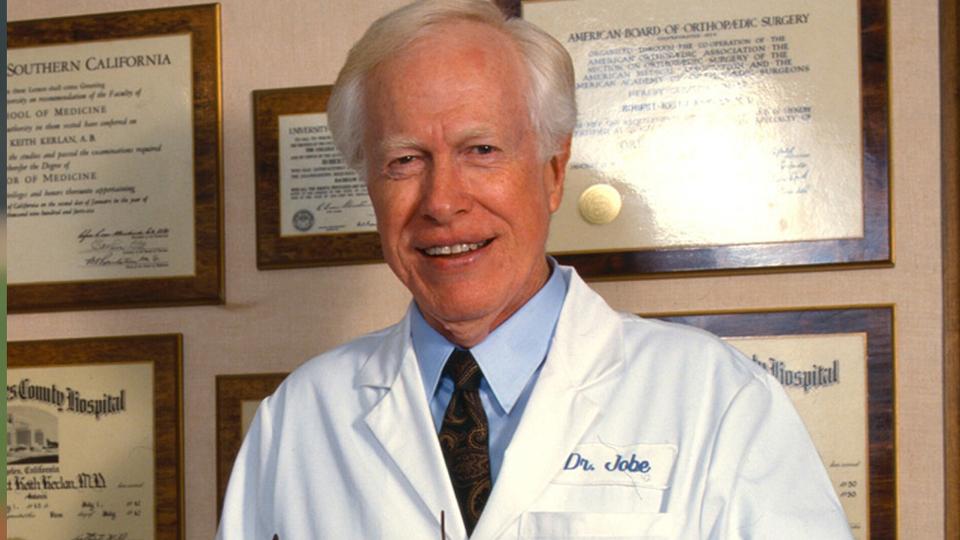
Dr. Frank Jobe
Jobe gave the operation 100-1 odds of being successful, but John had it anyway, as his other option was to start working at a friend's car dealership back in Terre Haute.
Traditionally, a pitcher misses an entire season in rehabilitation from the surgery. Some come back from it well, some don't. Some end up needing a 2nd TJS. The fact that John, the 1st pitcher to undergo the procedure, came back so well from it gave other pitchers hope.
A year and a half later, on April 16, 1976, John returned to the mound. He didn’t pitch well, losing to the Atlanta Braves, 3-1 at Atlanta-Fulton County Stadium. But he pitched without pain. Switching from his former blazing fastball and hard curveball to a sinker, in 22 games, all starts, he went 10-10 with a 3.09 ERA.
In 1977, he went 20-7, his 1st 20-win season, and had a 2.78 ERA. The Dodgers won the Pennant, and he started Game 3 of the World Series, but lost it to the Yankees and Mike Torrez. In 1978, he went 17-10 with a 3.30 ERA. The Dodgers won the Pennant again, and he started and won Game 1 of the World Series against the Yankees. He also started Game 4, and pitched well, but was not involved in the decision, as the Yankees won in 10 innings.
Yankee owner George Steinbrenner must have liked what he saw: His contract with the Dodgers having run out, on November 21, 1978, the Yankees signed John to a 3-year contract worth $1.4 million. He was never better than when he was a 36- and a 37-year-old Yankee: He went 21-9 with a 2.96 ERA in 1979, and 22-9, including winning his 1st 7 decisions, and a 3.43 ERA in 1980. That year, he finished 2nd int he AL Cy Young Award voting to Steve Stone, who won 25 games for the Baltimore Orioles.

In the strike-shortened 1981 season, he went 9-8, 2.63. The Yankees won the Pennant, and he pitched 7 innings of 3-hit shutout ball against the Dodgers to win Game 2 of the World Series. The Yankees were 2 wins away from getting him his World Series ring.
But the Dodgers won the next 3 games. After 4 innings of Game 6, and the score 1-1, Yankee manager Bob Lemon screwed up, sending Bobby Murcer, another man who was closer than ever to a ring than at any time in a long career, up to pinch-hit for John. He flew out. Lemon then sent George Frazier in to relieve for John, and he allowed 3 runs in the 5th. The Yankees lost, 9-2, and John had now been in 3 World Series, all of them Yankees vs. Dodgers, and on the losing side of all 3.
Steinbrenner began to break up the dynasty. This included a trade on August 31, 1982: He sent John to the California Angels for pitcher Dennis Rasmussen. He did well for the Yankees, but they got rid of him too soon, so this wasn't a bad trade for them.
Like Steinbrenner, Gene Autry, the legendary entertainer known as "The Singing Cowboy" and the owner of the Angels, was willing to spend big money if he thought it would get him big results. The 1982 Angels' pitching staff included such veteran stars as John, Luis Tiant, Stan Bahnsen (all former Yankees), Bruce Kison, Steve Renko, Andy Hassler, Ken Forsch, Dave Goltz and John Curtis. Their veteran hitters included former Yankee Reggie Jackson, perennial AL batting Champion Rod Carew, Fred Lynn, Don Baylor (all former AL MVPs), Bob Boone (Aaron' father), Rick Burleson, Doug DeCinces, Juan Beníquez and Brian Downing.
It almost worked: The Angels won the AL Western Division title, and led the AL Championship Series 2 games to none. But the Milwaukee Brewers won the next 3 games to take the Pennant.
John never came so close to a Pennant again. The Angels released him in midseason in 1985, and he signed with the Oakland Athletics. They released him after the season. He was 42 years old, and that year off was 10 years back. It looked like he was done.
But injuries to their starting pitchers led the Yankees to bring John back on May 2, 1986. He made 13 appearances, including 10 starts, and went 5-3 with a 2.93 ERA. In 1987, he made 33 starts, and went 13-6, although his ERA rose to 4.03. In 1988, he turned 45, and was the oldest player in baseball, though that elbow ligament was only 14 years old. He 35 appearances, including 32 starts, and went 9-8 with a 4.49 ERA.
In 1989, he made 10 appearances, all starts, and went 2-7 with a 5.80 ERA. On May 30, 5 days after his last appearance, and 8 days after his 46th birthday, the Yankees released Tommy John.
*
When he began his career, John F. Kennedy was President, and had just spoken at the two-year-old Berlin Wall. There were 20 teams in Major League Baseball, 9 of them playing in ballparks that opened in 1912 or earlier, and none of them playing on artificial turf or under a dome. Stan Musial was still playing, and Casey Stengel was still managing. Tom Seaver was in college, Reggie Jackson and Mike Schmidt were in high school, and Barry Bonds and Mark McGwire were about to be born.
When he ended his career, George H.W. Bush was President, and the Berlin Wall was 5 months away from coming down. There were 26 teams in Major League Baseball, 3 of them playing in ballparks that opened in 1912 or earlier, 10 of them playing on artificial turf, and 4 of them playing under a dome. Ken Griffey Jr., Sammy Sosa, Larry Walker and Jim Abbott were rookies. Derek Jeter was in high school, David Ortiz was in junior high; and Giancarlo Stanton, George Springer and Freddie Freeman were born.
Does Tommy John belong in the Baseball Hall of Fame? He won 288 games, and lost 231, for a winning percentage of .555. Indeed, he won more games after his surgery, 164, than he did before it, 124. Or, as John himself has put it, he won just 1 fewer game after his surgery than Sandy Koufax did in his entire injury-shortened career. (Given the nature of his condition, John's surgery, had it been available in Koufax's time, would have done him no good.) He also made more All-Star Games after, 3, than before, 1. His career ERA was 3.34, his ERA+ was 111, he pitched 46 shutouts, he had 2,245 strikeouts, and his WHIP was 1.283.
Here is a list of all the pitchers who match or surpass him in wins, winning percentage, shutouts and strikeouts, in chronological order: Cy Young, Christy Mathewson, Eddie Plank, Walter Johnson, Warren Spahn, Steve Carlton, Tom Seaver and Roger Clemens. That's it, that's the list: 8 guys. And only 4 of them pitched all or most of their careers in the post-1920 Lively Ball Era: Spahn, Carlton, Seaver and Clemens.
Baseball-Reference.com, a website that makes writing this blog far easier, has a Hall of Fame Monitor, on which a "Likely HOFer" is at 100, John is at 112, suggesting that he should be in. It also has a Hall of Fame Standards, on which the "Average HOFer" is at 50; John is at 44, suggesting that he falls short.
It also has Similarity Scores, usually comparing players of similar positions. John's Top 10 most statistically similar pitchers are Jim Kaat, Robin Roberts, Bert Blyleven, Fergie Jenkins, Early Wynn, Tom Glavine, Burleigh Grimes, Tony Mullane, Don Sutton and Eppa Rixey. Mullane is the only one of these who is not in the Hall of Fame.
While he was eligible for election by the Baseball Writers Assocation of America, which votes on recently retired players, from 1995 to 2009, T.J. never received as much as 32 percent of the vote. He has been eligible for the Veterans Committee's Modern Era Subcommittee in 2020, and its Classic Era Subcommittee in 2025, but fell short both times.
In my opinion, he should be in the Hall of Fame, not just for the historical significance of the surgery that bears his name and has saved many other careers after his, but on merit. Essentially, he had two good careers that added up to one great career.
*
In 2012, Lindsey Berra, Yogi's granddaughter, who works for ESPN, pointed out that 1 out of every 7 pitchers then in the major leagues had undergone Tommy John surgery at some point in their careers.
Like basketball star Bill Walton, John overcame his stutter and became a broadcaster in his sport, calling games for the Minnesota Twins from 1994 to 1996, the International League's Charlotte Knights in 1997, and the Yankees in 1998.
That year, he participated in the Yankees' Old-Timers Day festivities at Yankee Stadium. I was at that game, as they celebrated the 20th Anniversary of the 1977 and 1978 World Series, inviting several former Yankees and former Dodgers. In the Old-Timers Game between the former Yankees and the former Dodgers, John pitched for the Dodgers, and gave up a walkoff home run to Willie Randolph. At the age of 55, he still wasn't ending up on the winning side of Yankee-Dodger festivities.
He was hired as the pitching coach at Furman University in Greenville, South Carolina. In the 2002 and 2003 seasons, he coached in the Montreal Expos' organization. In 2004 and 2005, he returned to the Pinstripe organization, as the manager of the Class A Staten Island Yankees. He managed the Connecticut-based Bridgeport Bluefish of the independent Atlantic League from the start of the 2007 season to mid-2009, resigning to go into business, including advertising a joint cream. He had no connection to the Tommy John underwear company.

Tommy John and Mariano Rivera,
a few Old-Timers Days ago
John married twice, and had 4 children, all of them with names beginning with T, and 2 of them touched by tragedy. In 1981, his 2-year-old son Travis fell nearly 40 feet from a 3rd-story window of the family's rented house in New Jersey, and lapsed into a coma for nearly 3 weeks. He underwent successful treatment, and returned home to walk and play normally. Steinbrenner invited him to throw out the ceremonial first ball before Game 2 of the 1981 World Series.
Taylor John wasn't son lucky: He dealt with depression, and in 2010, he took his prescription drugs in the wrong combination, and died from an overdose. He was 28 years old. "He was the greatest kid in the world, but he would get into these panic spells and deep abysses," his father said. "He was wired different than the rest of us."
Daughter Tamara went to Duke University, where she met her husband, Patrick Mannelly, who went on to play for the Chicago Bears. Son Tommy John III pitched for his father at Furman, named All-Southern Conference. It shouldn't surprise anyone to know that one of Tommy John's children went into medicine: Tommy III became a chiropractor, and wrote Minimize Injury, Maximize Performance: A Sports Parent's Survival Guide, which discusses the injury risk associated with young athletes specializing in one specific sport and suggests ways to prevent youth from ever having to undergo major sports-related surgery, such as Tommy John surgery.
Tommy John and his 3rd wife, Cheryl Zeldin, settled in Bradenton, Florida, in the Tampa Bay area. He fell victim to bladder cancer, and died yesterday, on August 15, 2026, at the age of 83.
In 1987, in his 2nd tenure with the Bronx Bombers, he was one of the people interviewed for the documentary New York Yankees: The Movie. So were Yankee legends Mickey Mantle, Yogi Berra, Phil Rizzuto and Whitey Ford. Clips of interviews of Babe Ruth, Lou Gehrig, and the then-still-living Joe DiMaggio and the still-living-now Reggie Jackson were included.
With John's death, there are only 8 survivors among the interviewees: Bobby Richardson, and John's former teammates Roy White, Lou Piniella, Ron Guidry, Willie Randolph, Dave Righetti, Dave Winfield and Don Mattingly.


No comments:
Post a Comment