Monday, July 12, 2021

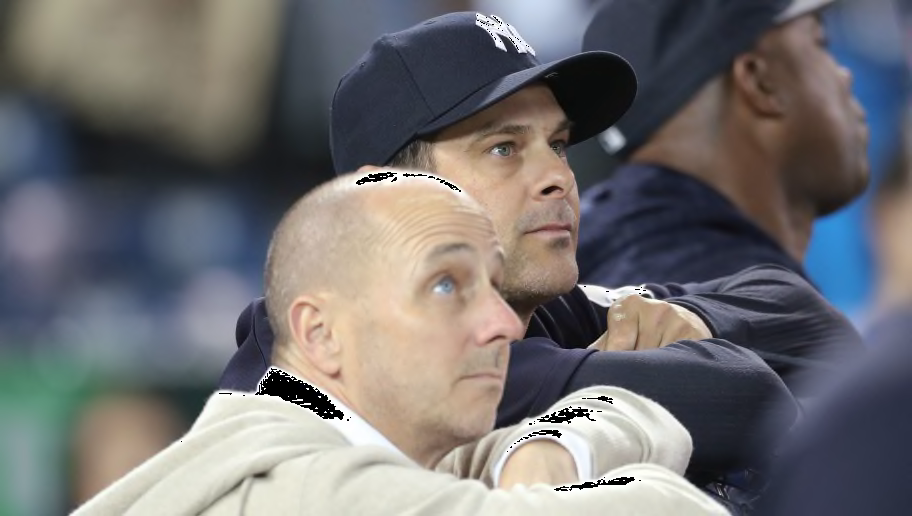
A Hell of a Way to Go Into the All-Star Break

That's a hell of a way to go into the All Star Break. Yesterday, the Yankees and the Mets each had a 5-run lead in their respective games, and both blew it.

The Mets blew  5-0 1st inning lead at home, to the Pittsburgh Pirates, with the 3rd-worst record in baseball. But it was piece-by-piece, not all at once. The way the Yankees blew it was worse.

The Yankees went down to Minute Maid Park and shut out the cheating Houston Astros twice, and they and their fans were feeling pretty good about themselves. Jameson Taillon was the scheduled starter for the series finale, but he had pitched well in his last 2 outings, so there was some reason for confidence.

Taillon pitched well again, going 6 innings, allowing 2 runs on 3 his and 2 walks. And he got plenty of support. Walks to Gary Sanchez and Luke Voit, and Gleyber Torres ground ball that resulted in an error, got them an unearned run in the 3rd inning. Tim Locastro hit a home run to lead off the 4th. Torres singled home a run in the 5th. Gio Urshela singled home a run in the 7th. And walks to DJ LeMahieu and Aaron Judge set up a Sanchez homer in the 8th. That made it 7-2 Yankees.

As Sanchez approached home plate, he mimed keeping his jersey close, mocking Jose Altuve for the home run he cheated to hit that gave the Astros the 2019 American League Pennant over the Yankees. He got seriously booed by the Astro fans, but they can't handle the truth.

Domingo German pitched a perfect 7th and a scoreless 8th. Being a starting pitcher, there was reason to believe he could finish the game. But he couldn't: He allowed an infield single to Yuri Gurriel, and a double to Kyle Tucker, who had homered off Taillon.

Aaron Boone took him out, which was the right thing to do. What was not the right thing to do was bring in Chad Green. He has been seriously inconsistent this season: Either very good, or very bad. This time, he was very bad.

This would have been the right time to bring in Aroldis Chapman, to see if he could break his Minute Maid Park jinx. But Boone didn't trust him. And Jonathan Loaisiga wasn't available, being on the COVID exposure list. And Zack Britton wasn't available, being on the Injured List. So he went with Green.

Green gave up a double to Chas McCormick. 7-4. He gave up a double to Abraham Toro. 7-5. He gave up a single to Jason Castro. He got Martin Maldonado to line out to Torres.

The batter was Altuve. Because of course it was. Boom. Astros 8, Yankees 7. WP: Ralph Garza (1-2). No save. LP: Green (3-5).

So all the good feeling over the 1st 2 games of the series was wiped out in the space of 7 batters.

*

The Yankees go into the All-Star Break 46-43, a winning percentage of .517, a pace for 84-78. That will not be good enough to make the Playoffs. They are 8 games, 7 in the loss column, behind the Boston Red Sox in the AL Eastern Division. They are 4 1/2 games, 3 in the loss column, out of the AL's 2nd Wild Card berth.

This is unacceptable. And the trading deadline is 18 days away.

The Mets go into the Break in 1st place in the National League Eastern Division, by 3 1/2 games over the Philadelphia Phillies. But their 47-40 record is only 1 1/2 better than that of the Yankees, and would be 7 games behind the Red Sox. And you can't say, "Gimme a break, look at the injuries the Mets have to their rotation!" The injuries the Yankees have had to theirs are worse.

The All-Star Game will be held tomorrow night, at Coors Field in Denver, home of the Colorado Rockies. It previously hosted the game in 1998. From the Yankees, Aaron Judge will start in right field, and Gerrit Cole and Aroldis Chapman will be on the pitching staff. The Mets will be represented by pitchers Jacob deGrom and Tajuan Walker.

We knew it was going to be a long season. And even though, in terms of where the All-Star Break fell in the 162-game process, the 1st half was longer than the 2nd half will be, the 2nd half may end up feeling longer.

Sunday, July 11, 2021

Cole Shuts Out Astros, Shuts Down the Debate

Who is the best pitcher in baseball? That's easy. It's Gerrit Cole.

You say it's Jacob deGrom? You're an idiot. deGrom could never do what Cole did last night.

The Yankee bullpen was already weakened by an injury to Zack Britton, and by the incomprehensible slump of Aroldis Chapman. It was further weakened by Jonathan Loaisiga having been transferred to the COVID list (apparently, he'd been exposed), and by Chad Green having pitched 2 innings the night before, making his entry into this game inadvisable.

So the Yankees were going to need Cole, himself in something of a slump, to go long. And they were going to need to score for him.

They did -- barely. They wasted a leadoff walk by Giancarlo Stanton and a 1-out single by Gio Urshela in the 2nd inning. Aaron Judge hit a home run off Zack Greinke in the top of the 3rd, and the few Yankee Fans in attendance, remembering how Jose Altuve, in the Astros' tainted World Championship year of 2017, was given the  American League's Most Valuable Player award despite Judge having the better stats (normally, the right decision), chanted, "MVP! MVP! MVP!"

But the Yankees wasted a 1-out Gleyber Torres double in the 4th, a leadoff walk by Kyle Higashioka in the 5th, a leadoff single by Luke Voit in the 6th, a leadoff single by DJ LeMahieu and a 1-out walk by Voit in the 8th, and a 2-out single by Brett Gardner in the 9th. So, if not for Judge's homer, Cole might have pitched one of the best games of the season, for naught.

Cole got through the 1st 3 innings without allowing a baserunner. He walked Altuve and Michael Brantley to start in the 4th, but got a double play to get out of it. Abraham Toro broke up the no-hitter with 1 out in the 5th, but Cole got out of it. Yuli Gurriel lead off the 7th with a single, but Cole got out of that, too. Boone sent him out for the 8th, and he got the Astros out 1-2-3. He had allowed only 4 baserunners: 2 hits and 2 walks, and was still throwing as high as 99 miles per hour.

David Cone's 147-pitch job in Game 5 of the 1995 American League Division Series, caused by then-manager Buck Showalter being unwilling to bring in Mariano Rivera (to be fair, no one yet knew what he could do), so terribly scarred general manager Brian Cashman that he made pitch limits sacred.

Among the results: Taking out pitchers who are cruising, and blowing the games for them; over-reliance on lefty pitchers to pitch to 1 batter, and then it not working, most notable in the form of Boone Logan; and babying young pitchers, and ruining them, most notably Joba Chamberlain. (Remember "The Joba Rules"?)

So the idea that Cole would take the mound for the 9th inning after having thrown 112 pitches must have sent a chill down Cashman's spine.

But Boone's options were limited: Leave Cole in, bring in the unreliable Luis Cessa, or bring Aroldis Chapman back into what became a house of horrors for him in 2019. And whoever he sent out for the 9th, the 1st batter was going to be Altuve, who hit the Pennant-winning homer off Chapman, and then begged his teammates not to rip off his shirt and show the wire he used to cheat.

Boone chose to leave Cole in for the bottom of the 9th. And Altuve singled on his 1st pitch. Now, the tying run was on, and the winning run was at the plate. Boone left Cole in.

Brantley kept fouling off pitch after pitch, causing Cole to expend himself further. Finally, Cole got Brantley to fly to center. 1 out. Still, Boone left him in. He struck Gurriel out on a 99-MPH fastball. 2 out.

But 126 pitches. Boone came out to take Cole out. But when he got to the mound, according to Cole in the postgame press conference, there were a few "George Carlin words" exchanged -- whether in anger or in desperation, Cole did not elaborate -- and Boone walked back to the dugout, letting Cole face Yordan Alvarez.

He threw Alvarez 3 pitches. All 99 MPH. All over the plate. Alvarez let the 1st one go. He missed the 2nd. He missed the 3rd.

Ballgame over. 129 pitches, no runs, 3 hits, 2 walks, in a bandbox stadium, against an American League team known to be cheaters. Gerrit Cole pitched the best game of the year, and I write this knowing that there have been no-hitters this season, including by one of his teammates. Nobody else -- not even deGrom -- has done this.

Yankees 1, Astros 0. WP: Cole (9-4). No save, although, if there was ever a game where a pitcher should be credited with both a win and a save, this is it. LP: Greinke (8-3).

The series, and the official 1st half of the regular season, concludes this afternoon. Jameson Taillon starts against Framber Valdez. It doesn't sound like a good setup for the Yankees, but then, Taillon was very good in his last start. And whatever happens in this game, the Yankees have taken at least 2 out of 3 in Houston, which should, at least, send the Astros the message that we're not fooling around with them anymore.

If only the Yankees could send similar messages to the Boston Red Sox (whom they trail in the AL Eastern Division by 8 games, 7 in the loss column) and the Tampa Bay Rays (whom they also trail). But all you can do is beat the team in front of you.

The Yankees will have to do a lot more of that in the 2nd half to make the Playoffs, and bring their fans the title they have waited 12 years for.

Saturday, July 10, 2021

Cortes Gives Houston a Problem, Yanks Beat Asterisks

The Yankees went on a 3-game winning streak, but a toothless performance in the last game of their series in Seattle was all too familiar, and didn't raise fans' hopes as the team headed into Minute Maid Park to face the cheating Houston Astros, a.k.a. the Asterisks.

I don't think anybody expected last night's game to be nearly a complete reversal of the one before.

After all, the starting pitcher was Nestor Cortes, one of the guys we're counting on to fill the holes left in the rotation by the injuries to Corey Kluber and Luis Severino.

But Houston had a problem. Cortes -- the man, the myth, the mustache -- did the business. He shut the Astros down 1-2-3 in the 1st inning. He allowed a double by Kyle Tucker in the 2nd, but stranded him. He walked Robel Garcia in the 3rd, but stranded him. He allowed a single by Yordan Alvarez in the 4th, but stranded him. In their own half of the 4th, the Yankees got singles from Gleyber Torres and Gio Urshela, and a double from Brett Gardner, and Cortes was staked to a 2-0 lead.

Cortes started the bottom of the 5th by striking out Abraham Toro. He got Jason Castro to ground out. But he walked Garcia. Cortes is normally a reliever, had thrown 74 pitches, and the dangerous (even when he's not cheating) Jose Altuve was due up next.

Aaron Boone may have panicked, especially since the reliever he chose was Lucas Luetge, who, like Cortes, is a lefthander, and Altuve bats righthanded. In the end, though, it worked: Luetge struck the dirty little cheating bastard out, and keep the lead in the Bronx Bombers' hands. If we get on Boone for decisions that don't work out, we need to credit him for decisions that do, even if they don't seem to make much sense at the time.

Luetge pitched a perfect 6th. With 1 out in the top of the 7th, Gardner drew a walk, Tyler Wade doubled, and DJ LeMahieu doubled them home to make it 4-0. That iced it. Chad Green allowed a double to Kyle Tucker in the bottom of the 7th, but stranded him, then pitched a perfect 8th.

With a 4-run lead, the bottom of the 9th was not a save situation. But Boone gambled that it might not be a good idea to put a struggling Aroldis Chapman back on the mound where he'd surrendered the home run to Altuve that won * the 2019 American League Pennant for the Astros. Jonathan Loaisiga justified that gamble, by getting the 1st 2 outs, and then doing what Chapman prefers to do: Getting the last out on a 100-mile-an-hour 3rd strike, to Alvarez.

Yankees 4, Astros 0. WP: Luetge (3-1, since Cortes fell 1 out short of qualifying for the win). No save. LP: Jake Odorizzi (3-4). The Astros got only 5 baserunners: 3 hits and 2 walks, and only twice did they get a runner to 2nd base, never to 3rd. If Kluber's no-hitter earlier in the season was the Yankees' best pitching performance of the season so far, this may have been the most important one.

The series continues tonight. Gerrit Cole starts against Zack Greinke. If Cole has his good stuff, this could be an epic pitching duel. As we have seen, that may be a bigger "if" than we've hoped.

Friday, July 9, 2021

July 9, 1896: The Cross of Gold Speech

July 9, 1896, 125 years ago: William Jennings Bryan delivers the "Cross of Gold Speech." It becomes a landmark in the history of American politics.

The Coinage Act of 1873 eliminated the standard silver dollar from American money, and was one of the causes of the Panic of 1873, leading to the worst depression the country had yet seen, lasting 5 years. In 1890, the Sherman Silver Purchase Act led to the Panic of 1893, causing an even deeper depression, which in turn caused great labor strife as it bottomed out in 1894. As 1896, and that year's Presidential election, dawned, the depression was still going.

Some politicians suggested that coining silver in a ratio of 16 to 1 -- 16 silver coins for every 1 gold coin -- would put money back in the pockets of the poor and the middle class. (Note the time of day on this post: 12:44, or 16 to 1.) There was just one problem: America did not have a liberal party at the time. The Democratic Party had grown conservative following the Presidency of Andrew Jackson that ended in 1837. And the Republican Party had grown conservative when they saw how much money was being made in railroads, mines and munitions as a result of the Union effort in the American Civil War.

There were minor parties with liberal pretentions, including the Populist Party. In 1892, their candidate for President, James B. Weaver, had won 5 States with 22 Electoral Votes, all in the West: Kansas, Colorado, Nevada, Idaho and North Dakota.

As so often happens when a third party makes some inroads, one of the two major parties takes on its ideas. This time, it was the Democrats, particularly in the urban Northeast and the rural West, who liked the idea of "free silver" and "bimetallism" (coining money in both gold and silver).

And one of their leaders was William Jennings Bryan, age 36, just barely old enough according to the Constitution to serve as President of the United States. He had been elected to the House of Representatives from a seat in Nebraska in 1890 and re-elected in 1892. But with the Democrats holding the White House through President Grover Cleveland, they were blamed for the depression (which they hadn't caused: "Sherman" was Senator John Sherman of Ohio, a Republican, and the brother of Civil War General William Tecumseh Sherman), and they took the biggest loss in terms of numbers in Congressional history in 1894.

Bryan was one of the Congressmen who lost his seat. But with a strong voice, necessary in those days before sound recordings and microphones became common, the man known as the Boy Orator of the Platte remained one of the Democrats' most sought-after speakers. And he was named as a Delegate to the 1896 Democratic National Convention, at the Chicago Coliseum.

President Cleveland and the aforementioned President Jackson are the only men to win the popular vote in 3 Presidential elections. Jackson finished 1st in both the popular vote and the Electoral Vote in 1824, but didn't get a majority of the Electoral Vote, and ended up losing to John Quincy Adams. He then definitively defeated Adams in 1828, and was re-elected in 1832.

Cleveland ran 3 times, and never got a majority of the popular vote, but got a plurality all 3 times. He got a majority of the Electoral Vote in 1884, finished 2nd to Benjamin Harrison in 1888, and regained the Presidency (the only ex-President ever to do so) by beating Harrison in 1892.

No President had ever served 3 terms. Cleveland believed he could get the Democratic nomination in 1896, but not that he could win the general election. While it wouldn't have been 3 consecutive terms, many people would have held his bid for a 3rd term, as well as his handling of the economy, against him. So he didn't run.

At the time, winning the Democratic nomination took a 2/3rds vote of the Convention delegates, meaning that "the Solid South" had a virtual veto on any candidate. So any candidate who didn't pander to Southern wishes on agriculture (must support it) and civil rights (must oppose it) had no chance. This rule wouldn't be changed for 40 years.

But the South did favor free silver. It was the Northeast, where most of the country's money was, that wanted to maintain the total gold standard. On July 9, the Convention's 3rd day, Senator William Vilas of Wisconsin gave a speech supporting the gold standard and defending President Cleveland, in the hopes of gaining the support of Cleveland's allies, and maybe of Cleveland himself, who was not in attendance. (That was normal for the time: Men wanted to be seen as being asked to be President, rather than asking for it themselves, so no candidate, not even a President running for re-election, attended a Convention.)

Vilas' speech was well-received. The next one was not: William E. Russell, a former Governor of Massachusetts, also spoke in favor of gold, but was ill, and couldn't make himself heard across the Coliseum hall. Just 7 days later, only 39 years old, he was dead from a bad heart. (A foreshadowing of what would happen to the much-older Bryan himself after the "Scopes Monkey Trial.")

Bryan followed him to the podium, and waited for the applause to fade. He said, "I would be presumptuous, indeed, to present myself against the distinguished gentlemen to whom you have listened if this were a mere measuring of abilities. But this is not a contest between persons. The humblest citizen in all the land, when clad in the armor of a righteous cause, is stronger than all the hosts of error. I come to speak to you in defense of a cause as holy as the cause of liberty: The cause of humanity."

He spoke for 35 minutes -- hardly unusual for a Convention speech, then or now. He challenged the notion that the gold standard was good for "businessmen." He put common laborers in the class of "businessmen":

The attorney in a country town is as much a businessman as the corporation counsel in a great metropolis. The merchant at the cross-roads store is as much a businessman as the merchant of New York. The farmer who goes forth in the morning and toils all day, who begins in Spring and toils all Summer, and who by the application of brain and muscle to the natural resources of the country creates wealth, is as much a businessman as the man who goes upon the Board of Trade and bets upon the price of grain.

The miners who go down a thousand feet into the earth, or climb two thousand feet upon the cliffs, and bring forth from their hiding places the precious metals to be poured into the channels of trade are as much businessmen as the few financial magnates who, in a back room, corner the money of the world. 

Bryan thus managed to link two previously separate wings of the Democratic Party together: The urban Northeast and Midwest, largely Catholic, made up of immigrants or the children of immigrants; and the rural South and West, struggling farmers. He united them as underdogs, making the Democratic Party the party of the underdog for the 1st time since the days of Old Hickory himself, Andrew Jackson. 

Moreover, in pointing out that their requests to the establishment had fallen on deaf ears, he invoked the Declaration of Independence, written by the man who would later found the Democratic Party, Thomas Jefferson:

It is for these that we speak. We do not come as aggressors. Our war is not a war of conquest. We are fighting in the defense of our homes, our families, and posterity. We have petitioned, and our petitions have been scorned. We have entreated, and our entreaties have been disregarded. We have begged, and they have mocked when our calamity came.

We beg no longer. We entreat no more. We petition no more. We defy them!

Not since Jackson had a Democratic politician even tried to reach the people on this level. A fundamentalist Presbyterian, he closed with Biblical imagery:

Having behind us the producing masses of this nation and the world, supported by the commercial interests, the laboring interests, and the toilers everywhere, we will answer their demand for a gold standard by saying to them: "You shall not press down upon the brow of labor this crown of thorns; you shall not crucify mankind upon a cross of gold."

At the words "crown of thorns," he gestured as if he were placing such a crown on his head. At "cross of gold," he put his hands out, as if he, himself, were Christ on the Cross. As he lowered his hands, there was dead silence. He thought he had failed. He began to walk off the stage. Only then did the Delegates realize that the speech was over: They erupted in cheers, and launched a demonstration that lasted twice as long as the speech itself.

Two policemen rushed to Bryan to protect him. They need not have bothered: Delegates picked Bryan up, and paraded him around the hall as their new hero.

Still, the two-thirds rule made it impossible for such a hero to be nominated on the 1st ballot. On that ballot, 14 men got at least 1 Delegate. There were 2 with more than 100: Bryan had 137, but he trailed Richard P. Bland, with 235. Bland was a former Congressman from Missouri, who had also lost his seat in the 1894 wipeout. And he was also a silver man. So was former Governor Robert E. Pattison of Pennsylvania. (Pattison Avenue, location of the eventual South Philadelphia sports complex, was named for him.) It was clear that a silver man would win, but which one?

On the 2nd ballot, it became clear that only 6 men had a chance, but Bland and then Bryan still had the best chance. Both men gained on the 3rd ballot. But on the 4th, Bryan took the lead. Bland had peaked: On the 5th ballot, his support collapsed, nearly all of it going to Bryan, to the point where he had 2/3rds, and Pattison was now 2nd. Bryan was the nominee.

And Bryan did what had been considered unacceptable for a Presidential candidate to do before: He took his message to the people, doing his own campaigning instead of letting others do it for him, criss-crossing America and its 45 States (including the newly-admitted Utah) by train.

In contrast, the Republicans nominated the Governor of Ohio, William McKinley, dedicated to conservative principles, including the gold standard. He did it the other way around: He made the people come to him. Or, rather, his campaign manager, Ohio Republican Party boss Mark Hanna, did.

Remembering that a previous nominee from Ohio, Representative James Garfield, had received visitors to his home in the Cleveland suburbs during the 1880 campaign, and given speeches there, Hanna worked with the railroads (which supported Republicans, anyway) to hire special trains to bring tourists to Canton, and visit McKinley at his home. It became known as "the front porch campaign." (A 3rd Ohioan, Senator Warren Harding, would do it in 1920.)

McKinley seemed as sound as the money he was supporting. And Bryan's rhetoric scared as many as it thrilled. Cleveland refused to use whatever political capital he had left to support him. It was even rumored that he was one of the "Gold Democrats" who ended up voting for McKinley.

Then there was a dirty trick. In the inner cities, and in smaller factory, mill and mining towns, many workers were told by their bosses in the last week, "If Bryan wins on Tuesday, don't come in on Wednesday" -- not that they would be fired, but that the factory would have to close.

On Election Day, November 3, 1896, McKinley was elected the 25th President of the United States. He won 51 percent of the popular vote, and Bryan nearly 47. McKinley won 23 States to Bryan's 22. Those figures make the election sound close. But McKinley won bigger States than Bryan did, so he won the Electoral Vote 271-176.

The election was a turning point for the Democrats, as it made them a national pro-labor party for the 1st time in 60 years. But the benefits were long in coming, and Bryan wouldn't receive them. By 1900, the depression was over, as McKinley's policies worked. In the wake of the Spanish-American War, the Philippine Campaign and the Boxer Rebellion, anti-imperialism was the Democrats' issue, and Bryan was nominated on such a platform. McKinley rode the good economy to win by an even larger margin.

McKinley was assassinated in 1901, and his Vice President, Theodore Roosevelt, became President. He was a progressive Republican, and when he ran for a full term in 1904, the Democrats turned away from Bryan, and nominated a conservative, federal Judge Alton Parker. Roosevelt won by the biggest popular-vote landslide yet.

In 1908, Roosevelt refused to run for what would have amounted to a 3rd term, and his handpicked successor, Secretary of War William Howard Taft, was nominated. Bryan made a 3rd try, and the Taft people made campaign buttons that said, "Vote for Taft this time. You can vote for Bryan anytime." Taft won by the largest margin ever, except for Roosevelt's 4 years earlier. Bryan was falling further and further behind.

In 1912, Roosevelt was unhappy that Taft had proven to be a conservative, and ran to regain the office. This split the Republican Party, and would have seemed to be Bryan's big chance. But he neither ran nor threw his support behind anyone. Governor Woodrow Wilson of New Jersey, a progressive, won, and appointed Bryan his Secretary of State.

Wilson enacted many of the reforms Bryan wanted, but they split over foreign policy, and Bryan resigned in 1915. Wilson was re-elected in 1916. Bryan passed up the chance to run in 1920 and 1924, knowing that the tide had turned back to the Republicans, but he was preparing to run again in 1928. But he died in 1925, shortly after participating in "the Scopes Monkey Trial." He was 65 years old.

At least he had gone into a recording studio, in 1923, and put the Cross of Gold speech on a record, so that we can hear it today, if not the Delegates' demonstration that followed.

As a uniter of the urban Democrats and the rural Democrats, Bryan was a precursor to Democratic Presidents Wilson, Franklin Roosevelt, Harry Truman and Lyndon Johnson. But as a populist, he was also a precursor to leftists masquerading as Democrats, such as Eugene McCarthy in 1968, Ralph Nader in 2000, and Bernie Sanders in 2016. Those men failed to get the nomination, and their supporters spoiled things for both the Democrats and themselves, resulting in Republican wins.

In 1896, the populists got what they wanted, in Bryan -- and while they still lost, they did something that McCarthy and Nader failed to do, and Sanders has also, thus far, failed to do: Convince the mainstream of the party to join them.

Bryan gave the Cross of Gold speech at the 2nd of 3 buildings to bear the name of the Chicago Coliseum, on 63rd Street at Stony Island Avenue on the South Side. It didn't last long: It had opened only weeks before, and burned down the next year. The site is now part of Jackson Park.

I Don't Trust This Long Season

Going back to their founding in 1977, a trip west to face the Seattle Mariners has usually meant trouble for the Yankees. This time, with both teams struggling, it looked like such a visit was, Cliche Alert, just what the doctor ordered.

But the Yankees' recent slump was like organized crime, as described by Michael Corleone (Al Pacino) in The Godfather Part III (set in 1979, a bad year for the Yankees): "Just when I thought I was out, they pull me back in!"

The series began on Tuesday night at T-Mobile Park, formerly Safeco Field. Justus Sheffield, a former Yankee "prospect" that Brian Cashman was actually willing to admit wasn't going to work out, and trade away, starting for the M's, leading some people to think he was going to do what so many former Yankees, especially pitchers, do when we give up on them: Turn into, for this 1 game, the kind of player we'd hoped they would become.

Jameson Taillon, a weak link in the Yankees' starting rotation thus far, pitched his best game with the team, going 7 innings, allowing just 1 run on 4 hits and 1 walk, striking out 9. A performance like that deserved a lot of support, and he got it. Cliche Alert: The Yankees scored early and often. And Sheffield did not have the steel necessary to stop it.

The game began with a single by DJ LeMahieu, a flyout by Aaron Judge that was deep enough for DJLM to tag up and go to 2nd base, a walk by Gary Sanchez, and a home run by Giancarlo Stanton. In the 2nd inning, the Yankees loaded the bases, got a wild pitch, and got a 2-RBI single by Luke Voit. 6-0.

3rd inning: A walk by Rougned Odor, a single by Miguel Andujar, a popup by Tim Locastro, and RBI single by DJLM, and RBI double by Judge. 8-0 Yankees. They didn't score again in the 4th, but another Voit RBI single in the 5th made it 9-0.

Over the 1st 5 innings, the Yankees' scoreline was 33201. That ZIP Code is not in use. If it was, it would be in Miami.

In the 8th, the Yankees added a 3-run homer by Odor. Having an 11-run lead in the 8th is a good time to help a struggling reliever work the kinks out. Although he walked the leadoff man in the bottom of the 8th, Wandy Peralta got the next 3 men out.

Having an 11-run lead in the 9th is a good time to help a struggling reliever work the kinks out. But Aaron Boone did not leave Peralta in. Instead, he brought in the pitcher most in need of a strong outing, the closer who began the year so brilliantly, but has pitched horridly of late: Aroldis Chapman.

He put on the kind of performance that, had it happened earlier in the year, we would have said, "Well, at least he got the job done in the end. But, given his recent outings, this was worrying. He allowed a single, then got a strikeout. He walked a better, then got a strikeout. He delivered another walk to load the bases, bringing a lot of us to ask, "He can't blow an 11-run lead in a pitcher's park, can he?" And then he got another strikeout to end it.

He walked the bases loaded and struck out the side. This is where John Sterling might say to Suzyn Waldman, "You know, Suzyn, you just can't predict baseball." But with Aroldis Chapman, such an occurrence wouldn't be all that hard to predict.

At any rate, it was over: Yankees 12, Mariners 1. WP: Taillon (3-4). No save, not with an 11-run lead. LP: Sheffield (5-8).

*

The Wednesday night game would be less comfortable, on more than one level. Domingo German was supposed to start, but he had to undergo an emergency root canal. So that's 3 times in this turn of the rotation that the Yankees needed an unintended starter. In this case, it was Nick Nelson.

Back-to-back singles in the 1st by Voit and Gleyber Torres gave Nelson a 3-0 lead before he even took the mound, but he couldn't handle it. He started with a strikeout, but then hit a batter, walked the next, nearly allowed a game-tying home run that turned into a long flyout, walked a batter and allowed a run on a wild pitch at the same time, and walked another batter to load the bases.

Boone had seen enough, and brought in Luis Cessa. It seemed a good time to worry. It wasn't: Not only did Cessa get out of this jam, he pitched 3 more innings without allowing a runner past 1st base. It might have been his best performance as a Yankee. And he was rewarded in the 2nd inning with a double by Locastro and a homer by Judge.

With his anesthesia worn off, German was brought in to pitch the 5th. He got 2 strikeouts, then a flyout. So it remained 5-1 in the Yankees' favor into the 6th. But that inning began with an error by Gio Urshela, and that unsettled German, until he allowed a home run that made it 5-4.

But that would be the Mariners' last baserunner. German pitched a perfect 7th, Jonathan Loaisiga a perfect 8th, and Chad Green a perfect 9th. Yankees 5, Mariners 4. WP: Cessa (2-1). SV: Green (3). LP: Yusei Kikuchi (6-4).

*

So that was 3 games in a row that the Yankees, both at the plate and on the mound, had gotten the job done. Things were looking up. Little did anyone know that the Yankees' output in the 1st inning of Game 1 of the series would be greater than their entire output in Game 3.

Jordan Montgomery started the Thursday afternoon finale. He had an average game, getting into the 7th inning and allowing 3 runs. The Yankees should have been able to overcome that.

They didn't. Starting the 2nd inning, Stanton doubled, and Voit was hit by a pitch. And LeMahieu was hit by a pitch in the 9th -- which led to the exchanges of some words and dirty looks. Those were the only baserunneres of the game.

It was reminiscent of an exchange from the move Major League, where Bob Uecker plays Harry Doyle, a broadcaster for the Cleveland Indians, a character based less on his real-life persona and more on Harry Caray of the Chicago Cubs, and says, on the air, "That's all we got? One goddamned hit?" His broadcast partner covers the microphone, and says, "You can't say, 'goddamned' on the air." And Harry says, "That's okay, nobody's listening, anyway."

Peralta gave up a home run in the 8th to make the final score Mariners 4, Yankees 0. WP: Logan Gilbert (3-2). No save. LP: A hard-luck Montgomery (3-4).

*

So the Yankees are 44-42, 9 games (8 in the loss column) behind the Boston Red Sox in the American League Eastern Division, and 4 1/2 games out of the 2nd AL Wild Card slot. According to FanGraphs, the Yankees now have an 8 percent chance of winning the Division, and a 37 percent chance of making the Playoffs.

And now, we have to close out the official 1st half of the season, before the All-Star Break, by going to Houston to play the cheating Astros, who are currently tied with the Red Sox and the Los Angeles Baseball Team for the best record in the major leagues.

This could be a long weekend, especially if the weather predictions hold up, although that won't affect the Yankees, who will be playing under a dome. Throw in the Break, and it could be a long week.

It's already been a long season. In Bull Durham, Susan Sarandon's character, Annie Savoy, said, "It's a long season, and you've got to trust it." And we've heard many times, so I have to say, "Cliche Alert": A baseball season is a marathon, not a sprint.

The New York City Marathon has been canceled twice in the last 9 years.

The Yankees' championship parade has been canceled 11 years in a row. It looks like it will be 12. Because I don't trust Cashman, I don't trust Boone, I don't trust these players, and I don't trust this long season. Do you?

Tuesday, July 6, 2021

July 6, 1971: Louis Armstrong Dies

You might be cool, but you'll never be as cool as
Louis Armstrong on the phone, wearing pajamas and a Mets cap,
in his home recording studio.

July 6, 1971, 50 years ago: Louis Armstrong dies of a heart attack at his home in the Corona neighborhood of the Borough Queens, in New York City.

The all-time icon of jazz had been billed as being born in New Orleans, which was correct, on the 4th of July, 1900, which was not. It was later discovered that his actual date of birth was August 6, 1901, so he was not quite 70 when he died. He was buried at Flushing Cemetery in Queens.

Known as "Satchelmouth" for his big mouth, which was later shortened to "Satchmo" and "Satch," and "Pops" as he got older, Louis was a big sports fan. In the 1930s, he sponsored Negro League baseball teams. He had season tickets to the Yankees until Shea Stadium was built just a few blocks from his house, and so he switched to the Mets.

Billy Crystal remembered that, for his first live major league game, on May 30, 1956, his father had used his connections in the music business, and got Louis' seats at Yankee Stadium. The Yankees beat the Washington Senators, and Mickey Mantle hit a home run off the facade on the right field roof, less than 2 feet from going completely out of the Stadium.

And for some reason, unusual for black Americans in his time, Louis loved tennis. When the National Tennis Center was established in Flushing Meadow-Corona Park in 1978, the stadium known as the Singer Bowl, built for the 1964 World's Fair, was made its centerpiece, and it was renamed Louis Armstrong Stadium.
The original Louis Armstrong Stadium

When Arthur Ashe Stadium was built in 1997, it was decided to tear Armstrong Stadium down and build a new stadium with the name, to act as the U.S. Open's secondary facility. It opened in 2018, and seats 14,000 people.
The new Louis Armstrong Stadium

Angry over the lack of progress in New Orleans, Louis chose to keep his residence in New York. Nevertheless, on August 4, 2001, in honor of the Centennial of his birth, the city renamed its airport Louis Armstrong New Orleans International Airport.

Monday, July 5, 2021

Time to Declare Independence from Cashman and Boone

After their 9th inning disaster against the Los Angeles Angels on Wednesday night, The biggest thing the Yankees needed was what they got, a day off on Thursday, to calm down, regroup, collect their thoughts, see where they went wrong, and prepare adequately for their next series.

But the last thing they needed was a series against The Other Team. Unfortunately, that's what they got.

As so often happens when the Yankees play the Mets, there was a rainout, but that gave them an additional day, to think things through, and better prepare. It didn't work.

At 1st, it looked like this Saturday afternoon game wasn't going to be so bad. Jordan Montgomery and Tajuan Walker traded goose eggs for 4 innings. If you had told me before the game that the Yankees weren't going to allow any runs in the 1st 4 innings of this game, I would have gladly taken it, especially given their propensity this season for allowing runs in the 1st inning.

Then came the top of the 5th. Montgomery got the 1st out, then allowed 3 straight singles, and a run came home. Aaron Boone panicked, and took Montgomery out. Maybe that wasn't such a bad decision. What was a bad decision it was bringing in Lucas Luetge, the 2nd half of that 9th and a meltdown from Wednesday night. He allowed 2 more runs, and at 3-0, the game seemed over.

Boone brought Justin Wilson into pitch the 6th. He got nobody out: He allowed 3 straight singles, then a walk, then a double. Boone brought Michael King in, and, by comparison, he wasn't so bad, allowing just one more run.

Going into the bottom of the 6th inning, the Yankees had shown no hunger. Which makes sense, because the score was "ate nothing." And Walker was pitching a no-hitter. This was well on its way to becoming the greatest regular season game in Mets history. It could have been repeated as part of the series Mets Classics on SNY as soon as the postgame show was over.

With 1 out in the bottom of the 6th, Aaron Judge had a home run. It looked like it wouldn't matter at all. Giancarlo Stanton singled, Luke Voit was hit with a pitch, and Gleyber Torres walked to load the bases.  And Gio Urshela singled home 2 runs.

It was only 8-3, but now, there was a glimmer of hope. After all, one of the constants about the Mets over the years has been their lousy bullpen. Except that not materialize. Urshela's single would be the Yankee's last baserunner of the game. Mets 8, Yankees 3. WP: Walker (7-3). No save. LP: Montgomery (3-3).

It was the 81st game of the regular season, the exact midpoint. The Yankees were 41-40, 1 game over .500. Disgraceful.

*

So, due to the Friday rainout, Sunday was going to feature a separate-admission doubleheader. This inadvertently revived a baseball tradition: A doubleheader on the 4th of July. At least the Yankees had Gerrit Cole pitching the opener.

But things can always get worse. Three batters into the game, Cole gave up a home run to Dominic Smith. At 1-0 to the Flushing boys, the game already seemed lost.

Stanton led off the bottom of the 2nd with a single. Urshela reached on an error. Torres grounded into another. Brett Gardner was hit with a pitch. Then Kyle Higashioka doubled Stanton and Torres home. And the newly-acquired Tim Locastro hit a sacrifice fly to score Gardner. It was 3-1 Yankees, and there was hope. In the 3rd, Judge singled, Voit singled him over to 3rd, and a Stanton groundout got Judge home. It was 4-1 Yankees, and there was more hope.

Cliche Alert: Walks can kill you, especially the leadoff variety. Cole walked Michael Conforto to start the top of the 4th. Then he gave up a single to Jeff McNeill. Then he walked Billy McKinney to load the bases with nobody out. A single by Tomas Nido brought Conforto home. Cole struck out Luis Guillorme, but gave up a single to Brandon Nimmo that scored McNeil.

Then Boone panicked again. He brought in Jonathan Loaisiga, sooner than he usually comes in. He gave up a single to Francisco Lindor, scoring McKinney. It was 4-4.

With 1 out in the bottom of the 5th, LeMaheiu singled. Judge singled him over to 3rd. A wild pitch got LeMahieu home, and it was 5-4 Yankees. But Voit and Stanton both flew out, and that was a sign that the Yankees weren't going to score any more runs.

It was still 5-4 Yankees going to the top of the 7th, the last inning, since that's the new rule for doubleheaders. Boone brought Aroldis Chapman in to close. He badly needed to nail down the save, not just for the team, but for himself, as his last few games, especially his last, were atrocious.

He got a 1-2 count on Pete Alonso... and gave up a game-tying home run. Then he hit Conforto with a pitch, possibly intentionally. Then he walked McNeil, certainly not intentionally. Boone took him out, and we'll never know what percentage of the vociferous boos was for Chapman, and what percentage was for Boone.

Boone brought in Luetge. So it was a repeat performance of Wednesday against the Angels: Single, strikeout, double, single, single. Six runs in the inning. Naturally, the Yankees went down quietly in the bottom of the 9th.

Mets 10, Yankees 5. WP: Jeurys Familia (3-1). No save. LP: Aroldis Chapman (5-3).

The Yankees were now at .500, 41-41. The fact that this disaster was against the Mets was mostly irrelevant. The what mattered a lot more than the who.

*

So Nestor Cortes was sent out to salvage the series finale. Not usually a starter, but with the game being only 7 innings, it wouldn't have been a terrible thing if he could only go 4. And he did get into the 4th, before Boone took him out.

Voit led off the 2nd with a double. Rougned Odor bunted him over to 3rd, and beat it out. Looked like great "small ball" -- until Urshela hit a home run. That's what you gotta do: Get men on base, and then hit the home run. 3-0 Yankees.

Cortes allowed a Smith double with 1 out in the 4th, and Boone took him out, for Darren O'Day. O'Day gave up a home run to Alonso, making it 3-2. Cue Han Solo: "I've got a bad feeling about this!" Then O'Day walked the next 2 batters, and it looked like the rout was on. But he settled down, and got the next 2 out.

Chad Green pitched a 1-2-3 top of the 5th. With 1 out in the bottom of the 5th, Gardner and LeMahieu drew walks. Judge moved them over with a groundout. With Gary Sanchez up, Miguel Castro threw a wild pitch that got Gardner home. But Sanchez struck out to end the threat.

Fortunately, Green pitched a 1-2-3 6th, and struck out the side in the 7th. Finally. Yankees 4, Mets 2. WP: Green (3-4, he got the win because the starting pitcher didn't go 5 innings). No save. LP: Corey Oswalt (1-1).

*

So we've passed the halfway mark of the regular season, and we've passed the 4th of July. The Yankees are 42-41. They are 10 games behind the hated Boston Red Sox in the American League Eastern Division, 9 in the loss column. They are 5 1/2 games, 4 in the loss column, out of the 2nd AL Wild Card berth.

They have no ace: Ever since that crackdown on "Spider Tack," Cole has been good, but not great. Corey Kluber and Luis Severino are still injured. Montgomery and Domingo German have been inconsistent. Jameson Taillon has been a bust.

The bullpen is a mess: Ever since that crackdown on Spider Tack, Chapman has gone from absolutely unhittable to absolutely crushable. Luetge has also fallen apart. Loaisiga has been inconsistent. Zack Britton has been hurt. O'Day is awful. King is worse.

This team simply isn't hitting enough. It's making mistakes on the basepaths. There seems to be no sense of urgency.

And, as the late, great Yogi Berra would have said, It's getting late early out there.

And now, they fly to the Pacific Coast, where they have historically had trouble.

Explain to me why Aaron Boone and Brian Cashman still have jobs. Hal Steinbrenner should declare independence from them.t game ork Met