Wednesday, June 28, 2017

Phil Jackson Fired, Joe Girardi and Brian Cashman Still Have Jobs

This morning, Knicks executive chairman James Dolan fired team president Phil Jackson, finishing off, at least in terms of hype divided by competitiveness, the biggest fiasco in NBA history.

Hank and Hal Steinbrenner continue to keep Brian Cashman and Joe Girardi in jobs for which they continue to show an appalling lack of competence.

Unbelievable.

*

Me, yesterday:

Last night, the Yankees began a series against the Chicago White Sox, their 1st visit to the former new Comiskey Park since its name was changed from U.S. Cellular Field to Guaranteed Rate Field.

And it almost became one of those games that makes me say, "If the Yankees end up losing the American League East (or missing the Playoffs completely) by 1 game, I want you to remember this game."

Cliche Alert: Almost only counts in horseshoes. And hand grenades.

Last night, Joe Girardi made sure there would be no "almost."

Luis Severino started, and he pitched brilliantly: 7 innings, 6 hits, no walks, 12 strikeouts. The only run he allowed was on an RBI double by Yolmer Sanchez in the 3rd inning.

But the Yankee bats went cold, and as the 8th inning dawned, that 1 run made the difference: It was 1-0 to the South Siders.

Finally, with 1 out in the top of the 8th, the Yankees did something about it. New callup Tyler Wade drew a walk. Jacoby Ellsbury reached on an infield single. Chase Headley struck out, but Aaron Judge singled Wade home, and Gary Sanchez (no relation to Yolmer) almost hit one out, settling for a double that brought home Ellsbury and Judge. 3-1 Yankees.

That should have been the spark Severino needed to pitch the 8th inning, and nail down the win with help from Dellin Betances in the 9th -- or maybe finish the job himself.

But because Joe Girardi is an idiot who doesn't know how to manage a bullpen, and Severino had already thrown 105 pitches, he brought Domingo German in to start the bottom of the 8th.

Cliche Alert: Walks can kill you. And he pitched to 2 batters, and walked them both.

Girardi took him out, and brought in a reliever. But because Joe Girardi is an idiot who doesn't know how to manage a bullpen, he brought in Tyler Clippard.

Tyler Clippard.

Cliche Alert: Noooooooo!

And the batter was ex-Yankee Melky Cabrera. Because, of course it was.

Clippard wasted no time: He threw a wild pitch to move the runners over, and then walked Melky to load the bases with nobody out. As he does.

Clippard got a strikeout and a flyout, then walked home a run, then got another strikeout. We were very lucky to escape that jam with only 1 run.

You would hope that the 3rd strike would turn out to be the last pitch that Clippard ever throws in a Yankee uniform.

But because Brian Cashman is an idiot who doesn't know how to build a roster -- the 1996-2003 dynasty was the work of Gene Michael and Bob Watson, and the 2009 title was because Hank and Hal Steinbrenner chose to spend for what remains the only time -- Clippard will probably be back.

The Yankees got runners on 2nd and 3rd in the top of the 9th, but did not score. So we had a 1-run lead going to the bottom of the 9th. Right: Bring on the best closer in baseball, Aroldis Chapman, to finish it off. After all, as we've seen, Dellin Betances is no closer.

But because Joe Girardi is an idiot who doesn't know how to manage a bullpen, he brought Betances on instead.

Groundout. So far, so good. Then, walk. Then, another walk. Cliche Alert: Walks can kill you. Then, he hit a batter, to loaded the bases. Then, a pop foul. One more out. Then, a cheap single that brought home the tying and winning runs.

White Sox 4, Yankees 3. WP: Dan Jennings (3-1). No save. LP: Betances (3-2).

Another loss that can be directly blamed on Girardi's bullpen idiocy.

And, since the Boston Red Sox won last night, they now lead the Yankees by 1 game in the American League Eastern Division, although the teams are still level in the all-important loss column, 43-34 to 41-34, with the Yankees having 2 games in hand.

The series continues tonight, Masahiro Tanaka starts against Carlos Rodon.

*

This morning, Knicks executive chairman James Dolan fired team president Phil Jackson, finishing off, at least in terms of competitiveness multiplied by hype, the biggest fiasco in NBA history.

Hank and Hal Steinbrenner continue to keep Brian Cashman and Joe Girardi in jobs for which they continue to show an appalling lack of competence.

Unbelievable.

Frank Kush, 1929-2017

One of the toughest coaches who ever lived died last week. Some people loved him for being that tough. Not all people, though.

Frank Joseph Kush was born on January 20, 1929 -- the same week as Dr. Martin Luther King, comedian Arte Johnson, and hockey icon Jacques Plante -- in Windber, Pennsylvania, outside Pittsburgh. Like many people in Western Pennsylvania, he was of Polish descent, and I suspect that his father or grandfather shortened the family name from something like "Kuczynski" or something like that to "Kush."

He was recruited to Michigan State University as a defensive lineman by coach Clarence "Biggie" Munn, and was an All-American in 1952, helping the Spartans win the National Championship. But the Korean War was on, and it was the U.S. Army rather than an NFL team that drafted him.

It worked out well for him, as he rose to the rank of 1st Lieutenant, and coached the football team at Fort Benning in Georgia. Dan Devine, later to be the head coach at Notre Dame, was an assistant to Munn, remembered Kush, and in 1955 hired him as an assistant at Arizona State University in the Phoenix suburb of Tempe. When Devine was lured away by the University of Missouri in 1958, Kush, was promoted to head coach. He moved into what was then a brand-new facility, Sun Devil Stadium.

The Army didn't make Kush tough, it only intensified the toughness he already had. And he wanted players who were tough. In the Summer, in the punishing heat of the Arizona desert (Cliche alert: "But it's a dry heat"), he seemed to copy Bear Bryant's 1954 Texas A&M "Junction Boys" plan.

He had a drill he called Bull in the Ring. A player he felt needed "motivation" would be put in the middle of a circle of players. Kush would call out a uniform number, and the player wearing it would rush him, and the two would block each other until Kush blew his whistle. Whichever player gave the best effort would be promoted to the circle, and the one who didn't would be relegated to the middle. One of Kush's Sun Devils, future Pro Football Hall-of-Famer Curley Culp, remembered breaking a teammate's face mask in such a drill.

He would also have a center, a quarterback, and 2 running backs -- nobody else, no linemen to block, just those 4 kids, and they were kids, just 17 to 22 years of age -- run plays against an entire 11-man defense. He figured if they could take it without blockers, they could take it with blockers.

Kush held training camp at ASU-owned Camp Tontozona near Payson, over 100 miles northeast of campus in the Tonto National Forest. There was a steep hill there that got nicknamed Mount Kush. If Kush thought a player needed discipline, he would have him run up and down that hill repeatedly.

But it worked. In 1959, his 2nd season in charge, ASU won the Border Conference, a league that also included arch-rival the University of Arizona, Northern Arizona, New Mexico, New Mexico State, Texas Tech, Texas-El Paso, Hardin-Simmons University, and West Texas A&M. In 1961, he won the title again.

The Border Conference folded in 1962, opening the door for a new league, the Western Athletic Conference. Border Conference members ASU, Arizona and New Mexico became charter members, as did Utah, Brigham Young and Wyoming. (So many changes have been made that, while the WAC still exists, its senior current member, Northern Arizona, joined in 2004.) While Kush didn't win any of the WAC's 1st 7 titles, he kept ASU competitive.

In 1964, he recruited a running back from Cheltenham High School, just past the northern City Line of Philadelphia, giving him a scholarship. This young man would become Kush's most famous pupil. But he never played a down for Kush. How is that possible? Simple: Until 1972, NCAA rules prohibited freshman from playing varsity sports. And by the time this Sun Devil was a sophomore, an even more successful ASU coach, Bobby Winkles, had gotten him to switch to baseball. His name was Reggie Jackson.

In 1969, Kush was offered the head coaching job at the University of Pittsburgh. He accepted. Five days later, he changed his mind, and went back to Arizona State. It was a good move, as he set the Sun Devils on a path of winning 5 straight WAC titles (1969 to 1973), and 7 in 9 years (adding them in 1975 and 1977). It worked out for Pitt, though: They hired Johnny Majors, and won the National Championship in 1976.

In 1978, ASU and Arizona left the WAC, and joined the Pacific-8 Conference, turning the Pac-8 into the Pac-10. (It's now the Pac-12.) Kush went 176-54-1 at ASU, and was named national Coach of the Year in 1975, going 12-0 and ending the season ranked Number 2 in the nation, although the weak WAC schedule denied them the National Championship.

In addition to the 9 league titles, he won the 1970 Peach Bowl, and the 1st 3 Fiesta Bowls, all on home soil, in 1971, '72 and '73. In 1978, he took his team to the Meadowlands for the inaugural Garden State Bowl. Rutgers wasn't so lucky on "home" "soil," as Arizona State beat them.

Kush coached 3 future Pro Football Hall-of-Famers: The aforementioned Curley Culp, a great defensive tackle with the Kansas City Chiefs and the Houston Oilers; Charley Taylor, receiver for the Washington Redskins, once the NFL's all-time leader in receptions and receiving yards; and Mike Haynes, one of the top defensive backs of his generation, a cornerback who starred for the New England Patriots and the Oakland/Los Angeles Raiders.

He also coached Dallas Cowboys quarterback Danny White, and San Diego Chargers and Green Bay Packers receiver John Jefferson. And he was one of the 1st college football coaches to recruit players of Samoan ethnicity, recognizing their size, speed and toughness.

On October 13, 1979, Kush was fired -- 3 hours before a game with the University of Washington. The previous month, Kevin Rutledge, a former punter, sued the school, claiming physical and mental harassment, including Kush punching him in the mouth after a bad punt in the previous season's game with Washington. Kush was fired not for the allegations in the suit, but for interfering with the University's internal investigation of the allegations.

This was just 10 months after Ohio State fired Woody Hayes for punching an opposing player during the 1978 Gator Bowl (and that was 2 months after the incident that Rutledge said happened).

Word of the suit got out, and, mirroring the Penn State fans' ugly defense of Joe Paterno in 2011, the insurance office of Rutledge's father suffered a suspicious fire, and the family's lawyer received 2 death threats.

Kush was allowed to coach the game on the day he was fired, and with a rabid crowd cheering them on, ASU won 12-7. His players carried him off the field. He ended his last season 3-2 --  and things got worse, as the NCAA ruled that he had used ineligible players, and had to forfeit his 3 wins. Eventually, the University cleared him, and a jury ruled in his favor in the suit.

*

In 1981, Kush coached the Hamilton Tiger-Cats of the Canadian Football League, getting them to the Eastern Conference Championship Game. After the season, he was hired by the Baltimore Colts. They went 0-8-1 in the strike-shortened in 1982 season.

That earned them the top pick in the 1983 NFL Draft, and they chose Stanford quarterback John Elway. But Elway -- perhaps convinced by his father, Jack, himself a college football coach -- refused to play for Kush, and forced a trade to the Denver Broncos. That doomed the Colts to a few more years of mediocrity. They moved to Indianapolis in 1984, and Kush quit toward the end of that season. They made the Playoffs only once until 1995 (in 1987).

Kush returned to the ASU campus by coaching the Arizona Outlaws of the United States Football League in 1985, but the league folded after "winning" its antitrust suit against the NFL, never playing a 1986 season.

Kush never coached again. He remained in Arizona, serving as director of the Arizona Boys Ranch, a "Boys Town" type of facility for the reform of juvenile offenders.

In 1995, he was elected to the College Football Hall of Fame. The next year, a statue of him was dedicated outside Sun Devil Stadium, and the field inside was named Frank Kush Field. That night, ASU played Nebraska, then ranked Number 1 in America, and beat them 19-0. In 2000, ASU hired him as an assistant to the athletic director, essentially a fundraiser, at which he was rather successful, just by being Frank Kush.
He died this past Thursday, June 22, 2017, at the age of 88. His son Danny told the media that he'd been suffering from dementia. He was also survived by sons named David and Damian. He was predeceased by his wife, Frances.

UPDATE: He was buried at St. Francis Cemtery in Phoenix.

Tuesday, June 27, 2017

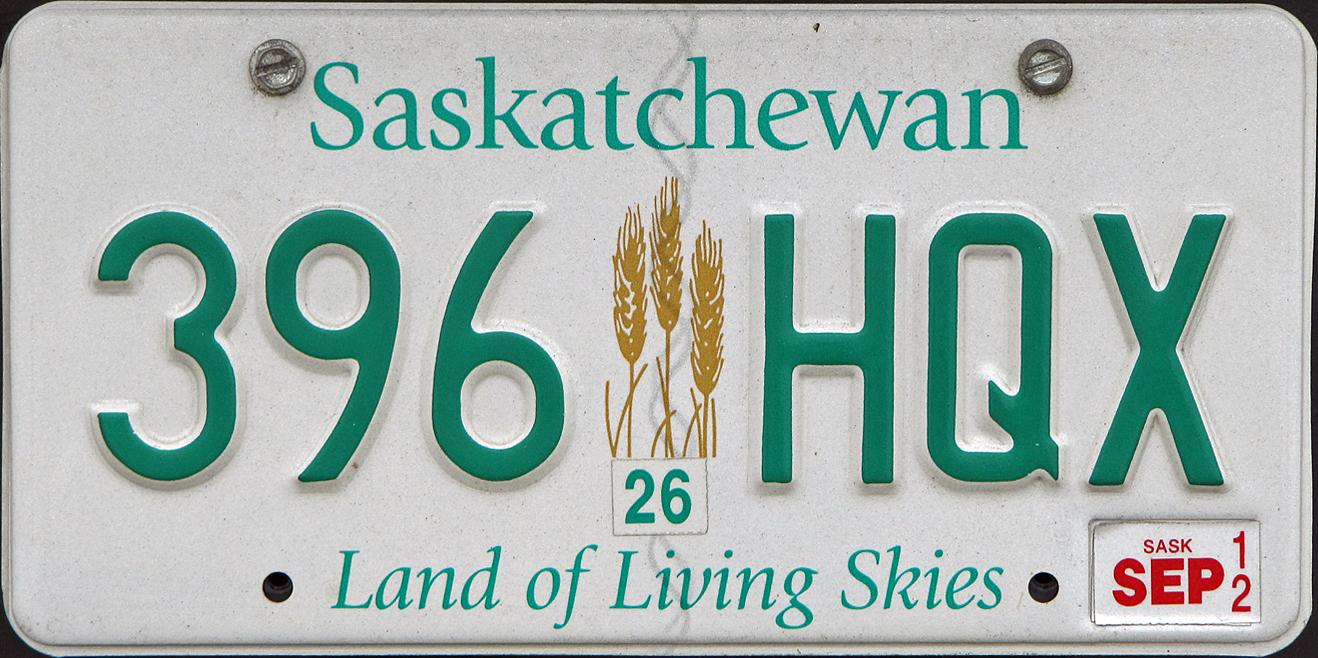
How to Go to a Saskatchewan Roughriders Game

This past Thursday, the Saskatchewan Roughriders opened the Canadian Football League season by losing 17-16 to the Montreal Alouettes in Montreal. This Saturday, they play their home opener, against the arch-rivals, the Winnipeg Blue Bombers.

This also completes a part of my project: I wanted to do a Trip Guide for a sports team in all 50 American States and all 10 Canadian Provinces. I have now done all the Provinces. The States? 34 down, 16 to go.

Before You Go. This is Canada, the Great White North, but it will also be Summer, so you don't have to worry about the cold. The local newspaper, the Regina Leader-Post, is predicting temperatures to be in the low 70s in daylight, and in the high 40s at night. So you should bring a jacket, but not a winter jacket.

Being in a foreign country has its particular challenges -- and, yes, for all its similarities to America, Canada is still a foreign country. Make sure you call your bank and tell them you're going. After all, Canada may be an English-speaking country (at least co-officially, with French), and a democracy (if a parliamentary one), and a country with teams in America's major leagues, but it is still a foreign country. If your bank gets a record of your ATM card making a withdrawal from any country other than the U.S., it may freeze the card, and any other accounts you may have with them. So be sure to let them know that you will, in fact, be in Canada for a little while.

As of June 1, 2009, you have to have a valid, up-to-date passport to cross the U.S.-Canadian border. You should also bring your driver's license (or other State-issued photo ID). If you don't have a valid passport, you will need a valid photo ID and a copy of your birth certificate. This is not something you want to mess with. Canadian Customs officials do not fuck around: They care about their national security, too.


Do yourself another big favor: Change your money before you go. There are plenty of currency exchanges in New York City, including one on 42nd Street between 7th and 8th Avenue. There are also a few in New Jersey: Travelex has exchange centers at Newark Liberty International Airport, and at 4 malls: Garden Sate Plaza in Paramus, Jersey Gardens in Elizabeth, Menlo Park Mall in Edison and Bridgewater Commons. 


Leave yourself $50 in U.S. cash, especially if you're going other than by plane, so you'll have cash on your side of the border. I was actually in Montréal on the day when it most favored the U.S.: January 18, 2002, $1.60 to $1.00 in our favor. As of Sunday night, June 25, US$1.00 = C$1.33, and C$1.00 = US 75 cents.


My suggestion is that, when you first get your money changed before you begin your trip, ask for $1 coins but no $2 coins. It's just simpler. I like Canada a lot, but their money, yikes, eh?

Regina is in the Mountain Time Zone, 2 hours behind New York. Adjust your timepieces accordingly. And this is very important: If you need to go to the bathroom, don't ask anyone where the "bathroom" is. Ask for the "washroom."

Tickets. Last season, the Roughriders averaged 31,327 fans per home game, about 94 percent of capacity. Getting tickets could be difficult. In the lower level, midfield seats are $98, sideline seats are $83, and end zone seats are $32. In the upper level, midfield seats are $67, and corner seats are $43. Those prices are in Canadian dollars.

Getting There. It's 1,942 miles from Midtown Manhattan to Regina, the capital of the Province of Saskatchewan, and the home of the Roughriders. It's 101 miles from Regina to the closest U.S.-Canada Border crossing, at Raymond, Montana. At first glance, flying would seem like the best way to get there.

But Air Canada really jacks their prices up during hockey's off-season. You'd be lucky to get round-trip fare for under $1,200, and you'd have to change planes in Toronto: Ain't no nonstops to Regina International Airport. Nor are there any to John G. Diefenbaker International Airport in Saskatoon (named for the Prime Minister from the Province), and it's no cheaper, so flying there and taking a train or a bus to Regina wouldn't help.

Maybe taking the train would be better? No: VIA Rail Canada does not go to Regina, only to Saskatoon. That's right; It's the capital city of one of the country's Provinces, and its national rail system doesn't go there.

Greyhound does go to Regina, but only offers 1 route per day, and you'd have to change buses twice, at Toronto and Winnipeg, as follows:

Leave Port Authority 12:15 AM Thursday
Arrive Toronto 10:30 AM Thursday (2 hour, 30 minute layover, change buses)
Leave Toronto 1:00 PM Thursday
Arrive Winnipeg 7:45 PM Friday (3 hour, 15 minute layover, change buses)
Leave Winnipeg 11:00 PM Friday
Arrive Regina 5:50 AM Saturday

Kickoff 7:00 PM Saturday
Game Ends around 10:00 PM Saturday (over 12 hours layoff, spend night in hotel)

Leave Regina 10:30 AM Sunday
Arrive Winnipeg 8:55 PM Sunday (1 hour, 20 minute layover, but no bus change)
Arrive Toronto 6:00 AM Tuesday (1 hour, 30 minute layover, change buses)
Leave Toronto 7:30 AM Tuesday
Arrive Buffalo 10:40 AM Tuesday (50 minute layover, change buses)
Leave Buffalo 11:30 AM Tuesday
Arrive Port Authority 7:50 PM Tuesday

And the round-trip fare would be $528.

Maybe driving would be better? It would certainly be cheaper and faster. It's best to get someone to go with you, so you can trade off driving and sleeping. You'll need to get into New Jersey, and take Interstate 80 West. You'll be on I-80 for the vast majority of the trip, through New Jersey, Pennsylvania and Ohio. In Ohio, in the western suburbs of Cleveland, I-80 will merge with Interstate 90. From this point onward, you won’t need to think about I-80 until you head home; I-90 is now the key, through the rest of Ohio and Indiana.

Just outside Chicago, I-80 will split off from I-90, which you will keep, until it merges with Interstate 94. For the moment, though, you will ignore I-94. Stay on I-90 through Illinois, until reaching Madison, Wisconsin, where you will once again merge with I-94. Now, I-94 is what you want, taking it across Minnesota, over the Red River into North Dakota, until reaching Jamestown.

Take Exit 256 to U.S. Route 281 North to U.S. Route 52 North, which you will take all the way up to the Border at Portal, North Dakota/North Portal, Saskatchewan. Route 52 becomes Provincial Route 39 North, and you'll take that to Bienfait, then Provincial Route 47 North to Stoughton, then Provincial Route 33 West to Regina.

If you do it right, you should spend about an hour and a half in New Jersey, 5 hours and 15 minutes in Pennsylvania, 4 hours in Ohio, 2 and a half hours in Indiana, an hour and a half in Illinois, 2 and a half hours in Wisconsin, 4 hours and 15 minutes in Minnesota, 6 hours in North Dakota, and 3 hours in Saskatchewan. That's 30 hours and 30 minutes. Counting rest stops, preferably halfway through Pennsylvania and just after you enter both Ohio and Indiana, outside Chicago, halfway across Wisconsin, at each end of Minnesota, in North Dakota, and at the border, and accounting for traffic in New York, the Chicago suburbs and the Twin Cities, it should be no more than 39 hours.

Once In the City. Although the Provincial capital, Regina is not the most populous city in Saskatchewan: Saskatoon is, 246,000 to 215,000. And, like most Canadian cities between Toronto and Vancouver, each one's vast prairies mean no real increase when you measure by metropolitan area: Saskatoon, 305,000; Regina, 236,000. Even the Province as a whole has only a little over 1.1 million people. This makes Regina the smallest "market" in any of the 5 major North American sports. Those people are about 77 percent white, 10 percent Aboriginal, 6 percent East Asian, 3 percent South Asian, 2 percent black, 1 percent Hispanic and 1 percent Middle Eastern.
Founded in 1882, and named for Canada's head of state at the time, Britain's Queen Victoria -- "Regina" is Latin for "Queen," as "Rex" is for "King" -- it's pronounced REJ-ih-nah, not Reh-JEE-nah or Reh-JIGH-na. Be careful.
A railroad cuts through the center of town, dividing numbered Avenues into North and South addresses. McDonald Street divides addresses into East and West. Regina Transit charges C$3.25 for a bus fare, with a $10 day pass. Route 1, "The Ring Road," is the city's "beltway."
The Saskatchewan Legislative Building in Regina

The drinking age in Saskatchewan is 19. Postal Codes, appropriately enough, start with S. The Provincial goods and services tax (GST, or sales tax) is 11 percent. SaskPower runs the electricity.

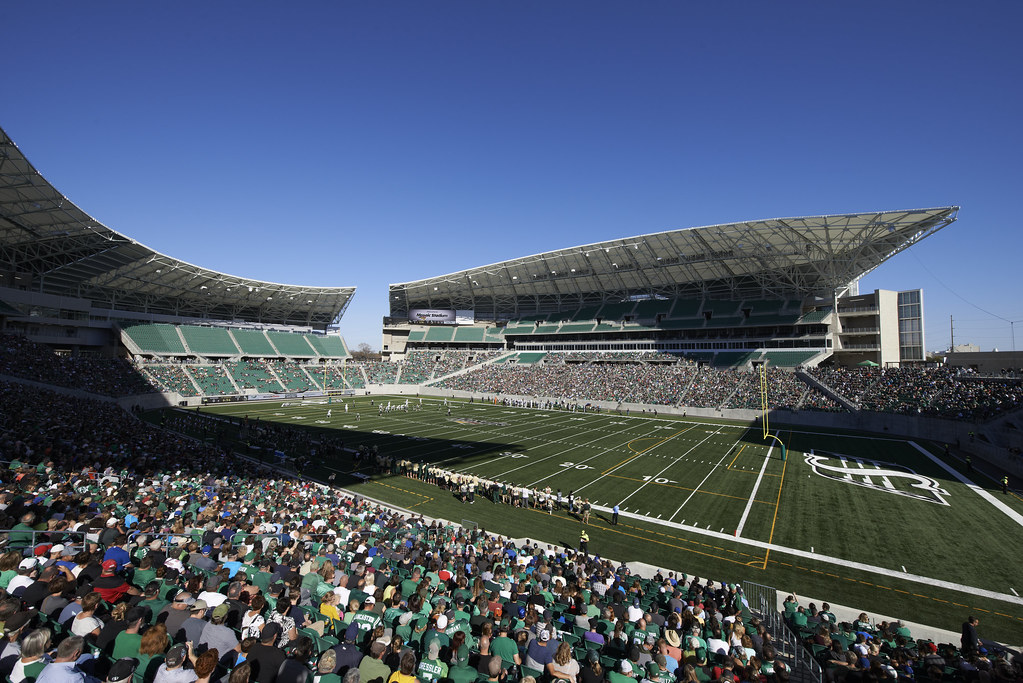
Going In. The Saskatchewan Roughriders played at Taylor Field from 1936 until 2016. This year, they moved 6 blocks to the west, into the new 33,000-seat Mosaic Stadium, which opened last October 1, at 1734 Elphinstone Street at 10th Avenue, about a mile northwest of downtown. Take Bus 12, or the Mosaic Stadium Shuttle. I can find no reference as to what parking will cost.
Mosaic Stadium, with the Regina Armory in the background

The Mosaic Company, which mines potash and phosphate, had previously had naming rights to the previous facility from 2006 onward: Mosaic Stadium at Taylor Field.

The Riders share the stadium with the University of Regina Rams, who also wear green. (Their football team is called the Rams, while all their other teams are the Cougars.) The playing surface has been artificial turf since 1979, FieldTurf since 2007, and runs north-to-south.
On July 22, a soccer doubleheader will be held there, Soccer Day in Saskatchewan. The opener will be between arch-rivals, the University of Regina and the Saskatoon-based University of Saskatchewan. The nightcap will be the new version of the New York Cosmos, of the new version of the North American soccer League, against Spanish club Valencia.

In 2018, the Canadian Premier League, Canada's attempt at a "top flight" soccer league, will begin play, and it is expected that Regina will have a team, playing out of Mosaic Stadium. Saskatoon may also get a team.

Food. According to a recent Leader-Post article, more detailed than the stadium website, "Several local restaurants will be offering their cuisines including Rock Creek Tap & Grill, Beer Bros., Coney Island, Western Pizza, Wok Box and Sweet Ambrosia Bakeshoppe."

Unfortunately, there will be an absolute obscenity available: Pulled pork poutine. If Jews and Muslims did not already prohibit pork, this would bring that prohibition about.

Team History Displays. The team was founded as the Regina Rugby Club in 1910, became the Regina Roughriders in 1924, and the Saskatchewan Roughriders in 1946. They have the most dubious distinction in North American sports: They reached 5 straight Finals but lost them all: 1928, '29, '30, '31 and '32 -- and then made it 6 out of 7 in '34. Not even the Buffalo Bills can match that.

They finally won the Grey Cup for the 1st time in 1966, then took until 1989 to win another (beating Hamilton 43-40 in the highest-scoring Final of all time), but have since won them in 2007 and 2013 (the last of these on home turf). However, there is no outward display for these titles in the stadium.

The Roughriders have won 4 Grey Cup Finals, but they've also lost a record 15. Four times, there was an "All Roughriders Final," as Saskatchewan faced the Ottawa Rough Riders (who spelled it as 2 words): Saskatchewan won in 1966; Ottawa won in 1951, 1969 and 1976. The Ottawa Rough Riders folded in 1996, and when Ottawa returned to the League in 2001 (failing in 2006) and again in 2014, they applied to use the old name, but Saskatchewan vetoed the use of the "Rough Riders" name, to avoid confusion; the 2001-06 team became the Renegades, and the team established in 2014 became the Redblacks, each using the old team's color scheme.

In 2009, the Roughriders had a particularly notorious Grey Cup Final loss: Damon Duval of the Montreal Alouettes missed a last-second field goal that appeared to give the Riders the Cup, but the Riders were penalized for having too many men on the field. That's right: In a version of football where you are allowed 12 men on the field, they had 13. Duval made the retry, and the Alouettes won 28-27.

The Riders have 8 retired numbers. Unfortunately, 4 of them were due to the players' deaths in the crash of Trans-Canada Air Lines Flight 810 at Mount Slesse near Chilliwack, British Columbia on December 9, 1956. The 4 players were returning home from the postseason Shrine Game between East and West All-Stars at Empire Stadium in Vancouver.

These tragic honorees are: 40, tight end Mel Becket; 55, offensive lineman Mario DeMarco; 56, offensive lineman Ray Syrnyk; and 73, defensive end Gordon Sturridge. Calvin Jack Jones of the Winnipeg Blue Bombers was also killed. The total death toll was 62.

Also honored with the retirement of their numbers are 23, 1960s and '70s quarterback Ron Lancaster; 34, 1960s and '70s running back George Reed; 36, 1980s and '90s kicker Dave Ridgway; and 44, 1970s and '80s guard Roger Aldag.

There are 28 figures from Roughriders history in the Canadian Football Hall of Fame:

* From the 1923 Division title: General manager Al Ritchie, team executive Clair Warner, coach and former quarterback Neil "Piffles" Taylor.

* From the 1928, '29, '30, '31, '32 and '34 Grey Cup Final defeats: Coach Ritchie, team executive Warner, team president Taylor, 2-way back Eddie "Dynamite" James, center Dean Griffing.

* From the 1951 Division title: Warner, team president Bob Kramer, 2-way back Ken Charlton, 2-way tackle Bill Clarke.

* From between the 1951 and 1966 Grey Cup berths: 2-way tackle Martin Ruby.

* From the 1966 Grey Cup: Warner, Lancaster, Reed, team executive Tom Shepherd, GM and former quarterback Ken Preston, head coach Eagle Keys (his real name), receiver Hugh Campbell, center and defensive tackle Ron Atchison, center Ted Urness, guard Al Benecick, guard and placekicker Jack Abendschan, defensive tackle Ed McQuarters.
George Reed

* From the 1969, '72 and '76 Final defeats, but not the '66 win: Defensive end Bill Baker.

* From the 1989 Grey Cup: Shepherd, Preston, Ridgeway, Aldag, slotback Ray Elgaard, receiver Don Narcisse, defensive end Bobby Jurasin,
Roger Aldag

* From the 2007 Grey Cup: Shepherd, offensive tackle Gene Makowsky, defensive back Eddie Davis. No player from the 2013 Grey Cup has yet been elected, although Shepherd was, and is, still there. Darian Durant, who played at the University of North Carolina, was the quarterback on both of those teams, but is still active, and thus not eligible for the Hall.
Darian Durant with the 2013 Grey Cup

In 2006, TSN (The Sports Network, Canada's version of ESPN) named the CFL's 50 Greatest Players. Named from the Riders were Reed (who came in at Number 2), Lancaster (7), Aldag (32), Elgaard (36) and Baker (43).

Although many American players have played in the CFL, no winner of the Heisman Trophy has ever played for the Roughriders.

The Riders' biggest rival is the Winnipeg Blue Bombers, against whom they play the Labour Day Classic. The Bombers lead this rivalry 34-18. (UPDATE: Through the 2018 season, the Bombers lead it 36-18.)

Stuff. The Rider Store is located in the north end of Mosaic Stadium. They also have locations at Northgate Mall and Grasslands in Regina, and one in Saskatoon. I don't know if, tying into the Western theme, they have cowboy hats with team logos on them.

Unlike most CFL teams, there are comprehensive book histories of the Roughriders, and fairly recent ones at that. In 2009, a little ahead of schedule, several writers collaborated on Saskatchewan Roughriders: The First 100 Years. Not among them was Graham Kelly, who wrote Green Grit: The Story of the Saskatchewan Roughriders in 2001; Saskatchewan Roughriders: The Players, the History & the Fans in 2012; and The Grey Cup: The Complete History in 1998.

The Riders have an entry in the CFL Traditions DVD series, and Pride of the Ride: A Film About the Saskatchewan Roughriders and Their Fans appeared on DVD in 2004.

During the Game. By their long waits for success, and their Western location, the Roughriders are sort of the Denver Broncos of the CFL. Their fans can be quite intense, very loyal and very loud, with MSN ranking them as the rowdiest sports fans in Canada. A 1995 win over the Calgary Stampeders brought in a club record 55,438 fans -- one-quarter of Regina's population. Although Lambeau Field can now seat about 75 percent of the population of Green Bay, I don't think either the Giants or the Jets is going to get 2 million fans (1/4 of New York City) for a home game anytime soon.

As with Pittsburgh in the 1970s, hard economic times in the 1980s and '90s led to an exodus from the Province, with people going where the jobs were. As a result, when the Riders go to Edmonton and Calgary, their support frequently outnumbers the Eskimo and Stampeder fans.

"Rider Nation" is also known for weird costumes, including, since they're green and shaped something like a football helmet, watermelon halves turned into hats. The old Section 28 at Taylor Field, on the East Stand, became renowned for its rowdy reputation, much like Yankee Stadium's Bleacher Creatures, Wrigley Field's Bleacher Bums, Madison Square Garden's former Blue Seats, and Veterans Stadium's 700 Level.

But if you go to Regina, as long as you're not supporting the Winnipeg Blue Bombers (regional rivals), one of the Alberta teams (ditto), the Ottawa Redblacks (the team from the capital), or the Toronto Argonauts (the team from the big media and culture center), you shouldn't worry about your safety. They might be happy to have an American guest checking out their version of football.

Nino Hernandez, an immigrant to Canada from the Philippines, is the regular National Anthem singer. The mascot is Gainer the Gopher. Gophers are common on the Saskatchewan prairies, a "gainer" is one who gains yards, and the name is also an anagram of "Regina." And he wears Number 13 because, in this 12-a-side league, Regina is "The Home of the 13th Man."
The Roughriders have several fight songs, including "Rider Pride," "Paint the World Green," "Green Is the Colour" (borrowed from the song of blue-clad London soccer team Chelsea), "On Roughriders" (to the tune of "On Wisconsin"), and "The Last Saskatchewan Pirate" by the Arrogant Worms (even though the singers of "The Toronto Song" are from Edmonton).

The Riders tend to play their arch-rivals, the Winnipeg Jets, in back-to-back weeks: On the 1st weekend in September, in Regina in one of the CFL's Labour Day Classic games, and in a game called the Banjo Bowl a week later in Winnipeg. The game got its name in 2003, when Blue Bombers placekicker Troy Westwood said that Riders fans were "a bunch of banjo-pickin' inbreds." As if there isn't a lot of rural area in Manitoba. He then "apologized" by saying, "The vast majority of the people in Saskatchewan have no idea how to play the banjo."

After the Game. As long as you don't try to interrupt the fun, your safety won't be an issue. What might be an issue is finding a good place for a postgame meal, or just a pint. The Evras Place shopping center, just to the northwest of the stadium, has eateries, but it might be closed after the game. Your best bet is probably to get back downtown.

If your visit to Regina is during the European soccer season (which we're now not, it starts up again in mid-August), the likeliest place to watch your favorite club is O'Hanlon's, at 1947 Scarth Street, downtown, across from the east side of Victoria Park.

Sidelights. Regina is not a big city. Its sports history is pretty much tied up in the Roughriders. In 1936, they began play at Park de Young, which was renamed Taylor Field in in 1947, in memory of the late Neil Joseph "Piffles" Taylor, a former Roughriders quarterback, coach and general manager, who is often credited as being the man most responsible for the development of pro football in Western Canada, as President of the Western Interprovincial Football Union, which later merged with the Interprovincial Rugby Football Union to form the CFL.
Taylor Field was a weird-looking stadium, somewhat resembling Metropolitan Stadium in Minnesota in how many decks it had in which spots. But it provided a wild a wacky (to borrow Marv Albert's phrase) home for the Riders, the University of Regina and high school football for 71 seasons. Temporary bleachers could boost it to 55,000 seats when it hosted the Grey Cup in 1995, 2003 and 2013, but it usually seated around 33,000.

It was on a plot of land bounded by 9th Avenue (north), Retallack Street (east), Railway Street (south) and Cameron Street (west), but its traditional address, for the team's founding and its legend, was 1910 Piffles Taylor Way. As with the new stadium, Bus 12 is the best way to get there from downtown.

The biggest hockey team in Regina is the Regina Pats of the Western Hockey League, celebrating their 100th Anniversary this year. They were founded in 1917 as the Regina Patricia Hockey Club, named for Princess Patricia of Connaught, a granddaughter of Queen Victoria, a grandniece of the then-head of state King George V, and the daughter of the Duke of Connaught, then Canada's Governor-General (the representative of the British monarch). She was also the namesake of the Princess Patricia's Canadian Light Infantry, and, to this day, the Pats wear the regimental badge as a shoulder patch.
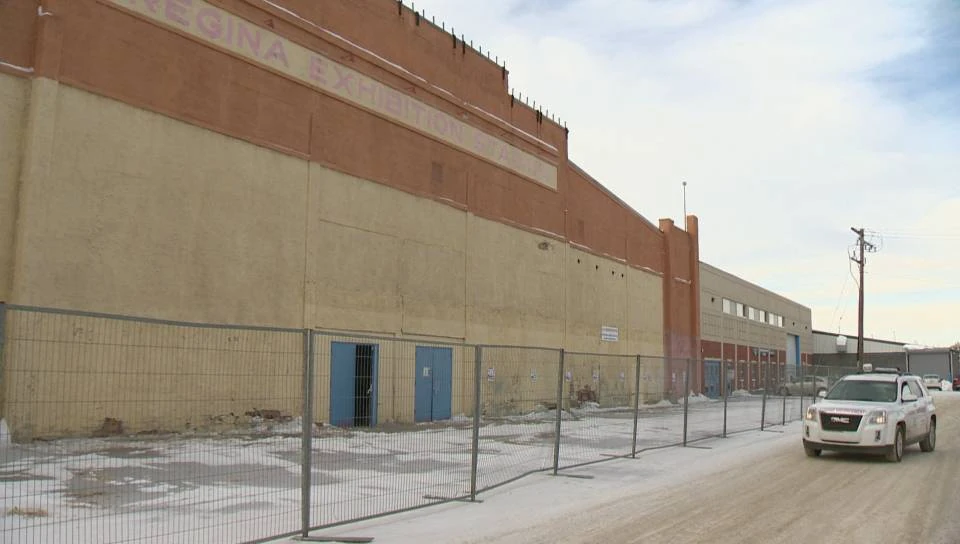
They won the Memorial Cup, the championship of Canadian junior hockey, in 1925, 1930 and 1974. They play at the 6,484-seat Brandt Centre, known from its 1977 opening until 2005 as the Regina Agridome, and distinctive due to its orange roof. It's part of the Evraz Place complex, just to the west of Mosaic Stadium, at 1700 Elphinstone Street. Its predecessor, the 1919-built Regina Exhibition Stadium, was demolished early this year.
The other Saskatchewan teams to have won the Memorial Cup are the 1928 Regina Monarchs, the 1985 Prince Albert Raiders and the 1989 Swift Current Broncos.

The closest NHL team to Regina is the Winnipeg Jets, 356 miles to the east. The Calgary Flames are 470 miles to the west. The Edmonton Oilers are 486 miles to the northwest.

The Province is not big on baseball. Cairns Field in Saskatoon, long the biggest baseball park in Saskatchewan, is currently without a professional tenant, although it has amateur ones. Basketball is also not popular there.

As I said, the University of Regina and the University of Saskatchewan in Saskatoon, 160 miles northwest of downtown Regina, are big rivals in various sports. UR, known as the Rams in football and the Cougars in all other sports, won the Churchill Bowl (replaced by the Uteck Bowl) in 2000, but lost the subsequent Vanier Cup Final. 2000 was also the year UR won the Hardy Cup, the national championship of Canadian collegiate hockey.

In contrast, US, whose teams are called the Huskies, were National Champions in hockey in 1983, basketball in 2010, women's basketball in 2015, and football in 1990, 1996 and 1998.

In 1988, the 15,195-seat Saskatchewan Place arena opened in Saskatoon. Now the SaskTel Centre, it is the home of the Saskatoon Blades of the Western Hockey League, arch-rivals of the Regina Pats.

In 51 seasons of play, the Blades have never won the Memorial Cup, losing the Final in 1989. Nor have they won the WHL title, going 0-for-5 in Finals. Indeed, they haven't even made the Playoffs the last 4 seasons. But they have something the Pats could never have: The cremated remains of Gordie and Colleen Howe, at the base of a statue of Gordie outside the arena. 3515 Thatcher Avenue. Gordie's hometown of Floral is 11 miles to the southeast of Saskatoon, and 156 miles northwest of Regina.

The most prominent museum in Regina, or in the Province, is the Royal Saskatchewan Museum, a natural history museum at 2445 Albert Street. Bus 4 or 7 from downtown. Neither Elvis Presley nor the Beatles ever performed in Saskatchewan.

The only Prime Minister from Saskatchewan has been John Diefenbaker. "Dief the Chief" returned the Conservative Party to power in 1957, before losing it in 1963. He famously got along with the Republican President Dwight D. Eisenhower, but famously did not with the Democratic President John F. Kennedy. To their friends, JFK called Dief "the boring son of a bitch," while Dief called JFK "a hothead," "a fool," "too young, too brash, too inexperienced, and a boastful son of a bitch!"

Dief died in 1979, living just long enough to see Joe Clark become the 1st Conservative PM since himself. (It didn't last long, though: His government fell apart over the budge within months, and Pierre Trudeau, father of current PM Justin Trudeau, won a snap election.) The Diefenbaker Centre, the closest thing Canada has to a Presidential Library, is at the University of Saskatchewan in Saskatoon, and he and his wife Olive are buried there.

The Mosaic Potash Tower, the tallest building in the Province and the tallest between Calgary and Winnipeg, stands just 277 feet high, 1700 12th Avenue, downtown, around the corner from Victoria Park.

Not many TV shows and movies have been shot, or set, in Saskatchewan, and I doubt that very many Americans would recognize any of them.

*

Regina is not easy to get to. And there's not a lot to do once you do. But a Saskatchewan Roughriders game is quite an experience for a football fan, so it may be worth a visit.

Girardi Almost Blows Another One, But Yanks Beat Pale Hose

Last night, the Yankees began a series against the Chicago White Sox, their 1st visit to the former new Comiskey Park since its name was changed from U.S. Cellular Field to Guaranteed Rate Field.

And it almost became one of those games that makes me say, "If the Yankees end up losing the American League East (or missing the Playoffs completely) by 1 game, I want you to remember this game."

The Yankee bats were not the problem. Tyler Austin, who played 26 games last season, hitting 5 home runs, but is technically still a rookie, hit his 1st homer of the season last night, for 2 runs. Chase Headley went 3-for-4 with an RBI. Austin Romine and Ronald Torreyes also had RBIs.

Starting pitcher Jordan Montgomery was not the problem. He went 7 innings, allowing just 1 run on 5 hits and a walk, striking out 8.

Relief pitcher Jonathan Holder was not the problem. He got the 1st 2 outs in the 8th.

Relief pitcher Dellin Betances was not the problem. He got the last out in the 8th.

Those of you old enough to remember that it doesn't take 3 pitchers to get 6 outs when the opposing team hasn't scored in the innings in question have probably figured out what the problem was: Joe Girardi was reading his damn binder and playing musical chairs with the bullpen again.

He sent Chasen Shreve out to pitch the bottom of the 9th inning, to protect a 5-run lead. And Shreve...

Let's be honest here: Shreve was not the problem. Girardi was the problem. Pretty much any other manager would have ignored the fact that Montgomery had thrown 100 pitches, and left him in for the 8th. Maybe for the 9th, too. He's already going to get 5 days rest, so what's another 15 to 20 pitches?

At the very least, since Holder had gotten the 1st 2 outs in the 8th, Girardi should have let him try to get the 3rd. Or, since Betances had gotten the last out in the 8th, Girardi should have let him try to get the outs in the 9th.

But because Joe Girardi is an idiot who doesn't know how to manage a bullpen, he pulled Montgomery sooner than he should have, burned Holder, burned Betances, and put Shreve in. Here's what Shreve got: Groundout, single, infield single, home run. That cut the Yankee lead from 6-1 to 6-4 in a hurry.

Girardi realized it was now a save situation, and got Shreve out of there, and brought in his closer, Aroldis Chapman. Yankee Twitter was in full collapse mode, sure the game would be lost, wondering why Girardi didn't put Chapman out there in the first place.

Chapman allowed a single. And an RBI double. And it looked for all the world like Girardi had blown yet another one, making the current Yankee slump 11 losses in the last 13 games.

Chapman pulled it together, and got a groundout and a flyout to end it in victory for the Bronx Bombers over the Pale Hose. Whew. Yankees 6, White Sox 5. WP: Montgomery (6-4). SV: Chapman (8). LP: David Holmberg (1-2).

Can someone please explain to me why Joe Girardi still has a job?

The series continues tonight. Luis Severino starts for the Yankees, Jose Quintana for the White Sox.

*

Days until the Red Bulls play again: 1, tomorrow night at 8:00, a "derby" against the Philadelphia Union at Red Bull Arena, in the U.S. Open Cup, the American version of England's FA Cup. In their last game, they lost at home to New York City FC for the 1st time, a pathetic 2-0 effort.

Days until the Red Bulls next play a "derby": See the previous answer. They will next play the New England Revolution on Wednesday, July 5, at Gillette Stadium in Foxboro, Massachusetts. They will next play NYCFC on Sunday, August 6, at Yankee Stadium. And they will next play the D.C. Scum on Saturday, September 27, at Red Bull Arena in Harrison, New Jersey.

Days until the U.S. national soccer team plays again: 4, this Saturday afternoon at 4:45, a friendly against Ghana, at Rentschler Field in East Hartford, Connecticut.

Days until The Arsenal play again: 16, on Thursday, July 13, when they begin their preseason tour of Australia and Asia, with a game against A-League winners Sydney FC at Stadium Australia in Sydney.

Days until the next Yankees-Red Sox series: 17, on Friday, July 14, at Fenway Park. 

Days until the Premier League season begins: 46, on Saturday, August 12. The Arsenal open at home to Leicester City. There is a chance, of course, that the TV networks could have Arsenal's match moved to the following Sunday or Monday.

Days until Rutgers University plays football again: 66, on Friday, September 1, home to the University of Washington. A little over 2 months.

Days until East Brunswick High School plays football again: 73, on Friday night, September 8, home to Sayreville, a "derby." 

Days until the New Jersey Devils play again: 102, on Saturday night, October 7, home to the Colorado Avalanche. A little over 3 months.

Days until the New Jersey Devils next play a local rival: 109, on Saturday night, October 14, against the New York Rangers at Madison Square Garden in Midtown Manhattan. Their 1st game against the New York Islanders will be on Sunday, January 7, 2018, at the Barclays Center in Brooklyn -- and they'll have played the Rangers 3 times by then. Their 1st game against the Philadelphia Flyers will be on Saturday, January 13, 2018, at the Prudential Center in Newark -- and they'll have played the Rangers 3 times and the Islanders once by then. This is a weird schedule. But, at least, now we have it. The NBA usually doesn't release its new season's schedule until August.

Days until the Alex Rodriguez Contract From Hell officially runs out, and the Yankees can spend his salary on new players: 126, on October 31.

Days until the next election for Governor of New Jersey: 133, on Tuesday, November 7. Just 19 weeks until we elect Phil Murphy, defeat Kim Guadagno, and end Christieism forever. But only if you vote!

Days until the next Rutgers-Penn State football game: 137, on Saturday, November 11, at Beaver Stadium in State College, Pennsylvania.

Days until the next North London Derby: 144, on Saturday, November 18, at the Emirates Stadium. This game could be moved to the following day, for TV purposes.

Days until the next East Brunswick-Old Bridge Thanksgiving high school football game: 149, on Thursday, November 23, at 10:00 AM. Under 6 months, and thank God it's at home, at Jay Doyle's Green Grove, rather than at that purple shit pit on Route 9. Under 5 months.

Days until the next Winter Olympics begins in Pyeongchang, Korea: 231, on February 9, 2018. Under 8 months.

Days until the next World Cup kicks off in Russia: 352, on June 14, 2018. Just under 1 year, or 12 months. Has Bruce Arena turned our chances around? Maybe. Or maybe, with the tournament on his soil, Vladimir Putin will tell his bitch Donald Trump to tell Bruce Arena to tank the games. Maybe not. Or maybe only if we end up playing Russia. I don't think Arena will listen. If he doesn't, I hope his life insurance is paid up, because Putin has had people killed for defying him.

Days until September 2018 roster call-ups, when we can finally start to expect seeing some of these wonderful "prospects" for whom Yankee general manager Brian Cashman threw away a chance at the 2016 Playoffs: 431. Under a year and a half, or a little over 14 months. Of course, we could end up seeing one of more of them sooner than that, but since most of them are at Double-A Trenton now, if that, who's kidding who?

Days until the next Congressional election: 497, on November 6, 2018. Under a year and a half, or a little over 16 months.

Days until the Baseball Hall of Fame vote is announced, electing Mariano Rivera: 561, on January 9, 2019. A little over a year and a half, or a little over 18 months.

Days until the Baseball Hall of Fame vote is announced, electing Derek Jeter: 926, on January 8, 2020. A little over 2 1/2 years, or a little over 30 months.

Days until the next Summer Olympics begins in Tokyo, Japan: 1,131, on July 24, 2020. A little over 3 years, or a little under 37 months.

Days until the next Presidential election: 1,593, on November 3, 2020. Under 3 1/2 years, or a little over 40 months.

Days until Liberation Day: 1,671, at noon on January 20, 2021. Under 4 years, or a little under 43 months. Note that this is liberation from the Republican Party, not just from Donald Trump. Having Mike Pence as President wouldn't be better, just differently bad, mixing theocracy with plutocracy, rather than mixing kleptocracy with plutocracy.

Monday, June 26, 2017

Buildings That Hosted Both Elvis and the Beatles

Photo taken at the Market Square Arena show.
And people were commenting that
they thought he'd lost some weight.

June 26, 1977, 40 years ago: Elvis Presley closes his tour at the Market Square Arena in Indianapolis, Indiana.

Cost of a ticket: $15 -- about $60 in today's money. Warmup acts began at 8:30 PM, but Elvis didn't take the stage until around 10:00. He sang 22 songs, over the next hour and 20 minutes.

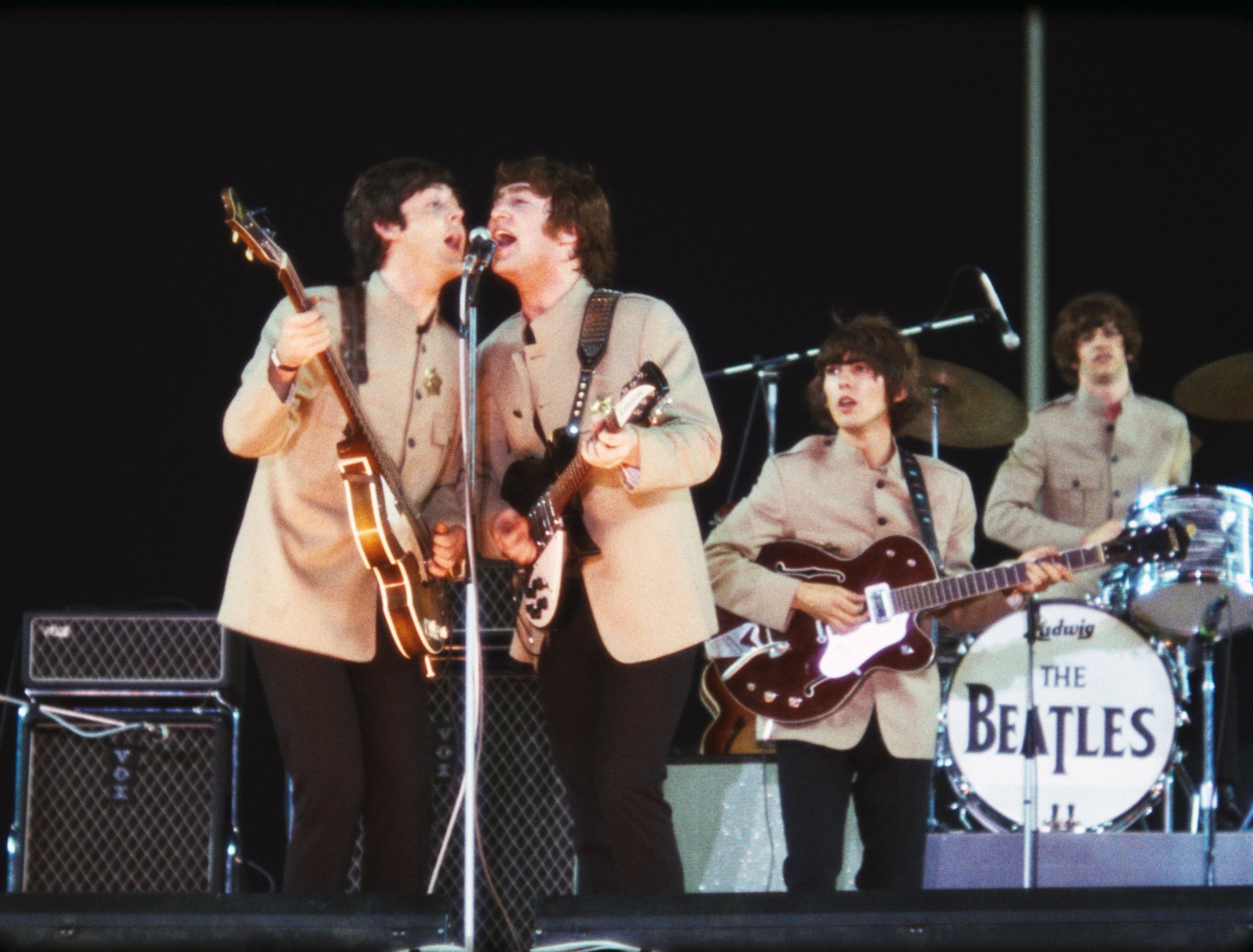
For comparison's sake, on their North American tours of 1964, 1965 and 1966, the Beatles usually sped through 11 songs in a shade over half an hour.

Elvis' set list:

* Also Sprach Zarathustra (a.k.a. the theme from 2001: A Space Odyssey, written by Richard Strauss)
* See See Rider (Ma Rainey, redone by several rock acts)
* Medley: I Got a Woman (Ray Charles) and Amen (Curtis Mayfield)
* Love Me (Jerry Lieber & Mike Stoller)
* Fairytale (Pointer Sisters)
* You Gave Me a Mountain (Marty Robbins, who also had the best-known version)
* Jailhouse Rock (Lieber & Stoller)
* It's Now Or Never (based on O Sole Mio)
* Little Sister (Doc Pomus & Mort Shuman)
* Medley: Teddy Bear (Kal Mann & Bernie Lowe) and Don't Be Cruel (Otis Blackwell)
* Release Me (Eddie Miller & Robert Young, best-known version by Engelbert Humperdinck)
* I Can't Stop Loving You (Don Gibson, best-known version by Ray Charles)
* Bridge Over Troubled Water (Paul Simon -- after this song, Elvis introduced the band and backup singers)
* Early Morning Rain (Gordon Lightfoot)
* What'd I Say (Ray Charles)
* Johnny B. Goode (Chuck Berry)
* I Really Don't Want to Know (Don Robertson & Howard Barnes, best-known version by Les Paul & Mary Ford)
* Hurt (Jimmie Crane & Al Jacobs, best-known version by Timi Yuro)
* Hound Dog (Lieber & Stoller -- after this song, Elvis thanked the crowd)
* Can't Help Falling In Love (his usual finale, written by George David Weiss)

At which point, Elvis left the stage, was escorted to his waiting car, and was driven back to his hotel. As usual, to discourage people waiting for an encore that was not forthcoming, an announcer said, "Ladies and gentlemen, Elvis has left the building."

No one knows it yet, but it will be his last concert. In just 51 days, Elvis Aaron Presley will be dead, from a heart attack, brought on by years of heavy use of prescription drugs, at the age of 42.

*

Elvis' 1st paid performance was, as you might guess, in his hometown of Memphis, Tennessee, at the Bon Air Club, on July 17, 1954.

He had 1,778 live performances, including TV appearances. Of these, by far the most, 764, were in Nevada, due to his Las Vegas commitments. On his early tours, where he was practically worked to death, he did a lot of shows in Southern States, sometimes 2, 3, or even 4 shows in 1 day, without very many days off.

177 were in Texas, 82 in Florida, 80 in Louisiana, 66 in Tennessee, 53 in North Carolina, 52 in Arkansas, 42 in California, 41 each in Georgia and Virginia, 40 in Mississippi, 36 in Alabama, 32 in Ohio, 27 in New York, 26 in Missouri, 23 in Indiana, 20 in Oklahoma, 16 in Michigan, 12 in Pennsylvania.

There were 10 each in Illinois, Nebraska and Washington; 9 each in Hawaii, Minnesota, New Mexico, South Carolina and Wisconsin; 7 each in Arizona, Kentucky and Maryland; 6 each in Kansas and Oregon; 5 each in Colorado, Iowa, Rhode Island and West Virginia; 4 each in Connecticut and Massachusetts; 3 in South Dakota; 2 in Utah; and 1 each in Maine and the District of Columbia.

He never gave a concert in the States of Alaska, Delaware, Idaho, Montana, New Hampshire, New Jersey, North Dakota, Vermont and Wyoming. Of these States, the only one that had a building that could have held him on his 1970-77 tours was New Jersey, the 14,770-seat Convention Hall (now Boardwalk Hall) in Atlantic City. The Meadowlands Arena wouldn't open until 1981.

He did 5 shows in Canada: 2 in Toronto, 2 in Ottawa, 1 in Vancouver, all in 1957. He never did a show outside North America, because his manager, Colonel Tom Parker, was actually Andreas Cornelis van Kuijk, an illegal immigrant from the Netherlands. He didn't accompany Elvis on his Army tour of 1958-60, either.

*

There were 16 buildings that hosted concerts by both Elvis Presley and the Beatles. Not together, obviously. They are listed here in the order that they fulfilled both halves.
1. CBS Studio 50, 1697 Broadway, New York. Built 1927, still stands, seating 400. Home of The Ed Sullivan Show, and renamed the Ed Sullivan Theater in 1967.

Elvis, October 28, 1956 and January 6, 1957. Beatles, February 9, 1964 and August 14, 1965. Each also taped an Ed Sullivan Show at another location: Elvis at CBS Television City in Burbank on September 9, 1956; and the Beatles at the Fontainebleau Hotel in Miami on February 16, 1964.

2. International Amphitheatre, 4220 S. Halstead Street, Chicago. Built 1934, seating capacity 9,000. Hosted the Republican Convention in 1952 and 1960, and the Democratic Convention in 1952, 1956, and, infamously, 1968. Hosted the NBA's Chicago Packers in 1961-62 and the Chicago Bulls in 1966-67; and the World Hockey Association's Chicago Cougars in 1972-75.

Elvis, March 28, 1957. Beatles, September 4, 1964; and August 12, 1966. Demolished 1999.

3. Olympia Stadium, 5920 Grand River Avenue, Detroit. Built 1927, seating capacity 15,000. Hosted the NHL's Detroit Red Wings 1927-79, and the NBA's Detroit Falcons in 1946-47 and the Detroit Pistons 1957-61.

Elvis, March 31, 1957; and September 11, 1970; April 6, 1972; September 29, 1974; and April 22, 1977. Beatles, September 6, 1964; and August 13, 1966. Demolished 1987.

4. Maple Leaf Gardens, 60 Carlton Street, Toronto. Built 1931, seated 13,718 when the Beatles played there. Hosted the NHL's Toronto Maple Leafs 1931-99, the NBA's Toronto Huskies in 1946-47, the WHA's Toronto Toros in 1974-76, and some home games of the NBA's Buffalo Braves in 1971-75 and Toronto Raptors in 1997-99.

Elvis, April 2, 1957. Beatles, September 7, 1964; August 17, 1965; and August 17, 1966. Converted to the Mattamy Athletic Centre, the new home of Ryerson University Athletics, in 2012, seating 2,796, but the familiar outer faces and roof with its maple leaf logos are intact.

5. Sam Houston Coliseum, 801 Bagby Street, Houston. Opened 1937, seated 9,200. Hosted the ABA's Houston Mavericks 1967-69, the WHA's Houston Aeros 1972-75, some University of Houston basketball games 1937-69, and several minor-league hockey teams.

Elvis, October 13, 1956; Beatles, August 19, 1965. Demolished 1998.

6. Veterans Memorial Coliseum, usually called the Portland Memorial Coliseum, 300 Winning Way (formerly listed as 1401 N. Wheeler Avenue), Portland, Oregon. Opened 1960, still stands, seats 12,888. Hosted the NBA's Portland Trail Blazers 1970-95, and a succession of minor-league hockey teams, including the Western Hockey League's Portland Winterhawks since 1976.

Beatles, August 22, 1965; Elvis, November 11, 1970, April 27, 1973 and November 26, 1976.

7. Seattle Center Coliseum, 305 Harrison Street. Opened 1962 as part of a World's Fair, and could be seen in the Elvis movie It Happened at the World's Fair. Seated 13,200. Hosted the NBA's Seattle SuperSonics 1967-94, and minor-league hockey.

Beatles, August 21, 1964; and August 25, 1966. Elvis, November 12, 1970; April 29, 1973; and April 26, 1976. Demolished 1994, and replaced on the same site with the KeyArena. (UPDATE: Demolished again, and replaced on the same site in 2021 with the Climate Pledge Arena.)

8. Cow Palace, 2600 Geneva Avenue, just outside San Francisco in Daly City. Built 1941, still stands, seats up to 16,500 for concerts. Hosted the 1956 and 1964 Republican Conventions. Hosted the NBA's San Francisco (now Golden State)Warriors 1962-71, the NHL's San Jose Sharks 1991-93, and the 1960 NCAA Final Four.

Beatles, August 19, 1964; and August 31, 1965. Elvis, November 13, 1970; November 28 and 29, 1976.

9. Public Auditorium, 500 Lakeside Avenue, Cleveland. Built 1922, still stands, seats 10,000. Hosted the 1928 and 1936 Republican Conventions, but never a sports team.

Beatles, September 15, 1964; Elvis, November 6, 1971. Now hosts the annual Rock and Roll Hall of Fame induction ceremony.

10. Baltimore Civic Center, 201 W. Baltimore Street. Built 1962, still stands, seats 14,000. Hosted the NBA's Baltimore Bullets 1963-73, and a succession of minor-league hockey teams.

Beatles, September 13, 1964; Elvis, November 9, 1971 and May 29, 1977. Currently named the Royal Farms Arena. (UPDATE: In 2022, it was renamed the CFG Bank Arena.)

11. Boston Garden, 150 Causeway Street. Built 1928, capacity 14,890. Hosted the NHL's Boston Bruins 1928-95, the NBA's Boston Celtics 1946-95, and the WHA's New England Whalers 1973-74.

Beatles, September 12, 1964; Elvis, November 10, 1971. Demolished 1998.

12. Cincinnati Gardens, 2250 Seymour Avenue. Opened 1949, seats 10,208. Hosted the NBA's Cincinnati Royals 1957-72, University of Cincinnati basketball 1949-89, Xavier University basketball 1949-2000, and various minor league hockey teams.

Beatles, August 27, 1964. Elvis, November 11, 1971; and June 27, 1973. Closed last year, and will soon be demolished. (UPDATE: It was.)

13. Memorial Auditorium, 650 S. Griffin Street, Dallas. Built 1957, still stands, seats 10,000. Hosted the ABA's Dallas Chaparrals 1967-73, before they moved to become the San Antonio Spurs.

Beatles, September 18, 1964. Elvis, November 13, 1971; and June 6, 1975. Now part of the Kay Bailey Hutchison Convention Center.

14. Indiana State Fairgrounds Coliseum, 1202 E. 38th Street, Indianapolis. Built 1939, still stands, seats 8,000. Hosted the Indiana Pacers in their American Basketball Association days of 1967-74, and several minor-league hockey teams.

Beatles, September 3, 1964. Elvis, April 12, 1972. Now named the Indiana Farmers Coliseum.

15. Mid-South Coliseum, 996 Early Maxwell Blvd., Memphis. Built 1963, still stands, but is closed and unlikely to reopen, seating 10,085. Hosted the ABA team known as the Memphis Pros in the 1971-72 season, the Memphis Tams in 1972-73 and 1973-74, and the Memphis Sounds in 1974-75. Also hosted Memphis State University (now University of Memphis) basketball 1963-91.

Beatles, August 19, 1966. Elvis, March 16 and 17, 1974 and June 10, 1975. The Coliseum was closed in 2006, but has not been demolished.

(UPDATE: In 2022, professional soccer team Memphis 901 FC announced plans to demolish the Coliseum, and build an 8,000-seat soccer-specific stadium on the site. But the team folded after the 2024 season, and the Coliseum is expected to remain standing for the foreseeable future.)

16. Milwaukee Exposition, Convention Center & Arena (MECCA), 400 W. Kilbourne Avenue. Built 1950, still stands, seats 10,783. Hosted the NBA's Milwaukee Hawks 1951-55 and Milwaukee Bucks 1968-88, Marquette University basketball 1974-88, and several minor-league hockey teams. Now used by the University of Wisconsin at Milwaukee's basketball team, hence its current name, the UW-Milwaukee Panther Arena, though it's still usually called the MECCA.

Beatles, September 4, 1964. Elvis, June 28, 1974; and April 27, 1977.

*

All of these buildings were indoors. Thus, none ever hosted a World Series or a Super Bowl. Shea Stadium hosted the Beatles and an AFL Championship Game, but Kansas City Municipal Stadium, despite the Chiefs' 3 AFL titles, never hosted an AFL Championship Game.

The Olympia, Maple Leaf Gardens and the Boston Garden hosted Elvis, the Beatles, and a Stanley Cup Finals. The Boston Garden, the Portland Memorial Coliseum, the Seattle Center Coliseum, the Cow Palace, the Baltimore Civic Center and the MECCA hosted Elvis, the Beatles, and an NBA Finals. The Portland Coliseum and the Cow Palace hosted Elvis, the Beatles, and an NCAA Final Four.

Once the Cincinnati Gardens is demolished, probably sometime this calendar year, that will leave only 10 of these buildings still standing: The Ed Sullivan Theater, Maple Leaf Gardens, the Cow Palace, the Indiana Farmers Coliseum, the MECCA, the Royal Farms Arena, the Public Auditorium, the Dallas Memorial Auditorium, the Portland Memorial Coliseum and the Mid-South Coliseum.

Maple Leaf Gardens and the Cow Palace will be the only buildings left to have hosted Elvis, the Beatles and an NHL team. Those 2, the MECCA, the Royal Farms Arena and the Portland Memorial Coliseum will be the only 5 buildings left to have hosted Elvis, the Beatles and an NBA team. If you count the ABA, add the Indiana Farmers Coliseum, the Dallas Memorial Auditorium and the Mid-South Coliseum, to make it 8.

Maple Leaf Gardens is the only building to have hosted an Elvis concert, a Beatles concert, and a Muhammad Ali fight: The Greatest took on Toronto native George Chuvalo there on March 29, 1966. Chuvalo, the Heavyweight Champion of Canada, went the 15-round distance, but lost. They would fight again in Vancouver in 1972, and Ali would win another decision.

Chicago's International Amphitheatre was the only building to have hosted an Elvis concert, a Beatles concert, and a Democratic Convention, hosting the Dems in 1952, 1956 and 1968. It also hosted the Republican Convention in 1952 and 1960. The Cow Palace, outside San Francisco, also hosted Elvis, the Beatles, and the Republicans, in 1956 and 1964.

Although Boardwalk Hall in Atlantic City (then named Convention Hall) hosted the Democratic Convention and the Beatles within a few days of each other in August 1964, as I said earlier, neither it, nor any other building in New Jersey, ever hosted an Elvis concert.

Neither Elvis nor the Beatles ever played the old (1925-68) Madison Square Garden. Elvis played the new Garden in 1972, and all 4 individual Beatles played it after their 1970 breakup, including George and Ringo at the Concert for Bangladesh in 1971, but never all 4 together.

Yanks Spoil Old-Timers' Day Again

I was worried that the Yankees could lose all 3 games this weekend. They nearly did. They needed a bottom of the 9th comeback and a 10th inning to win on Friday night to avoid the sweep.

Yesterday was Old-Timers' Day at Yankee Stadium. The theme was the 40th Anniversary of the 1977 World Championship. Featured from that year were Reggie Jackson (who has returned for OTD almost every season since 1991) and Sparky Lyle (who usually hasn't, due to managing the independent minor-league Somerset Patriots in Central Jersey, but he has retired from that role).

Also showing up from that season: Ron Guidry, Mickey Rivers, Willie Randolph, Roy White, Gene Michael (he was 1st base coach that season), Mike Torrez, and the man who victimized Torrez when he signed with Boston for the next season, Bucky Blessed Dent.

No sign of Chris Chambliss, Graig Nettles, Lou Piniella, Cliff Johnson, Ed Figueroa, Don Gullett and Dick Tidrow, all pretty important players from that team. Already dead and thus not available: Thurman Munson, Catfish Hunter and Paul Blair.

Also on hand:

* From the 1996-2003 Dynasty Tim Raines, newly (and belatedly) elected to the Hall of Fame; Joe Torre, who presented Raines with a gift of 2 seats from the old Yankee Stadium; Jorge Posada, in his OTD debut; Tino Martinez, still with that sweet lefty stroke; Paul O'Neill, once my favorite active player, but currently in my doghouse for his support of Trump; Bernie Williams, who's put on a lot of weight but can still hit; Mariano Duncan, the much-traveled Dominican 2nd baseman remembered for his 1996 World Series-winning slogan, "We play today, we win today, dass it"; David Cone; John Flaherty, who, like O'Neill and Cone, wore a battery pack to both play and broadcast at the same time, a tradition begun by the late great Bobby Murcer in 1991.

* From the 1980s: Rickey Henderson, who made one "snatch catch" and botched another, showing that he's still preoccupied with 1985.

* From before the 1976-81 Dynasty:  1961-62 World Champions Whitey Ford, Ralph Terry and Hector Lopez; 1956 World Series perfect game hero Don Larsen; and the last survivor of the 1947 and 1949 World Champions, the 92-year-old former 3rd baseman, cardiologist, and President of the American League, Dr. Bobby Brown.

*

Alas, as is always the case on OTD, there is a regular-season game to play, and the current Yankees played it as if they were the ones with the muscles and bones of men in their 40s, 50s, and beyond. Michael Pineda started, and he had nothing: He allowed 6 runs in the 1st 2 innings, putting the Yankees in a hole from which they could not recover. True, in 2006, they fell behind 9-0 to the Rangers in 2 innings at home, and came back to win 14-13 on a walkoff home run by Posada. But this is not 2006.

The bullpen was good: Tyler Webb in the 5th inning, Chad Green in the 6th and 7th, Dellin Betances in the 8th and Aroldis Chapman in the 9th (why not, DB68 and AC54 both need the work), all pitched scoreless ball, allowing just 2 hits and 2 walks between them. As our old friend Phil Rizzuto would say, "But the damage is done. I tell ya, Bill White, it's givin' me agita. Holy cow."

Not that the Yankees didn't do some damage of their own. Had Pineda pitched well, it might have been a dramatic game. Down 7-0, Mason Williams led off the bottom of the 5th with a single. Two outs followed, and Austin Romine struck out, but Ranger catcher Jonathan Lucroy couldn't handle it, and Romine got to 1st base, Williams to 2nd. Given new life, Aaron Judge singled home Williams, and Gary Sanchez hit a home run to make it 7-4, his 13th dinger of the season.

Ronald Torreyes led off the bottom of the 7th with his 2nd home run. After 2 outs, Judge and Sanchez drew back-to-back walks, and Didi Gregorius singled to right, scoring Judge. Unfortunately, while Sanchez is a really good hitter, he, to borrow Reggie's saying about Lou Piniella, he runs like a dump truck, and was thrown out at 3rd. Cliche alert: You should never make the 1st or last out of the inning at 3rd base. That could have been the tying run. Instead, it ended the inning.

Chase Headley doubled to lead off the 8th, but he was stranded. With 2 out in the 9th, Judge singled to left to give us hope. Another Sanchez homer would have been a walkoff, and a huge emotional lift. Instead, he struck out.

I can't fault Sanchez too much, because he did help get us that close. In fact, the only Yankee starter who didn't reach base was Brett Gardner, who went 0-for-5. Romine went 0-for-3, filling in for Aaron Hicks, who left with an injury. (Romine played 1st base and batted 2nd, Williams was moved from right field to Hicks' place in center, and rookie sensation Tyler Austin was moved from 1st to right.)

If only Pineda had pitched just a little better. If only he had done as well as he usually has this season. But he didn't, and it ended Rangers 7, Yankees 6. WP: Nick Martinez (3-3). SV: Matt Bush (9). LP: Pineda (7-4).

*

Jacoby Ellsbury, who has been dealing with post-concussion syndrome -- and, given what we've seen from football players, and soccer players from the leather ball era, that is scary -- has been activated from the Disabled List.

Just in time for Hicks to go on it, with a strained right oblique muscle. He says he'll be out for a month.

That would bring him back in late July -- just in time for Brian Cashman to trade him to a contender for either League's Pennant for 13 teenagers who won't see the major leagues in the 2010s.

In addition, Webb and Williams, both of whom did some good yesterday, have been sent back down to Triple-A Scranton -- this, Brian Cashman, you dumb cluck, is not a recommended way to run a ballclub -- and pitcher Ronald Herrera and Rob Refsnyder, once the 2nd baseman of a future that never happened, now a utility man, have been called back up.

These are the times that grind men's gears. (I may use that line again, including as a post title.) The Yankees have now lost 10 of their last 12. During this trying time, there have been 3 saving graces:

1. Chris Carter will no longer be part of then problem. He has been designated for assignment.

2. The Boston Red Sox have not been able to take advantage. Nor has anyone else. The Yanks and Sox remain tied for 1st place in the American League Eastern Division, with the Tampa Bay Rays 2 1/2 games back, the Baltimore Orioles 4 and the Toronto Blue Jays 5. In the all-important loss column, the Yanks lead the Sox by a game, the Rays and O's by 5, and the Jays by 6.

3. The Mets have also been injury-riddled and shambolic, so their fans haven't said much about our struggles, when normally they wouldn't shut up about them.

*

The Yankees now go on the road, to Chicago to take on the White Sox. All 4 games are set for first pitches of 8:10 PM New York time (7:10 Chicago time). Here are the projected starting pitchers for the series:

* Tonight: Jordan Montgomery vs. David Holmberg.

* Tomorrow: Luis Severino vs. Jose Quintana.

* Wednesday: Masahiro Tanaka vs. Carlos Rodon.

* Thursday: Luis Cessa vs. James Shields.

Then it's off to Houston for 3 games against the rampaging Astros. The Yankees better get what they can against the South Siders.