Thursday, May 8, 2025

May 8, 1945: V-E Day

I'm getting a little ahead of myself here. It was quite a week:

April 28, 1945: Former Italian dictator Benito Mussolini was executed.

April 29, 1945: Mussolini's corpse is hanged in Milan. Seeing this, Adolf Hitler, the dictator of Nazi Germany, knows he doesn't want the advancing Soviet Red Army to get their hands on him.

And U.S. troops liberate the Dachau concentration camp, outside Munich. It is believed that 32,000 people died there. Among those imprisoned were psychologist Bruno Bettelheim and the Rev. Martin Niemoller ("First they came for... ").

April 30, 1945: Hitler kills himself in his bunker in Berlin.

May 1, 1945: Nazi propaganda minister Joseph Goebbels follows with his own suicide in the bunker.

May 2, 1945: Nazi Generals Hans Krebs and Wilhelm Burgdorf commit suicide in the bunker. Martin Bormann, Hitler's private secretary, tries to escape, but doesn't get far, and also kills himself.

It's all over. Berlin has fallen. The Soviet Red Army raises the Red Flag over the Reichstag, the home of the German national legislature. It's just a matter of what remains of the Nazi government surrendering. What Hitler called "The Thousand-Year Reich" was dead after 12 years.

Soviet dictator Joseph Stalin had seen the photograph of the U.S. Marines raising the American flag on the Japanese island of Iwo Jima, and wanted a similar picture of the Soviet red banner with the yellow hammer and sickle over Berlin. He got it. The photographer was Yevgeny Khaldei. The soldier was 18-year-old Aleksei Kovalov -- no relation to the later hockey player of the same name. He later became a fireman in Kiev. Both men were Ukrainians, and both lived until 1997.
In late 1941, the Soviets were, perhaps, a mile away from losing the Eastern Front of the European Theater of World War II. Now, they had won what they called The Great Patriotic War.

May 3, 1945: The Nazis had their own version of the Titanic. And guess what: It sank. Unlike the original, it wasn't just due to incompetence. It had "help."

The SS Cap Arcona was launched in 1927. It was named after Cape Arkona on Rügen, Germany's largest island, on the Baltic Sea. It weighed 27,561 tons, compared to the 46,329 of the original RMS Titanic. It was 679 feet long, compared to the original's 889 feet. Cruising speed was close, 23 miles per hour to Titanic's 24. In other words, it was big, but not as big as the Titanic, the world's largest cruise liner when it first and last sailed in 1912.

Cap Arcona was the flagship of the Hamburg-South America line, and sailed between Hamburg, Germany's 2nd-largest city and largest port, and the east coast of South America. In 1940, the Kriegsmarine, the Nazi navy, took it over. In 1943, it was "cast" in the title role in Titanic, a Nazi propaganda film, designed to show that the British were incompetent because they built the "unsinkable," ill-fated TitanicIt had 3 smokestacks, instead of the 4 that Titanic had. But it was still big enough to be plausible.

In 1945, Cap Arcona became a prison ship, as the Nazis, aware that they were losing the war, and that the Allies had begun to liberate the concentration camps, began to evacuate their camps in occupied Norway and Denmark. On May 3, Cap Arcona was sunk off the coast of Neustadt -- fittingly, by Britain's Air Force -- and over 5,000 prisoners were killed. Compare that to the 1,500 who died on the real Titanic.

Same day: Ezra Pound, often called one of America's greatest poets, was arrested for treason. He was born in 1885 in Idaho. By 1908, he was already living in Italy, teaching there, and a published poet. He moved to London, and worked as foreign editor of American literary magazines. He introduced the world to Robert Frost, T.S. Eliot, James Joyce and Ernest Hemingway. Hemingway wrote in 1932 that, for poets born in the late 19th or early 20th century, not to be influenced by Pound would be "like passing through a great blizzard and not feeling its cold."

He blamed the horrors of World War I on international bankers, and moved to Italy, where he became a supporter of Mussolini, and later of Hitler and the leader of the British Union of Fascists, Oswald Mosley.

During World War II, Pound recorded hundreds of paid radio propaganda broadcasts for the Italian government, allied with the Nazis in the Axis. In these broadcasts, he attacked the U.S. government, and President Franklin D. Roosevelt in particular; the British government; international finance, Jews in general, and the Jewish influence on international finance; and munitions makers and arms dealers, accusing them of prolonging the war. Keeping with the Fascist theme, he used his broadcast to support the Holocaust, and to support eugenics, and urged U.S. soldiers to lay down their arms and surrender.

On May 3, 1945, Pound was arrested by the Italian Resistance, and was handed over to the U.S. Army. Ruled mentally unfit to stand trial, he was held at St. Elizabeths Hospital, a famed psychiatric facility in Washington, where he was diagnosed as a narcissist and a psychopath.
Despite being held there, his poetry collection The Pisan Cantos was published in 1948. He would continue work on the project, published in full in 1962 as The Cantos of Ezra Pound. Norman Mailer, a leftist author who despised Fascism, once said that he would rather read Pound than any of the Communist screenwriters known as the Hollywood Ten, because, he said, Pound was a better writer.

He was released in 1958, and, knowing he was not particularly welcome in America, returned to Italy, called America "an insane asylum," and gave a Fascist salute for the press. He died in Venice in 1972.

And another thing that happened on May 3, 1945: German rocket scientist Wernher von Braun and his brother Magnus surrender to American troops at Oberammergau, Bavaria.

Wernher von Braun had been a member of both the Nazi Party and the SS, and he designed the V-2 rocket that had killed thousands in raids on London. And yet, without him, America would not have gotten to the Moon – had the Soviets gotten him, the entire history of the world could have been changed.

Few have been so villainous and so heroic -- on the few occasions when one has been both, it has tended to go in the other direction. He died in 1977.

In 1960, Curd Jürgens, later to play a James Bond villain in The Spy Who Loved Me, played von Braun in I Aim at the Stars. Satirists Mort Sahl said the title should be extended to "...But Sometimes I Hit London."

In 1965, another satirist, Tom Lehrer, wrong a song titled "Wernher von Braun":

"Once the rockets go up
who cares where they come down?
That's not my department!"
says Wernher von Braun.

May 4, 1945: British Field Marshal Bernard Montgomery accepts the unconditional surrender of German forces in the Netherlands, Denmark, northwest Germany including all islands and all naval ships in those areas, at Lüneburg Heath, outside Hamburg.

May 5, 1945: The Mauthausen concentration camp, outside Linz, Austria, is liberated by the U.S. 11th Armored Division. Over 320,000 people were killed there. Among the survivors is Simon Wiesenthal, who goes on to become the world's foremost Nazi-hunter.

Canadian troops liberate Amsterdam. Today, the Dutch capital is home to 935,000 people, with a metropolitan area of 2.5 million, and is renowned as a center of art, culture, stylish soccer, and, well, naughtiness.

Also on this day: For all that Nazi Germany and Imperial Japan did to their various enemies in World War II, they could only hurt America from afar. Their respective saboteurs in America had a rather pathetic record. But there was one attack on the U.S. mainland that had, by any definition, some success.

"Balloon bombs" had been postulated as early as 1792 in France, but had never been considered practical until 1849, when the Austrian Empire used them on Venice, with some success, in the First War of Italian Independence.

Britain had used them on Nazi Germany in World War II. Japan had also tried them, as the only thing they could launch that could reach the U.S. mainland without getting shot down. On May 5, 1945, 6  civilians were killed near Bly, Oregon, when they discovered one of the balloon bombs (in Japanese, "Fu-Go") in Fremont National Forest, becoming the only fatalities from Axis action in the continental U.S. during the war.
A Fu-Go "balloon bomb"

Reverend Archie Mitchell (then age 27) and his pregnant wife Elsie (age 26) drove up Gearhart Mountain that day with 5 of their Sunday school students for a picnic. While Archie was parking the car, Elsie and the children discovered a balloon and carriage, loaded with an anti-personnel bomb, on the ground. A large explosion occurred, and the 4 boys -- Edward Engen (13), Jay Gifford (13), Dick Patzke (14) and Sherman Shoemaker (11) were killed instantly; while Elsie and Joan Patzke (13) died from their wounds shortly afterwards.

An Army investigation concluded that the bomb had likely been kicked or dropped, and that it had lain undisturbed for about 1 month before the incident. The U.S. press blackout was lifted on May 22 so the public could be warned of the balloon threat.

This would not be Rev. Mitchell's last experience in war. He served as a missionary to South Vietnam, and, along with 2 others, was taken captive by the Vietcong on May 30, 1962. None of them have been seen since.

A memorial, the Mitchell Monument, was built in 1950 at the site of the explosion. In 1987, a group of Japanese women involved in Fu-Go production as schoolgirls delivered 1,000 paper cranes to the victims' families as a symbol of peace and healing, and 6 cherry trees were planted at the site on the incident's 50th Anniversary in 1995.

May 7, 1945: Nazi Germany's surrender was authorized by Adolf Hitler's appointed successor as head of state, Reichspräsident Karl Dönitz, an Admiral. His administration was known as the Flensburg Government.

The act of military surrender was first signed at 2:41 AM on May 7 in SHAEF (Supreme Headquarters Allied Expeditionary Force) headquarters in Reims, France. A slightly modified document, considered the definitive German Instrument of Surrender, was signed on May 8 in Karlshorst, Berlin, at 10:43 PM local time. It read as follows:

The German High Command will at once issue orders to all German military, naval and air authorities and to all forces under German control to cease active operations at 23.01 hours Central European time on 8 May 1945.

In other words, 6:01 PM, U.S. East Coast time.

May 8, 1945: President Harry S Truman makes the announcement: It is Victory in Europe Day, or V-E Day.

Russia and some countries formerly in the Soviet Union celebrate V-E Day on May 9, as Germany's unconditional surrender entered into force at 11:01 PM on May 8, Central European Summer Time (6:01 PM, U.S. Eastern Time), and this corresponded with 12:01 AM on May 9, Moscow Time.

In Britain, though Winston Churchill ran the government as Prime Minister, crowds in London rushed to Buckingham Palace, chanting "We want the King!" Hearing it, King George VI, exhausted and aged by the war well beyond his 49 years, said, "The King wants his dinner." But he soon appeared on the balcony, in his Royal Navy uniform, with his wife Queen Elizabeth, and their daughters, Princesses Elizabeth and Margaret. Churchill soon appeared with them, with Minister of Labour Ernest Bevin leading the crowd in a singing of "For He's a Jolly Good Fellow."

(In Britain, the refrain to that chant is, "And so say all of us!" In America, it's "Which nobody can deny!")

In the United States, the event coincided with Truman's 61st birthday. He dedicated the victory to the memory of his predecessor, Franklin D. Roosevelt, who had died 26 days earlier. American flags remained at half-staff for the remainder of the 30-day mourning period. Great celebrations took place in many American cities, especially in New York's Times Square.

World War II would continue for another 3 months, until the Empire of Japan surrendered on August 14, which became known as V-J Day.

Monday, May 5, 2025

I Don't Get It, But I'll Take It

He might not get it, either.

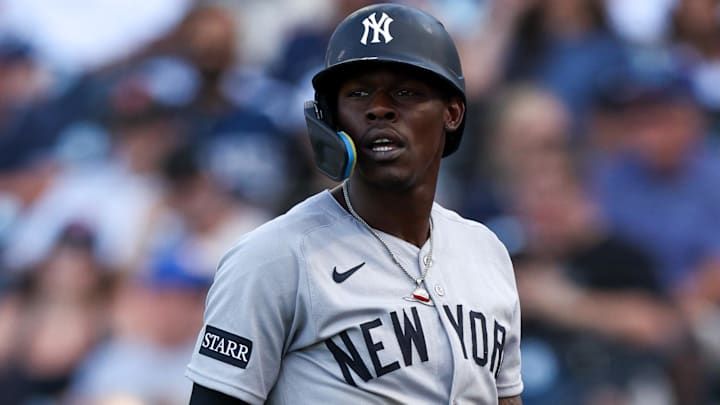
At this moment, Aaron Judge has a .423 batting average, a .510 on-base percentage, a .777 slugging percentage, a 263 OPS+, 11 home runs and 33 RBIs.

He has played in 34 games. At his current rate, he would end the season with 52 home runs and 157 RBIs.

That's insane. That's Babe Ruth numbers, or Barry Bonds on steroids numbers, plus a batting average that even Ted Williams would bug out at.

Judge is 6-foot-7 and 280 pounds of muscle, playing with short fences that the Babe, Mickey Mantle and Reggie Jackson would have given a tooth to hit toward, and not just at his home park -- on any given day, the Yankees can turn any ballpark into "a little league field" -- against pitchers who, when they find the plate at all, are throwing 100 miles per hour but they're mostly meatballs, and not as good as the best pitchers of previous generations.

Yes, he's special. But don't act so surprised at the results. Eventually, a player like Aaron Judge was going to happen. It's not like with Shohei Ohtani, who's big, but not that big: 6-foot-3 and 210, and shouldn't be putting up shocking numbers. (That doesn't make Ohtani better, but, even without the pitching, it might make him harder to believe.)

Anyway, do the Yankees miss Juan Soto? No. He's batting .256, with 5 homers and 14 RBIs. All by himself, Judge is making up his production.

*

But it's not just Judge: The rest of the team has to produce, too.

On Friday night, they started a home series against the Tampa Bay Rays, and produced just enough. Max Fried hit a batter in the 1st inning, walked one in the 2nd, walked another in the 3rd, allowed a single in the 5th, and had a batter reach base due to an error in the 7th. Paul Goldschmidt hit a 3-run home run in the 5th, and that was all the scoring in the game: Yankees 3, Rays 0.

The rest of the series was rainy and depressing. On Saturday, one of those hole-in-the-rotation days, Judge and Austin Wells each hit a home run. Ryan Yarbrough threw 64 pitches over 4 innings, allowing 1 run on 1 hit and 3 walks. He should have been left in for the 5th.

Instead, Aaron Boone brought Ian Hamilton in. He pitched a scoreless 5th. He should have been left in for the 6th.

Instead, Boone brought Fernando Cruz in. He pitched a scoreless 6th and 7th. He should have been left in for the 7th.

Instead, Boone brought Mark Leiter Jr. in. He blew it, allowing single and a walk, getting a strikeout, then allowing a single and a fielder's choice, and turning a 2-1 Yankee lead into a 3-2 Yankee loss.

Injuries to the starting rotation. Cashman instructing Boone not to trust the starters who take their place. Boone's total inability to handle a bullpen. Giancarlo Stanton, DJ LeMahieu, Jazz Chisholm and now, in this game, Anthony Volpe being injured. Put it all together, and it was Rays 3, Yankees 2.

Yesterday was another hole-in-the-rotation day. Will Warren didn't get out of the 5th inning, and it was 5-0 Rays. It was miserable.

How miserable was it? You know how Yankee broadcasters, going back at least as far as Phil Rizzuto, will sometimes talk about anything but the game they're actually getting paid to describe? Well, when it was 5-0 Rays, Michael Kay and former reliever Jeff Nelson were doing the game on YES, and they were talking about not a game at Yankee Stadium, but another New York Sunday institution: The New York Times Sunday Crossword Puzzle.

I occasionally do crossword puzzles. My mother loves them. So did hers. But the real crossword whiz in the family was Mom's Aunt Catherine, who died late last year at the age of 96. Until her eyesight started going at 93, she did the puzzle every day. All 4 of us (me, Mom, Grandma and Aunt Catherine) were in agreement that the Times puzzle starts easy on Monday, then gets progressively harder during the week, until Sunday when it's the hardest. The Times plans it that way, so it's not an opinion, and not an accident. Kay was trying, without success, to convince Nellie that the puzzle is actually at its hardest on Saturdays.

Good thing The Sopranos isn't still on the air, or Kay might have been talking about that.

Cody Bellinger hit a home run in the bottom of the 6th, getting the Yankees to within 5-2. That was given right back in the top of the 7th, by Carlos Carrasco: Single, single, walk, strikeout, 2-run single. 7-2.

As comedian and Yankee Fan Vic Dibitetto would say, "You know what ticks me off?" One thing that ticks me off is when a comeback falls short. In the bottom of the 8th, the Yankees got to within 7-5, and brought the go-ahead run to the plate. But they could get no closer, and the side was struck out in the 9th, ending the game at 7-5.

*

So, 34 games into the season, a little over 1/5th of the way into the season, the Yankees are 19-15, a percentage of .559, or a pace of 90-72. But they lead the American League Eastern Division, by 2 games over the Boston Red Sox, 3 each over the Tampa Bay Rays and the Toronto Blue Jays, and 5 1/2 over the Baltimore Orioles. In the all-important loss column, they lead the O's by 5, and each of the others by 3.

I don't get it. But I'll take it.

Tonight, the San Diego Padres come in for a 3-game Interleague series. Then, the Yankees make their 1st-ever trip to Sacramento, to face the temporarily exiled Athletics.

May 5, 1985: President Ronald Reagan Goes to Bitburg

May 5, 1985, 40 years ago: President Ronald Reagan, in Europe to commemorate the 40th Anniversary of V-E Day, the Allied victory in World War II (May 8, 1945), attends a ceremony, along with the Chancellor of West Germany, Helmut Kohl, at Kolmeshöhe Military Cemetery in Bitburg, in the Rhineland, near Germany's borders with France and Luxembourg.

The announcement that the visit, part of Reagan's larger mission to Germany, which also included an "economic summit" of the "Group of Seven" or "G7" countries (also including Canada, Britain, France, Italy and Japan) in Bonn, then the capital of West Germany, was made on April 11.

The visit was seen by Reagan and his supporters as a gesture of reconciliation. But after the arrangements had already been made, it was discovered that, of the 2,000 graves at that cemetery, in addition to ordinary German soldiers -- one was never identified, so his tombstone read simply, "Ein Deutschen Soldat" -- there were the graves of 49 members of the Waffen-SS. (Waffen meaning "Armed," so this was the military arm of the SS, which stood for Schutzstaffel, meaning "Protection Squadron").

These were not men who had done no more politically than fight for their country, even if it was against America. The postwar Nuremberg Trials had declared the entire SS to be a terrorist organization. These were officers, volunteers, men devoted to the Nazi cause, perfectly willing to torture and kill those they saw as less than the German ideal.

And Reagan had agreed to visit their graves.

I was 15 years old at the time, and an American of Polish descent on one side of my family, and Jewish descent on the other. To me, the biggest outrage was that there wasn't more outrage over this. There were still a lot of World War II veterans -- and a lot of Holocaust survivors -- alive in America, to whom this was an implicit insult.

Or, to put it another way: Suppose, at the 50th Anniversary celebrations in 1995, President Bill Clinton, a Democrat, had visited the graves of KGB agents in Russia. (Spoiler Alert: He didn't do that.) The Republicans would have had an unholy fit. That should have been the reaction of decent people in America, Republicans as well as Democrats, over Reagan's plan to go to Bitburg.

Some did react with anger. Some, merely with sadness. Speaking of Clinton, at the time, he was in his 3rd term as Governor of Arkansas. His daughter Chelsea was just 5 years old, and she wrote a letter to Reagan, asking him to call off the visit to the cemetery.

A long-scheduled ceremony in the White House on April 19, awarding the Congressional Medal of Achievement, provided author and Holocaust survivor Elie Wiesel -- who would be awarded the Nobel Peace Prize the following year -- with an unprecedented opportunity to publicly confront the White House on national television.

Despite fierce pressure to mute the confrontation with Reagan, whose strong support of Israel was valued, Wiesel implored him not to go to Bitburg. He said, "That place is not your place. Your place is with the victims of the SS."

Other Jewish leaders similarly called on Reagan to reconsider, as did 53 U.S. Senators on April 15, and 101 members of the U.S. House of Representatives on April 19 in bipartisan letters to the President.

Upon meeting with Kohl, a change of plans was made. "The leader of the free world" and the leader of democratic, tolerant postwar Germany would first visit the Bergen-Belsen concentration camp, to pay tribute to the Nazis' victims, before going to Bitburg, leaving just 8 minutes for the visit.

Of course, "The Teflon President" got away with it, just like he got away with everything else.

Friday, May 2, 2025

This Is How

Over the 3 games the Yankees played at Camden Yards, the Yankees outscored the Baltimore Orioles, 22-12. But this is baseball: We don't assign series wins based on aggregate scoring. It doesn't work that way.

Will Warren started on Monday night, and didn't get out of the 4th inning. The Yankees were down, 4-0 after 3 innings. They closed to within 4-3 in the 8th, but got no closer.

Tuesday night was when the Yankees unloaded the lumber. Trent Grisham led off the game with a home run. Aaron Judge hit one. Ben Rice hit one. Paul Goldschmidt grounded out, then Cody Bellinger hit one. Jazz Chisholm doubled, but he had to leave the game due to an injury. Oswald Peraza pinch-ran for him, and Anthony Volpe doubled him home. It was 5-0 Yankees before Carlos Rodón threw a pitch.

And when he did start throwing pitches, he was dealing. He had a perfect game going for 5 innings. He started the 6th by walking Emmanuel Rivera, then allowed a double to Jorge Mateo, and then an RBI groundout to Dylan Carlson. Rice hit another homer in the 2nd inning, and Austin Wells hit one in the 9th. The Yankees won, 15-3.

Carlos Carrasco started on Wednesday night, but he allowed 4 runs in the bottom of the 2nd, and that was pretty much it. Judge and Goldschmidt hit home runs, but the Yankees lost, 5-4.

The Yankees go into tonight's home series with the Tampa Bay Rays at 18-13, 2 games ahead of the hated Boston Red Sox in the American League Eastern Division. But Chisholm was put on the Injured List, and Giancarlo Stanton was just moved to the 60-Day version of it. How is it hard to be optimistic about a 1st-place team? This is how.

May 2, 1950: The Smathers Smears -- Real and Otherwise

 
George Smathers

May 2, 1950, 75 years ago: The Democratic Primary is held in Florida. With the Republican Party then having very little standing in the South, winning this Primary is, as the saying goes, "tantamount to election."

Born and raised in Alabama in 1900, Claude Pepper served in World War I and graduated from the University of Alabama and Harvard Law School. He established a legal practice in Florida, and in 1936 won a special election for the U.S. Senate in that State. He was re-elected in 1938 and 1944, and was up for election again in 1950.

Born in 1913 in Atlantic City, New Jersey, George Smathers was the son of a Floridian, who moved the family back to Miami. He graduated from the University of Florida and served in World War II. In 1946, he asked Pepper for help getting elected to Congress. He got it, and won.

How did Smathers thank Pepper? By opposing him in the 1950 Democratic Primary, and running an incredibly dirty campaign, based on the current anti-Communist "Red Scare." He opened his campaign on January 12, with a speech at Kemp's Coliseum in Orlando, accusing Pepper of being "the leader of the radicals and extremists," an advocate of treason, and a person against the constitutional rights of Americans.

Pepper had traveled to the Soviet Union in 1945 and, after meeting Soviet leader Joseph Stalin, declared he was "a man Americans could trust." Additionally, Pepper supported universal health care, sometimes referred to as "socialized medicine." Pepper's opponents called him "Red Pepper," and widely circulated a 49-page booklet titled The Red Record of Senator Claude Pepper.

Smathers accused the "Northern labor bosses" of paying black people to register and vote for Pepper. That accusation turned out to be true: Unlike Smathers, a traditional Southern "Dixiecrat" who favored segregation, Pepper did not. But neither did he openly oppose integration and interracial marriage, and so the Florida media claimed he supported them. Orlando Sentinel publisher Martin Andersen published a doctored photograph of Pepper shaking hands with a black woman in Sanford.

In its April 17, 1950 issue, Time magazine, then run by archconservative Henry Luce, published a story about a speech Smathers had given many times in rural parts of Florida. It became known as "The Redneck Speech":

Are you aware that Claude Pepper is known all over Washington as a shameless extrovert? Not only that, but this man is reliably reported to practice nepotism with his sister-in-law, he has a brother who is a known homo sapiens, and he has a sister who was once a thespian in wicked New York. Worst of all, it is an established fact that Mr. Pepper, before his marriage, habitually practiced celibacy.

Here's a question: Presuming that the charges against his brother and his sister were true -- and they were -- what did that have to do with his qualifications? Basically, the only thing this paragraph said that reflected badly on Pepper was the nepotism, which was also true. The problem was, people heard the words, and, not fully understanding them, compared them to words they did know, and were horrified, to the point where they couldn't possibly vote for Pepper.

The quote was a fake: Smathers never said it. He was happy to accept the benefits of it, but he never said it. No newspaper in Florida ever mentioned the speech. Smathers offered $10,000 -- about $135,000 in 2025 money -- to anyone who could prove he said it.

When the Primary was held on May 2, Smathers got 387,315 votes, to Pepper's 319,754. Percentage-wise, it was Smathers 54.8, Pepper 45.2. It was a landslide.

Seeing this, a Republican activist in California spoke to Representative Richard Nixon, who was running for the State's Senate seat against Representative Helen Gahagan Douglas, and told him that a publication like The Red Record would be useful against her.

The California Republican Party printed up 500,000 copies of "The Pink Sheet," listing reasons why Douglas was a Communist sympathizer, or a "pinko," rather than an outright Commie, or a "Red." Most of the reasons were ridiculous, including her support for blacks and Jews. Nixon called her "The Pink Lady," and said, in language that was a bit over-the-top for 1950, that she was "pink right down to her underwear." He won, with 59 percent of the vote -- but she gave him the nickname that would stick to him for the rest of his life: "Tricky Dick."

Smathers won the general election against the Republican nominee, Miami-area attorney John P. Booth, with 76 percent of the vote. He was re-elected in 1956 and 1962, all the while playing the "Dixiecrat," opposing civil rights legislation. Smathers did, however, vote for "socialized medicine" in 1965, when it was called Medicare and Medicaid.

Smathers was a close friend of John F. Kennedy, and served as a groomsman at his wedding to Jacqueline Bouvier in 1953, and that's the nicest thing I can say about this bum. He was also a friend of Nixon, sold his Key Biscayne house to him (where Nixon said he was when he found out about the Watergate break-in), and introduced Nixon to his infamous Florida friend Bebe Rebozo.

Like a lot of corrupt conservatives, George Smathers became a lobbyist after leaving Congress, because that's where the real money is. He died in 2007, at the age of 93, having never had to pay the $10,000 bounty on proof he gave "The Redneck Speech."

His son, Bruce Smathers, was elected Florida's Secretary of State in 1974 and 1976. He ran for Governor in 1978, losing the Democratic Primary to Bob Graham. In 1986, Graham won the Senate seat that had been held by Claude Pepper and George Smathers. (And, in between, by Republican Edward Gurney from 1969 to 1975, by Democrat Richard Stone from then until 1981, and the by Republican Paula Hawkins.)

Incredibly, Pepper did manage to come back, getting elected to the U.S. House of Representatives in 1962, supporting civil rights legislation, and, recognizing that his Miami-area district had a lot of retirees, became Congress' foremost champion of Social Security and Medicare. From 1983 to 1989, he was the Chairman of the Rules Committee, making him, arguably, the 2nd-most powerful member of the House, behind the Speaker.
By the time of this 1983 cover,
Henry Luce had been dead for 16 years,
and Time had gotten considerably more liberal.

Or, to put it another way: Had Pepper won in 1950, he might have lost in the Eisenhower landslide of 1956, and not recovered. Or, if he had won again then, the shift of the South might have doomed him in 1962, or 1968. He would never have become Senate Majority Leader, and if he had risen to the Chairmanship of a powerful Senate committee, he would have lost that in an election. And even if he got elected to the House later on, he wouldn't have become the Congressman he became.

Today, Claude Pepper is fondly remembered as a great public servant, while George Smathers, when he is remembered at all, is remembered for evil stands that he took, and an evil speech that he never gave. In other words, in the long run, not only was Pepper better off for losing that 1950 election, but he was better off than the man who won it.

Pepper died in office in 1989, at the age of 88, having outlived a lot of those retirees. But in the special election that followed, his seat was won by a Republican, Cuban exile Ileana Ros-Lehtinen. It was a harbinger of Florida's lurch to the political right. Today, a white politician in Florida is likely to be a Republican, and so far to the right as to make Smathers look like Pepper by comparison.

Florida has grown so much that Pepper's District was the 3rd when he first won the seat, but is now listed as the 27th. Today, it is represented by a Republican woman of Cuban descent, María Elvira Salazar, who had long been a news anchorwoman for a local Spanish-language TV station.

Thursday, May 1, 2025

May 1, 1975: Hank Aaron Becomes the All-Time RBI Leader

May 1, 1975, 50 years ago: Hank Aaron breaks another career record that had been held by Babe Ruth -- and hardly anybody notices.

On April 8, 1974, playing for the Atlanta Braves, Aaron hit the 715th home run of his career, surpassing Ruth as the all-time leader in that category. He finished the season with 733. On November 2, the Braves, who had moved from Milwaukee to Atlanta for the 1966 season, traded him to the team that replaced them in the beermaking city, the Milwaukee Brewers, for Dave May and Roger Alexander. Aaron returned to the city where he began his career, and was warmly welcomed by their fans.

At the age of 41, in the American League for the 1st time, Aaron, formerly a right fielder and 1st baseman, was now usually the Brewers' designated hitter. He came into the game of May 1 with 2,209 career runs batted in, tied with Ruth for the most all-time. But, with only a fraction of the attention that his pursuit of 715 home runs had gotten, it seemed like hardly anyone cared, or even noticed, his pursuit of 2,210 RBIs.

In the bottom of the 3rd inning at Milwaukee County Stadium, Aaron singled home Sixto Lezcano. This gave him 2,210 career RBIs, and also gave the Brewers a 2-2 tie with the Detroit Tigers. In the 5th, he hit a double, scoring Robin Yount, for his 2,211th RBI. That gave the Brewers a 5-3 lead.

Yount, who would one day join Aaron in the Baseball Hall of Fame, went 2-for-6 with 4 RBIs. He and Darrell Porter would both hit home runs. The Brewers won in a blowout, 17-3. The Brewers were slowly improving, but would not contend for the Playoffs until 1978. But, for the moment, they were better than the Tigers: In their 1st season without Al Kaline on their roster since 1952, they had one of their worst seasons ever.

On February 3, 1976, Major League Baseball's Records Committee revised Ruth's career RBI total to 2,204. In actuality, Aaron set the record with 2,205 on April 18, 1975. But nobody knew that at the time.

Aaron retired after the 1976 season, with 3,771 hits, 1,477 extra-base hits, 6,856 total bases, 755 home runs, and 2,297 RBIs. The hit total was then 2nd all-time behind Ty Cobb. The other figures were all-time records. While Barry Bonds used steroids to hit 762 career home runs, Aaron still holds the career records for extra-base hits, total bases and RBIs.

As of April 22, 1975, the active MLB leader in RBIs is Freddie Freeman, with 1,243. He turns 36 on September 12. He is not going to catch Aaron.

May 1, 1965: Montreal 13 Cups, Liverpool 1

Jean Béliveau with 2 of his closest friends

May 1, 1965, 60 years ago: In the 1st NHL game to be played after April, the Montreal Canadiens win their 13th Stanley Cup, taking the all-time lead from the Toronto Maple Leafs, who had won their 12th the year before. They have never given that lead up. They beat the Chicago Black Hawks, 4-0, in Game 7 of the Finals at the Montreal Forum.

The first Conn Smythe Trophy for most valuable player of the Playoffs – the entire playoffs, unlike other sports where it’s given only to the MVP of the finals – is awarded in honor of the former head coach and general manager of the Maple Leafs, the very Canadian, and very English, World War I hero and World War II officer, Constantine Falkland Cary Smythe, who, though no longer in charge of the team, was still alive. (He lived until 1980.)

And it went to a player on the Montreal Canadiens. Their Captain. A native of Quebec City, the capital of the French-speaking Province in Canada, a man who did not speak English until he became a major leaguer. Joseph Jean Arthur Béliveau. Known as Jean Béliveau, he scored in this Game 7. So did former Maple Leaf Dick Duff; the very French "Roadrunner," Yvan Cournoyer; and Henri Richard, brother of the retired superstar Maurice "the Rocket" Richard, another proud Francophone, who would succeed Béliveau as Captain (and would, himself, be succeeded by Cournoyer).

This was not a good day to be a Maple Leafs fan -- especially Smythe. At least he did not have to hand over the Cup, or the new Trophy bearing his name. That was the duty of the President of the NHL, Clarence Campbell, a man often considered his subordinate.

Béliveau, Richard, Duff, Cournoyer, Jacques Laperrière, goaltender Lorne "Gump" Worsley, head coach Hector "Toe" Blake and general manager Frank Selke, are in the Hockey Hall of Fame. Béliveau went on to play on 10 Cup-winning teams, and lived until 2015.

The Canadiens would win the Cup again in 1966. In 1967, the Leafs would beat them in the Finals, cutting the deficit to 14-13. But the Leafs have not been back to the Finals since. They are stuck on 13 Stanley Cups. The Canadiens now have 24.

*

On this same day, the FA Cup Final was played at the old Wembley Stadium in London. Liverpool FC beat Leeds United AFC, 2-1. The Mersey Reds, under manager Bill Shankly, win the FA Cup for the 1st time. The game is scoreless after regulation, but Liverpool's Roger Hunt and Leeds' Billy Bremner trade goals in extra time, before Ian St. John wins it in the 113th minute. Liverpool Captain Ron Yeats accepts the Cup from Queen Elizabeth.
Leeds thus do a "Runner-Up Double," finishing 2nd in the League and losing the FA Cup Final in the same year. While they do win some trophies in the 1960s and '70s, their pattern of being the era's "nearly men" has been set.

Leeds do, however, produce a notable first: Albert Johanneson, a left winger (in position, possibly also in politics) from South Africa, was the 1st black man to play in an FA Cup Final. By 1974, Bremner, as captain of both Leeds and Scotland, would seem to forget this, race-baiting the Zaire players at the World Cup.