Saturday, March 13, 2021

Top 5 Reasons You Can’t Blame the Chicago Cardinals for Moving to St. Louis

March 13, 1960: Violet Bidwill moves the National Football League's Chicago Cardinals to St. Louis. The widow of former team owner Charles Bidwill, she had married Walter Wolfner, and St. Louis was his hometown.

The Cardinals were a charter franchise in the NFL in 1920, along with another Chicago team -- the Chicago Tigers, who folded after that one season. Before that, they had been the Racine Normals, and before that, the Morgan Athletic Club. They began playing in 1898, playing at Normal Field on Racine Avenue on the South Side.

In 1901, they bought used uniforms from the University of Chicago, which called its teams the Maroons. But the reason UC had been willing to sell the uniforms is that they had faded. Chris O'Brien, the original owner, looked at the uniforms, and said, "That's not maroon, it's cardinal red." So the team became the Racine Cardinals. In 1922, they moved to Comiskey Park, sharing it with the White Sox.
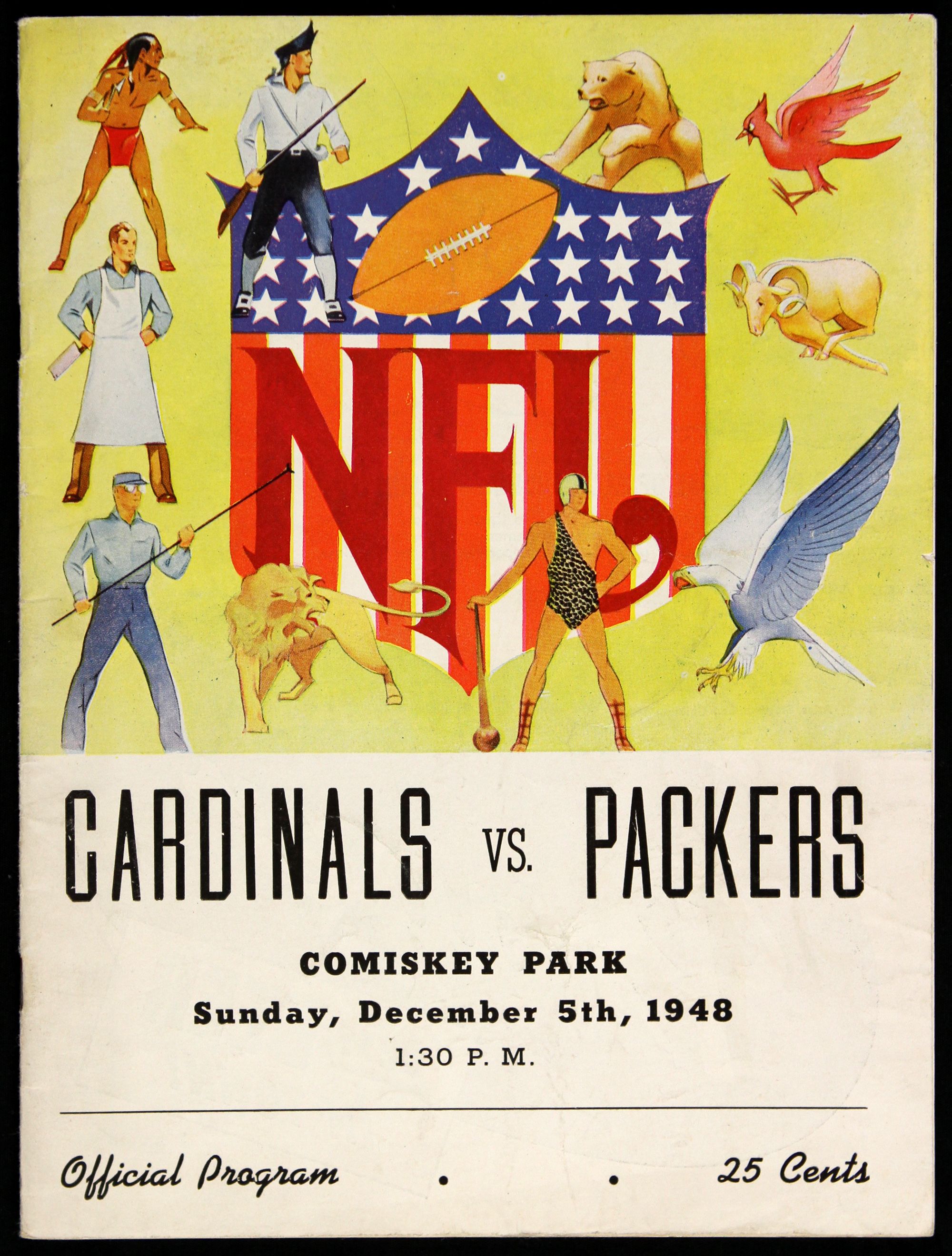
Comiskey Park, set up for football,
before the installation of the famous "exploding scoreboard."

A move to Soldier Field in 1959 didn't work out, so they moved to St. Louis, in spite of that city already having a baseball team named the St. Louis Cardinals. To differentiate themselves, the baseball team tended to call itself the Redbirds, and the football called itself the Big Red.

I suppose the football team could have named themselves after Walter: The St. Louis Wolves. After all, no team in major league sports then had "wolves" as part of their name. But the name "St. Louis Wolves" had already been used as the name of the baseball team in Abbot & Costello's "Who's On First?" routine.

They shared Sportsman's Park until moving into the new Busch Memorial Stadium in 1966. By that point, Violet's sons Charles Jr. and William had inherited the team, and forced their stepfather out. Billy bought Charles out in 1972.

The move to St. Louis didn't work out, and after the 1987 season, Violet's son, Billy Bidwill, moved he team to the Phoenix area, becoming the Phoenix Cardinals in 1988, and changing the name to the Arizona Cardinals in 1994.

In 1998, the team celebrated its 100th Anniversary, claiming to be the oldest active professional football franchise.  Even if you don't count the Canadian Football League -- the Hamilton Tiger-Cats can trace their history back to 1869, and the Toronto Argonauts theirs to 1873 -- the claim is dubious. The Racine Cardinals had suspended operations after the 1906 season. They started up again in 1913, but stopped again in 1918, due to World War I and the Spanish Flu epidemic, starting again in 1919.

They won the NFL Championship in 1925 (the story of how they were crowned is a doozy, and it's still disputed), beat the Philadelphia Eagles in the 1947 NFL Championship Game, and lost a rematch to the Eagles in 1948. Then things went sour, as several seasons were disastrous: 3'9 in 1951, 1-10-1 in 1953, 2-10 in 1954, 3-9 in 1957, 2-9-1 in 1958, and 2-9 in 1959. And so, for 1960, they moved.

Top 5 Reasons You Can’t Blame the Chicago Cardinals for Moving to St. Louis

5. The Death of Charley Bidwill. Charles Bidwill Sr. had been a minority owner of the Bears, and wanted to buy them from George Halas. But "Papa Bear" wouldn't sell, because he loved being the dictator of that team. So, following a handshake agreement with Dr. David Jones, owner of the Cardinals, Bidwill sold his Bears stock, which he had to do first, and then bought the Cardinals for $50,000 -- a shade over $1 million in today's money. Sounds like a steal.
Charley Bidwill

Things got rough: They merged with the Pittsburgh Steelers in 1944, due to the manpower shortage of World War II. There were listed in the standings as "Card-Pitt," but were so bad, they were nicknamed the Carpets, because everyone walked over them. They went 0-10. But things got better after The War, and they won the 1947 title.

It was too late for Charley: On April 19, 1947, he died of pneumonia at the age of just 51. His widow, Violet, became the 1st female majority owner in pro football history. But she knew nothing about running the team. Nor did her next husband, Walter Wolfner. The quality on the field plummeted, and so did attendance, to the point where the Bidwills were barely afloat.
Violet Bidwill Wolfner

Had Charley lived, he could have kept the team winning in the 1950s, or perhaps rebuilt into a contender, and maybe they wouldn't have had to move.

4. The AFL. The Bidwills were almost broke in the late 1950s, and wanted to move. But the NFL -- with Bert Bell as Commissioner, and his good friend George Halas helping to call the shots -- demanded a large relocation fee.

So the Bidwills looked to out-of-town investors. The problem was, while the family was willing to move, they would only sell a minority stake, as they still wanted control of the franchise. That turned out to be unacceptable to the would-be investors.

Those would-be investors included:

Lamar Hunt of Dallas, who had already tried to get an expansion team for his city, and was turned down. So he founded the American Football League, and placed his team, the Dallas Texans, in his city. The NFL struck back, by placing the Dallas Cowboys there. After 3 seasons that were successful on the field but not at the box office, he moved them, and they became the Kansas City Chiefs.

* Bud Adams of Houston. He hooked up with Hunt, and became the founding owner of the Houston Oilers, winning the 1st 2 AFL titles in 1960 and '61, and losing the '62 title game to Hunt's Texans.

* Max Winter of Minneapolis. In 1961, after failing to buy the Cardinals and move them to the Twin Cities, he succeeded in getting an NFL expansion team, the Minnesota Vikings.

* Bob Howsam of Denver. He was the owner of minor-league baseball's Denver Bears, and was trying to get a major league team for his city. He, Hunt, Adams and Winter were among the backers of the Continental League, which got outflanked when the American League and the National League chose to expand for the 1961 and '62 seasons.

Howsam became the original owner of the AFL's Denver Broncos, but quickly had to sell to Gerald Phipps. He also sold the Denver Bears, but became the general manager of the Cincinnati Reds, building the Big Red Machine. He was not a part of the Colorado Rockies' ownership group when they began play in 1993, but he lived just long enough to see them win their 1st Pennant in 2007.
The AFL's logo

With the AFL's founding, the NFL's owners, led by new Commissioner Pete Rozelle -- Bell had died during the 1959 season -- were concerned that the AFL would plant stakes in cities without NFL teams, and succeed there.

They were right: While New York, Los Angeles and San Francisco (through Oakland) got challengers, Boston, Buffalo, Dallas, Houston and Denver did not (yet) have NFL teams. Since expansion was a possibility (and the AFL did put teams in then-NFL-less Miami and Cincinnati), St. Louis would have been a target. So the NFL decided to make it easier for the Bidwills to move there.

3. St. Louis. Baseball's Cardinals had succeeded there. Thus far, so had basketball's Hawks. Two previous NFL teams had failed there, but the 2nd was back in 1934, during the Great Depression. It seemed like time for the city to try again.
Downtown St. Louis, circa 1960

At the time, the City of St. Louis had a population of about 750,000, while the surrounding County of St. Louis had another 700,000. It was a big city, and it didn't have an NFL team, nor was the AFL trying to get in.

What these facts obscured was the fact that the City had already lost about 100,000 people in the 1950s, but the suburbs had almost doubled in size. It was still a big market, but a new stadium would be needed to replace the North Side's Sportsman's Park, which seated only 31,000 people, although the addition of temporary bleachers in right field raised capacity to about 40,000. The new Busch Stadium, downtown, was big enough and accessible enough. So if the team had to move, St. Louis seemed like a good place to go.
Sportsman's Park, set up for football
 
2. The Chicago Bears. The Monsters of the Midway dominated the NFL from 1940 to 1946. But the Cardinals won the title in 1947 and reached the title game again in 1948. After that, through 1959, only once did either team reach the title game, the Bears in 1956, and they got slaughtered by the New York Giants.

But the Bears' early Forties success meant that they were the more popular team in the Chicago media market, and would stay that way. The Bears did a better job of promoting their players, as Halas played well with the media, both local and national. And the other NFL team owners liked Halas, and treated Mrs. Bidwill (later, Mrs. Wolfner) as if she was a woman who knew nothing about football. Which may have been accurate, but it certainly wasn't fair.
George Halas. If any man can be called "Mr. NFL," it is he.

Her sons William and Charles knew they couldn't compete with Papa Bear and his team. Sure enough, the Bears won the title in 1963, and with such legends as Mike Ditka, Gale Sayers and Dick Butkus, remained popular even when they weren't winning. At least in St. Louis, the Cardinals didn't have to compete with anyone else for the local media.

1. It Worked. At first. In their 1st season in St. Louis, they went 6-5-1. By 1963, they were 9-5. In 1964, they went 9-3-2, finishing 2nd to the Cleveland Browns in the NFL Eastern Division. They managed and 8-5-1 season in 1966, a 9-4-1 season in 1968, and another 8-5-1 season in 1970. After 3 down seasons, they went 10-4 to win the NFC Eastern Division in 1974, 11-3 to win the Division in 1975, and 10-4 (but failed to win the Division) in 1976.
Yes, things would go south again, as they only made the Playoffs once more, in the strike-shortened season of 1982. And it took them until 1998 to make the Playoffs again in Arizona, and until 2008 to make them again, reaching Super Bowl XLIII. And, after moving there in 1995, except for a blip from 1999 to 2004, the Rams didn't succeed in St. Louis, either, and moved back to Los Angeles after the 2015 season.

But from 1960 to 1976, it sure looked like St. Louis was a football town. Why the Cardinals finally failed in St. Louis is a discussion for another time.

VERDICT: Not Guilty. Staying in Chicago would have done the NFL's Cardinals no good.

Top 5 Reasons You Can't Blame Les Harrison for Moving the Rochester Royals to Cincinnati

March 13, 1957: The Rochester Royals beat the St. Louis Hawks, 104-99 at the Rochester Community War Memorial Arena, or "The War Memorial" for short, in Rochester, New York. The Royals got a balanced attack: Bob Burrow scored 19 points, Maurice Stokes 17, Jack Twyman 15, Art Spoelstra 14, and Tom Marshall and Dave Piontek 10 each. This overcame 22 points by the Hawks' Ed Macauley.

It was the Royals' last game of the regular season, and, at 31-41, they had the worst record in the NBA, so they didn't make the Playoffs. So this would be the last game they ever played. 

The team was founded by the brothers Lester and Joseph Harrison, known as Les and Jack, and entered the National Basketball League for the 1945-46 season. At first, they played at the Edgerton Park Arena. In that 1st season, the Royals won the Championship of that Midwest-based league, and reached the Finals in each of the next 2 seasons, but lost.

The Basketball Association of America was founded for the 1946-47 season, based mostly in the Northeast. In 1949, the NBL and the BAA merged to form the National Basketball Association, which dates its founding to the 1946 formation of the BAA. The Royals joined, and won the Championship in 1951, with "Lucky Les" (who had starred as a player at East High in Rochester) as head coach, defeating the New York Knicks in 7 games.
Among the Royals' players were Basketball Hall-of-Famers Bob Davies, Bobby Wanzer, Al Cervi, Arnie Risen, Pop Gates, Alex Hannum, and future Knicks coach Red Holzman, who was elected as a coach, but was also a very good player, making 2 All-NBL Teams before the institution of the NBA All-Star Game in 1951. Les Harrison has also been elected to the Hall, in the Contributor category.
Bob Davies. He had starred at Seton Hall,
and a banner honoring him hangs
at the Prudential Center in Newark.

In 1955, the Royals moved to the 11,000-seat War Memorial. Among the construction workers was Robert Morella, who became one of the most popular professional wrestlers of the 1960s and '70s, under the name Gorilla Monsoon. Like the Philadelphia and Baltimore Civic Centers, it had a horseshoe-shaped seating area with a stage at one end.

Like the Baltimore version (now the Royal Farms Arena), but unlike the Philadelphia version (demolished to make way for a hospital), it still stands, under the name of the Blue Cross Arena It serves as the home of one of the most historic minor-league hockey teams, the Rochester Americans. It is also the home of the Rochester Nighthawks of the National Lacrosse League. 
For a while, on a court named for Les Harrison, it hosted the minor-league Rochester Razorsharks. Since 1963, it has hosted the Kodak Classic, an annual college basketball tournament founded by Les Harrison, and named for the photography company that put Rochester on the world's map.

But the arena no longer hosts professional basketball. After the 1956-57 season, the Harrison brothers moved the team to Cincinnati. Cincy is known as "The Queen City of the Midwest," so the name "Royals" still fit.

The experiment didn't work. The Royals got to the NBA Eastern Conference Finals in 1963 and 1964, but not to an NBA Finals, unable to get past the Boston Celtics. In 1966, the Harrisons sold the team to another pair of brothers, Max and Jeremy Jacobs. Jeremy would later buy the NHL's Boston Bruins. In 1972, the team was moved to Kansas City, which already had a baseball team called the Royals, so they became the Kansas City Kings.

In 1985, under yet another owner, they moved again, becoming the Sacramento Kings. In the 21st Century, there were threats to move to Anaheim and Seattle, before the Golden 1 Center was built, to keep them in California's capital.

To this day, the Kings hang a banner with the name "ROCHESTER," the NBA logo (the silhouette of Jerry West), and the legend "WORLD CHAMPIONS 1951" -- even though that was 70 years and 3 cities ago. That 70-year drought is easily the NBA's longest. And it's actually 4 cities, if you count the fact that the team was actually the Kansas City-Omaha Kings from 1972 to 1975, playing some home games in Nebraska.

Whether they should have stayed in Cincinnati, or in Kansas City, or in Omaha, is each a discussion for another time. But maybe leaving Rochester set them on a path to moving around, and to failure: In the 64 years since leaving Rochester, they have won just 9 Playoff series (and haven't even made the Playoffs since 2006, the NBA's longest current drought), and have never made the NBA Finals. They reached the Conference Finals in 1963 and 1964 in Cincinnati, did so in 1981 in Kansas City, and have done so in 2002 in Sacramento. That's just 4 trips to the NBA's round of 4 in 70 years. That's pathetic.

Should they have left Rochester?

Top 5 Reasons You Can't Blame Les Harrison for Moving the Rochester Royals to Cincinnati

5. Seagram. The liquor producer had sponsored Les' 1st pro basketball team, and also sponsored the Royals at first. But they did not support his wish to take them into the larger league that was formed with the NBL-BAA merger. Had they stuck with him, the team might have lasted longer.

4. Television. Seeing Major League Baseball games on TV helped to kill the Negro Leagues and devastate the minor leagues. That didn't affect the NBA much, since there was almost no overlap in season.

But the rise of TV did give people a reason to stay home during basketball season. What's more, unlike MLB, boxing, horse racing and (eventually) the NFL, in the 1950s, the NBA didn't handle TV well. You'd think it would, since the court was small enough for cameras to easily follow. (Horse racing was then popular on TV because, despite having the largest "field," the horses were all bunched together, making for easy camera work.) Games were locally broadcast, but not nationally, and the teams just didn't get enough revenue from it.

3. The NBA. Like the NFL, it had started in smaller cities in the Northeast and the Midwest, and all those cities would turn out to be to small to keep the league going, and would lose their teams, except for Green Bay, Wisconsin.

There were 4 teams that didn't even survive the 1st BAA (NBA) season of 1946-47: The Pittsburgh Ironmen, the Cleveland Rebels, the Detroit Falcons and the Toronto Huskies -- and those were all big cities at the time. By the dawn of the 1950-51 season, Providence, St. Louis, Washington and even Chicago had lost their teams. The next season, Indianapolis followed. And the original version of the Baltimore Bullets, NBA Champions in 1948, folded early in the 1954-55 season.

The Royals/Kings aren't the only team that has made several moves. One of the charter BAA teams was the Buffalo Bisons. They didn't even make it to the New Year in that 1st season, moving to Moline, Illinois, next-door to Rock Island, and across the Mississippi River from Davenport and Bettendorf, Iowa. They became the Tri-Cities Blackhawks. (The region is now known as the Quad Cities.) They only stayed until 1951, became the Milwaukee Hawks, and then moved again in 1955, becoming the St. Louis Hawks, the team the Royals played in their last game in Rochester. In 1968, they moved again, becoming the Atlanta Hawks.

The Royals weren't even the only team moving in 1957: The Fort Wayne Pistons moved to Detroit. (As with the Royals, the name made even more sense in their new city than in their old one.) In 1960, the Minneapolis Lakers, winners of 5 titles, moved to Los Angeles.

In 1961, an expansion team called the Chicago Packers began. After 1 year, they became the Chicago Zephyrs, probably because Chicagoans didn't want to root for a team called the Packers. In 1963, they became the new Baltimore Bullets. In 1973, they moved to Washington. In 1997, the Washington Bullets became the Washington Wizards.

So the moving of teams wasn't something the early NBA establishment frowned upon. They would have been more surprised if the Harrison brothers had tried to stay in Rochester. Especially when there were other options.

2. Cincinnati. At the time, it looked like a good market. Between the University of Cincinnati and Xavier University, it had proven itself to be a good market for college basketball. There wasn't much competition: The overlap with baseball's Reds was minimal, since the NBA Playoffs had yet to extend into May; and there was no professional football team, just UC.
Cincinnati, circa 1957

On February 1, 1957, the Royals had played a regular-season game in Cincinnati, at the Cincinnati Gardens. Two of the Royals' players, Jack Twyman and Dave Piontek, were Cincinnti natives, and suggested the game. Playing games at neutral sites, in order to build up NBA fandom in places where the league didn't have teams, was fairly common in those days before a national TV contract would make such games unnecessary.

The Royals beat the Pistons, 96-80. The Gardens was roughly the same age and size as the War Memorial: It was relatively new, opening in 1949; and seated 10,000, slightly less. It, too, had the horseshoe shape with a stage at one end. The game was a sellout, unlike most of the Royals' games in Rochester.
At the time, Cincinnati was home to about 500,000 people. Today, it's only a little over 300,000, thanks to "white flight." And with just 2.8 million people, it's one of the smallest metropolitan areas with a major league team in any sport.

And the city did lose the Royals in 1972. Despite the building of the Riverfront Coliseum in 1975, the NBA has never returned. The Gardens was torn down in 2018, and the Coliseum, now the Heritage Bank Center, has had minor-league hockey as its main program for most of its history.

1. Western New York State. While Cincinnati's population has shrunk significantly, Rochester didn't have a whole lot of people to lose. Even in 1957, it was home to only about 330,000 people, a little more than Cincinnati has now. Today, despite a reputation for scientific research, and for being the basis of the city of Port Charles on the ABC soap opera General Hospital, Rochester has barely over 200,000 people, with a metro area less than half the size of Cincinnati's, at 1.1 million.
A recent photo of downtown Rochester

This is matched by the other cities in Western New York. Syracuse lost the NBA's Nationals in 1963, becoming the Philadelphia 76ers. Like Rochester, Syracuse has a longtime team in minor-league hockey, the Syracuse Crunch. Both cities also have long had teams in baseball's Class AAA International League, the Rochester Red Wings and the Syracuse Chiefs. But not in the major leagues in either sport.
Frontier Field, home of the Rochester Red Wings since 1996

As stated earlier, Buffalo had already lost the BAA's Bisons in 1946. Buffalo also had a team called the Buffalo Bills in the All-America Football Conference from 1946 to 1949, but when the NFL took 3 teams from the AAFC, they took the Cleveland Browns, the Baltimore Colts and the San Francisco 49ers. It became known as "The Screwing of Buffalo."

Buffalo would gain the AFL's version of the Bills in 1960, and the NBA's Braves and the NHL's Sabres in 1970, the same year the Bills became part of the AFL-NFL merger. The Braves would move in 1978, and are now the Los Angeles Clippers. And the Bills and Sabres have both faced the possibility of having to move. Today, both are still struggling, despite both being owned by billionaires Terry and Kim Pegula.

Remember the movie It's a Wonderful Life? George Bailey (played by Jimmy Stewart), operator of a building and loan association, is shown what his New York State hometown of Bedford Falls would have been like if he had never been born.

He sees that the company his father had founded had gone out of business, because George wasn't there to save it; the low-income housing George had built wasn't built; Henry Potter, the miserable old man who controlled everything in town but the building and loan, had changed the town's name to Pottersville; and, like an organized crime boss, he let other businessmen do what he pleased, so long as he got his cut.

And what businesses were doing well? Bars and casinos. The very things that, today, are pretty much the only businesses doing well in New York State, thanks to the local Native tribes getting casino licenses. In 2009, at the depth of a recession, a New York Times writer pointed this out, and contrasted it with the housing market that George Bailey once ran. The writer concluded that, for the sake of the future of the State of New York, the kindhearted Bailey was wrong, and the old bastard Potter was right. (And you thought the Times was a liberal newspaper.)

Put simply, New York State, from the capital of Albany on west through Syracuse, Rochester and Buffalo, simply can't support major league sports in the modern era.

VERDICT: Not Guilty. If Les Harrison (1904-1997) and his brother Jack hadn't moved the Royals when they did, they would have had to do so eventually. If they had sold the team, to take the decision out of their hands, no matter how committed the new owner(s) would have been to the city, the move would still have to have happened.

Thursday, March 11, 2021

The More They Stay the Same

March 11, 2020, 1 year ago: The COVID-19 epidemic begins, at least in the American mind. The disease had already been around for a while, probably around 3 months, and we'd been hearing about it for over 1 month. But this was the day that it hit home:

* The World Health Organization officially declared it a "pandemic," meaning "an epidemic of an infectious disease that has spread across a large region, for instance multiple continents or worldwide, affecting a substantial number of people."

* Husband & wife actors Tom Hanks and Rita Wilson announced that they tested positive for the virus. They ended up recovering, but we didn't yet know that they would.

* The National Basketball Association (NBA) shut down, and wouldn't resume until July 30, "inside a bubble" outside Orlando. Within hours, the National Hockey League (NHL) followed suit. Then, Major League Baseball (MLB). Then, the National Collegiate Athletic Association (NCAA) canceled both its men's and women's national tournaments outright. And Arsenal Football Club revealed that manager Mikel Arteta tested positive. The Premier League suspended its season shortly thereafter. In America, Major League Soccer (MLS) waited a little longer to do so.

The NBA, the NHL, MLB, MLS and the PL resumed their seasons under severe restrictions. The NCAA did not, and just started a new season, more or less on time in November.

That day, somebody on Twitter wrote, "Today was like if (Billy Joel's song) 'We Didn't Start the Fire' was a day." And someone responded:

Schools close, Tom Hanks, trouble in the big banks
no vaccine, quarantine, no more toilet paper seen.
Travel ban, Weinstein, panic COVID-19
NBA, gone away, what else do I have to sayyyyyy

*

I wrote this on March 12, having no idea at the time that the disease would kill at least 181 "9/11s":

The Coronavirus, a.k.a. COVID-19, has, thus far, killed about as many Americans as our worst mass shootings. That number could rise to more than the 3,000 or so that were killed on 9/11.

That's the best-case scenario. What might happen if we had a government that gave a damn about its citizens. We don't. Donald Trump only cares about himself, so he's going to do whatever he thinks it will take to keep him in the White House and out of prison. And he has botched this thing six ways to Sunday.

And the stock market, the one thing that had been saving Trump, giving him free rein to say, "Re-elect me because the economy is great," is in free-fall. It's lost a net 4,600 points in the last 4 trading days -- and that includes a 900-point gain on Monday.

Actor Tom Hanks, and his wife, actress Rita Wilson, were in Australia, and feeling a little under the weather. They got tested. They've got it.

There has been some panic, and the idea of Hanks, one of America's most beloved actors, having this disease has freaked some people out. The scientists say that of the people who get it, maybe 2 or 3 percent will die, most of them older people and/or those with compromised immune systems. In other words, if you get it, you may feel lousy for a few days, but you probably won't die because of it. In this one way, it is like the flu, although it may take longer to run its course.

Thus far, New Jersey has reflected this: As of this writing, a little before 1:00 PM on Thursday, March 12, we have about 25 cases, but only 1 death, a 69-year-old man. Most schools in New Jersey are closed, and other States are likely to follow.

Last night, Trump gave a speech from the Oval Office, contradicting his earlier claims that the virus was a hoax to make him look bad and would go away quickly.

But in that speech, his face was oranger and puffier than usual, his right eye was squinting as if he couldn't read the teleprompter (an activity he had mocked Barack Obama for), he slurred some words (twice in a space of 30 seconds, he turned the word "relief" into "reliff"), and gave the impression that he was either sick or on drugs (Adderall is the most-rumored one)...

Think about this: This NBA season has seen the collapse of the league's most recent quasi-dynasty, the Golden State Warriors; season-long, or nearly so, injuries to superstars Steph Curry and Kevin Durant; the injury-delayed arrival of super rookie Zion Williamson; and the death of league legend Kobe Bryant -- and none of those stories is the biggest story of the season. The biggest story of the season is that we don't know if -- and, if so, how, the season will be resolved.

*

The regular season was resumed on July 30, the Playoffs began on August 15, and the season ended on October 11, when LeBron James and the Los Angeles Lakers finally claimed the Championship, 377 days after the 1st preseason game.

To put that in perspective: 38 times, baseball has played and completed its World Series before October 11, although, due to expansion, not since 1968.

Only now -- 1 year, 30 million American cases, 542,000 deaths, 3 vaccines, and, most importantly for turning the preceding around, 1 President, later -- are things beginning to show signs of hope.

No thanks to certain people, who will never accept their responsibility for taking something that was going to be bad, no matter what was done, and refusing to do what could have been done, and thus making it a whole lot worse.

The worst part of it? The COVID/Coronavirus epidemic probably had no effect on the Presidential election at all. Anybody who was going to vote for Donald Trump before it still voted for him during it. Anybody who was going to vote for the Democratic nominee, before we knew who that was going to be, was already motivated to do so by Trump's crimes and other abuses. Joe Biden won not because of anger and sadness over COVID, but because of a voter registration drive that was already underway. I don't think COVID reaction swayed a single State.

Meanwhile, as the old saying goes, "The more things change, the more they stay the same." I understand the desire to keep things as "normal," or at least as comforting, as possible under unprecedented conditions. But the same stupid and rotten people who did stupid and rotten things before the epidemic and throughout it are still doing those things.

I have no sympathy for how any of them have already suffered, or will continue to do so. I'm liberal, but I'm not that liberal.

*

The details of this countdown are dependent on COVID restrictions:

Days until the New Jersey Devils again play a local rival: 0. They're playing the New York Islanders right now, at the Prudential Center in Newark.

Days until the next Arsenal game: 3, this Sunday, at 12:30 PM New York time, home to arhc-rivals Tottenham Hotspur in a North London Derby. Today, in Europa League Round of 16 action, Arsenal beat Athens team Olympiacos 3-1 away, virtually ensuring qualification for the Quarterfinals.

Days until the next North London Derby: See the previous answer.

Days until the next game of the U.S. National Soccer Team: 17, on Sunday, March 28, an international friendly against Northern Ireland, at Windsor Park in Belfast. 

Days until the New York Yankees open the 2021 season: 21, on Thursday, 1:00 PM, home to the Toronto Blue Jays. Just 3 weeks.

Days until the next New York Red Bulls game: 37, on Saturday, April 17, home to Sporting Kansas City. A little over 5 weeks.

Days until the Red Bulls again play a local rival: Unknown. MLS hasn't set the schedule beyond April.

Days until the next Yankees series against the Boston Red Sox begins: 85, on Friday, June 4, at 7:00 PM, at Yankee Stadium II. A little over 12 weeks.

Days until the COVID-delayed Euro 2020 opens: 107, on Friday, June 26. Under 4 months. Games will be played all over Europe, with the Semifinals and the Final at the new Wembley Stadium in London.

Days until the COVID-delayed 2020 Olympics open in Tokyo, Japan: 134, on Friday, July 23. Under 5 months.

Days until the next East Brunswick High School football game: 176, on Friday, September 3, at 7:00 PM, home to arch-rival Old Bridge. Under 6 months.

Days until the next East Brunswick-Old Bridge football game: See the previous answer.

Days until the next Rutgers University football game: 177, on Saturday, September 4, at 12:00 noon, home to Temple University.

Days until the next election for Governor of New Jersey and Mayor of New York City: 236, on Tuesday, November 2. Under 8 months.

Days until the next Rutgers-Penn State football game: 261, on the Saturday after Thanksgiving, November 27, at 12:00 noon, at Beaver Stadium in State College, Pennsylvania. Under 9 months.

Days until the 1st Baseball Hall of Fame election for which Alex Rodriguez and David Ortiz will be eligible, and we will know for sure whether steroid use keeps a player out, or if it's only perception that does: 320, on Tuesday, January 25, 2022. Under 11 months.

Days until the next Winter Olympics open in Beijing, China: 330, on Friday, February 4, 2022. Under 11 months.

Days until the next elections for Congress and for Governor of most States, including New York and Pennsylvania: 607, on Tuesday, November 8, 2022. Under 2 years, or under 20 months.

Days until the next World Cup opens: 620, on Friday, November 21, 2022, in Doha, Qatar. Under 2 years, or under 21 months.

Days until the next Women's World Cup opens: 851, on Friday, July 10, 2023, jointly held in the neighboring nations of Australia and New Zealand. Under 2 and a half years, or under 28 months.

Days until the next Presidential election: 1,335, on Tuesday, November 5, 2024. Under 4 years, or under 44 months.

Tuesday, March 9, 2021

March 9, 1946: The Burnden Park Disaster

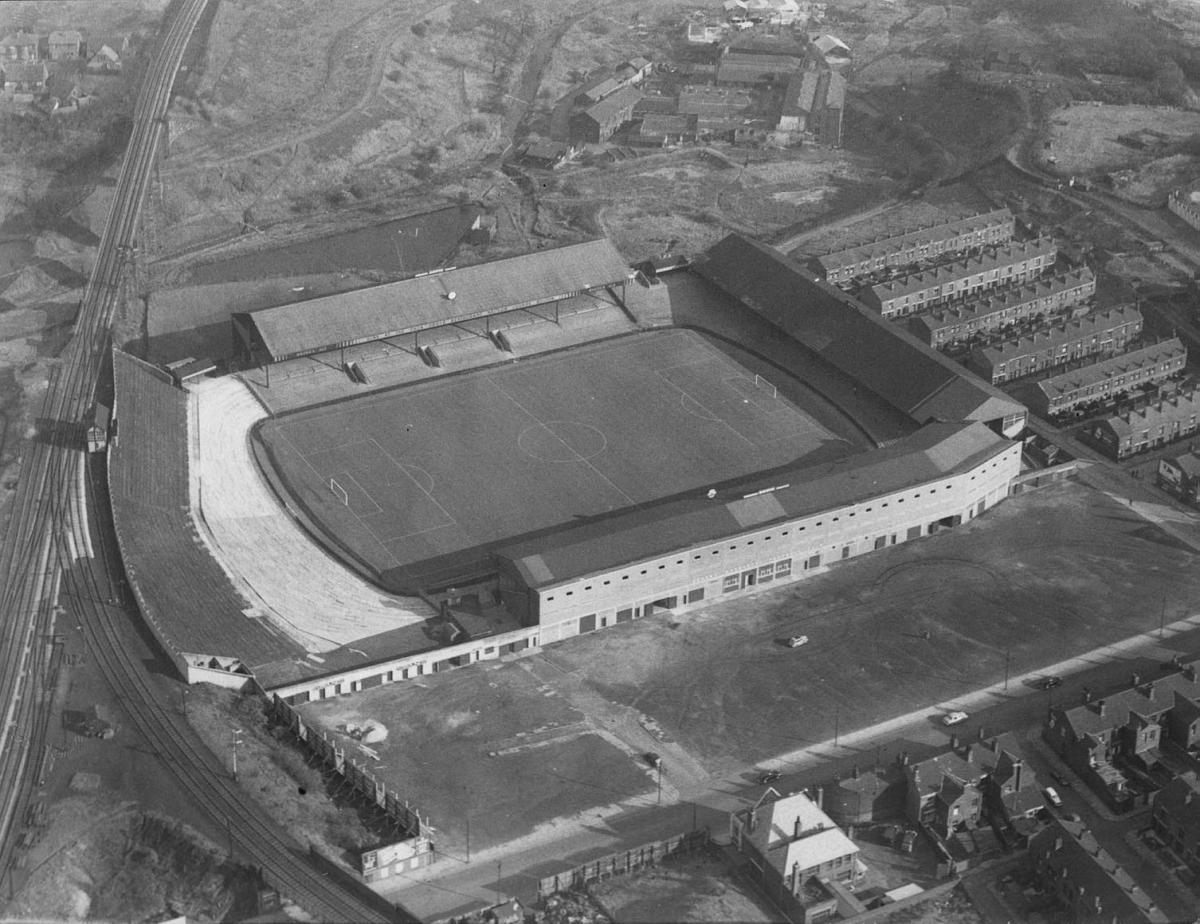
Burnden Park, Bolton, circa 1946

March 9, 1946, 75 years ago: A 2nd-leg tie of the Football Association Cup Quarterfinal is played at Burnden Park, a soccer stadium in Bolton, in what is now Greater Manchester, in the North-West of England. It ends in disaster -- and not because of the game itself.

This was the 1st FA Cup tournament held after World War II, and every round from the First Round Proper to the Sixth Round (the Quarterfinal) was held over 2 legs, 1 at each team's ground. (At the time, "stadium" seemed too grand a word for many of the venues in question). In the 1st leg of this round, at the Victoria Ground in Stoke-on-Trent, Staffordshire, Bolton Wanderers beat Stoke City 2-0.

For the return fixture, a crowd estimated at 85,000 people crammed into Burnden Park, a ramshackle structure built in 1895. Unlike in American baseball, there was no building boom in English football when concrete and steel stadiums became viable early in the 20th Century. Many of the old wooden structures were still in place as the Century neared its end.

And the crowds were bigger than ever, following the suspension of Football League and FA Cup competition at the dawn of the 1939-40 season, as the British Empire entered World War II. Buildings like Burnden Park were simply not designed with that many people in mind. Indeed, the gates were closed at 2:40 PM, 20 minutes ahead of the traditional English football kickoff time, because the stadium stewards didn't think any more people could fit in.

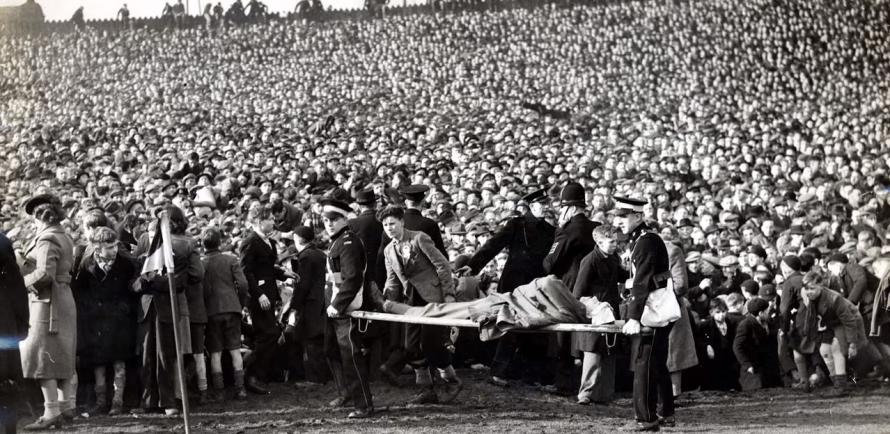
Shortly after the 3:00 kickoff, fans started spilling out of the Railway End, the stadium's north end, onto the pitch (the field). The referee, George Dutton, stopped the game, and had the pitch cleared. But two of the standing-room barriers on the End collapsed, and the crowd fell forward, crushing those underneath.

Unaware of this occurrence, Dutton restarted the game. But a police officer came onto the pitch to tell him that a fan had died. Dutton called over the Captains, Harry Hubbick of Bolton and Neil Franklin of Stoke, told them, and the players left the pitch.
After half an hour, in which the dead and injured were carried out, the game was restarted. Stanley Matthews, the Stoke superstar known as "The Wizard of Dribble," said that he was sickened by the decision. Not surprisingly, the game had little urgency, and ended 0-0. Thus, Bolton won 2-0 on aggregate, and advanced to the Semifinals.

It was later determined that 33 people had died, with over 400 injuries. It was the worst stadium-related disaster in British history, and it remained so until the Ibrox Park disaster of 1971. It has also been surpassed by the Hillsborough Disaster of 1989.

The FA Cup Semifinals were played on March 23. Bolton went to Villa Park in Birmingham, home of Aston Villa, and were beaten 2-0 by Charlton Athletic of South-East London. At Hillsborough Stadium in Sheffield, Yorkshire, where the aforementioned 1989 disaster would occur, Birmingham City and East Midlands team Derby County played to a 1-1 draw. A replay was held on March 27 at Maine Road, home of Manchester City, and Derby won that game 4-0. The Final was played on April 27 at the original Wembley Stadium, and Derby beat Charlton 4-1 in extra time. There were no security or safety incidents at any of these games.

A benefit match for the Burnden Park victims was held on August 24, 1946, at Maine Road. The national teams of England and Scotland played to a 2-2 draw.

Following the Hillsborough Disaster of 1989, it was ruled that all British stadiums would be converted to all-seater. This doomed most of the old stadiums that hadn't already been modernized, as it became cheaper to build an entirely new stadium than to fix up and maintain the old one. Conversion to all-seater left Burnden Park with a capacity of around 25,000.
Burnden Park, near the end

In 1997, Bolton Wanderers moved to what's now known as the University of Bolton Stadium, seating capacity 28,723. Burnden Park was demolished in 1999, and an Asda supermarket is now on the site.

Monday, March 8, 2021

March 8, 1971: The Super Fight

March 8, 1971, 50 years ago: For the 1st time -- and, so far, for the last time -- 2 men who were undefeated and, at least officially, undisputed Heavyweight Champions had faced each other in the ring. Of course, it had to be at Madison Square Garden. It was March 8, 1971. Like many others, it was billed as The Fight of the Century. It was also called The Super Fight. It was also called simply The Fight.

Muhammad Ali had won a Gold Medal for America in the 1960 Olympics in Rome, and had won the Heavyweight Title on February 25, 1964, beating Sonny Liston in Miami Beach. Shortly thereafter, he converted to Islam and changed his name, which had been Cassius Clay. He won a rematch with Liston, and defeated anyone and anyone challenging him, including former Heavyweight Champion Floyd Patterson.

But on April 29, 1967, he was drafted into the U.S. Army. He reported for induction, and refused to accept it. He was immediately indicted for draft evasion. His boxing license was subsequently suspended, and he was stripped of the title. He would be convicted, but appealed the decision. It went all the way to the Supreme Court of the United States, where it was overturned in a unanimous vote. However, that wouldn't happen until nearly 4 months after The Super Fight.

In the meantime, Joe Frazier, who had won a Gold Medal at the 1964 Olympics in Tokyo, had won a piece of the title on March 4, 1968, having beaten the other major contender, Buster Mathis, at the new Madison Square Garden. (The replacement for "the old Garden" really was new, having opened on February 11.) On February 16, 1970, Frazier unified the title by beating the holder of its other pieces, Jimmy Ellis.

Ali received a new boxing license, and on October 26, 1970, in Atlanta, knocked out Jerry Quarry in his 1st fight back. On December 7, he knocked out Oscar Bonavena at The Garden. In hindsight, the Louisville Lip should have had at least one more tuneup fight before taking on Smokin' Joe.

Neither man had ever lost a professional fight: Ali went into the fight 31-0; Frazier, 26-0. Of course, it had to be held at The Garden: Like its predecessor arena, it was billed as "The Mecca of Boxing." (I don't know what Ali, a Muslim, thought about that nickname.)

How big was this fight? How tough a ticket was it? Frank Sinatra, the biggest living name in entertainment, and a great fan of sports, especially boxing, couldn't get a ticket. So he made arrangements to be Life magazine's official photographer for the fight.

But there were music legends on hand, including Count Basie, Miles Davis, Motown's Diana Ross and Marvin Gaye, Bob Dylan and Isaac Hayes. So was TV host Ed Sullivan, a big sports and especially boxing fan, who knew a "really big show" and a "great stage" when he saw one. So was actor-director Woody Allen, who had been there 10 months earlier when the Knicks finally won their 1st NBA title, and his muse/then-girlfriend, Diane Keaton.

So was Playboy boss Hugh Hefner. So was "gonzo journalist" Dr. Hunter S. Thompson. So was author Norman Mailer, who fancied himself a good boxer. (He wasn't.) Former Champions Jack Dempsey and Joe Louis were there.

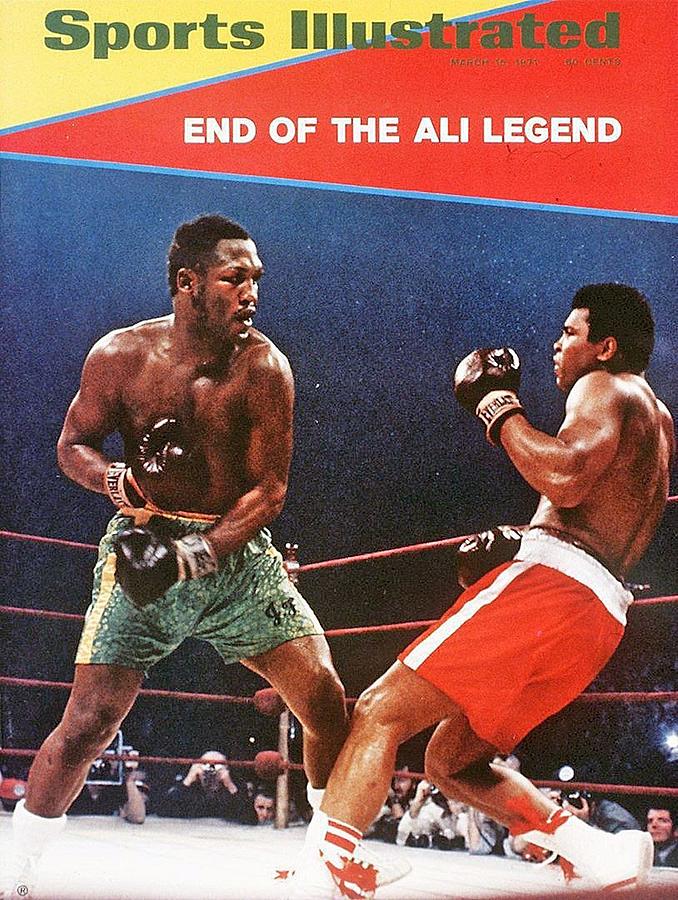
Most of the fight was even. But as it went on, Ali's rustiness began to show. In the 15th and final scheduled round, Frazier's famed left hook knocked Ali down, the 1st time he'd been knocked down since Henry Cooper did it at Wembley 8 years earlier. He got right back up, but it was too late: The knockdown was enough to give Frazier a unanimous decision, and the undisputed title.

Sports Illustrated would put the knockdown on their cover, and used the headline "END OF THE ALI LEGEND."

Well, that time, "The Dreaded SI Cover Jinx" fell on SI itself. Ali stayed in the ring on a regular basis, winning 10 straight fights, until fighting Ken Norton in San Diego in 1973. Norton broke Ali's jaw -- "Perhaps poetic justice," as his frenemy Howard Cosell would say -- and won a split decision. Undeterred, Ali fought Norton again, 6 months later at the Forum outside Los Angeles. Again, it was a split decision. This time, it went in Ali's favor.

And then he fought Frazier a 2nd time, also at the Garden. After 12 rounds, he won a unanimous decision. Except Frazier was no longer Champion: On January 22, 1973, in Kingston, Jamaica, he had been knocked out by George Foreman, who had won the Gold Medal at the 1968 Olympics in Mexico City. Foreman then knocked out Norton, the only other man to have beaten Ali.

A fight between Ali and Foreman was set up, and some people thought Foreman was going to kill Ali. Not just beat him, but possibly end his life. On October 30, 1974, in Kinshasa, the capital of the African nation of Zaire (now the Democratic Republic of the Congo), in a fight known as "The Rumble in the Jungle," Ali fooled everybody, and knocked Foreman out.

On October 1, 1975, he fought Frazier for a 3rd time, in the Philippines, in a fight known as "The Thrilla in Manila." Frazier hit Ali so hard, Ali told his trainer Angelo Dundee that the 9th round was the closest he had ever come to death. But Ali rallied, knocking Frazier's mouthpiece out in the 13th, and absolutely pummeling him in the 13th and 14th rounds.

Frazier's trainer Eddie Futch was afraid his man would get badly hurt if he fought a 15th round, so he stopped it. Ali stood to receive the cheers of the crowd, and collapsed. Both men should have retired for good after that fight. Neither did.

In 1988, Michael Spinks was 31-0, and held the IBF version of the Heavyweight Title. Mike Tyson was 34-0, and held the WBA and WBC versions. Both were undefeated, but the title was split, so it wasn't undisputed. This is the closest a fight has since come to the 1971 Super Fight. The fight was held at Boardwalk Hall in Atlantic City, and Tyson knocked Spinks out midway through the 1st round. Spinks never fought again.

Thursday, March 4, 2021

Scores On This Historic Day: March 4, 1933, The New Deal Begins

March 4, 1933: A new President is inaugurated, and it begins a new era in American history.

A few of our transfers of power have been fraught with worry:

* March 4, 1797: The 1st transfer of power, from George Washington to John Adams. It turned out not to be anything to worry about, but that was far from certain at the time, since no one, not even the brilliant and highly talented Adams, had Washington's gravitas.

* March 4, 1801: The 1st transfer of power from one party to another, from Adams, a member of the Federalist Party, to Thomas Jefferson, founder and leader of the Democratic-Republican Party, whose members called themselves "Republicans," but would eventually evolve into the Democratic Party. 

Once closely linked in the fight for independence, now estranged and bitter enemies, Adam had appointed what became known as "midnight judges" at the end of his Administration, with the intent of holding Jefferson back from perceived extreme measures. But Jefferson's 2 terms in office turned out to be comparatively peaceful. The friendship would later be restored.

* March 4, 1861: With the threat of civil war becoming very real, James Buchanan handed the Presidency over to Abraham Lincoln. Threats against Lincoln's life had already been made, and he practically had to sneak into Washington. He tried a conciliatory Inaugural Address. It didn't work.

* March 5, 1877: The disputed election that put Rutherford B. Hayes in as the next President, despite Samuel J. Tilden having received the most popular votes and, it appeared at first, the necessary Electoral votes, infuriated people to the point where another civil war seemed possible: The cry from the Democrats was "Tilden or blood!" And it wasn't officially settled until March 2. To complicate matters further, the usual Inauguration Day, March 4, fell on a Sunday: The official ceremony at the Capitol was set for the following day.

To simplify things, the outgoing President Ulysses S. Grant, suggested that Hayes take the Oath of Office in the White House on March 3, taking effect at noon on March 4, so that he would already be the President on March 5, so that the Inaugural ceremonies would essentially be going through the motions for public display. There was no violence.

* January 20, 1981: The 20th Amendment had moved Inauguration Day up, largely because of the events of 1933. President Jimmy Carter, a Democrat, and President-elect Ronald Reagan, a Republican who had overwhelmingly defeated him in a bitter election, were not friendly with each other. But that wasn't the problem.

The problem was that Carter was finally close to getting 52 hostages released by Iran, but the Iranian government decided to keep them in custody until after noon, U.S. Eastern Time, to deny Carter a full victory. Their plane ended up clearing Iranian airspace at 12;35 PM Eastern. While Carter went to meet them at the U.S. Air Force base in Weisbaden, West Germany, it was Reagan who welcomed them to the White House, making it look like he was taking credit for it. He did nothing to make their release happen.

* January 20, 1993: Despite a bitter campaign, President George H.W. Bush, Republican, and President-elect Bill Clinton, Democratic, had made peace with each other in the transition. But there was a situation involving Iraq on the last day of Bush's term. Bush suggested that his national security team remain in charge for a few hours more, and Clinton agreed. The situation was settled, and Clinton's team began their terms.

* January 20, 2001: Bush's son, George W. Bush, had emerged victorious over Clinton's Vice President, Al Gore, under dubious circumstances. There were protestors at the Capitol for the Inauguration, but there was no violence.

* January 20, 2017: Again under dubious circumstances, a Republican who did not win the popular vote took the office. This time, it was Donald Trump, the most underqualified incoming President ever, and the most psychologically unfit. Violence was feared. There was none.

* January 20, 2021: Joe Biden had beaten Trump, but after the attack on the Capitol while the Electoral Votes were being certified, people were afraid that another attack would be launched. This time, there was enough of a deterrent force on hand that the would-be second-time insurrectors did the smart thing, and stayed away.

If anything, the events of March 4, 1933 were fraught with even more worry than 2021 -- or even 1861.

*

For it was the depth of the Great Depression. Within 8 months of taking office as President on March 4, 1929, Herbert Hoover saw the stock market crash on his watch. He wasn't responsible for it. And it would be unfair to say he did nothing about it. A fairer statement would be that he didn't do enough things, and that he didn't take the things he did do, which did help a little, far enough.

So, in the 1932 election, he lost in a massive landslide to the Governor of New York, a Democrat, Franklin Delano Roosevelt. The interregnum between the election on November 8 and the Inauguration on March 4 was interminable, as a bitter Hoover, like Trump with Biden 88 years later, shared nothing with FDR and his team. Essentially Hoover sabotaged his own best chance at leaving office on a high note.

As a result, things got worse. Banks were failing all over the country. People were terrified. The American economy was on the brink of complete collapse, more so than it had been during the "panics" of 1791, 1819, 1837, 1857, 1869, 1873, 1893 and 1907, even ore so than during the Crash of 1929. And, as it turned out, more than during the Crash of 1987, the economic free-fall of 2008, and the drop during last Spring's coronavirus crisis.

Inauguration Day fell on a Saturday, and this may have been for the best, as the banks would have been closed anyway.

Roosevelt is sworn in, and makes the most important Inaugural Address in the history of the office. It wasn't just the conditions that were the problem, is was the fear of the problem, that he wanted to address, the fear that was making things worse. On that subject, it is fair to say that Hoover did nothing. Roosevelt did something right off the bat:

My friends: I am certain that my fellow Americans expect that, on my induction into the Presidency, I will address them with a candor and a decision which the present situation of our Nation impels.

This is preeminently the time to speak the truth, the whole truth, frankly and boldly. Nor need we shrink from honestly facing conditions in our country today. This great Nation will endure as it has endured, will revive and will prosper.

So, first of all, let me assert my firm belief that the only thing we have to fear is fear itself--nameless, unreasoning, unjustified terror which paralyzes needed efforts to convert retreat into advance. 

Despite a light rain falling on Washington for most of the day, the Inaugural crowd may have been the biggest in history to that point, and a great cheer went up.

Roosevelt promised "action, and action now!" He acted on it. Over the weekend, he set in motion the policies that embodied what he called, during the campaign, "a new deal for the American people." His New Deal measures included keeping the banks closed for a week, so they could straighten out their own situations. When they reopened on March 12, they were secure, and the nation's recovery began.

It would be long and slow, but FDR's New Deal measures helped millions of people get by. Had he only served 2 terms, and someone else had led the nation through World War II, FDR would still be remembered as one of the nation's greatest and most important Presidents. His leadership during World War II would put him up there with Washington and Lincoln as 1 of the 3 greatest.

There have been, essentially, 4 eras of American history:

* The Colonial era, beginning with the arrival of Christopher Columbus in 1492 (note that I'm not saying that he "discovered America"), and lasting until the Declaration of Independence in 1776.

* The Revolutionary era, from the Declaration until the end of the Civil War in 1865.

* The next era, whatever name you want to give it, lasting from the end of the Civil War until the start of the New Deal in 1933.

* And the era that began with the New Deal. If you want to say that, sometime since 1933, that 4th era ended and a 5th era has begun, I don't know what your line of demarcation would be. Neither the resignation of Richard Nixon in 1974, nor the Inauguration of Reagan in 1981, nor that of Clinton in 1993, nor the 9/11 attacks of 2001, nor the arrival of Trump in 2017, nor the leaving of Trump in 2021 carries the same amount of historical weight, nor is likely to.

*

On this Saturday, March 4, 1933, baseball teams were starting Spring Training, the NFL was out of season, and the NBA hadn't been founded yet. There was only the NHL to provide games and scores. Even then, there were slim pickings:

* Only one American-based team was scheduled to play: The New York Americans lost to the Montreal Canadiens, 2-0 at the Montreal Forum.

* And, in a game broadcast on the Canadian Broadcasting Corporation's most popular radio show, which would become, and remains, the CBC's most popular television show, Hockey Night In Canada, the Toronto Maple Leafs beat the Montreal Maroons, 4-2 at Maple Leaf Gardens in Toronto.

* The Detroit Red Wings and the Ottawa Senators had last played on March 2, against each other at the Ottawa Auditorium, with the Wings winning 3-2. They would play each other again on March 5, at the Olympia Stadium in Detroit, with the Wings winning 2-0.

* The Chicago Black Hawks had also last played on March 2, beating the Americans 3-2 at Chicago Stadium. They would next play on March 5, also at the Stadium, losing to the Maple Leafs 2-1.

* The Boston Bruins had last played on February 28, against the Senators at the Boston Garden. It ended in a 0-0 tie.

* The New York Rangers hadn't played since February 26, a 4-1 win over the Hawks in Chicago. Their next game would also be the Bruins' next game, on March 5, at what was then called the new, but would eventually be called the old, Madison Square Garden, and the Bruins won 2-1.

Also, Arsenal beat Liverpool, 1-0 at Highbury in North London.

Franklin Delano Roosevelt was inaugurated as President of the United States just 33 days after Adolf Hitler was appointed Chancellor of Germany, and the Nazi regime began. But there were no games played on that day: Baseball and football were out of season, there was no NBA yet, and no NHL games were scheduled.

No one knew it at the time, but FDR and Hitler were on a collision course. A little more than 12 years later, both would be dead -- but one of them would be victorious. And for most of those 12 years, it wasn't clear which one that would be.

Tuesday, March 2, 2021

March 2, 1951: The 1st NBA All-Star Game

Walter Brown, owner of the Boston Garden,
and thus owner of the Boston Celtics (and Bruins),
and host of the game, flanked by the Celtics named to the game,
Ed Macauley (22) and Bob Cousy (14).

March 2, 1951, 70 years ago: The 1st NBA All-Star Game is played, at the Boston Garden.

The players for this game were chosen by sportswriters, without regard to position, and the only rule was that a writer could not select a player from his own city. On February 13, the NBA's President (the title wouldn't be "Commissioner" until 1967), Maurice Podoloff announced the 10 players on each team.

From the Eastern Division, wearing white jerseys, coached by Joe Lapchick of New York:

* From the Baltimore Bullets: Center Red Rocha. This version of the Bullets went out of business in 1954. In 1961, the Chicago Packers were formed. They became the Chicago Zephyrs in 1962, the new Baltimore Bullets in 1963, then moved to the D.C. area for 1973-74, becoming the Capital Bullets. That name was every bit as dumb as a football fan might perceive "Chicago Packers" to be, so for 1974-75, they became the Washington Bullets. In 1997, they became the Washington Wizards.

* From the Boston Celtics: Guard Bob Cousy and center Ed Macauley.

* From the New York Knickerbockers: Forwards Vince Boryla and Harry Gallatin, and guard Dick McGuire. Hardly anybody uses the team's full name: To all and sundry, they are the Knicks.

* From the Philadelphia Warriors: Forwards Joe Fulks and Paul Arizin, and guard Andy Phillip. They became the San Francisco Warriors in 1962, then moved across the Bay to Oakland in 1971, becoming the Golden State Warriors. Despite moving back to San Francisco in 2019, they have kept the Golden State name.

* From the Syracuse Nationals: Forward Dolph Schayes. They moved in 1963, taking the Warriors' place in the City of Brotherly Love, becoming the Philadelphia 76ers.

From the Western Division, wearing blue jerseys, coached by John Kundla of Minneapolis:

* From the Fort Wayne Pistons: Forwards Larry Foust and Fred Schaus. They moved to Detroit in 1957.

* From the Indianapolis Olympians: Guard Ralph Beard and center Alex Groza. They went out of business in 1953.

* From the Minneapolis Lakers: Center George Mikan, and forwards Jim Pollard and Vern Mikkelsen. They moved to Los Angeles in 1960.

* From the Rochester Royals: Guard Bob Davies. They became the Cincinnati Royals in 1957, the Kansas City Kings in 1972, and the Sacramento Kings in 1985.

* From the Tri-Cities Blackhawks: Guard Frank Brian and forward Dwight Eddleman. This team was based in Moline, Illinois, and the region, which also includes Rock Island, Illinois and Davenport and Bettendorf, Iowa is now widely known as the Quad Cities. They became the Milwaukee Hawks the next season, the St. Louis Hawks in 1955, and the Atlanta Hawks in 1968.

Due to the limited size of the rosters, the NBA is the only one of the "Big Four" North American sports leagues that doesn't guarantee every team at least one player in its All-Star Game. Nevertheless, all 10 teams were represented. (The season had started with 11, but the Washington Capitols had gone out of business early on.)

The game was not broadcast on television, only on radio. At the end of the 1st quarter, the East led 31-22. At halftime, the East led 53-42. After 3 quarters, the East led 83-64. The final score was East 111, West 94.

Points scored, East: Macauley 20 for the game's Most Valuable Player award, Fulks 19, Schayes 15, Arizin 15, Boryla 9, Cousy 8, Rocha 8, Phillip 6, McGuire 6, Gallatin 5. West: Groza 17, Brian 14, Davies 13, Mikan 12, Mikkelsen 11, Schaus 8, Eddleman 7, Beard 6, Pollard 4, Foust 2. So everybody who got into the game scored. Schayes led all players with 14 rebounds, and McGuire did so with 10 assists.

Now 92 years old, Cousy is the game's last surviving player.