Showing posts with label william howe. Show all posts

Sunday, September 20, 2026

September 20, 1776: The Great Fire of New York


Have you ever wondered why Boston, Philadelphia, Baltimore, and even older New Jersey cities like Newark, Elizabeth, Perth Amboy and Trenton have building that predate American independence in 1776, but there aren't too many of them in New York? And why even the ones that are in the City aren't in Manhattan? (Fraunces Tavern, built in 1719, is one of the exceptions.)

This is why:

September 20, 1776, 250 years ago: The Great Fire of New York was set. It didn't "start," it "was set."

It was a bad Summer for the brand-new United States of America. The British Army was attacking the Continental Army, forerunner of the United States Army, commanded by General George Washington. On August 27, Washington's troops were defeated in Brooklyn in what became known as the Battle of Long Island. A dense fog enabled them to escape across the East River to Manhattan, in a maneuver that, in his book 1776, historian David McCullough called "America's Dunkirk."
On September 11, a date that was fraught with history, especially in America, well before 2001, a peace conference was held on Staten Island, including the British naval commander, Admiral Richard Howe, brother of their army commander, General William Howe; and American representatives including Benjamin Franklin and John Adams. It failed. A civilian exodus from the City began.

On September 15, British troops landed at Kips Bay, north of what was then the limits of New York City, roughly at what is now East 25th Street. On September 16, the Battle of Harlem Heights was fought, roughly where Riverside Church is now, at 120th Street at Riverside Drive. The Continentals pushed the British back.

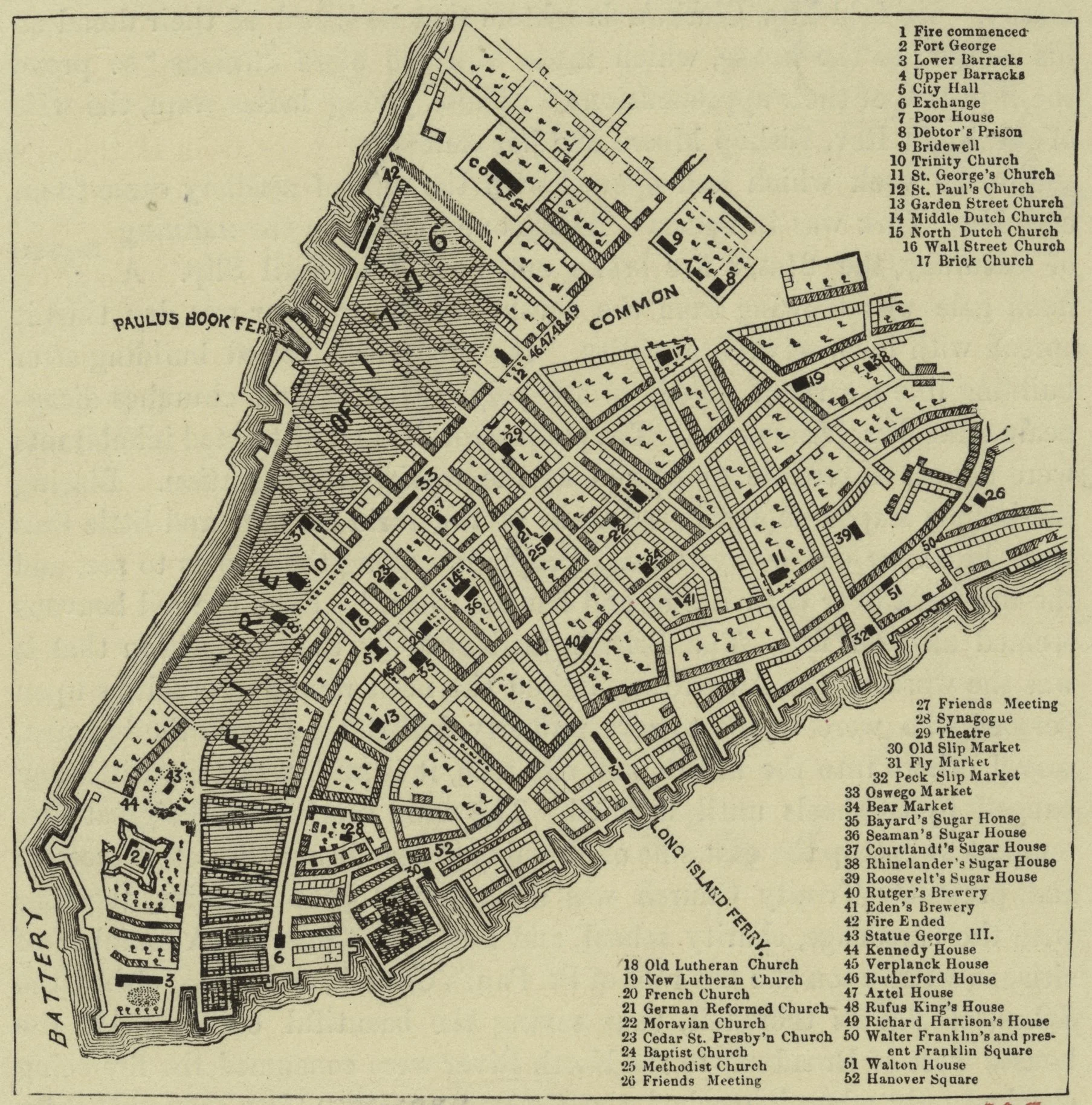
On September 20, the British decided to smoke out whatever resistance remained. A fire was set at the Fighting Cocks Tavern, near Whitehall Slip, at the southern tip of Manhattan Island, roughly where Whitehall Ferry Terminal is now. The fire destroyed from 10 to 25 percent of the buildings in the City, while some unaffected parts of the City were plundered. It burned until the next morning.

On September 22, the British executed an American spy, Nathan Hale, a 21-year-old native of Coventry, Connecticut. Captain John Montresor, a British officer who was present at the hanging, reported that Hale's last words were, "I only regret that I have but one life to lose for my country."
On October 28, Washington lost the Battle of White Plains. On November 16, defeat in the Battle of Fort Washington, a location named for him, meant that he had to get his troops across the Hudson River, and evacuate New York, roughly at the point where the bridge named for him now stands. They made their way across New Jersey, and across the Delaware River into Pennsylvania. As Thomas Paine, who was with them, wrote in his pamphlet The American Crisis, "These are the times that try men's souls."

Washington needed a miracle. On December 25, 1776, he made his own Christmas miracle.

It wasn't until November 25, 1783, after the Treaty of Paris recognizing American independence was signed and copies reached American shores, that the British Army ended their occupation of New York City. On December 4, Washington resigned his commission, and said goodbye to his troops at the oldest remaining building in Manhattan, Fraunces Tavern, which survived the fire, and has survived others over the years.
New York City was rebuilt. It is always being rebuilt. Old buildings -- but not pre-Revolution old -- are always being replaced by new ones. Americans claim to have respect for their heritage, but we tend not to have much respect for our physical history.

I am all for America in general, and New York in particular, looking forward. But you can't know where you're going unless you know where you've been.

Tuesday, March 17, 2026

March 17, 1776: The Siege of Boston

Henry Knox

March 17, 1776, 250 years ago: The Siege of Boston ends. No, this has nothing to do with the Yankees playing the Red Sox, or any other sporting event. It is the 1st great victory for the Continental Army in the War of the American Revolution.

The siege began on April 19, after the first battles of the war, at Lexington and Concord, Massachusetts, when Massachusetts militias blocked land access to Boston. The Continental Congress, meeting in Philadelphia, formed the Continental Army from the militias involved in the fighting, and appointed George Washington as commander in chief.

In June 1775, the British seized Bunker Hill and Breed's Hill, two Continental Army positions overlooking Boston. But their casualties proved heavy, and their gains were insufficient to break the Continental Army's encirclement.

After this, the Americans laid siege to Boston. No major battles were fought during this time, and the conflict was limited to occasional raids, minor skirmishes, and sniper fire. British efforts to supply their troops were significantly hindered by the smaller but more agile Continental Army and patriot forces operating on land and sea. The British suffered from a continual lack of food, fuel, and supplies.

In November 1775, General Washington sent General Henry Knox on a mission to bring the heavy artillery that had recently been captured at Fort Ticonderoga in Upstate New York. In a technically complex and demanding operation, Knox brought the cannons to Boston in January 1776, and this artillery fortified Dorchester Heights, which overlooked Boston Harbor.

This development threatened to cut off the British supply lifeline from the sea. The British commander, General Willie Howe, saw his position as indefensible, and he withdrew his forces from Boston to Halifax, Nova Scotia on March 17.

It has often been said that the American Revolution began in Boston on March 5, 1770, when British militia -- effectively, the first Boston Police -- fired on people throwing snowballs at them, killing 5 of them, the event that became known as the Boston Massacre. Six years later, the British bugged out of Boston. For what would eventually become known as the Hub City, the war was essentially over.

That would not be the case for points west and south: Connecticut, New York, New Jersey, Pennsylvania, Virginia, North Carolina, South Carolina and Georgia would all suffer terribly over the next 5 years.

When Washington became the 1st President of the United States, he appointed Knox to be the 1st Secretary of War, the post known since 1947 -- despite what Donald Trump and Pete Hegseth might now say -- as Secretary of Defense.

Tuesday, June 17, 2025

June 17, 1775: The Battle of Bunker Hill

Bunker Hill Monument

June 17, 1775. 250 years ago: The Battle of Bunker Hill is fought, the 1st battle of the War of the American Revolution after the opening battles of Lexington and Concord. It is remembered as a great heroic triumph for the American Patriots.

In fact, it was a case of "They lost the battle, but won the war." Or, as the ancient Greek King Pyrrhus of Epirus would have said, "If we are successful in one more battle with them, we shall be utterly ruined."

The battle isn't even correctly named. Although there is a Bunker Hill in Charlestown, across the Charles River from Boston and since incorporated as a neighborhood of the city proper, most of the action took place at adjacent Breed's Hill, a mile and a half from what's now known as Downtown Crossing.

On June 13, Colonel William Prescott took 1,200 colonial troops, and occupied both hills. On June 17, the British troops, under the command of General William Howe, became aware of the presence of colonial forces on the Peninsula, and mounted an attack against them. Two assaults on the colonial positions were repulsed with significant British casualties, but the redoubt was captured on their third assault, after the defenders ran out of ammunition. The colonists retreated over Bunker Hill, leaving the British in control of the Peninsula.
William Prescott

The battle was a tactical victory for the British, but it proved to be a sobering experience for them: They lost 226 men, while the colonials lost 115. The battle had demonstrated that inexperienced militia were able to stand up to regular army troops in battle.

The battle led the British to adopt a more cautious planning and maneuver execution in future engagements, which was evident in the subsequent New York and New Jersey campaign. The costly engagement also convinced the British of the need to hire substantial numbers of auxiliaries from the German province of Hesse -- the infamous Hessian mercenaries -- to bolster their strength in the face of the new and formidable Continental Army.

William Prescott served as part of the U.S. victory at the Battle of Saratoga in 1777. He lived on until 1795, at the age of 69. He has a statue on the grounds of the 221-foot-high Bunker Hill Monument, erected in 1843.

The colonials lost the battle because they ran out of ammunition. This supposedly led to the ammo-conserving order: "Don't shoot 'til you see the whites of their eyes!" But the available evidence shows that no one -- not Prescott, nor anyone else -- said this during the Battle of Bunker Hill. The saying goes back to Gustavus Adolphus, King of Sweden in the early 17th Century, at that country's peak of power.