Showing posts with label super bowl xiv. Show all posts

Friday, April 14, 2017

Dan Rooney, 1932-2017

Daniel Milton Rooney was born on July 20, 1932, in Pittsburgh, Pennsylvania. His father, Art Rooney, founded the NFL's Pittsburgh Steelers on May 19, 1933.

This means that Dan Rooney was a Steeler for life. Not just for nearly all of his life, but, until now, for all of the team's life.

Art Rooney and his wife, the former Kathleen "Kass" McNulty, had 5 sons. They were Dan, Art Jr., Tim, Patrick and John. They would have 32 grandchildren and 75 great-grandchildren. Art Jr. said that Art Sr., known to all of Western Pennsylvania as "The Chief," always told his sons, "Treat everybody the way you'd like to be treated. Give them the benefit of the doubt. But never let anyone mistake kindness for weakness." Or, as Art Jr. put it, "He took the Golden Rule, and put a little bit of the North Side in it."

The Rooney family has long lived in the Troy Hill section of Pittsburgh's North Side, which included North Catholic High School -- now named Cardinal Wuerl North Catholic High School and located in nearby Cranberry Township. The Rooney boys would assist their father at Steeler training camp, and in games at Forbes Field and later at Pitt Stadium. Dan served as a ballboy, and sold game-day programs. The sons seemed to be the only ones to notice a young Pittsburgh native at the 1955 camp, but their father deferred to the judgement of his head coach, Walt Kiesling, who cut the rookie.

What's that? You've never heard of Walt Kiesling? I'm not surprised. But you have heard of the rookie. He caught on with the Baltimore Colts the next season. His name was Johnny Unitas.


In 1952, while a student at Pittsburgh's Duquesne University, from which he would graduate with a degree in accounting, Dan Rooney married Patricia Reagan, who was working in the Steeler offices. They had 9 children. In 1960, he became the Steelers' director of personnel.


*

In 1964, in its 2nd year of inductions, Art Rooney became a member of the Pro Football Hall of Fame, and admired by all who knew him. But, let's be blunt: At this point, he was a failure as the operator of a football team.

From 1933 to 1968, 36 seasons, the Steelers had made the Playoffs exactly once, in 1947, because they'd tied the cross-State Philadelphia Eagles for 1st place in the NFL's Eastern Division. They held a Playoff at Forbes Field, and the Eagles won it.

If Art had died shortly after the Jets won Super Bowl III on January 12, 1969, it would have been said -- as is now being said of the late Chicago Blackhawks owner Bill Wirtz -- that the best thing he did for his team was to die, so that his son could run the team.

Indeed, his sons held what we would now call an "intervention," telling him that they should take over the operations of the team. He agreed -- and lived another 20 years, in which the sons turned the Steelers from a joke franchise into an iconic team of American sports.


Pretty much the first thing that Dan Rooney did was offer the Steelers' head coaching job to the head coach at nearby Penn State, Joe Paterno. Paterno turned him down. So he offered it to the defensive coordinator of the team the Jets had just beaten in the Super Bowl, who had been on the staff of the San Diego Chargers team that won the 1963 AFL Championship, and a lineman who had won 2 NFL Championships with the Cleveland Browns: Chuck Noll.


Dan's brother Art Jr. drafted Joe Greene, Jon Kolb and L.C. Greenwood in 1969; Terry Bradshaw and Mel Blount in 1970; Jack Ham, Gerry Mullins, Dwight White, Larry Brown, Ernie Holmes and Mike Wagner in 1971; Franco Harris and Steve Furness in 1972; and, in 1974, in perhaps the greatest single draft in NFL history, Lynn Swann, Jack Lambert, John Stallworth and Mike Webster -- 4 Hall-of-Famers in one draft.


Counting Greene, Bradshaw, Blount, Ham and Harris, that was 9 Hall-of-Famers in 6 drafts. Counting Noll, 10 -- all based on the decisions of Dan Rooney and Art Rooney Jr. To put that in perspective: The team had 5 players from 1933 to 1968 who ended up making the Hall. (Since, they've had 3, although some of the players from the Super Bowl XL and XLIII who may make it are not yet eligible.)


(UPDATE: Through the Hall's NFL Centennial election of 2020, there are 19 players who could legitimately be said to have been elected based at least in art on their performance with the Steelers. Donnie Shell has made it 10 players from that 1969-74 period, and 5 from the 1974 Draft alone. Before them, there were 5: Bill Dudley in the 1940s, Ernie Stautner and Jack Butler in the 1950s, Bobby Layne and John Henry Johnson in the 1960s. Since those '70s stars, there's been 4: Dermontti Dawson and Rod Woodson in the 1990s, and Jerome Bettis and Troy Polamalu in the 2000s. Ben Roethlisberger is still active, and thus not yet eligible.)

It took a while to build a winner, especially because Noll and Bradshaw had a contentious relationship. Moving from 1925-built Pitt Stadium into the new Three Rivers Stadium in 1970 helped. But in 1972, the Steelers won the AFC Central Division Championship, and reached the AFC Championship Game.

They made the Playoffs again in 1973. In 1974, they finally went all the way, winning Super Bowl IX on January 12, 1975. Pete Rozelle said his happiest moment in his 29 seasons as Commissioner of the NFL was handing the Vince Lombardi Trophy to Art Rooney Sr. -- but it was because of the building done by Dan and Art Jr.

The Steelers would reach 4 Super Bowls (IX, X, XIII and XIV), winning all of them, in a span of 6 years. All tolled, under Dan Rooney's operation, 48 seasons, they reached the Playoffs 29 times, won 22 Division titles (15 in the old AFC Central, 7 in the AFC North following the 2002 realignment), reached 16 AFC Championship Games (including this past season), won 8 AFC Championships, and won 6 Super Bowls, the most NFL Championships in the Super Bowl era. He also built Heinz Field, the Steelers' new home, for the 2001 season, and it is one of the best stadiums in the NFL.

With the 1st 4 Vince Lombardi Trophies

The Steelers became a cultural phenomenon, with their black and gold uniforms, their helmets with the "Steelmark" logo on only the right side with the left side remaining blank, their multi-ethnic working-class fan base, and their bright yellow Terrible Towels being waved in the stands (first at Three Rivers Stadium, then at Heinz Field).


The fact that the Steelers stood up, usually successfully, to the Dallas Cowboys and the Oakland Raiders, 2 of the most hated NFL teams nationwide, also helped boost their national image. Along with the Cowboys, the Raiders, the Green Bay Packers (due to their similar cultural stamp in the 1960s) and the Chicago Bears (ditto for the 1980s), the Steelers are one of the few NFL teams to have a nationwide fan base.


In New York and New Jersey, 400 miles from Pittsburgh, you can see Steeler bumper stickers and window stickers on cars every day. A website called SteelersBars.com lists bars catering to Steeler fans in 48 States, all but Nebraska and South Dakota.


Art Rooney Sr. loved it -- but it was Dan Rooney, and, to a lesser but very significant extent, Art Rooney Jr., who made it happen.


*


Dan is widely credited with leading the negotiations that ended the 1982 NFL players' strike and passing the collective bargaining agreement that followed it. In 1989, Rozelle retired, and some owners wanted to make Dan the new Commissioner. He declined, saying he'd rather continue to run his team. Paul Tagliabue was elected instead. In 1993, Dan led the NFL in approving the salary cap. In 2006, when Tagliabue retired, it was Dan Rooney who called Roger Goodell, and told him that he'd been elected the new Commissioner.


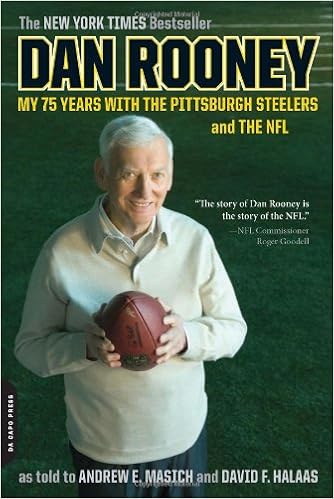
Goodell repaid the compliment with this blurb for Dan's memoir My 75 Years With the Pittsburgh Steelers and the NFL: "The story of Dan Rooney is the story of the NFL."


Art Rooney Sr. died in 1988, and Dan became majority owner, replacing Noll with Bill Cowher in 1992. By that point, Art Jr. had reduced his involvement in the team. (UPDATE: As of 2020, he remains a team vice president.) In 2003, Dan followed in his father's footsteps, and handed over day-to-day operations to his son, Art Rooney II (grandson of the founder and nephew of Art Jr.). It was Art II who oversaw the building of the teams that won Super Bowls XL and XLIII and lost Super Bowl XLV, and in 2007 replaced the retiring Cowher with his assistant, Mike Tomlin, the team's 1st black head coach.


That fact is significant because of "The Rooney Rule," which the NFL established at Dan's urging in 2003. Tony Dungy, a former Steeler defensive back and assistant coach, had just been fired as head coach of the Tampa Bay Buccaneers -- who ended up winning Super Bowl XXXVII under their new head coach, the white former Oakland Raider coach Jon Gruden. Dennis Green had also just been fired as head coach of the Minnesota Vikings, despite a winning record.


A group of civil rights attorneys, led by the legendary Johnnie Cochran, released a study showing that black head coaches, despite winning a higher percentage of games, were less likely to be hired, and more likely to be fired, than their white counterparts.


The Rooney family, like the great baseball executive Branch Rickey, consider themselves Abraham Lincoln-style Republicans, demanding fairness for all, regardless of race or religion. This was certainly an issue for the Rooneys, because Art Sr. was old enough to remember when being an Irish Catholic meant serious discrimination. Art Sr. had also helped to keep the Negro League's Pittsburgh-based Homestead Grays afloat for a time, and had no qualms about bringing black players to the Steelers once the color barrier had been broken in 1946.


One of Dan's key hires when he took control was Bill Nunn Jr., a black sportswriter who knew the football programs at what are now called Historically Black Colleges and Universities (HBCUs), and became one of the team's top scouts.


Dan's "Rooney Rule" requires teams to search among black, Hispanic and Asian candidates for all senior football operations positions within the NFL, regardless of a team's title for that position. Currently, 6 of the 32 head coaches in the NFL are African-American (Tomlin, Todd Bowles of the Jets, Hue Jackson of the Browns, Marvin Lewis of the Cincinnati Bengals, Jim Caldwell of the Detroit Lions and Anthony Lynn of the Los Angeles Chargers).


So 18.8 percent of the head coaches are black, and 7 of the general managers, or 21.9 percent -- as opposed to 12.6 percent of the general U.S. population, but 67.3 percent of NFL players. In addition,

1 head coach, Ron Rivera of the Carolina Panthers, is Hispanic. About 17.6 percent of Americans are Hispanic, but only 0.6 percent of NFL players are Hispanic.

In 2008, Dan and Art II bought out Dan's brothers, who wanted to increase their involvement in gambling establishments. Art Sr. had owned Yonkers Raceway in New York's Westchester County and Suffolk Downs in Boston. His son (Dan's brother) Tim runs Yonkers Raceway today.


A wing of the Rooney family lives in Florida, and controls horse and dog tracks there. Pat Rooney's son Tom is a Republican Congressman, representing a district southeast of Tampa Bay. His brother, Patrick Jr., is in the State House of Representatives, representing northern Palm Beach County.


Despite the family's Republican record, in 2008, Dan Rooney endorsed Senator Barack Obama of Illinois for President. He did not cite any unhappiness with Republican handling of the economy or the Iraq War. He did say, "When I think of Barack Obama's America, I have great hope. I support his candidacy, and look forward to his Presidency."


Some people believe Dan's endorsement won Pennsylvania for Obama. I doubt that it made much of a difference: The State had gone for the Democratic nominee in every election since 1992. And Obama would have won the election even if he'd lost Pennsylvania.
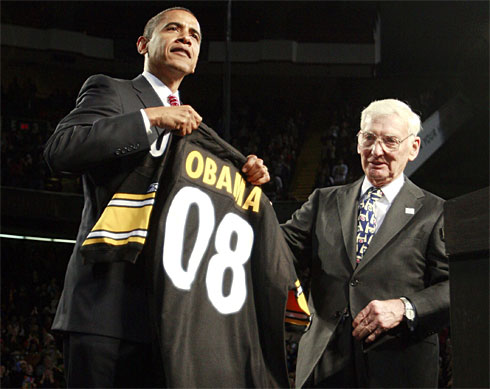
Dan would also give the 44th President a Number 44 jersey
at the White House ceremony honoring the Steelers
after winning Super Bowl XLIII in 2009.

But Obama remembered Dan's efforts, and also remembered his long record of support for Irish-American charities (inherited from his father), and named him U.S. Ambassador to the Republic of Ireland. He served in the post from July 1, 2009 to December 14, 2012.


Art Rooney Sr. and Dan Rooney are only the 2nd father-and-son combination to both be enshrined in the Pro Football Hall of Fame. The other is Tim and Wellington Mara of the Giants, with whom they would be linked by their descendants. Art Rooney Sr. and Tim Mara were good friends, linked by the horse-racing business. Wellington Mara's son Tim married Art Jr.'s daughter Kathleen. Their daughters, a
ctresses Kate Mara and Rooney Mara, are thus great-granddaughters of the founders of the Steelers and the Giants.

"Mean Joe" Greene made the presentation speech when Dan was elected to the Hall of Fame in 2000, saying "Dan has always led with humility. When things go as planned, Dan is in the background. When things don’t go as planned, he’s in the forefront."

Dan Rooney with a not-so-mean Joe Greene
at Heinz Field, September 8, 2013

That included always being there for his players, just as his father had, showing them that he was never going to be an absentee owner. As Steelers quarterback Ben Roethlisberger said this past January:


I have played with guys that have come from other teams. They look shocked when they see our owners, whether it's Mr. Dan Rooney or Mr. Art Rooney II, walking around the locker room and walking around practice. They don't ever see their owners. We see our owners every single day. I think it's just a blessing to know that they care about us, and that's one of the reasons we want to go win.


But it became harder for him as old age caught up to him. Recent photos showed him seriously stooped over. Dan Rooney passed away at the age of 84 yesterday, April 13, 2017. No cause was listed with the initial announcement, but it's been said that his health was deteriorating in recent weeks, and he missed the annual NFL owners' meeting a few weeks ago in Phoenix, his first time missing it since his father handed him the keys to the kingdom in 1969.


Bill Cowher said, "He was like a father, a friend, a mentor, a boss who inspired others around him. He was a people person and he never forgot where he came from. He epitomized Pittsburgh: Hard-working, humble, no-nonsense, tell it the way it is,and never forget where he came from. That's him. That's Pittsburgh."


No less an opponent than Dallas Cowboys owner Jerry Jones called it "a sad day for anyone who has had an association with the NFL," noting that Rooney "made all of our lives better."


"He shaped the league with instincts, wisdom and a soft-spoken velvet touch," Jones said. "He was a steward and a guardian for the growth and popularity of the NFL, because he loved the game so much."


Obama hailed him as well: "Dan Rooney was a great friend of mine. But, more importantly, he was a great friend to the people of Pittsburgh, a model citizen, and someone who represented the United States with dignity and grace on the world stage."


Dan Rooney knew what was important around the world. He knew what was important around the block, too.


Surely, he was taught by his father the words of Rudyard Kipling, because he certainly lived them:


If you can dream, and not make dreams your master
If you can think, and not make thoughts your aim
If you can meet with Triumph and Disaster
and treat those two impostors just the same...


If you can talk with crowds and keep your virtue
or walk with kings, nor lose the common touch
If neither foes nor loving friends can hurt you
If all men count with you, but none too much


If you can fill the unforgiving minute
with sixty seconds' worth of distance run,
yours is the Earth and everything that's in it

and, which is more, you'll be a Man, my son!

Dan Rooney was a man for all seasons -- not just 84 seasons of professional football, but for any season, for any occasion.


UPDATE: He was buried at Christ Our Redeemer Catholic Cemetery in Pittsburgh. It is also the final resting place of his father Art, Chuck Noll, long-ago Steeler coach Walt Kiesling, and 1890s baseball catcher Dick Buckley.

Sunday, January 11, 2015

Greatest Teams in States' Histories

UPDATE: Through Super Bowl LIII in February 2019, I see no reason to update any of these.

Alabama: 1974 Birmingham Americans, World Football League Champions. A pro league title, no matter how far under "major league" you might consider it, is ahead of a college team, no matter how many National Championships have been won by the University of Alabama or Auburn University.

Alaska: 1980 Alaska Goldpanners, Alaska Baseball League Champions. The ABL is a summer league for college-age players, similar to Massachusetts' Cape Cod League. Although the 'Panners, formerly named the Fairbanks Goldpanners, have won several Pennants, the 1980 team is usually held up as their best. They won 83 percent of their games, and featured future MLB All-Stars Kevin McReynolds and Mike Moore.

Arizona: 2001 Arizona Diamondbacks, World Series winners. The State's only World Champion, as the Cardinals, Suns and Coyotes are a collective 0-3 in finals.

Arkansas: 1971 Arkansas Travelers, Texas League Champions. This Double-A farm team of the St. Louis Cardinals (now of the Los Angeles Angels of Anaheim), based in Little Rock, featured Ken Reitz and Al Hrabosky, "the Mad Hungarian."

California: 1989 San Francisco 49ers, Super Bowl XXIV winners, maybe the most exciting team in NFL history. Joe Montana, Roger Craig, Jerry Rice, an offensive line anchored by Randy Cross, a defense highlighted by Ronnie Lott. Think about it this way: They had Steve Young... and he was the backup quarterback. I take this team ahead of the 1951 Los Angeles Rams or the 3 Raiders Super Bowl winners (2 in Oakland, 1 in Los Angeles); any World Series winner of the Los Angeles Dodgers, San Francisco Giants or Oakland Athletics, or the 2002 Anaheim Angels; any of the many NBA tiles won by the Los Angeles Lakers, or the 1975 Golden State Warriors; or the Stanley Cup teams, the 2007 Anaheim Ducks or the 2012 or 2014 Los Angeles Kings. And over any of the 11 National Championship teams of UCLA basketball.

Colorado: 1998 Denver Broncos, Super Bowl XXXIII winners. I take them over the previous season's Broncos, or the 1996 and 2001 Stanley Cup-winning Colorado Avalanche.

Connecticut: 1986 Hartford Whalers, Adams Division Finalists. This is a tricky one: While the Boston Celtics played a few home games every year at the Hartford Civic Center (due to it having a higher seating capacity and more modern conveniences than the Boston Garden) from its 1975 opening to 1978, when its roof collapsed due to heavy snowfall, and again from its reopening in 1980 until the TD Garden opened in 1995, and won 4 NBA titles in that stretch, they were never a Connecticut team. There was a Hartford Blues in the early National League and another in the early NFL, and the NFL's Giants played "home games" at the Yale Bowl in West Haven (just outside New Haven) in the 1973 and '74 seasons, but they were terrible then. The hockey team, known as the New England Whalers from their 1972 founding in the World Hockey Association until they came into the NHL in 1979, won the WHA title in 1973, but they were then playing at Boston Garden. They reached the Final again in 1978, but, as I said, the Civic Center's roof had collapsed, forcing them to play 2 years in nearby Springfield, Massachusetts. So their best performance as a Connecticut team was in 1986, getting to the NHL's round of 8.

Delaware: 1998 Wilmington Blue Rocks, Carolina League Champions. This Single-A farm team of the Kansas City Royals featured Carlos Beltran, and also Chad Durbin, who pitched for the Phillies' back-to-back Pennant winners of 2008-09.

District of Columbia: 1982 Washington Redskins, Super Bowl XVII winners. More loaded than the earlier Redskin NFL Championship teams of 1937 and 1942, or the later Super Bowl winners of 1987 and 1991. Also ahead of the 1924 World Series-winning Senators. The 1978 NBA Champion Bullets (now the Wizards)? They don't qualify here, as you'll see momentarily.

Florida: 1972 Miami Dolphins, Super Bowl VII winners. What LeBron James, Dwayne Wade and the 2012 and 2013 Miami Heat did -- not far from winning 4 straight NBA titles, something even the Michael Jordan-led Bulls did -- was remarkable. But the '72 'Phins were undefeated. I take them ahead of the 1997 and 2003 World Series-winning Florida Marlins, the 2002 Tampa Bay Buccaneers who won Super Bowl XXXVII, and the 2004 Stanley Cup-winning Tampa Bay Lightning.

Georgia: 1995 Atlanta Braves, World Series winners. Atlanta's only world champions, as, between them, the Braves (since 1966), Falcons (also since 1966), Hawks (since 1970), Flames (1972-80) and Thrashers (1999-2011) are a combined 1-5 in Finals.

Hawaii: 1975 Hawaii Islanders, Pacific Coast League Champions. This Triple-A team, which played from 1961 to 1987, and was then a farm team of the San Diego Padres, featured Bill Almon, Jim Essian, Rod Gaspar, Dave Roberts, and Butch Metzger, who would tie for the NL's Rookie of the Year the next season. The Islanders won the Pennant again in 1976, but both the location of their new home, Aloha Stadium, and their awful lease on it, doomed them.

Idaho: 1991 Boise Hawks, Northwest League Champions. This Class A farm team of the team then known as the California Angels had the best record of any team from Idaho's capital city to win a Pennant, and ranks higher than any of the Pennant winners from Idaho Falls in the Rookie League level Pioneer League. The most notable player from this squad was future Angels closer Troy Percival.

Illinois: 1985 Chicago Bears, Super Bowl XX winners. Just to qualify as the greatest Bears team, ahead of the 1921, 1932-33, 1940-41-43-46 and 1963 NFL Champions, says something. They are also ahead of the 1925 and 1947 NFL Champion Chicago Cardinals; the World Series-winning teams of the 1906, 1917 and 2005 Chicago White Sox, and the 1907-08 Chicago Cubs; the Chicago Blackhawks' Stanley Cup winners of 1934, 1938, 1961, 2010 and 2013; and, yes, any of the 6 NBA title teams of Michael Jordan's Chicago Bulls. And before you tell me that the Bulls had Jordan and Scottie Pippen, let me remind you that the '85 Bears had Walter Payton and Mike Singletary.

Indiana: 2006 Indianapolis Colts, Super Bowl XLI Champions. To find another "World Champion" from the Hoosier State, you've got to go back to the pre-Detroit Fort Wayne Pistons, National Basketball League Champions in 1944 and 1945.

Iowa: 1951 Waterloo Hawks. This early NBA team had its only winning record this season, but folded anyway due to poor finances. Their best known player was Johnny Orr, who became better known as a collegiate coach. Still, it's the only major league team that's ever called Iowa home. If this isn't good enough for you, Des Moines has had some good baseball teams, including the 1993 Iowa Cubs, American Association Champions; and the 1973 Iowa Oaks, the Triple-A team of the other Chicago franchise, the White Sox, who won their Division but lost the AA Pennant.

Kansas: 2013 Sporting Kansas City, MLS Cup Champions. Formerly the Kansas City Wizards, they shared Arrowhead Stadium in Kansas City, Missouri with the Chiefs from 1996 to 2007 (including winning the 2000 MLS Cup), but have played in Kansas City, Kansas since 2008. The 2013 titlists featured U.S. national team stars Matt Besler and Graham Zusi, both of whom are still there.

Kentucky: 1975 Kentucky Colonels, American Basketball Association Champions.

Louisiana: 2009 New Orleans Saints, Super Bowl XLIV Champions.

Maine: 2006 Portland Sea Dogs, Eastern League Champions. This Double-A farm team of the Red Sox featured several future major leaguers, most notably Jacoby Ellsbury. Maine had a higher-ranked team in Old Orchard Beach, the Triple-A Maine Guides, from 1984 to 1988, but they never won anything.

Maryland: 1958 Baltimore Colts, NFL Champions. Tough call, but I think the Colts of '58 and '59 were a better all-around team than the Ravens' titlists of 2000 and 2012, or the Orioles' World Series winners of 1966, '70 and '83. And let's not forget, the 1978 NBA Champion Washington Bullets (now Wizards) played in Landover, not in the District.

Massachusetts: 1963 Boston Celtics, NBA Champions. Why this Celtic team, and not another? It had Bob Cousy at the end, Bill Russell in the middle, and John Havlicek at the beginning. I'd take them over the '57 C's of Cousy, Russell and Bill Sharman; the '76 C's of Havlicek, Dave Cowens and Jo Jo White; or the '86 C's of Larry Bird, Kevin McHale and Robert Parish. Also over any Red Sox World Series winners, the 1914 "Miracle Braves," or any of the Bruins' Stanley Cup winners -- though the 1972 Bruins make it a close call.

Michigan: 1955 Detroit Red Wings, Stanley Cup Champions. This is one of the rare hockey teams that not only won the Cup, but could field a starting lineup entirely of Hockey Hall-of-Famers: A forward line of Ted Lindsay, Alex Delvecchio and Gordie Howe; Red Kelly and Marcel Pronovost on defense; and Terry Sawchuk in goal. All in the Hall; all but Pronovost among the top 50 players of all time; Kelly arguably in the top 20, and Howe and possibly also Sawchuk still the best ever at their respective positions. As loaded as the 1997-2008 Wings were, as loaded as the 1935 and 1952-57 Lions were, as nasty as the 1989-90 and 2004 Pistons were, and as good as any of the Tigers' 4 World Series winners were, the early-'50s Wings were special.

Minnesota: 1991 Minnesota Twins, World Series winners. The earlier title team, 1987, only won 84 games, plus the '91 Twins had Jack Morris. I take these Twins over George Mikan's Lakers who won 5 NBA titles in 6 years from 1949 to 1954. No Minnesota NFL or NHL team has yet won a title.

Mississippi: 1984 Jackson Mets, Texas League Champions. This Double-A farm team of the Mets featured 4 players who would feature in the big club's World Championship 2 years later: Lenny Dykstra, Roger McDowell, Rick Aguilera and Calvin Schiraldi -- of course, Schiraldi had been traded to the Red Sox for Bob Ojeda, and then blew Game 6 of the World Series for the Red Sox. (I said 4 who featured in the '86 Mets' title, not necessarily on it.) But the most interesting player on the '84 Jackson Mets might well have been slugging outfielder Billy Beane, who debuted with the Mets that September, but washed out as a player with both them and the A's, before working his way back up through the Oakland organization and becoming their general manager.

Missouri: 1969 Kansas City Chiefs, Super Bowl IV winners. Hard to pick a single one of the St. Louis Cardinals' 11 World Series winners, and it's plausible to say that none was even the greatest St. Louis team, as there's also the 1958 NBA Champion Hawks and the 1999 NFL Champion Rams. Aside from the Chiefs, the only other K.C. representative is the 1985 Royals, and even though they won the World Series, they might not have been as good as the 1980 Royals who lost it, or the 1976-77-78 Royals who didn't even win the Pennant.

Montana: 1971 Billings Mustangs, Pioneer League Champions. This Rookie League farm team of the Royals (now of the Cincinnati Reds) was led by George Brett, and also had reliever Mark Littell. It also had a pitcher named Randy Johnson -- but not the one that was just elected to the Hall of Fame.

Nebraska: 1975 Kansas City-Omaha Kings, NBA Western Conference Semifinalists. While the University of Nebraska has produced some great football teams, the Kings, splitting their home games from 1972 to 1975, remain the only major league team in any sport to play any home games in Nebraska. And this was the only one of their 3 seasons to see them make the Playoffs, led by Nate "Tiny" Archibald and Sam Lacey.

Nevada: 1984 Utah Jazz, NBA Western Conference Semifinalists. Because of Nevada's legalized gambling, major sports leagues are hesitant to place teams in Las Vegas. Nevertheless, due to losing money in the NBA's smallest market, Salt Lake City, the Jazz played a few home games at the Thomas & Mack Center, UNLV's home court, in the Vegas suburb of Paradise. It worked, as Adrian Dantley, Darrell Griffith and Mark Eaton won them a Playoff round, probably saving the franchise. The Lakers now play preseason games there.

New Hampshire: 2004 New Hampshire Fisher Cats, Eastern League Champions. This Double-A farm team of the Toronto Blue Jays, based in Manchester, was led by Aaron Hill and Brandon League.

New Jersey: 1986 New York Giants, Super Bowl XXI winners. More loaded than the Giants' 7 other NFL Championship teams. If you insist upon a "true New Jersey team," go with the 2000 Stanley Cup-winning New Jersey Devils, who had more overall talent than their 1995 and 2003 Cup winners.

New Mexico: 1972 Albuquerque Dukes, Pacific Coast League Champions. This Triple-A farm team of the Dodgers, managed by Tommy Lasorda, produced so many major league stars, including several players from the Dodgers' 1974, '77, '78 & '81 Pennant winners: Ron Cey, Davey Lopes, Joe Ferguson, Steve Yeager, Von Joshua, Charlie Hough, Rick Rhoden, Doug Rau... Even guys who made it with teams other than the Dodgers, like Larry Hisle, Tom Paciorek and Geoff Zahn.

New York: 1998 New York Yankees, World Series winners. As great as the 1927 Yankees were, they had a weak spot at catcher, and while their pitching could stand up to the game of that time, it couldn't compared to even later Yankee titlists such as 1936, 1951, 1961, 1978 or the Joe Torre teams. The 1986 Mets don't come close, nor do the 1955 Brooklyn Dodgers or any of the baseball Giants' World Series winners before they moved to California. Nor do any of the pre-Meadowlands Giants teams, the Jets' Super Bowl III winners, nor even the 1970 Knicks or 1983 Islanders or 1994 Rangers.

North Carolina: Carolina Hurricanes, 2006 Stanley Cup winners.

North Dakota: 1953 Fargo-Moorhead Twins, Northern League Champions. This Class C (roughly today's A-ball) farm team of the Cleveland Indians, as does the independent-league successor the Fargo-Moorhead RedHawks, represents 2 cities divided by the Red River: Fargo, North Dakota and Moorhead, Minnesota. (The local ballpark hasn't been in Moorhead since the 1930s.) This team may also be a partial inspiration for naming the Minneapolis-St. Paul franchise "the Minnesota Twins," along with the "Twin Cities" name. The '53 F-M Twins, managed by Zeke Bonura, went 86-39, despite having only 1 future major leaguer on their roster. But it was Roger Maris. They had 2 pitchers go 20-9 and 20-5, and another go 10-2.

Ohio: 1950 Cleveland Browns, NFL Champions. Tough call to make over the 1975 World Series-winning Cincinnati Reds, but there was just too much talent on those early 1950s Browns.

Oklahoma: 2012 Oklahoma City Thunder, NBA Western Conference Champions.

Oregon: 1977 Portland Trail Blazers, NBA Champions.

Pennsylvania: 1979 Pittsburgh Steelers, Super Bowl XIV Champions. Probably the best of the Steel Curtain's 6 Super Bowl winners, I take it over any of the Pirates' 5 World Series winners, the Penguins' 3 Stanley Cup winners, the Philadelphia Athletics' 5 World Series winners, the Phillies' 2 World Series winners, the 1926 NFL Champion Frankford Yellow Jackets, the Eagles' 3 NFL Championships, the Philadelphia Warriors' 2 NBA Championships, the 76ers 2 NBA Championships, and the Flyers' 2 Stanley Cup winners.

Rhode Island: 1928 Providence Steam Roller, NFL Champions. That's right, no S on the end. They went out of business in just 3 years later, due to the Great Depression. They had head coach-quarterback Jimmy Conzelman, a Hall-of-Famer). They had Fritz Pollard, the NFL's first great black player and (with the NFL's first Champions, the 1920 Akron Pros) the first black head coach in anything resembling a major league in any sport. And they had Gus Sonnenberg, who might've made the Hall if he'd stuck with football, but, like later Chicago Bears star Bronko Nagurski, he made more money in pro wrestling, won the heavyweight title, and he quit football to focus on wrestling. A charter member of the NBA was also called the Providence Steam Rollers, but didn't last long. This team ranks ahead of any title team of the Pawtucket Red Sox or Providence Bruins, and was New England's only NFL Championship until the 2001 Patriots.

South Carolina: 1995 Carolina Panthers, who played their home games at Clemson University, as what's now named Bank of America Stadium in Charlotte wouldn't open for another season. They weren't very good (but would reach the NFC Championship Game the next year), but they were unique: The only team in any major league -- or even "major league" -- to play home games in South Carolina.

South Dakota: 2008 Sioux Falls Canaries, American Association Champions. The only South Dakota team ever to win a Pennant (as far as I can tell), this AA was not the long-standing Triple-A league, but an independent league, roughly at Class A level. Pat Mahomes was its only player ever to play in the major leagues.

Tennessee: 1999 Tennessee Titans, AFC Champions, and 1 lousy little yard away from at least sending Super Bowl XXXIV into overtime. (Of course, there is the possibility that they could have missed the extra point.)

Texas: 1995 Dallas Cowboys, Super Bowl XXX Champions. Despite the 1995 Houston Rockets, the only really tough call here is whether this best of the 3 1990s titlists (due to the addition of Deion Sanders) was better than the 1971 or 1977 Cowboys.

Utah: 1998 Utah Jazz, NBA Western Conference Champions. If Jordan hadn't been so driven...

Vermont: 1996 Vermont Expos, New York-Pennsylvania League Champions. This Class A farm team of the Montreal Expos (since replaced by the Vermont Lake Monsters, an A's farm team), based in Burlington, is, as far as I know, the State's only Pennant winner. It had 7 future major leaguers, but none who stood out in the majors.

Virginia: 1972 Virginia Squires, American Basketball Association Eastern Conference Semifinalists. Julius Erving as a rookie. Ahead of any of their Triple-A Pennant winners such as the Norfolk Tars, the Tidewater/Norfolk Tides or the Richmond Virginians/Braves.

Washington: 1979 Seattle SuperSonics, NBA Champions. While the Seahawks are defending Super Bowl winners, and have a good shot at doing it again, I'm not yet convinced that they're better than Lenny Wilkens' '79 Sonics.

West Virginia: 1977 Charleston Charlies, International League Champions. This Triple-A farm team of the Houston Astros was the State's highest-ranking Pennant winner. It featured several future major leaguers, including future Astros Terry Puhl, Leon Roberts, Denny Walling, and 2 future Toronto Blue Jays catchers: Rick Cerone (also a future Yankee catcher) and Ernie Whitt.

Wisconsin: 1962 Green Bay Packers, NFL Champions. The Packers have more NFL titles than any other team, 13, and this one, loaded with stars like Bart Starr, Paul Hornung and Ray Nitschke, had the best record, 13-1. None of their other teams, including the 4 Super Bowl winners, can match this. Nor can their only World Champions in baseball, the 1957 Milwaukee Braves (even if they did have Hank Aaron, Eddie Mathews and Warren Spahn); or basketball, the 1943 Sheboygan Redskins and the 1971 Milwaukee Bucks (even if they did have an aging Oscar Robertson and a young Lew Alcindor, soon to become Kareem Abdul-Jabbar).

Wyoming: 1941 Cheyenne Indians. This club, featuring player-manager John Kerr, a former major league infielder, was the only one in the State's history to even have a winning record, going 59-44 in the Class D (equivalent to today's Rookie League) Western League.