Showing posts with label sportsman of the year. Show all posts

Friday, December 27, 2013

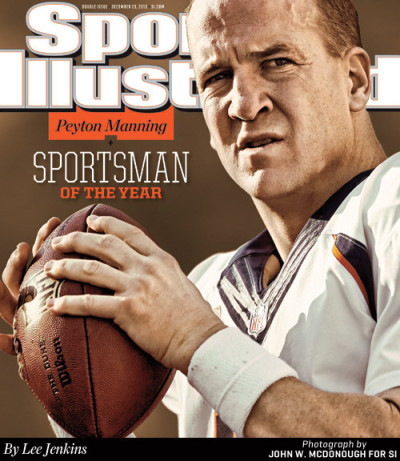
SI Got It Right: Peyton Manning IS the Sportsman of the Year

Peyton Manning is one of the top 10 quarterbacks of all time. He is a World Champion, could well win another title this season, and probably would have won at least 1 more Super Bowl had Bill Belichick not been an unrepentant cheater. Although he and his family are regular Republican donors, and he does commercials for the deeply evil "Papa John" Schnatter, he and his family are generous and seem like genuinely nice people.

And, this past season, at the age of 37, in the process of helping the Denver Broncos win the AFC West, he broke the single-season record for touchdown passes. So, yes, beyond any doubt, he is a legitimate candidate for Sportsman of the Year, for Sports Illustrated magazine or anyone else.

But, again, he's 37. This is his 15th season in the NFL -- his 16th if you count missing all of 2011 after neck surgery. He's had better seasons, including 2006, which he capped by leading the Indianapolis Colts to win Super Bowl XLI in February 2007.

In calendar year 2006, SI gave SOTY to Dwayne Wade, for leading the Miami Heat to their first NBA Championship. Was he a better choice than Manning? Possibly, as the big achievement came in the following calendar year.

Terry Bradshaw (1979, shared with Willie Stargell), Joe Montana (1990), Tom Brady (2005), Brett Favre (2007) and Drew Brees (2010) are NFL quarterbacks who've received the award. Until manning, Favre was the only one who did not get it in a calendar year in which he'd won a Super Bowl.

In 2007, a year which effectively began with Manning's long-awaited Super Bowl win, Favre captivated the nation with the story of his spectacular Monday Night Football game the day after his father passed away. It was also a year in which he broke some career records for quarterbacks, some of which Manning now holds, or likely will hold (unless he decides he's had enough and hangs 'em up after this great season).

SI has done "lifetime achievement awards" for its SOTY before:

* 1957: Stan Musial. Stan the Man, a serious candidate for the title of best hitter in National League history, and definitely the best in his own generation, did have a great individual season at age 37. So did his counterpart in the American League in his generation, Ted Williams, then 39. But neither one won the Pennant.

In contrast, another candidate for the title of best hitter in NL history, Hank Aaron, not only led his team to win the World Series, but hit a walkoff home run to win the Pennant-clinching game. So why Stan, and not Hank? Was it age -- Hank was just 23? Or was it... No, it probably wasn't race: The next year, SI chose a black man as Sportsman of the Year, track star Rafer Johnson. But Hank was still a better choice than Stan. So was Mickey Mantle, whose Yankees were beaten by Hank's Milwaukee Braves in the Series. So was Bill Russell, who led the Boston Celtics to their first NBA title.

* 1968: Bill Russell. By this point, Russell had won 10 NBA titles, 2 NCAA titles, and an Olympic Gold Medal. So, why now? Actually, this one was fully justified: He had just completed his 2nd season as the 1st black head coach in major league sports, and won the 1st title by a black coach. (Sort of: In the NFL's 1st season, 1920, Fritz Pollard was player-coach of the title-winning Akron Pros. But calling the NFL "major league" at that point was a bit of a stretch.) As it turned out, like a lot of player-coaches, Russell the coach didn't do to well without himself as a player.

* 1972: John Wooden, shared with Billie Jean King, making her the first Sportswoman of the Year and the pairing the first shared award. That BJK deserved to be considered is clear. But Wooden had won 6 NCAA titles before taking his 7th in the year in question. Why this time?

I could understand choosing Sandy Koufax in '65, Carl Yastrzemski in '67, Russell in '68, Tom Seaver in '69, and Bobby Orr in '70. But why was he not as deserving as Ken Venturi in '64 or Lee Trevino in '71? Those men weren't athletes, they were golfers. This was clearly a lifetime achievement award for the Wizard of Westwood.

* 1978: Jack Nicklaus. If you accept that golfers are athletes and therefore "sportsmen," this still doesn't make any sense. Yes, he won the British Open that year. But it was hardly his best year. So why then? Why him, instead of, say, Ron Guidry? Or Roger Staubach? Or Elvin Hayes? Or Guy Lafleur? Or Bear Bryant? Or Jack Givens? Or Mario Kempes? They could've given it to Steve Cauthen, the jockey who won the Triple Crown -- except they gave it to him the year before, when he gave them less reason to do so.

* 1985: Kareem Abdul-Jabbar. This one was justified because, although he was 38, Kareem carried the Los Angeles Lakers on his back to win the NBA title.

* 1986: Joe Paterno. My personal feelings about him aside, he had put Penn State into a de facto National Championship game. But he had done things like that before, a few times.

* 1992: Arthur Ashe. He was dying of AIDS, and closing a life devoted to activism of many kinds. It would have been better if they'd honored him in 1968 (when he became the 1st black man to win the U.S. Open, although Russell was a good choice) or in 1975 (when he became the 1st black man to win Wimbledon, a better choice than the now-disgraced Pete Rose).

* 1993: Don Shula. He broke the NFL career record for coaching wins, but it was hardly his best year. It should have been 1973, when he won back-to-back titles, including the capping of an undefeated season.

But SI picked Jackie Stewart, an auto racer. Jackie was a great personality, and perhaps the best at what he did (certainly, he was the best at the time), but auto racing is not a sport. It requires intelligence, toughness, and endurance, but no real athleticism. Also, the car is the biggest key: You put me in Stewart's car and Stewart in my 1979 Mercury Zephyr, and I'll beat him.

* 1997: Dean Smith. Yes, that was the year he broke the record for most NCAA coaching victories. (It has since been broken again.) And he did bring North Carolina to one more Final Four in his last season. But, as with some of these others, he had better years, including Shula's year of 1993, when he won the National Championship.

* 2011: Mike Krzyzewski and Pat Summitt. Each is now the all-time leader in NCAA coaching victories for basketball played by their respective genders. And each had a great year. But, again, both had better years.

*

So, are there any figures who deserved Sportsman of the Year more than Peyton Manning? An answer of "Yes" would do nothing to diminish Peyton's achievements. Even if he has achieved more in other years.

Title winners in the various sports?

* NFL: Baltimore Ravens. Joe Flacco, Ray Rice, John Harbaugh... Great, but not really much buzz. And then there's the can of worms you would open if you gave it to Ray Lewis.

* NHL: Chicago Blackhawks. Jonathan Toews or Patrick Kane... No, not much excitement, unless you live in Chicagoland.

* NBA: Miami Heat. LeBron James won SOTY last year.

* MLB: Boston Red Sox. Had SI named David Ortiz, knowing full well he was a cheater and a liar about it, I would have told every Yankee Fan to cancel their subscriptions and never buy the magazine again.

* UEFA: Bayern Munich. Arjen Robben, Franck Ribery... Not exactly paragons of virtue.

* Olympics: There wasn't any. And in a non-Olympic year, an Olympic-sport achievement would have to be mind-boggling to qualify its achiever for SOTY.

* Boxing: The most notable boxer of the year was Floyd Mayweather, whose greatest claim to fame is that he's a coward, too chicken to risk his undefeated record against Manny Pacquiao, even though it's now proven that Pacquiao is not invincible. Mayweather says he won't fight Pacquiao because he won't do business with Bob Arum.

What a chump: If I had people calling me a coward to not fight someone, I'd call the fighter up, and do a "Creed-Balboa III": No promoters, no money, no cameras, no fans, let's just do this. Mayweather won't, because he's a coward. And no sportsman.

* Tennis: Rafael Nadal and Serena Williams each won both the U.S. & French Opens, while Andy Murray became the 1st British man to win Wimbledon since 1936. Can't really say any of them is ahead of Peyton for this year.

You know what? I can't say there's a single athlete who appreciably deserves it more than Peyton does.

So, I'm going to agree with Sports Illustrated: Peyton Manning is the Sportsman of the Year.

But his brother Eli still out-titles him, 2-1.

Thursday, December 13, 2012

Who is the Sportsman of the Year?

Thanks to the magic of the Internet, I had already known it for a few days. But, last night, I was in a Barnes & Noble store, and I saw the cover of Sports Illustrated, awarding the magazine's annual Sportsman of the Year to LeBron James of the defending World Champion Miami Heat -- and, this past summer, Olympic Gold Medalist.

Last night, in Miami, the Heat lost 97-95 to the Golden State Warriors, a team that has missed the Playoffs 5 years in a row, made the Playoffs once in the last 17 years, and hasn't even been to the Conference Finals since Gerald Ford was President.

The Dreaded SI Cover Jinx strikes again? Or just a coincdence? As Leroy Jethro Gibbs taught us on NCIS, "Rule Number 39: There is no such thing as coincidence."

(Of course, I'm guessing Gibbs doesn't believe in jinxes, either.)

LeBron, Athlete of the Year? An understandable pick. But "sportsman"? The big jerk doesn't know the meaning of the word. If he does, he's got a funny way of showing it.

(UPDATE: LeBron would eventually prove to me that he is no jerk. At the time, though, I wasn't willing to see it. Shortsightedness on my part, or had LeBron grown up? At this point, it doesn't matter.)

Dictionary.com defines "sportsman" as follows:

1. A man who engages in sports, especially in some open-air sport, as hunting, fishing, racing, etc.

2. A person who exhibits qualities especially esteemed in those who engage in sports, as fairness, courtesy, good temper, etc.

Based on those definitions, am I judging LeBron too harshly?

He does engage in a sport. Basketball, unlike golf, is a sport. Although the "hunting, fish, racing, etc." part of it harkens back to a time when there were no professional team sports as we now understand that phrase.

As late as its first decade, 1954-64, SI went out of its way to focus on such sports: Horse racing (no problem there), tennis (no problem there), golf (I don't like it, but I understand), fishing (I don't like it, but I understand), hunting (I despise it, but I understand), and even dog shows and professional cardplaying -- not like in today's professional poker, but contract bridge.

The man most often associated with that latter game, Charles Goren, was on the SI cover at least twice in that period. Dog shows and card games are certainly competitions, but they're not sports. Okay, when Oscar Madison played poker on The Odd Couple, it could get somewhat physical.  Other than that...

But based on the 2nd definition...

* Good temper? Actually, yes. I have never seen LeBron lose his temper on the basketball court. If he ever has, I've either never heard about it, or missed it.

* Fairness? Well, if you think about it, he did fulfill his contract with the Cleveland Cavaliers. He wanted better players brought in, but he never demanded a trade from them. To the Cavs, he was fair. But to the Cavs' fans? Well, strictly speaking, he never had a contract with them. They certainly have the right to be mad at him, but does he really owe them anything more than he actually gave?

* Courtesy? This is where LeBron falls short. He had other options besides "taking my talents to South Beach." He could have stayed home in Cleveland. He could have gone to the great basketball city of New York. Or he could have gone to the great basketball city of Chicago. Considering how good both the Knicks and the Bulls are at the moment, he could have made all the difference those teams needed.

And when New York and Chicago love an athlete, that athlete stays loved. Even if they fall. After all, Joe Pepitone went to prison, and Lenny Dykstra is going there, but they're still loved in New York. But no, LeBron left for a ready-made team and good weather.

Winning a championship is never easy -- he found that out when the Dallas Mavericks beat the Heat, as the 2011 Heat did a great impersonation of the 2004 Lakers -- but the 2012 NBA Title was probably the most ready-made in the league's 65-year history. And it still felt like he was rubbing everyone else's noses in it.

I cannot see LeBron as Sportsman of the Year. Athlete of the Year, maybe. Sportsman of the Year, no.

So here are my 5 nominees, and my winner:

5. Urban Meyer. He left the University of Florida pretty much on top. Then he went to Ohio State when it was disgraced, and its loyal fans needed a lift. He gave them one. He (apparently) has obeyed the rules, and built an undefeated team that, if not for the transgressions of his predecessor Jim Tressel, would now be Big Ten Champions and preparing to play Notre Dame for the National Championship. But because of the NCAA's probation, they can't play to determine that they are, indeed, the best college football team in the country.

And you know what? Just like Terry Bowden, who led Auburn to an undefeated season in his first year after the scandal that forced Pat Dye to retire, he hasn't complained a lick. Compare him to men like Nick Saban and Bobby Petrino. And, if you want to throw in the collegiate form of another sport, Rick Pitino and John Calipari.

(UPDATE: Clearly, this was written before the 2018 abuse scandal at Ohio State.)

4. Usain Bolt. We can't know for sure that he is the fastest human who has ever lived. But as far as we can determine by timing, he is. And, except for being a Manchester United fan, he is, as far as I can determine, a man of sterling character, a credit to to his nation (Jamaica), his sport, and to any race, be it the 100-meter dash or the human race.

3. Michael Phelps. Sure, it seems greedy to want all those Gold Medals. But he challenged himself, and, yes, in some races he needed teammates, and challenged them, too, and they benefited. He's a great individual athlete and a great team athlete. He doesn't have a swelled head  He has a good sense of what he means to his sport.

And his one public misstep wasn't exactly committing a felony like what O.J. Simpson did and what Kobe Bryant was accused of, and it wasn't a blatant violation of the rules of his sport like what Pete Rose and the steroid users did, and it wasn't even a thoughtless (or even willful) humiliation of his family like what Tiger Woods did. Besides, there are now 2 States where it's legal.

(Man, if you had told me 20 years ago, or even 5, that, in 2012, gay marriage would be legal in more States than recreational marijuana use, I would've asked you what you were smoking.)

2. Eli Manning. The New York Giants quarterback didn't say he was the best quarterback -- even in his own family. He said he had joined "the elite" of quarterbacking. Then he proved his point. He showed the New England Patriots, for the 2nd time in 5 years, cheating doth never prosper for long.

While the groundsharing Jets don't know who their starting quarterback will be, or should be, Eli just does his job, quietly, and does it well, in the biggest sport in the country, in the biggest metropolitan area in the country. When he wins, he accepts it modestly and credits his teammates. When he loses, he takes it like a man, puts it in the past, and does his best the next week.

Of course, the Sportsman of the Year does not have to be a current athlete. My choice for 2012 isn't.

1. Bruce Bochy. Once upon a time, he was called "a good defensive catcher." Translation: He couldn't hit a beach ball with a telephone pole. He batted .239 with with 26 home runs and 93 RBIs. Curtis Granderson might call that "a typical season." Bochy calls it "my entire playing career" (1978 to 1987).

But, like a lot of mediocre athletes, his love for the game and his intelligence led him into coaching. All he's done is manage a team that had never won the World Series in over half a century in their current city to 2 in the last 3 seasons.
And this team, the San Francisco Giants, previously known for steroid cheat Barry Bonds, appears to have done so cleanly, and with a bunch of fun characters, who know what to take seriously, and what not to. Bochy has also been active in youth charities.  He's a great manager and a great guy, and hardly anybody knows it.

Tuesday, December 27, 2011

Sportsmen of the Year: An Overview (SI's, and Mine)

Sports Illustrated Sportsmen & Sportswomen of the Year

1954 Roger Bannister
1955 Johnny Podres
1956 Bobby Morrow
1957 Stan Musial (Lifetime Achievement Award, or LAA)
1958 Rafer Johnson
1959 Ingemar Johansson
1960 Arnold Palmer
1961 Jerry Lucas
1962 Terry Baker
1963 Pete Rozelle
1964 Ken Venturi
1965 Sandy Koufax
1966 Jim Ryun
1967 Carl Yastrzemski
1968 Bill Russell (LAA)
1969 Tom Seaver
1970 Bobby Orr
1971 Lee Trevino
1972 John Wooden and Billie Jean King (LAA in Wooden's case)
1973 Jackie Stewart
1974 Muhammad Ali
1975 Pete Rose
1976 Chris Evert
1977 Steve Cauthen
1978 Jack Nicklaus (LAA)
1979 Willie Stargell and Terry Bradshaw
1980 U.S. Olympic Hockey Team
1981 Sugar Ray Leonard
1982 Wayne Gretzky
1983 Mary Decker
1984 Edwin Moses and Mary Lou Retton
1985 Kareem Abdul-Jabbar
1986 Joe Paterno
1987 Athletes Who Care: Bob Bourne, Judi Brown King, Kipchoge "Kip" Keino, Dale Murphy, Chip Rives, Patty Sheehan, Rory Sparrow and Reggie Williams
1988 Orel Hershiser
1989 Greg LeMond
1990 Joe Montana
1991 Michael Jordan
1992 Arthur Ashe (LAA)
1993 Don Shula (LAA)
1994 Bonnie Blair and Johan Olav Koss
1995 Cal Ripken Jr.
1996 Tiger Woods
1997 Dean Smith (LAA)
1998 Mark McGwire and Sammy Sosa
1999 U.S. Women's Soccer Team
2000 Tiger Woods (only 2-time honoree)
2001 Curt Schilling and Randy Johnson
2002 Lance Armstrong
2003 David Robinson and Tim Duncan (LAA in Robinson's case)
2004 Boston Red Sox
2005 Tom Brady
2006 Dwyane Wade
2007 Brett Favre (LAA)
2008 Michael Phelps
2009 Derek Jeter
2010 Drew Brees
2011 Mike Krzyzewski and Pat Summitt (LAA in both cases)

61 honorees: 39 right, 24 wrong; 67 alive, 6 dead; 10 Lifetime Achievement Awards

My choices

1954 Roger Bannister
1955 Otto Graham
1956 Bill Russell
1957 Maurice Richard
1958 Rafer Johnson
1959 Ingemar Johansson
1960 Floyd Patterson
1961 Roger Maris
1962 Wilt Chamberlain
1963 Pete Rozelle
1964 Jim Brown
1965 Sandy Koufax
1966 Frank Robinson
1967 Carl Yastrzemski
1968 Al Kaline
1969 Tom Seaver
1970 Bobby Orr
1971 Roberto Clemente
1972 John Wooden and Billie Jean King
1973 Don Shula
1974 Muhammad Ali
1975 Arthur Ashe
1976 Chris Evert
1977 Al McGuire
1978 Steve Cauthen
1979 Willie Stargell and Terry Bradshaw
1980 U.S. Olympic Hockey Team
1981 Sugar Ray Leonard
1982 Wayne Gretzky
1983 Mary Decker
1984 Bonnie Blair and Johan Olav Koss
1985 Kareem Abdul-Jabbar
1986 Greg LeMond
1987 Magic Johnson
1988 Orel Hershiser
1989 Joe Montana
1990 Lou Piniella
1991 Michael Jordan
1992 Mario Lemieux
1993 Jacques Demers
1994 Bonnie Blair and Johan Olav Koss
1995 Hakeem Olajuwon
1996 Joe Torre
1997 Steve Yzerman
1998 John Elway
1999 U.S. Women's Soccer Team
2000 Derek Jeter
2001 Joe Sakic
2002 Lance Armstrong
2003 David Robinson and Tim DUncan
2004 Joe Dumars
2005 Roy Williams
2006 Dwayne Wade
2007 Peyton Manning
2008 Michael Phelps
2009 Troy Polamalu
2010 Drew Brees
2011 Aaron Rodgers

63 choices; 51 alive, 12 dead

Monday, December 26, 2011

Who Are the Real Sportsmen of the Year? Part III

1991 Michael Jordan. The best player in basketball at the time, he finally led the Chicago Bulls to their 1st NBA Championship. Can't disagree with this one.

1992 Arthur Ashe. Another lifetime achievement award (LAA) that SI gave out for SOTY. As I said in Part II, they should have given it to him in 1975, when he deserved it a whole lot more than Pete Rose. Ashe died of complications from AIDS early the next year, and is the most recent SI honoree to die (though not the one who is the most recently deceased).

Joe Gibbs of the Washington Redskins coached his 3rd Super Bowl winner in 9 years. If SI wanted to go for an achievement of clean consistency by a thoroughly decent man, there's one. Clarence "Cito" Gaston of the Toronto Blue Jays became the 1st black man to manage a World Series winner. If SI wanted to go for a civil rights achievement, there's one. Mario Lemieux of the Pittsburgh Penguins won his 2nd straight Stanley Cup, then, just before the calendar year ran out, came back from Hodgkin's disease to play again. If SI wanted to go for a champion dealing with a potentially fatal illness, there's one -- and this one not only lived, but returned to play at a Hall of Fame pace.

All were worthy of SOTY. Considering that Ashe should have been honored 17 years earlier, and that I've already reflected this fact in my own picks, I'm giving it to Lemieux.

1993 Don Shula. The Miami Dolphins boss surpassed George Halas of the Chicago Bears to become the winningest coach in NFL history, but this was another LAA, and it came 20 years after he could have been so honored, following the Dolphins' 1973 achievement of the undefeated season.

Jacques Demers overcome a learning disability, which prevented him from learning how to read until he was already an NHL coach, to lead the Montreal Canadiens to their 24th Stanley Cup -- their 23rd World Championship meant that they were the most successful franchise in North American sports from May 1986 to October 2000 when the Yankees won their 25th World Series. And they did it the hard way: Beating their Provincial rivals, the Quebec Nordiques, in 6 games including 3 overtime wins; sweeping the Buffalo Sabres but needing 3 more overtime wins; overcoming the New York Islanders (the last time that franchise has gone this far) in 5 games but needing 2 overtime wins (one in double OT); and topping the Los Angeles Kings in the Finals, losing Game 1 and then winning 4 straight, the 1st 3 in OT before winning in regulation at the Montreal Forum.

It was fitting that hockey's greatest franchise won the 100th Anniversary Stanley Cup (especially since the 1st Cup, and several others before the 1909 founding of the Canadiens, were won by teams from Montreal). A team that included such legends and stars as Patrick Roy, Guy Carbonneau, Denis Savard, Vincent Damphousse, Kirk Muller, Mike Keane, John LeClair, Mathieu Schneider and Eric Desjardins had a soft-spoken, determined leader who knew what it was like to refuse to quit. Demers is now a member of the Canadian Senate.

1994 Bonnie Blair and Johan Olav Koss. For the 1st time, the Winter Olympics were held in the even-numbered year between leap years, while the Summer Olympics continue to be held in leap years. SI honored 2 superb speed skaters: Blair remains, to this day, the most successful American female athlete in Olympic history; and Koss thrilled the home crowd at Lillehamer, Norway with his Gold Medals.

In a year that began with the assault on Nancy Kerrigan and the Dallas Cowboys (ugh) winning the Super Bowl, reached its midpoint with the O.J. Simpson murder case and the New York Rangers (ugh-squared) winning the Stanley Cup, and ended with Baseball Commissioner Bud Selig cancelling the postseason due to a strike in which the players, however greedy, had the comparative moral high ground, Blair and Koss were superbly sportsmanlike, and I do not question this decision by SI.

1995 Cal Ripken Jr. Whether Babe Ruth "saved baseball" after the 1920 Black Sox Scandal is dubious. Even more so, Ripken, the Baltimore Orioles shortstop, didn't "save baseball" by continuing to play until breaking Lou Gehrig's consecutive games played streak of 2,130 games (especially since, due to the strike, while he played in every game available to him, he didn't play from August 12 to the intended end of the season on October 2, or from the intended start of the next season on April 3 through April 24).

Ripken was a very good player for a long time, and while 3,000 hits was enough to make him a legitimate Hall-of-Famer, let's tell the truth: That streak, and the ego he maintained to maintain it, ended up hurting his team.

The real Sportsman of the Year was Hakeem Olajuwon of the Houston Rockets, whom he led to a 2nd straight NBA Championship, this one (unlike the 1st) alongside his college teammate Clyde Drexler, who, like Hakeem, had previously been 0-for-2 in NBA Finals (in his case, with the Portland Trail Blazers) and had joined with Hakeem to lead the University of Houston's "Phi Slamma Jamma" team to 3 NCAA Final Fours, including 2 Finals, but lost them all.

Hakeem's acts of charity were already well-known, and bringing Clyde the Glide back to his hometown was no act of charity: It was a masterstroke, as the Rockets, who struggled to beat the Patrick Ewing Knicks in 7 games the year before (avenging the NCAA Final to Ewing's Georgetown 10 years before), swept the Shaquille O'Neal-led Orlando Magic.

1996 Eldrick "Tiger" Woods. Tiger won the NCAA individual golf championship at Stanford University and the U.S. Amateur. He had not yet won a professional major, although he would do so in (pardon the pun) roaring fashion at the next year's Masters.

Even if you believe that golf is a sport (and it most certainly is not), this award was premature at best and massively dubious at worst. This was Joe Torre's year to get the award.

1997 Dean Smith. In what turned out to be his final year as a college head coach, the North Carolina boss guided his team to a 13th ACC Tournament Championship and an 11th Final Four, and surpassed Adolph Rupp to become the all-time winningest men's college basketball coach. (He has since been surpassed by Bobby Knight and Mike Krzyzewski.) He won 2 National Championships and coached the U.S. team to the Gold Medal at the 1976 Olympics.

If SI had a separate LAA, the Dean would have been an easy choice. But while he was a fine sportsman who had a great year, it didn't make sense to name him Sportsman of the Year.

After coming close 3 times with the Pittsburgh Pirates, Jim Leyland finally got to, and won, a World Series with the Florida Marlins. Coach Mike Holmgren, quarterback Brett Favre, and defensive end Reggie White led the Green Bay Packers to their 1st Super Bowl win in 31 years. Steve Yzerman led the Detroit Red Wings to their 1st Stanley Cup in 42 years.

Despite what we later learned about Favre and White, and the Marlins' spending spree with the promise of breaking them up in the off-season -- leading Dave Rosenbaum to title a book about the team If They Don't Win It's a Shame: The Year the Marlins Bought the World Series -- any of these potential selections would have been better for a single year. I'm going with Yzerman, the longest-serving Captain in NHL history, and a total class act for nearly 30 years now.

1998 Mark McGwire and Sammy Sosa. So Ripken didn't quite "save baseball," but the Mac & Sammy Show did? What we now know about Mac, and what we now suspect about Sammy, should be irrelevant, every bit as much as what happened to Pete Rose didn't cause SI to strip him of his 1975 honor, or what O.J. did in 1994 would not have made a difference had he gotten SOTY for his 2,003-yard rushing performance in 1973.

But did Roger Maris get SOTY for hitting 61 homers in 1961? No. Did Hank Aaron get it for reaching 715 homers in 1974? No. Even if you believe Jerry Lucas in '61 and Muhammad Ali in '74 were worthy honorees, the fact remains that Maris and Aaron were not so honored, and Maris, at least, won the World Series. Sosa did get the Chicago Cubs into the Playoffs, but McGwire's St. Louis Cardinals... Refresh my memory, did McGwire hit 70 homers while the Cards won 83 games, or did he hit 83 homers while the Cards won just 70? For all practical purposes, there's no difference: In spite of his individual achievement, his team did not reach the postseason.

Having already given the award to Torre for 1996, I'm not going to give it to him for 1998. Derek Jeter? Not just yet. How about John Elway? He finally got his ring, and then led the Broncos to a 14-2 regular season in what everyone presumed (correctly, as it turned out) would be his last season. A LAA? Not really: Had Elway been named SOTY, it would have been totally deserved. He was a winner and a sportsman.

1999 U.S. Women's Soccer Team. They won the World Cup, in front of the highest live attendance (90,185 at the Rose Bowl) and the largest TV audience ever for a women's sporting event, and offered what should be the final proof that a woman can be athletic and feminine at the same time. Or, as Rick Reilly put it in SI:

Admit it. You were thinking, Joe Torre in heels. You figured when a U.S. women's team finally broke through, one that made even the truck drivers care, it would be a bunch of women with Bronko Nagurski shoulders and five o'clock shadows. Well, the revolution is here, and it has bright-red toenails. And it shops. And it carries diaper bags. The U.S. women's soccer team is towing the country around by the heart in this Women's World Cup, and just look at the players. They've got ponytails! They've got kids! They've got (gulp) curves!

Captain Carla Overbeck crawls across a magazine page in a leopard-skin dress. Midfielder Julie Foudy calls the team "booters with hooters." Lethal scorer Mia Hamm makes PEOPLE'S 50 Most Beautiful. Midfielder Brandi Chastain shows up in the pages of Gear wearing only a soccer ball, which gets her on Letterman, who sends Late Night shirts to the whole team, which snaps a picture of the players apparently wearing only the shirts and cleats, which causes Letterman to refer to them forevermore as "Babe City."

"Hey, I ran my ass off for this body," says Chastain. "I'm proud of it."

This team is a wonderful combination of Amazonian ambush and after-prom party. "We're women who like to knock people's heads off and then put on a skirt and go dance," says Chastain.


With all due respect to what Derek Jeter, Kurt Warner, Tim Duncan and anybody else achieved in that calendar year, this was the year a soccer ball shattered the glass ceiling. I dare you to tell Chastain her team didn't deserve the Sportspeople of the Year award. She's 43 now, still playing, and broadcasting, is married with 2 kids... and could probably throttle you if she so desired. Go ahead, tell her, I dare you.

2000 Tiger Woods. This is the only time SI has given the award to a previous winner. He won the last 3 of the 4 majors, and then won the Masters the next year to become the 1st-ever holder of all 4 titles, even if he didn't quite do it all in the same year to form a true "Grand Slam." (This became known as the "Tiger Slam," which is certainly better than the infamous "Saturday Slam" of Greg Norman.)

But until Tiger, or any other golfer, tries to take a shot with Justin Verlander throwing the ball at him at 95 miles an hour, or with Ray Lewis bearing down on him at full prowl, or tries to put the ball in a hole guarded by Dwight Howard or Tim Thomas, he is playing a game... not a sport. You don't give Sportsman of the Year to a poker player, do you? No matter how successful.

Only one man has ever won the Most Valuable Player award of Major League Baseball's All-Star Game and its World Series in the same year. That's Derek Jeter of the 2000 World Champion New York Yankees. Derek would be honored by SI in 2009, but this was the year he deserved it most.

2001 Curt Schilling and Randy Johnson. As dominating as they were in the 2001 World Series, to call either man a "sportsman" is absolutely laughable.

Unfortunately, there wasn't a lot of choice. The Super Bowl MVP was Ray Lewis, who was coming off criminal charges. The NBA Finals were won by Shaq, Kobe Bryant, and the Lakers -- no sportsmen they, and of course they cheated again. There was no Triple Crown winner in horse racing, no Olympics, no World Cup, and boxing was a mess, as it had pretty much been for the 10 years before and the 10 years since.

And to give SOTY to Ray Bourque, whose achievement of finally winning the Stanley Cup after 22 years of superb hockey, and still being a major contributor to his team, while not entirely undeserved would, essentially, have been another LAA. I could give it to the Colorado Avalanche's Captain, Joe Sakic, instead of teammate Bourque. So I'll go with Sakic, who was also, in this year, selected as Canada's Captain for the upcoming Olympics, which they won.

2002 Lance Armstrong. Since I've already honored Yzerman, none of the Anaheim Angels was a standout choice, the Lakers won again, we now know that the New England Patriots are a bunch of dirty cheaters, and not that many Americans knew Ronaldinho's name (or nickname), and we still don't know for sure that Armstrong was doping, I'm going to let this one stand.

2012 UPDATE: Now we know. My replacement choice is Sarah Hughes, who won the women's figure skating Gold Medal.

2003 David Robinson and Tim Duncan. They led the San Antonio Spurs to their 2nd NBA Championship, all in the last 5 seasons. Robinson retired, and Duncan would make it 4 in 9. Both are distinguished, charitable individuals whose careers have never had a hint of scandal, and all lifted a community (West Texas) which has just this one major league sports team. I cannot question this honor.

2004 Boston Red Sox. At the time, even a sick, twisted, demented Yankee Fan like myself would have had a hard time doubting that they deserved it. Now we know: They cheated, they lied about it, they got caught, and they're still lying about it. We also know that Tom Brady, honored the next year and could have been honored for this year, benefited from cheating.

I'm giving it to Joe Dumars: In the late 1980s and early '90s, the idea of anyone associated with the Detroit Pistons getting SOTY was ludicrous. But Joe put together a team that, like the early 1970s Knicks, stressed team harmony over individual egos, and they beat the Lakers, a team so loaded it was considered "inevitable" champions. You know, just like the 2011 Miami Heat.

Go ahead: Tell me that Rasheed Wallace, Ben Wallace, Lindsey Hunter, Chauncey Billups, Richard Hamilton, Tayshaun Prince or Mehmet Okur is going to the Basketball Hall of Fame. At the moment, you can't. But that's 7 superb players, and they triumphed over sure HOFers Shaquille O'Neal, Kobe Bryant, Karl Malone and Gary Payton.

2005 Tom Brady. Brady and the New England Patriots, early in the year, had won their 3rd Super Bowl in 4 years, and Brady his 2nd SB MVP. But since "Spygate," we can't taken any of the Pats' achievements in the Belichick/Brady Era seriously.

The World Series winner? The Chicago White Sox. No overwhelming star, and manager Ozzie Guillen isn't exactly a sportsman. The NBA Champions? The Spurs, and we've already honored Duncan. The BCS winners? We now know that USC was cheating. The World Cup winners? The horse racing Triple Crown? The Olympic Gold Medalists? The undisputed heavyweight champion of the world? The Stanley Cup winner? There weren't any, of any of those. (This was the year the entire NHL season was canceled.)

And while a European sports magazine might have honored Steven Gerrard for the way he willed Liverpool FC from 3-0 down to win the Champions League Final, 99 percent of Americans didn't know who he was at the time.

While I haven't given my SOTY to Dean Smith, as much as I admire him, I'm giving the 2005 edition to Roy Williams, who did in this year what Smith did in 1982: Lead North Carolina to the 1st of 2 National Championships. And, unlike Smith, Williams can still win a 3rd.

2006 Dwyane Wade. In 2011, honoring a star of the Miami Heat would have been a sick joke. In 2006, it was a good choice.

2007 Brett Favre. At the time, it seemed like a good choice, if something of a LAA. In retrospect, who's kidding who? Whereas Peyton Manning led the Indianapolis Colts to their 1st Super Bowl (their 2nd, and their 4th World Championship if you count their Baltimore years), and has been an exemplar of stellar and fair play since arriving in the NFL in 1999. He has always "cut that meat." As opposed to Favre, whom we now know to have, uh, done something else with meat.

2008 Michael Phelps. Eight Olympic races, eight Gold Medals. Good guy, too. Except for the pot. I'm not taking this award away.

2009 Derek Jeter. Great award, but I've already given it to him for 2000, so I have to give it to someone else. I'm going with Troy Polamalu, the heart and soul of the Super Bowl Champion Pittsburgh Steelers (2nd win in this generation, 6th overall) and probably the most famous living person of Samoan descent. Certainly, the safety is a better choice than 2 of his prominent teammates from that game, quarterback Ben Roethlisberger (issues with women) and Santonio Holmes (also got into criminal trouble). I could make it a joint award with Polamalu and receiver Hines Ward.

2010 Drew Brees. What he's done for the people of the New Orleans area is immense -- and that's before you get into the football playing. A completely deserving award, especially when you consider the Saints' history before he got there.

2011 Mike Krzyzewski and Pat Summitt. As I said, 2 good choices for LAA, but neither was the sportsman of this year. Aaron Rodgers of the Green Bay Packers was -- unless he's hiding a criminal, pharmaceutical, or otherwise scandalous secret.

I'll have one final entry, as an overview.

Friday, December 23, 2011

Who Are the Real Sportsmen of the Year? Part II

From this point forward, all SOTY winners (SI's and mine) are still alive unless otherwise stated.

1970 Bobby Orr. It's hard to argue against the most popular hockey player of that time, especially since he led the Boston Bruins to the Stanley Cup and even scored the winning goal, despite getting tripped up by an opponent, still managing to raise his arms in victory. (That "Flying Goal" picture is one of the most famous in the history of the sport, and can be seen in Booth's office on Bones.)

He won the Ross Trophy as the NHL's leading scorer (as a defenseman!), the Norris Trophy as best defenseman, the Hart Trophy as regular-season Most Valuable Player, and the Smythe Trophy as Playoff MVP, and, as John Houseman would say, he got those trophies, and the Stanley Cup, the old-fashioned way: He earned them.

Orr wasn't just great, he was good: His acts of charity, including in business since his playing career ended far too soon due to injury, are as big a part of his legend as the way he forever changed the position of defenseman. And, though Canadian, he ignited hockey's popularity in America as no one before or since -- with the kind of boost from television that Frank Boucher, Eddie Shore, Maurice Richard and Gordie Howe were unable to provide. There are still many ice rinks in this country, and not just in the Bruins' native region of New England, that can legitimately be called Bobby Orr Rinks.

There are 3 other possible honorees, but I don't think I can put them ahead of Orr. Brooks Robinson, like Orr, redefined a position in a sport, in his case 3rd base in baseball, with his defensive wizardry in that year's World Series, and his hitting was also a big reason why, unlike the year before, the Baltimore Orioles were able to win it. He, Frank Robinson, Jim Palmer, Boog Powell and the rest redeemed themselves, big-time.

Willis Reed, though in incredible pain, captained the Knicks to their 1st NBA Championship. But with Red Holzman making such a big deal about how the Knicks were a team first, it made giving them individual awards problematic, no matter what Reed, Walt Frazier, Dave DeBusschere or Bill Bradley did on the court.

And then there was Pelé. In 1966, it would never have occurred to SI to name England's Captain Bobby Moore or its Final hat-trick hero Geoff Hurst their Sportsman of the Year. But 1970 was the 1st time the world really got to see the World Cup in blazing color. And what colors: Brazil's yellow, England's red, Italy's blue. The 1970 Brazil national team that won the Cup has often been hailed as the greatest team in soccer's history, and Pelé as its greatest player, still at his best at this point. The photo of Pelé and Moore, the greatest forward and the greatest defender in the sport, not just then but maybe ever, exchanging shirts after their group-stage game is every bit the classic as the one of Orr's Flying Goal.

But I guess SI wasn't ready for it. They'd rather name a white English-speaking Canadian winning a tournament in America in a sport that was already familiar to them, than name a black Portuguese-speaking Brazilian winning a tournament in Mexico in a sport that most Americans simply didn't get, even with the founding (if not yet the Pelé-inspired rise) of the North American Soccer League in 1967. Had I been old enough to understand at the time (and not a baby), I probably also would have given it to Orr.

1971 Lee Trevino. The diminutive Dallasite won both the U.S. and the British Opens this year, at a time when Jack Nicklaus and Gary Player were at their peaks, and did it with a felicidad de vivir (that's Spanish for joie de vivre) that made everybody like him. The 1st person of Spanish descent to be so honored by SI, he's one of the biggest money-winners, and one of the most popular people, ever to be involved with golf.

But if you believe, as I do, that golf is not a sport, then we have to look elsewhere for an honoree. And I have one, another Hispanic: Roberto Clemente. Because Pittsburgh wasn't a big market, his achievements had often been overlooked. But when the Pirates won the Pennant, he set out to show everyone just what he could do in the World Series. He got a hit in every game, including hitting a home run in Game 7. (In fact, he also got a hit in every game of the seven-game 1960 Series. That's 14 World Series games in his career, and he got a hit in all of them. Top that.)

With his intensity, his unwillingness to compromise (insisting upon being called Roberto instead of Bob or Bobby, although he let Pirate broadcaster Bob Prince keep calling him Bobby), his cannon of an arm, and his turning of an awkward batting stance into 4 batting titles and 3,000 hits, he made people notice not just him, but Latin ballplayers, and the people of Puerto Rico in general.

Roberto should have been named Sportsman of the Year for 1971. It was his best year. Sadly, 1972 would be his last year.

1972 John Wooden and Billie Jean King. For the 1st time, SI had a split award. Also for the 1st time, they named a pure coach. (Bill Russell was a player-coach in 1968.) And, also for the 1st time, they named a woman.

Wooden led UCLA to a 7th National Championship, and didn't lose a game in the calendar year. But it was a lifetime achievement award (LAA): What made him more worthy this time than in any of the 6 previous times?

Look at the other years: Maybe Sandy Koufax was more deserving in '65, Carl Yastrzemski in '67, Russell in '68, Tom Seaver in '69, or Orr in '70. But was Ken Venturi more deserving in '64, or Trevino in '71? If so, it wasn't by much. And it could be argued that, considering who the other champions of 1973 and '75 were, Wooden was more deserving in those years as well. (He died last year, a little short of his 100th birthday.)

But in the year in which Title IX was passed by Congress and signed into law by President Richard Nixon, Billie Jean was an easy choice. The 1st tennis player so honored by SI, she won 3 of the 4 majors, all but the Australian Open. (No woman would win the Grand Slam until Steffi Graf in 1988.)

But this wasn't just about her on-court achievements: Her activism led the tennis tournaments to give female competitors equal pay with male ones, and, more than any human being, living or dead, she raised the profile of women's sports, and 1972 was a landmark year in that regard.

Oddly, she may have had an even greater contribution the next year: That such a spectacle as her "Battle of the Sexes" against Bobby Riggs (who really was once a great tennis player, winning Wimbledon and the U.S. Open... in 1939) was necessary is one of the great stupidities of a decade loaded with them. She rendered a repeat of such a thing unnecessary.

1973 Jackie Stewart. "The Flying Scot" was the child of an auto dealer, and became a champion in Formula One racing, and SI's 1st SOTY honoree in any "motorsport." They had, however, featured auto and boat racing from the very beginning of the magazine.

Prior to ABC Wide World of Sports broadcasting this staple of European sport, Americans knew Indy-car racing (such as in the Indianapolis 500) and stock-car racing (though we did not yet tend to refer to it by its "league name," NASCAR). Formula One was foreign. Very foreign, full of Frenchmen, Germans, Italians, Brazilians. Like soccer.

But Stewart spoke English, if with a heavy and proud Scottish brogue. He oozed love for his sport. He was personable. He was charismatic. And in his final season (he had announced his was retiring), he became a legend on this side of the Atlantic Ocean as well.

He joined ABC to broadcast auto racing, and, along with Frazier, Joe Namath, Jimmy Connors and Reggie Jackson, was one of the top sports personalities in TV commercials in that era. In one commercial for Getty gas, he drove an F1 car up to a big gas guzzler and said that wasting gas "makes my Scottish blood run cold!" He became the most famous Scotsman in America, topping Canadian James Doohan's Montgomery Scott character from Star Trek.

No question, he was a great champion, and a great personality. But is auto racing a sport? I say it isn't. But '73 was a tough year: "The Swingin' A's" were champions, but not exactly "sportsmen." George Foreman won the heavyweight title but, at the time, wasn't exactly considered photo- or telegenic. The Knicks won their 2nd NBA Championship, but it simply wasn't as great a story as it had been in 1970.

Maybe if Hank Aaron had hit just 2 more home runs, to break the all-time record in spite of the vicious hate mail he got, instead of hitting Numbers 714 and 715 early the next season, he would have been named SOTY. He certainly was a deserving finalist.

And, of course, the Miami Dolphins began the year by completing their undefeated season, and continued their streak well into the following season. But Bob Griese, though a good quarterback, was colorless (the Dolphins' aqua and orange home jerseys notwithstanding). And their defense was known as "the No-Name Defense." (Totally unfair, especially now that Nick Buoniconti is in the Hall of Fame.)

Head Coach Don Shula? He was honored by SI 20 years later, an obvious LAA. But he was never really all that interesting. But he should have been SOTY. After all, as he and the surviving members of that 1972-73 Dolphin team will tell us (especially now that the Green Bay Packers won't go 19-0 this season), they are the only undefeated champions in NFL history. (Not quite true, but they are the only ones since the NFL Championship Game, and its successor the Super Bowl, began in 1932.)

1974 Muhammad Ali. No argument. Arguing would be pointless: Even if he didn't punch you for arguing, he'd talk and talk and talk you into submission. That year, he proved he was The Greatest. Aaron may have become baseball's all-time home run leader (and, for all honest men, he still is), but, barring an unforgivable crime, the new record was inevitable. Ali's knockout of Foreman to retake the heavyweight title was, at the time, truly shocking. (In retrospect, no, it wasn't.)

As he had so many times earlier in his career, he predicted victory, and, well, as Dizzy Dean (who died that year) taught us, "If you can do it, it ain't braggin'." Ali told us, and he was right: "When you see this, you'll be shocked! You'll be laughin'! And you will know, beyond a shadow of a doubt, that I am still... The Greatest... Of All Tiiiiiiiime!" He'll be 70 next month, and he still is The Greatest.

1975 Pete Rose. Yes, he (at least unofficially) captained the Cincinnati Reds to the World Championship, and won the World Series MVP. But, as we are now willing to see, even then he was no sportsman.

A better choice would have been Arthur Ashe, who not only became the 1st black man to win Wimbledon (Althea Gibson was the 1st black person to win it, in 1957), but delivered one of the most public early blows to the apartheid regime of South Africa. Ashe would receive the SOTY in 1992, a LAA, at the end of his lifetime. He deserved it at his peak.

1976 Chris Evert. The 1st tennis player, 1st woman, and 1st female to be a sole-winner of the SOTY (after Billie Jean shared it with Coach Wooden in 1972), she was also the youngest one yet: 22 years even, 9 months younger than Orr was in December 1970. She won Wimbledon and the U.S. Open, after having won the French the previous 2 years. (It would take her until 1982 to win the Australian and complete "the career Grand Slam.")

I see no fault with this selection, although they could have gone even younger and selected Nadia Comaneci. But I guess America wasn't ready for SI to give SOTY to a 14-year-old girl from a Communist country. Even if she did go on to defect, marry an American, and settle in the U.S.

1977 Steve Cauthen. Chrissie's title as youngest SOTY winner lasted just 1 year, as the 17-year-old Eclipse Award winner for Best Jockey was honored. He became known, borrowing the title of a popular TV show of that era, as the Six Million Dollar Man, because he became the 1st jockey to win that much money in a year. Actually, right guy... wrong year.

I'm biased. This was the 1st year whose sports moments I can really remember. And Reggie Jackson came to the Yankees for this year and became my man for all time. Sports star of the year? Even in retrospect, I'd say yes. But "sportsman" of the year? That's pushing it.

How about Al McGuire? The longtime basketball coach at Milwaukee's Marquette University, having gotten to the National Championship Game in 1974 and lost to North Carolina State, won it this time, topping Dean Smith's North Carolina, and tearfully retired.

He then began a second career broadcasting college hoops. The Far Rockaway native, and brother of 1950s Knicks legend Dick McGuire (Al also played for them but wasn't nearly as good as his brother), was one of the great personalities in the game's history. He was arguably the original "Dick Vitale." It was a sad day when he died.

1978 Jack Nicklaus. The Golden Bear won the British Open that year. That's it, just the 1 title. There had been 3 years in which he won 2, so what made this year any more special? Besides, while he remains the greatest performer his game has ever seen, golf is still a game -- not a sport.

This was the year they should have given it to Steve Cauthen. He won not one of his sport's majors, not two, but all three. Aboard Affirmed, he won the Triple Crown of thoroughbred horse racing. There has never been another.

1979 Willie Stargell and Terry Bradshaw. No way to dispute this dual award. In the last year of a decade that saw either the Pirates or the Steelers make the Playoffs each year, and both of them do so 4 times (1972, '74, '75 & '79), they each won their sport's World Championship.

Bradshaw and the Steel Curtain won Super Bowl XIII in January, and were setting themselves up for SB XIV the following January, their 4th title in 6 years. Stargell had been with the Bucs on their '71 title, and by '79 he was the "Pops" of a team called "The Family."

When the Pirates won the World Series in October, Pittsburgh began calling itself the City of Champions, and if you were going to argue, you had to face such black-and-gold badasses as Dave "Cobra" Parker, Bill "Mad Dog" Madlock, "Mean Joe" Greene, Jack Lambert and L.C. Greenwood -- the latter 2 so mean they didn't need no stinkin' nicknames. Sadly, Stargell has died.

1980 U.S. Olympic Hockey Team. Do you dare question this one? What are you, a Communist? Coach Herb Brooks has died, but all 20 players remain alive.

1981 Sugar Ray Leonard. He unified the Welterweight Championship of the World by knocking out the undefeated Thomas "Hit Man" Hearns in the 14th round in Las Vegas, a fight that was very much a lower-division equivalent to the 1975 "Thrilla in Manila" between Ali and Joe Frazier.

In a calendar year that saw championships won by such questionable personalities as the Oakland Raiders, Bobby Knight, the New York Islanders, the Boston Celtics, John McEnroe, and Tommy Lasorda, I can't dispute this one.

1982 Wayne Gretzky. In the 1981-82 season, Wayne Gretzky did to his sport what Wilt Chamberlain did to his in 1961-62, and Babe Ruth did to his in 1920: Rewrote the offensive record book. Although the Edmonton Oilers were not quite ready for prime time -- blowing a 5-0 lead in a Playoff game against the Los Angeles Kings, known as the Miracle On Manchester for the street the Forum is on -- there was no question at the time that Number 99 was class on and off the ice.

That he sided with his fellow owners, not his former fellow players, in the 2004-05 NHL lockout is despicable, but it doesn't change what he did, on and off the ice, to promote the game.

1983 Mary Decker. In spite of the efforts of Wilma Rudolph, Wyomia Tyus, and a few Eastern Europeans that we now know had pharmaceutical help, Decker was the 1st female track-and-field performer to receive the honor. She won the 1,500 and 3,000 meters at the World Championships, the first time the event was held, in Helsinki, Finland.

She had been unable to compete in the 1980 Olympics due to the U.S. boycott, but was a favorite to win Gold Medals at the 1984 Games. But it was not to be, in a race that was controversial even before it started, and more so afterward.

1984 Edwin Moses and Mary Lou Retton. Hard to argue with this dual entry. Moses won the Gold Medal in the 400-meter hurdles at the 1976 Olympics, missed the 1980 Games due to the boycott, and then won it again in 1984.

From 1977 to 1987, 10 years, 122 straight races, he never lost. Think about that: He had 122 chances to get beat by someone having a once-in-a-lifetime performance, or to get beat by someone cheating, or to have a bad race, or to be disqualified due to false starts, or to get hurt, or to get sick, or to not feel like showing up, or, God forbid, to have something tragic happen to him on the way to the meet, and none of that happened.  One hundred and twenty-two straight races. He kept the streak going until he was 32 years old -- that's like 45 in footracers' years. He was his sport's Hank Aaron and its Nolan Ryan.

Retton became the 1st American, male or female, to win an all-around Gold Medal in an Olympic gymnastic tournament, and the most famous person, let alone athlete, from West Virginia since the State produced football's Sam Huff and basketball's Jerry West in the 1950s.

I suppose SI could've made it a mass entry, as they did in 1980. The Soviet boycott (obviously payback for '80) made it a considerably easier Olympics for the West in general and the U.S. (and West Germany) in particular, and some other Americans should be mentioned.

Carl Lewis matched Jesse Owens' 1936 performance by winning Gold in the 100 meters, the 200 meters, and the long jump, and anchoring the 4-by-100-meter relay. A U.S. basketball team led by Michael Jordan and Patrick Ewing won the Gold, and was hailed as the best amateur basketball team ever. It may still be, since by the time Jordan and Ewing competed again in 1992, with a few other guys you may have heard of, professionals were allowed.

The U.S. men's gymnastic team won the all-around title, led by Peter Vidmar, Mitch Gaylord, and Bart Conner -- the last of them now better known as the husband of Nadia Comaneci. And Jeff Blatnick had survived Hodgkin's disease and the removal of his spleen to become America's first-ever Gold Medalist in Greco-Roman wrestling. Interviewed after his victory, through tears of joy he yelled, "I'm a happy dude!" Is that phrase symbolic of America in the 1980s, or what?

1985 Kareem Abdul-Jabbar. The former Lew Alcindor could have won in any number of years, but to be one of the top 5 players in the NBA at age 38, and to dominate the NBA Finals, clinching them against the Boston Celtics on the parquet floor of the Boston Garden, was something special. This was no LAA: This SOTY award was totally legit.

There was a time when the Los Angeles Lakers were not known for overweening egos, criminality and cheating on the court, but, rather, for power and style, and this was it: Kareem, Earvin "Magic" Johnson, James Worthy, Michael Cooper, and so on. (Okay, Kurt Rambis did look like a mustachioed basketball version of a hockey Hanson Brother, but other than that, they were as stylish a sports team as there has ever been, right up there with the early 1970s Knicks.)

1986 Joe Paterno. This isn't about what we now know about the football program at Pennsylvania State University. This is about what Joe Pa was thought to be at the time.

Sure, he, his team, their uniforms and their style of play were blander than Pat Boone eating rice pudding. But they got the job done, and even a Rutgers fan like me enjoyed seeing them beat the thugs of the University of Miami in the Fiesta Bowl (albeit on January 2, 1987, after this award was already given) to win their 2nd National Championship. The 1st happened in 1982, and there are those who argue they should have already been awarded them in 1969, 1970 and 1973. (And, later, in 1994.) So this looks like another LAA.

But look who the other major champions of the year were. Egomaniacs and/or cheaters like the Mets, the Chicago Bears, the Boston Celtics, the World Cup winners of Argentina with Diego "Hand of God" Maradona, and Mike Tyson. Teams nearly as bland as Nittany: The Montreal Canadiens (by this point, they were hardly the flashy "Flying Frenchmen" of the 1950s, '60s and '70s) and the University of Louisville. There was no Triple Crown winner in horse racing, and no Olympics. And while Nicklaus won the Masters at the shocking age of 46, I can't give Sportsman of the Year to a golfer, not even the greatest ever at the time of his greatest achievement ever.

But I don't, even reluctantly, concede this one to JoePa. In 1986, Greg LeMond became the 1st American -- indeed, the 1st non-European -- to win cycling's greatest prize, the Tour de France. He was considered worthy of the SOTY in 1989, why not in 1986?

1987 Athletes Who Care. In a year with comparatively bland champions like Phil Simms and the Minnesota Twins -- and with the Lakers' Kareem and the Oilers' Gretzky already past honorees -- SI went with charity:

* Bob Bourne of the Los Angeles Kings, formerly of the Islanders, who helped a handicapped children's school.
* Judi Brown King, a hurdler who won a Silver Medal at the 1984 Olympics, and helped abused children.
* Kipchoge "Kip" Keino, who won Gold Medals in track at the 1968 and '72 Olympics, who cared for orphaned children in his native Kenya (and is now head of that country's Olympic Committee, and was the 1st African native to win SI's SOTY, even in part).
* Dale Murphy, the Atlanta Braves' 2-time National League MVP, and a major charity fundraiser.
* Chip Rives, a college football player cited for helping needy children.
* Patty Sheehan, winner of 2 LPGA Championships (eventually winning 6 of women's golf's majors), who helped abused girls.
* Rory Sparrow, who came out of Paterson, New Jersey's famed-but-troubled Eastside High School to star for Villanova University and both New York-area NBA teams (he was with the Knicks at the time), who took his experience as an inner-city youth and helped those who came after him.
* And Reggie Williams, the Cincinnati Bengals linebacker who reached out to inner-city high schools, and was later elected to Cincinnati's City Council.

Nothing wrong with honoring any of those selections, all of whom are still alive and still involved with charity. But it is possible to select just one person for that year, and still fit the spirit in which SI made their selections. Magic Johnson led the Lakers to the NBA Championship, effectively moving them from being "Kareem's team" to being "Magic's team" that season (although Kareem, even at 40, was still one of the game's top 10 players), and being in the early stages of building his business empire.

When conservatives talk about the super-rich being "investors" and "job creators," they don't think of Magic. But they should. As Magic would later say of Jordan, "If Michael did what I'm doing, he really would own the world."

1988 Orel Hershiser. So much has been made out of one swing from Kirk Gibson that it's easy to forget that the biggest reason the Los Angeles Dodgers even got to that year's World Series (still their last) was the Big O. (Not to be confused with another legendary athlete, Oscar Robertson. Or singers Roy Orbison and Otis Redding, or today's President, Barack Obama, for that matter.)

His 59 straight scoreless innings, breaking the record of another Dodger pitching legend, Don Drysdale (who gave his emphatic approval), sparked a team that really didn't have much offense besides Gibson (who did win the NL MVP that year) to a surprising Pennant. Orel won Games 2 and 5 (the clincher) of the Series, won the Series MVP, and, later a pitching coach and now a broadcaster, has always been class on and off the field. This was a good selection.

1989 Greg LeMond. The difference between this year and '86 is that LeMond had come back from being shot to win the Tour de France. And, unlike Lance Armstrong and his comeback from cancer a decade later, there is no serious charge that he did so illicitly. He would win a 3rd TdF.

But if I give it to LeMond for '86, I can't give it to him again for '89. So I give it to Joe Montana, who, at this point, was probably the greatest any quarterback has even been, and as for the numbers of a Dan Marino, or a Tom Brady, or what Drew Brees is now doing, as impressive as those numbers are, well, as Charlie Brown would say, "Tell your statistics to shut up."

1990 Joe Montana. Totally understandable that SI would honor him for this year, just as it would have been for the year before. But if I honor him for '89, I can't do it again for '90. So I'm going with an oddball pick: Lou Piniella.

He took the Reds from the disaster that Rose had left them with, and not only controlled his "Eruptions of Mount Lou," but was calmer than Rose had been as manager, and took an unheralded team to upset wins over the Dodgers in the NL West, the Pirates in the NL Championship Series, and a sweep of the McGwire/Canseco/Stewart/Welch/Eckersley "Bash Brothers" A's in the World Series. Louuuuuuuu!

I'll probably get to Part III after Christmas.
Thursday, December 22, 2011

Who Are the Real Sportsmen of the Year? Part I

Sports Illustrated magazine names a Sportsman of the Year every December. Sometimes it's a tie: Sportsmen. Sometimes it's a Sportswoman. On a few occasions, it's been a Sportsman and Sportswoman.

This was the case this year: Mike Krzyzewski, the head coach of the men's basketball team at Duke University in North Carolina; and Pat Summitt, the head coach of the women's basketball team at the University of Tennessee.

Coach K's Blue Devils lost in the Regional Semifinal (a.k.a. the Sweet Sixteen) of the Men's NCAA Tournament. Coach Summitt's Volunteers (a.k.a. the Lady Vols) lost in the Regional Final (a.k.a. the Elite Eight) of the Women's NCAA Tournament.

So why were they given this prestigious honor -- which, unlike the Person of the Year awarded by SI's parent magazine, Time, is not for the person who most affected the news, but a genuine expression of appreciation?

Coach K -- who, for some reason, pronounces his name not by starting with a K, "Kruh-SHEV-skee," like it should be, but "Shuh-SHEV-skee" -- has won 4 National Championships, and last season surpassed Bobby Knight, to whom he was once an assistant, to become the all-time leader in wins by a college men's head basketball coach. As of this morning, he has won 910 games. So he did have an achievement worth mentioning this calendar year.

Coach Summitt, whose 8 National Championships trail only the late UCLA men's coach John Wooden with 10, was already the women's leader in the same category -- indeed, she leads all college basketball coaches, regardless of gender, with 1,080 wins as of her most recent contest.

This year, she announced that she had been diagnosed with early-onset dementia, Alzheimer's type. She still plans to coach through the end of this season, at least. On occasion, SI has awarded Sports(person(s)) of the Year for bravery as much as for achievement.

But, essentially, these are lifetime achievement awards. Both Krzyzewski and Summitt have had, competitively speaking, better years. And there were other deserving candidates.

SI has done this before. Since their founding in 1954, they have given out a Sportsman of the Year award every year, and not always to the right person -- and sometimes, not for the right reason.

Here's their list, and here's who I would have chosen, if not SI's choice.

1954 Roger Bannister. As great as Willie Mays, Otto Graham and Tom Gola were in that 1st year of the magazine's publication, SI got this one right. The four-minute mile was seen as a tremendous barrier.

A Swedish runner named Gunder Hägg had run the mile in 4 minutes, 1.4 seconds in 1945, and that record had stood for 9 years, and people were thinking that the 4-minute barrier would never be broken. There were even scientists who thought that, if it was broken, the strain on the man who did it would be such that he would die.

But Bannister, a medical student at England's University of Oxford (usually incorrectly written as "Oxford University"), knew from his studies of both medicine and athletics that it was possible, and, on May 6, 1954, at the Iffley Road Track on the Oxford campus, he did it in 3 minutes, 59.4 seconds.

His record was broken a few weeks later by Australian runner John Landy, but then, at the British Empire Games (now the Commonwealth Games) in Vancouver, Bannister, while not reclaiming the record, beat Landy.
Photo taken of Bannister at the Empire Games,
identifiable by the English Rose on his shirt.
Landy's outline of Australia is obscured, but note
the Canadian Maple Leaf on the 3rd-place finisher.

He then retired, becoming a neurologist rather than compete in the 1956 Olympics. (He'd finished 4th in the 1500 meters in the 1952 Games.) Sir Roger is now retired from medicine, although he still lectures. The record is now 3 minutes, 43.13 seconds, set in 1999 by Hicham El Guerrouj of Morocco.

1955 Johnny Podres. He was the pitcher who made the difference for the Brooklyn Dodgers in finally winning a World Series on the team's 8th try -- the last 5 defeats coming at the hands of the Yankees, whom they finally beat.

But was he really more deserving than Otto Graham, who came out of retirement to quarterback the Cleveland Browns to another NFL Championship, then retired at the top of his game again? I don't think so. Podres and Graham are both dead.

1956 Bobby Morrow. I had to look up his name to find out who he was: An American runner who won 3 Gold Medals at that year's Olympics, in Melbourne, Australia.

The real Sportsman of the Year was Bill Russell, who led the basketball team at University of San Francisco to a 2nd straight National Championship and the longest winning streak the sport had yet seen (later broken by Wooden's UCLA in 1971-74), and then led the U.S. team to the Olympic Gold Medal, before revolutionizing the pro game with the Boston Celtics (although the bulk of that happened after this calendar year).

Morrow was a white man from Texas. Russell was a black man born in Louisiana (though living his "formative years" in Oakland, California). Gee, I wonder why SI made the choice they made. Both Morrow and Russell are still alive.

1957 Stan Musial. You'll never get me to say an unkind word about Stan the Man, and he did have a fantastic season. But this was SI's first lifetime achievement award (hereafter abbreivated as LAA). Truly, Stan's best years were before SI began publishing.

How about Maurice Richard? In the spring, the Rocket led the Montreal Canadiens to yet another Stanley Cup. In the fall, he scored the 500th goal of his career, at a time when only 3 other players even had 300. True, it would have been a LAA for him as much as for Stan, but he did win a championship that year, something Stan hadn't done since 1946. (The Rocket also won one that year.) The Man is still alive, but the Rocket is dead.

1958 Rafer Johnson. The UCLA student set a world record in the decathlon, 2 years after winning an Olympic Silver Medal, and 2 years before winning a Gold with another record. SI names its first black SOTY. No argument here. He is still alive.

1959 Ingemar Johansson. The Swede knocked out Floyd Patterson at Yankee Stadium to take the Heavyweight Championship of the World. Funny, but when Floyd knocked Ingo out at the Polo Grounds the next year to become the 1st man to reclaim that title (a significant achievement, since many had tried), SI did not name him Sportsman of the Year. Again, the honoree was white, and the man who got gypped was black.

Anyway, Ingo, who is dead, remains the last white man and the last native of the continent of Europe to be an undisputed Heavyweight Champion. Then again, when was the last time we had an undisputed one of any race, of any continent? Lennox Lewis, in 2004, a black man from Britain, a nation that likes to remind us that, technically, they are not "in Europe."

Anyway, I can't think of a SOTY choice appreciably better than Ingo, although Johnny Unitas (NFL Champion Baltimore Colts) and Darrell Imhoff (NCAA basketball champion California) are possibilities.

1960 Arnold Palmer. If you presume that golf is a sport, Arnie was a very good choice: He won the Masters and the U.S. Open, and was the leading money-winner on the PGA Tour. If, like me, you do not think golf is a real sport, then it could be Patterson. It could also be the man who was chosen the next year. Arnie is still alive, Floyd is dead.

1961 Jerry Lucas. The Ohio State forward was hailed as a "scholar-athlete," and that was no joke: He remains one of the most celebrated intellectuals in sports history, a master of memory who has created a correspondence course to help people expand their own memory skills. He led Ohio State to the National Championship the year before, dethroning Imhoff and Cal, but in '61 the Buckeyes lost in the Final to the University of Cincinnati. This result would be repeated in '62, as Lucas and fellow future Hall-of-Famer John Havlicek completed their college careers.

There's no question that Lucas was deserving, but was he the most deserving? Admittedly, single-season home run record breaker Roger Maris was not much of a "sportsman," but his achievement, so much derided by the sports media of the time, has only grown in impressiveness in the half-century since. Lucas is still alive, Maris is dead.

1962 Terry Baker. The most celebrated lefthanded quarterback of his time, the Oregon State signal-caller was, like Lucas, hailed as a scholar-athlete. While he did win the Heisman Trophy and lead his school to a very successful season, they did not win their conference (the league now known as the Pac-12).

His pro career was a bust: The Los Angeles Rams drafted him despite already having Roman Gabriel, and he barely played. Although his degree was in mechanical engineering, he went to law school, and practiced law until retiring. He is still alive. A good choice for Sportsman of the Year, if not the best one.

I can understand why they didn't select Mickey Mantle of the World Champion Yankees: He wasn't exactly a good interview, and wasn't always a class act. But what about Russell? He led the Celtics to another title. What about Wilt Chamberlain? He only had the greatest season, individually speaking, that any basketball player is ever likely to have. What about Maury Wills, who made baseball fans rediscover the stolen base? What about Frank Mahovlich, who brought the Toronto Maple Leafs back to the Stanley Cup?

Since SI (with one exception) has never given this award out twice, I'm not going to give it to Russell a 2nd time. I'm giving it to Wilt. He's dead, Baker is still alive.

1963 Pete Rozelle. The word SI uses is "Sportsman," not "Athlete." This was the 1st time they gave it to a non-athlete. Consider the challenges Rozelle faced, when just 37 years old and in his 4th season as NFL Commissioner: The League's expansion, the bidding war for players with the AFL, the Paul Hornung and Alex Karras gambling scandal, and the decision, with very little time to make it, to play games 48 hours after the assassination of President John F. Kennedy.

Whether the JFK decision was right or wrong (and he later decided it was wrong), Rozelle was an incredibly consequential figure in this year. And, if it was a mistake, he still found a way to make it with class. SI got this one right. Rozelle is dead.

1964 Ken Venturi. He had come back from a car crash to win the U.S. Open. So his selection was understandable. But was he a better selection than Olympic heroes like Don Schollander, Dawn Fraser, Wyomia Tyus? World Series star Bob Gibson? Jim Brown, the best football player of his time (perhaps of all time), who won his only NFL Championship that season? Mahovlich, who won his 3rd straight Stanley Cup?

At any rate, like Bill Walton, Venturi overcame a youthful stutter to become a broadcaster in his sport. He is still alive.

1965 Sandy Koufax. No argument here. Koufax is still alive.

1966 Jim Ryun. He set the record in the mile run, and held it for 9 years. A year later, he would set the record in the 1,500 meters. His career as a right-wing Republican Congressman from Kansas should not obscure his athletic achievements.

But was he the sportsman of the year, capitalized or otherwise? Frank Robinson singlehandedly turned the Baltimore Orioles from pretenders to 1st-time Pennant winners and World Champions, winning the Triple Crown and becoming the 1st man to win baseball Most Valuable Player awards in both leagues.

Don Haskins coached Texas Western University (soon to become the University of Texas at El Paso, or UTEP) to the National Championship with an all-black starting lineup, defeating the all-white University of Kentucky. Bobby Hull became the 1st hockey player to score more than 50 goals in a season, breaking the record held by Maurice Richard and his former Montreal Canadien teammate Bernie "Boom-Boom" Geoffrion.

Certainly, having only once chosen a non-athlete to that point, they might have hesitated to give it to a manager in baseball or a head coach in one of the other sports, thus hurting Haskins' chances. I'd have chosen Robinson 1st, Haskins 2nd, Ryun 3rd, Hull 4th. Ryun, Robinson and Hull are still alive, Haskins is dead.

1967 Carl Yastrzemski. The last man to win baseball's Triple Crown, he led the Boston Red Sox to their "Impossible Dream" Pennant. Wilt Chamberlain, who led the Philadelphia 76ers to their (and his) 1st NBA title, could have been selected. So could John Wooden, or his star center Lew Alcindor (who became Kareem Abdul-Jabbar in 1972), who led UCLA to an undefeated National Championship. Then there was the star of college football's National Championship, O.J. Simpson of the University of Southern California. (At the time, we didn't know what he would do in 1994.)

If they'd chosen after New Year's Eve, when Vince Lombardi coached the Green Bay Packers to the NFL Championship in the Ice Bowl, maybe they would have thought differently.

But Yaz seemed such an inspirational figure that I'm going to say that SI got it right. Yaz, Lew/Kareem and O.J. are still alive; Wilt, Wooden and Lombardi are dead.

1968 Bill Russell. SI finally selects him, for becoming the 1st black head coach to win a World Championship in any sport, unless you count Fritz Pollard of the 1920 Akron Pros in the NFL's 1st season (when it was still, more or less, a semipro league). As we discovered in the 1970s and '80s, Russell wasn't much of a coach when he didn't have Bill Russell as a player. He is still alive.

1969 Tom Seaver. In spite of a 3rd straight title by Wooden and Alcindor/Abdul-Jabbar (they went 88-2 over that span), Seaver was "The Franchise" for the Miracle Mets. Certainly, he was a more sellable star to conservative sports fans than Joe Namath, the star of that other New York sports team to win a World Championship in that calendar year. (The Knicks won their 1st title the following year.) Seaver is still alive.

Part II will follow tomorrow.

Wednesday, December 1, 2010

George Is Very Disappointed In His Sons

I can hear George Steinbrenner now:

That's not the way I taught you boys.

Sure, I'd rather not spend more money than I have to. But if you don't spend the money on Jeter, he goes to another team! You want him on the Red Sox? The Angels? Either one of them could beat us in the Playoffs next year!

How about the Giants? They got a lot of new cash from winning the World Series, and they're interested. The Dodgers, too. They could get that ownership thing settled any day now.

How'd you like to play one of those teams in the Playoffs? Or in the World Series? You want Jeter getting a walkoff hit to win the Pennant? Or the World Series? Against the New York Yankees? What'll that do to the people of New York? It'll drive them right into that fake Ebbets Field out in Queens to watch the Mets!

And why the hell are we letting that loser Nolan Ryan take Pettitte away? He proved what kind of man he is. Texas? He's from Houston, the Rangers are in Dallas! After they embarrassed us on the field, you're gonna let them embarrass us in the boardroom? No way! They don't take our Andy Pettitte away, we take their Cliff Lee away!

Yeah, it costs a lot of money. Every title we won cost a lot of money, and when we won it, we made it all back. We're the Yankees, we're always going to make money -- as long as we win! We didn't win in the Eighties, and while we still made money, we weren't making as much money as the damn Mets!

I woulda had Jeter, Pettitte, Lee AND Mariano Rivera signed by now. Hank, Hal, if you don't get them all signed by Christmas, it'll make us look stupid. And the New York Yankees are not in the business of looking stupid. We're in the business of winning World Series!

Brian Cashman, if you don't get at least Jeter, Pettitte and Rivera signed by Christmas, you're fired!

I got half a mind to reach beyond the afterlife and bring Joe Torre back as general manager. At least he listened to me! You boys didn't even listen to me while I was alive and right in front of you!

The Hall of Fame... You think I care about that? I'm George Steinbrenner. I'm all about the next title! Jeter can win that for us. "In decline," my fanny! When I was his age, I was just gettin' warmed up!

Not, now, Billy. I know you think it's "Less Filling." This is not the time for that!

What's that, Billy? You want us to go after Carl Crawford? Again with the stupid "running game"? Billy, you've been giving me that crap since the beginning! We have a running game, Billy! We got Brett Gardner! He's got more upside than Crawford and he's won a World Series!

I'm startin' to feel like Rodney Dangerfield. You know what I mean, Rodney?

"Yeah, George, I tell ya, I don't get no respect, not even in Heaven! Bein' Jewish, all my life, Christians were tellin' me, 'Jesus loves you, Jesus loves you.' I get up here, and I find out he only likes me as a friend! And everybody else, they get up here, they get silk wings and a golden harp. Me, boy, I tell ya, I got polyester wings and a tin tuba! No respect at all!"

*

Update: Apparently, the San Francisco Giants have signed Miguel Tejada to play shortstop. This is a bad thing for them: Tejada is older than Jeter (by one month), about as productive (which is worse, because he's supposed to be a power hitter), and is tainted by steroids, and the Giants, long the enablers of Barry Bonds, really shouldn't be signing somebody like that. To say nothing of Tejada being an all-around jerk, which will also remind people of Bonds. But it does mean that the Giants will not be the team that signs Jeter.

Nor with the Colorado Rockies, who re-signed Troy Tulowitzki, who has been in the late 2000s what Jeter was in the late 1990s.

The Red Sox, Angels and Dodgers remain possibilities -- and possibly others. The longer Jeter remains unsigned by the Yankees, the greater becomes the possibility that he will be signed by someone else, and the greater becomes the possibility that the Yankee Dynasty comes to an end.

Especially if we have to rely all that much more on A-Rod. Cue the creepy music that indicates a movie character is doomed.

Also, Sports Illustrated has named Drew Brees, quarterback of the defending NFL Champion New Orleans Saints its Sportsman of the Year, succeeding Jeter. A great choice: Good guy, great achievement, and a great comeback story -- for him personally, for the Saints, for the New Orleans area, for the entire State of Louisiana.

Frankly, I don't think anyone else was a viable candidate this year. Maybe Tim Lincecum, for not only pitching great and winning a World Series but making baseball more fun in the process.

Maybe Rocky Wirtz, for picking up the pieces left behind by his father, and not only making the Chicago Blackhawks -- one of the 19 oldest teams in North American major league sports once you take out moved teams -- matter again, but guiding them to their first Stanley Cup in almost half a century.

Maybe NFL Commissioner Roger Goodell, for holding players and coaches accountable the way they haven't been, not even under Pete Rozelle -- the only previous commissioner of any of the top 4 sports leagues to win SI's SOTY, in 1963. But even Goodell isn't totally deserving, because he seems intent on leading the owners to forcing the kind of impasse that killed the 1994 baseball postseason and the entire 2004-05 NHL season.

So Brees is an easy choice. If there's a more deserving choice out there -- say, a super and wonderfully charitable athlete, coach or team executive, well above and beyond the call of duty -- he doesn't have the kind of profile a charitable and Super Bowl-winning quarterback does. So it was Brees, with ease.