Showing posts with label scott brosius. Show all posts

Saturday, October 21, 2023

October 21, 1998: The Yankees Complete the Greatest Baseball Season Ever

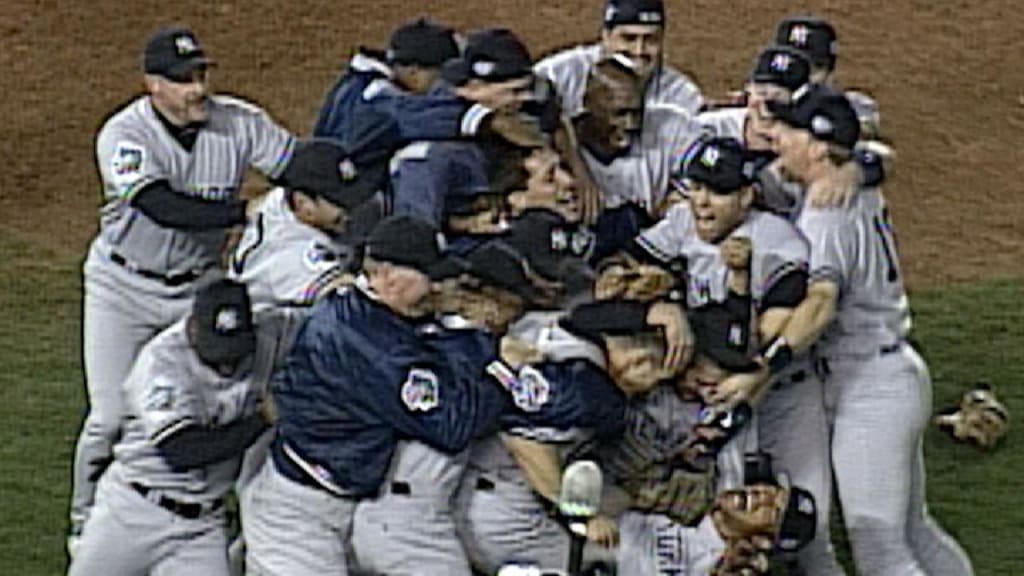
October 21, 1998, 25 years ago: The New York Yankees complete the greatest season in the history of baseball.

They started the season 0-3, and 1-4, and fans began to fear that this would be a bad season. Instead, they roared through the regular season, going 114-48. The 114 wins broke the 1954 Cleveland Indians' record for most wins in a season by an American League team. That record would be broken by the 2001 Seattle Mariners, who won 116 games, tying the major league record set by the 1906 Chicago Cubs. Ah, but the 1906 Cubs and the 1954 Indians both lost the World Series, and the 2001 Mariners didn't even get there.

The regular-season highlights including a perfect game by David Wells, against the Minnesota Twins on May 17. They clinched the AL Eastern Division on September 9, against the Auld Enemy, the Boston Red Sox, 7-5 at Fenway Park in Boston.

Center fielder Bernie Williams won the AL batting title with a .339 average. Shortstop Derek Jeter batted .324, right fielder Paul O'Neill batting .317, and 3rd baseman Scott Brosius -- told by manager Joe Torre that he didn't care if he batted .200, he was acquired that season for his glove -- batted an even .300.

Unlike so many past and future "Bronx Bombers" teams, the '98 Yankees didn't bomb teams out of the yard. 1st baseman Tino Martinez led the team with 28 home runs. Williams hit 26, O'Neill and designated hitter Darryl Strawberry 24, Jeter and Brosius 19, and catcher and 2nd baseman Chuck Knoblauch 17. Williams had 123 RBIs, O'Neill 116, Brosius 98, Williams 97, Jeter 84, Knoblauch 64 and Posada 63.

Left field was unsettled, but everybody who was tried contributed, including Strawberry, Tim Raines and Chili Davis, who had been stars on previous teams; journeyman Chad Curtis, rookies Ricky Ledee and Shane Spencer, the last of these hitting 10 home runs in a September call-up.

The pitching was the best in baseball. David Cone went 20-7, Wells led the league in winning percentage at 18-4, Andy Pettitte went 16-11, and, after being signed in June, Cuban defector Orlando Hernández, known as "El Duque" (The Duke), went 12-4. Between starting and relieving, Ramiro Mendoza went 10-2, with 1 save. Mariano Rivera was 3-0 with 36 saves and a 1.91 ERA, leading a bullpen that also included Mike Stanton, Graeme Lloyd and Jeff Nelson.

The Yankees swept the AL Division Series in 3 straight, completing it over the Texas Rangers in the Dallas suburb of Arlington, Texas on October 2. The AL Championship Series would be tougher. The Yankees won Game 1 over the Cleveland Indians.

In Game 2, on October 7, in the top of the 12th inning, Travis Fryman bunted. Tino fielded it, and threws to Knoblauch covering 1st. Except the ball hit Fryman in the back, and he reached base safely. That would have been bad enough. Except Knoblauch argued that Fryman ran out of the baseline -- which he had. But the ball was still loose and in play, and Enrique Wilson (later a Yankee) noticed this, and, even though he stumbled approaching the plate, scored the go-ahead run. The Indians scored 2 more runs in the inning, and won 4-1.

I was watching this game on NBC, as a Yankee Fan. I had gotten up to get a drink, and missed what became known as "the Blauch-head Play." Had I seen it as it happened, I would have gone straight to Newark Airport, where the Yankees would have been heading to fly to Cleveland for the next 3 games, and beaten Knoblauch to a pulp with my bare hands. (Most likely, somebody would have stopped me.)

Knoblauch had put the Yankees' magnificent season in jeopardy. The Indians won Game 3. So, for Game 4, it was El Duque to the rescue. Having pitched for the 2 most demanding bosses in the Western Hemisphere, George Steinbrenner and Fidel Castro, no way was a little bit of Cleveland cold going to stop him. He pitched a 4-hit shutout (with 1 inning of help each from Stanton and Rivera). Knoblauch started a key 4-6-3 double play in the 8th to eliminate the last Indian threat. The Yankees won, 4-0, and tied up the series at 2 games apiece.

In Game 5, the Yankees once again took the early lead, with a 3-run 1st inning, but the Indians responded. A leadoff homer by Kenny Lofton and a sacrifice fly by Manny Ramírez (not yet using steroids, as far as we know) made it a 1-run game. Paul O'Neill singled home a run in the 2nd to make it 4–2 Yankees. Chili Davis homerd in the 4th to put the Yankees ahead by 3, but Jim Thome, who always hit the Yankees well, hit his 3rd homer of the series in the bottom of the 6th to make it a 2-run game.

Knoblauch, still fighting for redemption, started another key 4-6-3 8th inning double play. David Wells, who claimed to have heard Indian fans insulting his dead mother all through the game, and the Yankee bullpen held off any further Indians scoring, and the Yankees won 5-3. The series went back to The Bronx, with the Bombers 1 win away from the Pennant.

For his 1st at-bat in Game 6, on October 13, the Yankee Fans gave Knoblauch a standing ovation, and NBC announcer Bob Costas said, "Apparently, all is forgiven." The Yankees overcame a 5-run Cleveland 5th, including another home run by Thome, and won, 9-5, clinching their 35th Pennant.

*

October 17, 1998: Game 1 of the World Series at Yankee Stadium, the way God intended it. The Yankees went into the top of the 7th trailing the San Diego Padres, 5-2. Knoblauch completed his redemption with a 3-run homer in the inning to tie it‚ off Padre starter Kevin Brown, who had a reputation as a "Yankee Killer" while pitching for the Texas Rangers. (Yankee Killer? Kevin Brown? We hadn't seen nothin' yet.)

Then, after reliever Mark Langston (himself rather successful against the Yankees while pitching for the Mariners and Angels) loaded the bases, Tino, who'd also been struggling lately, came up. With a 2-2 count, Langston threw a pitch that was just low. To this day, Padre fans say that it was strike 3, and Tino should have been called out, and that this "fixed" the Series for the Yankees.
Now, we Yankee Fans don't have much reason to get upset with Padres fans, but if you blow a 3-run lead in the 7th inning of a World Series game, you don't deserve to win the Series. Tino swung at the full-count pitch, and cranked it into the upper deck in right field for a grand slam. San Diego native Wells notched the win against his hometown team, and the Yankees triumphed, 9-6.
October 18, 1998: The Yankees struck early in Game 2‚ scoring 3 runs in each of the 1st 2 innings. They went on to cruise to a 9-3 win behind El Duque. Bernie and Jorge connected for homers.
October 20, 1998: Game 3, in front of 64,667 at Jack Murphy – excuse me, Qualcomm Stadium in San Diego. Having hosted Super Bowl XXXII in January, this becomes the 1st time the Super Bowl and the World Series have been played in the same stadium -- or even in the same metropolitan area -- in the same calendar year.
The Metrodome in Minneapolis hosted the World Series in October 1991, Super Bowl XXVI in January 1992, and the NCAA Final Four in April 1992. But no stadium has hosted a Super Bowl and a World Series in the same calendar year since. Detroit in 2006, Dallas in 2011 and Houston in 2017 have hosted both in the same metro area in the same calendar year (and, for the moment, Phoenix has a chance to do it this year), but not in the same stadium. In the pre-Super Bowl era, World Series and NFL Championship Games had been played in the same city in the same calendar year as follows: New York in 1936, 1938, 1956 and 1962; Detroit in 1935; and Cleveland in 1954.
The Padres tooke a 3-0 lead on the Yankees, but Brosius, having the season of his life, hit a home run to make it 3-2. In the top of the 8th, with the Yankees threatening with 2 men on, the Padres brought in their closer, Trevor Hoffman.
The Padre fans, believing him to be the world's greatest relief pitcher, wave their white towels and cheer wildly. The words, "IT'S TREVOR TIME" appear on the scoreboard. The public-address system blasts the song "Hell's Bells" by AC/DC.
George Steinbrenner, not familiar with the hard rock music of the Seventies and Eighties -- and also not familiar with the legally-forced change of name to the WWE -- tells the New York beat writers, "When they played that death march, it sounded like the WWF, when The Undertaker comes in. That's who I thought they were bringing in!"
Certainly, for National League batters that season, Hoffman might as well have been an undertaker. The whole production had become one of the most intimidating scenes in baseball.
But these were not NL batters, these were the New York Yankees, and they feared nobody. Brosius took Hoffman over the center field wall for a 5-3 Yankee lead, soon to be a 5-4 Yankee victory. The actual best closer in the game, Mariano Rivera, finished it off, and the Yankees can wrap up the Series with a sweep.
October 21, 1998, 25 years ago: The Padres had maybe their best team ever. Arguably, so did the Cleveland Indians that the Yankees beat in the ALCS. Maybe, so did the Texas Rangers that the Yankees beat in the ALDS. All of them had the bad luck to run into what may have been anybody's best team ever.
The setup seemed good: Just as it was San Diego native Terrell Davis who was the MVP of the Super Bowl that the Denver Broncos won on the same field, 9 months earlier, it seemed fitting that San Diego native Wells would win the clinching Game 5 of the World Series. But it wouldn't get that far. Pettitte and Brown traded goose eggs for 5 innings in Game 4, before Bernie got a run home on a groundout in the 6th. A Brosius single and a Ledee sacrifice fly got 2 more runs home in the 8th.
Brosius, already named the Series' MVP, took a grounder from Mark Sweeney for the final out, and the Yankees won, 3-0, for their 24th World Championship. Counting the postseason, they had won 125 games, losing just 50. It was the greatest season any team has ever had.
There is a weird postscript. After the 2003 season, Pettitte's contract had run out. He went to his hometown team, the Houston Astros. The Yankees signed Kevin Brown to replace him, and it was a disaster, culminating in one of the worst starts any Yankee pitcher has ever had, Game 7 of the 2004 ALCS against the Red Sox.

Monday, November 1, 2021

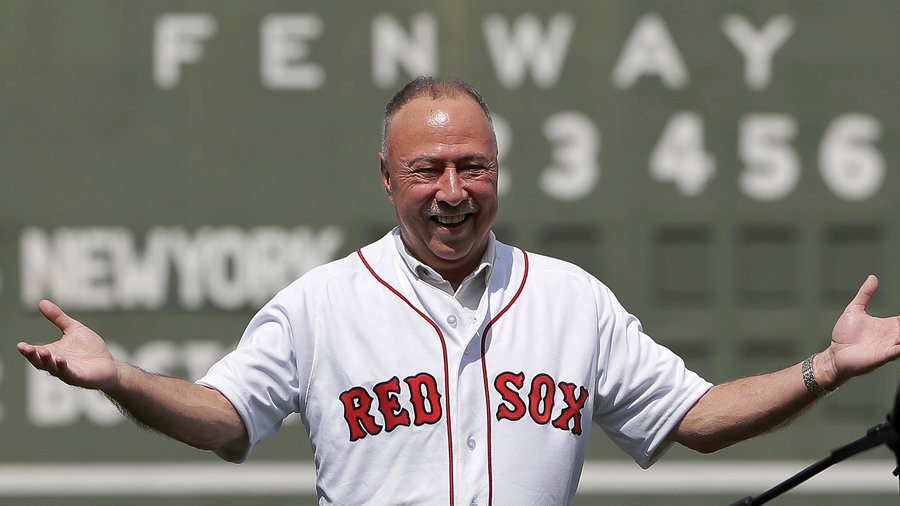
Jerry Remy, 1952-2021

In New York, Phil Rizzuto was a beloved player who became even more beloved as a broadcaster. In Philadelphia, it was Richie Ashburn. In Cleveland, Herb Score. In Cincinnati, Joe Nuxhall. In Chicago, Ron Santo. In Houston, Larry Dierker. In San Francisco, Mike Krukow.

In Boston, it's Jerry Remy.

Gerald Peter Remy was born on November 8, 1952 in the Boston suburb of Fall River, Massachusetts.  He grew up in nearby Somerset. He was drafted by the Washington Senators in 1970, but didn't sign. So he was eligible to be drafted again in 1971, and the California Angels selected him, and he did sign.

He made his major league debut on April 7, 1975, singling off Steve Busby, but was picked off. Still, the Angels beat the Royals, 3-2 at Anaheim Stadium. He played 2nd base for the Angels through the 1977 season, then was traded to his hometown Boston Red Sox for pitcher Don Aase.

The Red Sox needed a 2nd baseman to replace the light-hitting Denny Doyle. Remy fit the bill, as he got on base more, and was a better fielder. He and his double-play partner, shortstop Rick Burleson, were big reasons why the Red Sox led the American League Eastern Division most of the season. During the June 1978 games between the Red Sox and the arch-rival Yankees, it seemed as though he was always on base, and the Yankees hit grounder after grounder right at him. I got sick of him.

But the Sox collapsed, and the Yankees surged. A Playoff was needed to decide the American League Eastern Division title. In the 9th inning, with the Yankees leading 5-4, Remy hit the ball that Lou Piniella couldn't see, but managed to hold him to a single. Remy would have been the winning run had Carl Yastrzemski been able to get him and tying run Burleson home, but the Yankees hung on to win.

Remy never appeared in the postseason -- or, if you count the Bucky Dent Game, he never appeared in it again. Although he could still hit when healthy, injuries took over, and he was released after the 1985 season. With Marty Barrett at 2nd base in 1986, the Red Sox won the Pennant, and came as close as any team ever has to winning the World Series without actually winning it. Remy finished his career with a .275 batting average, 7 home runs, 329 RBIs and 208 stolen bases.

In 1988, "RemDawg" became a Red Sox broadcaster, and became more popular than ever, helping to call the games of 4 World Championship teams *. He also owned RemDawg's, a concession stand on Yawkey Way across from Fenway Park; and Jerry Remy's Sports Bar & Grill, on Boylston Street behind Fenway. The Red Sox elected him to their team Hall of Fame. In 2007, fans voted him the honorary president of "Red Sox Nation."
But in 2008, he began dealing with cancer. His fight had its ups and downs, and, for a while, it looked like he might beat it. He beat it until he no longer could, and died this past Saturday, October 30, 2021, just short of what would have been his 69th birthday.

*

November 1, 1816: James Monroe, then Secretary of State, is elected the 5th President of the United States. The nominee of the Democratic-Republican Party, forerunner of today's Democratic Party, defeats Rufus King, then a Senator from New York, and the nominee of the Federalist Party, 183 Electoral Votes to 34, taking every State but Massachusetts (22 EVs right there), Connecticut and Delaware.

Popular votes were not counted in every State, so it's not clear how many votes Monroe and King got. Still, this was the last gasp of the Federalist Party.

November 1, 1820: Monroe is re-elected, almost without opposition. The Federalists did not nominate a candidate for President. This was in spite of the Panic of 1819 having hurt the country's economy.

Monroe got 228 Electoral Votes -- all but 1. William Plumer, an Elector from New Hampshire who had served that State as Senator and Governor, cast his vote for Monroe's Secretary of State, John Quincy Adams. George Washington thus remained, and still does remain, the only man to be elected President by a unanimous Electoral Vote.

Contrary to legend, that was not Plumer's intent. Rather, he publicly admitted that he preferred Adams as President to Monroe. Four years later, with Monroe respecting the 2-term tradition established by Washington, Thomas Jefferson and James Madison, Plumer got his wish.

The Democratic-Republicans would face opposition, but not under the Federalist banner. By 1832, the dominant party was renamed the Democratic Party, and the Whig Party had replaced the Federalists as the pro-business party in America. By 1860, they'd be out as such, and the Republican Party would be in.

November 1, 1844: James Knox Polk is elected the 11th President of the United States. The Democrat, who had served as Speaker of the U.S. House of Representatives and then as Governor of Tennessee, defeated Senator Henry Clay of Kentucky, who thus became the 1st man to go 0-for-3 in Presidential elections. Others have done so, but Clay is the only man to be nominated 3 times and lose all 3.

The popular vote was actually very close, since Clay, a leading figure in American politics for over 30 years, was better-known nationally than Polk: Polk won 49.5 percent of the popular vote, making him the 1st plurality President since the popular vote began being recorded from every State then in the Union (starting in 1828); while Clay won 48.1 percent. The Electoral Vote was less close, as Polk won 170-105.

*

November 1, 1870: The Mutuals of New York visit the Chicago White Stockings at Dexter Park in Chicago before 6,000 people. With Chicago leading 7-5 after 8 innings, the Mutuals score 8 runs in the top of the 9th, to make it 13-7.

In the bottom of the 9th, Chicago adopts a waiting game, and the Mutuals' pitcher, Dutch-born Reinder Albertus "Rynie" Wolters, loads the bases on walks‚ and complains that the umpire is not calling strikes. A few hits and passed balls make the score 13-12 in favor of the Mutes when McAfee‚ the next batter for the Whites‚ lets a dozen balls go by without swinging. Wolters throws up his hands and walks off. The ump reverts the score to the 8th inning and the White Stockings win‚ 7-5.

Chicago has now defeated the Mutes twice since they took the Championship away from the Atlantics. The controversial ending of the game makes the Mutual club unwilling to give up the Championship.

The New York Clipper, the closest thing America had to a sports-only publication in those days, says‚ "In 1867 the Union club happened to defeat the Atlantics two games out of three of the regular series them played between them - only one series being played between clubs at that time. By this victory a precedent was established giving the championship title only to the club that defeated the existing champions two games while they were the champions. Of course this is an absurd rule but it has prevailed ever since."

November 1, 1871, 150 years ago: Stephen Crane (no middle name) is born in Newark, New Jersey. He published his 1st novel in 1893, Maggie: A Girl of the Streets. Its themes of poverty, including alcoholism and prostitution, made it incredibly controversial for its time. In 1895, despite having no military experience -- indeed, he was born 6 years after the end of the war depicted in it, the American Civil War -- he published The Red Badge of Courage, and made himself a legend of American letters.

He was soon hired as a foreign correspondent for William Randolph Hearst's New York Journal, covering the Greco-Turkish War of 1897, the Spanish-American War of 1898, and the Boer War. But he developed tuberculosis, and died from it in 1900, only 28 years old.  

November 1, 1874: The National Association season ends today, with the Boston Red Stockings being declared the Champions with a record of 43-17. Boston actually had a record of 52-18, but the Committee running the league throws out the games played by the Baltimore Canaries (not "Orioles"), because they did not complete their schedule. The Mutuals finish 2nd.

November 1, 1880: Henry Grantland Rice is born in Murfreesboro, Tennessee. After playing baseball at Vanderbilt University in Nashville, he moved into journalism. There had already been some well-known men named Henry Rice, so Grantland Rice used his middle name from then onward. His friends would call him "Granny."

He became the leading sports voice in the South, at Nashville's The Tennessean, before going to the
New York Tribune, which syndicated him nationally. In 1924, he covered the Army-Notre Dame game at the Polo Grounds in New York, and gave Notre Dame's backfield its nickname: The Four Horsemen. He also helped popularize Red Grange nationally, although, contrary to popular belief, he did not come up with Grange's nickname, the Galloping Ghost. Perhaps because of these connections, when Walter Camp died in 1925, the NCAA asked Rice to take over Camp's selections of college football's All-America team.

If the 1920s truly were "The Golden Age of Sports," Rice's writings were a big reason why, promoting Grange and Knute Rockne's Notre Dame in football, Babe Ruth in baseball, Jack Dempsey in boxing, Bill Tilden in tennis and Bobby Jones in golf. He helped to popularize golf among the masses, through his championing of Jones and, starting in 1934, Jones' tournament in Augusta, Georgia, The Masters.

Rice died in 1954, at which point it was easy to remember his most famous writing, though everyone forgets its source, a 1908 poem titled Alumnus Football:

For when the One Great Scorer comes
to mark against your name
He writes, not that you won or lost
but how you played the Game.

In 1966, a few years after the Baseball Hall of Fame established its J.G. Taylor Spink Award, tantamount to election for sportswriters, it gave the award to Rice.

November 1, 1884: The Gaelic Athletic Association is founded at Hayes's Hotel in Thurles, County Tipperary, in what's now the Republic of Ireland. The GAA governs the traditional Irish sports such as hurling and Gaelic football -- but not Irish soccer, which is governed by the Football Association of Ireland (FAI). The Northern Ireland equivalent is the Irish Football Association (IFA).

*

November 1, 1901, 120 years ago: The Colored Industrial and Agricultural School is founded in Ruston, Louisiana. Like many of what will become America's "historically black colleges and universities" (HCBUs), it is founded near an all-white school, in this case Louisiana Tech.

By the time Eddie Robinson becomes its head football coach in 1941, it is known as the Louisiana Negro and Normal Institute. (In those days, colleges for teaching teachers were known as "normal schools.") In 1946, a white sawmill owner, Judson H. Grambling, donated some land on which the school could build. As a result, the school was renamed Grambling State University, and a new town, Grambling, was created.

Robinson would coach at Grambling from 1941 until 1997, when it became clear that Alzheimer's disease had begun to affect his judgement, and he died in 2007. He became the winningest coach in the history of NCAA Division I football (although Division I-AA, now called the Football Championship Subdivision of FCS), with 408 wins against 165 losses and 15 ties. He won 17 titles in the Southwest Athletic Conference (SWAC) from 1960 to 1994, and 9 "black college national championships": 1955, 1967, 1972, 1974, 1975, 1977, 1980, 1983 and 1992.

Four of his players would be elected to the Pro Football Hall of Fame: Willie Davis, Buck Buchanan, Willie Brown and Charlie Joiner. Arguably, his 1st great player also should be, Paul "Tank" Younger. He also coached Doug Williams, who became the 1st black quarterback to win a Super Bowl, and ultimately succeeded him as Grambling head coach.

His success made Grambling (the "State" is usually not referred to) perhaps America's most familiar HBCU. Its band is also renowned, and was invited to perform at Super Bowl I in 1967. The Northern Louisiana school's rivalry with formerly all-black Southern University in Baton Rouge is played every Saturday of Thanksgiving weekend at the Superdome in New Orleans, known as the Bayou Classic -- and the halftime "Battle of the Bands" is considered more important by many alumni than the actual game.

November 1, 1925: After 3 defeats, plus 5 games against non-NFL teams, the expansion New York Giants finally win a game against another NFL team, defeating the 3-time defending Champion Cleveland Bulldogs, 19-0 at the Polo Grounds.

However, the win is not as impressive as it may seem, because the champs had fallen apart due to a dispute over the rights to pro football in the Cleveland area. And only 18,000 fans came out. Still, for the Giants, a win is a win.

*

November 1, 1931, 90 years ago: Henry Ford (no middle name) is born, no, not in Detroit, but outside Pittsburgh in Homestead, Pennsylvania. A quarterback and defensive back at the University of Pittsburgh, he was the 1st black quarterback at a college that wasn't what we would now call a historically black college or university (HBCU).

Naturally nicknamed "Model T," Henry was drafted by the Cleveland Browns, and was a rookie on their 1955 NFL Championship team. He is 1 of 8 surviving players from that team. He played with his hometown Pittsburgh Steelers in 1956 and 1957. But a Steeler official -- probably not team owner Art Rooney -- told him that, as a black player, he couldn't date a white woman. He quit the team, and married the white woman he was dating. They're still together.

He played semi-pro ball in Arizona for 2 years, then moved back to Pittsburgh and worked in the Acme grocery store chain. In 1977, he moved to Palo Alto, California, and made a fortune on Coca-Cola's vending operations in the the San Francisco Bay Area.

November 1, 1932: Alger Joseph Arbour is born in Sudbury, Ontario. A defenseman, he won the Stanley Cup with 3 different teams: The 1954 Detroit Red Wings, the 1961 Chicago Blackhawks and the 1962 and '64 (but not '63) Toronto Maple Leafs. He also reached the Stanley Cup Finals with the 1968, '69 and '70 St. Louis Blues.

But it's as a coach that he's remembered, taking the New York Islanders from expansion team (though not as their very first head coach) to 4 straight Stanley Cups in 1980, '81, '82 and '83. His 1,500 games and 740 games won are each 2nd all-time in NHL history behind Scotty Bowman, his coach in St. Louis. He's in the Hockey Hall of Fame, and the Islanders hang a banner at the Barclays Center with "1500," his wins standing in for his "retired number." He died in 2015.

November 1, 1946, 75 years ago: The right foot of Cleveland owner Bill Veeck is amputated‚ a result of a war injury in the South Pacific 2 years before. At this point, Veeck has already had a tremendous impact on promotion in a half season of ownership. A minor but typical change is the regular posting of NL scores on the Cleveland scoreboard‚ a departure from the long-standing practice of both Leagues, whose teams would only post the scores from around their own League.

Veeck doesn't let the amputation slow him down. He walks around on a prosthesis, and frequently stubs out his cigarette on it. He even says, "I'm not disabled. I'm crippled." In other words, his ability was reduced, but not eliminated. And, as long as his brain worked (however strangely at times), he had plenty of ability.

Also on this day, Richard Lee Baney is born in the Los Angeles suburb of Fullerton, California. Dick Baney pitched for the Seattle Pilots in 1969, and was mentioned a few times in Jim Bouton's book Ball Four. He also pitched for the Cincinnati Reds in 1973 and '74. He now invests in and 
manages real estate.

Also on this day, James Earl Kennedy is born in Tulsa, Oklahoma. A middle infielder, he played 12 games in the major leagues, all for the St. Louis Cardinals in 1970, batting .125. His younger brother Junior Kennedy was a 2nd baseman in the majors from 1974 to 1983. Both are still alive.

Also on this day, William Anton Lesuk is born in Mosse Jaw, Saskatchewan. A left wing, he played 8 seasons in the NHL and 4 more in the WHA. He played 3 games for the Boston Bruins in the 1969-70 regular season, and 2 more in the Playoffs, allowing him to get his name on the Stanley Cup.

He eventually went from penthouse to outhouse, as an original 1974-75 Washington Capital, the worst team of the NHL's modern era. But he also played for the Winnipeg Jets' WHA Champions of 1976, 1978, and 1979. He is still alive.

Also on this day, Richard Roman Grech is born in Bordeaux, France, and grows up in Leicester, England. He was the bass guitarist for a progressive rock group called Family when, in 1969, he was invited to join a new "supergroup" called Blind Faith, with the other members all being far better known: Lead guitarist Eric Clapton and drummer Ginger Baker from Cream, and keyboardist Steve Winwood from Traffic. The group recorded 1 album, toured behind it, and split up upon the comparative failure of both.

In the 1970s, Grech would record with Winwood in a revived Traffic, and with Baker in Ginger Baker's Air Force. In 1974, he formed another supergroup, KGB. He was the G, while singer Ray Kennedy was the K, and guitarist Mike Bloomfield of the Paul Butterfield Blues Band was the B. This group also had drummer Carmine Appice of Vanilla Fudge and Chicago session keyboardist Barry Goldberg.

KGB went nowhere and in 1977, Grech quit music and became a carpet salesman back in Leicester. His drug use caught up with him, and he died in 1990.

*

November 1, 1951, 70 years ago: 
Shanghai Greenland Shenhua Football Club is founded in Shanghai, China's "second city." Known as Shenua -- literally "The Flower of Shanghai" -- they won China's national league in 1961, 1962, 1995 and 2003, but were stripped of the 2003 title after it was found that they'd engaged in match-fixing. They've also won the Chinese FA Cup in 1956, 1991, 1998, 2017 and 2019.

Understandably, the rivalry big enough to be called "The China Derby" is between the biggest teams in each of the country's 2 largest cities: Shanghai Shenhua and Beijing Guoan. They also play the Shanghai Derby with Shanghai SIPG. Among their recent players have been Didier Drogba, the Ivorian forward formerly of West London's Chelsea, known for his diving; and Stephan El Shaarawy, the Italian forward of Egyptian descent who previously starred for AC Milan and AS Roma.

Also on this day, Karl-Heinz Granitza is born in Lünen, Germany. A striker, he starred in his homeland for Hertha Berlin. Then he came to America, and helped the Chicago Sting win the North American Soccer League title in 1981 and 1984 (the League's last season).

He continued to pay for Chicago teams in the Major Indoor Soccer League. When he returned to Berlin, he opened an American-themed sports bar named for a prominent Chicago thoroughfare: State Street. He is a member of America's National Soccer Hall of Fame.

*

November 1, 1961, 60 years ago: Anne Theresa Donovan is born in Ridgewood, Bergen County, New Jersey. A graduate of Paramus Catholic High School, she led Norfolk's Old Dominion University to the AIAW title, the closest thing women's college basketball then had to a National Championship, in 1980. But she had to go abroad to play pro ball, and played in Japan and Italy.

She went into coaching, and was head coach at East Carolina and back home at Seton Hall. In the WNBA, she coached the Indiana Fever, the Charlotte Sting, the Seattle Storm, the New York Liberty and the Connecticut Sun.

She played for the U.S. teams that won the Olympic Gold Medal in 1984 in Los Angeles and 1988 in Seoul, Korea; and coached them to the Gold Medal in 2004 in Athens, Greece and 2008 in Beijing, China. She died of heart failure in 2018, at age 56.

Also on this day, Derek Ervin Smith is born in Hogansville, Georgia. A guard, he was a member of the University of Louisville's National Championship team of 1980, he was named the Metro Conference's Player of the Year the next season.

He played 9 seasons in the NBA, and later served as an assistant coach with the Washington Bullets. He still held that post on August 9, 1996, when, aboard the cruise ship MS Dreamward, he suffered a heart attack and died at age 35. The ship had been rented by Abe Pollin for season ticketholders of the Bullets and the NHL's Washington Capitals, both of which he owned. Smith and Bullets layer Tim Legler were holding a basketball clinic aboard the ship when Smith was stricken.

His son Nolan Smith was just 8 years old. He went to Duke, and reached the Final Four with them in 2010. He later played 2 seasons for the Portland Trail Blazers, led Cedevita Junior to the 2014 Croatian league title, and now works in Duke's athletic department.

*

November 1, 1970: The 1st regular-season game between the Giants and the Jets is played. Despite having the home-field advantage in front of 63,903 fans at Shea Stadium, and being less than 2 years removed from their Super Bowl win, the Jets are defeated by the Giants, 22-10.

It was the 4th game of a 6-game winning streak for the Giants, who finished 9-5. The Jets, on the other hand, looked nothing like a recent champion, as this was the 5th game of a 6-game losing streak, and they finished 4-10.

November 1, 1971, 50 years ago: Cold Spring Harbor, the 1st album by 22-year-old Billy Joel, is released on Family Productions Records. It includes the songs "She's Got a Way" and "Everybody Loves You Now," both now thought of as among Billy's best. But the record is made at the wrong speed, and the songs don't sound right. Billy gets out of his contract, signs with Columbia Records, releases Piano Man 2 years later, and the rest is history.

Also on this day, the Toronto Sun is founded, a tabloid in both format and style, and a conservative counterpoint to the liberal broadsheet Toronto Star. Among its sports reporters have been George Gross, Jim Hunt and Ted Reeve.

November 1, 1975: The Summit opens on the west side of Houston, with a concert raising money for local hospitals, headlined by singer Andy Williams.

It was the home of the NBA's Houston Rockets from 1975 to 2003, the World Hockey Association's Houston Aeros from 1975 to 1978, a minor-league version of the Aeros from 1994 to 2003, and the Houston Comets of the WNBA from 1997 to 2003. The Rockets won NBA titles there in 1994 nd '95, while the Comets won the WNBA's 1st 4 titles, from 1997 to 2000. The Toyota Center opened in 2003, and the Rockets and Comets moved in. The Comets folded after the 2008 season, joining the Aeros in oblivion.

In 1998, the City of Houston sold the arena's naming rights, and it became the Compaq Center. In 2005, it was bought by Lakewood Church, for use as its Central Campus. In 2017, Hurricane Harvey hit Houston, and the megachurch's boss, the fabulously wealthy "prosperity gospel" Pastor Joel Osteen, refused to open the arena to refugees, due to severe flooding. The media proved this to be a lie: That section of Houston was not flooded. Busted, Osteen opened the building.

*

November 1, 1981, 40 years ago: Evan Bradley Mathis is born in Birmingham, Alabama. A guard, he played 12 seasons in the NFL, made the 2013 and 2014 Pro Bowls, and was a member of the Denver Broncos when they won Super Bowl 50. He is now a professional poker player.

Also on this day, the island nation of Antigua and Barbuda is granted independence by Britain. They remain members of the British Commonwealth.

November 1, 1984: The Los Angeles Clippers play their 1st home game after moving up the California coast from San Diego, at the Los Angeles Sports Arena. They had played 2 away games first. Oddly enough, their 1st game under the Los Angeles name was away to the Utah Jazz, the team they beat in their last game in San Diego.

The Clips beat the Knicks, 107-105. Last season's breakout Knicks star, Bernard King, scores 25, but some players who had won NBA Championships elsewhere lead the Clips to victory: 1971 Milwaukee Buck Junior Bridgeman, 1980 and '82 Laker Norm Nixon, and, overcoming a never-ending foot injury, 1977 Portland Trail Blazer, San Diego native and UCLA star Bill Walton.

For several years, this opener stood as the highlight of Los Angeles Clipper basketball, as, much like the Nets behind the Knicks in the New York Tri-State Area, they have been stuck behind the Lakers, partly due to the older team being so well-established, successful and popular, and partly due to their own perennial losing, due to then-team owner Donald Sterling caring only about schmoozing his pals at the games rather than winning.

November 1, 1988: Masahiro Tanaka is born in Itami, Hyōgo Prefecture, Japan. After starring in his homeland for the Sendai-based Tohoku Rakuten Golden Eagles, he signed with the Yankees in 2014, and became an All-Star in his rookie season.

He has helped the Yankees reach the Playoffs in 4 of the last 5 seasons, and, until Gerrit Cole was signed as his teammate, was the closest thing to a real ace that New York baseball currently has. (And I don't want to hear about any of the Mets' starting pitchers. They would get slaughtered in the American League.) He was 99-36 in Japan, and is 78-46 for the Yankees.


*

November 1, 1994: ADX Florence opens, the federal “supermax” prison in Florence, Colorado. It is the new Alcatraz: Home for the worst of the worst, and no one has ever escaped from it.

Notable current residents include, in chronological order of their crimes: Theodore Kaczynski, the "Unabomber"; Ramzi Yousef, convicted in the 1st World Trade Center bombing in 1993; Terry Nichols, the surviving Oklahoma City bomber; Eric Rudolph, the bomber of abortion clinics and the 1996 Olympic Park in Atlanta; Zacarias Moussaoui, "the 20th Hijacker" on 9/11; Richard Reid, the "Shoe Bomber"; Robert Hansen, the FBI Agent convicted of spying for Russia; Umar Abdulmutallab, the 2009 "Underwear Bomber"; Dzhokhar Tsarnaev, the surviving brother from the 2013 Boston Marathon bombing; and Joaquin Guzman, the Mexican drug lord known as "El Chapo."

November 1, 1996, 25 years ago: The Philadelphia 76ers play their 1st game at their new arena, then named the CoreStates Center, losing 111-103 to the Milwaukee Bucks. The arena is now known as the Wells Fargo Center, and the 76ers have reached the NBA Finals only once since moving in, in 2001.

Also on this day, Fox Sports Net makes its debut.

November 1, 1997: The Negro Leagues Baseball Museum opens in its new home in Kansas City‚ Missouri. It had been occupying a temporary site there for 4 years.

November 1, 1999: Chicago Bears legend Walter Payton dies of a rare liver disease in the Chicago suburb of South Barrington, Illinois. The NFL's former all-time leading rusher, and one of the real good guys of sports history, was only 45. 
As part of their 100th Season celebrations, the Bears named him 1st on their list of their 100 Greatest Players.

*


November 1, 2001, 20 years ago: Game 5 of the World Series at Yankee Stadium. Steve Finley and Rod Barajas hit solo home runs for the Arizona Diamondbacks in the 5th inning, and those remain the only runs of the game going into the bottom of the 9th.

In the top of the 8th, with the rumor going around that Paul O'Neill will retire after the Series (which turned out to be true), and, knowing that, win or lose, this was his last game at Yankee Stadium, Yankee Fans start chanting his name. It was a rare moment when Yankee Fans decided that there was something more important than winning: In this case, saying, "Thank you" to a team legend.

In an amazing case of history repeating itself‚ the Yankees again come from 2 runs down with 2 outs in the 9th inning, to win 3-2 in 12 innings. Byung-Hyun Kim is again victimized‚ this time by Scott Brosius' 2-run HR in the 9th. Alfonso Soriano's single wins it in the 12th. Steve Finley and Rod Barajas homer in the 5th for Arizona's runs.

In 97 previous years of World Series play, only twice had teams come from 2 or more runs down in the bottom of the 9th to win a game. The Yankees had now done it on back-to-back nights -- albeit in different months (October 31 & November 1).

Also on this day, the Memphis Grizzlies play their 1st game, after 6 seasons in Vancouver. But they get torched by 34 points from Jerry Stackhouse, and lose 90-80 to the Detroit Pistons, at the arena then named the Great American Pyramid.


November 1, 2009: Game 4 of the World Series at Citizens Bank Park. Yankee manager Joe Girardi starts CC Sabathia, the ALCS MVP but the loser of this Series' Game 1, on 3 days' rest. It seems to work, as the Yankees lead the Philadelphia Phillies 4-2 going into the bottom of the 7th.

One of the Phils' runs shouldn't have counted, because Ryan Howard didn't touch the plate. This could have been an epic controversy. And it might have been, because Chase Utley hits a home run off CC in the 7th, and Pedro Feliz hits one off Joba Chamberlain in the 8th to tie it.

But in the 9th, Johnny Damon fouls off pitch after pitch from Brad Lidge before singling with 2 outs. Mark Teixeira was up, and the Phils go into their lefthanders' switch. This is an echo of the shift used by the Cardinals on Ted Williams of the Red Sox in the 1946 World Series. But Damon realizes that, if he steals 2nd, he could steal 3rd, too, because no one would be covering. He goes for it, bringing up memories of another factor of the '46 Series, Enos Slaughter's "Mad Dash" that won Game 7 for the Cardinals.

Unnerved, Lidge accidentally hits Teix, and Alex Rodriguez gets the biggest hit of his career (and it remained so), a double to score Damon. Jorge Posada singles home Teix and A-Rod, and Mariano Rivera shuts the Phils down it the bottom of the 9th, securing a 7-4 Yankee victory, stunning the defending World Champions in their own raucous, not strangely silent, house. The Yanks can wrap it up tomorrow night.

*


November 1, 2010
: The Giants win their 1st World Series since moving to San Francisco. Edgar Renteria, who drove in the winning run for the Florida Marlins against the Cleveland Indians in the 11th inning during Game 7 of the 1997 Fall Classic, joins Yankees legends Lou Gehrig, Joe DiMaggio and Yogi Berra as only the 4th player in baseball history to collect two World Series-winning hits. (He had also made the last out for the St. Louis Cardinals as the Boston Red Sox won the 2004 World Series *.)

The Series MVP's 3-run homer off Cliff Lee in the 7th inning leads to San Francisco's 3-1 victory over the Rangers, and brings an end to 56 seasons of what some Giants fans had been, in recent days, describing as "torture." (Clearly, they'd never been truly tortured.)


November 1, 2013: The Brooklyn Nets play their home opener at the Barclays Center, and retire the Number 5 of Jason Kidd. Although he was then their head coach, and remains the only player to lead the team to the NBA Finals (in New Jersey in 2002 and 2003), Kidd never played for the Brooklyn edition of the team. They beat the defending Eastern Conference Champion Miami Heat of LeBron James and Dwyane Wade, 101-100.

November 1, 2015: Game 5 of the World Series at Citi Field. Curtis Granderson hits a home run in the bottom of the 1st inning, giving the Mets a 1-0 lead over the Kansas City Royals. The Mets make it 2-0 in the 6th, and Matt Harvey holds that lead into the top of the 9th.

But the Mets pull off a unique feat: They blow leads in every single game of a World Series. (Including in Game 3, which they came back to win anyway.) Only the Mets, right?

Harvey convinces manager Terry Collins to leave him in, and he walks the leadoff hitter, Lorenzo Cain. Eric Hosmer doubles Cain home, and Collins now pulls Harvey for Jeurys Familia. A groundout gets Hosmer to 3rd, and a fielding blunder by the Mets (surprise, surprise) results in the tying run coming home. Familia's 8 blown saves in a single postseason ties the record set by Robb Nen of the 2002 San Francisco Giants -- who, unlike Familia, does have a World Series ring, with the 1997 Florida Marlins.

The game goes to the 12th inning. Royals catcher Salvador Pérez singles off Addison Reed. Royals manager Ned Yost sends Jarrod Dyson in to pinch-run for him. Christian Colón singles him home, and then the unrelated Bartolo Colón is brought in, and he melts down. It remains the worst extra-inning performance in the 116-year history of the World Series. The Royals win the game 7-2, and win their 2nd World Series, their 1st in 30 years.

The Royals proved what the Yankees had proven in the regular season, what Chase Utley proved in the NL Division Series, and what nobody else, not the other Dodgers, nor the Chicago Cubs in the NLCS, seemed willing to prove: Stand up to the Mets, and they will fold. This pattern held in 2016, as the Mets reached the NL Wild Card game, but losing it.

In the 1995 Star Trek: Deep Space Nine episode "Past Tense, Part II," partly set in the year 2024, Captain Benjamin Sisko, a baseball fan despite living in the 24th Century, gave his opinion that the greatest baseball team of all time was the 2015 London Kings, pointing out that it was the rookie season of Japanese-American shortstop Harmon "Buck" Bokai. This suggests that the Kings won the 2015 World Series. Another person in the scene says the greatest team ever was the 1999 Yankees.

The scene came closer to getting it right than anyone could have expected: The Yankees did go on to win the World Series in 1999, going 11-1 in the postseason, following their 114-48 regular season and 11-2 postseason of the year before; and the 2015 World Series was won by a team with a regal name. 

Other Trek episodes had the Yankees beating the London Kings in the World Series in 2032, and losing to them in 2042, after which -- possibly due to World War III being fought in the show's stimeline -- baseball had so badly dropped in popularity that it was stopped, a major problem I have with Star Trek.

However, despite the Yankees' real-life 2 regular-season games with the Boston Red Sox in London in 2019, I seriously doubt that MLB will put a team in London by 2032, or even 2042. But at least the sport should remain popular well beyond then.  

November 1, 2019: The movie Blade Runner, which came out in 1982, takes place in November 2019. In real life at that time, things weren't that bad, certainly not compared to what happened in the real-life 2020 -- but not for a lack of trying by Donald Trump and Mitch McConnell. 

Monday, March 21, 2016

Top 10 Yankee Third Basemen

Bobby Cox played 3rd base for the Yankees in the 1968 and '69 seasons, and he's in the Baseball Hall of Fame. But these 2 things are not linked, by any means. However, he did coach for the Yankees in the 1970s, including as 1st base coach in the 1977 World Championship season, and that got him his 1st managing job, with the Atlanta Braves, in 1978.

Honorable Mention to Joe Dugan, 1922-28. "It's always the same," Jumpin' Joe, the 7th-place hitter on the "Murderer's Row" Yankees, said: "Combs walks. Koenig singles. Ruth hits one out of the park. Gehrig doubles. Meusel singles. Lazzeri triples. Then Dugan goes in the dirt on his can."

Actually, while hardly as fearsome as his teammates, Dugan wasn't a bad hitter, batting .280 lifetime, and reaching 60 RBIs 3 times, decent totals for a 3rd baseman in his era. He was a slick fielder, and helped the Yankees win 5 Pennants (1922, '23, '26, '27 and '28) and 3 World Series (1923, '27 and '28). He also had the "honor," along with Hall of Fame pitcher Herb Pennock, of being sold off by both Connie Mack of the Philadelphia Athletics and Harry Frazee of the Boston Red Sox.

Had he still been with the Yankees when they started wearing uniform numbers in 1929, he would have gotten Number 7 for his place in the batting order. He closed his career with the 1931 Detroit Tigers, wearing Number 25, the only number he ever wore.

Honorable Mention to Aaron Boone, 2003. He did more for the Yankees with one swing of the bat at 12:16 AM on October 17, 2003 than Alex Rodriguez did in his 1st 5 seasons as a Yankee -- and then made a mistake in the offseason, resulting in the acquisition of A-Rod.

10. Mike Pagliarulo, 1984-89. A native of the Boston suburb of Medford, Massachusetts, "Pags" grew up as a Red Sox fan. He used to wear a T-shirt that had "Boston Red Sox, World Champions 1903 1912 1915 1916 1918" on the back and the Yankees' titles on the front.

He was nearly as good a glove as the man he replaced, Graig Nettles, and, also like Nettles, he seemed to have that sweet lefty swing meant for Yankee Stadium. In his 4 full seasons in Pinstripes, he hit 94 home runs, and topped out at 87 RBIs.

Unfortunately, he went too far in mirroring Nettles' biggest flaw: He didn't make contact enough, striking out 510 times in what amounted to 5 seasons in The Bronx. He batted in the .230s, then dropped to .216 in 1988 and was at .197 in '89 when he was traded, like Nettles, to the Padres.

In 1991, playing for the Minnesota Twins, he had his best average, .279, and won a World Series. In that Twin infield with him was Chuck Knoblauch, just as he'd once been in an infield with Willie Randolph. So Pags is linked to both the 1976-81 dynasty and the 1996-2003 dynasty… but not closely enough: The Yanks got very close to the AL East title in '85 and '88, and made strong runs in '86 and '87, but he had to go to Minnesota to win a Pennant and a ring.

He started out wearing Number 46, then switched to 6, then to 13. 46 and 6 have been retired, and 13 might be, but not for him. He now runs a baseball-themed website, dugoutcentral.com. His son Mike helped Dartmouth's baseball team win the 2009 Ivy League Championship.

9. Billy Johnson, 1943-51. Batting .280 with 94 RBIs as a rookie on the 1943 World Champion Yankees, the Montclair, New Jersey native missed the next 2 years in World War II, then came back and helped the Yankees win the Series again in 1947, '49 and '50. A solid hitter, he was an All-Star in 1947. He started out wearing Number 7, then switched to 24. The former is retired by the Yankees, but not for him.

8. Scott Brosius, 1998-2001. He was only a Yankee for 4 years, but what a 4 years, just 3 outs away from being 4 straight World Championships. A .203 hitter with an OPS+ of 53 in his last season with the Oakland Athletics, the Yankees sent the hopeless Kenny Rogers (the choking pitcher, not the country singer) to the East Bay for the Oregonian, to replace the man at Number 7 on this list. Joe Torre said he just wanted him to field his position and not worry about hitting.

Turned out, in 1998, it was pitchers who had to worry about his hitting: Not only did he give the Yankees yet another great glove at the position, but he batted a career-high .300, posted a 121 OPS+, hit 19 homers, had a career-high 98 RBIs, made the All-Star Team, hit 2 home runs in Game 3 of the World Series, including a 410-foot game-winner to dead center off the San Diego Padres' supposedly invincible closer Trevor Hoffman, fielded the last out of the Series the next night, and was awarded the Series MVP.

He was hardly done, even in October. The Yankees won again in 1999, aided in part by Brosius' only Gold Glove season and 2 homers against the Red Sox in the ALCS. He hit another homer in the 2000 Series against the Mets, and in Game 5 of the 2001 Series, he tied the game in the bottom of the 9th with a homer, leading to a Yankee win in the 12th. Although he was only 34 and had just batted .287, he retired after that Series. He thus appeared in 4 World Series with the Yankees, and hit at least 1 home run in all of them.

He went on to become the assistant coach, and then the head coach, at his alma mater, Linfield College in McMinnville, Oregon. He was recently hired as the hitting instructor for the Tacoma Rainiers, the Triple-A affiliate of the Seattle Mariners. He is a member of his State's Sports Hall of Fame. He wore Number 18 as a Yankee, although it is unlikely to be retired for him, or anyone else, in the near future.

7. Wade Boggs, 1993-97. He was already a Hall-of-Famer-in-waiting for what he'd done with the Red Sox. This ranking is based solely on what he did with the Yankees. And what he did was help to bring the team back from its 1982-92 doldrums, including its 1989-92 dark age.

Upon arriving in 1993, he instantly became a good influence on the team's young hitters, and the Yankees finished 2nd, their highest finish since '85. Indeed, he may have provided a more important service to the club as an extra hitting instructor than he did as a player.  Nevertheless, he was hardly done: He batted .302, .342, .324, .311 and .292 in his 5 seasons in Pinstripes. He was the starting 3rd baseman on the 1996 World Champions, won both of his Gold Gloves as a Yankee, and made 4 of his 12 All-Star appearances as a Yankee.

Overall, he batted .328 lifetime, with a 130 OPS+, 3,010 hits including 578 doubles, reached postseason play 6 times, winning 3 Pennants and a World Series – and that doesn't count the 1994 season when the Yankees had the AL's best record when the strike hit and didn't get to find out what would happen.

The image of him, his face puffy and pink with tears, in the Shea Stadium dugout after the Red Sox blew the 1986 Series will live forever. The image of him equally pink with tears of joy on the Yankee Stadium mound in '96, and then riding that police horse along the outfield track, will also stick in our minds. As actor-comedian Denis Leary, a Worcester, Massachusetts native and huge Red Sox fan, has said, "If you had told my father that, one day, Wade Boggs would win the World Series with the Yankees, his head would have blown up."

Boggs returned to his native Tampa Bay, and became the Devil Rays' 1st retired number, 12, which he also wore with the Yankees, rather than the 26 he wore with the Red Sox, which they've announced that they will retire this coming May 26. The Yankees may never retire 12 for him, but a Plaque in Monument Park would be nice. After all, Reggie Jackson is there, and he, too, played 4½ seasons as a Yankee starter.

6. Gil McDougald, 1951-60. Yet another part of in the Yankees' old-time San Francisco connection, he was AL Rookie of the Year in 1951, ahead of teammate Mickey Mantle. A 5-time All-Star, he played 10 seasons, winning 8 Pennants and 5 World Series (1951, '52, '53, '56 and '58).

Unfortunately, he may be best remembered for an accident: On May 7, 1957, he hit a line drive right back at Cleveland Indians pitcher Herb Score, hitting him in the eye. Gil was so upset, he said he'd quit baseball if Herb lost the use of the eye. Herb did recover (although he wore glasses thereafter), and insisted unto the end of his life that it was an injury in the next year's spring training that really cut his career short. But Gil was never the same player again, either, although he did hit a key home run in the 1958 World Series.

Although just 32 years old, he retired after the 1960 season, expecting to be left unprotected in the expansion draft and not wanting to play for a considerably lesser team. He wore Number 12 throughout his Yankee career, and was later the baseball coach at Fordham University.

5. Frank Baker, 1916-22. John Franklin Baker was nicknamed "Home Run" Baker due to 2 homers he hit for the Phildelphia A's in the 1911 World Series, off New York Giants, and fellow future Hall-of-Famers, Rube Marquard and then Christy Mathewson. And he did lead the AL in homers 4 times… peaking at 12. It was the Dead Ball Era. Still, his career OPS+ was 135, meaning he was 35 percent more productive a hitter than the average player of his time.

A member of Connie Mack's first A's dynasty, 1910-14, the native of Maryland's Eastern Shore formed "The $100,000 Infield" with shortstop Jack Barry, Hall of Fame 2nd baseman Eddie Collins, and 1st baseman Stuffy McInnis. He sat out the 1915 season in a contract dispute, and, having already broken the dynasty up, Mack sold him to the Yankees for $37,500 – as sports historian Bert Randolph Sugar would say, these were Woodrow Wilson dollars. The year off hurt Baker, but he did hit .308 for the Yankees in 1918 and help them win their 1st 2 Pennants, in 1921 and '22, after which he retired.

4. Clete Boyer, 1959-66. Debuting in the major leagues with the Kansas City Athletics in 1955, the same year Brooks Robinson debuted with the Baltimore Orioles, it was impossible for Clete to win a Gold Glove as long as he stayed in the AL – and, in fact, he only won 1, and that was in 1969, with the NL's Atlanta Braves.

But, at his peak, he was every bit as good a fielder as Robinson, his performance in the 1961 World Series nearly as amazing as those of Robinson in the 1970 edition and Nettles in 1978. He used to dive for balls, come up only to his knees, and throw runners out.

He wasn't a great hitter, not topping 20 homers until he was traded and went to Atlanta-Fulton County Stadium, a.k.a. the Launching Pad. But he did hit 162 homers, 95 as a Yankee, and probably would have hit a lot more had he not been a righthanded hitter aiming for Death Valley at the pre-renovation old Stadium. A member of the Yankees’ 5 straight Pennant winners of 1960-64, he won World Series in 1961 and '62.

In 1964, he and his brother Ken, Captain of the St. Louis Cardinals, became the only brothers to both homer in the same World Series game. Their brother Cloyd pitched for the Cards a few years before Ken got there, and was briefly Clete's teammate on the A's, near their hometown of Alba, Missouri. Clete wore Number 6 through most of his Yankee career, and it has been retired, though not for him.

3. Robert "Red" Rolfe, 1934-42, after a 1-game callup in '31. The New Hampshirean is not in the Hall of Fame or Monument Park, but in an interview in 1980, broadcaster Mel Allen called him the best 3rd baseman he’d ever seen. Mel was biased (there's a shock), because Rolfe was the Yankee hot-corner man when he became "the Voice of the Yankees" in 1939.

But Rolfe did provide some justification for Mel's hyperbole. He was a fantastic fielder, who would have won several Gold Gloves had the award been around then. He also batted .289 lifetime, with 4 .300 seasons. He led the AL in triples in 1936 and in hits, doubles and runs in 1939.

He helped the Yankees win 6 Pennants (1936, '37, '38, '39, '41 and '42) and 5 World Series (all but the last). Oddly, he retired after the 1942 season, only 34. And it wasn’t to serve in World War II, either, but to become baseball coach at Yale University. He was a Dartmouth graduate, and later served as their athletic director and as manager of the Detroit Tigers. He wore Number 2 throughout his Yankee career, and it will be retired, though not for him.

2. Graig Nettles, 1973-83. He was the last player obtained, from the Cleveland Indians for Charlie Spikes, by the CBS regime before George Steinbrenner and Gabe Paul took over – and, with their Cleveland connections, it may have been a setup. But he hit 71 homers in 3 full seasons playing in what was usually called "Cavernous Cleveland Stadium," so what could he do at Yankee Stadium with its short right-field porch?

It took a while to find out, as he hit "only" 22 homers in '73, but he hit another 22 in '74 and 21 in '75, despite playing in Shea Stadium, a pitcher's park, while Yankee Stadium was being renovated. In the refurbished Stadium, with the RF pole being 310 feet from home plate and straightaway right just 353, Nettles hit 32 homers in '76 to lead the AL.

He hit 37 in '77, although it wasn't enough to lead the League with Jim Rice hitting 39; nevertheless, it was the highest home run total for a Yankee, at any position, between 1961 and 1980. He had a .248 lifetime batting average, lower than that of any nonpitcher in the Hall, but he hit 390 homers and had a 110 career OPS+.

It's for his fielding that he's best known. His stops in Game 3 of the '78 World Series saved the Yankees' bacon, and that was just what he did when the whole country was watching. He made plays like that all the time when it was only the Tri-State Area watching on WPIX-Channel 11. Starting his career when Brooks Robinson was still around, and playing at the same time as Aurelio Rodriguez and George Brett, limited him to 2 Gold Gloves, but he was at least as good a fielder as the former and better than the latter.

In 1984, the Yankees traded him to the San Diego Padres. Playing for his hometown team, alongside former Yankee teammate Goose Gossage, he helped them win their 1st Pennant. It was his 5th career Pennant, after 4 with the Yankees (1976, '77, '78 and '81) and 2 World Series wins (1977 & '78).

Should he be in the Hall, despite that .248 average? Baseball-Reference.com's Hall of Fame Monitor has him at 63 out of 100, and their HOF Standards has him at 31 out of 50. Their 10 Most Similar Batters is loaded with really good 3rd basemen and others who weren't quite good enough to get in: Darrell Evans, Gary Gaetti, Ron Santo, Dale Murphy, Brian Downing, Chili Davis, Don Baylor, Ron Cey, Joe Carter and Andruw Jones.  Santo is now in; of the rest, a case can be made for Evans, Carter and Jones, but that's about it.

But, until recently, Nettles was the greatest 3rd baseman in Yankee history. Though it should be noted that, when he was traded, the Yankees retired his Number 9 not for him, but for Roger Maris. And he has never received a Plaque in Monument Park. No Hall of Fame, no Monument Park, no number retirement. Just a Yankeeography and a big cheer every Old-Timers’ Day.

1. Alex Rodriguez, 2004-present. Someone check on Lisa Swan of Subway Squawkers, just to make sure my choice of A-Rod as the all-time greatest Yankee 3rd baseman hasn't shocked her into unconsciousness or hysteria. She and I have debated his greatness and his status as a "winner," a "clutch player," and a "real Yankee" for a few years now.

Sure, he's had his difficulties in the postseason, but with him, the Yankees 9 times, and he was the biggest reason the Yankees won the 2009 ALDS and ALCS, and he came through in the World Series as well. No one can say he was "just along for the ride."

Whether he will become the game's all-time home run leader with 763 or more, we don't know. But he goes into the 2016 season 687, plus 2,055 RBIs, and 3,070 hits. It remains to be seen what honors he receives in the future, possibly including the retirement of his Number 13, and a Plaque in Monument Park.

David Ortiz has been far less honest about his use of performance-enhancing drugs, and far below A-Rod in quality of play and in career statistics: On Baseball-Reference.com, A-Rod is a 390 on their HOF Monitor and a 78 on their HOF Standards; Ortiz is at 154 and 49. If Ortiz gets into the Hall of Fame, and A-Rod doesn't, then the people who vote for Big Papi and not A-Rod need to get slapped.

Tuesday, October 20, 2015

October 20: Mickey Born, Curse Dies

October 20, 1931: Mickey Charles Mantle is born in Spavinaw, Oklahoma, and grows up in nearby Commerce. Wasn't nothing to do there, back then, but work in the mines, and, until you were old enough to do that, play football and baseball. Mickey played baseball, and the rest is history.

"Baseball has been very good to me," he said on Mickey Mantle Day, June 8, 1969, with his Number 7 being retired and a Plaque in his honor dedicated, "and playing 18 years in Yankee Stadium for you folks is the greatest thing that could ever happen to a ballplayer."

Those 18 years in a Yankee uniform would stand as a club record until 2013, when both Derek Jeter and Mariano Rivera suited up for a 19th season. Mariano would retire after that, but Derek would play for a 20th season. Derek would also break Mantle's club record for games played, 2,401, extending it to 2,747.

October 20, 2004: The Red Sox ruin the anniversary of Mickey's birth. Unlike the 2003-13 Red Sox, Mickey didn't need no steroids to win baseball games. The chemicals he ingested were, most definitely, not performance-enhancing.

Having dropped 3 straight to the Sox to force a Game 7 at Yankee Stadium, the Yankees had nothing left, at least not emotionally. The Red Sox led 6-0 after 2 innings. It was 8-1 after 4. The final was 10-3.

This was not the kind of loss that crushes you because you had it won at the end, and blew it. We got beat early. From the 1st inning onward, we knew the Red Sox were going to win the game. We knew it, and their fans knew it. There was nothing that could be done. And we had to stick it out, all 9 innings, and hear those Red Sox fans give us the business in our house for, as it turned out, 3 hours and 31 minutes. Never mind what the clock said: This was the longest game in Yankee history.

It was 12:01 AM, October 21, when Ruben Sierra grounded to 2nd for the final out. So not only had the Sox ended the Curse of the Bambino, they had ruined the birthdays of both Mickey Mantle (dead since 1995) and Whitey Ford (then, as now, still alive).

Finally, after losing the Pennant to the Yankees on the final day in 1949, blowing the Division title to the Yankees in 1977 and 1978, losing the ALCS to the Yankees in 1999, and the shock of 2003, the Red Sox and their fans had their revenge over the Yankees. "We danced on their lawn" became a common saying in New England.
But, as 2 of The Boston Globe's legendary sports columnists pointed out, the job wasn't done:

Bob Ryan: "Let's get this out of the way right now. The question is asked, 'If the Red Sox lose the World Series, would it be enough to have beaten the Yankees?' The answer is, 'No!'"

Dan Shaughnessy, who popularized the phrase: "The Curse of the Bambino isn't 'The Red Sox can't beat the Yankees.' The Curse of the Bambino is 'The Red Sox can't win the World Series.' The Red Sox lost the World Series in 1946, 1967, 1975 and 1986, and those didn't have anything to do with the Yankees."

The Sox had also blown a Pennant in 1948, messed up a potential Division title in 1972, blown another Division title in 1974, looked like idiots in the ALCS in 1988, did the same thing in 1990, and looked like idiots in the ALDS in 1995. None of those had anything to do with the Yankees, either.

At the time, it was easy to be big about it, and say to the Sox, now happily calling themselves "The Idiots," "Good luck in the Series. You earned it."

On July 30, 2009, it was revealed that David Ortiz and Manny Ramirez, the 2 biggest reasons the Red Sox won the World Series in 2004 and again in 2007, had failed steroid tests. They hadn't earned a fucking thing. They'd cheated.

Ortiz was still there when they won it all again in 2013.

Those 3 titles are fake, and they goddamned well know it. 1918 * Forever.

They would say the Yankees "cheated" to win their titles. Really? The evidence against the 1996-2003 Yankees is incredibly flimsy. The evidence against the 2003-2013 Red Sox is overwhelming.

The baseball media, of course, will never give the Yankees the same benefit of the doubt that they give the Red Sox.

Well, to hell with them. The world knows the truth, whether they accept it or not.

*

October 20, 1803: The U.S. Senate ratifies the Louisiana Purchase, making possible the major-league cities of St. Louis, Kansas City, Minneapolis and Denver. If you count cities that have major-league teams in other sports but not baseball, add to the list New Orleans and Oklahoma City.

October 20, 1910: The Philadelphia Athletics dispose of Chicago Cub starter Ed Reulbach in 2 innings‚ then pin the loss on reliever Harry McIntire‚ who lasts a third of a inning. A's pitcher Jack Coombs coasts on 1 day's rest‚ 12-5‚ and helps himself with 3 hits.

Cub manager/1st baseman Frank Chance becomes the 1st player ejected from a World Series game when umpire Tom Connolly chases him for protesting a Danny Murphy home run drive against a sign over the right field bleachers. Chance opines too loudly that it should be a ground-rule double.


Also on this day (I previously had him listed as being born on October 12), Robert Leo Sheppard is born in Richmond Hill, Queens, the same neighborhood that would produce Rizzuto. He played quarterback for St. John’s University in Queens, and later taught public speaking there.

In between, he taught public speaking at John Adams High School in the Ozone Park section of Queens. This means he could, arguably, have had, as one of his students, my Grandma. (Sadly, family concerns forced her to drop out, so she never did graduate.  And I didn’t find out about the possibility until after both of them had died, so I couldn't ask either if Grandma had been taught by Sheppard.)

When the NFL had a team called the Brooklyn Dodgers, speech professor Sheppard did the public-address announcements for their games. Football Dodgers owner, and Yankees co-owner, Dan Topping heard him, and asked Sheppard to do the Yankees’ games. He accepted, and from 1951 until 2007, he hardly ever missed a game. Ill health forced him to miss the 2008 and 2009 seasons, but… 57 years! On top of that, from 1956 to 2005, 50 years, he did the football Giants’ games.

Sheppard was a generous gentleman and a complete professional, from sounding like an announcer, not a shameless shill (unlike such braying animals as Bob Casey of the Minnesota Twins, may he rest in peace, and Ray Clay of the Chicago Bulls); to accepting with humility the appellation that Reggie Jackson gave him: “The Voice of God.”

Such was the appeal of Sheppard, and such is the pull of Derek Jeter, that Jeter asked that a recording of Sheppard introduce him before every at-bat, for the rest of his career, even after Sheppard died, which happened in 2010, just short of his 100th birthday. (A recording of Sheppard was also used to introduce Mariano Rivera when he came out for his final big-league appearance in 2013.)

*

October 20, 1927: Joyce Diane Bauer is born in Manhattan, and grows up in Far Rockaway, Queens. We knew her as famed psychologist Dr. Joyce Brothers. She appeared on The $64,000 Question in 1955, and won the eponymous top prize (worth about $568,000 in 2015 money). Her subject was boxing, and it led to her becoming the 1st female commentator for a televised prizefight, the middleweight championship fight on CBS on September 23, 1957, in which Carmen Basilio took the title from Sugar Ray Robinson at Yankee Stadium.

In 1958, she became the 1st advice columnist to have her own TV show. In 1981, she played herself as a guest on “James Brown’s Celebrity Hot Tub Party” on Saturday Night Live, with Eddie Murphy playing “The Godfather of Soul and Hot Tub Man Number 1, James Brown!” Great sketch. Dr. Brothers died in 2013, at age 85.

October 20, 1928: David Jack -- or, to give his full legendary name, David Bone Nightingale Jack -- makes his debut for North London soccer team Arsenal. The inside forward -- today, we would call him a central midfielder -- helps Arsenal defeat Newcastle United, 3-0 at St. James Park in Newcastle.

Jack played for his hometown club Bolton Wanderers, and scored the 1st goal at the original Wembley Stadium in the 1923 FA Cup Final, leading the Manchester-area club to defeat East London club West Ham United. He scored the only goal in the 1926 FA Cup Final as well, leading Bolton over Manchester City.

But with Wanderers in financial trouble, Arsenal snapped him up. He would help Arsenal win the Cup in 1930, and the Football League in 1931, 1933 and 1934, establishing Arsenal's dynasty under manager Herbert Chapman, who broke the English purchase record to get him. He then retired, and managed a few teams before dying in 1958, age 60.

October 20, 1932: Roosevelt Brown is born in Charlottesville, Virginia. The greatest offensive tackle of his time, he anchored the New York Giants line that reached 6 NFL Championship Games in 8 years, including the 1956 World Championship.

Although his Number 79 has not been retired by the Giants, he is a member of their Ring of Honor at MetLife Stadium and the Pro Football Hall of Fame, and was named to the NFL’s 75th Anniversary All-Time Team. In 1999, The Sporting News ranked him Number 57 on their list of the 100 Greatest Football Players. Still the greatest offensive lineman in the history of New York Tri-State Area football, he died in 2004.

Also on this day, William Christopher is born in the Chicago suburb of Evanston, Illinois. Best known for playing Lieutenant, later Captain, John Patrick Francis Mulcahy, S.J, on M*A*S*H, he says he has often been asked near his Southern California home, “Father Mulcahy, say a prayer for the Dodgers.” “I suppose I should actually say one for the Angels,” he says, “but I do root for the Dodgers.”

In a 1st-season episode, the officers are listening to Armed Forces Radio for the Army-Navy football game, when Mulcahy walks in with his Notre Dame pennant. He’s told Notre Dame, America’s unofficial Catholic university due to its legendary football program, isn’t playing today. “Then what’s all the commotion?”

In another early episode, he is playing in a pickup game in camp, wearing a helmet that’s Notre Dame gold, but anachronistically has a two-bar facemask. Hawkeye asks him how the game’s going. He says, “Protestants 7, Catholics 3, but we’ll get ‘em!”

Mulcahy was also a big boxing fan, having coached boxing at the CYO in his native Philadelphia, and would minister to a former boxing champion who ended up dying at the 4077th while on a tour for the troops. But Christopher admitted knowing nothing about boxing.

Mulcahy also had “my sister the Sister,” who took the nom de nun of Sister Angelica, who first played and then coached basketball at her all-girls’ high school in Philly.

In 1975, Christopher played an Army doctor on Good Times -- an inside joke on CBS' part, I suppose. He later teamed up with castmate Jamie Farr in a stage version of The Odd Couple -- I'm presuming Christopher played Felix and Farr played Oscar -- and with Farr and Loretta Swit on Diagnosis Murder and Lois & Clark. He has again played priests on Heaven SentMad About You, and, in 2013, Days of Our Lives.

October 20, 1937: Juan Antonio Marichal Sánchez is born in Laguna Verde, Dominican Republic. Known for his high leg-kick during his windup, he won more games in the 1960s than any other pitcher, and until Dennis Martinez surpassed him, his 243 career wins were the most of any Hispanic pitcher.

He helped the San Francisco Giants to the 1962 National League Pennant and the 1971 NL Western Division title, although they fell just short a few other times while he was there. They have retired his Number 27, and dedicated a statue to him outside AT&T Park. He was the 1st Dominican player, and the 1st Hispanic pitcher (aside from Negro League star Martin DiHigo, who was not strictly a pitcher), elected to the Hall of Fame.

Sadly, like the other serious contender for the title of the greatest Hispanic pitcher, Pedro Martinez, he is best known for a moment of violence, hitting Dodger catcher John Roseboro over the head with his bat in a tight Pennant-race game in 1965. Unlike Pedro, however, this was out of character for Marichal, and Roseboro not only accepted his apology, but, after Marichal failed to be elected to the Hall in his 1st 4 years of eligibility, Roseboro spoke up on his behalf, and he was elected on the 5th try.

He went on to become a broadcaster for a Spanish-language network in the Caribbean, and called games in the 1990 World Series, including the 2 won by Cincinnati Reds pitcher Jose Rijo, who not only wore Number 27 in tribute to Marichal, but at the time was married to Marichal’s daughter Rosie, who can be seen on the official highlight film, yelling from the stands, “Let’s go, Rijo!”

*

October 20, 1951: Drake University of Des Moines, Iowa plays football against Oklahoma A&M – the name will be changed to Oklahoma State in 1958 – at Lewis Field in Stillwater, Oklahoma. Drake quarterback Johnny Bright, one of the 1st black players to receive serious consideration for the Heisman Trophy, is assaulted by white A&M defensive tackle Wilbanks Smith. “Unnecessary roughness”? Three times in the first 7 minutes of the game, Smith knocked Bright unconscious, the last time breaking his jaw.

A&M won the game, 27-14. It was Drake’s 1st loss of the season. Photographs of what becomes known as "the Johnny Bright Incident," by Don Ultang and John Robinson, were featured on the front page of the next day’s Des Moines Register, and won the Pulitzer Prize.

Neither his school nor the Missouri Valley Conference disciplined Smith, nor did the Conference discipline the school or any of its coaches, in any way. As a result, Drake left the league in protest. So did Bradley University of Peoria, Illinois, also integrated by that point. The NCAA issued new rules about blocking and tackling, and mandated better head protection, including facemasks for helmets.

Bright recovered, and finished 5th in the Heisman balloting, which was won by Dick Kazmaier of Princeton, who will likely remain the last Ivy Leaguer to win it. (Ed Marinaro of Cornell, in 1971, is currently the last one to even come close. He later played a cop on Hill Street Blues.)

Drafted by the Philadelphia Eagles, Bright didn't want to play there -- not because he thought Philadelphia was a racist city (long before Dick Allen and Curt Flood thought so, and they had already racially abused Jackie Robinson there), but because he knew there were a lot of Southern players in the NFL. He would play in Canada, and receive many honors (or, as they would spell it, “honours”) there, including 3 straight Grey Cups with the Edmonton Eskimos.

When he retired in 1964, he was the CFL’s all-time leading rusher, with 10,909 yards, a total then surpassed in the NFL only by Jim Brown, but Brown’s amazing 5.2 yards per carry, often cited as a reason why he's the game's greatest ever player, never mind running back, is actually surpassed by Bright, with 5.5, making him North America’s all-time leader in that stat at the time. Only 2 CFL players have passed him in rushing yardage since.

He is a member of the Eskimos’ Wall of Honour, and the College Football and Canadian Football Halls of Fame. Drake retired his Number 43 (he wore 24 with the Esks) and named the field at Drake Stadium after him. After serving as a teacher and principal at an Edmonton high school, he died in 1983 from complications from surgery. Ernie Davis of Syracuse became the 1st black Heisman winner in 1961.

Also on this day, Claudio Ranieri (no middle name) is born in Rome. A centreback, he briefly appeared with hometown soccer club AS Roma, before helping Calabria club Catanzaro and Sicilian clubs Catania and Palermo win promotion to Serie A, Italy's top league.

He has managed 15 different clubs, including Roma, and Spanish club Valencia twice, and the national team of Greece. He got Sardinia club Caglario promoted from Serie C1 to Serie A in the minimum 2 years, got Florence club Fiorentina promoted and won them the 1996 Coppa Italia, won Valencia the 1999 Copa del Rey, and got Monaco promoted back to France's Ligue 1 in 2013.

He's best known for his time at West London club Chelsea, managing them into the 2002 FA Cup Final and the 2004 Champions League Semifinal, but winning no trophies. He became known as the Tinkerman for his frequent rotation of his players. After the 2003-04 season, Roman Abramovich's 1st as club owner, "the Mad Russian" fired the Tinkerman. He is now manager of Leicester City, and is doing rather well there.

October 20, 1953: Keith Barlow Hernandez is born in San Francisco. Elaine: “Who does this guy think he is?” Keith: “I’m Keith Hernandez!”

He also thinks he’s the 1979 NL batting champion and co-MVP (a unique tied vote, shared with Willie Stargell), a member of World Series winners with the 1982 St. Louis Cardinals and the 1986 New York Mets, and one of the best-fielding 1st basemen ever.

These days, he thinks he’s a broadcaster with the Mets. He also thinks he’s really smart, which he is, but he’s not nearly as smart as he thinks he is. Although his acquisition made the Mets a contender and then a champion again after some very dark years, they have strangely not retired his Number 17. Nor has he been elected to the Baseball Hall of Fame.

October 20, 1955, 60 years ago: Aaron Pryor (no middle name) is born in Cincinnati. The former Junior Middleweight Champion of the World overcame drug abuse, and is now an ordained minister and an anti-drug counselor. His sons Aaron Jr. and Stephan have also become professional boxers.

October 20, 1958: David Michael Krieg is born in Iola, Wisconsin. A 3-time Pro Bowler, he quarterbacked the Seattle Seahawks to their 1st Conference Championship Game in 1983, and their 1st Division Championship in 1988. The Seahawks have elected him to their Ring of Honor. He is now a real estate investor in Phoenix.

October 20, 1959: Washington Senators owner Calvin Griffith makes a public statement that he will not move the team. As Congressman Joe Wilson would say, 50 years later, to a better man than either of them, “YOU LIE!”

*

October 20, 1960: Ralph Houk, former Yankee catcher, former Yankee coach, and manager of the 1957 International League Champion Denver Bears, is officially named manager of the Yankees. He will lead them to the next 3 AL Pennants and the next 2 World Championships.

As callous as the Yankees seemed in firing Casey Stengel, they had to make Houk their manager.  With 2 new expansion teams coming into the American League for the 1961 season, and 2 more into the National League in 1962, and with plenty of teams changing managers during the course of a season, Houk would have been hired by somebody, so the Yankees needed to promote him in order to keep him. It was a matter of "Use it or lose it."

The results spoke for themselves -- until the farm system ran dry.

October 20, 1961: Ian James Rush is born in St. Asaph, Wales. He was a superstar in the English soccer league, leading Liverpool to 6 League titles. He scored more goals in FA Cup play than any player in the 20th Century, shares with 1966 World Cup hero Geoff Hurst the record for most goals scored in League Cup play, and is the all-time leading goalscorer in Merseyside derbies (Liverpool vs. Everton).

There was a daunting statistic that Liverpool had never lost a game in which Rush scored. That stat held until the 1987 League Cup Final at the old Wembley Stadium, when he scored, and then North London-based Arsenal came back with 2 goals by Charlie Nicholas to win, 2-1.

Rush had a difficult 2-year spell with Juventus in the Italian league, before returning to Liverpool.  Not the 1st British player to be a bust in Italy, nor the last, he was asked if the language barrier would be a problem. He denied it: "I don't even speak English that well." (The Welsh do have their own separate language, but Rush can be understood in English, unlike later Liverpool legend Jamie Carragher, whose Scouse accent is so thick he needs a translator.)

After a brief spell managing Chester City, which had been his 1st pro club as a player, he became a pundit for Sky Sports. He is now a club ambassador for Liverpool. With 346 goals, he is their all-time leading scorer.

October 20, 1964: Former President Herbert Hoover dies of a gastrointestinal ailment in his suite at the Waldorf Towers in New York. He was 90, older than any former President before him except John Adams. (He has since been surpassed by Gerald Ford, Jimmy Carter, Ronald Reagan and George W.H. Bush.)

Hoover was a member of Stanford University's 1st graduating class in 1895. He was student manager of their 1st baseball and football teams. Former President Benjamin Harrison was a founding professor of Stanford's law school, and wanted to attend a football game. Young Hoover made old Harrison pay the admission fee: 25 cents -- about $7.00 in today's money.

Hoover attended Game 5 of the 1929 World Series at Shibe Park in Philadelphia, and was cheered as he threw out the ceremonial first ball. Just a year earlier, he had been elected in one of the biggest landslides ever. Then the stock market crashed, and the Great Depression began. He threw out the first ball at Shibe Park for Game 1 of the 1930 World Series, and this time, fans plagued by the Depression and Prohibition booed him and chanted, "We want beer!" When the Philadelphia Athletics won the Pennant again in 1931, Hoover did not show up for the World Series. In 1932, he lost by an even greater margin than his 1928 win.

October 20, 1965, 50 years ago: Just 1 year after he helped the Cardinals win the World Series and was named NL Most Valuable Player, team Captain Ken Boyer is traded to the Mets, for pitcher Al Jackson and 3rd baseman Charlie Smith.

Jackson had been one of the few respectable players in the Mets’ early years, while Smith is best known for getting traded by the Cardinals just one year later, even-up, for Roger Maris. An insult to Maris.

Also on this day, Mikhail Alekseyevich Shtalenkov is born in Moscow. A Gold Medal winner as the starting goalie for the post-Soviet "Commonwealth of Independent States" team at the 1992 Winter Olympics, he starred for Dinamo Moscow, was an original Mighty Duck of Anaheim in 1993, and played in the NHL until 2000.

October 20, 1967: Having just moved the Kansas City Athletics to Oakland, owner Charlie Finley names Bob Kennedy as their 1st manager. He does not, however, try to trade for Yankee 3rd baseman John Kennedy. Nor does he try to hire Hockey Hall-of-Famer Ted Kennedy as a consultant.

Also on this day, the expansion Seattle SuperSonics make their home debut, at the Seattle Center Coliseum. They face the other expansion team, the San Diego Rockets, and lose 121-114. John Block scores 32 and Johnny Green 30 for the Rockets, who will move to Houston in 1971. Walt Hazzard scores 32 for the Sonics, who will win the 1979 NBA Championship and become the Oklahoma City Thunder in 2008.

October 20, 1969: The Mets get their ticker-tape parade for winning the World Series.

Also on this day, Juan Alberto González Vázquez is born in Vega Baja, Puerto Rico. Known as Juan Gonzalez, the All-Star right fielder for the Texas Rangers hit 434 home runs in his career, won AL MVP awards in 1996 and 1998, and scared the hell out of us Yankee Fans by nearly ruining the 1996 season with his 3 home runs in the 1st 2 games of the ALDS.

But injuries ruined his career, leading him to being traded repeatedly, and his nickname “Juan Gone” began to refer less to the balls he hit, and more to his propensity for being out of the lineup. He had his last productive season at 33, and he was done at 35. Wow, he really, really fits the steroid profile. Both Jose Canseco and the Mitchell Report accused him of using. He still denies it.

He now owns and plays for a minor-league team in his hometown. He is eligible for the Baseball Hall of Fame, but he'll never get in.

October 20, 1971: Laura Mendez is born in San Juan, Puerto Rico.  We know her as Mrs. Jorge Posada.
I met her once, at a YES Network function. As in, YES, she looks just as good in person. And, YES, she's as nice as you would hope someone who looks that good is. And, YES, he ended up with her.  So here's hope for all of us.

Also on this day, Eddie Charles Jones is born in Pompano Beach, Florida. (Why "Eddie Charles"? If you're going with Eddie instead of Edward, why not Charlie or Chuck instead of Charles?) The Temple University guard was the 1994 Atlantic 10 Conference Player of the Year and a 3-time NBA All-Star. But he had lousy luck, being traded away from both the Los Angeles Lakers (in 1999) and the Miami Heat (in 2005) a season before they won NBA titles.

*

October 20, 1973: The Sydney Opera House, Australia's most famous structure, opens. The Rolling Stones hit Number 1 on the U.S. singles charts with "Angie." The Six Million Dollar Man premieres on ABC, starring Lee Majors as astronaut-turned-bionic-federal-agent Steve Austin. (Definitely not to be confused with the Stone Cold "professional wrestler" using the same name.)

And Game 6 of the World Series is played at the Oakland Coliseum. The Mets just need to win 1 of the last 2 games against the Athletics in Oakland, and they will have their 2nd World Championship in 5 seasons -- it has been 11 years since the Yankees went all the way. And Tom Seaver, "The Franchise," is on the mound.  What can go wrong?
The opposing starters in Game 6 of the 1973 World Series

This can go wrong: Met manager Yogi Berra has sent Seaver out on just 3 days' rest, hoping that "Tom Terrific" can close out the defending World Champions on their own patch, so that no Game 7 will be necessary.

But Reggie Jackson, not yet a New York baseball legend, hits 2 doubles, scores 1 run and knocks in 2. Jim "Catfish" Hunter, also a future Hall-of-Famer, pitches brilliantly. The A's beat the Mets 3-1. So there will be a Game 7 tomorrow.

To this day, many Met fans are angry at Yogi for starting Seaver on short rest. I'm sure some of them think of him as a Yankee and hate him for that reason alone. They shouldn't: There are only 4 human beings who have managed the Mets to a Pennant: Yogi, Gil Hodges, Davey Johnson and Bobby Valentine. And with Yogi's recent death, only Johnson and Valentine are still alive. (Terry Collins is now 2 wins away from making it 3 living again, and 5 overall.)

I looked it up: Reggie, the defining Yankee of his generation, and Seaver, the defining Met of that generation, faced each other 43 times, not counting spring training. The 1st time was in the 1973 All-Star Game, the last in a Red Sox-Angels game in 1986. I'll have a more detailed post about this someday. Reggie reached base in 15 of those 43 plate appearances, including 3 home runs and 8 RBIs, but Seaver also struck him out 13 times.

Also on this day, the Capital Bullets -- who will change their name again to the Washington Bullets next season -- play their 1st home game after 10 years in Baltimore, at the Capital Centre in suburban Landover, Maryland. At this point, the Bullets are one of the better teams in the NBA, and they prove it, beating the Boston Celtics 96-87. Phil Chenier leads all scorers with 26 points.

But the big story of October 20, 1973 is, unlike that game, actually in Washington, and it has nothing to do with sports. The day before, in an effort to get away with whatever he did that was recorded on his Oval Office tapes, President Richard Nixon offered a compromise: He would allow Senator John Stennis to review the tapes and present Special Prosecutor Archibald Cox with summaries.

On this day, Cox publicly refuses to accept this compromise. He knows that Stennis is not only a conservative from Mississippi and a supporter of Nixon's -- he's a conservative Southern Democrat, a.k.a. a "Dixiecrat," and no friend of mainstream Democrats -- but also hard of hearing. If those tapes reveal that Nixon committed an impeachable offense, Stennis might not hear it properly. And even if he does, he might refuse to admit it to Cox.

Nixon decides that, in order to survive as President, he has to fire Cox -- whom he had never fully trusted, as Cox had been Solicitor General under President John F. Kennedy and an old friend of
JFK's, and thus a partisan Democrat.

So he instructs his Attorney General, Elliot Richardson, the man with the power to fire Cox, to do it.  Richardson refuses, because he thinks it will spark a Constitutional crisis. Nixon says do it or you're fired. Richardson does the honorable thing and resigns his post.

So Nixon goes to the next man in line, Richardson's Deputy Attorney General, William Ruckelshaus.  He tells Ruckelshaus to fire Cox. He refuses. Nixon says do it or you're fired. Ruckelshaus still refuses, but does not resign. Nixon fires him.

So with the top 2 men in the U.S. Department of Justice now gone, Nixon goes to the Number 3 man, the Solicitor General, and tells him to fire Cox. He does.

Word quickly gets out, and the Washington press corps quickly dubs these events "The Saturday Night Massacre." People wake up the next morning to bold headlines in their Sunday papers. The Sunday morning news shows, NBC's Meet the Press, CBS' Face the Nation, and ABC's Issues and Answers (the predecessor program to This Week), can talk about nothing else.

The pressure on Congress to begin impeachment proceedings against Nixon vastly increases. And, with the Vice Presidency vacant, as Spiro Agnew has resigned and Gerald Ford has not yet been confirmed by either house of Congress as the new VP, the next man in line is the Speaker of the House of Representatives, Carl Albert of Oklahoma -- a Democrat. This would have been a political earthquake, much bigger than the end of Nixon's Presidency actually turned out to be.

Within days, Nixon realizes what a blunder he has committed, and tells the Acting Attorney General to appoint a new Special Prosecutor. That man would be Leon Jaworski. By December 6, Ford would be confirmed by both houses and sworn in as Vice President, and the danger of Nixon being impeached and removed, and replaced by a President of the other party, was gone, and things calmed down in Watergate -- for a while.

There would be ramifications, of course -- some lasting much longer than the Nixon Administration itself. In 1987, President Ronald Reagan appointed that same former Acting Attorney General to the U.S. Supreme Court, as his judicial views fit the archconservative vision that Reagan had for the country. But his role in the Saturday Night Massacre was held against him -- although it's possible that he might have been rejected by the Senate anyway. His name was Robert Bork.

On April 26, 1974, the Yankees would trade 4 pitchers to the Cleveland Indians: Fritz Peterson, Fred Beene, Steve Kline and Tom Buskey. Essentially sending away half their pitching staff, this became known as the Friday Night Massacre. But the trade was necessary: It got rid of 4 pitchers who didn't take the game as seriously as they did their social lives, and it brought in 2 players who would be essential in the Yankees' late 1970s Pennants: 1st baseman Chris Chambliss and pitcher Dick Tidrow. (They also got pitcher Cecil Upshaw, but he was injured and a nonfactor, and was traded after the season.)

*

October 20, 1976: Game 3 of the World Series, the 1st in Yankee Stadium since October 12, 1964, and the 1st since the renovation. The Cincinnati Reds tag Dock Ellis for 3 runs in the 2nd inning. Dan Driessen -- officially, the 1st designated hitter in National League history, since this was the 1st time the DH was used in the Series -- hits a home run in the 4th, and the Reds win 6-2, to take a 3 games to 0 lead.

Jim Mason hits a home run, the only one the Yankees will hit in the Series. The Reds were well-rested following their National League Championship Series win over the Philadelphia Phillies. The Yankees were physically and emotionally exhausted after their American League Championship Series against the Kansas City Royals, which went to the last inning of the last game before Chris Chambliss hit the winning home run. The Yankees weren't beaten embarrassingly in any individual game, but they were simply not ready for this Series.

Also on this day, the Long Island-based New York Nets are in trouble. Having to pay the NBA $3 million as an entry fee from the ABA, and having to pay the Knicks a $4.8 million "territorial indemnification fee," the Nets owe $7.8 million -- about $32.6 million in today's money.

The Nets offered their biggest star, Julius "Dr. J" Erving, to the Knicks in exchange for waiving the territorial indemnification fee. This would have dropped the Nets' fees to $3 million (about $12.5 million in today's money). But the Knicks refused: They wanted the money. This was a tremendous mistake, as they had already fallen far from their 1970 and '73 NBA titles with the retirements of Willis Reed, Dave DeBusschere and Jerry Lucas, while Walt Frazier and Bill Bradley were clearly in decline, although Earl Monroe was still good. The Knicks went on to crash and burn.

But so did the Nets: They sold Erving to the Philadelphia 76ers for $3 million, leaving them with only the territorial indemnification fee of $4.8 million (about $20 million in today's money). Despite having picked up future Hall-of-Famer Nate "Tiny" Archibald, the Nets instantly went from the ABA Championship to the worst record in the NBA. It would take until 1981-82 to recover, by which point the Knicks had also begun to do so.

October 20, 1977: A Convair CV-300 plane carrying the rock band Lynyrd Skynyrd crashes outside Gillsburg, Mississippi, killing lead singer Ronnie Van Zant, guitarist Steve Gaines, backup singer Cassie Gaines (Steve's sister), assistant road manager Dean Kilpatrick, pilot Walter McCreary, and co-pilot William Gray.

Also on board, surviving but badly hurt, were guitarists Allen Collins and Gary Rossington, bass guitarist Leon Wilkeson, keyboardist Billy Powell, drummer Artimus Pyle, backing vocalist Leslie Hawkins, road crew member Steve Lawler, band security manager Gene Odom, and road crew members Ken Peden and Marc Frank.

An engine malfunction caused the pilots to mistakenly dump the plane's extra fuel, instead of transferring it to another engine like they intended. That's right, the plane crashed because it ran out of gas. Maybe Neil Young was right after all, albeit in an incredibly different context: “Southern Man, better use your head.”

To make matters worse, in a case of "Timing is everything," just 3 days earlier, Skynyrd had released a new album, titled Street Survivors. The cover shows them standing in the middle of a fire. One of the more familiar tracks on the album is titled "That Smell." The lyrics include the words, "Tomorrow might not be here for you," and, "The smell of death surrounds you." The album would be repackaged, showing the band in front of a black background, and the original cover, much like the "Butcher Sleeve" of the 1966 Beatles compilation album Yesterday and Today, and the original cover of Electric Ladyland showing Jimmy Hendrix surrounded by naked women, has become a collector's item.

October 20, 1980: José Enger Veras Romero is born in Santo Domingo, Dominican Republic. The pitcher was a Yankee from 2006 to 2009, but was designated for assignment before he could pitch in that great postseason. He pitched for the Tigers in the 2013 ALCS, and is currently without a team after being released by the Houston Astros this past August.

October 20, 1981: Game 1 of the World Series at Yankee Stadium. A banner is hung from the upper deck:

DON'T THE
DODGERS
EVER LEARN

Not yet, they don't, as Bob Watson’s 1st-inning homer and the pitching of Ron Guidry and Goose Gossage shut the Bums down, 5-3.

October 20, 1982: Game 7 of the World Series at Busch Memorial Stadium. The Cardinals, including birthday boy Keith Hernandez, rally for 3 runs in the 6th to defeat the Milwaukee Brewers, 6-3.

The Cardinals win their 9th World Series, a total surpassed only by the Yankees. (Since then, if you combine their Philadelphia and Oakland titles, it has been matched by the A’s, although the Cards have now made it 11.)

The Cardinals will win 2 more Pennants in the decade, and have remained more or less competitive ever since. The Brewers have never played another World Series game, and did not even play another postseason game for 26 years.

But this is a dark day in the history of sports on planet Earth, for reasons that have nothing to do with the World Series. A UEFA Cup match was scheduled for the Grand Sports Arena of the Central Lenin Stadium, now named the Luzhniki Stadium. Spartak Moscow, the most popular sports team in the Soviet Union, hosted Dutch club HFC Haarlem.

Unlike some other soccer disasters, including the Hillsborough Disaster in Sheffield, England in 1989, this time, the problem wasn't too many tickets being sold. Even by Russian standards, this was a cold day for October: 14 degrees below zero. As a result, a stadium that could hold as many as 102,000 sold only 16,643 tickets. (Contrast that with the 1967 NFL Championship "Ice Bowl": It was 13 below at kickoff, but Lambeau Field in Green Bay was still filled to its capacity at the time, 50,861.)

It is believed that only 100 fans had come from the Netherlands to support Haarlem, despite having a young Ruud Gullit in their ranks. They won the Dutch league, the Eredivisie, in 1946 and had won promotion back into it in 1981 and qualified for the UEFA Cup in 1982. But they were relegated in 1990, and went bankrupt in 2010, and have had to start all over; the new club, named Haarlem Kennemerland, now plays in the Netherlands' 8th division.

Edgar Gess, a Tajik midfielder, scored in the 16th minute. The score remained 1-0 to Spartak nearly the rest of the way, and, not anticipating the poorly-supported visitors to get a late equalizer, hundreds of fans in the East Stand left their seats to leave the stadium and get to the Metro (Moscow's subway).

But in stoppage time, Georgian defender Sergei Shvetsov scored to make it 2-0. The fans leaving heard the remaining fans cheer, and, in the same setup as the Ibrox Disaster in Glasgow, Scotland in 1971, many of them turned around to head back and see what happened. This led to fans bumping into each other on the stairwell and falling like dominoes. There is an alternate theory that the reaction to Shvetsov's goal had nothing to do with it: Rather, it was a young woman losing a shoe, going back to pick it up, getting trampled, and a few fans stopping to help her, thus making a bad situation worse.

Initially, the Soviet government announced that the number of fatalities was a mere 3. Some had speculated that it was as high as 340. It wasn't until the fall of the Soviet Union, and the declassification of many documents, that the true number of deaths was revealed: 66 -- oddly, the exact same number as the similar Ibrox Disaster. It remains the greatest sporting disaster ever to happen on the European continent.

Four stadium officials, including the stadium's director and its top police officer, were charged. Two of them were never tried due to illness. The other two were imprisoned for 3 years.

On November 3, the 2nd leg of the UEFA Cup tie was played in Haarlem, the Netherlands. Despite Haarlem taking a 1-0 lead, Spartak won the game 3-1, including another goal by Shvetsov, won the tie 5-1, and advanced. On October 20, 2007, the players gathered at Luzhniki Stadium again, playing a memorial match for charity.

*

October 20, 1983: Michel Armand Vorm is born in IJsselstein, the Netherlands. The goalkeeper starred in his homeland for Utrecht and in the English Premier League for Welsh club Swansea City. He is now Hugo Lloris' backup on North London club Tottenham Hotspur, where his mistakes have led to the pun, "Vorm is temporary, class is permanent."

October 20, 1988: World Series MVP Orel Hershiser ends his dream season with a 5-2 four-hitter over the A's in Game 5 of the World Series. Mickey Hatcher starts the Dodger scoring with a 2-run homer in the 1st off Storm Davis‚ his 2nd homer of the Series.

The win gives the Dodgers a tremendous upset, and their 5th World Championship since moving to Los Angeles 30 years earlier, their 6th overall. But in 27 years, more than a quarter of a century, since, they have never won another Pennant. It can't all be due to the Curse of Donnie Baseball: Mattingly's only been there since 2008, manager since 2011.

October 20, 1990, 25 years ago: North London soccer team Arsenal defeats Manchester United, at United's ground of Old Trafford, 1-0, on a goal by Arsenal's new Swedish winger, Anders Limpar.

But late in the game, United's dirty left back Denis Irwin starts a fight that brings nearly every player on both teams into it. The Football Association deducted a point from United, and 2 from Arsenal. This had never happened before, and has not happened since.

This did not faze George Graham's Arsenal. Instead, it bred a siege mentality in them. They lost only 1 game the entire League season, and the following May 6, a Liverpool loss earlier in the day clinched the title for Arsenal. And who were they playing that night? Man United, of course, in the return fixture at Highbury. Alan Smith scored a hat trick to clinch the Golden Boot as the League's leading scorer. And, all game long, the Arsenal fans chanted, "You can shove yer fookin' two points up yer arse!"

On this same day, the talk of an Oakland dynasty is proven premature‚ as the Cincinnati Reds beat the Athletics 2-1, to complete one of the most stunning sweeps in World Series history.

Series MVP Jose Rijo (2-0‚ 0.59 ERA) retires the last 20 batters he faces to give the Reds their 1st World Championship since 1976, their 5th overall. However, the Reds have not won a Pennant since – in fact, they haven’t even won an NLCS game in the quarter of a century since.

Not joining the celebration at the end is Eric Davis‚ who ruptures his kidney diving for a ball during the game, and is taken to the hospital. This is the 1st of several injuries that ended up derailing what could have been a great career, although he did play on until 2001 and hit 282 home runs. He and Rickey Henderson are the only players to hit 25 home runs and steal 80 bases in a season, and he and Barry Bonds (before the steroids) are the only players to hit 30 homers and steal 50 bases in a season. He's now a roving instructor for the Reds, and they have elected him to their Hall of Fame. One of his teammates called him "the best hitter, best runner, best outfielder, best everything I've ever seen."

That teammate was Paul O'Neill. The Reds' manager was former Yankee great Lou Piniella. An intense right fielder who came up big in big moments, O'Neill reminded me even then of a lefthanded version of Sweet Lou, and I was thrilled when the Yankees traded for him. He would go on to win 4 more World Series with the Yankees, for a total of 5.

October 20, 1992: For the 1st time, a World Series game is played outside the United States of America, as Game 3 is played at the SkyDome (now known as the Rogers Centre) in Toronto.

The Blue Jays take a 3-2 win over the Atlanta Braves on Candy Maldonado's bases-loaded single in the 9th inning. Duane Ward gets credit for the victory in relief of Juan Guzman‚ and Joe Carter and Kelly Gruber homer for Toronto.

By starting in right field‚ Toronto's Joe Carter becomes the 1st player to start the 1st 3 games of a World Series at 3 different positions. He started Game 1 at 1st base and Game 2 in left field. Little did he know that a bigger distinction was yet to come: Catching the last out of the Series. And an even bigger one the following season.

In the 4th inning‚ Jays center fielder Devon White's sensational catch nearly results in a triple play. Deion Sanders was ruled safe on the play‚ but replays show he should have been the 3rd out. It would have been only the 2nd triple play in Series history, after Bill Wambsganss' unassisted feat in 1920.

Braves manager Bobby Cox is ejected from the game in the 9th, for arguing a check-swing call. He would also be thrown out of a Series game in 1996, and he remains the only manager facing this punishment since 1985. By a weird turn of events, the last player thrown out of a Series game was the unrelated Danny Cox, of the 1987 Cardinals. Only 2 men from New York teams have ever been thrown out of a World Series game, both in clinchers: Ralph Branca of the Dodgers, for bench-jockeying against the Yankees in Game 7 in 1952; and Yankee manager Billy Martin, for throwing a ball from the dugout onto the field in Game 4 in 1976.

October 20, 1993: Game 4 of the World Series at a rainy Veterans Stadium in Philadelphia. Charlie Williams becomes the 1st black man to serve as a home plate umpire in a World Series game. The Phillies blow a 14-9 lead over the Blue Jays in the 8th inning, capped by a Devon White triple (he seems to like playing on October 20), and lose 15-14, the highest-scoring game in Series history, breaking the record of Game 2 of the 1936 Series, the Yankees beating the Giants 18-4.

If you’re a Phillies fan, this is when the Series was lost, not when Mitch Williams came in to relieve in Game 6. But then, if you’re a Phillies fan, the 2007-11 quasi-dynasty may have helped you get over it.

October 20, 1994: Burt Lancaster dies from the lingering effects of a stroke. The great actor had played football players and boxers, and might be best remembered for the title role in Jim Thorpe, All-American. His last film was as baseball player-turned-doctor Archie “Moonlight” Graham in Field of Dreams. He was 80.

October 20, 1996: Game 1 of the World Series, the 1st Series game at Yankee Stadium in 15 years. The Atlanta Braves spoil the party with a 12-1 shellacking of Andy Pettitte and the Yankee bullpen. Andruw Jones, the Braves’ 19-year-old sensation from the Dutch Caribbean island of Curaçao, becomes the youngest player ever to hit a home run in a World Series game – in fact, he hits 2, joining Gene Tenace of the '72 A's as the only 2 players ever to homer in their 1st 2 Series at-bats.

After the game, George Steinbrenner barges into manager Joe Torre’s office. George yells about how the Yankees were embarrassed -- which, if we're being honest, they were. But Torre, who formerly managed the Braves to a postseason berth, and had just been clobbered in the 1st World Series game of his life at age 56, is unfazed. He tells George that they’ll probably lose Game 2 as well. “But we’re heading down to Atlanta,” he says, “and that’s my hometown, and we’ll win 3 straight there, and come back here and win it.”

Joe later says, "He looked at me like I had 2 heads." (Well, Joe's head is rather large.) George later says he thought Joe was nuts, but he appreciated the confidence. That confidence will be rewarded.

October 20, 1998: Game 3 of the World Series, in front of 64,667 at Jack Murphy – excuse me, Qualcomm Stadium in San Diego. Having hosted Super Bowl XXXII in January, this becomes the 1st time the Super Bowl and the World Series have been played in the same stadium -- or even in the same metropolitan area -- in the same calendar year. The Metrodome in Minneapolis hosted the World Series in October 1991, Super Bowl XXVI in January 1992, and the NCAA Final Four in April 1992. But no stadium has hosted a Super Bowl and a World Series in the same calendar year since, and Detroit in 2006 is the only metro area to do so (in stadiums built next-door to each other). In the pre-Super Bowl era, World Series and NFL Championship Games had been played in the same city in the same calendar year as follows: New York in 1936, 1938, 1956 and 1962; Detroit in 1935; and Cleveland in 1954.

The San Diego Padres take a 3-0 lead on the Yankees, but 3rd baseman Scott Brosius, having the season of his life, hits a home run to make it 3-2. In the top of the 8th, with the Yankees threatening with 2 men on, the Padres bring in their closer, Trevor Hoffman.

The Padre fans, believing him to be the world’s greatest relief pitcher, wave their white towels and cheer wildly. The words, “IT’S TREVOR TIME” appear on the scoreboard. The public-address system blasts the song “Hell’s Bells” by AC/DC.

Steinbrenner, not familiar with the hard rock music of the Seventies and Eighties, tells the New York beat writers, “When they played that death march, it sounded like the WWF, when The Undertaker comes in. That’s who I thought they were bringing in!”

Certainly, for NL batters that season, Hoffman might as well have been an undertaker. The whole production had become one of the most intimidating scenes in baseball.

But these are not NL batters, these are the New York Yankees, and they fear nobody. Brosius takes him over the center field wall for a 5-3 Yankee lead, soon to be a 5-4 Yankee victory. The actual best closer in the game, Mariano Rivera, finishes it off, and the Yankees can wrap up the Series with a sweep tomorrow.

October 20, 1999: Calvin Griffith dies at age 87 – 40 years to the day after he announced he wouldn’t move the Washington Senators, before actually doing so a year after that. The nephew and adopted son of Hall-of-Fame pitcher and executive Clark Griffith, he inherited control of the Senators in 1955, and moved them to Minnesota to become the Twins in 1961.

In 1978, he told a Lions Club dinner why he took the Senators out of D.C., which was on its way to becoming a majority-black city: "I'll tell you why we came to Minnesota: It was when we found out you only had 15,000 blacks here. Black people don't go to ballgames, but they'll fill up a rassling ring, and put up such a chant it'll scare you to death. We came here because you've got good, hardworking white people here."

Although the Twins came within 1 win of the 1965 World Championship, later decisions left the team mediocre through most of the Seventies. Griffith was so cheap and shortsighted that he was said to have engaged in one of Minnesota’s great outdoor pastimes, hunting for a type of fish known as walleyes, caught his legal limit, brought them to the supermarket, and traded them for a box of Mrs. Paul’s fish sticks. He sold the Twins in 1984 to Carl Pohlad, a billionaire who, ironically, turned out to be nearly as cheap as Griffith.

October 20, 2002: Francisco Rodriguez, a 20-year-old righthanded reliever from Venezuela, becomes the youngest pitcher ever to win a World Series game. With just 15 days of major league experience, "K-Rod" throws 37 pitches, retiring 9 consecutive batters in 3 innings, to pick up the victory when the Angels outslug the Giants in Game 2 of the Fall Classic, 11-10.

October 20, 2004: Lost in the excitement of the Red Sox' revenge over the Yankees, Jim Edmonds hits a home run in the bottom of the 12th inning, to give the Cardinals a 6-4 win over the Astros, and send the NLCS to a decisive Game 7.

Also on this day, Chuck Hiller dies in St. Petersburgh Beach, Florida at age 70. He was the Giants' starting 2nd baseman for their 1962 Pennant, and in Game 4 of the World Series he became the 1st NL player to hit a grand slam in Series play. He spent the 1965, '66 and '67 seasons with the Mets, and served as Whitey Herzog's 3rd base coach in Texas, Kansas City and St. Louis, finally winning a World Series ring with the '82 Cardinals. He was also the Mets' 3rd base coach in 1990.

October 20, 2007: Max McGee, trying to blow leaves off the roof of his Deephaven, Minnesota house with a leafblower, falls off, and is killed on impact. Why he was doing that himself at age 75, instead of hiring somebody to do it, is a secret he took to the grave. He could certainly afford to hire a professional: The North Texas native made millions as a co-founder of the Mexican restaurant chain Chi-Chi's.

But he's best known as a wide receiver for the Green Bay Packers, making the Pro Bowl for the 1961 season, and winning 5 NFL Championships: 1961, 1962, 1965, 1966 and 1967. In the 1st AFL-NFL World Championship Game, retroactively renamed Super Bowl I, at the Los Angeles Memorial Coliseum, he caught the 1st touchdown pass in Super Bowl history, from Bart Starr, helping the Pack beat the AFL Champion Kansas City Chiefs 35-10.

He caught 345 passes for 6,346 yards by the time he retired after Super Bowl II -- putting him among the all-time leaders at the time. The Packers elected him to their team Hall of Fame, and he later served as one of their broadcasters.

October 20, 2008: Gene Hickerson dies in Cleveland at age 73. The 6-time Pro Bowl guard and member of the Cleveland Browns' 1964 NFL Championship team lived long enough to be inducted into the Pro Football Hall of Fame in 2007.

Already suffering from the kind of ailments all too common among old football players -- he had dementia and was confined to a wheelchair due to injuries -- he was pushed onto the podium by 3 Browns running backs who were already Hall members, and the master of ceremonies said, "One last time, Gene Hickerson leads Bobby Mitchell, Jim Brown and Leroy Kelly."

October 20, 2009: Game 4 of the ALCS in Anaheim. The Yankees not only are not affected by last night's 11th-inning loss to the Los Angeles Angels, but bounce back from it in a big way. Alex Rodriguez hits his 3rd home run of the series, tying a postseason record with RBIs in 8 straight games. Johnny Damon homers. Melky Cabrera has 4 RBIs.

Aside from a Kendry Morales homer in the 5th inning, CC Sabathia was nearly untouchable, going 8 innings on 3 days' rest, putting up a performance which, along with his win in Game 1, earned him the ALCS MVP. The Yankees win 10-1, and can wrap up the Pennant in Game 5 in 2 days.

October 20, 2012: Dave May dies of the combined effect of diabetes and cancer in Bear, Delaware. He was 68. An outfielder, he won a Pennant with the 1969 Baltimore Orioles, but was traded before their 1970 World Championship. He closed his career with the 1978 Pittsburgh Pirates, but was released before they could win the 1979 World Series. He was named to the 1973 All-Star Game, though -- but that was because every team has to have at least 1 All-Star, and he was then the best player on the Milwaukee Brewers.

His son Derrick May was also a major league outfielder, and is now the Cardinals' minor-league hitting instructor. Another son, David May Jr., is a scout for the Toronto Blue Jays.

October 12, 2013: Don James dies of pancreatic cancer at his home in the Seattle suburb of Kirkland, Washington. He was 80. He was a quarterback at the University of Miami long before Jim Kelly, Bernie Kosar, Vinny Testaverde and Gino Torretta made that cool. But he enlisted in the U.S. Army after graduation and never played in the NFL.

In 1956, he became an assistant coach at the University of Kansas, and worked his way up to his 1st head coaching position, at Kent State University outside Cleveland, in 1971, only a year and a half after the National Guard massacre there. He led them to the Mid-American Conference title and the Tangerine Bowl in 1972, their 1st title and 1st bowl game of any kind. He coached future Pittsburgh Steeler linebacker Jack Lambert and future LSU and Alabama coach Nick Saban there.

In 1977, he was named head coach at the University of Washington. He won 6 Pacific-Ten Conference titles. He was named national Coach of the Year in 1977, 1984 and 1991. In 1984, he led them to an 11-1 season and a win over Number 2 Oklahoma in the Orange Bowl, but a loss to USC cost them not just the National but the Pac-10 Championship.

With their purple uniforms and the recent Prince album and film in mind, the Huskies became known as the Purple Reign. Sports Illustrated published a cartoon in one of their annual College Football Preview issues, saying that James' Huskies "don't rebuild, they reload," and showing a husky in a gold helmet with a black W on it being fired out of a cannon, with others waiting to go.

In 1990, the team began a 22-game winning streak that included an undefeated season and a long-awaited National Championship in 1991. But in 1992, allegations of improprieties came to light. Although neither James himself nor anyone on his coaching staff was cited for doing anything wrong, the team was put on probation. James retired after the season, citing a betrayal by the University administration that he thought had hung him out to dry. His career record was 178-76-3. He lived long enough to see his election to the College Football Hall of Fame.