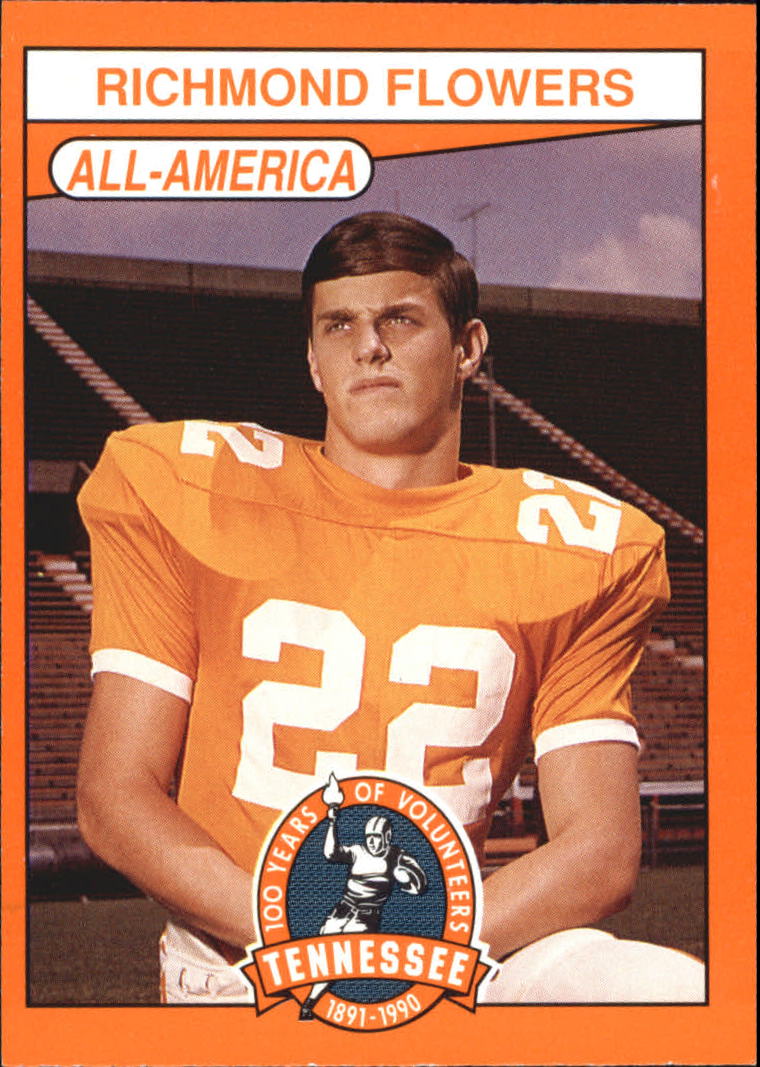
October 19, 1968, 50 years ago: It is the 3rd Saturday in October, which means a college football game between the University of Tennessee and the University of Alabama.
Richmond Flowers was from Dothan, Alabama. He got his undergraduate degree from Auburn University and his law degree from the University of Alabama -- making him a War Eagle and a Roll Tide. He enlisted in the U.S. Army in World War II, rose to the rank of Captain, and served on General Douglas MacArthur's special staff during the occupation of Japan.
In 1954, he was elected to the Alabama State Senate. In 1962, he ran for the office of State Attorney General, and won -- in the same election in which George Wallace was first elected Governor. Unlike Wallace, whose inaugural address promised, "Segregation now, segregation tomorrow, and segregation forever!" Flowers was a genuine 1960s-style liberal.
Richmond Flowers Sr.
He argued a landmark case before the U.S. Supreme Court:
Reynolds vs. Sims, announced on June 15, 1964. It struck down discriminatory State legislature district-drawing, which was almost entirely done in Southern States, to give white rural areas provenance over cities with black people in them; and ruled that districts for State legislatures must be roughly equal in population. These cases established the concept of "One man, one vote." (Now known as, "One person, one vote.")
Flowers also fought to aid the application of the federal law requiring public school desegregation, and successfully prosecuted members of the Ku Klux Klan, which was previously considered legally untouchable. Unused to challenges to their authority, they threw bricks through his house's windows, and burned crosses on his lawn on multiple occasions. He became known as "the most hated white man in Alabama."
At the time, the Constitution of the State of Alabama stated that the Governor could not succeed himself. So Wallace put his wife Lurleen up in the Primary. To fight this effort to have Lurleen be a puppet for her husband, Flowers ran. So did former Governors James Folsom and John Patterson. Unfortunately, this split the anti-Wallace vote, and Lurleen won. She died in mid-term, but George won again in 1970, after having run for President on a 3rd-party ticket in 1968.
The Klan's allies in the State government, no longer facing a State Department of Justice controlled by Flowers, got their revenge. He was indicted for extortion, trying to get payments from companies seeking licenses to do business in Alabama while he was Attorney General. To the end of his life, he insisted he was innocent.
His son, Richmond Flowers Jr., was a high school football and track star. Alabama coach Paul "Bear" Bryant wanted him at Alabama. Lots of people wanted him at Alabama. He refused, because of the way his home State treated his father. He went to the University of Tennessee, because his preferred sport was track, and while Alabama then had a decisive edge in football, Tennessee had an even more pronounced one in track.
He still played both sports, and helped to, pardon the pun, turn the tide of the football games in Tennessee's favor. He quit football after the 1967 season, so he could concentrate on making the U.S. Olympic team as a hurdler. But an injury ruined his chances of making the 1968 Olympics, where the U.S. track team included record-breakers Jim Hines, Lee Evans, Dick Fosbury, Al Oerter, Wyomia Tyus, and the great rebels Tommie Smith and his race's Bronze Medalist, John Carlos.
Tennessee coach Doug Dickey welcomed Richmond Jr. back onto the football team. Every year, "The Third Saturday In October," is when Tennessee plays neighboring Alabama. That will include tomorrow, when they will meet at Neyland Stadium in Knoxville. Alabama leads the series 55-38-7.
On October 19, 1968, they played in Knoxville. Awaiting trial, Richmond Sr. was escorted by FBI agents, and wearing handcuffs, into Neyland Stadium, to watch his son play. Richmond Jr., a receiver, caught a pass for the game's only touchdown. Tennessee won, 10-9.
The following year, Richmond Sr. was convicted -- as if there was any doubt that a jury of 12 white Alabamians would put him away. He was sentenced to 8 years, but was paroled after 16 months. In 1978, President Jimmy Carter, former Governor of Georgia, pardoned him.
He returned to his hometown of Dothan, and taught history and criminal justice at a community college there -- ironically named George C. Wallace State Community College, named for the father of his political rival. In 1989, CBS aired the TV-movie
Unconquered, written by Pat Conroy, author of
The Lords of Discipline and
The Prince of Tides. Richmond Sr. was played by Peter Coyote, and Richmond Jr. by Dermot Mulroney. Richmond Flowers Sr. died in 2007, at age 89.
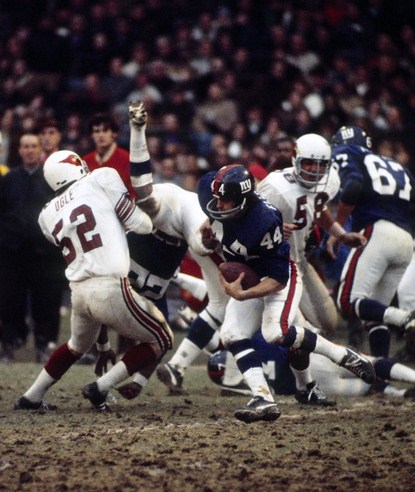
Richmond Flowers Jr. was drafted by the Dallas Cowboys in 1969, and was used as a safety and a kick returner. In 1971, he became a New York Giant, and intercepted 4 passes in the 1972 season. He got hurt in 1973, and played in the World Football League in 1974 before retiring.
Richmond Flowers Jr., playing for the Giants at Yankee Stadium
He finally went to the University of Alabama, getting his law degree there as his father did before him. He practiced law, got involved in commodities trading, and is now retired. Sadly, he supports Donald Trump, thus betraying everything his father stood for.
With his wife at a Tennessee football game
His son, Richmond Flowers III, followed his father into hurdling, college football, and the Cowboys. He became an assistant coach, and is now an agent for football coaches.
Richmond III, right, with Los Angeles Rams head coach Sean McVay
*
October 19, 202 BC: The Battle of Zama is fought outside Carthage, present-day Tunis, Tunisia. Publius Cornelius Scipio leads a Roman army to defeat the larger Carthaginian army, led by Hannibal and his 80 "war elephants." This ends the Second Punic Wars, and ends the threat of Hannibal, once known as the Scourge of Rome.
The victorious Roman general, having won this battle on the African continent, becomes known as Scipio Africanus. However, he resists the call to kill Hannibal and level Carthage to the ground, and allows Hannibal to remain in civilian charge of the city.
This leads other Roman leaders to smear Scipio, and he eventually died in an unfair disgrace. Hannibal himself would eventually lose power, be betrayed, and be murdered by Romans -- though he may have outlived Scipio, as both men are said to have died in 183 BC, 19 years after Zama. A Third Punic War finished the job -- "
Cartago delenda est," was the Roman cry: "Carthage must be destroyed!" -- in 146 BC.
The Punic Wars may have been the beginning of the racism of the white Europeans against black Africans, as many of Hannibal's soldiers were black, although it's not clear that Hannibal himself was.
October 19, 1216: King John of England dies in Newark. No, he wasn't carjacked. This was Newark-on-Trent in Nottinghamshire, not Newark-on-Passaic in New Jersey. He died of dysentery, and was not quite 50 years old. One of the least effective and most-hated English monarchs, he is succeeded by his 9-year-old son, Henry (later remembered as King Henry III).
October 19, 1453: In Champions League action, Bordeaux defeats Arsenal, and manager Harry Lancaster is sacked.
Actually, no. The French army retakes Bordeaux, meaning that the only part of France still under English control is the port of Calais.
The Hundred Years War is over, after 115 years. But by no means should England, and King Henry VI in particular, feel relief: Soon, the Wars of the Roses will begin.
October 19, 1469: King Ferdinand II of Aragon marries Queen Isabella I of Castile, uniting Spain. This allows them to complete the
Reconquista of Spanish lands from Muslim rulers, reform the Spanish government, reduce crime more than any rulers in Europe, and begin the Age of Exploration.
Unfortunately, it also leads to something no one expected: The Spanish Inquisition. And also the conquest of North and South America, and the enslavement and disease-aided slaughter of their peoples.
October 19, 1752: In his newspaper, the
Pennsylvania Gazette, Benjamin Franklin publishes an account of an experiment. In the account, he and his son William flew a kite in an electrical storm, to determine whether lightning was electricity.
According to the account, Ben kept the silk string of the kite dry at his son's end to insulate him while the hemp string to the kite was allowed to get wet in the rain to provide conductivity. A house key belonging to Benjamin Loxley was attached to the hemp string and connected to a Leyden Jar. A silk string was attached to this, held by William, who flew the kite while standing inside a doorway to keep himself and the silk string dry. Ben assumed that the Leyden jar would accumulate electricity from the lightning.
Ben never claimed that the kite was struck by visible lightning. Had that happened, Ben and William would almost certainly have been killed. But Ben did notice that loose threads of the kite string were repelling each other and deduced that the Leyden jar was being charged. He moved his hand near the key and observed an electric spark, proving the electric nature of lightning.
It has been alleged that the experiment never actually happened, and that Ben only proposed it. If he did try it, and it went wrong, he would have been dead at age 46, the career of one of the world's leading scientists ended in a very stupid way. And, without his contributions, it's likely that the American Revolution would have failed, and America would have remained part of the British Empire well into the 19th Century, and possibly even still part of the Commonwealth today.
Whatever happened, Ben Franklin lived to make his contributions to American independence. In 2010, the Philadelphia Union began play in Major League Soccer. Their leading fan group calls itself the Sons of Ben, in memory of Philly's greatest citizen, and their logo is centered by a skull, with Ben Franklin's hairstyle, Ben's invention bifocals, a Liberty Bell-style crack in his skull, a key, and 2 lightning bolts.
October 19, 1781: It took a combined U.S.-French all-star team, but the British are beaten at Yorktown, Virginia. Representatives of British commander Charles, Lord Cornwallis, hand over his sword and formally surrender in person to George Washington and Jean-Baptiste Donatien de Vimeur, Comte de Rochambeau.
The War of the American Revolution is not over, but this is the battle that ends what would, today, be called "major combat operations." The British had the best navy in the world, and along with France 1 of the 2 best armies. But they fought this war as if their commander-in-chief was Harry Redknapp, having some notable successes, but also some major blunders, and running out of money, men and excuses.
Cornwallis himself, later 1st Marquess Cornwallis, got a bum rap because he lost the climactic battle. Before the war, he argued against the Stamp Act in the House of Lords; during it, he won battles at Bound Brook, New Jersey and Brandywine and Germantown (now part of Philadelphia), Pennsylvania. After the war, he served as Governor-General of India, and as Lord Lieutenant of Ireland argued for Catholic emancipation there. So he was actually a pretty good general, and not at all a bad guy.
October 19, 1790: Lyman Hall dies in Waynesboro, Georgia at age 66. The physician and clergyman had been a signer of the Declaration of Independence, and dies 6 months after fellow signer Ben Franklin, and 5 days after fellow signer William Hooper.
*
October 19, 1810: Cassius Marcellus Clay is born in Madison County, Kentucky. A State legislator, and a cousin of legendary Kentucky legislator and 3-time Presidential candidate Henry Clay, he became one of America’s foremost abolitionists and public speakers in the pre-Civil War years.
He would tell his audience, "For those of you who believe in the laws of God, I have this," and reach into a pocket and pull out a Bible. "For those of you who believe in the laws of man, I have this," and reach into a pocket and pull out a booklet containing the text of the Constitution. "And for those of you who believe in neither, I have these," and reach into his pocket and pull out a pair of dueling pistols.
Abraham Lincoln appointed him Ambassador to Russia, gaining support for the Union from Czar Alexander II, and he soon came home and commanded a regiment in the Civil War. He lived until 1903.
The irony is that, when he is remembered at all today, he is remembered as the namesake of someone whose great-grandfather, an emancipated slave, grew up on land owned by Clay. His name was Cassius Marcellus Clay Jr., but he changed it, calling it, of all things, "a slave name." I wonder how much Muhammad Ali actually knew about the original Cassius Clay at the time?
October 19, 1812: CSKA Moscow, the club of the Red Army, defeats Paris Saint-Germain under gaffeur Napoleon Bonaparte.
Actually, Emperor Napoleon I of France retreats from Moscow, establishing the First Rule of European Warfare: Don’t try to invade Moscow if you know it's going to get cold soon.
October 19, 1846: Robert Leckie (no middle name) is born in Killearn, Stirlingshire, Scotland. One of the founders of Glasgow soccer team Queen's Park in 1867, he played for their side that stood as the 1st Scotland national team, playing England in the 1st international match, at the West of Scotland Cricket Ground in Glasgow on November 30, 1872. He also helped them win the 1st Scottish Cup in 1874.
He died in 1887, in Port Elizabeth, South Africa. I can find no record of what he was doing there, or the cause of his death at age 38. But, given the state of medicine in the late Victorian Age, it could have been one of many things now curable, or at least treatable.
October 19, 1873: Yale, Princeton, Columbia and Rutgers draft the 1st code of American football rules. At the time, however, "American football" still looked a lot more like soccer than the derivation of rugby it would soon become.
Also on this day, John Barton King is born in Philadelphia. If any American cricket player could have been called great, Bart King was perhaps the last one. From 1893 to 1912, he bowled (pitched) for the Gentlemen of Philadelphian, composed of players from the 4 leading cricket clubs in the Delaware Valley: Germantown, Merion, Belmont and Philadelphia. College players were also invited.
King helped the Philadelphians defeat the Australia national team in Philly in 1893, and toured England with them in 1897, 1903 and 1908. He continued to play until 1916, and lived until 1965. English cricket legend Plum Warner said he would have been far more famous if he had been British or Australian, since, by his era, American had pretty much given up on their interest in cricket.
October 19, 1876: Mordecai Peter Centennial Brown is born in Nyesville, Indiana. "Centennial" because 1876 was the nation’s 100th Anniversary. A farm accident as a boy left him with one finger missing and another one mangled and useless.
But that disability became a benefit, as it enabled him to grip a baseball in such a way that he had one of the best curveballs of all time. "Three-Finger" Brown became a Hall of Fame pitcher for the Chicago Cubs, helping them to 4 Pennants and the 1907 and 1908 World Series, the only 2 they've ever won.
He pitched from 1903 to 1916, and finished with a career record of 239-130, and the lowest career ERA in National League history, 2.06 He lived until 1948, and was elected to the Hall of Fame the next year.
October 19, 1894: The 1st college football game in Texas is played, on the campus of the University of Texas in Austin. The home team beats Texas A&M 38-0. The rivalry would be played every year, usually on Thanksgiving weekend, sometimes on Thanksgiving Day, until A&M left the Big 12 Conference for the Southeastern Conference in 2012. UT leads, 76-37-5.
October 19, 1896: Robert Arthur O'Farrell is born in Waukegan, Illinois. A fine defensive catcher, Bob O'Farrell won the 1926 World Series with the Cardinals, catching Babe Ruth stealing on the final play. (No, the last play was not Grover Cleveland Alexander striking out Tony Lazzeri. That happened in the 7th inning.) He managed them the next year, and also the Reds in 1934, and ran a bowling alley in Waukegan until he died in 1988.
Also on this day, Nat Holman -- I don't have a full name for him -- is born in Manhattan. One of the earliest great pro basketball players, he starred at New York University and then with the New York-based "Original Celtics." But it's as a coach that he's best remembered, at NYU's arch-rivals, City College of New York.
He coached at CCNY from 1919 to 1959, including through his playing career, which ended in 1930. He got the Beavers into the NCAA Final Four in 1947, and then, in 1950, they won both the NCAA Tournament and the National Invitational Tournament, a pivotal event in establishing the NCAA as the preeminent postseason tournament.
Unfortunately, the next year, the point-shaving scandal hit, and CCNY was implicated, and New York college basketball has never been the same, partly because the NIT, then conducted entirely at Madison Square Garden, was considered tainted, and that's the other reason the NCAA overtook it. As a result, the NCAA passed a rule saying that teams could no longer play in both. Ever since, the NIT has been the secondary tournament.
Nat Holman wrote the book on basketball. Literally: In 1922, while still one of the best players in the game, he wrote a book titled
Scientific Basketball. With the center jump after every basket eliminated, never mind shot clocks and 3-pointers and 7-footers playing, it became obsolete quickly.
He was elected to the Basketball Hall of Fame in 1964, and died in 1995, age 98.
*
October 19, 1900: Roy Worters (no middle name) is born in Toronto. A star with the New York Americans, he was probably the best goaltender the New York Tri-State Area ever saw, at least until Billy Smith. Yes, that includes Ranger Hall-of-Famers Chuck Rayner, Gump Worsley and Eddie Giacomin.
He won the Hart Trophy as NHL MVP in 1929 – but not the Vezina Trophy as best goalie. That went to George Hainsworth of Montreal. Worters did win the Vezina in 1931. Known as “Shrimp” because he was just 5-foot-3, he came up big many times for the Amerks.
He is in the Hockey Hall of Fame, along with teammates Red Dutton, Lionel Conacher, Billy Burch, Sweeney Schriner and Bullet Joe Simpson – quite a haul of honors for a franchise that only existed for 17 seasons, and made the Playoffs 5 times and never reached the Stanley Cup Finals. They did reach the Semifinals in 1936, and again in '38 after a hernia had ended Worters’ career. He died of throat cancer in 1957.
Also on this day, William Harold Ponsford is born in the Melbourne suburb of Fitzroy North, Victoria, Australia. Playing cricket from 1916 to 1939, Bill Ponsford would form a strong partnership for Australia with with Bill Woodfull, and later with the young Don Bradman. He lived until 1991.
October 19, 1905: Virgil Earp, Deputy Sheriff of Esmerelda County, Nevada, dies of pneumonia in Goldfield. He was 62, and this leaves his brother Wyatt as the last survivor of the Gunfight at the OK Corral in Tombstone, Arizona, 24 years minus 7 days earlier.
October 19, 1910: John Mills Jr. is born in Piqua, Ohio, outside Dayton. He (bass) and his younger brothers Donald (lead tenor), Herbert (tenor) and Harry (baritone) formed the singing group The Mills Brothers.
From 1931 to 1935, they had several hits, mostly standards, including "Tiger Rag" (a.k.a. "Hold That Tiger"), "Dinah," "I Ain't Got Nobody," "Rockin' Chair," "Up a Lazy River," "St. Louis Blues," "Bye Bye, Blackbird" and "It Don't Mean a Thing (If It Ain't Got That Swing)." On "Dinah," they had backed Bing Crosby, and Bing featured them on his CBS radio show.
But John fell ill in 1935, and, with antibiotics unavailable at the time, died on January 23, 1936. For a time, their father, John Mills Sr., who had sung in barbershop quartets, filled in, but the remaining brothers continued as a trio. Their later hits included "Paper Doll," "You Always Hurt the One You Love," "Till Then," and "The Glow-Worm." Rock and roll pretty much doomed them as hitmakers, but its doo-wop branch would not have been possible without them. And they did hit with a cover of The Silhouettes "Get a Job" in 1958, and once more in 1968 with "Cab Driver."
Herbert, Harry and Donald continued together, even recording an American Express "Do you know me?" (or, rather, "us?") commercial in 1980, until Harry died in 1982. Herbert died in 1989. At that point, Donald brought in the next generation of the family, until his own death in 1999. John Mills II, Donald's son, now leads the group.
October 19, 1921: Nils Gunnar Nordahl is born in Hörnefors, Sweden. A striker who dropped his first name, Gunnar Nordahl starred for IFK Norrköping, winning the Swedish league, the Allsvenskan, 4 straight times, 1945 to 1948, including also winning the Swedish Cup -- what the English call "doing The Double" -- in 1945. (Because Sweden was neutral during World War II, the Nazis did not invade, and their league was able to continue.) With his brothers Bertil and Knut, and also Gunnar Gren and Nils Liedholm, he helped Sweden win the Gold Medal at the 1948 Olympics in London.
Italian giants A.C. Milan, bought Gunnar Nordahl, Gren and Liedholm. The 3 Swedes become known as the Gre-No-Li trio, and helped the Rossoneri win Italy's Serie A in 1951 and 1955, plus 4 Coppa Italia, and the Latin Cup -- the closest thing Europe had to the European Cup before 1955 -- in 1951 and 1956. Nordahl was not, however, a member of the Sweden team that reached the Final of the 1958 World Cup on home soil.
He was top scorer in Sweden's league 4 times and in Italy's 5 times. He later managed Italian club AS Roma and several Swedish clubs, and died in 1995, at the age of 73.
Also on this day, George Kennedy dies. No, not the Oscar-winning actor: He wouldn't be born until 1925. This one was a former wrestler who, with others in 1909, founded Club Athlétique Canadien, which soon became Club de hockey Canadien, better known as the Montreal Canadiens. He owned the team until his death, including the 1916 Stanley Cup and their 1917 entry as founding members of the National Hockey League.
He was stricken in the Spanish Flu Epidemic of 1918-19, and never really recovered from it. Despite his influence, he has never been elected to the Hockey Hall of Fame.
Also on this day, General Armando Diaz, commander of Italian troops in World War I, is given a ticker-tape parade in New York.
Also on this day, Herbert Warren Kalmbach is born in Port Huron, Michigan. A real estate lawyer, he raised money for the Presidential campaign of his fellow Southern Californian, Vice President Richard Nixon in 1960. It lost, but Nixon never forgot Kalmbach's efforts. When Nixon tried again in 1968, and won, Kalmbach became his personal lawyer -- not the White House Counsel.
He got involved in the 1972 re-election campaign, and was caught in the crimes that fell under the umbrella term "Watergate," including raising hush money for the burglars. He plea-bargained, and served 6 months in jail, and was disbarred. His license to practice law was later reinstated, and he returned to practice. He died in 2017.
October 19, 1923: Citing the unsavory characters associated with the sport‚ American League President Ban Johnson persuades AL owners to prohibit boxing matches in their parks. The National League declines to go along with it. A month earlier, Jack Dempsey and Luis Firpo had their wild heavyweight title fight at the Polo Grounds, an NL park.
But the Yankees had already hosted the 1st pro prizefight at Yankee Stadium, with Benny Leonard successfully defending the lightweight title in a unanimous decision against Lew Tendler on July 24.
In July 1927, with Johnson having been forced out of his office due to illness, the Yankees broke his taboo by staging former heavyweight champ Dempsey against future heavyweight champ Jack Sharkey, in between Dempsey's 2 fights against Gene Tunney. The Yankees were not punished, and the ban was lifted. This was the last significant fight that Dempsey would win.
October 19, 1924: Louis Zborowski, Count de Montsaulvain, an English-born Polish great-grandson of an Astor who owned a lot of Manhattan real estate and was one of the top early auto racers, is killed when his Mercedes crashes into a tree during the Italian Grand Prix at Monza. He was just 29 years old.
His father, William Zborowski, the previous Count de Montsaulvain despite having been born in Elizabeth, Union County, New Jersey, was one of the earliest auto racers to be killed in a race crash, at Nice, France in 1903.
October 19, 1927: Billy Joe McCombs is born in Spur, in the Texas Panhandle. Known as Red McCombs, he played football in college and in the U.S. Army, and got rich in the energy and communications industries.
In 1972, having settled in San Antonio, he bought the ABA's Dallas Chaparrals, and moved them the next year, to become the San Antonio Spurs, owning them until 1975. He then bought the Denver Nuggets, and owned them until 1985. In 1998, he bought the Minnesota Vikings, and, when it became clear that he wouldn't be able to replace the Metrodome, the rumor began to run that he would move them. "The San Antonio Vikings" wouldn't have made sense. Instead, in 2005, he sold them to Zygi Wilf, who still owns them, and got U.S. Bank Stadium built. Red is still alive.
Also on this day, Hans Schäfer is born in Cologne, Germany. A left wing, he starred for hometown club
1. FC Köln, helping them win 5 Oberliga West titles, the 1962 German Football Championship, and the title in the 1st season of the Bundesliga, 1963-64.
In the 1954 World Cup in Switzerland, he scored 4 goals for West Germany, leading to their win over heavily-favored Hungary in the Final, known as the Miracle of Bern. He also played for West Germany in the 1958 and 1962 World Cups. He died in 2017, leaving Horst Eckel as the last surviving player from the 1st German World Cup winners.
Also on this day, Bedford Alfred George Jezzard is born in Clerkenwell, London. A forward he scored 38 goals for West London team Fulham in 1954, the most for any player at the team since World War II. He was selected for the England team at the 1954 World Cup, but didn't get into a game, only making 2 appearances for England, both the following season.
His career ended with an injury in 1957, and he became Fulham's manager from 1958 to 1964, getting them promoted to the First Division. He lived until 2005.
Also on this day, Pan American World Airways begins operation. It becomes the most famous of all American-based airlines, but goes out of business in 1991.
*
October 19, 1930: Ronald Vaughan Joyce is born in Tatamagouche, Nova Scotia. He served in the Royal Canadian Navy during the Korean War, then moved to Hamilton, Ontario and served in its police department. In 1963, he bought a Dairy Queen franchise there. In 1964, he and Toronto Maple Leafs defenseman Tim Horton bought a coffee shop, named it Tim Horton's, and a legend was born.
Horton died while still an active player, in a 1974 car crash, and Joyce bought full control of the doughnuts and coffee empire. His son, Ron Joyce Jr., married Tim's daughter, Jeri-Lyn Horton. In 1995, there was another marriage, between Tim Hortons (the apostrophe was dropped due to Quebec's language laws and Joyce's desire to have the same official name from Atlantic to Pacific) and Wendy's, with Joyce having more stock in the combined company than even Wendy's founder Dave Thomas.
The companies would later split, but Tim Hortons broke into the U.S. market, mostly in cities with NHL teams: New York, Philadelphia, Boston, Buffalo, Detroit, and Thomas' hometown of Columbus. There are 3 in New Jersey: Inside the Prudential Center, the Devils' arena in Newark; at the traffic circle formed by U.S. Routes 202 and 206 and N.J. Route 28, in Raritan, Somerset County; and on N.J. Route 23 in Hardyston, Sussex County.
Ron Joyce also founded the Tim Horton Children's Foundation, which is effectively Canada's answer to Ronald McDonald House. He is still alive.
UPDATE: He died on January 31, 2019.
October 19, 1933: Earl Lunsford (no middle name) is born in Stillwater, Oklahoma, the seat of what was then known as Oklahoma A&M University. He was a running back at that school, which became Oklahoma State in 1958, and was a 2-time Canadian Football League All-Star for the Calgary Stampeders, known as Earl the Pearl before either Earl Morrall or Earl Monroe was.
He later served as general manager of the Stamps and the Winnipeg Blue Bombers, and was elected to the Canadian Football Hall of Fame. He died in 2008.
Also on this day, George Dixon (also, no middle name) is born in New Haven, Connecticut. A running back, he also didn't want to take the chance of being a black player in an NFL full of Southern players, and went north to Canada. Playing for the Montreal Alouettes, he was named CFL Most Outstanding Player in 1962, and was elected to the Canadian Football Hall of Fame.
He later served as head coach at Loyola University in Montreal, leading them to the Canadian University Championship in 1972. In 1974, the school was merged with Sir George Williams University, to become Concordia University. Dixon died in 1990.
October 19, 1934: Donald David Guard is born in San Francisco, and grows up in Honolulu, where he met Bob Shane. They went back to San Francisco, here they met Nick Reynolds, and formed The Kingston Trio, who sparked a revival of folk music in 1958 that would last until the arrival of The Beatles in America in 1964.
The Trio recorded the 1948 Boston political song "M.T.A." in 1959, and between the 4th and 5th verses, Shane can be heard saying, "Pick it, Davey!" Davey Guard then played his banjo so fast that he could be heard saying, "Kinda hurts my fingers!" In 1961, he left the group, and John Stewart was hired as his replacement. Stewart is better known as the writer of "Daydream Believer," a Number 1 hit for The Monkees in 1967.
Guard died of cancer in 1991, only 56 years old. Stewart and Reynolds continued to perform with Shane as The Kingston Trio. Stewart and Reynolds lived until 2008, ages 68 and 75, respectively. Shane is the last survivor, now 83 and still performing.
October 19, 1936: George Matthewson Thomson is born in Edinburg, Scotland. A left back, he helped hometown team Heart of Midlothian -- a.k.a. "Hearts," or, in rhyming slang, the "Jam Tarts" or the "Jambos" -- win the Scottish League in 1958, the Scottish League Cup in 1959, and both of those trophies in 1960.
He moved south to Liverpool, and helped Everton win England's Football League title in 1963. He died in 2007.
October 19, 1940: Michael John Gambon is born in Dublin. After the death of fellow Irishman Richard Harris, he was handed the role of Albus Dumbledore in the Harry Potter films.
October 19, 1941: South America's greatest sports rivalry takes place in Buenos Aires, Argentina. River Plate, at home at the stadium known as El Monumental, defeats Boca Juniors 5-1, dethroning the defending League Champions and all but wrapping up the title for themselves. It is considered the beginning of a team known as La Máquina, "the Machine."
They are led by a 5-man forward line of Juan Carlos Muñoz, José Manuel Moreno, Adolfo Pedernera, Ángel Amadeo Labruna and Félix Loustau. They would win the title in 1941, 1942, 1945 and 1947. Muñoz was the last survivor of La Máquina, living until 2009.
Also on this day, Hector Cowan dies at age 78, on his farm near Stamford, New York, in the Catskill Mountains. "Hec" Cowan played offensive and defensive tackle at Princeton University, and was named to the 1st College Football All-America Team in 1889. He also served as head coach at North Carolina and Kansas, was elected to the College Football Hall of Fame, and became an ordained minister.
October 19, 1943, 75 years ago: Streptomycin, the first antibiotic remedy for tuberculosis, is isolated by researchers at Rutgers University in New Brunswick, Middlesex County, New Jersey. Rutgers has had a lot of victories in the laboratory. On athletic fields, uh, let me get back to you.
Also on this day, Santos Alomar Conde is born in Salinas, Puerto Rico. Sandy Alomar was a middle infielder who wore Number 2 for the Yankees, but he was no Derek Jeter.
He made his major league debut in 1964 with the Milwaukee Braves, moved with them to Atlanta in 1966, and was briefly a Met in 1967. He spent the bulk of his career with the team then known as the California Angels, and was an All-Star with them in 1970. He was with the Yankees when they won the 1976 American League Pennant, but the arrival of Willie Randolph made him expendable. After the season, he was traded to the Texas Rangers for Brian Doyle, and retired after the 1978 season, with a lifetime batting average of just .245.
His greatest contributions to baseball were still on their way. He has coached for the San Diego Padres, the Chicago Cubs, the Colorado Rockies and the Mets. With the Padres, he coached his sons, Sandy Alomar Jr. and Roberto Alomar, both of whom became All-Stars. He returned to the postseason with the 2006 Mets. He is now retired from baseball.
October 19, 1944: William P. Melchionni is born in Philadelphia, and grows up across the Delaware River in Pennsauken, Camden County, New Jersey. He attended Bishop Eustace Prep School in his hometown, and played guard at nearby Villanova University.
In his rookie season, 1966-67, he won an NBA Championship with his hometown team, the Philadelphia 76ers. He was never an All-Star in the NBA, but was one 3 times in the ABA, where he helped the New York Nets win the 1974 and 1976 league Championships. He did not make it back into the NBA when the Nets were admitted after the 1976 title. But the Nets, later in New Jersey and now in Brooklyn, retired his Number 25. So did Villanova.
He is still alive. His brother Gary Melchionni captained Duke University. Gary's son Lee Melchionni also played at Duke.
October 19, 1945: One heck of a day to be born. John Arthur Lithgow in Rochester, New York. Great actor, and author of children's books.
Patricia Ireland (no middle name), in the Chicago suburb of Oak Park, Illinois. Longtime President of the National Organization for Women from 1991 to 2001.
Jeannie Carolyn Stephenson in Stamford, Texas. Better known as Jeannie C. Riley, the singer of "Harper Valley P.T.A."
Gloria Richetta Jones in Cincinnati. She recorded the original and still best version of "Tainted Love" in 1965, wrote Gladys Knight's "If I Were Your Woman," and became the girlfriend of English glam-rock singer Marc Bolan, singing backup for his band T-Rex. Unfortunately, she was driving the car when it crashed, killing him on Septembe 16, 1977. She is still alive and performing, as is their son, Rolan Bolan, now 42.
And, in the Baltimore suburb of Towson, Maryland, drag queen/actor Harris Glenn Milstead, a.k.a. Divine. As far as I know, though, none had anything to do with sports.
I often find days where 2 famous people were born, or even 3. 4 is very rare. But 5, and I've heard of all of them? That doesn't happen very often.
Also on this day, Alan Mitchell Edward George Patrick Henry Gallagher is born in San Francisco. His name was long, but his major league career was short: The 3rd baseman played for his hometown San Francisco Giants from 1970 to 1973, and for the California Angels in 1973, finishing with a batting average of .263. "Dirty Al" later served as a longtime minor-league coach. He is still alive.
UPDATE: Al Gallagher died on December 6, 2018.
*
October 19, 1946: Princeton beats Rutgers 14-7 at Rutgers Stadium. An attempt to steal the cannon proves even more embarrassing for RU.
Rutgers University is in New Brunswick, in Middlesex County, New Jersey. (The stadium is across the Raritan River, in Piscataway.) Princeton University is in the town of the same name, in Mercer County. They are separated by 17 miles of State Route 27. In 1869, Rutgers beat Princeton in "the first college football game," in New Brunswick, hence Rutgers calls itself "the Birthplace of College Football."
Two cannons were left on the Princeton campus after the War of the American Revolution , although neither of them were used in the Battle of Princeton of January 3, 1777, as is often claimed. "Big Cannon" is located behind Nassau Hall in the center of the quadrangle there, called "Cannon Green," and "Little Cannon" is situated between Whig and Clio Halls.
For the War of 1812, Big Cannon was transported to New Brunswick to help defend the city against potential attack by the British, remaining on the Rutgers campus, where it was used for training during and after the American Civil War of 1861-65 by Rutgers cadets, until it was taken back to Princeton in 1875 by the "Princeton Blues," a local militia.
On the night of April 25, 1875, 10 members of the Rutgers Class of 1877 set out to take Big Cannon from Princeton. However, they were unable to move it, so instead they returned to New Brunswick with Little Cannon. Princeton responded with a raid on Rutgers, stealing some muskets, and the presidents of the colleges exchanged polite but demanding correspondence. Eventually, a joint committee settled the matter, and Little Cannon was returned to Princeton, escorted by the New Brunswick Police Chief. In other words, Rutgers was forced to cave.
On October 19, 1946, a contingent of Rutgers men slipped onto the Princeton campus, and again tried to steal the famed Big Cannon. This attempt was even more disastrous than the first. They attached one end of a heavy chain to the cannon and the other to their car, a Ford. Surprised by Princeton students and the police, they gunned the engine of the car so hard that the car was torn in half. The Rutgers students managed to escape, but with neither the car nor the cannon.
On the eve of the annual Rutgers-Princeton game of 1971, Big Cannon was apparently "stolen" again. A 5-foot-deep hole was found where the cannon sat. Campus police were baffled that the cannon had been taken, given its extreme weight. After crime photos were taken, it appears that a hole had simply been dug next to Big Cannon and the dirt from the hole used to bury it. Reports appeared in the Rutgers newspaper, the Daily Targum, as well as nearby papers such as the New Brunswick-based Daily Home News, the Princeton Packet and The Times of Trenton.
Big Cannon at Princeton is routinely painted red by Rutgers students, particularly in the week leading to Rutgers commencement, as well as on other notable Rutgers dates. In November 2011, a group of Rutgers students who went to paint the cannon in Princeton brought a video camera with them and made a documentary about the tradition. The footage became part of a larger project about the history of the Cannon War and its perception in the minds of current students today. The film, Knights, Tigers, and Cannons. Oh My!, by Zack Morrison, premiered at the New Jersey Film Festival in September 2012, and won the award for Best Student Film.
Also on this day, Arsenal defeat Staffordshire team Stoke City 1-0 at Highbury. Kevin O'Flanagan scores the goal. Soccer was not his best sport: He was renowned as a rugby player for Ireland, and excelled in sprint races and the long jump. He was also a noted amateur golfer and tennis player, and played Gaelic football as a boy.
But he's not the most notable player in this game. That would be Albert Sigurður Guðmundsson. Although this is the 1st of only 2 League matches he plays for Arsenal, it makes him the 1st native of Iceland ever to play professional soccer. He later served his country as Minister of Finance.
*
October 19, 1949: Three weeks after acquiring shortstop Chico Carrasquel from the Brooklyn Dodgers organization for cash and 2 minor leaguers‚ the Chicago White Sox all but steal 2nd baseman Nellie Fox from the Philadelphia Athletics for catcher Joe Tipton.
Carrasquel was not the 1st good shortstop to get stuck behind Pee Wee Reese in Brooklyn, nor the last, but he might have been the best. But the Mack family's financial situation meant that even if they had hung onto Fox, they would not have been the team that stayed in Philly, while the Phillies would have been the team that moved.
Also on this day, Clifford Lynn Dickey is born in Osawotamie, Kansas. He would have sounded a lot better playing football as "Cliff Dickey." Instead, he went by "Lynn Dickey." Still, he is probably still the best-known player in Kansas State's football history, and was named the all-time quarterback in Big Eight history when that league evolved into the Big Twelve. He and his successor at KSU, Steve Grogan, are the only KSU players to have their number retired – both wore Number 11.
He went on to play for the Houston Oilers and Green Bay Packers, helping the Packers to the 1982 NFC Central Division Title; famously outdueling Joe Theismann of the Washington Redskins in the highest-scoring
Monday Night Football game ever, a 48-47 win in 1983; and steering the Pack through the biggest snowfall in NFL history, 15 inches, in a 21-0 win over the Tampa Bay Buccaneers in 1985. He now hosts a sports-talk show on a Kansas City radio station.
October 19, 1950: Michael Dale Tallon is born in Noranda, Quebec. Although he won the 1969 Canadian Junior Golf Championship, his best sport turned out to be hockey. A defenseman, he was an original 1970-71 Vancouver Canuck, and he closed his career in 1980 with the Pittsburgh Penguins.
Dale Tallon is best remembered for his time with the Chicago Blackhawks. The Canucks traded him there in 1973, and he was given Number 9. Not only is this far more often a uniform number for a forward, but it had been worn by the Hawks' greatest player, Bobby Hull. Giving it out only a year after Hull left for the World Hockey Association was an indirect insult. Tallon took it in stride: "The only thing is, they forgot the decimal point."
Tallon finished his career with 98 goals and 238 assists. In 1983, the Hawks and Hull patched things up, and 9 was retired for Hull. By that point, Tallon was broadcasting for the Hawks. He later served as assistant general manager, and helped build their 2010, '13 and '15 Stanley Cup winners. After winning the 2010 Cup, and getting his ring, he was hired by the Florid Panthers as general manager, and remains in their front office.
Also on this day, Charles Marie Jérôme Victor Napoléon Bonaparte is born in Boulogne, France. Known as Prince Napoléon, he is a great-great-grandson of a brother of the original Napoléon
Bonaparte, and is the current Bonapartist claimant to the throne of France. He maintains his role as head of the royal house, but is under no illusion that he will ever re-establish the French monarchy and become Emperor Napoléon VII.
Unlike every other member of the European branch of the family, he has run for and won elective office, to the City Council in Ajaccio, the capital of Corsica, the French island on which his most famous ancestor was born.
October 19, 1951: Angels in the Outfield premieres. Janet Leigh plays a reporter covering the hapless Pittsburgh Pirates, who begin to get help from above. It would be remade in 1994, with the California Angels as the team in question, but the focus moves from a young lady reporter to a boy stuck in the foster care system.
October 19, 1953: On his morning CBS radio show,
Arthur Godfrey Time, host Godfrey fires his best-known performer, Julius La Rosa, saying, "That was Julie's swan song with us." On the radio show, and on the evening TV show
Arthur Godfrey and His Friends, Godfrey had made La Rosa a singing star in late 1951, but justified the firing by saying he had "no humility."
Well, La Rosa was certainly humiliated, very publicly, as few people in that era had been. As it turned out, the real reason was that La Rosa was getting more fan mail than Godfrey, so maybe a lack of humility was warranted.
Comedians began working the phrase "no humility" into their routines. Cabaret singer Ruth Wallis, who normally couldn't get on the radio because she worked sex-related double-entendres into her songs, had the only Top 40 hit of her career with a song titled "Dear Mr. Godfrey."
Frank Stanton, then president of CBS, said, "Maybe it was a mistake," that Godfrey shouldn't have fired La Rosa on the air. Godfrey compounded the mistake by firing his bandleader, Archie Bleyer, who had founded Cadence Records and made La Rosa his 1st signing. Bleyer had produced records by Don McNeill, whose ABC radio show was Godfrey's competitor -- not a very successful one, but close enough to bruise Godfrey's apparently fragile ego. Losing Bleyer's production talents hurt Godfrey even more, as the show's quality went downhill.
Almost immediately, Ed Sullivan booked La Rosa onto his own CBS show,
Toast of the Town. (It was renamed
The Ed Sullivan Show in 1955.) This led Godfrey to end his friendship with Sullivan. La Rosa had more and bigger hit records without Godfrey than with him, and had his own TV show (albeit only as a Summer replacement series) in 1955, '56 and '57. In the 1970s, he became a disc hockey on New York station WNEW, AM 1130, which specialized in the Big Band era, of which La Rosa was one of the last big stars.
In 1981, Godfrey's manager tried to put together a TV special, a reunion of the "Little Godfreys." La Rosa was willing to appear, but Godfrey insulted him during the preparations, and he walked off, and the special never happened. When Godfrey died in 1983, pretty much all anybody wanted to talk about was how he treated La Rosa.
Bleyer is now probably best known for producing records for The Chordettes, a vocal quartet that included his wife, Janet Ertel. On their best-known song, the 1955 Number 1 hit "Mr. Sandman," Bleyer provided the percussion by slapping his legs, and also played the "Sandman," by answering, "Yeeees?" He died in 1989, a year after Janet.
In 2003, Bob Murphy, knowing that he was dying of cancer, retired as Mets broadcaster. I was at his last game, and La Rosa, his favorite singer, was invited to sing the National Anthem. At age 73, the Brooklyn native still had a fine voice. He lived until 2016.
Also on this day, Lionel Eugene Hollins is born in Arkansas City, Kansas. A dazzling guard with the Portland Trail Blazers, he helped them win the 1977 NBA Championship. They have retired his Number 14. He later served as the head coach of the Memphis Grizzlies and the Brooklyn Nets. His son Austin Hollins plays in Germany's basketball Bundesliga.
October 19, 1954: Hugh Duffy dies of heart trouble in Boston. He was 87, and the last survivor of the Boston Beaneaters teams that won 5 National League Pennants in the 1890s, the last 4 with him, first as a center fielder, then a left fielder. A .325 lifetime hitter, his .440 average in 1894 remains the single-season record.
A native of nearby Cranston, Rhode Island, he later served the Boston Red Sox in several capacities, including manager, coach, scout, and was working until a year before his death.
Also on this day, Joseph Washington Bryant is born in Philadelphia. Joe was an All-Star with his hometown 76ers, known as "Jellybean." He went on to coach the WNBA's Los Angeles Sparks, and has also coached pro teams in Japan and Thailand.
He married Pam Cox, sister of fellow Philadelphian and former Washington Bullet John "Chubby" Cox. The Bryants are still together, and had 2 daughters, Sharia and Shaya, and a son, Kobe -- so named because Joe had played in the Japanese city with that name. Most people would argue that Jellybean Bryant's greatest contribution to basketball is Kobe Bryant.
Also on this day, Samuel Allardyce (no middle name) is born in Dudley, West Midlands, England. Big Sam – or Fat Sam, as those of us who don't like him, those of us with taste, call him – is best known for both playing for, and later managing, Bolton Wanderers in the English Football League.
A centreback, he played for Bolton, Sunderland, Millwall, in the North American Soccer League for the 1983 Tampa Bay Rowdies, Coventry City, Huddersfield Town, Bolton again, Preston North End, West Bromwich Albion, Limerick in Ireland, and Preston again. In 21 years as a player, he won the 2nd division with Bolton in 1978, and promotion from the 4th to the 3rd division with Preston in 1987. That's it.
He's managed Limerick (player-manager), Preston (player-manager), Blackpool, Notts County, Bolton, Newcastle United, Blackburn Rovers, West Ham United, and Sunderland. In 26 years as a manager, he's won the League of Ireland First Division with Limerick in 1992, the Football League Third Division (then the name of England's 4th division) in 1998, promotion with Bolton in 2001, and promotion with West Ham in 2012. But in 46 years of playing and managing in England, his number of major trophies won is exactly zero.
And yet, he's the greatest manager the England national team has ever had. He had a perfect record. He won 1, drew none, and lost none. He was hired on July 22, 2016, managed his 1st game on September 4, seemed doomed to a 0-0 draw with considerably weaker Slovakia in a 2018 World Cup Qualifier before Liverpool's Adam Lallana scored in stoppage time... and was fired on September 27, when he was caught on tape admitting to corruption, something he'd been investigated for before.
He was England manager for 67 days, and is currently unemployed -- perhaps unemployable. The truth is, he was completely unqualified to be England manager in the first place. His only qualifications seemed to be that he is English, and the English media and fans loved him.
It remains to be seen if he will be forgiven, but he has since been hired and fired at South London club Crystal Palace and Liverpool team Everton. His son Craig Allardyce also played and managed in England, and is now a players' agent.
October 19, 1955: Jean Kambanda (no middle name) is born in Butare, Rwanda. His country's Prime Minister from April 9 to July 19, 1994, and a member of the Hutu tribe, he led the government's genocide against the Tutsi tribe, leading to the deaths of as many as 1 million people.
When the Rwandan Patriotic Front launched a coup, he fled the country, was arrested in Kenya, and was taken to an International Criminal Tribunal in Tanzania, where he became the 1st head of government, of any country in the world, to plead guilty to genocide. He remains imprisoned in the African nation of Mali.
October 19, 1956: Bruce Weber is born in Milwaukee. He coached the basketball team at -- no, not Weber State -- the University of Southern Illinois into the NCAA Tournament's Sweet 16, and led the University of Illinois to 2 Big Ten Championships and a trip to the 2005 National Championship Game, being named National Coach of the Year. He is now the head coach at Kansas State.
Ironically, as an athlete, he played baseball at the University of Wisconsin-Milwaukee, but was cut from their basketball team.
October 19, 1957: Brian Stein (no middle name) is born in Cape Town, South Africa, and grows up in North London. He and his brother Mark Stein were forwards who helped Bedfordshire club Luton Town win the 1988 League Cup. Their brother Ed Stein played for North London club Barnet.
*
October 19, 1960: Two of the biggest stars in college basketball play their professional debuts, against each other, at the Cincinnati Gardens, launching 2 of the greatest careers in NBA history. Oddly, both are outshone by established teammates.
Jerry West of Cabin Creek, West Virginia and West Virginia University scores 20 points, but his teammate Elgin Baylor leads all players with 35. Oscar Robertson of Indianapolis and the University of Cincinnati scores 21 points, but Jack Twyman scores 30. Robertson's Cincinnati Royals defeat West's Los Angeles Lakers, 140-123.
This is also the Lakers' 1st game representing Los Angeles, after spending 13 seasons in Minneapolis, where they won 5 NBA Championships. They will make their home debut 5 nights later.
Also on this day, Senator John F. Kennedy of Massachusetts, the Democratic Party's nominee for President, is given a ticker-tape parade in New York. The Republican Party's nominee, Vice President Richard Nixon, would also receive one before the election.
While major-party nominees have often held rallies at Madison Square Garden right before the election, and each has had Conventions at buildings with the name, this is the only time either party's nominee has been given a ticker-tape parade.
(Others have gotten them in other cities. After losing this race, Nixon would go to Chicago in 1968, right after the disastrous Democratic Convention there, and it went off without a hitch, showing people, especially in Illinois, then a close State, that he was the more reliable candidate.)
October 19, 1962: Evander Holyfield (no middle name) is born in Atmore, Alabama. He's hardly without his flaws, but this Heavyweight Champion of the World did boxing a huge favor by exposing Mike Tyson as what he is: A punk and a coward who could dish it out (as well as anybody ever has) but couldn't take it.
He's the only man to win the Heavyweight Title 5 times. He's also the only man to knock down, let alone the only one ever to defeat, Riddick Bowe, although he only won 1 of their 3 fights.
October 19, 1963: After 14 seasons as the Syracuse Nationals, the Philadelphia 76ers make their home debut, taking the place of the Warriors, who moved to San Francisco the year before. It doesn't go so well: Despite 31 points from Lee Shaffer and 24 from Chet "the Jet" Walker, they lose to the Detroit Pistons, 124-121 at the Convention Hall of the Philadelphia Civic Center.
Also on this day, James Matthew Dombrowski is born in the Buffalo suburb of Williamsville, New York. An offensive tackle, he starred at the University of Virginia, who retired his Number 73. He later starred for the New Orleans Saints, and was named to their all-time team. He is in the College Football, Great Buffalo Sports, and National Polish-American Sports Halls of Fame.
Also on this day, Harold Macmillan resigns as Prime Minister of Britain after 6 years, unable to keep his moral authority after a scandal connected to him only because he had hired the man responsible, the sex-shamed Minister of Defence, John Profumo. Sir Alec-Douglas Home is named Leader of the Conservative Party, and thus Prime Minister, but will lose the office in an election a year later.
October 19, 1964: Fred Hutchinson dies of cancer. The manager of the Cincinnati Reds was only 45. The team had made a great run down the stretch to try to win him a Pennant, but fell 1 game short of the Cardinals.
Hutch and the Reds had won the Pennant in 1961, beating out the Milwaukee Braves, before falling to the Yankees in the World Series, the only one Cincinnati hosted in a 30-year stretch. Ironically, the last time the Reds had won the Pennant, in 1940, they beat the Detroit Tigers in the World Series, a team which featured Hutch as a pitcher. He had a 95-71 career record, a 3.73 ERA, a 113 ERA+, a 1.281 WHIP, and was an All-Star in 1951.
The Reds retired his Number 1. The next season, Major League Baseball began presenting the Hutch Award, to the active player who "best exemplifies the fighting spirit and competitive desire of Fred Hutchinson by persevering through adversity." The inaugural winner was Mickey Mantle. Other winners connected with the Yankees have been Joe Torre, Tommy John, Jim Abbott, David Cone, Jason Giambi, John Olerud and Raul Ibanez -- but only Mantle and Cone were Yankee players when they received the award. No player then with the Mets has ever received it, although it has been awarded to Torre, Olerud and Ray Knight while with other teams. The current holder is Adam Wainwright of the St. Louis Cardinals.
October 19, 1965: The Mets purchase Jerry Grote from the Houston Astros. He will be the starting catcher on their 1969 World Championship and 1973 Pennant teams. Late in the 1977 season, he will be traded to the Los Angeles Dodgers, and win the 1977 and 1978 Pennants with them.
Only 4 men have been starting catchers on Met teams that reached the World Series: Grote, Gary Carter, Mike Piazza and Travis d'Arnaud; and only Grote and Carter have helped them go all the way. Grote is the only one who got them into 2 World Series.
In fact, from 1969 to 1977, both starting catchers for New York’s baseball teams, Grote and Thurman Munson, wore Number 15. And, between Elston Howard's 32 in 1962 and Carter's 8 in 1986, no New York team won a World Series without a Number 15 behind the plate.
Also on this day, Bradley Lee Daugherty is born in Black Mountain, North Carolina. A star at the University of North Carolina, Brad Daugherty was widely expected to be the top pick in the 1986 NBA Draft. The Philadelphia 76ers held that pick. Then, in one of the biggest bonehead trades in NBA history, Sixers owner Harold Katz traded that pick, and thus Daugherty, to the Cleveland Cavaliers for Roy Hinson and cash.
Hinson is one of the best basketball players ever to come out of Central Jersey (Somerset County's Franklin High School), and was a star at Rutgers. At the time, there was nothing wrong with wanting a healthy Roy Hinson on your team. Indeed, he'd just had his best season. But giving up Daugherty was a mistake, and the Sixers only kept Hinson for another 2 years anyway, sending him to his home-State New Jersey Nets, for whom he played 3 seasons before retiring in 1991.
The Sixers also traded Moses Malone that day, so they traded a Hall of Fame center, who had only gotten them the 1 NBA Championship the franchise has now won in the last 49 seasons,
and a guy who would have been an ideal successor as Malone aged.
Daugherty became the Cavs' all-time leading scorer and all-time leading rebounder, distinctions he held until 2008, when those totals were surpassed, respectively, by LeBron James and Žydrūnas Ilgauskas. They never won a title with him, though, only getting as far as the 1992 Eastern Conference Finals.
A back injury cut short his career, but he was a 5-time All-Star, the Cavs retired his Number 43, and he was a unanimous choice among fans as the center on the Cavs' 25th, 30th and 40th Anniversary All-Time Teams. He would also be named to the ACC 50th Anniversary men's basketball team in 2002 and inducted into the North Carolina Sports Hall of Fame.
He has run several businesses, made a fortune above and beyond his basketball salaries, and works for ESPN as an analyst for college basketball and NASCAR. Yes, a black man announcing for NASCAR. He loves it. He may be black, but he's also from North Carolina. He even sponsored a racing team before joining the ESPN NASCAR broadcast crew. (He had to sell the team to avoid a conflict of interest.) The reason he wore 43 was in tribute to the number on the car of the man he calls "my favorite sportsman," North Carolina’s own Richard Petty.
October 19, 1966: Bobby Orr makes his NHL debut. He wears Number 27 and a crew cut, before receiving his more familiar Number 4 the next season and letting his hair grow out into the more familiar hairstyle. He collects an assist, and the Boston Bruins beat the Detroit Red Wings, 6-2 at the Boston Garden.
Also on this day, a nasty fight breaks out in the 3rd quarter of a game between the New York Knicks and the Los Angeles Lakers, at what is now usually called "the old Madison Square Garden." As a free throw is missed, the Lakers' Rudy LaRusso believes the Knicks' Willis Reed has thrown an elbow at his head. LaRusso throws a punch, and misses. Reed punches back, and LaRusso later said, "Reed hit me a couple good ones." The Lakers' Darrall Imhoff gets in there, and Reed socks him in the eye. John Block gets in there, and Reed breaks his nose.
Reed and LaRusso are both ejected, and fined $50 -- about $384 in today's money. Neither is suspended. I guess this was one time that the NBA having hardly any national attention was a blessing rather than a curse, with no ESPN to show the fight over and over and over.
Oh, yes: The Knicks won, 122-119.
October 19, 1967: Four years to the day after Philadelphia's current basketball team made its home debut, its hockey team does the same. There are notable differences: With the 76ers, it was at the classic Civic Center, and they lost; with the Flyers, it was at the brand-new Spectrum, and despite being an expansion team, they won.
At 2:59 into the 3rd period, Bill Sutherland puts the puck past Pittsburgh Penguins goaltender Les Binkley, and the Flyers have a 1-0 win over their fellow "Second Six" Pennsylvanians, in the 1st regular-season game between them. When they won their 1st Stanley Cup, on May 19, 1974, it would also be at The Spectrum, and it would also be 1-0, over the Boston Bruins.
October 19, 1968, 50 years ago: Greg Briggs (apparently, his full name) is born in Meadville, Mississippi. A safety, he won Super Bowl XXVII as a rookie with the Dallas Cowboys, was loaned out to NFL Europe, thus missing out on their Super Bowl XXVIII win, and returned to them to win Super Bowl XXX. He just missed another Super Bowl, closing his career with the 15-1 1998 Minnesota Vikings. He has since gone into the ministry.
October 19, 1969: Just 3 days after winning their "Miracle" World Series, the Mets appear on
The Ed Sullivan Show, singing "You Gotta Have Heart" from the Broadway musical
Damn Yankees.
Each player is identified with the primitive graphics of the time, and using their full names. Thus, Tom Terrific is "G. Thomas Seaver," the Express is "L. Nolan Ryan," and Tug is "Frank E. McGraw."
*
October 19, 1970: Christopher Lee Kattan is born in the Los Angeles suburb of Culver City, California. The son of cartoon voice actor Kip King, Chris Kattan is best remembered for his 1996-2003 work on
Saturday Night Live.
His impersonations included Bill Gates, CNN announcer Christiane Amanpour, Steve Irwin, Ricky Martin, Elian Gonzalez, and the slightly taller Kerri Strug. His fictional characters included male stripper Mango; Todd Henderson, a.k.a. Azrael Abyss of
Goth Talk, alongside Molly Shannon's Circe Nightshade; and, most notably, Steve Butabi, alongside Will Ferrell's Doug Butabi, a.k.a. The Roxbury Guys.
In 2001, while doing a
Golden Girls-themed sketch, he fell from a chair, injuring his neck. This was more than 2 years after the last Roxbury Guys sketch, and he has had considerable trouble doing their famous head-bob ever since. It also interfered with his 2014 run on
Dancing With the Stars.
October 19, 1971: Matthew Alan Jackson is born in Leeds, West Yorkshire, England. A right back, he helped Merseyside club Everton win the 1995 FA Cup, and Manchester-area club Wigan Athletic reach the 2006 League Cup Final. He is now Wigan's head of football operations.
October 19, 1972: Keith Charles Foulke is born at Ellsworth Air Force Base in Box Elder, South Dakota, and grows up in Huffman, Texas, outside Houston. He was the closer who got the final out of the 2004 World Series * for the Boston Red Sox, a bouncer up the middle from Edgar Renteria of the St. Louis Cardinals, which Foulke caught and tossed to 1st baseman Doug Mientkiewicz.
He previously reached the postseason with the Chicago White Sox in 2000 and the Oakland Athletics in 2003, that time losing an ALDS to the Red Sox. Knowing how their bullpen had failed them that year, the Red Sox signed him. He is now retired.
Also on this day, Prakazrel Samuel Michel is born in Brooklyn. "Pras" is one of the founding members of The Fugees.
October 19, 1973: Okan Buruk is born in Istanbul, Turkey. Despite being only 5-foot-6 1/2 inches, the midfielder won the Turkish Süper Lig 7 times with hometown club Galatasaray between 1993 and 2008. He also won the UEFA Cup (the tournament now known as the UEFA Europa League) with them in 2000, defeating Arsenal on penalty kicks after a scoreless match. (He did not take any of their penalties.)
It was the 1st time a Turkish club had won a European trophy, and with the Süper Lig and the Turkish Cup, it made for a European Treble for Gala. (But not the European Treble: That would have required the League, the Cup, and the UEFA Champions League.) That team also featured Brazilian goalkeeper Claudio Taffarel, who almost singlehandedly kept Gala in the game; and Romanian star Gheorghe Hagi and Gheorghe Popsecu.
He helped Turkey reach the Quarterfinal of Euro 2000 and 3rd place at the 2002 World Cup. He now manages Turkish club Çaykur Rizespor.
October 19, 1974: Leonard Antonio Little is born in Asheville, North Carolina. A defensive end, he played 12 seasons 14 the St. Louis Rams, winning Super Bowl XXXIV, losing Super Bowl XXXVI, and making the 2003 All-Pro Team. He was named to the St. Louis Rams 10th Anniversary Team. Unfortunately, he has twice been convicted of drunk driving.
October 19, 1975: During a break in the World Series, The
Boston Globe uses aerial photography to measure the exact distance from home plate to the foul pole at the left-field wall at Fenway Park, a.k.a. the Green Monster.
Since the 1934 renovation, the distance has been posted as a perilously close 315 feet. The recent trend of posting fence distances in the metric system led to a second posting of 96 meters. But hardly anybody believes the 315/96 figure: Most fans think it's closer, maybe even considerably closer.
A man who'd studied aerial photos taken from World War II reconnaissance planes, to prepare for missions bombing the photographed targets later, decides that the distance is exactly 304.779 feet. That's 304 feet, 9.3 inches. That's more than 10 feet shorter than it has been officially alleged to be. Art Keefe and writer George Sullivan measure it later in the month at 309 feet‚ 4 inches, still over 5 feet shorter than alleged.
In 1990, the Red Sox finally conceded that the distance wasn't 315 feet. The Wall was relabeled as 310 feet, or 94.5 meters -- roughly matching the Keefe-Sullivan measurement, but still over 5 feet longer than what the reconnaissance man said.
I wonder who Ted Williams believed. After all, he not only had to play that Wall as the Sox' longtime left fielder, but had been, himself, a pilot in World War II (and the Korean War), and was noted for his fine eyesight. I'll bet he didn't buy the 315 figure or the 310 one.
October 19, 1976: For the 1st time, a World Series game is played at the renovated version of the original Yankee Stadium, the 1st in The Stadium since October 12, 1964. However, as was the case in the Stadium's 1st World Series in 1923, and would be at the new Stadium's 1st Series game in 2009, the premiere is a loss.
Jim Mason hits a home run, the only one the Yankees will hit in the Series. But the Cincinnati Reds tag Dock Ellis for 3 runs in the 2nd inning. Dan Driessen -- officially, the 1st designated hitter in National League history, since this was the 1st time the DH was used in the Series -- hits a home run in the 4th, and the Reds win 6-2, to take a 3 games to 0 lead.
The Reds were well-rested following their National League Championship Series win over the Philadelphia Phillies. The Yankees were physically and emotionally exhausted after their American League Championship Series against the Kansas City Royals, which went to the last inning of the last game before Chris Chambliss hit the winning home run. The Yankees weren't beaten embarrassingly in any individual game, but they were simply not ready for this Series.
The Reds wrapped up their back-to-back titles the next day, and, for only the 2nd (and so far last) time in their history, the Yankees were swept in a World Series. That has never happened to the Mets. Small consolation for them.
Also on this day, Michael Brian Young is born in Covina, Orange County, California. The 3rd baseman for the Texas Rangers won the 2005 American League batting title, won the MVP award of the 2006 All-Star Game, and drove in the winning run at the 2008 All-Star Game at Yankee Stadium. He helped he Rangers win their 1st 2 Pennants, but not a World Series.
He began to decline in 2012, was traded twice, and retired before the 2014 season. He is the Rangers' all-time hits leader. He now runs a charity fighting childhood cancer.
Also on this day, Paul James Hartley is born in Hamilton, Scotland. The midfielder began his soccer career with his hometown team, Hamilton Academical (a.k.a. the Accies), helped Edinburgh's Hibernian (a.k.a. Hibs) get promoted to the Scottish top flight in 1999, helped the other Edinburgh team, Heart of Midlothian (a.k.a. Hearts), win the Scottish Cup in 2006, and with Glasgow's Celtic won the League in 2007 and 2008, making it a League and Cup double in 2007. He has since managed at Alloa Athletic, Dundee (not to be confused with Dundee United) and Falkirk.
Also on this day, M*A*S*H airs the episode "The Nurses." Major Margaret Houlihan (Loretta Swit) flips out at her nurses' shenanigans, and finally breaks down, allowing them to see the pained soul behind her Hot Lips.
October 19, 1977: For the 1st time -- the one in 1962 doesn't count, since it was 6 months after a title, and only happened because the Mets got one for merely existing, and it would have been stupid not to give the Yankees one -- the Yankees get a ticker-tape parade for winning the World Series.
How the Yankees, and the fans, got up and out to the parade site mere hours after their title win, I don't know.
Also on this day, Raúl Tamudo Montero is born in Santa Coloma de Gramenet, Catalonia, Spain. A striker, he starred for Espanyol, the "other club" in Barcelona, serving as longtime Captain and winning the Copa del Ray (King's Cup, Spain's answer to the FA Cup) in 2000 and 2006, and helping them reach the UEFA Cup Final in 2007.
Despite being the club's all-time leading scorer, Raúl Tamudo fell out with Espanyol in 2010, and bounced around Spain's La Liga as his injuries mounted. He retired in 2015.
October 19, 1978, 40 years ago: The Yankees get another ticker-tape parade. At least this time, since they had to fly back from Los Angeles, there was a day's rest in between.
Also on this day, the Chicago White Sox fire Larry Doby‚ naming Don Kessinger as player-manager for the 1979 season. Kessinger will not work out, and will be fired the following June. The former All-Star shortstop with the Cubs then retires as a player. There has never been another player-manager in the AL, and only Pete Rose has been one in the NL.
Also on this day, Ruslan Shamilevich Chagaev is born in Andijan, Uzbekistan, then part of the Soviet Union. From April 14, 2007 to July 24, 2016, he was recognized as Heavyweight Champion of the World by the World Boxing Association, the 1st Asian to be recognized as Heavyweight Champion by any of the major governing bodies.
He continued to be recognized as Champion by the WBA despite losing a bout where he challenged Nikolai Valuev for the title that was recognized by the International Boxing Federation (IBF), International Boxing Organization (IBO), and the World Boxing Organization (WBO). But in 2016, the WBA dropped its recognition of Chagaev. He has since retired.
October 19, 1979: The defending NBA Champion Seattle SuperSonics retire the Number 19 of their former player and current head coach, Lenny Wilkens. They beat the San Diego Clippers 106-98 at the Kingdome.
Also on this day, Prince releases his self-titled debut album.
*
October 19, 1980: The Chicago Blackhawks retire a uniform number for the 1st time in their 54-year history. It's the Number 21 of the recently retired Stan Mikita. They beat the Washington Capitals 8-4 at Chicago Stadium.
The Wirtz family, who owned the Hawks, and the team's greatest player ever, Bobby Hull, had been feuding, and that's why the Golden Jet wasn't the 1st Blackhawk to get his number retired. They made up, and Hull's Number 9 was retired in 1983.
Also on this day, José Antonio Bautista Santos is born in Santo Domingo, Dominican Republic. The right fielder for the Toronto Blue Jays has been an All-Star 6 times, led the AL in home runs in 2010 and '11, has 344 career home runs, and led the Jays to the AL East title in 2015 and the Wild Card and the ALCS in 2016. He spent this season with 3 teams: The Atlanta Braves, the Mets, and the Phillies.
José Bautista, a.k.a. "Joey Bats," is only the 2nd MLB player to follow me on Twitter, after Minnesota Twins pitcher Ervin Santana. I don't know why: I'm certainly not a fan of his.
Also on this day, Rajai Lavae Davis is born in Norwich, Connecticut, and grows up in nearby New London. An outfielder (mainly but not exclusively center field), he has a .269 lifetime batting average and 322 career stolen bases, peaking at 50 with the 2010 A's.
He and Bautista were teammates on the Jays in 2011, '12 and '13. He reached his 1st postseason appearance with the Detroit Tigers last year. In 2016, he helped the Cleveland Indians beat Bautista's Jays in Game 5 of the ALCS, to win the Indians' 6th AL Pennant. He helped the Red Sox win the AL East in 2017, and has come back to the Indians and helped them win the AL Central this year.
October 19, 1981: Game 5 of the NLCS. Rick Monday hits a solo home run with 2 out in the top of the 9th against Montreal's Steve Rogers, to give Los Angeles a 2-1 victory and a trip to the World Series.
The loss becomes known as Blue Monday, due to having been played in bitterly cold conditions in Montreal (the roof hadn't been finished yet), the Dodgers’ uniforms being blue, and the day being a very sad (a.k.a. "blue") one for baseball fans in Quebec.
The Expos were within 1 run of reaching the World Series. They would never find that run. In fact, they would never play another postseason game before being moved out of town after the 2004 season. The story of that team is one of dashed hopes and awful losses, including, ultimately, the loss to the fans of the team itself.
October 19, 1982: Gonzalo Pineda Reyes is born in Mexico City. The midfielder led Pumas, the soccer team sponsored by the National Autonomous University of Mexico (a.k.a. UNAM) to the 2004 League title, and Guadalajara to the League title in 2006.
In 2014, he led the Seattle Sounders to 1st place overall in Major League Soccer (the Supporters' Shield), and the national cup (the Lamar Hunt U.S. Open Cup). In any other country, this would be called "doing The Double." In MLS, all it means is that your team gets the top overall seed in the MLS Cup Playoffs, and the Sounders did not win the MLS Cup. He is now an assistant coach for them, and helped them with the 2016 MLS Cup that way.
Also on this day, Lodewicus Theodorus Oosthuizen is born in Mossel Bay, South Africa. Louis Oosthuizen won the 2010 British Open, and finished 2nd in the 2012 Masters.
October 19, 1985: Game 1 of the World Series at Busch Memorial Stadium in St. Louis, with the Cardinals facing their cross-State rivals, the Kansas City Royals. The Cardinals win Game 1 of the "Show-Me Series" or the "I-70 Series," 3-1, behind ace John Tudor.
Governor John Ashcroft of Missouri shows up, wearing half a red Cardinals jacket and half a blue Royals jacket sewn together. Bipartisanship may not have been something he liked in politics, but if it would win him votes in the Show-Me State, then he would show the voters. He would later be elected to the U.S. Senate, and was George W. Bush's 1st U.S. Attorney General.
Also on this day, Number 1 Iowa plays Number 2 Michigan at Kinnick Stadium in Iowa City. The Hawkeyes can't score a touchdown, but Rob Houghtlin kicks 4 field goals, the last on the final play of the game, and they beat the Wolverines 12-10, as fans pour onto the field in front of a national TV audience. In Iowa, the play is still known as The Kick.
Iowa, with their black & gold uniforms reminiscent of the Pittsburgh Steelers, and their "ANF" stickers on their helmets meaning "America Needs Farmers" (in solidarity with the recent Farm Aid concert at another Big Ten school, the University of Illinois), would lose the Number 1 ranking on November 8, losing to Ohio State. They needed another last-second field goal from Houghton to beat Purdue. They still won the Big Ten title, but lost to UCLA in the Rose Bowl.
Despite being selected by Iowa fans as the team's all-time kicker, Houghtlin never played in the NFL, and had a terrible single season of pro ball, in the Arena Football League, for the Chicago Bruisers. He is now a high school coach in the Detroit suburbs -- in, of all States, Michigan.
Also on this day, Oregon State beats the University of Washington 21-20 at Husky Stadium in Seattle, blocking a punt and recovering it in the end zone with 1 minutes and 29 seconds to play. Washington had been favored by 38 points, making this, by point spread overcome, the biggest upset in the history of college football.
Two games have topped this since: In 2007, USC was favored by 41 points, but was beaten by Stanford; and 2017, UNLV was favored by 45 points, but lost to Howard University.
Also on this day, Ashlyn Michelle Harris is born in Satellite Beach, Florida. Part of the women's soccer dynasty at the University of North Carolina, where she won 3 National Championships, she was the goalie for the Rochester-based Western New York Flash that won the 2011 title in what was then U.S. women's soccer's top league, Women's Professional Soccer (WPS).
She was a member of the U.S. team that won the 2015 Women's World Cup, as backup to Hope Solo, and is now the starting goalie for the Orlando Pride of the National Women's Soccer League (NWSL).
October 19, 1986: The Red Sox pound Dwight Gooden and 4 Met relievers in a 9-3 win. The Sox have now won the 1st 2 games of the World Series, both at Shea Stadium.
The next 3 – that's if a Game 5 is even necessary – will be at cozy Fenway Park. Suddenly, it looks like the Mets do not, as their arrogant fans believed pretty much since the end of the '85 regular season, have, as their new fight song says, "the teamwork to make the dream work." The dream is dying, and the little green pinball machine in the Back Bay is not a fitting emergency room in which to save its life.
Shocked at the defeat of the "inevitable" World Champion-to-be Mets, the
Daily News puts out a next day’s headline of surprise and anger, referencing a food familiar to Bostonians: "BEANS!"
Of course, we know how that story ends. Don't we, Sox fans? Don't we????
On the same day, George Pipgras dies in Gainesville, Florida at age 86. "The Danish Viking" went 102-73 in a major league pitching career stretching from 1923 to 1935. He won the World Series with the Yankees in 1923, 1927, 1928 and 1932, leading the American League with 24 wins in 1928.
He later became an AL umpire, and, as the 1927 Yankees, Lou Gehrig's 1st World Championship team, were invited back for Lou Gehrig Appreciation Day on July 4, 1939, he was assigned as the home plate umpire. He also umpired in the 1940 All-Star Game and the 1944 World Series.
*
October 19, 1990: The Oakland Athetics were predicted to sweep the Cincinnati Reds in the World Series. Now, it looks like it will be the other way around. The Reds take Game 3 in Oakland, 8-3, thanks to 2 home runs by Chris Sabo and the pitching of Tom Browning.
Also on this day, East Brunswick High School defeats West Windsor-Plainsboro -- now known as West Windsor-Plainsboro High School South -- in football, 35-7. It was EBHS' homecoming, and, as a recent graduate, I attended.
We had never played West Windsor, and they didn't have a reputation for rough fans, so a fight in the stands would not have been expected. But it happened -- and it wasn't even fans of either of the opposing schools involved!
By this point, nearly every high school in Middlesex County, New Jersey had lights. One that didn't, and still doesn't, is South River, which took East Brunswick students from its opening in 1891 until EB's opening in 1958, and was EB's main sports rival from then until their declining enrollment forced conference realignment in 1976. Madison Central, another neighbor and EB's main geographic/athletic rival, now known as Old Bridge, had the week off. So athletes from both schools, not playing on that Friday night, came to watch a game that could be a Playoff preview. (EB ended up making the Central Jersey Group IV Playoffs, WWP didn't.)
South River and Madison had no rivalry. The 2 towns don't border each other. The most that they have in common is that they both go to East Brunswick's Brunswick Square Mall to shop. But something started a fight. I was one of the people who tried to get closer, to get a better look, and I was hit in the head -- by a raw egg.
I was wearing an EB baseball cap, so I didn't even feel the impact. But I sure felt the raw egg dripping down from my cap into my left ear, and that was disgusting. And for 28 years, I've wondered: Who brings raw eggs to a football game -- when your team isn't even playing in it?
Also on this day,
Dances With Wolves premieres, starring and directed by Kevin Costner, who wanted to make what's known as a "revisionist Western," taking the side of the Native Americans.
A decade earlier, another revisionist Western,
Heaven's Gate, saw its costs run out of control, nearly put United Artists out of business, and became the standard by which all subsequent box office flops have been measured. When the price tag for Dance With Wolves grew, people began joking that it was
Kevin's Gate. But it not only made money, it won the Academy Award for Best Picture.
In 1995, having had this success, and those of the baseball-themed films
Bull Durham and
Field of Dreams, Costner began to think he was commercially bulletproof, and made
Waterworld. It became the 1st film ever to cost $200 million, and the "
Kevin's Gate" jokes started again. But
Waterworld
made money, too.
So he really pushed the envelope: His next project was
The Postman, based on a novel that was half-Western, half-post-apocalyptic story, set in 2013 Oregon. Released on Christmas Day 1997, this one did flop. Costner has made more movies, but he's never again been the big star that he was.
October 19, 1991: Game 1 of the World Series. The Minnesota Twins do not lose postseason games at the Metrodome. (At least, not until they start playing the Yankees there.) Greg Gagne and Kent Hrbek hit home runs to back Jack Morris, and the Twins beat the Atlanta Braves 5-2.
October 19, 1993, 25 years ago: Game 3 of the World Series. Playing at Veterans Stadium doesn't help the Philadelphia Phillies, as the Toronto Blue Jays pound them 10-3. Paul Molitor hit a home run.
Also on this day, Norwich City defeats Bayern Munich 2-1 in the 1st leg of the 2nd Round of the 1993-94 UEFA Cup (the tournament now known as the UEFA Europa League). It is one of the biggest upsets in the history of European soccer tournaments, and, barring the incredibly unlikely move of a match from their new Allianz Arena back to it, it will forever remain the only time that an English team beat Bayern at their historic Olympiastadion in Munich.
And it wasn't Manchester United that did it, or Liverpool, or Arsenal, or Chelsea, or any team with pretensions to being a "big club." It was Norwich City, known as the Canaries for their bright yellow shirts, who had qualified for the tournament with their best league finish ever, 3rd place in 1992-93. Given that they are usually in England's 2nd division, as they are currently, this is likely to remain the greatest victory in Norwich's history.
Jeremy Goss opened the scoring in the 12th minute, and Mark Bowen added another in the 30th. Both were from Wales, all the way across the United Kingdom from Norwich, in Norfolk, East Anglia. Christian Nerlinger pulled a goal back in the 41st, but
Die Roten were unable to find an equalizer, and the Canaries triumphed.
The 2nd leg was played at Norwich's Carrow Road stadium on November 3, and was a 1-1 draw, allowing Norwich to advance. They were eliminated in the next round, but Internazionale of Milan, which would go on to win the tournament.
October 19, 1995: Don Faurot dies in Columbia, Missouri, seat of the University of Missouri, at age 93. A halfback at "Mizzou" in the 1920s, he was their head coach from 1935 to 1942, taking time off for World War II, and again from 1946 to 1956; and athletic director from 1935 to 1942 and 1946 to 1967. He won the league that became known as the Big 8 in 1939, 1941 and 1942. In 1972, their Memorial Stadium was officially renamed Faurot Field in his honor.
Also on this day, Seinfeld airs the episode "The Hot Tub." Cosmo Kramer (Michael Richards) puts an above-ground hot tub in his apartment, but a power failure drops the temperature in it from 130 degrees Fahrenheit to 59, and he develops hypothermia.
A subplot involves George Costanza (Jason Alexander), working in the Yankees' front office, meeting with representatives of the Houston Astros, to try to negotiate Major League Baseball's new Interleague play. One thing leads to another, and George ends up yelling into a phone, "You tell that son of a bitch that no Yankee is
ever coming to Houston!"
Interleague play began in 1997. In 2013, the Astros were moved to the American League, making their games with the Yankees a regular occurrence. In 2017, the Astros beat the Yankees in the ALCS.
October 19, 1997: Game 2 of the World Series. Thanks to a home run from Sandy Alomar Jr. (who becomes a rare player to have hit home runs in the All-Star Game and the World Series in the same year -- even rarer, in the same stadium, Jacobs Field), and the pitching of Chad Ogea, the Cleveland Indians beat the Florida Marlins 6-1, and even up the Series.
October 19, 1999: A wild NLCS, just 2 days after Robin Ventura's "Grand Slam Single" won Game 5 at Shea Stadium, moves on to an even wilder Game 6 at Turner Field in Atlanta. The Braves blow Al Leiter off the mound with 5 runs in the 1st inning, and later lead the Mets 7-3. But the Mets storm back, with Mike Piazza tying the game with a home run. The Braves take an 8-7 lead late, but the Mets tie it. The Mets take a 9-8 lead in the 10th, but the Braves tie it.
In the bottom of the 11th, the Braves load the bases, and Met manager Bobby Valentine, instead of bringing in righthanded reliever Octavio Dotel to pitch to righthanded hitter Andruw Jones, brings in lefthander Kenny Rogers. Rogers has been one of the top pitchers in baseball in regular-season play the last few years, but his postseason experience has been limited to some terrible outings for the Yankees in 1996 and '97. For whatever reason, Valentine brings him in to face the Braves'
kinderwonder from the Netherlands Antilles.
I watched this game on TV with my father, who was a nominal Met fan (the only sports team he really cared about was Rutgers football), and it was this series, with all its twists and turns, that led him to finally understand what lunatics like me see in the game of baseball. And I remember telling him, late in the game, that this game and this series deserved to end with a hero, and that it would be a shame if it ended with a goat.
Did it end with a hero or a goat? It involved the Mets, so take a wild guess. With a 3-2 count on Jones, Rogers threw a pitch low and outside. Ball 4. 10-9 Braves. Winning run forced home. Pennant dream over.
If Jones had gotten a hit, to drive home the Pennant-winning run, he would have been a hero, and you couldn't really criticize anyone on the Mets. They had fought gallantly, at moments even brilliantly, from a 3-games-to-none deficit.
Of course, no one had ever come back from such a deficit to win a postseason series. Not in baseball, anyway. None had even forced a Game 7. None had even forced a Game 6 until the Braves themselves did it the year before against the San Diego Padres in the NLCS.
Back from 3-0 to win the series? That was
never going to happen in baseball. Everybody who had ever watched baseball was thinking that in October 1999. If only it had stayed that way for 5 more years, plus a couple more days.
Was the goat Rogers, for pitching poorly when his team needed him to get one more out and get out of the 11th-inning jam? Or was the goat Valentine, for yet another dimwitted bullpen move? (Paging Mel Rojas, and that was in a game with far less significance.)
Did this move convince him to leave Leiter in to face Luis Sojo in Game 5 of the next year’s World Series after 141 pitches? Who knows. Bobby V himself probably doesn’t know.
What is known is that the Mets had taken their fans on a thrilling ride, their first October ride in 11 years, and provided them with treasured moments on the ride... and then they crashed. What a way for the Mets and their fans to end the 20th Century.
*
October 19, 2001: Woody Dumart dies in Boston at age 84. A left wing, he, center Milt Schmidt, and right wing Bobby Bauer were all from Kitchener, Ontario, a city that had a lot of German immigrants, and was originally named Berlin. During World War I, the name was changed in memory of the Earl Kitchener, Britain's Secretary of State for War, who died on a ship sunk by a mine in 1916.
Dumart, Schmidt and Bauer were on a forward line together starting in 1937, and, because of their ancestry, were nicknamed the Kraut Line. After the U.S. got into World War II, and Germany was once again an enemy, they began to be called the Kitchener Line. After helping the Bruins win the 1939 and 1941 Stanley Cups, all 3 enlisted in the Royal Canadian Air Force at the conclusion of the 1941-42 season.
All 3 returned from The War in 1945, and all 3 would play in the 1st official NHL All-Star Game in 1947. Bauer played just 2 more years with the Bruins, before making a 1-game comeback in 1952. Dumart remained with the Bruins through 1954, Schmidt through 1955. Dumart scored 211 goals in his career, a pretty good total considering that a regular season was 50 games for most of his career.
All 3 would be elected to the Hockey Hall of Fame. Bauer was the 1st to die, in 1964; Schmidt lived on until 2017.
October 19, 2002: An All-California World Series begins at the ballpark then known as Edison International Field of Anaheim. It is the 1st Series in 13 years for the San Francisco Giants, the 1st ever in 42 seasons of play for the team then officially known as the Anaheim Angels.
Tsuyoshi Shinjo becomes the 1st Japanese-born player to appear in the World Series, beating Yankee Hideki Matsui by 1 year. The Giant designated hitter goes 1-for-3 in the 4-3 victory over the Angels.
This is the 1st time the Giants have had a lead in games in a World Series since October 3, 1954 -- the 1st time ever in San Francisco. They never led the Yankees in 1962, and got swept by the A's in 1989. Is this a good sign? As it turned out, no.
October 19, 2003: The Yankees bounce back behind Andy Pettitte to tie the World Series at 1 game apiece, with a 6-1 triumph over the Florida Marlins in Game 2. Matsui's 3-run homer in the 1st inning is all Pettitte needs. Alfonso Soriano also homers. Mark Redman takes the loss for the Marlins.
Nobody knows it at the time, and it would seem truly shocking to those fans still on a high after the Aaron Boone homer 3 days earlier, but this is the last World Series game the Yankees would ever win at the House That Ruth Built.
*
October 19, 2004: Game 6 of the ALCS. The Yankees had been 3 outs away from a sweep and the Pennant in Game 4. But the Sox had come from behind in both that game and Game 5 to make it a 3-2 series.
No matter, the series had come back to Yankee Stadium, home of Mystique and Aura and 39 American League Pennants and 26 World Championships. All the Yanks had to do was win tonight, and all those brand-new Sox memories would have been as wasted as Carlton Fisk’s home run that won Game 6 of the 1975 World Series.
Except Curt Schilling was pitching for the Sox. So badly hurt that he couldn't pitch well in Game 1, he’d had a special surgery on his ankle that allowed him to pitch tonight.
And the Yankees refused to test that ankle by bunting on him. John McGraw would have done it. Casey Stengel would have done it. Earl Weaver (not a New York manager but a crafty one) would have done it. You can be damn sure that Billy Martin would have done it. Joe Torre didn't do it. What good is "class" if you lose? Especially to The Scum?
Schilling pitched 7 solid innings, and Mark Bellhorn (cough-steroids-cough) hit a home run. It was a reverse of the Jeffrey Maier play in 1996: The ball hit a front-row fan in the chest and bounced back onto the field. It was an obvious home run, but the umpires ruled it went off the wall. Sox manager Terry Francona appealed, and the ruling was (sadly, but correctly) changed to a homer.
The Sox still led 4-2 in the bottom of the 8th, but the Yankees got Derek Jeter on 1st. With 1 out, Alex Rodriguez came to the plate. While he hadn't gotten a key hit that could have won Game 4 or Game 5, he does not yet have the reputation as a player who can't handle the postseason or other clutch situations. And the pitcher is Bronson Arroyo, Captain Cornrows (cough-steroids-cough), whose purpose pitch to A-Rod's back at Fenway back in July led to a nasty brawl.
Alex hits a weak grounder back to the mound, and as Arroyo tries to make the tag just before 1st base, he (or so it first appears) drops the ball. It’s been 18 years (minus 6 days) since the Bill Buckner Game. Now, at another New York ballpark in October, a ball rolls away from 1st base down the right-field line, and a run scores against the Red Sox! It's 4-3 Boston, and A-Rod is on 2nd with the tying run! The Stadium is going bananas! Red Sox fans are in full "Oh, noooo, not again! It can't be happening again!" mode.
Except this call is reversed as well. It's The Slap Play. A-Rod slapped the ball out of Arroyo's glove. It met baseball's legal definition of interference, and he was called out. What's more, Jeter was sent back to 1st. That's the part that bothers me, ruling-wise: Jeter had nothing to do with the interference, and he would have had 2nd legitimately even if A-Rod had done nothing out of the ordinary, and Arroyo had been allowed to properly tag him out. It wasn't Jeter's fault: 2nd base was rightfully his, interference or no, even if 3rd and home were not.
This killed the rally, but, as mad as I was at the umpires, A-Rod was rightfully the real target of Yankee Fans' wrath, including my own. This was the beginning of A-Rod's image as "a player who screws the Yankees over in the clutch," and he did not shake it until October 2009. Though he did his damnedest to restore it in the next 3 Octobers, and again in 2015. (So how many bad Octobers does one good October excuse? Apparently, at least 8.)
The Sox held on to win by that same 4-2 score, and the series was tied, the 1st time a Major League Baseball team had ever come back from 3-games-to-none down to force a Game 7. For the first time since I became aware of the Curse of the Bambino, I believed it was not going to work. As the man who popularized the Curse, Boston Globe sports columnist Dan Shaughnessy, pointed out, the kinds of things that usually went against the Red Sox and/or in the Yankees favor were now working the other way around.
As bad as the next night was, Game 6 was really the day that any curse, jinx, hex, hoodoo, hammer, whammy, whommy, whatever you want to call it, that the Yankees had over the Red Sox came to an end.
And those of us who are old enough to remember could feel it coming. I had no confidence at all that the Yankees would win Game 7, not even at home, especially with their starting pitching options so messed-up. As the aforementioned Doris Kearns Goodwin,a Brooklyn Dodger fan as a kid but a Red Sox fan since going to Harvard, likes to say, "There's always these omens in baseball." This was an omen to rival Damien Thorn.
Had the Yankees won Game 6, there would have been no Game 7. David Ortiz's "heroics" of Game 4 and Game 5 would have been meaningless, as they were the year before. They would have been no more consequential than Fisk's homer in '75, or Jim Leyritz's Playoff homer against the Seattle Mariners in the 1995 AL Division Series was for us, or Robin Ventura's "Grand Slam Single" for the Mets against the Braves in the 1999 NLCS: Thrilling, but not preventing the ultimate loss of the series. The Yankees would have prepared for the World Series against the St. Louis Cardinals, and probably won it.
If that had happened, you can be damn sure that the outcry from Red Sox fans (and fans of other teams that hate the Yankees) that, due to the steroid use of A-Rod, Jason Giambi and Gary Sheffield, "The Yankees cheated" and should be stripped of their Pennant and title. And their willing accomplices in the media would have gone along with it. There would have been a cloud over the Yankees, the way there never has been over the Red Sox, who, through Ortiz and Manny Ramirez, were far more reliant on performance-enhancing drugs, and, from 2003 to 2016, the Big Papi Years, probably wouldn't even have made the Playoffs, much less won 3 World Series.
The Yankees wouldn't have gotten away with it, as the Red Sox always have.
Still, having that cloud over us -- which we essentially had put over us anyway -- would have been preferable to the insufferable unearned arrogance of the Boston fans of the last 15 years, especially the bandwagoners.
And I still want the blood on Schilling's sock tested! I think he was using steroids, too! And somebody else must think so. It can't be only his rotten personality, his politics, and his post-retirement business shenanigans that's keeping him out of the Hall of Fame. If anything, those things, as bad as they are, should be irrelevant as to whether he belongs in Cooperstown.
*
October 19, 2005: The Houston Astros clinch the 1st Pennant in their 44-season history, as they defeat the St. Louis Cardinals‚ 5-1‚ to win the NLCS 4-games-to-2. Roy Oswalt gets the victory for Houston, while Jason Lane hits a home run. Oswalt is named the series MVP for his 2 victories.
This was the 1st major league Pennant ever won by a Texas-based team. Texas League Pennants had been won by the Houston Buffaloes 17 times between 1889 and 1957, 11 by teams from Dallas and 12 by teams from Fort Worth. But this was the 1st at the major league level.
It was also the last sporting event ever held at Busch Memorial Stadium in its 40 seasons of operation. It had hosted the baseball Cardinals since 1966, the football Cardinals from 1966 to 1987, the Rams for 3 games before their dome opened in 1995, and a few short-lived pro soccer teams.
October 19, 2006: Game 7 of the NLCS at Shea Stadium. Mets and Cardinals for the Pennant. In the top of the 6th, Met starter Oliver Perez has held the Cards to a 1-1 tie, but Scott Rolen blasts a drive to deep left field. It looks like a 2-run home run, the kind of big-game shot that fans of the losing team will lament for the rest of their lives.
Except Endy Chavez jumps up, reaches over the top of the wall, and snares it. He then fires back to the infield to double Jim Edmonds off 1st and end the threat. Shea erupts in fan noise.
It seemed like one of "these omens in baseball," that historian Doris Kearns Goodwin likes to talk about: The greatest catch made by a Met since Tommie Agee and Ron Swoboda in the 1969 World Series; potentially, the most important defensive play made by a Met since the "Ball Off the Wall Play" against the Pittsburgh Pirates on September 20, 1973, by Cleon Jones, Wayne Garrett and Ron Hodges.
This was a sign. This was
it. This was
the Mets' year. And the Yankees had already been eliminated. They're taking New York back. They're taking New York back
tonight!
In the top of the 9th, the score still 1-1, the Cards had a man on, and catcher Yadier Molina stepped up against Met reliever Aaron Heilman. If Heilman could just get out of this inning, the Mets would have the meat of their order coming up in the bottom of the 9th. And while Molina is one of the best defensive catchers of our time, he was not, then, regarded as much of a hitter.
But he hits a drive to left, and Chavez can't reach this one. No one can. Home run. Cards 3, Mets 1, and the Mets are down to their last 3 outs.
In the bottom of the 9th, Jose Valentin and Chavez lead off with singles off rookie closer Adam Wainwright. The tying runs are on base, and the Pennant-winning run at the plate, with nobody out. And Shea is buzzing again, as if the Molina homer hadn't happened.
But Wainwright strikes Cliff Floyd out looking, and gets Jose Reyes to fly out. Wainwright walks Paul Lo Duca to bring up Carlos Beltrán with the bases loaded, with the Pennant-winning run on 1st, and 2 men out.
Wainwright throws a curve on the outside corner. Just like Floyd, Beltran never even takes the bat off his shoulder. Strike 3. Ballgame over. Pennant dream over. Mets lose. Theeeeeeee Mets lose.
For the 2nd time, the Cardinals have a Pennant-winning top of the 9th home run. The 1st time was Jack Clark against the Dodgers in Game 6 of the 1985 NLCS.
This was an absolutely crushing defeat. How could the Mets blow it? After all, they were the best team in baseball, right? Certainly, the 97-win Mets were better than the 83-win Cards, right? Beyond any doubt, the Mets were now the best team in New York, better than the Yankees, right? How could this happen?
It could happen because the Mets choked. Again. Game 7 of the '06 NLCS was the last postseason game played at Shea Stadium. Then came the near-misses of the next 2 years, and a dreary down period. Then came a thrilling run to the 2015 Pennant, and blowing all 5 games of the World Series, including the one they ended up winning, followed by a Wild Card berth in 2016, and then this year's collapse. The Curse of Kevin Mitchell lives.
Ironically, the temporary hero Chavez and the permanent goat Heilman would end up being traded away together, the Mets sending them to the Mariners after the 2008 season. And, in October 2013, Carlos Beltran played in the World Series... for the Cardinals.
*
October 19, 2008, 10 years ago: Behind the solid performance of starter Matt Garza and the stellar relief work of rookie David Price to finish the game, which included striking out J.D. Drew with the bases loaded to end the 8th, the Tampa Bay Rays beat the defending World Champion * Red Sox, 3-1, in the decisive Game 7 of the ALCS, to win their 1st Pennant.
After posting the worst record in baseball in the preceding season, the Rays advance to the World Series, and will host the Phillies in Game 1 of the Fall Classic at Tropicana Field.
This was the 1st major league Pennant won by a team in the Tampa Bay region. Florida State League Pennants had been won by teams from Tampa 5 times and St. Petersburg 7 times.
October 19, 2009: Game 3 of the ALCS at Angel Stadium. The Yankees hit 4 home runs against the Los Angeles Angels of Anaheim: Derek Jeter to lead off the game, Alex Rodriguez to continue his postseason hot streak, Johnny Damon and Jorge Posada. The problem is, they're all solo home runs.
Howie Kendrick hit a solo homer off Andy Pettitte in the 5th inning, and Vladimir Guerrero hit a 2-run shot in the 6th. Posada's homer tied it in the 8th. The Angels loaded the bases with 1 out in the 10th, but Mariano Rivera got out of it.
In the 11th, David Robertson got the 1st 2 outs. Then Joe Girardi looked into his binder, and decided to remove Girardi for Alfredo Aceves. Aceves had been one of the Yankees' bullpen heroes that season. Not this time: He gives up single to Kendrick and an RBI double to Jeff Mathis. Angels 5, Yankees 4.
Aceves had also given up a go-ahead run in the 11th inning of Game 2, which had been erased by an A-Rod homer. This time, he doesn't get away with it. The winning pitcher is the aforementioned Ervin Santana.
The other Los Angeles team also blows a postseason lead on this day. In Game 4 of the NLCS at Citizens Bank Park in Philadelphia, the Dodgers lead the Phillies 4-3 going to the bottom of the 9th. Cliche Alert: Walks can kill you. Jonathan Broxton walks Matt Stairs, and hits Carlos Ruiz with a pitch. He gets the 2nd out, but Jimmy Rollins doubles into the gap in right-center, and the Phillies win 5-4.
It was later reported that Manny Ramirez, then with the Dodgers, left the dugout and started taking a shower before the game was over. Not the most bizarre episode of "Manny Being Manny," but a very disrespectful one.
October 19, 2010: The Yankees pay tribute to Freddy Schuman, a fan favorite at the ballpark since 1988 due to his signs and the rhythmic banging of a spoon against a skillet, by putting some of his memorabilia inside Gate 4 at the Stadium, and with a moment of silence prior to Game 4 of the ALCS.
The fans also show their appreciation of 85-year old iconic "Freddy Sez" when they photograph friends banging his displayed pan, and with their chanting of "Fred-dy! Fred-dy!" during the contest against the Rangers.
The Yankees blow a 3-2 lead, and lose 10-3. The Rangers have now blown the Yankees out 3 games in a row, and are 1 win away from the 1st Pennant in their 39-season history.
October 19, 2013: Number 2-ranked Oregon beats Washington State 62-38 at Autzen Stadium in Eugene, Oregon. In defeat, "Wazzu" quarterback Connor Halliday breaks NCAA records by throwing 89 passes and completing 58 of them.
October 19, 2014: The only recrimination from the Yankees' failure to reach the Playoffs 2 seasons in a row is the firing of hitting instructor Kevin Long. It was necessary, but it was not all that was necessary. Joe Girardi got 2 more seasons as field manager. The Yankees will go into the 2019 season with Brian Cashman still the general manager, Larry Rothschild still the pitching coach, and still no Pennants since 2009.
October 19, 2015: Fleming Mackell dies in the Ottawa suburb of Hawkesbury, Ontario at age 86. A center, he won the Stanley Cup with the Toronto Maple Leafs in 1949 and 1951, and returned to the Stanley Cup Finals with the Boston Bruins in 1953, 1957, and 1958.
October 19, 2016: The Cleveland Indians decide they need 4 pitchers to do it -- Girardi would approve -- but they shut out the Toronto Blue Jays, getting home runs from Carlos Santana (not the guitarist) and Coco Crisp, and win Game 5 of the ALCS 3-0, and win the Pennant.
It is the Tribe's 1st Pennant in 19 years, and only their 6th in their 116 seasons of play. The Jays, who got 1 game closer to a Pennant the year before, now haven't won one in 24 years.
Also on this day, Arsenal defeat Ludogorets Rasgrad of Bulgaria 6-0 in UEFA Champions League Group Stage play. It's only "One-nil to The Arsenal" after 41 minutes, on a goal by Alexis Sánchez. Against this kind of opposition, they should win easily.
But just before the half, Theo Walcott makes it 2-0. Right after the start of the 2nd half, Alex Oxlade-Chamberlain makes it 3-0. And then, it's a hat trick for Mesut Özil, who scores in the 56th, the 83rd and the 87th.
But the Gunners pay a high price: Santiago "Santi" Cazorla is injured. The diminutive but hard-working, popular Spanish midfielder was not yet 32 years old, but never played for Arsenal again, enduring several surgeries, one so badly botched that it almost cost him his foot. A skin graft from his arm, containing a tattoo of his daughter's name, was transplanted to his ankle. Finally, this past August, he played again, for his 1st club, Spanish team Villareal.
October 19, 2017: The Los Angeles Dodgers beat the Chicago Cubs 11-1 at Wrigley Field in Game 5 of the NLCS, and dethrone the Cubbies as NL Champions. Enrique Hernández hits 3 home runs, tying an LCS record, and Clayton Kershaw, so often coming up short in postseason play, is the winning pitcher.
October 19, 2032: According to Star Trek: Voyager, this was the date on which Ares IV became the 1st manned mission to land on the planet Mars. It goes wrong, and the commanding officer, Lieutenant John Kelly (played by Phil Morris) records a log entry in which he laments that, as a Yankee Fan, he's going to die without finding out who wins the World Series.
The crew of the USS Voyager finds the remains of ship and crew, and gives them a proper funeral. Seven of Nine (Jeri Ryan), standing over his coffin, says, "The Yankees, in 6 games." She does not mention who their opponents were.