
March 20, 1976, 50 years ago: The men's basketball team of Rutgers, the State University of New Jersey, beats the Virginia Military Institute, a.k.a. VMI, at the Greensboro Coliseum in Greensboro, North Carolina. This advances them to a record of 31-0, and to the NCAA Semifinal at The Spectrum in Philadelphia. Rutgers has reached the Final Four.
One of nine "colonial colleges," which opened before American independence in 1776, Rutgers was best known as the site of the 1st American football game in 1869. But, since then, sports successes had been few and far between.
Now, under coach Tom Young, they had a basketball team that was ready to challenge the rest of the country. The usual starting lineup was guards Mike Dabney and Eddie Jordan, forwards Phil "the Thrill" Sellers and Hollis Copeland, and center "Jammin'" James Bailey, a freshman.
It was one thing to beat regional rivals like Princeton and Seton Hall (also in New Jersey); Columbia, Fordham, Manhattan College and Long Island University (New York City); the University of Pennsylvania and Temple (Philadelphia); Bucknell, Lehigh and Lafayette (Northeastern Pennsylvania); the University of Delaware; the Naval Academy (Maryland); American University (Washington, D.C.); the University of Connecticut; and Boston College.
But beating bigger teams was another thing. On December 4, 1975, they beat Big Ten team Purdue. Between Christmas and New Year's, they went to Greenville, South Carolina to play in the Poinsettia Classic, and beat The Citadel (not a big deal) and Georgia Tech (which was a big deal). They beat West Virginia at Madison Square Garden on February 5.
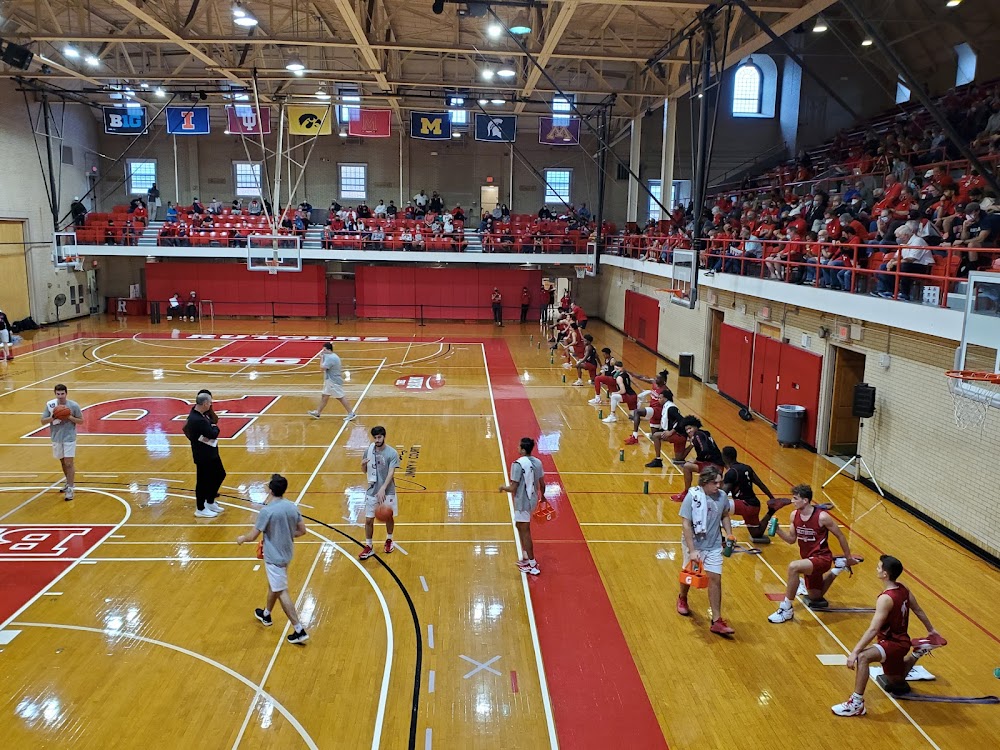
By this point, home games at the 3,200-seat College Avenue Gymnasium, built in 1931 after a fire burned down the previous gym on the site, roughly on the site of that first college football game, in New Brunswick, Middlesex County, New Jersey, were next to impossible to get into unless you were a student. It got so loud, paint chips fell from the ceiling. (I have had this confirmed by an RU graduate, Class of '76.) The decision to build a new arena was made.

The College Avenue Gym
Rutgers beat the University of Pittsburgh, then Syracuse. On March 1, they closed the regular season at home to St. Bonaventure, still undefeated at 25-0. The Bonnies took an early lead, but the Scarlet Knights came back, and won, 85-80. They entered the ECAC Metro Tournament at Princeton's Jadwin Gymnasium, and beat LIU and St. John's -- schools from Brooklyn and Queens, respectively -- to go 28-0.
It was on to the NCAA Tournament. This was only the 2nd time RU had made the Tournament, having gotten in the year before, and going out in the 1st Round. They had gotten to the Semifinals of the NIT in 1967, with future North Carolina State coach Jim Valvano playing for them.
They played Princeton -- not in New Jersey, but at the Providence Civic Center in Rhode Island. (It's now named the Amica Mutual Pavilion.) It was the closest game of the season, but Rutgers beat their ancient rivals, 54-53.
On to the Regional Semifinal, in Greensboro. Connecticut was not yet the power it would become, and Rutgers won, 93-79. That led to the Regional Final, also in Greensboro, against VMI. This time, Rutgers was solidly favored, and won, 91-75. They were undefeated. They were 31-0. They were ranked Number 4 in the country. And they were on their way to the Final Four.
Hail the Heroes:
* Number 12, a 6-foot-5-inch senior forward from Brooklyn, New York: Phil Sellers.
* Number 20, a 6-9 freshman center from Boston, Massachusetts: James Bailey.
* Number 22, a 6-3 sophomore guard from Washington, D.C.: Stanford Nance.
* Number 24, a 6-7 senior center from Parsippany, Morris County, New Jersey: Bruce Sherer.
* Number 30, a 6-1 junior guard from D.C.: Eddie Jordan.
* Number 32, a 6-4 senior guard from East Orange, Essex County, New Jersey: Mike Dabney.
* Number 34, a 6-5 sophomore forward from Trenton, Mercer County, New Jersey: Hollis Copeland.
* Number 42, a 6-2 junior guard from Queens, New York: Mark Conlin.
* Number 44, a 6-2 senior guard from Queens: Jeff Kleinbaum.
* Number 50, a 6-5 sophomore guard from East Rockaway, Long Island, New York: Steve Hefele.
* Number 52, a 6-7 senior center from Hackettstown, Warren County, New Jersey: Mike Palko.
* And Number 54, a 6-7 freshman forward from Belleville, Essex County, New Jersey: Abdel Anderson.
Since it was 1976, the Bicentennial year, the Final Four, and the All-Star Games for MLB, the NBA and the NHL, were held in Philadelphia. On March 27, against the University of Michigan, ranked Number 9 entering the Tournament, the bubble finally burst. The Wolverines jumped out to an early lead, and the Knights just couldn't get into their game. Michigan won, 86-70, and RU were 31-1.
In those days, there was a 3rd Place Game, and Rutgers lost that, too, 106-92 to defending National Champion UCLA, to finish 31-2. Indiana, coached by Bobby Knight, and featuring future NBA players Kent Benson, Scott May and Quinn Buckner, beat Michigan, and completed an undefeated season, 32-0. There hasn't been an undefeated season in college basketball since.
Calendar year 1976 was magical for Rutgers: In the Autumn, the football team also went undefeated, 11-0, but was not invited to a bowl game.
In 1977, Rutgers moved into the Rutgers Athletic Center, a.k.a. The RAC (pronounced like "rack"), across the Raritan River from New Brunswick, on the Livingston Campus in Piscataway. From 1986 to 2019, it was named the Louis Brown Athletic Center, after a donation from Brown's family.
Now named the Jersey Mike's Arena, it only seats 9,000, and has never been very good. Plans for renovation, or for a new arena in downtown New Brunswick, have been floated, but it looks like the current nondescript chunk of concrete is going to stay.
The College Avenue Gym still stands, and hosts the RU wrestling and volleyball programs.
Rutgers made the NCAA Tournament again in 1979, getting to the Sweet Sixteen. They made it again in 1983, getting to the 2nd Round. In 1989, they made it as Champions of the Atlantic-10 Tournament. They made it again in 1991. Both times, they went out in the 1st Round. They didn't make it again until 2021, but made it again in 2022.
Despite being the team's top player, Phil Sellers played just 1 season in the NBA, with the 1976-77 Detroit Pistons. Hollis Copeland played 2 seasons with the New York Knicks. James Bailey lasted 9 seasons, playing for both the Knicks and the New Jersey Nets, among other teams.
Eddie Jordan had the most successful pro career, playing 7 seasons, 3 of them with the Nets, and 3 with the Los Angeles Lakers, including winning the 1982 NBA Championship. He later coached the NBA's Sacramento Kings, Washington Wizards and Philadelphia 76ers.
Tom Young started at Rutgers in 1973, and coached them until 1985, when he was lured away by Old Dominion University in Norfolk, Virginia. He later served as an assistant to Jordan on the Wizards. He died on March 20, 2022, the 36th Anniversary of his Final Four achievement.
Phil Sellers died on September 19, 2023. The remaining players are still alive.


No comments:
Post a Comment