Saturday, March 22, 2025

George Foreman, 1949-2025

George Foreman was one amazing guy.  Actually, he was two amazing guys. The second was a great guy. The first... less so.

George Edward Foreman was born on January 10, 1949 in Marshall, Texas, about 150 miles east of Dallas, 20 miles west of the Texas-Louisiana State Line, and 40 miles west of Shreveport. In 2015, George, former Pittsburgh Steelers quarterback Terry Bradshaw, and actors William Shatner and Henry Winkler, all already old men, traveled the world together, for an NBC miniseries titled Better Late Than Never. Most viewers knew they were contemporaries, but not that they were close friends. And yet, despite being identified with Houston, Foreman was born not that far from Shreveport native Bradshaw.

He grew up in the Fifth Ward of Houston, then nearly all-black, but now about evenly divided between black and Hispanic. Other notable natives include Congressmembers Barbara Jordan and Mickey Leland, rap group Geto Boys, and baseball star Carl Crawford.

He was 1 of 6 siblings raised by his mother, Nancy, and her husband, J.D. Foreman. But, alone among his siblings, he was born before Nancy and J.D. were married. His younger siblings, in their Texas accents, called him "Mo'head." He thought they were saying he had a big head. It was a long time before he found out that his biological father was a man named Leroy Moorehead.

He later admitted that this is why he named all 5 of his own sons "George": "My sons are going to know who their father is."

He admitted, years later, that he was a bad kid. He dropped out of school at age 15, and made money by mugging smaller kids. At 16, he saw an ad for the Job Corps, and talked his mother into signing him up for it. He got his GED, and trained to become a carpenter and a bricklayer.

He learned to box, and in 1968, at the Olympics in Mexico City, he followed in the footsteps of future Heavyweight Champions Floyd Patterson, Muhammad Ali (then named Cassius Clay) and Joe Frazier, and won a Gold Medal.

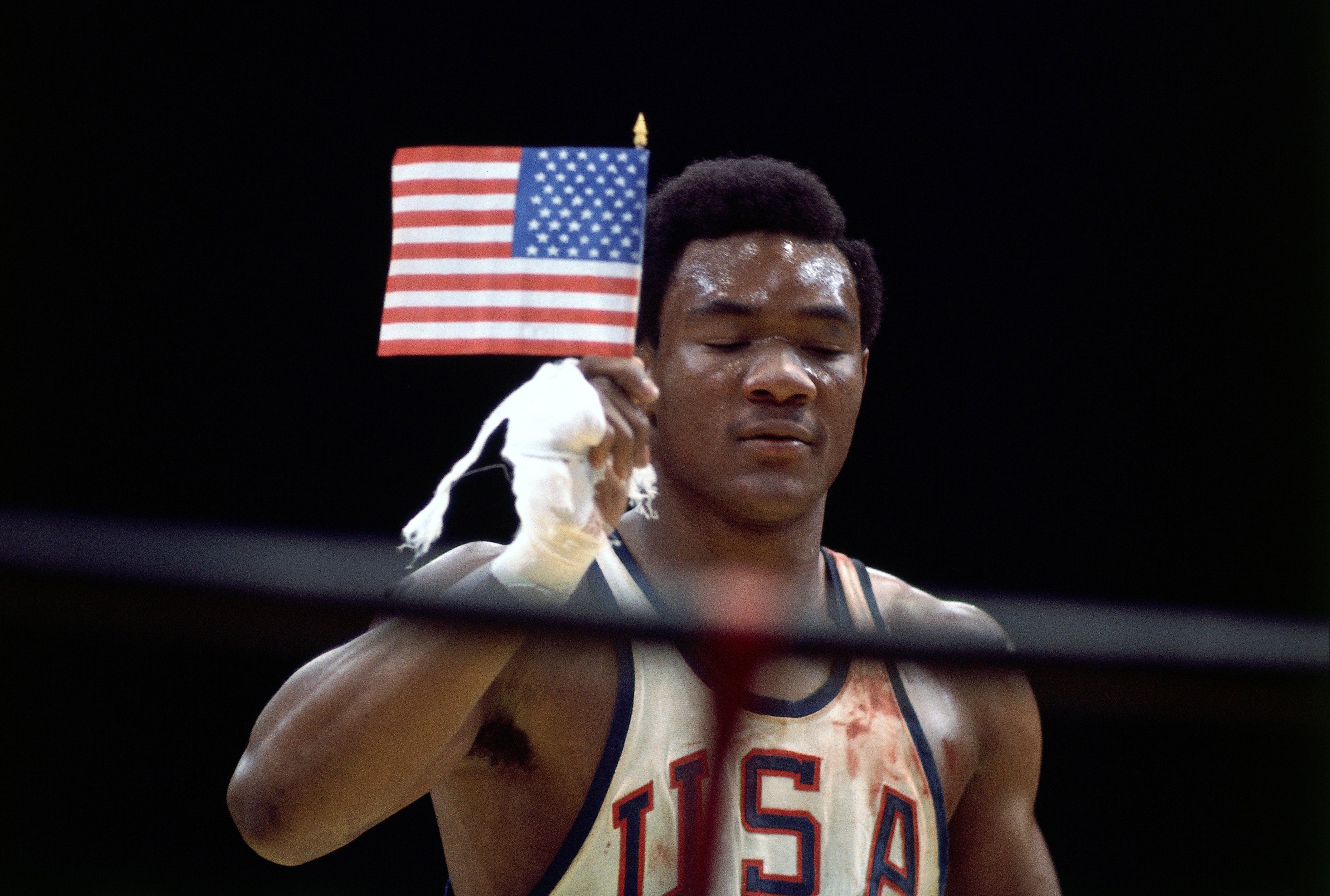
After winning the final match, he walked around the ring, holding a small American flag. He was highly praised for this, with sportswriters thinking he was trying to contrast himself with the "Black Power Salute" of sprinting medalists Tommie Smith and John Carlos, and the basketball boycott led by Kareem Abdul-Jabbar (then named Lew Alcindor) and Elvin Hayes. George said it wasn't true: He wasn't even thinking about that. He was just proud to be an American and a Gold Medalist.
On December 18, 1969, the day I was born, George Foreman climbed into the ring at the Seattle Center Coliseum, against Gary "Hobo" Wiler. The fight was meant to go a maximum of 10 rounds. It didn't make it to the end of the 1st round. George was now 13-0 as a professional.

On January 22, 1973, he was 37-0, and he got his shot at the Heavyweight Championship of the World. His opponent would be Frazier, who was 29-0, and already thought to be one of the greatest fighters who ever lived. It was at the National Stadium (now named Independence Park) in Kingston, Jamaica.

In what was known as the Sunshine Showdown (despite taking place at night), Foreman dominated from the opening bell. The rule mandating the fight be ended in the event of 3 knockdowns in 1 round was waived for this fight. Angelo Dundee, Muhammad Ali's trainer, who had also worked with Foreman, was seated at ringside, and, halfway through the 1st round, could be heard on ABC Sports' broadcast yelling, "Frazier's hurt!"

Sitting next to Dundee, Howard Cosell tried to tell the ABC audience what Dundee had said, but couldn't finish it, because Foreman delivered a knockdown blow: "Angie Dundee, Ali's trainer, right next to me, is saying it. You may hear it... Down goes Frazier! Down goes Frazier! Down goes Frazier! The Heavyweight Champion is taking the mandatory 8-count, and Foreman is as poised as can be in a neutral corner!"
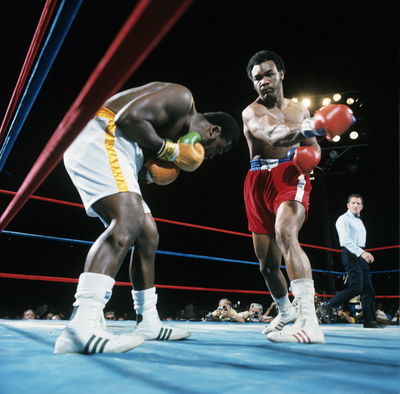
Frazier got up at the count of 2, but took the 8-count, and resumed. With 16 seconds left in the 1st round, Foreman knocked Frazier down again. He got up. Just before the bell rang to end the round, Foreman knocked Frazier down for a 3rd time. There was no "saving by the bell": Had Frazier not gotten up, it would have been over then.

It should have been over then. Instead, referee Arthur Mercante, who had refereed the 1st Ali-Frazier fight in 1971, let the 2nd round begin. Frazier was knocked down a 4th time. Mercante didn't stop it. Frazier was knocked down a 5th time. Mercante didn't stop it. Frazier was knocked down a 6th time. Only then did Mercante stop it. Foreman was the Champion.

In his next fight, on September 1 at Budokan in Tokyo, Japan, Foreman knocked Puerto Rican fighter José "King" Roman out in the 1st round. Next up, on March 26, 1974 in Caracas, Venezuela, Foreman knocked Ken Norton out in the 2nd round.

Roman had never fought Ali. But, now, Foreman had destroyed the only 2 men to defeat Ali as professionals. Yet Ali wanted to fight him to regain the title. Ali was talking his usual trash, but most people thought he would lose. Indeed, there were some who feared that Ali would be killed in the ring. For a promotional video broadcast on ABC's Wide World of Sports, Ali stuck his finger and his face in the camera, bragging about how he was once again going to shock the world. Foreman just calmly said, "I'm gonna kill you." Then he smiled, to show that he wasn't serious about that.

But, at 40-0 (as opposed to Ali's 44-2), and 25 years old (in his prime, as opposed to Ali being 32), Foreman looked like an unbeatable monster.

Built in 1952 under Belgian rule as the Stade Roi Baudouin, the site of the fight was renamed Stade du 20 Mai (for May 20, the anniversary of the founding of Zaire's ruling party) in 1967, and Stade Tata Raphaël (Father Raphael Stadium) in 1997, after the death of dictator Mobutu Sese Seko.

Through a months-long psychological campaign, including practically the entire black population of the continent of Africa in his favor and against the equally black Foreman – he had done something similar to Joe Frazier, who was puzzled by it: "I'm darker than he is!" – Ali had gotten into Foreman's head, just as he had done to Sonny Liston, Floyd Patterson, and just about everybody else he'd ever fought.

The referee was Zack Clayton, who had played in baseball's Negro Leagues, and for one of the great pre-NBA all-black teams, the New York Renaissance Five.

Ali fooled them all. People who say he just leaned against the ropes in his "rope-a-dope" strategy, and let Foreman tire himself out with punches, are fools. I've seen the tape of the fight a few times, and my opinion never changes: Ali got in a lot of punches, enough to win every round except for the 2nd and the 6th.

Foreman would later tell an interviewer that, at the end of the 6th, Ali yelled at him, "Is that all you got, George?" And Foreman had to admit, "Yup, that's about it."

In the 8th round, backed up against the ropes, Ali managed to turn an exhausted Foreman around, toss a few jabs, and knock him on his can. Foreman tried to get up, but he ran out of time, and Ali was the winner by a knockout. He proved that he really was "The Greatest... Of All Tiiiiiiiime!"

Ali was on top of the world again, the most beloved man in the world. Foreman was... he didn't really know where he was. He trained for a comeback, but didn't fight again for over a year. In 1976, he went to Las Vegas to fight Ron Lyle, who had been beaten by Ali the year before. It was an amazing fight, with each man knocking the other down, before Foreman knocked Lyle out in the 5th round.

He got a rematch with Frazier, at the Nassau Coliseum on June 15, 1976. Smokin' Joe had lost his 3rd fight with Ali the previous October, and seemed spent, so it didn't help Foreman's imagine much when he knocked Frazier out in the 5th. He won 3 more fights. On March 17, 1977, he went into the Roberto Clemente Coliseum in San Juan, Puerto Rico, and lost a unanimous decision to Jimmy Young. He was only 28, and at 45-2, he hardly seemed done as a fighter.

But what the crowd, and the TV audience, and boxing fans around the world didn't know was that he became ill in his dressing room after the fight. He was suffering from exhaustion and heatstroke, and stated he had a near-death experience. He spoke of being in a hellish, frightening place of nothingness and despair, and felt that he was in the midst of death.

Though not yet religious, he began to plead with God to help him. He explained that he sensed God asking him to change his life and ways, whereupon he said, "I don't care if this is death: I still believe there is a God!"

He stopped fighting, and became an ordained minister, initially preaching on street corners before becoming the minister of the Church of the Lord Jesus Christ in Houston, and devoting himself to his family and his congregation. He also opened a youth center.

As sportswriter and boxing broadcaster Larry Merchant put it, "There was a transformation from a young, hard character who felt a heavyweight champion should carry himself with menace to a very affectionate personality."

He married 4 times, before marrying Mary Joan Martelly in 1985, a marriage that lasted for the rest of his life. He had 5 sons and 7 daughters. As I said, he named all of his sons George Edward Foreman, like himself. Fortunately, they all have nicknames: George Jr. is Junior, George III is Monk, George IV is Big Wheel, George V is Red, and George VI is Little Joey. His 7 daughters were named Courtney, Isabella, Georgetta, Michie, Freeda, Leola and Natalia. No, he didn't name them all Georgetta or Georgia, or variations thereof.

At one point, when Red was a baby, the 1st 5 Georges did a Doritos commercial together. The problem was, Georges V, IV, III and Jr. ate the entire bag, leaving Big George with nothing, and, using the classic line of a boxer who's been unfairly beaten, said, "I was robbed!" It a parody of the Trident chewing gum ad, talking about how many dentists recommended it, the narrator said, "IV out of V George Foremans agree!"

At any rate, Big George had become a better man, a champion at life for a lot longer than he was a champion in boxing. And if that had been the end of the story, it would still have been an amazing story.

*

But the story got better. When F. Scott Fitzgerald said, "There are no second acts in American life," he could not have foreseen George Foreman.

In 1987, at the age of 38 -- an age at which many boxers have never retired and just kept at it, or had retired and come back at least once -- George returned to boxing, to raise money for his church. Discovering that he still had some punching power, he kept at it. He won 7 straight matches, and got a matchup at Caesars Palace outside Las Vegas with Dwight Muhammad Qawi, a former Champion at the Light Heavyweight and Cruiserweight levels. George won by a 7th-round TKO. His comeback was no longer a joke: He had a major name on his revived record.

Over the next year and a half, he went 11-0. Early in 1990, he was paired up with Gerry Cooney, who had given Larry Holmes a tough title defense in 1982. The fight was set for Convention Hall (now named Boardwalk Hall) in Atlantic City, New Jersey. It was billed as "The Preacher vs. the Puncher" and "The War at the Shore." But Tonight Show host Johnny Carson, who'd had George as a guest, noted that George was 41, and Cooney, while just 33, hadn't won a fight in nearly 4 years, and called it "Two Geezers at Caesars." (The Atlantic City version of Caesars is 2 blocks away.) George knocked Gerry out in the 2nd round. Gerry never fought again.

After 4 more wins, making him 69-2, and 24-0 in his comeback, George got another shot at the title, facing Evander Holyfield at Boardwalk Hall on April 19, 1991. It was billed as "The Battle of the Ages": Foreman was 42, and Holyfield was 28 and very much in his prime.

Holyfield won: One judge had it as close as 115-112, but the others had it as 116-111 and 117-110. Nevertheless, Foreman went the distance, didn't get hurt, and didn't embarrass himself. Lots of people, myself included, thought he had proven his point, and that he should stop before he did get hurt.

He didn't stop. His next fight was against a former NFL linebacker named Jim Ellis. People began to wonder if George had taken so many punches to the head that he thought he was fighting Jimmy Ellis, a contender from early in his career. George knocked him out. He won a close decision over Alex Stewart, a Jamaican who had given Holyfield a tough time, but had gotten clobbered by Mike Tyson. He knocked out South African fighter Pierre Coetzer. In 1993, at the Thomas & Mack Center outside Las Vegas, he lost a decision to Tommy Morrison.

Still, George wouldn't give up. With the governing bodies for boxing once again disagreeing on who the real Champion was, he signed to fight WBA and IBF Champion Michael Moorer on November 5, 1994, at the MGM Grand Garden Arena outside Las Vegas.

Moore was not considered a great fighter -- he'd won the title 6 months earlier, in a controversial majority decision over Holyfield -- but it didn't matter: He was about to turn 27, while George was 45. The oldest Heavyweight Champion ever had been Jersey Joe Walcott, 38 when he was knocked out by Rocky Marciano in 1952. 

Joe Cortez was the referee. A member of the International Boxing Hall of Fame, and a former Golden Gloves Champion from Harlem, New York City, he refereed over 900 fights in his career. This would be his 5th title fight in 1994 alone. Angelo Dundee, who had worked with both Ali and Foreman, was with Foreman this time. He wore the same trunks he'd worn against Ali in Zaire, 20 year earlier to the week. 

George's strategy was to let Moorer fight his usual fight, while waiting for him to slip up. He felt that if he was able to wait, Moorer would leave himself open for a combination that would allow George to knock him out.

Moorer controlled the pace of the fight from the beginning and kept winning rounds. George took a lot of punches, and his left eye swelled, nearly shut. But he stayed on his feet. At this point, the only fighters ever to knock him down were Ali, Lyle and Young. Holyfield hadn't done it. And only Ali had knocked him out.

Still, after the 9th round, the judges had it 88-83, 88-83 and 86-85 in Moorer's favor. And with the fight set for a maximum of 12 rounds, time was running out. Before sending him out for the 10th round, Angie told George it would take a knockout to win.

George hit Moorer with a body punch that slowed him down, giving George the chance he needed to land some combinations. He finally caught Moorer with a right on the jaw, and Moorer fell flat on his back. Not until Cortez's count reached 5 did Moorer move. At 8, he tried to push himself up. He couldn't, and Cortez reached 10. At 45 years, 9 months and 26 days old, 20 years and 6 days after he'd last held the title, George Foreman was the Heavyweight Champion of the World.

This was also the year that George did something that made him richer and more famous than boxing did: His claim to have succeeded in a return to boxing by eating healthy, which didn't seem to make sense as he was a bit fat, led to him teaming up with Salton, Inc., which was working with Michael Boehm. He was an inventor who had created an indoor grill that cooked on both sides at once. He didn't get his name on the product, but he got as much money from it as George did, selling it through commercials for "The George Foreman Lean Mean Fat-Reducing Grilling Machine." Everyone just called it "The George Foreman Grill." Even my mother bought one.
Five months after winning the title back, George defended it against German fighter Axel Schulz. It was a close decision, and the IBF ordered a rematch. George wouldn't give him one, and was stripped of the title. He fought 3 more times, the last a close decision to Shannon Briggs in Atlantic City in 1997. Finally hanging up the gloves for good at the age of 48, he was 76-5 -- 31-3 in his comeback.

In 2015, he (then 66 years old) and actors William Shatner (84) and Henry Winkler (70), and quarterback-turned-football analyst Terry Bradshaw (67), all close friends with each other (though most people didn't know that), got together for a special project for NBC. Better Late Than Never showed them traveling together to Asia for a 1st season, and then Europe for a 2nd season, and how they reacted to these different cultures. (A running gag was Shatner getting the others to try exotic food, often odd body parts of various animals.)

The European trip, in 2016. included a visit to Lithuania, from which Shatner's Jewish ancestors had come. But it was also the homeland of boxer Jonas Čepulis, who had competed for the Soviet Union, and lost to George in the heavyweight final at the 1968 Olympics in Mexico City. Sadly, Čepulis had died the year before, but George got to meet his family, and pay his respects at his early opponent's grave.

In 2022, he competed on the U.S. version of The Masked Singer, as "Venus Fly Trap." He sang "Get Ready" by The Temptations, but was eliminated. He may have knocked Joe Frazier out, but he couldn't sing like him.

George Foreman passed away yesterday, March 21, 2025, in Houston, surrounded by his family. He was 76 years old. He lived two very colorful lives, one troubled, one glorious.

Friday, March 21, 2025

Notable Last Survivors -- 2025 Sports Other Than Baseball Edition

Bob Cousy. He's 96 years old. He could probably still make a free throw.

I first did this series in 2021, and again in 2023. Significant updates need to be made.

Notable last survivors of occurrences in sports other than baseball:

* June 4, 1939: Reginald Welch, 87, the last survivor of the winners of the 1st FA Cup Final, the 1872 Wanderers. He was also the last surviving player from the England team that played Scotland to a 0-0 draw in the 1st international football (soccer) match, the same year. 67 years.

* August 15, 1939: George H. Large, 88, the last surviving player in the 1st American football game, New Brunswick, Middlesex County, New Jersey, November 6, 1869. Nearly 70 years. The native of Readington, Hunterdon County played on the Rutgers side, and in 1888 served as President of the State Senate, making him the Acting Governor on a few occasions.

* May 24, 1942: Billy MacKinnon, 90, the last surviving player in the 1st international football match, at Hamilton Crescent in Partick, Scotland, November 30, 1872. 70 years. He and all of his Scotland teammates played their "club football" for Queen's Park of Glasgow.

* August 6, 1943: Tom Garrett, 85, the last surviving player from the 1st official cricket test match, at the Melbourne Cricket Ground, on March 15, 1877. 66 years. He was a bowler, and remains the youngest Australian to play in a senior cricket match against England. Australia, which would not achieve independence for another 24 years, defeated England 245-196. Garrett is the great-grandfather of Peter Garrett, lead singer of Australian rock band Midnight Oil.

* July 14, 1951: Sammy Jones, 89, the last surviving player from the Australia cricket team that beat England in what became known as the 1st "Ashes" competition, August 29, 1882. 69 years.

* September 26, 1951: H. Montagu Allan, 90, the last surviving original inductee into the Hockey Hall of Fame in Toronto, in 1945. 6 years. He was the only original inductee who was alive at all. A major businessman in Montreal, in the early 20th Century, he was not a player. Instead, he was elected in the "Builders" category, for his donation of the Allan Cup, awarded annually to the national senior amateur champions of Canada.

Bob Pulford, a defenseman for the original Ottawa Senators, back when they were still called the Silver Seven, lived until 1940, making him the last 9 players who were original inductees.

* November 17, 1955: Bob Holmes, 88, the last surviving player from the 1st Champions of England's Football League, the 1888-89 Preston North End team. 66 years.

* May 15, 1961: Tommy Gorman, 74, the last surviving original owner in the NHL, owner and general manager of the Ottawa Senators in 1917. 44 years. He managed the Senators to the Stanley Cup in 1920, '21 and '23; the Chicago Blackhawks in 1934; the Montreal Maroons in 1935; and the Montreal Canadiens in 1944 and '46.

* February 14, 1963: Billy Barlow, 92, the last surviving player from the 1st Stanley Cup winners, the 1893 Montreal Amateur Athletic Association team. 70 years.

* March 17, 1965: Amos Alonzo Stagg, 102, the last surviving member of the 1st All-American college football team, 1889, an end at Yale University. 74 years. He became better known as a coach who introduced many of the things football fans now take for granted, including the playbook, the huddle, the center snap, the placekick, the onside kick, the position of linebacker, pads (for players and goalposts), the tackling dummy, uniform numbers and varsity letters.

* January 23, 1967: Holcombe Ward, 88, the last surviving member of the U.S. tennis team that won the 1st Davis Cup, at the Longwood Cricket Club in Boston, August 8-10, 1900. 67 years. Ward also won the U.S. Open in 1904, and was elected to the International Tennis Hall of Fame.

The tournament was original known as the International Lawn Tennis Challenge, but was almost immediately nicknamed the Davis Cup, named for Dwight F. Davis, a member of that 1900 U.S. team, who came up with the idea for a U.S. selection to challenge a British team. Soon, the tournament was expanded to other countries. 

* July 1, 1968: Dr. Ernest Hildner, 94, the last surviving player in the 1st basketball game, Springfield, Massachusetts, December 21, 1891. 76 years.

* September 2, 1969: Ray Nesser, 71, the last survivor of the 6 football-playing Nesser brothers from Columbus, Ohio, playing for the Columbus Panhandles in 1915. 54 years.

* February 15, 1970: Dimitrios Loundras, 84, the last surviving competitor in the 1st modern Olympic Games, in Athens, Greece, April 15, 1896. 74 years.

* February 25, 1977: Billy Coutu, 84, the last surviving player from the 1st NHL game, a 7-4 win for Coutu and the Canadiens over the Ottawa Senators in Ottawa on December 22, 2017. 59 years.

* August 22, 1977: Roy Large, 84, the last surviving player from the Carlisle Indian School team, led by Jim Thorpe, that upset the Army football team at West Point, New York, November 9, 1912. 65 years.

* January 21, 1982: Edward S. "Ned" Irish, 76, the last surviving original NBA owner, the founding owner of the New York Knicks, 1946. A little more than 35 years. He also led the building of the current version of Madison Square Garden, opening in 1968.

* October 31, 1983: George Halas, 88, the last surviving original NFL owner from 1920. 63 years. As the founding owner of the Chicago Bears, and (for all intents and purposes) the founder of the NFL, he was the 1st man elected to the Pro Football Hall of Fame, in 1963.

* July 3, 1984: Ernesto Mascheroni, 76, the last surviving player from the Uruguay team that won the 1st World Cup Final, July 30, 1930. 54 years. He was then a left back for Montevideo team Olimpia, and later played for Internazionale Milano in Italy before coming home and playing for Montevideo team Peñarol.

* January 15, 1986: Jim Crowley, 83, the last survivor of the backfield known as the Four Horsemen of Notre Dame, winners of the Rose Bowl, January 1, 1925. 61 years. Harry Stuhldreher died in 1965, Elmer Layden in 1973, and Don Miller in 1979.

* February 22, 1986: Tom Bradshaw, 82, the last surviving player from the Scotland team, the "Wembley Wizards," that upset England at the original Wembley Stadium in London on March 31, 1928. 58 years. At the time, though, he was playing his "club football" for an English team, Liverpool.

* May 11, 1986: Frederick "Fritz" Pollard, 92, the last surviving player from the 1st NFL Champions, the 1920 Akron Pros. 66 years.

* September 6, 1989: Jimmy Ruffell, 89, the last surviving player from the 1st game at the old Wembley Stadium in London, the 1923 FA Cup Final. 66 years. He played for East London team West Ham United, who lost to Manchester area team Bolton Wanderers, 2-0.

* April 17, 1990: Angelo Schiavio, 84, the last surviving player from the Italy team that won the World Cup on June 10, 1934. 56 years. He was a forward, played his entire career for Bologna, and at the time of the World Cup was also their manager.

* January 28, 1991: Harold "Red" Grange, 87, the charter inductee into both the College and the Pro Football Halls of Fame, who was the last survivor of "The Golden Age of Sports," a group of athletes considered the best of the 1920s. 71 to 61 years. Of the others: Baseball's Babe Ruth died in 1948, tennis' Bill Tilden in 1953, golf's Bobby Jones in 1971 (the people coming up with the "Golden Age" nickname considered golf a sport, but I don't), track's Paavo Nurmi in 1973, and boxing's Jack Dempsey in 1983.

* July 18, 1991: Magnus Goodman, 93, the last surviving player from the 1st Olympic Gold Medalists in hockey, the Canada team that won in Antwerp, Belgium in 1920. 71 years.

* October 12, 1996: René Lacoste, 92, the last survivor of the "Four Muskteers" from France who, along with America's Bill Tilden, dominated international tennis in the late 1920s and early 1930s. Their 1st major title was in 1924, 72 years earlier.

Jacques "Toto" Brugnon died in 1978, Henri Cochet died in 1987, and Jean Borotra died in 1994. Lacoste was nicknamed the Crocodile, and it became the emblem of the Lacoste tennis shirt, which he introduced in 1929, expanding it into a vast sporting goods empire.

* May 26, 1997: Ralph Horween, 100, the last surviving player from the NFL's pioneer era, a fullback for the Chicago Cardinals from 1921 to 1923. 74 years. He is also believed to be the 1st former NFL player to live to be 100.

* September 23, 1998: Ray Bowden, 89, the last surviving player for Arsenal under manager Herbert Chapman, who died in 1934. 64 years. Bowden played for Arsenal's League Champions of 1934 and '35, and their 1936 FA Cup winners.

* February 23, 2000: Stanley Matthews, 85, the last surviving player from the England soccer team which, while it did not play in the World Cup, took on its winners, Italy, at the home stadium of Arsenal Football Club in North London, November 14, 1934. 65 years.

At the time, he was an outside right (today, we would call his position "right winger") for Stoke City. He would still be playing in England's top division in 1965, at age 50, and remains the only British footballer ever knighted while still an active player. He was also the last England player in their matches with Germany at White Hart Lane in North London in 1935 and in Berlin in 1938.

* September 13, 2000: Duane Swanson, 87, the last surviving player from the 1st Olympic Gold Medalists in basketball, the U.S. team that won in Berlin in 1936. 64 years.

* May 17, 2001: Murray Murdoch, 96, the last surviving original New York Ranger from 1926. 75 years. He was also the last survivor from their 1928 Stanley Cup winners. 73 years.

* February 6, 2002: Jack Hurst, 87, the last surviving player from the Burnden Park Disaster, at Bolton, Greater Manchester, where 33 people died in an FA Cup Quarterfinal between Hurst's Bolton Wanderers and Stoke City, March 9, 1946. 56 years.

* August 7, 2002: Charles "Ookie" Miller, 92, the last surviving player from the Chicago Bears team that won the 1st NFL Championship Game, regardless of whether you consider that to be the unofficial one on December 18, 1932, at Chicago Stadium, a 9-0 win over the Portsmouth Spartans (they became the Detroit Lions in 1934); or the official one on December 17, 1933, at Wrigley Field, a 23-21 win over the New York Giants. 70 or 69 years. Either way, he played the position of center.

* November 4, 2003: Philip Slone, 96, the last surviving player from the U.S. team at the 1st World Cup, in 1930. 73 years. They reached the Semifinal, making them still the most successful U.S. men's World Cup team ever. Slone attended New York's High School of Commerce right after Lou Gehrig did, and was a midfielder on such early U.S. professional teams as the All-Jewish New York Hakoah and Brookhattan. He only played 1 game for the U.S. team, but it was in the 1930 World Cup.

* November 30, 2003: Jesus Correia, 79, the last of Lisbon soccer team Sporting Clube de Portugal's Cinco Violinos (Five Violins) that won 7 League titles from 1944 to 1953. 59 years.

* April 27, 2005: George "Red" Horner, 95, the last surviving player from the Ace Bailey Benefit Game, often called the 1st NHL All-Star Game, at Maple Leaf Gardens in Toronto, February 14, 1934. 71 years. He was also the last surviving player from the Howie Morez Memorial Game, at the Montreal Forum, November 2, 1937. 68 years. At the time of each game, he was a defenseman for the Toronto Maple Leafs.

* June 1, 2005: George Mikan, 80, the last surviving original inductee into the Basketball Hall of Fame in Springfield, Massachusetts, established in 1959. 46 years. (Its original building did not open until 1968.)

* October 26, 2005: George Swindin, 90, the last surviving player from George Allison's Arsenal teams, which ended with Allison's retirement in 1947. 58 years. He played for their League Champions 1938, '48 and '53, and their 1950 FA Cup winners.

* December 27, 2005: John Druze, 91, the last surviving member of the 1936-38 Fordham University line (offensive and defensive) known as the Seven Blocks of Granite, best known for their scoreless tie with the University of Pittsburgh at the Polo Grounds in New York -- which could retroactively be considered one of the periodic "Games of the Century" -- on October 16, 1937. 68 years.

* November 5, 2006: Pietro Rava, 90, the last surviving player from the "Rest of Europe" team that played England in the Football Association 75th Anniversary Game at Wembley Stadium, October 26, 1938. 68 years. A left back for Turin-based Juventus, he had helped Italy win the 1936 Olympics and the 1938 World Cup (the last survivor of each team), although he was not yet a regular for their 1934 World Cup win.

The last surviving England player was Stan Cullis, a centre-half for Wolverhampton Wanderers, who later became their greatest manager, living until February 28, 2001. 62 years.

* November 27, 2007: Bill Willis, 86, the last of pro football's "Four Jackie Robinsons" who desegregated the sport in 1946. 61 years. Willis, a guard, and Marion Motley, a running back, played for the Cleveland Browns in the All-America Football Conference, and eventually in the NFL.

Running back Kenny Washington and end Woody Strode, both of whom had played at UCLA, returned to the Los Angeles Coliseum to desegregate the NFL with the 1946 Los Angeles Rams. Washington died in 1971, Strode in 1994, Motley in 1999.

* October 27, 2008: Vladimir Savdunin, the last survivor of the Dynamo Moscow team that dominated Soviet soccer in the 1940s, and toured England in 1945 after World War II. 63 years.

* December 17, 2008: Sammy Baugh, 94, the last surviving original inductee into the Pro Football Hall of Fame in Canton, Ohio, September 8, 1963. 45 years. He played quarterback, cornerback and punter for the Washington Redskins from 1937 to 1952.

* January 27, 2009: Aubrey Powell, 90, the last surviving player from the Wales soccer team that beat England at the Hawthorns on October 20, 1945. 63 years.

* September 10, 2009: Lou Bender, 99, the last surviving player from "The Original Celtics," the 1st great pro basketball team, which dominated the sport in the 1920s. They were disbanded in 1927, so, 82 years.

* November 22, 2009: Juan Carlos Muñoz, 90, the last survivor of the Buenos Aires, Argentina team River Plate known as La Maquina (The Machine) that revolutionized South American soccer, winning league titles in 1941, 1942, 1945 and 1947. 68 years.

* January 21, 2010: Irwin Dambrot, 81, the last surviving player from the 1950 City College of New York basketball team, 60 years. They are the only team from New York City ever to win the NCAA Championship. They are also the only team ever to win the NCAA and the NIT in the same season. But he was also part of the point-shaving scandal that insured that such a "double" would never happen again, and ended New York basketball's glory days.

* December 23, 2011: James "Pappy" Ricks, 68, the last surviving player from the New York Renaissance Five, or "the New York Rens," the legendary all-black pro basketball team of the 1930s. He last played for them in 1936, so, 55 years.

* February 28, 2013: Ford "Moon" Mullen, 96, the last surviving basketball player from the 1st NCAA Tournament Champions, the University of Oregon, March 27, 1939. 74 years.

* July 22, 2013: Lawrie Reilly, 84, the last survivor of the "Famous Five" for Edinburgh team Hibernian, a.k.a. Hibs, winning the Scottish league title in 1951 and '52. 62 years.

* July 30, 2013: Oscar "Ossie" Schechtman, 94, the last surviving player from the 1st NBA game, the New York Knicks' 66-64 win over the Toronto Huskies at Maple Leaf Gardens, on November 1, 1946. 67 years.

* January 11, 2015: Jenő Buzánszky, 89, the last surviving player from Hungary's "Magnificent Magyars" that stunned England at the old Wembley in 1953, and then advanced to the 1954 World Cup Final before losing. 64 and 63 years.

* February 26, 2015: Earl Lloyd, 86, the last of the NBA's "Three Jackie Robinsons" at the start of the 1950-51 season. Almost 64 years. Chuck Cooper of the Boston Celtics was the 1st black player drafted by an NBA team, and he died in 1984. Nat "Sweetwater" Clifton of the New York Knicks was the 1st black player signed, and he died in 1990. But, as it worked out, Lloyd was the 1st player to get into a game, with the Washington Capitols.

* May 27, 2015: John Siegal, 97, the last surviving player from the Chicago Bears team that beat the Washington Redskins 73-0, the biggest blowout in NFL history, in the NFL Championship Game, at Griffith Stadium in Washington, December 8, 1940. 75 years. He played end on both offense and defense.

* July 16, 2015: Alcides Ghiggia, 88, the last surviving player from the Uruguay team that won the World Cup, shocking Brazil in the Final at the Estadio do Maracana, an event remembered in Brazil as the Maracanazo, July 16, 1950. 65 years.

* March 14, 2016: Davy Walsh, 92, the last surviving player from the Republic of Ireland team that upset England at Goodison Park in Liverpool, home of Everton Football Club, September 21, 1949. 66 years. At the time, he was a forward for Birmingham-area team West Bromwich Albion.

* October 21, 2016: Jerry Rullo, 93, the last surviving member of the 1st NBA Champions, the 1947 Philadelphia Warriors. 69 years.

* June 18, 2018: Walter Bahr, 91, the last surviving player from the U.S. soccer team that defeated England at the World Cup in Belo Horizonte, Brazil, June 29, 1950. 68 years. His sons Matt and Chris went on to become Super Bowl-winning placekickers. He barely outlived the last England player from that game, Roy Bentley, who died on April 20.

* September 19, 2019: Barron Hilton, 92, the last survivor of "The Foolish Club," the 8 rich men who decided to blow their fortunes on teams in the American Football League, at the AFL's founding meeting in Chicago, August 14, 1959, 60 years. He named his team the Los Angeles Chargers, but has always denied that he named them after the credit card he'd founded, Carte Blanche. (Why didn't he named them the Barons?)

He was a son of hotel magnate Conrad Hilton. And he was a brother of Conrad Nicholson Hilton Jr., a.k.a. Nicky Hilton, making him briefly a brother-in-law of Elizabeth Taylor.

Even weirder: His mansion in the Los Angeles suburb of Pasadena, California -- not far from the Rose Bowl, the house used as Wayne Manor on Batman, and the house used as the Governor's Mansion on Benson -- was used for exterior shots of the Carrington Mansion on Dynasty. That show was set in Denver. The main character, Blake Carrington, played by John Forsythe, was based on oil tycoon Marvin Davis. In 1978, and again in 1980, Davis tried to buy the Oakland Athletics and move them to his hometown of Denver. Davis' grandson was Brandon Davis, who, for a time, dated Barron's granddaughter Paris Hilton.

* January 15, 2020: Bobby Brown, 96, the last surviving player from the Scotland team that beat England 1-0 at Hampden Park in Glasgow on April 13, 1946. 74 years.

* May 16, 2020: Gene Rossides, 92, the last surviving player from Columbia University's 1947 upset of Army, which hadn't lost in 4 years, a game nown as "the Miracle of Morningside Heights." 73 years.

* August 8, 2020: Gabriel Ochoa Uribe, 90, the goalkeeper and last surviving player from Colombian soccer team Millonarios de Bogotá's Ballet Azul (Blue Ballet) that won league titles in 1949, '51, '52 and '53. 71 years.

* November 8, 2020: Howie Meeker, 97, the last surviving player from the 1st official NHL All-Star Game, at Maple Leaf Gardens in Toronto, October 13, 1947. 73 years. He was a right wing for the Toronto Maple Leafs, and is also the last surviving player for their Stanley Cup-winning teams of 1947, 1948, 1949 and 1951. At the time of his death, he was also the earliest surviving player for a Stanley Cup winner. He was elected to the Hockey Hall of Fame, as a broadcaster.

* December 5, 2020: Viktor Ponedelnik, 83, the last surviving player from the Soviet Union soccer team that won the 1st European Championship, beating Yugoslavia 2-1 at Parc des Princes in Paris, on July 10, 1960. 60 years.

* December 24, 2020: Jack Myers, 96, the last surviving player from the Philadelphia Eagles' 1948 and 1949 NFL Champions. 72 and 71 years.

* April 19, 2021: Viktor Shuvalov, 97, the last surviving player from the 1st Soviet team to win an Olympic Gold Medal, at Cortina d'Ampezzo, Italy in 1956. 65 years.

* January 18, 2022: Francisco "Paco" Gento, 88, the last surviving player from the 1st European Cup Final, at Parc des Princes, Paris, June 13, 1956. 66 years. He was also the last survivor from the 1957 Final, and remains the only man to win 6 European Cups, all with Real Madrid.

* May 10, 2022: Walter Hirsch, 92, the last surviving member of the University of Kentucky basketball program's "Fabulous Five" that won the 1948 National Championship. He was also the last survivor of Kentucky's 1949 National Champions.

* June 17, 2022: Hugh McElhenny, 93, the last surviving player from the San Francisco 49ers' 1954-56 "Million Dollar Backfield," the only entire backfield elected to the Pro Football Hall of Fame. 68 years. He was a halfback. Fullback Joe "the Jet" Perry and halfback John Henry Johnson died within a few weeks of each other in 2011. Quarterback Y.A. Tittle died in 2017.

* October 19, 2022: Charlie Trippi, 100, the last survivor of the Chicago Cardinals' "Million Dollar Backfield" that won the last NFL Championship for what is now the Arizona franchise, in 1947. 75 years. Quarterback Paul Christman died in 1970, halfback Pat Harder in 1992, halfback Elmer Angsman in 2002, halfback Marshall Goldberg in 2006.

* March 24, 2023: Jerry Green, 95, was the last surviving sportswriter who had covered every Super Bowl. He wrote for the Detroit News, covering the 1st 56 Super Bowls for them, but was too ill to cover Super Bowl LVII, and died a few weeks later. Jerry Izenberg, 94, of the Newark Star-Ledger, is still alive, but stopped covering them after Super Bowl LIII.

* July 25, 2023: Johnny Lujack, 98, was the last surviving player from the 1946 Army-Notre Dame "Game of the Century" at the old Yankee Stadium, a 0-0 tie between the teams then ranked Number 1 and Number 2 in the country. 77 years. The Notre Dame quarterback won the 1947 Heisman Trophy, and played 4 seasons for the Chicago Bears.

*

Alive as of March 21, 2025:

* Steve Wochy (born Wojciechowski), 102, is the oldest and earliest surviving NHL player. A right wing, he played 49 games for the Detroit Red Wings in the 1944-45 season, and 5 more in 1946-47. He had a much longer career in the minor leagues during the comparatively closed "Original Six" era.

* Neil Harvey, 94, is the last surviving player from the 1948 Australia cricket team that beat England in their regular "Ashes" series, known as "The Invincibles" because they are the only cricket team ever to tour England without losing a test match. June 10 to August 18, 1948. 75 years.

While Donald Bradman, often regarded as the greatest batsman in cricket history, was undergoing his farewell tour, Harvey was a rookie, on his 1st tour. Domestically, he played for Victoria (the State of Australia that includes Melbourne) from 1946 to 1957, and for New South Wales (the State that includes Sydney) from then until his retirement from the sport in 1963.

* Charles Coste, 101, is the earliest surviving Olympic Gold Medalist. A cyclist competing for France, he won in team pursuit in London in 1948. (UPDATE: He died on October 29, 2025. The earliest is now Gábor Benedek, 98, who won the modern penathlon at Helsinki in 1952.)

* George "Gabby" Sims, 97, is the oldest and earliest surviving NFL player. A two-way back, he played for the Los Angeles Rams in 1949 and 1950, losing the NFL Championship Game in both seasons, but served in the Korean War, missed their 1951 title season, and never played pro ball again.

* Bob Cousy, 96, is the last surviving player from the 1st NBA All-Star Game, at his home court, the Boston Garden, March 2, 1951. 74 years.

* Cliff Hagan, 93, is the earliest surviving player for an NCAA Championship team, the University of Kentucky, beating Kansas State at Williams Arena in Minneapolis on March 27, 1951. 74 years.

* Alex Delvecchio, 93, is the earliest surviving player for a Stanley Cup winner, the 1952 Detroit Red Wings. 73 years. (UPDATE: He died on July 1, 2025. That means the distinction of the earliest is shared by Phil Goyette and André Pronovost, the last survivors of the 1957, 1958, 1959 and 1960 Montreal Canadiens. Goyette died on January 17, 2026, leaving Pronovost.)

* Frank Blunstone, 90, is the earliest surviving player for a Football League title team, Chelsea FC, who clinched at home at Stamford Bridge against Yorkshire side Sheffield Wednesday, 3-0, on April 23, 1955. 70 years.

* Ken Rosewall, 90, is the earliest surviving winner of a tennis major. He won the 1953 French Open. He also won in his native Australia in 1953, 1955, 1971 and 1972; the U.S. in 1956 and 1970; and France again in 1968. But he never won Wimbledon.

The earliest women's winner is Angela Mortimer, 92, winner of the 1955 French Open. The Englishwoman also won Australia in 1958 and Wimbledon in 1961, but never won the U.S. Open.

* Sam Palumbo, 92, is the earliest surviving member of an NFL Championship team, the 1955 Cleveland Browns.

* Jackie Moore, 92, is the earliest surviving player for an NBA Championship team, the Philadelphia Warriors, who beat the Fort Wayne Pistons in 5 games, April 7, 1956. 69 years.

* Bill Leivers, 93, is the earliest surviving player for an FA Cup winner, Manchester City, who beat Birmingham City at Wembley Stadium, 3-1, on May 5, 1956. 67 years.

* Ray Swallow, 89, is the last surviving players from the Arsenal teams managed by Tom Whittaker, who died in office on October 24, 1956. 67 years. He did not win a trophy with Arsenal.

* Rosey Grier, 92, is the last surviving player from the New York Giants' 1956 NFL Champions, 68 years. Grier, a defensive tackle, is also the last survivor of the Los Angeles Rams' 1960s defensive line known as the Fearsome Foursome. End Lamar Lundy died in 2007, Tackle Merlin Olsen in 2010, and end Deacon Jones in 2013.

* There are 4 living survivors of the Munich Air Disaster that killed 23 people, including 8 members of the Manchester United soccer team on its way back from a European Cup Quarterfinal in Belgrade, Yugoslavia (now Serbia), February 6, 1958, 67 years: Stewardess Rosemary Cheverton; Eleanor Miklos, wife of travel agent Bela Miklos, who was killed; Vera Lukić, the wife of a Yugoslav diplomat; and her daughter, Vesna Lukić

As Vesna was a baby, she is likely to end up as the last survivor. Vera was pregnant with her son Zoran, and some sources list him as one of the survivors as well.

Bobby Charlton was the last surviving player who survived, living until 2023.

* The earliest surviving winners of the European Cup -- the tournament now known as the UEFA Champions League -- are 2 players from the 1958 Real Madrid team, 65 years: José Santamaría, 95; and Juan Santisteban, 88. They are also the last 2 survivors of Real Madrid's 1959 winners, and 2 of the 6 survivors of Real Madrid's 1960 winners.

* Pete Dawkins, 87, is the earliest surviving Heisman Trophy winner, for the Naval Academy in 1958. 67 years.

* Jerry Lucas, 85, is the earliest surviving Sports Illustrated Sportsman of the Year. He won in 1961, for helping Ohio State's basketball team to the 2nd of 3 straight NCAA Finals (but they only won the 1st, in 1960), and for being a scholar-athlete. He went on to a Hall of Fame career in the NBA.

Amarildo Tavares da Silveira, known by just his first name as Brazilian soccer players tend to be (or by a nickname), is the earliest surviving World Cup winner, as the last surviving player from the Brazil team that won the 1962 World Cup, beating Czechoslovakia at the Estadio Nacional de Chile in Santiago on June 17, 1962, 63 years.

Dino Sani, Moacir, José Altafini and José "Pepe" Macia are still alive, and were on the Brazil team that won the 1958 World Cup; while Pepe, Mengálvio and Jair da Costa are still alive from the 1962 team. In each case, the player in question did not play in the Final.

* Ismael Laguna, 81, is the earliest surviving World Champion in boxing. The Panamanian became Lightweight Champion on April 10, 1965, 60 years. He held the title for only 8 months, but regained it for 6 months in 1970.

* Geoff Hurst, 83, is the last surviving player from the England team that won the World Cup, beating West Germany at the old Wembley on July 30, 1966, 59 years. Terry Paine and Ian Callaghan were also on that team, and are also still alive, but neither played in the Final.

* There are 4 surviving participants in "The Cleveland Summit," gathered in support of Muhammad Ali after he was stripped of the Heavyweight Championship of the World for refusing to be drafted, June 4, 1967, 58 years: Football players Curtis McClinton, John Wooten and Walter Beach, all of whom were current or former Cleveland Browns; and basketball player Kareem Abdul-Jabbar (then still using his birth name of Lew Alcindor).

* Harry Sinden, 92, is the earliest surviving head coach of a Stanley Cup winner, the 1970 Boston Bruins, 55 years. Scotty Bowman, who won more Stanley Cups than any head coach, 10, 1st reached the Finals with the 1968 St. Louis Browns, 57 years, and is the earliest surviving head coach of a team that reached the Finals.

* Earl Ingarfield, 90, was the 1st head coach of the New York Islanders, in 1972, 51 years, and is also their earliest surviving head coach. Craig Patrick, about to turn 79, is the earliest surviving head coach of the New York Rangers, in 1979, 46 years. Doug Carpenter, 82, is the earliest surviving 1st head coach of the New Jersey Devils, in 1984, 40 years.

* Dick Motta, 93, is the earliest living head coach of an NBA Champion, the 1978 Washington Bullets, 47 years. Bobby Knight, 84, is the earliest living head coach of a college basketball National Champion, 1988 University of Kansas, 37 years. Kevin Loughery, 84, is the earliest living former head coach for the franchise now known as the Brooklyn Nets, 1973, 52 years. Hubie Brown, 91, is the earliest living former New York Knicks head coach, 1982, 43 years.

* Larry Holmes, 75, is the earliest surviving Heavyweight Champion of the World, first winning the WBC version of the title on June 9, 1978. 47 years. I had to change this one at the last minute, because it was announced on March 21, 2025 that George Foreman, who first won the title on January 22, 1973, had died at age 76.

* Tom Flores, 88, is the earliest head coach to take a team to win, or even into, a Super Bowl, winning Super Bowl XV with the Oakland Raiders on January 25, 1981. 44 years. Lou Holtz, 88, is the earliest living former New York Jet head coach, 1976, 49 years. Bill Parcells is the earliest living former New York Giant head coach, 1983, 42 years.

* Silver Charm, 31, is the earliest surviving horse to have won the Kentucky Derby, having won it in 1997.

Notable Last Survivors -- 2025 Baseball Edition

Bobby Shantz

I first did this series in 2021, and again in 2023. Significant updates need to be made.

Notable last survivors of baseball occurrences:

* June 10, 1904: Walter T. Avery, 90, the last participant in what was long purported to be the 1st baseball game, and was definitely the 1st one played under what became known as the Knickerbocker Rules, at the Elysian Fields in Hoboken, New Jersey on June 19, 1846. 58 years.

* March 27, 1927: Joe Start, 84, the last survivor of the Brooklyn Atlantics team that gave the Cincinnati Red Stockings, the 1st openly professional baseball team, their 1st loss, on June 14, 1870. 57 years.

* August 21, 1937: George Wright, 90, the last survivor of the 1869 Cincinnati Red Stockings. 68 years.

* July 7, 1939: James "Deacon" White, 91, the last surviving player from the 1st Major League Baseball game, on May 4, 1871. 68 years. Playing for the Cleveland Forest Citys, he was the game's 1st batter, against the 1st pitcher (and thus the 1st MLB player), Bobby Matthews.

White, elected to the Baseball Hall of Fame in 2013, 74 years after his death, was also the last surviving player from that 1st professional league, the National Association, 1871 to 1875. 64 years.

* July 3, 1948: Charles Witherow, 96, the last living MLB player from the 1870s. 69 years. He pitched 1 game for the 1875 version of the Washington Nationals.

* July 27, 1948: Joe Tinker, 68, the last survivor of the 1906-10 Chicago Cubs double play combination immortalized in Franklin Pierce Adams' poem "Baseball's Sad Lexicon," a.k.a. "Tinker to Evers to Chance.

He was one of the best shortstops of his time, but let's not kid ourselves: Without that poem, neither he nor 2nd baseman Johnny Evers, who died the year before at 65, would ever have gotten into the Baseball Hall of Fame. Maybe 1st baseman Frank Chance does, since he was also the manager who got the Cubs to 4 Pennants (including 2 World Series wins) in 5 years. He died in 1924, only 47, due to heart disease. The 3rd baseman in that infield, Harry Steinfeldt, was not only an ordinary player, but died even sooner, in 1914, only 38, from a cerebral hemorrhage.

* May 3, 1958: Al Maul, 92, the last surviving player from the Union Association, a quasi-major league that played only the 1884 season, playing for the Philadelphia Keystones. 74 years. He led the National League in earned run average in 1895, with the NL version of the Washington Senators, and last played in the major leagues with the 1901 New York Giants.

* July 17, 1961: Ty Cobb, 75, the last survivor of the original 5 honorees by the Baseball Hall of Fame, January 16, 1936. 25 years. He played center field, mostly for the Detroit Tigers, from 1905 to 1928. Christy Mathewson died in 1925, before the Hall was established; Walter Johnson in 1946, Babe Ruth in 1948, Honus Wagner in 1955.

* December 15, 1961: William Elsworth Hoy, 99, the last surviving player from the Players' League of 1890. 71 years. Known as Billy, and as Dummy because he was deaf (although not mute, as "dumb" then meant), he was long erroneously believed to be the inspiration for umpires' hand signals, as he couldn't hear them yell, "Ball!" or "Strike!"

He was also the last surviving player from the 1880s. 72 years. He played from 1888 to 1902, batted .288 lifetime, collected 2,044 hits, stole 607 bases, led the National League in stolen bases in 1888, and won the 1st American League Pennant with the 1901 Chicago White Sox.

He died 2 months after throwing out the first ball at a World Series game hosted by one of his former teams, the Cincinnati Reds, and 5 months before he would have become the 1st former MLB player to reach a 100th birthday.

* July 17, 1962: Lewis "Sport" McAllister, 87, the last surviving player from the worst single-season team in MLB history, the 1899 Cleveland Spiders who went 20-134. 63 years. An outfielder, he was also an original Detroit Tiger in 1901.

* June 28, 1963: Frank "Home Run" Baker, 77, the last survivor of the Philadelphia Athletics' "$100,000 Infield" of 1910-14. 59 years. He was the 3rd baseman. 2nd baseman Eddie Collins died in 1951, 1st baseman John "Stuffy" McInnis in 1960, and shortstop Jack Barry in 1961.

* January 16, 1965: Jimmy Williams, 88, the last survivor of the 1903 New York Highlanders, the 1st season of the team that became the New York Yankees. 62 years. He was a 2nd baseman.

* January 23, 1969: Al Bridwell, 85, the last survivor of the Fred Merkle Game that cost the New York Giants the National League Pennant, and gave it to the Chicago Cubs, September 23, 1908. 61 years. He was a shortstop, and hit the ball that drove in the apparent winning run, before Merkle ran off the field without touching 2nd base. He later admitted that he wished he'd never gotten that hit, for what Merkle had to endure.

* November 7, 1972: Freddy Parent, 96, the last surviving member of the winning team in the 1st World Series, the 1903 Boston Americans. 69 years. The team changed its name to the Red Sox in 1907. Parent was also the last surviving player in the Jack Chesbro Game of October 10, 1904.

* March 26, 1973: George Sisler, 80, the last survivor of the group of members of the Baseball Hall of Fame honored at the Hall's opening in Cooperstown, New York, June 12, 1939. 34 years. He played 1st base, mostly for the St. Louis Browns, from 1915 to 1930.

* March 1, 1974: Larry Doyle, 87, the last survivor from the Playoff game between the Giants and the Cubs that was forced by the Merkle Game, won by the Cubs, October 8, 1908. 66 years. He was a 2nd baseman, who once proclaimed, "It's great to be young and a Giant."

* October 2, 1975: Charlie Emig, 100, the last surviving player from the 19th Century. 76 years. He appeared in 1 game in 1896 for the Louisville Colonels. He is also believed to have been the 1st MLB player to have lived to see a 100th birthday.

* October 13, 1975: Charles "Swede" Risberg, 81, the last survivor of the "Eight Men Out," the Chicago White Sox players who threw the World Series, losing it to the Cincinnati Reds on October 9, 1919. 56 years.

* September 7, 1984: Joe Cronin, 77, the last survivor of the 5 straight American League players struck out by National League and New York Giants pitcher Carl Hubbell in the 1934 All-Star Game at the Polo Grounds in New York. 50 years. In order: Babe Ruth died in 1948, Lou Gehrig in 1941, Jimmie Foxx in 1967, Al Simmons in 1956, and Cronin in 1984. Bill Dickey, who lived until 1993, then got a hit. Lefty Gomez, who lived until 1989, then struck out -- but while that was a 6th strikeout, it wasn't a 6th consecutive strikeout. Hubbell lived until 1988.

* October 7, 1984: Artie Butler, 96, the last surviving teammate of Cy Young, with the 1911 Boston Rustlers (who became the Braves the next season). 73 years. He was an infielder.

* July 27, 1985: Smoky Joe Wood, 95, the last surviving player from the Addie Joss Benefit Game, held to support the family of the Cleveland Indians pitcher who died of meningitis at the start of the season, July 24, 1911. 75 years.

A pitcher, Wood was also the last survivor of the 1912 and the 1915 World Champion Boston Red Sox. 73 and 71 years. That also made him the last surviving player from the Fred Snodgrass Game in the 1912 World Series. He was also the last surviving player from the 1900-09 decade. 76 years.

* December 6, 1985: Burleigh Grimes, 92, the last survivor of the 17 pitchers who were still allowed to throw one of the altered pitches that fell under the category of "spitball" after they were outlawed in 1920. 65 years. The Hall-of-Famer, who pitched most of his career with the St. Louis Cardinals, including winning the 1931 World Series, and won 270 games, was also the last active pitcher allowed to do it, retiring after the 1934 season.

* July 28, 1986: Joe Oeschger, 94, the last survivor from the longest game in MLB history, 26 innings, finally called due to darkness, with Oeschger going the distance for the Boston Braves, and Leon Cadore going the distance for the Brooklyn Dodgers. 66 years. Both pitchers missed a start, but still had good seasons after that. Cadore lived until 1958.

Oeschger was also the last living player from the Philadelphia Phillies' 1915 National League Pennant winners, and was invited to throw out a ceremonial first ball at the World Series when the Phillies won the Pennant in 1983.

* August 17, 1986: Sammy Vick, 91, the last surviving player from the game in which Ray Chapman became the 1st player to sustain a fatal injury in an MLB game, August 16, 1920. 66 years. Vick played for the Yankees against Chapman's Cleveland Indians, who won 4-3. Carl Mays hit Chapman in the head with a pitch -- unintentionally, Mays always insisted -- and Chapman died the next day.

* March 14, 1988: Zeb Terry, 96, the last surviving teammate of Shoeless Joe Jackson, who was banned from baseball in 1920. 68 years. An infielder, Terry was a teammate of Jackson on the 1917 World Champion Chicago White Sox, but was with Pittsburgh when Jackson was (accused of) throwing the 1919 World Series.

* March 21, 1988: Edd Roush, 94, the last surviving player from the Federal League of 1914 and 1915, having played for the Pennant-winning Indianapolis Hoosiers in 1914, and moved with them to become the Newark Bears in 1915. 73 years.

He was also the last survivor of the 1919 World Champion Cincinnati Reds. 69 years. He insisted to the end of his life that they would have won the World Series even if the Chicago White Sox had played to win all the way. He was also the last surviving teammate of Christy Mathewson, who closed his career with the Reds in 1916. 72 years. Roush also threw out the first ball before the last game at Cincinnati's Crosley Field in 1970.

With a .323 lifetime batting average, and one of the best outfield arms anyone had ever seen at that point, he was generally considered to be the Reds' greatest player ever before the Big Red Machine of the 1970s, and was elected to the Baseball Hall of Fame.

* July 14, 1988: Lawton "Whitey" Witt, 92, the last surviving player from the 1923 New York Yankees, meaning he was the last survivor of the 1st game at the original Yankee Stadium on April 18, and of the 1st Yankee team to win the World Series, on October 15. 65 years.

* January 9, 1989: Bill Terry, 90, the last surviving player mentioned in Ogden Nash's 1949 poem "Line-Up for Yesterday." 40 years. The Hall of Fame 1st baseman for the New York Giants (Nash's favorite team) was also the last player to bat .400 for a full season in the National League, in 1930.

* May 17, 1989: George "Specs" Toporcer, 90, the last surviving baseball player interviewed by Lawrence S. Ritter for his book The Glory of Their Times, published on September 26, 1966. 23 years. An infielder for the St. Louis Cardinals, he was the 1st player known to have worn glasses on the field, hence his nickname.

He was also the last surviving player from their 1926 team that won the World Series, which included Grover Cleveland Alexander's strikeout of Tony Lazzeri with the bases loaded in the 7th inning of Game 7. 63 years.

* February 3, 1990: Erv Kantlehner, 97, the last surviving teammate of Honus Wagner, who retired in 1917. 73 years. A pitcher, Kantlehner was with the Flying Dutchman on the Pittsburgh Pirates in 1914, '15 and '16.

* April 22, 1993: Mark Koenig, 88, the last surviving player from the 1927 World Champion New York Yankees, a.k.a. Murderers' Row, often called the greatest baseball team ever. 66 years. He was also the last surviving player from Game 7 of the 1926 World Series, the St. Louis Cardinals' 1st World Series win, featuring baseball's most famous strikeout (other than the fictional one of "the Mighty Casey"), Grover Cleveland Alexander fanning Tony Lazzeri with the bases loaded in the 7th inning and the Cards up 3-2. And he was the last survivor of the Yankees' 1928 World Series win, too.

* November 12, 1993: Bill Dickey, 86, the last surviving player to have played for the Yankees under manager Miller Huggins, in 1928 and 1929. 64 years.

* June 27, 1997: Ray Benge, 95, the last surviving teammate of Grover Cleveland Alexander, who retired in 1930. 67 years. Benge and Alexander both pitched on the 1930 Philadelphia Phillies.

* September 26, 1997: Elwood "Woody" English, 91, the last surviving player from the 1st Major League Baseball All-Star Game, at Comiskey Park in Chicago, July 6, 1933. 64 years. He was a shortstop for the Chicago Cubs. He was also the last surviving player from Game 3 of the 1932 World Series, which featured Babe Ruth's "Called Shot."

* September 17, 1998: Chet "Red" Hoff, 107, the last surviving Yankee to have played under the New York Highlanders name, 1912. 86 years. He was also the last surviving player from the 1910s, and thus the last surviving player from the Dead Ball Era. 79 years.

Despite being teammates on the 1915 St. Louis Browns, in George Sisler's rookie season, Hoff turned out to be Sisler's last surviving teammate. He is also believed to be the longest-lived MLB player ever.

* March 8, 1999: Joe DiMaggio, 84, the last surviving inductee into Monument Park at Yankee Stadium prior to its closing for renovation, September 30, 1973. 26 years. Miller Huggins died in 1929, Jacob Ruppert in 1939, Lou Gehrig in 1941, Babe Ruth in 1948, Ed Barrow in 1953, Pope Paul VI in 1978, and Mickey Mantle in 1995.

He was also the last surviving player from the "Greatest Players Ever" list chosen for the 100th Anniversary of professional baseball in 1969. He was chosen as the "Greatest Living Player," and he insisted upon being introduced as such for the rest of his life.

* April 1, 2001: Joe "Jo-Jo" Moore, 92, the last surviving player who had played for the New York Giants under manager John McGraw, who retired in 1932. 69 years. He was an outfielder, made 6 All-Star Games, and helped McGraw's successor, Bill Terry, win the 1933 World Series.

* March 7, 2002: Mickey Haslin, 92, the last surviving player from MLB's 1st night game, at Crosley Field in Cincinnati, May 24, 1935. 67 years. An infielder, he drove in the Phillies' run in a 2-1 loss to the Reds.

* April 3, 2002: Karl Swanson, 101, the last surviving player who had played for the Chicago White Sox under founding owner and ballpark namesake Charlie Comiskey, who died in 1931. 71 years. Swanson was a 2nd baseman, who had played for the Pale House in 1928 and '29.

* July 5, 2002: Ted Williams, 83, the last man to bat .400 for a full season in 1941. 61 years.

* September 25, 2002: Ray Hayworth, 98, the last surviving teammate of Ty Cobb, who retired in 1928. 74 years. A catcher, he was a rookie on the Detroit Tigers in 1926, Cobb's last season with them, before closing his career with 2 seasons with the Philadelphia Athletics.

* January 2, 2004: Paul Hopkins, 99, the last pitcher who gave up one of Babe Ruth's 60 home runs in the 1927 season. 76 years. At the time, he pitched for the Washington Senators. This also made him the last surviving teammate of Walter Johnson. Tris Speaker was also on that '27 Senators team, before closing his career with Cobb on the '28 A's, so Hopkins was also Speaker's last living teammate.

* October 30, 2005: Al López, 97, the last surviving player from the 1920s. 75 years.

* July 22, 2007: Rollie Stiles, 100, the last surviving teammate of Rogers Hornsby, who last played in 1937. 70 years. He pitched for player-manager Hornsby on the 1933 St. Louis Browns.

* January 22, 2009: Bill Werber, 100, the last surviving teammate of Babe Ruth, playing for the Yankees in the 1930 and 1933 seasons. Ruth played his last game on May 30, 1935, so, 74 years. Werber also won the 1940 World Series with the Cincinnati Reds.

* December 1, 2009: Tommy Henrich, 96, the last surviving player from, and the beneficiary of, The Mickey Owen Game, Game 4 of the World Series, October 5, 1941. 68 years. He was also the last survivor of the Yankees' 1937, 1938, 1939 and 1941 World Champions. This also made him the last surviving Yankee who had played for team owner Jacob Ruppert. And the last surviving teammate of Lou Gehrig.

* August 9, 2010: Gene Hermanski, 90, the last surviving player from Jackie Robinson's debut game, April 15, 1947. 63 years.

* December 15, 2010: Bob Feller, 92, the last pitcher to have given up a hit to Joe DiMaggio during his 56-game hitting streak in 1941. 69 years. He was probably the best pitcher in baseball at the time. He also turned out to be the last player interviewed for Chicago Daily News sports editor John P. Carmichael's 1945 book My Greatest Day In Baseball.

* February 18, 2011: Buddy Lewis, 94, the last surviving player from Lou Gehrig's last game, on April 30, 1939. 72 years. A 3rd baseman for the Washington Senators, he also turned out to be the last player in the doubleheader played on Lou Gehrig Day on July 4, 1939.

* February 2, 2014: Ralph Kiner, 91, the last survivor from the New York Mets' original broadcasting trio that lasted from 1962 to 1979. 48 years. Lindsey Nelson died in 1995, Bob Murphy in 2004. Kiner was also a Hall of Fame slugging outfielder for the Pittsburgh Pirates.

* May 8, 2014: Charlie Mead, 93, the last surviving teammate of Mel Ott, who last played in 1947. 67 years. They played together on the New York Giants in 1943, '44 and '45.

* September 22, 2015: Yogi Berra, 90, the last surviving player from Game 3 of the 1947 World Series, the Bill Bevens Game. 68 years. He caught Bevens in that near-no-hitter. Bobby Brown, the last survivor of the Al Gionfriddo Game, did not play in the Bill Bevens Game. He was also the last survivor of the game where the Dodgers won their only World Series, Game 7, October 4, 1955, the Johnny Podres Game. 60 years.

* January 11, 2016: Monte Irvin, 96, the last living player who was a player in the Negro Leagues and elected to the Baseball Hall of Fame, prior to the desegregation of the game in 1947. 69 years.

* November 23, 2016: Ralph Branca, 90, the last surviving member of the 1st desegregated Major League Baseball team, the 1947 Brooklyn Dodgers. 69 years.

* April 28, 2017: Luis Olmo, 97, the last surviving MLB player who "jumped" to the Mexican League in 1946, a.k.a. "the Mexican Jumping Beans." 71 years. One of the earliest Puerto Ricans in MLB, he had been a star outfielder for the Brooklyn Dodgers.

* November 13, 2017: Bobby Doerr, 99, the last surviving MLB player from the 1930s. 78 years. With the 1941 Boston Red Sox, he became the last player on the team for which Ted Williams batted .406, and the last surviving teammate of Lefty Grove. 76 years. With the 1945 Red Sox, he became the last surviving teammate of Jimmie Foxx. 72 years.

With the 1949 Red Sox, he became the last surviving player from the 1949 Pennant-decider against the Yankees. 68 years. For the moment, he is also the longest-lived member of the Baseball Hall of Fame.

* October 18, 2018: Dick Cole, 92, the last survivor of the Chicago Cubs' ill-fated "College of Coaches" experiment of the 1961 and 1962 seasons. 56 years.

* January 1, 2020: Don Larsen, 90, the last surviving player from the perfect game that he pitched for the Yankees against the Brooklyn Dodgers in Game 5 of the World Series, still the only no-hitter in World Series history, October 8, 1956. 63 years.

Larsen was also the last surviving player in the trade with the Kansas City Athletics that brought Roger Maris to the Yankees, on December 11, 1959. 60 years. He and Hank Bauer were the most prominent players going to Kansas City.

* October 8, 2020: Edward "Whitey" Ford, 92, the last surviving player among the Yankees who were involved in what became known as "The Copacabana Incident" at the Copacabana nightclub in Midtown Manhattan, May 16, 1957. 63 years.

Billy Martin died in 1989, Mickey Mantle in 1995, Hank Bauer in 2007, Johnny Kucks in 2013 and Yogi Berra in 2015. The wives of all except Martin, then between marriages, were also there, and Ford outlived all of them as well.

* March 25, 2021: Bobby Brown, 96, the last surviving teammate of Bill Dickey, debuting with the Yankees in Dickey's last season, 1946. 75 years. He was also the last surviving player in Game 6 of the 1947 World Series, the Al Gionfriddo Game; and the last surviving player on the Yankees' World Series winners of 1947, 1949, 1950 and 1951.

* May 5, 2021: Del Crandall, 91, the last surviving player from the Boston Braves, who played their last home game on September 21, 1952, 69 years, and then moved to Milwaukee. He was the catcher on their team that won the 1957 World Series. (There are 30 surviving players from the Braves' Milwaukee tenure, 1952 to 1965.)

* October 4, 2021: Eddie Robinson, 100, the last surviving player from the last World Series winner from Cleveland, the 1948 Indians. 73 years.

* January 8, 2022: Eddie Basinski, 99, the last surviving player from the "tricornered game" in which the Yankees, Brooklyn Dodgers and New York Giants each played 6 innings at the Polo Grounds, to raise money for war bonds, June 26, 1944. 77 years.

A Dodger infielder, Basinski was also the last survivor of the 1930s and '40s players mentioned in Dave Frishberg's song "Van Lingle Mungo." Playing for the Pittsburgh Pirates in 1947, Basinski was also the last surviving teammate of Hank Greenberg.

* December 13, 2022: Curt Simmons, 93, the last surviving player from the Philadelphia Phillies' 1950 Pennant-winning "Whiz Kids." 72 years.

* April 16, 2024: Carl Erskine, 96, the last survivor of the Brooklyn Dodger players Roger Kahn profiled in his book The Boys of Summer, having covered the team for the New York Herald Tribune in 1952 and '53. 71 years.

* June 18, 2024: Willie Mays, 93, the last surviving player from the game 1951 National League Playoff game where Bobby Thomson hit a Pennant-winning home run; and the last surviving player from the 1954 World Series game where he made the catch that became the most famous defensive play in sports history.

* December 10, 2024: Rocky Colavito, 91, the last surviving player from the baseball-themed game show Home Run Derby, which aired in syndication from January 9 to July 2, 1960, 65 years.

* December 27, 2024: Charlie Maxwell, 97, the last surviving player from 3 notable Yankee games in 1951. 74 years. An outfielder for the Boston Red Sox, he played on April 17, making him the last survivor from the 1st MLB game for Mickey Mantle, and the Yankees' 1st game with Bob Sheppard as the public address announcer at Yankee Stadium.

And on September 28, he played in a doubleheader. The opener was Allie Reynolds' 2nd no-hitter of the season. The nightcap was the Pennant clincher.

* January 15, 2025: Tommy Brown, 97, the last surviving player from the Dick Sisler Game, where Sisler's 10th inning home run against the Dodgers gave the Phillies the 1950 Pennant. 74 years. With some irony, Brown had been the 2nd-youngest player in MLB history, debuting at age 16 with the 1944 Dodgers.

* March 5, 2025: Art Schallock, 100, the last surviving teammate of Joe DiMaggio, who last played in 1951. 74 years. A pitcher, Schallock was also the last survivor of the Yankees' 1953 World Series winners. 72 years. He was not on the Series roster in 1951 or '52.

*

Alive as of March 21, 2025:

* There are believed to be only 2 former Negro League players still alive. Bill Greason, 100, who pitched 8 games with the 1948 Birmingham Black Barons, and thus was a teammate of Willie Mays, and then 3 games with the 1954 St. Louis Cardinals. He is now the oldest living former MLB player. And Ron Teasley, 98, who played 2 games in the outfield for the 1948 New York Cubans. (For many years, "Cuban" was code for "too dark-skinned to pass for white.")

UPDATE: Teasley died on February 3, 2026, just after his 99th birthday. This probably means Greason, at 101, is the last one.

* Bobby Shantz, 99, is the last surviving man who played in MLB in the 1940s, thus making him the earliest surviving former MLB player. He is also the last surviving man who played for the Philadelphia Athletics, thus making him the last surviving man who played for Connie Mack on the A's.

Despite being just 5-foot-6 and 140 pounds, the lefthanded pitcher was the American League Most Valuable Player in 1952, helped the Yankees win the 1958 World Series, was an original Houston Colt .45 (Astro) in 1962, was part of the trade that sent Lou Brock from the Chicago Cubs to the St. Louis Cardinals, and returned to Philadelphia (as a native of Pottstown, Pennsylvania, almost his hometown) to close his career with the ill-fated 1964 Phillies.

* There are 2 surviving men who are veterans of both World War II and MLB: Shantz and Ed Mickelson, 98, a 1st baseman for both the St. Louis Cardinals and the departed St. Louis Browns.

UPDATE: Mickelson died on June 27, 2025, leaving Shantz as the last surviving veteran of both WWII and MLB.

* There are 2 remaining players from the St. Louis Browns, who played their last game on September 27, 1953, 71 years, then moved to become the Baltimore Orioles: The aforementioned Ed Mickelson, also 96; and infielder Billy Hunter, about to turn 97.

Hunter is also the last surviving player from the biggest trade in baseball history, 17 players between the Baltimore Orioles and the Yankees, December 18, 1954. 70 years. Among the players joining Hunter in going from Venable Park to the South Bronx was Don Larsen. Hunter would later become known as the 3rd base coach for the 1966-71 quasi-dynasty on the Orioles, and briefly as the manager of the Texas Rangers.

UPDATE: As I said, Ed Mickelson died on June 27, 2025, leaving Billy Hunter as the last living former St. Louis Brown. He died just 7 days later, on July 3, 2025.

* Sandy Koufax, 89, the last surviving member of the 1955 Brooklyn Dodgers, is the earliest surviving World Series winner. He did not, however, appear in that World Series. Bobby Richardson is the last surviving member of the 1956 New York Yankees, but he did not appear in that World Series. He did appear in the 1957 World Series, as did John DeMerit of the Milwaukee Braves, who beat the Yankees in that Series, making DeMerit the earliest surviving player to play on a winning World Series team. Taylor Phillips, the other surviving member of the '57 Braves, did not play in the Series.

* Stan Pawloski, 93, is the last living former teammate of Bob Feller, who pitched his last game for the Cleveland Indians on September 30, 1956, 68 years. Pawloski was a 2nd baseman, who played 2 games at the close of the 1955 season.

* There are 4 surviving players from the Brooklyn Dodgers, who played their last game on September 24, 1957, 66 years, and were then moved to Los Angeles: Jim Gentile, Fred Kipp, Bob Aspromonte and Sandy Koufax.

Aspromonte, who lasted in the majors until 1970, and thus was the last active former Brooklyn Dodger, and Koufax are the last 2 surviving teammates of Jackie Robinson.

* There are 6 surviving players from the New York Giants, who played their last game on September 29, 1957, 67 years, and were then moved to San Francisco: Joey Amalfitano, Ray Crone, Jackie Brandt, Al Worthington, Joe Margoneri and Bill White. (UPDATE: Crone died on January 15, 2026, and Worthington died on June 16, 2026. That left 4 living New York Giants: Amalfitano, Brandt, Margoneri and White.)

* There are 4 surviving players from the American League Pennant-winning Chicago "Go-Go" White Sox of 1959: Luis Aparicio, Ken McBride, J.C. Martin and Claude Raymond.

* There are 5 surviving teammates of Ted Williams, who played his last game for the Boston Red Sox on September 26, 1960, 63 years: Marty Keough, Ted Bowsfield, Jerry Mallett, Jim Mahoney and Ted Wills.

* There are 6 surviving players from the "Old" Washington Senators, who played their last game on October 2, 1960, 64 years, and were then moved to become the Minnesota Twins: Bob Ross, Bob Oldis, Camilo Pascual, Pedro Ramos, Ken Aspromonte and Jim Kaat. (From the "New Senators," who played from 1961 to 1971, and were then moved to become the Texas Rangers, there are 83 living players, so, too many to list.)

* From the Bill Mazeroski Game, October 13, 1960, 64 years ago, there are 7 survivors. The Pittsburgh Pirates have 5: Mazeroski himself, Bob Skinner, Vernon Law and Roy Face. The Yankees have 3: Bobby Richardson, Tony Kubek and Bobby Shantz.

* There are 9 surviving players who played for Casey Stengel on the Yankees: Bobby Richardson, Billy Hunter, Bobby Shantz, Tony Kubek, Zach Monroe, Gary Blaylock, Fred Kipp, Hal Stowe and Johnny James. (UPDATE: Hunter's death leaves 8.)

* From the game where Roger Maris hit his 61st home run of the season, October 1, 1961, 63 years ago, there are 3 survivors: Yankees Bobby Richardson and Tony Kubek; and Red Sock Carl Yastrzemski.

* There are 4 surviving players from the New York Mets' 1st game, an 11-4 loss to the Cardinals at Sportsman's Park in St. Louis, April 11, 1962. 63 years. Both are from the Cardinals: Julián Javier and Bill White. Félix Mantilla was the last surviving Met from that game, dying on January 10, 2025.

* There are 7 surviving players from the original New York Mets of 1962: Craig Anderson, Galen Cisco, Cliff Cook, John DeMerit, Rick Herrscher, Jay Hook and Jim Marshall.

* There are 24 surviving Milwaukee Braves; 76 from the Kansas City Athletics; 20 from the Red Sox' 1967 "Impossible Dream" Pennant winners; and 29 from the ill-fated 1969 Seattle Pilots -- in each case, too many to list here.

* Denny McLain, about to turn 81, is the last surviving pitcher to have won 30 games in a season, going 31-6 to help the Detroit Tigers win the 1968 World Series. 55 years.

* The earliest living Met manager is Joe Torre, from 1977.

* The earliest living Yankee manager is Lou Piniella, from 1986.

* The earliest living manager of a World Series winner, or even a Pennant winner, is Davey Johnson, 82, of the 1986 Mets.